

1 Define the contingent capital decision
The investment decision is how much additional capital to reserve, where to hold it and how early to secure the right to use it. A development budget can contain an allowance for adverse costs while the corresponding cash remains outside the project. A financing proposal can offer support that becomes unavailable before the final contractor payment. The proposed method makes those differences visible at approval. It asks the sponsor and lender to identify the obligations being protected, the selected stress conditions and the last date on which each source can supply money.
The subject is construction funding for property developments in the GCC. The public administrative evidence reviewed here concerns Dubai and Abu Dhabi; the construction-price methodology concerns Saudi Arabia. Those sources have separate geographic and institutional scopes. The numerical examples apply no country's legal requirements and represent no actual development. A transaction team should establish the location-specific account, approval and financing arrangements before using the framework. An agreement made at group level also needs a documented route into the project entity that owes the relevant payments.
The immediate work product is a contingent-capital schedule attached to the project cash forecast. Each source has an amount, permitted purpose, delivery date, conditions and expiry. Each stressed payment has an amount, recipient and due date. Matching those schedules gives the committee a specific approval question: which defined payments remain unsupported under the selected cases? The answer can support negotiations about reserves, committed equity or subordinated funding. It supplies a disciplined basis for discussion without assuming that a lender, shareholder or regulator has already approved a proposed structure.
2 Establish the research method and evidence boundary
This study combines a bounded review of official and professional sources with two independent, deterministic illustrations. RICS publications supply cost-planning and development-valuation context. World Bank materials describe negotiated support and intercreditor arrangements in project finance. Dubai and Abu Dhabi service materials identify account and approval questions. GASTAT describes the measurement of Saudi construction input prices. GAO guides provide a public framework for cost and schedule assessment. IFRS and NIST materials inform specific accounting and technology boundaries [1–12]. The paper's proposed workflow is author-developed.
The first illustration calculates additional capital across a selected cost and delay grid. It deliberately holds the amount exposed to price changes and monthly delay expenditure constant. The second illustration follows incremental payments, reserve cash, a later receipt and a support commitment through individually ordered events. It adds a sales receipt that is absent from the grid and must therefore remain a separate case. Both examples are inspectable arithmetic. They estimate no market rate, tail probability or observed project outcome and are unsuitable as a substitute for an actual project model.
The analytical focus is the smallest support package that covers the specified obligations within the specified scenarios and dates, subject to the stated availability assumptions. A claim that this method improves completion outcomes would require consented transaction evidence. No such performance claim is made. The discussion also establishes no worldwide first, verified buyer demand or absence of prior research. Its value for a particular mandate should be assessed through the quality of the cost evidence, financing documents and decisions it helps the parties make. Public guidance provides context; executed arrangements determine the transaction's available actions.
3 Set the construction and funding perimeter
The analyst should first define the project entity, asset perimeter and period being funded. A development may contain land acquisition, shared infrastructure, buildings delivered in phases and separate saleable or retained assets. Construction expenditure for one phase may depend on an obligation incurred by another entity. The funding schedule should name the party responsible for each obligation and the party entitled to use each capital source. Ownership links alone provide insufficient evidence that money can move freely between entities or that a lender's commitment covers every part of a development.
Remaining cost should be reconciled with completed work, certificates already issued and commitments for work still to be performed. A paid invoice is different from an unpaid certified amount; an estimated future variation is different from an agreed variation. The model should include the timing of retention, professional fees, completion testing, handover and other relevant obligations. It should also show excluded costs explicitly. The simplified grid concerns baseline construction and specified incremental delay costs. Land purchase, taxation, new scope, refinancing and baseline financing expense require their own schedules in a transaction application.
The funding perimeter should be equally precise. A principal commitment may include undrawn sums conditional on milestone evidence. A reserve may belong to a lender-controlled account. A shareholder's liquid assets may support several projects simultaneously. The analyst should reconcile those facts before assigning capital to completion. The proposed ledger allocates each source once, to an eligible obligation and date. It records cross-project commitments and required consents so that the committee can review the project-level plan alongside the sponsor's wider liquidity position. This avoids using the same resource twice in the analytical calculation.
4 Build an evidence based remaining cost estimate
A usable forecast starts with a work-package estimate and a stated price basis. The analyst should identify quantities, unit rates, procurement dates and the contractual treatment of changes. An apparently fixed contract can still have defined exclusions or adjustments that need legal and technical review. The proposed process records those provisions rather than assigning all costs to one inflation assumption. It distinguishes agreed prices, unawarded packages, provisional sums and potential claims. Each item should have an evidence date and a responsible reviewer so that subsequent changes can be traced.
RICS NRM 1 separates base costs, assessed risk allowances and inflation, including different time intervals for tender and construction exposure [2]. It is UK practice information and supplies no mandatory GCC contingency rate. That separation is useful here because the analyst needs to identify what a budget already contains before adding stress. GAO's cost guide likewise covers estimate scope, technical baseline, assumptions, data, sensitivity analysis and updating with actual costs [9]. These sources support an organised estimation process. The proposed financing model still needs project-specific quantities, prices and evidence.
For each package, the committee should see the original approved amount, current estimated amount, certified expenditure and forecast remaining expenditure. Changes should be explained by cause. Quantity growth, design development, input-price movement and delay-related standing costs should appear as separate adjustments where evidence permits. A summary percentage can then be reconciled to the underlying estimate. The financing adviser should ask the technical reviewer to explain unresolved items and the consequences of alternative specifications. The resulting cost record provides a basis for negotiating capital support and for recognising when the original scope or delivery strategy needs revision.
5 Separate price exposure from construction delay
Price movement affects a project through the packages whose prices remain adjustable or uncommitted. Delay affects it through the activities that continue, the resources held on site and the date receipts become usable. These effects may interact. A procurement delay can expose a package to a different price window, while a delivery delay can extend financing expense. The proposed model should identify the link explicitly before combining shocks. Applying an inflation rate to the whole budget and then adding a delay allowance that already includes escalation can duplicate the same underlying cost.
The grid below uses a transparent simplification: sixty monetary units remain exposed to a single proportional price increase, while every month of delay adds 0.6 of direct standing expenditure and 0.4 of financing carry. The carry is a constant-balance, non-compounding illustration. All three parameters are invented, and none is derived from a GCC index or financing quote. Baseline costs already funded by the original one hundred are excluded from the incremental calculation. The separate delay charge contains no price escalation, making the formula's accounting boundary inspectable.
An actual project needs a more detailed schedule. Package-level procurement, the critical path, available float and dependencies should determine which delay changes completion. GAO's schedule guide provides public scheduling-assessment context [10]. The paper proposes linking that technical schedule to cash dates rather than accepting an unsupported extension in months. A delay that shifts an activity within available float may have a different financing effect from a delay to handover. The consultant's assessment, commercial contract and bank's draw procedure should be reconciled before the committee adopts a revised support horizon.
6 Classify the resources that can actually be used
The schedule should distinguish deposited cash, callable commitments and prospective finance. Deposited money still needs a permitted-use check. A signed commitment needs its draw conditions, authority, settlement period and remaining amount confirmed. A prospective lender indication should remain outside the executable base case until its status supports inclusion. The proposed method presents a separate opportunity case for uncertain future sources. That allows the committee to consider a refinancing or sale route without relying on it to meet a contractor payment whose due date is already fixed.
Dubai Land Department's escrow-activation service describes an application, trustee review and departmental approval process, with routes linked to deposited developer or financing-bank amounts [5]. Its mortgage-deposit service has separate conditions for depositing financing and settling a financing instalment [6]. Those administrative descriptions support a project-specific check of deposited funds and payment authority. They establish no automatic entitlement to draw or withdraw funds for an unseen project. The source ledger should record the actual approval and account instruction, together with any remaining conditions, before calling a balance executable.
Accounting presentation is a further separate question. The IFRS agenda decision on demand deposits subject to third-party restrictions addresses a specified accounting fact pattern [11]. Presentation as cash does not itself establish authority for a particular construction payment. The financing team should therefore reconcile the accounting balance with the legal account conditions and operational release process. A committee pack can present both numbers, with the difference explained. The amount included in the payment model should follow the evidenced permitted use and date, rather than a general assumption based on the balance-sheet label.
7 State the fictional capital stack and assumptions
The aggregate illustration has baseline construction uses of one hundred monetary units and baseline contractual funding of one hundred. The funding is divided into seventy of assumed senior capital and thirty of assumed equity solely to illustrate the stack. Both baseline sources are assumed to arrive when their baseline obligations are due. A separate reserve of four is deposited and usable for incremental construction costs. The total initial resource picture is therefore one hundred and four. Every amount, funding permission and timing convention in this illustration is fictional.
Sixty units of baseline construction remain exposed to the selected price shock. The other forty are assumed unaffected within the grid, with no cost increase passed through those items. Each month of construction delay creates one additional unit of expense, split into 0.6 direct expenditure and 0.4 financing carry. That added carry uses a fixed illustrative balance and no compounding or capitalised fee. The reserve is available for all selected incremental obligations and has no competing use. The grid contains no additional sales cash, insurance recovery or refinancing receipt.
The capital decision is the additional commitment beyond that four-unit reserve. The diagram shows the largest selected stress, which adds twenty-one of incremental uses and therefore requires seventeen of additional support. That amount covers this particular modelled aggregate requirement under the stated assumptions. It supplies no assurance about a real project's completion or the sufficiency of an actual financing package. A committee applying the method should replace each fictional input with its own evidence and run the dated availability checks before relying on a comparable support amount.
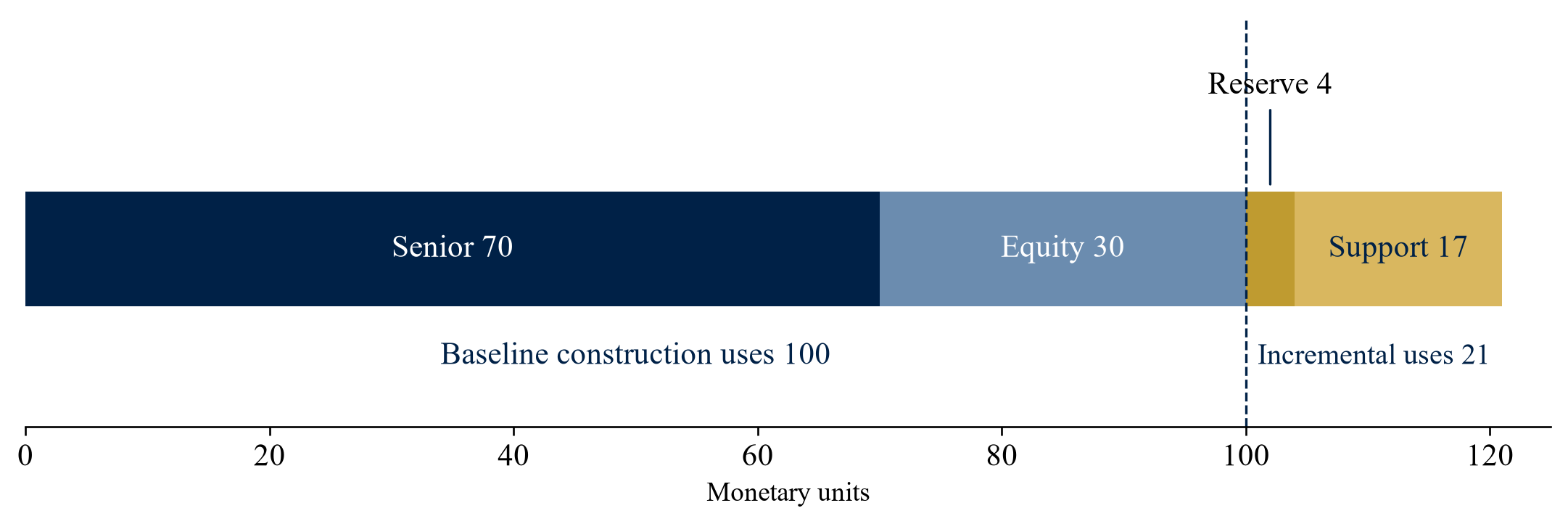
Author-developed illustration in monetary units. Baseline uses 100; selected incremental uses 21; reserve 4; additional support 17. The financing split and all availability assumptions are invented.
8 Calculate the cost and delay sensitivity matrix
Let i denote the selected price increase as a decimal and d the additional construction months. Incremental uses equal sixty multiplied by i, plus d. The extra contingent commitment equals the greater of zero and incremental uses less the reserve of four. These definitions permit direct reproduction without a proprietary model. A ten-percent increase and six-month delay add six and six respectively, giving incremental uses of twelve and extra support of eight. The calculation assumes the four-unit reserve can be used completely and on time.
The table reports extra support, leaving baseline finance unchanged. Zero extra commitment at a five-percent increase with no delay means the invented reserve covers the three-unit increase within this aggregate case. It says nothing about intra-period cash or documentary conditions. At a twenty-percent increase and nine-month delay, incremental uses are twenty-one and extra commitment is seventeen. These are deterministic boundary calculations over selected inputs. The endpoints have no statistical status and should not be described as an expected, probable or maximum possible market outcome.
The committee should keep the formula and inputs beside the result. Any change to the exposed amount, reserve or monthly expenditure should produce a new version of the matrix. If baseline funding also changes under stress, the calculation should include that separate reduction. If capital raises create additional fees or carry, those obligations need to feed back into uses. The simple subtraction remains appropriate only within its stated perimeter. The work product should therefore identify which rows of the detailed model it summarises and which real-world obligations remain outside it.
Table 1. Additional contingent commitment after the fictional four-unit reserve
| Delay months | Price 0% | Price 5% | Price 10% | Price 15% | Price 20% |
|---|---|---|---|---|---|
| 0 | 0 | 0 | 2 | 5 | 8 |
| 3 | 0 | 2 | 5 | 8 | 11 |
| 6 | 2 | 5 | 8 | 11 | 14 |
| 9 | 5 | 8 | 11 | 14 | 17 |
Author calculations: max(0, 60i + d - 4), in monetary units. Baseline uses and funding are both 100. No probability or observed GCC cost forecast is attached to the grid.
9 Interpret the grid before selecting a commitment
The matrix shows how the defined support requirement changes across the chosen cases. Within this invented formula, each five-percentage-point increase in price exposure adds three units of gross incremental expenditure. Each three-month delay also adds three. The reserve absorbs the earliest increments until it is exhausted. This creates the zero entries in the first part of the table. Once incremental uses exceed four, extra support increases one-for-one with additional modelled uses. Those relationships follow from the assumptions and describe no observed market sensitivity.
A committee can approve coverage of a named subset of the matrix and record what remains outside the approval. Choosing eight covers the aggregate ten-percent, six-month case and other cases requiring no more than eight, if their timing and eligibility match the assumptions. It leaves the twenty-percent, nine-month case short by nine. Selecting seventeen covers every aggregate cell shown. Neither choice establishes a confidence level. The investment discussion should specify why those scenarios were selected, who bears losses beyond them and when the decision must be reconsidered.
GASTAT's construction-cost methodology measures Saudi input-price movements across defined categories and a specified statistical base [8]. It offers measurement context for reviewing assumptions. A published national index needs to be mapped to the project's package mix, price dates and contractual exposure before it influences an estimate. The grid uses no latest index observation and no imported national growth rate. In a transaction application, the analyst should retain the index version, package weights and conversion method alongside supplier quotations. That permits technical review of the connection between the public series and the project's actual remaining cost.
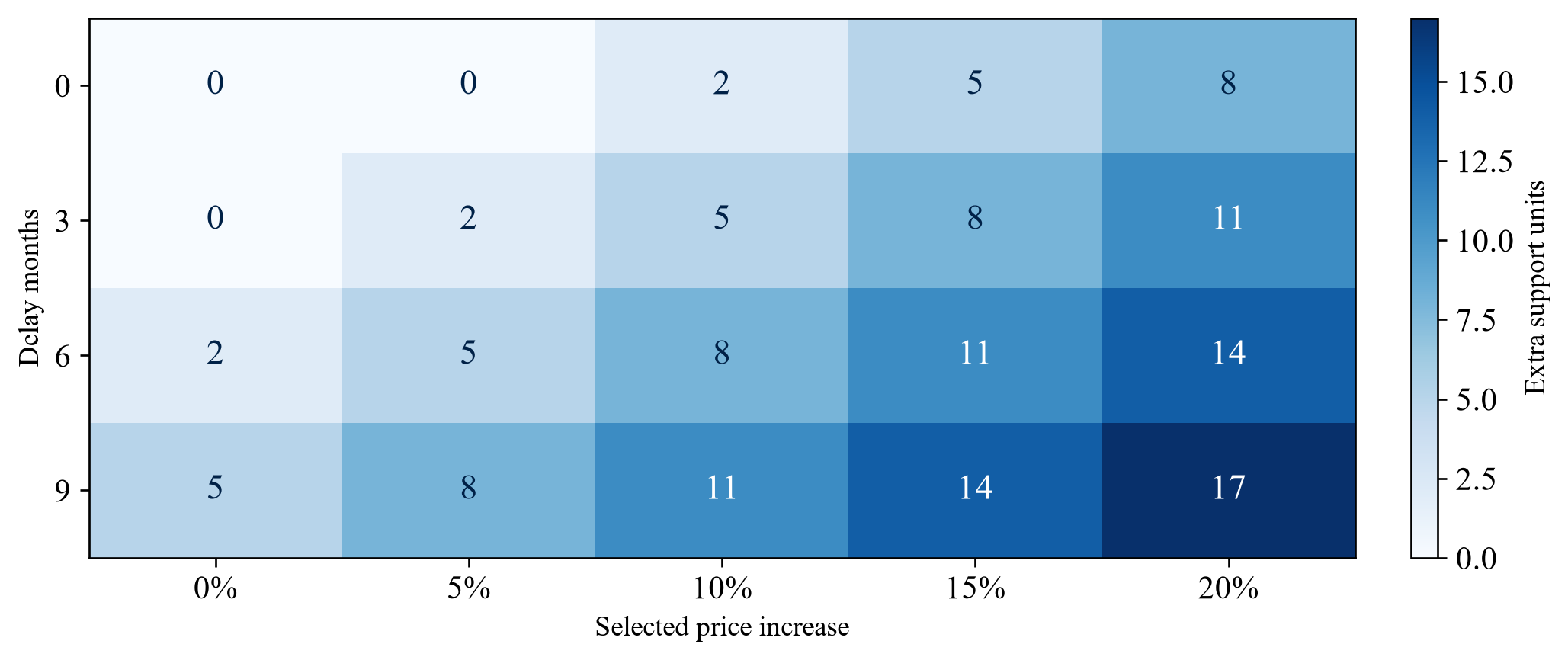
Author-developed heatmap reproducing Table 1 in monetary units. Colour indicates arithmetic size only; no risk rating, observed frequency or forecast confidence is represented.
10 Model each payment and receipt in event order
The second case isolates timing and remains separate from the stress matrix. It has incremental payments of three, four and six at months zero, two and four. Reserve cash of four is usable before the month-zero payment. A sales receipt of two becomes usable only after the month-four payment. There is no other receipt, expenditure or repayment. All events, permissions and quantities are hypothetical. The analyst orders reserve arrival, payment, subsequent payment and subsequent receipt individually; a month-end net number would conceal the largest payment-date requirement.
Without additional support, cash after the first payment is one. The month-two payment reduces the cumulative unsupported balance to minus three. The month-four payment reduces it to minus nine, before the later receipt brings it to minus seven. Total incremental payments are thirteen. Ultimate additional funding after reserve and sales cash is seven. Peak payment-date support is nine. The negative balances are analytical deficits rather than an assumption that an actual project can operate an unauthorised overdraft. They identify amounts that would need financing before the respective bills could be paid.
The nine includes the amount eventually absorbed by the net seven-unit requirement and the temporary effect of the later two-unit receipt. Adding seven and nine would count part of the requirement twice. The proposed sizing test asks what package meets every dated payment and survives the whole horizon, then records the closing position separately. If the support has repayment obligations, the model must add them at their actual dates. If sales money requires a further permission or reaches a restricted account, the usable receipt date should move accordingly. Its commercial sale date alone supplies insufficient payment evidence.
11 Test commitment expiry and draw policy
Assume a support commitment of nine is executable from month zero but its undrawn portion expires before the month-four payment. Previously drawn cash remains usable after expiry, and there are no fees, interest, repayment or restrictions in this separate fictional example. Under a just-in-time draw policy, the project calls three in month two to meet that payment. Six remains undrawn and expires. At month four, the project lacks six for the bill. The subsequent receipt of two leaves a residual unsupported requirement of four. Commitment amount alone therefore gives an incomplete description of this case.
Under permitted full prefunding, the project draws all nine before expiry. Together with the four-unit reserve, that gives thirteen of cash before the first payment. Cash after the respective payments is ten, six and zero; the later receipt produces a closing balance of two. Every payment is funded within this invented convention. The unused closing two is the temporary receipt-timing component of the original support need. It is not an economic gain or distributable cash assumption. An actual support facility's return, release and repayment conditions must govern what happens next.
The committee should compare prefunding, earlier calling of the remaining six, a verified expiry extension and alternative support with a longer availability period. The illustration grants the assumed draw rights and post-expiry cash permission solely for calculation. Actual documents may forbid advance drawing or require cash to stay in a restricted account. A renewal request also supplies no replacement capacity until it is executed. The support schedule should therefore show the last call date, settlement date, continuing use rights and responsible approval authority. Those fields make the available choices testable against the payment calendar.
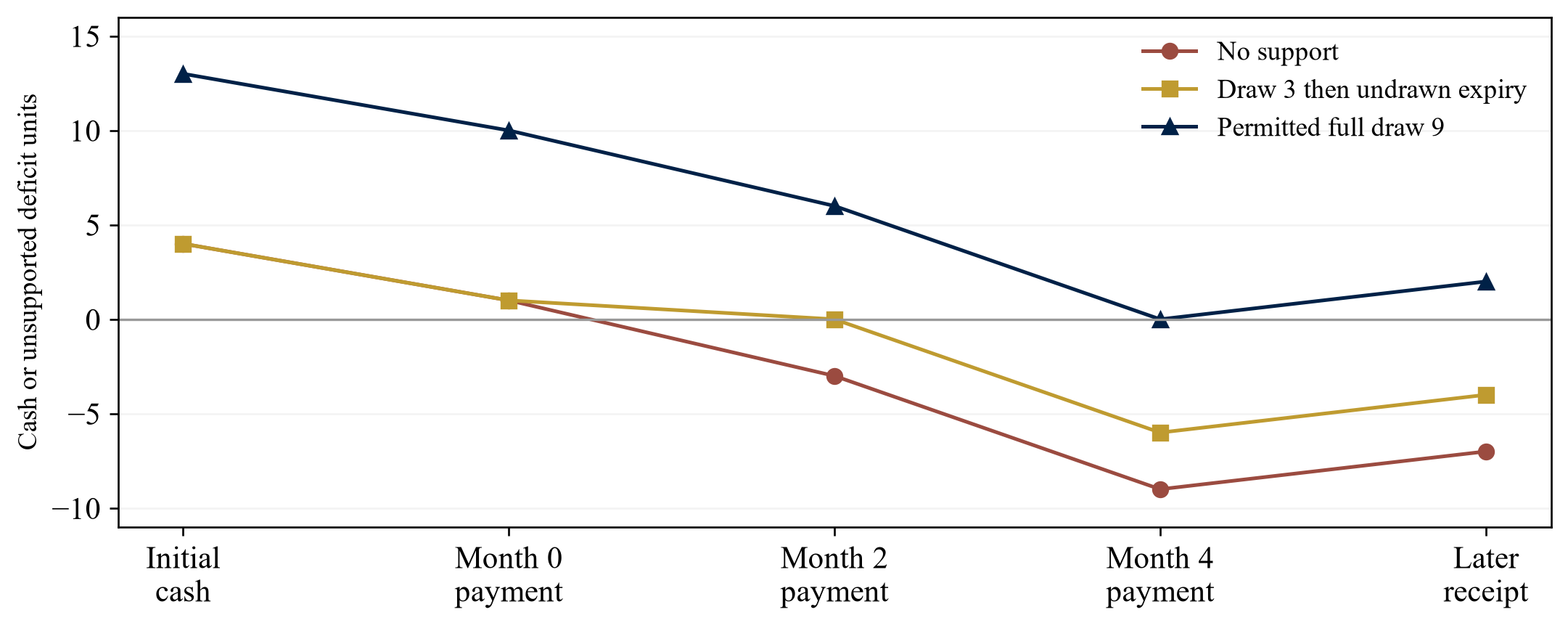
Reserve 4 precedes payments 3, 4 and 6. Sales cash 2 arrives after the last payment. Just-in-time support supplies 3 before expiry; full prefunding supplies 9. Negative lines show unsupported deficits, not authorised borrowing.
12 Document the support instrument and its conditions
Each proposed instrument should have a short availability record tied to the financing and corporate documents. The record needs the obligor, beneficiary, cap, permitted expenditure and remaining amount. It should explain how a call is made and what evidence accompanies it. Settlement lead time belongs beside the last call date, since a valid request can still produce money after a bill falls due. The proposed checklist also asks whether consent, subordination or an account instruction limits how the funds can be applied once received.
World Bank project-finance guidance discusses negotiated sponsor support, standby funding and contractual rights [3–4]. Its context is project-financed transactions and PPP arrangements. It supplies no standard GCC property commitment size or right to compel a shareholder contribution. The transaction team should read the actual support document and any intercreditor agreement together. A subordinated loan may have a different call process from an equity undertaking. A guarantee may cover a defined claim after other events rather than provide cash for the next construction certificate. Their names alone provide inadequate availability evidence.
The record should also identify amendment and renewal authority. A shareholder approval to consider additional funding should be recorded at its actual status. An executed commitment should be checked for competing obligations, enforceability and operational delivery by qualified reviewers. Changes in the sponsor's financial capacity should trigger a reassessment of reliability without automatically changing the legal meaning of the instrument. The committee then has two linked views: the amount contractually described and the amount assumed executable in the cash model. Any difference should be explained with the evidence and the planned remedy.
Table 2. Proposed bankability checklist for contingent capital
| Field | Evidence to inspect | Consequence for modelling |
|---|---|---|
| Amount and cap | Executed support and prior calls | Include remaining eligible amount only |
| Purpose and beneficiary | Account terms and legal entity | Match support to the actual obligation |
| Call conditions | Required certificates and approvals | Model the first executable call date |
| Delivery period | Settlement procedure and cutoffs | Include cash on its usable arrival date |
| Expiry and renewal | Operative expiry and executed extension | Exclude undrawn sums after expiry |
| Drawn cash use | Continuing account and use restrictions | Test prefunding permission separately |
| Competing calls | Sponsor portfolio and other support | Avoid allocating the same cash twice |
| Priority and repayment | Intercreditor and facility documents | Add permitted payments at their dates |
Author-developed diligence checklist. Each answer requires transaction evidence; the checklist establishes no financing entitlement or legal opinion.
13 Compare funded reserves and committed gap finance
A funded reserve gives the model an identifiable cash balance, subject to its account conditions. It also ties up capital before the adverse event occurs. An undrawn commitment preserves flexibility but introduces calling conditions, settlement timing and expiry. A transaction comparison should calculate both packages against the same dated obligations. The proposed analysis reports the financing charges and opportunity costs separately from the payment coverage result. Selecting a lower headline cost without checking the associated availability convention would leave the committee with an incomplete comparison.
Additional debt can create obligations that need further funding. Fees may fall due at signing or draw; interest may accrue on used amounts; principal can mature before the project generates usable sales cash. The examples exclude fees, interest and repayments associated with the additional support financing. The grid retains its separately specified 0.4 of fictional baseline financing carry per delay month. A real model should incorporate any further support obligations and repeat the sizing test. If extra financing changes the repayment or security position, the project may need consent from existing creditors. The World Bank discussion of intercreditor arrangements supplies context for negotiated priority and draw sequencing [4]; it establishes no permission to add financing to a particular project.
The committee should record the residual cases after each option. A reserve may cover payments within a fixed scope while leaving a prolonged delay unsupported. A commitment can cover that longer horizon only if its continuing availability is evidenced. Hybrid packages may combine a small initial reserve with committed equity or subordinated support. Their usefulness depends on the terms, the sponsor's capacity and the payment schedule. The paper proposes evaluating those conditions in a common cash model rather than assigning a generally superior structure. Pricing, enforceability and investor preferences require the actual mandate evidence.
14 Allocate sponsor capital across competing projects
A sponsor with several developments needs a portfolio view of support calls. A cash balance available to one project may also appear in another project's proposed contingency package. The proposed capital ledger records those allocations and tests whether the same adverse conditions could trigger several calls. Construction-input shocks, contractor exposure and common financing counterparties are possible analytical links to investigate. This paper supplies no estimated correlation or frequency. The committee should document the chosen joint scenario and the evidence behind it before concluding that a shared reserve provides adequate support.
An executable project plan may require explicit allocation priorities or separately funded accounts. The financing adviser should identify whether a support undertaking obliges the sponsor to contribute independently of performance elsewhere. The treasury team should show the assets available for settlement, any sale or transfer lead times and restrictions on those assets. A group net-worth figure does not directly establish payment-date liquidity. The proposed review retains both solvency information and a dated funding plan, with the professional assessments required for their interpretation. Its purpose is a traceable account of capacity and competing demands.
The illustrative reserve of four and additional commitment of seventeen belong exclusively to the single fictional project. They cannot also cover another development in the same calculation. A portfolio application should replace that simple convention with a resource-allocation problem using evidenced project requirements. It should report the projects left unsupported under each joint case and the time needed to raise additional money. Management can then consider rephasing expenditure, reducing optional scope or negotiating new support. None of those actions should be treated as available until its authority, commercial feasibility and financial effect are confirmed.
15 Connect contingent support to valuation and completion choice
A funding shortfall raises an investment question about the cost of continuing and the alternatives available at the decision date. The committee should compare the incremental capital required with a properly assessed completion value and the consequences of stopping or changing the project. The comparison needs a defined valuation basis, timing, transaction costs and legal perimeter. This paper does not assume that every cost increase can be recovered through selling prices or that completing the original design is always commercially preferable. Those conclusions require project and market evidence.
RICS's development-property professional standard addresses development assumptions, risk, sensitivity and property in progress [1]. It provides an authoritative valuation context, read with the applicable professional standards. The contingency model here supplies no professional market valuation and no mechanical relationship between an overrun and a value reduction. The analyst should keep the technical cost estimate, financing forecast and valuation opinion separate while reconciling their assumptions. A change in completion date should appear consistently in each relevant schedule. An independently assessed change in value may also affect financing capacity and the committee's alternatives.
The proposed decision record includes the additional cash approved, the uses it funds and the conditions for reconsideration. If a revised design reduces expenditure, the technical reviewer should explain its impact on delivery, approvals and saleable product. If asset disposal is proposed, the model needs expected net receipts, documentary permission and a credible timing basis. The paper provides no observed recovery value for either route. The committee should retain the alternative cases and their unresolved evidence so that the support decision can be reviewed as new information arrives. The capital package then remains linked to a specified completion strategy.
16 Assess contractual recovery without assuming its collection
Contracts can allocate consequences of changes, late completion, defects or other events, subject to their actual terms and applicable law. The financing forecast should record the event, contractual route, claim status and expected usable cash date. A proposed claim against a contractor is different from an agreed and collectible amount. A performance guarantee has its own beneficiary, call requirements, scope and expiry. The paper recommends qualified legal and technical review before including a recovery in the executable support plan. It establishes no entitlement to damages for a particular delay.
The cost forecast should show gross expenditure and recovery separately. Netting a disputed claim directly against the next bill can hide the money needed to keep construction moving. Even an agreed reimbursement may arrive after the contractor, consultant or supplier must be paid. The second fictional example illustrates this general timing arithmetic with a later sales receipt; it does not quantify a contractual recovery. A real claim schedule should use its own dated events. The committee should also account for any costs needed to pursue the claim and relevant financing restrictions.
Contract amendments can change both cost exposure and funding conditions. A revised specification may settle one issue while introducing a different approval or procurement requirement. The proposed workflow preserves the previous model and records the amendment's cash consequences before adopting a new baseline. It should explain whether contingent support can fund the amended obligation and whether creditors or account administrators need to consent. That evidence can support a controlled commercial negotiation. The analysis gives no assurance that contractual allocation removes the project's need to finance expenditure while a recovery is pending or contested.
17 Apply location specific account and approval evidence
A GCC-wide title requires a disciplined geographic boundary. Public materials for one emirate or country should remain attached to that jurisdiction and the particular service they describe. The proposed project pack includes a local account-and-approval schedule prepared with appropriate advisers. It names the registration, financing, account and payment instructions relevant to the actual development. It also records where evidence is incomplete. Requirements should be verified as of the transaction's decision date, especially when a proposed reserve or support structure depends on a specific release route.
The DLD materials cited here distinguish an escrow activation route from mortgage-deposit and financing-settlement conditions [5–6]. Their relevance is the need to test administrative approval and permitted funding together with the loan documents. ADREC's project-development page separately describes Abu Dhabi registration, escrow and milestone-related processes [7]. These sources supply operating context, with no opinion on an unseen project's eligibility. The paper intentionally does not combine their numerical conditions into one universal rule. The implementation team should obtain the operative requirements and project approvals applicable to the transaction.
Saudi construction-price measurement likewise remains a Saudi source [8]. It may inform an analyst's assessment of relevant packages after appropriate mapping, but it cannot automatically price work in Dubai, Abu Dhabi or another GCC market. Currency, supplier terms, logistics, labour and procurement dates need separate evidence. For locations beyond the public materials reviewed here, the paper proposes the same diligence questions while providing no verified local legal answer. The financing model should expose the difference between a general analytical method and the jurisdiction-specific permissions required to move and spend actual money.
18 Distinguish scenario coverage from probability
The grid answers what capital is required under selected inputs. It does not establish the likelihood of those inputs occurring or the probability that an approved package proves sufficient. A statistical confidence claim requires a defined population, comparable cost and schedule histories, a defensible joint distribution and appropriate validation. This paper has none of those empirical inputs. The committee can still use deterministic stresses as named decision cases. The approval should describe them as selected boundaries and state the cases outside the commitment, together with the authority for revisiting the decision.
A probabilistic extension would need to handle dependency between cost, procurement, construction and receipts. Treating every driver as independent could give a misleading aggregate distribution where common events affect several packages. Conversely, assuming all adverse drivers occur together may create a deliberate severe scenario with no claimed occurrence rate. Both choices require explanation. The proposed study would retain the individual assumptions and compare model results with consented outcomes. It should assess out-of-sample performance and record the limitations of any small, selected transaction dataset before assigning confidence to a capital number.
The present formula is intentionally simpler. It has no random draws, fitted parameters or simulation percentiles. Its largest extra-support entry of seventeen is the largest within the displayed grid. Events beyond twenty-percent exposed-cost inflation or nine months of delay are outside that grid, while new scope and many real financing obligations are outside the model perimeter. Those exclusions should remain visible when the result reaches an investment committee. Naming the uncovered cases provides a practical basis for setting review triggers, discussing additional sponsor capacity and assessing whether the development strategy remains financeable.
19 Establish the review and response procedure
The proposed review begins by reconciling actual expenditure and cash with the approved version. The technical team then revises remaining cost and critical dates, while treasury confirms usable resources and their conditions. The financing adviser calculates the updated payment deficits and expiry exposure. The responsible committee considers the proposed support or revised completion strategy with the necessary legal and technical advice. This sequence assigns evidence and decision authority without assuming that a dashboard alert itself authorises a draw, contract amendment or transfer between entities.
The response record should state the payment at risk, available remedy, latest action date and unresolved dependency. A commitment extension needs an executed amendment and any related approvals. A new sponsor contribution needs an evidenced amount and transfer route. A rephasing plan needs the contractual and technical basis for moving payments. The model should run each action at its actual cash date. It should retain the original shortfall as a comparison, making the contribution of the proposed action explicit. Management can then verify whether the remedy addresses the particular modelled obligation.
The timing illustration suggests a useful review date before support expiry, with enough lead time for settlement and approvals. No universal number of days is prescribed. A transaction team should calculate the deadline from the instrument and payment process. If that deadline passes without a completed remedy, the forecast should remove the expired capacity and report the remaining unsupported bills. The record should also distinguish a temporary payment gap from the ultimate net requirement. This supports a specific financing discussion while preserving the facts needed for subsequent accountability and assessment.
Table 3. Proposed evidence and response record
| Observation | Required reconciliation | Decision record |
|---|---|---|
| Revised package estimate | Scope prices and existing allowance | Updated cost and support amount |
| Construction date changes | Critical path and affected receipts | Revised payment and availability dates |
| Support expiry approaches | Last call settlement and use rights | Prefund renew or obtain other support |
| Reserve becomes restricted | Account purpose and approval | Remove unavailable payment capacity |
| Sponsor faces another call | Portfolio allocations and liquidity | Reassess project-specific support |
| Recovery remains uncertain | Claim status and collection date | Keep executable and opportunity cases separate |
Author-developed operating checklist. Actions require the actual authorised parties and executed documents; no standard regulatory trigger or automatic remedy is asserted.
20 Use data and AI with an auditable calculation layer
A permissioned document system could help organise contracts, certificates, estimates and support amendments for review. The proposed architecture attaches every extracted amount or date to its source document and version. A deterministic calculation layer then computes cumulative cash and support requirements from approved inputs. A language model may assist retrieval or explanation, subject to evaluation and qualified review. This paper reports no deployed system, measured extraction accuracy or verified reduction in processing time. Any claim of commercial benefit would need a controlled comparison using authorised transaction data.
The test set should include amendments that change expiry, similar amounts with different permitted purposes and dates that refer to reporting rather than payment. It should also include cases in which a document fails to establish availability. The proposed system should preserve that unresolved status instead of completing a missing term with a plausible value. Human reviewers need a way to correct extracted fields and inspect the downstream calculation. The change history should record the source, authorisation and effect on the support decision. Access controls and confidentiality need to match the documents and parties involved.
NIST's AI Risk Management Framework provides voluntary risk-management context for the design and evaluation of AI-enabled systems [12]. It is not a certificate of accuracy for the proposed tool. The paper recommends testing document handling, arithmetic, version control and escalation separately. Deterministic model results should be reproduced independently before they enter the committee pack. The system should also distinguish a mathematical deficit from an available legal remedy. A retrieved clause may identify an issue for professional review; it does not give software authority to call capital, approve a payment or determine an actual project's legal status.
21 Design an empirical study of contingent capital performance
A future study could assess the proposed method using consented development histories. The observation unit should be a dated support decision with the information available at that time. The dataset would need original and revised cost forecasts, payment certificates, account balances, release approvals, support terms and actual settlement events. It should preserve projects that encountered difficulty as well as those completed, with explicit inclusion criteria. A collection composed only of successful published case studies would provide an incomplete basis for assessing the adequacy of a contingency framework.
The study could compare the original approved support package with reconstructed payment-date requirements. Outcomes might include unsupported payment days, expired undrawn capacity and differences between predicted and actual remaining cost. Such measures need consistent definitions, treatment of scope changes and a clear distinction between unavailable evidence and zero values. The research should examine whether a revised forecast used information that was unavailable to the original decision maker. A later accurate estimate cannot establish that an earlier package was poorly selected if the relevant event could not have been known then.
Any result should report sample size, location, project type, contract mix and selection limits. Financing terms and account permissions may differ enough to prevent pooling without adjustment. A study of the effect of earlier review would also need to distinguish association from causation and account for actions taken in response to the warning. This paper provides the definitions needed to frame such an investigation but supplies no dataset or empirical estimate. Its worked numbers remain hypothetical examples. The proposed next research step is validation against authorised evidence before making claims about predictive or commercial performance.
22 Conclude with a bounded capital approval
The paper proposes approving contingent capital as a dated, conditional package for a defined completion strategy. In the aggregate illustration, additional support equals the incremental price and delay expenditure less the usable reserve, floored at zero. The largest selected case requires seventeen beyond the reserve of four. In the separate timing case, peak support of nine exceeds ultimate additional funding of seven because two arrives after the final bill. These findings follow exactly from invented inputs and supply no observed GCC benchmark. Their role is to make the approval logic reproducible.
The expiry example adds a distinct requirement. Drawing only three before the remaining six expires leaves the later payment unsupported by six, with four still unsupported after the receipt. Permitted full prefunding of nine supplies every selected payment and leaves two before any repayment obligation. Those statements depend on the deliberately assumed calling and use rights. Actual instruments need their conditions, fees, repayment, renewal and account permissions modelled. The committee should approve the supported cases and dates expressly, preserve the uncovered cases and assign responsibility for reassessment before any relevant deadline.
The practical conclusion is a specific diligence sequence: establish remaining obligations, map executable sources, test selected cost and delay cases, order payments and receipts, and review expiry with enough time to act. Professional valuation, legal, accounting and technical assessments remain necessary for a transaction. A reserve percentage or facility headline cannot establish sufficient dated capital on its own. The proposed framework provides a transparent basis for negotiations and a testable record of the decision. Further claims about completion probability, reduced financing cost or improved outcomes require empirical evidence that this paper does not provide.
References
- Royal Institution of Chartered Surveyors. Valuation of development property, global professional standard, first edition October 2019, effective 1 February 2020; reissued April 2023; development risk, sensitivity and property-in-progress context. Reviewed 8 October 2026. https://www.rics.org/content/dam/ricsglobal/documents/to-be-sorted/Valuation%20of%20development%20property_ready%20for%20approvals.pdf
- Royal Institution of Chartered Surveyors. NRM 1: Order of cost estimating and cost planning for capital building works, third edition UK, October 2021, effective 1 December 2021; reissued October 2022 as practice information; sections 2.15–2.16 and 3.18–3.19. Reviewed 8 October 2026. https://www.rics.org/content/dam/ricsglobal/documents/standards/NRM-1_Oct2022_Update.pdf
- World Bank Public-Private Partnership Resource Center. Key Issues in Developing Project Financed Transactions, undated public guidance on negotiated financing and support; PPP context, not verified GCC property terms. Accessed 8 October 2026. https://ppp.worldbank.org/financing/issues-in-project-financed-transactions
- World Bank Public-Private Partnership Resource Center. Intercreditor Arrangements, undated public guidance on equity timing, contingent support and funding priority. No illustrative percentage is adopted as a GCC requirement. Accessed 8 October 2026. https://ppp.worldbank.org/intercreditor-arrangements
- Dubai Land Department. Escrow Account activation, official administrative service description and application conditions. Actual project approval and payment permission require confirmation. Accessed 8 October 2026. https://dubailand.gov.ae/en/eservices/request-to-activate-an-escrow-account/
- Dubai Land Department. Depositing a mortgage into an escrow account application, official service with separate financing-deposit and financing-settlement conditions. Conditions remain attached to this service. Accessed 8 October 2026. https://dubailand.gov.ae/en/eservices/request-for-mortgage-payment-in-escrow-account/
- Abu Dhabi Real Estate Centre. Project Development, official operating context on registration, escrow and construction milestones; operative requirements and individual eligibility require confirmation. Accessed 8 October 2026. https://adrec.gov.ae/en/sectors/regulatory-services/project-development
- General Authority for Statistics, Saudi Arabia. Methodology and Quality Report for the Construction Cost Index Statistics, version 4.1, methodology update 23 July 2026. Official indexed text reviewed 8 October 2026; direct opening returned an access error. No latest index value or project-specific forecast used. https://www.stats.gov.sa/en/w/methodology-and-quality-report-for-the-construction-cost-index-cci-statistics-4.1
- U.S. Government Accountability Office. Cost Estimating and Assessment Guide: Best Practices for Developing and Managing Program Costs, GAO-20-195G, 12 March 2020. Public estimation-method context, not GCC law. Accessed 8 October 2026. https://www.gao.gov/products/gao-20-195g
- U.S. Government Accountability Office. Schedule Assessment Guide: Best Practices for Project Schedules, GAO-16-89G, December 2015. Public scheduling-method context, not a forecast for any project. Accessed 8 October 2026. https://www.gao.gov/products/gao-16-89g
- IFRS Interpretations Committee. Demand Deposits with Restrictions on Use arising from a Contract with a Third Party, IAS 7 agenda decision, April 2022, presentation references updated January 2026. Accounting scope is separate from actual payment permission. Accessed 8 October 2026. https://www.ifrs.org/content/dam/ifrs/supporting-implementation/agenda-decisions/2026/demand-deposits-with-restrictions-on-use-jan-26.pdf
- National Institute of Standards and Technology. Artificial Intelligence Risk Management Framework, voluntary framework and official resource page; proposed-system evaluation context. Accessed 8 October 2026. https://www.nist.gov/itl/ai-risk-management-framework
About the Author
Chennakeshav (CK) is a corporate finance and investment banking executive with 25+ years of global experience in deal origination, structuring and execution across M&A, growth capital and corporate strategy. He has led value-creation mandates for founders, corporates and funds — bridging the boardroom view to hands-on execution and close.
His career spans Morgan Stanley, HSBC, Lloyds Banking Group, EWEC, ADQ portfolio companies and Emirates Growth Fund, across TMT, real estate, fintech, deeptech, cleantech, infrastructure and energy. He has partnered with C-suite leaders, private equity and venture funds, sovereign wealth funds and family offices to finance complex fund raises and scale-up ventures, and has led M&A due diligence, post-merger integration and business-transformation initiatives to create value.
At Matchpoint Partners he is Managing Partner, leading the firm's corporate finance, M&A and capital-raising practice. He holds an MBA from London Business School, an engineering degree from VTU and a Master of Laws (LLM, in progress) from UCL London.
An active start-up mentor, CK mentors at Techstars, DIFC FinTech Hive, Startup Grind, Founder Institute and IN5, serves as Entrepreneur Mentor in Residence (EMiR) at London Business School, and judges the Entrepreneurship World Cup.
