

1. Define the step-in decision
A lender step-in regime gives secured creditors time and authority to protect an operating project when default threatens the project agreement or essential service. The transaction question is whether cure, temporary control, substitution or permanent transfer can restore performance before termination destroys the contracted revenue stream.
The working file should reconcile the project agreement, direct agreement, financing, security, permits and critical subcontracts. Each conclusion should identify the governing clause, responsible party and decision deadline.
A practical review asks what must be cured, who can lawfully act, how essential service continues, what capital is committed and which outcome produces the strongest risk-adjusted recovery.
2. Treat step-in as a defensive mechanism
Project lenders commonly prefer a performing asset to enforcement and sale. Step-in is therefore designed to preserve the project, cure default and protect debt value. It should not give lenders a general right to manage the asset while the project company performs.
The assessment should distinguish legal entitlement, operational feasibility and financial capacity. Purchaser, lenders and advisers should use the same default chronology and performance evidence.
The parties should translate the issue into a dated intervention plan with named owners, dependencies and evidence. Extensions should follow demonstrated progress rather than an open-ended standstill.
3. Put continuity of service first
Power and water assets provide essential services whose interruption can harm households, industry, public health and the wider economy. The direct agreement should keep service, safety, environmental compliance and lawful dispatch or production at the centre of every intervention.
The decision should be documented before rights expire or service deteriorates. Conditions should address notice, access, interim performance, funding, liability, approvals and reporting.
The governing objective is a credible rescue that preserves public service and lender value. A right that cannot be exercised under the full contract and regulatory chain does not support bankability.
4. Separate lender and authority intervention
Lender step-in responds to project-company default and threatened termination. Authority step-in commonly responds to emergency, health, safety, national-security or statutory duties. The contract must distinguish triggers, control, cost, liability and sequencing for these different interventions.
The working file should reconcile the project agreement, direct agreement, financing, security, permits and critical subcontracts. Each conclusion should identify the governing clause, responsible party and decision deadline.
A practical review asks what must be cured, who can lawfully act, how essential service continues, what capital is committed and which outcome produces the strongest risk-adjusted recovery.
5. Map the project contract chain
The offtake agreement, direct agreement, financing, security, EPC, O&M, land, grid, fuel, permits, insurance and government support form one rescue system. A right in the primary agreement is ineffective if another critical contract can terminate first.
The assessment should distinguish legal entitlement, operational feasibility and financial capacity. Purchaser, lenders and advisers should use the same default chronology and performance evidence.
The parties should translate the issue into a dated intervention plan with named owners, dependencies and evidence. Extensions should follow demonstrated progress rather than an open-ended standstill.
Table 1. Intervention level, trigger and completion test
| Intervention level | Typical trigger | Lender action | Purchaser protection | Completion test |
|---|---|---|---|---|
| Notice and monitoring | Early deterioration or financing default | Review information; engage project company | No transfer of control; service obligations continue | Agreed recovery plan and reporting |
| Monetary cure | Overdue payment or reserve deficiency | Pay amount or replenish account | Historic breach remains recorded | Amount cleared and underlying cause addressed |
| Non-monetary cure | Performance, contractor or permit breach | Fund and supervise remedial plan | Milestones, deductions and safety controls | Demonstrated compliant performance |
| Temporary step-in | Threatened termination or material continuing default | Appoint qualified nominee and assume performance | Accountability, access and time limit | Cure, substitution or orderly step-out |
| Permanent substitution | Existing project company cannot recover | Transfer or novate to approved substitute | Qualification and original risk allocation preserved | All contracts, permits and finance effective |
The sequence is illustrative and must be adapted to the executed contracts, applicable law and urgency of essential service.
6. Define the relevant default
The regime should identify defaults that require lender notice and suspension of termination. These can include payment failure, repeated performance deductions, delayed completion, insolvency, abandonment, permit failure and breach of essential environmental or safety obligations.
The decision should be documented before rights expire or service deteriorates. Conditions should address notice, access, interim performance, funding, liability, approvals and reporting.
The governing objective is a credible rescue that preserves public service and lender value. A right that cannot be exercised under the full contract and regulatory chain does not support bankability.
7. Set the notice standard
The purchaser should give the security trustee or agent the same default notice delivered to the project company, with enough detail to assess entitlement, cure and urgency. Notice mechanics should include address, delivery, deemed receipt and changes to the lender contact.
The working file should reconcile the project agreement, direct agreement, financing, security, permits and critical subcontracts. Each conclusion should identify the governing clause, responsible party and decision deadline.
A practical review asks what must be cured, who can lawfully act, how essential service continues, what capital is committed and which outcome produces the strongest risk-adjusted recovery.
8. Create an early-warning channel
Formal termination notice may arrive too late for an orderly rescue. Periodic performance, covenant, reserve, insurance and dispute reporting can identify deterioration earlier. The direct agreement should permit structured lender engagement without transferring day-to-day management.
The assessment should distinguish legal entitlement, operational feasibility and financial capacity. Purchaser, lenders and advisers should use the same default chronology and performance evidence.
The parties should translate the issue into a dated intervention plan with named owners, dependencies and evidence. Extensions should follow demonstrated progress rather than an open-ended standstill.
9. Coordinate financing acceleration
A financing default can occur before a project-agreement default. Lenders may accelerate debt or enforce security while the purchaser still sees a performing contractor. Intercreditor and direct-agreement rules should prevent an uncoordinated enforcement action from disrupting service.
The decision should be documented before rights expire or service deteriorates. Conditions should address notice, access, interim performance, funding, liability, approvals and reporting.
The governing objective is a credible rescue that preserves public service and lender value. A right that cannot be exercised under the full contract and regulatory chain does not support bankability.
10. Suspend termination for a decision period
After a qualifying notice, the purchaser should suspend termination for a defined period while lenders investigate. The period should be long enough for diligence and approvals, with shorter controls for urgent safety or service failures.
The working file should reconcile the project agreement, direct agreement, financing, security, permits and critical subcontracts. Each conclusion should identify the governing clause, responsible party and decision deadline.
A practical review asks what must be cured, who can lawfully act, how essential service continues, what capital is committed and which outcome produces the strongest risk-adjusted recovery.
11. Design the monetary cure right
Payment defaults may be cured by paying overdue amounts, replenishing reserves or funding required work. The contract should state which sums can be cured, whether interest or deductions continue, and how a payment affects the underlying breach.
The assessment should distinguish legal entitlement, operational feasibility and financial capacity. Purchaser, lenders and advisers should use the same default chronology and performance evidence.
The parties should translate the issue into a dated intervention plan with named owners, dependencies and evidence. Extensions should follow demonstrated progress rather than an open-ended standstill.
12. Design the non-monetary cure right
Performance failures may require engineering, management or contractor changes that cannot be completed immediately. A credible cure plan should identify actions, milestones, funding and interim service, with extension only while diligent progress continues.
The decision should be documented before rights expire or service deteriorates. Conditions should address notice, access, interim performance, funding, liability, approvals and reporting.
The governing objective is a credible rescue that preserves public service and lender value. A right that cannot be exercised under the full contract and regulatory chain does not support bankability.
13. Address persistent underperformance
Repeated availability or output failures can erode confidence even when each event is technically remediable. The regime should define cumulative default, root-cause review and the conditions under which management or contractor replacement becomes necessary.
The working file should reconcile the project agreement, direct agreement, financing, security, permits and critical subcontracts. Each conclusion should identify the governing clause, responsible party and decision deadline.
A practical review asks what must be cured, who can lawfully act, how essential service continues, what capital is committed and which outcome produces the strongest risk-adjusted recovery.
14. Address project-company insolvency
Insolvency may trigger immediate statutory consequences and restrict contractual control. The parties should test whether step-in, share enforcement, substitution and permit continuity survive formal proceedings under applicable law.
The assessment should distinguish legal entitlement, operational feasibility and financial capacity. Purchaser, lenders and advisers should use the same default chronology and performance evidence.
The parties should translate the issue into a dated intervention plan with named owners, dependencies and evidence. Extensions should follow demonstrated progress rather than an open-ended standstill.
15. Address subcontractor failure
EPC or O&M failure can threaten the project company even where sponsors and lenders remain solvent. Direct agreements with critical contractors should provide notice, cure, standstill, access to warranties and a route to replacement.
The decision should be documented before rights expire or service deteriorates. Conditions should address notice, access, interim performance, funding, liability, approvals and reporting.
The governing objective is a credible rescue that preserves public service and lender value. A right that cannot be exercised under the full contract and regulatory chain does not support bankability.
16. Address cyber and control-system failure
A cyber incident can interrupt dispatch, treatment, billing or remote control. The intervention plan should preserve incident command, regulator reporting, evidence, operational technology safety and controlled access by any lender-appointed operator.
The working file should reconcile the project agreement, direct agreement, financing, security, permits and critical subcontracts. Each conclusion should identify the governing clause, responsible party and decision deadline.
A practical review asks what must be cured, who can lawfully act, how essential service continues, what capital is committed and which outcome produces the strongest risk-adjusted recovery.
17. Address health and environmental emergencies
An urgent risk to people, water quality or the environment may justify immediate authority action. Emergency intervention should coexist with lender rights, record cost and responsibility, and return control when the emergency ends.
The assessment should distinguish legal entitlement, operational feasibility and financial capacity. Purchaser, lenders and advisers should use the same default chronology and performance evidence.
The parties should translate the issue into a dated intervention plan with named owners, dependencies and evidence. Extensions should follow demonstrated progress rather than an open-ended standstill.
18. Design construction-period step-in
Before completion, the rescue depends on remaining cost, schedule, contractor claims, permits and performance security. Lenders need access, design rights and replacement mechanics; the purchaser needs a credible completion plan and continued sponsor support where agreed.
The decision should be documented before rights expire or service deteriorates. Conditions should address notice, access, interim performance, funding, liability, approvals and reporting.
The governing objective is a credible rescue that preserves public service and lender value. A right that cannot be exercised under the full contract and regulatory chain does not support bankability.
19. Design operating-period step-in
During operations, the rescue focuses on service, maintenance, staffing, suppliers, working capital and regulatory compliance. An operating nominee should demonstrate capability and preserve lifecycle expenditure rather than pursue a short-term cash extraction.
The working file should reconcile the project agreement, direct agreement, financing, security, permits and critical subcontracts. Each conclusion should identify the governing clause, responsible party and decision deadline.
A practical review asks what must be cured, who can lawfully act, how essential service continues, what capital is committed and which outcome produces the strongest risk-adjusted recovery.
20. Make the direct agreement operative
The direct agreement should bind the purchaser, project company and finance parties and override inconsistent termination timing where law permits. It should cover notice, cure, step-in, substitution, liability, step-out, information and dispute resolution.
The assessment should distinguish legal entitlement, operational feasibility and financial capacity. Purchaser, lenders and advisers should use the same default chronology and performance evidence.
The parties should translate the issue into a dated intervention plan with named owners, dependencies and evidence. Extensions should follow demonstrated progress rather than an open-ended standstill.
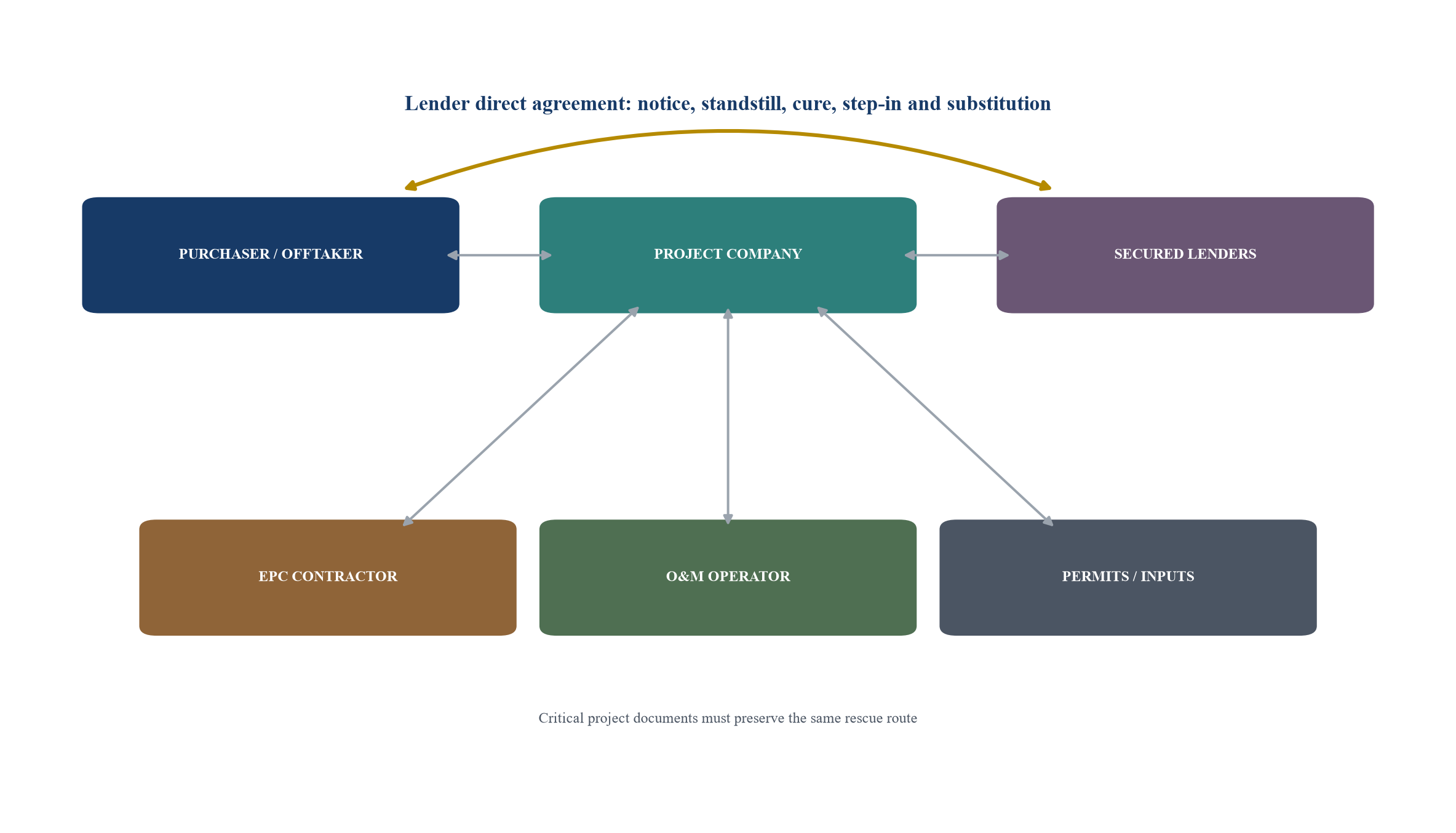
The structure is generic; transaction-specific rights require review of executed documents and applicable law.
21. Identify the lender representative
The security trustee, facility agent or designated representative should receive notices and exercise rights for the finance parties. The purchaser should deal with one authorised decision point and rely on verified appointment and signing authority.
The decision should be documented before rights expire or service deteriorates. Conditions should address notice, access, interim performance, funding, liability, approvals and reporting.
The governing objective is a credible rescue that preserves public service and lender value. A right that cannot be exercised under the full contract and regulatory chain does not support bankability.
22. Use a qualified nominee
Lenders rarely operate a utility themselves. A nominee can assume contractual performance during step-in. The nominee should have authority, resources, insurance, technical competence and access to project personnel, data and sites.
The working file should reconcile the project agreement, direct agreement, financing, security, permits and critical subcontracts. Each conclusion should identify the governing clause, responsible party and decision deadline.
A practical review asks what must be cured, who can lawfully act, how essential service continues, what capital is committed and which outcome produces the strongest risk-adjusted recovery.
23. Set substitute-entity criteria
A permanent substitute should meet objective technical, financial, legal, integrity and ownership requirements. Criteria should be disclosed in advance and approval should not be unreasonably delayed or withheld, subject to essential public-interest controls.
The assessment should distinguish legal entitlement, operational feasibility and financial capacity. Purchaser, lenders and advisers should use the same default chronology and performance evidence.
The parties should translate the issue into a dated intervention plan with named owners, dependencies and evidence. Extensions should follow demonstrated progress rather than an open-ended standstill.
24. Control purchaser consent
Consent protects the purchaser from an unsuitable operator or ownership structure. The direct agreement should define the information required, review period, permitted grounds for refusal and deemed or escalated outcomes where the decision is delayed.
The decision should be documented before rights expire or service deteriorates. Conditions should address notice, access, interim performance, funding, liability, approvals and reporting.
The governing objective is a credible rescue that preserves public service and lender value. A right that cannot be exercised under the full contract and regulatory chain does not support bankability.
25. Preserve licences and permits
A project rescue can fail if licences, land rights, grid access or environmental approvals cannot transfer. The legal diligence should identify consent, reissuance and continuing-compliance requirements before financial close.
The working file should reconcile the project agreement, direct agreement, financing, security, permits and critical subcontracts. Each conclusion should identify the governing clause, responsible party and decision deadline.
A practical review asks what must be cured, who can lawfully act, how essential service continues, what capital is committed and which outcome produces the strongest risk-adjusted recovery.
26. Preserve land and asset access
The nominee or substitute needs lawful access to the site, records, spares, control rooms and project assets. Land, lease and easement documents should acknowledge approved step-in and avoid automatic termination on enforcement.
The assessment should distinguish legal entitlement, operational feasibility and financial capacity. Purchaser, lenders and advisers should use the same default chronology and performance evidence.
The parties should translate the issue into a dated intervention plan with named owners, dependencies and evidence. Extensions should follow demonstrated progress rather than an open-ended standstill.
27. Coordinate security enforcement
Security over shares, accounts, receivables and project rights supports lender control. Enforcement must remain consistent with public-asset restrictions, foreign-ownership rules, procurement law and the direct agreement.
The decision should be documented before rights expire or service deteriorates. Conditions should address notice, access, interim performance, funding, liability, approvals and reporting.
The governing objective is a credible rescue that preserves public service and lender value. A right that cannot be exercised under the full contract and regulatory chain does not support bankability.
28. Coordinate share enforcement
Share security can permit replacement of the project-company owner without assigning the project agreement. Change-of-control consent, qualification tests and beneficial-ownership disclosure should align with this route.
The working file should reconcile the project agreement, direct agreement, financing, security, permits and critical subcontracts. Each conclusion should identify the governing clause, responsible party and decision deadline.
A practical review asks what must be cured, who can lawfully act, how essential service continues, what capital is committed and which outcome produces the strongest risk-adjusted recovery.
29. Coordinate assignment and novation
Temporary step-in can preserve the existing project company; permanent substitution may require assignment or novation. The documents should specify which obligations, liabilities, guarantees and accrued rights transfer.
The assessment should distinguish legal entitlement, operational feasibility and financial capacity. Purchaser, lenders and advisers should use the same default chronology and performance evidence.
The parties should translate the issue into a dated intervention plan with named owners, dependencies and evidence. Extensions should follow demonstrated progress rather than an open-ended standstill.
30. Test procurement-law compatibility
A substitute chosen after default may constitute a material contract change in some jurisdictions. The procurement analysis should establish the statutory basis, limits and approvals for lender substitution before bids are invited.
The decision should be documented before rights expire or service deteriorates. Conditions should address notice, access, interim performance, funding, liability, approvals and reporting.
The governing objective is a credible rescue that preserves public service and lender value. A right that cannot be exercised under the full contract and regulatory chain does not support bankability.
Table 2. Step-in risk-allocation matrix
| Risk | Finance-party obligation | Purchaser protection | Shared control | Required evidence |
|---|---|---|---|---|
| Notice failure | Maintain current agent details and respond promptly | Serve notices under agreed mechanics | Notice register and escalation | Delivery record and default chronology |
| Cure delay | Mobilise diligence, nominee and funding | Milestones; terminate if progress fails | Agreed cure plan and extensions | Critical path, funding and progress reports |
| Nominee performance | Appoint and supervise qualified operator | Approval criteria and continuing deductions | Operating protocol and reporting | Capability, insurance and compliance plan |
| Historic liabilities | Preserve project-company and security recourse | Retain accrued claims and remedies | Liability schedule | Claims, deductions and contract balances |
| Service interruption | Fund continuity and urgent work | Emergency intervention and statutory powers | Incident command and handover | Safety, output and restoration evidence |
| Failed rescue | Step out or complete substitution | Proceed to termination and continuity plan | Coordinated transition | Recovery comparison and closing record |
Allocation depends on the project agreement, direct agreement, financing structure, legal framework and service urgency.
31. Test insolvency-law compatibility
Contractual step-in may be affected by moratoria, administrator powers, avoidance rules or restrictions on ipso facto termination. Local counsel should map the practical route and identify any required legislative authority.
The working file should reconcile the project agreement, direct agreement, financing, security, permits and critical subcontracts. Each conclusion should identify the governing clause, responsible party and decision deadline.
A practical review asks what must be cured, who can lawfully act, how essential service continues, what capital is committed and which outcome produces the strongest risk-adjusted recovery.
32. Test competition and ownership controls
A proposed substitute may require merger, foreign-investment, utility or national-security approval. Timelines should be integrated into the cure plan and alternative nominees maintained where concentration or control concerns are plausible.
The assessment should distinguish legal entitlement, operational feasibility and financial capacity. Purchaser, lenders and advisers should use the same default chronology and performance evidence.
The parties should translate the issue into a dated intervention plan with named owners, dependencies and evidence. Extensions should follow demonstrated progress rather than an open-ended standstill.
33. Maintain environmental and social obligations
Step-in does not suspend environmental and social duties. The nominee should continue the management system, monitoring, community engagement and corrective actions required by law, contract and financing standards.
The decision should be documented before rights expire or service deteriorates. Conditions should address notice, access, interim performance, funding, liability, approvals and reporting.
The governing objective is a credible rescue that preserves public service and lender value. A right that cannot be exercised under the full contract and regulatory chain does not support bankability.
34. Maintain insurance
Property, business-interruption, liability and construction cover must remain effective during distress. The plan should fund premiums, protect loss-payee rights, notify insurers and obtain consent for material operator or ownership changes.
The working file should reconcile the project agreement, direct agreement, financing, security, permits and critical subcontracts. Each conclusion should identify the governing clause, responsible party and decision deadline.
A practical review asks what must be cured, who can lawfully act, how essential service continues, what capital is committed and which outcome produces the strongest risk-adjusted recovery.
35. Maintain hedging and market arrangements
Interest, currency, fuel and commodity hedges can terminate on insolvency or control change. The rescue model should quantify close-out exposure and preserve or replace risk management needed for debt service.
The assessment should distinguish legal entitlement, operational feasibility and financial capacity. Purchaser, lenders and advisers should use the same default chronology and performance evidence.
The parties should translate the issue into a dated intervention plan with named owners, dependencies and evidence. Extensions should follow demonstrated progress rather than an open-ended standstill.
36. Control project accounts
Step-in requires access to collection, operating, reserve and distribution accounts. The cash waterfall should prioritise service, safety, tax, payroll and approved cure spending before distributions.
The decision should be documented before rights expire or service deteriorates. Conditions should address notice, access, interim performance, funding, liability, approvals and reporting.
The governing objective is a credible rescue that preserves public service and lender value. A right that cannot be exercised under the full contract and regulatory chain does not support bankability.
37. Protect required reserves
Debt-service, maintenance and lifecycle reserves can fund continuity but should not be exhausted without a recovery plan. The revised budget should show replenishment and the point at which additional rescue capital is required.
The working file should reconcile the project agreement, direct agreement, financing, security, permits and critical subcontracts. Each conclusion should identify the governing clause, responsible party and decision deadline.
A practical review asks what must be cured, who can lawfully act, how essential service continues, what capital is committed and which outcome produces the strongest risk-adjusted recovery.
38. Fund working capital
Utilities need chemicals, fuel, spares, labour and logistics even while contractual disputes continue. A controlled working-capital facility should be sized to the cure plan and rank clearly within the security and repayment waterfall.
The assessment should distinguish legal entitlement, operational feasibility and financial capacity. Purchaser, lenders and advisers should use the same default chronology and performance evidence.
The parties should translate the issue into a dated intervention plan with named owners, dependencies and evidence. Extensions should follow demonstrated progress rather than an open-ended standstill.
39. Define sponsor obligations
Sponsors may retain completion support, equity cure, guarantees or management duties. Enforcement should not release these obligations accidentally. The rescue should distinguish value that lenders can compel from new voluntary sponsor capital.
The decision should be documented before rights expire or service deteriorates. Conditions should address notice, access, interim performance, funding, liability, approvals and reporting.
The governing objective is a credible rescue that preserves public service and lender value. A right that cannot be exercised under the full contract and regulatory chain does not support bankability.
40. Coordinate authority emergency step-in
An authority may need immediate operational control while lenders consider a longer rescue. The documents should allocate command, cost, access, liability and information, then sequence return or lender intervention.
The working file should reconcile the project agreement, direct agreement, financing, security, permits and critical subcontracts. Each conclusion should identify the governing clause, responsible party and decision deadline.
A practical review asks what must be cured, who can lawfully act, how essential service continues, what capital is committed and which outcome produces the strongest risk-adjusted recovery.
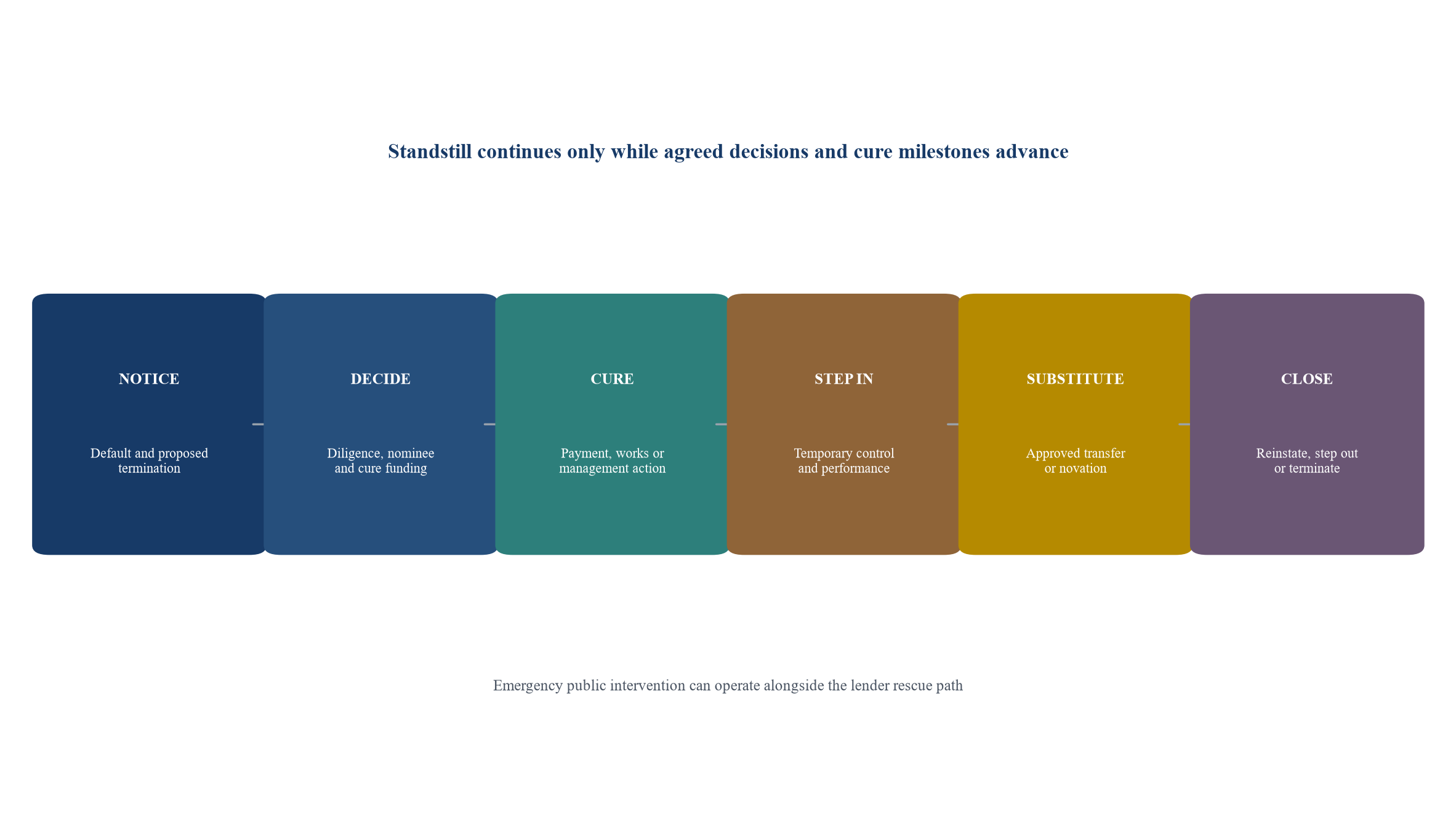
Timing is hypothetical and should be negotiated for the specific asset, default and legal framework.
41. Sequence overlapping rights
Purchaser, lenders, contractors, insurers, regulators and insolvency officers may each have intervention rights. A single timeline should show notice, standstill, emergency action, lender decision, cure, substitution, termination and service-contract preservation.
The assessment should distinguish legal entitlement, operational feasibility and financial capacity. Purchaser, lenders and advisers should use the same default chronology and performance evidence.
The parties should translate the issue into a dated intervention plan with named owners, dependencies and evidence. Extensions should follow demonstrated progress rather than an open-ended standstill.
42. Allocate liabilities during step-in
The nominee should be responsible for obligations arising from its conduct, while historic project-company liabilities remain allocated as agreed. Unlimited assumption of unknown accrued liabilities can make step-in commercially impossible.
The decision should be documented before rights expire or service deteriorates. Conditions should address notice, access, interim performance, funding, liability, approvals and reporting.
The governing objective is a credible rescue that preserves public service and lender value. A right that cannot be exercised under the full contract and regulatory chain does not support bankability.
43. Preserve accrued claims
Purchaser deductions and claims, lender rights against contractors and project-company rights should survive as specified. The rescue should not erase accountability for past breach or allow duplicate recovery.
The working file should reconcile the project agreement, direct agreement, financing, security, permits and critical subcontracts. Each conclusion should identify the governing clause, responsible party and decision deadline.
A practical review asks what must be cured, who can lawfully act, how essential service continues, what capital is committed and which outcome produces the strongest risk-adjusted recovery.
44. Design a workable step-out
Temporary control should end when cure succeeds, a substitute assumes the project or lenders withdraw. The notice, handover, accounts, data, personnel and continuing liabilities should be defined before intervention begins.
The assessment should distinguish legal entitlement, operational feasibility and financial capacity. Purchaser, lenders and advisers should use the same default chronology and performance evidence.
The parties should translate the issue into a dated intervention plan with named owners, dependencies and evidence. Extensions should follow demonstrated progress rather than an open-ended standstill.
45. Reinstate ordinary governance
After cure, the project should restore board authority, reporting, budgets, contractor management and distribution controls. The decision record should identify which temporary measures end and which remedial covenants continue.
The decision should be documented before rights expire or service deteriorates. Conditions should address notice, access, interim performance, funding, liability, approvals and reporting.
The governing objective is a credible rescue that preserves public service and lender value. A right that cannot be exercised under the full contract and regulatory chain does not support bankability.
46. Execute permanent novation
A permanent transfer should coordinate the project agreement, financing, security, contracts, permits, land, insurance, tax and employees. Completion conditions should prevent a gap in service or legal responsibility.
The working file should reconcile the project agreement, direct agreement, financing, security, permits and critical subcontracts. Each conclusion should identify the governing clause, responsible party and decision deadline.
A practical review asks what must be cured, who can lawfully act, how essential service continues, what capital is committed and which outcome produces the strongest risk-adjusted recovery.
47. Model lender rescue economics
Lenders compare cure funding and recovery under continued operation with enforcement and termination proceeds. The model should include time, additional capital, priority, operating risk, termination compensation and probability-weighted recovery.
The assessment should distinguish legal entitlement, operational feasibility and financial capacity. Purchaser, lenders and advisers should use the same default chronology and performance evidence.
The parties should translate the issue into a dated intervention plan with named owners, dependencies and evidence. Extensions should follow demonstrated progress rather than an open-ended standstill.
48. Size cure funding
The cure budget should cover overdue amounts, urgent maintenance, contractor mobilisation, working capital, advisers, insurance, reserves and contingency. Funding should be committed before the purchaser relies on the plan.
The decision should be documented before rights expire or service deteriorates. Conditions should address notice, access, interim performance, funding, liability, approvals and reporting.
The governing objective is a credible rescue that preserves public service and lender value. A right that cannot be exercised under the full contract and regulatory chain does not support bankability.
49. Test debt-service resilience
The revised model should test delayed output, deductions, cure expenditure, interest, reserves and relief timing. Distribution lock-up and covenant waivers should remain until stable performance is demonstrated.
The working file should reconcile the project agreement, direct agreement, financing, security, permits and critical subcontracts. Each conclusion should identify the governing clause, responsible party and decision deadline.
A practical review asks what must be cured, who can lawfully act, how essential service continues, what capital is committed and which outcome produces the strongest risk-adjusted recovery.
50. Compare termination compensation
Termination can crystallise public cost and still leave lenders with a shortfall. The decision should compare debt recovery, asset condition, procurement delay and service risk under termination with the proposed rescue.
The assessment should distinguish legal entitlement, operational feasibility and financial capacity. Purchaser, lenders and advisers should use the same default chronology and performance evidence.
The parties should translate the issue into a dated intervention plan with named owners, dependencies and evidence. Extensions should follow demonstrated progress rather than an open-ended standstill.
Table 3. Hypothetical rescue and debt-recovery sensitivity
| Scenario | Cure funding | Standstill period | Minimum cure-period DSCR | Estimated continued-operation debt recovery | Estimated termination debt recovery | Decision implication |
|---|---|---|---|---|---|---|
| Monetary cure and reserve refill | 18 | 30 days | 1.18x | 96% | 74% | Fund promptly and retain enhanced monitoring |
| O&M replacement | 42 | 120 days | 1.05x | 89% | 66% | Nominee and working capital are critical |
| Construction completion rescue | 95 | 240 days | 0.82x | 83% | 51% | Requires committed completion funding |
| Cyber-control restoration | 26 | 75 days | 1.00x | 91% | 69% | Incident command and secure access bind |
| Failed cure followed by substitution | 68 | 180 days | 0.94x | 78% | 58% | Substitute readiness drives value |
All values are hypothetical management assumptions in USD millions unless stated otherwise. They demonstrate method only and are not observations, forecasts or valuation conclusions.
51. Protect lifecycle and handback
A distressed project may defer maintenance to conserve cash. The technical plan should fund major overhauls, membrane replacement, corrosion control, spares and handback requirements before normal distributions resume.
The decision should be documented before rights expire or service deteriorates. Conditions should address notice, access, interim performance, funding, liability, approvals and reporting.
The governing objective is a credible rescue that preserves public service and lender value. A right that cannot be exercised under the full contract and regulatory chain does not support bankability.
52. Manage employees and stakeholders
A rescue can destabilise management, operators, suppliers and communities. Communications should preserve essential personnel, explain authority and maintain confidentiality while avoiding unsupported assurances.
The working file should reconcile the project agreement, direct agreement, financing, security, permits and critical subcontracts. Each conclusion should identify the governing clause, responsible party and decision deadline.
A practical review asks what must be cured, who can lawfully act, how essential service continues, what capital is committed and which outcome produces the strongest risk-adjusted recovery.
53. Build the evidence file
The file should contain notices, defaults, contracts, permits, models, technical reports, cure options, funding commitments, nominee diligence, approvals and minutes. Every extension or waiver should have a documented basis.
The assessment should distinguish legal entitlement, operational feasibility and financial capacity. Purchaser, lenders and advisers should use the same default chronology and performance evidence.
The parties should translate the issue into a dated intervention plan with named owners, dependencies and evidence. Extensions should follow demonstrated progress rather than an open-ended standstill.
54. Use independent review
Independent legal, technical and financial advisers should test entitlement, feasibility, cost and recovery. Their scope should be precise and conflicts disclosed. Final accountability remains with authorised parties.
The decision should be documented before rights expire or service deteriorates. Conditions should address notice, access, interim performance, funding, liability, approvals and reporting.
The governing objective is a credible rescue that preserves public service and lender value. A right that cannot be exercised under the full contract and regulatory chain does not support bankability.
55. Resolve disputes without paralysing service
The direct agreement can escalate disputes through senior representatives, expert determination and arbitration or court. Interim performance, access, payment and safety obligations should continue while disputed issues are decided.
The working file should reconcile the project agreement, direct agreement, financing, security, permits and critical subcontracts. Each conclusion should identify the governing clause, responsible party and decision deadline.
A practical review asks what must be cured, who can lawfully act, how essential service continues, what capital is committed and which outcome produces the strongest risk-adjusted recovery.
56. Run the legal gate
The first gate confirms enforceable step-in authority, notice, standstill, security, permits, procurement and insolvency compatibility. Unresolved legal conditions should be recorded before lenders rely on the right.
The assessment should distinguish legal entitlement, operational feasibility and financial capacity. Purchaser, lenders and advisers should use the same default chronology and performance evidence.
The parties should translate the issue into a dated intervention plan with named owners, dependencies and evidence. Extensions should follow demonstrated progress rather than an open-ended standstill.
57. Run the operational gate
The second gate validates the nominee, cure plan, service continuity, safety, environmental compliance, contractors, people and timeline. The plan should be executable from the first day of intervention.
The decision should be documented before rights expire or service deteriorates. Conditions should address notice, access, interim performance, funding, liability, approvals and reporting.
The governing objective is a credible rescue that preserves public service and lender value. A right that cannot be exercised under the full contract and regulatory chain does not support bankability.
58. Run the funding and recovery gate
The third gate confirms committed cure capital, cash waterfall, reserves, debt-service effect and comparison with termination recovery. The finance parties should approve the complete downside case.
The working file should reconcile the project agreement, direct agreement, financing, security, permits and critical subcontracts. Each conclusion should identify the governing clause, responsible party and decision deadline.
A practical review asks what must be cured, who can lawfully act, how essential service continues, what capital is committed and which outcome produces the strongest risk-adjusted recovery.
59. Run the public-value gate
The fourth gate tests service, fiscal exposure, accountability, procurement integrity and stakeholder consequences. Relief should preserve the original risk allocation except where a documented amendment is required.
The assessment should distinguish legal entitlement, operational feasibility and financial capacity. Purchaser, lenders and advisers should use the same default chronology and performance evidence.
The parties should translate the issue into a dated intervention plan with named owners, dependencies and evidence. Extensions should follow demonstrated progress rather than an open-ended standstill.
60. Adopt the decision record and 90-day plan
The final gate converts rights into action. The record should state default, notices, authority, nominee, cure, funding, liabilities, conditions, milestones, step-out or substitution, and the route if rescue fails.
The decision should be documented before rights expire or service deteriorates. Conditions should address notice, access, interim performance, funding, liability, approvals and reporting.
The governing objective is a credible rescue that preserves public service and lender value. A right that cannot be exercised under the full contract and regulatory chain does not support bankability.
Table 4. Illustrative 90-day step-in readiness plan
| Period | Workstream | Core actions | Decision output | Accountable owner |
|---|---|---|---|---|
| Days 1-15 | Preserve rights | Validate notices; map defaults, standstill, security, permits and emergency powers | Confirmed intervention perimeter | Purchaser, security trustee and counsel |
| Days 16-30 | Diagnose and stabilise | Protect service; inspect asset; reconcile contracts, cash, people and suppliers | Stabilisation and cure options | Technical adviser and project management |
| Days 31-45 | Nominee and funding | Diligence operator; commit cure and working capital; test insurance | Executable temporary step-in plan | Lenders and restructuring adviser |
| Days 46-60 | Approvals and documents | Obtain purchaser, regulator, procurement, ownership and lender approvals | Signed intervention documentation | Transaction counsel and authorities |
| Days 61-75 | Implement cure | Mobilise operator; fund works; manage accounts, contractors and reporting | Verified milestone performance | Nominee and independent engineer |
| Days 76-90 | Select end state | Reinstate, continue step-in, substitute or terminate; complete handover record | Approved recovery path | Project board and finance parties |
Timing is indicative and should be adapted to the default, urgency, consent process and legal framework.
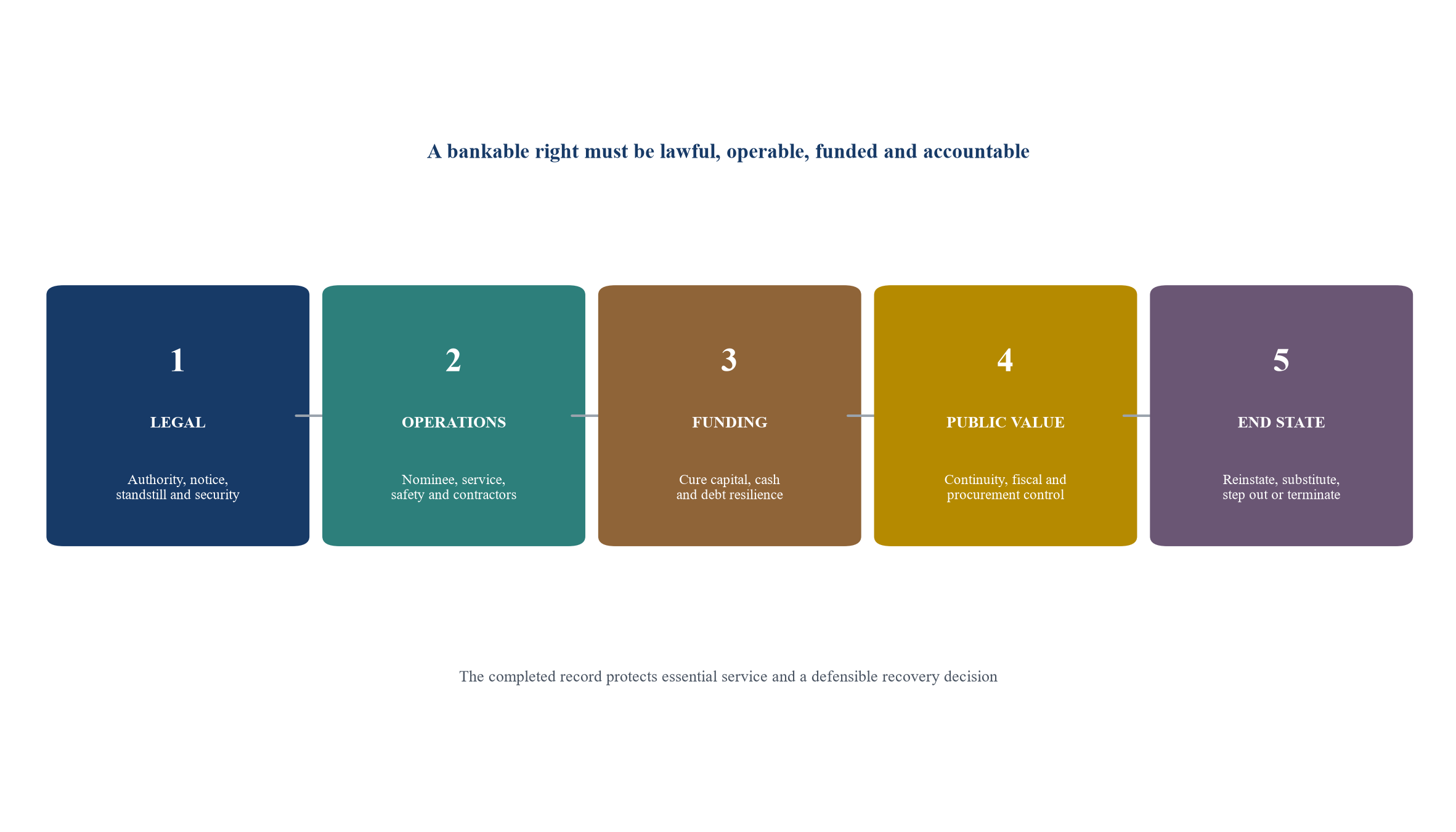
Each gate requires documented evidence before the rescue advances.
The framework converts an abstract financing protection into a controlled rescue pathway. It gives lenders a realistic period to preserve a viable project while protecting the purchaser's service, safety, procurement and accountability requirements.
Execution quality depends on preparation before distress. The direct agreement, permits, security, subcontracts, nominee criteria, cure funding and decision timeline should be tested at financial close and maintained throughout operations.
References
- World Bank Group, "Lender Protections and Government Support in PPPs," https://ppp.worldbank.org/lender-protections-and-government-support-ppps
- World Bank Group, "Key Issues in Developing Project Financed Transactions," https://ppp.worldbank.org/financing/issues-in-project-financed-transactions
- World Bank Group, "Considerations for Government," https://ppp.worldbank.org/considerations-government
- World Bank Group, "Guidance on PPP Legal Frameworks," lender step-in rights and direct agreements, https://ppp.worldbank.org/sites/default/files/2022-07/P17521204fa5900710ba160e9613aa44291.pdf
- World Bank Group, "Termination Provisions," https://ppp.worldbank.org/termination-provisions
- European PPP Expertise Centre, "EPEC Guide to Public-Private Partnerships," https://www.eib.org/files/publications/epec_guide_to_ppp_en.pdf
- European PPP Expertise Centre, "Termination and Force Majeure Provisions in PPP Contracts," https://www.eib.org/attachments/epec/epec_terminaison_and_force_majeure_en.pdf
- UNCITRAL, "Legislative Guide on Public-Private Partnerships," 2019, https://uncitral.un.org/en/lgppp
- UK Government, "Part 4: Contract Termination and Direct Agreements," 2026, https://www.gov.uk/government/publications/navigating-the-risks-of-pfi-project-distress/part-4-contract-termination-and-direct-agreements
- UK Government, "NISTA Contract Management Guidance: PFI Foundations," 2026, https://www.gov.uk/government/publications/pfi-foundations-for-contract-managers/nista-contract-management-guidance-pfi-foundations
- UK Government, "Standardisation of PF2 Contracts," funders' direct agreement and authority step-in provisions, https://www.gov.uk/government/uploads/system/uploads/attachment_data/file/221556/infrastructure_standardisation_of_contracts_051212.pdf
About the Author
Chennakeshav (CK) is a corporate finance and investment banking executive with 25+ years of global experience in deal origination, structuring and execution across M&A, growth capital and corporate strategy. He has led value-creation mandates for founders, corporates and funds — bridging the boardroom view to hands-on execution and close.
His career spans Morgan Stanley, HSBC, Lloyds Banking Group, EWEC, ADQ portfolio companies and Emirates Growth Fund, across TMT, real estate, fintech, deeptech, cleantech, infrastructure and energy. He has partnered with C-suite leaders, private equity and venture funds, sovereign wealth funds and family offices to finance complex fund raises and scale-up ventures, and has led M&A due diligence, post-merger integration and business-transformation initiatives to create value.
At Matchpoint Partners he is Managing Partner, leading the firm's corporate finance, M&A and capital-raising practice. He holds an MBA from London Business School, an engineering degree from VTU and a Master of Laws (LLM, in progress) from UCL London.
An active start-up mentor, CK mentors at Techstars, DIFC FinTech Hive, Startup Grind, Founder Institute and IN5, serves as Entrepreneur Mentor in Residence (EMiR) at London Business School, and judges the Entrepreneurship World Cup.
