

1. Define the credit decision
The lender is deciding whether a specific property and completion plan can produce controlled cash within the facility period. The file should identify the borrower, property owner, lease parties, proposed tenant activity, current approved use, required works, approving authorities, contractors, funding sources and the event that starts rent. A warehouse label in a valuation, lease or marketing document cannot answer those questions. The credit decision should state which facts are established, which evidence remains outstanding and which party bears the cash consequence if completion occurs later or costs more than assumed.
Begin with the transaction perimeter. A refinancing can fund an existing owner while a development facility funds a special-purpose borrower. The tenant may lease the whole building, one compartment or a subdivided unit. The sponsor may own the land, hold a long lease, usufruct or another registered interest. Contractors and consultants can have rights against the property or project cash. The lender needs a reconciled map of ownership, contractual obligations, permit applicants, insurance interests, security and payment accounts. The map should use names and identifiers taken from current records.
The central underwriting question is when the converted warehouse can lawfully and physically support the activity that generates rent. Public rules help define the questions. They do not prove compliance at an unnamed site. Obtain current advice from the responsible authorities and qualified specialists for the actual location, building, use and works. The paper supplies a decision method for evidence collection, drawdown control and downside analysis. It does not determine that any conversion is permitted or that a particular certificate, lease clause, security interest or enforcement route is sufficient.
2. Separate the regulatory layers
The UAE Fire and Life Safety Code of Practice supplies a national technical reference used by the official Dubai Civil Defence publication. The code classifies occupancies, addresses mixed occupancies, requires separation in specified cases and contains a dedicated chapter for multi-tenant terrace warehouses and factories. The selected local procedures in this paper come from Trakhees and apply within that authority's jurisdiction and stated service scope. A property elsewhere can follow another municipality, free-zone or authority process. The lender should confirm the current route for the selected parcel rather than transferring one jurisdiction's document list to another. [1] [2] [3]
Dubai Local Order No. 2 of 1999 states within its scope that land use, building occupancy and change require compliance with permitted uses and relevant planning permission. The legal question for a specific property requires the current planning classification, existing approvals and later rules or decisions that apply. A trade licence, signed lease or physical fit-out does not by itself establish planning permission. The credit file should connect the planned activity to the documents issued by the authority responsible for land use and building control. [6]
Fire, planning, building, environmental, licensing, lease and financing questions can proceed on related timelines while producing different evidence. A modification permit authorises specified works. A completion certificate concerns completed works under its applicable procedure. An operational fitness requirement can address operation or storage. A tenancy contract allocates private obligations between parties. A registered mortgage establishes rights under its governing law. The lender should maintain separate workstreams with dependencies, owners and dates. Combining every item under one label such as authority approval can conceal a missing condition that stops occupancy or rent.
3. Fix the property and security perimeter
Obtain the title record, cadastral information, site plan, existing building-completion evidence, approved drawings, current leases, encumbrance searches and corporate authority documents. Reconcile the property description across the valuation, facility agreement, insurance, lease and permit submissions. If the financed interest is a long lease, usufruct or musataha interest, record its remaining term and transfer or mortgage conditions. The Dubai mortgage law addresses registered real-property mortgages and selected property interests within its scope. It also places conditions on the mortgagee and registration. Transaction counsel should determine the permitted security package and any limitations for the selected lender. [8]
The law states that a real-property mortgage is effective against third parties when registered with the Dubai Land Department under the applicable process. It also extends the mortgage to appurtenances and later facilities described by the law and allows the mortgagee to object to conduct that materially impairs property value. These provisions support diligence questions about the works, additions and value protection. They provide no conclusion on priority, perfection or enforcement for an unnamed transaction. The lender should obtain current searches, registered documents, consents, releases and a transaction-specific legal opinion before relying on the property as collateral. [8]
Security should also cover the cash and contract perimeter to the extent legally available and suitable. Relevant rights can include rent receivables, lease proceeds, insurance proceeds, construction contracts, warranties, permits and project accounts. Some rights may require consent, notice, registration or direct agreements. Others may be personal to the permit holder or unavailable for transfer. A schedule should identify the right, legal owner, counterparty, governing law, transfer restriction, required step, completion status and enforcement relevance. The lender can then distinguish property value from the contractual and administrative rights needed to finish the conversion.
| Asset or right | Evidence to obtain | Credit question | Responsible review |
|---|---|---|---|
| Registered property interest | Title, site plan, cadastral record, searches and consents | What interest is financed and what ranks ahead of it | Transaction counsel and valuer |
| Existing building status | Completion evidence, approved drawings and authority records | What construction and use are currently approved | Technical adviser and authority consultant |
| Tenant lease and rent | Executed lease, registration, amendments and payment evidence | Which event creates the rent obligation and what can suspend or reduce it | Transaction counsel and commercial adviser |
| Modification and completion rights | Permit applications, permits, certificates and correspondence | Which party can apply, amend, complete and respond to an authority | Authority consultant and transaction counsel |
| Construction contracts | Scope, price, programme, security, warranties and termination rights | Can the lender preserve or replace the delivery route after default | Technical adviser and transaction counsel |
| Insurance proceeds | Policies, endorsements, claims and loss-payee terms | Does cover remain effective during works and how are proceeds controlled | Insurance adviser and transaction counsel |
| Project and rent accounts | Mandates, control terms and statements | Can completion funding and later rent be traced and applied | Bank, counsel and finance team |
Questions for transaction counsel and the credit team. The table makes no legal or security finding.
4. Establish current and intended use
The lender should record the current approved use and the proposed tenant activity in operational detail. Warehouse activities differ by stored materials, packaging, storage height, racking, processing, charging equipment, cold rooms, offices, dangerous goods, loading patterns and occupancy. The fire code defines warehouses as spaces used for storing goods or materials and identifies additional requirements for particular configurations. Its multi-tenant provisions also contemplate uncertainty where a warehouse is to be rented and the final storage type is not yet confirmed. The committee should avoid approving a generic warehouse use when the technical design depends on what will actually occur inside. [1]
Request the tenant's process description, material inventory, safety data where relevant, maximum stock volume, storage height, rack geometry, equipment, heat or ignition sources, employee and visitor numbers, working hours, vehicle movements and office component. Connect each input to the consultant's occupancy and hazard analysis. Changes after approval should enter a controlled review. A tenant cannot be permitted operational flexibility that invalidates the fire design or insurance assumptions on which the lender relied. The lease and monitoring package should state how material use changes are proposed, assessed and approved.
Mixed use needs particular attention. The fire code notes that a warehouse housing offices can be a mixed occupancy and requires fire-resistive separation for distinct occupancies under specified conditions. Cold rooms above the identified threshold and multi-tenant units receive specific treatment. These are technical examples, not a design for any property. The appointed fire and life-safety consultant should prepare the actual code analysis, drawings and submission. The lender should obtain that signed analysis and an exception schedule showing every unresolved interpretation, deviation, alternative solution or authority comment. [1]
5. Read the lease as a completion instrument
Dubai Law No. 26 of 2007 requires a written tenancy contract describing the property, purpose, term, rent and other specified matters and requires registration through the applicable system. It states that the landlord should hand over the property in good condition so the tenant can use it for the agreed purpose, while the landlord must provide approvals needed for tenant works in the circumstances described. It also restricts tenant changes without landlord permission and the required licences. These provisions should be applied by counsel to the actual lease, property and current law. [7]
Translate the lease into an obligation matrix. Identify the landlord works, tenant works, common works, design responsibility, approvals, completion standard, inspection rights, access date, handover protocol, rent-free period, rent-commencement event, longstop date, termination rights, delay damages, service charges, reinstatement, insurance and use covenant. A phrase such as ready for occupation needs an objective schedule. Attach the approved drawing set, technical specifications, test requirements and documentary deliverables. Record which party certifies completion and whether another party can dispute that decision.
Rent commencement should be modelled from the contractual trigger that counsel confirms. Possible triggers can include a fixed date, access, practical completion, a completion certificate, tenant acceptance or satisfaction of stated landlord works. The paper does not state that any one trigger is standard or legally sufficient. The lender should identify conditions that can postpone, suspend, offset or terminate rent and test their interaction with authority delays. A fixed model date without a reconciled lease clause and evidence path is a management assumption and should remain identified as such in the credit memorandum.
6. Convert the tenant use into a fire-design basis
The fire code's warehouse chapter links compartment size, protection and storage conditions. Multi-tenanted units require compartmentation under the cited provisions, and sprinkler requirements change with size and configuration. Shielded high-rack areas need appropriate coverage. Smoke management can depend on compartment size, with engineered measures identified for larger cases. Storage-height controls and signage also appear in the code. A lender should use these requirements to test whether the scope and budget arise from an approved design basis. It should not calculate the design itself. [1]
Ask the fire consultant to issue a design-basis memorandum that identifies occupancy, hazard, compartment geometry, fire resistance, sprinklers, alarms, smoke control, hydrant or hose-reel systems, emergency lighting, signage, egress, fire-service access and interfaces with racking or machinery. The memorandum should cite the current code and authority decisions used, list inputs received from the tenant and state open assumptions. Drawings, calculations and product schedules should carry consistent revision numbers. Any value-engineering proposal should be checked against the approved basis before a contractor removes it from the cost plan.
The official code requires listed, approved or registered fire and life-safety materials and systems within its stated framework. The lender's technical adviser should verify submittals, approvals, delivery records, installation inspections, testing and certificates for the actual products and systems. A quotation or purchase order shows commercial intent. It does not prove compliant installation or authority acceptance. The drawdown checklist should link each payment to measurable work and evidence, leaving adequate retention or undrawn funding for testing, rectification, certification and closeout. [1]
7. Map the approval sequence
The Trakhees modification-permit procedure states that a permit is required for specified modifications after the building completion certificate and includes racking and machinery installations within its listed service scope. It also requires compliance with approved drawings and conditions. The procedure applies to its own jurisdiction. The selected property's authority should confirm the current application route, document requirements, fees, review stages and validity periods. A project programme should include submissions, comments, resubmissions and specialist approvals based on current evidence rather than one published service target. [2]
The Trakhees modification-completion procedure states that a client may not occupy the unit until the final modification completion certificate and that occupancy follows compliance with the permit, no-objection certificate and approved drawings. The application moves through validation, inspection, approval or rejection and possible reinspection. Its published process measure excludes delay caused by missing drawings, clarification and special approvals. A lender should therefore treat the quoted service time as a bounded administrative measure, not a guaranteed project completion period. [3]
The associated application form lists supporting records that include the modification permit or no-objection certificate with revisions, structural inspection record where applicable, Dubai Civil Defence completion certificate, final demarcation certificate and approved stamped drawings. The Trakhees operational requirements also state within their scope that an operation-fitness certificate is required before operation or storage. Build a property-specific matrix from the live authority checklist and consultant advice. The matrix should show document owner, prerequisite, current revision, submission date, response, expiry and impact on occupancy or rent. [4] [5]
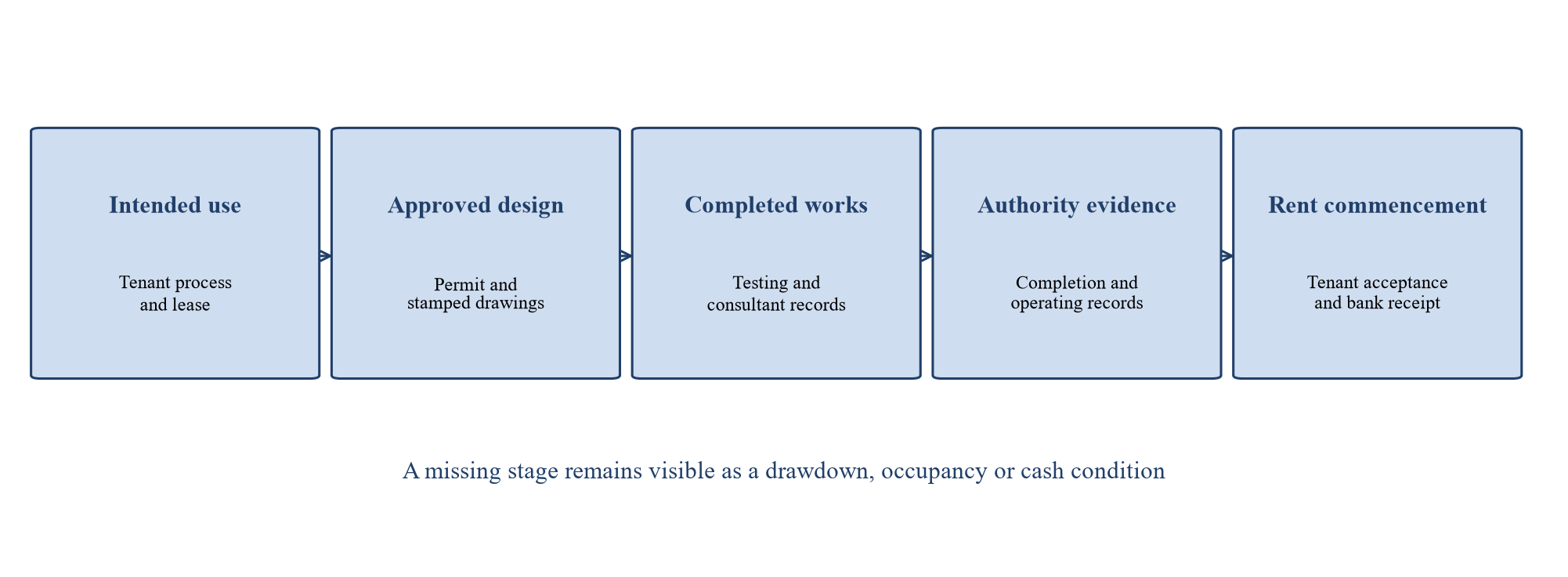
Original lender framework. The actual sequence and authority route depend on the property, use, documents and current requirements.
8. Build the completion budget from evidence
The cost plan should follow the approved work breakdown rather than a broad fire-safety allowance. Separate design and authority costs, enabling works, passive fire protection, compartment walls and doors, alarms, suppression, pumps and tanks, smoke management, emergency systems, electrical interfaces, racking interfaces, testing, certification, professional fees, taxes, contingency and closeout. Reconcile quantities and specifications to drawings. Identify owner-supplied and tenant-supplied items and confirm that every required element appears once. An excluded package can create a funding gap even when the headline budget remains unchanged.
Obtain fixed prices where available and record qualifications, provisional sums, escalation, payment timing, retention, advance payments and security. Compare the main contractor's scope with specialist fire contractors and authority-consultant responsibilities. Test interfaces such as power supply, water capacity, controls, penetrations, ceilings, roof loading, access and builders' work. A contractor can exclude an interface that each specialist assumes another party will provide. The technical adviser should maintain a responsibility matrix and confirm the cost consequence of unresolved gaps before the lender fixes its commitment.
Contingency should correspond to identified uncertainty. Design maturity, intrusive-survey findings, lead times, occupied-site constraints and authority comments can require different treatment. The hypothetical model uses one combined completion amount for transparent arithmetic. A live model should retain line items, tax and currency treatment, committed and forecast values, paid amounts, contingency transfers and remaining exposure. It should reconcile the approved budget to contracts, payment certificates, bank statements and site progress at every draw.
9. Allocate completion risk contractually
The facility documents should state the completion definition, budget, approved contracts, draw conditions, sponsor first-loss contribution, cost-overrun support, contingency controls, permitted changes, longstop date and consequences of delay. Conditions should refer to identifiable documents and authorised signatories. A requirement to progress approvals gives the lender limited evidence. A requirement to deliver a named permit, approved drawing revision, independent certificate or paid invoice can be tested. Counsel should align the facility wording with the property, construction, lease and authority documents.
Sponsor support should be assessed for amount, timing, legal enforceability and liquidity. An undertaking to fund every overrun carries limited value if the support provider lacks available cash or if enforcement occurs after the contractor stops. Obtain evidence suited to the proposed support and monitor it. The lender can require sponsor money to be spent first, pari passu or according to another documented sequence. The hypothetical case assumes USD 2.5 million of sponsor funding is paid first. It supplies no recommendation for a real transaction.
Construction contracts should address scope, programme, variations, payment, retention, defects, warranties, termination, assignment and step-in where legally appropriate. Direct agreements may preserve consultant or contractor performance after borrower default, subject to actual terms and law. The lender also needs a controlled change process. A lease amendment, tenant-use change or drawing revision can alter cost and timing without changing the facility amount. Material changes should return to legal, technical, valuation, insurance and credit review before the affected draw.
10. Gate drawdowns to completed evidence
Each draw should reconcile four views: work physically completed, amount contractually due, evidence accepted and remaining cost to complete. The independent technical adviser should inspect progress and review payment certificates, invoices, variations, permits, tests and programme. The borrower should provide the current budget, cash ledger, forecast and confirmation of unresolved claims. The lender should compare cumulative sources with cumulative uses and retain enough committed funding to finish the approved scope. A percentage-complete statement without cost-to-complete analysis can allow early overfunding.
Use specific gates for major workstreams. Design funding can follow appointment and a defined deliverable. Procurement funding can require approved submittals, purchase terms and protection for deposits. Installation draws can require site evidence and consultant certification. Testing and completion draws should require test records, defect status and authority submissions. Final release can depend on completion certificates, tenant handover, lease conditions and verified bank receipt where the facility relies on rent. The exact gates must match the transaction and cannot be supplied by this paper.
The lender should preserve an exceptions register. Each exception should state the unmet item, amount exposed, reason, mitigation, expiry, responsible reviewer and approving authority. Waivers should be documented and incorporated into the next certificate. Repeated temporary exceptions can become an undisclosed permanent change to the risk. Stop funding when the remaining committed sources no longer cover the verified cost to complete, required reserves and expected carry unless an authorised solution has been documented and funded.
| Stage | Evidence gate | Hypothetical lender draw | Cumulative lender draw |
|---|---|---|---|
| Approved design and mobilisation | Current permit route, approved design basis, contracts and sponsor funding evidenced | USD 0.75m | USD 0.75m |
| Passive fire and compartmentation | Measured work, approved products and independent certification | USD 1.50m | USD 2.25m |
| Alarm, suppression and water systems | Installed quantities, tests to date and payment certificate | USD 2.00m | USD 4.25m |
| Smoke, egress, racking and interfaces | Approved installation, coordination records and open-defect schedule | USD 1.25m | USD 5.50m |
| Integrated testing and authority inspection | Integrated test evidence, submission and inspection record | USD 0.75m | USD 6.25m |
| Completion and tenant handover | Required certificates, accepted handover and rent-trigger evidence | USD 0.25m | USD 6.50m |
| Undrawn completion headroom | Controlled availability for approved contingencies and rectification | USD 2.00m | USD 8.50m |
USD millions. Amounts and gates are hypothetical and do not represent UAE costs, lender terms or authority requirements.
11. Reproduce the hypothetical facility
The illustration uses a USD 42.0 million senior facility. A USD 31.5 million base loan supports the existing property exposure. A USD 8.5 million completion tranche funds approved conversion works after the assumed sponsor contribution. A separate USD 2.0 million interest-and-fees reserve supports specified financing cash flows. These components sum to the total commitment. The model assumes no additional revolving line, value-added tax facility, currency movement or capitalised amount beyond the stated reserve. Every figure is selected solely to demonstrate the underwriting method.
The hypothetical conversion budget is USD 9.0 million. The sponsor contributes USD 2.5 million first, leaving USD 6.5 million of base works for the lender. The completion tranche therefore contains USD 2.0 million of headroom beyond the base remaining works. The illustrative gates in Table 2 allocate USD 6.5 million to measured progress and retain USD 2.0 million for approved contingency or rectification. The reserve is held separately. A real facility should specify whether unused amounts can move between categories and who approves that transfer.
The lender should reconcile the model with bank cash. Evidence should show the sponsor's USD 2.5 million contribution, its eligible uses and the absence of circular funding. Cumulative lender advances should match the controlled project account and paid invoices. The remaining facility should be compared with the independent cost to complete, unpaid certified amounts, unresolved claims and reserve needs. Headroom in a facility schedule is not automatically available if conditions fail, the borrowing entity changes or a cost falls outside the approved scope.
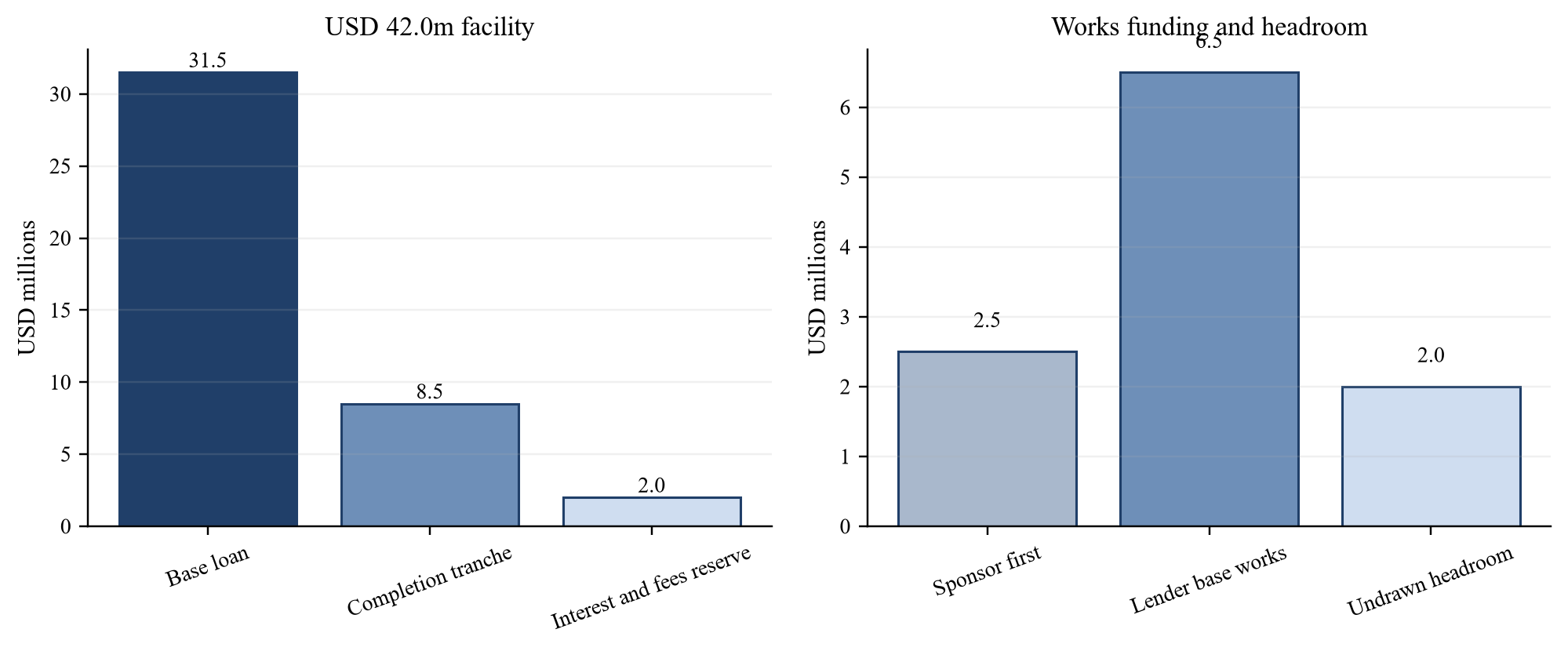
USD millions. Every amount and funding sequence is hypothetical and supplies no market benchmark or recommendation.
12. Bridge rent commencement to debt service
The operating illustration assumes annual contractual cash rent of USD 6.0 million after commencement and annual property cash costs of USD 1.0 million during rent-producing months. Twelve months produce USD 5.0 million of cash available for debt service. Dividing by assumed annual debt service of USD 3.6 million gives 1.39 times coverage and USD 1.4 million of residual cash. The values exclude tax, service-charge timing, tenant incentives, working capital, capital expenditure, reserve movements and other property cash flows.
If only ten months produce rent, cash available for debt service is USD 4.17 million and coverage is 1.16 times. Eight months produce USD 3.33 million and 0.93 times. Six months produce USD 2.50 million and 0.69 times, leaving a USD 1.10 million deficit against annual debt service. The model holds monthly rent and cash cost constant and gives no probability to a delay. A live case should use the lease payment dates, actual operating budget and facility payment schedule.
Rent commencement and cash receipt should remain separate dates. A lease can create an accrued obligation before money reaches the bank. A tenant may have a dispute, set-off, incentive, deposit or payment cycle that changes cash timing. Verify the first invoice, any tenant acceptance record and bank receipt. Reconcile rent to the controlled account and test recurring collections. If the lender relies on a reserve until collection history is established, state the amount, release conditions and treatment after a missed payment.
| Rent-producing months | Cash rent | Property cash costs | Cash available for debt service | Coverage | Residual cash after debt service |
|---|---|---|---|---|---|
| 12 months | USD 6.00m | USD 1.00m | USD 5.00m | 1.39x | USD 1.40m |
| 10 months | USD 5.00m | USD 0.83m | USD 4.17m | 1.16x | USD 0.57m |
| 8 months | USD 4.00m | USD 0.67m | USD 3.33m | 0.93x | Negative USD 0.27m |
| 6 months | USD 3.00m | USD 0.50m | USD 2.50m | 0.69x | Negative USD 1.10m |
USD millions except coverage. Cash available for debt service equals cash rent less property cash costs. All assumptions are hypothetical.
13. Stress cost and delay independently
The second sensitivity measures completion liquidity rather than debt-service coverage. Available completion resources after the sponsor's contribution equal the USD 8.5 million completion tranche plus the USD 2.0 million interest-and-fees reserve. Remaining works equal the total conversion cost after the USD 2.5 million sponsor contribution. Delay carry is assumed at USD 0.30 million per month. Headroom equals available resources less remaining works and delay carry. The method assumes the reserve can be used for the stated carry and does not move it into operating coverage.
With no overrun and no delay, headroom is USD 4.00 million. A 20 percent cost overrun and four-month delay reduce it to USD 1.00 million. A 30 percent overrun and six-month delay produce negative USD 0.50 million, meaning the stated sources are insufficient by that amount. The cost percentages apply to the full USD 9.0 million budget. Delay carry remains linear. No scenario includes probability, contractor recovery, sponsor backup, rent receipts, variation savings or a change in facility pricing.
Cost overrun and delay can share causes, yet the arithmetic treats their cash effects separately. Additional works increase the conversion cost. Additional time increases carry. Lost or deferred rent appears only in the operating sensitivity and should not be inserted again as completion carry. A live integrated model can place every cash flow on one timeline, provided each item enters once. The committee should stress the verified unresolved cost range, the programme's critical path, actual debt terms and sponsor support rather than adopting the illustrative grid.
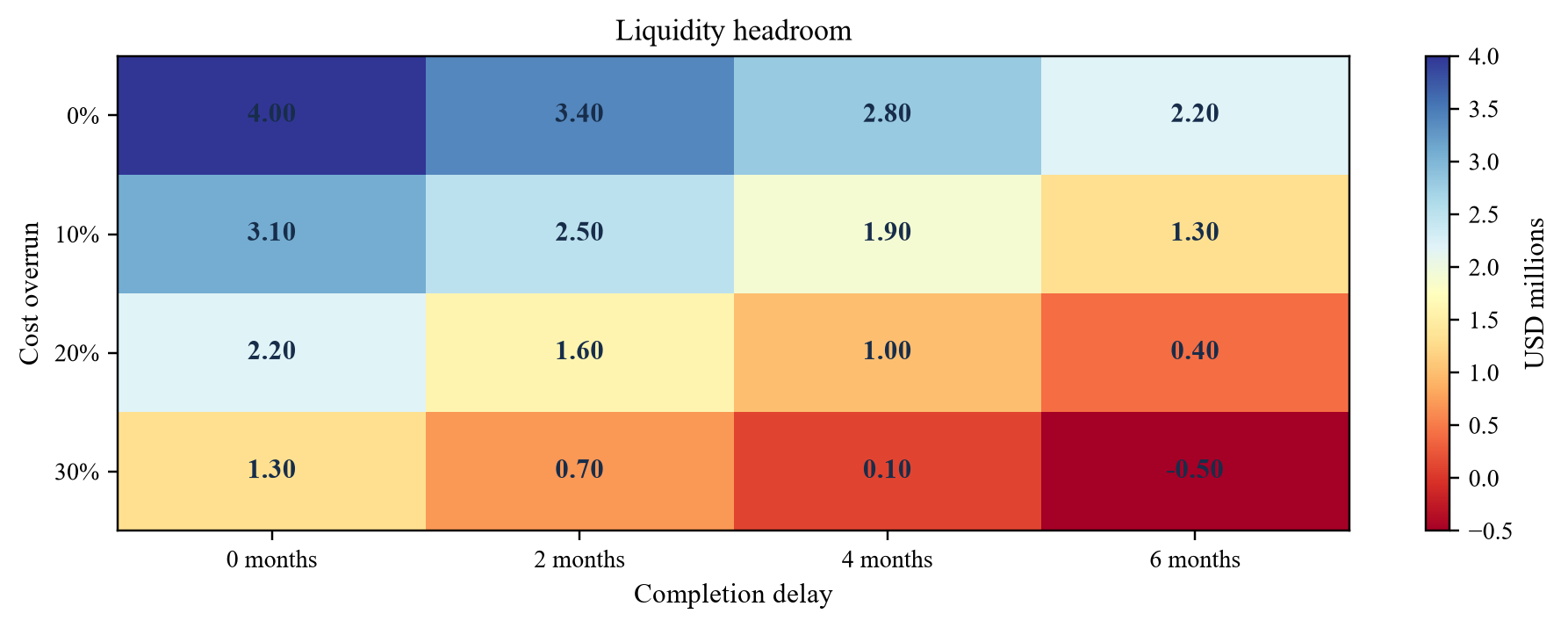
USD millions. Negative values indicate additional funding required under the stated arithmetic. No probability is assigned.
| Cost overrun | No delay | 2-month delay | 4-month delay | 6-month delay |
|---|---|---|---|---|
| 0 percent | USD 4.00m | USD 3.40m | USD 2.80m | USD 2.20m |
| 10 percent | USD 3.10m | USD 2.50m | USD 1.90m | USD 1.30m |
| 20 percent | USD 2.20m | USD 1.60m | USD 1.00m | USD 0.40m |
| 30 percent | USD 1.30m | USD 0.70m | USD 0.10m | Negative USD 0.50m |
Headroom equals USD 10.5 million of assumed completion and reserve availability less remaining works after sponsor funding and USD 0.30 million of carry per delay month.
14. Protect the asset during works
The lender's technical monitor should assess site control, temporary fire precautions, access, housekeeping, hot-work procedures, security, weather protection and protection of completed elements. The construction phase can create risks that differ from the completed design. Existing tenants or stored goods can add exposure. Obtain the contractor's method statements, permits, inspection records and incident logs. Specialist advice should confirm whether occupied or partially operational work can proceed and what temporary systems are required.
Insurance review should cover the owner, borrower, contractors, consultants, tenant and lender interests as relevant. Confirm the insured property, works, existing structures, plant, public liability, professional indemnity, delay or rent cover where available, exclusions, deductibles, policy period, notification duties and claims-control terms. The value and timing of insurance recovery can differ from the cost and cash impact of an event. The paper states no suitable insurance programme. A qualified adviser should report on the actual coverage and endorsements.
Valuation should distinguish current condition, assumed completed condition and stabilised income. Each valuation assumption should link to the works, approvals, lease and completion date used. If a valuation assumes the tenant can use the warehouse as intended, the lender should identify the documents needed to support that assumption. A downside value should reflect the lender's chosen scenario and actual market evidence. Public fire or permit rules provide no valuation result, rent, yield, liquidity or recovery estimate.
15. Monitor after completion and first rent
Completion evidence should remain version-controlled. Retain the approved drawings, as-built drawings, test records, certificates, equipment schedules, warranties, maintenance requirements, defect list and tenant handover record. The fire code and the selected operational requirements address ongoing system integrity and maintenance within their scopes. The property manager should maintain a compliance calendar and evidence of inspections, testing and rectification. The lender should define which failures require notice and which affect distributions, reserves or enforcement rights. [1] [5]
Tenant use should be monitored against the approved basis. Changes in materials, storage height, racking, machinery, charging, cold rooms, offices, subdivision or occupancy can alter the risk. The lease should require notices and approvals suited to the transaction. Periodic site inspections and tenant certifications can support monitoring. They do not replace authority requirements or specialist review. A variance should be investigated and corrected under an authorised plan, with its cost and cash effect reflected in the model.
Rent monitoring should reconcile the lease schedule to invoices, receipts, arrears, incentives, deposits, service charges and disputes. Compare actual commencement with the credit assumption and explain every delay. Track debt service, reserve balances and covenant calculations using bank evidence. A first receipt confirms one payment. It does not establish a full-year pattern. The lender should retain a staged stabilisation definition based on the actual facility, lease and risk appetite.
16. Define the advisory and diligence mandate
A capital provider can commission a focused warehouse-conversion screen by specifying geography, property type, transaction structure, facility size, tenant profile, intended use, return framework and approval requirements. The first phase can identify candidate assets and organise verified public and management information. Selected opportunities can progress to lease review, authority-path mapping, technical diligence, cost-to-complete analysis, valuation coordination and a reconciled credit model. Each deliverable should identify its sources, dates, responsible specialists and unresolved items.
A separately agreed paid scope can include origination research, borrower and property screening, data-room design, diligence coordination, financial modelling, downside analysis and preparation of an investment-committee memorandum. Scope, fees and deliverables require an executed engagement. This paper establishes no mandate, client budget, funding commitment or expected advisory revenue. Facility size does not determine professional fees. Commercial reporting should distinguish screened opportunities, accepted mandates, approved exposure, drawn capital, signed fees and collected fees.
Legal opinions, authority submissions, fire engineering, building inspections, valuations, insurance advice, audit and regulatory permissions remain with providers qualified and authorised for their assigned work. An adviser can coordinate those inputs and reconcile them into the credit package. The role described here includes no custody of client capital, discretionary investment management, lender approval authority or guarantee of completion. Matchpoint Partners can assess a separately agreed research or transaction-support scope against a capital provider's genuine deployment brief and documented decision process.
17. Record an auditable approval
The credit memorandum should state the borrower, property interest, current use, intended use, lease, rent trigger, authority route, fire-design basis, completion budget, facility, security, model, downside cases and monitoring plan. Attach the property-rights matrix, approval schedule, consultant reports, cost plan, source-and-use reconciliation, draw gates, sensitivity outputs and unresolved-item register. For every condition, identify the required evidence, responsible reviewer and approval authority. The committee should be able to trace each conclusion to a dated record.
Possible decisions include declining the transaction, approving the base loan only, approving a delayed completion tranche, or approving the full structure subject to evidence-based conditions. Another structure can require sponsor funding, revised lease terms, additional reserve or a smaller initial advance. These are evaluation alternatives and no ranking is implied. Suitability depends on the lender's mandate, actual documents, expert advice, pricing, risk appetite and portfolio. The memorandum should state the selected decision and the evidence that would cause it to change.
Conditions should avoid subjective completion language. Provide the named certificate, approved drawing revision and signed consultant report is testable. Resolve fire-safety matters is not. Continuing covenants should identify reporting dates and material-change triggers. Exceptions should be quantified, time-limited and approved through the lender's governance. The Central Bank of the UAE credit-risk standards require licensed financial institutions within scope to maintain board-approved governance, underwriting, collateral registration and ongoing monitoring. Basel supervisory principles similarly emphasise prudent underwriting and continuing review. [9] [10]
18. Research limits and conclusion
The research consists of selected official and authoritative sources accessed on 10 September 2026. They support propositions about fire and life safety, modification permits, completion evidence, permitted use, tenancy obligations, real-property mortgages and credit-risk governance within their stated scopes. They provide no property file, lease, tenant process, contractor proposal, authority correspondence, cost database, rent evidence, valuation, default history or recovery data for a warehouse conversion. The paper therefore estimates no market price, approval duration, rent, probability, loss or return.
The numerical model is intentionally simple. It uses one currency, a fixed USD 42.0 million facility, USD 9.0 million completion budget, USD 2.5 million sponsor contribution, constant monthly carry and annualised rent and costs. It omits value-added tax, changing interest, fees outside the reserve, intramonth cash, contractor claims, insurance proceeds, rent deposits, incentives, service charges, tax, foreign exchange, distributions and enforcement. The cost-and-delay grid and rent-month table answer different questions. A live model should integrate the actual cash flows without double counting.
The practical conclusion is an evidence chain. Establish the property and permitted use. Translate tenant activity into an approved fire-design basis. Reconcile the lease and rent trigger to modification, testing, authority and handover records. Fund measured works against a verified cost to complete. Preserve enough committed liquidity for closeout and delay. Confirm the first rent in the bank and monitor continuing use. This sequence gives a capital provider a transparent basis for approval, conditions, drawdown, monitoring or refusal when the evidence remains insufficient.
Appendix A. Lender evidence checklist
| Review area | Record to request | Responsible review |
|---|---|---|
| Borrower and property | Corporate authorities, title, site plan, searches, existing approvals and leases | Transaction counsel and credit |
| Intended warehouse use | Tenant process, materials, storage heights, racking, equipment and occupancy | Fire consultant, technical adviser and insurer |
| Design and permits | Design basis, calculations, permit, stamped drawings, comments and revisions | Authority consultant and fire consultant |
| Completion scope | Contracts, specifications, programme, cost plan, variations and responsibility matrix | Technical adviser and quantity surveyor |
| Fire-safety works | Product approvals, installation records, tests, defects and certificates | Fire consultant and authority consultant |
| Lease and rent trigger | Executed lease, registration, works schedule, handover and payment terms | Transaction counsel and commercial adviser |
| Facility and security | Facility documents, registered security, notices, consents, accounts and direct agreements | Transaction counsel and lender operations |
| Drawdown | Sponsor cash, payment certificate, invoice, bank evidence and cost to complete | Technical adviser, finance and credit |
| Completion and occupancy | Required certificates, as-built records, handover and operating evidence | Authority consultant, technical adviser and tenant |
| Rent and debt service | Invoice, bank receipt, reserve ledger, covenant model and arrears report | Asset manager, finance and credit |
Original checklist. It makes no finding about a property, borrower, tenant, approval or professional appointment.
The checklist should produce identifiable, dated records. Management-provided information should remain identified until corroborated. A missing item should remain open. The lender should decide whether it stops funding, reduces the draw, increases a reserve or becomes an explicitly accepted risk. The decision, amount and approving authority should appear in the file. A statement that all approvals are in place supplies insufficient evidence for a reviewer who needs to identify the approval, site, use, revision, issuer and continuing conditions.
Appendix B. Reproducible calculations and committee questions
The facility calculation is USD 31.5 million of base loan plus USD 8.5 million of completion tranche plus USD 2.0 million of interest-and-fees reserve, producing USD 42.0 million. The assumed USD 9.0 million completion cost less USD 2.5 million of sponsor funding leaves USD 6.5 million of base lender-funded works. The completion tranche therefore has USD 2.0 million of headroom before using the separate reserve.
Completion-liquidity headroom equals USD 10.5 million of completion-tranche and reserve availability less remaining works and delay carry. Remaining works equal USD 9.0 million multiplied by one plus the cost-overrun percentage, less USD 2.5 million of sponsor funding. Delay carry equals USD 0.30 million multiplied by delay months. At 30 percent overrun and six months, uses are USD 9.2 million of remaining works plus USD 1.8 million of carry. Headroom is therefore negative USD 0.50 million.
Operating cash available for debt service equals USD 6.0 million of annual contractual cash rent less USD 1.0 million of property cash costs when all twelve months produce rent. The result is USD 5.0 million. Dividing by USD 3.6 million of annual debt service gives 1.39 times coverage. Six rent-producing months give USD 3.0 million of rent less USD 0.5 million of costs, or USD 2.5 million. Coverage is 0.69 times and the cash deficit against debt service is USD 1.1 million.
The committee should ask which exact use is approved and which tenant activities can change it. Which works, tests and certificates remain before lawful occupancy and the contractual rent trigger? Who funds each overrun and month of delay? Do committed sources cover the independently verified cost to complete? Which property and contract rights can the lender control? Does the lease remain enforceable after a delay or borrower default? What evidence releases each draw and reserve? Which current record would cause the lender to decline or reduce the exposure?
Sources
- Dubai Civil Defence. UAE Fire and Life Safety Code of Practice, 2018 edition. Occupancy classification and Chapter 13 on multi-tenant terrace warehouses and factories. Accessed 10 September 2026. Read the primary source
- Ports, Customs and Free Zone Corporation, Trakhees Civil Engineering Department. Client procedure for obtaining modification permits, PCFC-TRK-CED-MF-CP-01, September 2024. Accessed 10 September 2026. Read the primary source
- Ports, Customs and Free Zone Corporation, Trakhees Civil Engineering Department. Client procedure for requesting Modification Completion Certificate and modification cancellation inspection, PCFC-TRK-CED-MF-CP-02, December 2022. Accessed 10 September 2026. Read the primary source
- Ports, Customs and Free Zone Corporation, Trakhees Civil Engineering Department. Application for Modification Completion Certificate, TRK-CED-MF-CF02a, July 2024. Accessed 10 September 2026. Read the primary source
- Ports, Customs and Free Zone Corporation, Trakhees. Operational Requirements for Trakhees, PCFC-TRK-LSD-CLS-REG02, March 2023. Modification, fire-system and operation-fitness requirements within the publication's scope. Accessed 10 September 2026. Read the primary source
- Government of Dubai, Dubai Legislation Portal. Local Order No. 2 of 1999 Regulating Construction Works in the Emirate of Dubai. Article 4. Accessed 10 September 2026. Read the primary source
- Government of Dubai, Dubai Legislation Portal. Law No. 26 of 2007 Regulating the Relationship between Landlords and Tenants in the Emirate of Dubai. Articles 4, 15, 18, 19 and 25. Accessed 10 September 2026. Read the primary source
- Government of Dubai, Dubai Legislation Portal. Law No. 14 of 2008 Concerning Mortgages in the Emirate of Dubai. Articles 4, 7, 9, 10, 17, 21 and 22. Accessed 10 September 2026. Read the primary source
- Central Bank of the UAE. Credit Risk Management Regulation and Credit Risk Management Standards, C 3/2024 and C 3/2024 STA, effective 30 November 2024. Accessed 10 September 2026. Read the primary source
- Basel Committee on Banking Supervision. Core Principles for effective banking supervision, revised 2024. Principle 17 on credit risk and related supervisory criteria. Accessed 10 September 2026. Read the primary source
- Central Bank of the UAE. Standards for Capital Adequacy of Banks in the UAE, claims secured by commercial real estate. Accessed 10 September 2026. Read the primary source
