

1 Put the finance decision ahead of the policy slogan
The investment decision is whether a project can meet its delivery date, contracted output and financing obligations while satisfying the local-content terms that actually bind it. A commitment to buy locally or train a workforce can create durable capability and public value. It can also introduce an unqualified supplier, an uncertain component lead time, a disputed measurement rule or a report due after physical works are complete. The sponsor needs to know which effect matters for price, debt capacity and the right to call the facility complete.
Project finance is especially sensitive to timing. Construction debt is funded before the asset produces contracted cash. An unresolved obligation that delays completion can extend interest during construction, defer revenue, consume contingency and hold sponsor support in place. World Bank PPP guidance identifies cost, delay and performance as central construction-and-completion risks, and recommends objectively measurable completion criteria [9]. A local-content promise belongs in that same evidence system when a contract gives it consequences for payment, operation or completion.
The first question is documentary: which tender, grant, concession, offtake, EPC, financing or environmental-and-social instrument contains the requirement? A government preference used to evaluate a bid is not automatically a covenant in the loan agreement. An audited supplier certificate is not automatically proof that a particular project's target was met. A workforce-training plan may be a monitored social outcome without being a condition precedent to first debt draw. The parties should resist collapsing these different mechanisms into one undifferentiated percentage.
This paper is an analytical framework. It does not determine a project's legal duties, eligibility for public support, availability of a waiver, completion under a particular contract or creditworthiness. Qualified local counsel, the authority, technical adviser and lenders must assess current documents and actual facts. No local-content percentage or cost in the worked example is presented as a legal threshold or observed market benchmark.
2 Identify the obligation's source and perimeter
The same project can be governed by several localisation instruments. A procurement statute or regulation may define bidder eligibility and evaluation. A tender may prescribe mandatory products. A concession may convert bid promises into milestones. A grant agreement may attach domestic-content conditions to disbursement. An EPC contract may delegate purchasing and reporting. A loan may require compliance with material project documents. Each instrument has a different obligor, verification date and remedy. The project company must build a source-of-obligation register before drafting the financing package.
The register should include the current text of the applicable rule, tender instructions, bid response, award decision, executed project agreement, variation provisions and any official clarification. It should record whether the obligation applies to the project company, contractor, consortium member or supplier. Scope matters: a requirement measured against total labour cost differs from one measured against eligible manufactured components or domestic third-party spend. Currency, period, subcontract tiers, related-party purchases, tax treatment and permitted substitutions can all change the numerator and denominator.
Saudi Arabia's translated government-procurement regulations define a targeted local-content percentage, minimum local content and mandatory national-product list; they also describe mechanisms used in specified public tenders [1]. Those definitions illustrate why one commitment can be an end-of-contract target while another can be a bid-stage floor. The exact tender and contract must be checked, and counsel should confirm the controlling Arabic text and any later amendments. The UAE's National In-Country Value certificate is issued through an audit process involving company information [2]; project-specific procurement duties still require their own contract analysis.
The World Bank's 2025 change is narrower than a general demand for local equipment. Its announcement concerns 30% of labour cost in specified internationally procured civil-works contracts, with implementation details and exceptions tied to the Project Procurement Strategy for Development [4,5]. In the United States, the Department of Energy describes Build America, Buy America as a domestic-content preference linked to covered federal financial assistance for infrastructure [6]. UK social-value guidance addresses award and contract commitments subject to procurement-law conditions [7,8]. These programmes cannot be translated into a single universal loan covenant.
3 Separate five contractual meanings of local content
Local content can operate as eligibility, evaluation, promise, monitored performance or completion condition. Eligibility asks whether a bidder or product may be considered. Evaluation changes the bid score or adjusted price. A promise commits the winner to a future outcome. Monitored performance requires periodic records. A completion condition gives a failure the power to hold a certificate, payment, subsidy or release of support. Each stage should have its own evidence and decision owner.
A bid may claim a supplier has domestic manufacturing capability. That claim should be supported by capacity, qualification, delivery and certificate evidence at bid date. If the project wins on a score reflecting that claim, the owner needs to know whether the eventual contract permits a substitute supplier and at what cost. The lender needs to know whether substitution threatens the concession or offtake, rather than assuming every bidder-score variance becomes a financial default.
An execution target may be cumulative and measured at final account. In that case, a single monthly shortfall may trigger a recovery plan rather than a breach. A milestone target may require evidence before a draw or provisional acceptance. The contract should say which. It should also define how rejected goods, returns, change orders, inflation and supplier insolvency enter the calculation. A percentage without a measurement protocol is a negotiation about facts postponed until the project has the least schedule flexibility.
A lender should classify each obligation by materiality and timing. A disclosure covenant may require reporting without a direct suspension right. A material project-document breach may trigger a notice, cure period and eventually an event of default. A specific completion test may hold the conversion of construction debt or release of sponsor support. These mechanisms should be drafted expressly. The phrase “maintain satisfactory local content” gives poor guidance to an independent engineer asked to certify physical performance.
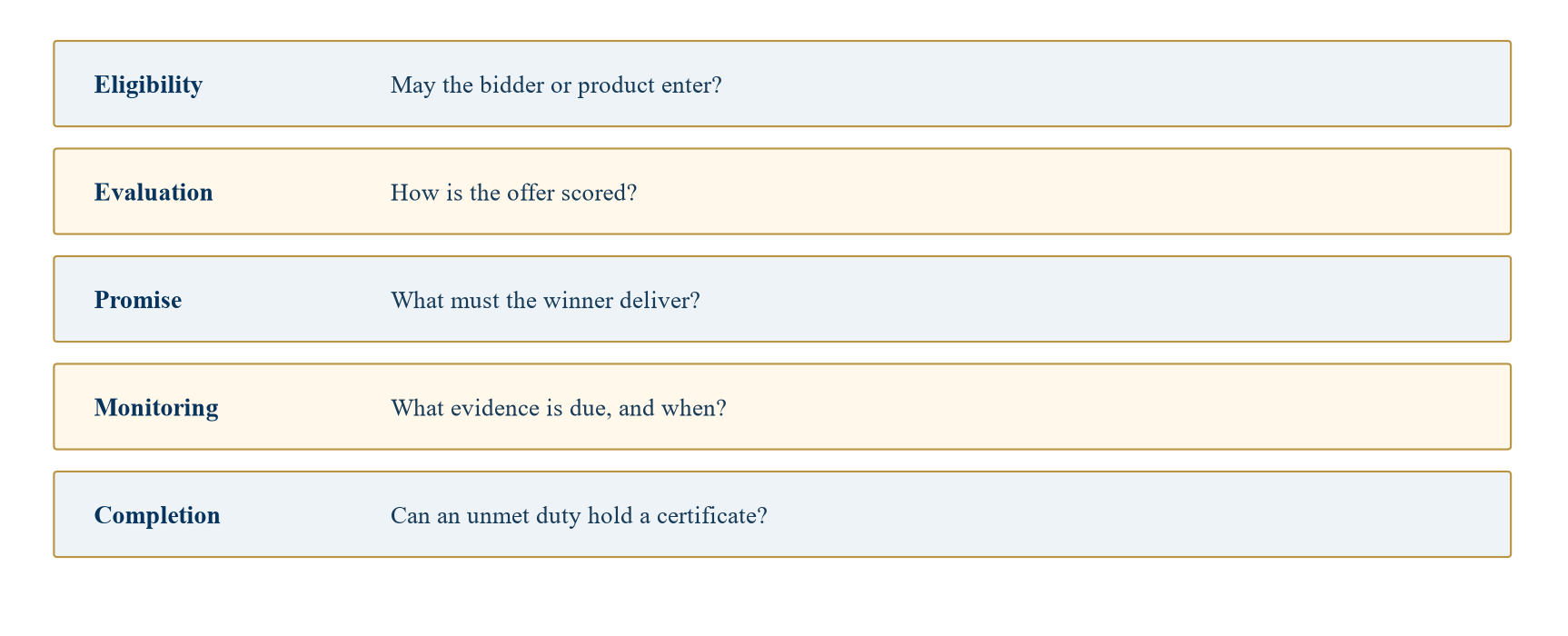
Author-developed taxonomy. The routes are conceptual and do not describe any jurisdiction's legal test.
4 Test whether the supply market can deliver the promise
The procurement plan should begin with a market-capacity assessment. It should name the required item or skill, specification, qualifying standard, expected volume, delivery schedule, number of credible suppliers and their available capacity. An enterprise's certificate may evidence a status or score, but it cannot by itself prove that its factory can deliver a bespoke transformer, certified battery enclosure or trained commissioning team by the required date. Technical and commercial diligence must run alongside compliance diligence.
The owner should distinguish manufactured origin, local value added, local labour and local ownership. A domestic distributor of imported equipment may qualify under one rule and fail another. A local subcontractor may use imported specialists for high-voltage commissioning. A manufacturer may assemble a product locally while critical components remain imported. The governing formula decides whether the activity counts; engineering evidence decides whether the product can safely enter the asset. Both must be known before financing assumes the purchase.
The capacity assessment should include the supplier's backlog, production yield, quality system, test history, working capital, warranty support and sub-tier dependencies. It should cover qualification lead time, not merely shipment lead time. A component that arrives on site on schedule but fails factory-acceptance or type testing can extend the critical path. The EPC contractor should reveal where its schedule relies on a single local source and what substitution rights it has if that source fails.
IFC's contractor-management guidance recommends incorporating environmental and social requirements into prequalification, procurement, contracting and performance monitoring [11]. That principle is useful here: a local supplier programme cannot sit in a separate public-affairs spreadsheet. It needs engineering specifications, purchasing controls, quality documentation, workforce arrangements and a remedial procedure. The sponsor should have a dated independent technical review of critical suppliers before locking the debt draw schedule.
5 Build a bill-of-quantities and workforce evidence ledger
The operational ledger should connect each commitment to a contract line. For goods, it records item ID, quantity, supplier, origin evidence, applicable value-added method, price, manufacturing and acceptance dates, and any substitution. For labour, it records role, employer, location, hours or cost as the controlling rule specifies, skills certification and payroll evidence. For services, it records scope, subcontract tier, place of performance and invoice reconciliation. The ledger needs version control so a later variation does not silently alter the denominator.
A practical control is to reconcile three views monthly: the EPC schedule of values, the project company's payment ledger and the local-content evidence. The first shows physical progress, the second cash paid and the third compliant value or labour. They will not always agree in the same month. Advance payments, retentions and materials stored off-site are examples. A variance should be explained and assigned, not forced into a false balance. The agreement should specify whether evidence is due before certification, before a payment or at a later audit.
Where an obligation is measured against total contract cost, the parties must agree how change orders enter the base. A change in scope can increase the denominator and cause a percentage decline even if the original local purchases were delivered. If the revised scope requires a specialist item unavailable locally, the EPC contractor should raise a notice before placing a purchase order. The owner can then seek an approved variation, adjust a target if the rules permit, or fund a compliant alternative. A retrospective argument after installation is much harder to resolve.
The ledger should be auditable without disclosing more personal or commercial data than necessary. Workforce records may contain protected personal information. Supplier pricing may be commercially sensitive. The reporting design should identify which party validates detailed evidence, what summary the lender receives, and which authority can inspect underlying documents. Data access and retention should be reviewed under applicable law. An unsupported “compliant” flag is inadequate when payment or completion depends on the result.
6 Allocate risk to the party able to control it
The sponsor controls its bid, capital structure and concession negotiations. The EPC contractor controls much of procurement and construction sequencing. A designated supplier controls manufacturing and evidence of origin. A public authority controls its own evaluation, approvals and official determinations. A lender controls credit conditions and remedies. Risk allocation should follow those capabilities while recognising that a project company remains responsible to the authority even when an EPC contractor performs the work.
The EPC contract should flow down specifications, local-content reporting and supplier qualification obligations. It should identify any committed local packages and the conditions for substitution. A broad fixed-price promise can price ordinary procurement risk, but cannot create unavailable capacity or make an authority issue a certificate. The employer may need to retain a defined change-of-law and owner-directed variation risk. World Bank PPP guidance recommends allocating risk to the party best able to manage its consequences and connecting that allocation to contractual obligations [9,10].
Failure routes should differ. If an EPC contractor ignores an agreed qualified supplier, it may bear the cost of reprocurement. If the authority changes a product list after signature, the concession and EPC contracts should define notice, time and cost relief. If the nominated supplier is insolvent despite reasonable diligence, the parties need a replacement process and a funded schedule buffer. If the sponsor's winning bid overstated local production capacity, the sponsor cannot expect lenders to treat a later correction as force majeure.
Lenders should examine the residual exposure after all pass-through rights. A project company can owe the authority more than it can recover from its contractor. Caps, exclusions, causation tests, certification delays and counterparty credit can create gaps. A security package against a contractor with weak balance sheet may offer little practical protection. The credit paper should show the gap in cash and time, along with who funds it before revenue begins.
Table 1. Illustrative risk-allocation matrix for local-content delivery
| Exposure | Primary control | Evidence | Contract and finance response |
|---|---|---|---|
| Bid promise beyond capacity | Sponsor and bidder | Supplier diligence and bid file | Redesign commitment before award; quantify sponsor risk |
| Qualified product delay | EPC and supplier | Production plan and test record | Notice, recovery plan, alternative source and schedule relief test |
| New mandatory item | Authority and project parties | Updated rule and procurement instruction | Counsel review of change mechanism, time and cost allocation |
| Unsupported labour percentage | EPC and payroll chain | Verified cost, role and period ledger | Cure plan and audited report before final account |
| Certificate delayed after physical tests | Certifier and obligor | Submission receipt and deficiency list | Separate physical completion, documentary hold and debt remedy |
| Cost overrun beyond contingency | Sponsor and contractors as agreed | Cost-to-complete and claims register | Equity cure, reserve or permitted debt adjustment |
Author-developed contract checklist; actual rights depend on governing documents and law.
7 Write completion tests that can be observed
Physical completion should have objective engineering criteria: mechanical completion, energisation, performance testing, permits, safe operation and handover records. Local-content completion may require a separate report, independent verification or authority sign-off. The documents should say whether these are simultaneous conditions, sequential conditions or separate post-completion obligations. A lender should never discover at scheduled conversion that an unspecified future audit can hold the technical completion certificate indefinitely.
The independent engineer can verify technical performance and review whether the compliance evidence package is complete. The engineer may not have legal authority to decide a disputed national-content formula. The finance documents should define who makes that decision, which certificate or report is conclusive for draw and conversion purposes, and how the parties treat an authority challenge. A document should not call a condition “objective” when it depends on an unbounded exercise of lender discretion. World Bank PPP guidance makes this tension explicit for completion criteria [9].
The contract should also distinguish provisional acceptance, commercial operation, final acceptance and final local-content account. Some obligations can be evidenced only after a period of operation or final supplier settlement. If such a report is due after commercial operation, the parties can consider a reserve, retention, reporting covenant or sponsor support rather than delaying revenue recognition or the entire debt conversion. Whether that structure is legally available depends on the applicable tender and concession.
The schedule should name every certificate, preparer, reviewer, submission date and cure period. It should specify an appeal or dispute route if the verifier rejects the evidence. It should address partial compliance, measurement error and supplier fraud separately. A cure right must be capable of being performed before the contractual long-stop. A 30-day cure period is illusory if an alternate component needs nine months of testing; time and cash must align with technical reality.
8 Design draw conditions for construction realities
At financial close, lenders need evidence that the project can enter construction lawfully and has a credible procurement plan. They may require executed project documents, permits, EPC security, equity funding, cost-to-complete evidence and a baseline local-content plan. Requiring final proof of a construction-period outcome at first draw would be logically impossible. The initial condition should verify the system for delivery, not completion of the system's eventual output.
During construction, draw certificates should pair physical progress and cost-to-complete with a compliance report. A local-content variance can be an early-warning trigger: the borrower must explain the cause, revised forecast, remedial procurement and cash effect. Suspension of all debt draws may be proportionate for a material uncured breach under the actual documents, but it can also worsen the very delay that threatens the project. Lenders should have graduated information, cure and funding responses drafted in advance.
The loan should define a materiality threshold linked to the underlying obligation. A reporting error, a temporary variance that remains recoverable and an authority notice threatening termination are different credit events. The agreement may require a third-party review when forecast compliance falls below a defined buffer. It may require an equity-funded reserve when the cost-to-complete exceeds available sources. IFC describes disbursement conditions, covenants, performance monitoring and action plans as ordinary parts of its project investment process [12]. That is a process reference, not a model clause for every lender.
Security and step-in rights also need alignment. If a lender replaces the project company or EPC contractor, the successor must know whether certificates and local-content scores can transfer. The direct agreement should preserve access to procurement records, subcontracts and cure periods. A step-in right is of limited use if the replacement cannot lawfully use the qualified supplier or verify the prior workforce spend. Counsel should test assignment and continuity before closing.
9 Make the cost-to-complete model reflect localisation
The financial model should identify local-content costs as a distinct set of assumptions rather than hide them in a generic EPC contingency. It should separate a local-source price premium, tooling or qualification costs, workforce training, reporting and audit, replacement inventory, schedule float and potential penalties. Any tax, customs, grant or tariff effects belong in separate lines supported by actual project advice. This makes it possible to test which item drives the downside and which party must fund it.
The base case needs a supported procurement schedule. A supplier quotation without capacity reservation may be too weak to support a critical-path date. A domestic-content certificate may expire before the procurement period. Local labour availability may vary with regional megaproject construction. The model should therefore show source status and confidence for each assumption. If the item remains uncontracted at financial close, the financing case needs a downside scenario and an identified decision date.
Delay has at least four cash effects: interest during construction, continued site and project-company costs, deferred contracted revenue and possibly extended hedges or guarantees. Some overlap; a model must avoid counting a cost twice. It should also record whether delay damages are collectible, their cap, creditworthiness of the payer and timing of receipt. A nominal EPC indemnity does not pay a debt coupon if the contractor disputes liability or pays months after the due date.
For cash-flow coverage after completion, recurrent localisation commitments can affect operating costs. Maintenance packages, staffing and periodic certification may have durable cash effects. The lender should test them in CFADS, not only construction contingency. If an authority has a variable penalty tied to annual performance, it needs a scenario rather than an unsupported base-case forecast. Any actual covenant headroom should be checked against the signed financing definition of cash available for debt service.
10 Show the arithmetic in a wholly hypothetical project
Consider an invented USD 600 million energy-infrastructure project. The assumed sources are USD 420 million of senior debt and USD 180 million of sponsor equity. Uses are USD 500 million of EPC and owner costs, USD 40 million of interest and fees during construction, and USD 60 million of unallocated contingency. This is an author's modelling case. It is not drawn from a market transaction, lender term sheet or tender. No stated source is evidence for these numbers.
Assume a qualified local component substitution costs USD 12 million more than the original line item and causes a six-month critical-path delay. For a deliberately simple carry calculation, assume the full USD 420 million debt amount is outstanding at 8% for the extra half-year. Incremental interest is USD 420 million times 8% times 0.5, or USD 16.8 million. Additional modelled cost is USD 28.8 million before any second-order effects. If both items can be funded from the original USD 60 million contingency, that contingency falls to USD 31.2 million; total project sources do not automatically rise. Real draw profiles, fees and hedges would change the calculation.
Now consider a separate severe case: USD 25 million substitution and qualification cost, twelve months of extra construction, and the same simplified full-draw 8% carry. Extra interest is USD 33.6 million; combined cost is USD 58.6 million. Only USD 1.4 million of the stated contingency remains. Suppose the lender's agreed minimum unused contingency at conversion were USD 20 million. The invented shortfall would be USD 18.6 million and would require a contractually permitted cure, such as sponsor equity, reduced distribution or a differently funded reserve. This is a test of funding mechanics, not a predicted outcome.
Assume annual cash available for debt service of USD 70 million and scheduled debt service of USD 50 million after completion. The simple ratio is 1.40 times. If recurring compliant procurement raises annual operating costs by USD 4 million without offsetting revenue, CFADS falls to USD 66 million and the ratio becomes 1.32 times. These are synthetic values, not quoted bank covenants. The actual loan definition of CFADS, cure rights and downside tests would govern.
Table 2. Hypothetical USD 600 million project: sources, uses and two local-content stresses
| Item | Base | Six-month substitution | Twelve-month severe case |
|---|---|---|---|
| Senior debt | 420.0 | 420.0 | 420.0 |
| Sponsor equity | 180.0 | 180.0 | 180.0 |
| EPC, owner costs and original IDC/fees | 540.0 | 540.0 | 540.0 |
| Localisation cost and extra interest | 0.0 | 28.8 | 58.6 |
| Contingency remaining within fixed sources | 60.0 | 31.2 | 1.4 |
| Illustrative annual CFADS after recurring cost | 70.0 | 66.0 | 66.0 |
| Illustrative debt-service coverage | 1.40x | 1.32x | 1.32x |
Every number is an author assumption; USD millions except coverage ratios. Simplified full-draw interest; no observed benchmark or real loan.
11 Locate the first unfinanceable point
The model should not stop at a base and downside total. It should identify the first dated point at which required funds exceed available committed sources, a draw condition fails, a long-stop becomes unreachable or a coverage test falls below the actual covenant. That point may arrive months before the final local-content report. A supplier replacement order could require cash immediately, while the authority assesses eligibility later.
The investment committee should set a maximum exposure envelope. It can specify how much contingency may be used without returning to the board, the amount of sponsor support committed, and the event that triggers a lender waiver request. A reserve is useful only if the party legally entitled to spend it can do so quickly. Locked cash that cannot purchase a replacement component before a critical-path deadline may not protect completion.
The bankability test should include a timing bridge. For each month, show physical progress, local-content compliance forecast, cash drawn, contingency left, debt-service date, remaining float and next certification. A percentage performance dashboard alone misses the possibility that one critical transformer has zero qualified substitutes. Equally, a high-cost item may be legally eligible but irrelevant to the critical path. The dashboard needs both contract compliance and construction logic.
Loss allocation should be checked against recoverability. If the EPC contractor owes delay liquidated damages, the borrower may still need cash before a claim is resolved. If a policy waiver is possible, it may be discretionary and slow. If a grant reimbursement is subject to later audit, it should not be treated as cash in hand. The credit committee should state which mitigants are committed, which are contingent, and which remain a management assumption.
12 Plan changes of law and changes of scope
Local-content requirements can change through legislation, procurement instructions, approved product lists, grant terms or a project variation. The contract needs a hierarchy for these events. A formal change in law may have one remedy; an authority's clarification of an existing tender may have another; an owner-directed redesign may be treated as a variation. The parties should avoid assuming that every new sourcing difficulty qualifies for public compensation.
Saudi regulations provide a useful illustration of multiple mechanisms: mandatory product lists, targeted percentages and minimum content can each be relevant in specified government procurements [1]. A project-specific contract determines which was incorporated and what happens if a list changes. US Department of Energy guidance describes domestic-content preferences and waiver processes in covered federal-assistance projects [6]. The availability, scope and timing of a waiver require actual agency and award analysis. A financier should not make an unapproved waiver the only path to completion.
The procurement team should maintain a dated rule register with an owner for monitoring changes. When a change is suspected, counsel determines applicability and the contract manager issues timely notices under the EPC, concession and loan documents. The engineer then identifies affected packages and construction dates. Finance quantifies cost and funding. This is a single decision loop; isolated legal or procurement memos may miss the cash consequence.
A change of scope can be just as material as a legal change. If a grid connection is redesigned, the project may buy different equipment, altering local-content ratios and supplier options. If capacity rises, the denominator may change. The variation order should therefore include a local-content impact statement and an updated funding source. The project should not accept a technically sound redesign that leaves the winning procurement commitment mathematically unreachable.
13 Preserve competition and technical integrity
Localisation should not be implemented by an informal instruction to buy from a preferred supplier regardless of qualification. The procurement framework may require fair treatment, transparency or non-discrimination. UK guidance on covered procurement objectives and social value expressly discusses relevance, proportionality, equal treatment and treaty-state obligations [7,8]. Other jurisdictions use different tests. The investment team should distinguish a lawful policy objective from an unsupported closed list invented inside the project.
Technical specifications must remain anchored in performance and safety. A local manufacturer can be supported through early qualification, test access, realistic lot sizing and capability development. It should not receive a waiver from critical equipment performance standards merely to meet a percentage. The owner and EPC contractor need a documented technical-equivalence process, witnessed tests, warranties and responsibility for interfaces. Safety and operability are completion conditions in their own right.
Procurement innovation can lower risk. A project may separate standard civil works from highly specialised equipment, develop local maintenance capacity first, or use a staged technology-transfer agreement. Each option should be evaluated against the governing rule and actual asset design. A transfer-of-technology promise is not local production until the qualifying method recognises it and the factory can deliver. The lender should ask for supplier milestones that demonstrate capability before a large non-refundable advance.
Competition among credible local suppliers improves resilience. Where there is only one qualified supplier, a spare strategy or pre-approved fallback may be worth more than a small headline discount. The fallback must be documented in the tender and grant context if substitution changes compliance. A risk committee should be shown the cost of losing the only qualifying producer and the latest date at which a substitute can enter without moving the operation date.
14 Treat workforce obligations as delivery systems
Labour localisation has different measurement and operational risks from manufactured content. The World Bank's 2025 requirement concerns a share of labour cost for certain international civil-works procurements [4,5]. A cost share can be distorted by role mix, overtime and subcontract structure. A headcount percentage would answer a different question. The governing document must define the metric, and the contractor should show a workforce plan capable of meeting both the metric and the safety-critical skills needs of the works.
The workforce plan should forecast roles by construction phase. Civil works may have a different skills mix from high-voltage commissioning, turbine controls or cybersecurity. Training takes time, and turnover can erase a planned compliance margin. The EPC contractor should name the training provider, admission standard, certification path, supervision ratio and transition into the next work package. The owner should review whether the plan survives peak labour demand on adjacent projects.
Payroll evidence should reconcile to the labour-cost denominator. Labour supplied through subcontractors, agencies or joint ventures may be treated differently by the actual rule. The employer's reporting procedure should address duplicates, unpaid trainees, allowances and off-site work. An auditor should be able to reproduce the result without relying on a narrative claim. Worker welfare, lawful recruitment and safety obligations remain separate; a local-content target does not excuse failures in those domains. IFC's contractor-management guidance treats E&S performance across procurement and construction as a managed system [11].
Lenders can use trend reporting. If the share is behind plan early, the remedy may be extra training or a change in later work-package allocation. Near commissioning, that same gap may be impossible to recover without uneconomic or unsafe staffing. The covenant should therefore require a forecast at completion, not merely report historic percentage. It should specify who validates the forecast and when a credible recovery plan must be funded.
15 Make reporting useful to an independent engineer and lender
An effective monthly report has four reconciled columns: contractual target, actual evidence, forecast final position and cash or schedule consequence. It should explain exceptions by item and assign an owner. It should link supplier changes to the critical-path schedule and the cost-to-complete report. A lender should be able to trace a headline compliance percentage to a small number of material work packages and understand whether a variance is recoverable.
The independent engineer's report should identify sources examined and scope limitations. It may witness factory tests and check procurement records, while a specialised certifying body verifies domestic-content calculation. The loan should not ask the engineer to opine on a legal issue outside its mandate. If an authority makes the final decision, the report can state whether the submission is complete, whether a deficiency notice exists and how much unresolved exposure remains. The credit decision should then use that precise status.
The report needs an exception protocol. A false supplier certificate, late auditor appointment or missed documentation deadline can produce a different risk from an actual lack of domestic production. The contract should name investigation, replacement evidence, notification and cure steps. It should also state who pays for retesting and whether disputed amounts are held in reserve. A small documentary gap can be resolved with records; a physical product-origin gap may require new procurement.
IFC's disclosed Central Termica de Temane project illustrates that contractor plans can include a local procurement plan alongside labour, health, safety and social plans [13]. That disclosure is an example of a project management architecture, not evidence that every project has the same covenant or completion test. The lesson is to integrate local-content evidence with construction management where the project's own agreements require it.
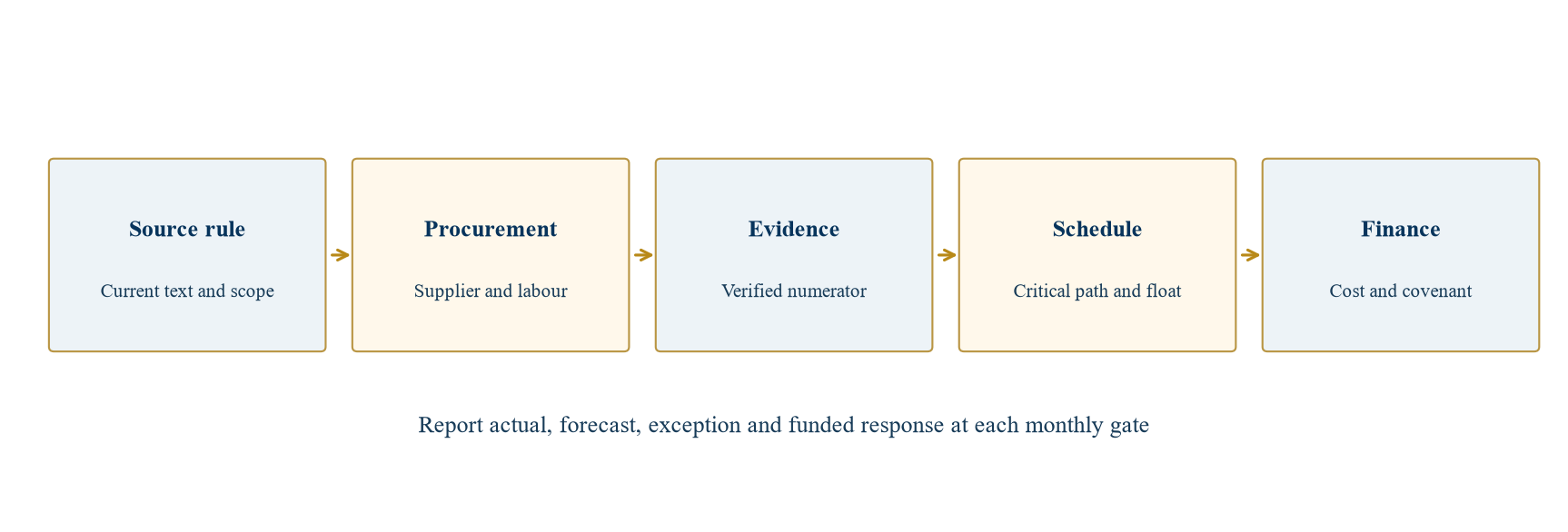
Author-developed management loop; arrows show information flow rather than a legal order of precedence.
16 Negotiate a cure hierarchy before it is needed
A useful cure hierarchy begins with evidence correction, then operational recovery, then compliant substitution, funded compensation where legally permitted, and finally a formal amendment or waiver. The hierarchy is not a promise that a regulator will accept each step. It provides a disciplined order for deciding what can be done, by whom and before what deadline. Counsel should confirm which remedies exist under the governing instrument.
Evidence correction applies when activity was compliant but poorly recorded. It requires an audit trail and a deadline for resubmission. Operational recovery applies when future local purchases or labour can restore a cumulative target. It needs a credible forecast and supplier commitments. Substitution applies when the planned source fails; it needs technical qualification, price and schedule impact. Compensation or penalty can apply only where the actual rule permits it and should not be assumed to replace a mandatory physical requirement.
An amendment may be necessary when scope has changed so substantially that the original target is no longer coherent. It can require authority, grantor, lender and contractor consent. A lender waiver of its own covenant does not amend the public contract. Conversely, an authority's acceptance of a revised target may leave the loan's model or reporting covenant unchanged. The consent matrix should show each document to be altered and any conditions to effectiveness.
Cure should preserve safety, service and evidence integrity. A sponsor should not purchase an unqualified component simply to improve a compliance ratio; nor should it count work performed outside the eligible scope. If time is too short for a safe cure, the board needs an honest forecast, a revised completion and funding case, and a negotiation strategy grounded in available contractual rights. Delaying disclosure can destroy more value than the initial variance.
17 Match sponsor support and reserves to the residual risk
The sponsor support package should cover exposure that cannot be passed to a creditworthy contractor or funded from contingency. It can include a capped cost-overrun commitment, equity cure, letters of credit, funded reserve or delayed distributions. The credit team should specify trigger, amount, form, expiry and claim procedure. A promise to “provide additional support as needed” can be difficult to price and may be ineffective when the parent has competing obligations.
The reserve should reflect actual project exposure, not an invented universal percentage of EPC cost. It may cover supplier qualification, alternate procurement, extra reporting, penalties where lawful and liquidity during delayed revenue. The size should be derived from item-level cost and schedule stresses. The hypothetical severe case above illustrates how a USD 60 million contingency can be almost exhausted by a USD 58.6 million combined cost. Its invented USD 20 million unused-contingency threshold then creates an USD 18.6 million funding gap. These figures are a teaching device only.
Release conditions should be as precise as funding conditions. A reserve might be released when a certifying body accepts the final local-content account, when the authority's challenge period expires or when a specified report is delivered. If release depends on an event outside the project company's control and without a deadline, sponsor capital can remain trapped. The investment committee should model that trapped cash and the potential effect on refinancing or exit.
The lender should also assess concentration of support. A supplier guarantee, EPC performance bond and sponsor support may all depend on the same corporate group or bank. Correlated failure reduces protection. The credit memo should show ultimate obligors, claim ranking, available amount after other calls and timing to cash. A contractual right is valuable only to the extent it can fund a cure before the project reaches a default or long-stop.
18 Run a negotiated downside before financial close
The negotiating team should test at least four paths: on-time compliant delivery, a recoverable reporting variance, a critical-source failure with substitution, and an unresolved authority challenge at physical completion. Each path needs dated construction, cash and contract consequences. A useful scenario records the earliest warning, the party with decision authority, cash required before recovery, latest cure date and resulting lender position. It should not assign unsupported probabilities to outcomes.
The critical-source failure path is often decisive. If a locally qualified switchgear supplier misses factory acceptance, the EPC schedule may need a replacement. The team should test whether an alternate supplier is legally eligible, technically equivalent and available in time. The model should show procurement premium, retesting, storage, carry and delayed revenue. The contract should say whether the EPC contractor, project company or public counterparty bears each item. A risk label without this path cannot support a debt-sizing decision.
The authority-challenge path is different. The asset may pass performance tests and start producing power or water, but final local-content evidence may remain disputed. The documents should tell the team whether revenue may begin, whether debt converts, whether sponsor support remains, what amount is retained and who pursues the administrative route. The board can then decide whether the hold is tolerable. The response depends on the actual concession, loan and public rule.
The scenario exercise should include a stop decision. If the only viable compliant supplier cannot meet the design, the project may need redesign before bidding or a smaller debt commitment. If an authority will not agree an objectively measurable completion route, the lender may decline the risk or demand stronger support. Making this decision before financial close can preserve capital; after full draw it becomes a restructuring problem.
Table 3. Dated decision gates for a financed local-content commitment
| Gate | Evidence needed | Decision | Cash or covenant consequence |
|---|---|---|---|
| Bid approval | Rule, supplier capacity, score claim | Commit, modify or decline | Price and sponsor exposure |
| Financial close | Executed obligations, baseline ledger, supplier plan | Set draw and support package | Initial availability of debt |
| Monthly construction | Actual and forecast compliance, cost-to-complete | Continue, cure or escalate | Contingency, equity, draw response |
| Critical-source failure | Failed test, alternate source, schedule | Substitute, redesign or seek amendment | Delay carry and funding gap |
| Physical completion | Engineering tests and permits | Accept technical performance | Revenue and construction-loan conversion |
| Local-content final account | Audit, official response and deficiency list | Release, cure or dispute | Retention, reserve and support release |
Author-developed execution template; fill with project-specific dates, thresholds and authority decisions.
19 Execute one document-controlled sequence
Before bid, the sponsor should commission local-counsel interpretation of the applicable requirement and a technical market test. The bid approval paper should state the exact promised metric, eligible scope, credible supplier or workforce path, price premium and likely evidence burden. It should distinguish policy objectives from contractual duties. The sponsor should retain the bid file because a later dispute often turns on what was offered and incorporated into the award.
Before financial close, the project company should align the concession, grant or offtake, EPC contract, key subcontracts, direct agreements and loan documents. The same defined terms should refer to the same metric and period. The independent engineer's mandate should match the tests it can perform. The base model should contain a supported procurement schedule and an itemised downside. The board should approve sponsor support and reserve limits in light of the residual risk.
During construction, the EPC contractor supplies a monthly ledger, supplier status, workforce forecast and exception report. The owner reconciles it to progress and payment. The engineer checks critical packages and completion forecast. Finance updates cost-to-complete and coverage. If a variance crosses an agreed trigger, the borrower issues notices and presents a funded cure. The lender decides under the actual agreement, using evidence rather than an unsupported percentage claim.
At physical completion, the technical tests, permits and safe operating capability should be certified in their own terms. The parties then apply the contract's separate local-content evidence and acceptance route. If unresolved, they implement the agreed reserve, retention or support mechanism and pursue the identified dispute or cure process. After final account, documents should preserve records long enough for audit and future refinancing. The responsible team should close the issue formally; silence is not proof of compliance.
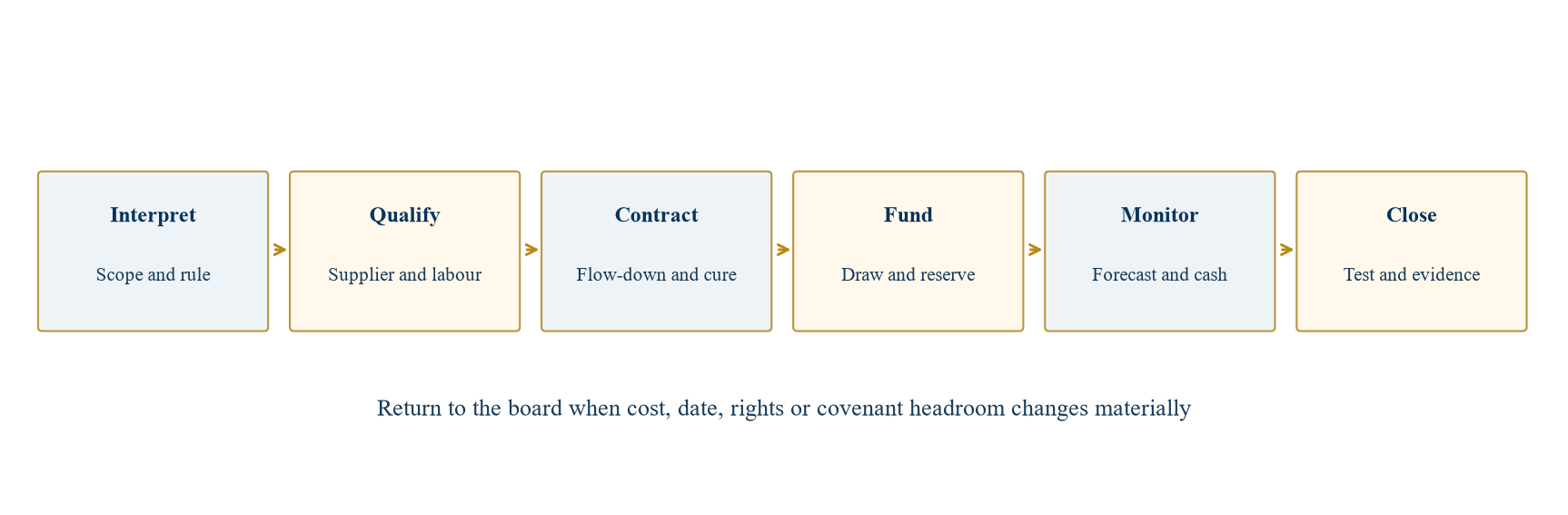
Author-developed transaction sequence; contractual and legal timing varies by project.
20 State the limits and the executable choice
The cited programmes differ in jurisdiction, legal source, scope, metric, decision-maker and remedy. Saudi government procurement rules cannot be assumed to govern a private UAE energy project. The UAE certificate process does not itself define the completion test of a specific concession. The World Bank's local-labour requirement applies only within its stated procurement scope. US domestic-content preferences depend on covered assistance and agency terms. UK social-value rules are neither a general domestic-source quota nor a substitute for a particular contract. Current local advice and executed documents decide applicability [1-8].
The numerical project is wholly hypothetical. Its USD 600 million total, USD 420 million debt, USD 180 million equity, 8% carry rate, cost and delay stresses, USD 20 million illustrative reserve threshold, USD 70 million CFADS and USD 50 million debt service were selected solely to demonstrate arithmetic. The example omits real draw profiles, tax, hedging, liquidated-damages timing, grants, inflation, legal costs and refinancing. Its 1.40 and 1.32 coverage ratios do not represent observed debt covenants. No claim is made about a real asset's economics or a lender's actual risk appetite.
The choice for a sponsor is to state the local-content promise in measurable project terms before price and debt are fixed. The choice for a lender is to see how that promise can affect critical path, cash, cure and conversion. The choice for a public counterparty is to define evidence and remedies that reward genuine capability without making completion indeterminate. These decisions can be recorded in one controlled package: source-of-obligation register, qualified-supply plan, evidence ledger, contract matrix, cost-to-complete model, downside schedule and decision log.
The next action on a live mandate is therefore a document reconciliation. The project team should place the procurement text, bid, concession, grant, EPC, loan and technical completion definitions side by side. It should identify every point at which a local-content variance changes a payment, certificate, deadline or funding right, and then verify that a funded cure can occur before the consequence becomes irreversible. That is the practical meaning of making localisation financeable.
References
- Saudi Ministry of Finance. Regulations on Preference for Local Content and Local SMEs and Companies Listed on the Capital Market in Business and Procurement Transactions, English translation of Council of Ministers Resolution No. 245, 26 November 2019. Accessed 6 October 2026. https://budget.mof.gov.sa/en/docslibrary/RegulationsInstructions/Documents/Regulations%20on%20Preference%20for%20Local%20Content%20and%20Local%20SMEs%20and%20Companies%20Listed%20on%20the%20Capital%20Market%20in%20Business%20and%20Procurement%20Transactions2.pdf
- UAE Ministry of Industry and Advanced Technology. Issuing an ICV certification. Accessed 6 October 2026. https://moiat.gov.ae/services/issuing-an-icv-certification
- ADNOC. In-Country Value Creation. Accessed 6 October 2026. https://www.adnoc.ae/empowering-people-and-driving-prosperity/creating-in-country-value
- World Bank Group. Strengthens Procurement Requirements to Support Job Creation, Skills Development. 18 July 2025. Accessed 6 October 2026. https://www.worldbank.org/en/news/press-release/2025/07/18/world-bank-group-strengthens-procurement-requirements-to-support-job-creation-skills-development
- World Bank Group. Local Labor Participation Requirements, August 2025. Accessed 6 October 2026. https://thedocs.worldbank.org/en/doc/9e927e1a1da158bb935ea6aba07bb016-0290012025/original/Local-Labor-Training-August-2025.pdf
- US Department of Energy. Build America, Buy America. Accessed 6 October 2026. https://www.energy.gov/management/build-america-buy-america
- UK Cabinet Office. Procurement Policy Note 002: Taking account of social value in the award of contracts. Updated 5 March 2025. Accessed 6 October 2026. https://www.gov.uk/government/publications/ppn-002-taking-account-of-social-value-in-the-award-of-contracts
- UK Cabinet Office. Guidance: Covered Procurement Objectives. Updated 15 April 2026. Accessed 6 October 2026. https://www.gov.uk/government/publications/procurement-act-2023-guidance-documents-plan-phase/guidance-covered-procurement-objectives-html
- World Bank PPP Reference. Risk Allocation in Public Private Partnerships. Accessed 6 October 2026. https://ppp.worldbank.org/risk-allocation
- World Bank PPP Reference. Construction Contracts Checklist. Accessed 6 October 2026. https://ppp.worldbank.org/ppp-overview/practical-tools/checklists-risk-matrices/construction-contracts-checklist
- International Finance Corporation. Good Practice Note: Managing Contractors' Environmental and Social Performance. October 2017. Accessed 6 October 2026. https://www.ifc.org/en/insights-reports/2017/publications-gpn-escontractormanagement
- International Finance Corporation. Project Cycle. Accessed 6 October 2026. https://www.ifc.org/en/what-we-do/products-and-services/ifc-project-cycle
- International Finance Corporation. Central Termica de Temane, project disclosure. Accessed 6 October 2026. https://disclosures.ifc.org/project-detail/ESRS/43099/central-termica-de-temane
About the Author
Chennakeshav (CK) is a corporate finance and investment banking executive with 25+ years of global experience in deal origination, structuring and execution across M&A, growth capital and corporate strategy. He has led value-creation mandates for founders, corporates and funds — bridging the boardroom view to hands-on execution and close.
His career spans Morgan Stanley, HSBC, Lloyds Banking Group, EWEC, ADQ portfolio companies and Emirates Growth Fund, across TMT, real estate, fintech, deeptech, cleantech, infrastructure and energy. He has partnered with C-suite leaders, private equity and venture funds, sovereign wealth funds and family offices to finance complex fund raises and scale-up ventures, and has led M&A due diligence, post-merger integration and business-transformation initiatives to create value.
At Matchpoint Partners he is Managing Partner, leading the firm's corporate finance, M&A and capital-raising practice. He holds an MBA from London Business School, an engineering degree from VTU and a Master of Laws (LLM, in progress) from UCL London.
An active start-up mentor, CK mentors at Techstars, DIFC FinTech Hive, Startup Grind, Founder Institute and IN5, serves as Entrepreneur Mentor in Residence (EMiR) at London Business School, and judges the Entrepreneurship World Cup.
