

1. Define the financing decision
The decision is whether a specific infrastructure project can replace or supplement bank and foreign-currency debt with a long-dated bond whose principal and interest are payable in the same currency as the project's durable revenues. The purpose is to improve lifecycle financing resilience, not merely to obtain a different label for existing debt.
The board should compare at least four executable routes: retained bank debt, a domestic syndicated loan, an onshore project bond and a combined bank-bond structure. Each route should be evaluated on net proceeds, all-in cost, tenor, amortisation, reserves, security, covenants, hedging, disclosure, execution certainty and capacity to withstand downside conditions.
Local currency removes a direct currency mismatch only when cash inflows are genuinely local-currency based. Revenues linked to a foreign currency, imported operating costs, offshore shareholder commitments and hard-currency maintenance can retain substantial exposure. The financing case must map each currency inflow and outflow before stating the benefit.
The decision record should distinguish project-level readiness from market-level readiness. A bankable asset can face an immature bond market, while a deep government market does not establish demand for a first-time infrastructure issuer. Both dimensions require evidence [1][2].
2. Use a five-gate bond system
The Local-Currency Infrastructure Bond System uses five approval gates. Gate One proves the project's revenue, operating and legal foundations. Gate Two establishes the currency and inflation match. Gate Three demonstrates investor and market capacity. Gate Four designs credit, liquidity and structural protection. Gate Five controls execution, allocation and continuing disclosure.
Each gate should identify evidence, accountable owner, decision authority and stop condition. The project cannot progress because an arranger expects demand or because a guarantee is under discussion. Investor feedback, eligibility analysis, legal opinions, technical reports and committed credit support must replace optimistic assumptions.
The gates are sequential enough to prevent wasted execution cost and iterative enough to allow market feedback to improve structure. An early investor sounding may reveal a rating threshold. The issuer can then test whether reserve, amortisation or credit enhancement can meet that threshold without producing an uneconomic transaction.
The approval paper should show what remains unresolved at every gate. A qualified approval should carry explicit conditions, owners and deadlines. Conditions that affect debt capacity, enforceability, currency alignment or investor eligibility must be resolved before launch.
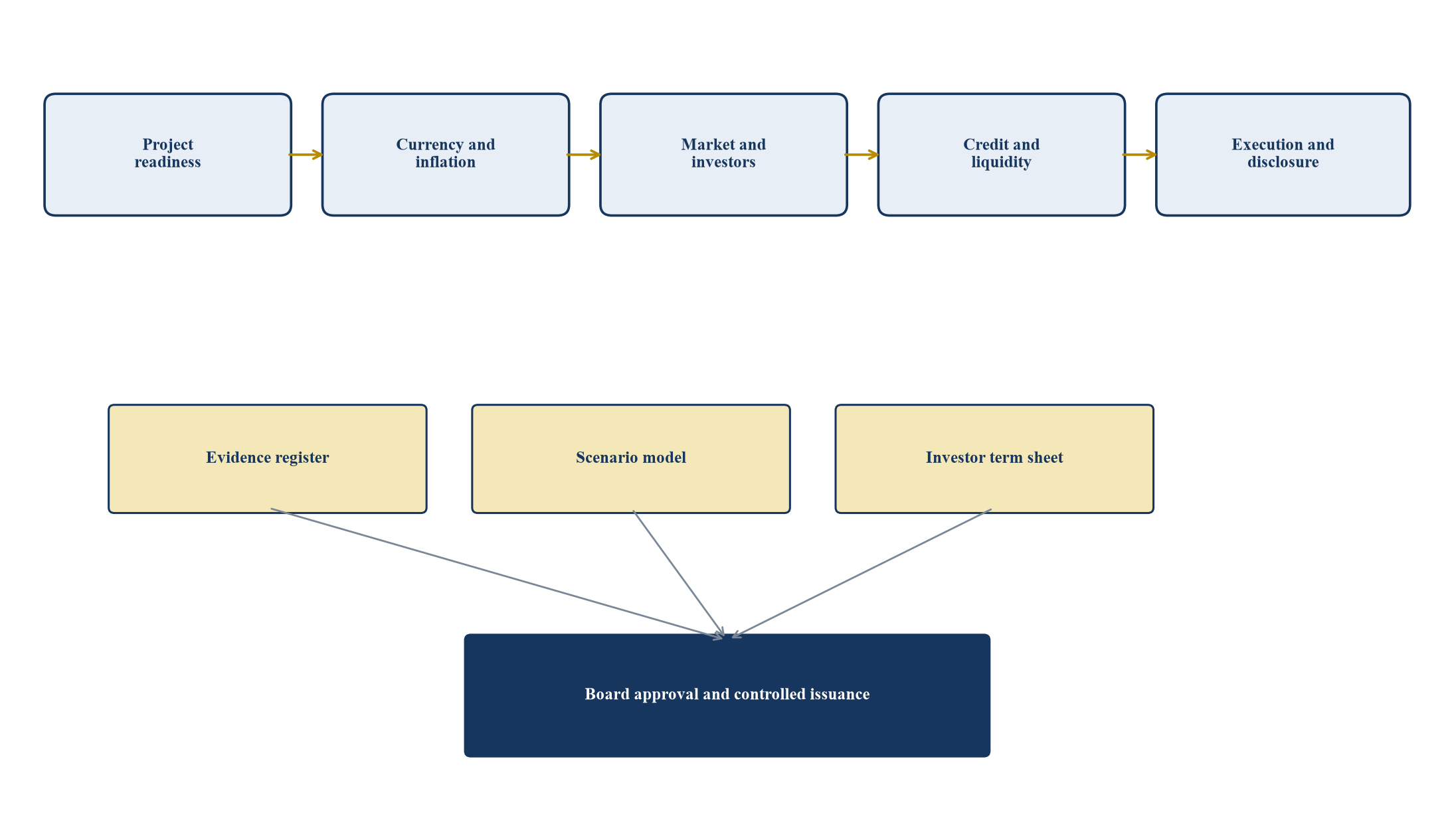
The proposed architecture connects project evidence, currency alignment, domestic market capacity, credit protection and controlled execution.
3. Map revenue currency before debt currency
The project should decompose revenue into tariff, availability, capacity, usage, subsidy, grant, ancillary and compensation components. Each component should be classified by denomination, payment currency, indexation, payer, payment timing, deduction regime and legal convertibility. A tariff stated in local currency can still contain a hard-currency adjustment or a delayed pass-through mechanism.
The cash-flow model should map operating and lifecycle expenditure by currency. Imported equipment, fuel, software licences, insurance, specialist maintenance and shareholder services can create residual hard-currency needs. A local-currency bond may reduce debt mismatch while leaving a material operating mismatch that needs reserves, contractual pass-through or a separate hedge.
Payment reliability matters alongside denomination. A local-currency public counterparty can delay payment, apply deductions or face budget constraints. The project must test collection evidence, appropriation mechanics, termination payments and dispute remedies. Currency alignment does not repair weak cash conversion.
World Bank analysis treats alignment of revenue inflows and financing outflows as a primary risk-reduction mechanism, while recognising that residual exposure may require financial or contractual mitigation [2]. The transaction should quantify both the eliminated mismatch and the exposure retained.
4. Separate nominal, real and indexed cash flows
Infrastructure tariffs can be fixed in nominal terms, linked to consumer prices, linked to sector inputs, reset periodically or determined through regulatory review. Debt service can be fixed, floating, inflation linked or sculpted. The financing model must compare these cash-flow bases explicitly.
A nominal fixed-rate bond can provide payment certainty while exposing coverage to operating-cost inflation. An inflation-linked bond can better match indexed revenues, yet index lags, caps, floors and basis differences can create coverage volatility. A floating-rate bond transfers benchmark risk into the project and can weaken the value of long tenor.
Indexation should be mapped at formula level. The model should state the index, publication lag, reset date, base period, cap, floor, pass-through fraction and treatment during extraordinary inflation. It should also test whether the debt index and revenue index behave differently under the same macroeconomic shock.
The board should select the structure that protects real debt capacity across plausible inflation paths. A lower opening coupon can be misleading when principal accretion, basis mismatch or delayed tariff adjustment shifts risk into later years.
5. Diagnose the sovereign curve
A functioning government bond curve provides benchmarks for pricing, valuation, collateral and investor portfolio construction. IMF and World Bank guidance identifies money markets, primary issuance, the investor base, secondary markets, financial-market infrastructure and the legal-regulatory framework as core local-currency-market building blocks [3].
The issuer should examine benchmark tenors, auction regularity, outstanding volume, bid-ask spreads, turnover, repo eligibility, settlement, custody, withholding tax and yield volatility. A quoted twenty-year sovereign yield has limited usefulness when the line rarely trades or investors cannot finance positions efficiently.
The project spread should be analysed over the relevant sovereign point and on an absolute-yield basis. Institutional investors may be constrained by liability targets, regulatory capital or internal return hurdles. The transaction can fail even when the spread appears attractive if the absolute yield, duration or liquidity profile does not fit portfolios.
The financing committee should test curve movement between approval and launch. Pricing limits should specify benchmark, spread, all-in yield and net-present-value thresholds. This prevents an apparent spread success from concealing an unacceptable rise in the underlying curve.
6. Measure domestic absorption capacity
Domestic absorption capacity is the amount of appropriately tenored risk that investors can purchase without breaching regulation, concentration limits, liquidity needs or internal credit standards. Aggregate pension and insurance assets are an upper bound, not a transaction order book.
The issuer should segment banks, pension funds, insurers, mutual funds, sovereign funds, asset managers, wealth platforms and qualified individuals. For each segment, it should document eligible instruments, rating thresholds, duration appetite, mark-to-market treatment, sector limits, single-name limits and capacity for private or listed bonds.
Investor interviews should use a consistent term sheet. Questions should cover preferred amortisation, coupon basis, minimum rating, security, guarantee value, liquidity, reporting, ticket size and approval timetable. Indicative interest should be recorded with conditions and expiry dates.
ADB and IFC describe local-currency issuance as both a funding tool and a market-development mechanism [4][5]. A first issue should still be sized to evidenced demand. Oversizing can create failed allocation, price concessions or concentration in a narrow investor group.
7. Build the project credit case
The credit case should begin with the project's legal and economic perimeter. It should identify the issuer, secured group, assets, licences, material contracts, revenue rights, operating obligations, accounts, reserves, security and permitted transfers. The bond documents and financial model must use the same perimeter.
Operating evidence should cover availability, output, demand, tariff application, billing, collection, operating cost, maintenance, working capital and lifecycle expenditure. Historical results should reconcile to accounts and bank statements. Forecast changes should be traceable to contracts, approved budgets or explicitly stated management assumptions.
The project should classify revenue as availability based, demand based, regulated, contracted commodity, merchant or mixed. Each form creates different exposure to counterparty quality, volume, price, curtailment, deductions and regulatory action. The bond structure should respond to the actual revenue mechanism.
The credit memorandum should state the decision-relevant weaknesses. Investors need a bounded explanation of risk, mitigants and residual exposure. Promotional language cannot substitute for evidence on collections, asset condition, contractual enforceability and downside cash flow.
8. Establish completion and operating readiness
Project bonds can finance construction, refinance operations or combine phases through credit enhancement. A local institutional investor may accept operating risk while declining construction, ramp-up or technology risk. The proposed issuance point should reflect that boundary.
Completion evidence should cover tests, certificates, permits, defects, claims, warranties, contractor security, insurance and independent technical review. Operating evidence should demonstrate stable conversion of physical performance into cash available for debt service over an appropriate period.
Ramp-up assumptions require explicit exit criteria. Temporary sponsor support, deferred maintenance, exceptional compensation and favourable working capital should be normalised. A project that reaches commercial operations can remain unsuitable for bond financing if cash flow depends on unresolved technical or collection conditions.
The board should compare the value of issuing now with the value of waiting for stronger evidence. A later issue can reduce spread or support longer tenor, while delay can expose the project to benchmark movement and bank-refinancing pressure. Both effects belong in the decision model.
9. Select the issuer and security architecture
The bond can be issued by the project company, a financing vehicle, a holding company or a pooled platform. The structure should preserve bankruptcy remoteness, cash-flow control, enforceable security and a clear relationship between bondholders and the operating asset.
The security package can include shares, project assets where legally permitted, material contracts, accounts, receivables, insurance proceeds and sponsor undertakings. The analysis should identify perfection, registration, priority, enforcement timing, public-law constraints and any asset or contract that cannot be transferred.
A financing vehicle can improve issuance mechanics but may add structural subordination, tax, account and insolvency complexity. Cash should not depend on discretionary upstreaming through entities exposed to unrelated creditors. Legal opinions should address capacity, authority, enforceability, security and insolvency assumptions.
The structure should also accommodate local settlement, depository and trustee requirements. A theoretically strong security package can lose practical value if enforcement is slow, the trustee lacks authority or payment and account controls do not operate under local law.
| Gate | Required evidence | Decision owner | Stop condition |
|---|---|---|---|
| Project readiness | Contract, operating, collection, technical and legal evidence | Board and credit committee | Cash flow or enforceability remains materially unresolved |
| Currency alignment | Revenue, cost, indexation and convertibility map | Finance and risk committees | Material mismatch lacks an executable mitigant |
| Market capacity | Sovereign curve, eligibility analysis and documented investor feedback | Financing committee | Demand is assumed or concentrated beyond approved limits |
| Credit protection | Rating case, reserves, covenants, security and committed enhancement | Credit and risk committees | Target resilience depends on uncommitted support |
| Execution | Approved terms, allocation, disclosure, settlement and contingency plan | Board and pricing committee | Terms exceed approved risk or value limits |
The evidence and stop conditions require transaction-specific legal, financial, technical, market and regulatory review.
10. Design amortisation around asset cash flow
Amortisation should reflect cash generation, asset life, maintenance and termination economics. A level-payment schedule can fit predictable cash flows. Sculpted debt service can stabilise coverage, while equal-principal amortisation reduces exposure faster. A bullet structure preserves early cash but creates concentrated refinancing risk.
The schedule should maintain a debt tail before contract or concession expiry. It should also consider major maintenance, tariff resets, licence renewals and periods of forecast volatility. Cash sweeps can accelerate repayment after strong performance, while distribution lock-ups protect liquidity after weak performance.
The issuer should test legal and market conventions. Domestic investors may prefer bullet or sinking-fund structures, and regulations may treat amortising instruments differently. Investor preference should inform design without overriding project resilience.
The board should compare total interest, average life, minimum coverage, refinancing exposure and distribution capacity across structures. A long stated maturity can offer little protection when a large bullet remains unsupported by demonstrated refinancing capacity.
11. Size debt with multiple constraints
Debt sizing should use annual and minimum debt-service coverage, loan-life coverage, project-life coverage, leverage, reserve adequacy and debt tail. The controlling amount is the lowest supported by economic resilience, rating, investor eligibility, legal limits, market capacity and governance standards.
The model should separate observed history, contracted inputs, approved budgets and management scenarios. Each adjustment to cash available for debt service should be defined consistently with the documents. Restricted cash, insurance proceeds, grants and extraordinary compensation require explicit treatment.
Debt capacity should be tested under combined stresses. Inflation can raise operating cost while monetary tightening raises refinancing yield. Currency weakness can increase imported costs and reduce foreign-investor appetite. Counterparty delay can coincide with maintenance expenditure. Single-variable sensitivity understates these interactions.
The financing committee should review a smaller issue alongside the maximum case. Reduced proceeds can improve rating headroom, investor diversification and lifecycle resilience. Capacity left unused can be economically valuable when it protects the project through stress.
12. Use credit enhancement with a defined purpose
Credit enhancement should solve a specific constraint: rating threshold, tenor, construction risk, liquidity, counterparty exposure, first-loss protection or investor familiarity. World Bank guarantees can support loans and bonds, including project bonds, to improve market access and tenor [6].
Possible instruments include partial credit guarantees, partial risk guarantees, liquidity facilities, subordinated tranches, first-loss reserves, debt-service support and political-risk cover. Each instrument transfers a defined exposure and leaves residual risk with the project or investors.
The issuer should calculate guarantee fee, coverage period, claim triggers, exclusions, cure rights, reimbursement, counter-guarantee, termination and disclosure effects. A high nominal coverage amount can provide limited value when timing, conditionality or exclusions do not match the project's stress path.
Enhancement should support market formation without concealing an unbankable project. OECD's 2025 analysis highlights infrastructure guarantees as a route to mobilising domestic institutional capital and describes Nigeria's InfraCredit model [1]. Replicability depends on local law, capital, rating, governance and investor rules.
13. Design reserves and liquidity protection
The bond should define debt-service, maintenance, tax, insurance, working-capital and lifecycle reserves. Each reserve needs a target, funding method, permitted use, replenishment rule, account control and release condition. Duplicated reserves can make the structure uneconomic, while thin reserves transfer ordinary volatility into default risk.
Liquidity should be sized to the timing of stress. A counterparty delay may require several payment periods of debt service. A major maintenance event may require a dedicated funded account. A standby facility has value only when capacity, draw conditions, term and provider credit are established.
The model should show reserve movement under central and downside cases. It should distinguish a temporary draw that cures from a persistent shortfall that merely delays restructuring. Replenishment priority affects both investor protection and equity distributions.
Reserve assets should comply with permitted-investment, custody and concentration rules. Local-currency cash can still face bank, sovereign and inflation exposure. The investment policy should preserve availability and principal rather than seek incremental yield inconsistent with the reserve's purpose.
| Choice | Potential benefit | Principal risk | Evidence required |
|---|---|---|---|
| Fixed-rate nominal bond | Predictable nominal debt service | Inflation can compress real coverage | Revenue and cost inflation analysis |
| Inflation-linked bond | Better match to indexed revenue | Basis, lag and principal accretion | Formula-level indexation model |
| Amortising bond | Declining exposure and lower refinancing concentration | Higher early debt service | Cash-flow and investor-demand evidence |
| Bullet bond | Lower early debt service | Large maturity and market-access risk | Credible take-out and sinking-fund plan |
| Partial credit guarantee | Rating or tenor uplift | Fee, conditionality and residual risk | Committed term sheet and rating analysis |
| Pooled issuance | Scale and diversification | Cross-asset governance and contagion | Eligibility, allocation and servicing framework |
The matrix is a decision aid. Legal, tax, regulatory and market treatment must be verified for the relevant jurisdiction.
14. Build covenant architecture around risk
Covenants should create early information and controlled remedies before cash impairment becomes default. Financial tests can include coverage, leverage, reserve funding and distribution conditions. Operational tests can address maintenance, insurance, permits, material contracts and asset disposal.
Definitions determine effectiveness. Cash available for debt service, permitted debt, restricted payments, major maintenance and force majeure should match the economic model and legal structure. Broad add-backs or cure rights can weaken an apparently strong ratio.
The covenant package should distinguish information undertakings, incurrence tests, maintenance tests, lock-up events and events of default. Remedies should be proportionate and executable. Automatic acceleration can destroy value when a controlled cash trap and remediation plan would better protect investors.
The issuer should test covenant behaviour in every downside case. The model should identify first trigger, trapped cash, cure capacity, reserve use and time to default. Investors and the board need the same understanding of how protections operate.
15. Address rating and regulatory eligibility
A rating can support price discovery, investor eligibility and continuing surveillance. The issuer should determine whether a local-scale, national-scale or international-scale rating is relevant and how investors interpret each scale. Ratings should not be compared across scales without adjustment.
The rating case should analyse construction or operating risk, revenue quality, counterparty exposure, operations, lifecycle needs, debt structure, liquidity, sovereign linkage and legal protections. The issuer should maintain a reconciliation between the rating model and its own downside case.
Regulatory treatment can control demand. Pension and insurance rules may specify minimum rating, listing, duration, concentration, valuation, custody and capital treatment. The transaction team should obtain current local advice and map each target investor segment to the applicable rule.
A rating target should be treated as a constraint, not a guaranteed outcome. The board should pre-approve responses to a weaker indication: reduce debt, increase reserve, add enhancement, adjust amortisation, change investor focus or defer the issue.
16. Plan primary issuance and price discovery
The issuance strategy should define format, listing, documentation, investor education, bookbuilding, allocation and settlement. A debut project bond may need a longer education period than a repeat sovereign or bank issuer. The timetable should allow investors to complete technical and legal diligence.
Price discovery should use the sovereign curve, comparable corporate and infrastructure bonds, bank alternatives, rating, duration, liquidity and enhancement. Comparables should be adjusted for currency, tax, seniority, amortisation, security and market conditions.
The issuer should establish a pricing committee with delegated limits for benchmark, spread, yield, proceeds, tenor, amortisation, fees and allocation. The committee should receive a live value bridge showing the effect of market movement and structural changes.
Allocation should support diversification and continuing market quality. Concentrating the issue with one bank treasury or affiliated investor can complete settlement while leaving weak price discovery and refinancing depth. Allocation records should identify investor type, ticket size and material conditions.
17. Treat secondary liquidity as a design variable
Infrastructure bonds are often buy-and-hold instruments, yet secondary liquidity affects valuation, investor approval and resilience during stress. BIS research links market liquidity and resilience to investor diversity and hedging-market depth [7].
The issuer should assess issue size, free float, listing, market making, repo eligibility, pricing transparency, settlement and availability of independent valuation. A small amortising bond can become progressively less liquid as principal declines.
Liquidity support must avoid false promises. A dealer's intention to quote does not guarantee two-way markets in stress. The offering materials and investor communications should accurately describe arrangements, constraints and termination rights.
The board should incorporate an illiquidity premium into route comparison. A bond can remain attractive if investors accept illiquidity for stable cash flow, credit protection and suitable yield. The economic model should not assume tight secondary spreads merely because the bond is listed.
18. Evaluate domestic and foreign investors separately
Domestic investors may have natural local-currency liabilities, regulatory familiarity and lower currency mismatch. Foreign investors can broaden demand and introduce external pricing discipline, while their returns depend on exchange rates and hedging.
BIS evidence shows that dollar strength and global risk appetite influence flows into emerging-market local-currency bonds [8]. Foreign ownership can therefore increase sensitivity to global conditions even when the issuer's debt is denominated locally.
The allocation strategy should test withdrawal of foreign demand, domestic concentration and bank absorption. It should identify the marginal buyer in normal and stressed conditions. A transaction relying on unhedged foreign demand should not be described as insulated from currency volatility.
Investor reporting may also differ. Domestic institutions can require local regulatory templates, while international investors can require broader disclosure, sanctions screening, tax analysis and custody access. The cost and governance burden should be included in the financing comparison.
19. Compare onshore and offshore local-currency formats
A local-currency bond can be issued onshore or offshore, including currency-linked formats in which settlement mechanics differ from the economic denomination. ADB describes both onshore and offshore local-currency issuance as tools that can support funding and market development [5].
The issuer should compare governing law, investor access, clearing, settlement, tax, convertibility, documentation, listing, disclosure and enforcement. Offshore access can widen distribution but introduce basis, transfer or settlement complexities. Onshore issuance can deepen domestic markets while facing narrower demand.
Proceeds should reach the project in the required currency and timing. Any swap, conversion or transfer arrangement should be documented with counterparty exposure, collateral, termination and replacement assumptions. The project must understand who carries convertibility and transfer risk.
The board should choose the format that offers the strongest executable fit. Market-development objectives can form part of the rationale, provided the issuer's value, resilience and governance remain within approved limits.
20. Model the hypothetical transaction
The hypothetical project earns indexed local-currency availability revenue and has completed two years of operations. It considers refinancing LCU 15.0 billion of bank debt with an LCU 14.5 billion seventeen-year amortising bond. The proposed bond has a 9.10 percent fixed coupon, a six-month debt-service reserve and a partial credit guarantee covering scheduled debt service within defined limits.
The model assumes annual cash flow available for debt service of LCU 2.35 billion in the opening year, increasing with the eligible revenue index. Transaction and guarantee costs are LCU 0.42 billion. The existing bank facility carries a floating all-in rate of 10.40 percent and has nine years remaining. All assumptions are illustrative and do not represent a market forecast or offer.
The comparison uses the same operating cash flows and valuation date. It calculates annual debt service, minimum coverage, average life, total nominal interest, present value of financing cost, reserves, fees, distributions and maturity exposure. It also identifies which risks change between routes.
The decision is not determined by the opening coupon. The bond extends duration and fixes the rate, while introducing disclosure, guarantee and market-governance costs. The model measures that package against retained bank flexibility and refinancing exposure.
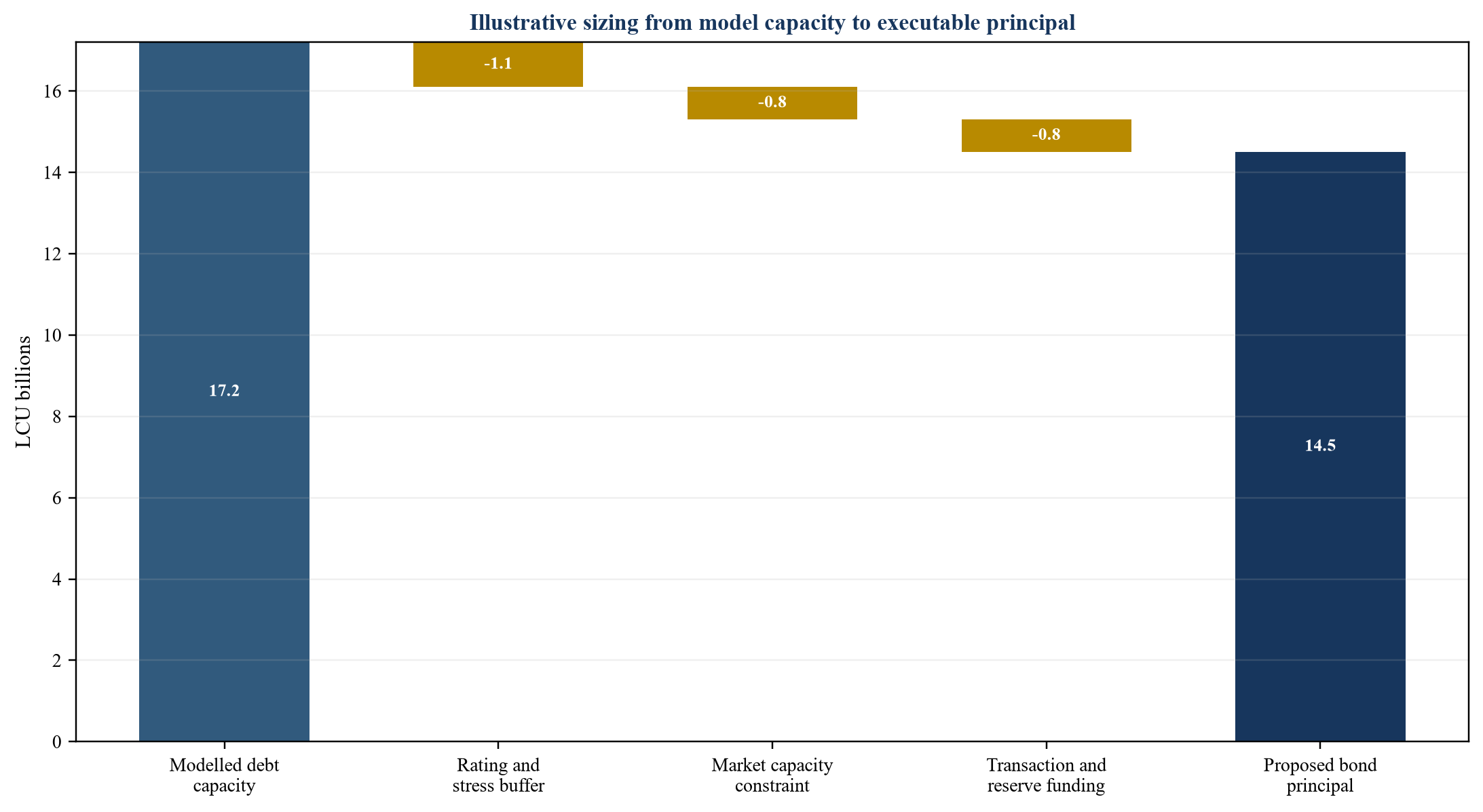
Values are illustrative management assumptions in LCU billions. They are not observed data, forecasts, offers or investment advice.
21. Stress the complete risk system
The hypothetical analysis uses four cases. The central case applies the stated revenue and cost assumptions. The inflation-lag case raises operating cost before revenue indexation catches up. The combined stress reduces availability, delays public payments and raises maintenance cost. The market-delay case assumes issuance occurs one year later at a 1.25 percentage-point higher yield.
The model should show debt-service coverage, reserve use, covenant triggers, liquidity minimum, distributions and outstanding debt in each case. It should also show whether the guarantee responds, how quickly it pays and whether reimbursement creates a future obligation.
Stress design should avoid double counting and omission. A sovereign shock can affect inflation, rates, currency, public-counterparty capacity and investor demand at the same time. The analysis should state correlations and sequence rather than add arbitrary penalties without an economic mechanism.
The board should approve a structure that remains governable through stress. Survival can depend on timely information, cash control and enforceable remedies as much as on opening leverage.
| Scenario | Minimum coverage | Reserve draw | First control response | Decision implication |
|---|---|---|---|---|
| Central | 1.43x | None | Normal surveillance | Supports proposed structure subject to execution |
| Inflation lag | 1.26x | None | Distribution lock-up watch | Test index basis and operating-cost protection |
| Combined operating and payment stress | 1.08x | LCU 0.38bn | Cash trap and guarantee notice | Requires committed liquidity and cure governance |
| One-year market delay | 1.31x | None | Retain bank facility and reprice | Readiness value must exceed delay and rate cost |
All figures are illustrative management assumptions. Coverage is cash flow available for debt service divided by scheduled debt service.
22. Control public-sector and contingent-fiscal exposure
Government support can appear through availability payments, guarantees, termination compensation, subsidies, tax treatment, minimum revenue or convertibility arrangements. The transaction should identify direct, contingent and behavioural obligations across the project contract and financing support.
The public authority should test affordability, appropriation, accounting, disclosure and debt-sustainability treatment. A guarantee that improves the bond rating can shift risk to the public balance sheet. Its price and approval should reflect the exposure transferred.
Termination payments require particular attention. The amount, currency, timing, deductions, dispute process and relationship to outstanding debt should be modelled under project default, authority default and force majeure. Investors should understand what is legally due and what remains subject to process or budget.
The financing case should show whether project-bankability measures create broader fiscal concentration. Several individually supportable projects can produce aggregate exposure under a common macroeconomic or counterparty shock.
23. Integrate green, social and sustainability labels carefully
An eligible infrastructure asset may support a green, social or sustainability-labelled bond. The label can broaden investor interest and strengthen use-of-proceeds and impact reporting. It does not replace project-credit analysis.
The issuer should align the framework with applicable principles, define eligible expenditure, manage proceeds, obtain external review where appropriate and report allocation and impact. ICMA's Green Bond Principles emphasise use of proceeds, project evaluation, management of proceeds and reporting [9].
Refinancing should identify the look-back period, asset eligibility and allocation methodology. Environmental benefits should use transparent boundaries, baselines and calculation methods. Claims should be consistent across the bond framework, offering materials and public reporting.
The board should assess incremental cost, governance and investor value. A label should be used when the project can sustain the reporting obligations and evidence. Unsupported impact claims can create legal, reputational and refinancing risk.
24. Govern disclosure and continuing reporting
Bond investors require timely financial, operating and event information. The issuer should define audited accounts, management reporting, operating metrics, covenant certificates, reserve balances, material events and impact reporting before launch.
Data ownership should be assigned across the project company, operator, public authority, trustee and calculation agent. Reporting definitions should match the model and bond documents. A metric that cannot be produced reliably should not become a continuing covenant without a remediation plan.
Disclosure controls should cover preparation, review, approval, publication and correction. Material changes in contracts, regulation, permits, insurance, litigation, counterparties or technical condition require clear escalation. Selective disclosure to one investor should be managed under applicable law.
The reporting calendar should be tested against actual system capability. Manual reconciliations and delayed public-sector data can make an otherwise suitable bond operationally fragile. Readiness includes the capacity to meet the information contract after closing.
| Workstream | Minimum evidence | Independent challenge | Approval output |
|---|---|---|---|
| Project | Contracts, operating history, asset condition and cash reconciliation | Technical, legal and model review | Bankability memorandum |
| Currency and inflation | Revenue-cost-debt map and index formulas | Treasury and scenario review | Currency-alignment decision |
| Market | Curve, investor eligibility, soundings and allocation capacity | Adviser challenge and board limits | Executable funding range |
| Credit | Rating case, security, covenants, reserves and enhancement | Rating, legal and credit review | Approved term sheet |
| Execution | Disclosure, timetable, pricing, settlement and fallback | Verification and pricing committee | Launch authority |
| Surveillance | Reporting, covenant, reserve and event processes | Trustee and internal-control testing | Post-close operating plan |
The register should be tailored to the asset, jurisdiction, investor rules and proposed structure.
25. Control tax, accounting and regulatory treatment
The structure can affect withholding tax, deductibility, transfer pricing, transaction-cost amortisation, embedded derivatives, hedge accounting, consolidation and distributable reserves. Current advice is required in the issuer, project, guarantee and investor jurisdictions.
Tax incentives should be verified for instrument, issuer and investor eligibility. An exemption can expire, require listing or apply only to particular holders. The financial model should show both gross and investor-net yields where tax affects demand.
Accounting analysis should distinguish debt modification, extinguishment, guarantee fees, reserves and inflation-linked principal. Reported earnings and leverage can change without equivalent cash effects. The board paper should present accounting and cash consequences separately.
Regulatory approvals should be built into the critical path. Securities, exchange, central-bank, pension, insurance, competition, public-finance and sector approvals can affect structure and timing. Assumed approvals should not support launch authority.
26. Prepare a failed-issuance plan
The issuer should know its response if rating, demand, pricing, guarantee, approval or settlement falls outside the approved case. A contingency plan protects the project from accepting weak terms to avoid the appearance of failure.
Alternatives can include retaining the bank facility, amend-and-extend, a smaller bond, private placement, bridge finance, staged issuance or deferral. Each alternative needs current capacity, economics, conditions, lead time and approval authority.
Communications should be prepared for investors, banks, public authorities, contractors, employees and rating agencies. Messages should be accurate, coordinated and consistent with confidentiality and disclosure duties. Failed execution can impair later access when explanations are incomplete or contradictory.
The financing committee should set restart conditions. Market volatility, incomplete diligence, legal delay and weak project performance require different remedies. Diligence, consents and investor feedback should have expiry dates so stale evidence is not recycled.
27. Execute through a controlled transaction map
The transaction map should integrate project diligence, financial model, rating, enhancement, legal documentation, regulatory approvals, investor education, disclosure, pricing, allocation and settlement. Every dependency should have an owner and decision date.
The issuer should maintain one approved term sheet and one controlled model. Changes in principal, tenor, coupon, reserve, guarantee, covenant or fees should flow through cash, rating and legal analysis. Version confusion can create inconsistent investor communication and board approval.
Verification should cover factual statements, contracts, financial information, technical claims, risks and impact metrics. The process should record source, reviewer, exception and final approval. Material unresolved items should remain visible to the pricing committee.
Closing should include conditions precedent, funds flow, security perfection, reserve funding, guarantee effectiveness, listing, settlement and repayment of replaced debt. A post-close report should reconcile executed terms to the final approved case.
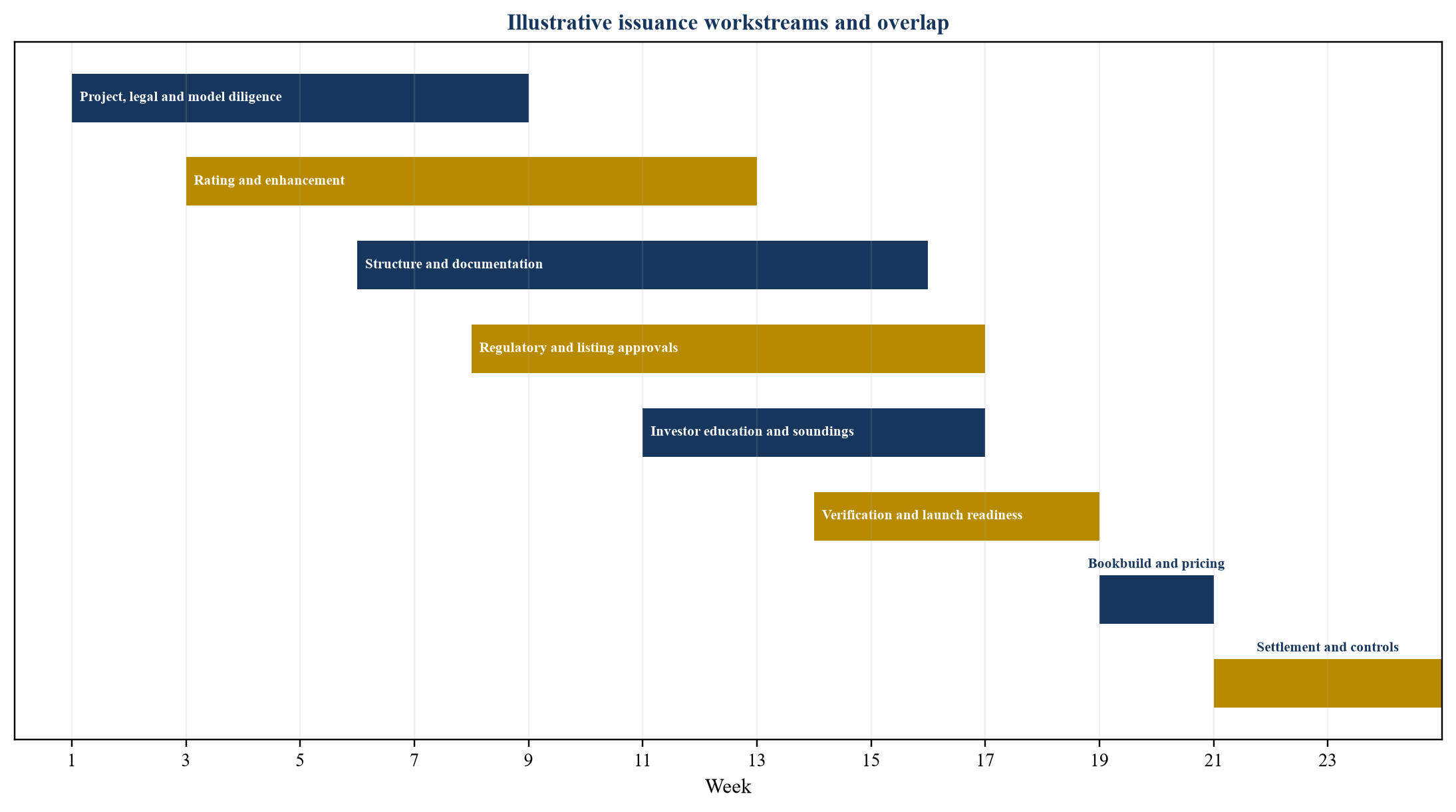
Timing is illustrative and should be adapted to the project's evidence, approvals, investor process and market conditions.
28. Monitor the bond after closing
Post-close surveillance should track operating performance, collections, inflation alignment, maintenance, reserves, coverage, covenants, counterparty quality, rating and market conditions. The reporting pack should compare actual outcomes with the approved case.
The issuer should maintain investor communication and correction procedures. A liquid secondary market may remain limited, but consistent information can support valuation and future access. Reporting discipline also improves the evidence base for refinancing or additional debt.
The guarantee and security package require active administration. Notices, claims, replenishment, registrations and covenant certificates should have calendars and accountable owners. Rights can weaken when procedural conditions are missed.
The board should review realised financing value after twelve and twenty-four months. The review should compare interest, fees, reserves, distributions, operating outcomes, rating movement and governance cost with the original decision model.
29. Create a replicable programme rather than a one-off issue
A successful debut can support later issuance, sector benchmarks and domestic investor capability. Replication requires standard definitions, data, contracts, servicing and governance. Each issue should improve the next transaction's evidence and execution process.
Pooling can increase size and diversification where individual projects are too small. The pool needs eligibility criteria, allocation rules, concentration limits, servicing, substitution, cross-default and performance reporting. Diversification should be measured rather than assumed.
Public and development institutions can support standardisation, guarantees, anchor investment and capacity building. Their role should have a defined market-development objective, risk budget and pathway for reduced support as private capacity grows.
The issuer or programme sponsor should publish a lessons record covering demand, pricing, allocation, diligence, reporting and secondary performance. Market development emerges from repeatable credible transactions and reliable institutions [1][3][4].
30. Convert local currency into durable project resilience
The completed financing case should allow an investor to trace local-currency revenue from the underlying contract through collection, operating cost, reserves and debt service. Every material mismatch should have a quantified exposure, owner and executable response.
The structure should align debt service with asset life and cash generation. Amortisation, reserves, covenants and enhancement should address actual project risks. The model should show how protections operate in central and combined-stress cases, including the first control response and available cure.
Domestic institutional demand should be documented through eligibility analysis and consistent investor feedback. The board should understand who can buy, in what amount, under which conditions and how demand changes when yield, rating, tenor or liquidity moves.
The executed bond should be reconciled to the approved case. Principal, yield, spread, tenor, amortisation, fees, security, reserves, guarantee, investor concentration and continuing obligations should be reported. Any deviation should show its value and risk effect.
Local-currency issuance can remove a destructive balance-sheet mismatch and mobilise domestic savings for long-lived assets. It succeeds when project evidence, market institutions, investor constraints and execution governance are treated as one system. The result should be measured through resilient cash flow, sustainable debt and credible repeat access to capital markets.
31. Apply the framework through a disciplined board decision
The final board paper should begin with the proposed decision and the maximum authority requested. It should state the issuer, project perimeter, instrument, currency, principal range, maturity, amortisation, coupon basis, security, reserves, enhancement, targeted investors and expected timetable. The paper should also identify which terms remain subject to market discovery and which cannot change without returning to the board.
The evidence appendix should permit a reviewer to reconstruct the transaction. It should include the revenue and cost currency map, historical operating reconciliation, project contracts, legal opinions, technical report, model-audit status, rating analysis, investor-eligibility matrix, market soundings, guarantee terms, tax and accounting advice, approvals, disclosure-verification record and contingency plan. Each item should have a date, owner, status and expiry or refresh requirement.
The route comparison should retain common assumptions. Bank debt, domestic loans, onshore bonds, offshore local-currency formats and hybrid structures should use the same operating forecast, stress cases, valuation date and transaction perimeter. Differences in fees, reserves, hedging, tax, flexibility, disclosure and continuing governance should be included. A route should not appear superior because its less visible costs were omitted or its execution probability was treated as certain.
The board should see a value bridge from gross financing benefit to net project value. The bridge should include benchmark and spread effects, interest, fees, guarantee cost, reserve funding, hedge termination, tax, refinancing timing, released support and continuing reporting expense. It should also show distribution capacity and retained resilience. Value that depends on favourable future refinancing should be identified separately from value secured at closing.
Risk acceptance should be explicit. The paper should list the material risks retained after issuance, including inflation basis, imported cost, public-counterparty delay, regulatory change, investor concentration, secondary illiquidity, guarantee conditionality and maturity exposure. Each risk should show the current mitigant, control owner, reporting indicator, trigger and approved response. A risk described without an owner or executable response remains a disclosure item rather than a managed exposure.
Delegated authority should be bounded through a pricing and structure grid. The pricing committee can be authorised to accept terms within approved ranges for principal, yield, spread, maturity, amortisation, reserve, guarantee fee, covenant and allocation. A change outside those ranges should require renewed authority because it can alter debt capacity, project value or stakeholder exposure. The final decision should also specify a withdrawal point so management can reject a poor book without creating a governance crisis.
The closing report should reconcile every executed term with the approved case. It should explain changes, quantify their effect and confirm that conditions precedent, security, reserves, guarantee, listing, settlement and repayment of existing debt were completed. Open items should carry owners and deadlines. This closes the issuance decision and creates a reliable baseline for surveillance, investor communication and any later financing.
The first annual review should compare realised interest, fees, reserve balances, coverage, distributions, investor concentration, reporting effort and rating movement with the approved case. It should explain every material variance and test whether the original currency-alignment thesis remains valid. Where market access, project performance or public-counterparty behaviour differs from the case, management should update the refinancing and liquidity plan. The review should be retained as evidence for future investors and for the next project considered under the programme.
Sources
- OECD, Unlocking Local Currency Financing in Emerging Markets and Developing Economies, 4 February 2025. Read the primary source
- World Bank, Addressing Exchange Rate Risk in Infrastructure Projects in Emerging Markets and Developing Economies, 2024. Read the primary source
- International Monetary Fund and World Bank, Guidance Note for Developing Government Local Currency Bond Markets, 12 March 2021. Read the primary source
- Asian Development Bank, Local Currency Bonds and Infrastructure Finance in ASEAN+3, July 2015. Read the primary source
- Asian Development Bank, ADB and Local Currency Financing: A 20-Year Journey, 10 February 2025. Read the primary source
- World Bank, Utilizing World Bank Partial Guarantees to Support Sovereign or Sub-Sovereign Commercial Debt Financing. Read the primary source
- Bank for International Settlements, Towards Liquid and Resilient Government Debt Markets in Emerging Market Economies, March 2024. Read the primary source
- Bank for International Settlements, The US Dollar and Capital Flows to Emerging Market Economies, September 2024. Read the primary source
- International Capital Market Association, Green Bond Principles, June 2025. Read the primary source
- International Finance Corporation, Creating Efficient Capital Markets in Africa, 2023. Read the primary source
- International Finance Corporation, Local Currency Syndications. Read the primary source
- International Finance Corporation, FY26 Investor Presentation, 2025. Read the primary source
- Bank for International Settlements, Emerging Market Economy Exchange Rates and Local Currency Bond Markets amid the COVID-19 Pandemic, 7 April 2020. Read the primary source
- Bank for International Settlements, Financial Stability and Local Currency Bond Markets, June 2007. Read the primary source
- World Bank, Promoting the Use of Capital Markets for Infrastructure Financing. Read the primary source
- World Bank, Submission to the G20 Investment and Infrastructure Working Group: Fixed-Income Instruments for Infrastructure Finance. Read the primary source
- World Bank Group, Public-Private Partnerships Reference Guide, 2018. Read the primary source
- International Finance Corporation, Local Currency Issuances, Fall Investor Newsletter 2025. Read the primary source
