

1. Define the localisation decision
The decision is whether a specific portfolio of medicines can be produced in the GCC at required quality, continuity and cost while earning a return that supports the capital invested. The answer should determine product scope, partnership form, site, technology-transfer sequence, procurement strategy, financing, capital drawdown and the conditions under which expansion proceeds. A policy objective can support the opportunity, but it cannot substitute for an executable operating case.
The mandate should identify the health need, target jurisdictions, patients, products, dosage forms, demand channels, intellectual-property position, marketing-authorisation holder, technology owner, manufacturing steps, site, utilities, workforce, procurement counterparties and intended export markets. Localisation can mean packaging imported bulk, producing finished dosage forms, manufacturing drug substance or operating a complete biologics platform. Each choice has different capital, skills, validation and regulatory requirements.
Approval should specify the maximum committed capital, minimum contracted or otherwise evidenced demand, milestones for licensing and qualification, permitted leverage, contingency reserve and conditions for later phases. The investment committee should receive one case connecting product-level demand to batch schedules, revenue, gross margin, capital expenditure, working capital and debt service.
2. Use the Demand-to-Access Localisation Framework
The proposed framework has eight gates: public-health and market priority; demand and procurement evidence; rights and partnership control; regulatory and quality pathway; technology-transfer readiness; manufacturing and supply-chain capability; finance and risk allocation; and access after launch. Each gate produces a finding that changes scope, timing, value or contractual protection.
The framework starts with products and patients rather than buildings. A facility may be capable of producing a dosage form while lacking rights to the selected product, a registered dossier, qualified materials, analytical methods or sufficient demand. Conversely, a product may have strong demand while requiring a process that the proposed site cannot qualify economically. The portfolio and platform must therefore be designed together.
An evidence register should connect epidemiology, essential-medicine priorities, historical purchases, tender quantities, product registration, licences, transfer protocols, bills of material, validation plans, workforce, utilities, capital requests and the financial model. This prevents policy, commercial, technical and finance teams from using different definitions of localisation or readiness.
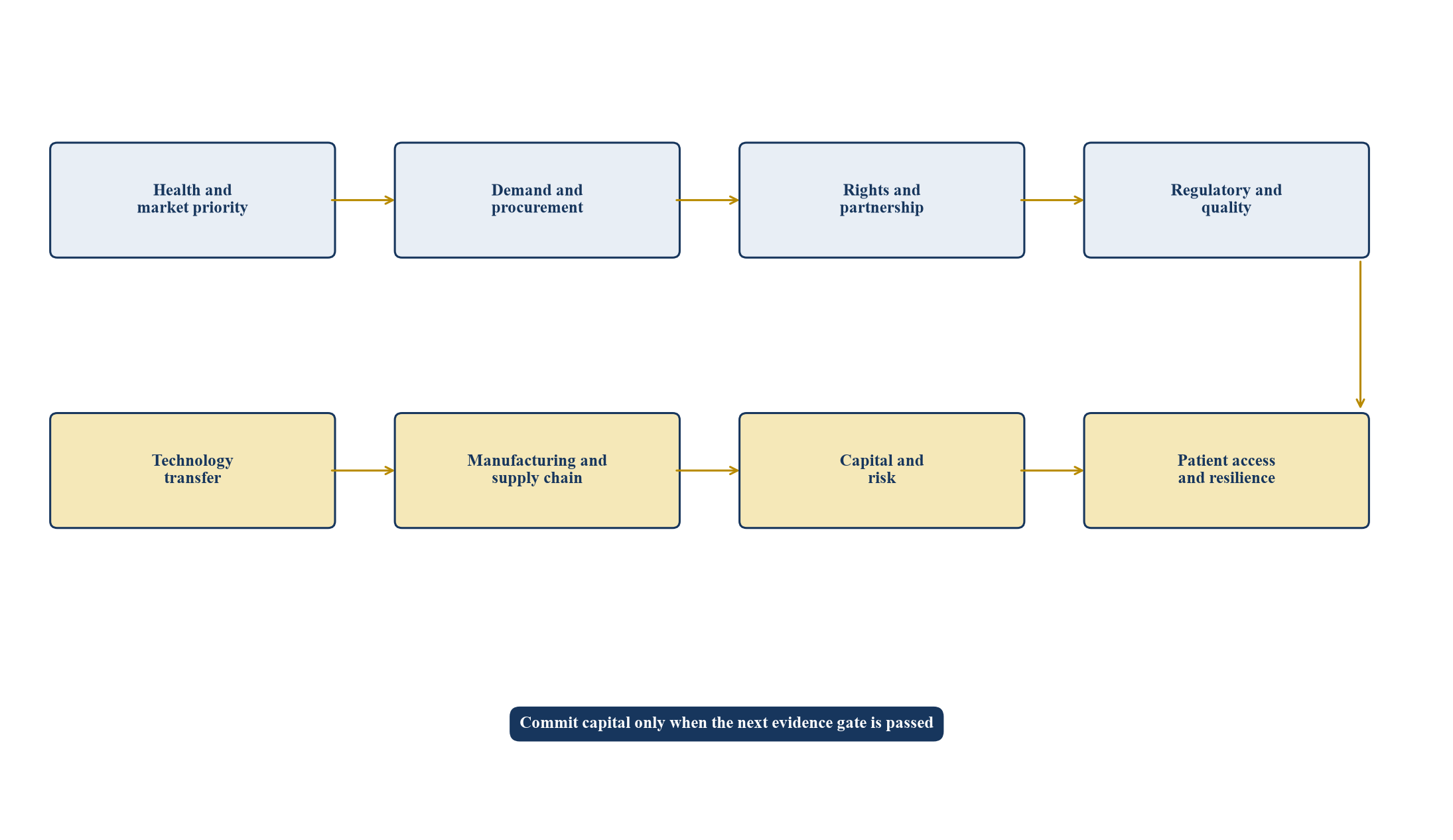
Each gate converts policy ambition into an evidence-based capital and partnership decision.
3. Define localisation by manufacturing step
Localisation should be described by the actual transformation performed within the jurisdiction. Local packaging can improve responsiveness and create a first operating capability, although much of the product value and supply risk may remain offshore. Secondary manufacture can add formulation, filling, tableting, coating, packaging and release. Drug-substance manufacture adds chemistry or biological processing with materially greater technical and environmental requirements.
The sponsor should create a product-process map showing where active ingredients, excipients, containers, components, testing, batch release and distribution occur. Local content should be measured through value added, qualified jobs, control of critical steps, supply resilience and export capability. A local label on imported finished or near-finished product provides a different strategic outcome from a process whose critical inputs and release capability are controlled within the region.
The chosen step should match the objective. Rapid continuity for a high-volume generic may support a staged packaging-to-formulation pathway. A biologic may require fill-finish first while upstream capability, analytical methods and specialised workforce are developed. The capital plan should state which risks are reduced at each stage and which remain dependent on foreign supply.
4. Prioritise medicines through a transparent product screen
Product selection should integrate health priority, demand, shortage risk, import dependence, technical feasibility, rights, competition, pricing, procurement and export potential. A medicine can be important but unsuitable for the first local platform because demand is too small, the process is too specialised or rights cannot be secured. A high-volume product can also be unattractive when tender prices do not cover a compliant local cost base.
The screen should use product-level data: annual units, treatment courses, dosage forms, strengths, pack sizes, suppliers, origin countries, purchase prices, lead times, shortages, shelf life, cold-chain needs and regulatory status. Demand should be separated among public tenders, private hospitals, retail, insurance and export channels. Related strengths and formulations should be assessed together because changeover and validation can affect economics.
The result should be a ranked portfolio with an explicit reason for inclusion, deferral or exclusion. Early products should create a usable platform, credible demand and manageable transfer sequence. Later products can deepen capability once the site, quality system and commercial relationships have demonstrated performance.
5. Reconstruct GCC demand rather than extrapolate imports
Import value is an incomplete proxy for local-manufacturing demand. It can include distributor margins, high-priced patented products, inventory cycles and products that a proposed facility cannot make. Demand should be reconstructed from patient need, historical consumption, procurement records, private-channel sales, product registrations and realistic market-share capture.
The GCC Health Council's joint procurement programme seeks high-quality products, fair prices, sufficient quantities and continuity from registered sources, while also supporting Gulf pharmaceutical industry and drug security [1]. NUPCO's unified catalogue aggregates the needs of Saudi governmental health sectors and is updated through sector committees [2]. These systems provide valuable demand architecture, yet catalogue inclusion does not establish an award or purchase commitment.
The model should distinguish addressable, qualified, bid, awarded and delivered volume. It should also account for tender cycles, substitution, stock policy, price review, payment terms and incumbent response. The investment case should use committed quantities only where enforceable evidence supports them and use probability-weighted scenarios for the remainder.
6. Turn procurement policy into bankable demand
Public procurement can make localisation investable when award rules, quantities, duration, quality requirements and pricing mechanisms are sufficiently clear. General policy support creates strategic relevance but may leave volume and price exposed. Lenders and equity investors need the contractual route from a qualified product to cash receipts.
The sponsor should document tender eligibility, local-content preferences, bid bonds, performance security, price ceilings, framework terms, minimum purchase obligations, call-off discretion, payment timing, penalties and termination. It should identify which entity buys, which entity pays and whether the award survives a change in budget, formulary or policy. Procurement dependence should be visible as a concentration risk.
A credible structure can combine base demand under a defined framework, competitive upside through tenders and private or export channels that reduce reliance on one buyer. Capital drawdown can be linked to registration, procurement qualification and award milestones. The transaction should avoid treating a memorandum of understanding or policy announcement as contracted revenue.
| Demand evidence | What it establishes | Remaining risk | Financing treatment |
|---|---|---|---|
| Binding purchase obligation | Quantity, price mechanism and buyer obligation | Performance, termination and payment | May support base debt case after legal review |
| Framework or tender award | Eligibility and potential call-off volume | Actual orders, budget and timing | Probability-weighted until orders are issued |
| Catalogue or formulary inclusion | Product is recognised within a purchasing system | Award, price and market share | Strategic evidence, not committed revenue |
| Historical consumption | Observed use and seasonality | Future substitution and policy change | Supports demand range with stress cases |
| Epidemiological need | Patient and treatment requirement | Diagnosis, access, funding and adoption | Long-term opportunity evidence |
| Export registration plan | Addressable markets and filing route | Approval, distributor and competition | Upside case after market-specific diligence |
Evidence should be assessed product by product and jurisdiction by jurisdiction.
7. Select the jurisdiction and site through a product lens
Site selection should begin with the product portfolio and operating model. The decision should consider regulatory pathway, market access, public-procurement relevance, utilities, logistics, environmental approvals, specialised labour, research links, incentives, financing and the ability to export. Free-zone, mainland and industrial-zone structures can differ in licensing, ownership, customs and market access.
UAE industrial policy identifies pharmaceuticals, biotechnology and medical equipment among priority sectors, and Emirates Development Bank offers healthcare and industrial financing products [3][4]. Saudi policy supports generic, biological, genetic and advanced-therapy manufacturing through the SFDA's role in the National Industrial Development and Logistics Program [5]. These policy signals should be translated into product-specific permissions, costs and obligations.
The site model should include power quality, backup generation, water quality, wastewater, clean steam, gases, cold chain, hazardous materials, waste disposal and expansion land. Utility connection and environmental capacity can sit on the critical path. The sponsor should obtain written technical and regulatory requirements before finalising layout or equipment orders.
8. Choose the partnership model
The partnership should allocate technology, market access, capital, execution and control to the parties best able to manage them. Options include licensing, contract manufacturing, a minority joint venture, a controlled joint venture, acquisition of an existing facility, build-operate-transfer arrangements and staged strategic investment. The legal form should follow the operating dependencies.
The technology owner may provide dossier rights, process knowledge, analytical methods, training, critical materials and regulatory support. The local partner may provide capital, site execution, procurement access, distribution, stakeholder coordination and workforce. Each contribution requires measurable deliverables, acceptance standards, timing and remedies.
Governance should reserve decisions on product scope, quality, regulatory filings, capital, related-party transactions, pricing, technology changes, dividends and exit. Deadlock, change of control, sanctions, licence termination and failure to transfer should have defined consequences. A partnership that cannot operate when interests diverge is a financing risk.
9. Secure intellectual-property and dossier rights
Manufacturing equipment is insufficient without the right to make, register and sell each product. The sponsor should map patents, data exclusivity, trademarks, know-how, biological materials, master cell banks, analytical methods, regulatory dossiers and territorial rights. Rights should cover the intended GCC and export markets, manufacturing steps and future improvements.
The licence should define exclusivity, sublicensing, field, territory, term, royalties, transfer price, minimum performance, audit rights, confidentiality, improvements, supply obligations, termination and post-termination transition. The marketing-authorisation holder and manufacturer roles should align with local law and the commercial model. Product ownership should remain clear during a partner default.
The financial case should separate technology fees that create a durable operating right from recurring payments that vary with sales. A high transfer price for critical inputs can move margin away from the local company. Related-party pricing, foreign exchange, withholding tax, customs and transfer-pricing rules require specialist review.
10. Build the regulatory pathway before the factory schedule
The regulatory plan should identify the authority, legal applicant, marketing-authorisation holder, manufacturing-site registration, product dossier, GMP certification, import permits for materials, pricing process, pharmacovigilance and post-approval obligations. Each target GCC market should have its own pathway, dependencies and lead times.
In the UAE, the Emirates Drug Establishment sets requirements for manufacturing-facility licensing, GMP inspection and product marketing authorisation. Its published manufacturing-facility process includes technical approvals, engineering plans, utilities, environmental permissions, qualified personnel and GMP inspection [6]. Its product authorisation service requires a standard technical file and identifies local manufacturers among eligible applicants [7].
The programme schedule should work backwards from commercial supply. Construction completion does not permit sale. Equipment qualification, process validation, analytical transfer, stability, inspection, site registration, product approval, pricing and tender qualification can follow different sequences. The model should recognise revenue only after the applicable chain is complete.
11. Treat technology transfer as a controlled programme
Technology transfer moves product and process knowledge, methods, materials, documentation and expertise from one organisation or site to another. WHO describes technology transfer as a collaborative process that requires an ecosystem and country-specific approach [8]. ICH Q10 includes transfers between development, manufacturing and testing sites within the pharmaceutical lifecycle [9].
The transfer plan should cover product knowledge, critical quality attributes, process parameters, equipment equivalence, analytical methods, cleaning, packaging, stability, validation, regulatory variations, training and continued process verification. It should identify the sending unit, receiving unit, quality responsibilities, acceptance criteria, deviations and change control.
The sponsor should schedule transfer batches against site capacity and regulatory submissions. Several products competing for the same technical experts or qualification equipment can create hidden delay. Payment to the technology owner can be staged against deliverables such as complete documentation, successful engineering batches, validated methods, accepted regulatory filings and commercial release.
12. Define the manufacturing platform
The facility should be designed around a defensible product family rather than the maximum number of possible dosage forms. Each additional technology adds equipment, utilities, containment, cleaning, analytical, training and regulatory complexity. Platform focus can improve execution, although it must leave enough flexibility for future products.
The process map should cover material receipt, quarantine, sampling, dispensing, manufacturing, in-process testing, packaging, laboratory testing, release, storage and distribution. Bottlenecks often sit outside the main production line. A fast tablet press cannot create output when coating, packaging, laboratory capacity or quality release is constrained.
The capacity model should use batches and product routes. It should include campaign rules, changeover, cleaning, maintenance, validation, yield, rejects and quality holds. Capacity is economically available only when the complete route, qualified staff, approved materials and regulatory permissions are in place.
13. Establish the quality system as a capital asset
Quality systems determine whether a facility can make, release and improve medicines consistently. They should be designed before validation and staffed before commercial pressure begins. ICH Q10 links pharmaceutical development, technology transfer, commercial manufacturing and product discontinuation through a lifecycle quality system [9].
The operating model should cover management responsibility, documentation, training, deviation investigation, corrective and preventive action, change control, supplier quality, complaints, recall, pharmacovigilance, data integrity, management review and product quality review. Independence between production and quality decisions should be protected in governance and staffing.
Quality costs should be included in the central case, including systems, laboratories, validation, environmental monitoring, reference standards, stability, audits and ongoing training. Under-resourcing can create temporary EBITDA while weakening batch reliability and regulatory confidence. The valuation should recognise mature quality capability as an operating asset.
14. Localise the supply chain selectively
Local production can remain exposed to imported active ingredients, excipients, single-use systems, filters, vials, stoppers, reference standards and spare parts. The sponsor should map each critical input by source, qualification status, lead time, shelf life, minimum order, currency, transport condition and substitutability.
Localising every input is rarely the first objective. The priority should be inputs whose disruption stops production, whose transport risk is material or whose local economics become viable across several products. Dual sourcing requires technical and regulatory work; an alternative supplier cannot be counted until qualified and approved.
Inventory policy should reflect supply risk and cash. Safety stock can strengthen resilience while increasing expiry, storage and working-capital exposure. The model should distinguish raw material, work in progress, quarantined stock, released finished goods and tender buffer. Ownership and insurance should be clear at each stage.
15. Build the workforce and knowledge-retention plan
Manufacturing capability resides in people as well as equipment. The plan should quantify roles in production, engineering, quality assurance, quality control, microbiology, validation, regulatory affairs, pharmacovigilance, supply chain, maintenance, data systems and management. Specialist roles can require long recruitment and licensing lead times.
Training should progress from theory to supervised practice and demonstrated competence. Technology-owner staff may support transfer, but the local organisation must be able to investigate deviations, manage change, maintain methods and train later cohorts. Knowledge should be captured in controlled documents and operating routines rather than remain with a few individuals.
Retention mechanisms should consider career paths, technical accreditation, succession, incentive design and the location of decision rights. The budget should include expatriate transition where needed and a realistic period of overlapping staffing. A rapid reduction in transfer support can leave a qualified facility without a self-sufficient operating system.
16. Stage capital around evidence
A localisation programme contains distinct capital pools: land and enabling works; building and clean rooms; utilities; production and laboratory equipment; digital systems; validation; licences; technology transfer; pre-operating staff; inventory; and commercial working capital. Each pool has different timing, recoverability and execution risk.
Capital should be released against milestones that reduce uncertainty. The first stage can fund rights, design, regulatory engagement and transfer planning. Later stages can follow confirmed utility capacity, detailed design, equipment specifications, procurement evidence, partner deliverables and financing conditions. Expansion can follow validation and observed demand.
The board should maintain an estimate-at-completion that includes commitments, change orders, foreign exchange, duties, delay, owner costs and contingency. Project reporting should separate sunk cost from capital still at risk. The existence of sunk cost should not compel continued investment when demand, rights or execution evidence deteriorates.
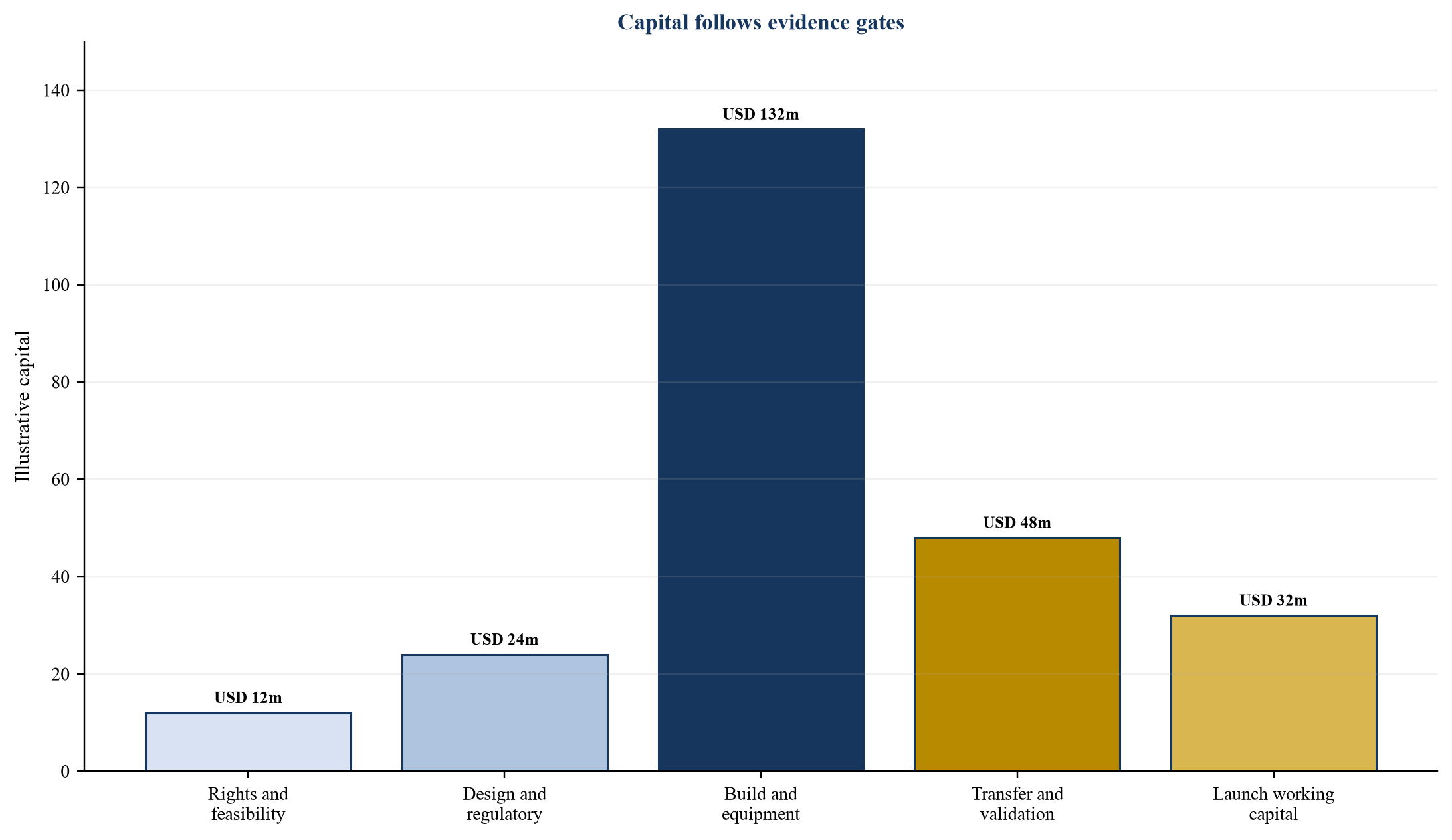
Values are hypothetical USD millions and do not represent an observed project.
17. Match financing to the risk period
Early development and transfer risk usually require patient equity, sponsor capital or strategic funding. Senior debt becomes more supportable when rights, construction, qualification, demand and cash flow are sufficiently evidenced. Equipment finance, development-bank facilities, working-capital lines, export credit and vendor terms can support specific assets or phases.
The financing structure should recognise that regulatory delay can postpone revenue while interest and operating costs continue. Grace periods and capitalised interest should be based on a realistic critical path. Debt sizing should use qualified output, executable prices, working capital and downside cash flow rather than nameplate capacity.
Security may include project assets, receivables, accounts, shares, insurance, material contracts and rights under direct agreements. Lenders should understand whether technology licences, procurement contracts and product approvals remain effective after enforcement or change of control. A financing package cannot be stronger than the rights that allow the project to operate.
Funding should also be matched to currency and tenor. Imported equipment, technology fees and critical materials may create foreign-currency exposure while sales are denominated in GCC currencies. The model should identify natural hedges, fixed and floating interest, refinancing assumptions and the point at which construction or transfer finance converts into operating debt. Hedging costs belong in the central case when exposures are material.
Working-capital facilities require their own borrowing-base logic. Receivables may arise from public buyers with long payment processes, while inventory can include slow-moving validation stock or products with limited shelf life. A lender may discount unapproved, quarantined or short-dated inventory. The sponsor should therefore calculate availability from eligible assets rather than assume that an accounting working-capital balance can be fully financed.
| Capital source | Best-aligned use | Evidence required | Principal limitation |
|---|---|---|---|
| Sponsor or strategic equity | Rights, development, transfer and contingency | Committed funds and governance | Dilution and return threshold |
| Sovereign or development capital | Strategic capability and long-duration assets | Policy mandate, milestones and additionality | Performance obligations and approval process |
| Senior project or corporate debt | Qualified assets and predictable cash flow | Completion, security, demand and debt service | Limited tolerance for transfer and demand risk |
| Equipment or export finance | Identified imported production assets | Supplier contract, insurance and acceptance | Does not fund the complete operating platform |
| Working-capital line | Eligible receivables and inventory | Borrowing base, controls and collections | Excludes ineligible or slow-moving assets |
| Vendor or technology-owner terms | Equipment, licences and transfer payments | Enforceable delivery and acceptance milestones | Counterparty concentration and termination risk |
Availability and terms depend on project, sponsor, jurisdiction and lender diligence.
18. Allocate sovereign and strategic capital
Government and sovereign participation can provide patient capital, infrastructure coordination, procurement alignment and strategic credibility. It should have a defined commercial and policy mandate. Unclear objectives can create conflicting expectations about pricing, dividends, employment, exports and continued support.
The investment documents should state capital commitments, draw conditions, governance, reserved matters, information rights, performance metrics and exit. Policy support should be distinguished from legally binding obligations. Where an incentive depends on local content, employment or production, the measurement method and consequences of shortfall should be documented.
Strategic capital can absorb early risk when the project creates public value that private finance cannot fully capture. The board should still measure product access, supply continuity, technical capability and financial performance. Transparent measurement protects both the public objective and the company from indefinite subsidy without learning.
The public investor should define the additional capability created by its participation. This may include a medicine that otherwise remains exposed to a fragile import route, a manufacturing technology that supports several products, a training platform or infrastructure that improves future transfers. The case should identify who benefits, how long support is required and which outcomes allow the company to operate on commercial terms.
Exit planning should begin at investment. Potential routes include dividends, strategic sale, public-market listing, transfer to a long-term industrial owner or continued sovereign ownership. Each route depends on mature governance, audited performance, durable rights and a quality record. An exit assumption should not require a valuation premium that the operating plan has not earned.
19. Model unit economics by product
Portfolio averages can hide products that consume capacity or working capital without covering their full cost. The model should calculate price, discounts, materials, royalties, conversion cost, quality cost, distribution, tender security, receivables and inventory by product and channel. Batch size, yield and changeover should drive cost.
Pricing may be constrained by public policy, tender competition, insurance or reference pricing. The sponsor should test whether local-preference mechanisms compensate for smaller initial scale or whether the project needs a broader market. Export pricing should include registration, distributor margin, freight, duties and market-specific packaging.
The product case should show contribution at observed and target utilisation. It should also show the cost of shortages, failed batches, expiry and delayed release. A product that appears profitable at steady state can destroy cash during a long ramp. Portfolio sequencing should therefore combine margin with the speed and reliability of qualification.
20. Build a coherent valuation
Valuation should begin after the operating case, not from a general pharmaceutical multiple. The model should separate existing distributable cash flow, value created through qualification, procurement-supported volume, export upside and terminal capability. Each component should have its own probability, timing and capital requirement.
Discounted cash flow can capture staged investment and long ramp periods. Comparable-company and transaction multiples can test the steady-state result when business mix, rights, quality maturity, growth and capital intensity are comparable. Replacement cost can inform asset value but does not establish earning value. A new facility without rights, demand or qualification may be worth less than its construction cost.
The terminal case should reflect product lifecycle, competition, pricing, maintenance capital and the durability of licences and partnerships. It should not assume that every initial product remains indefinitely. A platform premium requires evidence that the organisation can add products repeatedly without disproportionate cost or delay.
| Measure | Central case | Downside case | Main reason for difference |
|---|---|---|---|
| Total committed capital | 248 | 276 | Delay, revalidation and additional working capital |
| Year-five revenue | 286 | 171 | Tender timing and lower qualified volume |
| Year-five EBITDA | 54 | 19 | Utilisation, price and duplicate transfer costs |
| Net debt at valuation date | 112 | 146 | Slower cash conversion and overrun |
| Enterprise value | 440 | 242 | Lower earnings and higher risk |
| Equity value | 328 | 96 | Enterprise value less net debt |
| Qualified utilisation | 68% | 42% | Registration and transfer delay |
All figures are illustrative management scenarios in USD millions unless stated otherwise.
21. Stress timing, not only steady-state margin
Timing is a principal source of value variation. A six-month delay can add interest, staff, validation, inventory and supplier costs while postponing tender eligibility. Several dependent approvals can create nonlinear delay when a missed submission window moves the project into the next procurement cycle.
The model should contain an integrated schedule for rights, design, construction, utilities, equipment, transfer, validation, inspection, product registration, pricing, procurement and launch. Cash flows should reference milestone dates from that schedule. A separate optimistic schedule should not drive the valuation.
Scenarios should combine related events. A transfer delay can require continued imported supply, duplicate teams, additional stability, revalidation and revised procurement timing. The downside should show minimum liquidity, covenant headroom and the additional equity required to complete the programme.
22. Protect value through transaction terms
Transaction and partnership documents should allocate risks to the party able to control or evidence them. Consideration for technology, shares or an existing facility can be deferred until rights, files, transfer batches, regulatory approvals, tender awards or operating performance are achieved.
Representations should cover title, rights, dossiers, data, quality, regulatory history, product supply, contracts, litigation, sanctions, tax and intellectual property. Specific indemnities may be appropriate for identified liabilities. Covenants should govern pre-close operation, regulatory communication, transfer support, capital commitments and access to records.
Termination assistance is essential when the local company depends on a strategic partner. The documents should address continued supply, inventory, data, regulatory filings, training, transition licences and customer communication. A remedy that pays damages without preserving medicine supply may be commercially inadequate.
23. Plan market access and distribution
Local manufacturing does not automatically create market access. The operating company must secure product registration, pricing, reimbursement where relevant, distributor capability, tenders, hospital adoption, pharmacovigilance and reliable fulfilment. The commercial pathway should be designed alongside the facility.
The sponsor should map decision makers and evidence for each channel. Public tenders may prioritise price, quality, continuity and local content. Private hospitals and insurers may require formulary, clinical and contracting work. Retail channels require distribution reach, inventory and promotion within applicable rules. Export markets add local representatives and jurisdiction-specific filings.
Distribution agreements should define territory, channel, inventory, service levels, data, pricing authority, marketing conduct, product complaints, recalls and termination. The local manufacturer should retain enough demand data to plan production and assess channel performance. Exclusive distribution without measurable performance can trap product access.
24. Design resilient operations
Resilience requires capacity, inventory, qualified alternatives, utilities, cyber controls and decision rights. The company should identify single points of failure across suppliers, equipment, laboratories, people, systems, transport and batch release. It should assign recovery targets and fund the measures required to meet them.
Business-continuity planning should include backup utilities, critical spares, alternative logistics, emergency quality decisions, data recovery, reciprocal manufacturing options and communication with authorities and buyers. A second site or supplier helps only when the product, method and regulatory pathway are qualified.
The board should monitor resilience through leading indicators such as supplier performance, inventory coverage, overdue maintenance, deviation recurrence, laboratory backlog, staff vacancies and recovery tests. Resilience expenditure should be visible in the operating case rather than treated as an optional cost after launch.
25. Govern the programme across institutions
Medicines localisation spans health, industry, investment, finance, environment, utilities, customs, procurement and education. A sponsor can lose time when responsibilities are distributed and decisions are sequenced informally. A programme office should maintain one critical path, decision register and evidence pack.
Governance should distinguish regulatory independence from project coordination. Authorities should apply their mandates while the programme office coordinates submissions, dependencies and responses. Escalation should address unresolved interfaces without weakening quality or regulatory requirements.
The steering committee should include the sponsor, technology partner, operator and relevant capital providers. It should review safety, quality, rights, schedule, capital, demand, workforce and risk. Decisions should identify owners, due dates and effects on the approved case. Public announcements should follow evidence rather than precede it.
26. Use a milestone-based implementation roadmap
The roadmap should begin with product selection, rights and demand evidence. Concept and site design can then proceed with early regulatory engagement. Detailed design, equipment procurement and construction should follow a controlled scope. Technology transfer, validation, inspection and product approval should be integrated with procurement timing.
Milestones should have acceptance criteria. Mechanical completion is different from equipment qualification; equipment qualification is different from process validation; process validation is different from commercial release. A board report that combines these stages into one completion percentage can conceal the true readiness gap.
The programme should preserve schedule contingency around authority review, imported equipment, utilities, transfer batches and stability. Recovery actions should be decided before delay consumes all contingency. Later portfolio phases should remain optional until the first platform demonstrates quality and commercial performance.
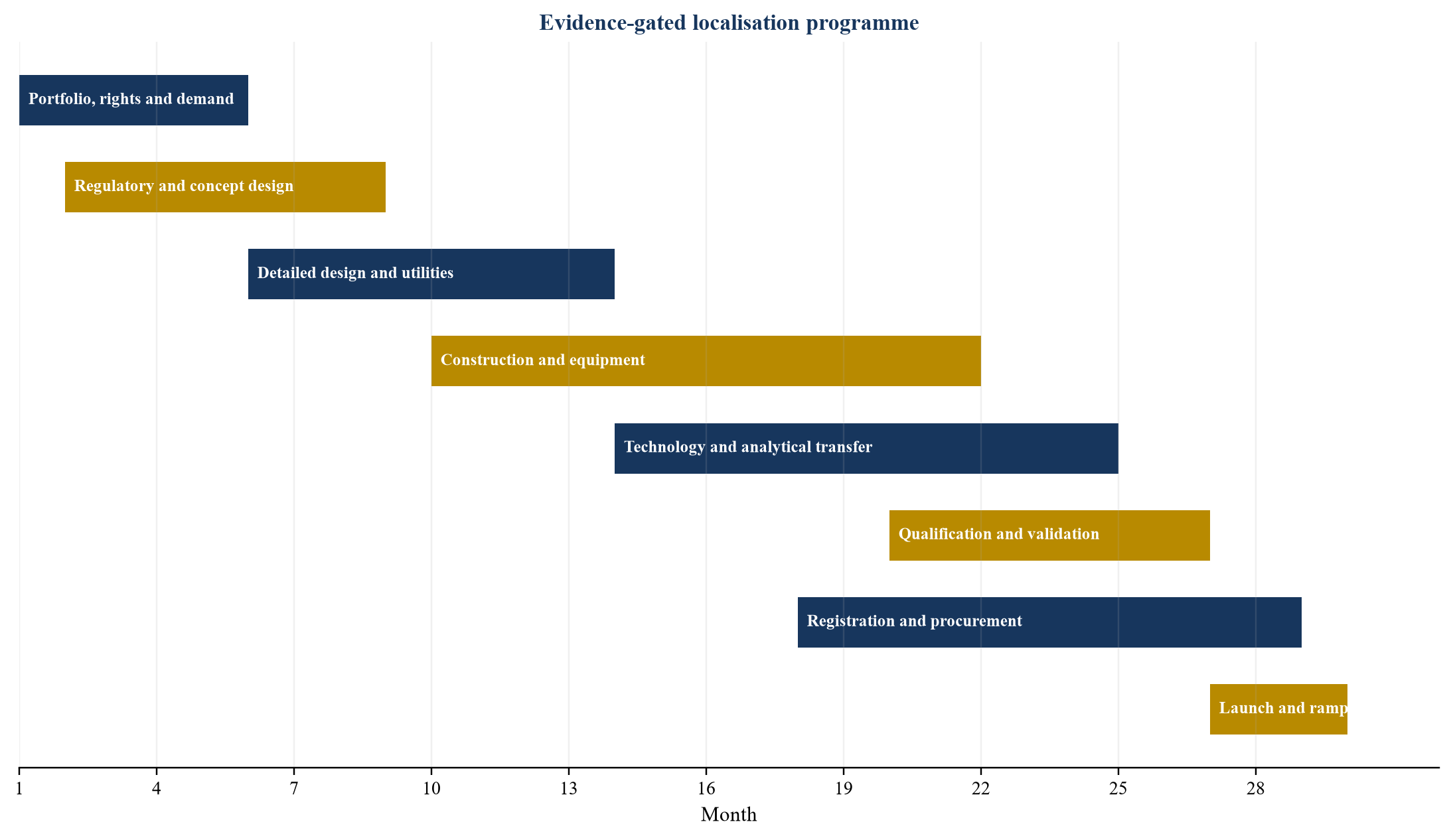
Timing is illustrative and depends on product, site, authority, transfer and procurement requirements.
27. Measure outcomes after launch
Post-launch reporting should connect strategic and financial outcomes. Measures can include registered local products, supplied treatment courses, on-time delivery, shortage events, batch success, release lead time, local value added, qualified jobs, supplier development, exports, revenue, EBITDA, cash conversion and return on invested capital.
Definitions should remain stable. Localisation percentages should identify the numerator, denominator and manufacturing steps included. Supply resilience should be tested through service and recovery evidence. Employment should distinguish temporary construction labour from sustained qualified roles. Export targets should be supported by registrations and sales.
The board should compare actual performance with the approved case by product. Variance should identify price, volume, mix, yield, downtime, quality, materials, working capital, transfer and timing. Capital allocation should respond to the evidence; successful lines can expand while weak products are restructured, transferred or discontinued.
Patient access should be monitored alongside manufacturing output. A plant can meet its production plan while products remain unavailable because of pricing, distribution, prescribing or procurement constraints. Management should reconcile batches released, units sold, units delivered and treatment courses supplied. It should investigate shortages by cause and show whether local production shortened recovery or merely changed the location of inventory.
Capability metrics should also test whether knowledge is becoming institutional. Measures can include the proportion of deviations investigated without external support, methods maintained by local teams, approved process improvements, successful inspections, local technical leaders and the time required to introduce the next product. These indicators show whether the platform can repeat localisation rather than depend indefinitely on the original partner.
28. Run integrated diligence
Diligence should combine market, procurement, regulatory, quality, technical, intellectual-property, finance, tax, legal, environmental, cyber, workforce and partner workstreams. A central issue register should link each finding to schedule, revenue, cost, cash, value, documents and operating action.
The team should test official and partner statements against source documents. Procurement opportunity should reconcile to catalogues, tenders, historical use and award terms. Technology capability should reconcile to complete transfer files and site requirements. Facility claims should reconcile to drawings, equipment, utilities, qualification and regulatory evidence.
Materiality should reflect medicines supply. A modest financial issue can become material if it interrupts a critical product, invalidates data or delays approval. Each issue should record evidence, affected products, containment, long-term action, cost, owner, date and transaction consequence.
29. Present the investment committee decision
The committee paper should begin with the requested authority, product portfolio, partnership, site, capital, financing, minimum liquidity and draw conditions. It should show the demand evidence, rights, regulatory pathway, transfer sequence, qualified capacity, quality system, workforce and supply chain.
The financial case should separate import or distribution earnings, local-manufacturing earnings, procurement-supported volume, export upside and incentives. The downside should show delay, lower utilisation, price pressure, additional validation and working capital. Sources and uses should reconcile to the schedule and funding commitments.
The recommendation should assign each unresolved risk to scope, milestone, price, contingent consideration, covenant, condition, reserve or post-close action. Approval should return to committee when product scope, partner, rights, procurement, capital, financing or schedule changes beyond defined tolerances.
| Decision gate | Evidence required | Approval test | Response when the test fails |
|---|---|---|---|
| Product priority | Health need, demand, shortage and technical screen | Portfolio solves a defined need at viable scale | Remove or defer weak products |
| Demand | Purchases, tenders, awards and channel evidence | Base volume is executable | Stage capital or reduce capacity |
| Rights | Licence, dossier, territory and transition rights | Company can make, register and sell | Renegotiate before commitment |
| Regulatory | Authority pathway, GMP and product plan | Critical path is documented and resourced | Rephase schedule and funding |
| Transfer | Complete package, experts and acceptance tests | Site can receive and sustain the process | Link payments to transfer milestones |
| Finance | Sources, downside liquidity and covenant headroom | Programme can complete under stress | Add equity, reserve or reduce scope |
Thresholds should be tailored to the products, jurisdictions and partnership.
30. Make the decision
A GCC medicines-localisation investment can proceed when the portfolio addresses a defined health and market need, demand is supported by procurement and channel evidence, rights permit manufacture and sale, the regulatory and transfer pathways are executable, and the facility can achieve required quality with funded capital and workforce. The central and downside cases should both preserve safe completion and supply continuity.
The sponsor should stage, resize or reject the programme when demand is aspirational, rights are incomplete, the technology owner cannot deliver the transfer package, utilities or workforce are unavailable, the timetable omits approval dependencies, or financing relies on steady-state cash before qualification. These findings should change capital at risk, not merely appear in a risk register.
The final decision should identify evidence that can reverse approval before each draw. Changes in procurement, product rights, authority requirements, partner capacity, equipment, transfer results or financing should be routed to the responsible owners and valuation model. A dated bring-down process keeps the investment connected to current facts.
The strongest localisation case is product-specific and institutionally coordinated. It states which medicines are required, who will buy them, who owns the rights, how knowledge transfers, where quality is controlled, which capital is committed and how patients receive the product. Specialist regulatory, technical, quality, legal, tax, intellectual-property and financing advisers should review the applicable evidence and agreements.
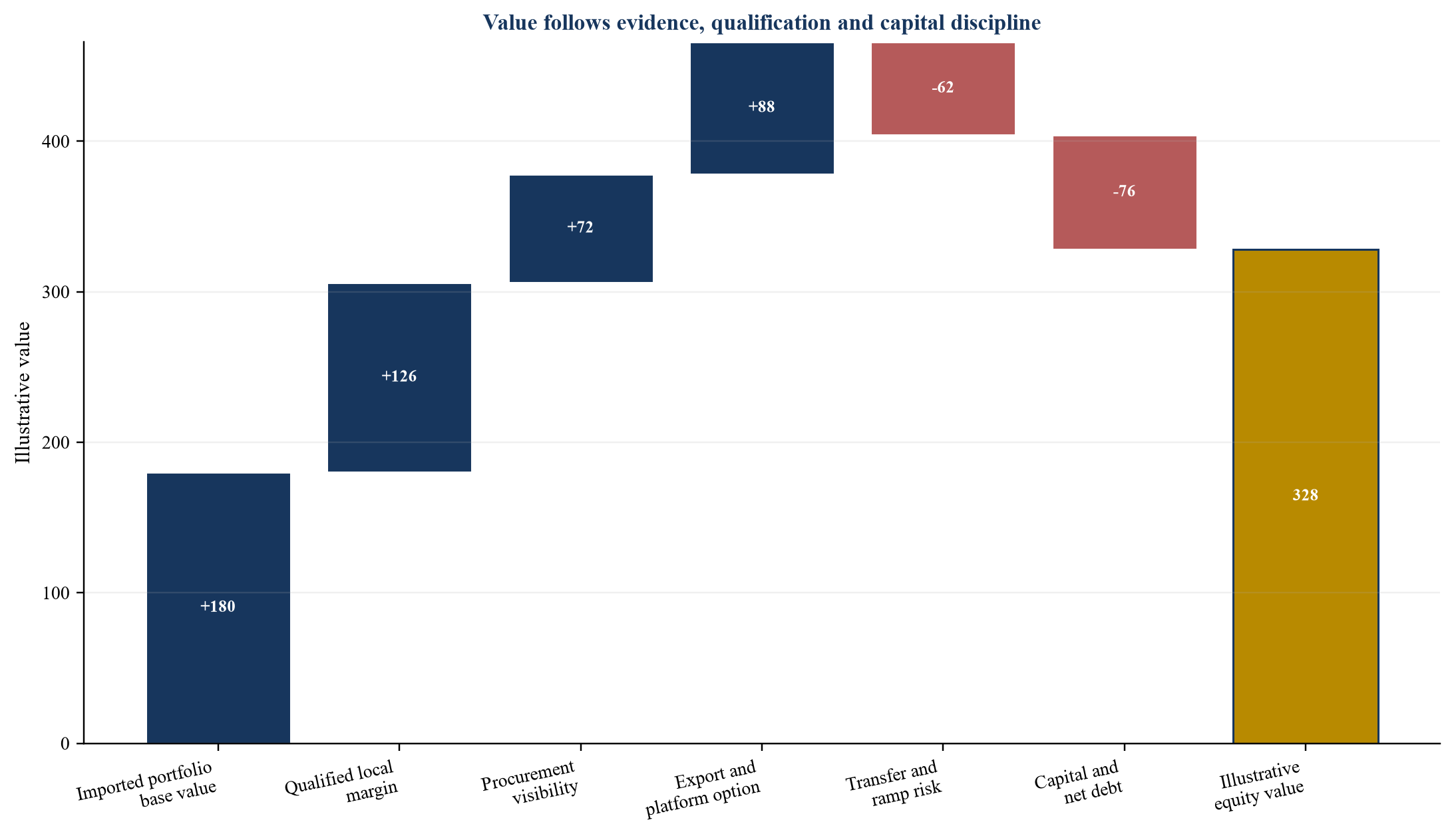
Values are hypothetical USD millions and do not represent market data or a fairness opinion.
Sources
- Gulf Health Council, Joint Procurement Programme and 2026 tender schedule. Read the primary source
- National Unified Procurement Company, Unified Catalogue for Pharmaceuticals. Read the primary source
- United Arab Emirates Ministry of Industry and Advanced Technology, Operation 300Bn strategy. Read the primary source
- Emirates Development Bank, Healthcare Finance in the UAE. Read the primary source
- Saudi Food and Drug Authority, SFDA in the National Industrial Development and Logistics Program. Read the primary source
- Emirates Drug Establishment, Issue a License for a Medical Products Manufacturing Facility. Read the primary source
- Emirates Drug Establishment, Issuance of Marketing Authorization for a Drug or Biopharmaceutical Product. Read the primary source
- World Health Organization, Technology transfer facilitation for local production. Read the primary source
- International Council for Harmonisation, ICH Q10 Pharmaceutical Quality System. Read the primary source
- World Health Organization, World Local Production Forum, Abu Dhabi, 2025. Read the primary source
- World Health Assembly, Resolution WHA74.6, Strengthening local production of medicines and other health technologies to improve access. Read the primary source
- World Health Organization, Pharmaceutical production and related technology transfer, landscape report. Read the primary source
- World Health Organization Regional Office for the Eastern Mediterranean, Local production of quality medicines and vaccines. Read the primary source
- Emirates Drug Establishment, Local human pharmaceutical manufacturing at Make it in the Emirates 2026. Read the primary source
- Emirates Drug Establishment, Permit to Import Medical Items and Products. Read the primary source
- Saudi Food and Drug Authority, National Biotechnology Strategy and biomanufacturing. Read the primary source
- Saudi Food and Drug Authority, Guide to Good Manufacturing Practice for Medicinal Products. Read the primary source
- Gulf Health Council, Annual Report 2024. Read the primary source
- International Council for Harmonisation, ICH Q9(R1) Quality Risk Management. Read the primary source
- International Council for Harmonisation, ICH Q12 Technical and Regulatory Considerations for Pharmaceutical Product Lifecycle Management. Read the primary source
- World Health Organization, Quality assurance of pharmaceuticals, good manufacturing practices and inspection, 10th edition. Read the primary source
- World Trade Organization, Agreement on Trade-Related Aspects of Intellectual Property Rights. Read the primary source
