

1 Start with the financing decision
A lender needs to know which climate-related event can affect repayment, what the borrower can do about it and how performance will be evidenced during the loan. A statement that a company intends to reduce emissions does not answer those questions. The transition plan may depend on grid capacity, equipment delivery, customer offtake, permits or capital that has not been funded. A physically exposed asset may need a flood barrier or cooling-system redesign even if its reported emissions improve. Credit documentation should trace the commercial consequence of each item before assigning a covenant.
The board and credit committee should begin with a decision register. For each proposed climate action, record the underlying asset or business unit, the affected cash flow, the required investment, the responsible party, the measurement method, the evidence date and the proposed finance response. An emissions target can be linked to a sustainability-linked pricing feature where it meets the relevant principles and the data are verifiable [1]. A mandatory site-protection investment may belong in the initial project budget and draw conditions. A decline in cash available for debt service belongs in the financial model and financial covenant tests. These decisions can coexist in one facility without being represented as the same kind of obligation.
This framework addresses corporate and project-related lending. The appropriate lender rights will vary with jurisdiction, borrower type, security, tenor and the negotiated agreement. The 2025 Sustainability-Linked Loan Principles are voluntary market guidance for sustainability-linked loans, not a statute that automatically rewrites existing debt [1]. IFRS S2 is a disclosure standard whose applicability depends on the reporting framework and jurisdiction [3]. The paper therefore proposes a method for drafting and diligence; it does not supply legal clauses for signature.
The output is a climate-to-credit map. It shows what can be measured annually, what must be built before or after drawdown, what information lenders need and where a failure changes price, availability of funds or repayment protection. A clean map makes a climate plan operational for the treasury team and examinable for lenders.
2 Separate six different promises
Climate financing often suffers from a category error. A public target, an annual emissions report, a sustainability-linked margin adjustment, an affirmative investment covenant, a maintenance financial covenant and an event of default have different consequences. A borrower can miss a sustainability performance target and incur a margin premium without breaching a conventional leverage or debt-service covenant. The negotiated loan terms determine the result. Describing a pricing ratchet as a guarantee of decarbonisation or repayment would misstate its role.
A disclosure promise tells investors what the borrower expects and what uncertainty remains. IFRS S2 requires information on material climate-related risks and opportunities and, when an entity has a transition plan, information about that plan that is relevant under the standard [3,4]. It does not require every entity to create a transition plan [4]. A reporting undertaking in a loan agreement is narrower and operational: deliver specified data, by a stated date, in a defined format, with supporting evidence. A sustainability-linked target then compares measured performance with an agreed annual level; its contractual consequence commonly changes financial characteristics of the loan, including margin [1,2].
An affirmative covenant commits the borrower to take an action, such as installing substation flood protection or maintaining an emissions-data control system. A condition precedent or draw condition can tie funding availability to completed design, permits, equity contribution or independent engineer certification. A financial covenant tests credit capacity, such as debt-service coverage. An event of default is a more serious remedy governed by negotiated triggers, grace periods and enforcement rights. It should not be smuggled into a climate schedule through imprecise wording.
Put the six promises in a term-sheet matrix before drafting. Ask which promise is material to the credit, whether the borrower controls performance, what evidence is available, whether a cure is possible and what remedy is proportionate. The remedy should follow the economic exposure. A missing annual carbon statement may justify a reporting escalation and a defined pricing treatment; a critical uncompleted resilience work may justify a draw stop if it is essential to safe operation. Counsel and lenders should agree those effects expressly.
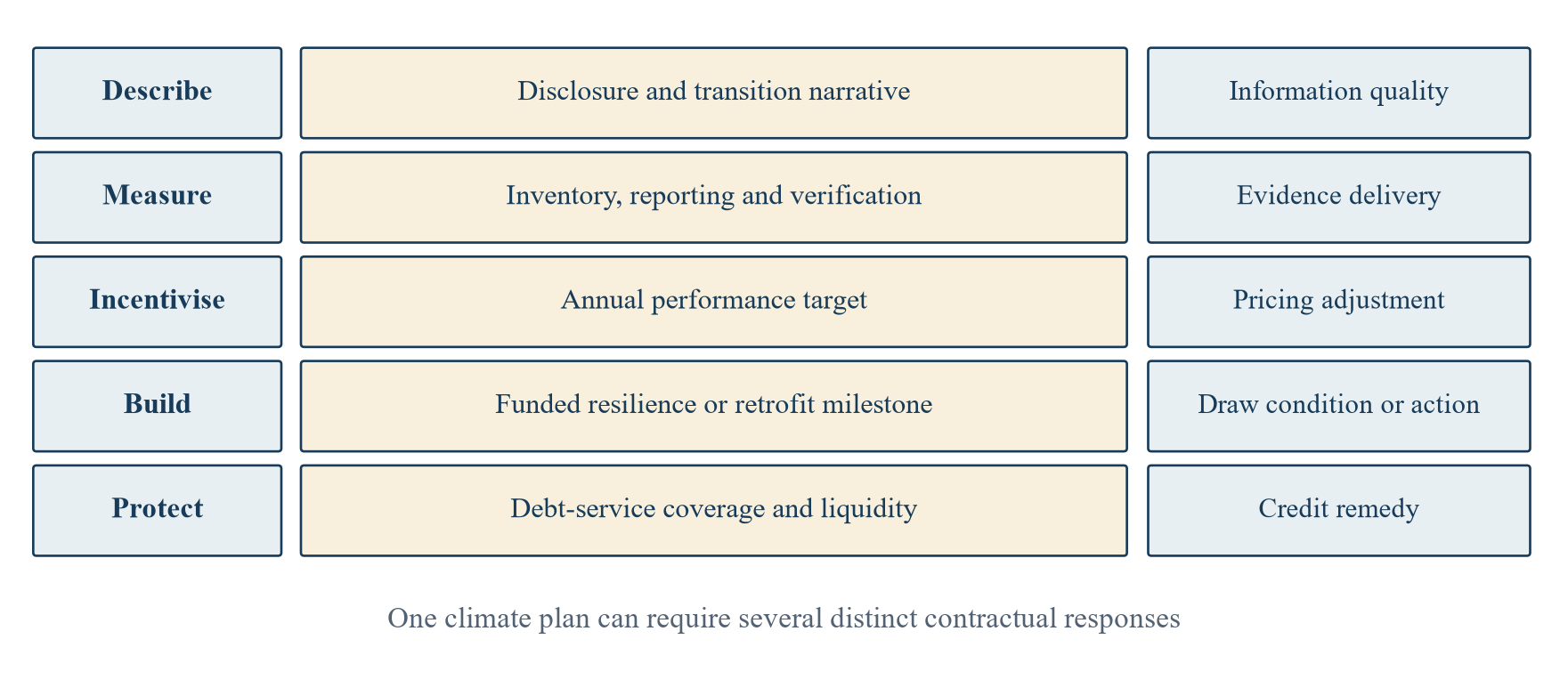
Author-developed decision map; the available instruments and consequences depend on the negotiated facility.
3 Establish the perimeter that the borrower can control
An emissions target is meaningless until the agreement identifies which entities, sites and activities it covers. Corporate inventories can be consolidated by equity share, financial control or operational control under the GHG Protocol framework [5]. A loan may be borrowed by a holding company while a critical plant sits in a joint venture. The lender must understand whether the obligor can obtain data, direct operational changes and fund capital expenditure at that plant. The reporting perimeter, obligor group and financed-asset perimeter should be reconciled, not assumed to be identical.
Create three linked schedules. The legal-entity schedule identifies borrower, guarantors, subsidiaries and material joint ventures. The physical-asset schedule identifies location, equipment, ownership, operating control and exposure to heat, flood, water or grid interruption. The emissions schedule identifies Scope 1 sources, purchased energy within Scope 2 and material value-chain categories within Scope 3, together with data owners and calculation methods [5,6]. A project loan may focus on a named asset while the borrower's public emissions disclosure covers a much larger group. That mismatch should be visible in the term sheet.
Boundary choices affect incentives. A target based only on emissions from owned equipment may improve when a polluting activity is outsourced, even if the wider physical emissions do not fall. A target expressed solely as intensity can improve while absolute emissions rise with expansion. A market-based Scope 2 figure can change because of contractual instruments; the GHG Protocol Scope 2 Guidance specifies quality criteria for such instruments [6]. The agreement should therefore define the selected measure, any parallel disclosure, the organizational boundary, the treatment of contracts and the cases that require a rebaseline.
Record baseline year, source data, emission factors, meter quality and known gaps. The GHG Protocol Corporate Standard describes base-year recalculation and consistency considerations [5]. The loan should specify a process for acquisitions, divestments, methodology changes and corrections. A borrower should not be rewarded merely because a transferred business disappears from the denominator. Equally, an acquisition can make an unchanged absolute target mechanically impossible without a transparent and independently reviewed adjustment. The goal is comparable performance, not an unchangeable number detached from the assets financed.
4 Test whether a climate indicator belongs in an incentive loan
The 2025 Sustainability-Linked Loan Principles identify five core components: selection of key performance indicators, calibration of sustainability performance targets, loan characteristics, reporting and verification [1]. A proposed indicator should be relevant, core and material to the borrower's business and capable of measurement. Targets should be ambitious and meaningful beyond business as usual and regulatory requirements [1,2]. The loan team should test the candidate against the actual operating system and data pipeline, rather than begin with a desired margin discount.
For an industrial energy-services borrower, an absolute Scope 1 and Scope 2 emissions measure may be relevant if the company controls fuel use and electricity procurement. A financed asset whose principal risk is heat-related output interruption may also need engineering milestones. Yet a one-time flood-wall completion date is not automatically a good recurring sustainability-linked KPI. It may be better as a funded project action. If resilience is chosen as a sustainability KPI, the parties need a material measure with a clear baseline, repeatable observation, ambitious annual targets and external verification. The 2025 principles do not remove that burden [1].
Avoid a KPI chosen for convenience alone. A company may have readily available office electricity data while the financed cement kiln, data centre or water plant carries the largest climate exposure. A target on the office number would give the lender little evidence about the financed business. Similarly, a target dependent on a third party's grid emissions factor or an unapproved power purchase contract may give the borrower limited control. The committee can still monitor those drivers, but the incentive should reflect the business's material transition challenge and genuine agency.
An internal target and a loan target also need separate governance. The internal plan can contain many activities and ranges. The loan schedule should identify a smaller set of contractual observations whose meaning survives audit. The borrower's board should approve the operational budget and data controls needed to achieve them. The lender should evaluate whether the proposed pricing effect is commercially significant, while avoiding any unsupported claim that a small margin ratchet alone will fund an expensive retrofit.
5 Calibrate annual targets against a real counterfactual
A sustainability performance target should be assessed against a documented baseline, a relevant external reference where available, applicable regulation and a credible planned investment path [1,2]. A promised reduction that merely follows a legal closure order does not show incremental ambition. A target that cannot be met under a funded plan may create an annual premium without improving the asset. The credit and sustainability teams should test both errors before signing.
Construct the target path from operational drivers. For emissions, list production volume, fuel mix, equipment efficiency, power procurement, contracted renewable supply, grid factors and planned asset changes. Identify the amount of each expected reduction and its delivery date. Distinguish actions already committed and financed from optional investments that require new approvals. Keep a separate counterfactual case under current business plans and applicable law; do not describe an author-created counterfactual as an observed outcome. A target may be ambitious when the transition measures and funding make it credible, not merely because the final percentage is large.
The 2025 principles expect annual SPTs for each KPI for every loan year, unless a justified exception applies [1]. A facility with a three-year tenor should therefore have a dated observation for each relevant year. The contract should state when the baseline is fixed, the unit and rounding convention, the observation period, the reporting deadline and the independent verifier's role. The guidance contemplates a sustainability amendment mechanism where a significant acquisition, reorganisation or methodology change undermines comparability [2]. The mechanism should require evidence and lender approval under the agreed voting threshold.
For illustration only, a fictional borrower with a 100,000-tonne carbon-dioxide-equivalent Scope 1 and 2 baseline might propose annual absolute levels of 92,000, 83,000 and 75,000 tonnes across three years. These numbers are author-assumed teaching inputs. They are not an endorsed trajectory or a claim of climate alignment. The committee would still need to verify the baseline, regulatory floor, operating plan, sector pathway and financing. If volume grows or an asset is acquired, the agreement should state how comparability is restored without reducing genuine ambition.
Table 1. Choosing a contractual home for each climate-plan item
| Climate-plan item | Suitable evidence | Potential loan mechanism | Decision control |
|---|---|---|---|
| Annual material emissions reduction | Consistent inventory, baseline and external verification | Sustainability performance target with specified pricing effect | Test ambition, boundary and methodology |
| Site flood or cooling protection | Engineer design, permits, contractor progress and completion certificate | Funded use of proceeds and draw or action milestone | Link cost, deadline and operating dependency |
| Annual climate-risk information | Board-approved report and underlying calculations | Information undertaking | State timing, format and escalation |
| Cash-flow deterioration after a climate event | Actual cash available for debt service and debt schedule | Debt-service covenant and liquidity protections | Model downside and cure rights |
| Material change in assets or accounting | Sale documents, updated inventory and verifier opinion | Rebaseline or sustainability amendment process | Preserve comparability and lender approval |
Author-developed classification; every term requires facility-specific legal and credit review.
6 Keep disclosure and contractual measurement connected
IFRS S2 addresses climate-related risks and opportunities that could reasonably be expected to affect an entity's prospects. It includes governance, strategy, risk management, and metrics and targets, including the resilience of strategy and business model to climate-related changes [3]. Its 2025 transition-plan guidance explains how an entity applying the standard can disclose material information about a plan it has [4]. The disclosure can be a valuable starting point for lender questions, yet a public report may use a different perimeter, frequency or materiality threshold from a loan schedule.
Build a reconciliation page between published disclosure and covenant measurement. Show the public reporting entity, the borrower group, the metric boundary, the baseline date, significant exclusions, the latest estimate and any restatement. If a public number uses market-based Scope 2 emissions, specify which electricity contracts and instruments meet the method's quality criteria [6]. If the loan's emissions measure is asset-specific, explain why it differs from the group total. A lender should be able to reproduce the bridge from underlying records without relying on a promotional claim.
Scenario analysis belongs in the same evidence file. IFRS S2 requires climate-related scenario analysis to inform an assessment of climate resilience, with an approach commensurate with the entity's circumstances [3]. A scenario is a structured test, not a forecast. The credit model should use the scenario to identify cash-flow sensitivities, capex or a tenor mismatch. If a borrower says its heat-exposed plant is resilient, ask for the engineer's operating temperature basis, historical outage data, cooling-water rights, spare equipment and insurance terms. If the information is incomplete, record a diligence gap and its financing consequence.
The EBA's ESG-risk-management guidelines, applicable to relevant institutions from 11 January 2026 with a later date for small and non-complex institutions, describe how those institutions identify and manage ESG risks [8]. They do not mandate an identical climate covenant in every corporate loan. A bank operating under them can use the borrower evidence to inform its own risk process. Other lenders and jurisdictions may have different obligations. The agreement should be built from applicable law, lender policy, asset exposure and negotiated terms.
7 Design the data and verification chain before signing
The weakest sustainability-linked contract is one whose annual number cannot be reproduced. For each metric, state the system of record, meter or supplier feed, responsible data owner, calculation rules, emission factors, version control, internal review and verifier access. A company can report a plausible aggregate while several sites lack validated meter data. Lenders should see the completeness threshold and correction process in advance.
The 2025 Sustainability-Linked Loan Principles require borrowers to provide up-to-date information on KPI performance and to obtain independent external verification for each relevant SPT assessment date that may change the loan's financial or structural characteristics [1]. The guidance offers detail on reporting and verification practices [2]. The agreement should name the qualification standard for the verifier, the required report, scope of limited or reasonable assurance if relevant, deadline, reliance rights and process if the verifier qualifies its conclusion. A marketing assurance statement is not necessarily the specified contractual verification.
Data control can be implemented through an evidence ledger. Each observation receives a timestamp, site, source, unit, calculation method, approver and link to the original record. Corrections should retain the earlier value and reason, not silently overwrite it. Where procurement changes emissions, preserve the electricity contract, instrument serial number and applicable quality test. Where a site is sold, retain the completion date and approved rebaseline decision. An automated dashboard may calculate a figure; a named professional should sign off its contractual use.
The information undertaking should distinguish late delivery from target failure. Missing data do not prove that emissions missed the target; they also cannot justify a pricing benefit. The parties can negotiate a temporary treatment for late or non-verifiable information, a cure period, the final treatment if the information never arrives and the effect on sustainability-linked classification. LMA guidance describes circumstances in which a loan may cease to be classified as sustainability-linked if appropriate SPTs are not maintained [2]. Exact terms should be explicit in the contract and reviewed by counsel.
8 Put physical resilience into the capital budget
Climate plans often give physical resilience a narrative section while sources and uses omit the required capital. A lender to a coastal utility, data centre, logistics hub or water plant needs a site-specific engineering scope. The work may involve elevation, drainage, backup power, heat tolerance, water storage, redundant equipment or operating procedures. A hazard map alone does not establish asset vulnerability or the cost-effective intervention. Qualified engineers should connect design assumptions, asset criticality and credible interruption modes.
IFC Performance Standard 1 describes integrated identification and management of project environmental and social risks, including relevant climate-related risks and adaptation opportunities [7]. Its application depends on the financing and institution. The Equator Principles provide a separate risk-management framework for defined project-related financing products used by adopting financial institutions [9]. Neither source supplies a universal flood-wall height or a project-specific cost estimate. Engineering and local requirements remain decisive.
For every material resilience action, include a line in the uses of funds, contingency, construction schedule and independent engineer's completion test. If it is essential before revenue operation, make it a pre-completion or draw condition where appropriate. If it can be completed after initial draw, define the deadline, escrow or retained funds, evidence and response to delay. Some work may be operating expenditure rather than capital. The model should reflect the correct cash date and any outage during installation.
The borrower should show how the action changes risk rather than assume protection is absolute. Compare design event, residual failure modes, business-interruption cover, deductibles and recovery time. A resilience project can reduce one vulnerability while leaving another: elevated switchgear may survive flooding while upstream grid supply fails. The lender should retain a physical downside case in the debt model even after the works are funded. This separates a credible adaptation investment from an unsupported claim that climate risk has been eliminated.
9 Illustrate a fully funded financing plan
Consider a fictional energy-services infrastructure company developing and upgrading a portfolio of industrial utility assets. Every amount in this example is author-assumed, and the company does not represent an actual borrower. The initial programme requires USD 400 million. Senior debt of USD 250 million and equity of USD 150 million fund the entire stated use. The illustrative structure assumes an eight-year amortisation period for comparison, an opening annual interest rate of 7%, and a USD 25 million first-year principal instalment. Real facilities may have staged drawdowns, sculpted repayments, floating rates, fees and different amortisation.
The uses include USD 280 million of core retrofit and expansion, USD 45 million of energy-efficiency and grid equipment, USD 40 million of site-specific cooling and flood resilience, USD 25 million of funded reserve and USD 10 million of transaction and financing costs. These amounts sum to USD 400 million. The resilience cost is already in the budget; it must not be subtracted again as a separate unfinanced obligation. The reserve is part of initial funding, not a substitute for recurring cash generation. A live transaction would need contractor prices, permits, construction timing, draw profiles and a legally defined reserve.
The sources-and-uses table should be linked to milestones. Equity may fund early design and permit work. The lender can require independent engineer confirmation before a resilience-work draw and check that equipment procurement is aligned with the emissions pathway. The project team should demonstrate the time and cost to commissioning, not assume that an announced target creates capacity. Delays may require further equity or amended debt terms. A climate covenant without funding for the underlying investment can make a weak credit look tidy on paper.
Table 2. Fictional sources and uses for the illustrative facility, USD million
| Sources | USD m | Uses | USD m |
|---|---|---|---|
| Senior secured debt | 250 | Core retrofit and expansion | 280 |
| Sponsor equity | 150 | Efficiency and grid equipment | 45 |
| Flood and cooling resilience | 40 | ||
| Funded reserve | 25 | ||
| Fees and transaction costs | 10 | ||
| Total sources | 400 | Total uses | 400 |
Every figure is author-assumed. Totals are arithmetic; these are not observed transaction values.
10 Quantify the difference between a pricing incentive and a credit shock
Assume first-year cash available for debt service, after ordinary operating costs, tax and maintenance expenditure, is USD 65 million. Opening principal is USD 250 million. At 7% interest, first-year interest is USD 17.50 million. With USD 25 million of principal repayment, debt service is USD 42.50 million and coverage is 1.53 times, rounded to two decimals. These are simple author-assumed inputs. The example does not model a full repayment schedule or interest-rate path.
Suppose a sustainability-linked target is missed and the contract adds ten basis points to the opening-loan interest rate for the relevant period. On a USD 250 million opening balance, the incremental annual interest is USD 0.25 million if the balance remains constant for the calculation. Debt service becomes USD 42.75 million and coverage is about 1.52 times if cash remains USD 65 million. The pricing change is a contractual incentive; it does not repair a physical asset or identify why the target failed.
Now assume a separate physical interruption cuts cash available for debt service by USD 12 million to USD 53 million. At USD 42.75 million debt service, coverage falls to about 1.24 times. If an additional USD 6 million of unbudgeted repair is paid from the same year's available cash, coverage falls to about 1.10 times. A hypothetical minimum debt-service ratio of 1.20 times would be passed in the first downside case and breached in the second, subject to the actual covenant definition, measurement date and permitted cure. The USD 6 million is a new repair amount; it is separate from the USD 40 million of resilience works already funded at financial close.
The sensitivity demonstrates scale rather than predicting an event. A ten-basis-point step of USD 0.25 million is small next to an author-assumed USD 12 million cash-flow interruption. The lender should therefore assess engineering resilience, insurance, liquidity, reserve and financial covenant protection directly. Raising the sustainability ratchet without addressing the underlying cash flow would change the price of debt while leaving the principal risk unresolved.
Table 3. First-year illustrative debt-service sensitivity
| Case | Cash available for debt service | Interest | Principal | Debt service | Coverage |
|---|---|---|---|---|---|
| Base case, 7% | 65.00 | 17.50 | 25.00 | 42.50 | 1.53x |
| Missed target, 7.1% | 65.00 | 17.75 | 25.00 | 42.75 | 1.52x |
| Physical interruption and 7.1% | 53.00 | 17.75 | 25.00 | 42.75 | 1.24x |
| Interruption plus USD 6m repair | 47.00 | 17.75 | 25.00 | 42.75 | 1.10x |
USD million except ratios; simple opening-balance interest, author-assumed scenarios, rounded results.
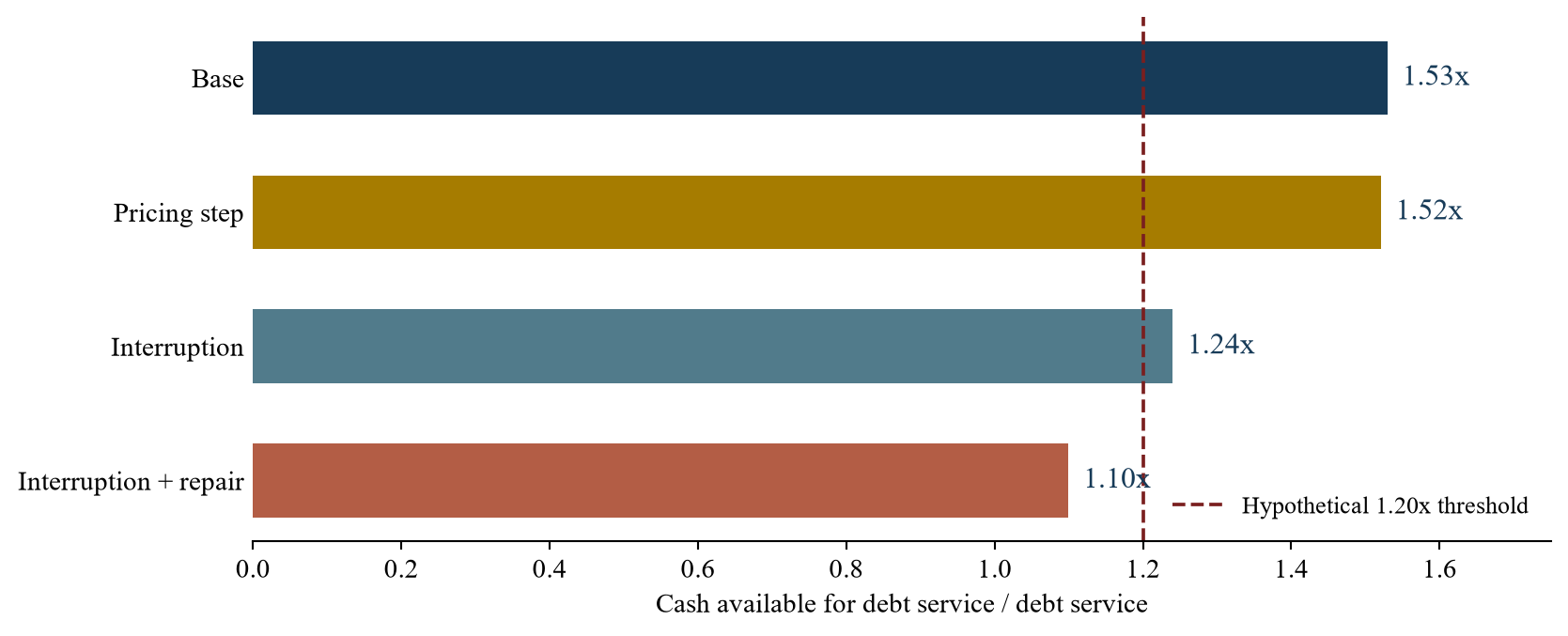
Author-assumed USD 250 million opening debt, first-year debt service and cash cases; the dashed 1.20x line is a hypothetical covenant threshold.
11 Draft the sustainability schedule as an evidence instrument
The sustainability schedule should start with definitions rather than aspirations. Specify KPI name, unit, included entities and sites, excluded activities, accounting method, baseline year, treatment of Scope 2 contractual instruments, annual target dates, rounding, data sources and verifier requirements. Attach the agreed baseline evidence. A target expressed as “reduce emissions in line with our strategy” is too open to interpretation for an annual pricing decision.
The schedule should also show the arithmetic of the pricing adjustment: which margin is affected, when the step begins, when it ends, whether multiple KPIs aggregate or offset, and what happens if one target is achieved and another is not. A two-way margin ratchet may include a reduction for achievement and an increase for a miss. The 2025 principles do not impose one universal adjustment size or formula [1]. The lender and borrower should model its actual cash effect and check that it is properly disclosed to decision makers.
Include a measurement and correction protocol. The borrower delivers annual data and a verifier report on a stated timetable. The facility agent circulates the result. The agreement states whether a correction affects a past interest period, a future period or neither, and who pays any true-up. It should distinguish ordinary calculation error, deliberate misstatement and a methodological revision required by new standards. For material revisions, the sustainability amendment process should preserve target ambition and require appropriate lender consent [2].
The schedule can refer to the borrower's transition plan, but should not incorporate an entire mutable corporate document by reference without deciding which provisions are binding. A board may update that plan in response to technology, acquisitions or regulation. If every change automatically alters the loan, neither side has a stable contract. Identify the specific quantitative commitments that are contractual, keep the wider plan as disclosed context, and set a formal route for amending the contracted numbers.
12 Make resilience milestones testable
An undertaking to “improve climate resilience” is hard to monitor. Break a material workstream into design acceptance, permits, procurement, installation, independent testing and operating handover. Each stage needs a deliverable, responsible person, deadline and funding source. A lender may use completion certification as a draw condition or as part of the construction monitoring package. The engineer should state the design basis and residual risks so that completion means more than invoices paid.
For a heat-exposed utility facility, a milestone might require installation and tested operation of a redundant cooling loop serving identified critical equipment, under an engineer-approved acceptance protocol. For a flood-exposed substation, it might require switchgear protection to a specified site-specific design elevation, verified by as-built survey. These are illustrative forms; no elevation, temperature or return period is prescribed here. The correct design follows site investigations, local code, insurer conditions and engineering judgement.
Allocate delay risk. If an equipment supplier fails, who funds replacement and interest during construction? If a permit is delayed, is there a long-stop date, alternative design or equity support? If works exceed budget, does the sponsor contribute more equity or may the loan be redrawn? A covenant that states a date but omits funding and remedy is incomplete. The credit team should test whether delayed works affect revenue commencement and the first debt-service date.
Monitoring should continue after completion. Physical protection can deteriorate or be disabled during maintenance. The operating company needs inspection intervals, incident logs, spare parts, drills and insurance renewal. The lender's information package can include exception reporting for material damage or loss of coverage. The package should focus on decisions and material exposure; collecting an ever-growing set of low-value climate metrics can obscure a failed critical control.
13 Rebaseline without turning ambition into discretion
Long-tenor borrowers change. They acquire facilities, dispose of assets, shift product mix, reconfigure a plant or adopt a revised emissions-accounting method. The GHG Protocol addresses structural changes and base-year recalculation [5]. The 2025 sustainability-linked guidance recognises that significant changes may warrant a sustainability amendment [2]. A workable agreement should permit comparability adjustments through a controlled process while refusing automatic reductions in effort.
Define objective triggers: a material acquisition or disposal, a change in consolidation boundary, a significant methodology revision, a corrected baseline error or a legal change that directly affects measurement. The borrower should submit the old and proposed calculation, source documents, effects by year, and an independent verifier's view. The lender should decide under the agreed approval threshold. Record the effective date and whether prior periods remain unchanged. An acquisition that adds emissions and cash flows requires a transparent bridge, not the deletion of an unfavourable year.
The same process can apply to resilience works. If a project design changes because a previously unknown site condition is found, the engineer should document the replacement protection level, budget and timetable. The borrower should show whether the revised action preserves the credit protection underlying approval. A cheaper design may be sensible; it is not automatically equivalent. A more expensive design may require more equity and a revised construction schedule. Change control should connect technical evidence to financing consequences.
Where a target can no longer be set with integrity, the parties should not continue to present the facility as sustainability-linked by habit. The LMA guidance addresses declassification where appropriate SPTs cease to be set [2]. The financial loan remains governed by its negotiated terms; the sustainability label is a separate representation. The borrower and lender should document any change in label, reporting and pricing transparently.
14 Allocate climate risk to the party able to act
Climate risks have multiple owners. The borrower controls site operations and most data. The sponsor controls equity support and strategic capital allocation. The independent engineer evaluates physical design and construction. The emissions verifier evaluates the specified performance measurement. The insurer sets coverage and exclusions. The lender evaluates credit and enforces loan rights. A public authority controls permits and applicable standards. A useful risk matrix names the decision owner and evidence, without pretending that one party controls weather, grid emissions or every third-party supplier.
For an emissions target, the borrower should own the inventory and actions; the verifier should test the reported level; the lender should apply the agreed pricing result. For physical works, the sponsor and borrower should fund and deliver; the engineer should certify; the lender should control drawdown and monitor residual credit risk. For a severe weather event, insurance may reimburse defined loss subject to deductibles and exclusions, while the borrower still owes debt service under the facility. The model should show how much liquidity is needed before any recovery arrives.
An allocation table can be maintained as a live register even if not reproduced in the public facility. Each row records the event, action, evidence date, cost bearer, lender right, cure route and residual exposure. The register should be reviewed before term-sheet approval, at signing, at each draw and after a material incident. If a risk has no owner, data source or funding, it remains an open credit issue.
IFC Performance Standard 1 provides a project-management lens through assessment, management systems and monitoring [7]. The Equator Principles may add requirements for transactions within their product and threshold scope where an adopting financial institution is involved [9]. These frameworks can help define the process, but neither overrides the negotiated allocation of cash, collateral and covenant rights. Counsel should check their application in each facility.
15 Govern missed targets, missing reports and actual credit stress
The agreement should have a decision tree for three distinct failures. First, a verified SPT miss triggers the agreed sustainability-linked price or structural consequence. Second, missing or qualified data triggers the negotiated reporting escalation and interim pricing treatment. Third, impaired cash generation or an uncompleted critical workstream triggers the relevant credit or construction provisions. Collapsing all three into one “climate default” can produce a remedy disproportionate to the evidence or leave a serious physical problem under-protected.
For a missed SPT, ask whether the borrower has a credible remediation plan and whether the current target path remains ambitious. The margin step may apply automatically under the contract, while management still needs an operational response. The lender should assess whether the miss signals weak governance, a one-off technical problem or deteriorating economics. A single measured miss does not, on its own, establish the cause. The following year's target should not be quietly reset without the amendment process.
For missing data, first locate the failure. Was a site meter unavailable, an emission factor changed, a verifier unable to obtain evidence or a report submitted late? The agreement should preserve source records and allow a defined cure. No party should claim target achievement from an unverified estimate when verification is required for the relevant loan characteristic [1]. If the issue remains unresolved, apply the contracted treatment and reconsider the facility's sustainability-linked representation [2].
For credit stress, focus on actual cash, liquidity and security. A flood event may depress output even while emissions fall. A carbon target may be achieved because a plant closed involuntarily. Neither result substitutes for debt-service analysis. The financial covenant definition, insurance proceeds, permitted repair expenditure, equity cure and enforcement threshold should be agreed in the main finance documents. The climate schedule can supply information; credit protection must follow cash-flow and legal analysis.
16 Use analytics and AI as controlled evidence tools
Large borrowers can have thousands of invoices, meter records and supplier contracts. Data engineering can map meter readings to sites, check gaps, flag outliers and link an emissions calculation to its original source. Geospatial tools can connect physical assets to hazard layers and engineering surveys. A lender can use these systems to identify questions for management. An automated score is not, by itself, an independently verified KPI or a site-specific resilience conclusion.
AI-based document extraction may help classify power contracts, permits, capital milestones and assurance reports. Every consequential output should retain document title, issuer, date, page, extracted value, confidence and reviewer decision. If an AI system reads “10 MW” as “100 MW,” a carbon or funding calculation could be distorted. Reconciliation against contracts and physical meters is essential. Confidential borrower records should be handled within authorised data environments and subject to the relevant data-rights terms.
Build exception reports rather than a single green score. Examples include a site with no meter history for three months, a renewable-energy instrument that fails the agreed quality test, a resilience milestone with paid invoices but no engineer sign-off, or a reserve below the agreed balance. The exception should name an owner and due date. Management can then resolve an evidence problem before annual verification or a lender reporting deadline.
The paper does not claim a measured improvement in credit outcomes from AI. A useful future study would compare error rates, verification time and covenant disputes across facilities with and without controlled data systems, adjusting for borrower complexity. Until such evidence exists, the case for analytics is operational traceability: it can make the chain from physical activity to a contractual number more inspectable, provided human review remains accountable.
17 Run a signing-to-maturity control sequence
Before term-sheet approval, the borrower and lender should agree the asset perimeter, material transition and physical risks, proposed metric, funding requirement and credit sensitivities. The diligence pack should contain baseline records, a transition action list, initial engineering findings, draft sources and uses, and a cash-flow model with downside cases. A missing baseline or unpriced resilience work is a decision gap, not a footnote to be settled after signing.
Before signing, the parties should settle the KPI definition and annual target schedule, the verifier's mandate, reporting timetable, margin mechanics and rebaseline rule. The project documents should identify required resilience works, independent engineer certification and draw conditions. Treasury should reconcile the funded reserve and any letters of credit with the financial model. Counsel should test how the climate provisions interact with existing representations, reporting defaults, financial covenants, cure rights and security documents.
During construction or implementation, the borrower should report capital spend, permit status and independent engineer exceptions. The lender should release draws against the agreed evidence. The emissions team should run the measurement process before the first pricing trigger to find gaps while they can still be corrected. At each annual assessment, the borrower submits the specified performance statement and external verification. The agent applies the contract's pricing result. The credit team separately tests coverage, liquidity, insurance and residual physical exposure.
At maturity or refinancing, the accumulated records provide more than a sustainability badge. They show what was financed, built and measured; how actual cash compared with sensitivity cases; and what adaptation or transition capex remains. A subsequent lender can assess a consistent history rather than reconstructing it from a marketing presentation. The original term sheet should be judged by that evidence trail and repayment outcome.
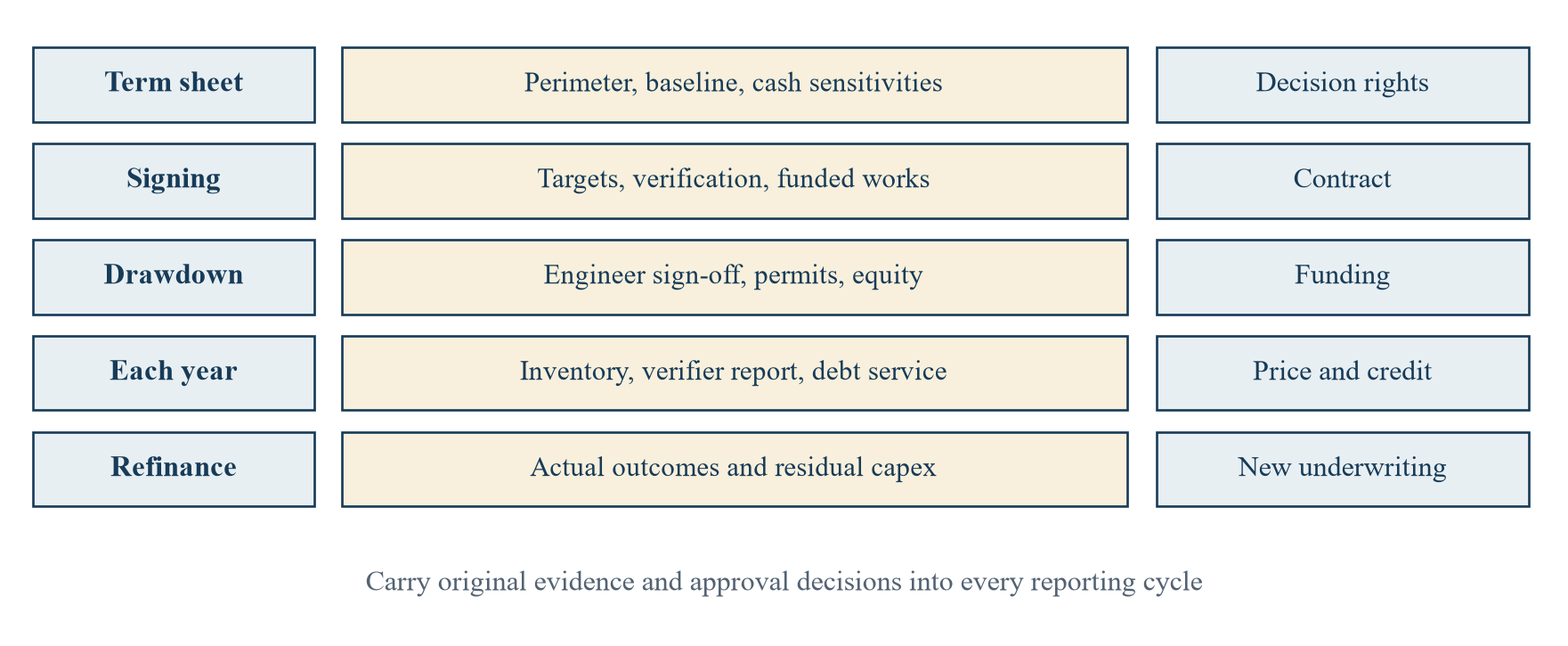
Author-developed sequence; local law, facility terms and asset risks govern implementation.
18 Recognise limits and research gaps
This is a contractual and credit decision framework, not a legal opinion, engineering design, emissions assurance report or underwriting recommendation. The cited standards have different scope. A market principle for sustainability-linked loans does not dictate the structure of a particular facility [1,2]. IFRS S2 disclosure requirements depend on whether and how an entity applies the standard [3,4]. The GHG Protocol defines accounting concepts but does not verify this fictional borrower's data [5,6]. IFC and Equator Principles requirements need transaction-specific applicability checks [7,9].
The fictional financing assumes one opening loan balance, fixed first-year rates, a simple principal instalment and cash flows stated to two decimals. It does not model tax, inflation, staged drawdown, hedging, loss timing, insurance recovery, reserve mechanics or a complete amortisation profile. Its emissions baseline and annual targets are author-created examples. The physical interruption and repair cost are also author-created. The sensitivity establishes how different orders of magnitude affect the illustrative ratio; it does not estimate the probability or severity of climate events for any real asset.
Empirical work could test whether independently verified SPTs and funded resilience milestones correlate with better credit outcomes. It would need borrower-level data on baseline quality, target ambition, actual capex, physical incidents, insurance, covenant performance and defaults. Selection effects would matter: companies that can afford verification may already have stronger controls. Public green-loan labels alone cannot isolate the causal contribution of a pricing ratchet.
Research can also compare physical-resilience investments by asset class. A data centre, port, water plant and transmission line face different failure modes and service obligations. Studies should join engineering performance to cash-flow effects and loan terms, while recording uncertainty. The framework here offers a way to specify the question and preserve the evidence, not a universal resilience premium or discount.
19 Conclusion
A climate plan becomes financeable when its material actions have a measured baseline, responsible owner, funding source, independent evidence and contractual consequence. The lender should treat emissions reduction and physical resilience as connected parts of the same operating and cash-flow system. Each part may require a different loan instrument. A sustainability-linked margin adjustment can reward or penalise a measured annual result; a funded draw milestone can deliver essential protection; a financial covenant can test repayment capacity.
The fictional financing makes the distinction visible. A ten-basis-point step changes annual interest by USD 0.25 million on the assumed opening loan balance. A hypothetical USD 12 million cash-flow interruption has a much larger coverage effect. Funding USD 40 million of resilience works in the initial uses is therefore a direct credit decision, while the annual emissions target remains an evidence and incentive decision. The numerical comparison is a teaching device, not a forecast.
The practical sequence is to define the perimeter, verify the baseline, choose material indicators, calibrate annual targets, fund physical work, draft reporting and verification terms, and test the whole structure against debt-service sensitivities. Rebaseline only through a documented process that preserves comparability and ambition. At each reporting date, ask what was measured, built, paid and independently checked. A climate covenant is credible when the answer can change a real lending decision and withstand examination after the deal closes.
References
- Loan Market Association, Asia Pacific Loan Market Association and Loan Syndications and Trading Association. Sustainability-Linked Loan Principles, 26 March 2025. Accessed 6 October 2026. https://www.lma.eu.com/application/files/2317/4481/8026/Sustainability-Linked_Loan_Principles_-_26_March_2025_.pdf
- Loan Market Association, Asia Pacific Loan Market Association and Loan Syndications and Trading Association. Guidance on Sustainability-Linked Loan Principles, 26 March 2025. Accessed 6 October 2026. https://www.lma.eu.com/application/files/3517/4298/0872/Guidance_on_Sustainability-Linked_Loan_Principles_-_26_March_2025.pdf
- IFRS Foundation. IFRS S2 Climate-related Disclosures, issued June 2023. Accessed 6 October 2026. https://www.ifrs.org/issued-standards/ifrs-sustainability-standards-navigator/ifrs-s2-climate-related-disclosures/
- IFRS Foundation. Disclosing Information about an Entity's Climate-related Transition, Including Information about Transition Plans, in Accordance with IFRS S2, June 2025. Accessed 6 October 2026. https://www.ifrs.org/content/dam/ifrs/supporting-implementation/ifrs-s2/transition-plan-disclosure-s2.pdf
- GHG Protocol. A Corporate Accounting and Reporting Standard, Revised Edition, 2004; corporate suite update status reviewed. Accessed 6 October 2026. https://ghgprotocol.org/sites/default/files/standards/ghg-protocol-revised.pdf
- GHG Protocol. Scope 2 Guidance, 2015; current standard and consultation status reviewed. Accessed 6 October 2026. https://ghgprotocol.org/scope-2-guidance
- International Finance Corporation. Performance Standard 1: Assessment and Management of Environmental and Social Risks and Impacts, 2012. Accessed 6 October 2026. https://www.ifc.org/en/insights-reports/2012/ifc-performance-standard-1
- European Banking Authority. Guidelines on the Management of ESG Risks, published January 2025. Accessed 6 October 2026. https://www.eba.europa.eu/publications-and-media/press-releases/eba-publishes-its-final-guidelines-management-esg-risks
- Equator Principles. The Equator Principles and Product Scope. Accessed 6 October 2026. https://equator-principles.com/about-the-equator-principles/
About the Author
Chennakeshav (CK) is a corporate finance and investment banking executive with 25+ years of global experience in deal origination, structuring and execution across M&A, growth capital and corporate strategy. He has led value-creation mandates for founders, corporates and funds — bridging the boardroom view to hands-on execution and close.
His career spans Morgan Stanley, HSBC, Lloyds Banking Group, EWEC, ADQ portfolio companies and Emirates Growth Fund, across TMT, real estate, fintech, deeptech, cleantech, infrastructure and energy. He has partnered with C-suite leaders, private equity and venture funds, sovereign wealth funds and family offices to finance complex fund raises and scale-up ventures, and has led M&A due diligence, post-merger integration and business-transformation initiatives to create value.
At Matchpoint Partners he is Managing Partner, leading the firm's corporate finance, M&A and capital-raising practice. He holds an MBA from London Business School, an engineering degree from VTU and a Master of Laws (LLM, in progress) from UCL London.
An active start-up mentor, CK mentors at Techstars, DIFC FinTech Hive, Startup Grind, Founder Institute and IN5, serves as Entrepreneur Mentor in Residence (EMiR) at London Business School, and judges the Entrepreneurship World Cup.
