

1. The investment decision
Potable reuse converts treated municipal wastewater into a source of drinking water through advanced treatment and controlled integration with a public water system. The capital decision covers far more than a treatment train. It commits a community to source control, operator competence, monitoring, reporting, incident response, long-term operations and a revenue mechanism capable of funding those duties.
The sponsor must therefore answer a combined question: can the system produce safe water under credible operating conditions, and can its institutions maintain public confidence and revenue through construction, commissioning, routine operation and abnormal events? Bankability emerges when those obligations are explicit, funded and enforceable.
2. What bankable means
A bankable potable-reuse project has a defined legal route, mature technical design, reliable feedwater, measurable performance, competent counterparties, committed funding and a credible source of repayment. It also has a durable public mandate. Public opposition, unclear authority or weak disclosure can delay permits, tariffs and construction even when the engineering is sound.
Lenders and public funders require evidence that completion and operations can be sustained. Ratepayers require evidence that health protection, affordability and accountability are real. The project structure should satisfy both tests through the same operating record rather than through separate narratives.
3. Potable-reuse pathways
Indirect potable reuse introduces advanced-treated water into an environmental buffer such as an aquifer or reservoir before drinking-water treatment. Direct potable reuse introduces advanced-treated water directly into a public water system or immediately upstream of a drinking-water plant without an environmental buffer. EPA describes both pathways as options within a region's water portfolio [1].
The pathway affects treatment, residence time, monitoring, permitting and communication. A buffer can provide response time and blending, while it does not replace validated treatment. Direct systems require especially clear diversion, redundancy and operator controls because the interval between treatment and distribution is shorter.
4. The regulatory gate
California's direct-potable-reuse regulations became effective on 1 October 2024 after expert review, public consultation and formal rulemaking [5]. The regulations establish detailed treatment, monitoring, operator, source-control, planning and management requirements [6]. They offer a useful illustration of how public-health protection becomes an investable compliance architecture.
A project should map every regulatory duty to a responsible entity, design feature, operating procedure, data field and funded cost. Regulatory compliance is not a single permit milestone. It continues through source control, validation, commissioning, reporting, corrective action and renewal.
5. The confidence-to-credit chain
Public confidence and credit quality are connected through a sequence of observable controls. A weakness in one link can affect approval, schedule, tariffs, operating continuity and repayment.
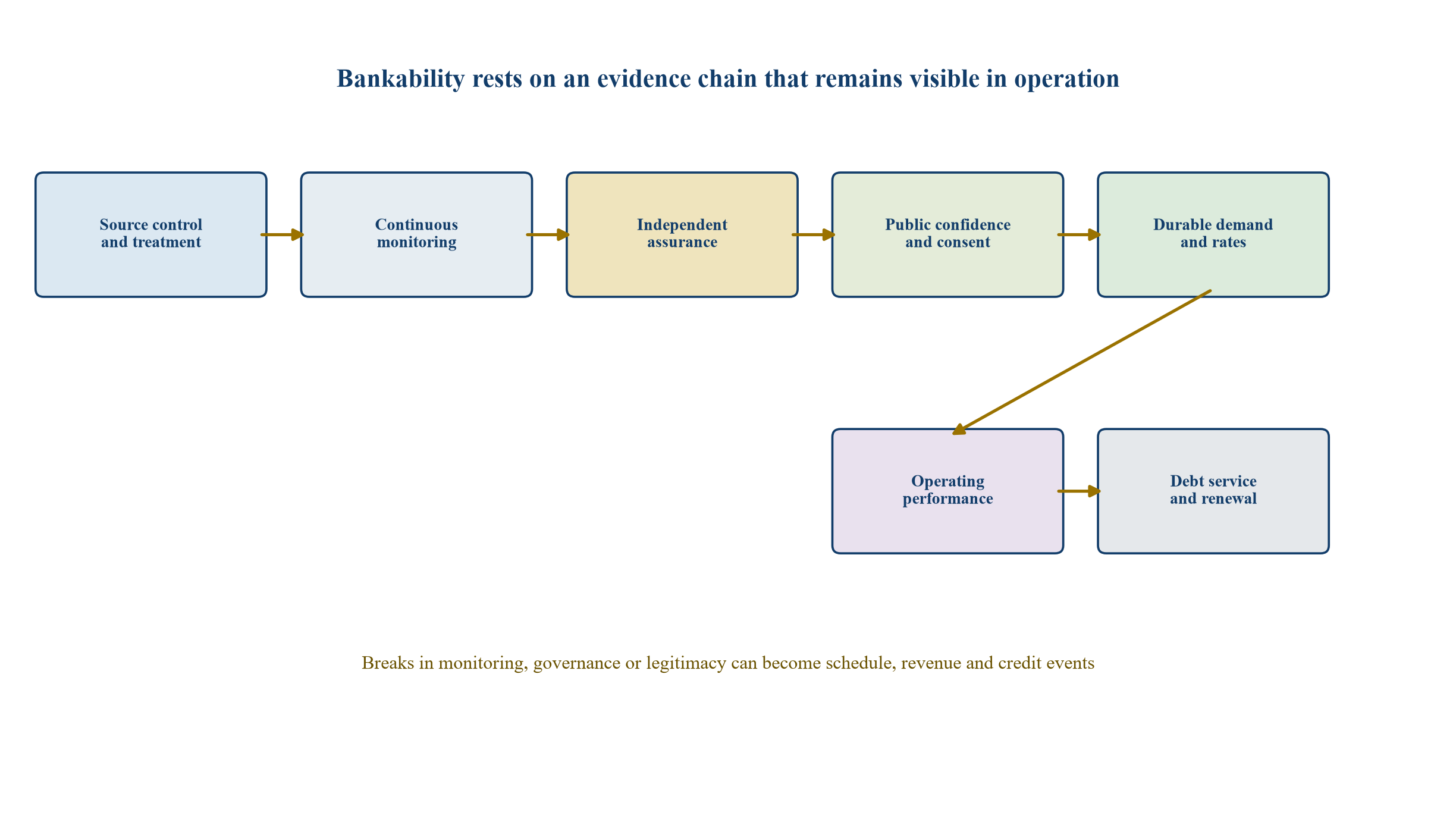
Conceptual decision chain; each project requires jurisdiction-specific legal, technical and credit analysis.
6. Health protection as the first covenant
WHO's potable-reuse guidance applies the framework for safe drinking water to municipal wastewater, including source protection, control measures, monitoring and public acceptance [3]. The financing model should begin with the same hierarchy. Capital structure cannot compensate for an incomplete safety case.
The sponsor should define health-based targets, identify hazards, validate barriers and establish operational limits before final debt sizing. Lender technical advisers should test whether critical controls are measurable in time to prevent off-spec water from reaching the public system.
7. Source control
Potable reuse begins in the sewer catchment. Industrial discharges, medical facilities, storm inflow and household chemicals can alter source-water quality. The source-control programme should include discharge permits, inspections, prohibited substances, pretreatment obligations, rapid notification and enforcement.
Treatment design can address expected variability. It should not assume that every upstream contaminant can be detected and removed after entry. A bankable programme funds source-control staff and analytical capability as enduring operating costs.
8. Multiple barriers
Advanced treatment commonly combines physical separation, membranes, oxidation and disinfection. Each barrier should have a defined function, validated performance, redundancy, maintenance plan and response to deviation. The combined train should address microbial and chemical risks under normal and credible upset conditions.
Barrier independence matters. Several nominal stages can share a common vulnerability, such as power loss, instrument failure or contaminated chemical supply. Hazard analysis should identify common-mode failures and provide power, storage, bypass prevention and alternative operating states.
9. Monitoring answers different questions
Operational monitoring asks whether a control measure is working now. Compliance monitoring tests whether regulated requirements are met. Verification confirms that the complete water-safety system performs as intended. Independent surveillance examines whether governance and assurance are credible. These functions require different parameters, frequencies and accountabilities.
Combining them into a single laboratory schedule obscures response time. Fast surrogate measures can protect operation; slower laboratory analyses can verify water quality; periodic audit can test the management system. The data architecture should preserve all three.
10. Continuous operational monitoring
WHO recommends continuous monitoring linked to supervisory control and data acquisition systems, automatic alarms and responses when critical limits are exceeded [3]. Relevant measures can include turbidity, conductivity, total organic carbon, ultraviolet intensity, disinfectant residual, pressure integrity and membrane performance.
The project should specify instrument redundancy, calibration, data validation, cybersecurity and alarm ownership. A dashboard without an automatic protective action remains an information tool. Critical deviation should trigger a predetermined diversion or shutdown state.
11. Verification monitoring
Verification uses microbial indicators, chemicals, treatment by-products and other parameters to confirm that the safety plan is achieving its objectives. Sampling locations and methods should be traceable from source through treatment, storage and final integration.
Results should be reviewed for trends as well as isolated compliance. A parameter moving within limits can still indicate fouling, source change or weakened treatment. The operating budget should include specialist interpretation, not only sample collection.
12. Independent surveillance
WHO identifies independent surveillance as a core element of safe drinking-water governance [4]. Surveillance can include regulator review, third-party audit, public-health oversight and periodic expert panels. Independence strengthens confidence when the utility is both operator and reporter.
The governing documents should define access to data, publication duties, escalation rights and the treatment of dissenting findings. A review body with no information rights or response mechanism can create appearance without control.
13. The monitoring hierarchy
The monitoring design should connect speed, purpose and decision rights.
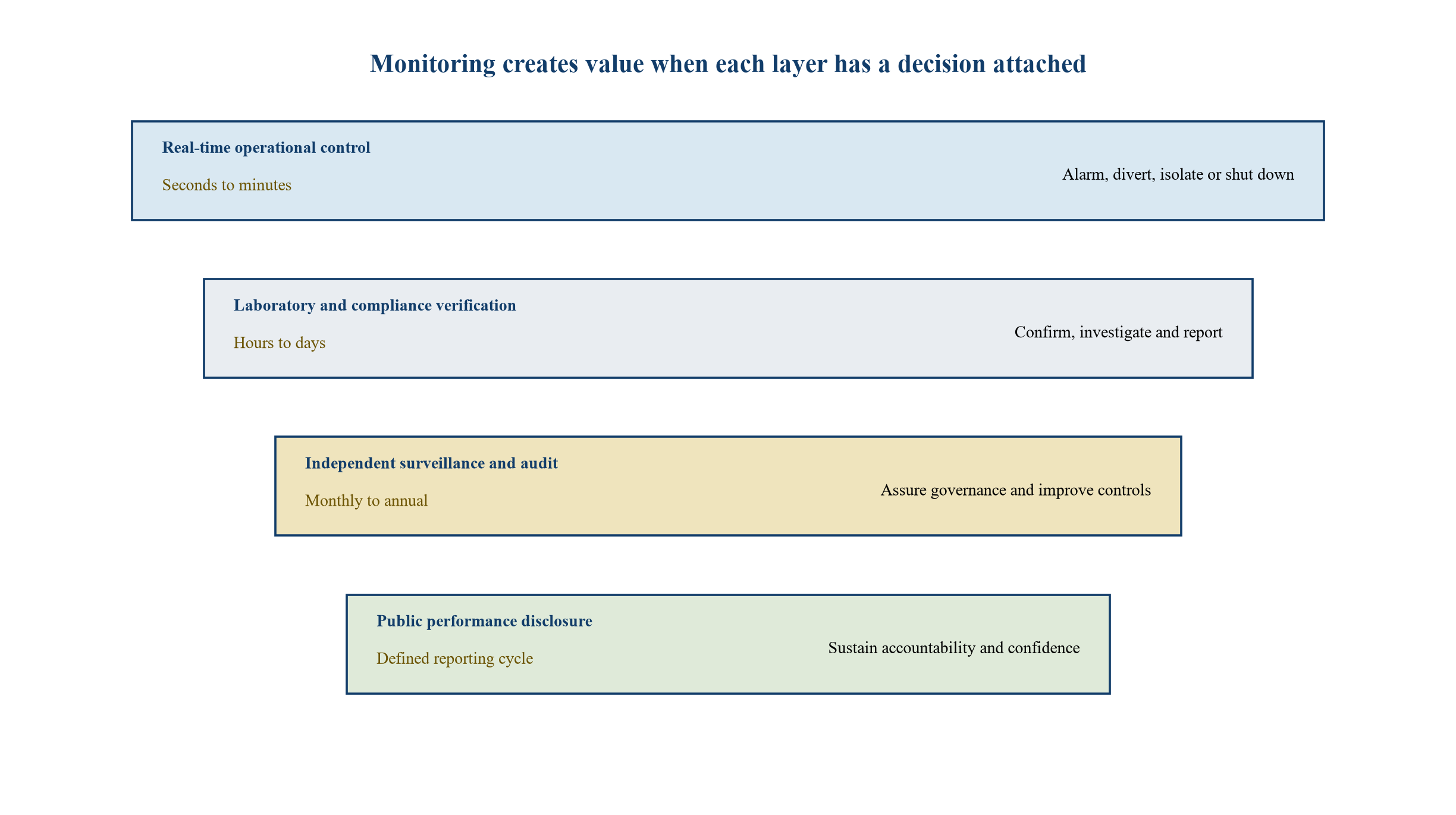
Illustrative architecture; parameters and response times require project-specific validation and regulation.
14. Automatic diversion
An off-spec event should have a safe destination. The system may divert water to wastewater treatment, holding storage, retreatment or disposal. Diversion capacity should cover detection, confirmation, repair and restart under the design upset.
The contract and operating plan should state who can initiate diversion, what happens on signal loss, how stored water is classified and what evidence is required for return to service. A design that depends on discretionary discussion during an acute deviation is fragile.
15. Data integrity and cybersecurity
Monitoring data support operational decisions, regulatory reporting and public confidence. Time synchronization, audit trails, access control, backup and change management are therefore safety and finance controls. Cyber intrusion or accidental configuration change can affect both treatment and evidence.
Critical operational technology should be segmented, tested and recoverable. Manual fallback procedures should be rehearsed. The data-retention policy should support incident reconstruction and lender or regulator review without exposing security-sensitive details.
16. Operator competence
California's framework includes advanced operator certification and detailed operational plans [6]. Qualified operators are a recurring obligation. Staffing models should cover shifts, leave, succession, training and specialist maintenance rather than naming a few individuals at financial close.
The operating agreement should define competency, minimum staffing, continuing education and authority to place the plant in a safe state. Incentives should reward compliant reliability and learning, not simply maximum throughput.
17. Public acceptance as an operating capability
Public acceptance is often treated as a communications campaign before approval. A stronger model treats it as an enduring institutional capability built from evidence, access, responsiveness and fair decision-making. Confidence can change after a rate increase, incident, leadership transition or misleading online claim.
The programme should maintain a stakeholder map, accessible monitoring information, visitor and education channels, incident protocols and trained spokespeople. These activities require a defined owner and budget throughout the asset life.
18. Language and framing
Technical precision and plain language should coexist. Terms such as purified water, advanced treatment, indirect reuse and direct reuse should be defined consistently. The utility should explain the complete urban water cycle, treatment barriers and response controls without suggesting that risk is impossible.
Overstatement weakens trust when future events occur. Communication should describe what is monitored, what happens on deviation and which independent bodies review performance.
19. Engagement before design lock
Early engagement can identify concerns about health, affordability, location, energy, residuals and governance before the design becomes difficult to change. San Diego formed working groups representing customers, community organisations, businesses and other stakeholders, alongside independent expert review [11].
The sponsor should record how material concerns affect the project. Participation without visible response can deepen scepticism. Design, route, reporting and tariff decisions should include a reasoned explanation.
20. Demonstration and direct experience
Pilot plants, visitor centres and transparent sampling can make treatment observable. Singapore's NEWater programme combines advanced treatment with public education and an established supply network [15]. Demonstration should show both performance and governance, including how the system reacts when a limit is approached.
A pilot is valuable when its source water, process and operating conditions inform the full project. A showcase operated under unusually favourable conditions should not be presented as full-scale evidence.
21. Public-confidence matrix
The project can convert broad trust language into specific commitments.
Table 1. Public-confidence commitments and credit relevance
| Confidence driver | Observable commitment | Responsible party | Credit relevance |
|---|---|---|---|
| Health protection | Validated barriers, critical limits and automatic diversion | Utility and operator | Protects licence to operate and continuity |
| Independent oversight | Regulator access, third-party audit and published response | Regulator and governing board | Reduces governance uncertainty |
| Transparency | Regular performance reports and incident disclosure protocol | Utility communications and compliance teams | Supports rate and political durability |
| Participation | Early consultation with documented response to material issues | Sponsor and public authority | Reduces approval and delay risk |
| Affordability | Published bill impacts, assistance and phased rate design | Governing board | Protects collections and consent |
| Competence | Certified staffing, training and succession | Operator | Protects operating performance |
| Corrective action | Clear authority, timelines and return-to-service evidence | Utility and regulator | Limits duration and severity of events |
Generic governance framework; local law and consultation requirements prevail.
22. Incident communication
Incident plans should distinguish operational deviations, confirmed non-compliance and public-health events. Each category needs decision rights, notification thresholds, approved channels and a record of actions. Speed matters, while premature or inconsistent statements can create confusion.
The plan should identify the regulator, public-health authority, elected leadership, media and affected customers. Exercises should test weekends, cyber outages and incomplete information. After action, the utility should publish findings and corrective measures within lawful limits.
23. Equity and legitimacy
Benefits and burdens should be visible across the service area. Communities may experience construction, treatment facilities or rate increases differently. They may also have different histories with water quality and public institutions. The engagement and affordability plan should reflect those conditions.
Legitimacy improves when the project explains alternative costs, distributional effects and safeguards. Targeted assistance, language access and community representation can be designed as project obligations rather than discretionary additions.
24. The long-term demand case
Potable reuse demand is usually system demand for reliable drinking water rather than a single customer's offtake. The case should reconcile population, conservation, climate, imported supply, groundwater, storage, desalination, emergency reserves and environmental obligations.
The relevant demand is the quantity that the system needs and can integrate at an acceptable cost. A high gross demand forecast does not prove that every unit of reuse capacity will be used or paid for.
25. Demand scenarios
The sponsor should model at least a central case, slower-demand case, severe conservation case and alternative-supply case. Each scenario should test production, unit cost, rate requirement and debt coverage. Regulatory delay and phased commissioning should also be modelled.
Demand uncertainty can be managed through modular capacity, staged conveyance and flexible operating schedules. Building the maximum concept at once transfers forecast risk to ratepayers and lenders.
26. Integrating reuse into the water portfolio
Reuse should be valued against the portfolio it changes. It can reduce imported-water exposure, preserve groundwater, diversify drought risk and reduce wastewater discharge. It can also add electricity, chemicals, concentrate management and specialised operating requirements.
Portfolio analysis should compare equivalent reliability, quality and timing. A nominal cost per unit of average production can mislead when alternatives have different drought availability or completion dates. The decision record should show the counterfactual supply plan.
27. Base demand and operating flexibility
Advanced treatment assets have substantial fixed cost. Stable base operation can improve unit economics and process control, while the wider system may need seasonal flexibility. Storage, blending and coordination with reservoirs or aquifers can separate steady plant output from variable customer demand.
The operating plan should state minimum stable output, turndown, start-up duration and planned maintenance. Revenue requirements should not depend on an utilisation assumption that the system cannot achieve.
28. Conservation risk
Successful conservation can reduce billed water even as fixed infrastructure costs remain. The financial model should separate total demand from reuse utilisation and utility revenue. A project justified by resilience may remain valuable at lower volumes, but its tariff design must recover fixed cost.
Sponsors should avoid framing conservation and reuse as competitors. A resilient portfolio can require both. The rate structure should prevent efficiency gains from creating an immediate funding shortfall.
29. Alternative-supply risk
New groundwater rights, desalination, imported-water contracts or demand changes can affect reuse utilisation. The sponsor should identify which alternatives are committed, permitted and financed, and which remain strategic possibilities. A speculative alternative should not be treated as equal to an executable project.
Decision gates can preserve flexibility. Early spending can focus on permits, pilots and rights of way while demand and competing supply become clearer. Later capital can follow defined evidence.
30. Revenue architecture
Potable reuse is often funded through system-wide water or wastewater revenues. A two-part revenue design can separate fixed capacity recovery from volumetric use. Charges may also allocate costs between water and wastewater services when the project delivers benefits to both.
The governing board should document the legal basis, cost allocation, rate-setting process and affordability impact. Lenders will examine whether the utility can adjust rates in time to maintain coverage and operations.
31. Tariff principles
A durable tariff is understandable, lawful, sufficient and adaptable. It should fund operations, monitoring, chemicals, energy, staffing, residuals, debt service, reserves and asset renewal. It should also account for grants and concessional funding without treating temporary support as recurring revenue.
Rate design can phase increases with construction and service commencement. Sudden back-loaded adjustments create political and collection risk. Published bill impacts and assistance mechanisms support informed consent.
32. Affordability
Average bill impact can hide the burden on lower-income households. The affordability analysis should examine income, essential use, arrears and customer segments. Assistance may include targeted discounts, lifeline volumes, payment plans or external support, subject to law.
Affordability measures need stable funding and administrative capacity. A promise without eligibility rules, budget and delivery system should not be credited in the financing case.
33. Public and concessional finance
EPA's WIFIA programme can finance eligible water recycling and alternative-water projects for creditworthy public and private borrowers [14]. California also provides water-recycling grants and low-interest revolving-fund loans [18]. Such instruments can lengthen tenor, reduce interest cost and support construction.
Concessional capital does not remove project risk. Borrowers still need engineering feasibility, creditworthiness, legal authority, reporting and repayment. The financing plan should match each source to eligible cost and timing.
34. The San Diego financing example
EPA records a USD 614 million WIFIA loan for the first phase of Pure Water San Diego within USD 1.4 billion of project costs, with estimated financing savings compared with typical market financing [9]. The city's 2024 annual report describes additional WIFIA, state revolving-fund loans and grants [10].
The example shows how a large reuse programme can combine federal, state and local funding. The figures belong to that programme and are not transferable assumptions. Each borrower must model its own timing, draw conditions, interest, capitalised cost and repayment.
35. The Oceanside and East County examples
EPA reports a USD 69.1 million WIFIA loan for Pure Water Oceanside against USD 158.4 million of project costs [12]. It also reports a USD 388 million loan for the East County Advanced Water Purification Project against USD 791 million of project costs [13].
Both projects connect reuse to local supply resilience and reduced dependence on imported water. The financing benefit sits alongside source, treatment, storage and system integration. Public credit programmes still require a complete project.
36. Orange County operating evidence
Orange County's Groundwater Replenishment System began operating in 2008 and expanded to 130 million gallons per day in 2023, according to an OCWD publication [19]. Long operating history can reduce uncertainty around treatment performance, maintenance and public engagement.
New projects should use relevant precedent while preserving site-specific analysis. Source quality, regulation, hydrogeology, treatment, energy and governance vary. A precedent supports diligence; it does not replace it.
37. Singapore's system model
PUB presents NEWater as a pillar of Singapore's water supply, produced through advanced treatment and supplied to industrial users, with indirect potable use during dry periods [15]. PUB also publishes distinct water-price components and NEWater pricing information [16].
The model illustrates the value of integrated planning, dedicated infrastructure, public education and transparent price categories. Replication requires local institutional capacity and cannot assume identical source, demand or public-finance conditions.
38. World Bank scale conditions
The World Bank's 2025 reuse report identifies integrated planning, clear policy and regulation, pricing signals, programmatic scale and bankable delivery models as enabling conditions [17]. It also notes that the business case is strongest where wastewater is near demand.
These conditions translate into transaction questions: who controls the source, who buys or integrates output, which entity sets rates, how residuals are handled and whether capacity can be developed as a programme rather than an isolated asset.
39. Delivery model
The utility can deliver the project through traditional procurement, design-build, progressive design-build, alliance, concession or another public-private structure. The choice should reflect design maturity, interface risk, financing capacity and public control requirements.
Risk transfer has value only when the receiving party can price and manage it. Unbounded water-quality, demand or legal-change risk can increase bids, weaken competition or return through claims.
40. Risk allocation
The allocation should connect control, evidence and remedy.
Table 2. Potable-reuse risk allocation framework
| Risk | Primary control | Typical owner | Contract response |
|---|---|---|---|
| Source-water variability | Source control, monitoring and equalisation | Utility or wastewater entity | Defined envelope, notice and relief for exceptional contamination |
| Treatment performance | Validated design, redundancy and qualified operation | Design-builder or operator within agreed limits | Performance tests, cure, liquidated remedies and step-in |
| Off-spec water | Automatic diversion and safe storage | Operator | Mandatory isolation, investigation and return-to-service protocol |
| Regulatory change | Monitoring of law and adaptable design | Shared by public authority and private counterparty | Change mechanism with evidence and mitigation duty |
| Construction interface | Integrated schedule and interface register | Sponsor and delivery contractor | Milestones, interface responsibility and delay allocation |
| Long-term demand | Portfolio planning and phased capacity | Utility or sponsoring authority | Modular build, review gates and rate covenant |
| Public acceptance | Transparent governance and continuing engagement | Sponsor and governing board | Reporting, consultation and incident communication duties |
| Energy and chemicals | Efficient design and procurement strategy | Operator or utility | Indexed pass-through, hedging or efficiency benchmarks |
| Asset renewal | Condition monitoring and reserve funding | Utility or project company | Lifecycle plan, reserve covenant and handback standard |
Illustrative only; allocation depends on law, delivery model, insurance and market capacity.
41. Completion risk
Treatment plants, pipelines, pump stations, reservoirs, power connections and controls must work as one system. Completion should therefore be defined by integrated performance rather than mechanical completion of individual contracts.
Tests should cover flow, quality, barrier validation, diversion, loss of power, communications, data transfer and operator readiness. The financing schedule should retain contingency and liquidity until integrated acceptance.
42. Interface management
Wastewater and drinking-water entities may have different boards, operators and funding. The project should establish a single interface register covering feedwater, ownership, meters, permits, power, residuals, laboratories, emergency response and data.
Each interface needs an owner, due date and acceptance evidence. Unresolved interfaces can survive procurement and appear during commissioning when remedies are expensive.
43. Technology risk
Potable-reuse technology has operating precedent, while specific membranes, oxidation systems, sensors and controls continue to evolve. The sponsor should separate proven unit processes from novel integration. Performance guarantees should use measurable outputs and defined source conditions.
Proprietary equipment can create replacement and supplier-concentration risk. The lifecycle plan should cover spares, software, intellectual-property access and credible substitutes.
44. Energy exposure
Advanced treatment can be energy intensive. Power price, carbon policy and connection capacity affect operating cost and resilience. The model should include consumption by process, pumping, residuals and standby systems.
Efficiency guarantees can be tested at defined source quality and throughput. Renewable procurement can support objectives, but reliability still requires an operating power plan and backup for critical controls.
45. Chemicals and consumables
Membrane cleaning, disinfection, oxidation and conditioning depend on chemicals and consumables. Price, storage, transport and shelf life should be modelled. Single-source materials can become an operating vulnerability.
The operator should maintain approved suppliers, safety stock and quality checks. Indexed cost treatment can prevent hidden risk premiums while preserving incentives for efficient use.
46. Residuals and concentrate
Reverse-osmosis concentrate, spent media, sludge and off-spec water require lawful management. Disposal routes can determine siting and cost. The environmental assessment should cover normal and upset volumes.
Residual infrastructure should be commissioned with the treatment plant. A project cannot claim full capacity when its concentrate route is temporary or constrained.
47. Lifecycle maintenance
Membranes, ultraviolet systems, pumps, instruments and control equipment require renewal. The base case should use condition and vendor evidence for replacement intervals and include major-maintenance downtime.
Deferred renewal can preserve near-term cash while weakening safety and reliability. Reserve covenants, asset-management plans and board reporting can protect lifecycle funding.
48. Insurance and liability
Insurance may cover property damage, business interruption, construction and specified liabilities. It will not replace safe design, compliance or public accountability. Exclusions, deductibles and limits should be reviewed against the risk allocation.
The project documents should address indemnity, consequential loss and claims procedure. Public-law obligations may remain with the utility regardless of contractual transfer.
49. Rate covenant and coverage
Debt sizing should use pledged revenue after realistic operations and maintenance. The rate covenant can require the utility to set lawful charges sufficient for debt service and specified coverage. It should also protect essential operating and monitoring expenditure.
Coverage based on optimistic ramp or deferred maintenance is weak. Sensitivities should test demand, completion, power, chemicals, interest and delayed rate action.
50. Liquidity and reserves
Construction contingency covers defined cost uncertainty. Debt-service reserve, operating liquidity and lifecycle reserves address different risks. Their size should reflect funding terms, revenue adjustment speed and operating criticality.
Reserve release should require evidence, not simply a date. A newly commissioned plant may need more operational liquidity while performance stabilises.
51. Hypothetical financing case
The following case illustrates how monitoring, confidence and demand affect debt capacity. It assumes a public utility project with system-wide revenue support. The values are deliberately generic and do not describe a market tariff, named project or investment recommendation.
Table 3. Hypothetical potable-reuse financing case
| Item | Base case | Downside case | Decision interpretation |
|---|---|---|---|
| Design capacity | 100 units | 100 units | Physical capacity does not change |
| Year-five utilisation | 85% | 65% | Demand and system-integration risk |
| Annual fixed revenue | 120 | 105 | Rate action and affordability affect recovery |
| Annual variable revenue | 45 | 31 | Lower production reduces volumetric receipts |
| Operating and monitoring cost | 76 | 82 | Lower throughput and incident controls raise unit cost |
| Net revenue before debt service | 89 | 54 | Cash available to service debt and renew assets |
| Annual debt service | 55 | 55 | Contracted debt obligation remains fixed |
| Debt-service coverage | 1.62x | 0.98x | Downside requires rates, reserves, phasing or lower debt |
| Renewal allocation | 14 | 8 | Underfunding renewal creates future reliability risk |
Illustrative assumptions only; not a forecast, valuation, tariff proposal or representation of any project.
52. Interpreting the downside
The downside illustrates a structural mismatch: fixed debt remains while utilisation and revenue fall, and monitoring expenditure cannot prudently be cut. A sponsor can respond through lower initial debt, modular build, stronger system pledge, rate adjustment, grants or larger reserves.
The appropriate response depends on legal authority and affordability. The model should not solve coverage by reducing safety-critical operations or renewal below supported levels.
53. Confidence shock
A treatment deviation can create direct cost, temporary diversion, additional testing and public concern. The financial effect depends on the event, response and evidence. A transparent, rehearsed response can shorten uncertainty; delayed or inconsistent disclosure can magnify it.
The downside model should include temporary production loss, purchased replacement water, specialist cost and slower rate action. It should avoid invented probabilities where no evidence exists.
54. Demand-to-coverage bridge
The financing structure should show how physical demand becomes collected revenue and then debt capacity.
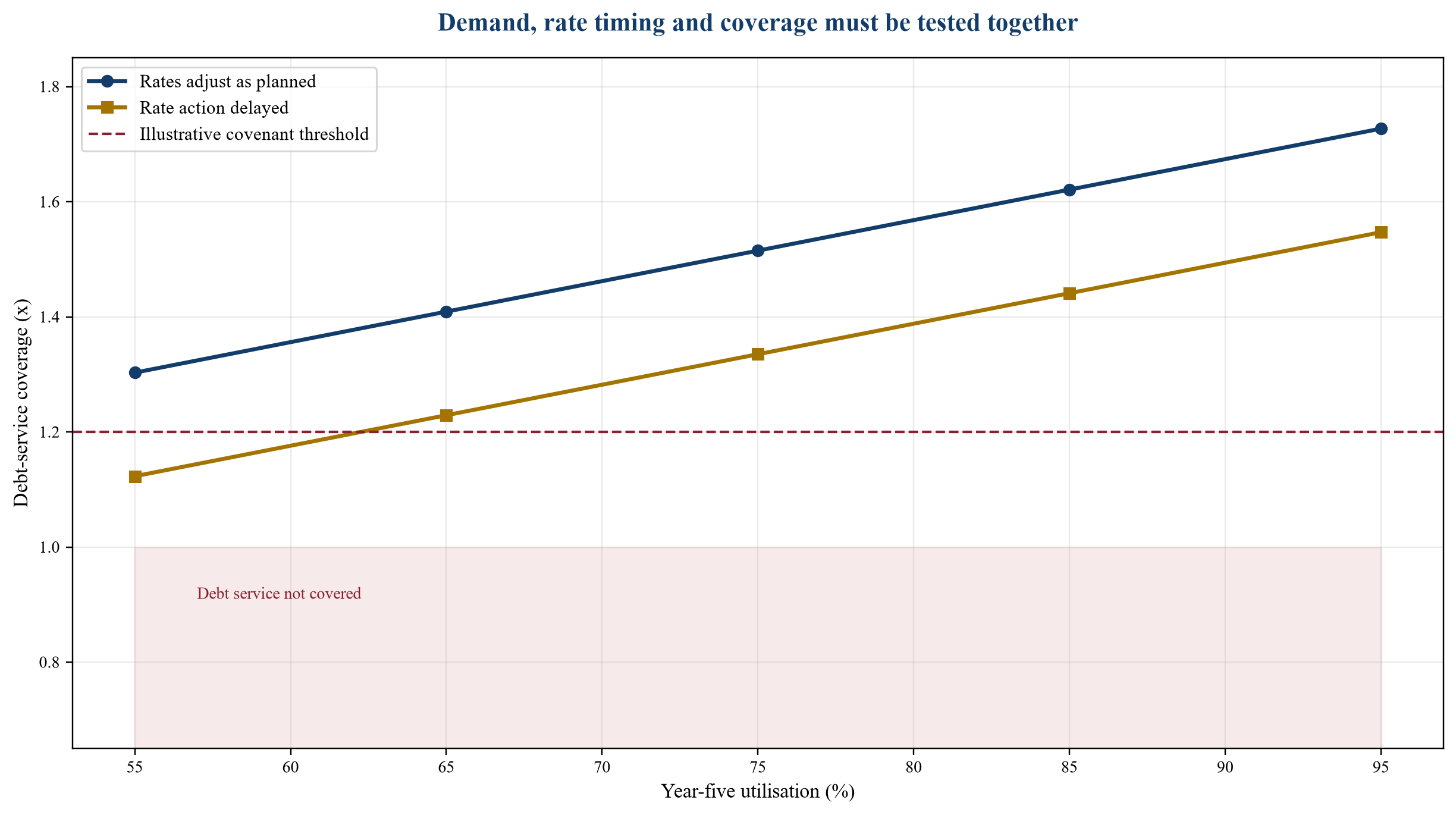
Illustrative index values only; not a forecast or project valuation.
55. Conditions precedent
Financial close should require permits, land, procurement, committed funding, approved business plan and evidence of tariff authority. Major interfaces, feedwater rights, residual route and power connection should be sufficiently developed. Public-consultation obligations should be complete or bounded.
Notice to proceed can have additional conditions for final design, financing and contractor security. Conditions should close real risks rather than create a checklist detached from the critical path.
56. Commissioning gate
Commissioning should include staged operation with surrogate monitoring, laboratory confirmation and regulator observation. Water should remain outside public supply until acceptance criteria and operating readiness are satisfied.
The ramp plan should define feedwater conditions, duration, challenge tests, data review and authority to progress. Schedule pressure should not override safety evidence.
57. Performance tests
Tests should cover capacity, water quality, energy, chemical use, residuals, reliability, diversion and restart. They should reflect seasonal source conditions or include later confirmation if initial conditions are unrepresentative.
Remedies can include retesting, correction, retention, performance damages and, for persistent failure, replacement or termination rights. The remedy should match the nature of the obligation.
58. Operating agreement
The operator needs clear scope, performance standards, staffing, data duties, maintenance, emergency authority and interface obligations. Payment can combine fixed availability, variable throughput and performance components.
Penalties should not encourage concealment or unsafe continuation. The safest response to a genuine deviation may be diversion, and the contract should support that decision.
59. Governance and decision rights
The governing board sets policy, approves rates and holds management accountable. Management runs the programme. The regulator protects public health. The operator controls routine operation within approved procedures. Independent reviewers provide assurance without displacing statutory authority.
A decision-rights matrix should cover design changes, alarms, diversion, public notice, restart, capital contingency and rate proposals. Ambiguity during an incident can be more damaging than a well-understood conservative rule.
60. Public reporting
Regular reporting can include production, availability, key treatment indicators, compliance, diversion events, energy, cost, construction and corrective actions. Reports should explain material changes and definitions so that trend comparisons remain meaningful.
Disclosure should protect operational security and personal information. An independent summary can help the public interpret technical results.
61. Data room for funders
The financing data room should contain the regulatory map, design basis, validation, source-water data, demand study, financial model, rate authority, affordability analysis, procurement, environmental review, consultation record, operator plan, insurance and risk register.
Documents should reconcile. A demand forecast, plant size and revenue model using different assumptions signal weak governance. Version control and an assumptions register reduce diligence friction.
62. Technical due diligence
Technical advisers should examine source variability, process selection, redundancy, hydraulic integration, residuals, utilities, constructability, commissioning, monitoring and lifecycle cost. They should trace claims to measured data and validated models.
The review should distinguish design maturity from future work. Open matters can be accepted when they have owners, schedules, budgets and conservative allowances.
63. Legal and regulatory due diligence
Legal review should confirm authority to source, treat, distribute, charge, borrow and grant security. It should map permits, environmental obligations, procurement rules, consultation, land, discharge and public-record duties.
Regulatory change mechanisms should preserve health requirements and define financial treatment. A contract cannot prevent the regulator from protecting public health.
64. Financial due diligence
The model should reconcile capital cost, financing, draw, interest, grants, operations, renewal, revenue, coverage and reserves. Historical utility collections and rate action provide evidence for assumptions. Sensitivities should include delay, cost escalation, utilisation, power, chemicals and interest.
The forecast should show nominal and real terms clearly. Inflation indices for construction, electricity, labour and tariffs may differ.
65. Procurement discipline
Procurement should encourage competition while preserving system integration. Performance specifications should define outcomes without leaving critical interfaces ambiguous. Bid evaluation should examine lifecycle cost, technical compliance, delivery capability, financial strength and proposed risk qualifications.
Abnormally low bids require scrutiny. A contractor that underprices monitoring, redundancy or commissioning can create future claims or performance risk.
66. Programme phasing
Phase one can establish core treatment, conveyance and operating evidence. Later modules can follow demand and funding. Shared infrastructure should be sized with an explicit expansion case rather than hidden oversizing.
Phasing can reduce forecast exposure while increasing interface and mobilisation cost. The model should compare both effects and preserve space, hydraulics and control integration.
67. Community benefit
A project can provide local supply resilience, reduced discharge, skilled jobs and improved environmental outcomes. These benefits should be quantified where evidence permits and separated from financial cash flow. Public value does not automatically create repayment capacity.
Benefit commitments should have measures, owners and reporting. Unsupported promotional claims can weaken confidence.
68. Climate resilience
Potable reuse can be less dependent on rainfall than surface supply, while source flows, power, flooding, heat and coastal hazards remain relevant. Climate assessment should cover both water availability and facility exposure.
Resilience measures may include elevation, redundant power, storage, diversified chemicals and emergency interconnection. Capital should be linked to identified hazards rather than a generic resilience label.
69. Failure modes
Material failure modes include source contamination, barrier underperformance, instrument drift, power loss, cyber event, residual constraint, operator shortage, construction delay, tariff challenge and loss of confidence. Each should have prevention, detection, response and recovery.
The risk register should record evidence and residual risk. Red status should trigger a decision, not simply a narrative update.
70. Red flags
Red flags include a plant size unsupported by system integration, public outreach beginning after design, monitoring without automatic diversion, temporary residual disposal, unsupported rate assumptions, dependence on one operator, incomplete source-control authority and a financial model that cuts monitoring under downside.
Each red flag can be resolved or priced only through specific evidence. Reassurance is not a substitute.
71. Implementation sequence
The sponsor can proceed through need and alternatives, regulatory pathway, source characterisation, pilot and validation, public engagement, concept design, tariff and affordability, procurement, financing, construction, commissioning and operation. These workstreams overlap, while each has evidence gates.
The critical discipline is to prevent engineering, finance and engagement from moving on separate calendars. A design change can affect rates and confidence; a rate constraint can affect phasing and debt.
72. First 180 days
The initial programme should establish governance, confirm the regulatory route, commission source sampling, define demand scenarios, open stakeholder engagement, create the risk register and develop a reference concept. It should also map grants and concessional finance without assuming award.
By day 180, the sponsor should have a decision-grade problem definition, evidence plan, preliminary affordability view and a list of matters that could stop the project.
73. Lender monitoring after close
Reporting after close should cover construction, cost, schedule, permits, funding, rate action, stakeholder matters and technical performance. During operation it should cover production, quality, availability, incidents, cost, collections, coverage and reserves.
Lender reporting should use the same source systems as regulatory and public reporting where practical. Parallel manual datasets create inconsistency risk.
74. Replication
A successful potable-reuse programme can provide standard design modules, contracts, operating procedures, training and communication assets. These can reduce development time in later locations. Each new project still needs local source, regulation, demand, affordability and stakeholder analysis.
Platform value should be based on delivered capability and evidenced pipeline. Proposed capacity is not equivalent to contracted or approved capacity.
75. Conclusion
Potable reuse becomes bankable when health protection, monitoring, governance, acceptance, demand and finance form one controlled system. Treatment barriers and automatic diversion protect water quality. Independent surveillance and transparent reporting make performance visible. Continuing engagement and affordability measures support a durable public mandate. Portfolio planning and phased capacity establish credible demand. Lawful rates, lifecycle funding, reserves and disciplined contracts convert those foundations into credit quality.
Sponsors should fund acceptance and monitoring as core infrastructure, not discretionary communication. They should test the complete chain from sewer catchment to customer bill, preserve safety expenditure under downside and size debt against conservative net revenue. Concessional finance can improve affordability, while long-term value rests on reliable operation and legitimate decision-making. A project that can explain how it prevents, detects, communicates and recovers from failure is better positioned to secure public consent and patient capital.
References
- United States Environmental Protection Agency. Potable Water Reuse and Drinking Water. https://www.epa.gov/ground-water-and-drinking-water/potable-water-reuse-and-drinking-water
- United States Environmental Protection Agency. 2017 Potable Reuse Compendium. https://nepis.epa.gov/Exe/ZyPURL.cgi?Dockey=P100TNCB.TXT
- World Health Organization. Potable Reuse: Guidance for Producing Safe Drinking-Water. https://www.who.int/publications/i/item/9789241512770
- World Health Organization. Water Safety Plan Manual, Second Edition. https://www.who.int/publications/i/item/9789240067691
- California State Water Resources Control Board. Regulating Direct Potable Reuse in California. https://waterboards.ca.gov/drinking_water/certlic/drinkingwater/direct_potable_reuse.html
- California State Water Resources Control Board. SBDDW-23-001 Direct Potable Reuse Regulations. https://www.waterboards.ca.gov/drinking_water/certlic/drinkingwater/documents/direct_potable_reuse/sbddw-23-001-dpr-reg-text-oal-final.pdf
- California State Water Resources Control Board. Nation-Leading Regulations for Converting Wastewater to Drinking Water Go into Effect. https://www.waterboards.ca.gov/press_room/press_releases/2024/pr20241002.html
- California State Water Resources Control Board. November 2024 Executive Director's Report. https://www.waterboards.ca.gov/board_info/agendas/2024/nov/110624_8_edrpt.pdf
- United States Environmental Protection Agency. Pure Water San Diego. https://www.epa.gov/wifia/pure-water-san-diego
- City of San Diego. Pure Water San Diego 2024 Annual Report. https://www.sandiego.gov/sites/default/files/2025-02/pw-art-annual-report-ada-022625-v6.pdf
- City of San Diego. Pure Water Stakeholders and Working Group. https://www.sandiego.gov/public-utilities/sustainability/pure-water-sd/stakeholders
- United States Environmental Protection Agency. Pure Water Oceanside and Lower Recycled Water Distribution System Expansion Project. https://www.epa.gov/wifia/pure-water-oceanside-and-lower-recycled-water-distribution-system-expansion-project
- United States Environmental Protection Agency. East County Advanced Water Purification Project. https://www.epa.gov/wifia/east-county-advanced-water-purification-project
- United States Environmental Protection Agency. WIFIA Eligibility. https://www.epa.gov/wifia/wifia-eligibility
- PUB, Singapore's National Water Agency. NEWater. https://www.pub.gov.sg/Public/WaterLoop/OurWaterStory/NEWater
- PUB, Singapore's National Water Agency. Water Price. https://www.pub.gov.sg/Public/WaterLoop/Water-Price
- World Bank. Scaling Water Reuse: A Tipping Point for Municipal and Industrial Use. https://www.worldbank.org/en/topic/water/publication/scaling-water-reuse
- California State Water Resources Control Board. Water Recycling Funding Program. https://waterboards.ca.gov/water_issues/programs/grants_loans/water_recycling/
- Orange County Water District. Final Expansion of California's Groundwater Replenishment Project. https://www.ocwd.com/wp-content/uploads/Journal-AWWA-2025-Clark-Final-Expansion-of-California-s-Celebrated-Groundwater-Replenishment-Project.pdf
About the Author
Chennakeshav (CK) is a corporate finance and investment banking executive with 25+ years of global experience in deal origination, structuring and execution across M&A, growth capital and corporate strategy. He has led value-creation mandates for founders, corporates and funds — bridging the boardroom view to hands-on execution and close.
His career spans Morgan Stanley, HSBC, Lloyds Banking Group, EWEC, ADQ portfolio companies and Emirates Growth Fund, across TMT, real estate, fintech, deeptech, cleantech, infrastructure and energy. He has partnered with C-suite leaders, private equity and venture funds, sovereign wealth funds and family offices to finance complex fund raises and scale-up ventures, and has led M&A due diligence, post-merger integration and business-transformation initiatives to create value.
At Matchpoint Partners he is Managing Partner, leading the firm's corporate finance, M&A and capital-raising practice. He holds an MBA from London Business School, an engineering degree from VTU and a Master of Laws (LLM, in progress) from UCL London.
An active start-up mentor, CK mentors at Techstars, DIFC FinTech Hive, Startup Grind, Founder Institute and IN5, serves as Entrepreneur Mentor in Residence (EMiR) at London Business School, and judges the Entrepreneurship World Cup.
LinkedIn: https://www.linkedin.com/in/ckadya/
Profile: https://www.matchpoint-partners.com/team/ck-adya.html
