
Introduction
Shipping faces a capital-allocation problem with several linked uncertainties. The 2023 International Maritime Organization strategy targets net-zero greenhouse-gas emissions from international shipping by or around 2050. It also sets indicative 2030 and 2040 checkpoints and seeks at least 5%, striving for 10%, of shipping energy from zero or near-zero greenhouse-gas fuels and technologies by 2030.[1] These goals affect ships with operating lives that can extend for two decades or more.
Regional regulation is already shaping operations. The European Union's FuelEU Maritime Regulation applies a well-to-wake greenhouse-gas intensity limit to covered ships calling at European ports. The required reduction starts at 2% in 2025 and rises over time. Passenger and container ships within scope must use onshore power or another zero-emission technology at specified berths from 2030, with broader application at equipped EU ports from 2035.[2]
The resulting decision is larger than the engine. A shipowner needs fuel at the right ports, in the right quantity, at an acceptable lifecycle intensity and price. A port needs credible vessel demand, permits, land, storage, transfer systems, trained crews and emergency response. A producer needs bankable offtake and certification. Capital becomes stranded when these investments are evaluated separately.
This paper provides a decision framework for ammonia, methanol and port readiness. It treats the molecule, vessel, port, route, contract and financing as one system. It separates observed evidence from hypothetical financial modelling and offers staged gates for investment committees.
1. Define the decision unit
The appropriate decision unit is a trade corridor or repeatable operating network. A vessel without dependable bunkering can lose utilisation. A terminal without committed demand can remain idle. A fuel plant without a credible delivery route and customer can struggle to finance production.
Define the corridor by vessel class, annual sailings, ports of call, voyage length, cargo, charter arrangement, bunkering pattern and regulatory exposure. Identify which party controls vessel specification, fuel procurement, berth access and environmental claims. The analysis should state whether the objective is immediate compliance, full lifecycle decarbonisation, fuel optionality, customer differentiation or a combination.
The corridor boundary should include the fuel's production and transport. A nominally renewable molecule can have weak well-to-wake performance if hydrogen, carbon dioxide, electricity or logistics are emissions-intensive. The fuel choice therefore begins upstream of the port.
2. State the investment question
An investment committee needs a precise question: should the organisation commit capital now, stage the investment, secure options, or wait for specified evidence? The question should identify the vessel or fleet, route, fuel pathway, port assets, expected start date, capital envelope and required return or coverage metric.
Separate irreversible and reversible decisions. An engine order, large storage tank and dedicated pipeline can create long-lived exposure. Engineering studies, land reservations, option agreements and pilot transfers can preserve future choices at lower cost.
The committee should also identify the cost of delay. Waiting may reduce technology risk while creating delivery-slot, compliance or customer risk. Early commitment may secure capacity while increasing exposure to fuel price, supply and standards. The decision process should value both flexibility and timing.
3. Compare molecules on a common basis
Ammonia and methanol must be compared using the same service output. A price per tonne is misleading because energy content, engine efficiency, storage requirements, pilot fuel, boil-off or vapour handling, and cargo-space loss differ.
Calculate the delivered cost per unit of useful propulsion energy. Add the cost of production, certification, transport, terminal handling, bunkering, onboard storage, conversion losses, emissions control, maintenance and compliance. Apply the same currency, location, tax and carbon assumptions.
Lifecycle emissions also require a common boundary. FuelEU Maritime and the IMO lifecycle approach use well-to-wake concepts.[1][2] The comparison should capture feedstock and electricity origin, synthesis, transport, combustion emissions and relevant non-carbon greenhouse gases. A molecule label alone does not establish environmental performance.
4. Recognise the maturity difference
Methanol has commercial dual-fuel engines, operating vessels and established interim IMO safety guidance for methyl and ethyl alcohol fuels.[4] DNV reported 166 methanol-capable vessel orders in 2024 and another 40 methanol vessel orders in the first half of 2025 across several segments.[6][7]
Ammonia remains earlier in deployment. The IMO approved interim safety guidelines for ships using ammonia as fuel in December 2024. Those guidelines cover arrangement, installation, control and monitoring while recognising that some functional requirements may need alternative design criteria.[3] Demonstration and early commercial orders are advancing, but operating data remain more limited.
Maturity should be assessed by the intended delivery date. A vessel ordered today may enter service after engines, standards and bunkering systems progress further. The committee should distinguish current evidence, contracted delivery capability and expected future availability.
5. Map the integrated system
The fuel decision connects renewable power, feedstock, synthesis, storage, transport, terminal operations, bunkering and vessel use. Each interface can interrupt cash flow.
For methanol, the upstream system may use biomass or combine renewable hydrogen with a sustainable carbon source. For ammonia, the upstream system combines hydrogen with nitrogen. Both pathways need large volumes of renewable electricity when produced as low-emission e-fuels.[11][12]
The system map should show physical flow, title, custody, certificates, payment, security and emergency authority. It should identify every point where product quality, carbon intensity or operational readiness is verified.
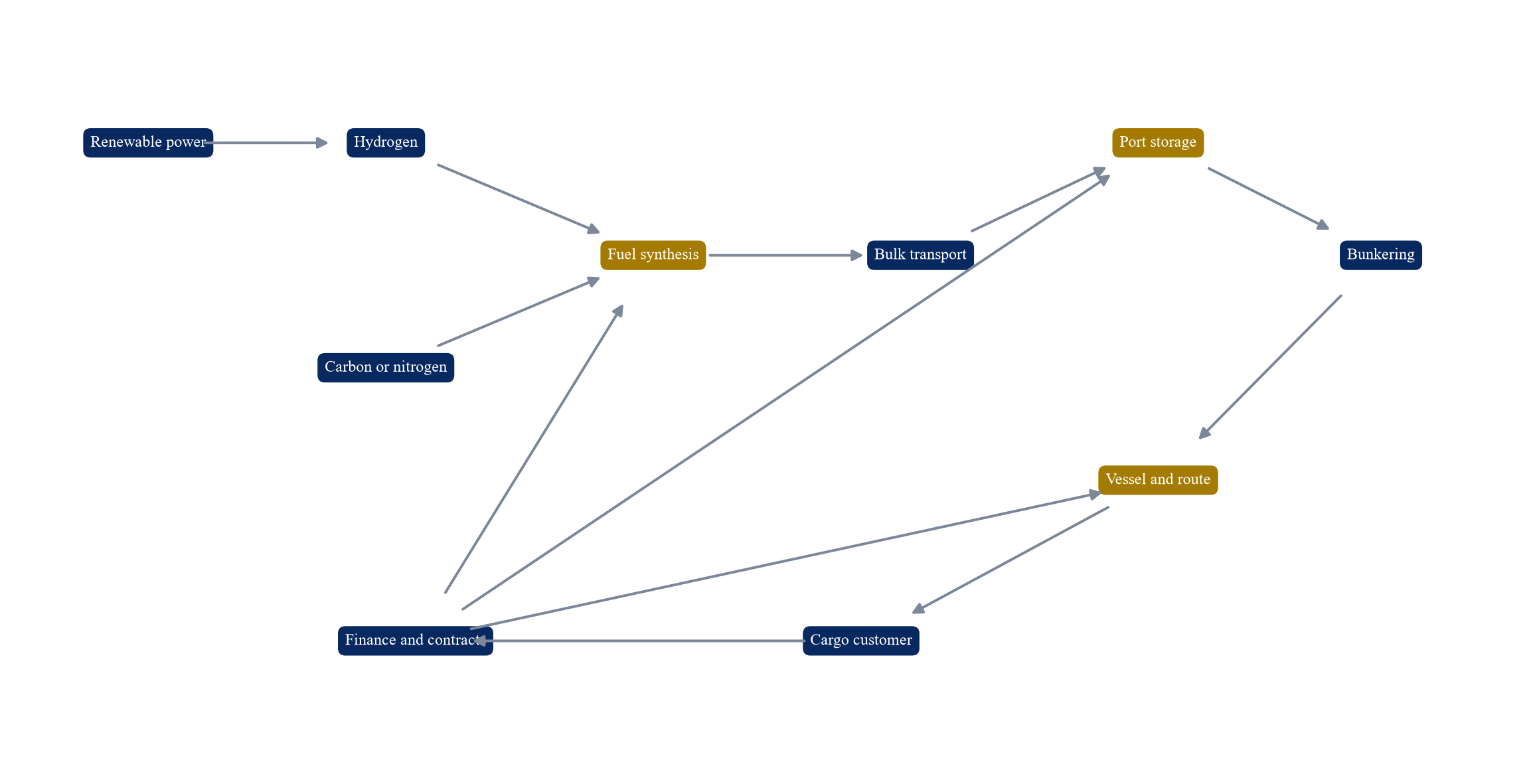
Proposed system map; actual assets, rights and responsibilities depend on the selected corridor, regulation and contracts.
6. Evaluate route and vessel fit
Route characteristics shape the molecule decision. Deep-sea vessels need high endurance and may accept fewer bunker locations if each call provides large volumes. Short-sea or fixed-route vessels can rely on a smaller corridor and bunker more often.
Assess voyage length, weather reserve, auxiliary load, port time, cargo sensitivity, draft, deadweight and tank location. Lower volumetric energy density can require more tank space than conventional fuel. The commercial consequence depends on vessel design and cargo economics.
Newbuilds, conversions and fuel-ready designs have different risk. A newbuild can optimise tank and machinery arrangement. A conversion must work within existing structure, stability, cargo and class constraints. A fuel-ready notation can preserve an option, but the committee should verify which equipment and future work remain outside the current price.
7. Measure cargo impact
Fuel storage can reduce cargo capacity or require a larger vessel. The effect is route-specific and should be converted into annual contribution margin rather than described only as tank volume.
Calculate lost slots, tonnes, lane metres or passenger space under each tank arrangement. Include the effect of containment, cofferdams, segregation and safety distances. Compare the loss with potential fuel savings, compliance value and customer premium.
Charter contracts may allocate this cost differently. An owner can pay for the vessel while a charterer buys fuel and earns cargo revenue. The fuel decision needs contractual alignment between capital expenditure, operating savings and emissions benefits.
8. Assess engine and machinery readiness
Engine readiness includes commercial availability, reference hours, class approval, warranty, pilot-fuel requirement, load response, maintenance, emissions control and supplier support. A manufacturer delivery commitment provides stronger evidence than a general technology roadmap.
For methanol, evaluate ignition support, material compatibility, low-flashpoint safety, fuel preparation and formaldehyde or other emissions where relevant. For ammonia, evaluate toxicity containment, ventilation, double-walled piping, purge systems, selective catalytic reduction, ammonia slip and nitrous-oxide performance.
The machinery assessment should include auxiliary engines, boilers and emergency systems. A ship whose main engine can use the selected fuel may still rely materially on conventional fuel for other loads.
9. Test fuel origin and carbon provenance
Grey methanol and grey ammonia are widely produced from fossil inputs. Their presence in existing chemical markets does not establish low lifecycle emissions. Renewable and low-emission variants need reliable evidence of electricity, hydrogen, carbon source, synthesis efficiency and transport.[11][12]
The procurement specification should set a maximum greenhouse-gas intensity, certification method, chain of custody, audit right and remedy. It should state whether book-and-claim arrangements are acceptable and how duplicate claims are prevented.
Fuel provenance can change over a contract term. The buyer should require periodic data and define treatment when a production pathway, electricity source or certificate becomes ineligible under the governing regime.
10. Compare feedstock constraints
Renewable methanol needs a sustainable carbon source. Biomass-based production faces feedstock availability, competing uses and traceability. E-methanol uses hydrogen and carbon dioxide, with production cost strongly affected by electricity and carbon-source cost.[11]
Renewable ammonia avoids the need for carbon feedstock. It still requires hydrogen, nitrogen separation, synthesis, storage and transport. IRENA notes that most existing ammonia is produced from natural gas or coal and that large additional low-carbon volumes would be required for new energy uses.[12]
The analysis should therefore compare the marginal low-emission supply available to shipping, not the total existing commodity market. Fertiliser, chemicals, power and other sectors can compete for the same molecules.
11. Establish well-to-wake performance
Well-to-wake analysis should use the rule set that governs the route and reporting purpose. Identify the greenhouse gases, time horizon, default values, certification rules and treatment of electricity, captured carbon and co-products.
Ammonia produces no carbon dioxide at combustion, yet nitrous oxide has high global-warming potential and must be controlled and measured. Methanol releases carbon dioxide when used; its climate performance depends on whether the carbon came from a sustainable biogenic source or an eligible captured source and how the production energy was generated.
Use a range when production data are preliminary. A single label such as green can conceal material differences. The commercial contract should link price and acceptance to verified intensity bands.
12. Define the safety case
Safety must be designed around the molecule. Methanol is toxic and flammable, with a low flashpoint and a flame that can be difficult to see. Ammonia is acutely toxic, corrosive in some conditions and hazardous through inhalation; it also has different flammability characteristics.
The IMO ammonia guidelines set functional requirements for design, construction and operation, including containment, supply, ventilation, detection, control and crew protection.[3] Methanol ships operate under separate interim guidance.[4]
The safety case should cover normal transfer, maintenance, leakage, collision, fire, exposure, evacuation and environmental release. It should integrate ship, terminal, tug, emergency services and public authorities. A port permit does not substitute for vessel-specific risk assessment.
13. Design detection and containment
Detection architecture should reflect credible leak rates, dispersion and occupied spaces. Define detector type, location, alarm levels, voting logic, ventilation response, emergency shutdown and manual verification.
Containment includes tank design, secondary barriers, drip trays, double-walled piping, segregation and drainage. Review compatibility of seals, gaskets, valves and coatings with the selected fuel and expected temperature.
The financing case should include periodic calibration, spare sensors, testing and replacement. Safety equipment requires lifecycle operating cost and trained personnel. A capital estimate that includes installation but omits continuing assurance is incomplete.
14. Plan crew competence
Training must cover fuel properties, operating procedures, personal protective equipment, gas detection, bunkering, emergency shutdown, first aid and incident command. Competence should be role-specific and demonstrated through drills.
Singapore's methanol bunkering reference includes operational, safety, custody-transfer and crew-competence requirements.[8] Its development used experience from ship-to-ship and simultaneous bunkering operations.
The staffing plan should address recruitment, certification, refresher training and contractor competence. Early fleets may face a limited pool of experienced seafarers and terminal operators. The financial model should capture the cost of building that capability.
15. Integrate emergency response
The emergency plan should define who has authority to stop transfer, isolate equipment, evacuate an area and communicate with public agencies. It should reconcile ship and port command structures.
Model credible releases and weather conditions. Identify exclusion zones, water-spray or vapour-control systems, drainage, containment, firefighting, medical response and environmental monitoring. Conduct tabletop and live exercises before commercial operations.
Port readiness depends on adjacent land use and community exposure. A technically feasible facility can face permitting constraints if hazard contours extend beyond controlled areas. The site plan should demonstrate acceptable risk under the applicable jurisdiction.
16. Choose the bunkering mode
Truck-to-ship can support low initial volumes and pilots. Ship-to-ship can deliver larger quantities and support more berths. Shore-to-ship can use fixed pipelines and storage where demand is concentrated. Each mode has different capital, flexibility, throughput and interface risk.
Define transfer rate, parcel size, berth occupancy, simultaneous operations, metering, sampling and weather limits. A slow transfer can erode vessel schedules and port economics even if the equipment works safely.
The chosen mode should match the demand ramp. Modular assets can reduce early stranded-capital risk. Fixed infrastructure can lower unit cost after throughput becomes dependable.
17. Establish custody transfer
The commercial system needs reliable measurement of quantity and quality. Define meter standard, calibration, sampling, laboratory, temperature and density correction, documentation, dispute procedure and digital record.
Singapore's methanol framework requires custody-transfer controls and supports mass-flow meters and digital documentation.[8] These systems reduce ambiguity while requiring governance, cybersecurity and audit controls.
The contract should allocate losses between storage, bunker vessel and receiving ship. Measurement uncertainty should be reflected in tolerance and payment provisions rather than left to operational negotiation.
18. Build the port-readiness assessment
Port readiness should be measured across regulation, safety, demand, supply, infrastructure, operations, competence, emergency response, finance and community acceptance. One completed tank or pilot does not demonstrate the full system.
The Port of Rotterdam uses a structured readiness-level method. Its 2025 ammonia pilot advanced procedures to a level allowing bunkering on a project basis, while the port described methanol readiness as more developed.[10]
Score each dimension using documented evidence. Apply a weakest-link rule for commercial launch: the corridor cannot exceed the readiness of a critical dependency. The assessment should be refreshed as permits, standards, assets and contracts change.
Table 1. Ammonia and methanol decision matrix
| Dimension | Methanol diligence focus | Ammonia diligence focus | Decision evidence |
|---|---|---|---|
| Vessel maturity | engine references, fuel-system performance and conversion scope | engine delivery, reference hours and full safety architecture | class documents, warranties and operating data |
| Fuel origin | sustainable biomass or eligible carbon and hydrogen | hydrogen and electricity origin plus synthesis performance | lifecycle certificate and audit rights |
| Storage | tank volume, low-flashpoint controls and material compatibility | refrigerated or pressurised storage, toxicity controls and segregation | approved design and hazard study |
| Bunkering | transfer rate, vapour control, metering and spill response | exclusion zone, detection, containment and emergency response | permit, procedure, drills and interface agreement |
| Air emissions | lifecycle carbon, combustion pollutants and pilot fuel | nitrous oxide, ammonia slip, nitrogen oxides and pilot fuel | verified engine and after-treatment data |
| Port maturity | commercial licence, supplier and repeated operations | project-based approvals, pilots and evolving standards | readiness assessment and authority approval |
| Commercial supply | low-emission volume, carbon source and price | low-emission volume, competing demand and price | binding supply contract and certification |
| Financeability | dependable throughput and offtake margin | staged capital and stronger completion conditions | integrated model, security and downside case |
Proposed framework; ratings require corridor-specific evidence and do not constitute a fuel recommendation.
19. Verify permits and standards
Prepare a permit register covering land use, environmental approval, hazardous substances, storage, marine operations, bunkering, emissions, water, waste, construction and occupational safety. Identify the approving authority, submission date, dependency and appeal risk.
International guidance, flag requirements, class rules and port regulations can overlap. The project should map which standard controls each asset and interface. Alternative-design approval may be required when prescriptive provisions are incomplete.[3]
The financing conditions precedent should use objective evidence. A general authority letter or pilot permission may not authorise routine commercial operations at the proposed scale.
20. Secure land and interfaces
Fuel infrastructure requires land, berth access, utilities, road or rail connection, pipeline corridors, safety separation and marine access. Confirm tenure, permitted use, construction rights and lender step-in.
Interface agreements should allocate responsibility between port authority, terminal operator, fuel supplier, bunker vessel, shipowner and berth operator. Define access, scheduling, maintenance, metering, incident response and liability.
Shared assets can improve utilisation while creating coordination risk. The project should identify priority rules when several users need the same berth, pipeline or storage capacity.
21. Quantify demand
Demand should be built from vessel calls, fuel consumption and executable procurement commitments. Separate contracted demand, advanced negotiations, strategic interest and market potential.
DNV reported that alternative-fuel-capable vessels in operation and on order were expanding rapidly, while actual low-greenhouse-gas fuel consumption remained far below the fleet's potential capacity in 2025.[20] This gap illustrates the need to distinguish fuel-capable tonnage from actual low-emission fuel use.
Create a monthly demand profile by vessel and route. Apply realistic ramp-up, availability and substitution assumptions. A terminal designed around annual headline demand can face severe seasonal underutilisation.
22. Assess supply
Supply diligence should identify producer, location, technology, construction status, feedstock, electricity, expected start date, certification, logistics and alternative customers. Announced capacity should be discounted for development and execution risk.
IRENA's 2025 trade analysis shows how renewable hydrogen derivatives may move from resource-rich producing regions to industrial and transport markets.[13] That opportunity also introduces project, transport, certification and geopolitical dependencies.
Require evidence of financing, permits, engineering, power supply and offtake. A memorandum of understanding can support collaboration while providing limited assurance of delivered volume.
23. Match supply to demand
Build a corridor balance by month and year. Include production ramp-up, shipping time, storage limits, maintenance and reserve inventory. Identify who bears shortfall and surplus.
The fuel contract should define minimum volume, nominations, tolerance, quality, carbon intensity, delivery point, price, credit support and replacement rights. Long-term supply can support infrastructure finance when the seller can perform and the buyer's obligation is enforceable.
Optionality has value. A portfolio of sources can reduce concentration risk while increasing certification and logistics complexity. The model should charge for that complexity.
24. Create the readiness benchmark
A readiness benchmark should use comparable evidence and distinguish technical possibility from repeatable commercial service. The proposed benchmark rates seven dimensions from one to five: vessel, fuel supply, standards, port permits, infrastructure, operations and commercial contracts.
The exhibit below is a hypothetical framework. It reflects broad observed maturity patterns and does not rate an identified port or investment. The actual score must be established through diligence.
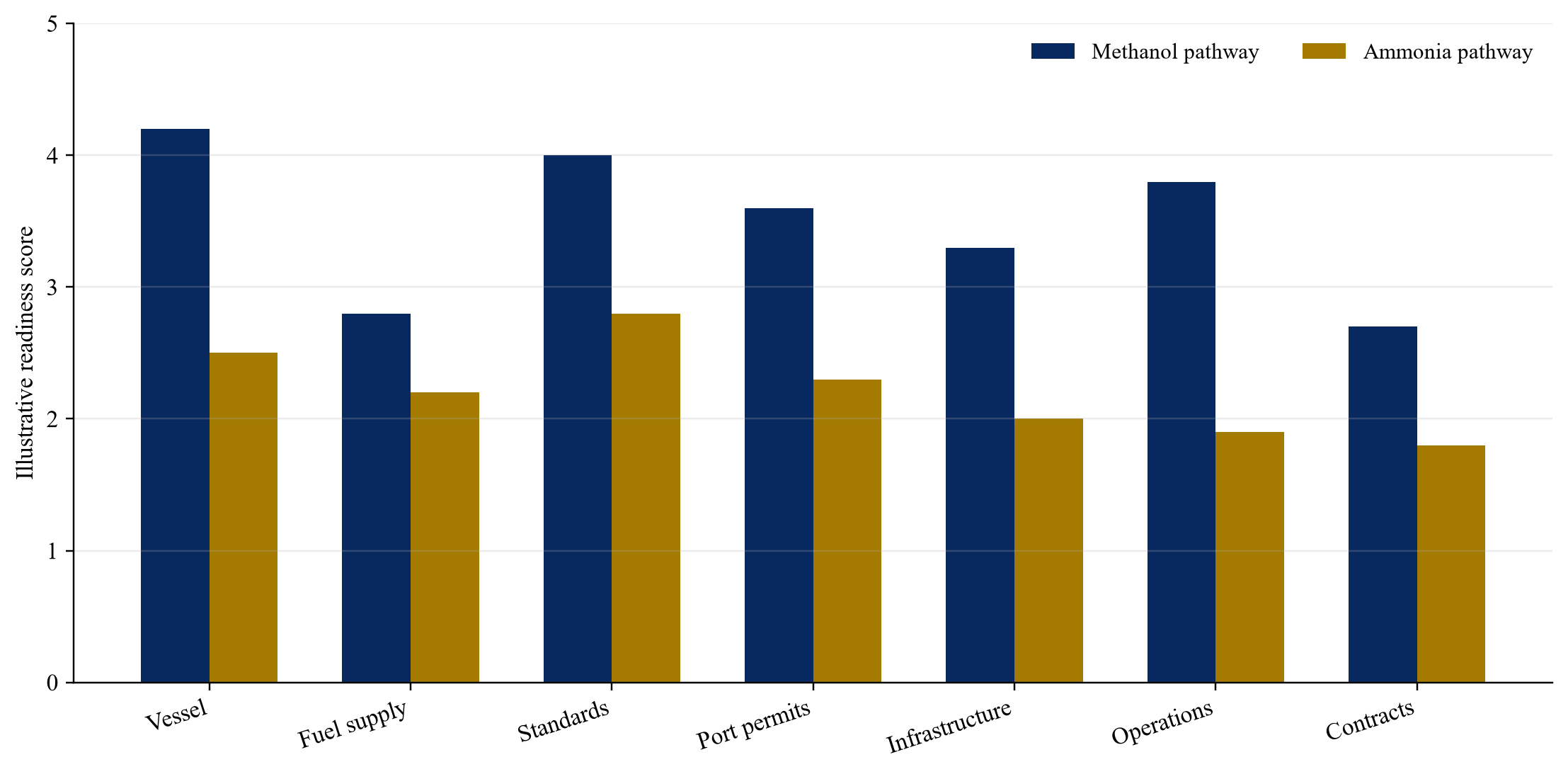
Hypothetical scores from 1 to 5 for framework demonstration; no identified port, vessel, supplier or investment.
25. Define the capital scope
Vessel capital can include engine premium, fuel tanks, fuel preparation, piping, detection, ventilation, after-treatment, class, engineering and commissioning. Port capital can include land, tanks, jetties, pipelines, loading arms, bunker vessels, utilities, control systems and emergency equipment.
Upstream fuel capital may dominate the system. The World Bank's port studies illustrate how green-fuel projects combine renewables, electrolysis, synthesis, storage and export infrastructure, often at billion-dollar scale.[15][16]
Create a responsibility matrix. A corridor can fail when each party assumes another will finance the enabling asset. The matrix should show owner, funding source, completion date and contractual dependency.
26. Estimate operating cost
Operating cost includes fuel purchase, transport, storage, terminal handling, bunker delivery, energy, labour, maintenance, consumables, inspection, certification, insurance, training and emissions control. Pilot fuel and after-treatment consumables should be explicit.
For the port, fixed cost can remain high at low throughput. Include staffing and emergency readiness before commercial volume reaches design capacity. For the vessel, include maintenance and off-hire associated with new equipment.
The cost comparison should use annual service delivered. Apply the same voyage, cargo and utilisation assumptions to both molecules.
27. Model fuel-price uncertainty
Low-emission marine-fuel prices depend on renewable-power cost, electrolyser utilisation, feedstock, carbon source, synthesis efficiency, plant scale, financing, logistics and policy. Historical fossil commodity relationships provide limited protection.
IRENA reported a broad range for renewable methanol production cost and emphasised its dependence on electricity, hydrogen and carbon dioxide.[11] Renewable ammonia also depends strongly on renewable hydrogen and plant utilisation.[12]
Use scenarios with transparent inputs. Avoid presenting one long-term price as a forecast. The investment decision should show which price combinations each pathway can withstand.
28. Include compliance value
Compliance value can arise from avoided penalties, pooled compliance, customer contracts, carbon pricing or a corporate emissions target. Identify the legal and contractual source of each value.
FuelEU Maritime allows flexibility mechanisms and uses annual greenhouse-gas intensity performance.[2] A ship's economic value can therefore depend on fleet-level strategy and pooling rather than its fuel alone.
Do not double count. A premium paid by a cargo customer, an environmental attribute and a compliance unit may refer to the same emissions benefit. Contract terms should allocate each claim once.
29. Test capital and operating sensitivities
The central financial question is how vessel premium, port utilisation and fuel spread interact. High fixed infrastructure cost can become affordable at dependable throughput. A lower vessel premium can be overwhelmed by an expensive or unavailable fuel.
The illustrative exhibit varies port utilisation and delivered green-fuel premium. It uses index values and does not represent observed prices, returns or an identified project.
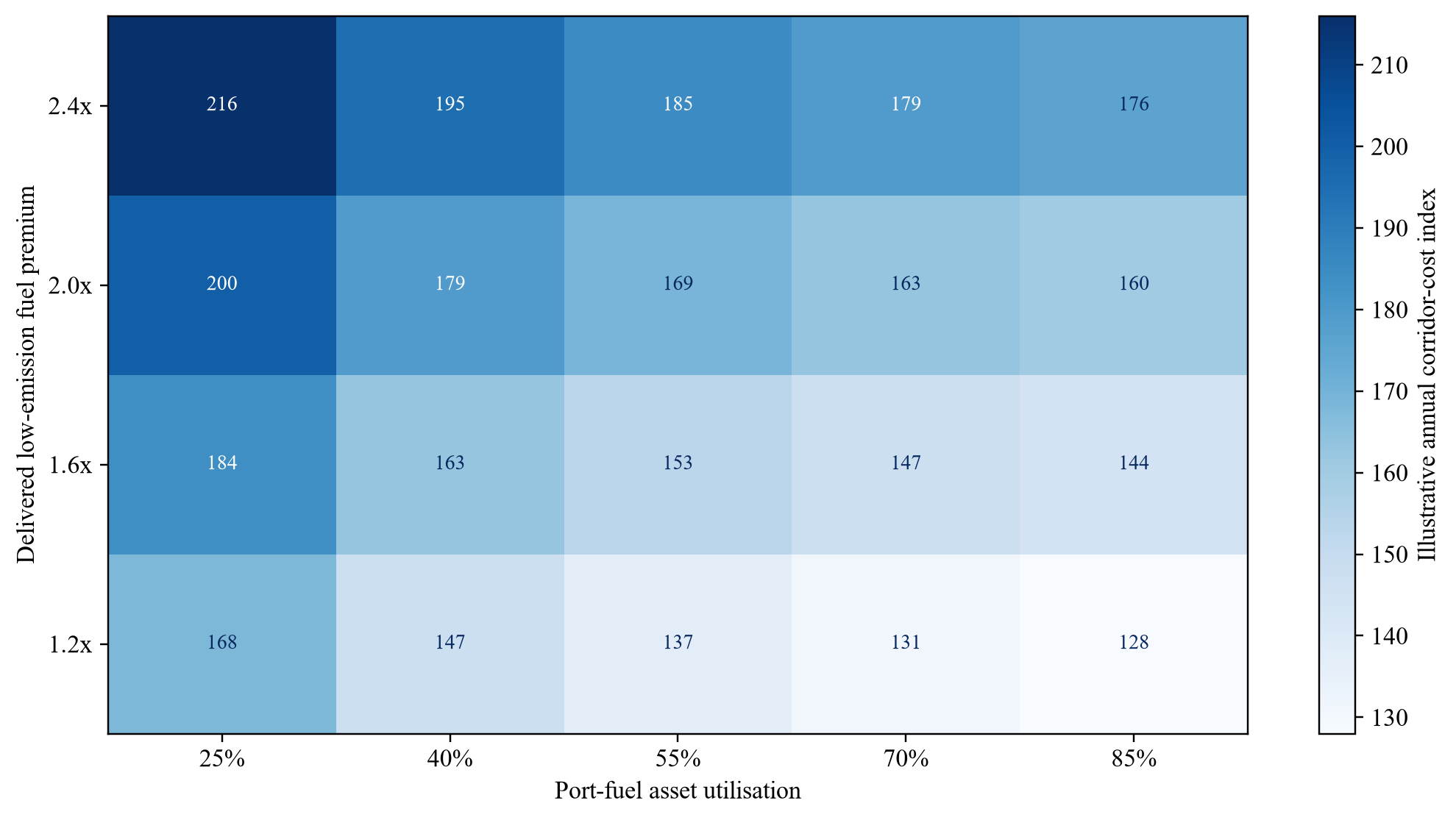
Hypothetical index values for framework demonstration; no identified vessel, port, borrower or transaction.
30. Size contingency
Contingency should reflect design maturity, interface count, site conditions, equipment novelty, delivery slots, commissioning and regulatory uncertainty. A percentage of total capital can obscure which risks it covers.
Build a quantified risk register with probability, cost, schedule and responsible party. Separate sponsor contingency, contractor contingency and lender reserve. Avoid counting the same protection twice.
Early ammonia projects may require larger allowance for safety engineering, permitting, training and integration. Methanol projects may still carry significant fuel-supply and lifecycle-carbon uncertainty. The contingency should follow evidence rather than a generic maturity label.
31. Structure vessel finance
Vessel finance may use corporate debt, lease, export-credit support, mortgage finance, green loans or charter-backed structures. Lenders should understand who controls fuel selection and pays the resulting operating cost.
Loan covenants can include class status, insurance, approved fuel systems, emissions reporting and restrictions on major modification. A green financing label should align with measurable eligibility and reporting criteria.
Residual value deserves explicit treatment. A specialised fuel system can support value when the fuel network develops and impair value when supply or standards diverge. The downside case should use conservative sale or charter assumptions.
32. Structure port finance
Port assets can be financed on a corporate, concession, project-finance or public-private basis. Revenue may come from throughput fees, storage, berth services, land lease, utilities or availability payments.
Project finance requires dependable throughput, tariff, operating performance and concession rights. Early infrastructure may need public support, anchor-customer commitments, minimum-volume payments or staged equity because merchant demand remains uncertain.
The World Bank identifies ports as important nodes for low-emission fuel value chains and emphasises policy, technical and financial coordination.[14] The financing structure should allocate development risk to parties able to manage it.
33. Coordinate producer finance
A fuel producer needs long-term demand, credible price support, power and feedstock, construction protection and access to transport. The port and vessel commitments can strengthen its financing when they are binding and aligned.
Review take-or-pay, deliver-or-pay, price floors, indexation, change in law and termination compensation. A buyer commitment that ends before debt maturity provides limited bankability unless replacement demand is credible.
The producer's financing conditions and the ship or terminal schedule should be reconciled. Circular conditions can arise when each party waits for the other to reach financial close.
34. Allocate volume risk
Volume risk includes vessel demand, fuel production, port availability and transfer performance. Assign each risk to the party that can control or diversify it.
Minimum-volume commitments can support infrastructure. They should define ramp-up, planned maintenance, force majeure, shortfall payments and make-up rights. Fuel suppliers may provide delivery guarantees subject to defined caps and credit support.
A corridor reserve can cover temporary mismatch. Its size should reflect replacement-fuel cost, logistics lead time and operational consequences.
35. Allocate price risk
Price formulas can be fixed, indexed, cost-based or linked to compliance value. Each structure leaves different exposure to electricity, feedstock, carbon, transport, foreign exchange and fossil-fuel benchmarks.
Define index source, location, timing, quality, carbon-intensity adjustment, floor, cap and fallback. Use hedges only where a sufficiently related and liquid instrument exists.
The model should reproduce the executed formula. A simplified escalation rate can hide basis risk. Where no hedge exists, reduce leverage, hold liquidity or use contractual collars.
36. Allocate regulatory risk
Regulation can change eligible fuels, lifecycle methodology, safety standards, taxes, penalties and reporting. The contract should distinguish foreseeable compliance evolution from exceptional change.
Define adjustment, renegotiation, termination and compensation. Avoid clauses that merely require good-faith discussion while debt service continues. Lenders need a process and timeline.
The decision should remain viable under more than one regulatory path. DNV's 2026 forecast uses scenario analysis because global and regional outcomes remain uncertain.[5]
37. Address technology performance
Performance guarantees should cover capacity, fuel consumption, emissions, availability and other outputs material to cash flow. Define test duration, input conditions, measurement and cure.
For ammonia, include nitrous-oxide and ammonia-slip performance where relevant. For methanol, include pilot-fuel consumption and full fuel-system performance. Guarantees should remain supported by liquidated damages, security or warranty.
Technology risk cannot be transferred beyond the contractor's balance sheet and liability cap. Residual risk should be reflected in contingency, ramp-up and debt sizing.
38. Build the insurance package
Review hull and machinery, protection and indemnity, property, business interruption, marine liability, pollution, construction, delay in start-up and terrorism. Confirm how insurers treat novel fuel systems and terminal hazards.
Policy exclusions, deductibles, sublimits and waiting periods can materially reduce protection. The insured values and interruption period should align with replacement time and debt obligations.
Early engagement with insurers can improve design and reveal evidence requirements. Insurance does not replace safe design, operating controls or adequate contractual liability.
39. Protect availability
Availability depends on fuel production, transport, storage, berth, bunker asset, crew, equipment and weather. Map single points of failure and recovery time.
Redundancy can include alternate suppliers, dual-fuel operation, reserve inventory, multiple transfer modes and emergency access to conventional fuel. Each option has cost and emissions implications.
The vessel operating plan should specify when it will switch fuel, how compliance is preserved and who bears incremental cost. Dual-fuel capability provides operational flexibility while leaving exposure to the availability and price of both fuels.
40. Establish data governance
Operational and environmental data support custody transfer, safety, emissions reporting, certification, invoicing and covenant compliance. Define the authoritative system for each field.
Controls should cover sensor calibration, access, change logs, cybersecurity, reconciliation, retention and independent assurance. Digital bunkering records can improve efficiency and auditability when standards and governance are aligned.[8]
The reporting package should be designed before launch. A corridor cannot credibly sell environmental value when it cannot reconcile production, delivery and consumption data.
41. Use a staged implementation roadmap
Stage one defines the corridor, selects candidate pathways and secures data. Stage two completes front-end engineering, hazard studies, port-readiness assessment and commercial term sheets. Stage three executes pilots and conditional contracts. Stage four commits major capital after integrated conditions are satisfied. Stage five scales after operating evidence.
Each gate should specify required evidence, decision authority, capital at risk and stop criteria. A calendar milestone alone is weak governance.
Staging can preserve both ammonia and methanol options until route, supply or regulation becomes clearer. It can also identify a deliberate near-term molecule and a different long-term pathway.
Table 2. Staged corridor implementation roadmap
| Stage | Principal work | Required evidence | Capital posture | Gate decision |
|---|---|---|---|---|
| 1. Frame | route, vessel, demand, fuel candidates and regulatory map | agreed corridor boundary and data room | studies and option budget | proceed with defined candidates |
| 2. Design | engineering, hazard assessment, lifecycle analysis and port scoring | class concept, authority path and cost range | preserve land and equipment options | select preferred pathway |
| 3. Prove | pilot transfer, drills, fuel samples and commercial terms | operating record, certified fuel and bankable term sheets | limited modular assets | authorise conditional contracts |
| 4. Commit | final design, permits, supply, offtake and financing | executed contracts, funded contingency and completion tests | major capital commitment | financial close |
| 5. Operate | commissioning, monitoring and corrective action | verified safety, throughput, emissions and cash flow | controlled ramp-up | scale or remediate |
| 6. Scale | additional vessels, berths and suppliers | repeatable performance and diversified demand | portfolio capital | expand corridor network |
Proposed implementation framework; timing and gates require project-specific engineering, regulation and contracts.
42. Set completion tests
Vessel completion should include class, flag, sustained engine performance, fuel consumption, emissions controls, safety systems and crew readiness. Port completion should include permits, storage, transfer rate, metering, emergency response and simultaneous-operations capability.
Fuel completion should include quality, carbon-intensity certification, delivery volume and logistics. Commercial completion should require executed contracts and credit support.
Tests should use specified conditions and independent verification. Temporary waivers should trigger cure plans and limits on distributions or further capital release.
43. Monitor operating performance
Create a monthly dashboard covering safety events, near misses, fuel delivered, transfer time, quality, lifecycle intensity, vessel consumption, pilot fuel, after-treatment, downtime, cost and contract performance.
Compare actual results with financing and emissions assumptions. Variance analysis should identify technical, commercial or data causes and assign corrective action.
The dashboard should support board and lender oversight without exposing sensitive information publicly. Public claims should use verified, appropriately bounded data.
44. Define expansion rules
Expansion should follow demonstrated utilisation, safety and margin. Adding storage or bunker capacity before anchor demand can increase stranded-asset risk. Waiting until full utilisation can create congestion and lost vessel demand.
Set thresholds for additional tankage, transfer equipment, bunker vessels and supplier capacity. Include lead times and permit dependencies.
Portfolio design can connect several ports and routes. Common standards, contracts and data interfaces can reduce transaction cost while preserving local safety requirements.
45. Apply the investment-committee test
The committee should test five propositions. First, the molecule fits the vessel and route. Second, the fuel is demonstrably low-emission and available. Third, the port can store and transfer it safely and repeatedly. Fourth, contracts allocate volume, price, performance and regulatory risk. Fifth, downside cash and liquidity support the proposed capital.
Evidence should be classified as verified, conditional or absent in the internal diligence record. Reader-facing conclusions should use plain language and avoid implying certainty beyond the evidence.
The committee should approve a specific stage with conditions and stop rules. A general endorsement of an alternative fuel does not authorise an investable corridor.
Table 3. Investment-committee decision scorecard
| Test | Core question | Evidence for approval | Downside response |
|---|---|---|---|
| Strategic fit | Does the pathway serve the route and customer proposition? | named vessels, routes, cargo economics and compliance map | narrow the corridor or preserve options |
| Fuel integrity | Is delivered fuel available, certified and low-emission? | binding supply, lifecycle data and audit rights | lower committed volume and require alternatives |
| Vessel readiness | Can the ship operate safely at dependable performance? | class approval, warranties, tests and trained crew | stage conversion or use fuel-ready design |
| Port readiness | Can the port permit, store, bunker and respond? | permits, assets, procedures, drills and metering | pilot first and use modular infrastructure |
| Contracts | Are volume, price, performance and claims enforceable? | executed terms, credit support and direct agreements | reduce leverage and impose conditions precedent |
| Economics | Does combined downside preserve liquidity and coverage? | integrated service-cost model and correlated stress | reduce capital, add reserve or defer commitment |
| Execution | Are owners, milestones and stop rules clear? | accountable programme and evidence-based gates | hold capital until the next gate is satisfied |
Proposed diligence framework; conclusions require project-specific technical, legal, environmental and financial review.
46. Limitations
This framework is general. It does not replace legal, tax, accounting, technical, environmental, regulatory, safety, insurance, commodity, valuation or financing advice.
Standards, regulation, fuel supply, vessel orders, technology and prices can change. Industry disclosures use different definitions and reporting periods. Port-readiness examples do not establish comparable commercial economics.
All numerical exhibits use hypothetical values for explanation. They are not forecasts, investment returns, credit opinions or evidence concerning an identified vessel, port, supplier, borrower or transaction.
47. Conclusion
The choice between ammonia and methanol is a system decision. Methanol currently offers broader operating evidence and port frameworks. Ammonia offers a carbon-free molecule at combustion while requiring a more demanding toxic-risk, emissions-control and readiness case. The appropriate pathway depends on the route, ship, fuel origin, port and contracts.
Decision-makers can improve capital discipline by defining a corridor, comparing useful propulsion service, verifying lifecycle emissions, scoring the weakest readiness link and staging irreversible expenditure. The financial model should integrate vessel, fuel and port cash flows and test correlated downside.
A credible marine-fuel strategy therefore advances fuel, fleet and port evidence together. It commits major capital after the safety case, supply chain, commercial structure and financing have reached the same gate.
Appendix A. Investment-committee questions
1. Which vessels, routes and ports define the corridor?
2. Which regulatory requirements apply during the asset life?
3. What service output is used to compare ammonia and methanol?
4. How does tank volume affect cargo capacity and annual margin?
5. Which engine and fuel-system performance is contractually supported?
6. What is the verified well-to-wake intensity of each supply pathway?
7. Which feedstock, power and synthesis dependencies remain unresolved?
8. Which safety rules govern vessel, terminal and transfer operations?
9. Are exclusion zones and adjacent land uses acceptable?
10. Which crew, terminal and emergency competencies are demonstrated?
11. Which bunkering mode supports the required parcel and transfer time?
12. How will quantity, quality and carbon intensity be measured?
13. Which permits authorise routine commercial service?
14. Which vessels have binding demand commitments?
15. Which producers can deliver certified volume on schedule?
16. How do vessel, port and producer financing conditions interact?
17. Who bears shortfall, price, performance and regulatory risk?
18. What contingency and liquidity cover correlated delay or interruption?
19. Which evidence releases each capital stage?
20. What conditions would stop, defer or redirect the investment?
References
- International Maritime Organization, 2023 IMO Strategy on Reduction of GHG Emissions from Ships, July 2023. https://www.imo.org/en/ourwork/environment/pages/2023-imo-strategy-on-reduction-of-ghg-emissions-from-ships.aspx
- European Parliament and Council, Regulation (EU) 2023/1805 on the use of renewable and low-carbon fuels in maritime transport, 13 September 2023. https://eur-lex.europa.eu/eli/reg/2023/1805
- International Maritime Organization, MSC.1/Circ.1687, Interim Guidelines for the Safety of Ships Using Ammonia as Fuel, 10 January 2025. https://futurefuels.imo.org/wp-content/uploads/2025/10/MSC.1-Circ.1687-Interim-Guidelines-For-The-Safety-Of-Ships-Using-Ammonia-As-Fuel-Secretariat.pdf
- International Maritime Organization, MSC.1/Circ.1621, Interim Guidelines for the Safety of Ships Using Methyl/Ethyl Alcohol as Fuel, 7 December 2020. https://wwwcdn.imo.org/localresources/en/MediaCentre/HotTopics/Documents/MSC.1-Circ.1621.pdf
- DNV, Maritime Forecast to 2050, 2026 edition, accessed 2 October 2026. https://www.dnv.com/maritime/maritime-forecast/
- DNV, Alternative fuels orderbook shows resilience amid overall decline in newbuild market, 1 July 2025. https://www.dnv.com/news/2025/alternative-fuels-orderbook-shows-resilience-amid-overall-decline-in-newbuild-market/
- DNV, LNG powers unprecedented year for orders of alternative-fuelled vessels, 6 February 2025. https://www.dnv.com/news/2025/lng-powers-unprecedented-year-for-orders-of-alternative-fuelled-vesselss/
- Maritime and Port Authority of Singapore, Singapore launches new standard on methanol bunkering, 10 March 2025. https://www.mpa.gov.sg/media-centre/details/singapore-launches-new-standard-on-methanol-bunkering--paves-way-for-maritime-industry-s-transition-to-sustainable-alternative-fuels
- Maritime and Port Authority of Singapore, World's First Use of Ammonia as a Marine Fuel in a Dual-Fuelled Ammonia-Powered Vessel, 15 March 2024. https://www.mpa.gov.sg/media-centre/details/world-s-first-use-of-ammonia-as-a-marine-fuel-in-a-dual-fuelled-ammonia-powered-vessel-in-the-port-of-singapore
- Port of Rotterdam Authority, Pilot prepares port for safe bunkering of ammonia, 12 April 2025. https://www.portofrotterdam.com/en/news-and-press-releases/port-rotterdam-takes-important-step-making-shipping-more-sustainable-pilot
- International Renewable Energy Agency and Methanol Institute, Innovation Outlook: Renewable Methanol, January 2021. https://www.irena.org/publications/2021/Jan/Innovation-Outlook-Renewable-Methanol
- International Renewable Energy Agency and Ammonia Energy Association, Innovation Outlook: Renewable Ammonia, May 2022. https://www.irena.org/Publications/2022/May/Innovation-Outlook-Renewable-Ammonia
- International Renewable Energy Agency, Analysis of the Potential for Green Hydrogen and Related Commodities Trade, July 2025. https://www.irena.org/Publications/2025/Jun/Analysis-of-the-potential-for-green-hydrogen-and-related-commodities-trade
- World Bank Group, Shipping and Ports, accessed 2 October 2026. https://www.worldbank.org/ext/en/topic/transport/shipping-and-ports
- World Bank Group, What Potential Can Wind, Water, and Watts Create in Colombia?, 2026. https://www.worldbank.org/en/topic/transport/publication/what-potential-can-wind-water-and-watts-create-in-colombia
- World Bank Group, Morocco to fuel global shipping's energy transition, 17 February 2026. https://blogs.worldbank.org/en/arabvoices/morocco-to-fuel-global-shipping-s-energy-transition
- World Bank Group, Keys to Energy-Efficient Shipping, 2025. https://www.worldbank.org/en/topic/infrastructure/publication/energy-efficient-in-shipping
- Mærsk Mc-Kinney Møller Center for Zero Carbon Shipping, Northern European and Baltic Green Corridor Pre-Feasibility Study, 2022. https://www.zerocarbonshipping.com/files/northern-european-baltic-green-corridor-prefeasibility-study.pdf
- Maritime and Port Authority of Singapore, Opening Remarks at the 2025 Nautical Institute Singapore Conference, 17 July 2025. https://www.mpa.gov.sg/media-centre/details/opening-remarks-at-the-2025-nautical-institute-%28singapore%29-conference-by-mr-ang-wee-keong--chief-executive--maritime-and-port-authority-of-singapore--17-july-2025
- DNV, Fleet readiness surges ahead of fuel supply, 11 September 2025. https://www.dnv.com/news/2025/dnv-fleet-readiness-surges-ahead-of-fuel-supply-green-transition-at-a-tipping-point/
About the Author
Authored by Chennakeshav Adya Independent Researcher
Chennakeshav (CK) is a corporate finance and investment banking executive with 25+ years of global experience in deal origination, structuring and execution across M&A, growth capital and corporate strategy. He has led value-creation mandates for founders, corporates and funds — bridging the boardroom view to hands-on execution and close.
His career spans Morgan Stanley, HSBC, Lloyds Banking Group, EWEC, ADQ portfolio companies and Emirates Growth Fund, across TMT, real estate, fintech, deeptech, cleantech, infrastructure and energy. He has partnered with C-suite leaders, private equity and venture funds, sovereign wealth funds and family offices to finance complex fund raises and scale-up ventures, and has led M&A due diligence, post-merger integration and business-transformation initiatives to create value.
At Matchpoint Partners he is Managing Partner, leading the firm's corporate finance, M&A and capital-raising practice. He holds an MBA from London Business School, an engineering degree from VTU and a Master of Laws (LLM, in progress) from UCL London.
An active start-up mentor, CK mentors at Techstars, DIFC FinTech Hive, Startup Grind, Founder Institute and IN5, serves as Entrepreneur Mentor in Residence (EMiR) at London Business School, and judges the Entrepreneurship World Cup.
Matchpoint profile: https://www.matchpoint-partners.com/team/ck-adya.html LinkedIn: https://www.linkedin.com/in/ckadya/
