

1. The transaction question
The buyer must determine what it is acquiring and which assets actually create repeat revenue. A membrane element is a physical product. The economic system around it includes formulation, coating and assembly know-how, patents, trademarks, qualification records, plant references, distributors, service relationships, performance data and replacement demand.
The acquisition case should answer five questions. Which operating assets use the target's products? How often do they replace them? Why do customers return? Which legal and operational rights allow the target to serve that demand? What could break after closing?
2. Why membrane aftermarket value is difficult to see
Reported sales can combine first fill, replacement elements, modules, skids, chemicals, spare parts, service and project revenue. Accounting systems may identify product families without identifying the operating plant that generated the order. Distributor sales can further obscure the end user.
A buyer therefore cannot accept total revenue as evidence of an installed base. It needs a plant-level reconciliation that connects the original specification, operating status, replacement history and current customer route.
3. The value chain
Membrane businesses participate at several layers: chemistry and materials, membrane sheet, element fabrication, module design, pressure vessels, engineered systems, controls, service and plant operation. Each layer carries different intellectual property, margin, working-capital and customer risks.
Transaction scope should identify where the target participates and where it depends on third parties. A branded element business with outsourced membrane sheet has a different risk profile from a vertically integrated manufacturer.
4. Build the transaction perimeter
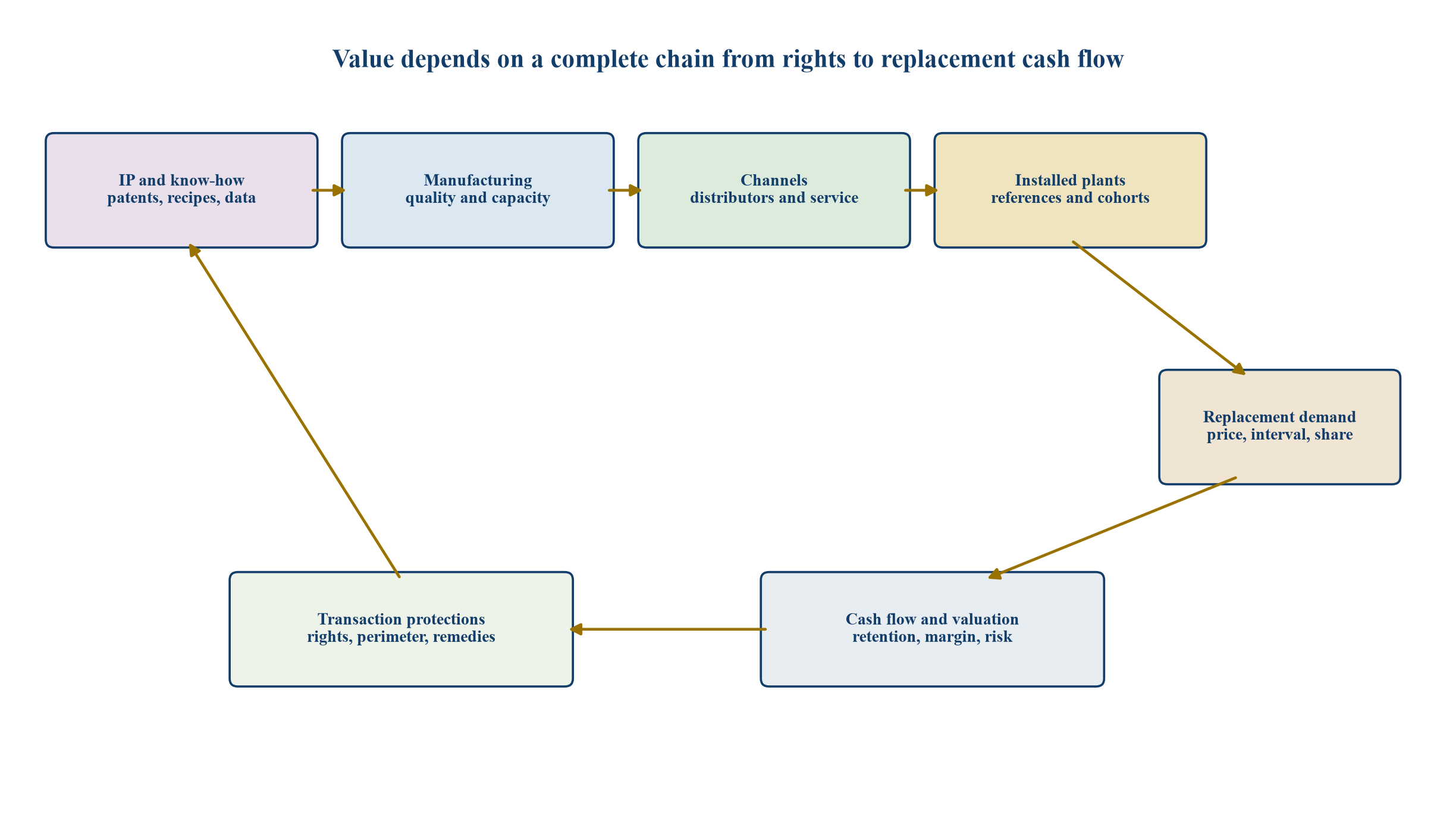
Generic decision map; actual legal entities, contracts and operating interfaces require transaction-specific diligence.
5. Define the acquired system
The perimeter should list legal entities, facilities, employees, patents, applications, trademarks, domains, software, laboratory records, technical files, designs, customer contracts, distributor agreements, inventory and data. Shared assets require an allocation or continuing right.
A perimeter schedule should also identify exclusions. An excluded pilot plant, laboratory, coating line or key licence can undermine the forecast even when historical revenue appears transferable.
6. Segment revenue before valuing it
Revenue should be separated into original equipment, first fill, replacement, service, chemicals, rentals, digital subscriptions and projects. The segmentation should be tied to invoices, product codes and end-user records.
Replacement revenue deserves its own bridge from installed assets to units, price and gross margin. A top-down percentage of total revenue provides little protection against project cycles or misclassification.
7. Installed base as an economic asset
Xylem states that its substantial installed base supports parts, replacement and service revenue [1]. The principle applies to membrane businesses only when the target can identify the relevant plants and retain access to them.
The installed base is therefore an evidence set rather than an accounting balance. It comprises operating references, configuration, commissioned capacity, product generation, replacement history, customer route and service status.
8. Create a plant register
The register should contain plant name or coded identifier, geography, customer, application, feedwater, capacity, commissioning date, installed membrane family, number of elements, train configuration, last replacement, historical orders, distributor and operating status.
Sensitive customer information may be disclosed through a clean team or anonymised data room. The buyer still needs enough detail to test uniqueness, duplicates and current operation.
9. Distinguish references from installed positions
A reference can mean a pilot, demonstration, first fill, partial train or full operating plant. Marketing lists often combine these categories. The diligence register should identify the actual commercial position.
A plant that once tested a product does not create the same replacement opportunity as a fully specified fleet with repeated orders.
10. Confirm current operation
Plants can close, change feedwater, reduce utilisation, replace systems or switch supplier. Historical commissioning data therefore needs an operating-status check.
Evidence can include recent invoices, service visits, customer correspondence, remote performance data, distributor confirmations and public operating records. The level of verification should match the value attributed to each cohort.
11. Element count and configuration
Capacity alone does not determine replacement units. Element count depends on membrane type, vessel design, recovery, flux and system configuration. A buyer should reconcile engineering bills of material with shipment history.
The forecast should state which elements can be replaced independently and which require a train-wide intervention.
12. Replacement intervals
Replacement intervals vary with feedwater, pretreatment, cleaning, pressure, fouling, scaling, damage, warranty and operating strategy. DuPont notes that premature seawater reverse-osmosis replacement increases element, labour, downtime and restart cost [2].
Historical intervals should be analysed by plant cohort and product family. A single global interval conceals the factors that drive demand and customer economics.
13. Replacement is not automatic
An installed position creates an opportunity, not a contractual entitlement. Customers can extend element life, reduce plant utilisation, qualify another supplier or conduct a competitive tender.
The model should apply a retention probability based on evidence. It should not assume that every installed element returns to the target.
14. Compatibility and switching
Compatibility can reduce physical switching cost. DuPont markets elements that can fit existing systems, illustrating the commercial importance of compatibility [3]. Qualification, performance confidence, procurement policy and warranty conditions can still create practical switching costs.
Diligence should identify whether product dimensions, connectors, software, performance curves or service procedures are proprietary, standardised or readily substituted.
15. Qualification as a commercial moat
Utilities, industrial operators and engineering contractors may require testing, references or approved-vendor status before changing a critical component. The cost and time of qualification can support retention.
The buyer should inspect approved-vendor lists, qualification protocols, tender specifications and customer change history. Management statements about being specified require documentary support.
16. Performance guarantees
Salt rejection, permeate flow, pressure, recovery, fouling resistance and life can influence selection. Guarantees should be reconciled to actual test conditions and warranty obligations.
Aggressive guarantees can win first fill while creating later claims. Diligence should review claim frequency, concessions, replacement credits and any gap between laboratory and field performance.
17. Product authenticity
DuPont provides anti-counterfeiting tools for FilmTec and TapTec elements [4]. Counterfeit or grey-market products can erode revenue, damage brand reputation and confuse warranty responsibility.
The target should show serialisation, channel controls, enforcement, customer education and incident records. The buyer should quantify leakage where evidence permits.
18. Distributor economics
Distributors can provide local reach, inventory, technical support and customer relationships. They can also obscure end-user data or carry competing brands.
The review should cover territory, exclusivity, minimum purchases, pricing, rebate, inventory, termination, change of control, customer ownership, non-compete and post-termination rights.
19. Direct and indirect channels
Direct accounts may provide clearer data and margin. Indirect accounts may diversify reach and reduce cost to serve. The transaction case should state how each route affects price, retention and visibility.
Channel conflict can arise if the buyer already sells through a different network. Integration planning should protect customer continuity before changing commercial arrangements.
20. Service relationships
Service visits can reveal deterioration, schedule cleaning, support warranty and identify replacement timing. Xylem defines service revenue to include outsourced water services, maintenance, repair, inspection, subscriptions and related spare parts [5].
The target's service footprint should be assessed as both a revenue stream and a demand-sensing capability.
21. Digital performance data
Remote monitoring can improve plant performance and provide early indications of replacement need. Data can strengthen the aftermarket model when the target has lawful access, consistent definitions and adequate coverage.
The buyer should inspect data ownership, consent, cybersecurity, retention, transfer rights, interface dependencies and customer termination rights.
22. Cohort analysis
Installed plants should be grouped by commissioning year, application, product generation, geography and channel. Orders can then be matched to expected replacement windows.
Cohort analysis identifies whether growth comes from expanding fleets, shorter replacement, higher prices or improved share. It also exposes aging products and dormant references.
23. A replacement revenue curve
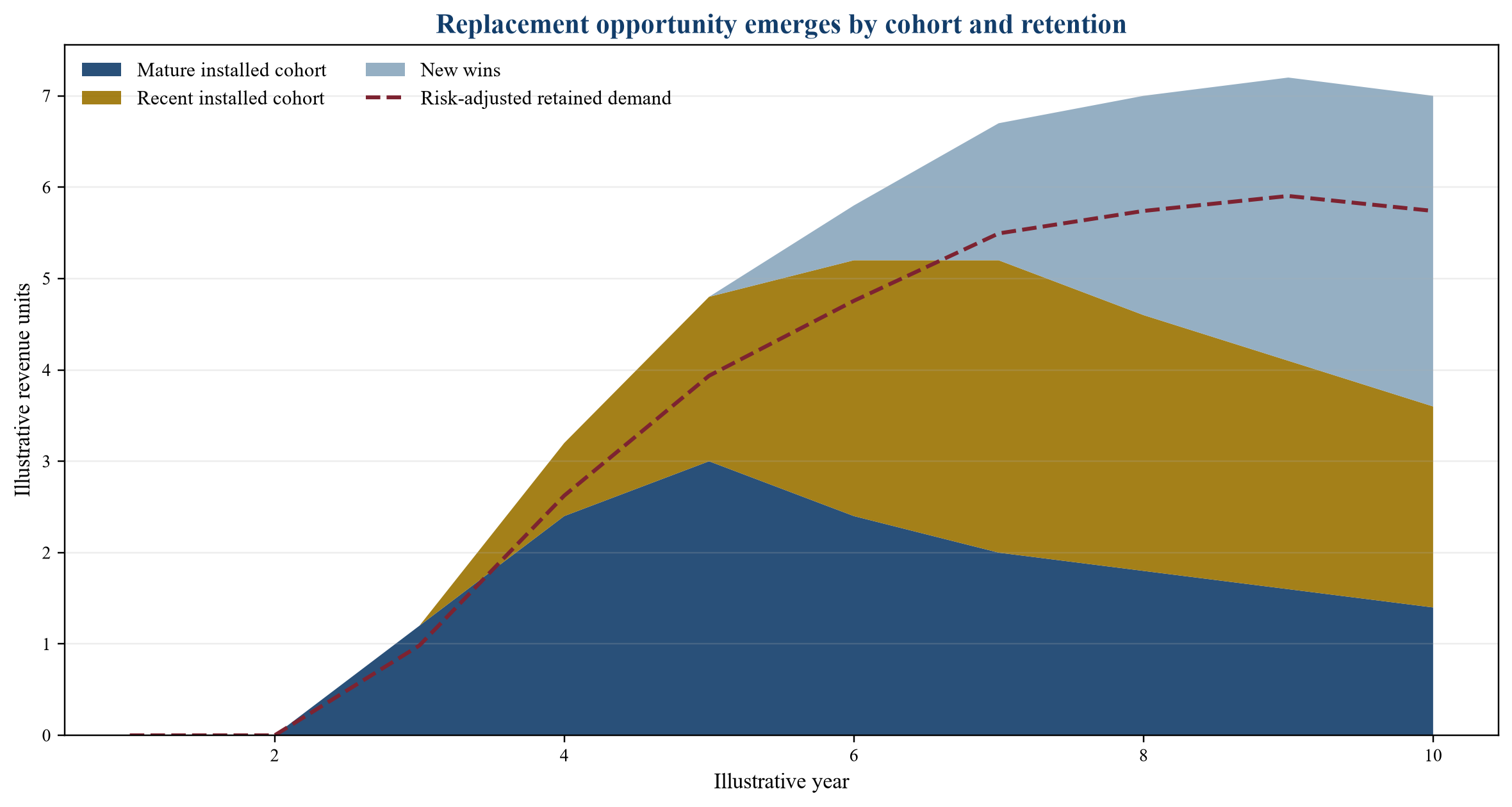
Illustrative values only. The curve is not a forecast or description of an actual company.
24. Reconcile model to invoices
The model should reproduce historical replacement revenue before it is used for forecasts. Differences may arise from distributors, price, currency, partial changes, inventory movements or misclassified first fill.
Each unexplained difference should become a diligence item. A model that cannot explain history should not determine purchase price.
25. Price-volume-mix
Growth should be separated into units, list price, discount, geography, product mix, application and currency. Inflationary price increases may not persist. Premium products may carry different replacement economics.
The buyer should identify whether margin expansion came from price, material cost, productivity or temporary shortages.
26. Customer concentration
A large installed position at one utility or industrial group can create recurring revenue and significant concentration. The customer may tender periodically or negotiate against the installed dependency.
Concentration should be measured by end user as well as invoiced distributor. Contract duration and switching evidence should accompany the revenue share.
27. Application concentration
Municipal desalination, industrial process water, microelectronics, food and beverage, mining and wastewater reuse have different quality, cyclicality and service requirements.
The buyer should test whether claimed diversification is real or whether several channels serve the same end market.
28. Geographic concentration
Local regulation, currency, sanctions, tariffs, logistics and water investment affect demand. A broad list of countries can still depend on one regional distributor or public budget.
The forecast should identify local service and import requirements, including any country-of-origin or approved-supplier conditions.
29. First fill and future aftermarket
New project awards can seed future replacement demand. The value should reflect commissioning probability, element count, replacement timing and future retention.
Backlog should be separated into awarded, contracted, shipped, commissioned and operating positions. A tender shortlist is not an installed asset.
30. Reference plants and new sales
Reference plants can reduce qualification friction and support tender credibility. Their commercial value depends on performance, relevance, customer permission and access to operating evidence.
The buyer should review which references can be named publicly, which can be used privately and which are subject to confidentiality.
31. Patent portfolio
Patents can protect membrane chemistry, fabrication, module design, cleaning, controls or applications. The portfolio should be mapped to current products and forecast revenue.
Counts should be supplemented by jurisdiction, family, claim scope, remaining term, prosecution status, maintenance, citation, opposition, litigation and design-around risk.
32. Chain of title
USPTO records allow parties to record assignments and other documents affecting title, including licences and security interests [6]. Recorded ownership is an important diligence input.
The USPTO also states that recording is ministerial and does not determine the validity or effect of the underlying document [7]. The buyer must inspect executed assignments, employment terms and corporate history.
33. Employee inventions
Key inventions may have been created by founders, employees, university researchers, contractors or joint-development partners. Each inventor's obligation and assignment should be traced.
Missing signatures, incorrect entity names and country-specific employee-invention rules can impair ownership or create compensation claims.
34. Joint development
Development agreements can allocate background IP, project IP, improvements, publication, licensing and commercial fields. A broad partner right may reduce exclusivity or constrain sale.
The buyer should inspect side letters, statements of work, grants and informal collaborations, not only the main agreement.
35. Licences in
The target may rely on licensed membrane chemistry, software, designs, trademarks or data. Licence diligence should cover scope, exclusivity, territory, field, sublicensing, royalties, audit, minimums, improvements, termination and change of control.
A non-transferable or terminable licence can be a closing condition rather than a post-close integration item.
36. Licences out
Outbound licences can create income while limiting exclusivity. Rights may extend to future improvements or allow sublicensing.
The buyer should map licensed fields against its strategic plan and identify most-favoured terms or change-of-control payments.
37. Freedom to operate
Ownership of a patent does not by itself establish the right to practise a product. USPTO guidance notes that other rights can restrict use [7].
Freedom-to-operate analysis should cover material products, processes and jurisdictions. It should distinguish legal opinion, management belief and absence of known claims.
38. Know-how
Manufacturing recipes, coating conditions, quality controls, supplier specifications, failure analysis and operating experience can be more important than published patents.
Know-how should be documented, access-controlled and transferable. Dependence on a few individuals creates retention and continuity risk.
39. Trade secrets
Trade-secret value depends on secrecy measures. The buyer should review confidentiality agreements, access logs, laboratory controls, vendor disclosures, cyber incidents, departures and enforcement history.
Information already disclosed without protection may have limited trade-secret status even when commercially useful.
40. Patent expiry and product migration
Revenue can continue after a patent expires through brand, qualification, manufacturing quality and customer relationships. Competition can also intensify.
The forecast should identify expiry dates and the planned migration path to new products. Double counting old and successor products should be avoided.
41. Trademark and brand
Brand can signal genuine product, performance history and warranty support. DuPont's anti-counterfeiting programme illustrates the link between brand protection and channel confidence [4].
The buyer should confirm registrations, ownership, coexistence agreements, domains, packaging and transition rights.
42. Software and algorithms
Design tools, projection software, remote monitoring and optimisation algorithms can support specification and service. Source code, third-party components and licences require review.
Open-source obligations, cloud dependencies and employee-created scripts can affect transferability and security.
43. Technical data package
The acquired data should include drawings, formulations, bills of material, process windows, test methods, specifications, validation, certificates, failure records and change history.
A list of files is insufficient. The buyer should test whether a competent team can reproduce and support the product using the package.
44. Manufacturing capability
The buyer should assess membrane-sheet production, element fabrication, automation, clean conditions, utilities, yield, scrap, testing, maintenance and capacity. Single-source equipment can create outage risk.
Historical utilisation should be reconciled with forecast volume and required capex. Claimed capacity should be demonstrated at required quality.
45. Quality system
Quality variation can impair field performance and replacement trust. Diligence should review incoming materials, process control, release testing, certificates, non-conformance, corrective action and customer complaints.
Product genealogy should connect raw materials and production lots to shipped elements and field incidents.
46. Supplier dependencies
Critical polymers, fabrics, spacers, adhesives, pressure vessels and electronics may have limited sources or qualification periods. Pricing and allocation can affect margin and delivery.
The buyer should inspect supply terms, alternates, inventory, lead times, quality events and change-of-control provisions.
47. Warranty and claims
Warranty reserves should be reconciled to claim history, open cases and replacement credits. Field problems may be settled through discounts outside formal claims.
A product cohort with rising failure rates can create both liability and misleading replacement revenue.
48. Environmental and safety matters
Manufacturing can involve chemicals, solvents, wastewater and waste. Site assessments should cover permits, storage, discharge, remediation, worker exposure and product stewardship.
The transaction perimeter should allocate historical and continuing liabilities, including shared sites and retained operations.
49. Regulatory and certification
Drinking-water and industrial applications may require certifications, approvals or customer-specific validation. The buyer should confirm holder, scope, manufacturing site and transfer requirements.
A certification held by a seller affiliate may require continued support or reapplication.
50. Competition and aftermarket control
The 2023 United States Merger Guidelines identify switching costs and interoperability as relevant to merger analysis [8]. A membrane transaction can raise questions when installed positions, compatible products or service channels are concentrated.
The buyer should assess market definition, substitution, tender evidence, customer power, entry, compatibility and access to complementary products. Legal advice is required for a specific transaction.
51. Remedies and separability
FTC remedy guidance notes that IP divestitures can require all necessary rights, supply arrangements, technical assistance and key personnel [9]. This is directly relevant when a membrane business is carved from a broader technology platform.
The separation plan should test whether the business can compete with the transferred IP, people, production, data, contracts and reputation.
52. Carve-out perimeter
Shared facilities, ERP, laboratories, procurement, sales, brands and service teams can complicate separation. Historical accounts may include allocations that do not represent standalone cost.
The buyer should build a bottom-up standalone model and identify transitional services, replacement capex and stranded cost.
53. Transitional services
TSAs may cover IT, manufacturing, quality, finance, procurement, HR, brand, regulatory and customer service. Each service needs scope, performance, price, duration, exit plan and data protection.
Critical technical services should have tested exit milestones before the TSA expires.
54. People transfer
Scientists, process engineers, application specialists, plant operators, salespeople and field-service staff can carry essential know-how and relationships. The organisation map should identify key roles and single points of failure.
Retention arrangements should align with integration milestones and local employment requirements. Knowledge transfer should be documented.
55. Historical financial quality
Revenue and margin should be traced to ledgers, invoices, product codes and customer records. Normalisations should be supported and separated from forecast synergies.
The review should identify distributor stocking, cut-off, rebates, returns, warranty credits, capitalised development and related-party transactions.
56. Working capital
Inventory may include long-lead raw materials, membrane sheet, finished elements, consignment and distributor stock. Shelf life and obsolescence matter when products change.
The purchase agreement should define normal working capital using seasonality and product-specific reserves.
57. Backlog
Backlog can include cancellable orders, framework call-offs and project milestones. The buyer should distinguish first fill, replacement and service orders.
Conversion, margin and cancellation history should support any value attributed to backlog.
58. Revenue quality bridge
Table 1. Installed-base and aftermarket diligence heatmap
| Area | Core evidence | Principal risk | Transaction response |
|---|---|---|---|
| Installed plants | Plant register, BOM, commissioning and recent orders | Dormant or duplicated references | Verify high-value cohorts and haircut unsupported units |
| Replacement interval | Plant-level order history and operating conditions | Average interval hides dispersion | Model cohorts and downside cases |
| Retention | Tender history, approved-vendor status and switching | Installed position treated as entitlement | Apply evidence-based retention probability |
| IP ownership | Assignments, employment and development agreements | Missing title or encumbrance | Cure before closing or exclude value |
| Manufacturing | Yield, quality, capacity and supplier data | Forecast cannot be produced reliably | Capex, supply protection or price adjustment |
| Channels | Distributor contracts and end-user visibility | Leakage, termination or conflict | Consent, transition and customer plan |
| Service data | Work orders, subscriptions and site access | Data rights do not transfer | Obtain consent and alternative evidence |
| Warranty | Claims, reserves, concessions and failure cohorts | Replacement revenue includes defects | Specific indemnity and cohort reserve |
59. Forecast architecture
The forecast should begin with verified installed cohorts. Units equal active elements multiplied by replacement probability and target share. Revenue adds price and mix. Margin subtracts manufacturing, channel, freight, warranty and service cost.
New installed wins should enter only after probability-weighting and commissioning. The model should prevent the same project from appearing in backlog, new sales and future replacement without timing controls.
60. Scenario design
Base, downside and upside cases should vary plant activity, interval, retention, price, input cost, product migration and new wins. The downside should include a technical failure or channel loss where material.
Scenarios should be decision tools with explicit assumptions. They should not be presented as observed market outcomes.
61. Hypothetical revenue build
An illustrative cohort of 20,000 active elements with a five-year mean replacement interval creates 4,000 annual units before retention. At 80 per cent retention, the model supports 3,200 units. A price of 500 currency units produces 1.6 million of revenue before mix, currency and channel deductions.
These figures are hypothetical. A real transaction requires plant and invoice evidence.
62. Gross margin
Replacement products can carry attractive margin when production is stable and service value is recognised. Margin can weaken through distributor discounts, expedited freight, raw-material volatility, warranty and low manufacturing yield.
The buyer should model contribution by product and route, including service needed to preserve the account.
63. Customer acquisition economics
First-fill pricing may be discounted to create a future installed position. The investment case should compare upfront contribution with expected replacement cash flow and support cost.
The analysis should avoid capitalising a lifetime value that is unsupported by contractual or behavioural evidence.
64. Identifiable intangible assets
IFRS 3 requires an acquirer to recognise identifiable intangible assets separately from goodwill when they meet the separability or contractual-legal criteria [10]. Patents, brands, licences and customer relationships may therefore require separate analysis.
The deal model and purchase-price allocation serve different purposes but should reconcile their economic assumptions.
65. Customer relationships
IFRS supporting material notes that contractual relationships and prior purchases are important inputs to valuing a customer relationship [11]. Installed-plant order history can therefore inform the analysis.
The useful life should reflect attrition, product cycles, tender patterns and customer behaviour rather than a generic period.
66. Technology valuation
Technology may be valued through income, market or cost evidence, subject to professional standards and transaction facts. A relief-from-royalty analysis needs a supportable royalty base and rate. An excess-earnings approach needs contributory asset charges and attrition.
The buyer should prevent the same cash flow from being allocated to technology, brand, customer relationships and goodwill more than once.
67. Installed-base valuation
The installed base is not necessarily a separately recognised accounting asset. Economically, it can support customer relationships, technology adoption and future replacement cash flow.
Valuation should connect cohorts to cash flow, deduct required support and apply risks not already captured in the discount rate.
68. Valuation bridge
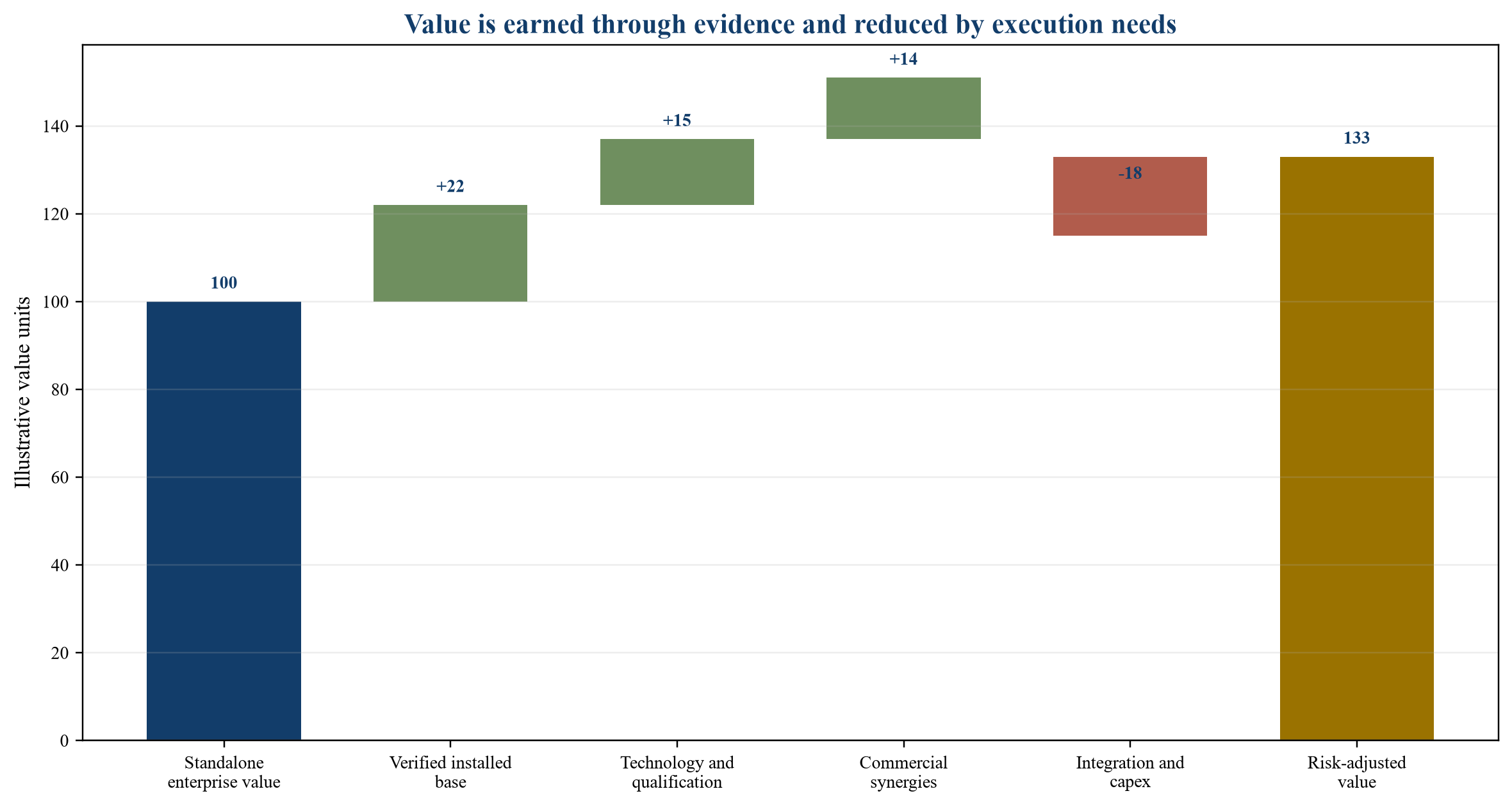
Illustrative values only. The bridge is not a valuation, offer or forecast.
69. Discount rate and probability
Risk should be reflected consistently. A forecast can apply explicit probabilities to plant activity, retention and new wins, then discount the resulting cash flow. Adding a broad risk premium for the same uncertainty can double count risk.
The valuation record should state where each uncertainty is captured.
70. Synergies
Revenue synergies may arise from cross-selling products, channels, service or geographies. Cost synergies may arise from procurement, manufacturing, facilities and corporate functions. Xylem's Evoqua materials describe service scale and synergy capture as integration objectives [12][13].
Synergies should have an owner, action, timing, cost, dependency and probability. They should remain separate from the target's standalone performance.
71. Integration risk
Product rationalisation can disrupt qualifications and customers. Channel consolidation can trigger termination or competitor entry. Manufacturing transfer can affect quality.
The first integration principle should preserve supply, support and traceability for operating plants while decisions are tested.
72. Product portfolio decisions
Overlapping products should be mapped by performance, cost, qualification, plant cohort, patent life and customer commitment. Discontinuation requires a migration and warranty plan.
The buyer should avoid forcing customers onto a preferred product without validating operating conditions and approvals.
73. Manufacturing integration
Plant consolidation should be justified by landed cost, quality, capacity, resilience and transfer validation. Qualification can be site-specific.
Dual production may be needed during transition. The model should include duplicated cost and working capital.
74. Commercial integration
Account ownership, pricing authority, distributor communication and brand transition should be decided before close. Key customers need a continuity message supported by operating capacity.
Sales incentives should protect replacement accounts as well as new-project wins.
75. Data integration
Plant registers, serial numbers, products, customers and service records should use common identifiers. Migration should preserve history and consent.
The combined company needs one view of installed cohorts before it can manage replacement demand reliably.
76. Integration and separation roadmap
Table 2. Integration or separation roadmap
| Period | Commercial | Technology and IP | Operations | Finance and control |
|---|---|---|---|---|
| Pre-close | Confirm accounts, consents and channels | Cure title and secure licences | Validate supply and quality continuity | Lock perimeter and closing accounts |
| Day 1 | Customer and distributor continuity | Preserve repositories and access | Maintain approved sites and specifications | Open controls and reporting |
| Days 2-30 | Reconcile plant register and account owners | Interview inventors and map products | Review inventory, capacity and claims | Validate revenue bridge and working capital |
| Days 31-100 | Launch retention and cross-sell pilots | Prioritise patent and product roadmap | Test transfer and procurement synergies | Track costs, synergies and purchase accounting |
| Months 4-12 | Rationalise channels with evidence | Execute migration and licence actions | Implement qualified footprint changes | Reforecast cohorts and test investment case |
77. Purchase-agreement protections
Representations should address IP ownership, non-infringement disclosures, contracts, product compliance, warranties, inventory, data, employees, environmental matters and financial statements. Specific risks may require indemnities, escrow, holdback or insurance.
The agreement should define transferred assets precisely. A general reference to technology may not capture data, know-how, laboratory records and domain rights.
78. Earnouts
An earnout can address uncertainty in replacement or new-product performance. Metrics should be auditable and resistant to changes in allocation, pricing, channel and integration decisions.
Earnouts can create operating conflict. The buyer should use them only when governance and measurement are workable.
79. Closing conditions
Material consents, IP cures, key-person arrangements, regulatory approvals, supply continuity and data-transfer requirements may need completion before closing.
Conditions should focus on risks that cannot be repaired economically after control transfers.
80. Sources and uses
Table 3. Hypothetical transaction sources and uses
| Uses | Illustrative amount | Sources | Illustrative amount |
|---|---|---|---|
| Equity purchase price | 120 | Buyer equity | 70 |
| Refinance debt | 20 | Acquisition debt | 65 |
| Fees and taxes | 7 | Seller rollover | 12 |
| Integration and qualification reserve | 8 | ||
| Working-capital and warranty reserve | 5 | ||
| Total | 160 | Total | 147 |
| Funding gap requiring redesign | 13 | Funding gap | 13 |
The exhibit is hypothetical. It demonstrates that integration, qualification and warranty needs belong in funding design. A purchase price funded without implementation cash can impair the acquired business.
81. Financing
Debt capacity should rely on durable cash flow after maintenance capex, working capital, warranty and integration cost. Replacement revenue should be supported by verified cohorts and downside retention.
Lenders may require security over shares and assets, IP covenants, reporting, insurance and restrictions on disposal. Legal advice is required for enforceability and jurisdiction.
82. Investment committee decision
The committee should receive a bridge from reported revenue to verified aftermarket cash flow, a map of required rights, downside cases, valuation, funding and integration actions. Open items should have owners and closing impact.
The decision should identify which value is paid for, which is contingent and which remains an unpriced strategic option.
83. Red flags
Red flags include marketing references presented as operating plants, replacement revenue unsupported by invoices, patent counts without product mapping, missing inventor assignments, shared know-how outside the perimeter, distributor termination, unexplained warranty replacements, product concentration, incompatible systems and synergies without owners.
Each red flag requires evidence, a price adjustment, contractual protection, a closing condition or a decision to stop.
84. First 100 days
The first 100 days should preserve customer supply, reconcile the plant register, secure technical records, confirm key people, stabilise quality, review warranty cohorts, align account ownership, validate inventory and establish a monthly replacement-revenue dashboard.
Synergy pilots should begin only where they do not disturb qualification or service continuity.
85. Ongoing governance
Management should report active installed elements, verified plant status, replacements due, win rate, retention, price, margin, complaints, warranty, distributor inventory, qualification and IP actions. Metrics should reconcile to finance.
The board should review the original acquisition case against realised performance and update product and capital priorities.
86. Evidence protocol for a confirmatory review
Confirmatory diligence should use a controlled evidence protocol rather than a collection of management presentations. The buyer should define the population for each test, select a sample that captures value concentration and risk, record the source document, preserve the calculation and log exceptions. A plant sample can cover the largest installed fleets, each major product generation, important geographies, disputed references and a random selection from the remaining population. The protocol should state what was verified directly, what was corroborated indirectly and what remains a management estimate.
The plant-level test should begin with an original shipment or commissioning record and proceed to recent operating or commercial evidence. It should reconcile element type and count, current operating status, replacement dates, customer or distributor route, price and warranty history. Where customer confirmation is unavailable, the buyer can combine invoices, service records, serial numbers and distributor evidence. The resulting confidence grade should affect the cohort forecast rather than disappear into a general diligence qualification.
IP testing should connect each material product to patent families, know-how, software, trademarks and third-party rights. The reviewer should inspect assignment documents, employee and contractor obligations, joint-development agreements, licences, maintenance records and material disputes. Search results are an input; legal analysis of ownership, validity, scope and freedom to operate requires qualified counsel in the relevant jurisdictions. Open items should identify the affected product and revenue so that the transaction team can assess value and remedy.
Commercial testing should reconcile end-user demand through the invoicing chain. Distributor purchases can reflect sell-through, safety stock, tender preparation or temporary stocking. The buyer should compare shipments with distributor inventory, end-user orders and installed replacement schedules. Pricing analysis should separate list changes, discount, product mix, freight and currency. Customer interviews, when authorised, should address performance, switching, qualification, service and future procurement without disclosing competitively sensitive information improperly.
Operational testing should link the forecast to demonstrated manufacturing yield, qualified capacity and critical supply. A production trial can confirm throughput and quality at representative specifications. The review should quantify scrap, rework, release failures, overdue maintenance, bottlenecks and capex required to meet forecast volume. Supplier diligence should identify sole-source materials, approved alternatives and the time needed to qualify a change. These findings belong in the valuation and funding plan, not solely in an operational appendix.
The final evidence ledger should accompany the investment-committee paper. Each material value driver should show evidence status, owner, residual risk, financial impact, contractual treatment and post-close action. This creates a traceable line from installed plants and legal rights to forecast cash flow, purchase price and integration priorities. It also allows the buyer to update the case as evidence changes before signing or closing.
87. Conclusion
The membrane aftermarket can support valuable recurring cash flow, but installed equipment does not create an automatic annuity. Value depends on active plants, documented configurations, credible replacement behaviour, product qualification, transferable rights, manufacturing quality, channel access and customer confidence.
The buyer should build the case from plant-level evidence, trace every material right, distinguish technology from relationships and goodwill, and fund the work required to preserve the system after closing. A disciplined perimeter, cohort model, IP review, valuation bridge and integration plan can turn a broad strategic claim into an auditable transaction decision.
References
- Xylem Inc. Annual Report on Form 10-K for the year ended 31 December 2025. https://www.sec.gov/Archives/edgar/data/1524472/000152447226000012/xyl-20251231.htm
- DuPont Water Solutions. Desalination with Seawater Reverse Osmosis Membranes. https://www.dupont.com/water/industries/desalination-seawater-reverse-osmosis-membranes.html
- DuPont Water Solutions. FilmTec Prime RO. https://www.dupont.com/brands/filmtec-prime-ro.html
- DuPont Water Solutions. Anti-counterfeiting Solutions. https://www.dupont.com/water/resources/anti-counterfeiting-solutions.html
- Xylem Inc. Annual Report on Form 10-K for the year ended 31 December 2024. https://www.sec.gov/Archives/edgar/data/1524472/000152447225000013/xyl-20241231.htm
- United States Patent and Trademark Office. Patents Assignments: Change and Search Ownership. https://www.uspto.gov/patents/maintain/patents-assignments-change-search-ownership
- United States Patent and Trademark Office. Manual of Patent Examining Procedure, Section 301, Ownership and Assignability of Patents and Applications. https://www.uspto.gov/web/offices/pac/mpep/s301.html
- United States Department of Justice and Federal Trade Commission. Merger Guidelines. https://www.ftc.gov/system/files/ftc_gov/pdf/2023_merger_guidelines_final_12.18.2023.pdf
- Federal Trade Commission. Negotiating Merger Remedies. https://www.ftc.gov/advice-guidance/competition-guidance/negotiating-merger-remedies
- IFRS Foundation. IFRS 3 Business Combinations. https://www.ifrs.org/issued-standards/list-of-standards/ifrs-3-business-combinations/
- IFRS Foundation. Customer-related Intangible Assets under IFRS 3 and IAS 38. https://www.ifrs.org/content/dam/ifrs/supporting-implementation/agenda-decisions/2009/ifrs-3-ias-38-customer-related-intangible-assets-march-2009.pdf
- Xylem Inc. Xylem to Acquire Evoqua in a $7.5 Billion All-Stock Transaction. https://www.xylem.com/it-it/about-xylem/newsroom/press-releases/xylem-to-acquire-evoqua-in-%247.5-billion-all-stock-transaction
- Xylem Inc. Announces Reportable Segment Change to Scale Global Services Offering. https://www.xylem.com/en-qa/about-xylem/newsroom/press-releases/xylem-announces-reportable-segment-change-to-scale-global-services-offering/
- Veolia. Acquisition of CDPQ's 30 per cent stake in Water Technologies and Solutions. https://www.veolia.com/en/our-media/press-releases/veolia-acquires-cdpqs-30-stake-water-technologies-and-solutions-achieving
- Veolia. Completion of the Sale of the New Suez to the Consortium of Investors. https://www.veolia.com/en/our-media/newsroom/press-releases/veolia-announces-completion-sale-new-suez-consortium-investors
- DuPont Water Solutions. FilmTec Reverse Osmosis and Nanofiltration Membranes Technical Manual. https://www.dupont.com/content/dam/dupont/amer/us/en/water-solutions/public/documents/en/RO-NF-FilmTec-Manual-45-D01504-en.pdf
About the Author
Chennakeshav (CK) is a corporate finance and investment banking executive with 25+ years of global experience in deal origination, structuring and execution across M&A, growth capital and corporate strategy. He has led value-creation mandates for founders, corporates and funds — bridging the boardroom view to hands-on execution and close.
His career spans Morgan Stanley, HSBC, Lloyds Banking Group, EWEC, ADQ portfolio companies and Emirates Growth Fund, across TMT, real estate, fintech, deeptech, cleantech, infrastructure and energy. He has partnered with C-suite leaders, private equity and venture funds, sovereign wealth funds and family offices to finance complex fund raises and scale-up ventures, and has led M&A due diligence, post-merger integration and business-transformation initiatives to create value.
At Matchpoint Partners he is Managing Partner, leading the firm's corporate finance, M&A and capital-raising practice. He holds an MBA from London Business School, an engineering degree from VTU and a Master of Laws (LLM, in progress) from UCL London.
An active start-up mentor, CK mentors at Techstars, DIFC FinTech Hive, Startup Grind, Founder Institute and IN5, serves as Entrepreneur Mentor in Residence (EMiR) at London Business School, and judges the Entrepreneurship World Cup.
LinkedIn: https://www.linkedin.com/in/ckadya/
Profile: https://www.matchpoint-partners.com/team/ck-adya.html
