
1. The remote power decision
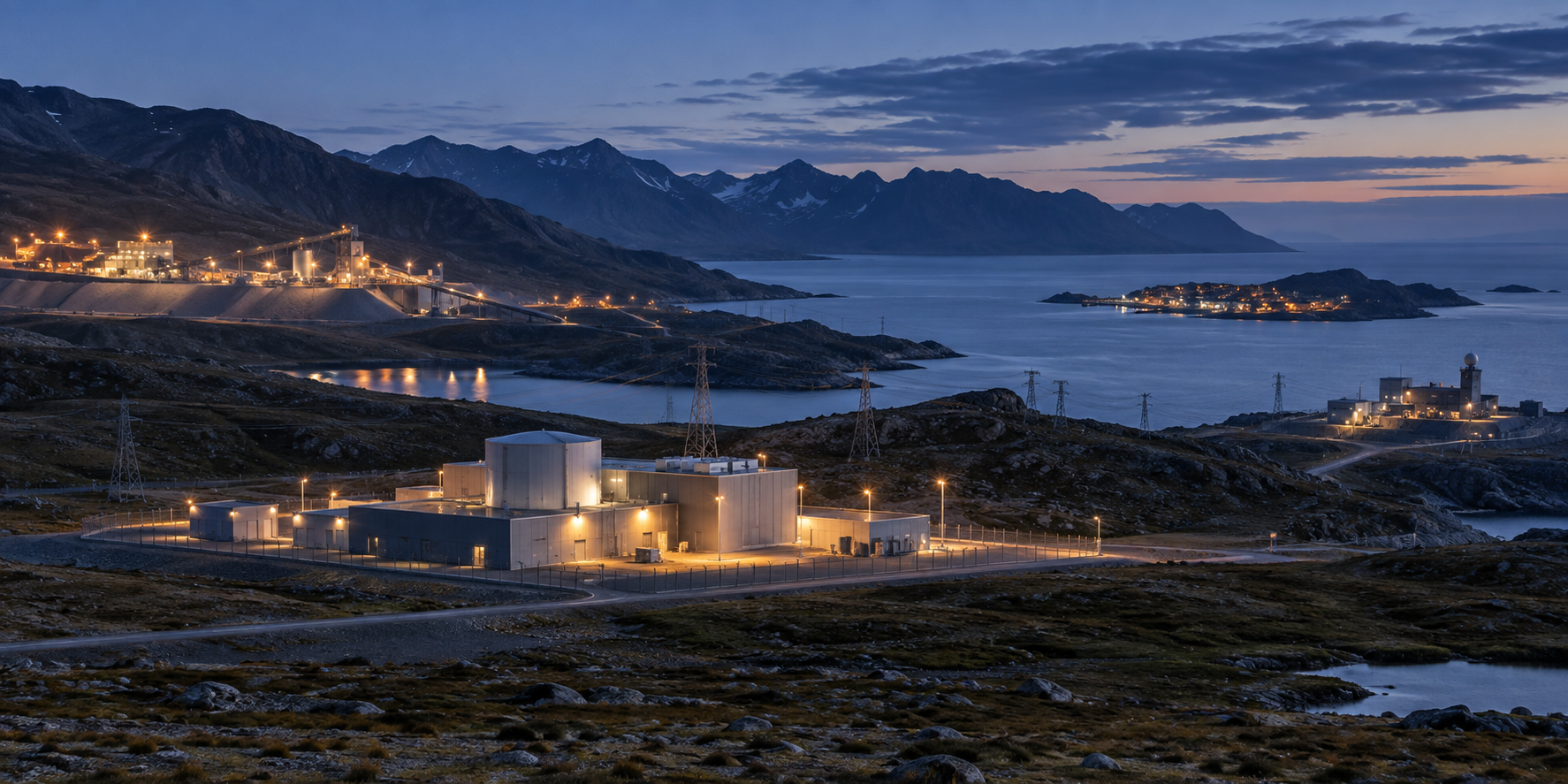
Remote power is an operating-system decision. A mine, military installation or island cannot rely on annual energy averages when a short interruption can stop production, compromise a mission or interrupt essential public services. The sponsor must compare complete systems that deliver electricity, heat, reserve, black-start capability and fuel security across the life of the host.
A microreactor can enter that comparison where its size matches the dependable load and where long refuelling intervals reduce logistical exposure. The alternative can include diesel, gas, solar, wind, batteries, demand response, interconnection or a hybrid of several resources. The central question is which portfolio delivers the required service at an acceptable whole-life cost and risk.
2. Three markets with different value drivers
Mines value production continuity, process heat, power quality and the ability to develop deposits beyond economic grid reach. Defence installations value mission assurance, secure operation, islanding and independence from vulnerable fuel supply. Islands value affordability, energy sovereignty, resilience and reduced exposure to imported fuel.
These markets cannot share one generic business case. A mine may have a finite reserve life and volatile commodity revenue. A defence installation may have strong sovereign credit but exacting security requirements. An island utility may have a diverse public load, affordability constraints and limited technical capacity. Contract design must begin with the host's actual operating and credit profile.
3. What counts as a microreactor
The International Atomic Energy Agency describes microreactors as very small reactors intended for niche markets, including remote communities, mines, industry and islands. Designs differ in coolant, moderator, fuel, transportability, output and operating model. Many concepts seek factory fabrication, passive safety, limited on-site staffing and long fuel cycles.
The label does not establish maturity or equivalence. A heat-pipe design, gas-cooled design and small light-water design can have different licensing evidence, fuel requirements, temperature output, maintenance practices and transport rules. Procurement should define the required service and qualification evidence, then assess designs against that specification.
4. Technology readiness is commercially material
The investment case changes sharply between a paper design, an engineering test unit, a licensed demonstration and an operating fleet. First-of-a-kind construction can expose design completion, component qualification, fuel fabrication, installation, commissioning and regulatory risks. A buyer cannot convert these uncertainties into bankability merely by offering a long contract.
Technology-readiness diligence should verify design maturity, test evidence, supply-chain qualification, licensing interactions, fuel availability, reference projects and funding through demonstration. The decision should distinguish what has been demonstrated from what remains planned. Milestone payments and termination rights should follow observable evidence.
5. The buyer's service specification
The buyer should state dependable electrical output, process heat, ramping, islanding, black start, voltage and frequency support, annual availability, planned outages, emergency response, cybersecurity, physical security, staffing and end-of-life requirements. The specification should also define seasonal load, critical loads and acceptable loss-of-load probability.
This approach prevents a design-led procurement from overlooking the system. The microreactor may need batteries for fast response, renewables for marginal energy, diesel for commissioning or emergency backup, and a microgrid controller for secure dispatch. The contract should cover the integrated service rather than a reactor in isolation.
6. A staged decision process
The project should pass through need definition, site screening, technology qualification, regulator engagement, commercial structuring, integrated design, financing, construction, commissioning and operating-readiness gates. Each gate should have evidence requirements, a responsible decision-maker and a termination rule.
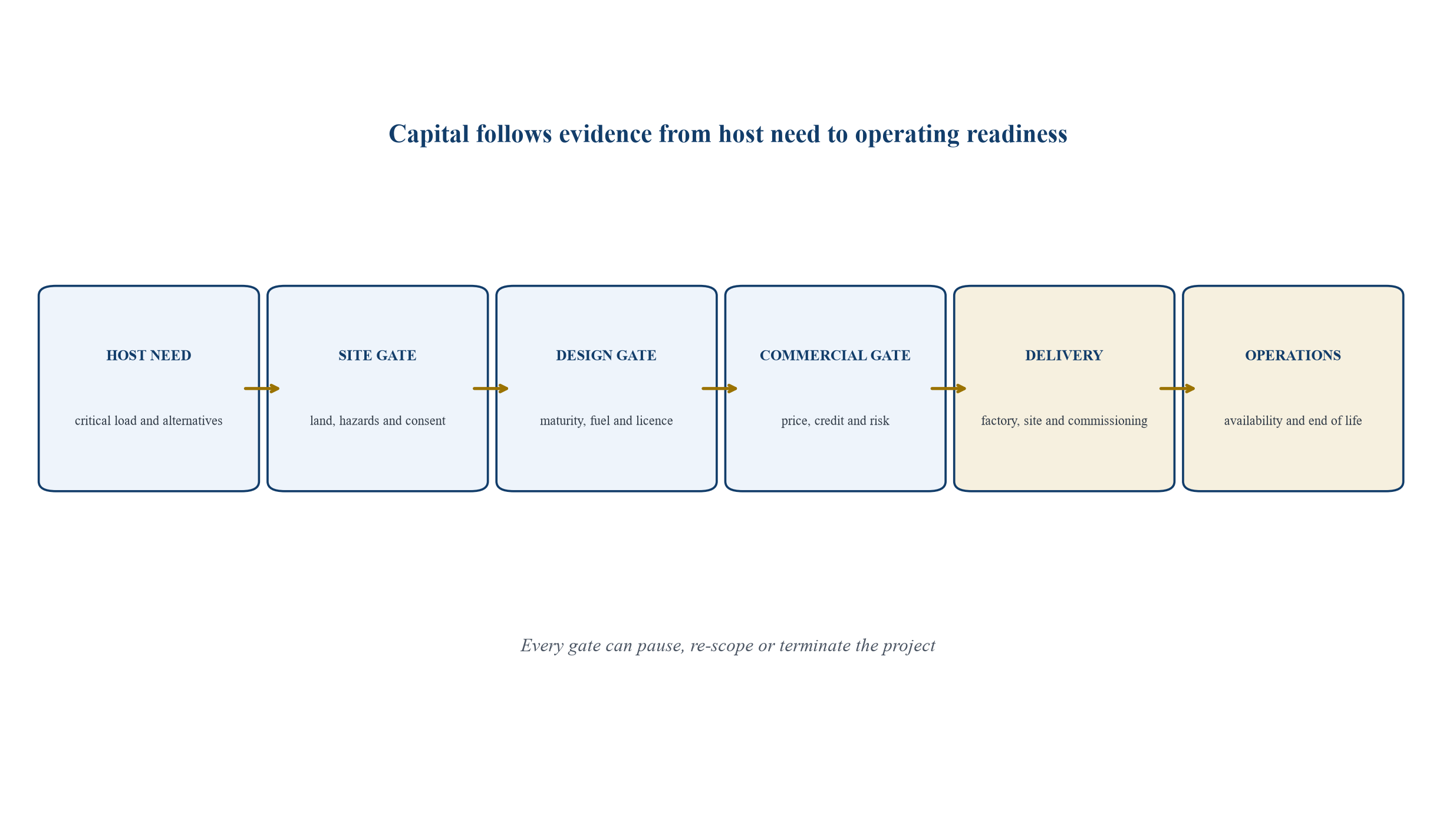
Generic commercial framework; regulatory requirements vary by jurisdiction and design.
7. Site screening
Site screening should cover external hazards, water, access, transport constraints, geology, seismicity, flooding, extreme weather, population, emergency arrangements, security perimeter and proximity to critical loads. A transportable design can still require substantial civil, electrical, security and communications infrastructure.
The site must also support the full project life. A mine that may close early needs a plan for reactor removal, continued operation for another user or funded decommissioning. An island site requires hurricane, tsunami, salt-corrosion and port-access analysis where relevant. Defence sites require integration with restricted areas and mission operations.
8. Social licence and host-community participation
Formal approval does not replace sustained engagement. Remote and Indigenous communities may be affected by site selection, transport routes, emergency planning, waste arrangements and long-term land use. Engagement should begin before a preferred design creates path dependence.
Participation can include governance rights, employment, training, local procurement, benefit sharing or equity where appropriate. The commercial model should fund the engagement and capacity required for informed participation. Commitments must remain traceable to responsible parties and enforceable project budgets.
9. Regulatory pathway
The United States Nuclear Regulatory Commission states that it can license microreactors under existing Parts 50 and 52. Part 53 became available in 2026 as a technology-inclusive framework, while the proposed Part 57 is intended to support rapid and high-volume licensing for qualifying microreactors. The chosen route affects application content, design finality, manufacturing and site approvals.
Other jurisdictions have their own nuclear law, regulator capacity and environmental-assessment requirements. A deployment schedule should reflect the actual pathway agreed with the competent authority. A generic vendor schedule is insufficient without jurisdiction-specific pre-application evidence, site data and regulatory resources.
10. Standardisation and fleet economics
Factory production can lower cost only when the product, interfaces, quality programme and licensing basis remain sufficiently standard across units. Site-specific modifications can erode repeatability and restart engineering review. The commercial model should separate standard product scope from site adaptations.
Fleet procurement can create learning, shared spares, common training and central monitoring. It also concentrates design and common-mode risk. A buyer or government should decide whether it wants a single-design fleet, staged competition or multiple technologies. The choice affects bargaining power, interoperability and recovery from a vendor failure.
11. Fuel is part of the project
Some advanced designs depend on high-assay low-enriched uranium or other fuel forms with emerging supply chains. Fuel availability, fabrication qualification, transport packaging, safeguards, insurance and inventory timing can determine the commissioning date. A reactor order without a credible fuel plan is incomplete.
The contract should identify the party responsible for initial cores, reloads, price exposure, title, transport, loss and delay. Long-life cores can reduce routine logistics, while they may increase the importance of a single delivery and end-of-life movement. Fuel-security scenarios should test supplier failure and geopolitical restrictions.
12. Waste and spent fuel
The buyer needs a defined route for operational waste, spent fuel and activated components. Responsibilities can sit with the vendor, operator, host, state or a national waste organisation. The route should be legally permissible and financially funded before operation.
Transportable concepts can propose return to a central facility for refuelling, refurbishment or decommissioning. That model depends on certified transport packages, receiving-facility capacity and durable contractual obligations. The project should test what happens if the vendor or receiving facility is unavailable decades later.
13. Security and safeguards
Security design includes physical protection, cyber controls, access, insider risk, material accountancy and coordination with public authorities. Remote operation can change staffing economics and create communications dependencies. Autonomy can reduce routine human action and increase the importance of verified control architecture.
Security requirements should be incorporated early in site layout and operating cost. Defence installations may offer protected environments while introducing mission-specific restrictions. Mines and islands can have limited local response capacity. The regulator and security authorities determine acceptable arrangements.
14. Emergency planning
Emergency arrangements should reflect the licensed hazard profile, site conditions and available response resources. A remote site can have long travel times, limited medical facilities and severe weather constraints. The plan should integrate the host's incident command, local authorities and reactor operator.
Claims of reduced emergency-planning zones require regulatory approval and design-specific evidence. The commercial model should carry the cost of drills, communications, equipment, staffing and community coordination. Emergency readiness remains an operating obligation throughout the contract.
15. Operating model
Operating models can include host ownership, utility ownership, vendor ownership, a special-purpose company or a government entity. Operations may be on site, centrally supported or partly remote, subject to regulation. The owner and licensed operator can be different parties with carefully defined duties.
The model should identify who holds the licence, employs qualified staff, controls dispatch, maintains configuration, reports events, manages fuel and retains ultimate safety authority. Economic incentives must remain consistent with safe operation. A service provider cannot accept responsibilities that nuclear law assigns to the licensee.
16. Microgrid integration
A microreactor can provide a firm anchor within a hybrid microgrid. Solar and wind may reduce marginal energy cost, batteries can provide rapid response and diesel can support commissioning or rare contingencies. The integrated control system must manage load changes, outages, maintenance and restoration.
The optimal mix depends on load shape and renewable resource rather than annual demand alone. A reactor sized to peak load may operate inefficiently during low-load periods. A smaller reactor combined with storage and renewables can improve utilisation, while increasing integration and interface risk.
17. Process heat and cogeneration
Mines and islands may need steam, drying, desalination, district heat, cooling or hydrogen. A design capable of useful heat can displace additional fuel and improve economics. Heat delivery requires temperature, pressure, distance, redundancy and contamination-boundary analysis.
Cogeneration should be valued using avoided system cost and actual demand. A theoretical high-temperature output has no value without compatible equipment and a year-round user. Contracted heat offtake can strengthen revenue and create operational coupling between the reactor and industrial process.
18. The mine-load case
A mine-load model should begin with the production plan, reserve life, processing route, expansion options and closure schedule. Crushing, grinding, ventilation, pumping and camp loads have different criticality. Process interruption can create costs far above the market value of lost electricity.
Power demand can change as ore grade, depth and throughput evolve. The project should model ramp-up, plateau, decline and closure. Modular additions or relocation can help, provided the technology and licence permit them. The reactor term should not exceed the supportable host life without another credible offtaker.
19. Mine closure and commodity risk
Commodity prices can shorten mine life even when geological reserves remain. A long-duration reactor contract therefore needs protection against closure, care and maintenance, ownership change and insolvency. Possible protections include minimum payments, sponsor guarantees, funded termination amounts, reserve accounts and alternative-site rights.
The lender should assess the mine as the principal credit exposure when electricity revenue depends on one host. Technical mine due diligence, cost position and reserve quality become part of energy-project finance. A high-quality reactor cannot compensate for a weak offtaker.
20. The defence-load case
Defence installations can value power through mission continuity rather than commodity energy savings. Critical communications, surveillance, data processing, logistics and accommodation require dependable service during grid outages or fuel disruption. A resilient system may have economic value that does not appear in ordinary utility tariffs.
Procurement should define mission loads, islanding duration, restart requirements and security classification. Government can provide strong credit and demonstration support. It can also impose bespoke assurance, domestic-content and supply-chain requirements. Project Pele is designed as a mobile prototype for resilient military power and provides learning rather than a settled commercial benchmark.
21. The island-load case
Island systems can combine residential, commercial, public-service, tourism, water and transport loads. Demand may be highly seasonal and concentrated in a small grid. Imported fuel exposes consumers to price, shipping and foreign-exchange risk. Extreme weather can interrupt ports and damage generation or networks.
A microreactor proposal should be tested against renewable and storage portfolios, interconnection where feasible, efficiency and demand flexibility. The public utility needs a tariff and subsidy model that protects affordability. A technically robust option can remain unfinanceable if the utility cannot recover cost or if government support lacks durability.
22. Water and desalination value
Electricity and water systems are coupled on many islands. Desalination, pumping and storage can provide a flexible load when water tanks create operational buffer. Reactor heat may also support thermal desalination where the design and location are suitable.
The economic model should value reliable water output, avoided fuel and reduced emergency supply costs. It should also recognise maintenance coordination and the consequence of a common outage. Separate water storage, backup generation and demand management can prevent one asset from becoming a single point of failure.
23. Load duration and reactor sizing
Nameplate demand is a weak sizing metric. The project should construct hourly or sub-hourly demand, separate critical and flexible loads, and identify minimum stable demand. Growth and decline scenarios should reflect the host's operating plan.
Table 1. Host-load and commercial screening matrix
| Dimension | Mine | Defence installation | Island system |
|---|---|---|---|
| Dependable-load basis | Production plan, process bottlenecks and reserve life | Mission loads, islanding duration and contingency posture | Public demand, tourism seasonality, water and essential services |
| Principal credit exposure | Mine owner and commodity cycle | Sovereign or government agency | Utility, government and tariff framework |
| Early-termination risk | Closure, grade decline or insolvency | Mission change or procurement cancellation | Policy change, affordability pressure or demand loss |
| Additional value | Process heat and deposit development | Mission assurance and fuel-logistics reduction | Energy sovereignty, water security and price stability |
| Required protection | Minimum payment, termination amount and relocation rights | Appropriation, termination and security provisions | Government support, tariff pass-through and liquidity reserve |
Generic screening questions; project evidence is required for each host.
A reactor sized below peak can run at high utilisation while storage and dispatchable backup serve short peaks. A larger unit may support growth or heat loads and face greater low-load curtailment. The sizing decision should compare total system cost, outage resilience and expansion flexibility.
24. Availability has two layers
The project needs both reactor availability and system availability. A reactor can meet its contractual target while the host loses power because of switchgear, network, storage or control failures. Conversely, backup assets can preserve service during planned reactor outages.
The contract should define the delivery point, measurement method, exclusions, planned outage allowance and liquidated damages. Availability guarantees should reflect the economic loss controlled by the supplier. The buyer still needs contingency for events outside the supplier's control.
25. Maintenance and outage strategy
Long refuelling intervals do not remove planned maintenance. Inspection, surveillance, calibration, rotating equipment, balance-of-plant work and regulatory testing continue. Remote sites can increase mobilisation time and spare-parts cost.
Maintenance design should specify on-site capability, remote support, critical spares, specialist mobilisation, outage windows and temporary power. A fleet operator can share expertise and inventory. The financial model should include major maintenance reserves and realistic outage duration.
26. Transportability and relocation
Transportability can create option value for finite-life mines or changing defence needs. It requires more than physical dimensions. The design, fuel state, transport package, route, permits, lifting systems, receiving site and decommissioning status must all support movement.
Relocation rights should allocate disconnection, decontamination, transport, site restoration and recommissioning cost. A future destination must meet licensing and commercial requirements. Relocation should be treated as a contingent option rather than assumed residual value.
27. Cost boundary
The cost comparison should include reactor supply, site development, civil works, grid and microgrid equipment, security, licensing, owner costs, initial fuel, spares, financing, operations, insurance, waste, decommissioning and replacement power. Vendor quotations often cover only part of this boundary.
The alternative-system boundary should be equally complete. Diesel includes fuel delivery, storage, inventory, spill risk, maintenance and emissions exposure. Renewable portfolios include overbuild, storage replacement, controls, backup and network stability. Consistent boundaries prevent a misleading headline comparison.
28. Reference-class estimating
An emerging technology needs a reference class assembled from comparable manufacturing, nuclear island, site, transport, microgrid and remote-logistics work. No single precedent may capture the project. The estimate should separate mature components from novel interfaces.
Contingency should reflect design maturity and correlated risks. A percentage added to direct cost can understate discrete events such as fuel delay, licensing redesign or failed commissioning. The model should include event-based scenarios and a liquidity plan.
29. Cost-performance benchmark
The benchmark connects each cost category to the service or risk it purchases. This makes value engineering traceable and prevents removal of essential scope.
Table 2. Microreactor cost and performance benchmark
| Cost category | Commercial purpose | Principal evidence | Downside test |
|---|---|---|---|
| Reactor and factory package | Standardised firm-power module | Design maturity, quality programme and factory test plan | Redesign, manufacturing delay or supplier distress |
| Fuel and transport | Initial energy inventory and lawful delivery | Fabrication contract, package certification and safeguards plan | Fuel delay, price escalation or route closure |
| Site and microgrid | Deliver usable power and heat at the host | Integrated design, protection study and site investigation | Interface failure, civil growth or control instability |
| Licensing and assurance | Establish permission and operating basis | Regulator plan, submissions and evidence schedule | Review extension or new requirement |
| Operations and maintenance | Sustain availability and compliance | Staffing model, spares, training and service plan | Specialist scarcity or longer outages |
| Waste and decommissioning | Complete end-of-life obligations | Legal route, cost study, security and receiving capacity | Vendor failure or unavailable repository path |
Illustrative categories; actual requirements depend on design, jurisdiction and host.
30. Time-to-power
Remote hosts often need power on a fixed schedule. A mine cannot commission processing without energy. A defence installation may have a resilience deadline. An island may face retiring diesel units. The commercial value of time therefore belongs in the comparison.
The schedule should include design completion, regulator engagement, site studies, environmental review, fuel, factory production, transport, civil works, installation, testing and operational readiness. Parallel activity can shorten delivery and increase rework risk. Each critical-path assumption needs an evidence owner.
31. Price architecture
Possible pricing structures include a capacity charge, energy charge, heat charge, availability payment, fixed service fee or indexed tariff. The price can separate fixed capital recovery from variable operating cost. Fuel, inflation, foreign exchange and change-in-law adjustment require explicit rules.
A pure energy price can leave the supplier exposed when the host load falls. A pure fixed payment can weaken dispatch incentives. A two-part tariff can align capacity readiness with actual output. Performance deductions should target controllable service failures without threatening safe operation.
32. Contract term
The contract term should match debt, major maintenance, fuel cycle and host life. Long terms improve capital recovery and create termination exposure. Mines may need a shorter firm term with extension options. Island utilities may need sovereign support for a multi-decade commitment.
Renewal, buyout, relocation and end-of-term arrangements should be agreed at the start. Residual value should not depend on an unidentified future buyer. The model should fund all obligations even if the contract is not renewed.
33. Host-credit protection
Project finance depends on revenue certainty. The offtaker should provide audited financial information, operating forecasts and evidence of authority to contract. Parent guarantees, government guarantees, letters of credit, reserve accounts or prepayment can strengthen weak credit.
Protection must be durable through ownership changes and commodity cycles. A termination payment should cover debt, break costs, unavoidable operating obligations, removal and decommissioning. Security should be enforceable under applicable law and compatible with nuclear-licence constraints.
34. Vendor-credit protection
The vendor may be an early-stage company whose balance sheet is small relative to project obligations. Technology promises, warranties and long-term service commitments are only as strong as the responsible entity and security behind them.
The buyer should assess funding runway, parent support, intellectual-property access, key suppliers, insurance and continuity plans. Source-code escrow, design-data access, step-in arrangements and substitute operators can reduce dependency. These rights require regulatory and export-control review.
35. Ownership structures
Host ownership gives control and direct access to savings while exposing the host to nuclear capability and capital risk. Utility ownership can bring operating experience. Vendor ownership can support standardisation and service delivery while concentrating vendor credit. Government ownership can suit strategic demonstrations.
A special-purpose company can isolate cash flow and allocate contracts. Nuclear liability, licence duties and decommissioning obligations may remain outside conventional project-finance assumptions. Structure should follow law and operational accountability rather than tax or financing preference alone.
36. Project finance readiness
First deployments are unlikely to resemble mature contracted infrastructure. Lenders require complete design, predictable construction, proven operations, creditworthy revenue and enforceable completion support. Early projects may require sponsor balance sheets, government funding, export credit or vendor financing.
Project-finance readiness can improve after demonstration, standardisation and fleet learning. A staged capital stack can fund development with risk capital, construction with guaranteed or supported debt, and operations with refinancing after performance tests. The plan should not assume refinancing is necessary for survival.
37. Public-sector support
Public support can fund demonstration, shared licensing, fuel infrastructure, site development, credit enhancement or contracts for difference. Support should target risks that generate public learning or strategic value and cannot be efficiently borne by one project.
Conditions should require transparent milestones, cost reporting, knowledge transfer and recourse for failure. Support should avoid paying twice for the same risk through grant, guarantee and tariff. The public decision should compare the microreactor with deliverable alternatives.
38. Insurance and nuclear liability
Nuclear liability regimes can channel responsibility and require financial security. Conventional construction, marine, cargo, property, business interruption and cyber policies may contain nuclear exclusions. The project needs specialist coverage mapping.
Insurance diligence should identify statutory liability, operator coverage, supplier indemnities, transport risk, terrorism, delay in start-up and business interruption. Uninsurable or capped exposures should be allocated and funded explicitly. Host contracts cannot override mandatory liability law.
39. Decommissioning security
Decommissioning is a current financing requirement for a future obligation. The regulator may require a cost estimate and financial assurance. A transportable unit still leaves site restoration, contaminated systems, waste and licence termination work.
The project should establish funded reserves, guarantees or other approved security. Contributions should respond to updated estimates, inflation and operating changes. Host termination must not strand the obligation in an undercapitalised project company.
40. Scenario valuation
Valuation should compare the risk-adjusted present value of complete systems. Cash flows include capital, operating cost, fuel, replacement energy, host payments, heat value, carbon exposure, decommissioning and residual obligations. The discount rate should reflect stage and risk rather than technology labels.
Scenarios should vary host life, reactor availability, delivery date, capital cost, fuel schedule, tariff, alternative fuel price and end-of-life cost. Correlations matter: licensing delay can increase financing cost and defer host savings at the same time. A single deterministic levelised cost hides these interactions.
41. Hypothetical system model
Consider a hypothetical remote host with an average electrical load of 7 MW, a peak of 11 MW and a 20-year requirement. The decision compares a microreactor hybrid, a diesel-renewable hybrid and an extended grid connection. The model includes firm capacity, storage replacement, fuel delivery, outage backup and end-of-life obligations.
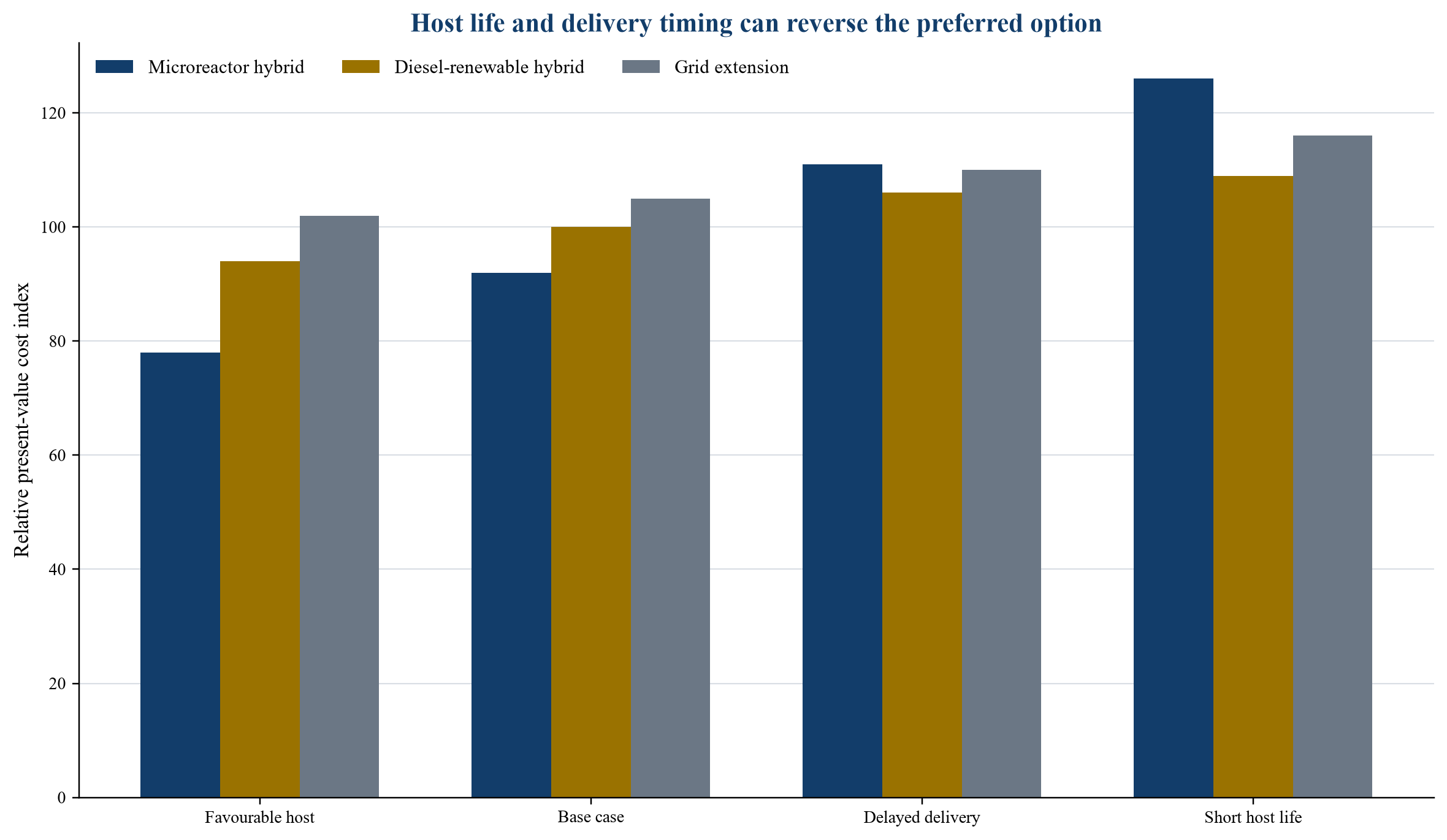
Unattributed values are illustrative indices and do not represent a named project, forecast or offer.
In the favourable case, a long host life, timely delivery and high avoided fuel-logistics cost improve the microreactor outcome. Delivery delay removes early savings and increases financing cost. A short host life weakens capital recovery and raises end-of-life cost per unit of service. The result illustrates sensitivity rather than a technology conclusion.
42. Break-even tests
The investment committee should define maximum capital cost, latest commercial-operation date, minimum host term, minimum availability, maximum operating cost and funded end-of-life requirement. These thresholds should appear in procurement and financing documents.
Break-even analysis should also identify the alternative fuel price and grid-connection cost at which the decision changes. A board can then observe whether market movements improve or erode the case. Thresholds are more useful than a single base-case return because they link assumptions to action.
43. Resilience valuation
Resilience value can include avoided production loss, emergency logistics, mission interruption, water shortage, public-service disruption and safety consequences. It should be estimated from the host's actual failure scenarios. A large theoretical value should not be used to justify an uneconomic project without evidence.
The model should distinguish frequent short outages, rare long disruptions and fuel-supply shocks. Batteries, spare generators, fuel inventory and network hardening may provide some of the same value. The microreactor receives credit only for incremental resilience within the complete portfolio.
44. Carbon and environmental value
Microreactors can reduce diesel combustion and associated emissions where they displace fossil generation. The net environmental assessment should include construction, fuel cycle, transport, waste, land, water and decommissioning as required by law and decision policy.
Carbon value can arise through explicit prices, avoided compliance cost, corporate targets or public policy. It should be modelled separately from energy savings. A project should remain transparent about which benefits are monetised, contracted or qualitative.
45. Real options
A pilot can buy information about licensing, construction, operations and host acceptance before fleet commitment. A standardised order with options can reserve capacity while limiting irreversible spend. Site work can be sequenced to preserve alternative generation plans.
Relocation, expansion and heat-use options can add value when they are technically and contractually credible. Option value depends on rights, approvals, compatible sites and funding. An unsupported assumption that the unit can always be moved or resold should receive no base-case value.
46. Risk allocation
Risk should sit with the party able to control, price or absorb it. The vendor can control design and factory quality. The host controls load and some site interfaces. Government controls elements of policy and may absorb demonstration risk. The licensed operator retains safety responsibility within the legal framework.
Table 3. Microreactor risk allocation and controls
| Risk | Primary control | Possible bearer | Decision evidence |
|---|---|---|---|
| Technology maturity | Testing, design assurance and staged milestones | Vendor, sponsor and demonstration funder | Verified qualification record and funded completion plan |
| Licensing and site approval | Early engagement and complete evidence | Project sponsor with policy support where justified | Agreed pathway, submission plan and regulator resources |
| Fuel availability | Long-term supply, inventory and qualified transport | Vendor, fuel supplier and government | Binding supply plan and certified logistics |
| Host termination | Minimum payment, guarantee and relocation option | Host, parent or government | Enforceable termination schedule and security |
| Availability | Integrated design, spares and performance testing | Operator and vendor within defined limits | Reliability case, warranty and reserve capacity |
| Waste and decommissioning | Approved route and funded security | Owner, operator and responsible public body | Cost study, receiving path and financial assurance |
| Common-mode fleet event | Diversification, surveillance and contingency | Fleet owner and public authorities | Fleet risk plan and alternative service capacity |
Generic structure for commercial design; mandatory legal responsibilities remain with the responsible entities.
47. Interface risk
Factory scope, site scope, fuel, microgrid, heat systems, security and licensing evidence can be supplied by different parties. Gaps between packages create cost and schedule exposure. One integration authority should own the configuration and interface register.
Interface control documents should define data, physical connections, testing, acceptance and change rights. The programme schedule should show when each interface must be frozen. A contract structure with many strong suppliers can still fail when no party owns system performance.
48. Governance
The board should establish a committee covering nuclear safety, host operations, finance, security, community engagement and independent technical challenge. The licensed operator's safety authority must remain clear. Commercial pressure should never suppress reporting or delay required action.
Independent advisers can assess design maturity, cost, schedule, host credit and financing. Their reports should separate observed evidence from management forecast. Decision papers should record dissent, conditions and unresolved items rather than compressing uncertainty into one rating.
49. Programme controls
Cost, schedule, risk and technical maturity should share a work-breakdown structure. Each package should reconcile budget, commitments, actual cost, forecast, contingency, physical progress and critical-path effect. Design maturity and licensing evidence should accompany expenditure progress.
Management should report leading indicators such as open safety questions, design changes, supplier non-conformances, fuel milestones and host-interface readiness. Payment percentage alone is not evidence of completion. Contingency release should require documented risk retirement.
50. Construction and installation
Factory production can shift work from the remote site to a controlled environment. Site work still includes foundations, shielding, security, electrical systems, heat systems, communications and temporary facilities. Transport and lifting can create narrow weather and logistics windows.
The delivery plan should integrate factory acceptance, route surveys, permits, receiving inspection, installation and preservation. Damage or delay in transit needs contractual and insurance treatment. Remote sites require sufficient local inventory and accommodation for commissioning teams.
51. Commissioning and operating readiness
Commissioning should test the reactor, balance of plant, microgrid, heat systems, security and emergency arrangements as one operating system. Fuel loading, low-power tests and power ascension follow regulatory requirements. The host must be ready to accept power without compromising process safety.
Performance acceptance should include dependable output, availability demonstration, load response, islanding, restart and heat delivery where contracted. Holdbacks and reserves should remain until the relevant tests pass. Early commercial operation should not transfer unresolved construction defects to the buyer.
52. Commercialisation roadmap
The roadmap begins with a service requirement and alternative-system study. It proceeds through community and regulator engagement, design qualification, site development, fuel and waste arrangements, commercial structure, financing, construction and operating proof. Fleet expansion follows verified performance.
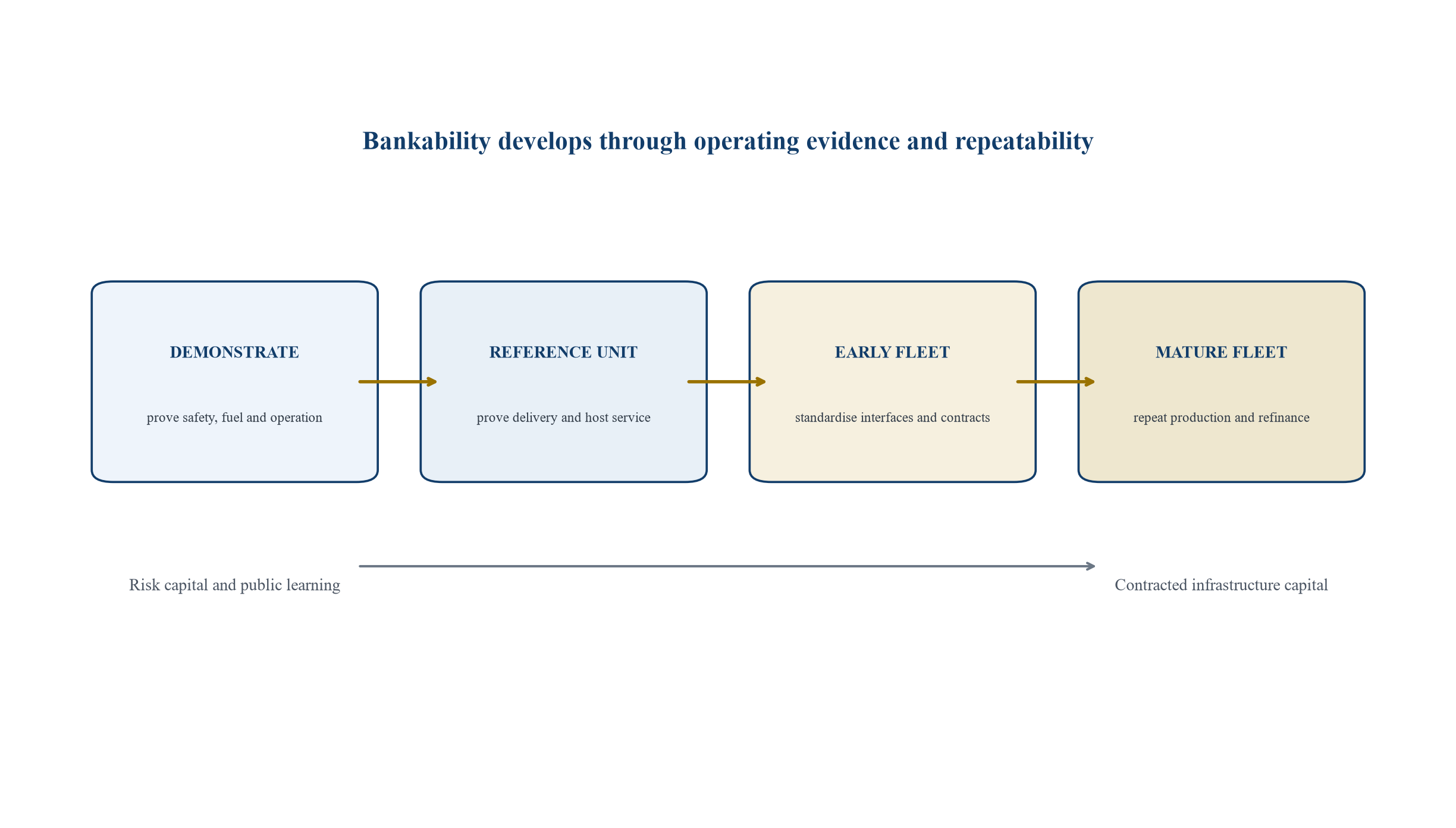
Generic roadmap; timing and decision rights depend on jurisdiction and procurement model.
Demonstration capital should be prepared for design and schedule uncertainty. A reference unit establishes delivered cost and operating data. Early fleets can standardise procurement and central services. Mature fleets may support lower-cost debt after repeated performance, durable fuel supply and clear end-of-life arrangements.
53. The mine decision pack
The mine board should receive the load forecast, reserve and closure plan, alternative-power study, technology diligence, licensing plan, integrated design, host-impact analysis, cost and schedule, power-service agreement, termination security, financing, process-heat value and decommissioning plan.
The case should show how power cost affects the mine cost curve and net present value. It should also show the consequence of commodity downside, delayed mine ramp-up and early closure. Energy strategy and mine planning must use the same production assumptions.
54. The defence decision pack
The defence decision should define mission loads, threat and resilience scenarios, security, procurement authority, technology evidence, site and licence pathway, fuel logistics, operating model, data rights, domestic supply-chain requirements and whole-life budget.
The comparison should include conventional resilience investments and mobile backup. Demonstration objectives should be separated from operational requirements. A prototype can generate strategic learning without yet satisfying the availability standard for a critical mission.
55. The island decision pack
The island decision should include an integrated resource plan, demand and affordability forecast, renewable and storage alternatives, water coupling, grid-stability study, site and hazard analysis, public consultation, tariff design, sovereign support, operator capability and end-of-life funding.
The government should assess energy sovereignty, foreign-exchange exposure, resilience, emissions and public-finance risk. The contract should protect consumers from uncontrolled construction cost while preserving sufficient revenue for safe operation. Independent regulation and transparent performance reporting support legitimacy.
56. Red flags and decision rules
Red flags include a design without completed qualification evidence, a schedule disconnected from the regulator, fuel dependent on an unfunded future facility, an undefined waste route, a vendor with insufficient runway, a host term shorter than debt, unsupported relocation value, and a tariff that excludes backup and decommissioning.
A project is strongest when the host has a stable critical load, credible long-term credit, costly or vulnerable fuel logistics, a suitable site, a clear regulator pathway, qualified fuel, a mature integrated design and enforceable end-of-life arrangements. It should pause when reducible evidence gaps remain and stop when the host, safety or legal basis fails.
57. Conclusion
Microreactors may create value where remote power is expensive, fragile or strategically critical. Their value proposition combines firm electricity, heat, fuel-logistics reduction and resilience. Their risk profile combines emerging technology, nuclear regulation, concentrated host credit and long-duration obligations.
A credible project begins with the host service requirement and a complete alternative-system comparison. It advances through staged evidence, community participation, regulatory alignment, fuel and waste certainty, integrated contracting and funded end-of-life duties. Bankability will develop through demonstrated performance and repeatable fleets. Until that evidence exists, capital structure and pricing should reflect the real risks carried by each party.
References
- International Atomic Energy Agency. Small Modular Reactors: Advances in SMR Developments 2024. Vienna: IAEA, 2024. https://www.iaea.org/publications/15790/small-modular-reactors-advances-in-smr-developments-2024
- International Atomic Energy Agency. Technology Roadmap for Small Modular Reactor Deployment. Nuclear Energy Series No. NR-T-1.18. Vienna: IAEA, 2021. https://www.iaea.org/publications/14896/technology-roadmap-for-small-modular-reactor-deployment
- International Atomic Energy Agency. Small Modular Reactor Designs. Vienna: IAEA, 2024. https://conferences.iaea.org/event/448/attachments/21635/37232/4.%20Small%20Modular%20Reactor%20Designs.pdf
- International Atomic Energy Agency. Approaches for the Management of Spent Fuel and Radioactive Waste from Small Modular Reactors. Vienna: IAEA. https://www.iaea.org/topics/small-modular-reactors
- United States Nuclear Regulatory Commission. Microreactors. Updated 10 April 2025. https://www.nrc.gov/reactors/new-reactors/advanced/modernizing/microreactors.html
- United States Nuclear Regulatory Commission. Proposed Part 57: Licensing Requirements for Microreactors and Other Reactors with Comparable Risk Profiles. https://www.nrc.gov/facilities-safety/new-reactors/advanced-reactors/modernizing-how-we-regulate/rulemaking/proposed-part-57-licensing-requirements-for-microreactors-and-other-reactors-with-comparable-risk-profiles
- United States Nuclear Regulatory Commission. Pre-application Process for Advanced Reactor Applicants. https://www.nrc.gov/facilities-safety/new-reactors/advanced-reactors/new-applicants/guidance-for-prospective-applicants/pre-application-process
- United States Nuclear Regulatory Commission. Policy and Licensing Considerations Related to Micro-Reactors. SECY-20-0093. 23 October 2020. https://www.nrc.gov/docs/ML2025/ML20254A363.pdf
- United States Nuclear Regulatory Commission. Micro-Reactor Licensing and Deployment Considerations: Fuel Loading and Operational Testing at a Factory. SECY-24-0008. 8 February 2024. https://www.nrc.gov/docs/ML2320/ML23207A252.pdf
- United States Nuclear Regulatory Commission. Nth-of-a-Kind Microreactor Licensing and Deployment Considerations. SECY-25-0052. 2025. https://www.nrc.gov/node/2151881
- United States Department of Energy. Construction and Demonstration of a Prototype Mobile Microreactor: Final Environmental Impact Statement. DOE/EIS-0546. 2022. https://www.energy.gov/sites/default/files/2022-02/final-eis-0546-mobile-microreactor-2022-02-volume-1.pdf
- United States Department of Energy. One Year After Executive Orders, U.S. Nuclear Energy Renaissance Is in Full Swing. 2026. https://www.energy.gov/ne/articles/one-year-after-executive-orders-us-nuclear-energy-renaissance-full-swing
- Idaho National Laboratory. Project Pele. https://inl.gov/project-pele/
- Natural Resources Canada. Canada's Small Modular Reactor Action Plan. Updated 20 December 2024. https://natural-resources.canada.ca/energy-sources/nuclear-energy-uranium/canada-s-small-modular-reactor-action-plan
- Natural Resources Canada. Small Modular Reactors for Mining. https://natural-resources.canada.ca/energy-sources/nuclear-energy-uranium/small-modular-reactors-smrs-mining
- Natural Resources Canada. Nuclear Energy Strategy for Canada. 2026. https://natural-resources.canada.ca/energy-sources/nuclear-energy-uranium/nuclear-energy-strategy-canada
- Canadian Nuclear Safety Commission. Small Modular Reactors. https://www.cnsc-ccsn.gc.ca/eng/reactors/power-plants/small-modular-reactors/
- International Renewable Energy Agency. Small Island Developing States at a Crossroads: The Socio-economics of Transitioning to Renewables. Abu Dhabi: IRENA, 2024. https://www.irena.org/Publications/2024/Mar/SIDS-at-a-Crossroads-The-socio-economics-of-transitioning-to-renewables
- International Renewable Energy Agency. Renewable Energy in Hybrid Mini-Grids and Isolated Grids: Economic Benefits and Business Cases. Abu Dhabi: IRENA, 2015. https://www.irena.org/publications/2015/Apr/Renewable-Energy-in-Hybrid-Mini-Grids-and-Isolated-Grids
- Nuclear Energy Agency. Small Modular Reactor Dashboard: Third Edition. Paris: OECD Publishing, 2025. https://www.oecd-nea.org/jcms/pl_111110/the-nea-small-modular-reactor-dashboard-third-edition
About the Author
Chennakeshav (CK) is a corporate finance and investment banking executive with 25+ years of global experience in deal origination, structuring and execution across M&A, growth capital and corporate strategy. He has led value-creation mandates for founders, corporates and funds — bridging the boardroom view to hands-on execution and close.
His career spans Morgan Stanley, HSBC, Lloyds Banking Group, EWEC, ADQ portfolio companies and Emirates Growth Fund, across TMT, real estate, fintech, deeptech, cleantech, infrastructure and energy. He has partnered with C-suite leaders, private equity and venture funds, sovereign wealth funds and family offices to finance complex fund raises and scale-up ventures, and has led M&A due diligence, post-merger integration and business-transformation initiatives to create value.
At Matchpoint Partners he is Managing Partner, leading the firm's corporate finance, M&A and capital-raising practice. He holds an MBA from London Business School, an engineering degree from VTU and a Master of Laws (LLM, in progress) from UCL London.
An active start-up mentor, CK mentors at Techstars, DIFC FinTech Hive, Startup Grind, Founder Institute and IN5, serves as Entrepreneur Mentor in Residence (EMiR) at London Business School, and judges the Entrepreneurship World Cup.
LinkedIn: https://www.linkedin.com/in/ckadya/
Profile: https://www.matchpoint-partners.com/team/ck-adya.html
