

1. The financing question
Direct air capture removes carbon dioxide from ambient air through engineered contactors, regeneration systems and energy inputs. Durable removal also requires conditioning, transport, permanent storage and monitoring. The technology's climate purpose is clear only when the entire chain produces a verified net removal. The investment question is how to fund that chain before a large plant has a long operating record.
One financing at notice to proceed can expose capital to unresolved technology, construction, energy, storage and market risks. Milestone capital divides the programme into stages. Each stage purchases evidence needed for the next decision. Capital is committed in advance only to the extent required for continuity and credible procurement.
2. Why the first tonne is expensive
Atmospheric carbon dioxide is dilute, so direct air capture requires substantial air movement, sorbent or solvent cycling, heat, electricity and process equipment. The International Energy Agency has reported a wide range of future capture costs and emphasises dependence on technology, energy, site and financing assumptions. Early commercial projects also carry first-of-a-kind engineering and supply-chain premiums.
The first verified tonne therefore bears more than steady-state operating cost. It reflects research, pilot learning, design, permitting, shared infrastructure, commissioning and measurement. A financing plan that values every early tonne at a mature-plant cost can create a funding gap and distort procurement decisions.
3. Technology proof and project proof are different
A capture medium can perform in a laboratory while the integrated plant fails to meet availability, energy or maintenance expectations. A plant can operate technically while its storage, certification or customer contracts remain incomplete. The financing plan should distinguish technology proof from project proof.
Technology proof covers material performance, cycle stability, contaminants, energy demand and manufacturability. Project proof covers site, utilities, permits, construction, storage, measurement, buyers, insurance and finance. The milestone schedule should show which evidence belongs to each category and who verifies it.
4. Current public support
The United States Department of Energy's Regional Direct Air Capture Hubs programme is designed to support commercial-scale deployment, including hubs capable of at least one million tonnes a year. Its 2024 funding opportunity described infrastructure access platforms, mid-scale facilities and large-scale facilities, with different capacity and funding parameters.
This staged public architecture reflects the diversity of readiness across the sector. Public selection or negotiation does not prove that a private project is financeable. Investors should examine award terms, cost share, reimbursement mechanics, milestones, conditions and termination rights.
5. Market commitments
Carbon-removal buyers can support suppliers through advance commitments, pre-purchases and long-term offtake. Frontier's published request for proposals describes multi-year, pay-on-delivery agreements and evaluates whether an offtake helps a supplier reach a critical scale-up milestone. Pay-on-delivery protects buyers from non-performance.
The same feature limits construction liquidity. A supplier cannot spend a future payment before delivery without bridge capital or assignment. The financing model should distinguish contracted revenue from cash available before commissioning. Prepayment, deposit, escrow, guarantee or lender advance can bridge that timing gap.
6. Certification and unit integrity
A removal unit should represent quantified net atmospheric removal after lifecycle emissions, with durable storage and controls against double issuance and double claiming. Regulation (EU) 2024/3012 establishes a voluntary certification framework, and the European Commission's 2026 methodology covers direct air capture with carbon storage.
Certification affects revenue eligibility and delivery timing. The project should identify the applicable methodology, certification body, monitoring plan, registry and liability rules. Methodology change risk belongs in both the contract and the downside model.
7. The milestone capital architecture
The structure below connects evidence, capital and commercial rights. Early capital funds learning and preserves option value. Later capital receives stronger security after risk reduction. Buyer revenue supports delivery, while public support can address infrastructure and first-commercial externalities.
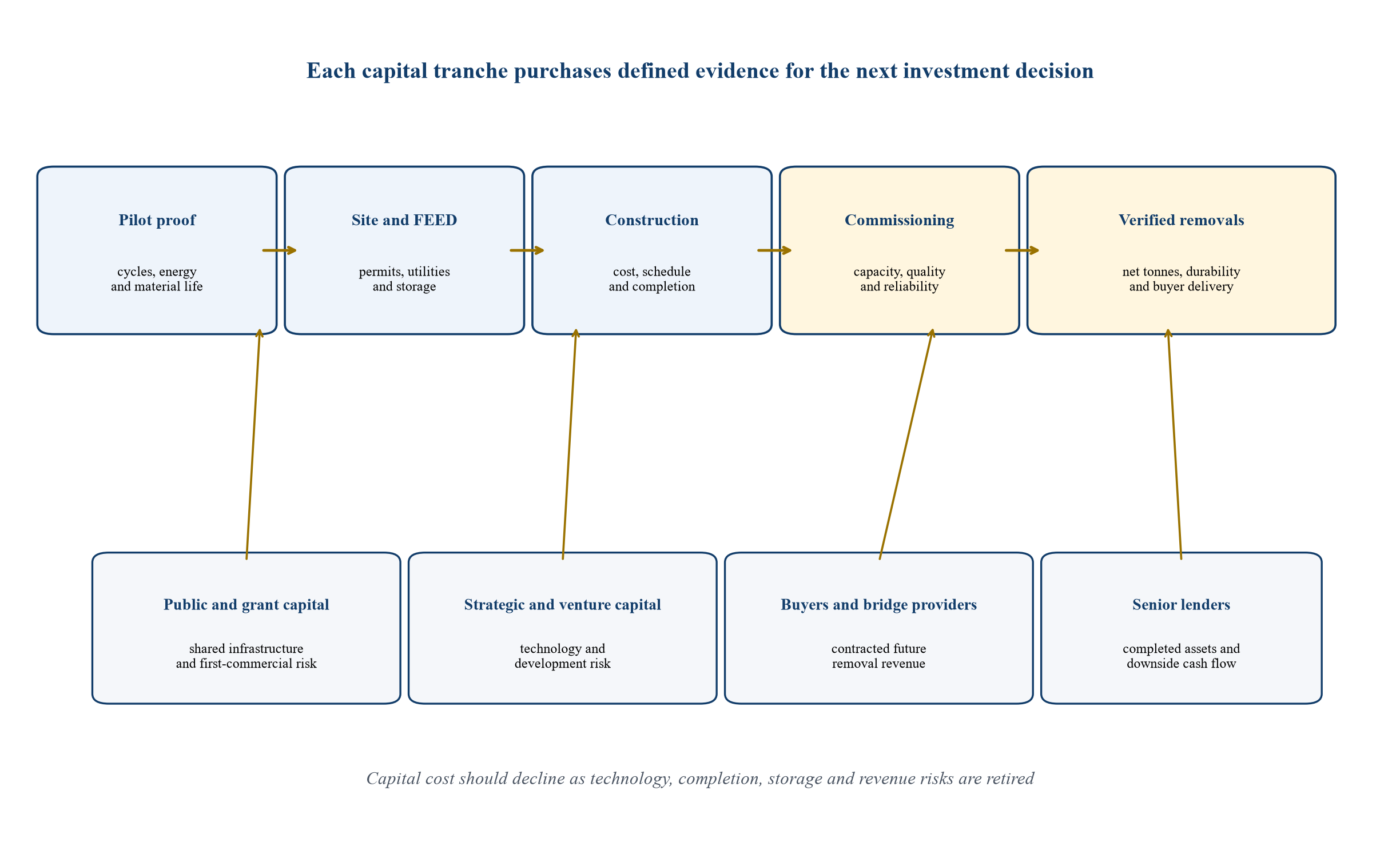
Generic structure. Actual instruments, regulatory treatment and security depend on the project and jurisdiction.
8. Stage zero: evidence plan
Before funding a pilot or site, management should define the evidence required for investment. The plan should list metrics, test conditions, sampling frequency, independent reviewer, data ownership, pass threshold and consequence of failure. Tests should reflect the expected operating environment.
An evidence plan prevents a successful experiment from being reinterpreted after the event. It also lets investors price the next tranche before the current stage finishes. Material changes should require documented approval and an explanation of their effect on comparability.
9. Stage one: component and pilot proof
The first stage should test capture rate, energy, sorbent or solvent life, degradation, water, contaminants, thermal integration, controls and maintainability. A pilot should run long enough to reveal cyclic and seasonal performance. Short demonstrations may miss replacement and reliability risk.
Capital at this stage is risk capital or non-dilutive support. The instrument can include tranched equity, a convertible security or grant reimbursement. Senior project debt is generally unsuitable because there is no completed asset or dependable operating cash flow.
10. Stage two: site and pre-FEED
Site selection should reconcile clean energy, heat, water, land, labour, logistics, carbon transport, storage and community requirements. Pre-FEED converts a technology concept into a facility basis, preliminary balance, layout, cost range and execution plan.
The milestone should require documented site control, utility pathways, storage route, permit register, community plan and a cost estimate of stated maturity. A site with inexpensive energy can still fail if grid connection, storage or approvals arrive late.
11. Stage three: FEED and commercial alignment
Front-end engineering should establish process design, equipment, integration, construction strategy, schedule, estimate, contracting plan and performance guarantees. Commercial work should advance in parallel. Removal offtake, storage, energy and public funding need compatible commencement dates and conditions.
The FEED milestone should test whether the project is one integrated plan. A technically complete design with conditional storage and revenue remains development-stage. The investment committee should see the full conditions-precedent map and critical path.
12. Stage four: notice to proceed
Notice to proceed commits the largest capital. It should follow approved FEED, fixed or bounded major packages, permits, site rights, storage capacity, funding agreements, completion support and a base-case revenue package. Residual risks should have named owners, price and contingency.
The board should also approve stop rights and contingency draw conditions. A project that exceeds budget before mechanical completion may need equity, grant amendment or scope reduction. Senior lenders should avoid an unfunded completion exposure.
13. Stage five: commissioning
Mechanical completion proves that systems are installed. Commissioning proves that they work together. Tests should cover capture capacity, energy intensity, product quality, availability, emissions, metering and safe operation. The storage chain should accept and account for delivered carbon dioxide.
Milestone payments can separate first capture, sustained run, performance test and commercial operation. A single short test can hide reliability risk. Performance liquidated damages or sponsor support should cover material shortfall where contractors or technology providers accept responsibility.
14. Stage six: verified removal
A captured tonne becomes a saleable removal only after lifecycle accounting, transport, durable storage, monitoring, certification and registry controls. Delivery may therefore lag physical capture. Working-capital facilities should model this gap.
The offtake contract should define measurement, verification, issuance, transfer, retirement, replacement and reversal. The buyer should pay against the agreed unit and evidence. The project should not count uncertified inventory as cash unless a lender explicitly advances against it.
15. Milestone design principles
Milestones should be objective, material, attributable and independently reviewable. They should test the risk that the next capital provider cannot absorb. A documentation milestone alone is weak if the underlying permit, contract or performance remains conditional.
Table 1. Indicative milestone schedule and evidence gates
| Stage | Evidence | Independent check | Capital released | Failure response |
|---|---|---|---|---|
| Pilot | sustained performance, energy and media life | technical expert | pilot and design equity | redesign, repeat or stop |
| Site and pre-FEED | site control, utilities, storage route and estimate | owner's engineer | development capital | change site or narrow scope |
| FEED | design basis, schedule, cost and guarantees | technical and cost review | procurement deposits | reprice, rebid or defer |
| Financial close | permits, contracts, funding and completion support | lender diligence | construction debt and equity | hold notice to proceed |
| Commissioning | sustained capacity, quality and energy tests | performance test agent | retention and term conversion | cure, damages or resize debt |
| Delivery | certified net removal and durable storage | certification body | buyer payment | replace units or withhold payment |
Generic framework. Thresholds and reviewers require project-specific design.
16. Binary and graduated milestones
A binary milestone is clear: a permit is issued, storage contract effective or test passed. A graduated milestone can reflect partial performance, such as capacity or energy within a band. Graduated structures reduce cliff effects but require a pre-agreed payment curve.
The design should match cost and controllability. A developer should not lose all capital because a public authority issues a permit days late. It should face a consequence for plant underperformance within its control. Cure periods, waivers and repeated tests need limits.
17. Governance
The milestone committee should include the sponsor, relevant funder, technical reviewer and observer rights for major buyers or lenders. It should operate under a written charter covering evidence, conflicts, voting, reserved matters, waivers and records.
Technical reviewers should report directly to the committee for milestone certification. Management retains responsibility for delivery. A reviewer should not approve assumptions it helped create without independent challenge.
18. Development capital
Development spending funds site studies, engineering, permits, contracting and community work. It is exposed to cancellation and has limited recovery value. Development capital therefore expects control rights, conversion economics or participation in later project value.
The budget should separate reusable technology work from site-specific work. A failed site may leave valuable engineering, data and intellectual property. Agreements should state who owns that value and whether it can be transferred to a replacement project.
Development capital should be released against a rolling budget and decision calendar. The sponsor should report committed cost, forecast cost to complete, cash runway and evidence produced. A development overrun can signal inadequate scope definition before construction begins. The committee should require a recovery plan before adding capital.
Exclusivity and option periods should match the work programme. Long site or supplier exclusivity can protect investment, yet it can also block alternatives after a missed milestone. Extensions should require progress evidence and a funded plan. Termination should preserve licences, data and access needed to evaluate a replacement route.
19. Strategic equity
Equipment suppliers, energy providers, storage operators and industrial partners may invest for strategic reasons. Their expertise can improve execution and align contracts. Their commercial interests can also create related-party pricing or exclusivity risk.
Governance should require independent review of related-party contracts, transfer pricing and conflicts. Strategic rights should not prevent competitive procurement or future financing. Technology licences and step-in rights must survive sponsor distress.
Strategic investors may value learning, equipment sales, energy demand or storage throughput beyond the project's financial return. The investment memorandum should identify these benefits and avoid treating them as project cash. A lower required equity return can support the capital stack, but the operating company should not accept an uneconomic supply contract in exchange.
Reserved matters should protect the project without giving one strategic shareholder a veto over ordinary refinancing, supplier replacement or future sites. Information rights need confidentiality boundaries where investors compete elsewhere. Exit rights should support long-term operation and avoid a forced sale during commissioning.
20. Public capital
Public funding can address learning spillovers, shared infrastructure, community benefits and first-commercial risk. It can take the form of grants, cost share, tax credit, loan guarantee, contract or public procurement. Each has different cash timing and compliance conditions.
The project model should reflect reimbursement delay, eligible-cost rules, matching requirements, audit, reporting and clawback. Award headline value is not equivalent to available cash. A bridge facility may be required against approved reimbursement.
Public milestones and private-finance milestones should be reconciled in one schedule. A government programme may reimburse after documented expenditure, while contractors require deposits and monthly payment. The project needs enough unrestricted liquidity to cover the gap. Lenders advancing against reimbursement should diligence appropriation, approval, set-off and termination rights.
Cost-share rules can restrict movement among budget categories. Contingency, foreign exchange, owner cost or financing fees may be ineligible. The model should separate eligible and ineligible expenditure and identify the equity source for each. Reporting failures can delay cash even when construction is progressing.
21. Buyer capital
Buyers can pay on delivery, prepay, provide deposits or support a financing vehicle. Prepayment gives construction liquidity and exposes the buyer to project failure. Security can include escrow, refund guarantees, milestone release, collateral or replacement rights.
Buyer rights should remain compatible with senior finance. A buyer cannot have unrestricted refund priority over project assets if lenders require first-ranking security. Intercreditor terms should state remedies, cure, assignment and treatment of undelivered units.
A prepaid purchase can be structured as customer capital rather than debt, although accounting, insolvency and regulatory treatment require advice. The contract should state whether prepayment purchases fixed tonnes, reserves capacity or creates a monetary claim. Price and volume should adjust transparently if the project is resized.
Pooling several buyers can diversify credit and reduce reliance on one procurement programme. Standard contract terms simplify financing, while buyer-specific claims and delivery preferences can complicate allocation. The project should maintain a delivery waterfall, replacement protocol and registry record that reconcile every unit to one buyer.
22. Offtake bankability
A bankable removal purchase agreement defines annual volume, price, delivery window, certification, durability, replacement, credit support and termination. It should distinguish failure to commission, failure to capture and failure to certify. Remedies should reflect the stage and likely mitigation.
Pay-on-delivery contracts create contracted future revenue but no cash before delivery. Lenders may advance against them after discounting construction, performance, price and buyer credit. A minimum payment or termination amount can improve value if enforceable.
The agreement should address methodology change. A new standard may tighten lifecycle boundaries or monitoring and reduce eligible volume. The parties can agree a compliance plan, cost-sharing rule, substitute methodology and termination threshold. A broad promise to deliver any future-approved unit creates an unpriced obligation.
Assignment matters because project lenders may enforce security or transfer the plant. Buyers can require technical and integrity qualifications for a replacement operator. Consent should not be unreasonably withheld where the substitute meets objective criteria. Direct agreements can preserve the contract during cure and restructuring.
23. Price structure
Early removal prices may be high and decline as scale and learning improve. A fixed declining schedule provides visibility. A cost-indexed price protects the supplier but can weaken efficiency. A target-price structure can share savings and overruns.
The contract should identify energy, storage, certification and inflation indices. Public support and transferable credits need explicit treatment. A price should not assume cost reduction without a programme that can produce it.
Price should be tested against verified net tonnes rather than gross capture. Higher lifecycle emissions or storage losses can lower deliverable volume without lowering plant cost. This basis risk should be allocated through thresholds, adjustment bands and reporting. The operating model should show the price required at each net-delivery level.
Foreign exchange can be material when equipment, debt and buyer contracts use different currencies. Hedging may be unavailable for the full development period. The project can align currencies, index part of the price or maintain contingency. The buyer should understand which adjustment compensates external cost and which rewards supplier performance.
24. Sources and uses
The illustrative case below separates development, equipment, infrastructure, contingency and liquidity. It is a financing tool rather than a cost estimate. Real projects require engineering estimates and binding commercial terms.
Table 2. Hypothetical sources and uses for a first-commercial DAC facility
| Uses | Index | Sources | Index |
|---|---|---|---|
| Development, site and FEED | 35 | Development and strategic equity | 60 |
| Capture modules and process plant | 180 | Construction equity | 90 |
| Energy and balance of plant | 65 | Public grant or cost share | 85 |
| CO2 conditioning and storage connection | 45 | Buyer prepayment or bridge | 35 |
| Contingency and owner costs | 50 | Senior construction debt | 95 |
| Interest, reserves and working capital | 30 | Subordinated or contingency facility | 40 |
| Total | 405 | Total | 405 |
Illustrative index values only. They are not market data, engineering estimates or financing terms.
25. Capital should migrate with risk
Early capital receives technology and development risk. Construction capital receives completion risk. Term lenders should enter after commissioning or convert construction debt after performance tests. Buyer bridge capital sits between contract value and delivery timing.
The cost of capital should decline as evidence accumulates. A structure that keeps expensive venture capital in a mature operating asset can reduce competitiveness. A structure that introduces cheap debt before risk retirement can create default and restructuring.
26. Capital release waterfall
The figure shows an illustrative migration from risk capital to contracted and senior capital. Width represents relative cumulative funding, not a market estimate. The release gate under each stage requires evidence and an approved remaining budget.
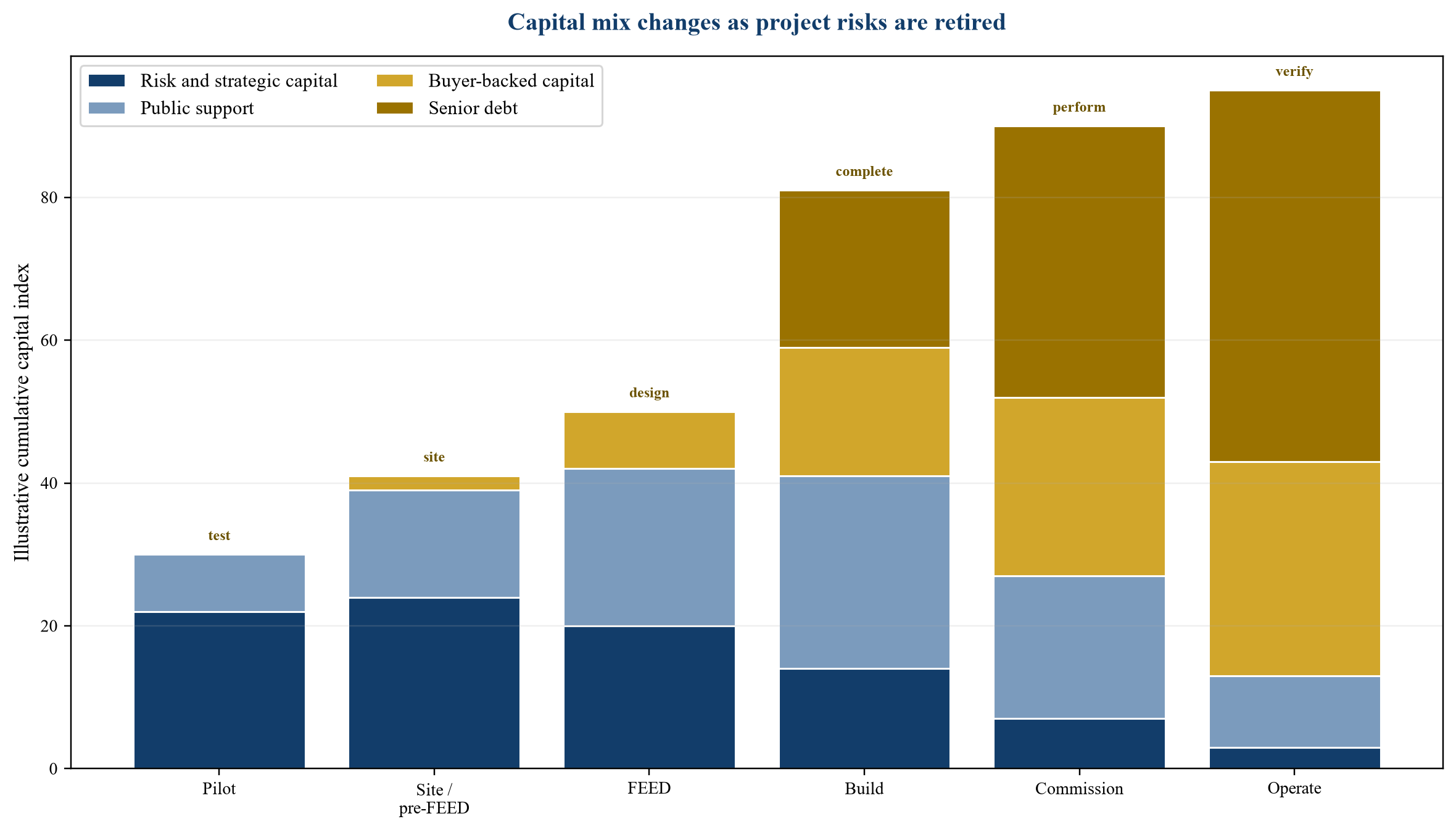
Generic financing sequence. Relative amounts and timing are hypothetical.
27. Construction contracting
The sponsor can use an engineering, procurement and construction contract, multiple packages or an engineer-procure-construction-management structure. A novel plant may have limited appetite for a full turnkey guarantee. Interface risk then remains with the owner.
The financing case should identify guaranteed scope, performance, delay damages, caps, exclusions and security. Owner contingency should reflect uncovered interfaces. Technology provider obligations need to survive contractor default.
Long-lead capture modules, fans, heat systems, compressors and electrical equipment can drive schedule and working capital. Procurement milestones should distinguish engineering release, factory acceptance, shipment, site acceptance and commissioning. Advance-payment security should cover deposits where supplier credit is material.
Modular construction can reduce site work and support replication. It also moves quality and schedule risk into factories and logistics. The owner should inspect manufacturing capacity, quality systems, sub-suppliers and transport constraints. A module design freeze should occur only after interfaces are sufficiently mature.
28. Completion support
Completion support covers cost overrun, delay and performance shortfall until agreed tests are passed. It can come from sponsor equity, contingent facility, guarantee, reserve or public support. The amount should follow a quantified downside case.
Support should have clear expiry. A vague obligation can become disputed when needed. Lenders should understand sponsor capacity and competing commitments. Buyers should know whether their prepayment is protected during a completion problem.
The completion test should align with the debt case. Mechanical completion alone is inadequate when debt service depends on verified removals. The test can require sustained capture, net-removal eligibility, storage acceptance, minimum availability and effective offtake. A partial test can release part of the support while retaining a reserve for remaining performance.
Cost-to-complete certification should be repeated before major debt draws. It should include committed cost, remaining procurement, claims, contingency and schedule impact. If available funding falls below the reviewed requirement, drawdown should stop until the gap is cured.
29. Energy risk
DAC economics depend strongly on electricity and heat cost, carbon intensity, availability and connection timing. A project should secure energy consistent with its net-removal methodology. Curtailment and grid delay can affect both volume and unit emissions.
Contracts can combine long-term supply, indexed price, hedging, behind-the-meter generation and flexibility. The downside model should test price, outage, carbon intensity and connection delay. A low headline tariff without firm delivery is weak evidence.
Heat quality matters as well as quantity. A technology designed for low-grade heat can use waste heat, geothermal or heat pumps where available. A different site may require electric or fuel-based generation and change lifecycle emissions. The engineering balance and certification methodology should use the same energy assumptions.
The project may provide grid flexibility by shifting regeneration or storing intermediate material. That capability should be demonstrated before including ancillary revenue or lower tariffs. Operational flexibility cannot impair removal quality, equipment life or delivery commitments.
30. Storage risk
Permanent geological storage requires capacity, injection permits, specifications, transport and monitoring. A DAC plant can be complete while storage is unavailable. The storage agreement should align commencement, volume, quality, liability and remedies with capture and buyer contracts.
Lenders need technical and legal diligence on the actual storage route. Alternative capacity can reduce concentration risk if product specifications and transport permit switching. A general regional storage plan is not a firm project right.
The project should map custody transfer from compression to injection. Metering, impurities, pressure, losses and off-specification treatment affect payable removal. Storage fees may include capacity, throughput, transport and monitoring components. Minimum charges should align with capture ramp-up and force-majeure relief.
Long-term liability and monitoring can sit with the storage operator or transfer under law after closure. The removal contract and certification scheme may impose additional replacement duties. The financial model should include monitoring, insurance and any reserve required after operations.
31. Measurement and verification
Measurement should cover gross capture, process emissions, energy, transport, storage and leakage under the chosen methodology. Data systems need calibration, access controls, audit trails and retention. The registry process should prevent duplicate issuance and retirement.
The financing model should distinguish physical capture, stored tonnes, certified units and paid deliveries. Timing and quantity can differ. Working capital and covenant definitions should use the metric that actually drives cash.
Data governance should assign system ownership, calculation control and change approval. Raw meter data, laboratory results, invoices and registry records should reconcile to the delivered-unit statement. Manual adjustments require reason, authority and audit trail. Cybersecurity and continuity are relevant because lost or compromised data can delay certification.
Independent verification should be scheduled before cash becomes tight. The project should understand sampling, materiality, site access and corrective-action timing. A reserve can protect debt service during ordinary verification lag, but it cannot cure a methodology or integrity failure.
32. Debt-service model
Senior debt should be sized to conservative cash flow after operating cost, maintenance, storage, certification, tax and reserves. Revenue beyond firm offtake should receive a haircut. Contracts shorter than debt maturity create refinancing or merchant risk.
Debt service coverage should be tested under lower availability, higher energy cost, certification delay, storage outage, buyer default and price reset. Reserve accounts can bridge short interruptions. Structural underperformance requires equity, debt reduction or contract change.
The model should include a monthly commissioning and ramp-up period because annual averages can hide liquidity stress. Interest during construction, fees, reserve funding and delayed grant receipts affect peak debt. The base case should state when capitalised interest ends and cash interest begins.
Covenants can include debt-service coverage, minimum liquidity, contracted-volume coverage, storage capacity and operating performance. Cure rights should be limited and transparent. Distribution tests should protect maintenance, certification and debt-service reserves before cash leaves the project.
33. Debt-service sensitivities
The figure shows hypothetical coverage ratios across removal price and verified delivery. It is a decision map, not a forecast. The example demonstrates how performance and commercial price interact.
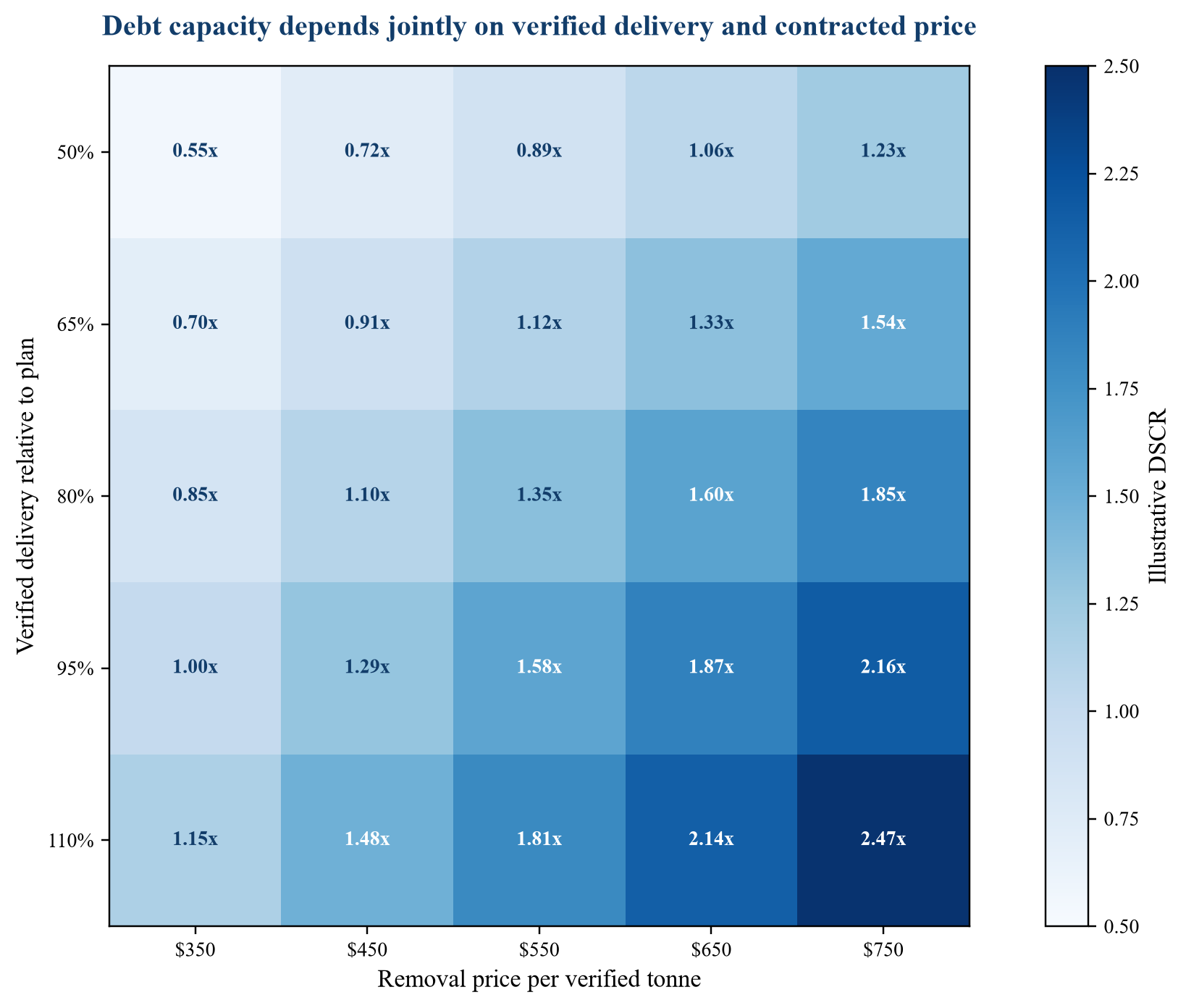
Illustrative ratios only. Inputs do not represent a market project or financing offer.
34. Risk allocation
Risk should sit with the party able to control, price or diversify it. The technology provider can support component performance. The construction contractor can support defined scope and schedule. The energy supplier can support availability. The storage operator can support injection service. Buyers can support demand and credit.
Table 3. Indicative risk-allocation matrix
| Risk | Primary owner | Supporting instrument | Financing test |
|---|---|---|---|
| Technology performance | technology provider and sponsor | warranty, test, damages, reserve | performance survives downside |
| Cost and schedule | contractor and sponsor | fixed packages, contingency, completion support | fully funded completion plan |
| Energy price and availability | project and supplier | long-term supply, index, hedge | net-removal and coverage stress |
| Storage access | storage operator and project | firm capacity, specification and remedies | aligned commencement and volume |
| Certification | project and verifier | methodology plan, audit and replacement | units remain eligible for payment |
| Buyer demand | buyer and project | offtake, prepayment, credit support | minimum revenue is enforceable |
| Policy and support | project and government programme | grant, tax opinion, covenant | expiry and clawback are modelled |
| Community and permitting | sponsor and authorities | engagement, permit plan and conditions | critical path has sufficient float |
General framework. Final allocation requires project-specific contracts and legal advice.
35. Failure and redesign
A milestone framework is valuable because it can stop or redesign a project before all capital is spent. Failure should trigger a documented root-cause review, remaining-cash protection, data preservation and a decision among cure, repeat, resize, relocate, sell or close.
Investors should agree who controls that decision and who owns technology, equipment and contracts. A failed test can create valuable evidence. Governance should prevent a sponsor from continuing solely to preserve option value with other parties' capital.
The failure plan should be written before the relevant test. It should identify safe shutdown, supplier notices, site obligations, employee retention, data capture and communications. A disorderly pause can destroy more value than the technical failure itself. Insurance and warranty notices should follow their contractual deadlines.
Redesign capital should require a fresh investment case. Management should quantify the root cause, probability of cure, additional cost, schedule, remaining runway and value after success. Sunk cost should remain outside the decision. The committee should compare cure with relocation, technology substitution and orderly closure.
Buyer communications require precision. The project should explain whether delivery is delayed, reduced or no longer feasible under the contracted methodology. It should preserve replacement and refund rights. Public statements should reflect verified facts and avoid implying successful removal before certification.
36. Replication
The first plant should produce a replication package: verified performance, standard design, supplier data, construction productivity, operating procedures, certification history and contract templates. Replication can reduce engineering and financing risk.
Site-specific elements remain. Energy, climate, water, storage, permitting and community conditions can change performance. A repeat project should identify which evidence transfers and which tests must be repeated.
The replication model should separate a standard module from the site balance of plant. Standard equipment can support factory learning, warranties and spare parts. Site systems can remain flexible around energy and storage. A controlled design authority should approve changes and preserve configuration records.
Financing can also standardise. A portfolio facility may fund eligible modules after the first plant meets performance tests. Eligibility should include site rights, energy, storage, offtake, permits and cost limits. Cross-collateralisation can diversify individual plant risk while transmitting problems across the portfolio, so release and concentration rules matter.
Learning should be measured. Management can track engineering hours, equipment cost, installation productivity, commissioning duration, availability, energy and maintenance across generations. Cost reduction should enter forecasts only when a specific design, supplier or operating improvement supports it.
37. Data room
The financing data room should include technology evidence, design basis, site rights, permits, energy, storage, construction contracts, schedule, cost report, offtake, public support, certification plan, insurance, governance and the integrated model. Documents should reconcile quantities and dates.
Version control matters because milestones change the evidence base. Every investment memorandum should reference the document versions used. Open items should have owner, deadline, capital effect and consequence.
The data room should contain an evidence index mapped to every milestone. For each test it should identify the protocol, raw data, calculation, reviewer, approval and exception. This turns diligence into a repeatable process and makes later refinancing more efficient. Missing evidence should be explicit rather than buried in narrative.
Commercial documents should reconcile price, volume, commencement, tenor, termination and credit support. Technical documents should reconcile capacity, energy, storage and schedule. The financial model should draw from a controlled assumptions register. Differences among these sources should be resolved before committee approval.
Access should follow role and confidentiality. Technology data, buyer terms and public-award information may have different restrictions. The project should retain an immutable release set for each financing decision. Later documents should not silently replace the evidence used for an earlier approval.
38. Board approval
The board should approve the financing question, milestone plan, total exposure, stop rules, evidence reviewers and authority at each gate. It should see committed and conditional capital separately. It should understand which risks remain with the sponsor.
Approval should include the downside funding requirement and liquidity runway. A project should not begin a major stage with enough cash only for the optimistic case. Funding certainty is part of completion readiness.
The board paper should distinguish project value, technology-platform value and strategic value. Project cash flow can support project debt. Platform opportunities may justify sponsor equity. Strategic benefits may matter to a partner without becoming operating-company revenue. Keeping these values separate reduces double counting.
The board should approve a communications protocol for milestones. Public awards, offtakes and construction starts can create expectations before conditions are met. Disclosure should identify the stage, conditions and uncertainty. Investor reporting should use the same definitions as the internal evidence plan.
Board oversight should continue after financial close. Quarterly reporting can cover cost to complete, critical path, milestone status, safety, community commitments, contracted revenue, storage readiness and liquidity. Exceptions should show decision, owner and funding effect.
39. Investment committee checklist
The committee should confirm that each tranche buys decision-relevant evidence, the test is independently reviewable, the remaining budget is funded and contracts align across capture, energy, storage, certification and buyers. It should challenge any milestone that measures activity rather than risk retirement.
For debt, the committee should confirm completion support, minimum revenue, buyer credit, certified-unit timing, storage capacity, reserves and covenant headroom. Merchant revenue and unawarded public support should remain outside the base case.
The committee should receive a sources-and-uses reconciliation, monthly liquidity model, milestone calendar, conditions-precedent tracker and risk-allocation schedule. It should see who can stop the project and what value remains after each stage. Any waiver should state the risk accepted and compensating protection.
The technical case should state the operating envelope and the duration of evidence. The commercial case should state which buyers are legally committed and which remain prospects. The policy case should state enacted support and unresolved eligibility. The model should not blend these evidence levels.
Final approval should name the next gate and the evidence required. This keeps the financing process cumulative. Each completed stage should make the following investment decision clearer, reduce uncertainty and improve the project's ability to attract appropriately priced capital.
40. Conclusion
Direct air capture needs capital before the first verified removal generates cash. Milestone finance provides a disciplined bridge by tying each tranche to evidence that reduces technology, site, construction, performance, storage or revenue risk. It protects scarce capital and clarifies when a project is ready for a lower-cost source of funding.
The strongest structure separates physical progress from commercial proof. Mechanical completion, captured tonnes, stored tonnes, certified units and paid deliveries are different states. Contracts and financial models should recognise each one. Buyer commitments, public support, equity and debt can then play distinct roles within one coherent capital plan.
References
- United States Department of Energy. Regional Direct Air Capture Hubs. https://www.energy.gov/oced/DACHubs
- United States Department of Energy. OCED announces up to USD 1.8 billion for transformational direct air capture technologies. 2024. https://www.energy.gov/oced/articles/oced-announces-18-billion-new-funding-transformational-direct-air-capture
- United States Department of Energy. Regional Direct Air Capture Hubs project selections. https://www.energy.gov/hgeo/project-selections-foa-2735-regional-direct-air-capture-hubs-topic-area-1-feasibility-and
- United States Department of Energy. Carbon Dioxide Removal Multi-Year Program Plan. 2025. https://www.energy.gov/sites/default/files/2025-01/Carbon%20Dioxide%20Removal%20Multi-Year%20Program%20Plan.pdf
- United States Department of Energy. Carbon Management Liftoff Report. https://liftoff.energy.gov/carbon-management/
- International Energy Agency. Direct Air Capture 2022. https://www.iea.org/reports/direct-air-capture-2022
- International Energy Agency. Unlocking the potential of direct air capture through carbon markets. 2023. https://www.iea.org/commentaries/unlocking-the-potential-of-direct-air-capture-is-scaling-up-through-carbon-markets-possible
- International Energy Agency. Driving down the cost of carbon removal. 2025. https://www.iea.org/commentaries/driving-down-the-cost-of-carbon-removal-why-innovation-matters
- International Energy Agency and GenZero. The Role of Carbon Credits in Scaling Up Innovative Clean Energy Technologies. 2024. https://www.iea.org/reports/the-role-of-carbon-credits-in-scaling-up-innovative-clean-energy-technologies
- Frontier. Request for offtake proposals. 2024. https://frontierclimate.com/assets/offtake-rfp.pdf
- Frontier. How Frontier works. https://frontierclimate.com/how-it-works
- European Union. Regulation (EU) 2024/3012 establishing a certification framework for permanent carbon removals, carbon farming and carbon storage in products. https://eur-lex.europa.eu/eli/reg/2024/3012/oj
- European Commission. Certification methodologies for carbon removals. https://climate.ec.europa.eu/areas-action/carbon-removals-and-carbon-farming/certification-methodologies_en
- European Commission. Delegated Regulation (EU) 2026/285 establishing permanent-removal methodologies. https://eur-lex.europa.eu/eli/reg_del/2026/285/oj
- Council of the European Union. Carbon removals policy and certification process. https://www.consilium.europa.eu/en/policies/carbon-removals/
- United States Internal Revenue Service. Instructions for Form 8933. 2025. https://www.irs.gov/instructions/i8933
- United States Department of Energy. Carbon Negative Shot. https://www.energy.gov/hgeo/carbon-negative-shot
- National Academies of Sciences, Engineering, and Medicine. Negative Emissions Technologies and Reliable Sequestration. https://nap.nationalacademies.org/catalog/25259/negative-emissions-technologies-and-reliable-sequestration-a-research-agenda
- Intergovernmental Panel on Climate Change. Climate Change 2022: Mitigation of Climate Change. https://www.ipcc.ch/report/ar6/wg3/
- International Organization for Standardization. ISO 14064 greenhouse gases. https://www.iso.org/standard/66453.html
- International Organization for Standardization. ISO 27914 geological storage. https://www.iso.org/standard/64148.html
- ICVCM. Core Carbon Principles. https://icvcm.org/core-carbon-principles/
- Carbon Offsetting and Reduction Scheme for International Aviation. Eligible emissions units. https://www.icao.int/environmental-protection/CORSIA/Pages/CORSIA-Emissions-Units.aspx
- World Bank. Carbon Pricing Dashboard. https://carbonpricingdashboard.worldbank.org/
About the Author
Chennakeshav (CK) is a corporate finance and investment banking executive with 25+ years of global experience in deal origination, structuring and execution across M&A, growth capital and corporate strategy. He has led value-creation mandates for founders, corporates and funds — bridging the boardroom view to hands-on execution and close.
His career spans Morgan Stanley, HSBC, Lloyds Banking Group, EWEC, ADQ portfolio companies and Emirates Growth Fund, across TMT, real estate, fintech, deeptech, cleantech, infrastructure and energy. He has partnered with C-suite leaders, private equity and venture funds, sovereign wealth funds and family offices to finance complex fund raises and scale-up ventures, and has led M&A due diligence, post-merger integration and business-transformation initiatives to create value.
At Matchpoint Partners he is Managing Partner, leading the firm's corporate finance, M&A and capital-raising practice. He holds an MBA from London Business School, an engineering degree from VTU and a Master of Laws (LLM, in progress) from UCL London.
An active start-up mentor, CK mentors at Techstars, DIFC FinTech Hive, Startup Grind, Founder Institute and IN5, serves as Entrepreneur Mentor in Residence (EMiR) at London Business School, and judges the Entrepreneurship World Cup.
LinkedIn: https://www.linkedin.com/in/ckadya/
Profile: https://www.matchpoint-partners.com/team/ck-adya.html
