
1 Start with the payable product, not the waste pile
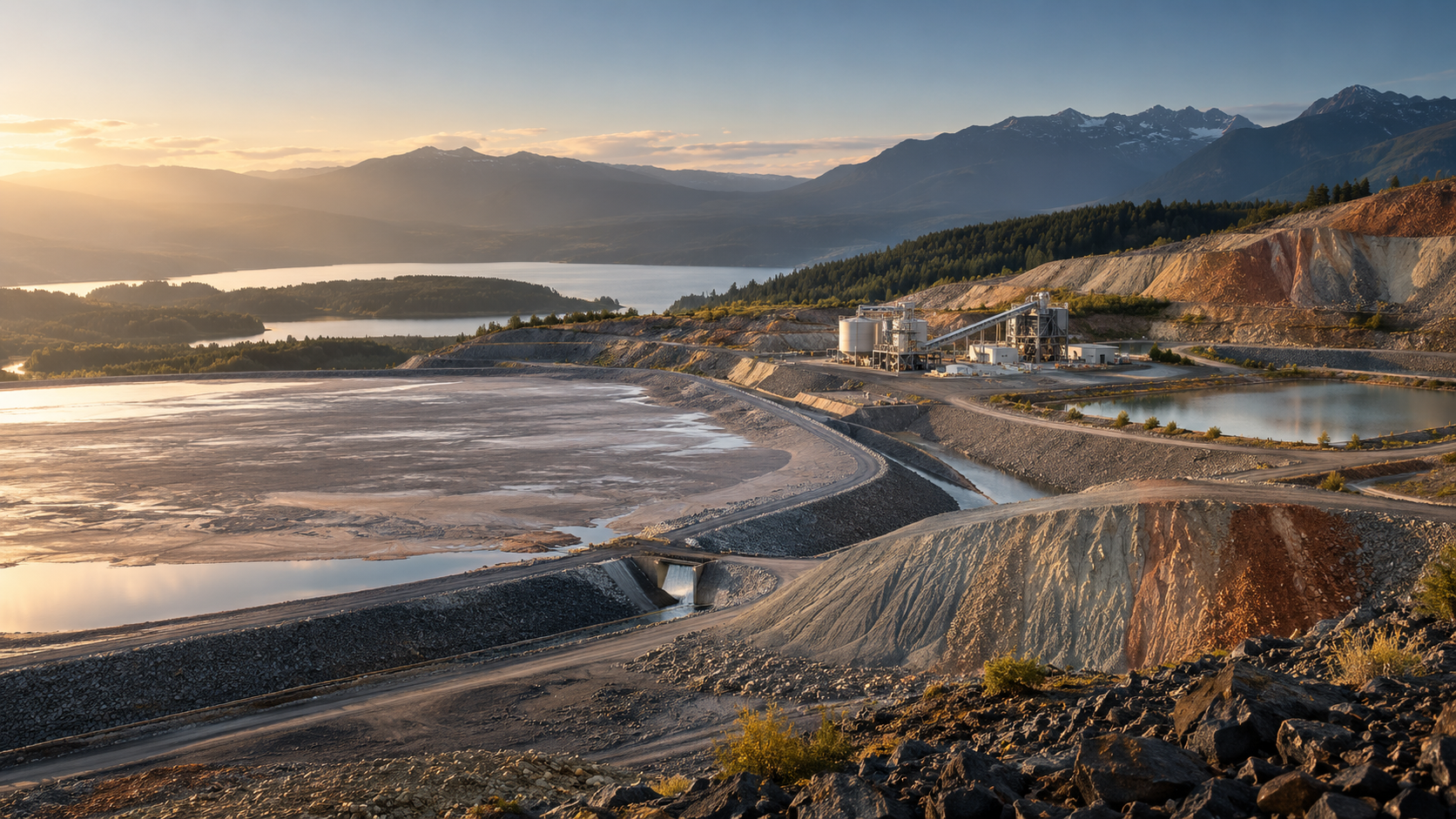
A tailings facility can look like an unusually convenient mineral deposit. The original mine has already extracted, moved and crushed the rock. Roads, power and operating records may be nearby. Historic extraction may have ignored a mineral now viewed as strategically important. These features can lower some search costs. They do not determine how much of the remaining metal can be recovered or sold. Fine particle size, oxidised surfaces, changing mineralogy, variable moisture and a difficult product specification can turn a promising assay into a costly processing problem.
The commercial question is therefore backward from the buyer: what material will an identified customer accept, in what specification, on what payment terms, after which process and at whose environmental risk? This question produces a different asset description from “tonnes of tailings multiplied by grade.” It requires a chain from physical access to payable output. A metal that remains locked in a mineral phase after a laboratory test has no revenue in the proposed process. A recovered concentrate that attracts heavy penalties or cannot be shipped under applicable rules may have much less value than a quoted refined-metal price implies.
The US Geological Survey distinguishes the presence of critical minerals in mine waste from the technical ability to extract them [2]. Its national inventory maps mine-waste features and relevant attributes, creating a starting point for investigation rather than a project-level resource or reserve [1]. The International Energy Agency identifies mine-waste reprocessing as a possible source of critical minerals and notes mapping, technology, incentives and liability questions [4]. These sources support an investigation. They do not turn a mapped waste feature into a cash flow.
An investment committee should name the proposed final product before assigning a value to the tailings. It should identify the buyer, draft specification, process route, assay protocol, recovery test, permitting path and closing conditions. Where any of these is unresolved, the project remains an option to investigate. The price of that option should reflect the probability and cost of discovering an investable project, rather than treat the whole pile as immediately saleable inventory.
2 Define the physical and legal perimeter
Tailings are not a homogeneous mineral claim. A historic site can include separate lifts, cells and episodes of deposition, each with different feed source, process chemistry and weathering history. The visible landform may contain water, soil, construction debris and areas unsafe to excavate. An active facility can serve an operating mine whose storage capacity and stability cannot be disturbed without a redesign. A legacy site may have incomplete records, unclear ownership, multiple land interests and a remediation obligation that predates the proposed recovery project.
The sponsor needs a plan-view and depth model of the material it can lawfully and safely reach. Map boundaries, volume, bulk density, moisture, deposition history, exclusion zones, impoundment structures, pipelines, seepage pathways, access roads and neighbouring receptors. Record who owns the land, tailings, contained minerals, surface access and any infrastructure; identify permits and third-party consents. A right to conduct sampling does not necessarily confer a right to remove or sell material. Contract drafting should use locally qualified counsel and avoid assuming a uniform property rule across jurisdictions.
The baseline should distinguish the facility as found from the additional effects of the recovery project. That distinction matters commercially. The project may remove hazardous material, but it may also create dust, expose reactive surfaces, change water flows or leave a new residue. Legacy liability can remain with an earlier operator, attach to land, or become disputed. The proposed sponsor needs a documented position on which costs and obligations it accepts, with financial security and access rights adequate to perform them. Environmental benefit should be measured against the actual baseline, not presumed from a circular-economy label.
The Global Industry Standard on Tailings Management addresses the entire lifecycle of a facility, including operation, monitoring, closure and post-closure [7]. IFC mining guidance likewise treats tailings and waste management as continuing engineering and environmental responsibilities [10]. These are useful diligence reference points; jurisdiction-specific legal requirements and permits must be checked separately. The acquisition perimeter should be no broader than the rights, engineering plan and risk capital can support.
3 Inventory is a search tool, not a reserve
Public datasets help locate candidate sites and understand past mining. The USGS National Mine Waste Inventory provides geospatial features and attributes for the United States [1]. Such a feature is evidence that a mine-waste location has been identified under the dataset's methods. It does not establish tonnage available for rehandling, average grade, mineralogical form, processing recovery, economic cut-off or title. Those questions require site-specific evidence.
The distinction matters when published studies report a possible contained-metal endowment. The USGS Four Corners assessment, for example, examines mine waste as a potential source of commodities under stated data and estimation assumptions [11]. A contained endowment is a mass-balance concept. It is not the tonnage of saleable product and does not include all technical, commercial or legal deductions. An analyst should retain the study's uncertainty and scope when using it to prioritise sites. Converting a regional total directly into a project valuation would mix unlike quantities.
A useful first-pass screen has three columns. The first records observed or reported facts: facility location, historic operation, available assays, maps, permits and visible infrastructure. The second records unanswered questions: accessibility, grade variability, mineral hosts, competing liabilities and product route. The third specifies the cheapest test that could resolve each question. This screen prevents a public map from becoming an implicit resource statement. It also directs early funds to uncertainty reduction rather than immediate plant design.
The investor should request original sampling protocols, laboratory certificates and chain-of-custody records for any historical grade claim. A single high-grade composite may describe a deliberately selected sample. It may also represent one layer or one process campaign. Its relevance to a four-year feed plan depends on the distribution of grade and the ability to mine and blend the material. A credible tonnage-and-grade model requires spatial coverage, bulk-density and moisture estimates, and an independent check of the feed that can actually be delivered to the plant.
4 Sample for recoverability and variability
Sampling design begins with the commercial unit: dry tonnes of feed that can be recovered at a stated rate and supplied consistently. The USGS has published protocols for sampling hard-rock mine waste, including documented field information and laboratory analysis [3]. That guidance helps design a repeatable programme; the precise grid, depth, composite strategy and analytical methods still depend on the site's depositional history and proposed process. A consultant should document why each sample represents a part of the facility and which material remains unsampled.
Grade is necessary but insufficient. Mineralogical work should determine the host phase, liberation size, oxidation state, harmful constituents and likely behaviour in a candidate circuit. Testwork should report mass balance across feed, concentrate, solution and residue, including impurities and water use. Bench recovery at one selected grade should not be silently applied to every cell. The sampling and test programme should cover low-grade, high-grade and contaminated domains, with a blend schedule that resembles the intended operation. Hold back samples for an independent laboratory where the decision warrants it.
The sampling plan must also characterise environmental behaviour. Rehandling can expose material to oxygen and water, change leachate quality and disturb a containment structure. Measure baseline water, dust and stability conditions before intervention. Compare proposed new residue with the original material rather than assume it is less harmful. A technically attractive metal recovery that transfers more risk to water treatment or closure may reduce total project value.
The first capital gate should purchase a representative dataset and a credible process hypothesis, not a headline recovery percentage. Deliverables include a facility model, analytical quality-control report, mineralogical map, preliminary material and water balance, health-and-safety plan, and a ranked set of feasible process routes. A negative result can still be a valuable outcome if it prevents expenditure on an unsuitable plant.
Table 1. Evidence that must survive each conversion from mine waste to cash
| Quantity or right | Evidence to obtain | Main failure if assumed | Decision supported |
|---|---|---|---|
| Accessible dry feed | Survey, density, moisture, stability and access plan | Visible volume cannot be safely or legally rehandled | Sample or stop |
| Representative grade | Spatial sampling, assays and independent checks | High-grade samples overstate blended feed | Pilot scope |
| Recoverable metal | Mineralogy, mass balance and repeat pilot runs | Metal remains locked or recovery varies by cell | Process design |
| Payable product | Buyer specification, impurities, logistics and offtake terms | Recovered material is discounted or rejected | Revenue model |
| Net distributable cash | Capex, opex, taxes, water, closure and rights ledger | Legacy and incremental costs absorb receipts | Financing decision |
Author-developed diligence framework; no row states that a candidate site has passed the test.
5 Choose a process route by full residue and water balance
Possible recovery routes include physical separation, flotation, hydrometallurgy, bioleaching or a combination. Their suitability is determined by mineral hosts and the product the market will buy. The International Energy Agency's critical-minerals research highlights innovation in processing and refining, while also recognising that technologies must be scaled and diversified commercially [5]. A laboratory extraction result is a process lead, not a plant guarantee. Moving to continuous operation changes residence time, reagent recovery, impurity build-up, energy use and residue handling.
The process comparison should use one reconciled mass balance. For every dry tonne fed, record metal in feed, metal to product, metal in intermediate streams, metal to residue and analytical closure error. Add the water balance and reagent inventory. This forces the design team to show what happens to unwanted material. If a route consumes large amounts of fresh water, produces a difficult residue or requires a concentrated chemical supply chain, those costs belong in the same investment comparison as recovery. A product with a higher metallurgical yield can be commercially inferior after treatment charges and environmental management.
A pilot should operate long enough to test feed variability and recycling of process water. It should produce enough product for an independent buyer to assess specification and contaminants. The trial should record availability, throughput, energy, labour, consumables, maintenance, effluent and residue composition. It should also define scale-up risks that cannot yet be resolved. An investable engineering package uses measured pilot inputs, conservative ranges where evidence remains thin, and a design allowance for start-up and ramp-up. It does not import commodity forecasts to compensate for uncertain recovery.
The US Department of Energy's Rare Earth Elements Demonstration Facility programme supports demonstration of recovery and processing from waste and other unconventional feedstocks [8]. Its existence underlines the importance of commercial-scale proof. A public demonstration award is evidence that a technology pathway merits testing under that programme; it is not evidence that a different tailings site can repay project debt. An independent engineer should connect pilot results to the exact site, feed and product proposal before financing terms are set.
6 Separate recovered metal from payable metal
The value bridge has at least five steps. Accessible dry feed multiplied by representative grade yields contained metal in the proposed feed. Multiplying by process recovery yields metal reporting to an output stream. Adjusting for product specification, penalties, moisture, transportation, treatment and commercial settlement yields the payable quantity and net realised price. Cash receipts then meet rehandling, processing, site management, capital and closure costs. Each step can change materially with the feed blend or offtake agreement.
A purchaser may buy a mixed concentrate rather than a refined commodity. The headline exchange price of the pure metal is then an unsuitable revenue input without explicit payability and deductions. A producer may also need a toll processor, export route or domestic separation facility. The capacity, credit quality and permitted status of that route affect financing. An offtake term sheet should identify the form of product, assay and dispute procedure, acceptance bands, minimum volume, pricing basis, deductions, delivery point and payment security. A verbal expression of interest should not be modelled as binding revenue.
The same separation protects against double counting. A portfolio investor might value the metal recovery and a possible remediation service fee. Both may be real in a negotiated contract. They should enter the model only after the obligations, payer, performance measurement and collection risk are specified. Avoid assuming that removing tailings automatically produces a carbon credit, a waste-management payment or release from historic liability. Those outcomes require applicable rules and enforceable agreements.
Management should review a reconciled volume-to-cash waterfall every month in a producing project. Differences between sampled grade, plant head grade, recovered metal and paid invoices reveal losses that a single “recovery” figure hides. Before production, the same waterfall is a scenario model. The investment committee should see ranges for each conversion separately so that a robust plant circuit cannot mask an uncertain buyer or a well-priced offtake cannot mask an unsafe feed plan.
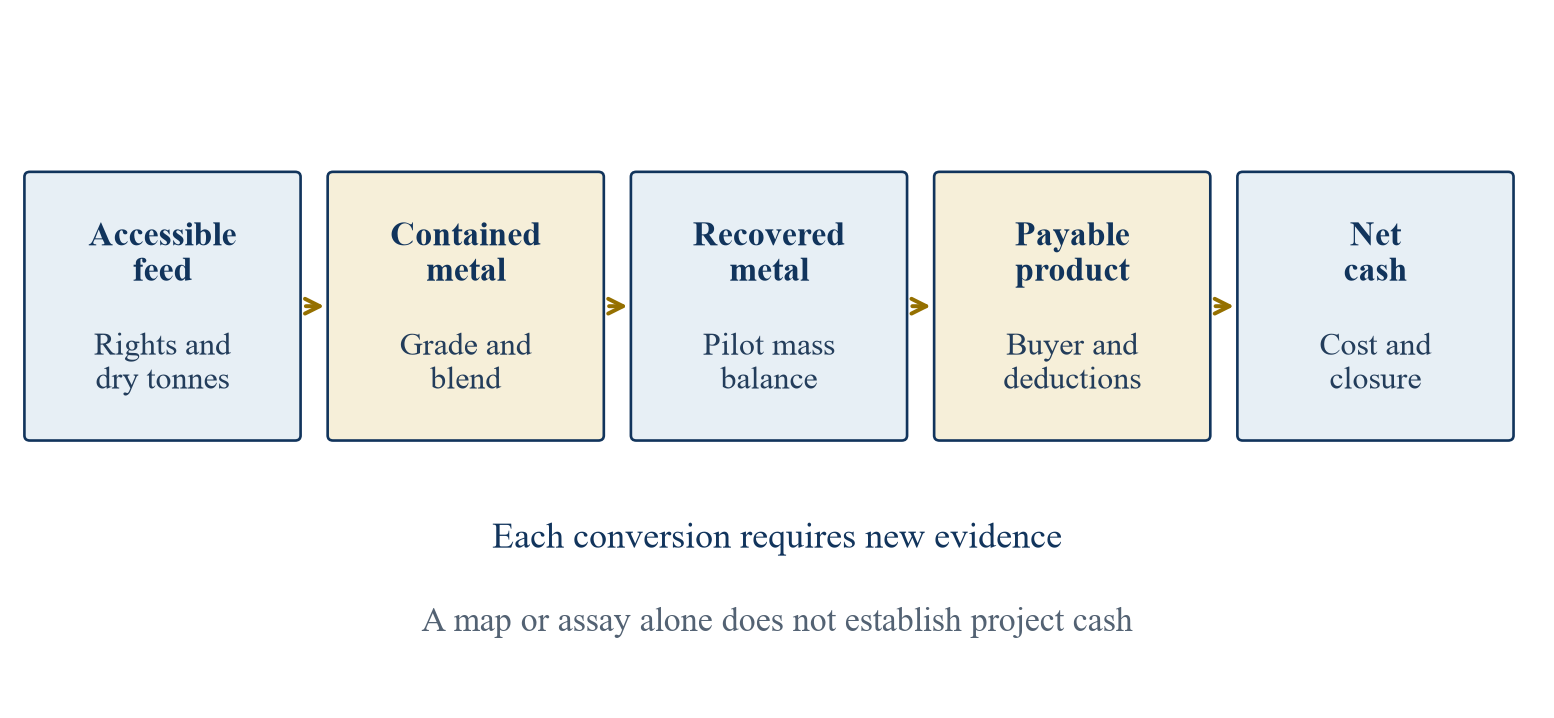
The diagram identifies separate proof points; it does not represent measured performance at a particular site.
7 Treat tailings engineering as part of the asset
Reprocessing changes a facility. Material removal can alter slope geometry, pore pressures and drainage. New pumps, pipelines, stockpiles or residue cells can change the risk perimeter. A finance model should carry design, monitoring and contingency costs for the entire intervention, including the period after metal production. The Global Industry Standard on Tailings Management requires attention to governance, affected people, technical design, monitoring and disclosure across the facility lifecycle [7]. IFC guidance likewise provides environmental, health and safety considerations for mining operations [10]. Their application should be interpreted by qualified specialists alongside local law and site permits.
A due-diligence team needs a baseline stability assessment and a rehandling sequence signed off by competent engineers. It should identify the conditions under which excavation stops: movement, seepage, water level, dust or process-water excursions. The plan should describe where processed residue goes and whether the facility's existing closure concept remains valid. Insurance, bonding and reserve accounts need to match the obligations the project actually takes. If legacy and new material share a structure, the contract should state how monitoring, data access, maintenance and incident responsibility are coordinated.
Community effects also belong in the asset model. A project can create local work and reduce a waste footprint, while also bringing traffic, noise, water abstraction or disturbance to a closed mine. Consultation, land access and grievance processes can affect schedule and cost. Public acceptance cannot be inferred from the fact that a mine previously operated. The sponsor should provide an understandable plan for the site after processing and the source of funds to maintain it.
The strongest project may be one where recovery and remediation are deliberately integrated. Even there, two separate performance claims must be measured: saleable mineral output and environmental improvement against a credible baseline. Financing documents should specify the test and responsible party for each. This prevents a buyer of concentrate, a remediation counterparty and a lender from relying on different definitions of success.
8 Allocate old and new environmental obligations explicitly
A legacy facility can carry obligations that arose before a proposed mineral-recovery project. The investor needs a rights-and-liabilities ledger that identifies the owner, operator, regulator, historical permits, known conditions, active monitoring and financial assurance. It should distinguish the cost of maintaining the site without the project from the cost caused by reprocessing. A contract can allocate financial responsibility between parties; it cannot erase statutory obligations or prevent third-party claims by itself. Local counsel and environmental engineers must test the proposed allocation against the actual jurisdiction and site.
This distinction affects valuation. If the buyer assumes all unknown historical remediation cost in exchange for mineral rights, an attractive concentrate margin may be insufficient compensation. If the original operator remains responsible for legacy pollution, the new operator still needs access, coordination, incident rules and proof that its works do not aggravate the condition. Funds reserved for post-closure monitoring should be based on a costed engineering plan. A generic percentage of revenue can understate a long-lived water-treatment obligation.
The US Environmental Protection Agency's abandoned-hardrock-mine Good Samaritan programme illustrates how carefully a limited-liability mechanism must be defined [9]. It operates under specific permitting and eligibility conditions in the United States. It is not a universal release for a commercial reprocessor, and it says nothing about the law in another country. The EU Critical Raw Materials Act separately asks covered operators to assess whether critical raw materials can be recovered from extractive waste under its specified procedures [6]. An assessment requirement is neither a project permit nor a finding that recovery is economical.
For transaction purposes, diligence should attach a site condition report, permit matrix, liability allocation, indemnity limitations, security package, environmental insurance review and a funded closure plan. The committee should price residual uncertainty and require a walk-away right where it cannot be bounded. Treating environmental performance as an engineering deliverable improves the odds of a durable operating licence and a financeable asset.
9 Build the offtake before scaling the plant
For an unconventional feed, an identified buyer is as important as an identified mineral. The product may contain a marketable metal alongside elements that trigger penalties or restrict transport. The sponsor should obtain specifications from multiple potential customers where feasible, including assay method, payable basis, impurity limits, blending rights, volume tolerance, delivery point and rejection process. A technically recovered material that no buyer can process at acceptable cost is inventory, not cash.
Commercial testing should begin before a final plant design. Small product lots can be sent to independent laboratories and candidate processors. The resulting feedback can determine whether the project needs a different circuit, extra purification or a different target metal. The capital model should reflect those changes, including working capital and payment delay. If only one processor can accept the product, that dependency belongs in the counterparty-risk analysis and the contract should address capacity reservation and termination.
Offtake discussions must distinguish interest from commitment. A buyer may issue a nonbinding letter pending pilot output, plant completion or regulatory permission. That letter can help define the development work. It should not be converted into a full-price, full-volume assumption in the debt case. A financeable arrangement needs a specified product, performance obligations, credit support where necessary, enforceable remedies and a credible route to delivery. A lender may require independent sampling and laboratory procedures so that the underlying cash receipts can be audited.
The commercial team should also test whether the product competes with established mines, recycling or another waste source. Critical-mineral designation can indicate strategic interest; it does not establish a premium to the quoted commodity price. Net realised price is a contract and logistics outcome. The model should show the contractual formula and a conservative sensitivity, with taxes and royalties assessed separately under applicable law.
10 Place the project in its policy and market context
Critical-mineral policy has increased attention to domestic supply chains, alternative feedstocks and processing capacity. The IEA's recycling analysis includes mine-waste reprocessing as a potential source of supply, while noting the need for mapping, technological development, incentives and solutions for legacy liability [4]. Its outlook on mining and refining innovation describes pathways to diversify supply and the challenges of bringing new processes to scale [5]. Those are reasons to investigate. They are not a substitute for a customer contract or a site-level price forecast.
The EU Critical Raw Materials Act creates a specific assessment framework for extractive waste. Article 27 addresses preliminary economic assessments by covered operators, including quantities, concentrations and technical and economic recoverability [6]. Compliance and timing depend on the operator and facility. The commercial implication is that more structured data may become available and that rights holders may need a disciplined screening process. A sponsor still needs permits, sampling and engineering evidence for a particular project. A legal assessment should be obtained before presenting a compliance route to investors.
Public demonstration finance can lower the private cost of testing a novel process, but grant eligibility is conditional and programmes have their own objectives. The US DOE demonstration initiative for rare earth elements from unconventional feedstocks is an example of a public mechanism aimed at technological validation [8]. A grant should enter a base case only after award terms, eligible expenditure and cash timing are verified. A project that needs an uncertain grant to repay ordinary debt should be described as grant-dependent, with a funded alternative or a delayed investment decision.
The investor should therefore separate three markets: the market for the final mineral product, the market for processing technology, and any market for remediation services. They have different customers, contracting terms and evidence burdens. A single narrative about strategic minerals can obscure which of these actually pays the project. The capital stack should be built around the verified payer and the risk it can bear.
11 Model a fictional project with the full conversion chain
The following cobalt-bearing tailings case is entirely fictional. Its purpose is to show how a contained-metal headline can diverge from project cash. All quantities, prices, costs, timings and recovery factors are author assumptions. They are not site data, market benchmarks, engineering estimates or a forecast. The case assumes 1.0 million accessible dry tonnes processed over four years at 250,000 tonnes per year. The blended cobalt grade is assumed to be 0.10%, yielding 250 tonnes of contained cobalt each year. A 65% process recovery yields 162.5 tonnes in output; a 90% payability factor leaves 146.25 payable tonnes.
At an assumed net realised price of USD 30,000 per payable tonne, annual receipts are USD 4.3875 million. Assumed processing and rehandling costs of USD 11 per feed tonne total USD 2.75 million per year. Water and waste management cost USD 0.45 million and fixed site cost USD 0.25 million per year. The resulting annual operating cash before tax is USD 0.9375 million. The example then assumes initial capital spending of USD 3.0 million and an additional USD 0.5 million closure payment at the end of year four. It uses a 10% annual discount rate, no salvage, no tax, no debt, no royalties and no ramp-up. These omissions make it a transparent teaching model, not a bankable valuation.
The four-year annuity factor at 10% is 3.1699. Discounted operating cash is about USD 2.9717 million. Subtracting initial capital and the discounted closure payment produces an illustrative net present value of approximately negative USD 0.370 million. The project is economically weak under these assumptions despite one million tonnes of feed and 1,000 tonnes of contained cobalt over its life. The result turns on recovery, payability, product price, operating cost, capital and closure. Each requires site-specific evidence before any investment conclusion.
Table 2. Fictional cobalt-bearing tailings case, author assumptions only
| Model line | Author assumption or calculation | Annual or project result |
|---|---|---|
| Accessible dry feed | 1,000,000 tonnes over four years | 250,000 tonnes per year |
| Blended cobalt grade | 0.10% of dry feed | 250 contained tonnes per year |
| Process recovery | 65% of contained cobalt | 162.5 recovered tonnes per year |
| Product payability | 90% of recovered cobalt | 146.25 payable tonnes per year |
| Net realised price | USD 30,000 per payable tonne | USD 4.3875 million receipts per year |
| Rehandling and processing | USD 11 per feed tonne | USD 2.75 million cost per year |
| Water, waste and fixed site cost | USD 0.45m plus USD 0.25m | USD 0.70 million cost per year |
| Operating cash before tax | Receipts less stated annual costs | USD 0.9375 million per year |
| Initial capital and closure | USD 3.0m at start; USD 0.5m at end of year four | 10% discount rate |
| Illustrative project NPV | Four annual cash flows less capital and discounted closure | Negative USD 0.370 million |
USD figures are millions unless stated. There is no observed site, transaction, price quote or technical performance behind this example. Figures may not sum exactly because of rounding.
12 Use sensitivities to find the evidence worth buying
The fictional case allows a simple threshold test. With every other assumption held constant, recovery needs to reach about 66.73% for net present value to break even at a 10% discount rate. At 75% recovery, annual payable metal rises to 168.75 tonnes; annual operating cash rises to USD 1.6125 million; and illustrative net present value rises to about positive USD 1.770 million. This is a one-variable sensitivity, not evidence that the higher recovery can be achieved at unchanged cost or quality. A real process improvement might require extra reagents, more energy, purification, capital or a different residue plan.
The threshold shows why a representative pilot is worth paying for before plant construction. The difference between 65% and 66.73% recovery is small relative to the uncertainty often present in early bench work. A lender should therefore demand a margin above modeled break-even, supported by tests across feed domains and operating conditions. A point estimate that barely clears a spreadsheet hurdle gives little protection against delays, moisture, grade dilution or product penalties. The investment committee should examine a joint downside in which several adverse variables move together.
Capital and operating costs need equivalent scrutiny. An additional USD 1 million of initial capital reduces illustrative net present value by exactly USD 1 million in the simple case. A USD 1 per tonne increase in annual rehandling or processing cost reduces annual cash by USD 0.25 million and illustrative net present value by about USD 0.792 million before tax. These arithmetic results are specific to the fictional four-year model. They identify diligence priorities: verify feed logistics, pilot-scale consumption, engineering scope and closure design rather than rely on a broad critical-minerals narrative.
The price sensitivity should use the actual planned product. A refined-metal reference price cannot replace the net realised price of an impure concentrate. The commercial team can test a price deck, but should disclose how each scenario maps to payability, treatment charges and shipping. The model should remain auditable from tonnes through invoices. This is the bridge between geological investigation and a financeable cash flow.
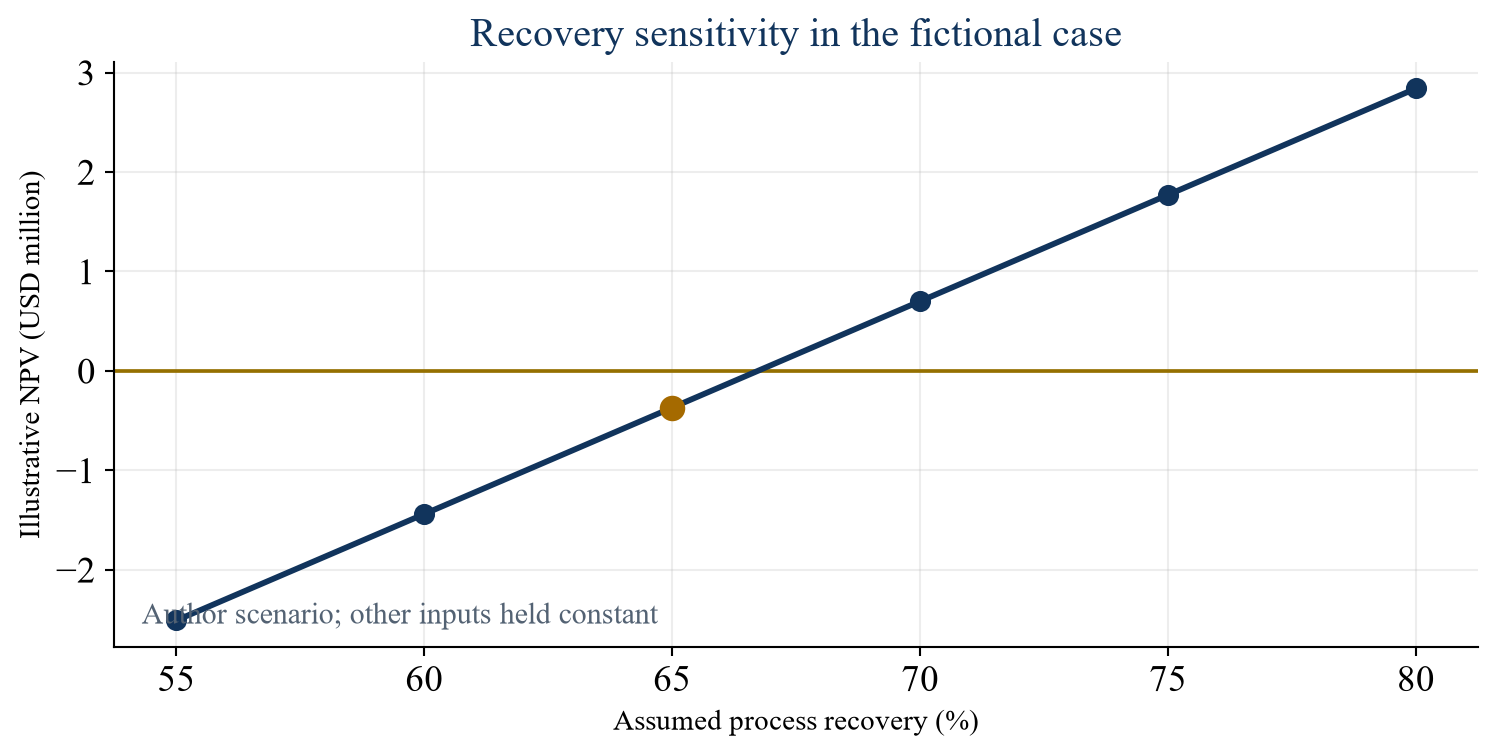
All other fictional inputs are held constant; this is arithmetic sensitivity, not a field performance claim or forecast.
13 Translate uncertainty into a capital sequence
The first expenditure should answer whether the investor has a credible option at all. That gate covers rights, available records, safety, legacy conditions and a target product hypothesis. The second funds representative sampling, mineralogy and bench tests. The third supports a pilot, product qualification, engineering and permit path. Only the fourth should commit to a full plant, substantial reclamation works or long-term project debt. Each gate requires a defined deliverable, cost ceiling, independent reviewer and decision date.
A staged approach can improve negotiation. A tailings owner may grant an exclusive evaluation option with access and sampling rights, then a development right after objective tests. The investor can avoid buying unknown liabilities before the material is understood. The owner can retain a negotiated share of verified value. The option agreement should cover data ownership, sample disposition, confidentiality, exclusivity duration, restoration after testing and what happens if a regulatory path is unavailable. The legal form will vary by jurisdiction.
Capital sources should match the maturity of evidence. Early studies and pilot work carry technology and site risk; ordinary project debt may be unavailable or expensive. Equity, strategic capital, equipment partnerships and eligible public demonstration funding may be more appropriate at this stage. Once rights, technical performance, permitted engineering and offtake are substantially proven, lenders can evaluate a forecast cash flow, security, covenants and contingency. A financing structure should not force debt-service certainty onto an unresolved metallurgical experiment.
The sponsor should maintain a live evidence register. For each assumption in the model, record the source, date, owner, independent reviewer, uncertainty range and next test. A board can then see whether additional funds purchase information likely to change the investment decision. This is more useful than an aggregate “project confidence” score, which can hide a single fatal weakness such as unavailable water rights or an unacceptable residue.
14 Make permitting and schedule part of valuation
The project schedule begins before construction. Sampling, disturbance, water use, waste transport, process chemicals, new residue management and closure may each require approvals. The existing mine permit may not cover a new operator or a different process. A brownfield location can have advantages, but it can also have inherited restrictions and public concerns. The sponsor should build a permit matrix with the responsible authority, legal basis, studies, consultation, decision points and appeal risk. Counsel and engineering advisers should confirm that matrix for the particular site.
The EU assessment framework in Article 27 of Regulation (EU) 2024/1252 is relevant to covered EU facilities [6]. It does not grant automatic permission to reprocess waste. Likewise, the EPA's Good Samaritan framework applies to defined US remediation circumstances [9]. A project in another geography requires its own legal and technical pathway. The paper deliberately makes no claim that a programme or permit applies to a fictional case.
Schedule affects financial returns. A delayed permit can extend option fees, monitoring and development-team cost; it can also move the first product sale into a different market environment. A lender should test whether site rights survive delay and whether the proposed technology remains supported by suppliers. The model should identify decision points at which the sponsor can pause rather than continue accumulating sunk costs. Contingency for engineering and consultation should be visible, with no assumption that public strategic interest shortens legal review.
In investment committee materials, present a baseline schedule and a downside schedule tied to specific conditions. The conditions might include supplemental sampling, a redesigned water circuit, longer product qualification or a residue-storage redesign. These are project actions, not abstract percentages. Their cash impact should be modelled alongside technical sensitivity so that the capital provider sees the cost of obtaining permission and establishing sustained operation.
15 Structure the transaction around distinct risks
The asset owner, technology provider, plant operator, product buyer, lender and environmental counterparty bear different risks. An integrated sponsor may control several roles, but the contracts should still make each obligation visible. The asset owner can grant feedstock and site access rights. The technology provider can warrant specified pilot deliverables and supply support. The plant operator can accept availability and operating standards within tested limits. The buyer can commit to product that meets a defined specification. The lender can fund against documented contracts, reserves and security. Environmental responsibility needs its own allocation and monitoring procedure.
Pricing the tailings as a simple percentage of contained metal can overpay the owner before recovery and closure liabilities are understood. Alternative structures include a modest evaluation payment, staged option fees, reimbursement of defined site services, and a royalty linked to actual paid product. Each has tax, accounting and legal consequences requiring professional advice. Any royalty should clarify deductions, audit rights, related-party sales, minimum operations and abandonment. The owner may reasonably seek protection against a sponsor that ties up the asset without advancing the project; the investor needs the right to stop when evidence is adverse.
The technology contract should avoid promising a recovery number measured on a different feed. It can instead specify a pilot protocol, minimum test duration, representative samples, measurement and dispute methods, and the conditions under which a commercial performance guarantee is offered. The operator needs clear boundaries for feed grade, particle size, water quality and contaminants. If the site cannot provide feed within the design envelope, both parties should know who pays for a change. A bankability review should test these interfaces rather than count the number of signed contracts.
M&A diligence should examine whether rights and liabilities transfer with the target company or sit in separate land, operating and environmental arrangements. Security over plant may be weak if the sponsor cannot enter the site after default. Data, samples and permits can be as important to enforcement as equipment. The transaction structure should allow a replacement operator and preserve the evidence needed to manage the facility safely. These are commercial design questions to resolve before a headline acquisition price is agreed.
16 Require an independent technical evidence package
An independent review should examine the exact model assumptions that generate revenue and liability. This includes accessible feed volume, grade domains, sampling representativeness, mineral hosts, pilot recovery across feed blends, product quality, plant availability, water and residue balances, stability, permitting and closure cost. The reviewer should distinguish measurements from estimates and estimates from management targets. A high-grade laboratory result cannot substitute for a continuous pilot; an offtake discussion cannot substitute for a binding price mechanism.
The package should preserve raw data, sample locations, lab certificates, analytical quality control, chain of custody, process logs and model versions. A buyer, lender or insurer can then reproduce material balances and test downside cases. Where earlier records are incomplete, a fresh baseline may be needed. The investment committee should be told which missing data could change the decision. An independent engineer's role is to challenge the assumptions, not merely reproduce a sponsor slide deck.
The technical report should also identify unresolved operational interfaces. For example, an active mine may need to keep using the tailings facility while the reprocessor excavates an older cell. A pilot may rely on an offsite water source unavailable to the full plant. A concentrate may meet a laboratory specification but require a permitted shipping route. These interfaces can be fatal even when chemical recovery looks attractive. A final investment decision should be conditioned on evidence that the operating system works as a whole.
Public research can inform the questions but not answer them for a particular site. The USGS work on mine-waste recovery highlights the role of mineral hosts and extractability [12]. A lender still needs a site-specific dataset and engineering conclusion. The report should therefore cite public sources for general methods and keep project claims tied to qualified measurements and contracts.
17 Consider portfolio development without hiding site risk
A sponsor may screen many waste sites and build a common process platform. Portfolio scale can spread specialist staff, laboratories and market access. It can also create false comfort if one circuit is assumed to fit different mineralogies. Each facility needs its own rights, feed model, environmental baseline and pilot acceptance. A shared process should be treated as a hypothesis to test across representative sites. The plant may have a portable module, yet each new location still carries local permitting, water, transport and community conditions.
A portfolio can be sequenced by option value rather than contained-metal size. Prioritise sites where rights are clear, records are usable, independent testing is affordable, buyer specifications are attainable and obligations can be bounded. A large but unstable facility with unclear ownership may consume more development capital than a smaller accessible site. Portfolio investment should track cash spent to eliminate uncertainty and the number of projects that pass each gate. A single successful pilot should not be used to value all remaining sites as ready for construction.
Shared infrastructure can improve economics after feasibility. A central refining partner, common assay lab, mobile equipment fleet or standardised data room may reduce repeat costs. Those savings need contracts and logistics evidence. Moving wet tailings long distances can be expensive; a hub-and-spoke design should compare transport of feed, intermediate product and finished concentrate. It should also assess the environmental footprint of those movements. The lowest theoretical process cost may not be the lowest delivered-product cost.
Portfolio financing can separate platform and project risks. Early equity can fund screening and pilots. A later project vehicle can hold verified site rights, contracts and permits. A central technology company can license a demonstrated process without imposing all site liabilities on other assets. The structure should be designed with counsel and lenders; it should not be assumed that legal separation eliminates cross-liability or reputational exposure after an incident.
18 Build a monitorable operating dashboard
If a project proceeds, operational reporting should follow the same conversion chain used in diligence. Report tonnes excavated and processed, feed moisture, blend and grade, metal in each stream, recovery, product quality, accepted and paid volumes, water balance, residue characteristics and environmental trigger events. Reconcile mass across the plant and cash to customer invoices. Record downtime by cause. This gives management an early warning when the project moves away from the pilot case.
The dashboard should show safety and environmental conditions beside production. Tailings movement, pore pressure, seepage, dust, water quality and complaints may define a safe operating envelope. If a trigger is breached, the agreed response can include inspection, reduced throughput or a stop to excavation. A finance covenant tied only to product volume can create a perverse incentive to continue operating through a stability warning. Lenders and owners should receive a defined incident-notification protocol and access to independent review.
Monthly financial reporting should distinguish price movement from plant performance. A lower receipt may arise from lower grade, poor recovery, an impurity penalty, a disputed assay, transport cost or buyer payment delay. The remedy differs in each case. Working capital should track concentrate inventory and receivables. Closure reserves should be funded according to the approved plan, with changes reflected in the model when engineering evidence changes. This is how a static investment case becomes a controlled operating asset.
Data rights matter over the full life. Raw assays, model changes, monitoring data and environmental records may need to be transferred if the operator changes or the project is sold. Contracts should ensure continuity, confidentiality and regulator access where required. A platform that cannot provide the evidence behind its recovery and environmental claims will struggle to refinance or sell, regardless of how attractive its headline metal content appears.
19 Select a decision rule that can reject an attractive story
The committee should write a falsifiable investment test. First, the sponsor must show enforceable rights and a bounded liability perimeter. Second, representative sampling and independent mineralogy must support a feed plan. Third, a pilot must demonstrate recovery, product quality and residue management across relevant blends. Fourth, engineering, permits and offtake must support a downside case with adequate contingency and closure funding. Failure at any gate leads to redesign, a smaller study or exit.
The test should name the expected decision before each study. More data are not always worth their cost. If a site lacks a lawful route to excavate, an expensive recovery pilot may not change the investment outcome. If the only buyer has rejected the product impurity profile, another resource estimate may be less useful than a purification test. The decision value of information depends on whether the new result can alter the proposed capital action. A gate memo should record its cost, alternatives, remaining uncertainties and the amount of capital exposed if the committee proceeds.
Use downside cases that combine plausible technical and commercial weaknesses. Lower grade can reduce output while higher reagent use raises cost. A difficult feed domain may also worsen residue handling and delay permitting. Single-variable charts are useful for locating thresholds; combined scenarios reveal whether the financing plan can absorb interacting risks. In the fictional case, a small recovery improvement crosses the arithmetic break-even line. That narrow margin would not by itself justify funding a plant. The project would need measured headroom and contractual support.
The decision rule is deliberately strict because a tailings project can appear to offer two forms of value: critical-mineral supply and waste reduction. Both require proof. Rejecting a weak site preserves capital for a stronger one and avoids creating a new environmental obligation in pursuit of an unverified product. The framework is useful to owners seeking partners, investors considering acquisitions, lenders reviewing debt, and public bodies evaluating demonstration support.
Table 3. Author-developed staged implementation and financing roadmap
| Gate | Capital use | Required evidence | Decision |
|---|---|---|---|
| 0: Rights and baseline | Legal, site and environmental screen | Access, title, facility condition, initial product hypothesis | Option, redesign or exit |
| 1: Representative feed | Survey, sampling, mineralogy and bench tests | Feed domains, quality control, candidate route and baseline | Fund pilot or stop |
| 2: Pilot and customer | Continuous pilot, product lots and engineering | Mass and water balance, buyer feedback, residue route and capex range | Develop permitted project or redesign |
| 3: Finance and build | Final engineering, permits, offtake and security | Downside case, enforceable contracts, closure funding and independent review | Commit construction capital or decline |
| 4: Operate and close | Monitoring, working capital and closure reserve | Reconciled output, paid invoices, safe facility and funded closure | Continue, adjust or shut down safely |
Timing and budget are site-specific; this table defines evidence and decision rights rather than a forecast.
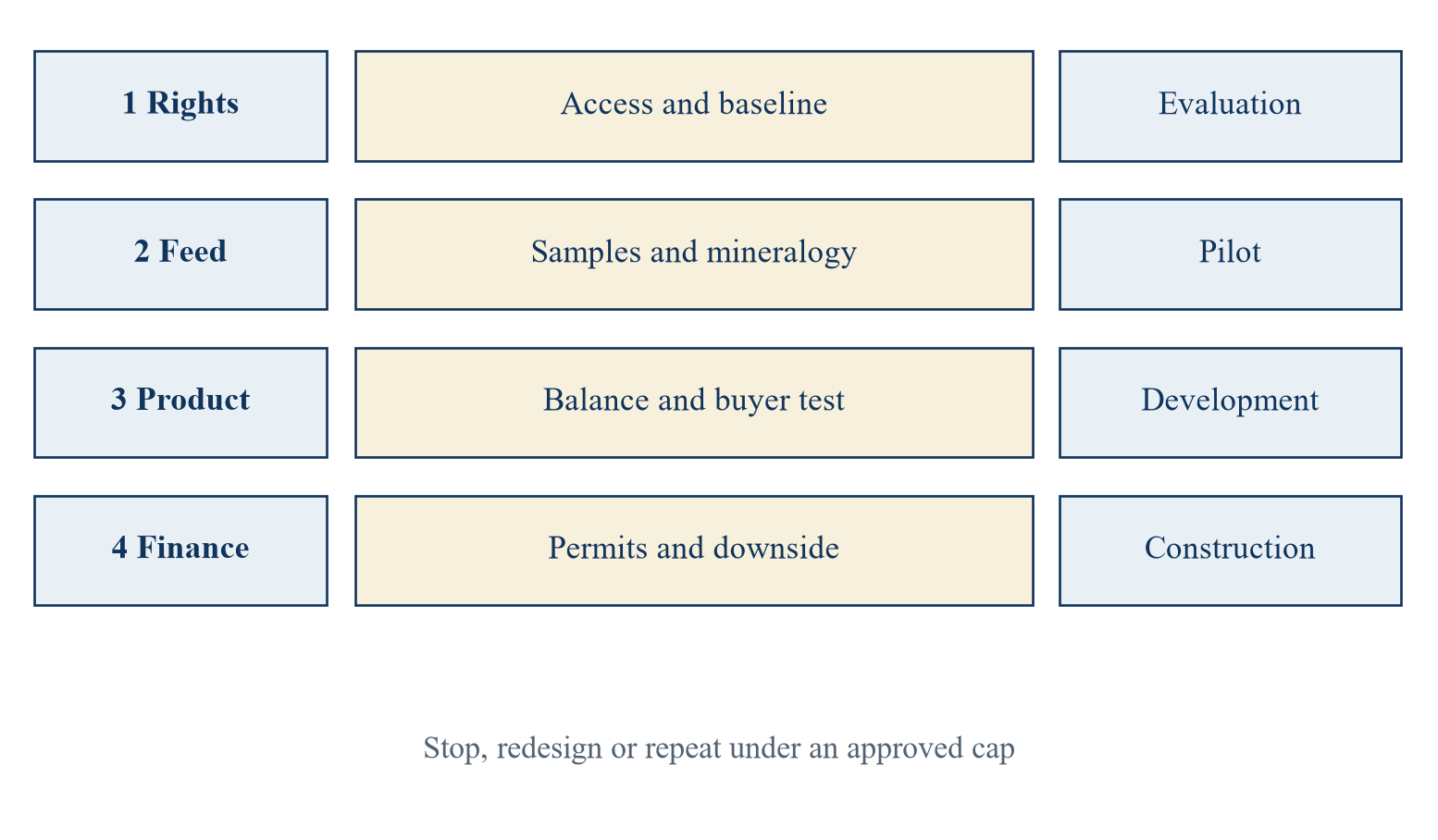
The route is a governance sequence; it implies no outcome, duration or approval for a specific facility.
20 Limitations and avenues for further work
This paper is a commercial framework, not a site assessment. It does not estimate a mineral resource or reserve, characterise any actual waste facility, select a process, assess environmental compliance, forecast commodity prices or recommend a transaction. The fictional cobalt case omits taxes, royalties, financing, working capital, ramp-up, inflation and many engineering contingencies to isolate the conversion from contained metal to cash. A real decision requires qualified technical, legal, environmental, tax and financial advisers working from verified site data.
Published inventories and policy reports have different purposes from project diligence. The USGS inventory identifies mapped features [1]. USGS sampling and recovery research describes methods and opportunities [2, 3, 12]. The IEA and EU sources describe supply and policy context [4, 5, 6]. Tailings and mining guidance identifies governance and technical controls [7, 10]. None independently validates a proposed plant's recovery, closure cost, product acceptance or creditworthiness. The sources also reflect particular jurisdictions and publication dates; users should check current law and data before making decisions.
Further research should compare pilot-to-plant performance across distinct mineral hosts and feed histories, publish transparent datasets on product payability and residue treatment, and examine how legacy-liability allocation affects capital cost. Other useful work includes independent testing of modular circuits, better remote and subsurface mapping of variable tailings cells, and contract structures that price environmental improvement separately from mineral sales. Such research needs measured observations and disclosed methods. The commercial framework here identifies questions rather than claiming those results.
21 Conclusion
Historic tailings can be a source of critical minerals when a project can prove accessible feed, representative grade, recoverable metal, a customer-accepted product and cash after all operating, capital and closure obligations. The physical waste pile is the start of that evidence chain, not the end. Public inventories and strategic policy can direct attention to promising sites. Investment value arises from site-specific rights, engineering, pilot performance, permits and paid product.
The fictional cobalt case shows the discipline of carrying every conversion into the financial model. One million tonnes of assumed feed and 1,000 tonnes of assumed contained metal produce a negative illustrative net present value under the stated recovery, payability, cost and closure assumptions. A modest one-variable recovery increase changes the arithmetic result, but field performance and other costs remain unverified in the example. No project should be financed from that sensitivity alone.
A staged capital route gives the owner and investor a practical way forward. Secure bounded study rights; establish the facility baseline; sample and test representative material; qualify the product and residue; and commit construction capital only when the full operating and liability system is credible. The same framework can support acquisition, partnership or project-financing discussions. Its principal discipline is to make every claim of mineral value traceable to evidence and every environmental obligation visible to the party funding it.
References
- US Geological Survey. National Mine Waste Inventory, version 2.0 (October 2026). Accessed 5 October 2026. https://www.usgs.gov/data/national-mine-waste-inventory-ver-20-october-2026
- US Geological Survey. Critical Minerals in Mine Waste, Fact Sheet 2025-3026 (2025). Accessed 5 October 2026. https://www.usgs.gov/publications/critical-minerals-mine-waste
- US Geological Survey. Earth Mapping Resources Initiative Protocols for Sampling Hard-Rock Mine Waste and Related Materials, Scientific Investigations Report 2025-5068 (2025). Accessed 5 October 2026. https://www.usgs.gov/publications/earth-mapping-resources-initiative-protocols-sampling-hard-rock-mine-waste-and
- International Energy Agency. Recycling of Critical Minerals: Executive Summary (2024). Accessed 5 October 2026. https://www.iea.org/reports/recycling-of-critical-minerals/executive-summary
- International Energy Agency. Global Critical Minerals Outlook 2025: Innovation in Mining, Refining and Recycling to Promote Diversification (2025). Accessed 5 October 2026. https://www.iea.org/reports/global-critical-minerals-outlook-2025/innovation-in-mining-refining-and-recycling-to-promote-diversification
- European Union. Regulation (EU) 2024/1252 establishing a framework for ensuring a secure and sustainable supply of critical raw materials, Article 27 (2024). Accessed 5 October 2026. https://eur-lex.europa.eu/eli/reg/2024/1252/oj
- Global Tailings Review. Global Industry Standard on Tailings Management (2020). Accessed 5 October 2026. https://globaltailingsreview.org/global-industry-standard/
- US Department of Energy. Rare Earth Elements Demonstration Facility. Accessed 5 October 2026. https://www.energy.gov/cmei/manufacturing/rare-earth-elements-demonstration-facility
- US Environmental Protection Agency. Good Samaritan Remediation at Abandoned Hardrock Mines Program. Accessed 5 October 2026. https://www.epa.gov/cleanups/good-samaritan-remediation-abandoned-hardrock-mines-program
- International Finance Corporation. Environmental, Health, and Safety Guidelines for Mining (2007). Accessed 5 October 2026. https://www.ifc.org/content/dam/ifc/doc/2000/2007-mining-ehs-guidelines-en.pdf
- US Geological Survey. Mine Waste as a Potential Source of Critical Minerals and Other Commodities: Examples from the Four Corners Region (2025). Accessed 5 October 2026. https://www.usgs.gov/publications/mine-waste-a-potential-source-critical-minerals-and-other-commodities-examples-four
- US Geological Survey. Critical Mineral Recovery Potential from Mine Waste. Accessed 5 October 2026. https://www.usgs.gov/centers/geology-energy-and-minerals-science-center/science/critical-mineral-recovery-potential
About the Author
Chennakeshav (CK) is a corporate finance and investment banking executive with 25+ years of global experience in deal origination, structuring and execution across M&A, growth capital and corporate strategy. He has led value-creation mandates for founders, corporates and funds — bridging the boardroom view to hands-on execution and close.
His career spans Morgan Stanley, HSBC, Lloyds Banking Group, EWEC, ADQ portfolio companies and Emirates Growth Fund, across TMT, real estate, fintech, deeptech, cleantech, infrastructure and energy. He has partnered with C-suite leaders, private equity and venture funds, sovereign wealth funds and family offices to finance complex fund raises and scale-up ventures, and has led M&A due diligence, post-merger integration and business-transformation initiatives to create value.
At Matchpoint Partners he is Managing Partner, leading the firm's corporate finance, M&A and capital-raising practice. He holds an MBA from London Business School, an engineering degree from VTU and a Master of Laws (LLM, in progress) from UCL London.
An active start-up mentor, CK mentors at Techstars, DIFC FinTech Hive, Startup Grind, Founder Institute and IN5, serves as Entrepreneur Mentor in Residence (EMiR) at London Business School, and judges the Entrepreneurship World Cup.
