

1. The investment decision
A desalination owner considering brine valorisation faces a portfolio decision rather than a single-product choice. The possible outputs can include additional water, sodium chloride, calcium and magnesium compounds, bromine derivatives, potassium salts, acids, alkalis, construction inputs and selected trace elements. Each product requires a different process train, specification, market and risk allocation.
The decision is whether an integrated recovery project creates more durable value than continued discharge, deep-well injection, evaporation, concentration or another permitted management route. The investment case should compare complete systems at the same delivery boundary. Gross contained value is only an initial screening measure.
2. Brine is a variable feedstock
Brine composition changes with source water, desalination technology, recovery ratio, pretreatment, antiscalants, cleaning events, temperature and seasonal operation. Two plants using seawater reverse osmosis can produce materially different concentrate streams. A mineral project designed from a published seawater composition can therefore miss the actual impurity and scaling burden.
The feedstock programme should include time-series sampling, independent laboratory analysis, mass-balance reconciliation and treatment-chemical records. The project also needs an agreed range for flow, total dissolved solids, major ions, trace elements, organics and suspended matter. A single composite sample is insufficient for a finance case.
3. Resource recovery begins with the disposal counterfactual
The United States Department of Energy describes brine valorisation as recovery of products and materials from desalination concentrate, and notes that avoided disposal cost can contribute to project economics [1]. The correct counterfactual is the owner’s compliant future cost of managing the brine without the recovery project.
That cost can include discharge infrastructure, monitoring, permits, energy, outfall maintenance, transport, evaporation area, injection capacity, environmental mitigation and future compliance upgrades. Only avoidable costs belong in the incremental benefit. Sunk outfall expenditure and fixed costs that remain after the project should stay in the counterfactual.
4. A product hierarchy
The product screen should start with high-mass constituents and nearby industrial demand. Sodium chloride, magnesium compounds, gypsum, calcium carbonate and recovered water can offer material volume. Bromine, lithium, rubidium and other trace elements can have higher unit value but may be present at much lower concentrations and require greater selectivity.
The hierarchy should distinguish bulk products, intermediate streams and refined products. Producing a mixed magnesium-rich stream is different from supplying battery-grade or pharmaceutical-grade material. The plant should target the least complex specification that a credible customer will contract.
5. The recovery system
The process map links the water plant, concentration steps, selective recovery, finishing, logistics and residual management. It also shows where shared infrastructure and product-specific capital should be measured.
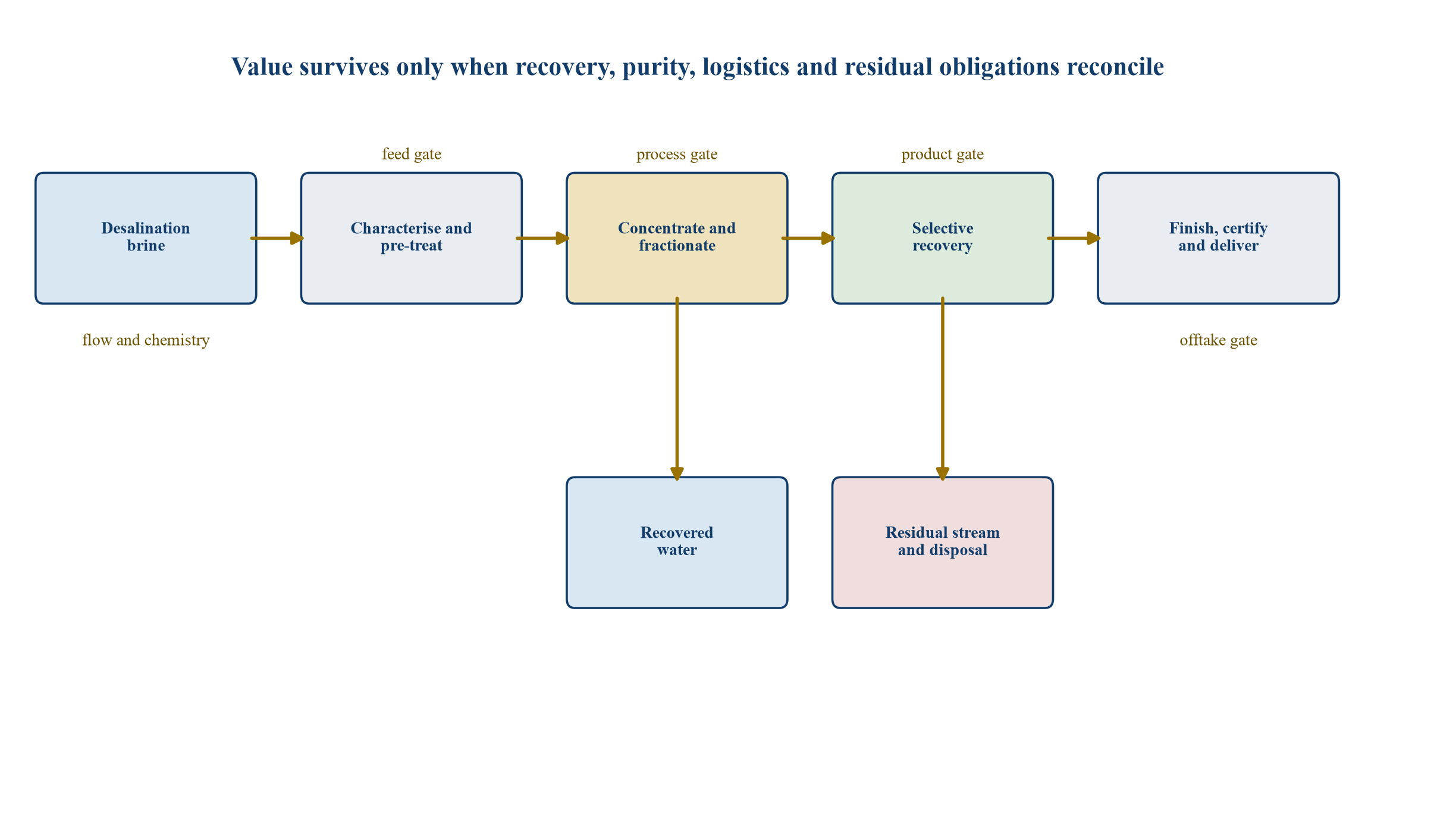
Generic architecture; the valid sequence depends on feed composition, product specification, site conditions and permits.
6. Characterisation must support a mass balance
The laboratory programme should measure constituents that affect product value and process performance. Major ions determine precipitation sequence and chemical demand. Trace metals can create opportunity or contamination. Organics, antiscalants and suspended matter can inhibit crystallisation, foul membranes or disqualify products.
Sampling should cover normal, low-flow, high-recovery and cleaning conditions. The mass balance should reconcile feed, permeate and concentrate within an agreed tolerance. Unreconciled data can create false recovery yields. Independent chain of custody and laboratory quality controls are appropriate where the results will support financing or an offtake agreement.
7. Technology choices follow chemistry
Available unit operations include chemical precipitation, nanofiltration, electrodialysis, bipolar-membrane electrodialysis, ion exchange, adsorption, solvent extraction, membrane distillation, evaporation and crystallisation. The European Commission’s SEA4VALUE programme tested a modular combination of selective membranes, adsorbents and metallurgical separation methods for multiple elements [3][4].
The technical sequence should remove interfering species before expensive selective steps. Process integration must account for pH, redox state, reagent recycle, wash water, mother liquor and waste. A high laboratory recovery can lose value when polishing and disposal are included.
8. Technology readiness is product-specific
A unit operation can be commercially established in one duty and developmental in another. Electrodialysis has industrial applications, while selective recovery of a trace element from a complex seawater-brine matrix may remain at pilot scale. Crystallisation is established, while obtaining a saleable crystal size, purity and moisture content from a changing feed can still be project-specific.
The owner should assign readiness to the complete product train, including feed preparation, separation, finishing, quality control and residual management. The weakest essential stage determines the programme risk.
9. Bulk salt
Sodium chloride is abundant in seawater brine and can be recovered through concentration and crystallisation. Its large mass does not guarantee attractive economics. Industrial salt markets are regional, specifications vary, and transport cost can overwhelm a low unit price.
The commercial study should identify customers by grade and delivery form. Moisture, particle size, insolubles, calcium, magnesium and trace contaminants matter. A project should not assume that recovered mixed salt receives the same price as vacuum salt or a qualified chlor-alkali feedstock.
10. Magnesium products
Magnesium can be precipitated as magnesium hydroxide or converted into other compounds. Potential uses include flame retardants, wastewater treatment, construction materials and chemical manufacturing. Each market has distinct purity, particle-size and reactivity requirements.
Magnesium recovery can also remove hardness before downstream concentration. This creates a process benefit even where the product revenue is modest. The financial model should separate avoided scaling and equipment savings from external product sales.
11. Bromine
The United States Geological Survey states that bromine occurs principally in seawater, salt lakes and underground brines, and that it can be recovered from seawater as a coproduct of salt production [5][6]. Commercial recovery still requires sufficient concentration, oxidation and separation infrastructure, safe handling and access to derivative markets.
Bromine economics depend on local chemical integration and product form. A project near an established bromine or specialty-chemical chain has a different risk profile from a standalone export project. Feed concentration alone does not establish feasibility.
12. Calcium products
Calcium carbonate, gypsum and related products can be precipitated during hardness removal. Their value can arise from sale, internal reuse or reduced scaling in downstream equipment. Commodity markets are specification-sensitive and often local.
The project should test mineralogy, purity, dewatering, drying, particle size and customer performance. A wet filter cake with variable impurities cannot be valued as a packaged industrial product. Disposal remains the downside case until customer acceptance is documented.
13. Potassium and sulphate products
Potassium chloride, potassium sulphate and sodium sulphate can be relevant in staged concentration or crystallisation systems. Selective recovery requires control of competing ions and phase behaviour. Fertiliser applications also require product registration and contaminant limits.
The screen should compare direct product recovery with sale of an intermediate stream to an established processor. An intermediate can reduce capital and market risk, though it transfers part of the value to the customer.
14. Lithium and other trace elements
Lithium receives attention because of battery demand, while seawater concentrations are low relative to many continental brines. Trace-element recovery can require pre-concentration, highly selective media, large contact volumes and extensive polishing. The European Commission’s research programmes treat lithium and other strategic elements as technology-development targets [3][7].
The investment case should present trace-mineral revenue as an option until pilot data demonstrate capacity, selectivity, recovery, cycle life, reagent demand and product quality. Headline commodity prices applied to nominal contained mass are unsuitable for capital approval.
15. Acids and alkalis
Bipolar-membrane electrodialysis and related electrochemical routes can convert suitable salt streams into acid and alkali products. The DOE notes sodium hydroxide and hydrochloric acid among possible brine-derived products [1]. On-site production may avoid transport and reduce the owner’s chemical purchases.
Internal use can be more financeable than merchant sale because specification, demand and logistics are already visible. The model should include electricity, membrane replacement, purification, storage, safety systems and the opportunity cost of any salt feed diverted from other products.
16. Chlorine and chlor-alkali integration
Purified sodium chloride can feed chlor-alkali production, generating chlorine, hydrogen and sodium hydroxide. Integration requires high feed purity, continuous demand, electrical capacity and stringent safety controls. Chlorine has limited economic transport distance and significant handling obligations.
A desalination site should consider chlor-alkali only where an industrial cluster or anchor consumer can absorb the products. The project perimeter may be better structured as a joint venture with an experienced chemical operator.
17. Recovered water
Concentration and crystallisation processes can recover additional water. Its value depends on quality, location and the cost of the marginal alternative. Water revenue can be more stable than mineral revenue where the desalination offtake contract recognises incremental compliant production.
The model must assign energy and shared capital consistently across water and products. A recent economic study of multi-product recovery plants shows that cost-allocation method can materially change apparent levelised costs [9]. Decision makers should see both total-project cash flow and transparent product economics.
18. Construction and cement inputs
DOE identifies use of suitable brine streams in manufacturing products such as cement as a possible valorisation route [1]. Construction use can absorb volume, while chloride, sulphate, metals and variability can limit acceptance. Product liability and building standards matter.
Testing should address performance in the customer’s formulation, long-term durability and contaminant leaching. A generic claim that salt or precipitate can enter construction should not be treated as an offtake case.
19. Industrial symbiosis
Co-location can combine the desalination plant’s brine, electricity, steam, cooling water, storage and logistics with a chemical, fertiliser, mining or construction customer. Shared infrastructure can reduce capital and create a stable local market.
It also creates dependence. The owner should test what happens when the industrial customer shuts down, changes specification or loses demand. Buffer storage, alternative disposal and minimum-take obligations protect the water plant’s primary service.
20. Product screen
The screen should combine chemistry, process, customer and transaction evidence. It should eliminate products that have attractive theoretical content but weak recovery or market access.
Table 1. Product-screening framework for desalination brine
| Product family | Evidence required | Principal value driver | Principal disqualifier |
|---|---|---|---|
| Recovered water | Quality, volume, delivery boundary and offtake | Avoided marginal water cost or contracted revenue | High incremental energy or off-specification output |
| Sodium chloride | Crystal purity, moisture, particle size and customer test | Scale and local industrial demand | Low price relative to drying and transport cost |
| Magnesium compounds | Recovery, purity, particle properties and application test | Product value plus hardness removal | Reagent intensity or variable impurities |
| Calcium and sulphate products | Mineralogy, dewatering and performance test | Local construction, chemical or fertiliser demand | Product liability or disposal-grade quality |
| Bromine products | Concentration, recovery route, safety case and derivative offtake | Integration with specialty-chemical value chain | Insufficient scale or remote market |
| Acids and alkalis | Salt purity, power demand, membrane life and internal demand | Avoided chemical purchase and logistics | High electricity cost or inadequate utilisation |
| Lithium and trace elements | Selectivity, cycle life, yield, polishing and qualified product | High unit value and strategic option | Low concentration and immature complete process train |
Generic screening logic; actual product selection requires site sampling, engineering and customer qualification.
21. The contained-value trap
Contained value multiplies concentration, flow and commodity price. It ignores recovery losses, impurity, downtime, conversion cost, product grade, transport, royalties, working capital and residual disposal. It can be useful for ranking elements, while it cannot support valuation.
The next screen is recoverable saleable value. This applies demonstrated recovery to the operating composition range and customer specification. Net cash value then deducts incremental operating cost, sustaining capital, logistics and unavoidable residual cost.
22. Product price selection
The relevant price is the price for the specified product at the project’s delivery point. Exchange-traded metal prices can be unrelated to a hydroxide, mixed salt, solution or intermediate. Published prices may reflect different purity, volume, geography and contract terms.
The model should use customer indications, comparable contracts or independently sourced market assessments where available. Scenario prices should be clearly identified and stress-tested. Price escalation should not rescue a weak base case.
23. Market depth
A recovery project can produce a material share of a local niche market. The model should compare planned output with addressable demand, customer concentration and realistic ramp-up. Selling the first tonnes at a premium does not prove that full output can clear at the same price.
The commercial plan should map existing supply, substitution, import parity, qualification time and customer switching costs. Take-or-pay or floor-price arrangements can support financing when backed by a creditworthy buyer.
24. Logistics and location
Bulk mineral value is sensitive to distance, handling form, storage and return freight. Drying can reduce transport mass but increase energy and capital. Export may require bagging, containers, port capacity and product registration.
The feasibility model should price the actual route to each customer. A location-adjusted netback is more useful than a global benchmark. Co-located consumption can convert an otherwise marginal product into a viable one.
25. Avoided disposal value
Recovery can reduce brine volume, contaminant load or discharge salinity. The economic benefit equals the cost genuinely avoided under the permitted counterfactual. If the outfall and monitoring remain necessary, only variable and deferrable costs should be credited.
For inland plants, concentrate disposal can be a binding constraint. The Bureau of Reclamation’s concentrate-management work compares treatment, minimisation and disposal options within site-specific constraints [2]. A recovery project can create option value by extending disposal capacity.
26. Environmental value and obligation
Reduced discharge can support environmental objectives, while recovery processes consume energy, reagents and materials and create secondary residues. The project should use a complete lifecycle boundary. Moving contaminants into a solid waste stream is not elimination.
Environmental benefits should be quantified separately from cash unless a contract, compliance obligation or recognised credit creates economic value. Permit changes, marine studies, waste classification and product-end-use obligations should enter the programme schedule.
27. Energy intensity
Concentration becomes harder as salinity rises. Thermal processes can require substantial heat and electricity, while membrane and electrochemical processes face osmotic pressure, scaling and resistance. Energy integration, waste heat and renewable supply can change the feasible process sequence.
Recent techno-economic studies show that performance varies widely across proposed minimal- and zero-liquid-discharge configurations [11][12]. Their results are process-specific. A project should use a site mass and energy balance rather than transfer a published unit cost.
28. Reagent intensity
Precipitation, pH adjustment, regeneration and polishing can consume acids, alkalis, antiscalants and wash water. Reagent cost and embedded mass can be comparable to product output. Supply security and storage can constrain operation.
The process should test reagent recycle and on-site generation where appropriate. The model should show consumption per tonne of qualified product and per cubic metre of brine, with sensitivity to feed variability.
29. Materials and corrosion
Hypersaline and chemically active streams can corrode metals, degrade seals and foul heat-transfer surfaces. Material selection affects capital, availability and maintenance. Laboratory compatibility does not replace long-duration pilot evidence.
The owner should define corrosion allowance, inspection, cleaning, spare parts and replacement intervals. Vendor guarantees should cover the actual chemistry and temperature range.
30. Hypothetical value bridge
The illustrative bridge shows why gross product revenue can fall sharply before reaching operating cash value. The values are arbitrary indices for method demonstration.
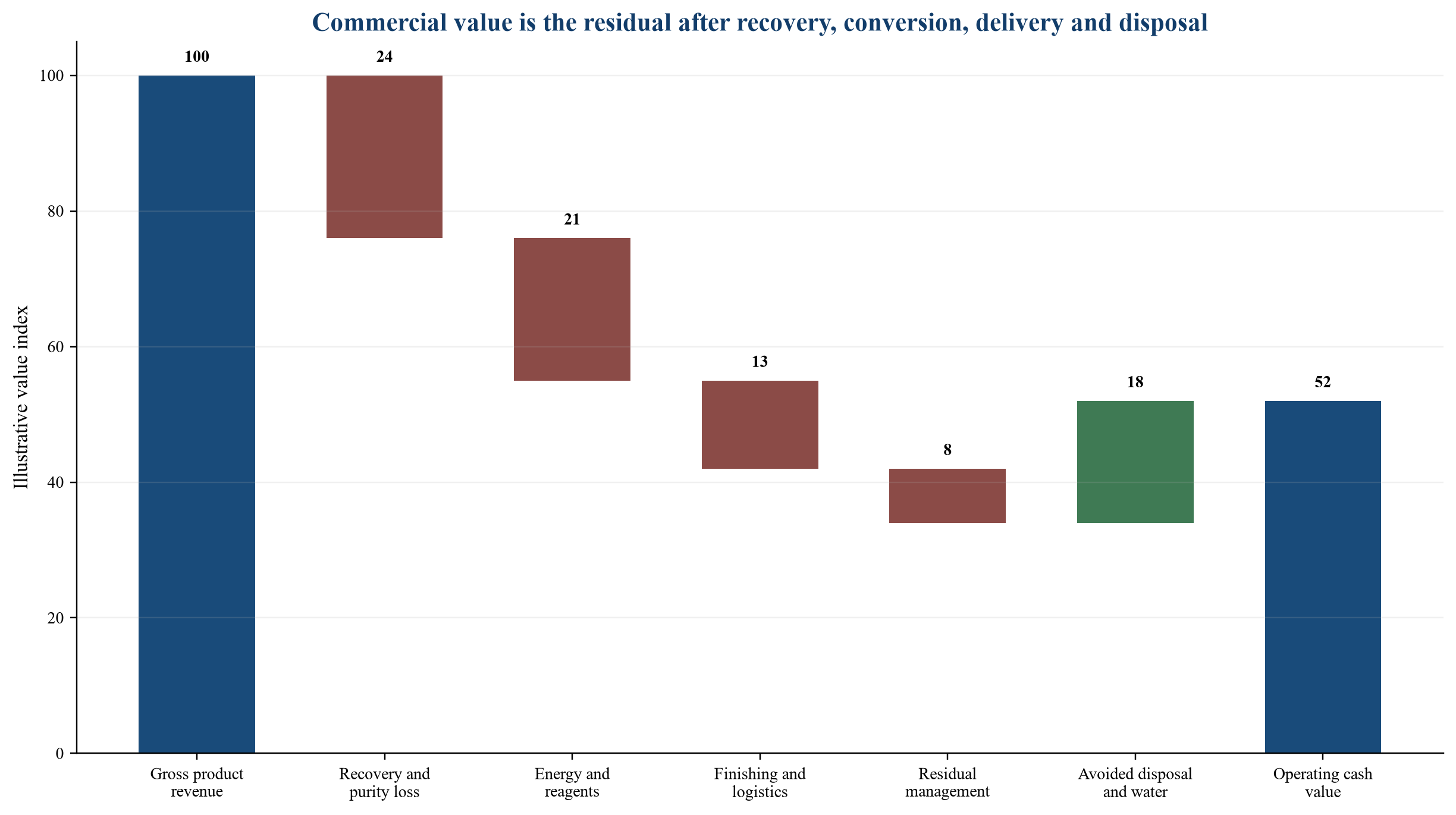
Illustrative indices only; not a market forecast, plant estimate or valuation.
31. Capital cost
Installed cost includes process equipment, buildings, foundations, electrical connection, piping, storage, laboratories, utilities, controls, fire protection, product handling, tie-ins, owner cost and contingency. Brownfield interfaces can dominate an equipment quotation.
The estimate should state maturity, exclusions, currency, location, duty and price date. Contingency should correspond to unresolved scope and technology risk. A percentage applied without a risk register can conceal uncertainty.
32. Operating cost
Operating cost includes energy, reagents, membranes, sorbents, filters, labour, maintenance, laboratory work, waste, packaging, transport, insurance and royalties. Product-specific costs should be separated from shared brine and water infrastructure.
The model should include start-up, off-specification production and ramp-up. A steady-state laboratory yield cannot be applied to every operating hour.
33. Cost allocation
Multi-product systems require a transparent method for allocating shared cost. Physical allocation can use mass, energy or process duty. Economic allocation uses relative value. Dual approaches can separate water and product objectives. The chosen method can materially affect reported product cost [9].
Financing should focus on total-project cash flow and contracted obligations. Product profitability remains useful for shutdown, expansion and portfolio decisions. Both views should reconcile to the same accounts.
34. Working capital
Recovered products can require inventory, customer testing and long payment terms. Reagents and spare parts can require imported stock. Working capital can therefore absorb cash before stable sales develop.
The financial model should include qualification inventory, off-specification reserves, receivables, payables and minimum stock. Commodity price exposure and foreign exchange can increase collateral needs.
35. Revenue recognition
Revenue should be recognised at the contracted delivery and acceptance point. Product rejection, moisture adjustment, assay settlement and volume tolerance can change cash receipts. Internal use should be valued at the avoidable purchase cost, excluding taxes or logistics that do not apply.
Any environmental or strategic premium should be supported by a contract or approved policy. It should not be embedded in product price without evidence.
36. Offtake structure
An offtake agreement can specify product, quality, volume, delivery, price, indexation, minimum take, rejection, testing, credit support and change in law. The buyer may require qualification before committing to scale.
A staged agreement can begin with samples and pilot lots, then convert to conditional capacity reservation and long-term offtake after acceptance. This matches commercial commitment to technical evidence.
37. Tolling and processing
The owner can sell an intermediate stream to a processor or pay a tolling fee for conversion. This reduces finishing capital and market-development burden. It introduces processor credit, capacity and logistics risk.
The tolling case should compare netback, recoveries, title transfer, losses, assay, waste ownership and minimum volume. Alternative processors protect continuity.
38. Joint venture
A joint venture can combine the water owner’s feedstock and site with a technology provider’s process and a customer’s market access. Governance should define capital contributions, intellectual property, operating control, product allocation, expansion rights and failure scenarios.
The water plant’s service obligations should remain protected. The venture should have no right to disrupt water production when the recovery system is unavailable.
39. Build-own-operate structures
A specialist can design, finance, build and operate the recovery facility under a service or concession agreement. Payment can combine availability, avoided-cost sharing and product revenue. This structure can transfer execution risk when the provider has a proven reference plant and adequate balance sheet.
The contract should define feed quality, minimum flow, utilities, site access, product ownership, residual responsibility and termination. Risk transfer is only as strong as the provider’s capacity and security package.
40. Financing structure
Early stages are suited to owner equity, grants, strategic capital or technology-provider funding. Project debt requires stable feed rights, proven technology, contracted offtake, permits, fixed or bounded cost and credible completion support.
A hybrid structure can finance established water-recovery and bulk-product stages separately from trace-mineral options. This prevents speculative upside from supporting senior debt.
41. Government and innovation funding
Public programmes can support pilot plants, first-of-a-kind integration and critical-material research. SEA4VALUE received European Union research funding to develop and demonstrate a modular multi-mineral process [3][4]. Public funding is evidence of policy interest, not proof of commercial returns.
Grant conditions, intellectual-property rights, procurement and reporting should be included in the transaction plan. The base case should remain clear about which costs and risks are subsidised.
42. Performance guarantees
Guarantees should address throughput, recovery, product purity, energy, reagent consumption, availability and residual quality. They should use the operating feed envelope and define test duration, sampling, laboratory and correction methods.
A guarantee for elemental recovery without product quality or operating cost can fail commercially. Liquidated damages and remedy should correspond to value lost and remain creditworthy.
43. Product qualification
Customer qualification may require repeated samples, production audits, safety data, regulatory registration and application testing. The schedule can be longer than equipment installation.
The project should begin qualification during pilot operation. It should retain samples, analytical methods and batch records. The offtake date should follow realistic acceptance milestones.
44. Residual responsibility
Recovery leaves mother liquor, sludge, purge streams, spent media or off-specification solids. Their volume and classification must be measured. A zero-liquid-discharge label does not mean zero waste.
Contracts should allocate ownership, transport, disposal and future liability. The owner needs an alternative route when a product fails qualification.
45. Permitting
The project may change discharge chemistry, waste classification, air emissions, chemical storage, process safety and land use. Product manufacture can trigger separate licences and registrations.
The permitting plan should identify critical-path approvals, consultation and testing. A recovery plant should not assume that an existing desalination permit covers chemical production.
46. Safety
Acids, alkalis, chlorine, hydrogen, bromine and concentrated brines require process-safety management. Hazard analysis should cover generation, storage, transfer, emergency systems and nearby receptors.
Safety capital and staffing belong in the feasibility estimate. A product route with attractive gross margin can be unsuitable at a constrained water site.
47. Intellectual property and freedom to operate
Selective membranes, sorbents, process sequences and control methods can be patented or licensed. The owner should understand background intellectual property, improvements, field restrictions, royalties and replacement rights.
Freedom-to-operate review should occur before committing to a proprietary process. Data ownership is also important because operating results can improve future designs.
48. Data governance
The programme should maintain a controlled dataset covering samples, laboratory methods, flow, energy, reagents, recovery, product assays, customer tests and residuals. Raw data and calculation versions should be preserved.
Independent engineering and financial reviewers need access. Supplier dashboards alone are insufficient where formulas or exclusions cannot be reproduced.
49. Pilot design
A useful pilot represents the expected feed range and complete product train. It should run long enough to reveal fouling, degradation, cycle life, cleaning and product variability. Short campaigns can establish chemistry while missing operability.
The pilot protocol should define success, failure, redesign and termination criteria. It should produce customer samples and residual streams at meaningful scale.
50. Stage gates
The programme should move from characterisation to bench testing, integrated pilot, demonstration and commercial construction. Each stage should resolve named uncertainties before larger capital is released.
Table 2. Evidence-gated development roadmap
| Gate | Technical evidence | Commercial evidence | Capital decision |
|---|---|---|---|
| Feed gate | Seasonal composition and reconciled mass balance | Disposal counterfactual and candidate market map | Fund laboratory screening |
| Product gate | Recovery, purity and stable intermediate | Customer specification and sample interest | Fund integrated pilot |
| Pilot gate | Continuous operation, energy, reagents and residual data | Customer sample acceptance and preliminary terms | Fund demonstration and permitting |
| Demonstration gate | Complete train, availability and performance persistence | Conditional offtake, logistics and price mechanism | Approve commercial design |
| Financing gate | Bankable design, guarantees and permits | Executed offtake and credit support | Commit construction capital |
| Operations gate | Acceptance and reproducible quality | Delivery, payment and alternative outlet | Release completion support |
Generic stage-gate framework; schedule and evidence depend on technology and market.
51. Portfolio logic
A plant can develop a sequence of products rather than an all-at-once complex. Hardness removal and recovered water can support later salt or chemical recovery. Shared concentration and utilities can create platform value.
The portfolio should preserve optionality while preventing one speculative product from delaying a viable stage. Modular design, spare tie-ins and data rights can support future expansion.
52. Scenario design
The financial model should test feed, recovery, quality, price, utilisation, energy, reagents, logistics, capital and disposal cost. Variables should be linked to physical drivers. A downside scenario should include failed qualification for at least one product and continued residual management.
Scenario combinations matter. Low recovery and low price can coincide during ramp-up. High energy price can affect both process cost and competing product supply.
53. Hypothetical sensitivity
The illustrative chart shows a generic project’s operating cash-value index under changes in six drivers. The values demonstrate method only and do not describe a project.
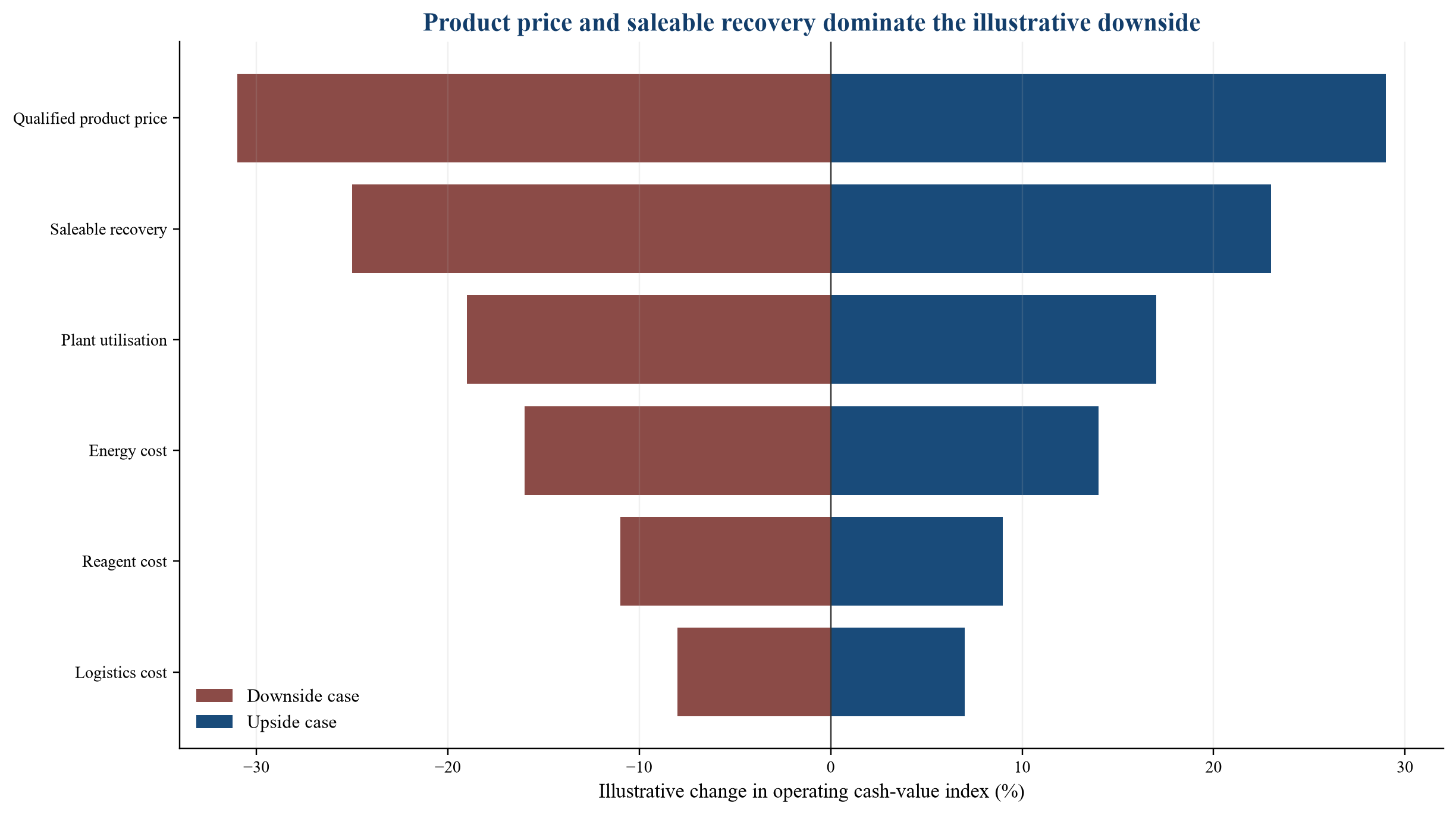
Illustrative percentage changes to an arbitrary cash-value index; not a forecast or valuation.
54. Risk allocation
Each material risk should sit with the party that can control or price it. Feed variability often remains with the water owner within a defined envelope. Process performance can sit with the technology provider. Product demand and price may sit with an offtaker under a contract or remain an equity risk.
Residual disposal must always have a responsible party and funded route. Interface risk across several technology packages needs a single integrator or explicit system guarantee.
55. Risk register
The register should connect evidence to contractual and financing responses.
Table 3. Brine-resource recovery risk and investment response
| Risk | Evidence required | Commercial response | Investment response |
|---|---|---|---|
| Feed composition outside range | Seasonal samples and operating history | Feed envelope and adjustment mechanism | Size buffer or retain stop right |
| Recovery or purity shortfall | Integrated pilot and independent assays | Performance guarantee and rejection rules | Reduce product value and stage capital |
| Market too small | Customer map and qualification pipeline | Minimum take, floor price or multiple outlets | Cap capacity at contracted demand |
| Energy or reagent escalation | Metered balances and supply quotes | Indexation, hedge or pass-through | Stress debt service and reserve |
| Residual becomes hazardous | Full-stream analysis and legal classification | Supplier indemnity and disposal contract | Fund downside disposal route |
| Technology-provider failure | Financial, technical and reference diligence | Parent support, source-code and step-in rights | Hold contingency and alternative process |
| Water service disruption | Tie-in and operability study | Priority for water operation and bypass | Require independent engineer approval |
| Permit delay | Authority engagement and application plan | Long-stop dates and cost allocation | Stage notice to proceed |
Generic framework; probability, impact and remedy require project-specific diligence.
56. Independent engineering
The independent engineer should validate the feed basis, process model, scale-up, equipment duty, utilities, availability, capital estimate, schedule, guarantees and residual route. Product recovery should reconcile through the mass balance.
The review should identify which claims come from continuous pilot data and which come from vendor models. Lenders should not treat grant-funded demonstration as a commercial reference without comparing scale and duty.
57. Market diligence
Independent market work should confirm product definition, addressable demand, competing supply, substitution, qualification, price basis, logistics and customer credit. It should interview actual buyers under appropriate confidentiality.
The report should state where evidence remains indicative. A letter of interest is different from a take-or-pay contract.
58. Legal diligence
Legal work should cover feed and site rights, licences, technology intellectual property, permits, product regulation, waste, environmental liability, offtake, construction, operations and financing security. Cross-border sales can add sanctions, customs and product-registration issues.
The transaction should preserve the water owner’s ability to operate and dispose of brine if the recovery project terminates.
59. Accounting and tax
The structure should determine ownership of feedstock, products, environmental obligations and shared assets. Revenue, internal transfer pricing, grants, tax incentives, depreciation and import duties can affect returns.
Accounting allocation should remain separate from engineering allocation. The board should see cash economics before tax optimisation.
60. Board decision record
The board paper should state the disposal counterfactual, feed evidence, selected products, excluded products, process readiness, customer status, scenario assumptions, residual route, capital at risk and next evidence gate. It should identify every value component that lacks a contract.
Approval should be conditional on independent technical review, customer qualification, permits and a reconciled model. A materially different feed, process or market should return to the board.
61. Red flags
Red flags include valuation from contained mass, commodity prices unrelated to product form, a single brine sample, vendor-only assays, omitted residuals, no customer qualification, assumed zero-liquid discharge, unpriced drying and logistics, and debt sized on uncontracted trace-mineral revenue.
Other warning signs are a pilot that excludes finishing, a guarantee limited to laboratory recovery, a buyer without credit support, and a recovery facility that can interrupt water service.
62. Practical first hundred days
The first month should establish governance, sample design, laboratory methods, disposal cost and product longlist. The second month should complete seasonal or representative sampling where available, mass-balance reconciliation, market interviews and technology screening. The third month should select bench tests, customer specifications and pilot objectives.
The output is a ranked portfolio with a clear no-go list, evidence gaps, budget and decision calendar. Commercial engagement begins before equipment selection.
63. When bulk products lead
Bulk products can lead when concentration is high, specification is achievable, customers are nearby and avoided disposal or water value supports shared capital. A modest product margin can be robust when logistics are short and technology is established.
The owner should still cap production at realistic demand. Excess low-value solids can recreate a disposal problem.
64. When trace minerals lead
Trace minerals can lead when the brine is unusually enriched, selective recovery is proven, the product has qualified demand and the process can operate through impurities. This is more likely in specialised industrial or geological brines than ordinary seawater concentrate.
For conventional seawater desalination, trace minerals often belong in the option portfolio. Pilot data should earn their inclusion in the finance case.
65. Commodity-cycle resilience
The financing case should distinguish structural demand from temporary price strength. Commodity cycles can compress margins at the same time that interest, energy or reagent costs rise. A facility with a single high-cost product can become stranded even when the underlying mineral remains useful.
Resilience can come from internal consumption, contracted floor prices, several qualified products and the ability to suspend a finishing step while preserving water recovery or disposal service. The downside model should test an extended low-price period rather than a brief shock. Equity should carry uncontracted commodity upside.
66. Modular capacity
Modularity can align investment with demonstrated feed, product acceptance and customer demand. A first module can prove continuous performance and logistics before shared infrastructure is expanded. Standardised skids can shorten construction, although duplicate balance-of-plant equipment can reduce economies of scale.
The design should identify which assets are truly modular and which require full-scale commitment at the beginning. Intake, electrical connection, buildings, storage and residual management can create large common costs. Expansion rights, space and utility reservations should be priced explicitly.
67. Procurement strategy
The owner can procure a single integrated package, several specialist packages or a licensed process with local engineering. A single integrator simplifies interface responsibility but may add margin and reduce technology choice. Multi-package procurement can preserve competition while placing system integration on the owner.
Bid evaluation should use a common feed envelope, product specifications, test protocol, utility prices, residual boundary and lifecycle horizon. Equipment prices are not comparable when guarantees and exclusions differ. The procurement decision should consider credit support, references, spare parts, intellectual property and long-term service.
68. Commissioning discipline
Commissioning should prove mass balance, utilities, product quality, residual quality, operability and safety across the agreed range. It should include start-up, shutdown, cleaning, product changeover and upset recovery. A short acceptance run at favourable feed conditions can hide lifecycle limitations.
The completion test should use independent sampling and calibrated meters. Punch-list items that affect yield, quality or safety should remain conditions to final acceptance. Payment milestones should follow evidence rather than mechanical installation alone.
69. Operating organisation
Brine recovery adds chemical-process and product-quality responsibilities to a water utility. The operator may need laboratory, process-safety, maintenance, sales, logistics and customer-quality capabilities. These costs and skills should be included from feasibility.
An experienced specialist can operate the recovery facility under a long-term agreement. The interface must preserve water-plant authority, data access and step-in rights. Incentives should reward qualified saleable output, safe availability and controlled residuals rather than gross tonnes alone.
70. Performance monitoring
Monthly reporting should reconcile brine feed, recovered water, products, residuals, energy, reagents, availability, customer acceptance and cash. Variances should be separated into feed, process, market and logistics causes. This prevents a revenue shortfall from being explained only as an operating problem.
The owner should track product yield and netback by batch or campaign. Degradation in membrane, sorbent or crystalliser performance should trigger maintenance before customer quality fails. Independent audits can support lender and offtaker confidence.
71. Replication and platform value
A successful first plant can create a repeatable development platform, customer network and operating dataset. Replication still requires site-specific chemistry, disposal rules, energy cost and market access. A process that works in one brine cannot be copied solely from nameplate flow.
Platform valuation should separate proven recurring economics from future development options. Data, qualification and supplier frameworks can shorten later projects, while each capital commitment should pass its own evidence gates. The board should avoid capitalising an undeveloped pipeline as if it were contracted capacity.
72. Conclusion
Desalination brine can support additional water, industrial salts, chemical intermediates and selected higher-value products. The opportunity is site-specific. The investable unit is the complete chain from variable brine through recovery and finishing to accepted product and managed residual.
Owners should begin with reconciled chemistry and a disposal counterfactual, rank products by saleable netback and market depth, qualify customers early, allocate shared costs transparently and stage capital against evidence. Co-location, internal chemical use, avoided disposal and recovered water can create a stronger base than speculative mineral revenue. Bulk products require logistics discipline; trace elements require exceptional selectivity and proof. A project becomes financeable when technical performance, product acceptance, residual responsibility and cash allocation are documented in contracts and independently verified.
References
- United States Department of Energy. Water Resource Recovery Basics. https://www.energy.gov/cmei/ito/water-resource-recovery-basics
- United States Bureau of Reclamation. Concentrate Management Toolbox and Selected Case Studies, Project 5239. https://www.usbr.gov/research/projects/detail.cfm?id=5239
- European Commission CORDIS. SEA4VALUE: Development of Radical Innovations to Recover Minerals and Metals from Seawater Desalination Brines. https://cordis.europa.eu/project/id/869703
- European Commission CORDIS. SEA4VALUE Final Reporting Summary. https://cordis.europa.eu/project/id/869703/reporting
- United States Geological Survey. Mineral Commodity Summaries 2026. https://pubs.usgs.gov/publication/mcs2026
- United States Geological Survey. Mineral Commodity Summaries 2026, Bromine chapter. https://pubs.usgs.gov/periodicals/mcs2026/mcs2026.pdf
- European Commission. Horizon 2020 Water Research and Innovation Projects 2014-2020, including SEArcularMINE. https://research-and-innovation.ec.europa.eu/system/files/2022-03/water_research_and_innovation_projects_2014-2020.pdf
- National Renewable Energy Laboratory. Brine Management and Resource Recovery Technology Roadmap. https://www.nrel.gov/docs/fy21osti/79895.pdf
- Ktori, R., van Loosdrecht, M.C.M. and Xevgenos, D. Economic Evaluation of Water and Resource Recovery Plants: A Novel Perspective on Levelized Cost. Desalination 599, 2025, 118475. https://doi.org/10.1016/j.desal.2024.118475
- Economic Evaluation of a Brine Upcycling System for Resource Recovery from Seawater Desalination Brine. Separation and Purification Technology 371, 2025, 133259. https://doi.org/10.1016/j.seppur.2025.133259
- Vallerio, M., Salano, L. and Manenti, F. Towards Near-ZLD Sea Water Brine Treatment: A Techno-Economic Study. Desalination 621, 2026, 119562. https://doi.org/10.1016/j.desal.2025.119562
- Techno-Economic Analysis of Zero Liquid Discharge Systems for Treatment and Utilization of Brine via Resource Recovery. Chemical Engineering and Processing 200, 2024, 109773. https://doi.org/10.1016/j.cep.2024.109773
- Morgante, C. et al. A Global Outlook of the Desalination Industry and State-of-the-Art Technologies for Brine Valorisation. Desalination 621, 2026, 119718. https://doi.org/10.1016/j.desal.2025.119718
- Lundaev, V. et al. Material Extraction Potential of Desalination Brines: A Technical and Economic Evaluation of Brines as a Possible New Material Source. Minerals Engineering 185, 2022, 107652. https://doi.org/10.1016/j.mineng.2022.107652
- United States Bureau of Reclamation. Desalination and Water Purification Research Reports. https://www.usbr.gov/research/dwpr/DWPR_Reports.html
About the Author
Chennakeshav (CK) is a corporate finance and investment banking executive with 25+ years of global experience in deal origination, structuring and execution across M&A, growth capital and corporate strategy. He has led value-creation mandates for founders, corporates and funds — bridging the boardroom view to hands-on execution and close.
His career spans Morgan Stanley, HSBC, Lloyds Banking Group, EWEC, ADQ portfolio companies and Emirates Growth Fund, across TMT, real estate, fintech, deeptech, cleantech, infrastructure and energy. He has partnered with C-suite leaders, private equity and venture funds, sovereign wealth funds and family offices to finance complex fund raises and scale-up ventures, and has led M&A due diligence, post-merger integration and business-transformation initiatives to create value.
At Matchpoint Partners he is Managing Partner, leading the firm's corporate finance, M&A and capital-raising practice. He holds an MBA from London Business School, an engineering degree from VTU and a Master of Laws (LLM, in progress) from UCL London.
An active start-up mentor, CK mentors at Techstars, DIFC FinTech Hive, Startup Grind, Founder Institute and IN5, serves as Entrepreneur Mentor in Residence (EMiR) at London Business School, and judges the Entrepreneurship World Cup.
LinkedIn: https://www.linkedin.com/in/ckadya/
Profile: https://www.matchpoint-partners.com/team/ck-adya.html
