

1. Design the endgame before capital enters
A minority investment divides economic ownership from unilateral control. The investor contributes capital and receives a meaningful share of future value, but the founder or incumbent group can often retain day-to-day authority. This arrangement can support growth, succession or balance-sheet repair. It also creates a future coordination problem because no party may have the power, information or funding to deliver an exit alone.
Entry documentation should therefore explain how ownership can evolve. The relevant question is wider than the investor’s expected holding period. The company may receive a strategic offer, the founder may want to buy back shares, the investor may need partial liquidity, a new round may change voting power, or an initial public offering may become feasible. A downturn can make the original allocation of control unworkable. Each event requires a route, an approval process and an economic method.
The Exit and Control Architecture Test begins with four possible destinations: third-party sale, private secondary transfer, public listing and negotiated control transition. It then tests every destination through the same chain: trigger, price, funding, approval, compliance and settlement. A right that fails one link should be treated as contingent negotiating leverage rather than a reliable source of liquidity.
This architecture should sit alongside the business plan and capital structure. Commercial milestones can provide review points, while legal rights define what the parties can do. The board should revisit the design after material financings, acquisitions and changes in regulation. A carefully drafted agreement cannot remain executable when the underlying ownership, debt or operating position has changed beyond recognition.
2. Build a route hierarchy instead of a single promised exit
An entry memorandum often assumes one attractive exit. Real outcomes are more varied. A strategic buyer may offer the best price but require full control. A financial buyer may accept a significant minority but seek governance protections. A private secondary can provide limited liquidity without changing control. A public listing can create a trading venue while subjecting holders to conversion, disclosure, lock-up and orderly-sale constraints.
The route hierarchy should state which pathway is preferred, which pathway is available as a fallback, and which rights expire or convert when another route begins. It should also identify who can initiate each process. A founder-controlled company may allow the board to commence a sale, grant a qualified investor the right to request a process after a defined date, and permit a partial secondary within annual limits. An IPO route can become active only after financial, governance and market-readiness conditions are met.
Priority rules matter because rights can conflict. A right of first refusal may slow a third-party sale. A tag right may increase the number of shares offered and reduce deal certainty. A drag can support a full sale but expose minority holders to terms negotiated by the controlling group. A put can create a cash obligation during the same period in which the company needs capital. The hierarchy should specify suspension, sequencing and waiver rules so that one mechanism does not destroy another.
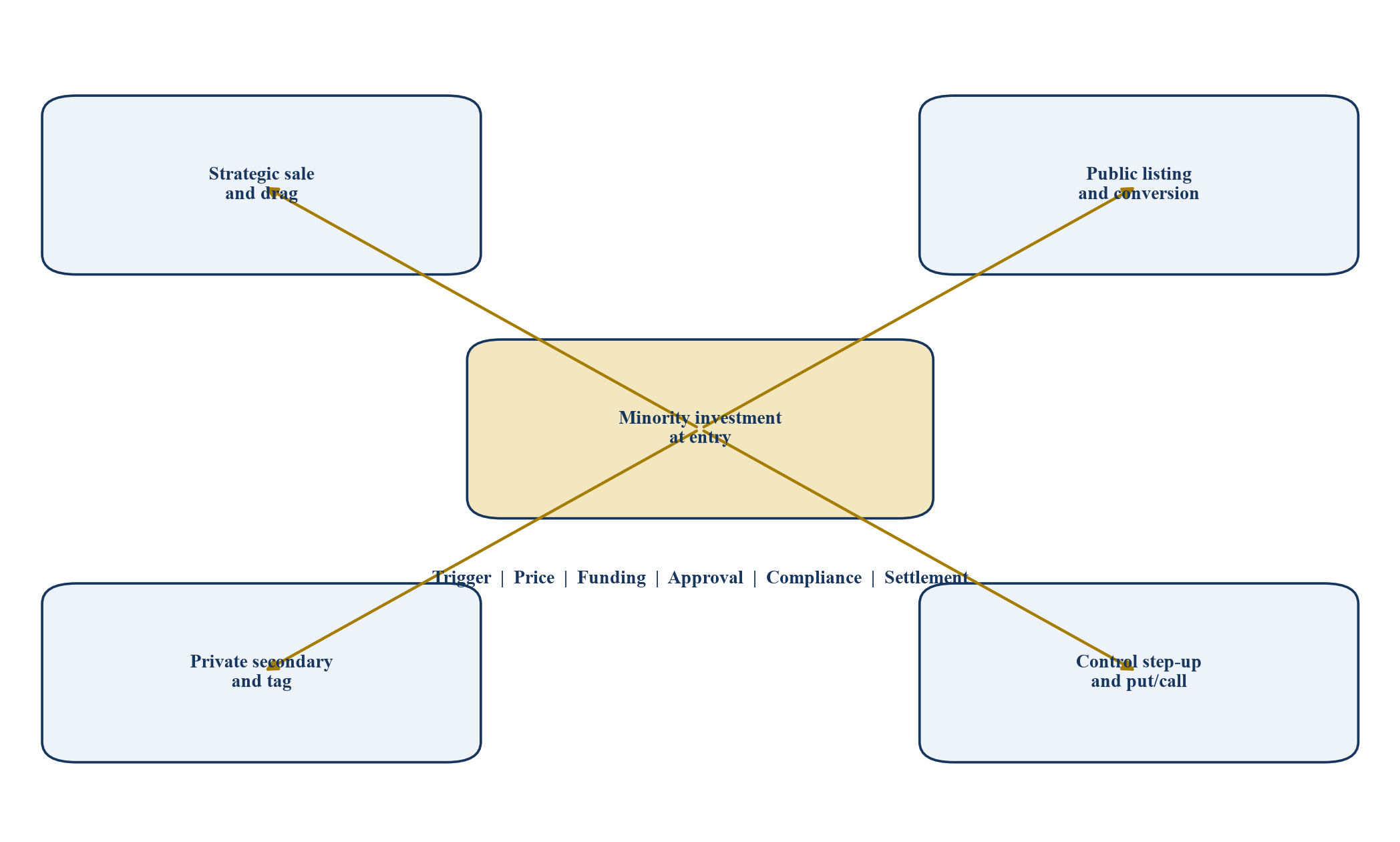
The diagram presents four potential routes. Availability and enforceability depend on the definitive documents, applicable law, capital structure and facts at the time.
3. Define objective triggers and evidence
A trigger converts a future possibility into a present right. Calendar triggers are easy to observe but can be commercially crude. Performance triggers can be relevant but invite disputes when accounting policies, budgets or market conditions change. Transaction triggers such as a bona fide third-party offer, a qualified financing or an IPO filing are more closely connected to an executable event. Governance triggers can address deadlock or repeated material breach, but they need clear notice and cure processes.
Each trigger should specify the event, evidence, calculation agent, notice, cure period and long-stop date. Terms such as underperformance, material breach or reasonable offer need measurable content. A revenue trigger should identify the accounting basis, currency, period, permitted adjustments and auditor role. A deadlock trigger should state the reserved matter, number of failed meetings, escalation participants and mediation or expert-determination step.
The design should limit strategic behaviour. An investor should not be able to create a breach and then exercise a discounted call. A founder should not be able to delay a required meeting until an option expires. A board should not classify a genuine third-party approach as preliminary merely to avoid a process right. Good-faith obligations help, but a complete procedural record is more useful.
Evidence should be generated during ordinary governance. Board packs, audited accounts, capitalization records, financing notices and approved budgets can support later decisions. A clause that depends on evidence the company does not routinely produce is expensive to operate and vulnerable to challenge.
4. Separate market-facilitation rights from compulsory rights
Rights of first offer, rights of first refusal, co-sale rights and registration rights facilitate a transaction. They can give an existing holder priority, allow another shareholder to participate or require the company to support an offering. They do not by themselves create a funded buyer at an acceptable price.
Puts, calls and drag-along rights are more compulsory. A put requires a specified person to buy, a call enables a specified person to acquire, and a drag can require other holders to sell into a qualifying third-party transaction. Their value depends on the obligor’s capacity, the enforceability of the transfer and the completeness of the pricing and settlement terms.
The distinction should be visible in valuation and decision papers. A tag right can preserve equal access to a sale but may remain unused if no buyer accepts the additional shares. A put against an undercapitalised company can be economically weak even when the drafting is clear. A drag attached to a credible auction may be highly valuable because it removes a holdout risk that would otherwise reduce buyer interest.
The board should describe each right by function: information, process initiation, participation, priority, price protection, compulsory transfer or control change. This classification prevents the parties from treating every clause as equivalent exit certainty.
5. Connect drag rights to a credible sale process
A drag-along right can make a whole-company sale executable by requiring minority holders to transfer on the agreed terms. It should identify the initiating threshold, qualifying buyer, minimum consideration conditions, form of consideration, allocation of transaction costs, liability cap, escrow treatment and required warranties. It should also specify how option holders, convertible securities and different share classes participate.
The initiating threshold should reflect the company’s ownership. A simple majority can be too low when a founder and one investor could transfer obligations to the remaining holders. A very high threshold can give a small holder an effective veto. A tiered approach can require both an ownership percentage and approval by a specified class or disinterested group.
Minority holders should not be required to give business warranties they cannot verify or bear uncapped liability. Their liability can be several, limited to title, capacity and their proportionate proceeds, with fraud attributable only to the relevant person. Earn-outs, rollover equity and buyer securities require careful equivalence because identical nominal consideration may produce different risk.
The sale process should state who selects advisers, controls communications, approves bids and manages conflicts. A drag becomes more defensible when the initiating group can show a competitive process, informed board consideration and consistent treatment of holders in the same class.
6. Use tag rights to protect participation without paralysing a sale
A tag-along right allows a minority holder to sell alongside a controlling or significant shareholder. The clause should define which transfers trigger it, the proportion that can be tagged, the notice content, the response period and the seller’s obligation if the buyer refuses the additional shares.
A full tag can be appropriate for a control sale because the minority holder may otherwise remain with a new controller it did not select. A proportional tag can suit smaller transfers. Exemptions commonly address estate planning, affiliates, employee vehicles and permitted reorganisations, subject to joinder and continued liability.
Execution depends on notice discipline. The tag notice should disclose buyer identity, price, consideration form, material conditions, closing date and any arrangements that confer value outside the share price. Management agreements, non-competes, rollover terms and transaction bonuses can alter the true economics. The process should provide a method for identifying and allocating disguised consideration.
The company should maintain current contact and ownership records. A short exercise window sent to an obsolete address can create a dispute at signing. The transaction calendar should also allow time for securities-law analysis and buyer diligence on the tagging holders.
7. Calibrate rights of first offer and refusal
A right of first offer invites the protected party to propose terms before the seller approaches the market. A right of first refusal allows it to match a third-party offer. The first can preserve confidentiality and speed. The second provides better price discovery but can discourage bidders who expect their work to be used as a free option.
The clause should define equivalence when consideration includes shares, earn-outs, vendor finance or strategic arrangements. Matching only the cash amount can ignore material differences in certainty, tax, timing and credit risk. An independent expert can compare economic value, while the agreement can require a cash equivalent for non-cash terms.
Timetables should be commercially realistic. A protected party needs information and financing time, while the seller needs an expiry date and freedom to close. If the third-party deal changes materially, the right can reset. Minor changes should not create an endless cycle. A deviation threshold and long-stop date provide discipline.
The parties should decide whether these rights fall away for a board-approved strategic sale, public offering or permitted transfer. The route hierarchy should avoid a private transfer restriction obstructing a transaction already protected by drag, tag and approval rights.
8. Design put options around lawful and funded payment
A put can protect an investor after a holding period, breach or failed exit process. Its commercial weakness is often the obligor. A company may be unable to purchase its own shares under applicable capital-maintenance, distributable-reserve, solvency or approval rules. A founder may lack cash. A holding company guarantee may be structurally remote from operating assets.
The design should identify the buyer, funding source, maximum annual amount and consequences of insufficient lawful funds. Alternatives include instalments, a funded reserve, third-party sale process, permitted refinancing, transfer to a creditworthy affiliate or a deferred claim with security. Each alternative has tax, accounting, insolvency and regulatory consequences requiring local advice.
The exercise price should not create an impossible obligation. A fixed internal-rate-of-return formula can exceed enterprise value after weak performance. A fair-market-value standard is more responsive but can be disputed. A hybrid can use independently determined fair value with a floor only for specified culpable events, subject to lawful-payment constraints.
The documents should avoid language implying certain liquidity. The decision paper should disclose that a put can become delayed, restructured or unenforceable if payment would breach law or creditor protections. The investor can respond by combining the put with process rights and information that support an external sale.
9. Use call options for control transition and remediation
A call can support founder succession, investor control step-up or remediation after serious breach. The trigger and price should reflect the purpose. A call following an agreed control milestone can use fair value. A call following fraud or wilful misconduct may use a different formula if lawful and enforceable. Broad bad-leaver discounts create litigation and fairness risk when applied to substantial founder equity.
Control calls need financing and regulatory analysis. Acquiring additional shares may require competition, foreign-investment, sector, takeover or change-of-control approvals. Debt documents may treat the exercise as a change of control. Employee incentives and customer contracts may also be affected.
The acquirer should model the post-call governance before exercise. Moving from 20 per cent to 51 per cent changes consolidation, board responsibility, funding expectations and exit options. Control without sufficient operating capability or liquidity can destroy value.
A staged call can be more practical. The investor can acquire enough shares to reach a defined governance threshold after a failed sale process, with further acquisitions subject to approvals and funding. The company should maintain a current capitalization model so the number of shares required does not become ambiguous after dilution.
10. Establish a defensible valuation standard
Price language should identify the unit of account, valuation date, premise, methodology, capital structure, debt and cash treatment, minority or control assumptions, marketability assumptions and treatment of synergies. IFRS 13 defines fair value as an exit price in an orderly transaction between market participants at the measurement date. Contractual fair value can adopt or modify that framework, but the modification should be explicit.
The valuation process should appoint a qualified independent expert, specify information access and deal with manifest error. The expert’s role can be determination rather than arbitration. The parties should state whether submissions are shared and whether the expert must explain its conclusion.
Price should reconcile different instruments. Preferred shares, ordinary shares, options and convertibles may have different rights. A waterfall model should test liquidation preferences, participation, conversion, accrued dividends and exercise costs. A single per-share price can misallocate proceeds when rights differ.
Synergies require particular attention. A strategic buyer may pay for integration benefits unavailable to a standalone market participant. The drag can allocate actual transaction consideration, while a call option may use standalone fair value. Applying the same standard to both can create unintended transfers of value.
11. Model the capital structure at the exercise date
Exit rights are negotiated against today’s cap table and exercised against a future one. New rounds, option grants, conversions, acquisitions and restructurings can change ownership and voting power. The agreement should state whether thresholds use issued shares, fully diluted shares, voting rights or a specified class.
The model should project at least a base financing, a down round and an acquisition-funded issuance. It should show who can initiate each route after dilution and whether a blocking position emerges. Protective provisions can require consent before issuing a new class that materially impairs exit rights, while preserving sufficient flexibility to finance the company.
The company should update a rights matrix after each material issuance. The matrix should reconcile constitutional documents, shareholder agreements, side letters, debt covenants and incentive plans. Conflicts should be corrected before a transaction creates time pressure.
This discipline also supports diligence. Buyers discount uncertain capitalization and disputed rights. A complete record of issuances, consents, waivers and joinders can shorten the path from offer to closing.
12. Apply the framework to a hypothetical minority investment
The worked case assumes 200 million fully diluted shares before financing and a USD 240 million pre-money equity value. The investor contributes USD 60 million of primary capital at USD 1.20 per share and receives 50 million shares. The post-money equity value is USD 300 million and the investor owns 20 per cent of 250 million fully diluted shares.
The founder holds 145 million shares, equal to 58 per cent after closing. The employee pool represents 30 million shares, or 12 per cent, and early shareholders hold 25 million shares, or 10 per cent. The securities are assumed to have a one-times non-participating liquidation preference that converts when ordinary value is higher. These are illustrative assumptions only.
The entry architecture provides a board-led strategic-sale route, a 75 per cent drag threshold including investor consent, a full tag on a control sale, a company right of first refusal for other transfers, a limited secondary window after year three, IPO cooperation and conversion provisions, and a review process after year five. A company put is not treated as guaranteed cash. It activates a structured liquidity process and permits a purchase only to the extent lawfully funded.
| Holder | Shares | Post-money ownership | Entry value at USD 1.20 per share |
|---|---|---|---|
| Founder | 145m | 58.0% | USD 174m |
| Employee pool | 30m | 12.0% | USD 36m |
| Early shareholders | 25m | 10.0% | USD 30m |
| New investor | 50m | 20.0% | USD 60m |
| Total | 250m | 100.0% | USD 300m |
Values are illustrative scenario inputs and are not a valuation opinion, forecast or market benchmark.
13. Test a strategic sale and drag outcome
In year four, a strategic buyer offers USD 600 million for all shares on a cash-free, debt-free basis. The simplified ordinary value is USD 2.40 per fully diluted share before transaction adjustments. The investor’s converted ordinary value is USD 120 million, which exceeds its USD 60 million preference. The investor therefore converts under the stated assumptions.
The drag threshold is met when holders of at least 75 per cent approve and the investor consents. The board commissions financial analysis, reviews alternatives and manages founder conflicts. All holders receive the same price for the same class. Liability is several and capped at proceeds, apart from each seller’s own fraud and fundamental warranties.
Execution still requires a complete waterfall, debt and cash reconciliation, treatment of options, regulatory approvals and funds flow. If the founder receives a separate non-compete payment, the board should test whether it is genuine compensation or diverted sale consideration. Rollover equity should be valued and disclosed.
The drag removes holdout risk, but the process creates legitimacy. Competitive tension, disinterested review and clear allocation support both price and enforceability. A clause alone cannot substitute for these facts.
14. Test a public-listing pathway
In year five, the company considers an initial public offering at an illustrative USD 900 million equity value. The investor’s 20 per cent holding has a gross value of USD 180 million before dilution, underwriting discounts, lock-up, taxes and market movements. This value is not immediate cash.
The IPO provisions should address automatic conversion, registration cooperation, information rights, board composition, lock-up, orderly sale and rights termination. The company needs audited financial statements, governance controls, disclosure capability and an eligible legal structure. Listing rules and market conditions can change, so the agreement should refer to a qualified offering rather than a fixed exchange or obsolete threshold.
The parties should agree which rights survive. Private vetoes and information rights commonly fall away or convert because public-company governance and equal disclosure rules apply. Registration rights can support later liquidity but remain subject to securities law, underwriter control and market windows.
The board should model post-offering ownership and free float. An oversized sell-down can weaken the capital-raising message. A staged liquidity plan can balance new primary proceeds, shareholder sales and after-market stability.
15. Test a private-secondary outcome
In year three, market participants value the company at an illustrative USD 360 million, equal to USD 1.44 per fully diluted share. The investor seeks to sell 12.5 million shares, one quarter of its holding, for USD 18 million. The company approves a limited secondary within the annual policy.
The transfer remains subject to securities-law exemptions, contractual restrictions, buyer qualification, right-of-first-refusal procedures and joinder. The company provides an approved information package and avoids selective disclosure that would prejudice other holders or future financing.
The investor retains 37.5 million shares, equal to 15 per cent before any additional dilution. Governance rights should be tested against ownership thresholds. A board seat may survive above a stated percentage, while certain consent rights can fall away. The buyer should not receive undisclosed side rights that fragment governance.
Private-secondary liquidity is partial. It can reduce concentration and demonstrate price discovery, but the shares remain restricted and the company remains private. The route should therefore coexist with later sale and IPO provisions.
16. Test a downside control process
In year five, the company’s illustrative equity value falls to USD 180 million. The ordinary value of the investor’s 20 per cent holding is USD 36 million, below the original USD 60 million investment. A fixed-return put could require cash the company does not possess and intensify distress.
The architecture instead activates a ninety-day strategic review, independent valuation and buyer outreach. The founder receives a time-limited right to finance a purchase at the independently determined contractual value. If that right is not funded, the investor can seek a third-party sale or propose a staged control acquisition, subject to approvals and a board assessment of solvency and stakeholder interests.
The investor’s one-times non-participating preference is tested against the actual transaction waterfall. It does not create cash outside a liquidation or qualifying transaction. The company’s debt, working capital and legal capital constraints remain relevant.
This route preserves negotiation without disguising a weak promise as certain liquidity. The downside framework should state who pays for the process, how the company continues to finance operations and when rights expire.
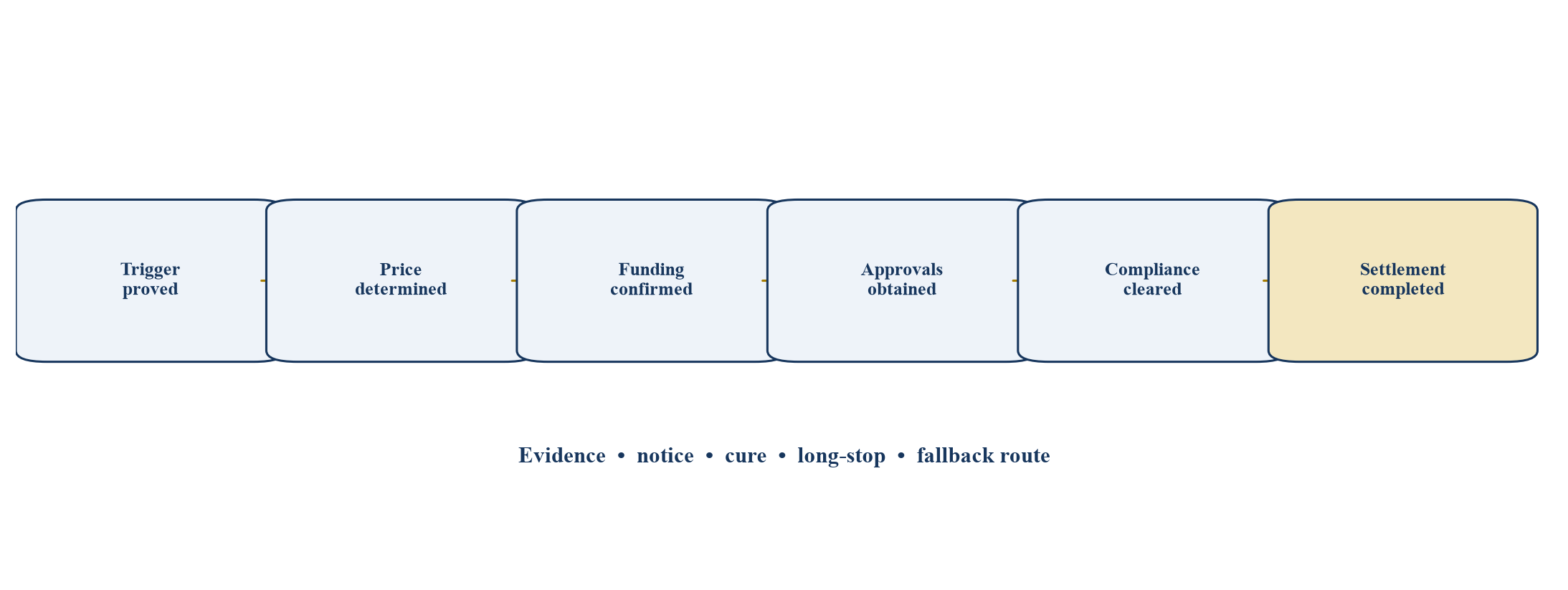
Every stage requires evidence. Failure at one stage should redirect the parties to an alternative route or a documented waiver.
17. Compare scenario proceeds without implying certainty
The four scenarios show different forms of value. A strategic sale converts the whole holding into cash, subject to closing adjustments. An IPO creates quoted value but may delay monetisation. A private secondary provides partial cash and leaves residual exposure. A downside process may produce no immediate sale and instead change governance or control.
| Route | Illustrative equity value | Investor gross value or proceeds | Liquidity character |
|---|---|---|---|
| Strategic sale | USD 600m | USD 120m cash before adjustments | Full, conditional on closing |
| Public listing | USD 900m | USD 180m quoted value before dilution | Staged, subject to lock-up and market |
| Private secondary | USD 360m | USD 18m on 25% of investor shares | Partial cash; 75% holding retained |
| Downside process | USD 180m | USD 36m ordinary value indication | Process and control response; funding uncertain |
Gross values exclude dilution after entry, debt and cash adjustments, fees, taxes, preference complexity and market movements. They are illustrative inputs only.
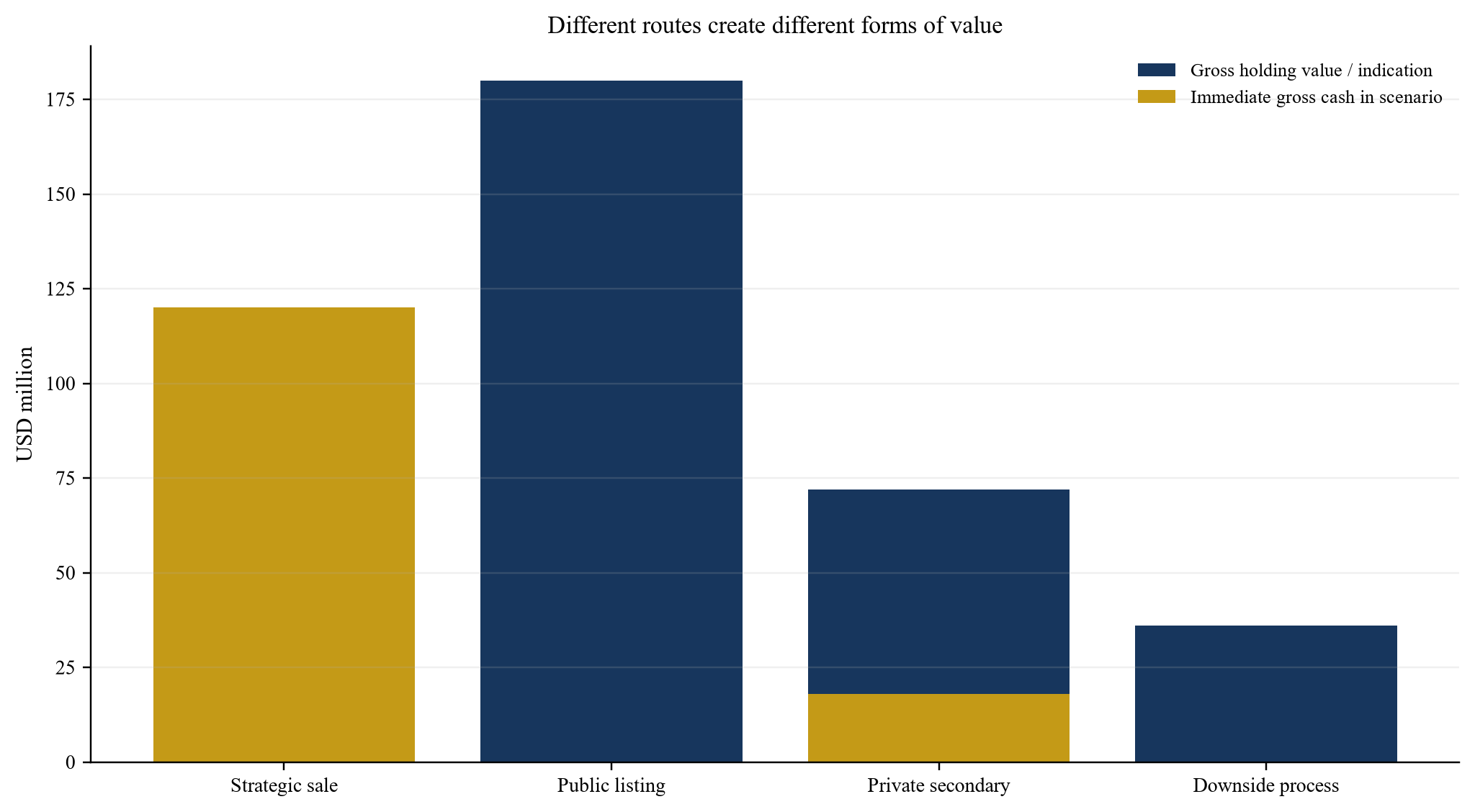
Values are scenario calculations rather than forecasts. IPO value is quoted value, and downside value is an indication rather than assured proceeds.
18. Protect minority fairness and manage conflicts
Exit and control decisions frequently involve conflicts. A founder may negotiate employment, rollover or non-compete terms. An investor may seek liquidity while holding a board seat. A controlling shareholder may prefer a buyer or transaction structure that disadvantages another class.
The governance process should identify interested directors, require disclosure and use disinterested approval where appropriate. An independent committee may commission valuation or fairness advice, test alternatives and document its reasoning. The OECD principles emphasise equitable treatment, protection of shareholder rights and effective management of conflicts and related-party transactions.
Class rights and constitutional approvals should be mapped separately from contractual consents. A shareholder agreement cannot by itself eliminate statutory protections. Delaware law also requires transfer restrictions to meet applicable notice and validity conditions. UK squeeze-out and sell-out provisions apply only when statutory conditions are met.
The record should show the information considered, alternatives, allocation of benefits and treatment of dissenters. This evidence supports both a sound decision and later diligence.
19. Map securities, takeover and listing regulation
Private shares remain subject to securities law. In the United States, a resale generally requires registration or an available exemption. Rule 144 and other exemptions impose conditions that vary with holding period, affiliate status and issuer information. A broad repurchase or tender can trigger additional rules.
In the United Kingdom, the Takeover Code can apply to relevant companies and transactions. The current Code requires a mandatory offer in specified circumstances when a person and concert parties cross or increase holdings within the 30 to 50 per cent range. Offer conditions and equal-treatment principles can affect structure. Companies Act squeeze-out and sell-out provisions create statutory routes at high acceptance thresholds.
An IPO route must reflect current listing and public-offer requirements. In January 2026, UK public-offer and admission-to-trading reforms and related listing-rule changes came into force. Entry documents should use adaptable definitions and require compliance with the rules in effect at the transaction date.
ADGM and other jurisdictions have their own company, insolvency, market and court frameworks. Cross-border structures can involve several regimes at once. Local counsel should map the issuer, holders, buyer, offer location, listing venue and regulated activities before launch.
20. Build a complete decision and execution matrix
| Right or route | Trigger evidence | Price method | Funding source | Primary execution risk |
|---|---|---|---|---|
| Drag-along sale | Bona fide offer and approval threshold | Actual transaction consideration | Third-party buyer | Process conflict and class treatment |
| Tag-along sale | Qualifying controller transfer | Same terms with value-equivalence test | Third-party buyer | Buyer refuses additional shares |
| Right of first refusal | Complete third-party offer notice | Match or economic equivalent | Existing holder | Delay and non-cash equivalence |
| Put option | Date, breach or failed process | Contractual fair value or formula | Company, founder or affiliate | Lawful funds and credit capacity |
| Call option | Milestone, breach or control event | Contractual fair value with stated adjustments | Investor or founder | Funding and regulatory approval |
| IPO pathway | Qualified offering and approvals | Market offering price | Public investors | Readiness, lock-up and market volatility |
The matrix is a planning tool. Definitive requirements depend on jurisdiction, documents and transaction facts.
21. Use a risk heat map to allocate diligence
The company should score probability, impact and controllability. High-severity issues need evidence before signing. The most common red risks are an unfunded put, ambiguous valuation, undisclosed side rights, missing transfer joinders, conflicting class approvals and an option whose exercise would breach law or debt covenants.
Risk assessment should distinguish failure of the right from failure of the underlying business. A company can perform well and still have an unworkable transfer process. It can also suffer an operating setback while the governance architecture functions exactly as intended. Combining these risks in a single score hides the control that the board is trying to test.
The heat map should assign an owner and a next evidence date. Legal counsel can own enforceability analysis, the chief financial officer can own capitalization and funding evidence, and the board committee can own conflict controls. A rating should move only when new evidence changes probability, impact or controllability. Repeating an unchanged rating without evidence creates false comfort.
The company should also model correlated failure. A downturn can reduce valuation, constrain lawful repurchase capacity, breach debt covenants and make third-party financing unavailable at the same time. The downside route needs to work under this cluster rather than under an isolated legal assumption. A staged process, preservation of cash and early buyer outreach can provide more resilience than a large immediate payment obligation.
| Risk | Worked-case rating | Evidence required | Proposed control |
|---|---|---|---|
| Unfunded compulsory purchase | High | Funding plan and lawful-payment analysis | Process fallback, instalments and solvency condition |
| Ambiguous fair-value standard | High | Draft valuation instruction and test calculation | Complete unit, date, premise and expert procedure |
| Conflicting transfer rights | Medium to high | Consolidated rights matrix | Priority, suspension and waiver rules |
| Minority process conflict | Medium to high | Conflict register and approval map | Disinterested committee and documented alternatives |
| Cap-table drift | Medium | Fully diluted model after each issuance | Threshold recalculation and joinder controls |
| Regulatory change | Medium | Jurisdiction and transaction perimeter | Current-law condition and specialist advice |
| IPO execution | Medium | Readiness assessment and adviser plan | Conversion, lock-up and staged-sale provisions |
| Settlement failure | Medium | Funds flow, escrow and deliverables list | Closing agent, long-stop and failure remedies |
Ratings illustrate the worked case and require transaction-specific reassessment.
22. Implement the architecture through a controlled process
Implementation begins during term-sheet negotiation. The parties should agree the destination routes, commercial triggers and core price principles before detailed drafting. Counsel can then translate the architecture into constitutional documents, shareholder agreements, subscription documents, incentive plans and board procedures.
The company should produce a rights matrix, capitalization model, route diagram and specimen exercise calculation. A tabletop exercise can test a strategic offer, a founder transfer, an IPO and a downside review. If the team cannot identify the decision-maker, documents, timetable and funds flow for each scenario, the architecture remains incomplete.
After closing, the board should review exit readiness at least annually and after material financings or acquisitions. The review should update ownership, thresholds, regulatory perimeter, audited-information readiness and likely funding sources. It should record which rights have expired, converted or become impractical.
The implementation team should maintain a responsibility matrix. The company secretary controls notices and signed documents. Finance maintains the fully diluted model, valuation inputs and funds-flow capability. Legal advisers monitor restrictions and approvals. Management maintains transaction-ready commercial information. The board or a designated committee owns route selection and conflict decisions.
A process budget should be approved before a right is exercised. Valuation, legal, accounting, tax, regulatory and adviser costs can be material, particularly when a route fails. The documents should state which costs the company bears, which follow the selling holders and which can be deducted from proceeds. The allocation should avoid giving one party an unchecked ability to spend company cash on a private liquidity objective.
Communications also require control. Premature disclosure of a possible sale or listing can affect employees, customers, lenders and securities-law analysis. A small transaction team, approved disclosure protocol and clean-team arrangement can protect confidentiality while allowing qualified bidders to complete diligence.
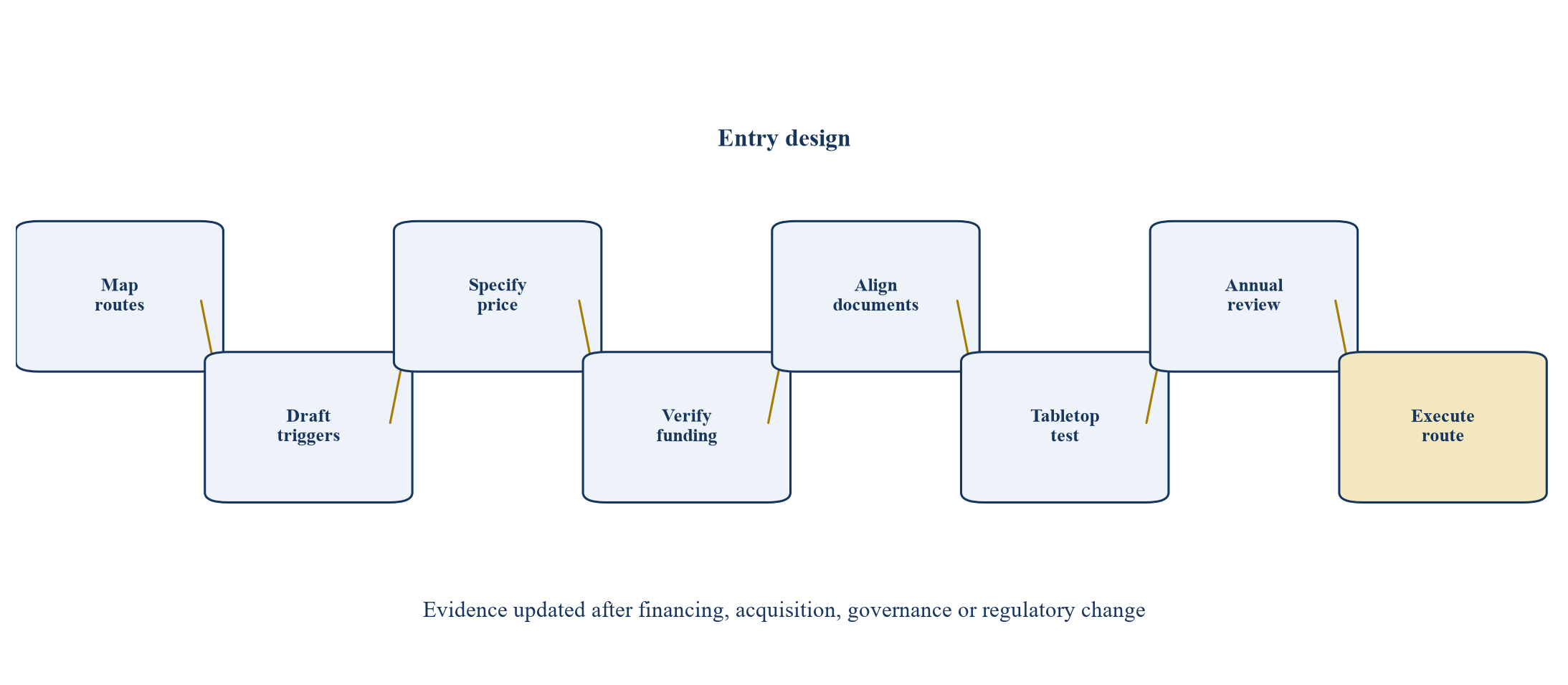
The cycle should be repeated after material capital, ownership or regulatory changes.
23. Maintain a decision-grade data room
The data room should contain current constitutional documents, shareholder agreements, side letters, capitalization records, board and shareholder approvals, option registers, transfer notices, waivers, debt covenants and regulatory correspondence. Every holder should have executed the required joinder.
Transaction readiness also requires audited financial statements, tax records, material contracts, intellectual-property ownership, employment arrangements and compliance evidence. These materials affect value and closing conditions even when the exit clauses are perfect.
The company should maintain a rights abstract that links each conclusion to the signed source document. The abstract is a navigation tool rather than a substitute for legal review. Version control matters because an old side letter or unrecorded waiver can change a threshold.
An annual legal and financial readiness review can convert this material into action. Missing consents can be cured, dormant entities removed and cap-table discrepancies reconciled before a buyer discovers them.
The data room should also preserve the evidence behind valuation adjustments. Debt-like items, working-capital policies, customer concentration, contingent liabilities, capitalised development costs and related-party arrangements frequently change the bridge from headline enterprise value to shareholder proceeds. A buyer will test these matters regardless of how the shareholder agreement defines fair value.
Information rights should support readiness without exposing sensitive material indiscriminately. Role-based access, confidentiality duties, clean teams and board escalation can separate legitimate investor oversight from competitively sensitive information. A departing investor should return or destroy material in accordance with the agreement while retaining records required by law.
The company should run an annual mock diligence request. Management can measure response time, locate approval gaps and identify metrics that cannot be reconciled to audited or controlled sources. This exercise turns the data room from a static archive into an operating control and gives the board evidence about the likely execution timetable.
24. Limitations and conclusion
The framework is a transaction-design method rather than legal, tax, accounting, regulatory or investment advice. Enforceability depends on jurisdiction, corporate form, insolvency position, documents and facts at the time. Valuation standards and securities rules can change. The worked case simplifies preferences, debt, taxes, dilution and transaction adjustments.
A minority investment reaches a stronger endgame when the parties design several credible routes at entry. The central discipline is the trigger-price-funding chain. A route also needs approvals, compliance and settlement mechanics. Drag, tag, first-refusal, put, call and IPO rights should be evaluated by the function they perform and the evidence needed to use them.
The company should preserve strategic flexibility while removing avoidable ambiguity. A route hierarchy, conflict process, valuation instruction, funding analysis, rights matrix and annual readiness review make the architecture operational. These controls cannot determine which future transaction will occur. They can give the board and shareholders a defensible method for moving from minority ownership to liquidity or control when circumstances support it.
Sources
- National Venture Capital Association, Model Legal Documents, including Investors’ Rights, Voting, and Right of First Refusal and Co-Sale agreements, accessed 17 September 2026, Read the primary source
- Delaware General Assembly, Delaware General Corporation Law, Title 8, section 202, restrictions on transfer and ownership of securities, accessed 17 September 2026, Read the primary source
- Delaware General Assembly, Delaware General Corporation Law, Title 8, section 251 and related merger provisions, accessed 17 September 2026, Read the primary source
- UK Parliament, Companies Act 2006, Part 28 Chapter 3, squeeze-out and sell-out provisions, accessed 17 September 2026, Read the primary source
- UK Takeover Panel, Takeover Code Rule 9.1, circumstances requiring a mandatory offer, accessed 17 September 2026, Read the primary source
- UK Takeover Panel, Takeover Code Rule 10.1, requirement for a 50 per cent acceptance condition, accessed 17 September 2026, Read the primary source
- Financial Conduct Authority, Statement on public-offer and admission-to-trading regulations and UK Listing Rules changes effective 19 January 2026, accessed 17 September 2026, Read the primary source
- U.S. Securities and Exchange Commission, Private Secondary Markets, registration and exemption framework for private resales, accessed 17 September 2026, Read the primary source
- U.S. Securities and Exchange Commission, Rule 144: Selling Restricted and Control Securities, accessed 17 September 2026, Read the primary source
- U.S. Securities and Exchange Commission, Private Companies and the SEC, accessed 17 September 2026, Read the primary source
- U.S. Securities and Exchange Commission, Tender Offer Rules and Schedules, Compliance and Disclosure Interpretations, updated 9 July 2026, accessed 17 September 2026, Read the primary source
- U.S. Securities and Exchange Commission, Exit Strategies and Liquidity, accessed 17 September 2026, Read the primary source
- IFRS Foundation, IFRS 13 Fair Value Measurement, accessed 17 September 2026, Read the primary source
- OECD, G20/OECD Principles of Corporate Governance 2023, shareholder rights, equitable treatment and conflict safeguards, accessed 17 September 2026, Read the primary source
- Abu Dhabi Global Market, Companies Regulations 2020, accessed 17 September 2026, Read the primary source
- Abu Dhabi Global Market Courts, Ekar Holding Limited shareholder dispute judgment concerning a drag-along process, 15 November 2022, accessed 17 September 2026, Read the primary source
