

1 A file can be absent for different reasons
An issuer preparing an equity raise may discover that a financial audit is unfinished, the signed customer agreement behind a revenue claim is missing, or the capitalisation table does not match the share register. Each problem can interrupt a financing conversation. The interruption may arise because a reviewer cannot verify an attractive claim. It may arise because the missing record conceals a different economic position from the one in the deck. It may also arise because the investor's mandate, ticket or risk appetite did not fit the transaction at all. The treatment should follow the actual reason.
This paper asks how these gaps can affect investor progression and the cost of capital raising for a GCC mid-market company. An observed investor drop-off rate would require records of approaches, requested documents, stage changes and reasons for decline across funded and unfunded cases. Such a dataset was not available for this paper. The analysis instead defines events a company can record, maps plausible cost channels and illustrates arithmetic under labelled assumptions. It does not convert a request for more information into evidence that the investor would otherwise have funded the business.
The principal decision is whether to launch outreach now, repair a material gap first, or redesign the proposed instrument. The answer depends on the investor's actual request, the company's cash runway, the nature of the gap and the time needed to obtain reliable evidence. A board should state the legal issuer, amount, share class, current ownership and use of proceeds before grading data-room readiness. A beautiful room of documents cannot compensate for an undefined transaction.
The scope covers private, unlisted corporate equity raises involving GCC operating groups, with a fictional UAE case used for illustration. Company and securities rules differ across jurisdictions and free zones. References to ADGM law apply only to entities within that perimeter. Any specific issuance, shareholder consent or disclosure question requires the applicable documents and qualified legal advice. The framework is a decision aid for management, investors and advisers; it is not a rulebook for every capital provider.
2 The missing file, the hidden fact and the counterfactual
The phrase 'missing file cost' is useful only if it identifies the counterfactual. Consider a signed customer contract absent from the initial room. If the contract exists, matches the deck and can be retrieved quickly, the gap may cause a short verification pause. If the signed terms permit termination before the forecast period, the financing case itself changes. If the investor declined because the ticket was too small, retrieving the contract would not have changed that decision. The same visible data-room gap therefore supports different interpretations.
Define a document gap as a source that a named reviewer has requested and the issuer cannot currently supply in an acceptable form. Define a fact gap as a material proposition for which no reliable source exists, or for which available records conflict. Define a route gap as a mismatch between the transaction and the capital provider's mandate or decision authority. These categories are author-developed. They should be recorded as separate fields because their remedies differ: retrieval, accounting or legal reconciliation, commercial re-underwriting, or counterparty reselection.
An incremental cost can be attributed to a gap only when three questions have support. Did it lie on the critical path to the next decision? Would an earlier complete and accurate source have changed that path? What cash, fees or ownership effect followed during the incremental period? The issuer may be able to observe a date and a payment. Attribution to the gap usually remains a judgment unless investor records or a comparable counterfactual support it. A board memo should label the observed event, management's interpretation and the scenario result separately.
This discipline prevents false conclusions from a weak sample. A company may approach ten investors and hear nothing from six. The silence is an observed outcome of the approaches; it is not an observed vote on its missing audited accounts. Another investor may request a contract and later decline. The request and decline are dated facts, while causation requires the investor's stated reason and a careful assessment of alternative explanations. A fundraising process can learn from these records without inventing a conversion statistic.
3 What public material says about the evidence
The Central Bank of the UAE's Credit Risk Management Standards require covered licensed financial institutions to conduct robust credit due diligence, collect comprehensive financial information and document credit decisions. For wholesale obligors, the standards describe a formal process for financial analysis based on audited financial statements from reputable firms [1]. This is direct evidence about a regulated lending workflow. It is not an equity-fund rule or proof that every GCC investor requires a completed audit at the first meeting.
The International Auditing and Assurance Standards Board's ISA 700 addresses how an auditor forms an opinion and reports on financial statements [2]. An audit report provides an identifiable assurance output for the financial statements it covers. Its existence does not validate a later management forecast, a customer contract that has changed, or the capitalisation table. An equity investor can still seek quality-of-earnings work, accounting-policy explanations and access to current management accounts.
IFRS 15 sets principles for reporting revenue from contracts with customers, including the nature, amount, timing and uncertainty of revenue and cash flows [3]. IAS 7 sets the framework for reporting operating, investing and financing cash flows [4]. These standards help specify which bridge a reviewer needs when a deck highlights revenue growth and the issuer's available cash is moving differently. Their application depends on the reporting framework and actual contract terms.
IFC publicly describes the preliminary information requested in its financing proposals and a subsequent process of appraisal and review [5, 6]. This is a concrete institutional example of staged decisions. IFC's development mandate and eligibility criteria make direct transfer to a GCC family office or private equity fund inappropriate. The paper uses IFC material to justify a distinction between initial interest, appraisal and approval, while relying on the actual counterparty's request list for transaction work.
4 Define investor progression before measuring drop-off
A credible stage ledger needs an event definition for each step. 'Approached' means the issuer or authorised adviser sent a specified transaction description to a named counterparty. 'Qualified response' means that counterparty acknowledged mandate relevance and asked a substantive question. 'Room opened' means controlled access was granted; it does not prove that files were reviewed. 'Diligence advanced' means a named reviewer accepted a defined next workstream. 'Investment decision' requires a formal acceptance, decline or documented pause at the relevant authority. 'Funded' means proceeds reached the issuer.
Drop-off should be an outcome category with a stated reason where available: declined, withdrawn by issuer, expired, paused, mandate mismatch, or no response by a predetermined cut-off. A company should preserve open cases and dates. If it counts only funded deals, the analysis will overlook approaches that stopped after an unresolved evidence request. If it treats every non-response as a document rejection, the analysis will overstate an unsupported cause.
An event record can include the material requested file, its version, request date, accepted date, investor's stated concern, issuer response and whether another task was simultaneously gating progress. Private communications should be stored with consent and access controls. The investor's words should be captured accurately; the issuer's interpretation belongs in a separate field. An adviser can classify a problem as likely material, but that classification should remain attributable to the adviser and open to challenge.
Published venture-capital survey research shows that professional investors use multiple selection criteria and that practices differ across investor types [7]. Its respondents and period do not provide a GCC mid-market drop-off rate. The stage ledger is designed to generate a local evidence base where permission is available. Until that work is done, this paper discusses pathways and illustrative scenarios rather than claiming to know how often a particular missing file changes an investment decision.
5 Audited accounts and the limits of their signal
Audited financial statements can reduce ambiguity about the historical entity, accounting period, policies and auditor's opinion. The first check is whether the audit covers the same legal perimeter as the proposed issuer and the operating business valued in the raise. A holding-company audit may exclude a material subsidiary acquired after year end. An operating-company audit may not cover the debt and shareholder rights at the holding company that will issue new shares. The audit file should therefore sit beside an entity bridge and current management accounts.
A missing audit can have several explanations: the statutory timetable has not reached completion, the scope is being expanded, management has not reconciled records, or the company did not commission an audit. These explanations carry different implications. The company should state the reporting period, audit status, outstanding questions and expected completion evidence. A management draft must be marked as unaudited. A signed audit report should be presented with its opinion and any relevant emphasis or qualification, rather than as a generic badge of credibility.
Prior research warns against a universal price claim. A 2020 study of voluntary audits in four Latin American countries reported a positive association with financing access in its sample [8]. A 2026 study of small private firms examined self-selection and reported higher, rather than lower, interest rates among voluntarily audited firms in its setting [9]. These studies concern different populations and financing channels. Neither estimates how a GCC equity investor prices a particular issuer's missing audit. They show why a causal benefit should not be assumed from the mere presence of a report.
For the board, the practical test is narrower. Can historical revenue, margin, working capital, debt and cash be reconciled to the current investment perimeter? Does the audit status create a specific counterparty condition or prevent approval under that investor's policy? Can a pending audit be completed before the next decision without threatening runway? The answers may lead to targeted preparation, a condition in a term sheet or a different fundraising sequence. The absence of an audit should not be described as a universal valuation discount.
6 Customer contracts and the commercial bridge
Customer evidence spans a chain: proposal, purchase order, signed agreement, performance, invoice, acceptance and cash receipt. These records do not support identical claims. A deck may describe a nonbinding pipeline as contracted revenue, or recognise revenue before cash is collected. A financier examining a growth case needs a bridge from the contract's rights and performance conditions to reported revenue and forecast cash. IFRS 15 provides accounting principles for the revenue portion [3]; the legal enforceability and commercial outcome depend on the actual agreement.
A contract ledger should identify the customer and contracting entity, effective and expiry dates, minimum commitment, termination rights, delivery obligations, payment terms, currency, dispute rights and amendments. It should reconcile signed value to recognised revenue and collections. For a project business, the ledger should distinguish an award from a notice to proceed, certified work, approved variation and disputed claim. For a subscription business, it should distinguish annual recurring revenue from usage-based or cancellable fees. The fields are preparation choices, not a universal investor template.
The missing-file issue can become a fact issue when a recovered agreement weakens the investment thesis. A termination right may reduce the protected cash flow; a side letter may change the margin; an assignment restriction may constrain collateral or a sale. The appropriate response is to correct the deck and model. Concealing the terms risks a later diligence failure and can damage credibility. An investor might still value the business after the correction, but the revised case must be explicit.
Concentration raises another question. When a few contracts drive the forecast, a missing source for one account can have a large decision effect. The board should stress the loss or delay of the most material account and show whether the proposed raise still funds the intended milestone. No public source reviewed here gives a single GCC contract-concentration cut-off for equity investors. The actual investor's mandate and the company's economics determine materiality.
7 Capitalisation records and decision authority
The capital table is a financial model of ownership. The legal register, constitutional documents, signed subscription agreements, option plans, convertible instruments and board or shareholder resolutions are the sources that can establish its inputs. A spreadsheet alone may omit granted options, conversion rights, preference shares, transfer restrictions or pre-emption rights. The issuer should reconcile issued shares, fully diluted shares and any instrument that can change either denominator.
ADGM's Companies Regulations require a register of members for companies within its jurisdiction, with entries that include members and share holdings [10]. The rule is an example of why a private spreadsheet should be checked against formal records. Other GCC jurisdictions have their own company laws and filing systems. The paper does not imply that ADGM law governs every GCC issuer. Any assessment of an issuance, waiver or historical allotment should use the law and constitutional documents of the actual legal entity.
A capital-table defect can affect the transaction in several ways. It can prevent an accurate statement of the shares the new investor will receive. It can reveal that a consent or waiver is required. It can alter how much of the company existing owners retain at a given pre-money price. It can change voting, liquidation or information rights. These are potentially substantive facts, not mere missing annexes. The board should commission a reconciliation and legal review when records conflict, rather than adjust spreadsheet cells until the requested percentage appears.
The initial investor pack can include a current legal register, a fully diluted bridge, a schedule of options and convertibles, relevant shareholder rights, and a list of approvals needed for the proposed issue. Each document should have an effective date and a reviewer. A waterfall model should separate current ownership from hypothetical post-raise ownership. No decision about who legally owns shares should be made from the cap table model alone.
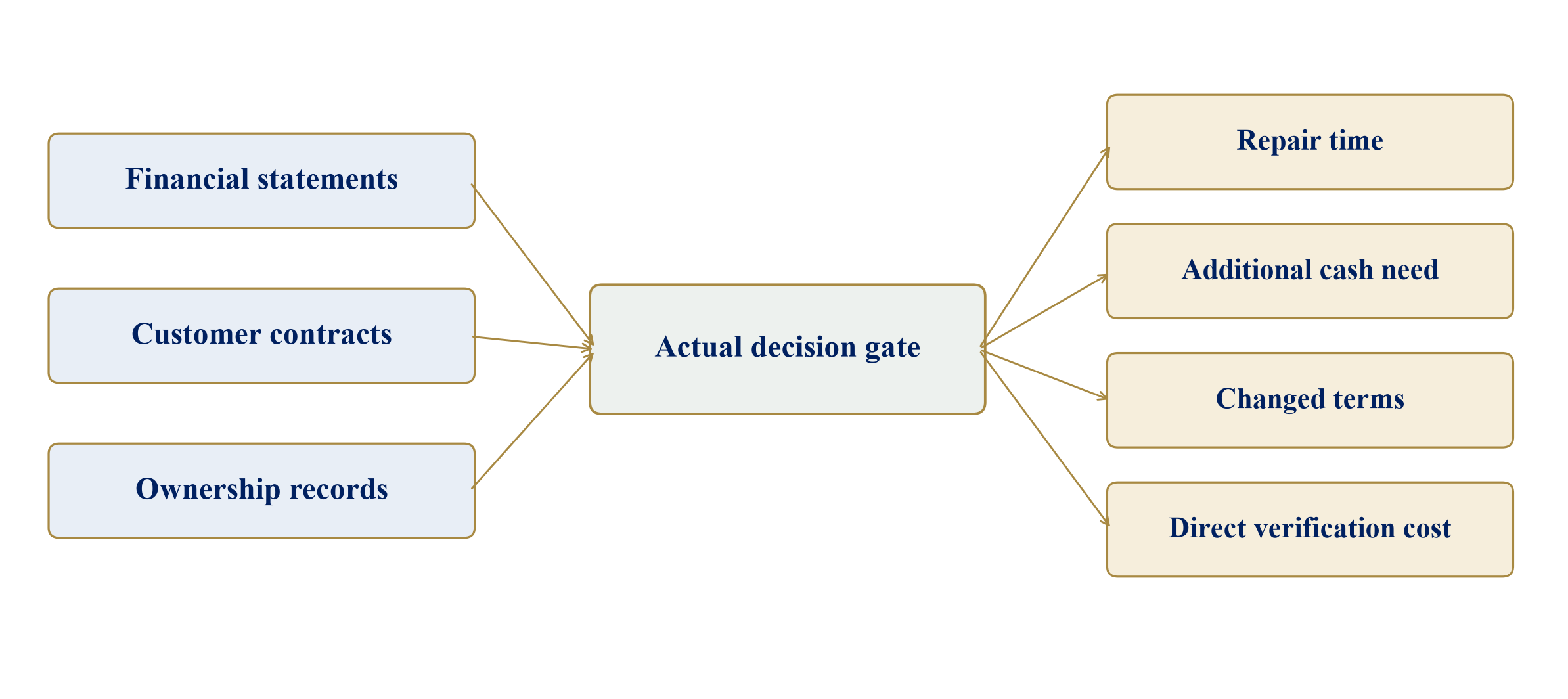
Author-developed causal map. Arrows identify possible mechanisms; they do not establish observed investor behavior or a causal effect in any specific raise.
8 Debt and equity require different readiness tests
The tracker for an equity raise may contain a lender alternative. Debt can preserve present ownership but requires a repayment case, credit approval and often security or covenants. Equity has no scheduled principal repayment but changes ownership and control rights. A company may seek debt while repairing its equity file, or consider equity when cash flows cannot support amortising debt. The instruments should be compared on downside cash and legal capacity, not on a simplistic headline cost.
Table 1 separates the evidence needed for each route. It is an author-developed preparation matrix, not a claim that every fund and lender asks the same questions. A company should mark the actual counterparty's requirements against it. The table also prevents a mistaken assumption that an audit or contract file has the same decision purpose for both instruments.
Table 1. Evidence domains for equity and debt readiness
| Evidence domain | Equity decision question | Debt decision question | Source to reconcile |
|---|---|---|---|
| Historical accounts | What earning power and cash use support value? | What cash flow supports scheduled payment? | Audit, management accounts, bank bridge |
| Customer agreements | How durable is growth and margin? | Which receipts are available for repayment? | Signed contracts, amendments, invoices, collections |
| Ownership | What share class and dilution will be issued? | Who controls the obligor and guarantor? | Register, cap table, rights and options |
| Forecast | What milestone can the raise reach? | What stressed debt-service capacity remains? | Versioned model, assumptions, sensitivities |
| Existing capital | Which rights rank ahead of new equity? | Which debt and security rank ahead? | Debt schedule, shareholder agreements |
| Authority | Who must approve the issue or waiver? | Who may borrow and pledge assets? | Constitutional documents, minutes, consents |
Author-developed crosswalk. Actual requirements depend on the financier, issuer and applicable law.
The Central Bank's standards establish a specific underwriting floor for covered UAE lenders [1]. An equity investor's diligence can be extensive without being governed by that bank standard. Management should record the cost of each route under an explicit scenario: new shares and rights for equity; interest, fees, covenant and refinancing exposure for debt. A bridge may buy time for equity diligence, while its maturity can also increase pressure if the equity process slips.
9 Four channels of a conditional missing-file cost
The first channel is direct repair expense: accounting reconciliation, audit completion, legal advice, consent work or a specialised valuation. These costs can often be recorded from invoices. The second is incremental time: extra months of operating cash need before funding. Time has an economic cost only when it changes cash use, opportunity, financing need or risk. The third is a change in instrument or terms, such as a bridge instead of planned equity. The fourth is a changed business valuation after a source reveals weaker fundamentals. The fourth channel should be attributed to the new economic fact, not automatically to the delay in locating the file.
The cost ledger should show the baseline financing plan and each alternative scenario. At minimum, record the intended raise amount E, pre-money valuation V, expected funding month, cash balance, burn and critical milestones. For a simple primary-share issue, post-raise investor ownership is E divided by V plus E. The formula assumes the stated valuation basis, share class and no other changes in fully diluted shares. Real transactions can include options, preferences, secondary sales and contingent rights that require a fuller model.
When a delay creates additional cash need, update E using the period of incremental cash outflow after mitigation. When a separate diligence finding changes the value case, update V under a clearly labelled assumption and show the reason. Keep a no-repricing scenario beside any repricing scenario. This decomposition avoids presenting a valuation haircut as an observed penalty for missing paperwork when it may reflect customer economics, market changes or negotiations.
Probability-weighted 'expected costs' require probabilities grounded in an issuer's own historical data or an appropriate cohort. This paper has neither. It uses scenario comparisons and sensitivity ranges. A board can still make a decision: if repair takes longer than available runway, it needs a contingency; if a source can be verified before outreach, that sequence may save a question cycle. The framework clarifies exposure without pretending to know the odds of approval.
10 A wholly fictional dilution illustration
Assume an invented UAE mid-market company plans to raise AED 30 million at an assumed AED 120 million pre-money valuation. Under a plain primary-equity model, the new investor would own 30 divided by 150, or 20.0 percent, immediately after the issue. Assume its independent audit is delayed and the board's cash plan requires AED 1 million per additional month. If funding moves three months later and the cash outflow is not otherwise reduced, the company might seek AED 33 million. At the same assumed valuation, 33 divided by 153 equals about 21.6 percent. The 1.6 percentage-point difference comes from the larger assumed amount in this teaching model.
Consider a second, separate assumption: a recovered customer amendment and corrected forecast lead the board to test an AED 100 million pre-money valuation. If the company still seeks AED 33 million, the model yields about 24.8 percent post-raise investor ownership. The 4.8 percentage-point difference from the original plan combines a larger raise and a lower assumed valuation. It cannot be described as an observed cost of the missing audit; the valuation assumption relates to a commercial fact and could be affected by many other factors.
In both scenarios the illustrative transaction may have different share rights, options or existing convertibles. The arithmetic is a transparent simplification, not a term sheet, lender quote or market benchmark. A real board should add the actual fully diluted share base, rights waterfall and pre-emption or consent requirements before using such a calculation in a decision.
Table 2 keeps the assumptions separate. Its purpose is to let a board ask which part of a possible dilution change is driven by cash timing and which part by a revision to underlying value. Without a documented investor response, neither line predicts how a live investor would price the company.
Table 2. Fictional equity scenarios and ownership arithmetic
| Case | New equity sought | Assumed pre-money value | Simple investor ownership | What changes |
|---|---|---|---|---|
| Original plan | AED 30m | AED 120m | 20.0% | Baseline assumption |
| Extra cash need only | AED 33m | AED 120m | 21.6% | Three assumed months at AED 1m net outflow |
| Extra cash and revised value | AED 33m | AED 100m | 24.8% | Separate lower valuation assumption |
All AED amounts, durations and valuations are invented teaching assumptions. No actual GCC transaction or valuation penalty is represented.
11 Put the fundraising calendar beside the cash calendar
An equity process has at least two clocks. The transaction clock records outreach, document requests, investor review, committee or partner decisions, negotiation, consents and settlement. The operating clock records payroll, supplier obligations, capital expenditure and customer collections. A document gap can be costly when it shifts the first clock beyond a cash constraint on the second. A gap repaired before the investor's next available decision date may have no incremental cash effect even if staff spent days resolving it.
Figure 2 draws these clocks as parallel tracks. Its intervals are illustrative and contain no observed GCC median. In a live process the issuer should replace every placeholder with dated events and the actual counterparty's decision calendar. It should also identify tasks running concurrently: an audit may be completed while an investor evaluates customers, and a cap-table reconciliation may be completed while legal counsel drafts terms. Adding every workstream's duration would double count elapsed time.
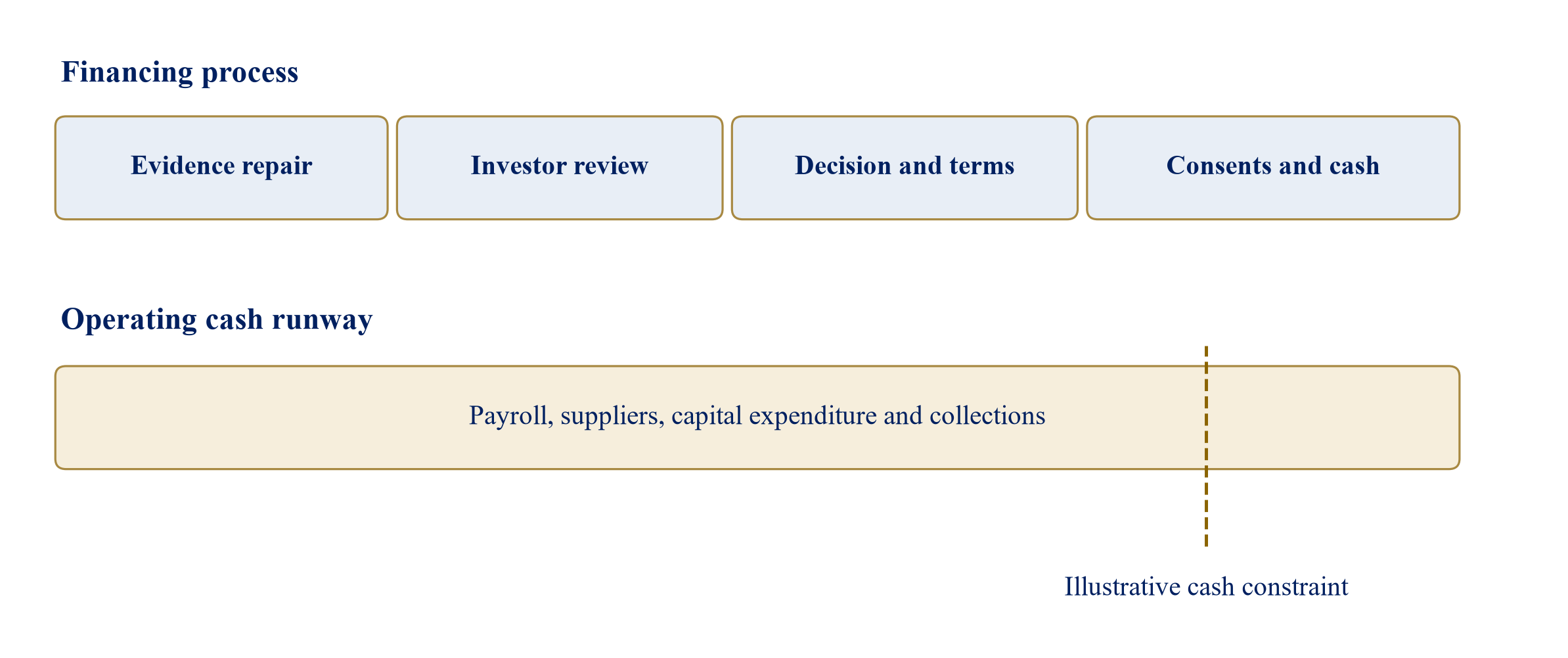
Author-developed illustrative sequence. Lengths and positions are not observed fundraising durations.
The board should record the date by which a complete source must be available to affect the next financing decision. It should also record the date by which cash must be received to avoid a contingency. The interval between those dates governs urgency. A direct cost estimate should include only expenditures causally linked to the repair. A scenario for extra equity should use the forecast cash shortfall that remains after available management actions. These distinctions make the timeline an economic instrument rather than a decorative project plan.
12 A document checklist with decision purpose
A checklist can show what is missing while concealing why it matters. The proposed register therefore attaches each file family to a claim, an owner, a legal entity, a period and the next decision that needs it. It also records the status as present and checked, present but unreconciled, requested, unavailable or inapplicable. 'Present' should not imply 'accepted by investor'. The actual counterparty may ask for different items or deeper testing.
Table 3 covers the three evidence domains and the financing perimeter. Its source list is a preparation proposal. The issuer should add local statutory filings, sector licences, tax records and material related-party arrangements where they affect the transaction. It should avoid collecting sensitive personal or customer information merely to fill an index. Access should be proportionate to the financing stage and permitted disclosure.
Table 3. Equity-raise document checklist tied to decision use
| File family | Decision it can inform | Verification point | Repair owner |
|---|---|---|---|
| Audited accounts and auditor report | Historic financial perimeter | Opinion, period, entity and adjustments | Finance and auditor |
| Current management accounts | Since-year-end performance | Reconcile to audit and bank cash | Finance |
| Customer agreements and amendments | Quality of revenue and backlog | Conditions, cancellation and side letters | Commercial and legal |
| Invoice, receipt and ageing bridge | Cash conversion | Customer acceptance and disputes | Finance and operations |
| Share register and constitutional documents | Issued ownership and authority | Current holdings, class rights and filings | Company secretary and counsel |
| Options, convertibles and rights schedule | Fully diluted ownership | Exercise, conversion and consent terms | Finance and counsel |
| Forecast and sources-and-uses model | Funding amount and runway | Assumptions, cash trough and version | Finance and board |
| Existing debt and security schedule | Ranking and financing constraints | Covenants, negative pledge and consents | Treasury and counsel |
Author-developed checklist. Legal applicability and investor requirements require transaction-specific confirmation.
The register should retain rejected or superseded versions with dates. If an audited balance changes after an adjustment, every valuation bridge and use-of-proceeds assumption that depended on it should be reviewed. If a customer amendment changes committed revenue, the model and pitch should show the new baseline. If the share register changes, the fully diluted bridge and board authority should be updated. A folder count cannot perform this dependency test; a claim-to-source map can.
13 Sequence repairs by criticality and lead time
An issuer with three simultaneous gaps needs a repair sequence. Start by identifying a hard legal or economic constraint: can the proposed issuer issue the specified shares, and does the corrected operating case support the ask? Next identify the longest lead item, such as audit completion or a shareholder consent. Then identify evidence needed to keep an active investor's next decision on track. This order may differ from a tidy data-room index. It should be reviewed against actual dates and counterparties.
A repair owner should define acceptance in advance. 'Final audit' means a signed report for the identified entities and period, with management accounts linked to it. 'Customer contract' means the executed agreement and material amendments, with a reconciled commercial schedule. 'Cap table' means a checked bridge to the legal register and all relevant rights. The deliverable should answer the investor's actual question. Sending another version of a spreadsheet without the signed source may leave the gate unchanged.
Figure 3 separates three questions that can otherwise be conflated in a readiness review. The first branch tests whether a source is available and checked. The second tests what the source actually says about the proposed investment case. The third tests whether the investor's mandate and instrument still fit the corrected case. Each branch ends in a distinct board action; none assigns an observed probability of funding.
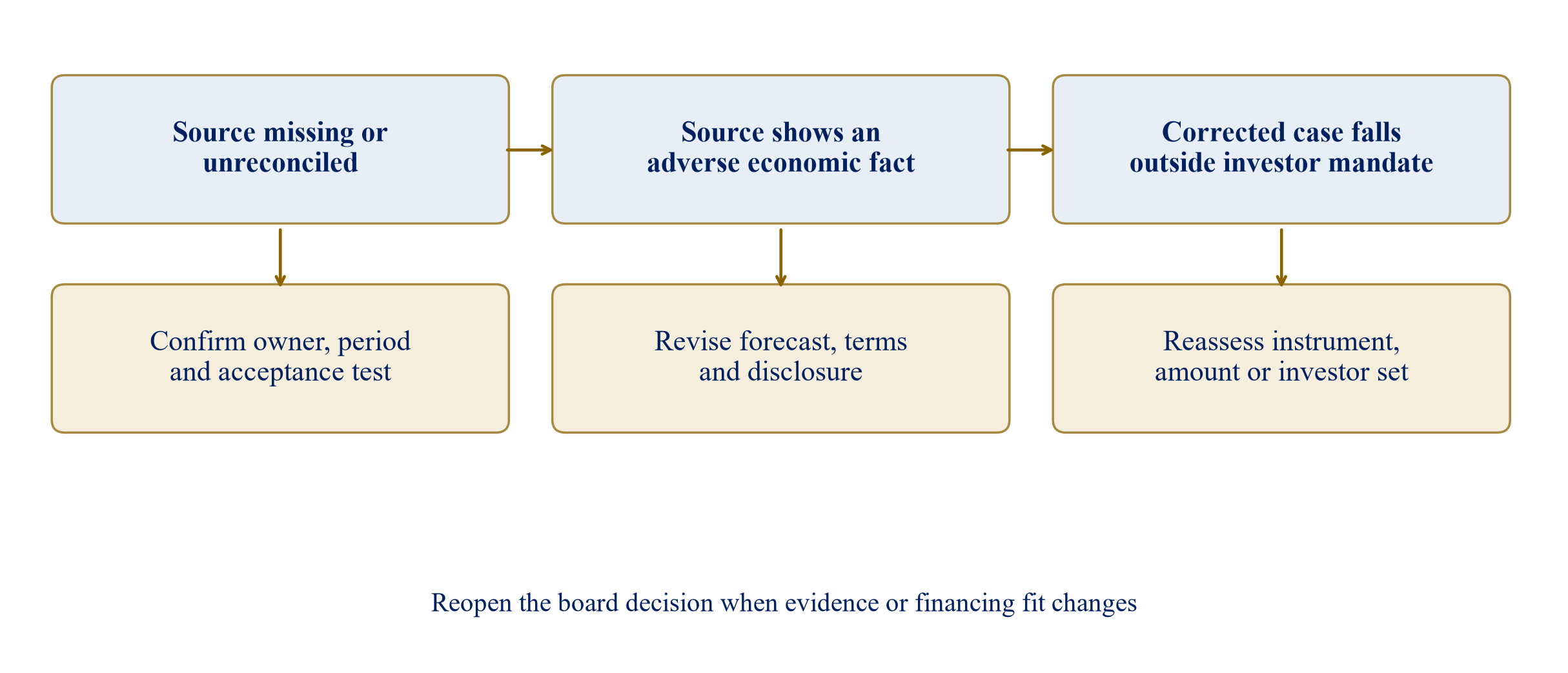
Author-developed decision pathway. Branches are diagnostic options, not observed investor outcomes.
When a gap reveals a substantive problem, management should revisit the transaction plan. Suppose an audit adjustment reduces earnings; a financing case may still work after a transparent restatement, but the valuation argument changes. Suppose the contract has a termination right; a milestone-based raise or lower initial amount may better reflect the risk. Suppose the share register is disputed; legal resolution may be necessary before any issuance. Each outcome is a decision about facts, not a cosmetic document clean-up.
The cost ledger should treat management time as a scarce resource without inventing an hourly market price. It can record actual adviser invoices and internal staff days. It can also identify a missed commercial milestone, but monetary attribution requires evidence that the milestone would otherwise have occurred and that the financing gap caused the miss. Scenario ranges can help a board set contingencies while remaining visibly conditional.
14 The board's readiness decision
The board should receive a transaction definition, a cash forecast, an evidence exception list and a decision request. The exception list should show the claim affected, source missing or contradictory, financier who asked, next gate, repair plan, latest useful date and consequences if the source proves adverse. A director should be able to distinguish a file that is late from a financial result that is worse than anticipated. This distinction affects disclosure, terms and the decision to continue.
Management can choose three actions. It can launch a tightly scoped outreach process with disclosed exceptions and agreed follow-up dates. It can delay outreach until the critical sources are accepted. It can redesign the instrument, amount, entity or target investor list. The action should be compared with the issuer's cash runway and legal authority. A decision memo should record the rationale and an explicit review date. These are author-developed governance options, not advice that one action is always superior.
Approval language matters. A term sheet may be nonbinding, conditional or subject to investment committee approval. A preliminary response can express interest while leaving diligence open. The board should use the counterparty's own description of its stage. IFC's published investment cycle is one institutional example of distinct appraisal and approval stages [6]. For a private fund, the actual fund documents and process govern. Future cash should remain a scenario until a legally effective commitment and settlement path exist.
The board should also record what has changed since it authorised the raise. New options, debt, customer amendments or cash needs can alter the share count and negotiation range. A board-approved amount based on stale financials may not cover the business through the intended milestone. Refreshing the decision papers before advanced negotiations reduces the risk that management presents a commercial case different from the one directors considered.
15 The bridge-financing question
An issuer facing a cash constraint while repairing its equity file may consider short-term debt, shareholder funding or a smaller equity tranche. Each option has a different cost and rights profile. A bridge facility may impose interest, fees, security and a repayment date. A shareholder loan may have priority or conversion rights. A smaller equity tranche may increase later execution risk. The board should model the terms it can actually obtain, along with a scenario in which the planned larger raise does not close.
The hypothetical company from section 10 could cover three assumed months of AED 1 million net outflow with a bridge. The interest and fee cost cannot be calculated without terms. If management tests an illustrative 12 percent annual simple interest rate on AED 3 million for three months, interest would be AED 90,000 before fees, taxes or compounding. That rate is a teaching assumption, not a lender quote or GCC benchmark. The model should separately show any commitment fee, collateral cost and repayment exposure once real terms are available.
A bridge can affect the future equity negotiation. Its maturity may become a hard deadline; covenants can constrain spending; security may require consents; a convertible feature can change fully diluted ownership. The board should test what happens if the equity process extends beyond bridge maturity. It should avoid assuming that short-term funding solves an underlying mismatch between the business and investor mandate. A lender's own credit review and approval remain independent under the applicable regulatory framework [1].
The comparison should use cash and control side by side. A dilution calculation alone omits debt service and downside risk. A debt-cost calculation alone omits ownership and governance rights. The debt-versus-equity matrix provides the questions; the cost ledger shows how a documentation repair can shift the timing and amount under each route. The model should identify any double counting, such as adding the same three months of burn both to the bridge amount and to the later equity ask.
16 Confidentiality, data rights and trust
Evidence repair often involves documents that should not be freely distributed. Customer contracts can contain prices, personal details and restrictions on disclosure. Audit workpapers belong within an auditor's professional framework and may not be appropriate for general circulation. Shareholder registers and beneficial-ownership records can contain sensitive information. ADGM guidance notes that applicable entities maintain beneficial-ownership information and that access to its registry record is restricted [11]. The issuer should assess its own disclosure rights and the investor's legitimate need at each stage.
A staged review can provide a redacted summary for preliminary screening, then controlled access to original records under agreed confidentiality terms. Redaction should preserve the clause needed for the decision. An agreement with every economic term concealed cannot verify contracted revenue. A third-party confirmation can sometimes address a specific fact where the underlying document cannot be shared, but the intended investor must accept that form of evidence. The issuer should agree the path before using a claim as a cornerstone of the pitch.
Version control is a trust control. An investor should be able to identify the document and model version on which its questions were based. If the issuer replaces a source, it should explain the change and its effect on previous statements. A corrected error can be manageable. An unexplained correction can create a new credibility question. The record should include who approved disclosure and whether the board was told about a material change.
The issuer should avoid using a silent data-room download as proof of an investor's reliance. Access logs show that a file was available or opened; they do not establish comprehension, acceptance or an investment decision. Meaningful evidence of progression comes from a dated question, written acceptance of a defined workstream, a term proposal or a formal decision. Privacy safeguards should be built into any future study of these events.
17 GCC scope and the limits of legal transfer
The GCC is not a single company-law jurisdiction. A UAE mainland entity, an ADGM company, a DIFC company, a Saudi company and a cross-border holding structure can have different registers, filing requirements, approval rules and enforcement routes. An investor may buy shares in a holding vehicle while the operating cash and customer contracts sit elsewhere. A missing document can therefore be material because it prevents an entity bridge, even when the operating business is sound.
This paper uses ADGM's member-register provisions as one jurisdiction-specific example [10]. It does not infer a single GCC rule on share issuance or pre-emption. A transaction file should specify the law governing the issuer, material subsidiaries, investment instrument and shareholder rights. Counsel should check consents, historical issuances and transfer restrictions under those sources. Management should mark unresolved legal questions plainly in the screening memo.
Accounting frameworks and audit obligations also vary by entity and circumstance. An investor may request audited consolidated accounts even where an issuer's statutory minimum is different. A lender covered by UAE central-bank standards has its own underwriting duties [1]. The board should distinguish a statutory filing requirement, an investor condition and a management preparation choice. The economic model can apply to all three, but the legal basis should never be merged.
Cross-border groups need a currency and cash-access bridge. An equity raise in a holding company may fund operations in another country; the cash forecast must show permitted transfers, foreign-exchange assumptions and local liabilities. This paper offers no legal or tax conclusion on any transfer. The practical readiness question is whether the capital provider can understand how funds reach the business and how ownership rights relate to the assets and cash flows described.
18 A research design for investor drop-off
A future empirical study would require a consented sample of GCC mid-market equity approaches, including refusals and processes still open at the observation cut-off. For each approach, researchers would capture the issuer and instrument definition, investor mandate, submitted file versions, dated requests, response dates, decision stages, stated reasons, terms and settlement outcome. The study would protect confidential pricing, personal data and committee records through access controls and aggregate reporting.
Before seeing outcomes, researchers should define document-gap variables. An audited-accounts gap could record the period missing, legal perimeter, report status and date accepted. A contract gap could record whether the source was absent, conditional, contradictory or unavailable for lawful disclosure. A capital-table gap could record whether the legal register and fully diluted model reconciled. Independent coders should test agreement on materiality and stage classifications. An investor's stated reason should remain separate from the researcher's inference.
A model could then estimate whether a documented gap is associated with a lower probability of reaching the next stage after accounting for sector, stage, business quality, size, instrument, investor mandate and market conditions. Association would not prove causation. Better businesses may maintain better records, and investors may ask more questions of attractive companies. A repair observed within the same process could support a narrower before-and-after analysis, subject to changes in other facts and investor circumstances.
The study should include both calendar and economics. Record cash burn during a demonstrated critical-path wait, actual repair invoices, bridge terms and final dilution. For unfunded issuers, costs and outcomes still matter. A pre-registered protocol would reduce the temptation to define 'drop-off' after reviewing results. This paper reports no such cohort, regression or average cost. Its proposed ledger is a blueprint for collecting evidence that could eventually answer the question in the title.
19 A practical readiness sprint
A board can begin with a time-boxed diagnostic, using the actual financing calendar rather than an assumed market timetable. The finance team reconciles audited and current accounts, entity perimeter, bank cash and forecast. The commercial team verifies the contracts and revenue bridge that drive the model. Counsel or the company secretary checks the legal register, option and convertible schedules, rights and consent map. The transaction lead tests the proposed investor mandate and decision stage.
The diagnostic should end with a claim-to-source register and a dated exceptions list. Each exception receives one of four dispositions: accepted evidence, repair with an owner and proof, disclosed limitation for the next stage, or transaction redesign. The issuer should not relabel a fact gap as a missing file merely to keep the original valuation narrative. A material adverse finding belongs in the board's financing case and in appropriately accurate investor communications.
The next phase builds the conditional cost model. Use the board-approved baseline ask and valuation assumptions, then change one driver at a time: repair duration, net monthly cash use, bridge terms, amount raised and valuation case. Record which outcomes are observations and which are scenarios. For live investor feedback, quote the stated reason and date, while keeping management's interpretation separately labelled. The model should show the cash trough and dilution calculation, not just a headline 'cost of delay'.
During outreach, maintain a small weekly dashboard: cash runway, current evidence gate, accepted source versions, investor stage, open consent, next decision and contingency route. The board can stop or reshape a process when the economics no longer support the ask. A well-managed sprint cannot guarantee investor interest or terms. It can give management a more reliable account of what is known, what must be repaired and which decision should follow.
20 Conclusion and research limits
The cost of a missing file is conditional. A record that can be retrieved before the next decision may have little incremental effect. A late source on the financing critical path can increase cash need or require a bridge. A source that reveals weaker contracts or disputed ownership can change the fundamental value or legal capacity of the raise. These outcomes require different responses and should not be presented as one observed valuation penalty.
The public sources support the design of a careful readiness review. UAE credit standards show a regulated lender's information and audit-related duties [1]. Audit, revenue and cash-flow standards define the nature of financial evidence [2, 3, 4]. IFC material separates preliminary review from later investment decisions [5, 6]. ADGM company-law and beneficial-ownership sources show why entity and ownership records matter within that jurisdiction [10, 11]. Prior investor and audit studies provide useful context with material limits of transfer [7, 8, 9].
The matrix, timeline, checklist, path diagram and AED scenarios are author-developed. The fictional dilution calculations are arithmetic under stated assumptions. The paper has no matched GCC issuer-investor dataset and cannot report a drop-off rate, a causal effect of an audit or a standard equity valuation discount for missing documents. A future consented study would need accepted and rejected approaches, original file versions, stated decision reasons and controls for business quality and investor fit.
The board's immediate question is which missing or contradictory source changes the next real decision, who can resolve it, and how the financing plan works if the source confirms a less favourable fact. A disciplined answer can shape outreach, contingency cash and disclosure. The eventual investment decision belongs to the counterparty under its own mandate and authority.
References
- Central Bank of the UAE. “Article 5: Credit Underwriting,” Credit Risk Management Standards, effective 30 November 2024. https://rulebook.centralbank.ae/en/rulebook/article-5-credit-underwriting-0
- International Auditing and Assurance Standards Board. “International Standard on Auditing (ISA) 700 (Revised), Forming an Opinion and Reporting on Financial Statements.” 2015. https://www.iaasb.org/publications/international-standard-auditing-isa-700-revised-forming-opinion-and-reporting-financial-statements
- IFRS Foundation. “IFRS 15 Revenue from Contracts with Customers.” Accessed 6 October 2026. https://www.ifrs.org/issued-standards/list-of-standards/ifrs-15-revenue-from-contracts-with-customers/
- IFRS Foundation. “IAS 7 Statement of Cash Flows.” Accessed 6 October 2026. https://www.ifrs.org/issued-standards/list-of-standards/ias-7-statement-of-cash-flows/
- International Finance Corporation. “How to Apply for Financing.” Accessed 6 October 2026. https://www.ifc.org/en/what-we-do/products-and-services/how-to-apply-for-financing
- International Finance Corporation. “IFC Project Cycle.” Accessed 6 October 2026. https://www.ifc.org/en/what-we-do/products-and-services/ifc-project-cycle
- Paul Gompers, William Gornall, Steven N. Kaplan and Ilya A. Strebulaev. “How Do Venture Capitalists Make Decisions?” NBER Working Paper 22587, 2016. https://www.nber.org/papers/w22587
- Anahi Briozzo and Diana Albanese. “Voluntary audit, investment, and financing decisions in Latin American small and medium enterprises.” Journal of International Accounting, Auditing and Taxation 38 (2020), article 100302. https://doi.org/10.1016/j.intaccaudtax.2020.100302
- Riste Ichev, Jernej Koren, Urska Kosi, Katarina Sitar Sustar and Aljosa Valentincic. “Cost of debt for private firms revisited: voluntary audits as a reflection of risk.” International Review of Economics & Finance 109 (2026), article 105474. https://doi.org/10.1016/j.iref.2026.105474
- Abu Dhabi Global Market. “Companies Regulations 2020,” consolidated version dated 29 November 2024, section 118; jurisdiction-specific illustration, accessed 6 October 2026. https://en.adgm.thomsonreuters.com/sites/default/files/net_file_store/ADGM1547_20963_VER20241129.pdf
- Abu Dhabi Global Market. “Beneficial Ownership and Control.” Accessed 6 October 2026. https://www.adgm.com/operating-in-adgm/obligations-of-adgm-registered-entities/beneficial-ownership-and-control
About the Author
Chennakeshav (CK) is a corporate finance and investment banking executive with 25+ years of global experience in deal origination, structuring and execution across M&A, growth capital and corporate strategy. He has led value-creation mandates for founders, corporates and funds — bridging the boardroom view to hands-on execution and close.
His career spans Morgan Stanley, HSBC, Lloyds Banking Group, EWEC, ADQ portfolio companies and Emirates Growth Fund, across TMT, real estate, fintech, deeptech, cleantech, infrastructure and energy. He has partnered with C-suite leaders, private equity and venture funds, sovereign wealth funds and family offices to finance complex fund raises and scale-up ventures, and has led M&A due diligence, post-merger integration and business-transformation initiatives to create value.
At Matchpoint Partners he is Managing Partner, leading the firm's corporate finance, M&A and capital-raising practice. He holds an MBA from London Business School, an engineering degree from VTU and a Master of Laws (LLM, in progress) from UCL London.
An active start-up mentor, CK mentors at Techstars, DIFC FinTech Hive, Startup Grind, Founder Institute and IN5, serves as Entrepreneur Mentor in Residence (EMiR) at London Business School, and judges the Entrepreneurship World Cup.
