

Introduction
Municipal waste is an essential service, a public-health obligation and a physical commodity whose quantity and composition change over time. A concession can place collection, transfer, sorting, biological treatment, energy recovery, landfill remediation or final disposal inside one long-term contract. It can also mobilise private capital and operating expertise. The same contract can fail when it treats waste volume, environmental policy and technology performance as fixed for twenty or thirty years.
The World Bank Group's What a Waste 3.0 estimates that low- and lower-middle-income countries require about USD 556 billion of investment between 2022 and 2050, supported by stronger regulation and more reliable cost recovery.[1] Public budgets, development finance and private capital therefore need a payment structure that can survive political, operational and market change. A workable structure must also respect the waste hierarchy. Prevention, reuse and recycling can reduce residual tonnes. A concession that depends on ever-rising tonnage can place debt service in conflict with public policy.
The transaction question is precise: how should an authority define, pay for and monitor a waste-management service so that lenders can underwrite cash flow while the municipality retains the ability to improve recycling, reduce residual waste and change collection practices? The answer sits in contract architecture, measurement, risk allocation and governance.
1. Define the public service before choosing the technology
The authority should begin with the required outcomes: safe collection, legal treatment, diversion from uncontrolled disposal, recycling, emissions control, reliable capacity, remediation and transparent reporting. Technology selection follows those outcomes. Starting with an incinerator, mechanical-biological-treatment plant or anaerobic-digestion concept can narrow competition before the waste stream and policy pathway are understood.
The service specification should state geographical coverage, included waste streams, customer classes, transfer points, treatment obligations, residual-disposal route, emergency capacity and interface with separately procured collection. It should also identify activities retained by the authority. A project company cannot manage contamination at source when collection design, public communication and enforcement remain outside its control.
2. Preserve the waste hierarchy
Waste prevention, preparation for reuse, recycling, recovery and disposal form a hierarchy. The European Investment Bank states that eligible waste projects must align with the waste hierarchy, polluter-pays principle and applicable waste-management plans.[7] European Union municipal-waste recycling targets are 55 per cent by 2025, 60 per cent by 2030 and 65 per cent by 2035.[5] These requirements illustrate a broader structural issue even where EU law does not apply.
The concession should allow higher-value diversion to expand without causing an unmanageable revenue shock. It can achieve this through a payment floor tied to available compliant capacity, periodic rebasing, authority compensation for directed changes and clearly defined merchant exposure. The contract should avoid a blanket put-or-pay obligation that discourages prevention or source separation.
3. Draw the system boundary
The financed system may include collection vehicles, transfer stations, weighbridges, material-recovery facilities, organics treatment, refuse-derived-fuel preparation, waste-to-energy, landfill cells, leachate systems, gas capture, grid connection and closure works. Each interface needs an owner, meter and remedy.
Associated facilities also matter. Access roads, power export, water supply, wastewater discharge and ash disposal may sit outside the project company while remaining essential to service delivery. IFC Performance Standard 1 requires an environmental and social management system proportionate to project risks, supported by stakeholder engagement, monitoring and review.[12] Lenders should test the full service chain rather than the fence line of the principal plant.
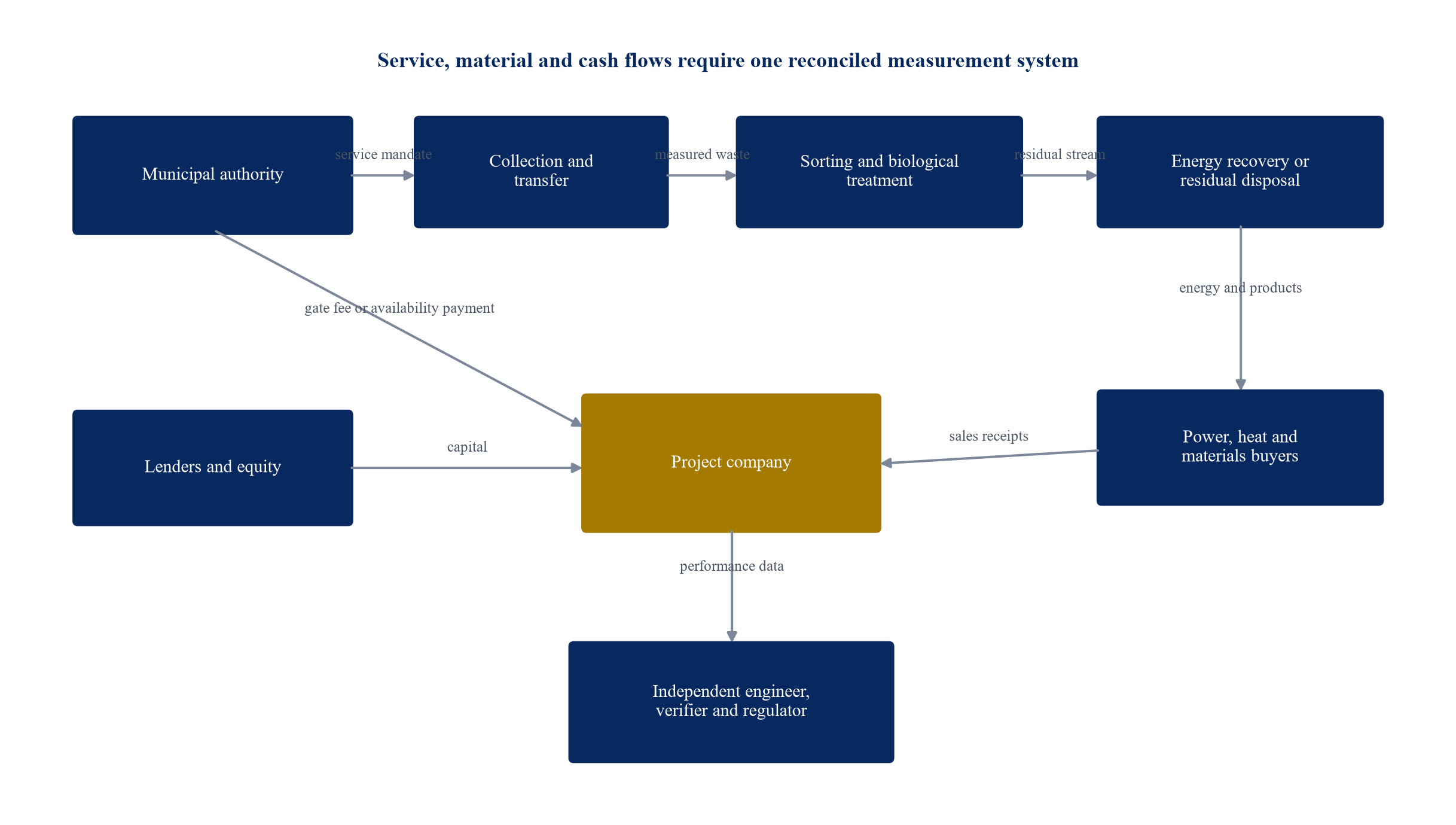
Proposed framework; the actual service boundary, technologies and payment arrangements depend on local law, waste characteristics and procurement design.
4. Choose a concession archetype
A design-build-finance-operate-transfer arrangement can place construction, financing and long-term operations in one project company. A design-build-operate contract can leave financing with the authority. A lease or affermage can transfer operations of existing assets. An integrated service contract can combine collection and treatment. Each form transfers a different set of risks.
The World Bank PPP Reference Guide emphasises that a PPP framework should govern identification, appraisal, procurement, monitoring and fiscal accountability.[13] The legal label alone does not determine substance. The contract should identify who funds initial assets, owns land, obtains permits, manages demand, pays for change, controls customer tariffs, bears residual value and receives the assets at handback.
5. Build the revenue stack from enforceable contracts
Potential revenues include municipal gate fees, availability payments, household or commercial tariffs, electricity, heat, recovered materials, compost, refuse-derived fuel, extended-producer-responsibility receipts and environmental attributes. The base case should include only amounts supported by contracts, law or a conservative market case.
Each revenue line needs a unit, payer, delivery point, price, index, settlement cycle, credit support, performance test and termination regime. Electricity can be contracted through a power purchase agreement; Dubai's disclosed waste-to-energy arrangements include a 35-year electricity purchase agreement between DEWA and Dubai Municipality.[10] This provides a useful example of separating waste-service and electricity-purchase functions, while project-specific terms remain confidential or jurisdiction-dependent.
6. Design the gate fee
A gate fee commonly pays per tonne accepted or treated. That simplicity can mask material differences. The contract should distinguish weighed tonnes, eligible tonnes, accepted tonnes, processed tonnes, diverted tonnes and residues. It should specify which measure triggers payment and how rejected, hazardous, oversized or contaminated loads are handled.
A pure per-tonne fee transfers volume risk to the project company and can create an incentive to retain waste. A pure availability payment transfers more demand risk to the authority and can weaken throughput discipline. A hybrid can pay for available compliant capacity, variable operating cost per eligible tonne and outcome-based adjustments. The chosen form should match which party controls waste delivery, collection policy and competing facilities.
7. Protect affordability and cost recovery
Municipal waste systems need a durable source of payment. Household tariffs, general budgets, commercial charges, landfill levies, producer-responsibility receipts and intergovernmental transfers can contribute. The authority should test affordability, billing capacity, collection rates and the political process for tariff adjustment.
Payment security may include a budget appropriation covenant, escrow account, reserve, intercept arrangement, sovereign or municipal guarantee, letter of credit or development-finance support. The contract should state the order in which these protections are used. A nominal gate fee provides little financeability if invoices can be disputed indefinitely or annual budgets do not cover the indexed obligation.
8. Forecast quantity with policy scenarios
Waste quantity depends on population, income, tourism, commercial activity, prevention, reuse, source separation and competing facilities. A single growth curve is insufficient. The model should include a policy case, a slower-growth case and a faster-diversion case.
What a Waste 3.0 covers generation, composition, collection, treatment, financing and private participation across countries.[1] Its global evidence can frame the range of system needs; local weighbridge records and route data should drive the transaction model. Historic data should be reconciled to municipal boundaries, included customers and seasonal patterns before bidders price capacity.
9. Measure composition and calorific value
Weight alone does not establish treatment performance. Moisture, organics, plastics, paper, metals, glass, inert material and hazardous contaminants affect processing cost, recyclate yield, biological performance, energy output, emissions and residue volume.
The Global Infrastructure Hub waste-to-energy risk matrix notes that recycling and composting are sensitive to composition and that public collection changes can affect the waste delivered to a facility.[3] The concession should therefore include a baseline characterisation, sampling protocol, tolerance bands and a process for material change. Compensation should require evidence of cause and economic effect rather than an automatic payment for every variance.
10. Link green targets to controllable outcomes
Targets can cover collection coverage, source separation, recycling, organic diversion, landfill reduction, energy efficiency, methane capture, emissions and public reporting. Each target needs a baseline, denominator, measurement method, owner and consequence.
The project company should bear performance risk it can control. The authority should retain or share outcomes driven by household behaviour, product design, producer schemes or laws outside the concession. A target without an attribution rule can create disputes. A target with an unrealistic fixed denominator can reward waste growth. The contract should state how population, service area and excluded streams change the calculation.
11. Avoid a waste lock-in
Long-term debt needs predictable cash. Circular-economy policy needs flexibility. The contract can reconcile both through capacity bands, scheduled reviews and hierarchy-compatible change mechanisms. A minimum revenue floor can support fixed costs while variable payments decline with volume.
The facility should be sized from residual-waste scenarios after feasible prevention and recycling. Modular capacity, multiple treatment lines and alternative feedstocks can reduce lock-in where technically and legally suitable. New recycling rules should not automatically trigger a project-company windfall. The authority should compensate only for demonstrable contract value affected by a directed change beyond agreed bands.
12. Coordinate collection and treatment
Collection design shapes treatment economics. Separate organics can improve recycling and reduce moisture in residual waste. Different bin systems, collection frequencies and enforcement regimes change contamination. Transfer-station operation affects haulage cost and delivery timing.
Where collection remains with the authority or another contractor, the concession needs interface standards. These include delivery windows, vehicle compatibility, data transfer, rejected loads, emergency routing, contamination notices and dispute tests. An integrated contract can internalise some interfaces, although it also increases procurement scope and market concentration.
13. Benchmark the commercial structure
Different payment models suit different service boundaries. The benchmark below is a decision framework rather than a claim about universal market practice. Actual procurement law, public accounting, technology and waste data determine the available structure.
Table 1. Municipal waste concession payment archetypes
| Payment archetype | Primary payment basis | Volume risk | Policy flexibility | Typical financing implication |
|---|---|---|---|---|
| Tonnage gate fee | Eligible tonnes accepted or treated | Mainly private | Lower without rebasing | Debt depends on delivery covenant and volume floor |
| Availability payment | Compliant capacity and service availability | Mainly public | Higher | Debt relies on authority credit and performance regime |
| Hybrid fixed and variable | Available capacity plus tonnes and outcomes | Shared | Moderate to high | Fixed cost recovery can support debt; variable cost follows throughput |
| User-tariff concession | Collected customer charges | Private or shared | Depends on tariff rules | Billing, collection and tariff-adjustment risk are central |
| Merchant treatment | Shorter waste contracts and product sales | Private | High for authority | Lower leverage and stronger sponsor support are generally required |
Decision framework; actual allocation depends on local law, service scope, data quality and public-sector capacity.
14. Structure electricity and heat revenues
Energy revenues depend on net export, availability, grid access, tariff, balancing and environmental rules. The model should deduct internal consumption and treatment-related auxiliary load. It should distinguish guaranteed offtake from merchant exposure.
An electricity contract should cover meter location, losses, dispatch, planned outages, curtailment, negative prices, indexation, grid compliance, change in law and termination. Heat sales need a credible nearby demand anchor and pipeline responsibilities. Energy upside should not conceal a deficient service-payment mechanism. The waste concession must remain viable under a conservative energy case unless lenders explicitly accept merchant risk.
15. Treat materials revenue conservatively
Recovered paper, metals, plastics, glass, compost and refuse-derived fuel have different quality specifications and market cycles. Revenue depends on contamination, sorting efficiency, buyer credit, transport and import or export rules. Some streams may carry a disposal cost rather than a positive price.
The base case should use contracted floors or conservative net prices after processing, haulage and rejection. Merchant upside can support equity returns or cash sweeps. It should receive limited debt credit when prices and outlets are volatile. Product-quality testing and buyer diversification belong in operating covenants.
16. Integrate extended producer responsibility
Extended producer responsibility can shift some packaging, textile, electronic or other post-consumer costs from municipalities to producers. It can improve cost recovery while introducing new definitions, reporting and payment interfaces. The 2025 EU Waste Framework Directive revision introduced common textile producer-responsibility rules and binding food-waste reduction targets.[18]
The concession should state whether producer-responsibility receipts belong to the authority, project company or a separate scheme operator. Double recovery should be avoided. If a gate fee already pays the full cost of sorting a material, an additional producer payment should be allocated through an agreed reconciliation. Data quality becomes a commercial condition because material-specific payments can depend on measured composition and treatment route.
17. Separate environmental attributes from service compliance
Avoided landfill methane, renewable-energy attributes, carbon credits and recycled-content claims may create value where applicable rules permit them. These claims need boundaries, additionality rules, monitoring, ownership and retirement controls. Compliance with the concession does not automatically create a saleable environmental credit.
UNEP's 2025 Global Methane Status Report records continuing methane-mitigation gaps and highlights the role of empirical data and finance.[8] A project should first meet legal and contractual waste obligations. Any environmental-attribute revenue should then be tested for eligibility, permanence where relevant, leakage, double counting, verification cost and change in methodology. Lenders should exclude speculative credits from core debt sizing.
18. Establish the land and permitting case
Land title, zoning, access, buffer zones, utility corridors and disposal rights should be resolved before major construction funding. Waste facilities can face community opposition, odour, traffic, air-emission, water, ash and visual-impact concerns. A permit schedule should show application owner, evidence, consultation, conditions, appeal risk and expiry.
The IFC Waste Management Facilities EHS Guidelines cover collection, transport, receipt, processing, storage, biological treatment, incineration and landfill.[11] The environmental and social case should apply the relevant standards across the selected treatment train. Where the authority controls land acquisition or resettlement, the project company and lenders still need evidence that government-led processes meet the agreed financing standards.
19. Address workers, communities and the informal sector
Waste systems can support formal and informal livelihoods. Changes to collection, landfill access or sorting can affect workers and waste pickers. Contract preparation should identify affected groups, labour conditions, occupational risks, livelihood dependencies and grievance mechanisms.
IFC Performance Standards address labour, community health and safety, land acquisition, biodiversity, Indigenous Peoples and cultural heritage as applicable.[12] A livelihood-restoration or inclusion plan may be required where existing activities are displaced. Social measures need budgets, responsibilities, milestones and monitoring. Treating them as general commitments can delay land access, permits and financial close.
20. Define technical performance at the service level
Plant guarantees should connect equipment performance to concession outcomes. Relevant measures can include throughput, availability, recovery rate, organics quality, net power, emissions, residue ratio, landfill-gas collection, leachate treatment and odour control.
A technology can meet a nameplate throughput test while failing to produce saleable materials or compliant emissions. Completion tests should therefore use representative waste, agreed composition bands and a sustained operating period. The tests should also confirm weighbridge data, laboratory procedures, grid export, residue outlets and environmental-monitoring systems.
21. Allocate design and construction risk
The private partner typically controls detailed design, procurement, construction, integration and commissioning. Fixed-price, date-certain EPC arrangements can transfer part of this risk, subject to exclusions, caps, contractor credit and interface terms. The public authority usually retains land, specified approvals and risks created by mandatory designs or late authority decisions.
Construction contingency should cover quantity uncertainty, ground conditions, utility interfaces and price escalation not transferred to the EPC contractor. Lenders should test completion support, delay liquidated damages, performance liquidated damages, insurance and sponsor funding obligations. A contractual cap should be compared with the cash loss created by delay or underperformance.
22. Design the operating payment mechanism
The payment mechanism should begin with the gross service payment and apply transparent adjustments for availability, eligible tonnes, pass-through costs, indexation and performance. Deductions should correspond to service harm and remain proportionate. A minor reporting error should not trigger the same consequence as prolonged non-availability or illegal disposal.
The project company needs enough predictability to operate and service debt. The authority needs remedies that change behaviour. Repeated failures can escalate from cure plans to increased monitoring, deductions, step-in and termination. The contract should prevent double deductions for the same event unless distinct harms are measured.
23. Calibrate performance deductions
Deductions can cover missed collection, facility unavailability, failure to accept eligible waste, recycling shortfall, emissions breach, odour, data failure or delayed reporting. Each deduction requires a measurement source, tolerance, cure period, cap and escalation rule.
The annual cap should preserve incentives without making debt service impossible after a modest breach. Serious environmental or safety events can sit outside ordinary caps. Lenders will examine deduction history, dispute rights and whether an authority can set off unrelated claims. Independent verification can reduce disputes where the authority is both payer and performance judge.
24. Index the right cost drivers
A long-term nominal fee should not assume one inflation index captures labour, fuel, chemicals, maintenance, disposal, insurance and electricity. The formula can weight material cost categories, subject to floors, caps or efficiency factors. Pass-through items should be narrowly defined and evidenced.
Foreign-exchange risk matters when debt, equipment or consumables are imported while revenue is local currency. The project may use local-currency debt, hedging, tariff indexation or sponsor support. Unhedged currency movements should appear in downside analysis. An indexation formula should also specify lag, publication failure, rebasing and negative inflation.
25. Build a hypothetical capital plan
Consider a hypothetical integrated system with transfer upgrades, sorting, organics treatment, energy recovery, landfill remediation and initial reserves. Total uses are USD 420 million. The figures illustrate transaction architecture and do not describe an identified project or available financing terms.
The structure uses USD 220 million of senior debt, USD 20 million of subordinated shareholder funding, USD 60 million of public capital or eligible grant support and USD 120 million of equity. Actual public support requires legal authority, budget approval, value-for-money analysis and compliance with procurement and subsidy rules.
Table 2. Hypothetical municipal waste concession sources and uses
| Uses | USD million | Sources | USD million |
|---|---|---|---|
| Sorting and organics facilities | 92 | Senior debt | 220 |
| Energy-recovery and grid works | 155 | Subordinated shareholder funding | 20 |
| Transfer, logistics and weighbridges | 34 | Public capital or eligible grant support | 60 |
| Landfill remediation and residual cells | 48 | Sponsor equity | 120 |
| Development and financing costs | 24 | ||
| Contingency | 35 | ||
| Interest during construction and reserves | 32 | ||
| Total uses | 420 | Total sources | 420 |
Illustrative model in USD million; figures do not describe an identified project, authority or financing offer.
26. Build one integrated operating model
The model should begin with households, commercial customers and included waste streams. It should calculate collection, transfer, treatment, recovered materials, organics outputs, energy, residues and disposal. Every tonne should reconcile from receipt to final destination.
Revenue calculations should use the same volume and performance data as operating costs. Separate models for gate fees, recycling and energy can create inconsistent assumptions. The integrated model should distinguish fixed cost, variable cost, pass-through cost, lifecycle maintenance, closure funding, taxes, working capital and reserve movements.
27. Establish a hypothetical base case
Assume 750,000 eligible tonnes per year. A gate fee averaging USD 55 per tonne produces USD 41.25 million. An availability component contributes USD 18 million; net energy receipts contribute USD 20 million; recovered materials and producer-responsibility receipts contribute USD 8 million; permitted environmental attributes contribute USD 3 million.
Annual cash operating cost is USD 51 million, lifecycle maintenance funding is USD 7 million, authority-independent administration and insurance are USD 4 million, and working-capital and reserve funding average USD 4 million. Simplified cash flow available for debt service is therefore USD 24.25 million. With annual debt service of USD 18 million, the illustrative debt-service coverage ratio is 1.35 times. Tax, depreciation and other project-specific items require separate treatment in an actual model.
28. Test capex and operating sensitivities
Capital cost affects gearing, contingency and completion support. Operating cases affect cash available for debt service after financial close. The model should test construction cost, delay, waste quantity, composition, recycling yield, energy price, operating cost, residue disposal, indexation and payment delay.
The hypothetical cases below hold annual debt service at USD 18 million. They are simplified management illustrations. A transaction model should calculate monthly cash, taxes, reserves, sculpted debt service and covenant ratios.
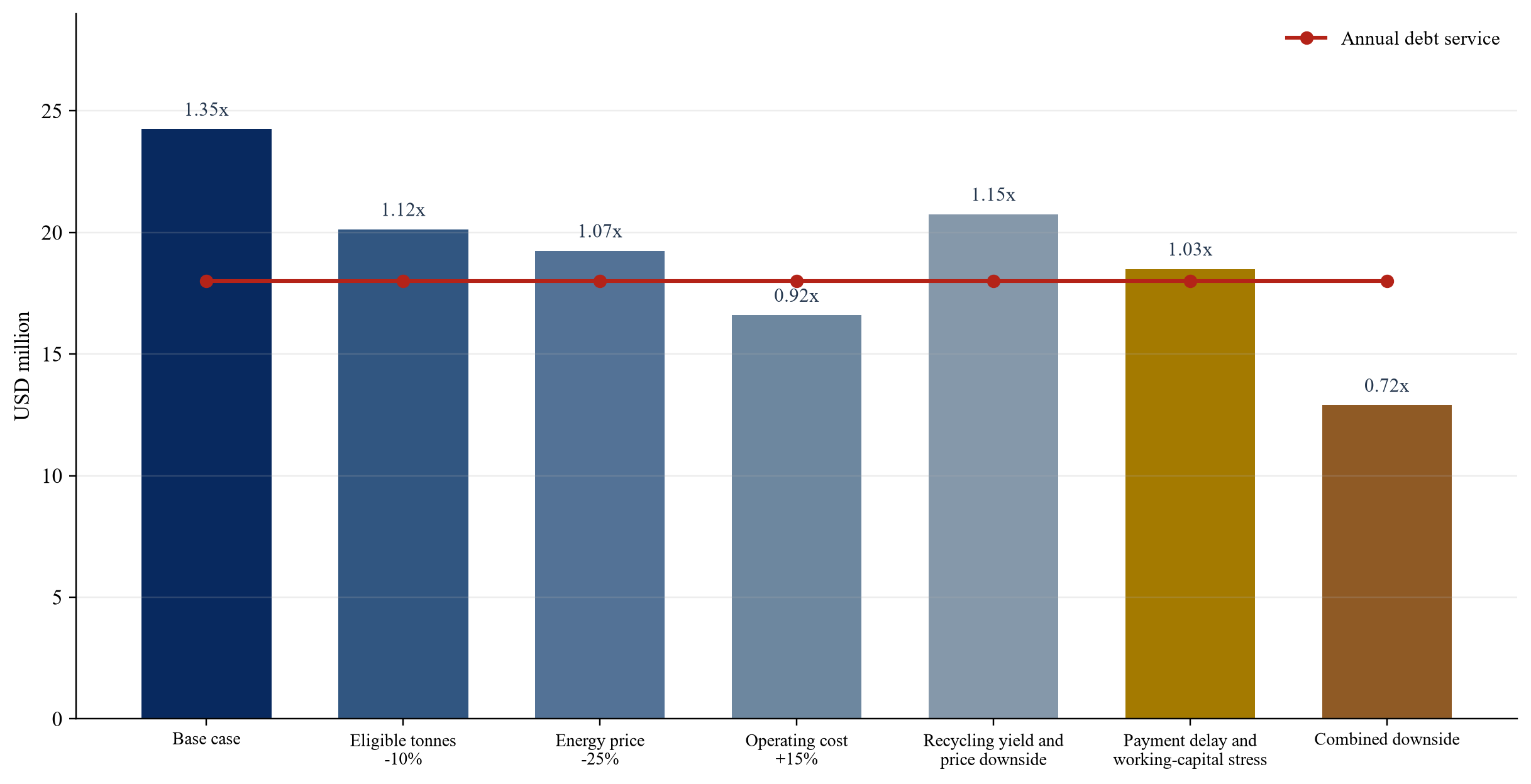
Illustrative USD million cash flow and coverage ratios; scenarios do not describe an identified project or forecast.
29. Size debt from protected cash
Senior debt should be sized from service payments and contracted revenues that remain available under conservative operating cases. Merchant materials, energy or environmental-attribute upside may receive reduced credit. The lender case should apply the actual deduction regime, indexation lag, payment timing and authority credit support.
Coverage tests should include a distribution lock-up above the default threshold. Cash sweeps can direct merchant upside to debt reduction. Reserve accounts can cover debt service, lifecycle maintenance, working capital and closure obligations. The security package should include project accounts, contracts, insurance, shares and step-in rights subject to public-law limits.
30. Test the public counterparty
The authority's payment capacity is central when gate fees or availability payments support debt. Diligence should examine legal authority, budget process, historical payment, revenue sources, debt limits, guarantee rules and dispute enforcement. A municipal obligation can carry different risk from a sovereign obligation.
The public-sector affordability model should extend beyond financial close. It should include indexed payments, retained costs, contingent liabilities, compensation events, termination exposure and future capacity. Fiscal commitments need disclosure and approval under the applicable PPP framework. A project can be financeable for the private partner while remaining unaffordable for the authority.
31. Allocate risk to the party able to manage it
The World Bank's PPP guidance states that risk should be assigned to the party best able to control its likelihood, control its impact or absorb it at the lowest cost.[2] Automatic transfer to the private partner can increase price or make bids unfinanceable. Retaining every risk with the authority removes the performance benefits of a concession.
The allocation should distinguish construction, waste delivery, waste composition, operations, environmental compliance, product markets, energy offtake, law, force majeure and public payment. Shared risks need objective bands and calculation methods. The matrix below shows a starting point for negotiation rather than a substitute for project-specific legal drafting.
Table 3. Proposed municipal waste concession risk-allocation matrix
| Risk | Public authority role | Project company role | Principal contractual control |
|---|---|---|---|
| Land and authority-controlled access | Provide defined rights and disclosed conditions | Comply with access rules and protect site | Land schedule; delay relief; compensation event |
| Design, construction and commissioning | Approve outputs without directing means | Design, build, integrate and test | EPC terms; completion tests; liquidated damages |
| Waste quantity | Deliver or procure within agreed band where controlled | Manage operational variability inside band | Volume band; fixed and variable payment; rebasing |
| Waste composition | Control collection-policy changes | Manage ordinary variability and acceptance | Baseline sampling; tolerance; directed-change relief |
| Operating performance | Monitor and enforce | Operate, maintain and meet service levels | Availability regime; deductions; lifecycle plan |
| Recycling and diversion policy | Set policy and source-separation programme | Meet controllable processing and quality targets | Attribution rules; hierarchy clause; periodic review |
| Energy and materials markets | Support permits and contracted interfaces | Manage sales strategy within agreed base case | PPA; offtake contracts; downside assumptions |
| Environmental and social compliance | Retain government obligations and oversight | Maintain project ESMS and permits | Standards; monitoring; serious-breach regime |
| Change in law | Bear discriminatory or authority-driven change as agreed | Bear general business compliance within band | Defined relief; cost sharing; termination threshold |
| Force majeure | Share specified uncontrollable risks | Mitigate, insure and restore | Relief; insurance; long-stop; termination compensation |
| Authority payment | Budget, pay and maintain support | Submit valid invoices and evidence | Payment dates; dispute limits; security and cure |
Starting framework; allocation must be adapted to governing law, service scope, authority capacity, technology and site conditions.
32. Manage directed policy change
The authority may introduce source separation, new recycling targets, landfill taxes, producer-responsibility schemes or competing infrastructure. These can improve public outcomes while changing the project's tonnes, composition and revenues. The concession should identify which changes are anticipated and priced.
A directed-change mechanism should require notice, technical assessment, mitigation, cost evidence and a defined financial response. The response can adjust service requirements, capacity, term or payment. Compensation should restore the agreed economic position only to the extent proven. It should not guarantee the original shareholder return regardless of project performance.
33. Define change in law
General changes in tax, labour, environmental or business law can be treated differently from discriminatory or project-specific changes. The allocation should reflect the party's ability to price, insure and manage the change. The contract should state materiality thresholds, mitigation duties, timing and excluded costs.
Environmental standards can affect emissions controls, ash treatment, landfill closure, recycling calculation and monitoring. A well-designed change process preserves service continuity while costs are assessed. Unresolved change should escalate through expert determination or dispute procedures without permitting indefinite non-performance.
34. Align force majeure, relief and compensation
Flood, earthquake, epidemic, war, embargo, grid failure, access restriction and authority-caused delay have different causes and insurance availability. The contract should separate relief events from compensation events. Relief may excuse performance without paying revenue; compensation may restore specified cost or cash.
The project company should maintain business-continuity and emergency-routing plans. The authority should identify alternative disposal capacity where the public service must continue. Prolonged events need long-stop dates and termination rules. Insurance proceeds should be applied through a reinstatement and lender-control mechanism.
35. Design termination compensation
Termination can follow project-company default, authority default, prolonged force majeure or voluntary authority action where law permits. The compensation formula affects lender recovery, public affordability and incentives. Full debt protection after private default can weaken lender discipline; inadequate recovery after authority default can prevent financing.
The formula should address senior debt, break costs, cash, insurance, rectification cost, subcontractor liabilities and equity where applicable. It should prevent double recovery and define valuation date, audit and payment timing. Direct agreements should give lenders a cure and substitution period before termination.
36. Plan handback from the beginning
Assets transferred at the end of the term should meet a defined condition. The concession should specify remaining design life, inspection, maintenance records, environmental liabilities, spares, licences, data and staff transition. A handback reserve or security can fund required works.
Condition surveys should begin several years before expiry. Defects need cure periods and independent certification. Landfill and environmental obligations may continue beyond the operating term. Their funding and ownership should remain explicit after handback.
37. Build a controlled data architecture
Weighbridges, vehicle systems, plant controls, laboratory results, energy meters, emissions monitors, landfill-gas data and financial systems should feed one governed reporting chain. Each metric needs a definition, source, owner, frequency, validation and retention period.
The contract should control manual adjustments, downtime estimation and meter replacement. The authority and lenders need audit rights without disrupting operations. Cybersecurity, system resilience and data portability matter because service payment, regulatory compliance and green-target reporting all rely on the same evidence.
38. Procure on whole-life value
Lowest gate fee can conceal weak technical assumptions, high residual risk or unrealistic merchant revenue. Bid evaluation should compare whole-life public cost, service quality, hierarchy alignment, financeability, environmental and social performance, deliverability and risk transfer.
The authority should provide reliable waste data, land information, permits strategy, draft contracts and payment support. Bidders should submit one reconciled technical and financial model. Departures from assumptions need clear pricing. Competitive dialogue or structured clarification may help where law permits, although equal treatment and auditability must be preserved.
39. Test value for money and affordability separately
Value for money compares the concession with a credible public delivery alternative, including risk, lifecycle cost and service outcomes. Affordability tests whether the authority can meet expected and stressed payments. A project can score well on risk-adjusted value while exceeding the available budget.
The public-sector comparator should use consistent scope and timing. Optimism bias, retained risk, procurement cost and financing differences should be visible. Sensitivities should include lower waste volume, policy change, inflation, delay, compensation and termination. Independent review can challenge assumptions before bid launch and before award.
40. Control refinancing and surplus value
Once construction and ramp-up risks decline, the project may refinance. The concession should state whether refinancing gains are shared and how gains are calculated. Restrictions may apply to increased leverage, distributions, tenor extension or security changes.
Merchant upside from energy, materials or environmental attributes can be treated through gain share, tariff adjustment or equity retention. The chosen method should preserve operating incentives and avoid excessive complexity. Public value should be assessed across the full contract, including tax, employment, environmental outcomes and service resilience.
41. Establish lender controls
Lenders require notice of default, cure periods, substitution rights and access to key project information. Direct agreements should align authority termination rights with financing cure processes. The project company should obtain lender consent for material contract changes, disposals, new debt and distributions.
Financial covenants can include debt-service coverage, reserve funding, permitted debt and distribution tests. Operational covenants can cover maintenance, insurance, permits, product offtake, environmental compliance and lifecycle planning. Controls should support service continuity and should not prevent the authority from enforcing urgent health, safety or environmental obligations.
42. Use an investment-committee evidence pack
The approval pack should include the service specification, waste-data report, composition study, options analysis, site and permit plan, environmental and social assessment, payment mechanism, public affordability model, private financing model, risk matrix, draft concession, procurement plan and stakeholder record.
Every critical assumption should have a source, owner and expiry date. Waste forecasts, energy prices, material outlets, capex, operating cost and public-payment security need separate evidence. A red-team review should identify where one assumption supports several revenue lines or where the authority is accepting an unpriced contingent liability.
43. Apply decision gates
Gate one confirms service need, legal authority and policy alignment. Gate two confirms waste data, technology options and site feasibility. Gate three confirms affordability, value for money, environmental and social pathway, and draft risk allocation. Gate four authorises procurement. Gate five evaluates bids and confirms financeability. Gate six approves award and financial close.
Each gate should have a named decision body and documentary evidence. Approval should lapse where critical data, permits, bid validity or financing commitments expire. This prevents a historic approval from being treated as current evidence after the transaction changes.
44. Implement through a controlled roadmap
The implementation roadmap should combine authority, technical, commercial, environmental, social, procurement and financing workstreams. Parallel work can shorten the programme only when dependencies are visible. Procurement should not outrun land, waste data or payment authority.
The illustrative roadmap below uses six gates. Actual periods depend on law, market capacity, site conditions and consultation. The authority should update the critical path monthly and connect delay to budget, bid validity and service-continuity decisions.
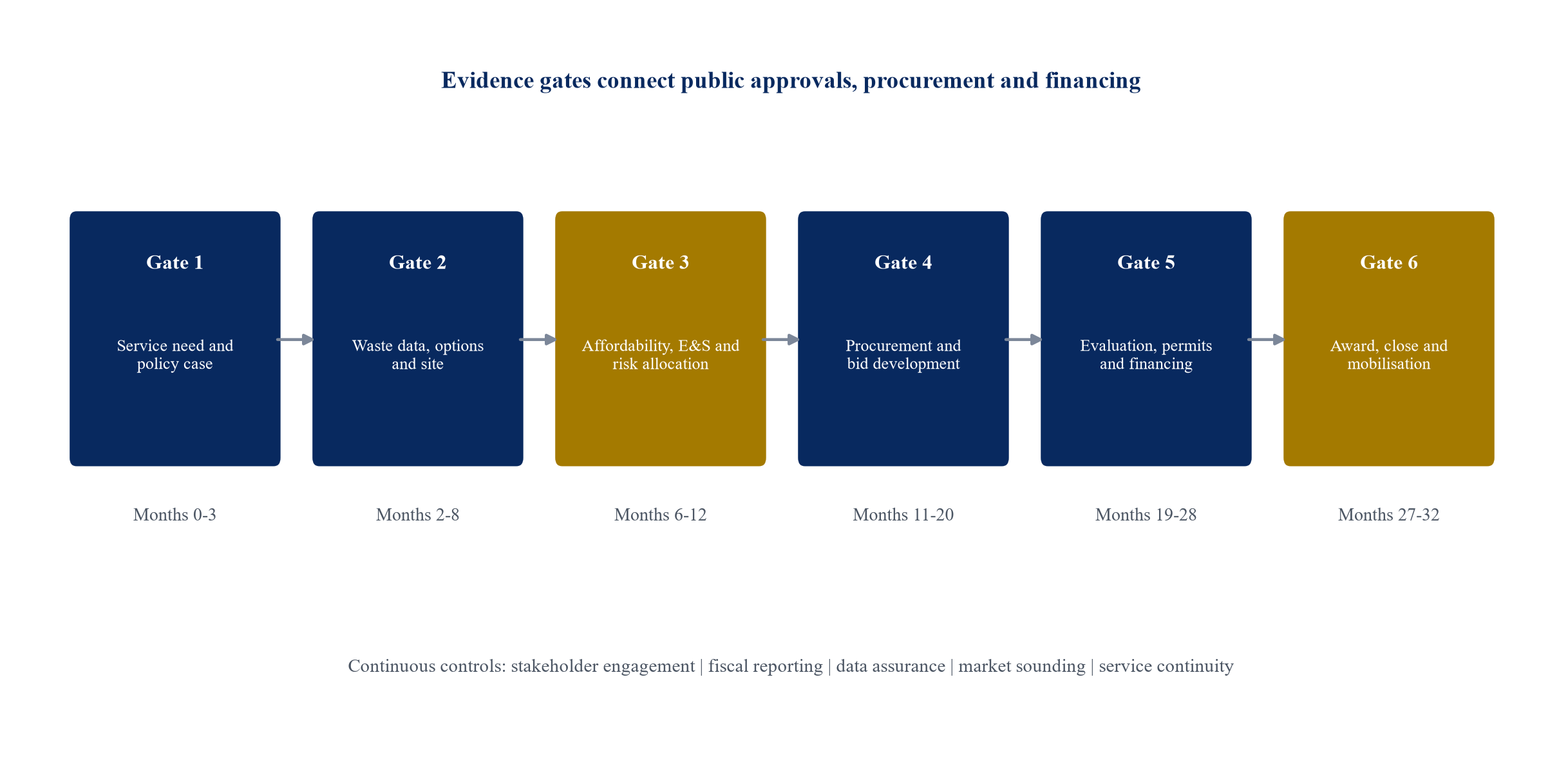
Illustrative sequence; actual durations and approvals depend on procurement law, project scope and jurisdiction.
45. Govern the contract after financial close
Contract management begins before operations. The authority needs a staffed team, delegated powers, payment controls, technical and environmental advisers, a change register, performance dashboard and contingency plan. Staff turnover should not erase institutional knowledge.
Monthly reports should reconcile tonnes, composition, treatment, outputs, emissions, deductions, invoices, incidents and lifecycle work. Quarterly governance should review trends and disputes. Annual review should assess capacity, policy changes, contingent liabilities and handback funding. Scheduled strategic reviews can rebase the service without reopening every commercial term.
Conclusion
A financeable municipal waste concession pays for a clearly defined public service through measures the project company can control. Gate fees, availability payments, energy sales, recovered materials, producer-responsibility receipts and environmental attributes should be modelled separately and reconciled through one measurement system. The contract should preserve the authority's ability to reduce waste and increase recycling through capacity bands, periodic rebasing and directed-change rules.
The strongest structures combine conservative waste and product assumptions, proportionate performance deductions, authority payment security, project-specific risk allocation, complete environmental and social controls, and decision gates supported by current evidence. This approach can align debt service with public value while avoiding incentives to maximise residual waste.
FREQUENTLY ASKED QUESTIONS
1. What is the difference between a gate fee and an availability payment?
A gate fee is usually linked to eligible tonnes accepted or treated. An availability payment pays for compliant service capacity, subject to performance deductions. A hybrid can combine fixed-cost recovery with variable operating payments.
2. How can a concession avoid discouraging recycling?
The contract can use residual-waste scenarios, capacity bands, periodic rebasing, source-separation interfaces and compensation only for authority-directed changes outside agreed assumptions.
3. Which revenues should support senior debt?
Senior debt can rely on protected municipal service payments and contracted energy or product revenues that survive conservative volume, performance, price and payment assumptions.
4. Who should bear waste-volume risk?
Allocation depends on who controls collection, service boundaries, competing facilities and policy. An authority delivery band with fixed and variable payments can share the risk transparently.
5. How should waste-composition change be handled?
The contract should use baseline sampling, tolerance bands, repeated testing, attribution rules and compensation based on demonstrated technical and financial effect.
6. Can carbon or methane credits be included in the base case?
Only where eligibility, ownership, monitoring, verification, double-counting controls and durable buyer terms are established. Speculative environmental-attribute revenue should remain outside core debt sizing.
7. What should an integrated completion test cover?
It should test representative waste, throughput, availability, recovery, product quality, emissions, residues, energy export, data systems and verifier-ready evidence over a sustained period.
8. What is the most important public-sector financing control?
The authority should maintain a long-term affordability model covering indexed payments, retained costs, contingent liabilities, compensation, termination and future service capacity.
References
- World Bank Group, What a Waste 3.0, 2025, https://www.worldbank.org/en/publication/what-a-waste
- World Bank PPP Resource Center, Allocating Risks, accessed 3 October 2026, https://ppp.worldbank.org/allocating-risks
- Global Infrastructure Hub and Allen & Overy, PPP Risk Allocation Tool 2019 Edition: Water and Waste, accessed 3 October 2026, https://ppp.worldbank.org/sites/default/files/2022-03/gih-ppp-risk-allocation-water-and-waste.pdf
- World Bank PPP Resource Center, Model RFP and Concession Agreement for Waste to Electricity Project, 2022, https://ppp.worldbank.org/library/model-rfp-concession-agreement-waste-electricity-project
- European Commission, Waste Framework Directive, accessed 3 October 2026, https://environment.ec.europa.eu/topics/waste-and-recycling/waste-framework-directive_en
- European Commission, Implementation of the Waste Framework Directive, accessed 3 October 2026, https://environment.ec.europa.eu/topics/waste-and-recycling/implementation-waste-framework-directive_en
- European Investment Bank, Solid waste management, accessed 3 October 2026, https://www.eib.org/en/projects/topics/energy-natural-resources/solid-waste/index
- United Nations Environment Programme, Global Methane Status Report 2025, 2025, https://www.unep.org/resources/report/global-methane-status-report-2025
- Dubai Electricity and Water Authority, Waste management systems and circular economy, 14 April 2025, https://www.dewa.gov.ae/en/about-us/media-publications/latest-news/2025/04/dewas-adaptation-of-innovative-waste-management-systems-promotes-sustainability-and-circular-economy
- Dubai Electricity and Water Authority, Power Purchase Agreement for electricity produced from the Dubai Waste Treatment Center, 14 February 2023, https://www.dewa.gov.ae/en/about-us/media-publications/latest-news/2023/02/dubai-municipalitydewa-sign
- International Finance Corporation, Environmental, Health, and Safety Guidelines for Waste Management Facilities, 2007, https://www.ifc.org/content/dam/ifc/doc/2000/2007-waste-management-facilities-ehs-guidelines-en.pdf
- International Finance Corporation, Performance Standards on Environmental and Social Sustainability, 2012, https://www.ifc.org/en/insights-reports/2012/ifc-performance-standards
- World Bank Group and partners, PPP Reference Guide Version 3, 2017, https://ppp.worldbank.org/PPP-Reference-Guide
- UK Department for Environment, Food and Rural Affairs, Extended producer responsibility for packaging: local authority payment calculations 2026 to 2027, 2026, https://www.gov.uk/government/publications/extended-producer-responsibility-for-packaging-local-authority-payment-calculations-2026-to-2027/methodology-and-procedure-for-calculating-2026-to-2027-year-2-payments
- UK Department for Environment, Food and Rural Affairs, Energy from waste: a guide to the debate, 2014, https://assets.publishing.service.gov.uk/media/5a7c77ade5274a559005a113/pb14130-energy-waste-201402.pdf
- European Commission and Eurostat, Municipal waste reporting metadata, accessed 3 October 2026, https://ec.europa.eu/eurostat/cache/metadata/EN/env_wasobl_esms.htm
- European Commission, Zero pollution targets, accessed 3 October 2026, https://environment.ec.europa.eu/strategy/zero-pollution-action-plan/zero-pollution-targets_en
- European Commission, Revised Waste Framework Directive enters into force, 16 October 2025, https://environment.ec.europa.eu/news/revised-waste-framework-directive-enters-force-2025-10-16_en
- World Bank PPP Resource Center, Structuring the PPP Contract, accessed 3 October 2026, https://ppp.worldbank.org/structuring-ppp-contract
- World Bank PPP Resource Center, Concessions, Build-Operate-Transfer and Design-Build-Operate Projects, accessed 3 October 2026, https://ppp.worldbank.org/agreements/concessions-bots-dbos
About the Author
Chennakeshav (CK) is a corporate finance and investment banking executive with 25+ years of global experience in deal origination, structuring and execution across M&A, growth capital and corporate strategy. He has led value-creation mandates for founders, corporates and funds — bridging the boardroom view to hands-on execution and close.
His career spans Morgan Stanley, HSBC, Lloyds Banking Group, EWEC, ADQ portfolio companies and Emirates Growth Fund, across TMT, real estate, fintech, deeptech, cleantech, infrastructure and energy. He has partnered with C-suite leaders, private equity and venture funds, sovereign wealth funds and family offices to finance complex fund raises and scale-up ventures, and has led M&A due diligence, post-merger integration and business-transformation initiatives to create value.
At Matchpoint Partners he is Managing Partner, leading the firm's corporate finance, M&A and capital-raising practice. He holds an MBA from London Business School, an engineering degree from VTU and a Master of Laws (LLM, in progress) from UCL London.
An active start-up mentor, CK mentors at Techstars, DIFC FinTech Hive, Startup Grind, Founder Institute and IN5, serves as Entrepreneur Mentor in Residence (EMiR) at London Business School, and judges the Entrepreneurship World Cup.
