

1 Make biodiversity a project-finance decision
Renewable electricity can reduce emissions and still disturb habitat, migration, breeding or water systems. A wind layout can intersect a bird flight corridor. A solar site can fragment habitat through fencing and access roads. A transmission connection can create a new footprint outside the generation parcel. The investment question is therefore specific: which site, technology and design can obtain the necessary consents and operate within the resulting conditions at an acceptable risk-adjusted return? Calling biodiversity an ESG consideration does not calculate a financing need or answer that question.
A project sponsor usually controls more choices before the site is fixed than after land contracts, grid studies and equipment selection are advanced. Siting can eliminate a high-conflict footprint. Moving a road, reducing panel coverage, changing turbine placement or retaining a habitat corridor can reduce the severity of remaining effects. Once a permit application is lodged, redesign may trigger new survey work, revised public consultation, delay and changes to contractor pricing. The model should therefore show both the cost of early avoidance and the cost of leaving the decision until construction.
For an investment committee, the output is a signed decision record. It should specify the project perimeter, ecological baseline, applicable law and lender standards, design alternatives, permit route, unresolved survey questions, funded measures, cash-flow consequences and conditions for committing capital. Unknowns remain visible until qualified ecologists, counsel and engineers resolve them. A generic biodiversity score cannot substitute for site-level evidence or predict whether a particular authority will grant consent.
This paper is a method for transactions and financing, not a biological assessment or a legal opinion. Its worked wind project is invented and has no named jurisdiction. Jurisdiction-specific rules are compared separately so that a statutory obligation in one market is not mistakenly imposed on another. The model values stipulated obligations and design choices; it does not assign a probability to ecological harm or permit refusal without site evidence.
2 Define the project footprint as a network
The legal boundary of a generation site seldom matches its ecological footprint. Turbines, foundations, substations, access roads, laydown yards, quarries, cables, water crossings and grid connections can each affect different habitat. Temporary construction areas may be restored after commissioning, yet the time needed for ecological recovery can outlast the building programme. A buyer should map each component, its land right, contractor scope and consent path. The map should include third-party infrastructure on which the project depends, even where a separate entity holds the permit.
Commercial boundaries matter as well. A long-term power-purchase agreement may set delivery obligations and availability remedies. Grid curtailment, wildlife curtailment and equipment downtime have different causes and may receive different treatment under that contract. Lenders may require compliance with national law and separately apply an environmental-and-social framework. Insurance can cover a physical loss without covering a delayed consent or the routine cost of ecological monitoring. The project model must connect each obligation to the party carrying it.
The ecological baseline should be described by habitat type, species, seasonal use, connectivity and existing disturbance. One visit is rarely enough to settle a migratory or breeding question. Survey scope, timing and methods need a qualified ecological lead and the relevant regulator. A missing season of field evidence should appear as a schedule and financing uncertainty; it should not be converted into a guessed low-risk conclusion. Existing geographic datasets can screen alternatives, while fieldwork and consultation test the actual site.
The perimeter should be versioned. A late change to access roads can invalidate an earlier impact map. A cable re-route can move the scheme into another landholding or protected area. The investment file should therefore tie every map, survey and financial case to the same design revision. This is basic transaction control: a board should know whether the nature budget corresponds to the project it is approving.
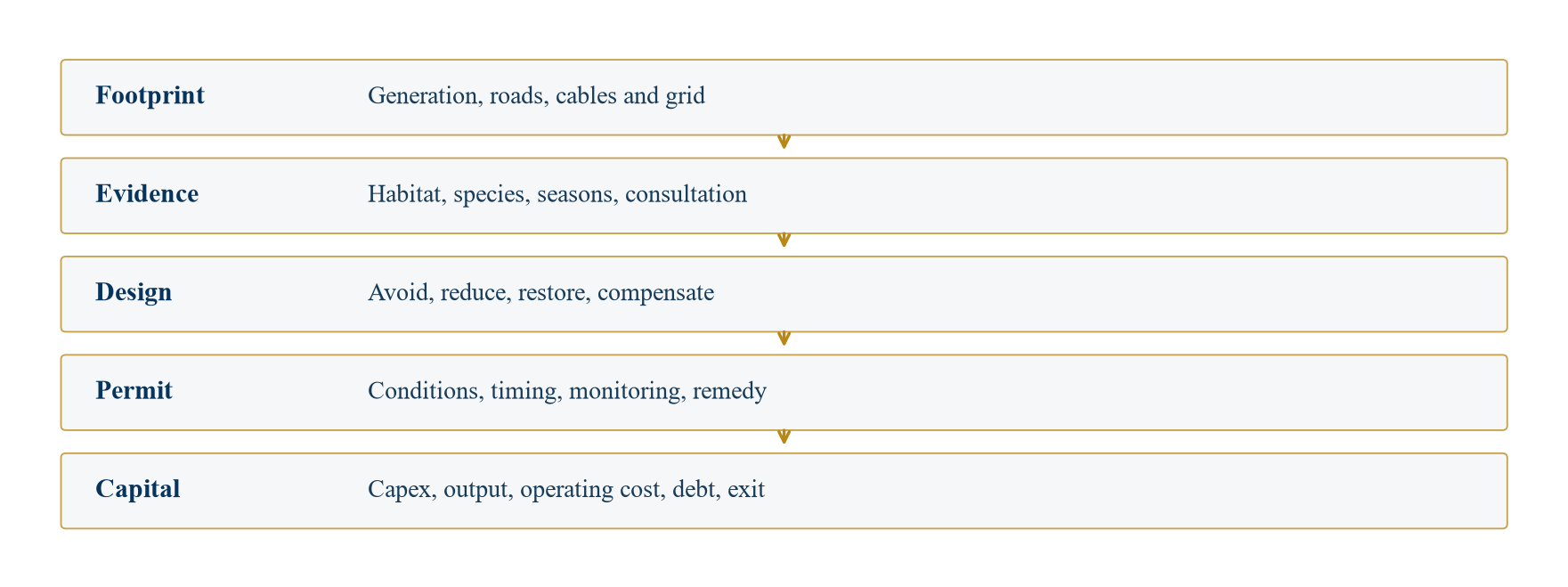
Author-developed process map. It is a decision framework, not a legal permit sequence for a named jurisdiction.
3 Separate legal duties, standards and commercial commitments
Three categories should sit in separate columns. The first is binding law and the actual permit: planning conditions, species protection, protected-area rules, water licences, decommissioning security and any mandatory gain or compensation requirement. The second is a financing or investor standard, such as IFC Performance Standard 6 or World Bank Environmental and Social Standard 6 where incorporated into a lender's requirements [1-3]. The third is the sponsor's voluntary or contractual commitment, including a public nature claim, landowner covenant, community agreement or corporate procurement promise.
These categories can produce similar field actions while creating different remedies. Breach of a statutory permit can stop works or operations. A lender-standard breach can trigger a corrective-action plan or financing consequence under the loan documents. An unsupported public claim can create reputational and contractual exposure. A deal team should identify the source of each duty, the exact project entity bound, measurement method, time horizon and escalation route. A biodiversity-management plan with no link to the financing model is an incomplete control.
IFC Performance Standard 6 applies a mitigation hierarchy that prioritises avoidance and minimisation, then restoration, with offsets considered for residual effects subject to its conditions [1]. It also differentiates modified, natural and critical habitat and imposes demanding conditions for projects in critical habitat. The standard does not mean a developer can buy its way out of every siting conflict. In some settings the credible project choice is a different site or configuration. Specialist legal and ecological review is required before a financing team treats mitigation as a feasible route.
The regime matrix should be refreshed on the date of a live decision. Rules can change between option agreement, application, financial close and operation. Equally important, regulations often include exemptions, transitional provisions and implementing measures. A paper can state a national framework; it cannot infer that an individual project qualifies for a specific consent path. The project file needs a local-law memorandum and written regulator correspondence where available.
4 Use avoidance to preserve option value
Early site selection is a capital-allocation exercise. A lower-yield parcel may produce a better investable project if it avoids a protected habitat, shortens permitting and permits more predictable operations. A high-resource site with severe wildlife conflict can carry survey expense, redesign, late mitigation and restricted output. Comparing gross wind speed or solar irradiation alone can therefore rank the wrong option first. Each candidate should be evaluated on delivered energy after constraints, full lifecycle costs and a consent route supported by evidence.
An avoidance screen should identify protected and sensitive areas, migration routes, breeding and foraging patterns, water dependencies and cumulative development pressure. It should also test the routes of cable, access and grid infrastructure. Avoidance can mean rejecting a parcel, shifting equipment, reducing density, changing a construction corridor, preserving a buffer or choosing a different technology. The decision should be recorded before the team spends heavily on a single layout. IFC guidance emphasises landscape and ecological context rather than a narrow site polygon [1,2].
Option contracts and land-rights documentation can preserve redesign flexibility. If a developer signs a rigid layout with fixed access easements before the survey, an ecologically better route may become commercially unavailable. Conversely, a broad area reservation may be expensive and politically difficult. The investment committee should ask which design changes remain feasible, what additional land is needed, and when the option expires. These are executable transaction questions, not a generic preference for biodiversity.
Avoidance also has a financing value that is hard to express as a single probability. It can reduce the number of unresolved issues at financial close and improve the credibility of an operating forecast. A team should show it as a comparison of conditional designs and remaining evidence, not as an unsupported dollar premium. If the lower-yield site is chosen, its lost generation must appear in the model alongside the avoided ecological costs.
5 Make the survey programme a critical-path workstream
An environmental baseline is built over time. Species movement, breeding, vegetation and hydrology can change by season. A survey schedule should name the study area, methods, qualified personnel, review authority, required seasons, deliverables and decision dates. It should state which investment gate depends on each result. The project schedule must allow for regulator feedback and design iteration. Treating an incomplete baseline as a fixed-price construction risk invites a false sense of certainty.
Existing data are useful for triage, but a public map can be out of date or too coarse for turbine micro-siting and cable routing. Field evidence should be traceable to dates, locations, methods and limitations. A consultant's conclusion should distinguish observed presence, modelled use and absence of observation. That distinction matters for protected species and migratory pathways. The legal team should confirm whether additional assessments or consultations are mandatory and whether data can be reused after a design change.
The acquisition timetable can create pressure to call a missing survey season immaterial. A buyer can manage this through a phased bid, conditional price, a long-stop date, delayed notice to proceed or seller-funded survey obligation. The chosen mechanism must be acceptable under the transaction documents and project financing. A purchase agreement cannot make an ecological baseline complete. The deal team needs a credible route to finish the work and a defined decision if the result is adverse.
The board pack should include an evidence-quality register. For each material habitat or species, record the available dataset, field season, method, expert view, regulator position, residual uncertainty and next evidence gate. The register should be updated after every layout revision. This is more useful than a red-amber-green label because it tells the board exactly what it must know before committing construction capital.
6 Compare permit regimes without mixing their rules
The European Union's amended Renewable Energy Directive creates a framework for renewable acceleration areas and faster permitting, while preserving environmental safeguards and requiring member-state implementation [4,5]. An investor should inspect the national measures and the designated area. The directive's acceleration concept cannot be treated as blanket approval for any project, particularly where protected sites or migratory routes are involved. Mitigation measures, screening and project-specific conditions remain decision-relevant.
In England, biodiversity net gain is a statutory planning objective for qualifying development, subject to exemptions and detailed rules [6]. The 10% requirement should not be generalised to every type of renewable project or every UK jurisdiction. Government guidance states that nationally significant infrastructure project development-consent-order applications submitted on or after 2 November 2026 will be subject to the relevant biodiversity-net-gain regime [7,8]. At this paper's 6 October 2026 review date, that stated future application date had not yet arrived. Live applications require counsel to test the applicable route and transitional provisions.
In the United States, the Fish and Wildlife Service provides an eagle incidental-take permit route for qualifying wind-energy activities, with conditions and distinctions between general and specific permits [9]. That regime addresses a particular protected-species issue; it is not a general biodiversity permit. Other federal, state, tribal and local requirements may matter. Likewise, IFC and World Bank standards can become financing obligations without being national legislation [1-3].
Table 1. Selected biodiversity regimes and transaction questions
| Source | Relevant scope | Transaction question | Model input |
|---|---|---|---|
| IFC Performance Standard 6 | Projects to which the standard is contractually applied | Can the site and mitigation hierarchy satisfy the lender? | Survey, design, management and monitoring budget |
| World Bank ESS6 | World Bank Environmental and Social Framework projects | Which ecosystem and species duties enter the financing plan? | Environmental and social action costs |
| EU Renewable Energy Directive | EU framework, implemented through member-state law | Is the actual parcel in an applicable acceleration area? | Permit route and design conditions |
| England biodiversity net gain | Qualifying English development, subject to route and exemptions | What gain plan and security are required? | Habitat delivery and maintenance funding |
| US eagle incidental-take guidance | Qualifying eagle-related wind activity | Which permit pathway and conditions apply? | Monitoring, siting and operating costs |
Scope summary from cited primary sources reviewed 6 October 2026. Project-specific applicability requires local legal and ecological advice.
7 Turn the permit into a quantified condition register
A permit is a bundle of operational instructions as well as a permission to construct. Conditions can govern dates of vegetation clearing, transport routes, lighting, noise, drainage, buffers, habitat restoration, carcass searches, adaptive management, reporting and curtailment. Each condition needs a named owner, due date, evidence of compliance and cost account. The condition register should be built from the actual permit text, regulator letters, approved plans and land agreements, not from a generic diligence checklist.
The financial translation has five channels. Some conditions create upfront capital cost, such as altered foundation or cable design. Others create recurring operating expenditure for monitoring and habitat management. Some reduce saleable electricity through seasonal, wind-speed or species-triggered curtailment. Others delay revenue by restricting construction windows or extending consent milestones. Long-tail obligations can require funded restoration, land stewardship or decommissioning security. Each channel has different tax, debt and valuation treatment, which a specialist model should determine for the jurisdiction and project structure.
Conditions should be linked to the production model at an hourly or seasonal level where the operating restriction is material. A flat annual haircut can hide the interaction between wildlife activity, high-output hours and the shape of the offtake price. The ecological expert defines a defensible operating rule; an energy-yield specialist estimates generation effects; counsel confirms enforceability; finance computes cash flow. A board should not let one discipline silently substitute its assumption for another's evidence.
For a portfolio acquisition, conditions vary by asset. A standardised template helps compare projects, but the underlying evidence remains asset-specific. The buyer should reconcile condition registers against both the data room and the seller's forecast. An omitted annual monitoring obligation may be small beside construction capex yet material to operations, covenant headroom and the price a future buyer will pay.
8 Price construction windows and redesigns
Nature constraints can change construction sequencing before they affect operation. A restricted breeding or migration period may limit vegetation clearance, piling, overhead-line work or access to a parcel. A revised route can require new civil drawings, equipment transport plans and subcontractor pricing. The impact is determined by the actual schedule and contract terms. A three-month restricted window does not automatically mean three months of project delay; work may be resequenced, but that flexibility must be demonstrated.
Build a critical-path schedule with permitting, procurement, grid connection, financing drawdown and construction milestones. For each biodiversity-related constraint, identify whether it affects a critical activity, its latest start, feasible resequencing and cost of acceleration. Ask the EPC contractor to price the alternative schedule with a dated offer. Include standby costs, inflation clauses, interest during construction and the commercial operation date where supported by contracts. A delay can also change tax-credit or tariff eligibility in a jurisdiction, which requires specific legal confirmation.
A redesign should be evaluated as a package. Moving a turbine may reduce wildlife interaction but lower energy yield, lengthen a cable and alter geotechnical conditions. Replacing a road with a narrower track can change emergency access. The ecological gain, energy impact and engineering cost should be presented together. Management's preferred configuration should be traceable to surveyed alternatives and documented reasons for rejection. That record is valuable in consultation and in lender diligence.
The transaction terms can reserve this risk. A purchaser might require a permit milestone before closing, a capped seller-funded redesign or a purchase-price mechanism linked to a defined design. The legal viability of each mechanism depends on the acquisition and local law. The finance team should show the cash consequences of each negotiated allocation, including who pays if a promised permit is delayed beyond the long-stop date.
9 Model curtailment as an operating rule
Wildlife curtailment can be a known operating condition, an adaptive measure triggered by monitoring, or a proposed mitigation awaiting regulatory agreement. These states should remain distinct. International guidance on bird and bat fatality monitoring for onshore wind highlights the need for designed monitoring, consistent methods and interpretation of results [10]. An output forecast should not assume that a future reduction in curtailment will be approved merely because the sponsor expects better monitoring data.
The energy model should start with a qualified resource and yield assessment, then separate technical availability, grid constraints, wake effects, losses and nature-related curtailment. A wildlife rule may apply in particular seasons, hours, temperatures or wind speeds. Its energy effect depends on the overlap with valuable generation periods. The model should state whether lost MWh also change renewable certificates, contracted availability, merchant revenue or debt-sizing metrics. The offtake contract must be read alongside the permit.
Monitoring can create an adaptive-management loop. If actual outcomes breach a threshold, a permit may require more stringent operation, additional mitigation or further study. The model should include a conditional downside case for this possibility if the condition and credible technical basis are known. It should not assign an invented likelihood to a species response. Management can fund detection technology or habitat measures, but a claimed performance benefit needs field evidence and regulator acceptance before it enters the base case.
This is a portfolio issue too. Curtailment at one asset can be correlated with a seasonal pattern across nearby sites. A lender should ask whether multiple projects share the same migration route or protected-species constraint. Geographic diversification in the debt portfolio is only useful to the extent that ecological and regulatory exposures are actually diversified.
10 Use explicit, limited numerical scenarios
The following calculation is an author-created teaching example. Assume an onshore wind project with 250 MW installed capacity, an annual capacity factor of 35% before nature-related curtailment, an average realised electricity price of USD 70 per MWh and a 15-year analytical horizon. Gross annual output is 250 × 8,760 × 0.35 = 766,500 MWh. Multiplying by the assumed price gives USD 53.655 million of gross annual revenue. Assume baseline annual operating cost of USD 15 million. This is an illustration only; it is not a market forecast or a valuation of any existing asset.
Design A is assumed to require USD 12 million of upfront biodiversity-related capital work, USD 1 million of annual monitoring and habitat management, and curtailment equal to 3% of the stated gross output. The annual revenue effect is 766,500 × 0.03 × USD 70 = USD 1.60965 million. The combined recurring effect is USD 2.60965 million. At an assumed 8% discount rate, a 15-year level annual amount has a present-value factor of about 8.55948. The resulting simplified present cost is USD 12 million plus USD 2.60965 million × 8.55948, or approximately USD 34.34 million.
Design B is assumed to require USD 18 million of upfront redesign and mitigation, USD 0.7 million of annual management and 1% curtailment. Its annual generation revenue effect is USD 0.53655 million and its combined recurring effect is USD 1.23655 million. The simplified present cost is approximately USD 28.58 million. The second design costs more on day one yet has a lower present cost under these invented parameters. Neither design is presumed ecologically acceptable. The calculation excludes financing taxes, inflation, degradation, merchant-price shape, terminal value and uncertainty because no real project documents exist.
Table 2. Hypothetical biodiversity cost and output cases, USD million unless shown
| Item | Gross reference | Design A | Design B |
|---|---|---|---|
| Capacity and gross annual output | 250 MW; 766,500 MWh | Same pre-curtailment | Same pre-curtailment |
| Annual nature-related curtailment | None assumed | 3% | 1% |
| Annual revenue lost to curtailment | 0 | 1.610 | 0.537 |
| Annual monitoring and habitat cost | 0 | 1.000 | 0.700 |
| Upfront biodiversity capital work | 0 | 12.000 | 18.000 |
| Fifteen-year present cost at 8% | 0 | 34.337 | 28.584 |
Author assumptions only. Fifteen annual payments discounted at 8%; present-value factor 8.55948. Numbers are rounded.
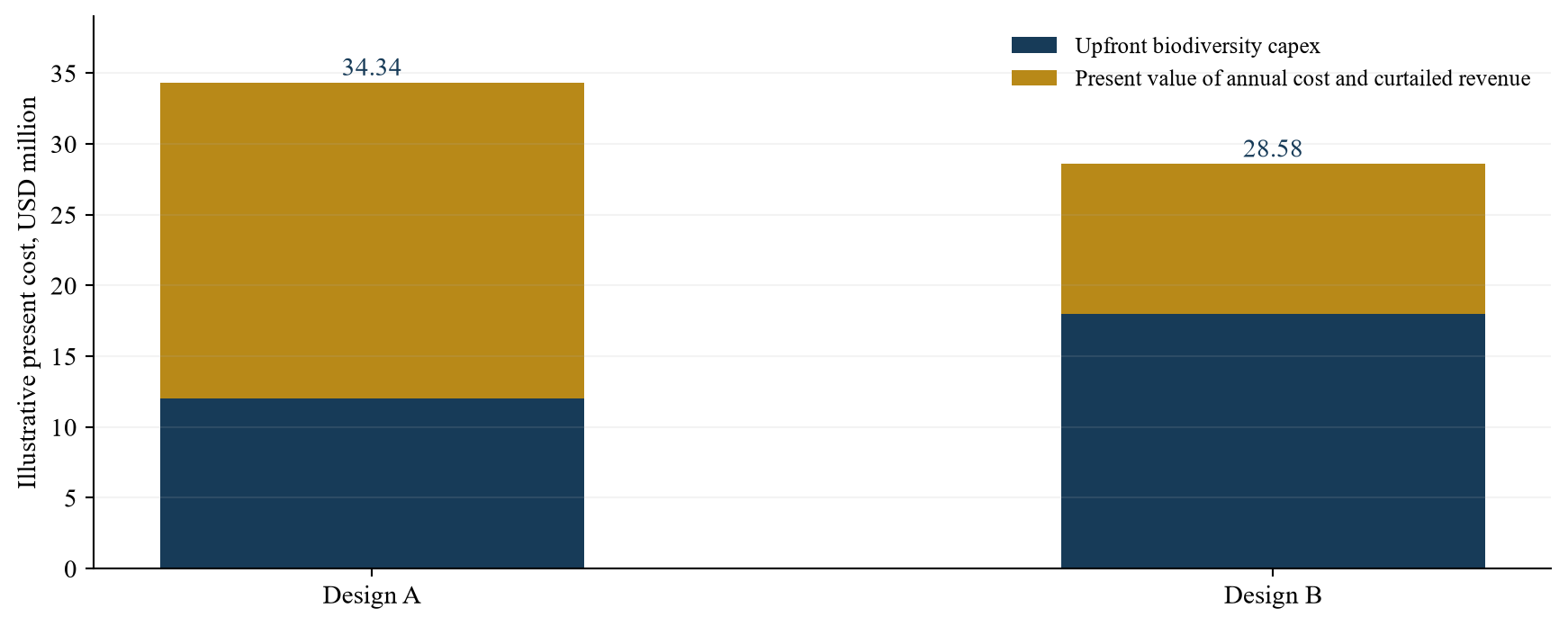
Author assumptions; USD million, rounded. A lower modelled cost does not establish permit or ecological acceptability.
11 Stress the assumptions that can change the choice
The ranking in Table 2 is conditional on curtailment, management cost, upfront work and the discount rate. A small change in one assumption can reverse it. Before using a model for a bid, finance should show a two-dimensional sensitivity for the variables that ecology and engineering have yet to settle. For the invented example, every percentage point of gross-output curtailment represents 7,665 MWh and USD 0.53655 million of annual revenue at the assumed flat price. Over 15 years at 8%, that is about USD 4.59 million of present revenue. The calculation is mechanical and ignores hourly price shape.
The value of more survey work can be framed as a decision question. If a survey could establish that a lower-curtailment layout is permissible, its potential value is related to the difference in funded design costs. That is not the same as saying the study is worth the full difference. The study may be inconclusive; the authority may impose additional conditions; the equipment design may change. The committee should compare the cost and duration of gaining evidence with the decisions it could actually change, and retain a stop option if the evidence is adverse.
Permit timing deserves a separate scenario. A twelve-month delay would affect the date at which output begins, interest during construction and possibly the price received under a contract. It should be modelled from actual debt draw schedules, EPC terms and offtake provisions. In this paper there is no verified project timetable, so no dollar figure is assigned to the delay. Presenting an invented delay cost as a market benchmark would create false precision.
The discount rate in the simple example is also an author assumption. A project-finance valuation should use a rate and cash-flow definition consistent with its debt, tax, currency, inflation and contractual risks. A present cost comparison is one lens; lenders may care more about annual cash-flow troughs and security for long-tail obligations. A design with a lower present cost can still be harder to finance if its early-year payments are concentrated.
12 Finance the obligations at the right entity
Nature-related obligations need cash and legal ownership. A special-purpose project company may hold the permit while a parent signs a land agreement, an EPC contractor performs restoration and an affiliate manages monitoring. The finance documents should align these responsibilities. If the operating company must maintain habitat for years after debt maturity, the closing plan needs a credible funding source and a surviving governance mechanism. England's guidance on significant on-site and off-site biodiversity gains describes long-term maintenance arrangements, including 30-year obligations where applicable [6,8]. That detail belongs to qualifying English projects, not to the paper's jurisdiction-neutral example.
Debt sizing should reflect the cash-flow period in which curtailment or management cost is most severe. If wildlife curtailment overlaps with high-price hours, an average annual output haircut may understate its effect on debt-service coverage. If a permit requires a costly restoration milestone before first generation, a construction facility must fund it before operating cash arrives. Lenders should seek independent technical, ecological and legal reports; the model should show the approved mitigation package and any reserve accounts required under actual financing terms.
Security can take several forms: restricted cash, a letter of credit, a parent guarantee, an insurance product or a funded trust where the law permits. Each has pricing and enforceability implications. A nominal provision in a spreadsheet is not cash security. The transaction team should identify the beneficiary, release conditions, step-in rights and what happens if the project company becomes insolvent. Decommissioning and habitat obligations may continue when the owner has no operating revenue. Their treatment should be negotiated with counsel and the regulator.
The financing agreement can also require periodic ecological reporting and a corrective-action mechanism. These should match what the operator can measure. A vague covenant to maintain biodiversity performance can be difficult to test; a dated survey, incident threshold, approved management plan and remedial timetable are more operational. Finance cannot certify ecological compliance without the specialists who own the methods.
13 Allocate biodiversity risk in an acquisition
A buyer of a development-stage project is buying a permit pathway as well as a site. Due diligence should retrieve all survey reports, raw data, regulator correspondence, environmental assessments, consultation records, land covenants, pending objections, habitat agreements and approved plans. Counsel should reconcile the permit application against the exact project design and company being acquired. A seller presentation may describe a project as "permitted" while material discharge conditions, species licences or grid works remain outstanding.
The acquisition agreement can distinguish signing, closing and construction notice to proceed. A condition precedent may require a specified consent, while a covenant requires the seller to maintain the application and disclose adverse regulator feedback. The parties can allocate cost for a bounded redesign, require a long-stop date or defer a portion of consideration until a defined milestone. Any contingent mechanism should define evidence, decision authority and dispute resolution. Unclear wording can replace environmental uncertainty with litigation uncertainty.
Warranties should be checked against data-room evidence and seller knowledge qualifiers. A statement that the project complies with environmental law is different from a guarantee that future operational curtailment will stay below a percentage. The first can be tested with counsel and records; the second needs a technical basis and may not be insurable. Indemnities, escrow or insurance can address specific past liabilities, but they do not create habitat or make a poor site acceptable for consent.
The buyer should decide which adverse finding changes price, which changes design and which ends the transaction. These thresholds should be documented before the final bid. A late ecological surprise is expensive partly because the team has already become committed to a preferred asset. Preserving the option to walk away is a governance control, especially when a sensitive site has no credible avoidance route.
14 Compare a new build with a brownfield repower
Repowering an existing renewable site can appear easier because the land has been used for energy generation. It can also change turbine dimensions, rotor sweep, operating hours, roads and cables. The ecological baseline may have shifted during the existing asset's life. An investor should not infer that an old permit automatically covers a new configuration. Counsel and ecologists must identify the consent path for the exact repowering design and the obligations that carry over from the previous project.
The commercial comparison includes removal of old equipment, restoration of obsolete hardstanding, continued landholder rights, construction outage and the increased output of new technology. A design that produces more MWh may need additional seasonal curtailment or collision monitoring. The net delivered-output gain, not nameplate capacity alone, determines revenue. Existing wildlife incident records can be valuable evidence, provided monitoring methods and reporting quality are understood. An absence of recorded fatalities under weak monitoring is not proof of absence of impact.
A brownfield site may provide roads, grid connection and community familiarity, reducing some development work. It may also carry legacy obligations, contaminated land or disputed restoration responsibilities. The purchaser should reconcile historic permit compliance, enforcement notices and monitoring results with the new business plan. A decommissioning reserve for the old plant should not silently fund obligations of the new plant unless documents permit that use.
The relevant counterfactual may be continued operation of the old plant, not an undeveloped parcel. Investment committees should compare keep-operating, repower, redesign and divest options, each with its own permitted output and capital need. Biodiversity is one line in that comparison, but it can determine which option is executable. Qualified ecological assessment and actual permit text remain essential.
15 Test portfolio concentration and cumulative effects
Portfolio investors can aggregate individual projects while overlooking a shared ecological dependency. Multiple wind farms along the same flyway, solar parks in a connected habitat or grid lines across one watershed may face cumulative assessment, public scrutiny or similar operating restrictions. Geographic spread on a financial map does not guarantee diversification of species or permitting exposure. The acquisition team should map common habitats, regulators, seasons, consultants, permit precedents and mitigation markets across assets.
Cumulative effects can be relevant even when each project appears modest. A regulator may consider the combined footprint of existing and proposed development under the applicable assessment framework. The actual legal requirement is jurisdiction-specific, so a project team must establish the scope with local advice. For financing, the practical question is whether later projects rely on the same scarce ecological capacity or the same off-site habitat provider. A portfolio model that assumes identical low-cost mitigation for every asset may exhaust the available solution.
Acquisition integration should create a consistent condition register while preserving the distinct legal wording of each permit. Shared monitoring vendors can improve data quality, yet measurement methods must still satisfy project-specific conditions. If a portfolio uses one central ecological team, it needs authority and budget to recommend curtailment or stop work when thresholds are crossed. Governance should give that team a direct escalation path to operations and lenders where required.
At exit, a buyer will ask whether the portfolio's reported output was achieved under compliant operation. A high production year that resulted from ignoring curtailment conditions is not evidence of sustainable earning power. Conversely, a documented adaptive-management programme may support a more reliable forecast. Neither conclusion can be presumed; the evidence is in permit compliance, monitored outcomes, generation records and independent review.
16 Build adaptive management into the operating plan
Environmental assessment is forward-looking. Monitoring during construction and operation tests what actually happens. A management plan should define baselines, methods, frequency, thresholds, responsible people and response actions. For wind projects, bird-and-bat fatality monitoring guidance stresses survey design, correction for detection bias and careful interpretation [10]. A simple raw carcass count may misrepresent outcomes if search coverage, scavenging and observer efficiency are ignored.
The operating plan should link trigger events to decision rights. If a threshold is exceeded, who can alter turbine operation? Who informs the regulator? Who updates the energy forecast and lenders? Who funds a new measure? A plan that says "monitor and adapt" without these answers has not priced its response. The financial model can use conditional cases tied to explicit trigger definitions, but the probability of those triggers requires site-specific evidence. This paper does not supply one.
Technology can assist detection, tracking and reporting. Cameras, radar, acoustic sensors and analytics may be useful, subject to validation, privacy or data rules, uptime, false positives and regulator acceptance. A vendor's claimed reduction in curtailment should not enter a base-case forecast until a suitable field trial and permit review support it. Contracting should specify data ownership, performance metrics, maintenance, audit access and the consequences of sensor failure.
Independent review matters when operator incentives conflict with compliance. An asset manager focused on availability may have reasons to under-report a costly event. A lender or board should receive evidence that reporting methods are maintained and corrective actions are closed. This is an operational-control question, not a general statement about good intentions.
17 Convert monitoring into a valuation evidence pack
An exit buyer will reconstruct the project's sustainable cash flow. It will ask whether output records include periods of non-compliance, whether curtailment assumptions match recent monitoring, and whether habitat obligations are funded. A well-structured evidence pack should contain each permit and approved plan, survey data, regulator letters, incident and remedy logs, generation by hour, curtailment classifications, monitoring invoices, security arrangements and forecasts reconciled to observed operation.
Data should be version-controlled. A changed detection method can create an apparent improvement or deterioration unrelated to real ecological outcomes. The seller should explain methodology changes and commission specialist interpretation where necessary. A buyer may apply its own lender standard in addition to local law. The seller's readiness therefore includes an assessment of whether the project can satisfy a foreseeable financing diligence process. A permit alone may be insufficient for a lender that contractually requires a higher environmental-and-social standard.
Long-tail habitat agreements and security must be transferable or continue to bind the correct entity after a change of control. The sale agreement should address approvals, replacement guarantees and release of seller support. If an external habitat provider performs the obligation, the buyer needs enforceable access to records and remedies. These arrangements can affect transaction timing as much as price.
An unverified claim of "nature positive" should be excluded from valuation materials. The buyer can value a demonstrable reduction in cost or risk only when the supporting survey, permit history and cash flows are available. The paper's framework supplies an evidence route; it does not claim that biodiversity expenditure automatically increases exit multiples. That conclusion would require a documented transaction and comparable evidence.
18 Use a decision-gated implementation roadmap
An implementation plan should start before land is fully committed. Gate one screens alternative footprints with available ecological data and identifies obvious exclusion or high-conflict areas. Gate two commissions seasonally adequate fieldwork and records the remaining uncertainty. Gate three integrates the survey into preliminary engineering, yield and the mitigation hierarchy. Gate four tests the actual permit route, public consultation and lender standards. Gate five funds the approved construction and operational obligations in the financial model. Gate six establishes monitoring and a change-control process for the operating period.
The gates are not a fixed number of months. The time required depends on species, season, jurisdiction, consultation and design. A credible project schedule is built backwards from the required evidence and authority decisions. If commercial pressure forces an acquisition before the baseline is complete, the transaction documents should preserve an explicit contingent decision and funding reserve. The board should see the cost of that choice and the conditions under which it can stop.
Each gate has a named owner. Ecology owns methods and impact conclusions; engineering owns buildable alternatives; counsel owns applicability and permit interpretation; finance owns the cash model; the project company owns delivery and compliance. The investment committee owns the capital decision. Clear ownership prevents an environmental consultant from becoming the de facto guarantor of a financial forecast or a finance analyst from determining ecological acceptability.
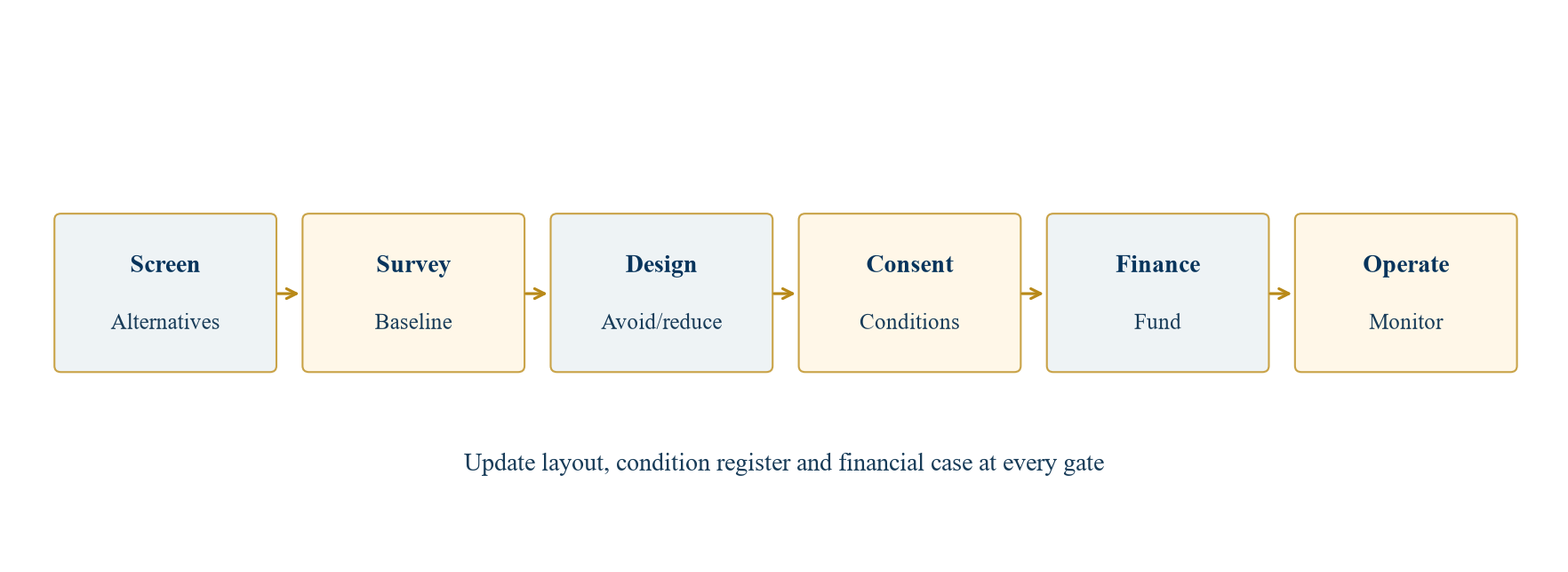
Author-developed governance sequence; durations and legal steps must be set for the actual jurisdiction and project.
19 Require an investment-committee evidence standard
A committee paper should present one approved project layout and the alternatives that were seriously considered. It should show legal applicability, survey completeness, likely consent route, material objections, funded measures, output assumptions, construction schedule and financial sensitivities. A number in a valuation model should have a traceable origin: permit condition, field observation, qualified forecast, executed contract or clearly labelled management assumption. The committee should know which assumptions remain unresolved at its decision date.
The decision standard can have four outcomes: proceed on current evidence; proceed only after defined information or consent; redesign and return; or stop. A request for another survey is useful only if its result can change one of these outcomes. An investment committee should not accept an unexplained "low ecological risk" label as a substitute for the project's habitat, species and permit evidence. A legal opinion and an ecological report answer different questions, and neither alone establishes bankability.
The table below is a decision template. It is intentionally generic and contains no implied finding about a live asset. In a transaction, each row should point to the relevant document and responsible professional. It should also show whether the item is satisfied at signing, financial close, notice to proceed or operation. The order of these milestones can materially affect cash committed at risk.
Table 3. Biodiversity investment-committee decision record
| Decision item | Required evidence | Financial translation | Gate owner |
|---|---|---|---|
| Site and alternatives | Surveyed footprints, constraints map, rejected options | Yield and redesign comparison | Ecology and engineering |
| Applicable permits | Local-law memo, authority correspondence, draft conditions | Timing, security and obligations | Counsel and project company |
| Construction effects | Seasonal method statement, EPC schedule and prices | Capex and interest during construction | EPC and finance |
| Operating effects | Curtailment rule, energy-yield report, monitoring plan | MWh, price shape and recurring cost | Ecology, yield adviser and finance |
| Long-tail duties | Habitat agreements and decommissioning security | Reserve, guarantee and exit transfer | Counsel, finance and asset management |
Author-developed template. Populate with project-specific evidence and professional sign-off before use.
20 State the limits and the executable decision
The sources in this paper establish frameworks and selected current rules. They do not describe the ecology, law or permit position of the invented wind project. The two numerical designs are hypothetical author assumptions. They omit construction financing, tax, energy-price volatility, hourly curtailment shape, biodiversity outcomes, insurance and decommissioning. The figures show a way to communicate decisions, not evidence that one specific mitigation package is sufficient. Project-specific work requires local legal advice, qualified ecological fieldwork, engineering, energy-yield analysis and current lender terms.
The method also has a timing limit. Regulations and guidance can change after this review date. In particular, the stated England application date for biodiversity net gain on nationally significant infrastructure project development-consent-order applications is 2 November 2026 [7,8]. A project whose submission date, route or transitional position differs needs fresh confirmation. No rule in the regime table should be applied by analogy to an unrelated geography.
The practical result is a conditional capital decision. A sponsor should know which biodiversity constraints can be avoided by siting, which can be mitigated through a credible and funded plan, and which may make the scheme uneconomic or unconsentable. It should translate the enforceable conditions into output, cost, timing, security and exit evidence. It should preserve a stop option until the evidence supports commitment. The financial model is then a record of an executable design rather than a calculation attached to an uncertain permit.
The committee can make the decision testable by recording three thresholds before receiving the final ecological report: the maximum additional capital required for an acceptable redesign, the lowest debt-service headroom it will accept under a compliant operating rule, and the latest date at which the project can reach financial close without losing its commercial case. Those thresholds are project choices, not values supplied by this paper. An adverse field result should trigger a specified redesign or stop decision. The same record should identify the evidence that would allow the committee to revisit its decision. This creates a traceable link between the survey, the permit, the investment mandate and the financing model, while leaving ecological and legal judgments to the professionals authorised to make them.
For buyers and lenders, the most useful next action is a joint ecological, legal, engineering and finance review of a specific project perimeter. That review can produce the condition register, alternative-layout comparison, funded mitigation budget and committee recommendation. It should report uncertainties openly. The benefit is a transaction process in which nature-related obligations enter the same discipline as grid, construction and offtake risk.
References
- International Finance Corporation. Performance Standard 6: Biodiversity Conservation and Sustainable Management of Living Natural Resources, 2012. Accessed 6 October 2026. https://www.ifc.org/en/insights-reports/2012/ifc-performance-standard-6
- International Finance Corporation. Guidance Note 6: Biodiversity Conservation and Sustainable Management of Living Natural Resources, 2012. Accessed 6 October 2026. https://www.ifc.org/content/dam/ifc/doc/2010/2012-ifc-performance-standards-guidance-note-en.pdf
- World Bank. Environmental and Social Standard 6 within the Environmental and Social Framework. Accessed 6 October 2026. https://www.worldbank.org/en/projects-operations/environmental-and-social-framework/brief/environmental-and-social-standards
- European Union. Directive (EU) 2023/2413 amending renewable-energy rules, Official Journal, 2023. Accessed 6 October 2026. https://eur-lex.europa.eu/eli/dir/2023/2413/oj/eng
- European Commission. Recommendation and guidance on speeding up permit-granting for renewable energy and related infrastructure, 2024. Accessed 6 October 2026. https://energy.ec.europa.eu/publications/recommendation-and-guidance-speeding-permit-granting-renewable-energy-and-related-infrastructure_en
- UK Government. Biodiversity net gain guidance, updated 2026. Accessed 6 October 2026. https://www.gov.uk/guidance/biodiversity-net-gain
- UK Government. Biodiversity net gain for nationally significant infrastructure projects: collection. Accessed 6 October 2026. https://www.gov.uk/government/collections/biodiversity-net-gain-nationally-significant-infrastructure-projects
- UK Government. Nationally Significant Infrastructure Projects Biodiversity Gain Statement for Energy. Accessed 6 October 2026. https://www.gov.uk/government/publications/nsips-biodiversity-gain-statement-for-energy/nationally-significant-infrastructure-projects-biodiversity-gain-statement-for-energy-accessible-version
- United States Fish and Wildlife Service. Eagle Incidental Take Wind Energy Permits. Accessed 6 October 2026. https://www.fws.gov/program/eagle-management/eagle-incidental-take-wind-energy-permits
- International Finance Corporation, European Bank for Reconstruction and Development and KfW. Good Practice Handbook and Decision Support Tool: Post-Construction Bird and Bat Fatality Monitoring for Onshore Wind Energy Facilities, 2023. Accessed 6 October 2026. https://www.ifc.org/en/insights-reports/2023/bird-bat-fatality-monitoring-onshore-wind-energy-facilities
About the Author
Chennakeshav (CK) is a corporate finance and investment banking executive with 25+ years of global experience in deal origination, structuring and execution across M&A, growth capital and corporate strategy. He has led value-creation mandates for founders, corporates and funds — bridging the boardroom view to hands-on execution and close.
His career spans Morgan Stanley, HSBC, Lloyds Banking Group, EWEC, ADQ portfolio companies and Emirates Growth Fund, across TMT, real estate, fintech, deeptech, cleantech, infrastructure and energy. He has partnered with C-suite leaders, private equity and venture funds, sovereign wealth funds and family offices to finance complex fund raises and scale-up ventures, and has led M&A due diligence, post-merger integration and business-transformation initiatives to create value.
At Matchpoint Partners he is Managing Partner, leading the firm's corporate finance, M&A and capital-raising practice. He holds an MBA from London Business School, an engineering degree from VTU and a Master of Laws (LLM, in progress) from UCL London.
An active start-up mentor, CK mentors at Techstars, DIFC FinTech Hive, Startup Grind, Founder Institute and IN5, serves as Entrepreneur Mentor in Residence (EMiR) at London Business School, and judges the Entrepreneurship World Cup.
