
1. The integrated-resource decision
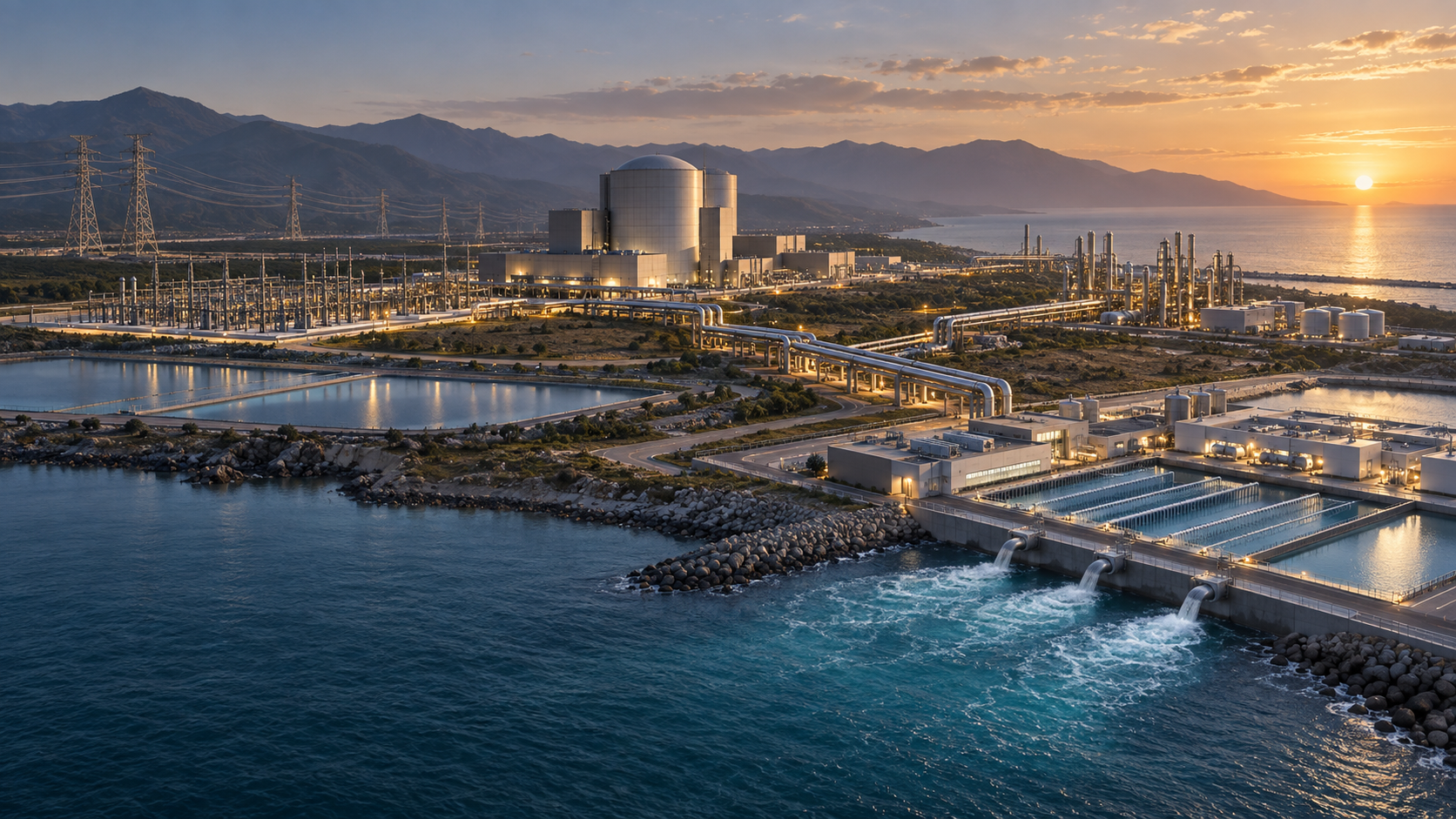
The investment question is whether one reactor can serve three contracted markets more effectively than separate electricity, steam and water assets. The answer depends on site-specific demand, reactor technology, heat grade, desalination process, network configuration, offtaker credit and the cost of alternatives. Revenue stacking has value only when the physical system can deliver each product with acceptable reliability and the contracts convert that capability into durable cash flow.
The project should therefore begin with a system requirement rather than a reactor selection. The sponsor needs hourly electricity demand, steam temperature and pressure, water quantity and quality, expected growth, seasonal variation, outage tolerance and the location of each delivery point. These requirements define the useful operating envelope and expose where one product can support or constrain another.
2. Three products with different economics
Electricity is measured at an electrical delivery point and can sometimes reach multiple buyers through a grid. Steam and useful heat are local products because transport distance, pressure loss and temperature degradation matter. Desalinated water can be stored, while bulk conveyance and pumping can materially affect total cost. The three products therefore have different markets, infrastructure and credit characteristics.
Their pricing conventions also differ. Electricity can use capacity and energy charges, steam can use reservation and metered-use payments, and water can use availability and volume tariffs. A combined project must reconcile these conventions without double recovery or uncovered common costs. Each customer needs a price that is understandable within its own procurement and regulatory framework.
3. What cogeneration changes
Cogeneration allocates reactor thermal output among electricity generation and non-electric applications. Heat extraction can improve total useful-energy utilisation where a stable heat load exists. It can also reduce electrical generation, alter turbine conditions and add heat exchangers, piping, controls and safety boundaries. The relevant measure is total value delivered from the integrated plant, not gross reactor output alone.
The OECD Nuclear Energy Agency reports operating experience with nuclear plants providing district heat, desalination or process heat and notes that existing reactors can supply industrial heat below approximately 300 degrees Celsius [1]. Small modular reactors may broaden siting and application choices, but project economics still depend on the specific design, licensing basis and customer interface [2].
4. Technology choice follows the service
Light-water reactors can support electricity and lower-temperature heat applications. High-temperature reactor concepts may address additional industrial processes, subject to maturity and licensing. A sponsor should map required temperature and pressure against demonstrated design output, heat-transfer arrangements and materials. A generic statement that a reactor provides heat does not establish compatibility with an industrial process.
The reactor choice also affects module size, construction sequence, refuelling, load following, cooling, fuel supply and multi-unit availability. A multi-module plant can phase capacity and maintain partial output during an outage. It can also create more interfaces and common-mode exposure. Technology diligence should connect design evidence directly to the contracted service specification.
5. The service specification
The procurement specification should define dependable electrical capacity, annual energy, steam flow, pressure, temperature, condensate return, water volume, water quality, ramping, planned outages, force-majeure treatment and restoration performance. It should also define measurement, testing, data access and the physical boundary for each product. These terms become the basis for design acceptance and revenue.
A single headline capacity cannot express the service. Maximum electricity may be available only when steam extraction or desalination is reduced. Maximum water output may require electricity or heat that would otherwise be sold. The specification should include feasible combinations and identify prohibited states, minimum stable loads and transition rates.
6. A staged decision process
The project can advance through six evidence gates: demand validation; technology and site fit; integrated engineering; commercial allocation; financing and approvals; and construction and operating proof. Each gate should retire named risks and preserve a credible alternative if evidence fails.
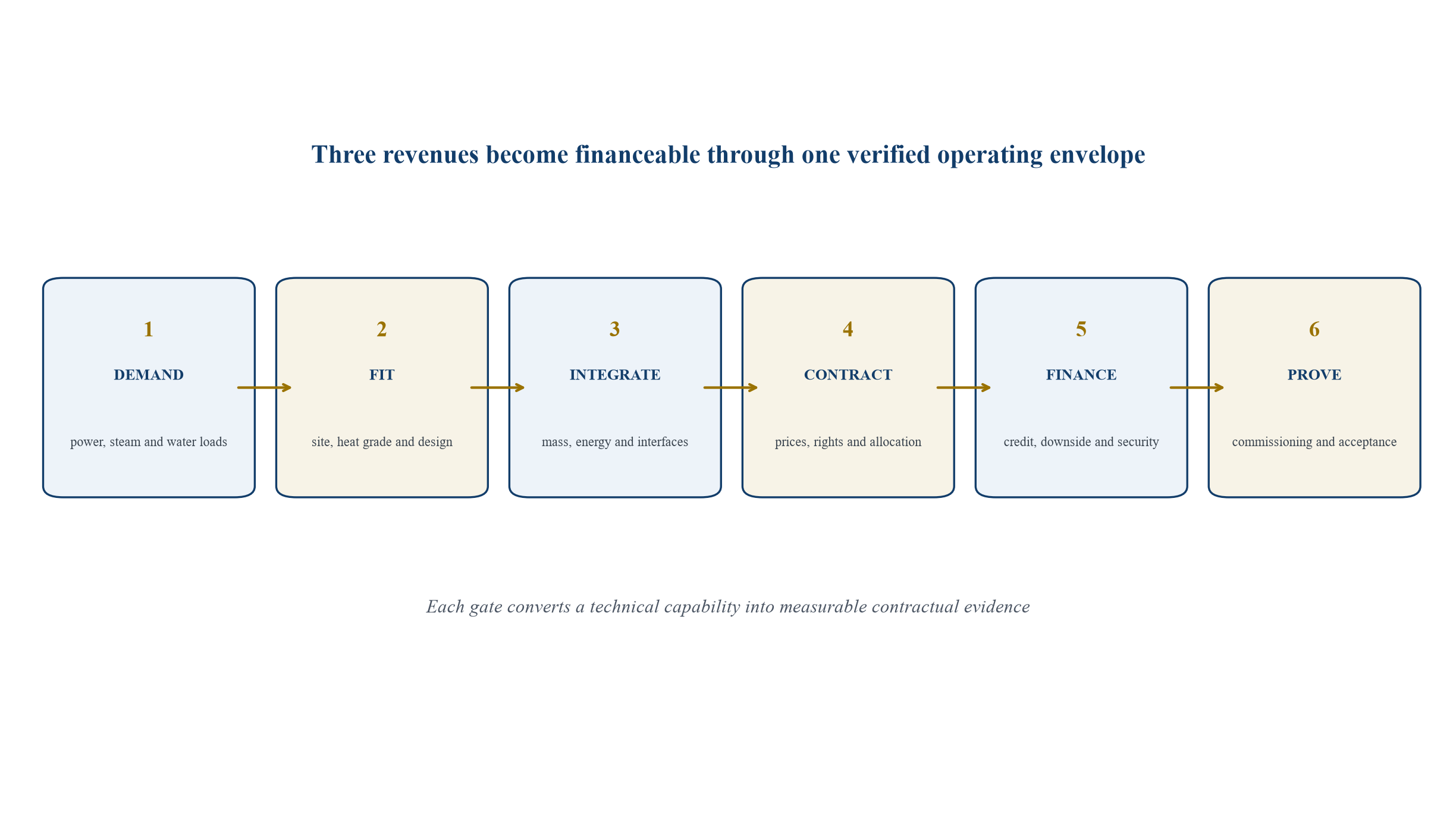
Generic decision process; project governance and approvals depend on jurisdiction and procurement model.
Early expenditure should be proportionate to evidence. Demand studies and thermodynamic modelling can identify incompatibilities before major design commitment. Contract heads of terms should be tested against the engineering model before lenders rely on projected revenue. Final investment approval should require aligned technical, commercial and regulatory baselines.
7. Site and cluster economics
An integrated plant needs proximity to steam and water customers, an acceptable nuclear site, cooling and intake arrangements, grid access, product pipelines and emergency infrastructure. Industrial clusters, coastal utility zones and existing generation sites may provide concentrated demand and shared infrastructure. Each location brings specific environmental, security, land and interface requirements.
Steam transport losses and pipeline cost can make distance decisive. Water can travel farther, subject to pumping and network cost. Electricity has the widest potential market where grid connection is available. Site screening should optimise the combined system and record which product anchors the location decision.
8. Demand aggregation
A large industrial customer may provide the steam anchor, while a utility or market buys electricity and a water authority buys desalinated water. Aggregating several smaller customers can diversify revenue and create additional distribution assets, metering and credit administration. The sponsor needs a demand map that distinguishes firm, interruptible and prospective load.
Expansion demand should receive probability weighting and contractual evidence. A planned industrial park or population forecast is not equivalent to committed offtake. The base financing case should rely on contracted or demonstrably supportable demand. Expansion capacity can be structured as an option or later module rather than assumed at financial close.
Demand validation should reconcile customer forecasts with independent drivers. Industrial steam demand should connect to production capacity, utilisation and shutdown plans. Water demand should connect to population, industrial use, storage, leakage and reuse policy. Electricity demand should connect to grid planning, retirements and dispatch. The sponsor should maintain a single scenario register so that one optimistic economic outlook is not counted three times across the revenue case.
9. The electricity product
The electricity contract can include a fixed capacity payment, variable energy payment, ancillary-service revenue and indexation. The capacity payment supports capital recovery when the plant is available, while the energy payment covers output-related cost. Dispatch and curtailment rights must account for steam and water obligations.
If electricity is the balancing product, output will rise or fall as thermal energy is diverted. The power purchaser should understand the resulting operating profile. Grid-code compliance, reserve requirements and connection charges belong in the model. Merchant exposure should be evaluated separately from contracted revenue.
10. The steam product
Steam value depends on flow, pressure, temperature, dryness, delivery distance and the customer's avoided boiler cost. Condensate return can reduce water and heat requirements, subject to quality control. The steam contract should define normal operating range, permitted excursions, outage coordination and responsibility for customer-side equipment.
Industrial processes can suffer losses far above the commodity value of interrupted steam. Service standards should reflect controllable performance and exclude consequences that the supplier cannot prudently insure. The customer may retain backup boilers or thermal storage. The project model should include their cost when they are necessary for bankable reliability.
11. The water product
The water contract should define daily and annual volume, potable or industrial quality, pressure, storage, availability, testing, rejected water and network losses. A water purchase agreement can use an availability payment plus a volumetric charge. This structure supports fixed-cost recovery while preserving an operating incentive.
Storage decouples production from immediate consumption and can make desalination a flexible load. Storage capacity has physical and public-health constraints. The system should preserve minimum water service during reactor or desalination outages through tanks, network connections, alternative plants or emergency supply.
12. Reverse osmosis
Seawater reverse osmosis uses electricity to pressurise feedwater through membranes. It can operate with nuclear electricity without a direct steam interface. Modern energy-recovery devices reduce consumption, while intake quality, salinity, temperature, pretreatment and membrane condition affect actual performance. The World Bank identifies reverse osmosis as the dominant and increasingly efficient desalination pathway in many markets [3].
Reverse osmosis can provide operational flexibility because trains can be scheduled within limits and water can be stored. Frequent cycling, minimum-flow requirements and membrane ageing need engineering confirmation. The business case should include pretreatment chemicals, membrane replacement, brine disposal, intake and outfall systems, and pumping to the customer.
13. Thermal desalination
Multi-effect distillation and multi-stage flash processes use thermal energy and electricity. They can be relevant where suitable low-grade heat exists, high product-water quality is valued, or local operating experience supports the technology. Coupling design influences turbine extraction, heat-exchanger duty and the amount of electricity forgone.
The IAEA's Desalination Thermodynamic Optimization Program evaluates alternative coupling configurations, while its Desalination Economic Evaluation Program compares power and water cogeneration options [4][5]. These tools support screening and do not replace project-specific engineering, cost data or safety analysis.
14. Hybrid desalination
A hybrid plant can combine reverse osmosis with a thermal process to use both electricity and heat, manage water quality and diversify operating modes. It may also use blending to meet a target specification. The 2024 IAEA SMR conference included analysis of a small pressurised-water reactor coupled with reverse osmosis and membrane distillation, illustrating active development of hybrid concepts [6].
Hybridisation adds equipment, controls and optimisation choices. The economic case should identify the specific benefit obtained from each train. The project should avoid complexity that produces only a theoretical efficiency gain. Availability, maintainability and operator capability should influence the selected configuration.
15. Heat quality and exergy
Heat at a high temperature has greater capacity to perform work than heat near ambient conditions. Extracting steam from different turbine stages changes the electrical opportunity cost. A commercial allocation based only on thermal megawatt-hours can therefore misprice the value transferred to the steam or water business.
The integrated model should record extraction conditions, return conditions, conversion losses and the electricity that could otherwise have been generated. Cost allocation can use incremental cost, opportunity cost, benefit sharing or a regulated methodology. The chosen method should remain consistent across contracts and financing forecasts.
16. The mass-and-energy balance
The engineering model should reconcile reactor thermal output, turbine performance, internal use, steam extraction, condensate return, desalination consumption, cooling and net exports. It should cover normal operation, low load, maintenance, start-up and credible failure states. The balance establishes which revenue combinations are physically achievable.
Version control matters because small changes in one subsystem can affect several contracts. The approved model should be linked to performance guarantees and acceptance tests. Commercial teams should not quote product volumes from inconsistent design cases.
The model should report gross and net quantities. Electricity used by desalination, pumping and common auxiliaries cannot also be sold at the grid meter. Returned condensate can reduce makeup-water and heating duty, subject to quality. Thermal losses in steam distribution should appear between the plant boundary and customer meter. These reconciliations convert engineering output into billable quantities and prevent revenue overstatement.
17. Product-priority rules
When total demand exceeds available output, the plant needs a priority protocol. Drinking water, grid stability or a safety-critical industrial process may receive priority under defined conditions. The protocol should address normal dispatch, scarcity, emergency operation, planned maintenance and restoration.
Priority rules transfer economic value among customers. A steam customer that can be curtailed to protect water requires a suitable price and backup plan. A power purchaser that carries balancing cost needs compensation or clear limits. The rules should be reflected in tariffs, damages and force-majeure provisions.
18. Multi-unit configuration
Several reactor modules can improve phasing and partial availability. One unit can undergo maintenance while others serve essential loads. Modules can be added as demand grows. Common systems, shared control rooms and common design features can reduce cost and create common-mode risk.
The financial model should use unit-specific outage schedules and shared-system constraints. It should distinguish an individual module failure from a site-wide event. Contracted dependable output should reflect the actual redundancy and maintenance philosophy.
19. Cooling and water intake
Nuclear generation and desalination both interact with water systems. Site design should assess cooling technology, seawater intake, temperature, biofouling, discharge, brine concentration and environmental permits. Combining systems may create infrastructure efficiencies and cumulative environmental effects.
The intake and outfall can become critical common assets. Their capacity, ownership, availability and expansion rights should be defined. Climate-related sea-level, temperature and extreme-weather scenarios belong in long-life asset planning.
20. Safety boundaries
Heat-transfer systems should preserve the nuclear safety boundary and prevent unacceptable interaction between reactor systems and industrial or desalination facilities. Intermediate heat exchangers, pressure isolation, monitoring and separation can be required. The regulator determines the acceptable design and licensing evidence.
Commercial contracts must respect the licensed operator's authority. A customer cannot direct operation in a way that conflicts with safety. Change control should require technical and regulatory review before customer modifications affect the shared system.
21. Nuclear regulation and non-electric use
The nuclear licence should address the selected design, site and non-electric interfaces. Environmental and water approvals may sit with additional authorities. Industrial pipelines and water-quality regulation create further obligations. An integrated approvals register should identify dependencies and responsible parties.
The IAEA's current SMR programme includes non-electric applications, coupling, siting, safety, regulation and stakeholder engagement as distinct workstreams [7]. A project schedule should reflect jurisdiction-specific requirements and regulator capacity. Vendor timelines remain assumptions until aligned with competent authorities.
22. Water regulation and public service
Bulk water is often a regulated or government-procured service. Tariffs may be subsidised, pooled across assets or recovered through a public utility. The water purchaser's legal authority, budget mechanism and payment history are therefore central credit issues.
Water-quality failure can create public-health consequences and reputational risk. The contract should define laboratories, sampling, reporting, remediation and emergency supply. The desalination operator and water network operator need coordinated incident procedures.
23. Industrial customer diligence
Steam revenue can depend on one refinery, chemicals plant, minerals processor or manufacturing cluster. Diligence should cover production outlook, cost position, ownership, environmental compliance, maintenance plans and alternative heat sources. A long steam contract can be exposed to plant closure or technology change.
The customer should provide parent support, minimum payments or termination compensation proportionate to the project's dedicated investment. Lenders should test commodity and margin downside where it affects the customer's survival. A technically sound heat network remains vulnerable to weak industrial credit.
24. Water-offtaker diligence
The water buyer should be assessed for statutory mandate, procurement approval, tariff recovery, government support, demand forecast and network capacity. Rapid demand growth can strengthen utilisation and require additional conveyance investment. Conservation, reuse and leakage reduction can reduce expected demand.
The World Bank's GCC water-energy work emphasises pricing, efficiency, reuse and the energy intensity of water supply [8]. A desalination project should therefore sit within a complete water-resource strategy. Demand projections should not ignore policy measures that alter consumption.
25. Electricity-offtaker diligence
The electricity buyer may be a public utility, corporate customer, market operator or trading intermediary. Diligence should cover credit, dispatch authority, grid access, curtailment compensation, network congestion and regulatory change. Corporate power contracts require alignment between contract term and the buyer's operating life.
Merchant electricity assumptions should use observable market rules and scenario ranges. The project should identify whether steam or water commitments limit dispatch into high-price periods. Revenue forecasts should avoid simultaneous use of incompatible product maxima.
26. Common infrastructure
Shared land, security, control, intake, cooling, electrical systems, heat exchangers, pipelines and administration can lower combined cost. They can also create cross-default and availability exposure. The asset register should distinguish common, product-specific and customer-owned infrastructure.
Each common asset needs an owner, operator, maintenance plan, replacement reserve and access protocol. A shared pipeline or intake can become a financing bottleneck when its rights are outside the project company. Lenders need enforceable continuity arrangements.
27. Cost boundary
The full cost boundary includes reactor supply, turbine and heat extraction, desalination trains, intake and outfall, steam and water networks, grid connection, site, security, licensing, owner costs, financing, fuel, operations, waste and decommissioning. Customer-side conversion or backup may also be required for a complete comparison.
The alternative case should use equally complete boundaries. Separate assets can have different financing, redundancy and environmental costs. A combined project should receive credit for genuine shared savings and carry the cost of additional coupling and governance.
28. Allocating common cost
Common cost can be allocated by capacity, usage, incremental causation, avoided cost or negotiated benefit. Each method produces different product economics. An allocation suitable for management accounting may not support tariff regulation or lender protections.
The project should establish a documented hierarchy. Direct costs go to the relevant product; incremental shared costs follow causation; residual common costs use a stable rule; and future expansions pay for the capacity they consume. The approach should prevent one customer from subsidising another without explicit policy approval.
29. Cost-performance benchmark
The benchmark should connect expenditure to the service and risk it purchases. It should also show the evidence required before a cost assumption enters the financing case.
Table 1. Integrated cogeneration cost and performance benchmark
| Package | Commercial purpose | Core evidence | Downside test |
|---|---|---|---|
| Reactor and turbine | Produce dependable thermal and electrical output | Licensed design basis, performance model and qualification record | Output shortfall, redesign or delayed delivery |
| Heat extraction and steam network | Deliver specified steam at the customer boundary | Heat balance, hydraulic study, materials and acceptance plan | Pressure loss, customer outage or pipeline failure |
| Desalination and water network | Deliver specified water volume and quality | Feedwater data, process design, storage and conveyance study | Fouling, quality failure, intake outage or demand loss |
| Grid and balancing | Export electricity and maintain system compliance | Connection agreement, dispatch study and grid-code evidence | Curtailment, congestion or balancing cost |
| Shared site systems | Support safe integrated operation | Interface register, ownership and availability model | Common-mode outage or cost-allocation dispute |
| End-of-life obligations | Complete decommissioning and asset retirement | Cost study, waste route and financial assurance | Cost escalation or unavailable receiving path |
Generic categories; project values require design, market and jurisdiction-specific evidence.
30. Operating expenditure
Operating cost includes nuclear staffing, maintenance, fuel, security, insurance, regulatory fees, desalination chemicals, membranes, industrial-water treatment, pumping, laboratory work and product-network maintenance. Shared teams may reduce duplication, while specialised obligations remain.
The model should separate fixed and variable cost and identify indexation. Membrane replacement, major maintenance and refuelling create periodic cash needs. Reserve accounts should match the actual cycle rather than a uniform annual assumption.
31. Revenue architecture
An integrated project can combine three separate offtake contracts under a common operating protocol. Each contract should acknowledge the others and use consistent definitions for availability, planned outage, force majeure and common-asset failure. A coordination agreement can resolve priorities, data and change control.
The project company needs sufficient fixed revenue to cover debt service and essential fixed cost under a prudent downside case. Variable revenue can provide upside and operating incentives. The contract package should prevent one customer's dispute from suspending unrelated payments.
Cash-flow waterfalls can preserve product accountability. Product receipts first fund taxes and direct operating costs; agreed shares then fund common operating cost, debt service, reserves and distributions. A deficiency caused by one customer's non-payment should trigger its security and cure process before burdening the other customers. Transparent allocation supports tariff review and gives lenders a traceable route from invoices to debt service.
32. Electricity pricing
A two-part electricity tariff can separate dependable capacity from metered energy. Indexation may cover inflation, fuel and approved change in law. Performance deductions should reflect controllable shortfall and preserve safe operating decisions.
The power price should incorporate the opportunity cost of heat extraction only where that cost is not recovered elsewhere. Clear allocation avoids double counting. Dispatch instructions that reduce steam or water revenue require pre-agreed compensation or priority treatment.
33. Steam pricing
Steam pricing can include a reservation charge for contracted capacity, a metered charge for delivered energy and a return-water adjustment. The tariff can reference the customer's avoided boiler fuel, subject to floors and ceilings, or use cost-based indexation.
Minimum offtake or take-or-pay protects dedicated infrastructure and capital recovery. The customer needs maintenance coordination and permitted interruption rights. Termination payments should cover debt, break costs and stranded steam-network investment.
34. Water pricing
Water pricing can include an availability payment, volume charge, quality adjustments and pass-through for electricity or chemicals within defined limits. Public affordability and fiscal commitments should be tested through the purchaser's approved procurement and tariff framework.
The contract should define deemed availability when the plant can produce but the network cannot accept water. It should also define storage saturation, emergency production and minimum dispatch. Network losses after the delivery point should remain with the responsible operator.
35. Coordinated outages
Refuelling and major maintenance can interrupt several products at once. The annual plan should align reactor work, desalination maintenance, industrial shutdowns and grid conditions. Multi-unit configurations may preserve partial service.
Customers should receive notice and participate in coordination without controlling nuclear safety decisions. Backup water, electricity and steam arrangements should be funded according to the risk allocation. Planned-outage allowances should use one common calendar across contracts.
36. Change control
An industrial customer may expand, the water authority may change quality standards, and the grid may impose new requirements. Each change can affect the integrated design. A joint change process should identify engineering, licensing, schedule, price and financing consequences before approval.
The party requesting a discretionary change can bear the incremental cost. Mandatory legal changes require an agreed allocation and mitigation duty. The baseline should remain traceable through configuration records and contract amendments.
37. Ownership structures
One special-purpose company can own the reactor and all product assets. Separate companies can own the nuclear plant, desalination facility and networks under long-term supply agreements. A public-private structure can retain strategic water or nuclear assets in public ownership.
The preferred structure depends on licences, tax, security, public procurement, financing and operational capability. Separation can ring-fence risks and create interface dependence. Integration can simplify control and concentrate liability. Legal responsibility should follow the actual operating model.
38. Project finance readiness
Limited-recourse debt requires predictable construction cost, credible completion support, enforceable offtake, strong counterparties, adequate reserves and a tested operating plan. Emerging reactor technology can require sponsor, vendor or government balance-sheet support before conventional project debt becomes available.
Revenue diversity can improve resilience when exposures are genuinely distinct. It can also create three correlated claims on one plant. Lenders should model common outages, shared cost growth, offtaker default and product-priority constraints rather than applying a simple diversification benefit.
Debt sizing should use the lower of contracted cash-flow capacity and asset-level downside capacity. A base case can include all committed minimum payments. A lender case should apply product-specific haircuts, common-outage assumptions, operating reserves and major-maintenance funding. Ratios should be tested after the weakest credible product case and after a common-asset event. Refinancing assumptions should remain outside the base repayment plan unless committed.
39. Completion support
Construction completion should cover the integrated facility and product acceptance tests. A reactor that generates electricity but cannot meet steam or water obligations may be technically complete and commercially incomplete. Sponsors need a clear definition of provisional and final completion.
Completion support can include equity commitments, guarantees, contingency facilities and vendor security. Release should require cost, schedule, performance, licence and operating-readiness conditions. Remaining product-network defects should be quantified and funded.
40. Credit enhancement
Government guarantees, utility support agreements, letters of credit, escrow and debt-service reserves can strengthen weak offtake credit. Their legal authority, budget treatment and enforceability require diligence. Support should be proportionate to essential-service and demonstration objectives.
Cross-collateralisation should be used carefully. Strong electricity revenue should not automatically absorb an unlimited water-purchaser default. The financing documents can establish cure periods, replacement rights, cash sweeps and product-specific reserves.
41. Hypothetical operating model
Consider a hypothetical coastal project with a multi-unit reactor site. The base operating plan allocates thermal output among power, industrial steam and desalination. Revenue contracts include fixed availability payments and variable production charges. The values below are illustrative indices rather than engineering or market estimates.
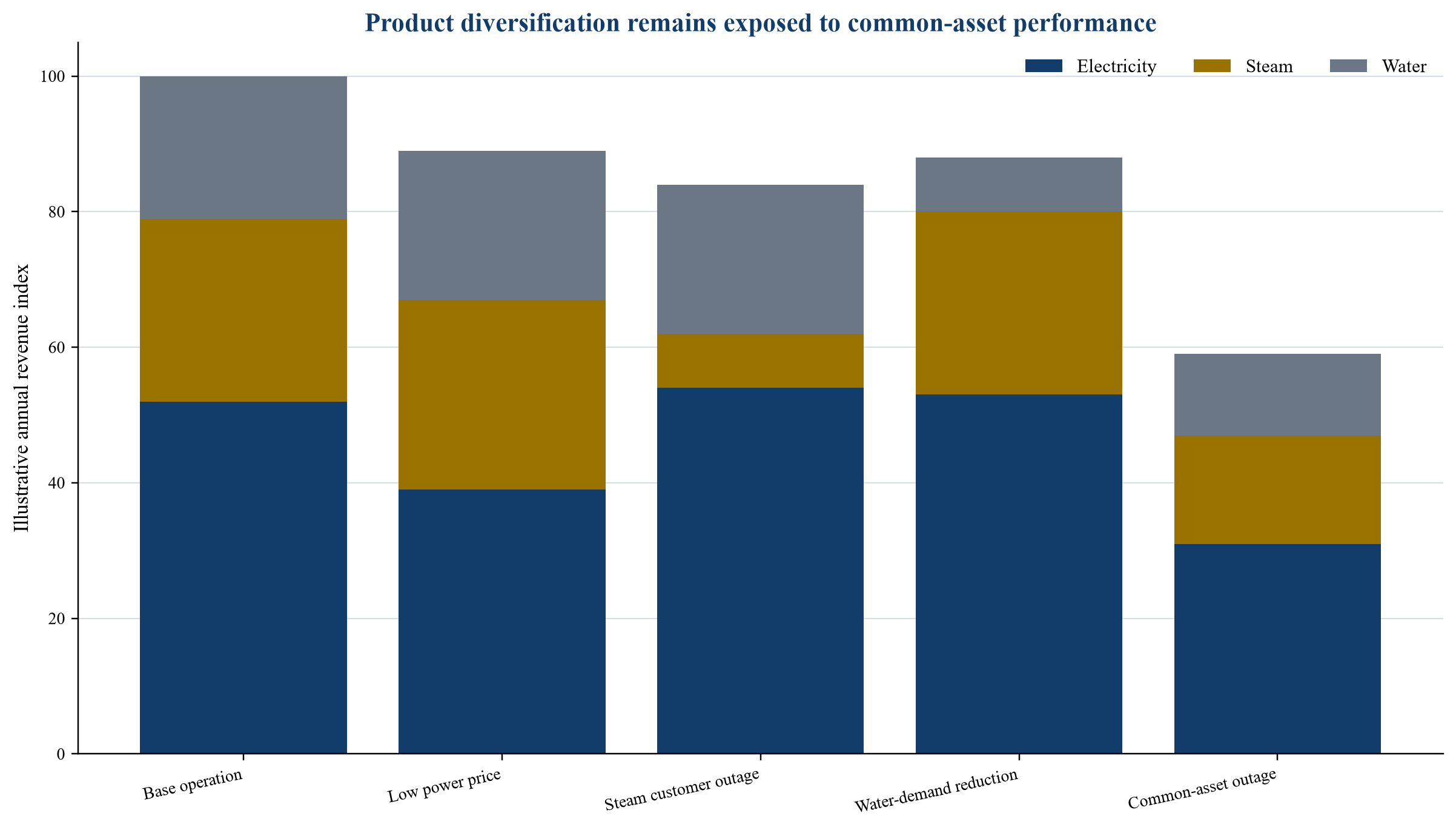
Unattributed values are illustrative indices and do not represent a named project, forecast or offer.
The single-product cases preserve revenue from unaffected customers. The common-asset outage reduces all three lines. This distinction should drive insurance, reserves, availability guarantees and debt sizing. The model should also reflect variable-cost savings and backup obligations during each event.
42. Scenario valuation
Valuation should use an integrated discounted-cash-flow model with separate product schedules and a reconciled energy balance. Cash flows include capital, operating cost, taxes, fuel, financing, product revenue, penalties, replacement service, reserves and end-of-life obligations. Discount rates or risk adjustments should reflect stage and exposure.
Scenarios should vary construction cost, completion date, reactor availability, heat-extraction performance, power price, steam demand, water demand, offtaker credit and decommissioning cost. Correlations matter because a licensing delay can increase interest during construction and defer all three revenues simultaneously.
43. Break-even analysis
Decision thresholds can include maximum capital cost, minimum fixed revenue, minimum contract term, required dependable output, maximum outage duration and minimum credit support. The board should see which assumption causes the investment case to fail.
Break-even analysis should also compare separate-asset alternatives. The integrated project earns approval when its risk-adjusted value exceeds the credible alternative and survives defined downside. A headline blended tariff cannot replace product-level and common-asset tests.
Table 3. Hypothetical break-even and decision-threshold register
| Decision variable | Threshold question | Evidence owner | Required action if breached |
|---|---|---|---|
| Capital cost | What maximum all-in cost preserves target coverage and equity return? | Sponsor finance and independent estimator | Re-scope, add support, reprice or stop |
| Completion date | What latest date preserves customer need and debt capacity? | Integrated programme director | Fund acceleration, renegotiate milestones or stop |
| Fixed revenue | What minimum contracted availability revenue covers essential fixed obligations? | Commercial lead and lenders | Add credit support or reduce leverage |
| Steam demand | What minimum reservation level supports dedicated heat infrastructure? | Industrial offtaker and market adviser | Resize network or secure replacement load |
| Water offtake | What minimum payment survives conservation and reuse scenarios? | Water authority and demand adviser | Phase capacity or revise tariff structure |
| Common availability | What minimum integrated availability supports all three contracts? | Operator and independent engineer | Add redundancy, reserves or performance support |
| Credit support | What security covers termination and delayed payment? | Legal and credit advisers | Obtain guarantee, letter of credit or escrow |
Illustrative decision design; thresholds must be derived from the project model and approved contracts.
The register should identify an owner and a measurement date for every threshold. A breach before final investment approval is a decision event, not a reporting footnote. During construction and operation, the same thresholds can trigger contingency draw, covenant action or customer remedies. This approach makes scenario analysis operational and keeps the board focused on variables that can change the decision.
44. Option value
Water storage can shift desalination production, flexible industrial loads can absorb heat, and modular reactor additions can follow demand. These options can improve utilisation and reduce irreversible commitment. Their value depends on technical capability, contractual rights and future approvals.
The base case should give no value to an option that lacks a feasible path. Expansion land, pipeline capacity, grid rights and licence amendments should be secured where they are essential. Option exercise costs and timing belong in the model.
45. Insurance and liability
Nuclear liability follows applicable international and national regimes. Construction, property, machinery breakdown, business interruption, marine and environmental coverage may apply to different parts of the project. Insurance availability and exclusions should be tested early.
Consequential losses across three customers can exceed insurable capacity. Contracts should use rational liability caps, waivers and service-restoration obligations. Safety and statutory duties remain unaffected by commercial limitations.
46. Risk allocation
Risk should sit with the party able to control, price or absorb it. The reactor supplier controls design and specified factory performance. The integrated operator controls dispatch and maintenance. Customers control demand and their own facilities. Government controls elements of policy and may support strategic or demonstration risk.
Table 2. Integrated nuclear cogeneration risk allocation
| Risk | Primary control | Possible bearer | Decision evidence |
|---|---|---|---|
| Technology and integration | Qualification, modelling, interface control and testing | Vendor, EPC contractor and sponsor | Verified design basis and integrated performance guarantee |
| Construction completion | Fixed scope, contingency and completion support | EPC contractor, sponsor and public support provider | Cost schedule, security and funded completion plan |
| Product demand | Minimum payment, storage and replacement customer rights | Relevant offtaker and project company | Binding contract, demand study and network capacity |
| Common-asset outage | Redundancy, maintenance and reserves | Operator and project company within defined limits | Reliability model, outage protocol and backup plan |
| Offtaker credit | Guarantee, letter of credit and step-in rights | Customer, parent or government | Audited credit and enforceable security |
| Regulatory change | Early engagement and change-in-law mechanism | Public authority and project parties by allocation | Approvals register and contractual adjustment method |
| Decommissioning | Funded security and approved waste route | Owner, operator and responsible public body | Cost study, financial assurance and receiving path |
Generic commercial structure; mandatory legal and safety duties remain with the responsible entities.
47. Interface management
The reactor, turbine, heat exchangers, desalination plant, product networks, grid and customer facilities can have different contractors. Interface gaps create performance and schedule risk. One integration authority should own the master requirements, configuration and interface register.
Interface documents should define loads, data, physical connections, controls, testing and change rights. Payments should reflect completion of usable interfaces. A collection of individually compliant packages can still fail as a system.
48. Governance
The project board should include nuclear safety, engineering, water, industrial operations, grid, finance, security and stakeholder competence. The licensed operator's authority should remain explicit. Commercial decisions should record safety and regulatory implications.
An offtaker coordination committee can manage forecasts and outages. It should have defined powers and escalation. Independent technical and commercial reviews can test management evidence before investment and completion decisions.
Reserved matters should cover material design changes, new customers, priority-rule amendments, additional debt, major settlements and release of contingency. Decision papers should show product-level and common-system effects. The board should receive an integrated dashboard and retain access to the underlying product ledgers. This structure allows commercial accountability while protecting the operator's non-delegable safety responsibilities.
49. Programme controls
The work-breakdown structure should connect cost, schedule, design maturity, licensing evidence, procurement, interfaces and risk. Each reporting period should reconcile commitments, actual cost, forecast, contingency, physical progress and critical-path movement.
Leading indicators include open design questions, interface changes, supplier non-conformances, permit milestones, fuel readiness, network completion and customer-side preparedness. Percentage spent is not evidence of an operable integrated asset.
50. Construction sequencing
The reactor island, turbine systems, desalination trains, pipelines, grid works and customer interfaces can follow different schedules. Early network completion can support testing or separate assets. Late customer facilities can delay revenue despite plant readiness.
The integrated schedule should identify common access, heavy lifting, marine works, commissioning utilities and temporary service. Delay analysis should separate common and product-specific causes because liquidated damages and relief differ.
51. Commissioning
Commissioning should progress from component tests to integrated operating modes. Tests should cover electricity-only, steam-only where feasible, water-only using available energy, combined output, transitions, trips, restoration and emergency priorities. Regulators and customers require agreed witness points.
Performance acceptance should use corrected test conditions and reliable metering. Holdbacks should remain until relevant product tests pass. The operator needs procedures and trained staff for normal and abnormal combinations.
52. Operating readiness
Operating readiness includes licensed staff, industrial and water operators, maintenance, spares, laboratories, security, emergency plans, customer coordination and data systems. The organisation should rehearse common-asset outages and conflicting demand.
Revenue operations require billing-quality meters and agreed reconciliation. Performance data should support lenders, regulators and customers without disclosing protected nuclear information. Cybersecurity should cover both safety-related and commercial interfaces.
53. Commercialisation roadmap
The roadmap begins with a cluster demand study and alternative-supply comparison. It proceeds through site and technology selection, integrated design, regulator engagement, heads of terms, bankable contracts, financing, construction and operating proof. Replication follows verified performance.
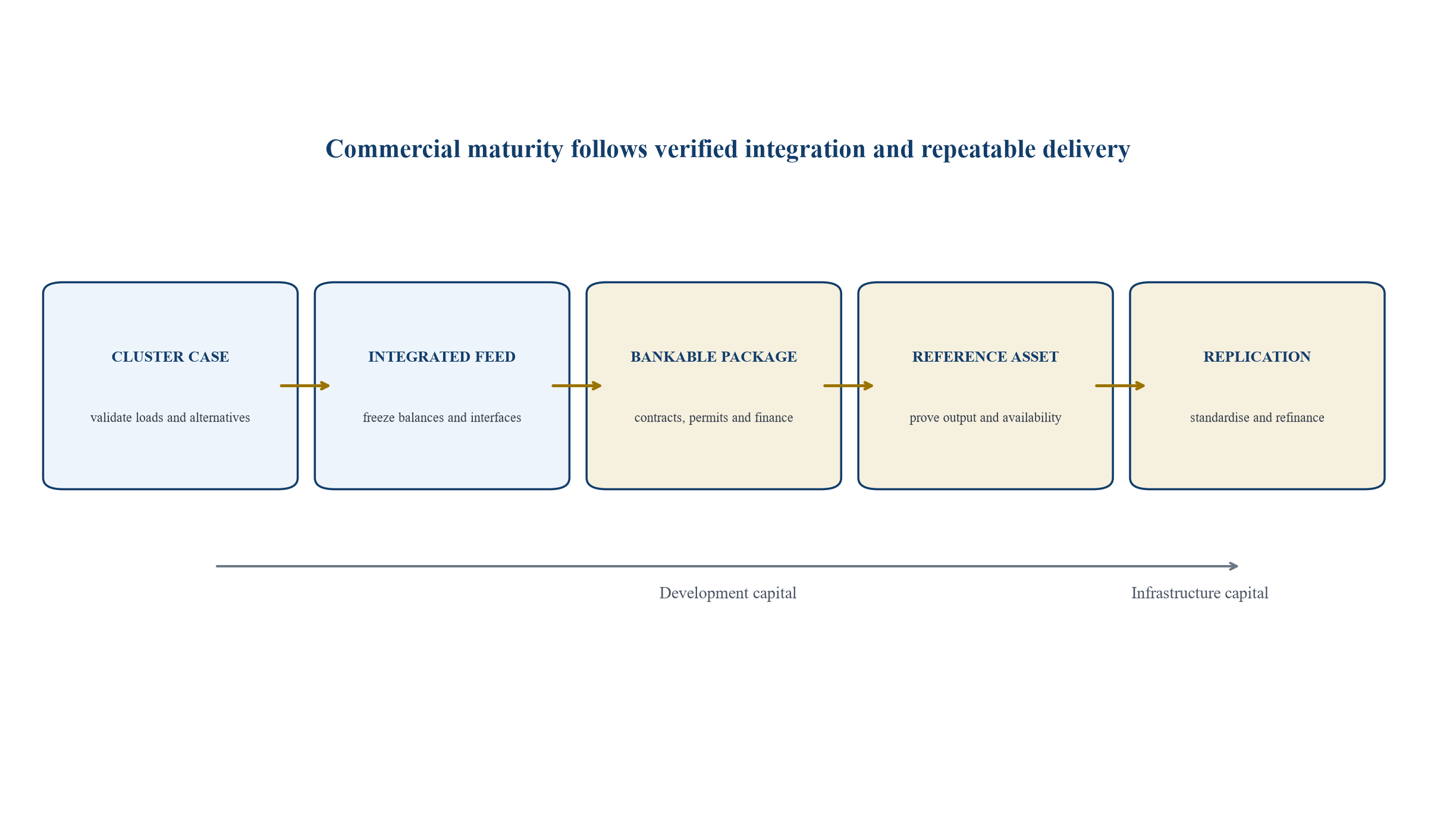
Generic roadmap; timing and decision rights depend on technology, jurisdiction and procurement model.
Early projects may need public or sponsor capital for technology and integration risk. A reference asset provides delivered cost, availability and product-performance evidence. Standardised contracts and interfaces can then support lower-cost capital for repeat projects.
54. Investment-committee decision pack
The decision pack should contain demand evidence, alternative-system comparison, site and technology diligence, mass-and-energy balance, product-priority rules, approvals plan, integrated cost and schedule, contract package, credit support, financing, scenario valuation and end-of-life plan.
The pack should show unresolved issues, decision conditions and accountable owners. It should distinguish observed evidence from vendor or management estimates. Sensitivities should reconcile to the contract and engineering cases.
The committee should receive a sources-and-uses schedule, a contract-to-model bridge and a risk-to-contingency bridge. The first reconciles all funding. The second shows where each revenue and cost term enters the financial model. The third links named risks to quantitative contingency, insurance, contractual protection or retained exposure. These bridges reduce the chance that commercial protections are described in prose and omitted from cash flow.
55. Customer decision packs
The electricity buyer needs capacity, dispatch, grid and price evidence. The steam customer needs heat quality, reliability, backup and termination evidence. The water purchaser needs quality, storage, network, affordability and emergency-supply evidence. Each customer should also understand common-asset dependencies.
Shared summaries can promote alignment, while confidential commercial data remains protected. Inconsistent assumptions across customer approvals should be reconciled before financial close. The coordination agreement should preserve this common baseline through operation.
56. Red flags and decision rules
Red flags include product volumes that exceed one reconciled heat balance, steam demand without a creditworthy long-term customer, water demand disconnected from network planning, three contracts with inconsistent outage definitions, common assets outside lender security, unsupported completion dates, and decommissioning obligations excluded from the price.
The project is strongest when the site has durable co-located demand, compatible heat requirements, qualified technology, credible regulation, strong offtakers, minimum-payment revenue, transparent common-cost allocation and resilient fallback modes. It should pause when fixable evidence gaps remain and stop when the safety, legal or core demand basis fails.
57. Conclusion
One reactor can support electricity, steam and desalinated water, creating a broader value proposition than power generation alone. Commercial value arises through useful heat, shared infrastructure, dependable essential services and contracted revenue. Commercial risk arises because the products depend on one integrated asset and can compete for the same output.
A financeable structure begins with a verified operating envelope. It converts that envelope into compatible contracts, explicit priority rules, robust credit support, coordinated outages and funded end-of-life obligations. Revenue stacking supports bankability when each cash flow is measurable and the common downside is fully modelled. Demonstrated integrated performance is the foundation for repeatable infrastructure finance.
References
- Nuclear Energy Agency. Beyond Electricity: The Economics of Nuclear Cogeneration. Paris: OECD Publishing, 2022. https://www.oecd-nea.org/jcms/pl_71699/beyond-electricity-the-economics-of-nuclear-cogeneration
- Nuclear Energy Agency. Small Modular Reactor Dashboard: Third Edition. Paris: OECD Publishing, 2025. https://www.oecd-nea.org/jcms/pl_111110/the-nea-small-modular-reactor-dashboard-third-edition
- World Bank. Fresh Perspectives: Emerging Issues and Opportunities for Desalination in the Middle East and North Africa. Washington, DC: World Bank, 2025. https://documents1.worldbank.org/curated/en/099120325085522367/pdf/P510972-95cd0c55-9926-4bca-a6fe-422af95faaff.pdf
- International Atomic Energy Agency. Desalination Thermodynamic Optimization Program. Vienna: IAEA. https://www.iaea.org/resources/databases/desalination-thermodynamic-optimization-program
- International Atomic Energy Agency. Desalination Economic Evaluation Program. Vienna: IAEA. https://nucleus.iaea.org/Pages/deep.aspx
- International Atomic Energy Agency. Electricity and Water Cogeneration Using a Small 75 MWth PWR. International Conference on Small Modular Reactors and their Applications, 2024. https://conferences.iaea.org/event/374/contributions/31268/
- International Atomic Energy Agency. International Conference on Small Modular Reactors and their Applications: Scientific Programme. Vienna: IAEA, 2024. https://conferences.iaea.org/event/374/program
- World Bank. Advancing Knowledge of the Water-Energy Nexus in the GCC Countries. Washington, DC: World Bank, 2022. https://www.worldbank.org/en/country/gcc/publication/advancing-knowledge-of-the-water-energy-nexus-in-the-gcc-countries
- International Atomic Energy Agency. Opportunities for Cogeneration with Nuclear Energy. Vienna: IAEA. https://www.iaea.org/topics/non-electric-applications
- International Atomic Energy Agency. Nuclear Energy for Desalination. Vienna: IAEA. https://www.iaea.org/topics/non-electric-applications/nuclear-desalination
- International Atomic Energy Agency. Introduction of Nuclear Desalination: A Guidebook. Technical Reports Series No. 400. Vienna: IAEA, 2000. https://www.iaea.org/publications/6161/introduction-of-nuclear-desalination
- International Atomic Energy Agency. Status of Design Concepts of Nuclear Desalination Plants. IAEA-TECDOC-1326. Vienna: IAEA, 2002. https://www.iaea.org/publications/6561/status-of-design-concepts-of-nuclear-desalination-plants
- International Atomic Energy Agency. Economics of Nuclear Desalination: New Developments and Site Specific Studies. IAEA-TECDOC-1561. Vienna: IAEA, 2007. https://www-pub.iaea.org/MTCD/Publications/PDF/te_1561_web.pdf
- International Atomic Energy Agency. Small Modular Reactors: Advances in SMR Developments 2024. Vienna: IAEA, 2024. https://www.iaea.org/publications/15790/small-modular-reactors-advances-in-smr-developments-2024
- International Atomic Energy Agency. Technology Roadmap for Small Modular Reactor Deployment. Nuclear Energy Series No. NR-T-1.18. Vienna: IAEA, 2021. https://www.iaea.org/publications/14896/technology-roadmap-for-small-modular-reactor-deployment
- Nuclear Energy Agency. Small Modular Reactors: Nuclear Energy Market Potential for Near-term Deployment. Paris: OECD Publishing, 2016. https://www.oecd-nea.org/jcms/pl_14924/small-modular-reactors-nuclear-energy-market-potential-for-near-term-deployment
- Nuclear Energy Agency. High-level Analysis of Radiological Protection Challenges Related to the Deployment of Small Modular Reactors. NEA/WKP(2025)2. Paris: OECD Publishing, 2026. https://www.oecd-nea.org/upload/docs/application/pdf/2026-01/nea-wkp-2025-2.pdf
- World Bank. The Role of Desalination in an Increasingly Water-Scarce World. Washington, DC: World Bank, 2019. https://documents.worldbank.org/en/publication/documents-reports/documentdetail/099813503182429986
- International Renewable Energy Agency. Water Desalination Using Renewable Energy. Abu Dhabi: IRENA, 2012. https://www.irena.org/publications/2012/mar/water-desalination-using-renewable-energy
- International Atomic Energy Agency. Climate Change and Nuclear Power 2024. Vienna: IAEA, 2024. https://www.iaea.org/publications/15733/climate-change-and-nuclear-power-2024
About the Author
Chennakeshav (CK) is a corporate finance and investment banking executive with 25+ years of global experience in deal origination, structuring and execution across M&A, growth capital and corporate strategy. He has led value-creation mandates for founders, corporates and funds — bridging the boardroom view to hands-on execution and close.
His career spans Morgan Stanley, HSBC, Lloyds Banking Group, EWEC, ADQ portfolio companies and Emirates Growth Fund, across TMT, real estate, fintech, deeptech, cleantech, infrastructure and energy. He has partnered with C-suite leaders, private equity and venture funds, sovereign wealth funds and family offices to finance complex fund raises and scale-up ventures, and has led M&A due diligence, post-merger integration and business-transformation initiatives to create value.
At Matchpoint Partners he is Managing Partner, leading the firm's corporate finance, M&A and capital-raising practice. He holds an MBA from London Business School, an engineering degree from VTU and a Master of Laws (LLM, in progress) from UCL London.
An active start-up mentor, CK mentors at Techstars, DIFC FinTech Hive, Startup Grind, Founder Institute and IN5, serves as Entrepreneur Mentor in Residence (EMiR) at London Business School, and judges the Entrepreneurship World Cup.
LinkedIn: https://www.linkedin.com/in/ckadya/
Profile: https://www.matchpoint-partners.com/team/ck-adya.html
