
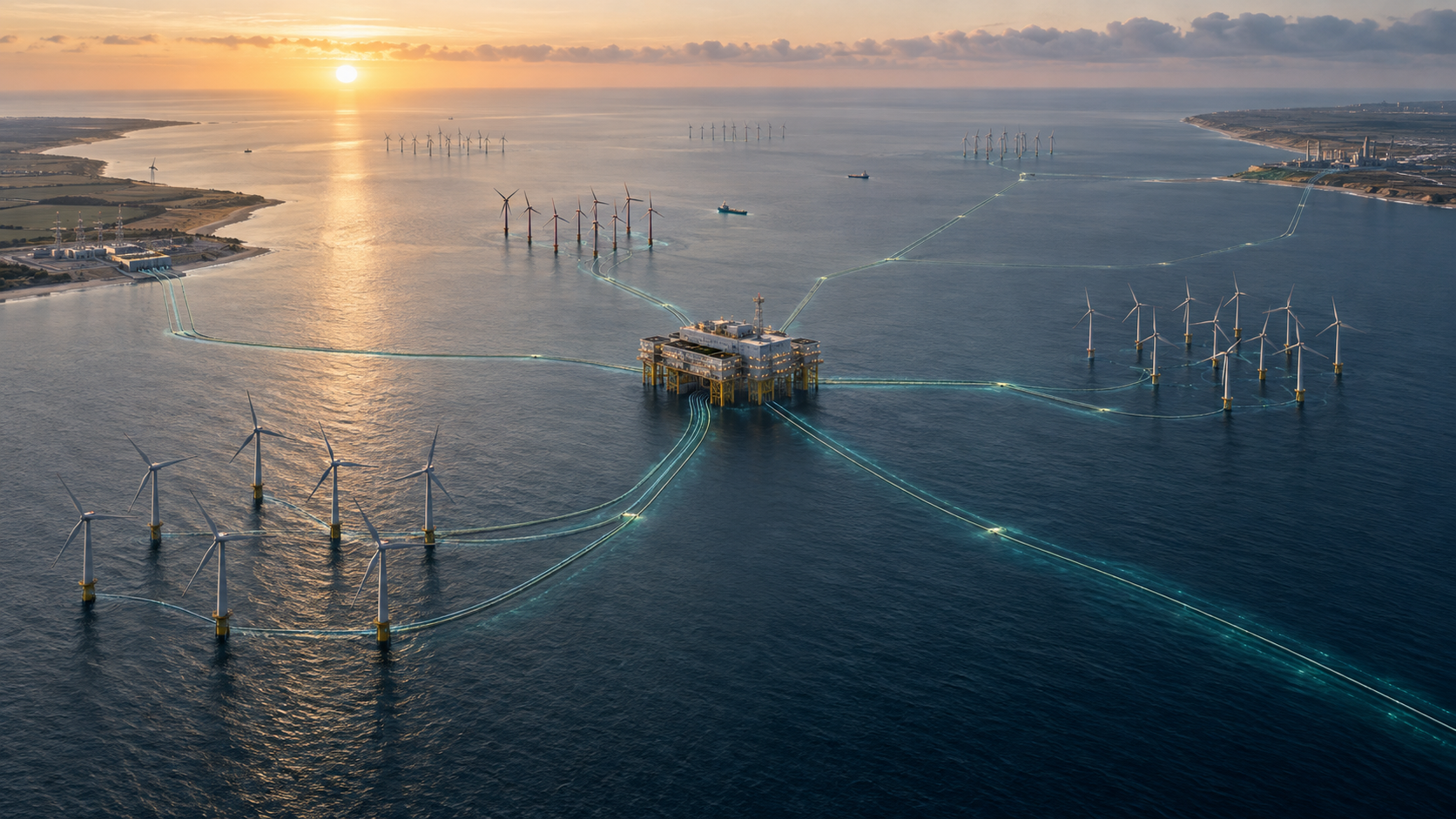
1 The decision and the evidence boundary
Offshore transmission requires a decision about the entire route from wind-farm terminals to usable onshore capacity. A radial connection, shared export hub and meshed offshore network represent different arrangements of that route. Each also requires an ownership structure, a market configuration and an enforceable allocation of construction and operating responsibilities. This paper evaluates those choices separately, using primary records accessed on 10 October 2026. Its decision tests are analytical recommendations. Any financial sensitivities introduced alongside them are hypothetical appraisal cases.
The evidence spans an operating hybrid connection, network-development recommendations, regulatory decisions, research programmes and projects under development. Those categories carry different evidential weight. An operating connection establishes that its particular configuration has entered service. A government agreement records a policy and funding commitment. A network plan identifies a recommended future system. A research demonstrator addresses defined technical questions. None of these records provides a universal cost, availability or financing benchmark for a different offshore project.
The current planning context also requires careful dating. ENTSO-E describes its 2024 Offshore Network Development Plans as high-level strategic assessments whose corridors depend on national targets and investment frameworks. NESO published a Beyond 2030 Update on 30 June 2026, reflecting changes to connections, national targets and offshore planning. Its 43 recommended projects guide subsequent decisions by Ofgem and delivery organisations. These records support coordinated appraisal; project-specific consent, procurement and financing evidence remains necessary.[1][2]
The central investment question is therefore precise: which network arrangement has a credible delivery sequence, measurable system benefits and an executable recovery mechanism for each participating asset? Answering it requires a common technical boundary and separate commercial accounts.
2 Separate topology, ownership and market design
Topology describes electrical connections. In a radial arrangement, generation exports through a dedicated route to an onshore connection. A shared hub collects several offshore users before export. A meshed network includes interconnected nodes and alternative electrical paths. A hybrid asset combines offshore-generation connection with cross-border exchange. These categories should be drawn explicitly in the appraisal schematic because a shared collection platform, a two-country hybrid and a fully meshed multi-terminal network present different interface requirements.
Ownership describes the legal entities responsible for assets, investment and operation. Market design determines bidding-zone boundaries, capacity allocation, balancing and settlement. A physical network diagram cannot establish any of those commercial rules. The European framework itself separates offshore planning from cross-border investment allocation. The British 2026 MPI decision separately addresses bidding-zone configuration and trading arrangements.[4][6]
Table 1. Design layers and associated investment obligations
| Decision layer | Appraisal question | Evidence needed before commitment |
|---|---|---|
| Electrical topology | Which users, nodes and shore connections are physically linked? | Defined single-line diagram, export limits and contingency studies |
| Ownership and delivery | Which entity builds, owns, operates and replaces each component? | Asset boundaries, licences, procurement obligations and transfer arrangements |
| Market configuration | Where is power priced and how is transmission capacity allocated? | Applicable bidding zones, trading rules, balancing and settlement provisions |
| Revenue recovery | Which entity receives each payment and bears each deduction? | Generation contracts, network determinations and interconnector rules |
| Expansion rights | How can a later user or additional link join? | Reserved interfaces, access process and incremental cost allocation |
Notes: Analytical classification, informed by the distinctions in the regulatory sources.[3][4][6]
The appraisal should assess commercial attributes alongside the topology label. For example, an expansion-ready design should be appraised against a documented expansion specification and its additional cost. The word “ready” requires an identifiable connector, control capability, protection strategy, space reservation and legal access process. Each should appear as a separate deliverable with an acceptance authority.
3 Read the project benchmark by maturity
Kriegers Flak provides operating evidence for a specific hybrid arrangement. 50Hertz records joint operation with Energinet since the end of 2020. Its project description identifies two subsea cables between the Danish Kriegers Flak and German Baltic 2 wind-farm areas, with 400 MW transmission capacity. This establishes an operational reference for combined generation connection and cross-border exchange; it supplies no observed performance series for the other projects considered here.[7]
Table 2. Primary-source benchmark and evidence limits
| Reference | Verified milestone | Appropriate use in appraisal |
|---|---|---|
| Kriegers Flak Combined Grid Solution | Operator reports service since end-2020; 400 MW project description | Operating hybrid architecture; project-specific precedent |
| Bornholm Energy Island | Danish-German agreement announced 26 January 2026 for 3 GW of offshore wind | Cross-border commitment and support-cost sharing |
| Princess Elisabeth Island | Contractor reports foundation completion on 20 August 2026 | Civil-works progress; separate electrical stages |
| LionLink and Nautilus | Ofgem timelines consultation opened 17 September 2026 | Regulatory development following approval in principle |
| InterOPERA | CORDIS records a programme running to 30 April 2027 | Interoperability development and demonstrator scope |
Notes: Dated primary-source benchmark; operator, government, contractor, regulator and Commission records establish the stated milestones.[4][7][9][10][11]
Ofgem identifies LionLink and Nautilus as non-standard interconnectors in its Offshore Hybrid Asset pilot. The September 2026 consultation concerns delivery timelines and incentives; it remained scheduled to close on 15 October 2026. That is a consultation milestone. Bornholm's agreement covers sharing support needed for offshore wind, alongside a cross-border grid project. Princess Elisabeth's completed foundations and its separately disclosed electrical-development decisions require their own status fields.[4][9][10]
An investment committee should retain this maturity classification throughout its comparison. Planned capacity, civil completion, energisation and sustained operating performance belong in distinct columns. Financing assumptions should cite the relevant stage and the remaining approvals.
4 Define one system boundary and one chronology
The comparison should begin with a common service requirement: which offshore generation and cross-border services must be accommodated, at which connection points and by which dates? ENTSO-E's planning materials place offshore corridors within a wider transmission assessment. The TYNDP 2024 system-needs study considers onshore cross-border networks and offshore hybrid corridors together. Its findings are scenario-based estimates of efficient expansion; each identified corridor retains its planning status.[1]
For a project appraisal, the proposed boundary should include offshore collection, export cables, converter or transformer platforms, landfall works, onshore converters, substations and reinforcement needed to accept the power. The boundary should also identify assets supplied by another programme. Their costs, dates and operating restrictions need a traceable treatment even when they sit outside the sponsor's procurement package. The comparison should state the service provided at the end of that complete chain.
Chronology deserves an equally explicit boundary. Record the first generator's commissioning requirement, later-user entry dates, interconnector availability, onshore reinforcement and the timetable for any expansion. Use the same dates across engineering, economic and financing models. A proposed hub that assumes several simultaneous connections should also be examined with sequential connections. A meshed option should identify which useful services exist before its final link arrives.
NESO's June 2026 update connects recommendations to Ofgem's later investment decisions and to delivery by transmission owners and developers.[2] An appraisal should reproduce that distinction in its schedule: recommendation, cost approval, consent, contractual commitment, construction, testing and operation. The interval between those events is part of the investment case and should be visible in the cash-flow timetable.
The schedule review should examine the date at which each common asset becomes useful independently. For a staged development, request an energisation plan for the first connection, a later-user tie-in procedure and any required interruption of existing service. Record who approves the interruption, which party bears the associated expenditure and how the agreed outage enters the generation and network accounts. Procurement dates should be linked to the consent and design information required by the supplier. This produces an auditable sequence between the service requirement, the authorised scope and the construction commitments.
5 Make shared-user commitment executable
A shared hub requires a workable agreement between users whose developments have individual schedules. Ofgem's anticipatory-investment framework explicitly distinguishes an initial user that invests in shared infrastructure and later users. Its December 2023 decision discusses multiple later users, joint letters and proportional user-commitment profiles. It also addresses the consequences of changes to the coordinated solution.[3]
For diligence, each prospective user should have a commitment record linking its reserved capacity to its connection date, consent position, procurement progress and financial security. The record should specify the party authorised to confirm changes. A connection request and an executed commitment have different contractual significance; the appraisal should reproduce the actual status shown in the underlying agreement.
Table 3. Proposed shared-user commitment schedule
| Item | Required agreement | Downside case to examine |
|---|---|---|
| Capacity reservation | Quantity, interface and entry date | User needs less capacity or arrives later |
| Development expenditure | Approval rights and cost-sharing basis | Design changes after common procurement |
| Construction responsibility | Lead party and substitute delivery process | Initial user's project is delayed |
| Financial security | Amount, provider, expiry and release conditions | Security expires before later-user entry |
| Withdrawal | Cancellation charges and stranded-cost treatment | A committed user exits |
| Expansion | Technical scope and cost-allocation process | Additional user requires redesign |
Notes: Recommended diligence instrument; project-specific agreements and the applicable framework control the terms.[3]
The shared project also needs a governed change process. A later generator's turbine configuration, collection voltage or commissioning sequence may require an interface review; the relevant parties should determine the consequence through engineering studies and the applicable agreements. The project record should identify the cost owner and approval route for each change. For financing, lenders need the resulting construction and cash-flow obligations, including any continuing exposure after a user's withdrawal. The appraisal should avoid treating unallocated shared expenditure as an assured future reimbursement.
6 Treat anticipatory investment as a staged approval problem
Anticipatory investment addresses capacity or preparatory works that serve later demand. The European Commission's June 2025 guidance links such investment to medium- and long-term network needs, robust scenarios and early stakeholder participation. It recommends advance clarity over future-utilisation risk and describes a possible two-step approval process covering design and permitting, followed by construction. Its recommendations also address the regulatory treatment of approved assets with lower-than-expected initial utilisation.[5]
The British Early-Stage Assessment has a defined offshore context. Ofgem explains that it provides confidence about the treatment of anticipatory expenditure in a future cost assessment and final transfer to an offshore transmission owner. Its decision permits a staged assessment and establishes material-change and cost-allowance arrangements. Those provisions should be read with the relevant project approval and guidance; an appraisal should record their actual scope.[3]
The practical decision is how much irreversible expenditure to authorise at each stage. A proposed approval ladder could separate surveys and design, seabed and land reservations, civil accommodation for future equipment, long-lead components and final installation. Each stage should have a documented purpose, expected beneficiaries and stop condition. The expenditure's treatment after cancellation or redesign should be written beside its approval.
This staged approach supports a transparent comparison of immediate construction with future modification. The appraisal should test the cost of preparing an interface today, the later works it is intended to avoid, and the circumstances in which the preparation remains unused. It should also show the funding entity and recovery date. Consumer exposure, developer exposure and regulator-approved recovery are separate entries. A signed project determination is the evidence required to convert a proposed allocation into a financing assumption.
An anticipatory-investment dossier should retain the alternatives considered at approval. Record the service requirement, the later-user evidence and the engineering scope attached to the decision. Subsequent changes should be reconciled to that baseline with their incremental expenditure and revised benefits. If the later-user schedule changes, identify the remaining use of the approved works and the party authorised to reconsider the next expenditure stage. This permits a reviewer to distinguish a previously approved preparation cost from a new construction request and to trace the treatment of each amount through the applicable assessment process.
7 Map institutions to decisions
The European offshore framework assigns roles to governments, system operators, regulators, the Commission, ENTSO-E and ACER. TEN-E Articles 14 to 16 distinguish sea-basin planning, offshore cost-sharing guidance and project-level cross-border investment allocation.[6]
The British evidence also separates system planning, regulatory decisions and government policy. NESO publishes network recommendations. Ofgem assesses investment and regulatory frameworks. The March 2026 MPI market-arrangements decision is a joint Ofgem and Department for Energy Security and Net Zero document. It selects a preferred model and identifies further work on the wider framework.[2][4]
For a cross-border project, the proposed governance map should assign an institution and legal instrument to every material decision. These include seabed access, marine and land permissions, transmission licensing, generation support, bidding-zone treatment, cost allocation, security standards and commissioning acceptance. Where two jurisdictions must act, identify the dependency and the last date by which alignment is required for procurement.
The map should also cover operating changes after commissioning. A revision to a trading arrangement or interface limit should have a defined authority, consultation route and consequence for existing contracts. Project participants should agree which determinations their financing models assume and which remain outstanding. The appropriate diligence question is whether the combined instruments create a coherent, executable project in both jurisdictions. A memorandum announcing cooperation should retain its published status until subsequent legal and contractual steps are evidenced. This preserves a usable distinction between institutional support and a completed investment authorisation.
8 Allocate costs against benefits and financing gaps
Cost-benefit analysis should use a common counterfactual and identify the distribution of benefits. TEN-E Article 16 links eligible investment allocation to net-positive impacts and identifies tariff recovery after other receipts. Article 18 separately conditions grants for works on matters including positive externalities and financing need.[6]
These legal provisions do not supply a project's numerical allocation. A proposed appraisal should therefore report system value, distributional effects, project receipts and public-funding requirements as separate calculations. Transfers between participants should be reconciled, with a clear boundary between resource savings and movements of money. Each benefit should have a defined metric, beneficiary, time period and scenario dependency.
Table 4. Proposed cost-benefit and allocation register
| Appraisal component | Required measurement | Allocation question |
|---|---|---|
| Physical network expenditure | Comparable lifecycle scope and timing | Which party incurs each cost? |
| System dispatch effects | Scenario-based change in system operating cost | Where does the benefit arise? |
| Offshore energy delivery | Delivered energy and constraints by scenario | Which generators face the change? |
| Cross-border exchange | Capacity use and congestion income | Which regime governs receipts? |
| Reliability and security | Defined contingency and service metrics | Which users receive the service? |
| Funding gap | Project cash flows after approved recovery | What instrument addresses the residual? |
Notes: Proposed appraisal register; the statutory framework separates planning, allocation and financial assistance.[6]
Bornholm illustrates an evidenced negotiated element. The January 2026 government statement says Denmark and Germany agreed to share the support need for offshore wind, reflecting expected electricity flows and benefit distribution. It does not publish the cost-split percentages.[9] A benchmark should preserve that disclosure boundary. For another project, the financing model should use the executed allocation, its adjustment provisions and its payment timetable.
The proposed allocation register should also distinguish forecast benefits from settled contributions. For each participating jurisdiction, show the scenario used to estimate benefits and the instrument used to create payment obligations. Identify the treatment of cost escalation, scope change and a subsequent connection by another beneficiary. A review mechanism should state the trigger, calculation method and decision authority. This permits sensitivity analysis around changing benefit distributions while keeping the financing case tied to the amounts actually committed. Any unresolved residual should remain visible beside the proposed instrument for funding it.
9 Resolve offshore prices and access rules
Market configuration determines the commercial meaning of a physical export route. The March 2026 British decision identifies offshore bidding zones with implicit trading as the preferred MPI market model. It records remaining work on offshore-wind receipts, compatibility with Contracts for Difference, curtailment, balancing and operability. The document distinguishes the choice of bidding zone from the mechanism used to allocate cross-border capacity.[4]
For appraisal, the model specification should name the price at which each generator sells its electricity, the reference used by its support contract and the treatment of differences between them. It should also document the allocation of cable capacity in each trading timeframe. An offshore node with links to two markets requires explicit operating and settlement assumptions for congested periods, outages and maintenance. Those assumptions should follow the applicable rules and project agreements.
The analysis should examine how a market configuration affects both dispatch and commercial receipts. Report energy delivered to each shore, realised generation price, support settlement, imbalance charges and congestion income separately. A system-cost result should be shown beside the affected parties' cash-flow results, with any compensation mechanism separately identified. This makes the funding requirement visible when the parties receiving system benefits differ from those undertaking the investment.
The 2026 decision records competing stakeholder views on compensation and leaves elements of the wider framework for further development.[4] A financing case should therefore list unsettled rules as conditions requiring resolution before commitment. Its downside case should specify which receipts are excluded pending that resolution. The policy record supports diligence on those issues; it does not establish a universal compensation entitlement or a completed offshore support contract.
The market-data request should identify the forecast vintage, time resolution and treatment of simultaneous offshore output. Request a reconciliation between the dispatch model's prices and the prices used in the financing model. Document the assumed bidding-zone boundary for every study year, including transition periods. For capacity allocation, list the rules used in day-ahead, intraday and balancing cases and identify any unresolved interaction. The reviewer should be able to reproduce the allocation of energy and money for a selected congested hour from the same input set and the specified settlement conventions.
10 Keep generation, network and interconnector accounts separate
Offshore generation receipts originate in electricity sales and any applicable support settlement. The government's Allocation Round 5 methodology explains generation revenue as wholesale-market proceeds combined with the CfD difference between strike and reference prices. It also recognises route-to-market and imbalance costs, transmission-loss treatment and revenues after contract expiry. This historical methodology explains the accounting distinction; each project's actual allocation-round contract governs its terms.[12]
Network recovery requires its own regulatory evidence. British OFTO arrangements use tendered revenue and asset-availability provisions. Interconnector cap-and-floor arrangements establish revenue boundaries and assessment processes, with rules governing capacity receipts and congestion income. They should be modelled using the applicable licence and determinations.[3][4]
Table 5. Cash-flow boundaries for financing analysis
| Asset or activity | Receipts to identify | Costs and deductions to identify |
|---|---|---|
| Offshore wind generation | Electricity sales; applicable support settlement | Generation expenditure, route-to-market charges and imbalance |
| Offshore transmission owner | Licence-based tender revenue | Operating expenditure, availability deductions and lifecycle obligations |
| Regulated transmission investment | Approved recovery under its jurisdiction | Allowed-cost treatment and performance obligations |
| Interconnector | Capacity-related and congestion receipts; applicable cap-and-floor settlement | Operating costs, revenue-use rules and regime adjustments |
| Shared development vehicle | Contractually allocated contributions | Common expenditure, security and unrecovered commitments |
Notes: Proposed accounting boundaries; entitlement depends on the relevant contracts and approvals.[3][4][12]
For a hypothetical financing model, separate accounts should reconcile to the overall project boundary without duplicating receipts. Electricity value belongs in the generation account where the sales contract assigns it. Congestion income belongs in the relevant network or interconnector account under its rules. Support for generation and support for infrastructure should retain separate sources and conditions. This permits a direct examination of which entity services debt, the timing of its cash receipts and the party bearing any shortfall.
11 Specify converter, cable and control interfaces
TenneT's published 2 GW standard describes 66 kV collection cables to an offshore converter, a 525 kV direct-current export system and conversion to 380 kV alternating current onshore. Its cable-system description includes positive and negative poles, a neutral cable and fibre-optic communication. These details provide a concrete technical reference for a standardised connection arrangement.[8]
A future interconnection requires an additional interface specification. The European Commission's InterOPERA record identifies multi-vendor, multi-terminal HVDC compatibility, grid-forming capability, control and protection, standardised models, simulation processes and procurement frameworks as programme objectives. Its demonstrator and research timetable constitute development evidence.[11]
Table 6. Proposed technical acceptance register
| Interface | Specification to freeze | Acceptance evidence |
|---|---|---|
| Wind collection to platform | Voltage, capacity, protection and power quality | Agreed studies and witnessed tests |
| Converter to cable system | Electrical ratings, pole arrangement and fault duties | Coordinated design and type-test documentation |
| HVDC controls between vendors | Functional responsibilities and interaction limits | Validated models and joint simulation results |
| Protection and fault recovery | Detection, isolation and restoration sequences | Defined contingency demonstrations |
| Communications and supervision | Data ownership, redundancy and cyber responsibilities | End-to-end system acceptance |
| Later expansion | Reserved physical and control interfaces | Approved extension studies and procurement requirements |
Notes: Recommended diligence instrument, grounded in the published technical and interoperability scope.[8][11]
Procurement should connect those specifications to contractual responsibility. Assign one accountable integration process, identify model-delivery obligations and specify the treatment of proprietary information. Record how future software changes, replacement components and additional terminals enter the testing process. A vendor's conformity to its own package specification should be accompanied by project-level interface evidence before system acceptance. The financing review should identify the costs and schedule allowances associated with that evidence, together with the party responsible for remedying failed tests.
12 Measure curtailment, losses and availability consistently
Curtailment, transmission losses and unavailable capacity affect different parts of an appraisal. The proposed energy ledger should begin with wind energy available at the defined generation boundary, then identify technical losses, constrained output and energy delivered to each settlement point. Each deduction needs a documented definition. Compensation, when provided by the applicable rules or contracts, should appear in a separate monetary ledger.
The March 2026 MPI decision confirms that curtailment, compensation and balancing arrangements require continuing policy development. Ofgem's OFTO materials separately address asset availability and revenue-stream treatment.[3][4] The appraisal should preserve those distinctions and reproduce the governing measurement method. An energy-based deduction, a capacity-availability measure and a revenue deduction should each retain its own unit and calculation.
For comparison, use a common set of wind profiles, demand cases, planned maintenance and equipment contingencies. Request project-specific cable and converter loss curves and document the provenance of every assumed loss input. Record converter operating points, auxiliary consumption and the settlement boundary used by the energy model. For availability, request failure, repair and access assumptions with provenance, including the treatment of weather windows, spare equipment and simultaneous outages.
A meshed-network appraisal should test the usable alternative paths after each defined contingency, including the surviving converter and onshore constraints. A shared hub should be examined for outages affecting several users through a common component. Report these cases as scenario results, with the corresponding contractual consequences. Where observed failure or repair data are unavailable, the appraisal should state the information gap and keep any numerical sensitivity explicitly hypothetical. No operating-performance series for the projects in Table 2 is asserted in this paper.
For lender diligence, translate the engineering cases into a defined cash-flow bridge. Identify the affected energy volume, applicable sales price, support treatment, operating expenditure and any documented compensation. Keep the physical recovery date separate from the settlement-payment date. Review the insurance schedule against the same event definitions, waiting periods and exclusions, without assuming that a technical outage creates an insured claim. The resulting register should permit a reviewer to trace a selected event from the equipment boundary through the operational response to the borrowing entity's cash position.
13 Convert the preferred architecture into a financeable package
The proposed financing review should begin with the entity that borrows and the receipts legally available to it. For each entity, assemble construction contracts, connection arrangements, revenue approvals, insurance provisions and operating obligations. Test debt service against the account's own cash flows and documented support. Any transfer from another project participant needs an enforceable instrument, payment priority and counterparty assessment.
Construction diligence should examine schedule dependencies across turbines, platforms, cables, converters and onshore works. Assign responsibility for delayed interfaces and specify the interaction of extension-of-time provisions, damages, termination rights and revenue start dates. Ofgem's September 2026 OHA consultation addresses proposed regime start, backstop, delay-payback, reasonable-delay and pre-operational force-majeure mechanisms.[4] Those proposals demonstrate the importance of delivery-timing rules; their consulted status should remain visible in a project model.
Princess Elisabeth provides a dated example of staged decisions. Elia's 30 April 2026 information memorandum records continuation of the island and transformer development for 2.1 GW under the June 2025 government decision, alongside the decision to avoid entering the HVDC contract under the then-prevailing market conditions. Jan De Nul subsequently reported foundation completion on 20 August 2026.[10] Civil progress, electrical procurement and generation availability require separate evidence.
A financing memorandum should therefore present conditions precedent by asset and interface. Include approved recovery, committed users, permissions, integration tests, required onshore capacity and acceptable cost-to-complete. Stress cases should identify the party funding overruns, delayed recovery and stranded shared expenditure. The financial comparison should state the assumptions and outputs of those cases without presenting hypothetical borrowing terms as observed market conditions.
The operating package should receive a separate lifecycle review. Request the maintenance plan, access arrangements, spare-parts strategy, software support and replacement obligations for each common component. Link the associated expenditure to the responsible entity and its revenue account. At the end of an initial revenue period, distinguish contracted receipts from any assumption about extension or future re-tendering. The appraisal should also identify decommissioning security and the treatment of assets that remain useful to later users. Those items define the expenditure and obligations extending beyond the original construction financing.
14 Use an evidence-led implementation roadmap
The proposed roadmap has six decision gates. The first establishes a common service requirement, physical boundary and dated counterfactual. The second compares feasible radial, hub and meshed configurations with consistent generation, demand and contingency inputs. The third confirms user commitments and the institutions responsible for permissions, market rules and recovery. The fourth freezes technical interfaces and validates the procurement and testing programme. The fifth authorises construction against executable contracts and financing. The sixth accepts operation against measured performance and the applicable revenue regime.
At each gate, the decision record should contain an owner, an evidence package and a consequence for delay or failure. The system map should use separate visual layers for electrical connections, ownership and payment flows. The market benchmark should retain the maturity classification in Table 2. Capital and operating sensitivities should identify hypothetical inputs and show their effect on the relevant entity's accounts. The implementation roadmap should connect each unresolved issue to the next contractual or regulatory decision.
A radial option should receive a complete assessment of delivery, cost and future modification. A shared-hub option should demonstrate executable commitments and common-interface responsibility. A meshed option should demonstrate useful staged services, interoperable controls and an allocation mechanism across beneficiaries. These are proposed decision standards; a preferred configuration follows from project-specific evidence and the agreed appraisal objectives.
The international relevance lies in that sequence of tests. Developers and authorities in any offshore market can use the same questions while applying their own laws, institutions and support arrangements. European and British records provide accessible evidence about coordinated planning, anticipatory investment, hybrid-market development and project staging. A local investment decision requires local permissions, engineering and contracts. The final recommendation should identify the chosen architecture, its evidence-supported benefits, its outstanding conditions and the expenditure authorised at the next gate.
15 A common boundary for three offshore choices
The following illustration separates the network decision from the financing of a complete wind farm. Every input is author-selected and hypothetical, with no calibration to an actual project, equipment quotation or observed market outcome. Two generating projects, A and B, each have 500 MW of nameplate capacity. A enters service in year 1 and B in year 6 in the base case. Year 0 is their common network decision date. Costs and energy values are expressed in constant year-0 real dollars and discounted at 6% across years 1 to 25. Each operating cash flow arrives at year-end, and each connection investment occurs one year before its first service.
Three alternatives serve that boundary. Separate radial connections require USD 600m for A at year 0 and USD 600m for B at year 5. The shared alternative invests USD 660m in an 800 MW common hub and USD 180m in A's spur at year 0; B's USD 180m spur follows at year 5. An A-only common installation is separately assumed to cost USD 480m for 500 MW. The difference identifies USD 180m of anticipatory common investment. The third alternative retains the shared design and conditionally adds a 200 MW path to another shore or market, costing USD 360m at year 10 for service from year 11.
Available wind energy equals capacity multiplied by 8,760 hours, a 50% gross capacity factor and 95% generator availability. Annual delivery then applies capacity-curtailment and electrical-loss fractions sequentially. Radials use 2% and 4%; the hub uses 2% and 3.5% with A alone, changing to 6% and 3.5% with both users. The mesh uses 2% and 4% for the two-user wind portfolio. These capture factors are explicit engineering assumptions. They do not follow from a simulated weather sequence, chronological dispatch or power-flow solution, and require replacement with project-specific studies before investment appraisal.
Fixed annual operating costs are USD 12m per radial, USD 10m for the common hub and USD 3m per active spur. Delivered wind also incurs USD 1.5/MWh of variable grid cost. The extra path adds USD 6m annually plus separate merchant transaction costs. Wind-farm capital and operating costs, tax, debt terms, replacements, decommissioning and terminal proceeds remain outside the model. The common end date deliberately shortens a delayed B's service window, retaining the same planning boundary across all alternatives.
Table 7. Hypothetical common boundary and topology assumptions
| Input | Selected value | Interpretation |
|---|---|---|
| Decision horizon / real discount rate | 25 years / 6% | Year 0 common decision; year-end cash |
| A / B first service | Years 1 / 6 | B delay and absence tested separately |
| Each generator / available wind | 500 MW / 2.081 TWh annually | 50% gross factor times 95% availability |
| Radial / hub / extra mesh capacity | 500 each / 800 / 200 MW | Nameplate path assumptions; no power flow |
| Radial capex | 600 per link | A year 0; B year 5 |
| Common hub / each spur capex | 660 / 180 | Common plus A spur year 0; B spur year 5 |
| A-only common hub benchmark | 480; 500 MW | 180 anticipatory capex in shared design |
| Mesh capex / first service | 360 / year 11 | Investment at year 10 |
| Wind energy value / variable grid cost | 70 / 1.5 USD/MWh | Applied once to delivered wind energy |
| Merchant use / gross margin | 35% / 30 USD/MWh | Mesh only; separate transaction volume |
Hypothetical author-selected assumptions and calculated results; constant year-0 real USD million except stated units. Every input is chosen for this illustration. All links and fees are illustrative. Wind-farm costs, taxes, debt terms, terminal value, dispatch and social-welfare values are outside the boundary.

View figure at full size; scroll horizontally on smaller screens.
Author-selected hypothetical system. A starts in year 1 and B in year 6. Separate 500 MW radial links are compared with an 800 MW common hub; the optional additional 200 MW path starts in year 11. Generation SPVs own the wind farms and the illustrative grid SPV owns transmission assets. Solid arrows show energy paths; rust dashed arrows show capacity fees and the contracted share of merchant benefit. B fees begin only on B service. The diagram presents connectivity and payment roles, without a dispatch, power-flow or legal-ownership claim.
16 Architecture economics and delivered energy
Whole-system comparison counts resource expenditure and delivered-energy value within the defined network boundary. Tariffs between the generators and grid owner are transfers, so they enter the subsequent allocation analysis alone. Discounted grid cost is capital expenditure plus fixed and variable operating costs. The levelized grid-cost metric divides that amount by discounted delivered wind energy. It measures the transmission burden within this illustration; the omitted generation costs preclude interpreting it as a complete electricity production cost.
With B starting in year 6, the radials cost USD 1,367.303m in present value and deliver 41.798 discounted TWh. The shared hub costs USD 1,227.361m and delivers 40.639 discounted TWh. The grid-cost ratio consequently falls from USD 32.712/MWh to USD 30.202/MWh. Shared capital and fixed-operation savings provide most of the difference. Lower delivered volume also reduces variable operating expenditure, which is counted once as an operating-cost change. The lower energy denominator limits the improvement in the ratio.
A separate net-value comparison prices delivered wind at an assumed constant USD 70/MWh. The hub saves USD 139.942m of resource cost and sacrifices 1.159 discounted TWh, valued at USD 81.125m. Its resulting advantage over matched radials is USD 58.817m. Curtailment and electrical losses already determine delivery, so the calculation adds no further curtailment-saving payment, avoided-generation benefit or congestion rent. This accounting discipline matters when several technical studies describe the same recovered megawatt-hour under different labels.
The constructed mesh case has USD 1,467.052m of discounted resource costs and 41.399 discounted TWh. Its displayed USD 35.437/MWh grid-cost ratio includes costs supporting merchant transactions and grants no merchant-benefit credit to the numerator. It therefore answers a cost-allocation question different from the incremental mesh appraisal. Gross merchant benefits enter the net-value calculation separately, with transaction-variable costs included among resource costs. This makes the energy denominator and benefit boundary visible to the reader.
The illustration ranks the shared hub first under the selected base inputs, while the constructed mesh has lower net value than either the hub or radials. These are conditional results. They establish a decision baseline for testing later commitment and marginal expansion. The optional mesh can remain unbuilt at year 10; the model assigns no probability, option premium or expected-value gain to preserving that choice. Any project decision also needs engineering designs and credible cost estimates for comparable service quality.
Table 8. Hypothetical architecture economics on the same horizon
| Metric | Separate radial | Shared hub | Hub plus mesh |
|---|---|---|---|
| PV capital cost | 1,048.355 | 974.506 | 1,175.529 |
| PV fixed operating cost | 256.252 | 191.897 | 224.436 |
| PV variable operating cost | 62.696 | 60.958 | 67.087 |
| PV total grid resource cost | 1,367.303 | 1,227.361 | 1,467.052 |
| Discounted delivered wind, TWh | 41.798 | 40.639 | 41.399 |
| Grid cost / delivered wind, USD/MWh | 32.712 | 30.202 | 35.437 |
| PV gross merchant benefit | 0.000 | 0.000 | 99.766 |
| Net system advantage versus radial | 0.000 | 58.817 | -27.873 |
Hypothetical author-selected assumptions and calculated results; constant year-0 real USD million except stated units. B starts in year 6 in every column. Levelized grid cost is discounted resource cost divided by discounted delivered wind; the mesh numerator includes merchant-path costs and receives no benefit credit. Net advantage includes delivered-wind value at 70 USD/MWh and separate gross merchant benefit, deducting all grid costs once. Capacity fees are transfers and are excluded.

View figure at full size; scroll horizontally on smaller screens.
Author-selected hypothetical assumptions, with B starting in year 6 in every architecture. Upper panel shows discounted capital, fixed operating and variable operating resource costs at 6% real; the mesh variable-cost component includes merchant transactions. Lower panel shows prescribed annual wind delivery after generator availability, topology-specific capacity curtailment and electrical losses. Mesh wind recovery starts in year 11. Capacity-fee transfers and wind-farm generation costs are excluded; no additional monetary curtailment benefit is counted.
17 Who funds the interval before the second user
The grid owner's cost-recovery arrangement allocates half the common capital and fixed operating costs to each user. Each project also bears its own spur and variable wind-delivery costs. A's allocated present-value cost is USD 648.962m; B's is USD 578.399m. Those amounts exactly reconcile to the shared system's USD 1,227.361m cost. Fixed annual capacity fees recover each allocation at the model discount rate: A pays USD 50.766m in years 1 to 25, and B pays USD 67.483m in years 6 to 25. They represent selected contractual schedules, without an actual regulated tariff or lender commitment.
The timing creates an initial funding requirement even though the base-case discounted recovery gap is zero. The grid owner spends USD 840m at year 0, including USD 330m of common capital allocated to B. B contributes no operating fee before its service begins. A's annual payment covers its assigned economic share; it provides no year-0 subscription for B's share. Equity, construction funding or another committed contribution would therefore need an explicit funding arrangement. The annual cash schedule records the initial outlay and later B-spur investment, while leaving debt terms and liquidity facilities unspecified.
Delay stresses retain the original fee amounts and year-25 expiry. B's spur investment moves with its arrival, and the grid owner's variable operating costs decline with the missing output. Common capital and common standby costs remain. Arrival in year 10 produces a USD 131.986m recovery gap; arrival in year 14 produces USD 236.531m. These exposures incorporate the avoided and deferred costs, giving a more complete measure than simply capitalising lost tariff receipts.
Absence produces no B spur, generation or fee stream and leaves a USD 394.949m recovery gap. The USD 180m anticipatory common capital remains committed. Against the separately selected A-only hub, that extra capital plus additional common fixed operation has a USD 205.567m present value. The larger contractual gap also reflects B's allocated share of common assets and running costs; the two measures answer distinct questions and must remain separate.
A hypothetical ex-ante reallocation spreads each positive recovery gap across A's full payment window. A's annual fee becomes USD 61.091m for year-10 B entry, USD 69.269m for year-14 entry and USD 81.662m for absence. Its unchanged base fee remains USD 50.766m throughout the actual contract stress. The reallocated amounts show a possible negotiated funding burden. They create no automatic right to charge A more after a later event.
Table 9. Hypothetical second-user timing and unchanged-fee exposure
| B first service | B fees, PV | Operator gap, PV | A fixed fee / year | A reallocated fee / year |
|---|---|---|---|---|
| Year 6 | 578.399 | 0.000 | 50.766 | 50.766 |
| Year 10 | 403.663 | 131.986 | 50.766 | 61.091 |
| Year 14 | 265.255 | 236.531 | 50.766 | 69.269 |
| Absent | 0.000 | 394.949 | 50.766 | 81.662 |
Hypothetical author-selected assumptions and calculated results; constant year-0 real USD million except stated units. B's fixed annual fee is 67.483, payable only from actual service to year 25. A's unchanged fee recovers its base allocation. The reallocated A fee is a separate hypothetical ex-ante agreement covering a positive operator gap across years 1-25; it is not an automatic contractual increase. Common anticipatory capex of 180 remains committed at year 0 in all cases.

View figure at full size; scroll horizontally on smaller screens.
Author-selected hypothetical assumptions. Upper panel preserves both original annual capacity-fee rates, delaying B payments until actual service and ending all contracts in year 25. The operator recovery gap accounts for the deferred B spur and reduced variable operating costs. Lower panel compares A's unchanged fee with a separate hypothetical ex-ante allocation of the positive recovery gap across A's years 1-25; the reallocation is not an automatic amendment. The A-only radial reference is an annual equivalent at the same discount rate. The Absent category has no B spur, output or fee receipts.
18 Utilisation and commitment thresholds
Timing and utilisation affect different parties through different channels. Comparing the shared design with radials at each matched B arrival date gives a positive system advantage through first service in year 9. The year-9 advantage is USD 11.086m; at year 10 it becomes negative USD 3.058m. This is an integer-year break-even bracket within the selected cost and output assumptions. It provides a practical milestone for reviewing anticipatory investment while preserving the uncertainty about actual construction costs, future projects and commissioning dates.
That system threshold differs from the first generator's allocation threshold. A's year-10 reallocated annual fee of USD 61.091m still falls below the USD 61.872m annual-equivalent cost of its own radial connection. The shared system has already crossed its net-value break-even date in that case. One comparison includes both users' energy effects and resource timing; the other addresses A's assigned payment burden. A decision memorandum should identify whose threshold controls the requested approval and disclose the corresponding alternative.
The utilisation test keeps B's arrival in year 6 and preserves its USD 67.483m annual capacity fee. B's output factor scales its selected delivered energy while holding the prescribed network capture factors constant. At full output, delivery is 1,887.222 GWh annually and receipts at USD 70/MWh are USD 132.106m. At half output, receipts are USD 66.053m, slightly below the unchanged grid fee. The grid-fee-only threshold is 51.083% of base delivered output. It identifies the energy receipts required to pay this one charge; all wind-farm costs, tax and debt remain outstanding.
The network owner continues receiving the same capacity fee in these utilisation cases, provided the user performs its contract. Its variable wind-delivery costs fall with output. The model therefore records a small operating-cost saving instead of treating lower production as an automatic tariff shortfall. Counterparty default, fee renegotiation and volume-based tariff structures require separate cases. Replacing the capacity fee with an assumed volumetric payment would change the risk allocation and must be documented as a new agreement.
For B's complete absence, keeping A on its original fee requires a committed third-party contribution worth USD 394.949m at year 0. An equivalent later payment must account for its actual discount timing. This is a cost-recovery threshold, with no assumed public guarantee or legal entitlement. The investment gate should identify the payer, enforceable payment trigger and available funding evidence for any proposed contribution before assigning that amount to a financing plan.
Table 10. Hypothetical B utilisation with the original capacity fee
| B output factor | Delivered GWh / year | Energy receipts / year | Fixed grid fee / year | Receipts after grid fee |
|---|---|---|---|---|
| 25.000 | 471.805 | 33.026 | 67.483 | -34.457 |
| 50.000 | 943.611 | 66.053 | 67.483 | -1.431 |
| 75.000 | 1,415.416 | 99.079 | 67.483 | 31.596 |
| 100.000 | 1,887.222 | 132.106 | 67.483 | 64.622 |
Hypothetical author-selected assumptions and calculated results; constant year-0 real USD million except stated units. Output factor is percent of the selected base annual B energy; B still enters in year 6 and pays the same capacity fee. Energy receipts equal delivered output times 70 USD/MWh. The grid-fee-only threshold is 51.083%. Generation capex, generation operating costs, tax and debt remain excluded; the final column is not project profit or debt-service capacity.
19 The later mesh decision needs two separate tests
At year 10 the expansion decision compares only incremental consequences from the extra path. The illustration restores 140.226 GWh of annual wind delivery from year 11. Valued at USD 70/MWh, that recovery contributes USD 9.816m annually. The merchant case uses 35% of the 200 MW path's annual transaction-equivalent capacity, or 613.200 GWh, and assumes a gross margin of USD 30/MWh. Deducting USD 1.5/MWh variable transaction cost leaves USD 17.476m annually. Merchant volume is a separate assumed activity; recovered wind energy receives no second merchant-margin benefit.
The combined annual reservation for recovered wind and merchant use remains below the extra path's annual nameplate throughput. This is a limited accounting check. Coincident flows, directional constraints, outage conditions and market coupling still require a chronological physical and market study. The calculation carries those limitations into its decision interpretation instead of assigning additional congestion, resilience or security-of-supply values.
Incremental capital, fixed operation and the extra wind-variable cost have a USD 234.702m present value. Recovered wind value contributes USD 53.234m and net merchant benefit contributes USD 94.778m. The resulting system incremental NPV is negative USD 86.691m. At 35% merchant use, the assumed gross margin must reach USD 56.068/MWh for system break-even. At the base USD 30/MWh margin, required merchant utilisation is 67.013%. These thresholds hold the incremental investment, wind recovery and remaining service window fixed.
Contractual recovery applies a second test. The grid owner is assumed to receive USD 8m annually of incremental wind capacity payments and a contracted 50% of net merchant benefit. Those receipts have a USD 90.775m present value, leaving USD 143.927m of unrecovered incremental cost. The residual uncontracted merchant benefit is excluded from this calculation. No social or welfare value enters recoverable cash, and the model offers no debt-capacity conclusion.
At 35% utilisation, a USD 60/MWh gross margin gives positive system incremental value while the chosen contracts still leave a recovery gap. The contractual break-even margin is USD 116.558/MWh when the wind fee and 50% capture fraction remain fixed. The selected base margin would require capture exceeding 100% of the available net merchant pool. An approval therefore needs both sufficient incremental value and a credible allocation of recoverable receipts. Changing the contracted fraction or wind fee is a new commercial arrangement, requiring its own counterparty and affordability review.
Table 11. Hypothetical mesh marginal benefit and contractual recovery
| Gross margin, USD/MWh | System incremental NPV | Contracted receipts, PV | Recovery gap, PV | Required capture, % |
|---|---|---|---|---|
| 30.000 | -86.691 | 90.775 | 143.927 | 201.857 |
| 60.000 | 13.076 | 140.658 | 94.044 | 98.341 |
| 90.000 | 112.842 | 190.542 | 44.161 | 65.005 |
Hypothetical author-selected assumptions and calculated results; constant year-0 real USD million except stated units. Merchant utilisation stays 35%; incremental wind capacity fees are 8 annually and 50% of net merchant benefit is contracted. Merchant variable cost is 1.5 USD/MWh. Recovery gap equals incremental capital, fixed cost and extra wind-variable cost less contracted wind and net-merchant receipts; positive values need funding. Required capture is the net-merchant-benefit fraction needed after the selected wind fee; values above 100% exceed this benefit pool. Uncontracted residuals and social benefits provide no contractual recovery.

View figure at full size; scroll horizontally on smaller screens.
Author-selected hypothetical assumptions. Each line changes the additional 200 MW path's annual merchant utilisation and gross transaction margin, deducting 1.5 USD/MWh variable merchant cost. Upper panel adds separate recovered-wind value and net merchant benefit, then deducts incremental capital, fixed operating and extra wind-variable costs. Lower panel retains the selected wind fee of USD 8m annually and 50% contracted capture of net merchant benefit. The vertical line marks the base gross margin of 30 USD/MWh; the horizontal zero line marks the respective break-even test. Uncontracted residuals and social benefits are excluded from contractual recovery.
20 Funding the grid through the appropriate borrower
The financing review should identify the borrower before selecting an instrument. We propose separate funding schedules for the wind generator, the transmission owner and any interconnector business. Each schedule should identify committed expenditure, permitted receipts, payment priority and the approvals needed to use those receipts. A consolidated investment presentation can then show the complete system while preserving the cash available to each legal entity.
The EIB's July 2026 announcement provides a current corporate-financing example. It describes TenneT Germany's EUR 3.5 billion senior European green bond, with EIB participation of EUR 74 million and proceeds for a transmission investment programme including onshore and offshore infrastructure. Four tranches have maturities of 4, 8, 12 and 20 years. These are disclosed corporate bonds; the announcement supplies no limited-recourse financing terms for a particular offshore hub.[13]
For a proposed project borrower, review the enforceability of its own payment rights, construction support, operating obligations and termination treatment. An indicative future user should remain outside committed recovery until the applicable agreement is executed and its conditions are understood. If a public authority or regulated network business funds anticipatory capacity, record the actual approval, eligible expenditure, timing and treatment of unused capacity. A possible future tariff review should retain an explicit uncertainty in the funding schedule.
The hypothetical capacity fees in this paper recover selected discounted costs. They provide an allocation calculation and expose shortfalls after a delayed user. They contain no borrowing rate, amortisation schedule, reserve account or lender covenant. Actual debt capacity requires those additional cash-flow and credit assessments. Funding discussions should therefore distinguish the amount allocated to a participant, the amount contractually recoverable and the amount that lenders agree to advance.
21 Agreeing how benefits and costs cross borders
We propose a joint decision record for each participating jurisdiction. The record should identify the service being purchased, the agreed reference network, the beneficiary, the expenditure included and the mechanism for settlement. It should also identify changes that reopen an allocation: a delayed wind award, a revised onshore reinforcement, an added terminal or a different market arrangement. Each proposed adjustment requires the parties' agreed process and the applicable regulatory treatment.
The European Commission's June 2024 announcement recommends beginning collaboration and cost discussions when network needs are identified. It distinguishes sea-basin analysis from final project-level allocations decided by countries and national regulators with transmission-operator support. ACER's May 2026 policy paper examines the gaps and overlaps among congestion-income distribution, inter-TSO compensation and cross-border cost allocation. It explores alternative reforms and calls for further quantitative evaluation; it selects no definitive preferred solution.[15][17]
For a financing decision, translate the applicable arrangement into a dated schedule of receipts and obligations. A beneficiary's estimated welfare gain may support a policy discussion. The borrowing entity requires a payment right with a defined payer, amount or formula, settlement interval and treatment of disputes. Keep those records separate so that the investment committee can see the remaining steps between an analytical benefit and a usable cash receipt.
Cost overruns require an allocation agreed before material commitments are made. The proposed agreement should distinguish variations requested by one participant, changes needed for the common system and expenditure caused by delay. Specify who can approve each category and which costs remain outside shared recovery. At each update, reconcile the total project ledger to the participants' ledgers. This permits review of a transfer between participants without counting that transfer again as a system benefit.
22 Applying the framework in another offshore market
A transfer to another geography should begin with local institutions and the proposed service. Identify who grants marine rights, authorises transmission, operates the onshore network, procures generation and approves cost recovery. Review the relevant project permissions and agreements directly. The architecture comparisons in this paper can organise that review; its European and British arrangements require jurisdiction-specific legal analysis before use elsewhere.
The US Department of Energy's Atlantic transmission action-plan page describes shared lines, interregional coordination and possible HVDC interlinks. The recommendations were revised and republished in March 2024. They supply historical planning evidence and are not treated here as proof of current US offshore policy or an authorised project.[14] FERC's published explainer describes the separate long-term regional planning and cost-allocation orders, including scenario assessment and an enhanced role for state entities. The explainer itself advises readers to consult the governing legal texts.[16]
For an actual US proposal, we recommend a dated legal and tariff register covering the relevant regional transmission organisation or utility, state decisions, federal requirements and the project's interconnection arrangements. The register should state which decisions are effective, which applications remain pending and which contractual costs belong to the generator. A regional planning requirement does not, by itself, establish the funding or permits for a particular offshore connection.
The same review method applies to a new Asian, Middle Eastern or other offshore market without assuming equivalent tariffs or market institutions. Establish an executable first-stage service and its payer. Test whether later users have committed dates and whether expansion can be procured within the available technical interfaces. Where local engineering, policy or revenue evidence is missing, state that gap and confine numerical analysis to explicitly hypothetical sensitivities. The resulting recommendation should identify the local evidence required before expenditure is committed.
23 Using data to test an expansion decision
The proposed data register links each model input to its source, unit, period, physical boundary and responsible reviewer. Wind profiles, delivered energy, cable losses, converter availability, curtailment and prices should retain their individual definitions. Record the model version and the contracts or regulatory decisions used to translate physical results into cash. A revised settlement rule should trigger a new revenue calculation even when the physical network remains unchanged.
Castro Valerio and co-authors' 2025 research manuscript develops an AC/DC optimal-power-flow formulation with price-zone constraints and applies it to a simulated North Sea network. It examines how the treatment of price-zone exchanges changes the modelled operation. Its case study supplies methodological evidence; it is not an operating record or a valuation of the assets considered in this paper.[18]
Our financial illustration has a narrower calculation boundary: selected annual energy deductions, timed expenditure and cash allocation. It performs no dispatch optimisation, contingency power flow or electromagnetic-transient simulation. Before an actual mesh investment, qualified engineers should test loading, controls, losses and post-contingency operation using project-specific models. Commercial specialists should then test the applicable allocation of capacity, settlement and compensation against those engineering cases.
We propose using analytical software to reconcile input versions and flag missing units, incompatible time periods, duplicate benefits and inconsistent contract dates. Any AI-assisted extraction should retain the source passage and require accountable human review before a model assumption is accepted. These are proposed assurance controls; this paper presents no measured accuracy, time saving or financial benefit from an AI system. The investment record should remain reproducible from the approved evidence and calculation files.
24 Deciding what expenditure to authorise next
The practical output is a bounded investment decision with a dated evidence package. We propose that the investment committee record the selected architecture, the service available at its first operating stage, the expenditure authorised now and the conditions for a later expansion. Maintain a complete alternative with the same service boundary, so that any claimed saving can be traced to a specific engineering or commercial difference.
Table 12. Proposed evidence required at each commitment
| Commitment | Evidence required | Exposure to retain in the decision |
|---|---|---|
| Reserve a corridor or interface | Local rights, design envelope and expiry | Reservation cost and later compatibility |
| Build the first radial service | Committed user, onshore access and acceptance tests | Delay, repair and modification cost |
| Build shared anticipatory capacity | Defined later users or approved recovery support | Unused capacity and payer credit |
| Contract common integration | Frozen interfaces, models and joint testing obligations | Responsibility for failed system tests |
| Add an interconnector or mesh | Feasible dispatch, market access and approved allocation | Uncontracted benefits and incremental cost |
| Release operating support | Accepted performance, executable maintenance and receipts | Residual work, lifecycle cost and recovery expiry |
Notes: Author-proposed decision matrix. Each entry requires project-specific engineering, contractual and regulatory evidence; no example constitutes an investment approval.
The worked cases demonstrate why timing and allocation deserve their own decisions. A lower combined resource cost can coexist with an operator funding gap when a user arrives late. A beneficial mesh expansion can still have insufficient contracted receipts under the selected capture assumptions. The hypothetical fee reallocation transfers cost to the first user and requires a separate agreement. Those results should be reported alongside the system comparison, with the relevant account and scenario identified.
The proposed approval should state how outstanding conditions affect the next commitment. If the second user's timing remains uncertain, compare a smaller first stage, a reservation and a fully funded shared build using the same dated assumptions. If mesh benefits depend on merchant use, test the available contractual capture and retain uncontracted income as an exposed sensitivity. The final recommendation should name the party responsible for each unresolved item and the evidence needed to authorise the following stage.
References
- ENTSO-E. (a) Offshore Network Development Plans. Undated. https://www.entsoe.eu/outlooks/offshore-hub/tyndp-ondp/ (b) ENTSO-E publishes the first Offshore Network Development Plans. 23 January 2024. https://www.entsoe.eu/news/2024/01/23/entso-e-publishes-the-first-offshore-network-development-plans-paving-the-way-towards-the-implementation-of-european-offshore-renewable-energy-targets/ (c) TYNDP 2024. Undated. https://www.entsoe.eu/outlooks/tyndp/2024/ Accessed 10 October 2026.
- National Energy System Operator. The future for Great Britain’s electricity infrastructure for the 2030’s and beyond. 30 June 2026. https://www.neso.energy/news/future-great-britains-electricity-infrastructure-2030s-and-beyond Accessed 10 October 2026.
- Ofgem. (a) Decision on the Early-Stage Assessment for Anticipatory Investment. 12 December 2023. https://www.ofgem.gov.uk/decision/decision-early-stage-assessment-anticipatory-investment (b) Decision on the Early-Stage Assessment for Anticipatory Investment. 12 December 2023. https://www.ofgem.gov.uk/sites/default/files/2023-12/Decision%20on%20the%20Early-Stage%20Assessment%20for%20Anticipatory%20Investment.pdf (c) Early-Stage Assessment Guidance Document. 12 December 2023. https://www.ofgem.gov.uk/sites/default/files/2023-12/Early-Stage%20Assessment%20Guidance%20Document1702059641485.pdf (d) Decision: OFTO extension and evolution of a mature asset class. 10 July 2025. https://www.ofgem.gov.uk/decision/decision-ofto-extension-and-evolution-mature-asset-class (e) Extension of Tender Revenue Stream (EoTRS) and Tender Revenue Periods. 10 July 2025. https://www.ofgem.gov.uk/sites/default/files/2025-07/Decision-Doc-April-2025.pdf Accessed 10 October 2026.
- Ofgem and Department for Energy Security and Net Zero. (a) Decision for the market arrangements regime for Multi-Purpose Interconnectors. 13 March 2026. https://www.ofgem.gov.uk/decision/decision-market-arrangements-regime-multi-purpose-interconnectors (b) Decision on Market Arrangements for Multi-Purpose Interconnectors. 13 March 2026. https://www.ofgem.gov.uk/sites/default/files/2026-03/Decision-on-Market-Arrangements-for-Multi-Purpose-Interconnectors.pdf (c) Timelines and incentives for the Offshore Hybrid Asset Pilot Scheme. 17 September 2026. https://www.ofgem.gov.uk/consultation/timelines-and-incentives-offshore-hybrid-asset-pilot-scheme (d) Interconnector Cap and Floor Regime Handbook, updated December 2024. 10 December 2024. https://www.ofgem.gov.uk/sites/default/files/2024-12/Interconnector_Cap_and_Floor_Regime_Handbook_Updated_Version.pdf Accessed 10 October 2026.
- European Commission, Directorate-General for Energy. (a) EU guidance on ensuring electricity grids are fit for the future. 2 June 2025. https://energy.ec.europa.eu/news/eu-guidance-ensuring-electricity-grids-are-fit-future-2025-06-02_en (b) Commission Notice on a guidance on anticipatory investments for developing forward-looking electricity networks, C/2025/3179. 6 June 2025. https://op.europa.eu/en/publication-detail/-/publication/9782c288-426e-11f0-b9f2-01aa75ed71a1/language-en Accessed 10 October 2026.
- European Parliament and Council of the European Union. (a) Regulation (EU) 2022/869 on guidelines for trans-European energy infrastructure. 30 May 2022. https://eur-lex.europa.eu/eli/reg/2022/869/oj/eng (b) Consolidated text, 29 April 2026. 29 April 2026. https://eur-lex.europa.eu/legal-content/EN/TXT/?uri=CELEX:02022R0869-20260429 Accessed 10 October 2026.
- 50Hertz. (a) Kriegers Flak: Combined Grid Solution. Undated. https://www.50hertz.com/Grid/Griddevelopement/Concludedprojects/CombinedGridSolution (b) Interconnectors and phase shifters. Undated. https://www.50hertz.com/Grid/Griddevelopement/Interconnectorsandphaseshifters (c) Combined Grid Solution, German project page. Undated. https://www.50hertz.com/de/Netz/Netzausbau/RealisierteProjekteseit2012/CombinedGridSolutionKriegersFlakCGS Accessed 10 October 2026.
- TenneT. Aansluiten van een windpark met onze 2 gigawatt-standaard. April 2025. https://magazines.tennet.eu/contact-magazine-noord-nederland-april-2025/aansluiten-van-een-windpark-met-onze-2-gigawatt-standaard Accessed 10 October 2026.
- German Federal Ministry for Economic Affairs and Energy and Danish Ministry of Climate, Energy and Utilities. (a) Milestone reached: Denmark and Germany conclude bilateral agreement to invest in Bornholm Energy Island and strengthen European energy security. 26 January 2026. https://www.bundeswirtschaftsministerium.de/Redaktion/EN/Pressemitteilungen/2026/01/20260126-denmark-and-germany-conclude-bilateral-agreement-invest-bornholm-energy-island.html (b) North Sea Summit achieves major successes for Europe’s energy supply. 24 February 2026. https://energiewende.bundeswirtschaftsministerium.de/EWD/Redaktion/EN/Newsletter/2026/02/Meldung/topthema.html Accessed 10 October 2026.
- Elia Group; Jan De Nul. (a) Elia Group Information Memorandum. 30 April 2026. https://investor.eliagroup.eu/-/media/project/elia/shared/documents/investor-relations/financial-position/2026/im-hybrid-bond.pdf (b) Foundations for the Princess Elisabeth Energy Island successfully completed. 20 August 2026. https://www.jandenul.com/news/foundations-princess-elisabeth-energy-island-successfully-completed Accessed 10 October 2026.
- European Commission, CORDIS. Enabling interoperability of multi-vendor HVDC grids: InterOPERA. Undated. https://cordis.europa.eu/project/id/101095874 Accessed 10 October 2026.
- Department for Business, Energy and Industrial Strategy; Department for Energy Security and Net Zero. Contracts for Difference: Methodology used to set Administrative Strike Prices for CfD Allocation Round 5. 14 December 2022. https://www.gov.uk/government/publications/contracts-for-difference-cfd-allocation-round-5-administrative-strike-prices-methodology-note/contracts-for-difference-methodology-used-to-set-administrative-strike-prices-for-cfd-allocation-round-5 Accessed 10 October 2026.
- European Investment Bank. EIB backs TenneT Germany's landmark EUR 3.5 billion European Green Bond. 14 July 2026. https://www.eib.org/en/press/all/2026-250-eib-backs-tennet-germany-s-landmark-eur3-5-billion-european-green-bond Accessed 10 October 2026.
- US Department of Energy. Atlantic Offshore Wind Transmission Action Plan. March 2024. https://www.energy.gov/oe/atlantic-offshore-wind-transmission-action-plan Accessed 10 October 2026.
- European Union Agency for the Cooperation of Energy Regulators. (a) Reforming cost and benefit sharing to support Europe's electricity grid expansion. 18 May 2026. https://www.acer.europa.eu/news/reforming-cost-and-benefit-sharing-support-europes-electricity-grid-expansion (b) ACER policy paper on cost and benefit sharing for cross-border grids. May 2026. https://www.acer.europa.eu/sites/default/files/documents/Official_documents/Position_Papers/Position%20papers/ACER-Policy-Paper-Infratructue-Cost-Sharing-2026.pdf Accessed 10 October 2026.
- Federal Energy Regulatory Commission. Explainer on the Transmission Planning and Cost Allocation Final Rule. Undated. https://www.ferc.gov/explainer-transmission-planning-and-cost-allocation-final-rule Accessed 10 October 2026.
- European Commission Directorate-General for Energy. Commission provides guidance on collaborative investment frameworks for offshore energy projects. 27 June 2024. https://energy.ec.europa.eu/news/commission-provides-guidance-collaborative-investment-frameworks-offshore-energy-projects-2024-06-27_en Accessed 10 October 2026.
- Bernardo Castro Valerio, Vinicius Albernaz Lacerda, Marc Cheah-Mane, Pieter Gebraad and Oriol Gomis-Bellmunt. Optimizing Offshore Wind Integration through Multi-Terminal DC Grids: A Market-Based OPF Framework for the North Sea Interconnectors. 26 May 2025. https://arxiv.org/html/2505.19886v1 Accessed 10 October 2026.
About the Author
Chennakeshav (CK) is a corporate finance and investment banking executive with 25+ years of global experience in deal origination, structuring and execution across M&A, growth capital and corporate strategy. He has led value-creation mandates for founders, corporates and funds — bridging the boardroom view to hands-on execution and close.
His career spans Morgan Stanley, HSBC, Lloyds Banking Group, EWEC, ADQ portfolio companies and Emirates Growth Fund, across TMT, real estate, fintech, deeptech, cleantech, infrastructure and energy. He has partnered with C-suite leaders, private equity and venture funds, sovereign wealth funds and family offices to finance complex fund raises and scale-up ventures, and has led M&A due diligence, post-merger integration and business-transformation initiatives to create value.
At Matchpoint Partners he is Managing Partner, leading the firm's corporate finance, M&A and capital-raising practice. He holds an MBA from London Business School, an engineering degree from VTU and a Master of Laws (LLM, in progress) from UCL London.
An active start-up mentor, CK mentors at Techstars, DIFC FinTech Hive, Startup Grind, Founder Institute and IN5, serves as Entrepreneur Mentor in Residence (EMiR) at London Business School, and judges the Entrepreneurship World Cup.
https://www.linkedin.com/in/ckadya/ https://www.matchpoint-partners.com/team/ck-adya.html
