

1. The contracting decision
The decision is which outcomes an operator should deliver, how those outcomes will be measured, how payment changes with performance and which risks remain with the authority. A water contract can cover selected services, network zones, full operations or a concession with capital responsibility.
The design should begin with customer and system outcomes. Input specifications remain necessary for safety and minimum standards, but payment based only on activities can leave the authority carrying delivery risk.
2. Outcome-based contracting
Outcome-based contracting links part of remuneration to verified results. World Bank guidance describes non-revenue-water performance contracts as incentivised service contracts and distinguishes them from full public-private partnerships [1]. The operator receives flexibility within a controlled scope and accepts defined performance exposure.
The authority remains responsible for a contract that is measurable, financeable and consistent with law. Risk transfer written on paper has little value when the operator cannot control the cause.
3. The balanced outcome
Leakage, continuity, quality, affordability, response and asset stewardship interact. Lower pressure can reduce losses while weakening service. Aggressive collection can improve revenue while harming vulnerable customers. Deferred maintenance can improve short-term cost.
The payment model should therefore balance outcomes and include non-negotiable safeguards. OECD guidance states that indicators should cover health, environment, equity and cost efficiency [2].
4. Define the service boundary
The contract should define geography, customers, assets, sources, bulk transfers, treatment, network, meters, billing, collections and exclusions. Boundary changes can alter apparent performance without changing operations.
The baseline and payment formula must use the same boundary. New developments, industrial customers and transferred zones need predetermined treatment.
5. Contract architecture
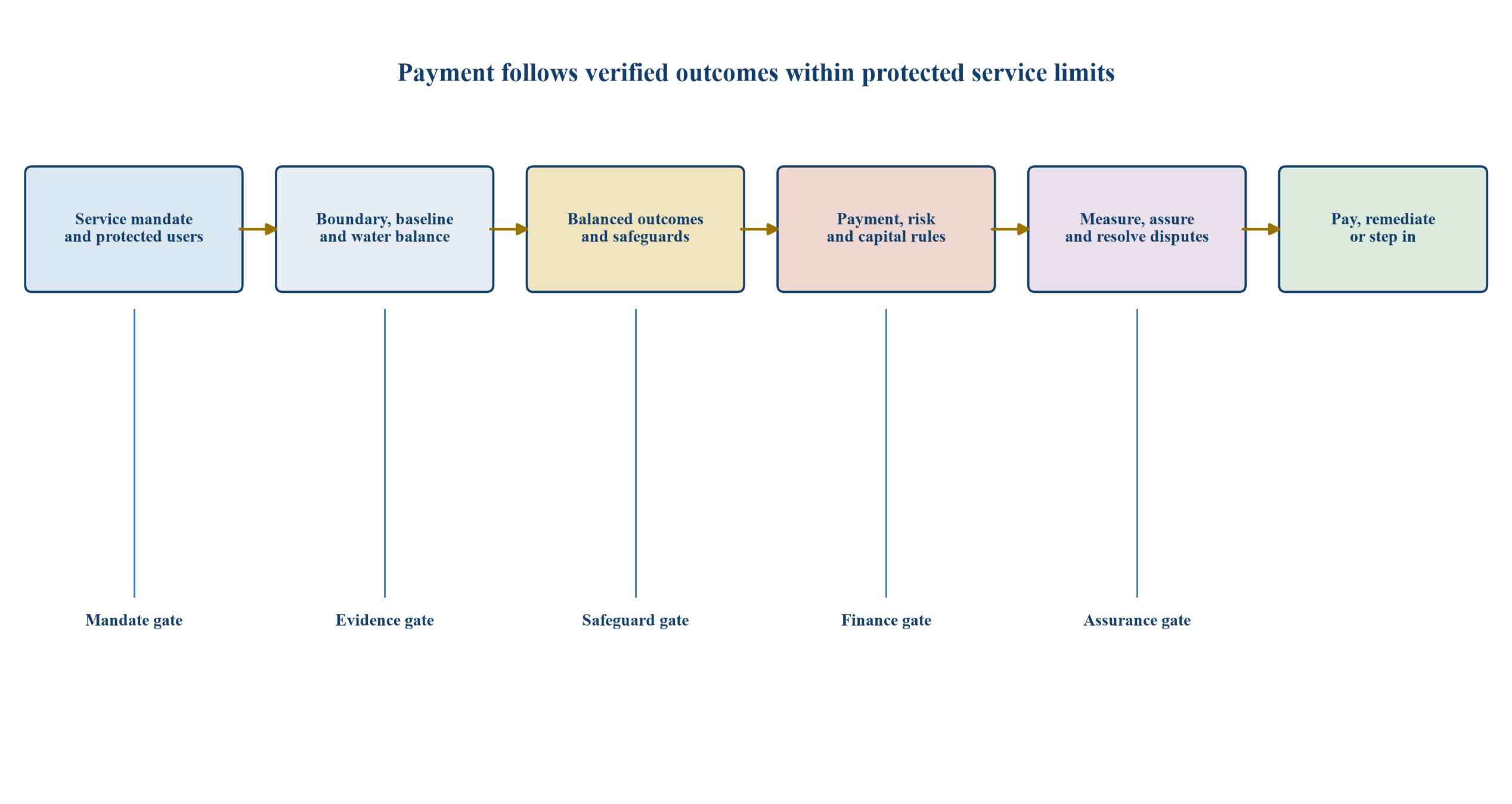
Generic framework; actual metrics, law and payment rules require local evidence.
6. Contract forms
A service contract can target leakage, metering or billing. A management contract can cover wider operations. A lease can transfer operating and commercial risk while the authority funds major capital. A concession can place broader investment obligations with the operator.
The form should match control, duration, capital need and institutional capacity. Label alone does not determine risk allocation.
7. Readiness assessment
The authority should assess data, asset knowledge, water balance, procurement, regulation, tariff policy, workforce, capital and contract-management capacity. Weak readiness can make performance measurement disputable.
Preparatory work may include meter verification, district boundaries, customer-register cleanup and urgent repairs. These investments support competitive bids and credible financing.
8. The water balance
Non-revenue water is the difference between water entering the distribution system and billed authorised consumption. It includes physical losses, commercial losses and authorised unbilled consumption [1]. Each component requires different action.
The contract should use a documented water balance with units, periods, meter accuracy, estimation and reconciliation. A single percentage can conceal volume and revenue effects.
9. Production measurement
Bulk production and import meters determine the top of the balance. Calibration, range, downtime, bypass and data gaps can materially change reported losses. The baseline should state uncertainty.
Payment should not depend on a volume that neither party can verify. Reference testing and replacement rules belong in the contract.
10. Customer measurement
Meter age, size, installation, read frequency and low-flow accuracy affect billed consumption. Estimated reads and inactive accounts can distort commercial losses.
A meter programme needs controlled replacement, testing and customer communication. The operator should not receive duplicate credit for meter correction and physical leakage reduction.
11. District metered areas
District metered areas can localise flow, pressure and losses. Their boundaries, valves, meters and customer allocation must be validated. Open interconnections can invalidate results.
The contract should define acceptance and maintenance of each district. Rollout count is an input; verified performance is the outcome.
12. Baseline period
The baseline should cover representative demand, weather, production, restrictions, outages and customer changes. A short or abnormal period can create windfall or impossible targets.
Historical data should be reconciled and adjusted through agreed rules. Material uncertainty should influence payment bands and verification effort.
13. Baseline adjustment
Adjustments may be needed for new customers, boundary changes, bulk supply, drought restrictions, source changes and exceptional events. Rules should be objective, symmetric and auditable.
The operator should not control the adjustment unilaterally. Independent determination may be appropriate where value is material.
14. Core scorecard
Table 1. Balanced outcome scorecard for a water concession
| Outcome | Primary measure | Safeguard | Payment role |
|---|---|---|---|
| Water quality | Compliance and barrier performance | No material deterioration | Threshold and penalty |
| Continuity | Hours of supply and interruption | Critical users protected | Bonus and penalty |
| Physical loss | Verified real-loss volume | Minimum pressure maintained | Performance payment |
| Commercial loss | Verified billing and collection improvement | Customer-rights compliance | Separate performance payment |
| Affordability | Bill burden and support access | Protected-customer rules | Constraint and shared benefit |
| Asset stewardship | Condition, maintenance and renewal | No deferred-risk transfer | Retention and handback |
Weights should reflect local priorities and controllability. One strong metric should not offset a material safety failure.
15. Water quality
Quality obligations should cover legal compliance, treatment barriers, sampling, laboratories, incident response and reporting. Payment incentives should never encourage reduced testing or unsafe blending.
Material quality failure should trigger a payment stop, remediation and regulatory response. The contract should define responsibility where source quality is controlled by the authority.
16. Continuity
Continuity should measure hours, planned and unplanned interruption, geography and critical customers. Average system availability can hide persistent local failure.
The operator needs access to supply, power and capital required to meet the target. Relief should be limited to events outside its control and mitigated reasonably.
17. Pressure
Pressure affects leakage, supply, fire protection and customer service. A contractor can reduce losses by lowering pressure, so minimum and maximum service bands should constrain the incentive.
Measurement should use representative points and calibrated devices. Pressure management should preserve service and asset integrity.
18. Physical losses
Physical-loss payment should use verified volume, normalised for pressure and system changes where appropriate. Repair count or kilometres surveyed are supporting indicators, not the ultimate outcome.
The economic level of leakage depends on water value, energy, repair cost, scarcity, environment and customer impact. Zero leakage is not a realistic contract target.
19. Commercial losses
Commercial loss includes meter under-registration, unauthorised use and data or billing errors. Recovery can improve cash quickly, but actions may affect customers and political relationships.
The contract should require lawful procedures, evidence and appeals. Revenue improvement should be separated from tariff increase and demand growth.
20. Authorised unbilled consumption
Firefighting, public facilities, flushing and approved free supply should be measured or estimated consistently. Reducing legitimate use is not a performance benefit unless policy changes.
The authority should approve categories and reporting. Transparency improves the water balance and public accountability.
21. Affordability
Affordability can be measured through bill burden, arrears, disconnection, support uptake and essential-use protection. Indicators should be segmented to avoid averages hiding vulnerable customers.
The tariff and subsidy framework must support the contract. An operator cannot carry broad social policy without a funded mechanism.
22. Customer service
Response time, complaint resolution, billing accuracy, connection and restoration can be included. Satisfaction surveys require representative design and independent administration.
Customer measures should connect to remedies. Reporting alone does not protect service users.
23. Environmental outcomes
Energy, abstraction, discharge, sludge and greenhouse-gas intensity may be relevant. Leakage reduction can lower production and energy, while increased pressure or treatment can move impacts elsewhere.
Environmental metrics should avoid double counting and remain subordinate to legal compliance.
24. Asset stewardship
The operator should maintain an asset register, risk-based plan, inspections, spares and lifecycle records. Short-term outcome payments can encourage underinvestment if handback is weak.
Condition and renewal obligations should reflect asset criticality. Independent surveys can protect both parties.
25. Outcome hierarchy
Safety and legal compliance should be thresholds. Continuity and customer protection may be minimum obligations. Leakage and efficiency can then drive variable payment within those limits.
This hierarchy prevents financial incentives from purchasing performance through unacceptable service trade-offs.
26. Payment architecture
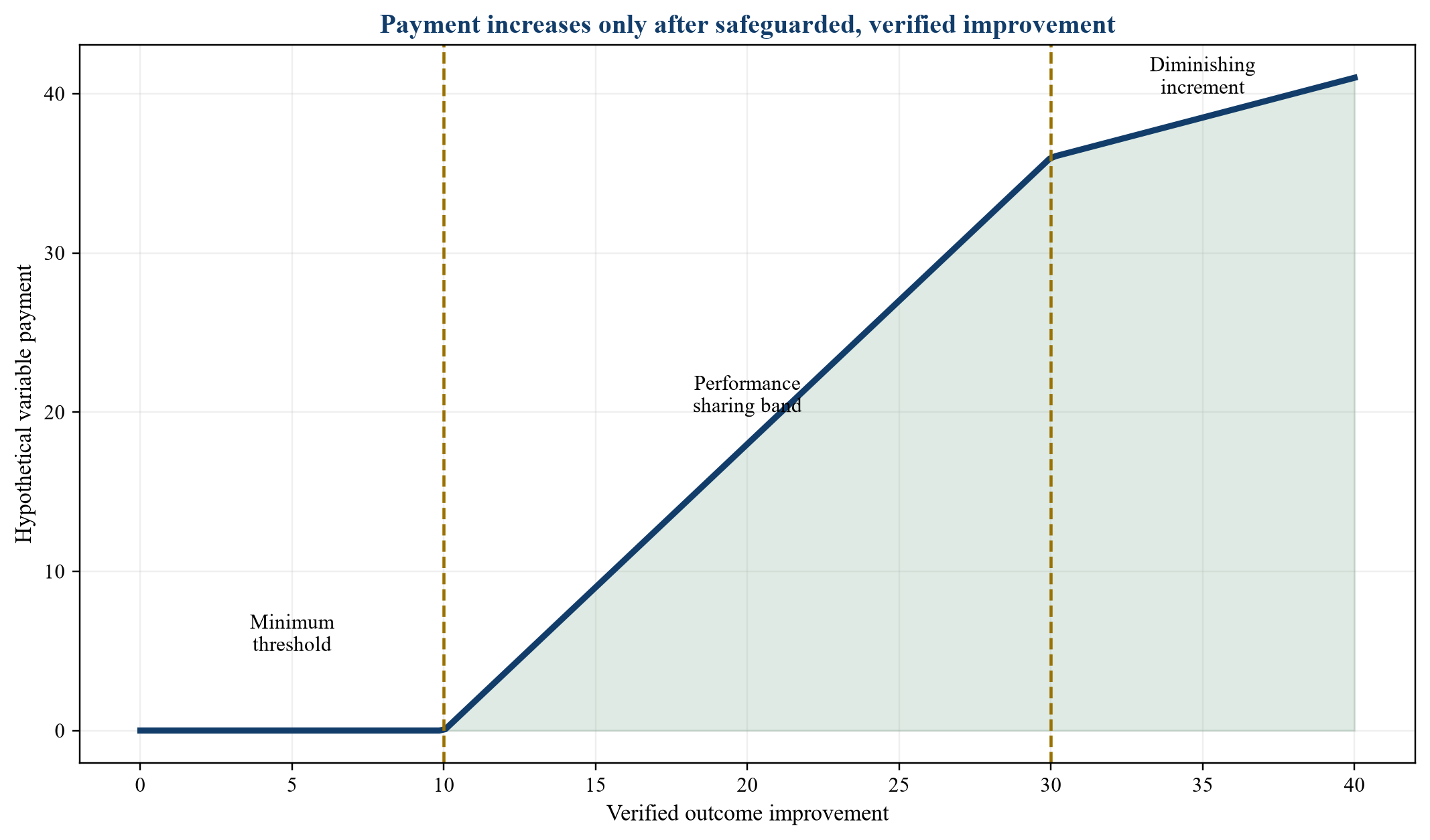
Illustrative only; values do not describe an actual concession or recommended tariff.
27. Fixed and variable payment
Fixed payment can cover minimum staffing, systems and mobilised capacity. Variable payment rewards outcomes. Too little fixed payment can impair financeability; too much can weaken incentive.
The blend should reflect controllable cost, capital and risk. Bidders should show how they fund the performance period.
28. Thresholds and bands
A threshold avoids paying for normal fluctuation or measurement noise. A sharing band can align authority and operator benefits. Caps limit fiscal exposure and windfalls.
The curve should remain understandable. Excessive formula complexity creates disputes and weakens management focus.
29. Penalties
Penalties should relate to material service failure, non-reporting, unsafe operation or missed obligations. Unlimited exposure can make bids expensive or unfinanceable. Trivial penalties may be ignored.
Remediation and step-in can matter more than monetary deduction during operational failure.
30. Indexation
Labour, energy, chemicals and materials may require indexation. The formula should allocate inflation that neither party controls while preserving efficiency incentives.
Index sources, base dates, lags, caps and extraordinary review should be stated. Currency risk needs separate treatment.
31. Capital responsibility
The contract should identify who designs, approves, funds, owns and maintains capital. Many performance-based leakage contracts leave major capital with the utility [3]. Delay by one party can prevent the other's outcome.
Dependencies need schedules, relief rules and decision rights. Capital approval should not become an automatic excuse.
32. Operator-financed capital
Operator finance may accelerate delivery but requires revenue certainty, security, termination compensation and control over implementation. Assets with long life can exceed the contract period.
The financing structure should match amortisation and handback. Public obligations should remain transparent.
33. Authority-financed capital
Public or utility funding can lower capital cost and preserve ownership. The operator can still carry design, delivery or performance risk. Budget and procurement delays remain key dependencies.
The authority should commit a credible capital envelope and approval process. Unfunded targets are not effective risk transfer.
34. Cost sensitivity
Table 2. Hypothetical contract economics under different delivery states
| State | Authority capital | Operator cost | Verified annual benefit | Contract interpretation |
|---|---|---|---|---|
| Weak baseline | USD 35m | USD 18m | USD 12m | Rebuild measurement before full incentive |
| Controlled rollout | USD 55m | USD 24m | USD 32m | Fund staged expansion after verification |
| High-performance case | USD 75m | USD 30m | USD 48m | Share benefit subject to service safeguards |
| Capital delay | USD 25m | USD 26m | USD 17m | Apply dependency and relief rules |
The figures are hypothetical and illustrate decision structure only. A real case requires local water value, tariff, cost, baseline and financing evidence.
35. Value of saved water
Saved water may defer supply capital, reduce energy and chemicals, enable connections or improve resilience. The marginal value varies by season, location and scarcity.
The financial model should avoid applying one average value to every unit. Benefits should correspond to an actual operating or capital decision.
36. Revenue recovery
Commercial-loss reduction can generate cash, but collections may have affordability and legal constraints. Revenue should be measured net of tariff change, demand and write-offs.
The authority should retain policy control over customer protection. Incentives can reward accurate, lawful recovery.
37. Procurement strategy
Market sounding can test capability, risk appetite, data needs and financing. Prequalification should examine water-loss experience, safety, contract management, financial capacity and local delivery.
Bid evaluation should compare outcome price and methodology while preserving competition. Lowest fixed price may not deliver best value.
38. Bid data room
The data room should include water balance, meters, network maps, pressure, incidents, customers, billing, collections, assets, maintenance, capital, tariffs, energy and contracts. Limitations should be explicit.
Bidders need site access and questions. Information asymmetry otherwise appears in price or disputes.
39. Target setting
Targets should reflect baseline, economic potential, asset condition, capital and service limits. An imposed benchmark from another utility may be infeasible or inefficient.
The authority should test component analysis and bidder proposals. Targets can tighten in stages as evidence improves.
40. Risk allocation
Demand, source supply, climate, tariff, customer growth, existing assets, permits, capital, labour and force majeure should be allocated to the party best able to manage them. Shared risks need adjustment mechanisms.
A long list of operator risks does not prove transfer. Price, exclusions and renegotiation reveal the practical allocation.
41. Change in law
Water quality, labour, environment, tax and tariff law may change during a long contract. The mechanism should define materiality, mitigation, evidence and compensation.
Routine compliance evolution can remain an operator risk within limits. Fundamental policy change may require relief.
42. Drought and scarcity
Drought can change production, demand, pressure and restrictions. Baseline adjustment should protect neither party from controllable failure nor create windfall from public restrictions.
The contract should distinguish emergency direction, operator response and long-term adaptation.
43. Energy risk
Pumping and treatment can make energy a material cost. Pressure and leakage actions affect use. Indexation can cover price, while efficiency remains incentivised.
Energy baselines should reflect volume, head and quality. Renewable projects need separate capital and performance treatment.
44. Workforce
Existing employees may hold essential local knowledge and employment protection. The plan should address transfer, retention, competence, training and industrial relations.
Labour savings should not compromise shift coverage or emergency response. People obligations need cost and timetable.
45. Data rights
The authority should own or have enduring access to raw operational, customer, model, configuration and performance data. Open formats and interfaces reduce lock-in.
Data should remain available during dispute, termination and handback. Cyber and privacy controls apply throughout.
46. Measurement system
Meters, sampling, time, transformations and validation form the payment evidence chain. Each material measure needs specification, calibration, quality rules and accountable review.
Measurement cost should be proportionate to payment and service consequence. Independent checks can focus on material metrics.
47. Verification protocol
The protocol should define data cut-off, adjustments, missing data, uncertainty, approval and dispute. It should be tested using historical periods before tender.
Both parties should reproduce the calculation from controlled data. A black-box model undermines financeability.
48. Independent verifier
An independent verifier can certify baselines, outcomes and adjustments. Appointment, competence, access, liability and payment should preserve independence.
The verifier should determine evidence, not manage the operator. Contract authority remains with the parties and regulator.
49. Audit trail
Every payment should retain source data, calculations, adjustments, approvals and exceptions. Version control is essential when boundaries or formulas change.
The audit trail supports lenders, regulators and dispute resolution. It also improves programme learning.
50. Dispute ladder
Operational discussion, expert determination, mediation and arbitration or court can form a ladder. Technical measurement disputes may need specialist determination before legal escalation.
Time limits should protect cash flow and service. Undisputed amounts should remain payable where appropriate.
51. Step-in rights
The authority and lenders may need step-in for serious failure. Triggers should be objective and proportionate. The process should protect access, data, people and essential suppliers.
Step-in is an emergency control, not a routine management tool. Cure and exit should be defined.
52. Termination
Termination can arise from operator default, authority default, prolonged force majeure or convenience. Compensation should reflect debt, assets, performance and fault.
The formula must preserve service transfer and avoid unaffordable windfall. Lender rights require alignment.
53. Handback
Handback should cover condition, remaining life, records, spares, licences, systems, workforce and contracts. Surveys should begin well before expiry.
Retention or security can support remediation. Handback standards should be measurable from the start.
54. Financing diligence
Lenders should review authority credit, tariff and budget, payment mechanism, baseline, performance exposure, capital dependency, termination, insurance and dispute timing.
Debt service should survive plausible underperformance and delayed verification. Aggressive leverage can weaken operational flexibility.
55. Equity case
Equity value depends on fixed margin, outcome upside, capital returns, risk and exit. The model should test downside from missed metrics, cost inflation and authority delay.
Performance upside is credible only when the operator controls the drivers and measurement is reliable.
56. Affordability financing
Subsidy, viability-gap support, development finance or blended capital may support essential investment. Funding should be tied to transparent outcomes and customer protection.
Hidden subsidy within unpaid operator obligations weakens sustainability. The fiscal commitment needs approval.
57. Governance
A contract-management unit should combine technical, commercial, legal and customer skills. It needs authority to validate, pay, enforce and adapt within defined limits.
Weak public contract management can defeat a strong contract. Budget and retention should be planned.
58. Reporting dashboard
The dashboard should show quality, continuity, pressure, physical and commercial losses, affordability, complaints, assets, capital, payment and open exceptions. It should distinguish verified from provisional results.
Public reporting may require redaction, while core outcomes should remain transparent.
59. First 100 days
Mobilisation should confirm people, access, baseline instruments, critical incidents, customer channels, suppliers, capital dependencies and reporting. Unsafe changes should be prohibited.
The parties should approve the measurement-control plan before variable payment begins.
60. Implementation roadmap
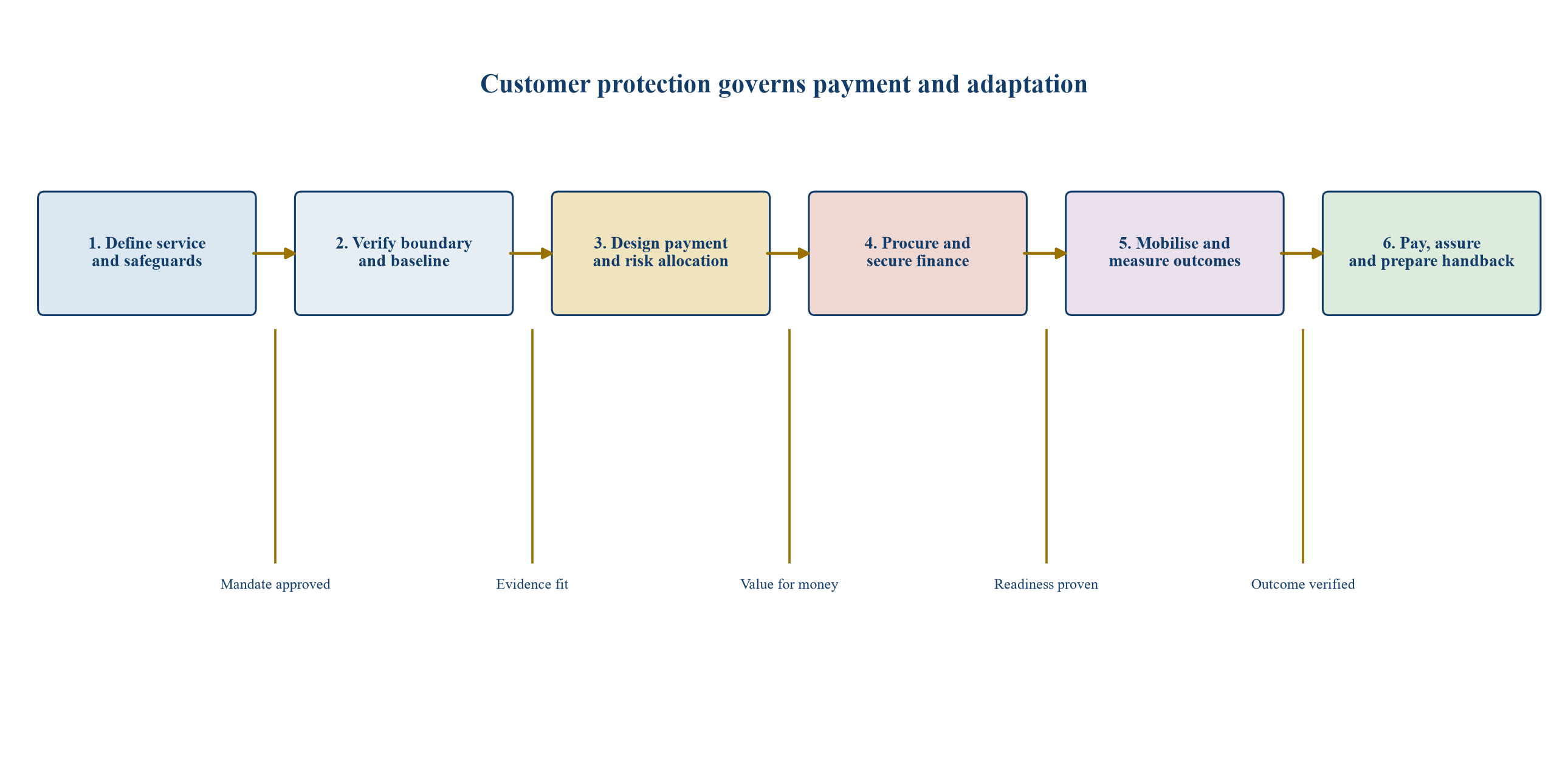
Generic roadmap; timing depends on procurement, baseline readiness, approvals and financing.
61. Common failure patterns
Failure patterns include weak baseline, one-dimensional targets, unfunded capital, unbounded relief, excessive formula complexity, poor public management, data lock-in and handback neglect. Each shifts risk back to customers or taxpayers.
The design review should test these explicitly before tender.
62. Diligence request list
The request should cover law, mandate, tariffs, customers, water balance, meters, pressure, quality, incidents, assets, capital, energy, staff, data, cyber, suppliers, land, permits, finance and complaints.
Evidence should be reconciled to sites and accountable owners. Summary reports alone are insufficient.
63. Investment committee questions
The committee should ask which outcomes are protected, which risks are controllable, how the baseline is verified, who funds capital, how payment changes, what customers bear and how service continues on failure.
It should compare traditional procurement, targeted PBC, management contract and concession alternatives.
64. Market testing
Draft metrics and risk allocation should be tested with credible bidders and lenders without allowing the market to rewrite public outcomes. Feedback can identify unpriceable risk, data gaps and competition constraints.
Material changes should return through governance and be disclosed consistently to bidders.
65. Pilot or full scale
A pilot can test baseline, technology and cooperation. It may understate scale, long-term maintenance and customer complexity. Full scale can capture system value but increases risk.
The decision should identify what evidence the pilot must produce and how expansion will be procured.
66. Contract adaptation
Long contracts need scheduled review and defined reopening for material events. Adaptation should preserve outcome integrity and competitive value.
Changes require evidence, approval, price treatment and public reporting. Informal renegotiation weakens accountability.
67. Source-water dependency
The operator may depend on authority-controlled reservoirs, wells or bulk suppliers. Source volume and quality affect continuity, treatment cost and leakage calculations. The contract should define delivery conditions, measurement, planned outages and relief.
Source failure should not create automatic compensation when the operator could mitigate through storage, operating changes or emergency planning. The allocation should reflect practical control.
68. Network growth
New developments alter customers, demand, pipe length and pressure zones. The contract should state who designs, funds, approves and operates extensions. Performance metrics need adjustment without rewarding normal growth.
Connection standards and developer contributions should remain transparent. Poorly integrated growth can create future leakage and service liabilities.
69. Industrial customers
Large industrial users can dominate volume, revenue and continuity requirements. Contract terms may include dedicated quality, pressure, redundancy and curtailment. Closure or expansion can distort system indicators.
The baseline should treat these customers separately where material. Operator incentives should not encourage preferential service that weakens protected public outcomes.
70. Emergency response
The operator should maintain incident command, alternative supply, communications, laboratories, repair resources and mutual aid. Response targets should cover notification, isolation, restoration and after-action review.
Emergency performance can be measured without rewarding the occurrence of incidents. Prevention and readiness remain part of the outcome framework.
71. Insurance
Required coverage may include property, machinery breakdown, environmental, cyber, professional liability and business interruption. Deductibles and exclusions should align with retained risks.
Insurance proceeds need rules for restoration and payment. Coverage does not replace operating controls or financial capacity.
72. Performance security
Bonds, guarantees, letters of credit, retention and parent support can secure obligations. Their size and duration should reflect mobilisation, remediation and transition exposure.
Security should be callable under clear conditions and remain available through handback. Excessive requirements can reduce competition or increase price.
73. Refinancing
Long concessions may refinance after construction or performance stabilisation. The contract should address consent, gain sharing, increased leverage and continuing resilience.
Refinancing benefit should be measured after fees and risk. The authority should not absorb downside created by the operator's capital decision.
74. Tax and accounting
Tax, depreciation, asset recognition, grants and concession accounting can affect bids and reported returns. The parties should obtain jurisdiction-specific advice and preserve consistent economic comparison.
Accounting treatment should not override service obligations or risk allocation. Changes in interpretation may require controlled review.
75. Political and fiscal commitment
Multi-year payment obligations need lawful appropriation, tariff support or credit enhancement. A technically sound concession can fail when the authority cannot pay or enforce tariffs.
The affordability and fiscal case should be approved with the contract. Payment security should remain transparent to customers and public decision makers.
76. Gender and inclusion
Service interruptions, collection practices and access can affect customer groups differently. Consultation and indicators should capture vulnerable households, informal settlements, carers and essential services where evidence supports them.
Inclusion requirements need measurable actions and funded mechanisms. Broad commitments without data or remedy provide limited protection.
77. Climate resilience
Flood, drought, heat, salinity and power disruption can change assets and performance. The operator should maintain risk assessment, adaptation actions and emergency capability within its control.
Climate adjustment should preserve incentive while recognising material external change. Capital responsibilities must be explicit.
78. Technology proposals
Leak detection, smart meters, analytics and pressure control can improve outcomes. Procurement should remain technology-neutral where possible and require interoperability, evidence and lifecycle support.
The operator should own delivery risk within approved safeguards. The authority needs data and transition rights if technology changes or the contract ends.
79. Benefits attribution
Benefits may result from operator action, authority capital, tariff reform, rainfall, restrictions or customer change. The verification protocol should attribute value consistently and avoid double payment.
Material shared contributions can use agreed sharing rules. Attribution uncertainty should be disclosed rather than hidden in precision.
80. Completion and renewal
Before renewal, the authority should assess outcomes, asset condition, affordability, capability, market competition and future needs. Extension should require evidence of value and lawful process.
Open liabilities and handback work need resolution. Continuity planning should begin even when renewal is expected.
81. Board decision record
The approval should preserve the chosen form, alternatives, baseline limitations, metrics, payment, capital, risk, financing, customer protection, verification and exit. Conditions precedent and unresolved matters need accountable owners.
This record allows future boards and regulators to assess whether amendments remain consistent with the original public-service mandate.
82. Metric definition register
Table 3. Illustrative outcome-measurement control register
| Metric | Boundary and calculation | Evidence control | Adjustment rule | Payment consequence |
|---|---|---|---|---|
| Water-quality compliance | Approved sampling points and statutory method | Accredited tests and incident reconciliation | No favourable adjustment for operator-caused failure | Threshold; material failure suspends variable payment |
| Continuity | Customer-hours of supply by service zone | Telemetry, incident logs and customer records | Adjust only for approved authority or force-majeure event | Graduated bonus or deduction |
| Real-loss reduction | Normalised physical-loss volume | Bulk meters, district balance and pressure evidence | Account for boundary, demand and verified pressure change | Shared verified benefit above threshold |
| Commercial-loss reduction | Corrected billed and collected volume | Meter tests, customer register and billing audit | Exclude tariff and ordinary demand growth | Separate recovery incentive |
| Affordability | Bill burden, arrears and protected-user outcomes | Tariff, billing and support-programme records | Reflect approved tariff or subsidy changes | Safeguard; breach limits upside |
| Asset stewardship | Risk-based maintenance and handback condition | Asset register, inspection and independent survey | Reflect approved capital responsibility | Retention, remediation or handback release |
The register should be contractually controlled and updated only through the formal change mechanism. It provides one reference for operations, verification, payment and dispute.
83. Minimum data quality
Each payment metric should have minimum completeness, accuracy, timeliness and traceability requirements. When data fail the threshold, the contract should define conservative substitution, delayed payment or independent reconstruction. Automatic use of operator estimates can weaken incentive and create disputes.
The parties should classify missing data by cause and materiality. Repeated measurement failure may indicate a control breach requiring remediation beyond the immediate payment period.
84. Leakage persistence
A repaired leak creates value only while the repair, pressure regime and network condition sustain the saving. Payment based entirely on short measurement windows can reward temporary improvement. The contract should use persistence periods, repeat checks or retention.
The measurement plan should distinguish seasonal movement from deterioration. Persistent performance can support later release of retained payment or expansion to additional zones.
85. Quality-adjusted continuity
Water delivered outside the required quality specification should not count as normal continuity. The contract needs a rule for boil notices, contamination, low pressure and emergency supply. This protects customers from a metric that rewards flow without safe service.
The calculation should remain simple enough to verify. Material incidents should also follow regulatory and contractual remedies outside the score.
86. Collections conduct
Improved collections can strengthen utility finance, but methods should comply with law, tariff rules and customer protections. The operator should document notice, dispute, payment-plan and disconnection procedures. Vulnerable or essential users may require specific safeguards.
Payment should reflect lawful incremental recovery net of reversals and unsupported charges. Complaints and appeal outcomes can act as conduct indicators.
87. Operator relief events
Relief should be available only for events that materially affect performance, fall outside allocated control and are mitigated reasonably. Notice, evidence, causation and duration should be specified. Broad relief language can neutralise the incentive.
The authority's own failures, such as delayed capital or unavailable source supply, need a defined adjustment. Concurrent operator failure should remain attributable where evidence supports it.
88. Authority obligations
The authority may need to provide assets, information, permits, tariff decisions, capital, access and timely approvals. These obligations should have owners and dates. Failure can affect performance and financing.
The contract should include escalation and cure before compensation. Authority accountability strengthens value for money and reduces opportunistic claims.
89. Lender direct agreement
A direct agreement can give lenders notice, cure and step-in rights before termination. It should preserve the authority's ability to protect service and address serious operator failure. Cure periods must reflect operational urgency.
The agreement should align with security, termination compensation and replacement procedures. Conflicting rights between finance documents and the concession create avoidable execution risk.
90. Fiscal reporting
Public reporting should show fixed payment, variable payment, capital support, guarantees, contingent liabilities and realised outcomes. Forecast commitments should be separated from actual cash and verified benefit.
Transparent reporting supports budget control and public legitimacy. Commercial confidentiality can be protected without concealing the public-service and fiscal position.
91. Value-for-money reassessment
Value for money should be reassessed at procurement, preferred bidder, financial close and material amendment. The comparison should include retained risk, public capital, contract-management cost, financing, service outcomes and realistic alternatives.
A lower headline price does not establish value when outcomes, risk or asset condition differ. The authority should record the reason for any change in conclusion.
92. Exit continuity plan
The authority should maintain a current plan for operator failure, expiry or replacement. It should identify people, systems, data, licences, suppliers, inventory, control access and emergency finance required to continue service.
The plan should be tested periodically. A contractual right to take over is weak when operational capability and information are unavailable.
93. Tender evaluation and bid comparability
A performance-based procurement needs a bid model that permits genuine comparison. Each bidder should price the same reference network, baseline assumptions, capital responsibilities, demand conditions and service standards. The authority should provide a controlled data room, a common clarification process and a transparent approach to data limitations. Departures from the reference case should be scheduled explicitly rather than embedded in narrative qualifications.
Evaluation should separate fixed service cost, variable outcome price, capital funding, financing assumptions and retained public obligations. A low variable rate may coexist with a high fixed fee or extensive authority-funded capital. A bid with an ambitious loss target may depend on operating restrictions, deferred maintenance or customer actions that the contract does not permit. Whole-life comparison should therefore include expected payment across plausible performance cases, retained risk, public funding, contract-management cost, transition and handback.
Technical scoring should test the causal chain between intervention and result. The bid should show how district metering, pressure management, active leakage control, asset renewal, customer-meter correction and billing remediation affect the specified outcomes. Staffing, supply-chain capacity, data systems, commissioning and mobilisation should be consistent with the programme. Evaluation teams need technical, commercial, legal, financial and customer expertise, with conflicts recorded and controlled.
The preferred bid should then be recalculated using the final negotiated allocation. Changes to the baseline, payment curve, capital programme, relief regime or termination terms can change value materially. Approval should rely on the final contract economics and service package, supported by a documented comparison with the public-sector or conventional procurement alternative.
94. Claims prevention and evidence discipline
Outcome contracts can generate recurring claims when causation, data quality or authority obligations are uncertain. The contract-management plan should maintain an issue log linking each event to notice, evidence, mitigation, metric effect, payment treatment and resolution. Operational teams should preserve contemporaneous records; later reconstruction is usually slower, more expensive and less reliable.
Early-warning meetings can resolve emerging boundary changes, meter failures, delayed authority works and abnormal demand before they reach formal dispute. Agreed interim treatment should be time-limited and should preserve both parties' rights. Independent verification should remain separate from advocacy by either contract party.
Periodic claim-pattern review can identify weak definitions or recurring control failures. Any amendment should specify the affected period, financial consequence, audit trail and future rule. This discipline helps the authority distinguish legitimate relief from ordinary performance risk and helps lenders assess whether cash-flow adjustments follow a controlled process.
95. Conclusion
Outcome-based water concessions can align public service and private execution when the contract measures the full service rather than one attractive metric. Leakage, continuity, quality, affordability and asset stewardship should operate as a balanced system.
The strongest structure begins with a reliable boundary and baseline, allocates controllable risks, funds required capital and pays only for verified improvement within service safeguards. It preserves data, step-in, termination and handback capability.
The final approval should record outcomes, metrics, baseline, payment curve, capital responsibilities, risk allocation, financing, verification, dispute, customer protections and exit. This keeps accountability connected to payment throughout the contract.
References
- World Bank PPP Resource Center. Contracting Tools for Non-Revenue Water Reduction. https://ppp.worldbank.org/water-and-sanitation/contracting-tools-non-revenue-water-reduction
- OECD. Managing and Financing Water for Growth in Thailand. 2022. https://www.oecd.org/content/dam/oecd/en/publications/reports/2022/07/managing-and-financing-water-for-growth-in-thailand_b4d16d0a/839a4f70-en.pdf
- World Bank PPP Resource Center. Performance-Based Contracting Tools for Non-Revenue Water Reduction. https://ppp.worldbank.org/water-and-sanitation/performance-based-contracting-tools-non-revenue-water-reduction-tools-resources
- World Bank and PPIAF. Using Performance-Based Contracts to Reduce Non-Revenue Water. 2016. https://ppp.worldbank.org/library/using-performance-based-contracts-reduce-non-revenue-water
- World Bank and PPIAF. Operational Manual: The Use of Performance-Based Contracts for Non-Revenue Water Reduction. https://connect4impact.worldbank.org/topic/wbg-ppiaf-operational-manual-use-performance-based-contracts-non-revenue-water-reduction
- World Bank PPP Resource Center. Performance-Based Contracting Case Studies. https://ppp.worldbank.org/water-and-sanitation/performance-based-contracting-tools-non-revenue-water-reduction-case-studies
- World Bank PPP Resource Center. Case Study on the Performance-Based Contract in Ho Chi Minh City. https://ppp.worldbank.org/library/case-study-performance-based-contract-ho-chi-minh-city
- Dalton, J. Performance-based contract for non-revenue water reduction: case study Bahrain. Water Supply, 2019, 19(4), 1073-1079. https://doi.org/10.2166/ws.2018.159
- World Bank PPP Resource Center. Performance-Based Management Contract for Water Supply and Wastewater Services. https://ppp.worldbank.org/sites/default/files/2024-09/water%20management%20contract%202.pdf
About the Author
Chennakeshav (CK) is a corporate finance and investment banking executive with 25+ years of global experience in deal origination, structuring and execution across M&A, growth capital and corporate strategy. He has led value-creation mandates for founders, corporates and funds — bridging the boardroom view to hands-on execution and close.
His career spans Morgan Stanley, HSBC, Lloyds Banking Group, EWEC, ADQ portfolio companies and Emirates Growth Fund, across TMT, real estate, fintech, deeptech, cleantech, infrastructure and energy. He has partnered with C-suite leaders, private equity and venture funds, sovereign wealth funds and family offices to finance complex fund raises and scale-up ventures, and has led M&A due diligence, post-merger integration and business-transformation initiatives to create value.
At Matchpoint Partners he is Managing Partner, leading the firm's corporate finance, M&A and capital-raising practice. He holds an MBA from London Business School, an engineering degree from VTU and a Master of Laws (LLM, in progress) from UCL London.
An active start-up mentor, CK mentors at Techstars, DIFC FinTech Hive, Startup Grind, Founder Institute and IN5, serves as Entrepreneur Mentor in Residence (EMiR) at London Business School, and judges the Entrepreneurship World Cup.
LinkedIn: https://www.linkedin.com/in/ckadya/
Profile: https://www.matchpoint-partners.com/team/ck-adya.html
