

1. The decision
The governing body must decide whether a performance contract can convert water losses and weak collections into durable service and cash-flow gains. The decision includes the target area, baseline, contractor scope, payment formula, verification method, capital source, utility obligations and treatment of gains after the contract ends.
The programme should proceed only when the utility can measure the starting position, provide operating access, fund verified payments and sustain the improved system. A performance label cannot compensate for incomplete data or absent institutional commitment.
2. Define non-revenue water
Non-revenue water is the difference between system input volume and billed authorised consumption. The recognised water balance separates billed consumption, unbilled authorised consumption, apparent losses and real losses [1][2]. Each component has a different technical intervention and financial effect.
Real losses concern physical leakage and storage overflow. Apparent losses can arise from meter error, data handling or unauthorised consumption. A programme should preserve this distinction from diagnosis through payment.
3. Define the cash problem
Water saved does not always become cash. A reduced leak may avoid treatment, pumping or future capacity cost while producing no immediate revenue. Corrected metering may increase billing, while collection still depends on customer service, affordability, enforcement and payment systems.
The financial case should reconcile four bridges: system input to billed volume; billed volume to billed value; billed value to cash collected; and cash collected to net operating benefit.
4. Why input contracts underperform
Traditional contracts commonly pay for surveys, meters, valves, repairs or labour. Those inputs can be necessary, yet payment may be weakly connected to sustained loss reduction. The World Bank's 2025 guidance describes the rationale for contracts that focus on outputs and preservation of results [1].
A results contract creates stronger incentives only when performance is measurable and the contractor has sufficient control. Poor baselines, changing boundaries or delayed utility actions can make the result impossible to attribute.
5. Performance-contract architecture
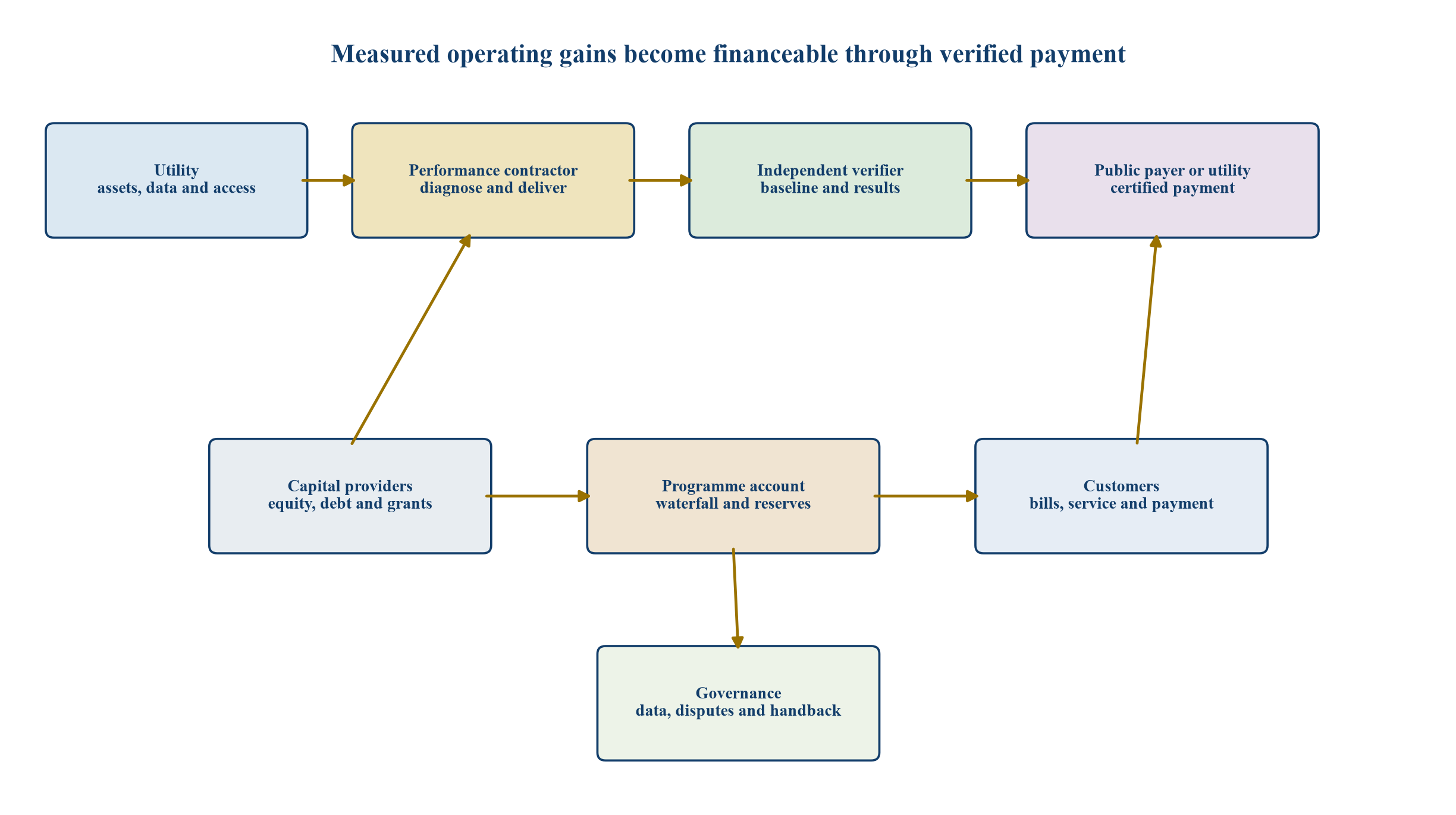
Generic structure; actual roles, security and regulation depend on jurisdiction and programme conditions.
6. Choose the outcome
The programme can target litres saved, pressure stability, continuity, billed consumption, billing accuracy, collection efficiency, cash collected or a combination. Each outcome should have a unit, data source, measurement period and responsibility map.
The World Bank operational manual defines performance-based contracting around specific measurable results and links at least part of payment or extension to achievement [2]. The commercial schedule should follow that discipline.
7. Screen the opportunity
Screening should determine whether the target area has material losses, usable data, manageable boundaries, sufficient benefit and institutional support. The World Bank manual describes an initial screening phase before detailed preparation [2].
The screen should reject areas where input meters are absent, supply is too intermittent to establish a baseline, planned network changes overwhelm measurement or the utility cannot meet essential obligations.
8. Establish the water balance
The water balance reconciles system input, authorised consumption and losses. It should use a defined period and documented meter, estimation and data-quality assumptions. Reconciliation should occur at utility, zone and district-metered-area levels where feasible.
A percentage NRW target alone can mislead because changes in system input or billed consumption alter the ratio. Volume, value and service indicators should be reported together.
9. Establish the commercial baseline
The commercial baseline should cover customer records, active connections, meter condition, reading completeness, billing timeliness, billing corrections, arrears, disputes, payment channels and cash allocation. It should distinguish government, commercial, industrial and household accounts where their behaviour differs.
Historic billing is evidence only after reconciliation to meter reads, tariff tables, account status, cancellations and receipts. The contract should state which data defects are included in the contractor's scope.
10. Boundary integrity
A measurement area needs stable hydraulic and commercial boundaries. Water entering, leaving and transferred between areas should be metered or estimated through a disclosed method. Customer accounts should map to the same geography.
Boundary changes, new bulk customers, network extensions and source changes require baseline adjustment. Without such rules, operational growth can be mistaken for contractor performance or underperformance.
11. Meter confidence
Bulk meters, district meters and customer meters have different accuracy, failure and replacement characteristics. The preparation team should maintain an asset register, calibration status, data frequency and confidence grade.
The contractor should not be rewarded for a measurement change that merely revises the estimate of water entering the area. Calibration and replacement effects require controlled treatment.
12. Data governance
The utility should define source systems, access rights, retention, change logs, approval roles and cybersecurity. Raw data should remain available to the verifier and audit function. Manual adjustments should identify user, time, reason and supporting evidence.
Data used for payment should be reproducible. A dashboard is useful for management, while payment certification needs traceable records and documented formulae.
13. Measurement and verification chain
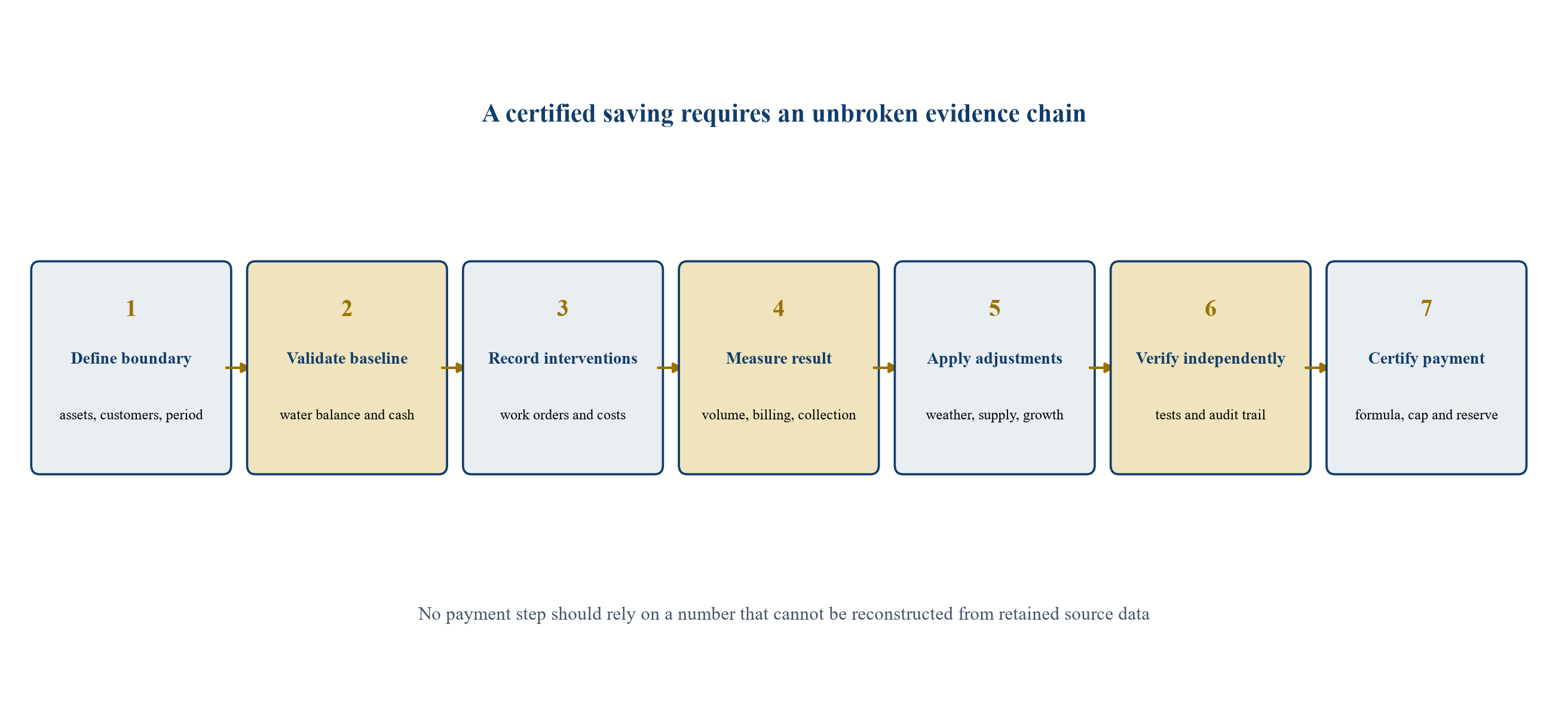
Each gate should preserve the evidence required to reproduce a certified result.
14. Baseline period
The period should be long enough to capture seasonality and operating variation. The contract should identify abnormal outages, rationing, drought restrictions, major bursts, tariff changes and temporary customers. Exclusions should be documented before bidding where possible.
A rolling or re-opened baseline weakens incentive certainty. Adjustments should be limited to defined external changes and calculated through an agreed method.
15. Normalise for continuity
Intermittent supply changes pressure, leakage and consumption. A contractor who improves continuity may initially increase measured losses or billed use. The baseline and target should control for supply hours and pressure where these are material.
Service improvement should remain an explicit outcome. A lower leak volume achieved by reducing supply can damage customers and should not earn performance payment.
16. Normalise for demand
Weather, conservation, industrial activity, population and connection growth can change consumption. The adjustment method should use observable variables and avoid excessive model discretion.
The bidder should receive historical series and the proposed formula. Lenders should test the payment impact when actual demand differs from the base case.
17. Separate real and apparent losses
Real-loss interventions include pressure management, active leak detection, repair quality, asset renewal and reservoir control. Apparent-loss interventions include meter replacement, account correction, illegal-use control and data-process improvement.
Different interventions create different timing, capex and customer risks. Contract pricing and verification should preserve these distinctions.
18. Collection improvement
Collection efficiency compares cash collected with amounts due under a defined convention. The denominator, treatment of arrears, credits, taxes, bad debt and government accounts should be explicit.
The contractor can improve channels, reminders, segmentation, dispute resolution and field processes. Tariff authority, social policy and legal enforcement commonly remain with the utility or government.
19. Customer protection
Collection improvement should comply with applicable consumer, privacy and service rules. Vulnerable customers, disputed bills, meter faults and affordability cases require controlled processes.
Payment should reward verified legitimate cash, not aggressive collection of invalid or unresolved amounts. Complaint rates, reversals and service quality can operate as safeguards.
20. Contractor scope
The scope can include diagnosis, district creation, metering, pressure management, leak repair, customer-meter replacement, data cleansing, billing improvement, collection support and training. It should identify utility-retained works and approvals.
The contractor needs sufficient authority to deliver targets. The utility needs control over public-service decisions and a clear approval timetable.
21. Utility obligations
Utility obligations can include network access, staff support, excavation permissions, customer communication, supply continuity, material approval, billing-system access and timely payment. Failure consequences should match the effect on results.
The contract should distinguish excused delay, baseline adjustment and compensation. Automatic relief without evidence can weaken performance discipline.
22. Payment components
A practical structure may combine mobilisation, fixed service payment, verified-work payment and performance payment. The fixed component supports minimum capability; the output component preserves incentive.
IFC's discussion of Ho Chi Minh City describes a mixture of fixed fees, district-area payments, volume-based performance fees and unforeseen-works pricing [8]. Every programme requires its own allocation.
23. Pay per unit saved
A unit payment can apply to independently verified water saved above an agreed threshold. The rate should reflect economic benefit, affordability, contractor cost and risk.
The formula should state the measurement window, baseline adjustment, persistence requirement, cap and treatment of negative performance. A high rate with weak measurement can transfer value without durable benefit.
24. Share of cash collected
Collection remuneration can be a share of incremental valid cash attributable to approved interventions. The formula should exclude tariff increases, unrelated arrears settlements, accounting reclassification and receipts outside the target population unless specifically included.
Cash should be cleared and reconciled before certification. Chargebacks, reversals and refunds require later true-up.
25. Net-benefit principle
Gross savings can overstate value. The utility should deduct incremental power, treatment, repair, meter, billing, collection, tax and verification costs where relevant. Avoided capacity or environmental benefit may be real but should not be treated as cash available for debt service without funding.
The financial model should present physical, accounting and cash benefits separately.
26. Performance schedule
Table 1. Illustrative performance and payment schedule
| Outcome | Measurement | Payment treatment | Essential safeguard |
|---|---|---|---|
| Real water saved | Adjusted district input less legitimate consumption and authorised use | Unit fee after threshold and persistence test | Pressure and continuity floor |
| Apparent loss recovered | Valid incremental billed consumption after meter and account controls | Share of verified net billing value | Reversal and dispute adjustment |
| Cash collection gain | Cleared incremental receipts against eligible accounts | Share of verified cash after exclusions | Customer-protection and affordability protocol |
| Service continuity | Hours of supply and pressure compliance | Gate, bonus or deduction | Independent data and outage classification |
| Sustainability | Result retained through maintenance period | Holdback release | Asset register, training and handback test |
27. Thresholds and bands
A threshold can ensure that ordinary variation and utility-led improvements are not paid as contractor performance. Tiered rates can reflect diminishing marginal value or encourage stretch results.
Bands should remain understandable. A formula with many interacting thresholds can become difficult to bid, finance and audit.
28. Caps and floors
A payment cap protects the utility budget, while a minimum commitment can support mobilisation and finance. Both should follow the approved business case.
The model should test whether the cap truncates economically valuable performance and whether the floor pays despite material failure. Termination rights should address persistent underperformance.
29. Persistence
Leakage reduction can reverse when pressure, repair quality or maintenance deteriorates. Payment can be split between initial achievement and sustained performance over later periods.
A holdback or maintenance payment creates continuing incentive. The programme should fund utility capability for the post-contract period.
30. Independent verification
The verifier should have a defined appointment, scope, data access, timetable and duty of independence. Its work can include baseline audit, meter tests, formula review, sample inspections and payment certification.
The verifier should not redesign the commercial bargain. Disputes about interpretation require a separate expert or contractual process.
31. Audit rights
The utility, lenders and authorised public auditors may need access to relevant data, systems, work orders and payment calculations. Rights should protect customer data and contractor confidential information.
Records should be retained beyond final payment and through the applicable audit period.
32. Dispute ladder
The contract should provide operational resolution, senior escalation, independent expert determination and formal dispute procedures. Time limits should protect monthly cash flow.
Undisputed amounts should be paid while a defined element remains contested. Later true-up can correct certified errors.
33. Risk allocation
Table 2. Illustrative risk-allocation matrix
| Risk | Preferred owner | Contract treatment | Finance response |
|---|---|---|---|
| Baseline data defect | Utility for historic data; contractor for accepted field validation | Disclosure, validation period and defined adjustment | Contingency and delayed performance exposure |
| Delivery method | Contractor | Output specification and freedom within standards | Fixed-price scope and performance security |
| Utility access or approval delay | Utility | Relief, extension and documented cost treatment | Liquidity reserve and notice discipline |
| Measurement-system failure | Party controlling meter or platform | Redundancy, estimation hierarchy and repair deadline | Conservative certification and reserve |
| Customer affordability and enforcement policy | Utility or government | Approved customer protocol and excluded events | Collection downside and payment security |
| Result persistence | Contractor during maintenance term; utility after handback | Holdback, maintenance KPI and capability transfer | Tail reserve and staged release |
34. Financing perimeter
The financing perimeter can include meters, valves, pressure equipment, information systems, vehicles, repair works, mobilisation and working capital. Some programmes remain service contracts funded from utility budgets. Others may use contractor finance, bank facilities or blended capital.
The contract form should reflect the actual capital at risk. A short service term may be unsuitable for long-lived private debt unless repayment is front-loaded or supported.
35. Funding and financing
Verified utility savings, increased collections, tariff revenue, government transfers and grants provide funding. Equity and debt provide financing that expects repayment from funding.
Avoided economic cost does not automatically enter the payment account. The legal payer and budget source should be identified for each contract payment.
36. Sources and uses
Table 3. Illustrative sources, uses and controls
| Illustrative item | Purpose | Potential source | Control |
|---|---|---|---|
| Baseline and design | Surveys, water balance, customer and data audit | Utility, preparation grant or development finance | Approved preparation budget |
| Field and digital capex | Meters, valves, pressure controls and systems | Utility capex, contractor equity, debt or blended finance | Certified procurement and asset register |
| Repair programme | Labour, materials and reinstatement | Utility payment or contractor-financed working capital | Work-order and quality verification |
| Performance payment | Reward for verified durable result | Utility savings budget, tariff revenue or public support | Independent certification and cap |
| Liquidity and reserves | Payment delay, debt service and maintenance | Facility, guarantee, escrow or retained cash | Account waterfall and release tests |
37. Contractor equity
Equity absorbs delivery and residual risk and can align incentives. The amount should reflect capex, working capital, fixed obligations and payment volatility.
Thin capital combined with uncapped delivery risk can make performance promises fragile. Parent support or security may be appropriate during mobilisation and installation.
38. Working-capital facility
Monthly costs can precede quarterly or annual certification. A revolving facility can bridge eligible expenditure and certified receivables.
The lender should understand certification timing, deductions, disputes, payer credit, assignment rights and termination compensation. Borrowing against unverified future savings carries substantial performance risk.
39. Term debt
Term debt may finance durable equipment and system investment where contract tenor and payment support permit amortisation. Debt service should follow conservative certified cash flow after operating costs and reserves.
The programme should avoid debt maturity beyond the reliable payment term unless refinancing risk is explicitly accepted.
40. Results-based and concessional capital
Grants or concessional funding can support preparation, first-loss risk, affordability, capability transfer or demonstration. The support should address a defined barrier and remain visible.
IFC identifies blended finance as a potential means to lower capital cost or address market gaps in water projects [8]. Subsidy should not conceal weak measurement or permanent operating deficits.
41. Payment security
Security can include escrow, reserve accounts, letters of credit, guarantees or direct budget commitments. The instrument should match certification frequency, payer risk and replenishment timing.
A guarantee with slow draw procedures may fail to protect working capital. The parties should test the actual claim process before mobilisation.
42. Account waterfall
Certified payment can flow through taxes, operating costs, senior debt service, reserve replenishment, maintenance and equity distribution. Priority should be consistent with the finance documents.
Distribution should be locked when performance, reserves or coverage fall below agreed levels.
43. Debt-service coverage
Cash available for debt service should include only enforceable, conservatively timed receipts. It should exclude unbudgeted economic benefits and disputed performance claims.
Coverage should be tested against lower verified savings, slower collection, higher repair cost, delayed certification and payer delay.
44. Illustrative sensitivity
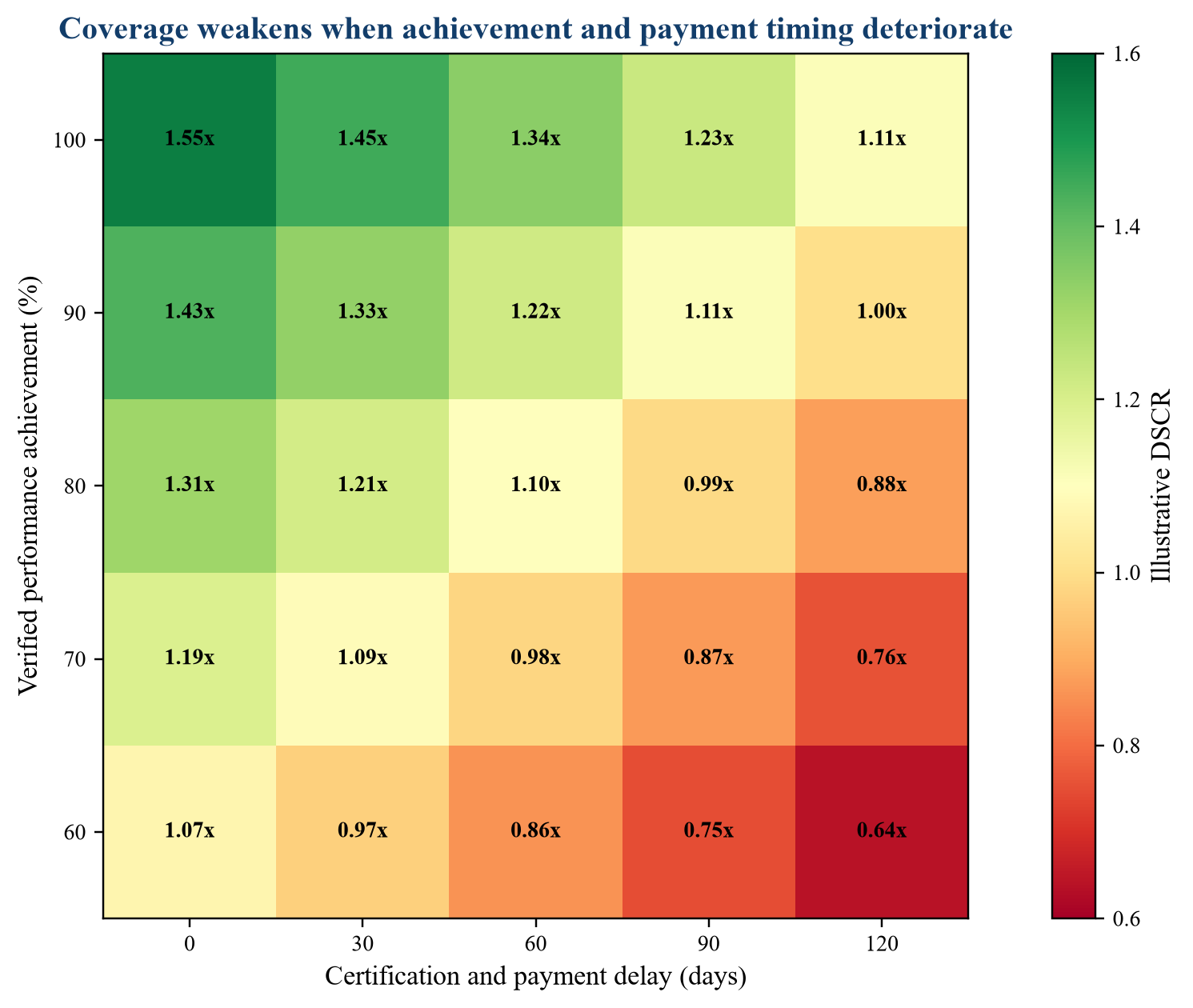
Illustrative values only; this is not a forecast, financing proposal or description of an actual programme.
45. Reserve design
Reserves can cover operating liquidity, performance-payment delay, debt service and maintenance. Each reserve needs a target, funding source, permitted use and replenishment rule.
Liquidity protects timing; it does not transform a structurally insufficient benefit into a viable contract.
46. Performance security
Bid security, performance bonds, retention, parent guarantees or liquidated damages can protect mobilisation and delivery. Security should be proportionate and callable under clear conditions.
Excessive security raises bid cost and can reduce competition. The authority should align security with the loss it is designed to cover.
47. Termination
Termination should distinguish contractor default, utility default, prolonged force majeure and public-interest termination. Compensation should address verified assets, debt, break costs and unpaid certified amounts according to the event.
Lenders may require notice, cure and step-in rights. Public-service continuity should remain central.
48. Procurement strategy
The procurement package should include baseline data, asset and customer information, draft measurement protocol, payment formula, utility obligations, contract term, security and evaluation method. Bidders should receive a common data room.
The World Bank standard framework uses a two-envelope process and permits prequalification choices [1]. The authority should follow applicable procurement law and project requirements.
49. Bid evaluation
Evaluation should consider methodology, team, mobilisation, data plan, technical solution, target credibility, fixed price, performance rate, financing certainty, departures and whole-life value.
The lowest unit rate may conceal weak targets, exclusions or future variation. Bids should be normalised to comparable scenarios.
50. Market engagement
Early engagement can test contractor appetite, local capacity, data sufficiency, payment structure, financing and risk allocation. Material information should be shared fairly during procurement.
Engagement should identify which obligations prevent bankable pricing and which risks the market can manage efficiently.
51. Contract term
The term should cover mobilisation, diagnostic work, installation, performance ramp-up and a sufficient maintenance period. It should remain aligned with capital recovery and utility strategy.
A term that ends immediately after target achievement can leave the utility with fragile gains and limited knowledge transfer.
52. Mobilisation
Mobilisation should establish governance, data access, field safety, customer communications, equipment standards, work-order processes and the detailed baseline plan. The parties should agree a responsibility calendar.
Early deliverables should be accepted through objective criteria before major performance exposure begins.
53. District-metered areas
District areas support local measurement, pressure management and intervention prioritisation. Their design should consider network topology, valves, boundary integrity, meter siting, data communication and operational use.
Creating districts is an enabling investment rather than proof of loss reduction. Payment for establishment should remain separate from verified savings.
54. Pressure management
Pressure should support service while reducing avoidable leakage and bursts. The target should include minimum customer pressure and critical-service requirements.
Automated controls need operating protocols, failure modes and cybersecurity. Low pressure should not become an artificial route to payment.
55. Leak detection and repair
Detection should prioritise areas using flow, pressure, acoustic, incident and asset evidence. Repair quality, response time and reinstatement should be monitored.
Repeated failures at the same asset can indicate a wider renewal need. The contract should define when local repair gives way to utility-funded replacement.
56. Meter renewal
Meter replacement should follow age, technology, flow profile, test evidence and economic value. Blanket replacement can destroy value where accounts, installation or data systems remain defective.
Old and new meter performance should be sampled so that billing gains are not confused with tariff or consumption changes.
57. Billing controls
Billing improvement can include account cleansing, route completion, exception handling, tariff application, estimate control and reconciliation. Changes need testing and approval.
The utility should track unbilled accounts, estimated bills, delayed bills, reversals, duplicate accounts and unresolved exceptions.
58. Collection operations
Collections can improve through accurate bills, convenient payment, segmentation, reminders, dispute resolution, structured arrears plans and lawful enforcement. Customer trust and service reliability influence willingness to pay.
The programme should measure sustainable behaviour, not a temporary end-period push that advances cash from future months.
59. Digital systems
Sensors, advanced meters, analytics and mobile tools can improve visibility and action. Their value depends on data quality, integration, user adoption, maintenance and decision rights.
Technology procurement should specify interoperability, ownership, export, cybersecurity, support and replacement. Proprietary lock-in can impair handback.
60. Capability transfer
Utility staff should participate in diagnosis, operations and review. Training should link to real processes, assets and data rather than generic classroom hours.
Handback should test whether the utility can operate districts, validate data, maintain equipment, run the water balance and continue customer controls.
61. Environmental and social controls
Field work can affect roads, households, businesses and public safety. The programme needs permitting, traffic, excavation, reinstatement, grievance and worker-safety processes.
Customer-data activity requires lawful collection, access and retention. Service actions should follow applicable protections.
62. Climate value
Reducing real losses can lower abstraction, treatment and pumping per billed unit and can improve resilience where water is scarce. The benefit depends on system conditions and should be quantified transparently.
Carbon or climate claims should identify the boundary, energy factor, baseline and methodology. They should remain separate from contract cash unless monetised through an enforceable mechanism.
63. Utility creditworthiness
World Bank creditworthiness materials connect governance, operational performance, financial management, investment planning and commercial-finance access [4][5]. NRW and collection performance are relevant parts of that wider assessment.
A performance contract can improve evidence and cash flow. It does not replace tariff authority, governance, accounting quality or a credible capital plan.
64. Lender diligence
Lenders should review the contract, baseline, measurement system, contractor capability, utility obligations, payer credit, payment security, financial model, accounts, insurance and termination. They should reproduce a sample performance certificate.
The diligence team should distinguish certified receivables from contingent future gains and verify assignability and step-in rights.
65. Contract-model consistency
Every material model assumption should map to a contract clause, evidence file or clearly identified hypothesis. Savings volume, unit payment, collection share, cap, holdback, cost, tax, reserve, delay and termination should use the executed definitions.
Independent model review should test logic, formulae, circularity, scenario controls and document consistency.
66. Scenario laboratory
The parties should calculate results and payments under meter failure, boundary change, supply interruption, pressure change, major burst, tariff change, customer growth, data outage, delayed approval, contested bills and payer delay. Each event should produce one defensible contractual outcome.
Combined scenarios reveal liquidity risk. Lower achievement and slower certification can weaken debt service more sharply than either event alone.
67. First 180 days
The first six months should complete screening, data-room assembly, water and commercial baselines, field validation, option analysis, market engagement, financial model, procurement plan, payment security and approval path.
By day 180, unresolved data and institutional gaps should be visible. The authority should stop or redesign a programme that cannot support auditable payment.
68. Investment-committee pack
The approval pack should include baseline confidence, target economics, procurement strategy, payment formula, risk matrix, sources and uses, downside coverage, security, affordability controls, customer safeguards, implementation plan and stop conditions.
Management estimates should remain identified. Committee approval should state maximum budget, contingent exposure and delegated authority.
69. Monthly operating dashboard
The dashboard should show input volume, billed consumption, real and apparent losses, continuity, pressure, active accounts, meter-read completeness, billed value, cash collected, arrears, complaints, interventions, certified result and payment status.
Definitions should reconcile to contract schedules and finance reports. Trend and confidence are as important as the latest point estimate.
70. Red flags
Red flags include an unverified baseline, moving boundaries, absent bulk meters, contractor dependence on utility actions without relief, payment tied only to NRW percentage, collections rewarded without bill validity, capex hidden in a service fee, unsecured public payment, short maintenance, weak data rights and debt sized to full target achievement.
Each red flag requires evidence, redesign, price, protection or a decision not to proceed.
71. Decision rule
Proceed when the utility can define and verify the result, the contractor can materially influence it, the payment source is lawful and credible, customer and service protections are embedded, the net benefit is positive under downside conditions and the improved system can be sustained.
Debt should be sized to conservative certified cash flow. Public and concessional support should address explicit barriers.
72. Preparation checklist
The preparation team should confirm programme authority, baseline data, asset and customer perimeter, water balance, commercial reconciliation, meter confidence, intervention options, customer safeguards, verifier scope, payment formula, utility obligations, budget source, procurement route, financing plan, security and handback.
Each item should have an owner, evidence, status and decision consequence. Open issues should remain visible through tender and close.
73. Financial-close checklist
Close should require executed programme and finance documents, approved baseline protocol, verifier appointment, permits, systems access, insurance, security, accounts, equity commitments, facility conditions, base-case model and initial work plan. Payment-security instruments should be issued and tested.
The closing memorandum should record waivers and residual risks. First drawdown should reconcile to approved uses and the mobilisation schedule.
74. Operating review
Quarterly review should compare actual and expected performance, costs, certification, payment, customer outcomes and capability transfer. The parties should investigate causes before changing targets.
Annual review can update the work plan within the contract. Material commercial change should follow the formal variation process.
75. Handback
Handback should include calibrated meters, functioning systems, asset records, source data, software rights, manuals, spares, trained staff, open-work register and a verified final water and commercial balance. Defects and missing data should affect holdback release.
The utility should prepare its post-contract budget and operating team before the contractor exits.
76. Build the baseline evidence ledger
The evidence ledger should identify every source used in the water and commercial baselines, its owner, coverage period, quality, reconciliation status and permitted adjustment. Bulk-meter records, customer reads, billing extracts, receipts, work orders, outage logs, pressure data and network maps should carry stable identifiers. Missing or estimated values should remain visible so that confidence is not lost inside an aggregate result.
The ledger should also record each bidder question and authorised clarification that affects measurement. At contract signature, the parties should freeze the accepted baseline package and its digital hash or equivalent control. Later corrections should follow the agreed change procedure and retain both original and revised records.
77. Price uncertainty explicitly
The contractor's bid contains uncertainty about hidden leaks, asset condition, customer records, access, permits and utility responsiveness. The authority should decide which uncertainties are priced by the contractor, shared through provisional sums or retained through utility obligations. Undefined uncertainty commonly returns as qualification, claim or weak competition.
The financial model should show contingency by risk rather than one unexplained percentage. Drawdown and release should follow evidence. If field validation reveals a materially different network, the contract should state whether scope, target, price or schedule changes and how the revised value-for-money test is performed.
78. Protect the counterfactual
Performance is the difference between observed results and an agreed counterfactual. The counterfactual represents what would reasonably have occurred without the contracted intervention after allowed external adjustments. It should remain simple enough to audit and robust enough to prevent payment for unrelated change.
The preparation team should test the formula against historical periods and known events. It should examine whether ordinary demand variation, tariff change, new connections, supply interruptions or utility projects would create false gains. Material uncertainty can be addressed through thresholds, control areas, matched comparisons or a shared-risk band rather than unsupported precision.
79. Integrate the capital plan
Leakage and collection programmes should connect to the utility's wider asset-management and investment plans. A contractor may identify mains that require renewal, reservoirs that need rehabilitation or systems that need replacement beyond the contracted scope. The utility needs a route to approve, fund and sequence those investments without distorting performance measurement.
The programme can provide better evidence for future capital allocation by revealing burst frequency, night flow, meter failure, account quality and service constraints. The utility should define how this evidence enters its planning process. Performance payments should not consume the entire benefit when essential renewal and capability expenditure remain unfunded.
80. Reconcile service and revenue
An improvement programme should report whether customers received better continuity, pressure, water quality, billing accuracy, responsiveness and payment access. Financial improvement that coincides with declining service can damage legitimacy and collection over time. Service measures should therefore operate as payment gates, deductions or parallel approval criteria where they are material.
The utility should analyse distributional effects. New billing from corrected meters can be valid while creating affordability pressure for particular groups. Approved communication, dispute resolution and targeted support can protect both customers and cash conversion. The contract should distinguish lawful social-policy decisions from contractor underperformance.
81. Test accounting treatment
The parties should determine how equipment, installation, service payments, contingent fees, grants, receivables and termination amounts are treated under applicable accounting and tax rules. Accounting classification can affect reported earnings, assets, debt, covenants and budget approval. It should be assessed before bid evaluation and financial close.
The payment certificate should separate taxable and non-taxable components where required and identify the asset owner. The model should include tax timing rather than only headline rates. Any assumed grant or concessional treatment should be supported by the programme documents and relevant approval; absence of approval should remain a downside case.
82. Prepare for refinancing and expansion
Successful performance may improve utility creditworthiness and create a case for wider network investment. The original contract should address whether certified operating evidence can support refinancing, how security is released, and whether refinancing gains are shared. Expansion should be procured and approved through a transparent mechanism rather than presumed inside the initial award.
Lenders should understand whether later capital ranks ahead of, alongside or behind their facility. The utility should preserve access to data and assets for future programmes. A proprietary system or exclusive right that prevents competitive expansion can reduce long-term value even when the first contract meets its target.
83. Preserve governance after success
Early gains can weaken when management attention shifts, skilled staff leave, meters fail or preventive maintenance is deferred. The governing body should assign post-contract accountability, budget, performance targets and reporting. The water balance and commercial reconciliation should continue at the same or improved frequency after handback.
Internal audit can review data controls, work orders, customer adjustments and result persistence. Management incentives should align with service, efficiency and cash quality. The utility should maintain a register of deterioration triggers and predetermined responses. Sustained governance converts a completed contract into an enduring operating system rather than a temporary improvement campaign.
84. Design an early-warning framework
The programme should identify warning indicators before a contractual target is missed. Examples include rising minimum-night flow, repeated bursts, pressure instability, meter-data gaps, unclosed work orders, delayed billing, increasing estimates, dispute growth, failed payment transactions and slower certification. Each indicator should have a threshold, owner, review frequency and required response. Warning thresholds support intervention; they should not automatically replace the contractual performance test.
The finance dashboard should connect operating warnings to liquidity and covenant exposure. A widening data gap can delay certification even when field performance remains strong. A surge in disputes can reduce eligible collection. Management should see the expected timing of impact, available reserve and cure action. Lenders should receive material-event notices according to the finance documents.
85. Govern changes to algorithms and analytics
Analytical tools can prioritise leaks, predict failures, identify meter anomalies and segment collections. A model that influences payment or customer action requires documented inputs, version control, validation, access and review. Material changes should pass the approved change process and preserve reproducibility of earlier certifications.
Automated recommendations should remain subject to operational and legal controls. The programme should monitor false positives, geographic or customer bias, data drift and override patterns. The contractor should provide usable exports and sufficient documentation for handback. The utility should retain the ability to verify the result without depending on an unavailable proprietary model.
86. Establish a benefits-reinvestment policy
Verified net benefits can support debt service, performance payment, maintenance, targeted affordability measures and future network investment. The governing body should approve the order of use and report it transparently. Reinvestment can demonstrate that efficiency gains improve service and resilience, supporting public acceptance of commercial discipline.
The policy should distinguish recurring and one-off gains. Arrears collection may create a temporary cash uplift; durable billing accuracy and real-loss reduction can support longer-term planning. Commitments should therefore follow the persistence and confidence of each benefit. Distribution or budget reallocation should occur only after programme obligations, reserves and essential maintenance are funded.
87. Conclusion
Paying for water saved can convert operational improvement into accountable finance when the result is defined, measured and preserved. The strongest structure separates physical water, valid billing and cash collection; assigns controllable risk; protects customers; and uses independent verification to connect evidence to payment.
Finance follows credible funding. Conservative debt sizing, payment security, reserves and transparent support can mobilise capital, while the contract's central discipline remains durable utility performance. The programme succeeds when verified gains continue after handback and strengthen service, cash flow and investment capacity.
References
- World Bank. Water Loss Reduction Performance Based Contract Guidance Note. 2025. https://documents1.worldbank.org/curated/en/099157411052511694/pdf/IDU-ddae29b5-2722-4a36-9992-5ac7789d6bb1.pdf
- World Bank and Public-Private Infrastructure Advisory Facility. The Use of Performance-Based Contracts for Nonrevenue Water Reduction: Operational Manual. https://documents1.worldbank.org/curated/en/314541537521949076/pdf/130050-20-9-2018-12-7-9-WPBCforNRWOperationalManualWEBPDF.pdf
- World Bank PPP Resource Center. Contracting Tools for Non-Revenue Water Reduction. https://ppp.worldbank.org/water-and-sanitation/contracting-tools-non-revenue-water-reduction
- World Bank Global Water Security and Sanitation Partnership. Financing the Water Sector. https://www.worldbank.org/en/programs/global-water-security-sanitation-partnership/publications/gwsp-financing-the-water-sector
- World Bank. Water Utility Creditworthiness Course Prospectus. https://connect4impact.worldbank.org/system/files/2024-08/Water%20Utility%20Creditworthiness%20Course%20Prospectus.pdf
- World Bank PPP Resource Center. Performance-Based Contracting Tools for Non-Revenue Water Reduction: Tools and Resources. https://ppp.worldbank.org/water-and-sanitation/performance-based-contracting-tools-non-revenue-water-reduction-tools-resources
- World Bank PPP Resource Center. Case Study on the Performance-Based Contract in Ho Chi Minh City. https://ppp.worldbank.org/library/case-study-performance-based-contract-ho-chi-minh-city
- International Finance Corporation. Creating Markets for Climate Business: An IFC Climate Investment Opportunities Report. https://www.ifc.org/content/dam/ifc/doc/mgrt/ifc-climate-investment-opportunity-creating-markets.pdf
- International Water Association. Performance-Based Contracts for Non-Revenue Water Management. https://www.iwa-network.org/our-work/performance-based-contracts-for-non-revenue-water-market-development
- World Bank PPP Resource Center. Using Performance-Based Contracts to Reduce Non-Revenue Water. https://ppp.worldbank.org/library/using-performance-based-contracts-reduce-non-revenue-water
- World Bank. Water Utility Turnaround Framework: A Guide for Improving Performance. https://documents1.worldbank.org/curated/en/515931542315166330/pdf/Water-Utility-Turnaround-Framework-A-Guide-for-Improving-Performance.pdf
- World Bank. Performance Improvement Planning: Developing Effective Billing and Collection Practices. https://documents1.worldbank.org/curated/en/713571468138288578/pdf/441190WSP0IN0P1ive0billing01PUBLIC1.pdf
- World Bank. Water utility creditworthiness: Reduce leaks, secure future. 2026. https://blogs.worldbank.org/en/water/water-utility-creditworthiness--reduce-leaks--secure-future
- World Bank PPP Resource Center. Performance-Based Contracting for Non-Revenue Water Reduction Training. https://ppp.worldbank.org/water-and-sanitation/performance-based-contracting-non-revenue-water-reduction-training
- World Bank. Reducing Non-Revenue Water in Developing Countries: How the Private Sector Can Help. https://documents1.worldbank.org/curated/en/385761468330326484/pdf/394050Reducing1e0water0WSS81PUBLIC1.pdf
- World Bank Group. 2030 Water Resources Group Annual Report FY25. https://documents1.worldbank.org/curated/en/099825301292615028/pdf/IDU-779f0726-3571-40af-b5f2-0ea1a4e63be0.pdf
About the Author
Chennakeshav (CK) is a corporate finance and investment banking executive with 25+ years of global experience in deal origination, structuring and execution across M&A, growth capital and corporate strategy. He has led value-creation mandates for founders, corporates and funds — bridging the boardroom view to hands-on execution and close.
His career spans Morgan Stanley, HSBC, Lloyds Banking Group, EWEC, ADQ portfolio companies and Emirates Growth Fund, across TMT, real estate, fintech, deeptech, cleantech, infrastructure and energy. He has partnered with C-suite leaders, private equity and venture funds, sovereign wealth funds and family offices to finance complex fund raises and scale-up ventures, and has led M&A due diligence, post-merger integration and business-transformation initiatives to create value.
At Matchpoint Partners he is Managing Partner, leading the firm's corporate finance, M&A and capital-raising practice. He holds an MBA from London Business School, an engineering degree from VTU and a Master of Laws (LLM, in progress) from UCL London.
An active start-up mentor, CK mentors at Techstars, DIFC FinTech Hive, Startup Grind, Founder Institute and IN5, serves as Entrepreneur Mentor in Residence (EMiR) at London Business School, and judges the Entrepreneurship World Cup.
LinkedIn: https://www.linkedin.com/in/ckadya/
Profile: https://www.matchpoint-partners.com/team/ck-adya.html
