
Introduction
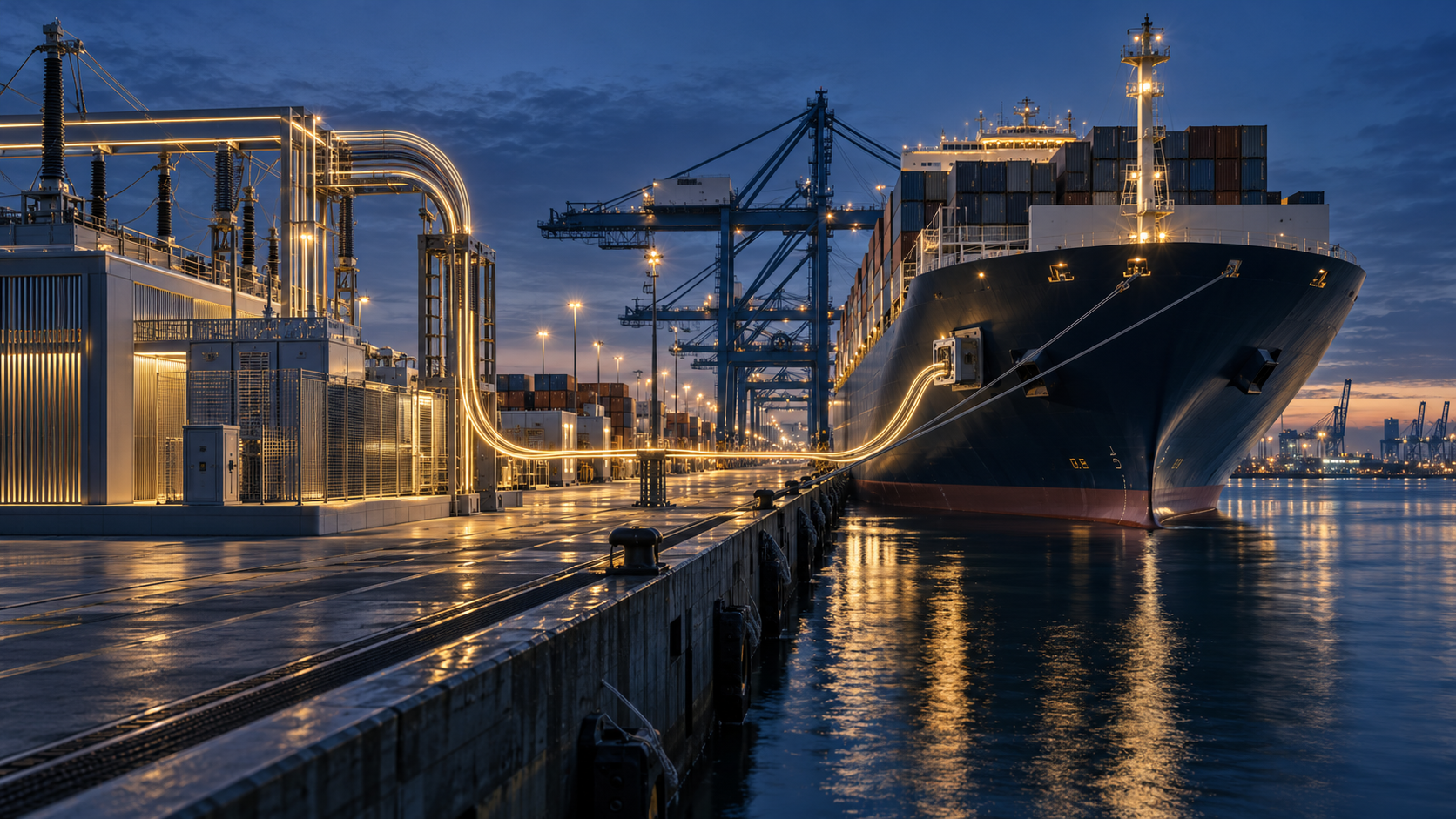
Shore-side electricity, also called shore power, onshore power supply or cold ironing, allows a vessel to switch off auxiliary engines while berthed and draw electricity from land. The operating concept is established. The financing challenge remains difficult because the complete service spans a public or regulated electricity network, port infrastructure, terminal equipment and shipboard systems. Each layer can be technically complete while the combined service remains unavailable.
Regulation is moving the issue from voluntary environmental investment towards required infrastructure and operating capability. The European Union's Alternative Fuels Infrastructure Regulation requires qualifying TEN-T maritime ports to provide shore-side electricity for at least 90% of relevant container and passenger vessel calls by the end of 2029. FuelEU Maritime requires covered container and passenger ships to use onshore power or another zero-emission technology at specified berths from 2030, with broader application at equipped European ports from 2035.[1][2]
These dates create a coordinated capital programme. Ports may need substations, underground cables, frequency conversion, connection equipment and civil works. Network operators may need upstream reinforcement. Terminals may lose operational space during construction. Shipowners may need switchboards, transformers, cable interfaces, control systems and class approval. The programme can fail commercially when one party funds early and the others arrive late.
This paper develops a decision and financing framework for that programme. It focuses on the allocation of capital, completion, demand, tariff, operating and residual-value risks. It separates primary evidence from hypothetical modelling and provides an investment-committee process for a port, terminal, utility, shipowner, lender or public sponsor.
1. Define the service being financed
The financing unit should be the delivery of dependable electrical energy to an eligible vessel during a defined port call. This service boundary includes the grid connection, port distribution system, berth interface, cable management, vessel interface, control and metering. It also includes operating procedures, trained personnel, scheduling, emergency response and settlement.
A project defined only as a substation can omit vessel demand. A vessel retrofit defined only as installed equipment can omit compatible berths. A complete service definition identifies the vessel classes, berths, voltage, frequency, power range, connection standard, expected call pattern, minimum availability and party responsible at every interface.
The investment case should distinguish connection capability from actual use. A berth can be technically equipped and remain underutilised because vessels arrive without compatible systems, grid capacity is constrained, electricity is expensive or operating procedures are incomplete. Debt and public-benefit assessment should therefore track connected calls, energy delivered, availability and emissions avoided.
2. Map the regulatory timetable
Regulatory exposure depends on geography, port traffic, vessel type, gross tonnage, voyage pattern and exemptions. The project team should create a legal applicability matrix for every target berth and vessel rather than rely on a general compliance date.
AFIR establishes port infrastructure requirements for relevant TEN-T maritime ports, subject to traffic thresholds and specified call coverage.[1] FuelEU Maritime creates operating requirements for passenger and container vessels and includes exceptions for safety, emergency, technical incompatibility and other defined circumstances.[2] National implementation, grid connection, environmental permission, building approval and port rules can add separate milestones.
The timetable should identify the last date for a viable grid application, detailed design, procurement, civil works, energisation, testing and commercial service. Grid reinforcement can have a longer lead time than berth equipment. A regulatory deadline does not shorten transformer, cable, switchgear, permitting or network-development schedules.
3. Establish the demand base
Demand begins with port-call data. For each berth, record vessel identity, class, length of stay, auxiliary load, seasonality, liner schedule, ownership, charter structure and current shore-power capability. Separate vessels already equipped, ordered with capability, contractually committed to retrofit and technically addressable.
The demand forecast should convert calls into megawatt-hours using vessel-specific or class-based load profiles and realistic connection time. It should deduct time for arrival, mooring, safety checks, connection, disconnection and departure. It should also reflect calls during maintenance or grid curtailment.
Evidence should be graded. Historical calls provide stronger evidence than market forecasts. Executed use agreements provide stronger evidence than letters of interest. A forecast based on regulatory obligation still needs to consider permitted exceptions, diverted calls, terminal changes and fleet renewal. Lenders can size against the dependable portion while sponsors retain exposure to upside.
4. Assess the grid connection
Shore power can create large, concentrated and sometimes simultaneous electrical loads. A port with several container, cruise or ferry berths may require capacity beyond the local network's existing headroom. The assessment should include peak demand, diversity, power quality, fault level, resilience, voltage, frequency and future electrification of cargo-handling equipment, trucks and other port users.
The utility study should identify the connection point, firm and interruptible capacity, reinforcement assets, delivery date, security standard, curtailment rules and cost allocation. It should clarify whether the port owns dedicated assets or pays regulated connection charges. The study must also address who bears the cost if the wider network plan changes.
Grid congestion is a current constraint in major ports. Rotterdam's updated shore-power strategy states that congestion complicates implementation even as the port plans more than 100 installations and over 43 megawatts of capacity across 2025 to 2035.[3] This reinforces the need to treat upstream capacity as a critical path.
5. Segment the physical assets
The asset register should divide the programme into network reinforcement, grid connection, port distribution, substation, frequency conversion, berth cabling, cable-management equipment, control, metering and vessel conversion. Each asset needs an owner, operator, maintenance regime, useful life and handover test.
Segmentation supports financing and risk allocation. A regulated utility may finance general network reinforcement. A port authority may finance common ducts and distribution. A terminal may own berth equipment. A service company may own mobile cable-management equipment. A shipowner finances vessel conversion.
Shared assets create utilisation benefits and interface obligations. Dedicated assets can simplify accountability while reducing diversity across users. The design should place assets with the party best able to operate them and support the associated credit, completion and technology risk.
6. Set interoperability requirements
Interoperability determines whether an equipped vessel can use an equipped berth. The IEC/IEEE 80005 series establishes requirements for high-voltage and low-voltage shore connection systems, including general requirements, data communication and ship-specific applications.[4] Project documents should identify the applicable edition, voltage, frequency, plug, cable, communication and safety functions.
The technical schedule should cover connection sequence, earthing, synchronisation, load transfer, emergency shutdown, monitoring, galvanic protection, harmonic performance and disconnection. Vessel class, flag, port and terminal approvals should be mapped to the same specification.
Technology procurement should avoid proprietary choices that restrict future vessel access without a documented benefit. Where multiple vessel types use one berth, adapters or modular equipment may be justified. Compatibility should be demonstrated during factory, site and vessel integration tests.
7. Define the vessel-conversion scope
A vessel retrofit can include connection cabinets, shore switchboard, transformer, protection, automation, cabling, ventilation, structural work and changes to power-management systems. The scope depends on vessel voltage and frequency, existing electrical architecture, available space, class rules and intended ports.
The owner should complete a feasibility study before committing to a fleet programme. The study should address stability, fire safety, cable route, short-circuit capacity, redundancy, load transfer, hotel and reefer loads, installation window and class approval. Dry-dock availability and lost operating days can be material.
The conversion contract should define guaranteed capability, supported ports, documentation, training, spares and warranty. A nominally shore-power-ready vessel may still require material equipment or software. Diligence should record installed capability rather than marketing terminology.
8. Coordinate completion
The project contains several completion dates: utility capacity, port distribution, berth equipment, terminal operating readiness and vessel conversion. Revenue or compliance value begins only when the required set is available together.
An integrated programme should maintain a single critical-path schedule with interface milestones. The parties should exchange design data, notice changes and participate in joint tests. The contractual structure should provide relief for documented delay caused by another layer while preserving incentives to complete.
Financing can use staged drawdown and separate completion tests. Long-lead equipment may be funded after design freeze and permits. Construction debt can convert to term debt after grid energisation, berth testing and evidence of compatible vessel calls. Vessel financing can release retrofit funds against port-readiness milestones.
9. Allocate construction risk
Construction risk includes unknown ground conditions, live-terminal working, cable routes, utility outages, marine interfaces, equipment lead times and vessel dry-dock constraints. A single turnkey contract may cover berth infrastructure while utility and ship works remain separate.
The employer should maintain an interface matrix rather than assume a contractor has accepted risks outside its control. Delay liquidated damages are useful only when the liable party controls the cause and has sufficient balance sheet or security. Caps, exclusions and force-majeure provisions determine actual recovery.
Contingency should be based on design maturity and site evidence. The financing plan should include sponsor equity, undrawn debt or reserve for cost overrun. Public grants should state whether overruns are eligible and whether delayed milestones can lead to clawback.
10. Build the contract architecture
The contract architecture links the utility connection agreement, port concession, terminal lease, engineering and construction contracts, equipment supply, operation and maintenance, shore-power use agreement, electricity supply, vessel-conversion contract and finance documents.
Direct agreements can give lenders notice and cure rights under material contracts. Access rights should survive operator replacement and lender enforcement. The project should also document who can schedule connection, interrupt supply, conduct maintenance and suspend service for safety.
The central commercial agreement should define availability, booking, minimum use, tariff, metering, electricity quality, delay, curtailment, liability, data and change in law. Where several users share capacity, priority rules must be transparent.
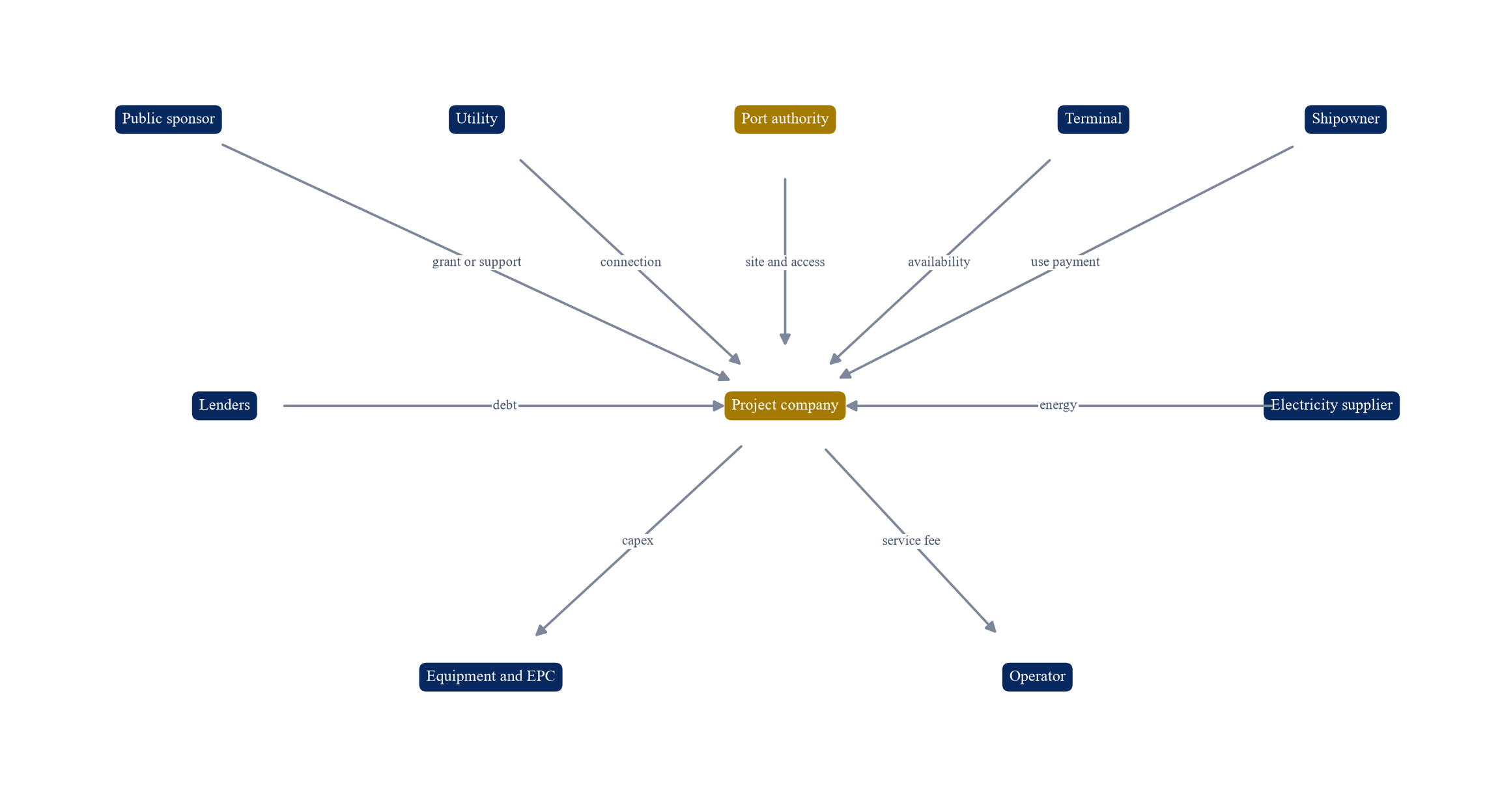
Proposed structure; ownership, regulation and contracts depend on the port, utility and jurisdiction.
11. Choose the revenue model
Several revenue models are possible. A port or terminal can recover costs through a connection fee, energy markup, capacity charge, berth tariff, environmental fee or bundled port service. A project company can receive an availability payment from the port and a variable use payment from vessels.
An energy-only tariff exposes fixed capital to uncertain volume. A pure availability payment protects debt service while shifting demand risk to the port or public sponsor. A two-part tariff can align the structure: a fixed reservation or availability component supports fixed costs and a variable component reflects electricity and use.
Tariff design should avoid discouraging connection. Shipowners compare the total shore-power cost with onboard fuel, maintenance, carbon and compliance costs. The project should show each component, indexation and taxes. Any subsidy should have a stated duration and transition path.
12. Align payment with benefit
Benefits accrue to several parties. The port and surrounding community receive local air-quality and noise benefits. The vessel may save fuel or meet regulation. The terminal may improve concession performance. The electricity network gains demand but may incur reinforcement cost. Cargo owners may obtain lower supply-chain emissions.
The funding model should allocate payment according to legally supportable benefits and control. Public funding can support shared infrastructure and non-monetised public benefits. Ports can fund common assets. Terminals can support berth-specific equipment. Shipowners can fund onboard conversion. Users can pay for electricity and service.
Cross-subsidy should be explicit. An unclear allocation can create disputes or discriminatory access. State-aid, procurement, concession and tariff rules require jurisdiction-specific advice.
13. Use public capital precisely
Public capital can address an enabling-infrastructure gap, early utilisation risk or environmental externality. It should have a defined purpose, eligible cost base, milestone and monitoring plan. It should not conceal an uneconomic operating structure.
The European Commission's Alternative Fuels Infrastructure Facility supports electricity and alternative-fuel infrastructure. In November 2025 the Commission announced more than €600 million for 70 projects, including shore-power installations at 24 ports.[5] The Port of Rotterdam's programme combines an approximately €90 million European Investment Bank loan with around €70 million of Connecting Europe Facility support within an investment programme reported at about €284 million.[6][7]
These examples demonstrate blended capital at programme scale. A project-specific financing still requires analysis of grant conditions, disbursement timing, eligible expenditure, completion obligations, procurement and clawback.
14. Size the capital programme
The capital budget should include network studies, utility connection, substation, transformers, frequency conversion, switchgear, cabling, trenching, berth works, cable management, control, metering, testing, owner costs, development, insurance, interest during construction and contingency.
Vessel budgets should include feasibility, design, class, equipment, installation, dry-dock, off-hire, testing, training and spares. Common development costs should be allocated consistently when several berths or vessels share engineering.
The estimate should state price date, currency, tax, escalation, procurement status and accuracy range. It should also identify replacement capital for power electronics, cables and moving equipment whose useful life may be shorter than civil works.
Table 1. Hypothetical sources and uses for an integrated port programme
| Uses | Amount | Funding source | Amount |
|---|---|---|---|
| Utility connection and reinforcement | 34 | Public enabling grant | 28 |
| Port distribution and substation | 31 | Port sponsor equity | 32 |
| Three berth systems and civil works | 42 | Terminal contribution | 14 |
| Six vessel conversions | 21 | Vessel-owner equity or asset finance | 21 |
| Development, testing and owner costs | 8 | Senior project debt | 45 |
| Contingency and financing costs | 12 | Contingency facility | 8 |
| Total hypothetical uses | 148 | Total hypothetical sources | 148 |
Illustrative values only; no identified port, vessel, borrower or transaction is represented.
15. Create the base financial model
The model should consolidate capital timing, grant receipts, debt drawdown, electricity purchases, connection charges, operating costs, maintenance, insurance, administration, fixed payments, energy delivered and use tariffs. It should also show each stakeholder's economics separately.
Volume is driven by connected calls, average load and connected hours. Revenue may include fixed and variable components. Energy cost should reflect wholesale or retail price, network charges, capacity, losses and taxes. Maintenance should follow equipment life and service contracts.
The model should avoid counting the same benefit twice. Fuel savings belong to the shipowner unless the tariff captures them. Carbon or compliance value should be included only where the party can lawfully monetise it and the value is supported by an applicable mechanism.
16. Model electricity and fuel spreads
Connection decisions respond to the total cost of shore electricity relative to onboard generation. The comparison should include fuel price, auxiliary-engine efficiency, maintenance, lubricants, emissions cost, carbon exposure and any mandatory-use requirement.
Electricity price can include energy, network, demand and capacity charges. A high peak charge can materially affect a low-utilisation berth. Storage, managed connection or coordinated scheduling may reduce peaks, subject to technical and economic analysis.
The tariff should define pass-through, indexation and hedging. A fixed user tariff combined with variable electricity cost creates margin risk. A full pass-through reduces that risk while leaving the vessel exposed. Caps, collars or indexed capacity payments can distribute volatility.
17. Model utilisation ramp-up
Utilisation should be built vessel by vessel and berth by berth. The model should reflect delivery and conversion dates, route changes, maintenance, seasonal calls, exemptions and operational learning. It should not assume that every technically compatible call connects from the first day.
Base debt sizing can use contracted or highly dependable volume. An upside case can include additional vessels and voluntary users. A downside case should delay conversions, reduce calls and shorten connected time.
Liquidity is especially important during ramp-up. An interest reserve, debt-service reserve, sponsor support or availability payment can bridge a documented commissioning and adoption period. Permanent support for structurally weak demand requires a separate policy decision.
18. Size debt against dependable cash flow
Debt capacity depends on the stability and enforceability of cash flow. An availability payment from a creditworthy port or terminal can support greater leverage than an uncontracted per-kilowatt-hour margin. A minimum-use commitment can support debt when the shipowner credit and remedy are acceptable.
Lenders should test debt-service coverage, loan life, reserve adequacy and refinancing exposure. They should also examine termination compensation under the concession, utility connection and use agreements. Asset value may be limited if equipment is specialised or inseparable from the berth.
The tenor should reflect the shortest reliable contract and concession period, allowing enforcement and tail. Amortisation can follow contracted cash flow and expected replacement capital rather than accounting depreciation alone.
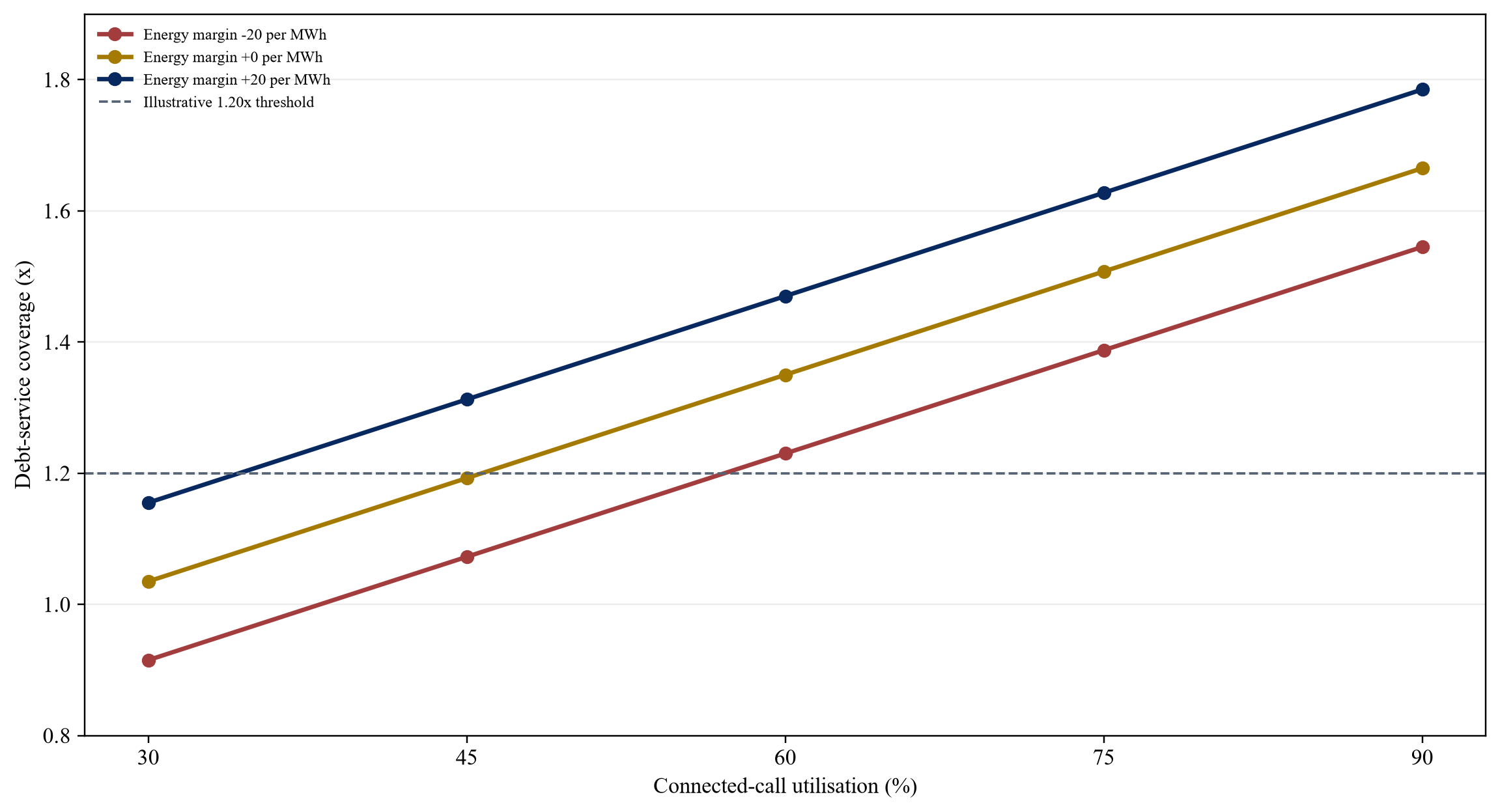
Illustrative scenario analysis only; values are not forecasts or transaction evidence.
19. Stress correlated downside
Risks can occur together. A delayed grid connection can postpone berth testing and vessel use. Lower utilisation can increase unit network cost. Electricity price increases can reduce voluntary connection and weaken variable revenue. A contractor delay can consume contingency while interest accrues.
The combined stress should apply delay, cost overrun, lower calls, shorter connection time, higher electricity cost and weaker availability. It should show minimum cash, coverage, covenant breach and required sponsor support.
Recovery cases should be operationally credible. Higher tariffs may further reduce demand. Deferred maintenance can reduce availability. The model should identify actions within management control, such as staged berths, renegotiated capacity, reserve draw or delayed expansion.
20. Address grid curtailment
Connection agreements may offer firm, interruptible or managed capacity. A managed connection can accelerate delivery or reduce cost while creating availability risk. The project should quantify expected curtailment and define scheduling or load-management procedures.
The tariff and use agreement should state whether users pay during grid unavailability and who bears fuel, delay or compliance costs. Availability calculations should distinguish project equipment failure from upstream network interruption.
Battery storage or local generation can provide peak management or resilience where technically and economically justified. Their cost, emissions, degradation, permitting and control should be included. Storage should solve a measured constraint rather than serve as a generic addition.
21. Allocate volume risk
Volume risk can sit with the project company, port, terminal, shipowner or public sponsor. Allocation should follow control and credit. The port influences concessions and common infrastructure. The terminal controls berth operations. The shipowner controls fleet conversion and route deployment, subject to charters.
Minimum-use agreements can require a specified number of calls, connected hours or energy volume. Take-or-pay can support fixed costs but must address service unavailability, route disruption and regulation. Portfolio agreements across several vessels can reduce single-asset concentration.
Where mandatory use creates dependable demand, the model should still test legal exceptions and enforcement. Regulation can strengthen the case while leaving operational and counterparty risk.
22. Allocate tariff risk
Tariff risk includes regulatory approval, user acceptance, electricity pass-through, network charge changes and competitive port response. The financing case should identify which components are controlled, regulated or indexed.
A transparent tariff can combine a reservation charge, connection charge and energy charge. A ramp-up discount may support adoption if its funding is identified. Charges should avoid incentives to reserve capacity without use or to disconnect early.
Change-in-law provisions should distinguish general business cost from project-specific requirements. The contract can provide reopeners for material grid, tax or environmental changes while limiting frequent renegotiation.
23. Allocate performance risk
Performance requirements should cover available capacity, voltage, frequency, connection time, metering accuracy, communication, safety functions and planned maintenance. Vessel obligations should cover compatibility, crew readiness, booking data and safe operation.
Service credits can compensate users for project-controlled unavailability. They should align with likely loss and remain within financeable limits. Repeated failure can trigger cure, replacement or termination.
Equipment warranties and operation contracts should support the service promise. A project company should avoid promising higher performance than its contractors and utility provide without retaining sufficient contingency.
24. Allocate residual-value risk
Civil works and ducts may serve several future technologies. Power electronics, connectors and vessel equipment can become obsolete or incompatible. Residual-value assessment should separate reusable infrastructure from specialised components.
The base case should assume no speculative resale value for site-specific equipment unless supported by evidence. Replacement cycles should reflect manufacturer guidance, operating environment and maintenance. Salt, movement and frequent connection can affect equipment condition.
Interoperability, modularity and adaptable capacity can preserve option value. The project should record the cost of future expansion and the limit beyond which replacement is required.
Table 2. Proposed risk-allocation matrix
| Risk | Natural owner | Contract mechanism | Lender evidence |
|---|---|---|---|
| Grid reinforcement delay | utility or sponsoring port, subject to control | dated connection agreement, milestones and relief | executed agreement and credible network plan |
| Berth construction overrun | berth asset owner and EPC contractor | fixed scope, contingency, security and delay remedy | design maturity and funded overrun support |
| Vessel-conversion delay | shipowner and retrofit contractor | fleet schedule, warranty and minimum-use start conditions | class-approved design and dry-dock slot |
| Interoperability | owners at each interface | common standard, data schedule and integration testing | approved interface matrix and tests |
| Volume ramp-up | port, terminal and committed users | availability payment, reservation or minimum use | call history and executed commitments |
| Electricity-price spread | user or project under tariff design | indexed pass-through, cap, collar or hedge | transparent tariff and stress test |
| Service availability | project operator | performance standard, service credit and reserve | O&M contract, spares and response plan |
| Regulation and change in law | allocated by jurisdiction and control | compliance covenant, reopener and termination rules | legal applicability and permit register |
| Residual value | asset owner and capital provider | conservative terminal value and replacement reserve | component life and reuse assessment |
Allocation requires project-specific legal, regulatory, technical and credit review.
25. Structure vessel finance
Vessel conversion can be funded from owner equity, corporate debt, lease finance, sustainability-linked facilities or public support where eligible. The financing should match the retrofit's value, remaining vessel life and charter allocation.
Security may be part of existing vessel mortgages. New finance requires consent, ranking and insurance review. A retrofit lender should verify that the equipment is integral to the vessel and that its value depends on route access and regulation.
Charter terms determine who pays capital, electricity and fuel and who receives compliance value. Owners and charterers need aligned reimbursement, use obligation and data. A split incentive can leave installed equipment unused.
26. Structure port finance
Port assets can sit on the port authority's balance sheet, within a terminal concession, in a project company or under an energy-as-a-service arrangement. The choice affects procurement, tariff, control, security and access.
Programme finance can pool several berths and technologies, diversify demand and reduce transaction cost. Project finance can isolate cash flows where contracts and concession rights are sufficiently defined. Corporate finance may be simpler where the port has strong credit and integrated operations.
The EIB's Rotterdam transaction illustrates long-term financing for a multi-terminal programme, accompanied by CEF grant support and project-level environmental assessment.[6][7] It does not establish economics for another port; it provides evidence that large integrated programmes can combine institutional debt and public capital.
27. Protect access and concession rights
Infrastructure finance requires durable land, quay, cable-route and operational rights. The project should verify concession term, extension, exclusivity, nondiscriminatory access, tariff authority and termination compensation.
Lenders need step-in and cure rights where permitted. Equipment ownership and removal rights should be clear. A concession shorter than debt tenor or asset life creates refinancing and residual-value risk.
Access rules should support multiple eligible users and prevent capacity hoarding. Booking, cancellation and priority should be published or contractually clear, subject to safety and terminal operations.
28. Manage operating interfaces
Daily operation links vessel arrival, berth assignment, utility capacity, connection staff, terminal sequence and departure. The operating protocol should state information deadlines, weather limits, pre-arrival checks, connection authority, load transfer and emergency action.
The Port of Seattle and other early adopters emphasise coordinated vessel and terminal procedures as part of shore-power operation.[8] The US Environmental Protection Agency's assessment also identifies early utility coordination, compatible equipment, ship pre-approval and reliable operation as important project factors.[9]
The model should include labour, training, testing, inspection and spare parts. A low allowance can overstate cash flow and reduce availability.
29. Establish metering and data controls
The project needs settlement-grade metering for energy, demand and connection time. Data should reconcile utility supply, berth output and vessel receipt. Losses and auxiliary consumption require stated treatment.
Controls should cover calibration, time synchronisation, access, change logs, cybersecurity, retention and dispute. Operational data also support availability, emissions and regulatory reporting.
The data agreement should limit use and disclosure while permitting lender, grantor and regulator verification. Environmental claims should use documented electricity factors and applicable methodology.
30. Quantify environmental value
Shore power can reduce berth emissions from auxiliary engines. The result depends on vessel load, connection time, engine fuel and emission factors, electricity generation and upstream boundary. Local pollutant benefits and greenhouse-gas benefits are different measures.
The EPA assessment provides a method and scenarios for comparing shore and onboard power at US ports.[9] Project analysis should use current local grid data and vessel evidence. It should state assumptions and avoid presenting gross engine emissions as net lifecycle savings.
Environmental value can support public funding, concession objectives or customer reporting. It should enter financial cash flow only when a contract, credit or regulation provides an enforceable value.
31. Plan procurement
Procurement strategy should reflect interface and market capacity. Long-lead transformers, switchgear, frequency converters and cable systems may require early orders. Early procurement before design maturity can create change and storage risk.
Framework agreements can support several berths while preserving competition and standardisation. Separate utility, civil and electrical packages can suit specialist markets but increase interface management. A lead integrator can reduce coordination risk if responsibility and security are sufficient.
The procurement plan should include cybersecurity, software support, spare parts, obsolescence and local service. Lowest initial cost may produce higher downtime or replacement exposure.
32. Use staged investment gates
Stage one establishes regulation, demand, grid options and technical standard. Stage two secures connection studies, vessel feasibility, concept design and commercial terms. Stage three completes permits, final design, binding commitments and finance. Stage four builds and converts. Stage five commissions and ramps up. Stage six expands after verified use.
Each gate should specify evidence, decision authority, capital at risk and stop conditions. Land reservation and utility studies can preserve options before major commitment. Berths and vessels can be sequenced around anchor users.
Staging should retain system integrity. A low-cost berth installation without upstream capacity or compatible vessels creates limited value. The gate should assess the complete service.
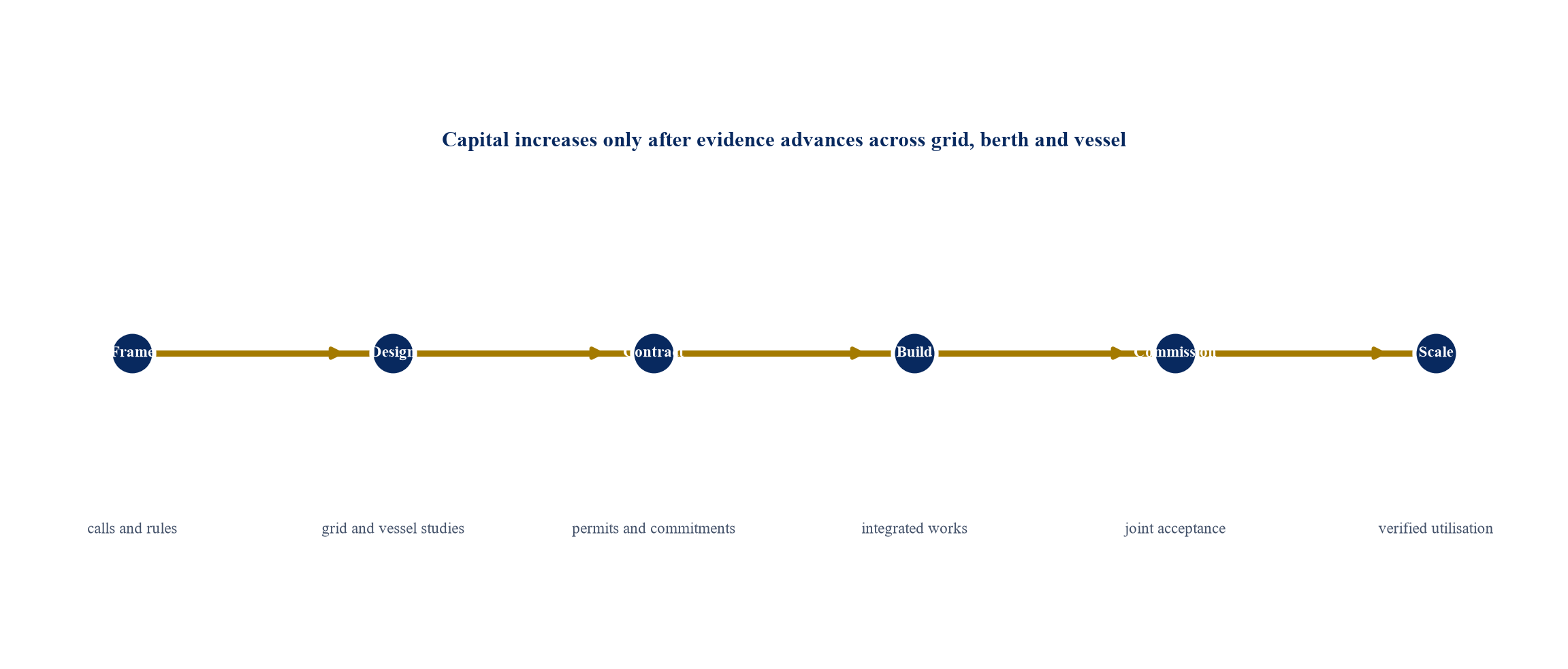
Proposed governance framework; timing and evidence require project-specific adaptation.
33. Set completion tests
Grid completion should confirm available capacity, protection, power quality and communication. Port completion should confirm distribution, berth equipment, cable management, metering, procedures and trained staff. Vessel completion should confirm class approval, onboard equipment, protection, control and crew competence.
Integrated acceptance should connect representative vessels under defined load conditions. Tests should cover normal operation, transfer, shutdown, communication loss, emergency stop, restart and metering. Defects should be categorised by effect on safe commercial use.
Financial completion can require permits, insurance, operating contracts, reserve funding and anchor-user effectiveness. Waivers should be time-limited with cure plans.
34. Build the operating dashboard
The dashboard should report eligible calls, connected calls, connected hours, energy delivered, peak load, availability, curtailment, connection time, safety events, meter variance, maintenance, revenue, energy cost and cash coverage.
Variance analysis should distinguish vessel refusal, incompatibility, berth unavailability, grid interruption and scheduling. This supports contractual remedies and investment decisions.
Public reporting should use verified and appropriately bounded data. Commercial, vessel and security-sensitive data should remain controlled. Lender and grant reporting can use a governed data room.
35. Define expansion rules
Expansion should follow demonstrated use, service performance, grid capacity and contracted demand. Triggers can include average berth utilisation, queueing, anchor-user commitment and minimum coverage under downside.
The programme should preserve ducts, space and protection capacity where the option is cost-effective. It should avoid oversized power electronics that remain idle for years. Modular converters and mobile connection equipment may support early phases.
Network planning should integrate other port electrification demands. Cargo equipment, electric trucks, harbour craft and fuel production may compete for capacity. A portfolio plan can coordinate peaks and shared reinforcement.
36. Apply the investment-committee test
The committee should test six propositions. The regulation and service boundary are clear. Historical and contracted calls support the demand case. Grid capacity has a credible date and allocation. Port and vessel designs are interoperable and permitted. Contracts allocate completion, availability, use and tariff risks. Combined downside preserves liquidity and acceptable coverage.
Approval should identify a stage, capital limit, conditions and stop rules. Evidence should include a legal applicability matrix, call database, grid offer, class-approved design path, interface matrix, contracts, model, stress cases and implementation schedule.
The committee should also identify the party that funds delay. A structure can appear balanced while leaving the project company exposed to costs caused by utility, terminal or fleet timing. Liquidity and remedy should match that exposure.
Table 3. Investment-committee decision scorecard
| Test | Approval evidence | Principal downside | Gate response |
|---|---|---|---|
| Regulatory need | applicability by berth, vessel and date | exemption or timetable change | stage demand and retain adaptable assets |
| Demand | call history and executed use or availability terms | conversion or route delay | size debt to dependable cash flow |
| Grid | dated capacity offer and reinforcement plan | congestion or curtailment | managed connection, reserve and staged berths |
| Technical integration | common standard, class path and test plan | incompatible or late interface | joint design freeze and integrated acceptance |
| Commercial structure | transparent tariff, indexation and remedies | weak use or adverse power spread | two-part tariff and risk-sharing mechanism |
| Finance | funded contingency, reserves and downside coverage | correlated delay and cost overrun | lower leverage and sponsor support |
| Execution | accountable programme, permits and procurement | fragmented ownership | central interface governance and stop rules |
Proposed framework; conclusions require project-specific diligence and professional advice.
37. Limitations
This paper provides a general decision framework. It does not provide legal, regulatory, engineering, environmental, tax, accounting, insurance, valuation, investment or credit advice.
Regulation, port traffic, grid capacity, electricity prices, fuel prices, equipment costs and funding programmes can change. Public project examples have their own contracts and policy context. They do not establish the cost, performance or financeability of another project.
All numerical tables and charts are hypothetical. They are not forecasts, offers, valuations, credit opinions or evidence concerning an identified port, vessel, company, borrower or transaction.
38. Conclusion
Shore power is an integrated service whose assets sit across several balance sheets. Its financeability depends on simultaneous grid, berth and vessel readiness. Treating those layers separately can leave completed assets without use or converted vessels without dependable access.
A credible structure begins with call-level demand and a dated grid plan. It uses interoperable design, coordinated completion, a transparent tariff and contracts that allocate availability and use. Public capital can support shared infrastructure and public benefits. Commercial debt should be sized against dependable payments and protected by reserves for ramp-up and delay.
The investment committee should release capital in evidence-based stages. Major commitment follows when regulation, demand, capacity, design, permits, contracts and downside liquidity advance together. This discipline turns an environmental objective into a financeable port-call service.
Appendix A. Investment-committee questions
1. Which berths, vessel classes and calls define the initial service?
2. Which regulatory requirements and exceptions apply?
3. What capacity is required under simultaneous peak conditions?
4. Which utility reinforcement is needed and when can it be delivered?
5. Which assets belong to the utility, port, terminal, project company and shipowner?
6. Which IEC/IEEE 80005 requirements govern each interface?
7. Which vessels are equipped, ordered, committed to conversion or technically addressable?
8. Which dry-dock and class milestones control vessel readiness?
9. Which design and construction interfaces remain outside a single contractor's control?
10. Which payment supports fixed cost during ramp-up?
11. How are electricity, network and capacity charges passed through?
12. Which public benefits and shared assets justify grant support?
13. Which cash flows support debt and which remain sponsor risk?
14. What happens when grid, berth or vessel completion is delayed?
15. Who bears curtailment, incompatibility and service unavailability?
16. How do combined delay, overrun, lower use and adverse energy spreads affect liquidity?
17. Which permits, concession rights and access rights survive financing and enforcement?
18. Which tests demonstrate integrated commercial service?
19. Which operating data support billing, compliance and environmental reporting?
20. Which evidence triggers the next berth or vessel investment?
References
- European Parliament and Council, Regulation (EU) 2023/1804 on the deployment of alternative fuels infrastructure, 13 September 2023. https://eur-lex.europa.eu/eli/reg/2023/1804/oj/eng
- European Parliament and Council, Regulation (EU) 2023/1805 on the use of renewable and low-carbon fuels in maritime transport, 13 September 2023. https://eur-lex.europa.eu/eli/reg/2023/1805
- Port of Rotterdam Authority, City and Port of Rotterdam Authority present updated shore power strategy, 15 May 2025. https://www.portofrotterdam.com/en/news-and-press-releases/city-rotterdam-and-port-rotterdam-authority-present-updated-shore-power
- International Electrotechnical Commission, IEC/IEEE 80005 series: Utility connections in port, accessed 2 October 2026. https://www.iec.ch
- European Commission, More than €600 million for 70 projects to accelerate the deployment of alternative fuels infrastructure, 17 November 2025. https://transport.ec.europa.eu/news-events/news/more-eu600-million-70-projects-accelerate-deployment-alternative-fuels-infrastructure-2025-11-17_en
- European Investment Bank, Shore-side power supply in the Port of Rotterdam, project 20230181, accessed 2 October 2026. https://www.eib.org/en/projects/all/20230181
- Port of Rotterdam Authority, Port of Rotterdam continues greening efforts with EU financing, 12 February 2026. https://www.portofrotterdam.com/en/news-and-press-releases/port-rotterdam-continues-greening-efforts-eu-financing
- Port of Seattle, Shore power at the Port of Seattle, accessed 2 October 2026. https://www.portseattle.org/programs/shore-power
- United States Environmental Protection Agency, Shore Power Technology Assessment at U.S. Ports, updated June 2022. https://www.epa.gov/ports-initiative/shore-power-technology-assessment-us-ports
- United States Environmental Protection Agency, Clean Ports Program, accessed 2 October 2026. https://www.epa.gov/ports-initiative/cleanports
- Port of Los Angeles, Clean Ports Program, accessed 2 October 2026. https://www.portoflosangeles.org/environment/air-quality/clean-ports-program
- International Association of Ports and Harbors, World Ports Tracker 2025, May 2025. https://www.iaphworldports.org/n-iaph/wp-content/uploads/2025/05/IAPH-World-Ports-Tracker-2025.pdf
- International Association of Ports and Harbors and MTBS, Port Climate Investments Report, September 2024. https://www.iaphworldports.org/n-iaph/wp-content/uploads/2024/09/2024-09-26-MTBS-IAPH-Port-Climate-Investments-Report-corrected.pdf
- California Air Resources Board, Control Measure for Ocean-Going Vessels At Berth, accessed 2 October 2026. https://ww2.arb.ca.gov/our-work/programs/ocean-going-vessels-berth-regulation
- DNV, Shore power, accessed 2 October 2026. https://www.dnv.com/maritime/insights/topics/shore-power/
- European Maritime Safety Agency, Guidance on shore-side electricity, accessed 2 October 2026. https://www.emsa.europa.eu
- International Maritime Organization, 2023 IMO Strategy on Reduction of GHG Emissions from Ships, July 2023. https://www.imo.org/en/ourwork/environment/pages/2023-imo-strategy-on-reduction-of-ghg-emissions-from-ships.aspx
- International Energy Agency, Electricity Grids and Secure Energy Transitions, October 2023. https://www.iea.org/reports/electricity-grids-and-secure-energy-transitions
- World Bank Group, Shipping and Ports, accessed 2 October 2026. https://www.worldbank.org/ext/en/topic/transport/shipping-and-ports
- Port of Rotterdam Authority, Rotterdam World Gateway to equip its entire quay with shore power, 28 March 2024. https://www.portofrotterdam.com/en/news-and-press-releases/rotterdam-world-gateway-equip-its-entire-quay-shore-power
About the Author
Authored by Chennakeshav Adya Independent Researcher
Chennakeshav (CK) is a corporate finance and investment banking executive with 25+ years of global experience in deal origination, structuring and execution across M&A, growth capital and corporate strategy. He has led value-creation mandates for founders, corporates and funds — bridging the boardroom view to hands-on execution and close.
His career spans Morgan Stanley, HSBC, Lloyds Banking Group, EWEC, ADQ portfolio companies and Emirates Growth Fund, across TMT, real estate, fintech, deeptech, cleantech, infrastructure and energy. He has partnered with C-suite leaders, private equity and venture funds, sovereign wealth funds and family offices to finance complex fund raises and scale-up ventures, and has led M&A due diligence, post-merger integration and business-transformation initiatives to create value.
At Matchpoint Partners he is Managing Partner, leading the firm's corporate finance, M&A and capital-raising practice. He holds an MBA from London Business School, an engineering degree from VTU and a Master of Laws (LLM, in progress) from UCL London.
An active start-up mentor, CK mentors at Techstars, DIFC FinTech Hive, Startup Grind, Founder Institute and IN5, serves as Entrepreneur Mentor in Residence (EMiR) at London Business School, and judges the Entrepreneurship World Cup.
Matchpoint profile: https://www.matchpoint-partners.com/team/ck-adya.html LinkedIn: https://www.linkedin.com/in/ckadya/
