

1. Define the portfolio valuation decision
The decision question is which sites and capacity layers justify current value, development value or option value. The evidence record should begin with transaction perimeter, site register, grid evidence, permissions, construction status, contracts and cash. Every item requires a source, date, owner, jurisdiction and reconciliation to the site model. European market demand and constrained grids provide context. Site-specific evidence still controls probability, schedule and cash-flow recognition. [1][2]
The principal failure is that a single pipeline total can price incompatible capacity stages as equivalent. The model should expose the underlying dependency and the event that confirms or rejects it. Management estimates can support scenarios when they are identified as assumptions and remain separate from observed evidence.
The recommended response is to separate operating, contracted-conversion, development and strategic-option value. Development and strategic options should retain their own probability, time, capital and abandonment assumptions. The investment committee should see the value at risk, the earliest observable indicator and the intervention available before capital is released.
2. Adopt a European capacity dictionary
The decision question is how land, grid, construction, customer and cash states are defined consistently across jurisdictions. The evidence record should begin with land rights, utility documents, engineering, permits, commissioning, contracts, invoices and receipts. Every item requires a source, date, owner, jurisdiction and reconciliation to the site model. European market demand and constrained grids provide context. Site-specific evidence still controls probability, schedule and cash-flow recognition. [1][3]
The principal failure is that terms such as secured power, available power and operational capacity can describe different rights and dates. The model should expose the underlying dependency and the event that confirms or rejects it. Management estimates can support scenarios when they are identified as assumptions and remain separate from observed evidence.
The recommended response is to approve one evidence-based capacity ledger for every site. Development and strategic options should retain their own probability, time, capital and abandonment assumptions. The investment committee should see the value at risk, the earliest observable indicator and the intervention available before capital is released.
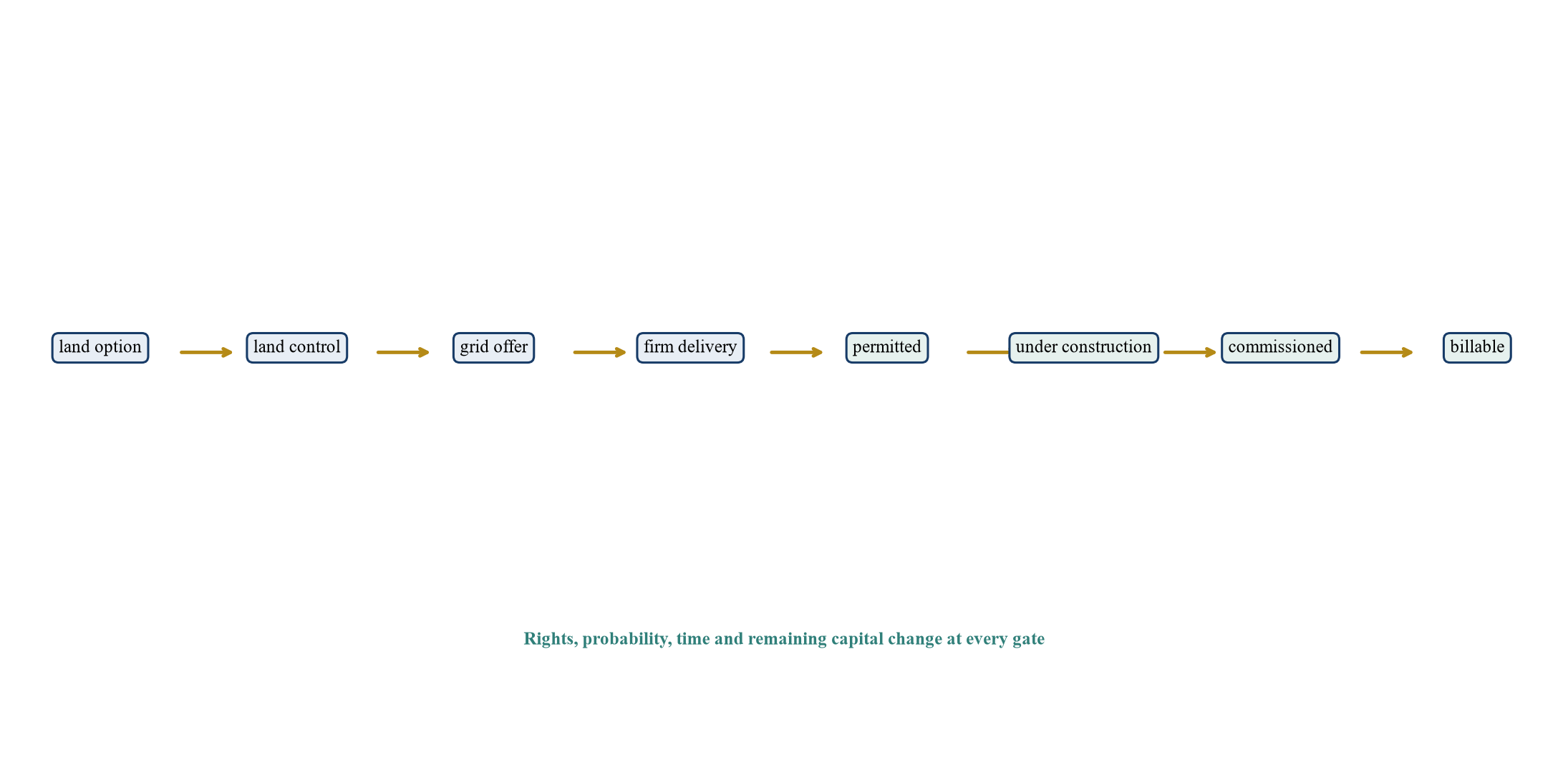
Analytical framework; jurisdiction-specific rights and engineering determine each stage.
| Stage | Minimum evidence | Value layer |
|---|---|---|
| land option | exclusive enforceable option | strategic option |
| land control | title or financeable lease and access | development base |
| grid offer | dated utility terms and conditions | conditional option |
| firm delivery | enforceable capacity and delivery path | powered-land value |
| permitted | consent covering intended design | development value |
| commissioned | completed integrated testing | operating capacity |
| billable | accepted customer service and invoice | operating value |
Proposed definitions; jurisdiction-specific documents control treatment.
3. Fix the legal and geographic perimeter
The decision question is which entities, sites, leases, easements, substations, contracts, permits and liabilities transfer. The evidence record should begin with corporate records, title, leases, access, grid contracts, permits and asset registers. Every item requires a source, date, owner, jurisdiction and reconciliation to the site model. European market demand and constrained grids provide context. Site-specific evidence still controls probability, schedule and cash-flow recognition. [4][5]
The principal failure is that critical rights can remain with a seller, affiliate, landlord, utility or special-purpose vehicle. The model should expose the underlying dependency and the event that confirms or rejects it. Management estimates can support scenarios when they are identified as assumptions and remain separate from observed evidence.
The recommended response is to map ownership, control, consent, duration and closing treatment. Development and strategic options should retain their own probability, time, capital and abandonment assumptions. The investment committee should see the value at risk, the earliest observable indicator and the intervention available before capital is released.
4. Verify land control and permitted use
The decision question is whether the owner controls land for the required term, density, access and data-centre use. The evidence record should begin with title, lease, options, zoning, planning history, rights of way and site constraints. Every item requires a source, date, owner, jurisdiction and reconciliation to the site model. European market demand and constrained grids provide context. Site-specific evidence still controls probability, schedule and cash-flow recognition. [6][7]
The principal failure is that land can be marketed as powered while use, access, duration or expansion remains restricted. The model should expose the underlying dependency and the event that confirms or rejects it. Management estimates can support scenarios when they are identified as assumptions and remain separate from observed evidence.
The recommended response is to value only the land rights that support the intended facility and financing. Development and strategic options should retain their own probability, time, capital and abandonment assumptions. The investment committee should see the value at risk, the earliest observable indicator and the intervention available before capital is released.
5. Classify grid rights and obligations
The decision question is whether a utility offer, queue position, connection agreement or delivered supply creates an enforceable capacity right. The evidence record should begin with connection documents, milestones, securities, network works, curtailment, tariffs and termination. Every item requires a source, date, owner, jurisdiction and reconciliation to the site model. European market demand and constrained grids provide context. Site-specific evidence still controls probability, schedule and cash-flow recognition. [8][9]
The principal failure is that headline power can be conditional on works, readiness, security, dates or shared-network reinforcement. The model should expose the underlying dependency and the event that confirms or rejects it. Management estimates can support scenarios when they are identified as assumptions and remain separate from observed evidence.
The recommended response is to assign probability and schedule from enforceable rights and dependencies. Development and strategic options should retain their own probability, time, capital and abandonment assumptions. The investment committee should see the value at risk, the earliest observable indicator and the intervention available before capital is released.
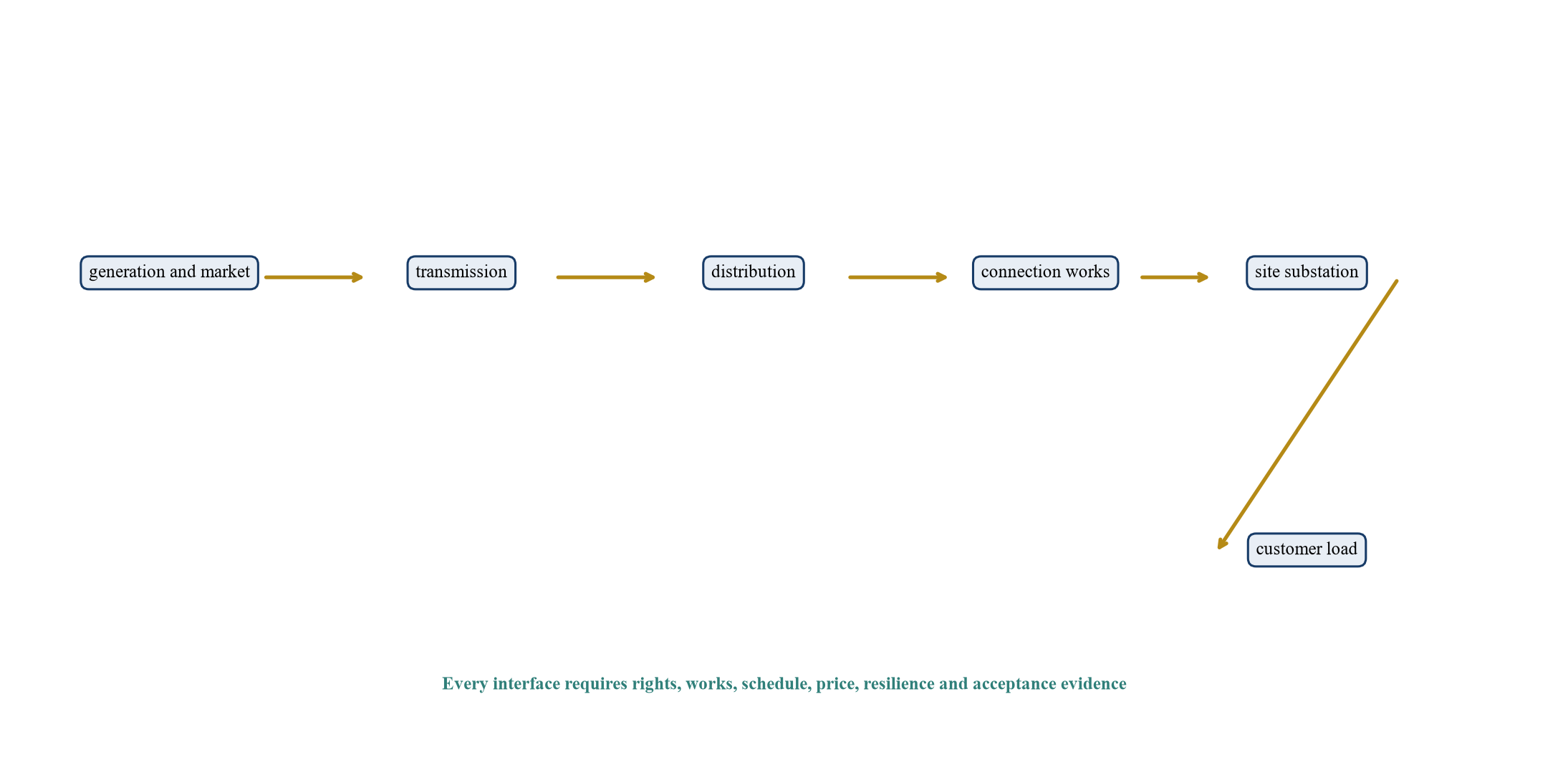
Analytical framework; actual utility and network obligations require legal and engineering verification.
| Evidence | Principal question | Valuation treatment |
|---|---|---|
| feasibility response | can the network study the request? | no base value |
| queue position | what milestones preserve priority? | early option |
| connection offer | which conditions, security and dates apply? | conditional option |
| executed agreement | who builds what and by when? | probability-weighted value |
| energised supply | what capacity, price and constraints apply? | operating dependency |
| redundant supply | can service survive defined outages? | resilience value |
Proposed diligence matrix; utility documents determine enforceability.
6. Distinguish firm, interruptible and constrained supply
The decision question is which operating conditions determine when and how much power can serve customer load. The evidence record should begin with utility service levels, curtailment, redundancy, outage, capacity and demand-charge terms. Every item requires a source, date, owner, jurisdiction and reconciliation to the site model. European market demand and constrained grids provide context. Site-specific evidence still controls probability, schedule and cash-flow recognition. [8][10]
The principal failure is that nominal capacity can have limited availability or insufficient resilience for the target service. The model should expose the underlying dependency and the event that confirms or rejects it. Management estimates can support scenarios when they are identified as assumptions and remain separate from observed evidence.
The recommended response is to model deliverable power, resilience and customer service separately. Development and strategic options should retain their own probability, time, capital and abandonment assumptions. The investment committee should see the value at risk, the earliest observable indicator and the intervention available before capital is released.
7. Map network reinforcement and queue dependencies
The decision question is which third-party projects, permits, equipment and readiness conditions govern energisation. The evidence record should begin with transmission and distribution plans, queue milestones, substations, cables, transformers and construction interfaces. Every item requires a source, date, owner, jurisdiction and reconciliation to the site model. European market demand and constrained grids provide context. Site-specific evidence still controls probability, schedule and cash-flow recognition. [9][11]
The principal failure is that a site schedule can omit upstream critical-path works beyond the developer’s direct control. The model should expose the underlying dependency and the event that confirms or rejects it. Management estimates can support scenarios when they are identified as assumptions and remain separate from observed evidence.
The recommended response is to build an integrated utility-to-site critical path with accountable evidence. Development and strategic options should retain their own probability, time, capital and abandonment assumptions. The investment committee should see the value at risk, the earliest observable indicator and the intervention available before capital is released.
8. Test planning and environmental permissions
The decision question is whether consent covers buildings, generators, cooling, substations, noise, water, emissions and operating hours. The evidence record should begin with planning decisions, environmental studies, permits, conditions, appeals and discharge evidence. Every item requires a source, date, owner, jurisdiction and reconciliation to the site model. European market demand and constrained grids provide context. Site-specific evidence still controls probability, schedule and cash-flow recognition. [6][12]
The principal failure is that headline permission can exclude a required component or contain conditions that constrain operation. The model should expose the underlying dependency and the event that confirms or rejects it. Management estimates can support scenarios when they are identified as assumptions and remain separate from observed evidence.
The recommended response is to translate every condition into design, cost, schedule and operating limits. Development and strategic options should retain their own probability, time, capital and abandonment assumptions. The investment committee should see the value at risk, the earliest observable indicator and the intervention available before capital is released.
| Workstream | Evidence | Cash consequence |
|---|---|---|
| planning | use, massing, generators and hours | capacity and delay |
| environment | noise, air, ecology and contamination | mitigation and operating limits |
| water | abstraction, supply and discharge | cooling design and cost |
| heat reuse | network, counterparty and obligation | capital and revenue |
| construction | building and safety approvals | schedule and commissioning |
| appeals and conditions | status, discharge and challenge | probability and financing |
Proposed checklist; local law and permit conditions control.
9. Assess water, heat and resource obligations
The decision question is how water availability, discharge, waste heat and resource-efficiency requirements affect design and operation. The evidence record should begin with water rights, utility capacity, environmental conditions, heat studies, energy reporting and local policy. Every item requires a source, date, owner, jurisdiction and reconciliation to the site model. European market demand and constrained grids provide context. Site-specific evidence still controls probability, schedule and cash-flow recognition. [1][13]
The principal failure is that a power-secured site can remain commercially weak when cooling or resource obligations are unresolved. The model should expose the underlying dependency and the event that confirms or rejects it. Management estimates can support scenarios when they are identified as assumptions and remain separate from observed evidence.
The recommended response is to cost the compliant design and evidence feasible resource interfaces. Development and strategic options should retain their own probability, time, capital and abandonment assumptions. The investment committee should see the value at risk, the earliest observable indicator and the intervention available before capital is released.
10. Define the target engineering configuration
The decision question is which density, redundancy, cooling, network and security design converts site rights into saleable service. The evidence record should begin with basis of design, single-line diagrams, thermal studies, rack profile, resilience and customer specification. Every item requires a source, date, owner, jurisdiction and reconciliation to the site model. European market demand and constrained grids provide context. Site-specific evidence still controls probability, schedule and cash-flow recognition. [14][15]
The principal failure is that generic facility design can fail the power density or cooling requirement of target AI workloads. The model should expose the underlying dependency and the event that confirms or rejects it. Management estimates can support scenarios when they are identified as assumptions and remain separate from observed evidence.
The recommended response is to value capacity against a defined customer product and retrofit path. Development and strategic options should retain their own probability, time, capital and abandonment assumptions. The investment committee should see the value at risk, the earliest observable indicator and the intervention available before capital is released.
11. Reconcile procurement and construction readiness
The decision question is whether design, contractors, long-lead equipment, labour and interfaces support cost and schedule. The evidence record should begin with procurement plan, quotations, contracts, lead times, labour, logistics, contingency and construction programme. Every item requires a source, date, owner, jurisdiction and reconciliation to the site model. European market demand and constrained grids provide context. Site-specific evidence still controls probability, schedule and cash-flow recognition. [16][17]
The principal failure is that development value can assume equipment and contractor availability that has not been secured. The model should expose the underlying dependency and the event that confirms or rejects it. Management estimates can support scenarios when they are identified as assumptions and remain separate from observed evidence.
The recommended response is to use a risk-adjusted cost and schedule with procurement gates. Development and strategic options should retain their own probability, time, capital and abandonment assumptions. The investment committee should see the value at risk, the earliest observable indicator and the intervention available before capital is released.
12. Prove commissioning and operational acceptance
The decision question is which tests establish that electrical, cooling, controls, safety and customer service operate as designed. The evidence record should begin with commissioning scripts, test results, defects, certifications, customer acceptance and incident history. Every item requires a source, date, owner, jurisdiction and reconciliation to the site model. European market demand and constrained grids provide context. Site-specific evidence still controls probability, schedule and cash-flow recognition. [14][18]
The principal failure is that mechanically complete capacity can be treated as operational before integrated testing and acceptance. The model should expose the underlying dependency and the event that confirms or rejects it. Management estimates can support scenarios when they are identified as assumptions and remain separate from observed evidence.
The recommended response is to recognise operating value only after the required service evidence. Development and strategic options should retain their own probability, time, capital and abandonment assumptions. The investment committee should see the value at risk, the earliest observable indicator and the intervention available before capital is released.
13. Verify customer demand and contract conversion
The decision question is which executed commitments attach to each site, capacity block, delivery date and specification. The evidence record should begin with customer agreements, orders, credit, milestones, fit-out, acceptance, billing and termination. Every item requires a source, date, owner, jurisdiction and reconciliation to the site model. European market demand and constrained grids provide context. Site-specific evidence still controls probability, schedule and cash-flow recognition. [19][20]
The principal failure is that pipeline and reservations can be counted as contracted demand without enforceable minimums. The model should expose the underlying dependency and the event that confirms or rejects it. Management estimates can support scenarios when they are identified as assumptions and remain separate from observed evidence.
The recommended response is to link each customer commitment to power, design, capital and acceptance. Development and strategic options should retain their own probability, time, capital and abandonment assumptions. The investment committee should see the value at risk, the earliest observable indicator and the intervention available before capital is released.
14. Model operating utilisation and renewal
The decision question is how billable load, price, margin, term and renewal create current cash. The evidence record should begin with meters, invoices, receipts, contract expiry, service levels, credits and customer cohorts. Every item requires a source, date, owner, jurisdiction and reconciliation to the site model. European market demand and constrained grids provide context. Site-specific evidence still controls probability, schedule and cash-flow recognition. [19][21]
The principal failure is that operating capacity can carry weak value when price, margin, concentration or renewal is poor. The model should expose the underlying dependency and the event that confirms or rejects it. Management estimates can support scenarios when they are identified as assumptions and remain separate from observed evidence.
The recommended response is to build contract-level cash and renewal cases. Development and strategic options should retain their own probability, time, capital and abandonment assumptions. The investment committee should see the value at risk, the earliest observable indicator and the intervention available before capital is released.
15. Separate sustaining, conversion and expansion capital
The decision question is which expenditure preserves current service, fulfils contracts or creates future capacity. The evidence record should begin with condition surveys, capex ledgers, projects, contracts, schedules, permits and contingencies. Every item requires a source, date, owner, jurisdiction and reconciliation to the site model. European market demand and constrained grids provide context. Site-specific evidence still controls probability, schedule and cash-flow recognition. [16][22]
The principal failure is that development capital can exclude reliability, compliance or customer-specific obligations. The model should expose the underlying dependency and the event that confirms or rejects it. Management estimates can support scenarios when they are identified as assumptions and remain separate from observed evidence.
The recommended response is to classify every capital item by cash purpose and value layer. Development and strategic options should retain their own probability, time, capital and abandonment assumptions. The investment committee should see the value at risk, the earliest observable indicator and the intervention available before capital is released.
| Capital class | Purpose | Value treatment |
|---|---|---|
| sustaining | preserve operating service | deduct from operating cash |
| compliance | meet permit and code | unavoidable requirement |
| reliability | protect resilience | risk-adjusted investment |
| customer conversion | deliver executed contract | contracted-conversion cost |
| base development | create commissioned capacity | development cost |
| expansion | create future saleable capacity | contingent growth cost |
Proposed classification; site engineering controls cost.
16. Build the development probability tree
The decision question is which legal, grid, permission, design, procurement, funding, construction and customer gates remain. The evidence record should begin with site evidence, historical outcomes, current milestones, independent challenge and schedule. Every item requires a source, date, owner, jurisdiction and reconciliation to the site model. European market demand and constrained grids provide context. Site-specific evidence still controls probability, schedule and cash-flow recognition. [2][23]
The principal failure is that one blended probability can hide a near-binary fatal dependency. The model should expose the underlying dependency and the event that confirms or rejects it. Management estimates can support scenarios when they are identified as assumptions and remain separate from observed evidence.
The recommended response is to estimate conditional probability and timing at each gate. Development and strategic options should retain their own probability, time, capital and abandonment assumptions. The investment committee should see the value at risk, the earliest observable indicator and the intervention available before capital is released.
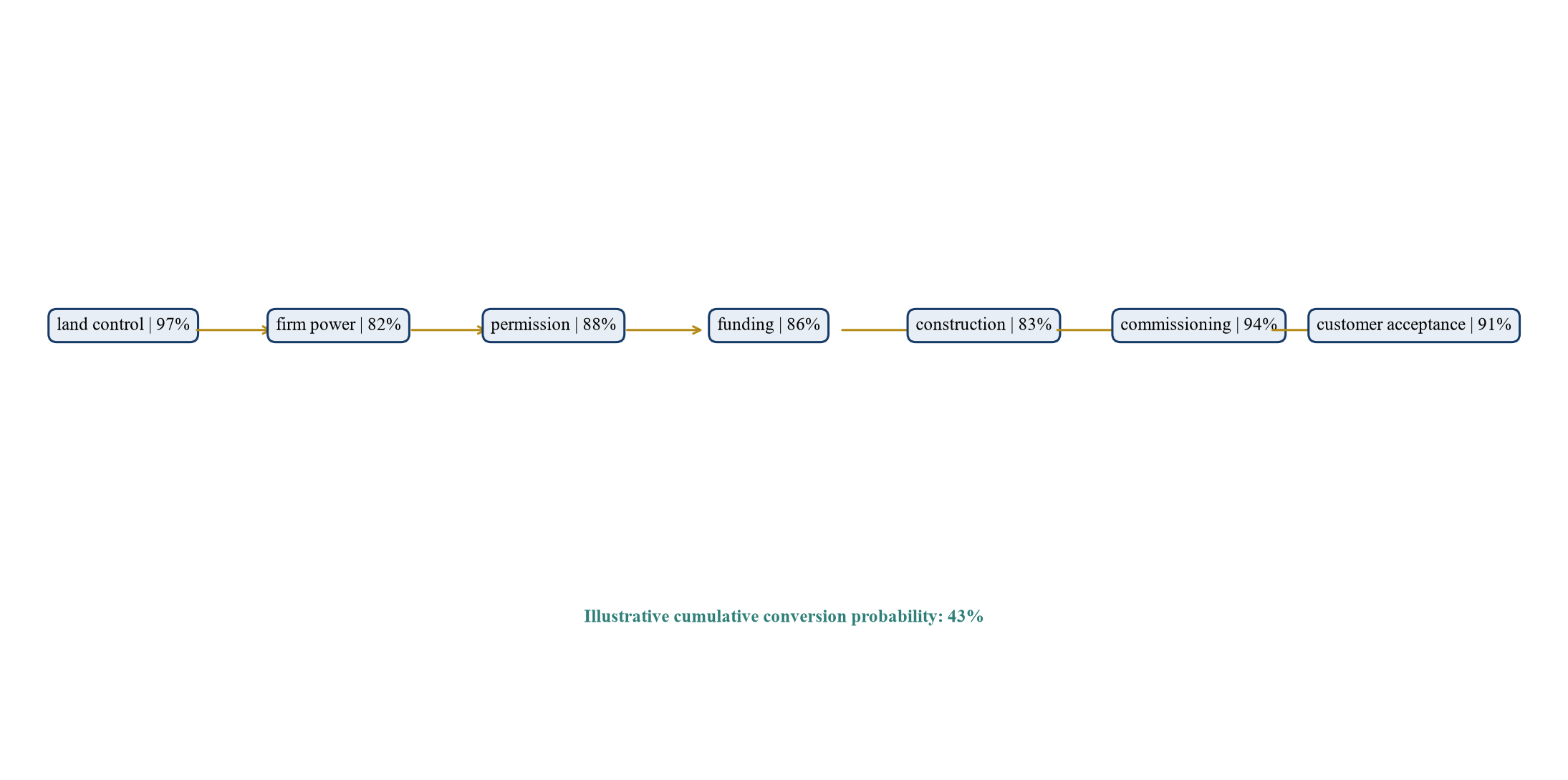
Illustrative conditional gates; probabilities require site-specific evidence.
| Gate | Evidence | Stop or redesign trigger |
|---|---|---|
| land | control, access and duration | unresolved title or insufficient term |
| power | enforceable delivery and works | speculative timing or fatal constraint |
| permission | approved design and conditions | incompatible use or material appeal |
| funding | committed sources and contingency | unfunded base case |
| construction | executable contracts and schedule | critical interface unresolved |
| customer | enforceable commitment and credit | non-binding demand |
Illustrative; site-specific evidence determines probability.
17. Estimate remaining cost and schedule distribution
The decision question is how central, delayed and stressed paths affect total funding and value. The evidence record should begin with quantity, price, contract, contingency, escalation, interface and financing evidence. Every item requires a source, date, owner, jurisdiction and reconciliation to the site model. European market demand and constrained grids provide context. Site-specific evidence still controls probability, schedule and cash-flow recognition. [16][17]
The principal failure is that one completion date and budget can understate correlated delay and cost. The model should expose the underlying dependency and the event that confirms or rejects it. Management estimates can support scenarios when they are identified as assumptions and remain separate from observed evidence.
The recommended response is to use probabilistic cost and schedule ranges with explicit correlations. Development and strategic options should retain their own probability, time, capital and abandonment assumptions. The investment committee should see the value at risk, the earliest observable indicator and the intervention available before capital is released.
18. Value current operational capacity
The decision question is how accepted service, collected cash, renewals and sustaining capital support enterprise value. The evidence record should begin with billable load, contract cash, operating cost, capital, tax and working capital. Every item requires a source, date, owner, jurisdiction and reconciliation to the site model. European market demand and constrained grids provide context. Site-specific evidence still controls probability, schedule and cash-flow recognition. [19][21]
The principal failure is that portfolio value can assign operating multiples to capacity that is not yet producing cash. The model should expose the underlying dependency and the event that confirms or rejects it. Management estimates can support scenarios when they are identified as assumptions and remain separate from observed evidence.
The recommended response is to use customer and capacity cohorts in a discounted-cash-flow model. Development and strategic options should retain their own probability, time, capital and abandonment assumptions. The investment committee should see the value at risk, the earliest observable indicator and the intervention available before capital is released.
19. Value contracted conversion capacity
The decision question is how executed customer commitments become billable service after remaining work. The evidence record should begin with contract terms, customer credit, power, construction, commissioning, capital and acceptance. Every item requires a source, date, owner, jurisdiction and reconciliation to the site model. European market demand and constrained grids provide context. Site-specific evidence still controls probability, schedule and cash-flow recognition. [19][20]
The principal failure is that signed demand can be valued without delivery probability, cost or customer remedy. The model should expose the underlying dependency and the event that confirms or rejects it. Management estimates can support scenarios when they are identified as assumptions and remain separate from observed evidence.
The recommended response is to discount the expected cash after all conversion costs and risks. Development and strategic options should retain their own probability, time, capital and abandonment assumptions. The investment committee should see the value at risk, the earliest observable indicator and the intervention available before capital is released.
20. Value powered land and development capacity
The decision question is how land and power rights create residual value before operations. The evidence record should begin with control, grid maturity, planning, design, cost, schedule, demand, funding and alternative use. Every item requires a source, date, owner, jurisdiction and reconciliation to the site model. European market demand and constrained grids provide context. Site-specific evidence still controls probability, schedule and cash-flow recognition. [2][23]
The principal failure is that powered land can be priced through a headline MW multiple detached from cash and obligations. The model should expose the underlying dependency and the event that confirms or rejects it. Management estimates can support scenarios when they are identified as assumptions and remain separate from observed evidence.
The recommended response is to use probability-weighted site cash and option analysis with explicit remaining capital. Development and strategic options should retain their own probability, time, capital and abandonment assumptions. The investment committee should see the value at risk, the earliest observable indicator and the intervention available before capital is released.
21. Value strategic land and early power options
The decision question is when scarce locations and early rights justify option value despite limited maturity. The evidence record should begin with land duration, exclusivity, queue position, competing uses, carrying cost and abandonment rights. Every item requires a source, date, owner, jurisdiction and reconciliation to the site model. European market demand and constrained grids provide context. Site-specific evidence still controls probability, schedule and cash-flow recognition. [7][9]
The principal failure is that strategic narratives can make non-exclusive or expiring rights appear permanent. The model should expose the underlying dependency and the event that confirms or rejects it. Management estimates can support scenarios when they are identified as assumptions and remain separate from observed evidence.
The recommended response is to price the option, exercise cost, expiry and abandonment decision. Development and strategic options should retain their own probability, time, capital and abandonment assumptions. The investment committee should see the value at risk, the earliest observable indicator and the intervention available before capital is released.
22. Normalise market multiples
The decision question is how transaction and public-company evidence compares after capacity stage, geography, leases and capex. The evidence record should begin with disclosed values, capacity definitions, operating cash, remaining capital and dates. Every item requires a source, date, owner, jurisdiction and reconciliation to the site model. European market demand and constrained grids provide context. Site-specific evidence still controls probability, schedule and cash-flow recognition. [24][25]
The principal failure is that unadjusted value per MW can transfer another portfolio’s maturity and scarcity to the subject. The model should expose the underlying dependency and the event that confirms or rejects it. Management estimates can support scenarios when they are identified as assumptions and remain separate from observed evidence.
The recommended response is to compare like-for-like capacity layers and reconcile to DCF. Development and strategic options should retain their own probability, time, capital and abandonment assumptions. The investment committee should see the value at risk, the earliest observable indicator and the intervention available before capital is released.
23. Apply the hypothetical portfolio bridge
The decision question is how 640 marketed MW convert into 56 MW of billable service and distinct value layers. The evidence record should begin with the illustrative site ledger, power rights, permissions, construction, contracts and cash. Every item requires a source, date, owner, jurisdiction and reconciliation to the site model. European market demand and constrained grids provide context. Site-specific evidence still controls probability, schedule and cash-flow recognition. [1][2]
The principal failure is that one denominator would treat current operations and early options as equivalent. The model should expose the underlying dependency and the event that confirms or rejects it. Management estimates can support scenarios when they are identified as assumptions and remain separate from observed evidence.
The recommended response is to allocate capacity, cost, probability and value by stage. Development and strategic options should retain their own probability, time, capital and abandonment assumptions. The investment committee should see the value at risk, the earliest observable indicator and the intervention available before capital is released.
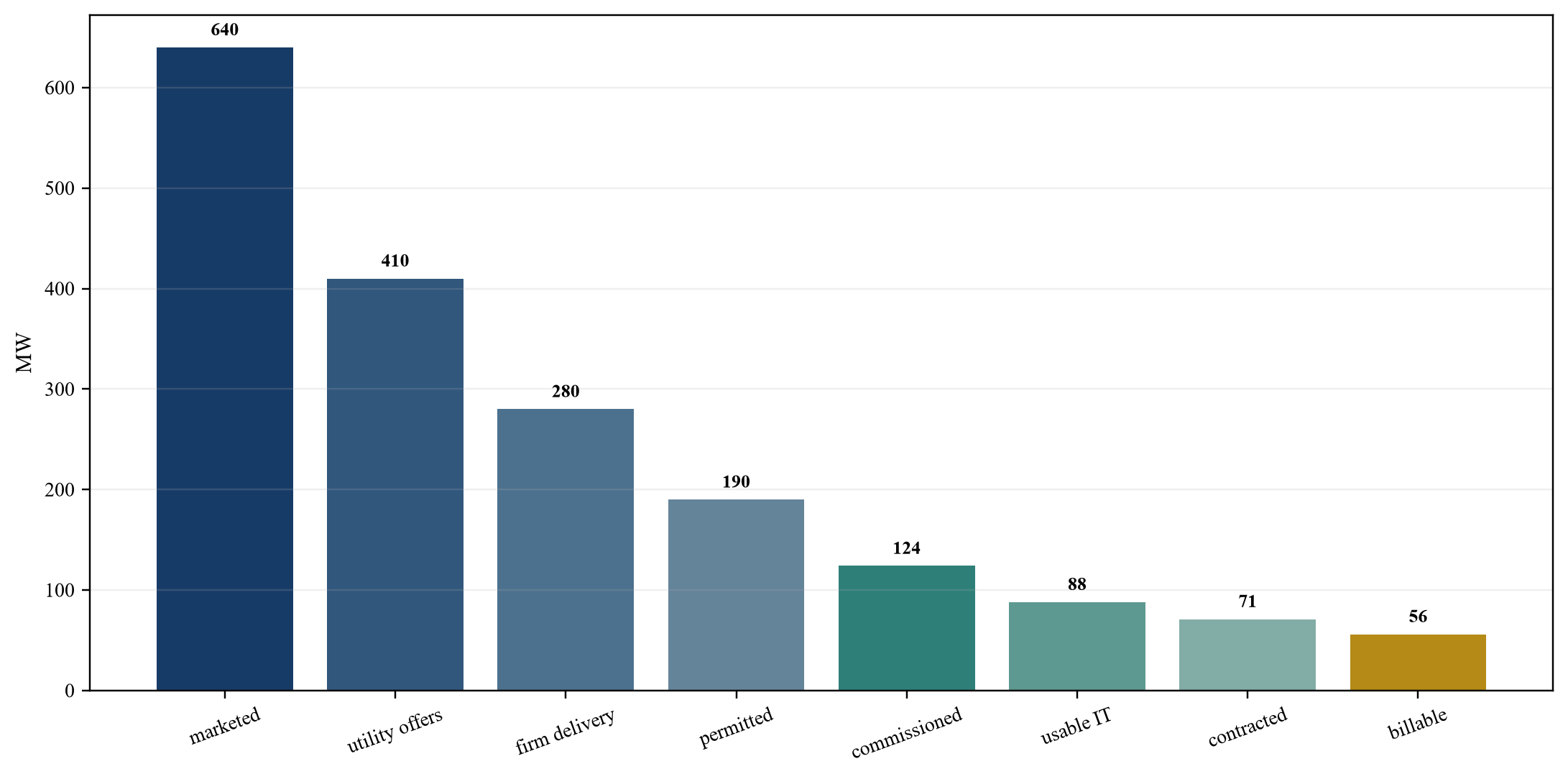
Wholly hypothetical MW; figures do not describe an identified portfolio.
| Layer | MW | Remaining requirement | Value treatment |
|---|---|---|---|
| marketed pipeline | 640 | evidence across all gates | no single value |
| utility offers | 410 | conditions and network works | early option |
| firm contracted delivery | 280 | site readiness and construction | powered-land value |
| permitted | 190 | funding and execution | development value |
| commissioned critical | 124 | customer configuration | operating capacity |
| billable | 56 | margin, renewal and collection | operating value |
Wholly hypothetical; figures do not describe an identified portfolio.
24. Bridge enterprise value to equity value
The decision question is how site values, corporate cost, debt, leases, tax, committed capital and contingencies reach shareholder value. The evidence record should begin with valuation outputs, capital structure, cash, leases, commitments and transaction adjustments. Every item requires a source, date, owner, jurisdiction and reconciliation to the site model. European market demand and constrained grids provide context. Site-specific evidence still controls probability, schedule and cash-flow recognition. [21][26]
The principal failure is that headline enterprise value can conceal the funding still required to create operating assets. The model should expose the underlying dependency and the event that confirms or rejects it. Management estimates can support scenarios when they are identified as assumptions and remain separate from observed evidence.
The recommended response is to show a transparent bridge and downside liquidity. Development and strategic options should retain their own probability, time, capital and abandonment assumptions. The investment committee should see the value at risk, the earliest observable indicator and the intervention available before capital is released.
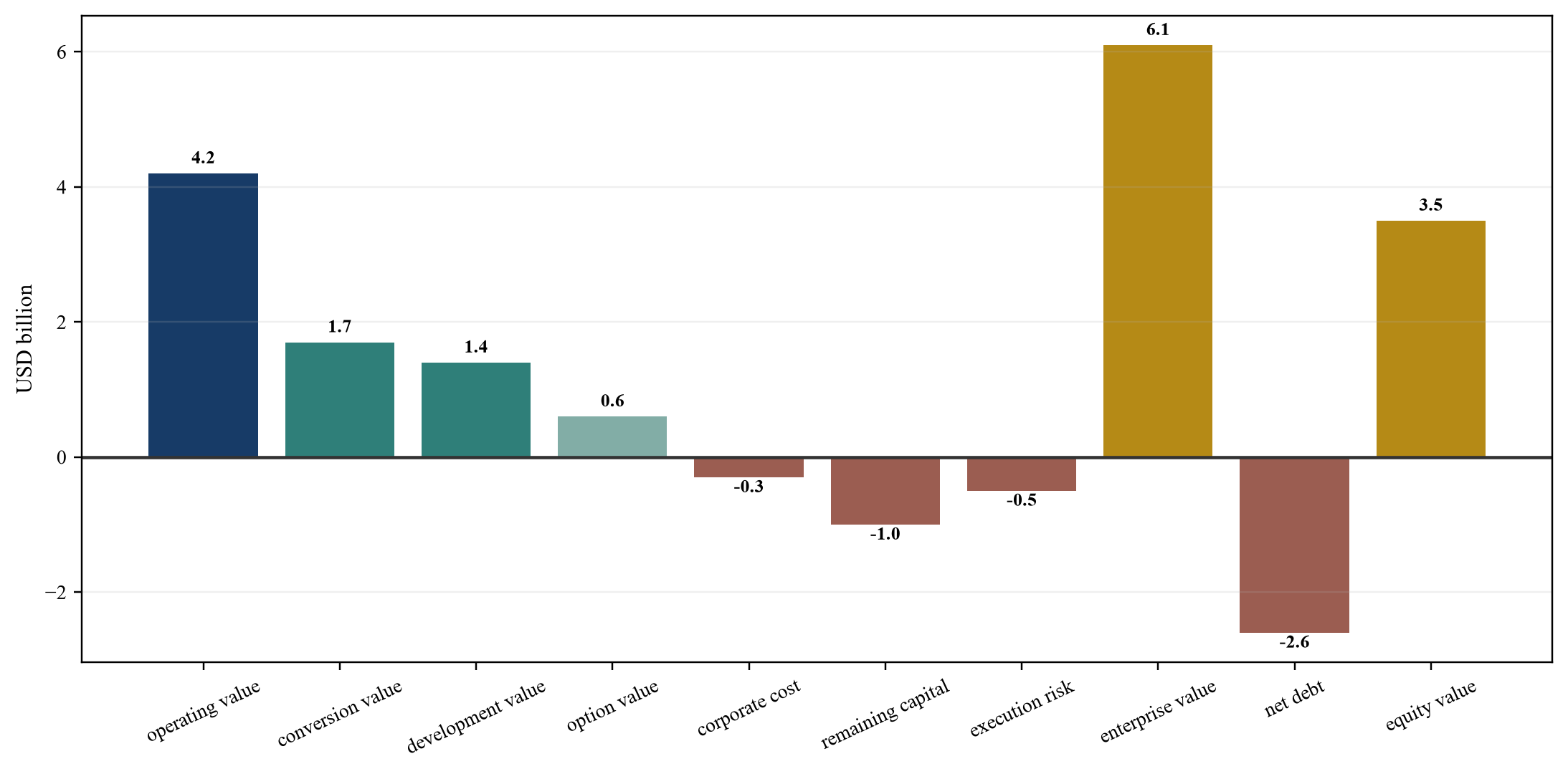
Wholly hypothetical USD billions; this is not a valuation opinion.
25. Stress delay, cost and conversion
The decision question is which power delay, permission, capex, customer and utilisation cases drive loss. The evidence record should begin with probability tree, cost distribution, schedule, financing and covenant scenarios. Every item requires a source, date, owner, jurisdiction and reconciliation to the site model. European market demand and constrained grids provide context. Site-specific evidence still controls probability, schedule and cash-flow recognition. [9][23]
The principal failure is that independent sensitivities can miss compounding site and financing failures. The model should expose the underlying dependency and the event that confirms or rejects it. Management estimates can support scenarios when they are identified as assumptions and remain separate from observed evidence.
The recommended response is to test coherent site-level and portfolio-level downside cases. Development and strategic options should retain their own probability, time, capital and abandonment assumptions. The investment committee should see the value at risk, the earliest observable indicator and the intervention available before capital is released.
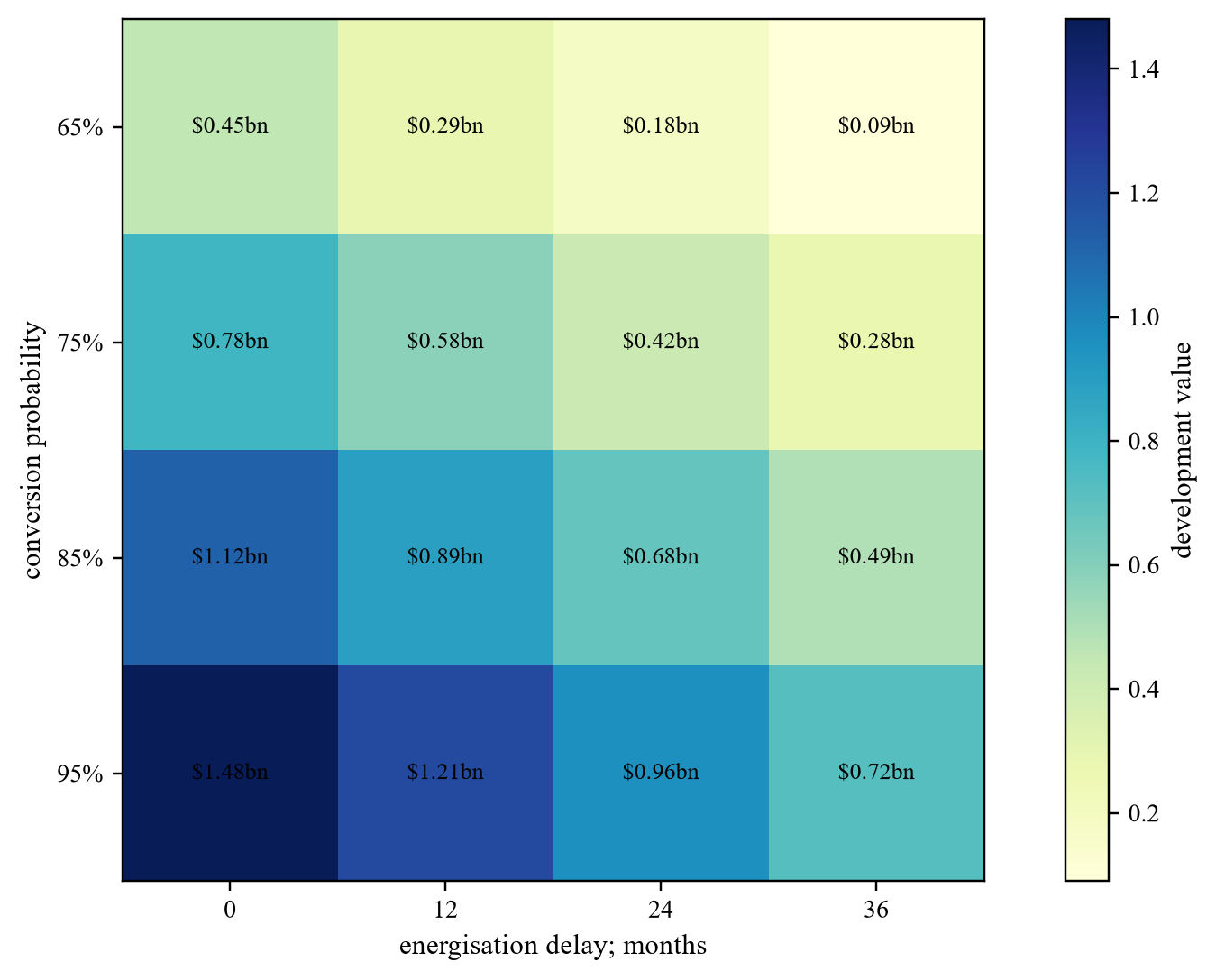
Wholly hypothetical USD billions; this is not a valuation opinion.
26. Size financing to maturity and cash
The decision question is which equity, construction debt, project debt and reserves fit each capacity stage. The evidence record should begin with sources and uses, draw conditions, security, covenants, reserves and operating cash. Every item requires a source, date, owner, jurisdiction and reconciliation to the site model. European market demand and constrained grids provide context. Site-specific evidence still controls probability, schedule and cash-flow recognition. [20][26]
The principal failure is that acquisition debt can rely on undeveloped capacity that produces no debt service. The model should expose the underlying dependency and the event that confirms or rejects it. Management estimates can support scenarios when they are identified as assumptions and remain separate from observed evidence.
The recommended response is to match instruments and drawdown to verified milestones and resilient cash. Development and strategic options should retain their own probability, time, capital and abandonment assumptions. The investment committee should see the value at risk, the earliest observable indicator and the intervention available before capital is released.
27. Translate diligence into price and protections
The decision question is which adjustment, escrow, earn-out, milestone, condition and covenant allocate development uncertainty. The evidence record should begin with site findings, seller rights, financing, remedies and post-close plan. Every item requires a source, date, owner, jurisdiction and reconciliation to the site model. European market demand and constrained grids provide context. Site-specific evidence still controls probability, schedule and cash-flow recognition. [4][5]
The principal failure is that valuation caveats can disappear from transaction documents. The model should expose the underlying dependency and the event that confirms or rejects it. Management estimates can support scenarios when they are identified as assumptions and remain separate from observed evidence.
The recommended response is to attach every material dependency to value, protection, owner and deadline. Development and strategic options should retain their own probability, time, capital and abandonment assumptions. The investment committee should see the value at risk, the earliest observable indicator and the intervention available before capital is released.
28. Reach the investment decision
The decision question is whether the evidence-gated value range, funding and protections justify commitment. The evidence record should begin with perimeter, capacity ledger, cash flows, probability, capital, financing and board record. Every item requires a source, date, owner, jurisdiction and reconciliation to the site model. European market demand and constrained grids provide context. Site-specific evidence still controls probability, schedule and cash-flow recognition. [2][26]
The principal failure is that a portfolio pipeline total can displace site-level evidence and fiduciary judgement. The model should expose the underlying dependency and the event that confirms or rejects it. Management estimates can support scenarios when they are identified as assumptions and remain separate from observed evidence.
The recommended response is to approve separate value layers and a funded trigger-based development plan. Development and strategic options should retain their own probability, time, capital and abandonment assumptions. The investment committee should see the value at risk, the earliest observable indicator and the intervention available before capital is released.
| Decision | Evidence required | Possible action |
|---|---|---|
| operating value | billable cash and renewals | approve or reprice |
| conversion value | contract, power, capex and acceptance | milestone funding |
| development value | land, power, permit, cost and probability | retain as contingent value |
| option value | exclusivity, expiry and exercise economics | preserve or abandon |
| financing | resilient cash and draw conditions | resize or restructure |
| unresolved dependency | quantified cash and legal allocation | condition, escrow or decline |
Proposed governance; transaction-specific approvals remain necessary.
Sources
- European Commission, *Energy efficiency in data centres*. Read the primary source
- European Union, Directive (EU) 2023/1791 on energy efficiency. Read the primary source
- European Commission, Delegated Regulation (EU) 2024/1364 on a common Union rating scheme for data centres. Read the primary source
- European Commission, *EU merger control*. Read the primary source
- European Commission, *Foreign Subsidies Regulation*. Read the primary source
- European Commission, *Environmental Impact Assessment*. Read the primary source
- European Commission, *Land use and land-use change*. Read the primary source
- European Network of Transmission System Operators for Electricity, *Ten-Year Network Development Plan*. Read the primary source
- Agency for the Cooperation of Energy Regulators, *Electricity infrastructure and network development*. Read the primary source
- European Network of Transmission System Operators for Electricity, *European Resource Adequacy Assessment*. Read the primary source
- European Commission, *European grids action plan*. Read the primary source
- European Commission, *Industrial emissions and safety*. Read the primary source
- European Commission, *Water Framework Directive*. Read the primary source
- European Commission Joint Research Centre, *European Code of Conduct for Data Centre Energy Efficiency*. Read the primary source
- European Union Agency for Cybersecurity, *NIS2 Directive resources*. Read the primary source
- Eurostat, *Construction producer prices and costs*. Read the primary source
- European Central Bank, *Economic Bulletin*. Read the primary source
- European Commission, *Construction products regulation*. Read the primary source
- IFRS Foundation, *IFRS 15 Revenue from Contracts with Customers*. Read the primary source
- IFRS Foundation, *IFRS 9 Financial Instruments*. Read the primary source
- IFRS Foundation, *IAS 36 Impairment of Assets*. Read the primary source
- IFRS Foundation, *IAS 16 Property, Plant and Equipment*. Read the primary source
- European Investment Bank, *Project cycle*. Read the primary source
- U.S. Securities and Exchange Commission, *Equinix, Inc. filings*. Read the primary source
- U.S. Securities and Exchange Commission, *Digital Realty Trust, Inc. filings*. Read the primary source
- European Banking Authority, *Loan origination and monitoring guidelines*. Read the primary source
