

Introduction
Renewable generation has low marginal cost and high upfront capital cost. Its financing therefore depends on the expected quantity, price and timing of future electricity revenue. A power purchase agreement can convert part of that uncertain revenue into a contracted cash flow. The European Investment Bank describes PPAs as an increasingly important financing instrument because they provide revenue stability for generators and price visibility for buyers [1]. IRENA likewise identifies revenue-securing instruments, including PPAs and contracts for difference, as important to access lower-cost capital [2].
The contract does not remove risk. It reallocates risk through the strike price, settlement quantity, reference market, delivery profile, tenor, credit support and remedies. A pay-as-produced fixed-price PPA transfers a different package from a baseload PPA. A virtual PPA may hedge the price at one hub while leaving the project exposed to its nodal price. A price floor protects downside without fixing all revenue. A collar distributes extreme price movements between the parties. A proxy-generation structure changes the quantity used for settlement and therefore changes who carries weather and operating risk.
The distinction matters more as renewable penetration increases. ACER reports that pay-as-produced remains the dominant PPA structure in Europe, while baseload and pay-as-consumed structures allocate volume and profile risk differently [3]. The European Commission notes that price cannibalisation and negative-price hours can affect the profitability and uptake of pay-as-produced contracts [4]. The 2026 European Commission study of the PPA market identifies wholesale-price volatility, profile costs, limited forward liquidity, creditworthiness, permitting, grid access and accounting complexity as continuing constraints [5].
This paper compares four price and quantity structures through the perspective of a project sponsor, corporate buyer, utility offtaker and lender. It uses a common decision framework rather than jurisdiction-specific legal advice. Contract enforceability, derivatives regulation, accounting and tax treatment require local professional advice.
1 Define the commercial decision
The first decision is the purpose of the PPA. A project sponsor may need a minimum contracted revenue to reach financial close. A corporate buyer may seek long-term cost stability, renewable attributes or both. A utility may procure energy and capacity for customers. A trader may intermediate shape, balancing and credit. The same structure can create value for one purpose and create unmanaged exposure for another.
The parties should state the target before negotiating price. A project-finance target might require debt service coverage above an agreed threshold under a downside case. A buyer target might limit annual energy-cost variance or aggregate mark-to-market exposure. An environmental target might require hourly or annual attribute delivery. These targets determine which risks need to be transferred and which can remain merchant.
The contract boundary also matters. A physical PPA involves electricity delivery and associated scheduling or balancing obligations. A financial PPA settles price differences without physical delivery between the counterparties. The United States Environmental Protection Agency describes a virtual PPA as a financial instrument because the buyer does not take delivery [6]. The European Commission similarly distinguishes physical delivery from financial settlement and identifies volume, imbalance, basis and regulatory risks [4].
2 Decompose the PPA into five variables
Every PPA can be reduced to five commercial variables. The settlement quantity defines how many megawatt hours enter the calculation. The contract price defines the fixed strike, floor, cap or formula. The reference price defines the market value against which settlement occurs. The delivery profile defines when electricity is deemed delivered. Credit and termination provisions determine whether the promised cash flow survives stress.
The common financial settlement for hour t can be written as the settlement quantity multiplied by the difference between the contract price and reference price. When the reference price is below the contract price, the buyer pays the seller. When it is above, the seller pays the buyer. A physical PPA may embed the economic effect in an energy invoice rather than a separate derivative settlement.
Quantity can be actual metered output, a fixed baseload volume, a shaped profile, buyer consumption or proxy generation. Reference price can be the project node, a zonal price, a trading hub or another index. A fixed strike at the wrong reference point can leave substantial basis risk. A fixed strike applied to actual output can leave weather and profile risk. The parties need to examine the combined payoff rather than each clause in isolation.
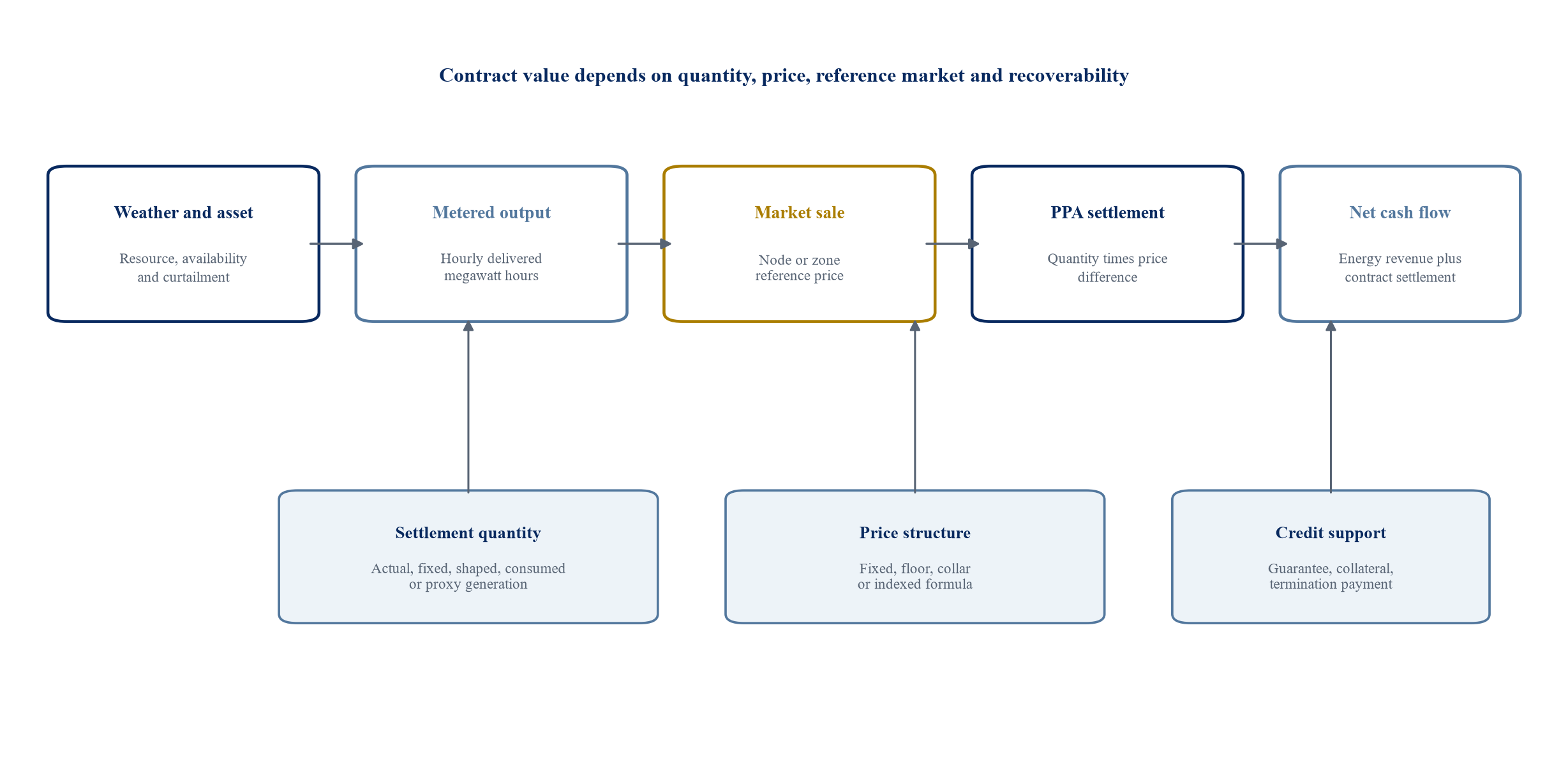
The diagram separates physical electricity revenue from financial settlement and credit support. It is an analytical framework and does not represent a specific transaction.
3 Understand the fixed price structure
A fixed-price PPA applies a strike price to an agreed settlement quantity. It is the simplest structure to communicate and can provide strong revenue visibility when quantity and reference price align with physical output. The United States Department of Energy describes an offsite PPA as a fixed-for-floating arrangement in which the project sells into the market and the parties settle the difference between market price and the agreed rate [7].
The fixed price transfers market-price risk. The project gains protection when market prices are below the strike and gives up upside when prices are above it. The buyer receives the opposite payoff. The economic result can be stable only when the buyer's electricity purchase cost and the PPA reference price move together. A buyer whose load sits in a different zone may face basis risk. A buyer whose consumption profile differs from project output may face shape and volume risk.
Fixed pricing can support debt because the contracted portion of revenue is easier to model. Lenders still test production, curtailment, negative prices, basis, counterparty default and contract termination. A fixed price does not create a fixed annual cash flow when the settlement quantity varies with weather or availability.
4 Understand the price floor
A price floor sets a minimum contract price. When the reference price falls below the floor, the buyer or hedge provider pays the difference. When the reference price exceeds the floor, the project retains merchant upside, subject to the precise contract formula. The floor resembles a put option from the project's perspective.
The floor protects downside while preserving participation in high prices. Its cost can appear as a premium, a lower floor, revenue sharing, a cap on upside, collateral or another economic concession. A lender can give credit to the protected cash flow, but debt sizing will depend on floor level, tenor, settlement quantity, counterparty credit and the treatment of revenue above the floor.
The buyer has asymmetric exposure because payments arise in low-price periods without an equal right to receive high-price value. A floor therefore requires a clear commercial rationale. A public offtaker might use it to unlock finance while allowing the project to remain exposed to efficient market signals. A financial intermediary might price it as an option. A corporate buyer may prefer a collar because it receives protection against high prices in return for supporting the floor.
5 Understand the price collar
A collar sets a floor and a cap. Below the floor, the project receives support. Between the floor and cap, the project remains exposed to market prices. Above the cap, the buyer receives the excess or the project revenue is limited, depending on settlement design. The structure shares extreme price outcomes.
The collar can reduce the buyer's concern that a long fixed price becomes uneconomic when market prices fall. It can preserve some merchant signal for the project while supporting a minimum cash flow. The width of the collar determines how much market exposure remains. A narrow collar approaches fixed pricing. A wide collar approaches merchant exposure with tail protection.
Debt credit for the collar should use the floor and contracted quantity rather than expected merchant upside. Lenders may recognise a portion of above-floor revenue through conservative price curves and haircuts. The cap can limit upside available for debt prepayment or equity return. The structure should be modelled with hourly prices because annual averages can conceal negative-price hours and capture-price effects.
6 Understand proxy generation
Proxy generation changes the settlement quantity. It estimates how much electricity the project could have generated from observed weather, the equipment power curve and an agreed operating-efficiency factor. The International Swaps and Derivatives Association provides an optional proxy-generation attachment to its global financial PPA template [8]. ISDA describes proxy generation as a benchmark quantity based on the available renewable resource.
The structure separates weather risk from operational risk. A settlement based on actual generation makes the buyer's volume depend on both weather and project operations. A proxy quantity reflects weather but assumes agreed operational efficiency. The project bears the difference between proxy and actual generation, including equipment underperformance beyond agreed treatment. The buyer receives a settlement quantity linked to weather without policing every operational covenant.
Proxy generation does not remove price basis, shape or counterparty risk. It also introduces model and data risk. Weather stations, data quality, equipment curves, degradation, losses, availability assumptions, maintenance treatment and settlement-agent governance must be defined. A project can sell only actual electricity into the market while the financial PPA settles on proxy quantity. The difference can create cash flow volatility for the project.
7 Compare the structures through risk ownership
The most useful comparison asks who carries each risk after all documents are combined. Fixed price primarily reallocates market-price risk. A floor reallocates downside price risk. A collar reallocates extreme price outcomes. Proxy generation reallocates weather quantity and operational performance differently. None of these structures automatically resolves basis, curtailment, credit or termination.
The World Bank's PPA guidance states that risks should be allocated to the party best able to manage them, with pricing adjusted when a party accepts risk outside its normal capacity [9]. This principle supports granular allocation. The project can manage equipment availability through operations and maintenance. A buyer may be able to manage load-shape exposure. A trader can manage market and balancing positions. An insurer or financial institution may price weather or credit risk.
Table 1. Comparative risk allocation across four PPA structures
| Risk | Fixed price using actual output | Price floor | Price collar | Proxy generation |
|---|---|---|---|---|
| Wholesale price below strike | Primarily buyer or hedge provider | Buyer below floor | Buyer below floor | Depends on fixed, floor or collar price term |
| Wholesale price above strike | Buyer benefits through settlement | Project generally retains upside | Buyer benefits above cap | Depends on price term |
| Weather volume | Shared through actual output and buyer exposure | Project unless floor quantity differs | Project unless collar quantity differs | Buyer or hedge provider through proxy quantity |
| Operational performance | Affects project output and settlement volume | Project | Project | Project bears proxy-to-actual shortfall |
| Shape and capture price | Shared; depends on hourly reference | Mostly project above floor | Shared within collar | Remains unless separately hedged |
| Location basis | Party exposed to node-to-hub difference | Remains | Remains | Remains |
| Curtailment | Depends on deemed-energy clauses | Depends on floor settlement rules | Depends on collar settlement rules | Depends on proxy and curtailment treatment |
| Counterparty credit | Bilateral exposure can be material | Asymmetric low-price exposure | Two-way exposure | Depends on price term and quantity |
| Model and data | Limited to metering and price data | Limited to metering and price data | Limited to metering and price data | Material weather, power-curve and efficiency risk |
The allocation shown is a general analytical starting point. Actual allocation depends on contract wording, market rules and linked hedges.
8 Separate price risk from capture price
Renewable projects receive the price prevailing when they generate. Solar output can concentrate in hours when solar supply is abundant and prices are lower. Wind output can experience similar capture-price effects. A baseload forward price or annual average can therefore overstate the market value of actual output.
The reference price should match the project as closely as practical. Nodal settlement reduces one form of basis risk but may be illiquid. Hub settlement can improve liquidity while leaving node-to-hub basis. A shaped reference can match expected output but can be complex and model-dependent. The European Commission identifies profile and imbalance costs as important PPA barriers [5].
The financing model should calculate hourly or sub-hourly revenue where data allow. It should test capture-rate decline as renewable penetration increases. The strike price must be interpreted alongside the expected capture rate, settlement point and negative-price provisions.
9 Measure volume and profile mismatch
A pay-as-produced contract transfers actual output. The buyer receives more contracted energy when the resource is strong and less when it is weak. This can conflict with a flat or consumption-linked load. A baseload contract fixes hourly quantity and shifts balancing responsibility toward the generator or intermediary. A shaped contract uses a predetermined profile. A pay-as-consumed contract follows the buyer's demand and transfers more volume risk to the seller [3].
The mismatch creates residual purchases and sales. A corporate buyer may buy contracted renewable output and still purchase electricity when load exceeds output. It may sell excess output when generation exceeds load. The value of those transactions depends on hourly prices. An annual matching statement can conceal material cash volatility.
Volume risk should be measured through historical resource data, load data, outage assumptions and forward price scenarios. The parties should agree treatment of new load, plant expansion, degradation and changes in consumption. The quantity definition should be operationally measurable and legally enforceable.
10 Test negative prices and curtailment
Negative prices can cause a project to pay the market to generate. A fixed-price PPA may still make generation economic when the buyer supports the difference. This can weaken the signal to curtail. Contracts therefore use negative-price clauses, minimum-price thresholds, suspension periods or deemed-energy rules.
Curtailment can be economic, grid-directed or caused by project failure. Each category should have defined quantity and payment treatment. A project may seek deemed generation for grid curtailment outside its control. A buyer may resist paying for output that was not delivered. A proxy-generation structure needs a specific adjustment because proxy quantity can remain positive during curtailment.
Lenders examine whether curtailment risk is compensated, capped or supported by historical evidence. The cash model should test prolonged negative prices, congestion and grid outages. A short contractual threshold can create a large annual revenue effect when high-renewable hours cluster.
11 Align PPA tenor with financing
Contract tenor determines the period of protected revenue. IRENA notes that longer contracts can spread costs over more years and reduce price, while increasing policy, counterparty and long-term liability exposure [10]. A shorter contract leaves a larger merchant tail and may reduce debt tenor or increase refinancing risk.
The PPA start date should align with commercial operation and long-stop provisions. Construction delay can shorten the effective hedge or create buyer replacement-cost claims. The expiry date should be tested against debt maturity, reserve release and asset life. A project can combine a contracted period with a merchant tail, but debt sizing should use conservative post-contract assumptions.
Extension rights, repowering and change in law should be addressed. A fixed option held by one party can have material value. The contract should identify the price or valuation process for any extension rather than leaving it to a future negotiation that lenders cannot underwrite.
12 Size debt from contracted cash flow
Project debt is repaid from available cash after operating costs, taxes, working capital and reserve movements. Lenders model debt service coverage under base and downside cases. Contracted revenue can support higher leverage when quantity, price, tenor and counterparty credit remain reliable.
A fixed-price PPA with actual output can still produce low debt service coverage in a weak-resource year. A floor can support minimum price while leaving resource risk. A collar can provide a similar downside floor with different upside allocation. Proxy generation can stabilise the buyer's weather-linked settlement but can increase project exposure when actual operations underperform the proxy.
The debt case should separate contractual floor revenue, expected merchant revenue and stress revenue. It should apply haircuts to merchant upside and model termination. Debt tenor should not materially exceed contracted cash flow without credible refinancing or merchant assumptions.
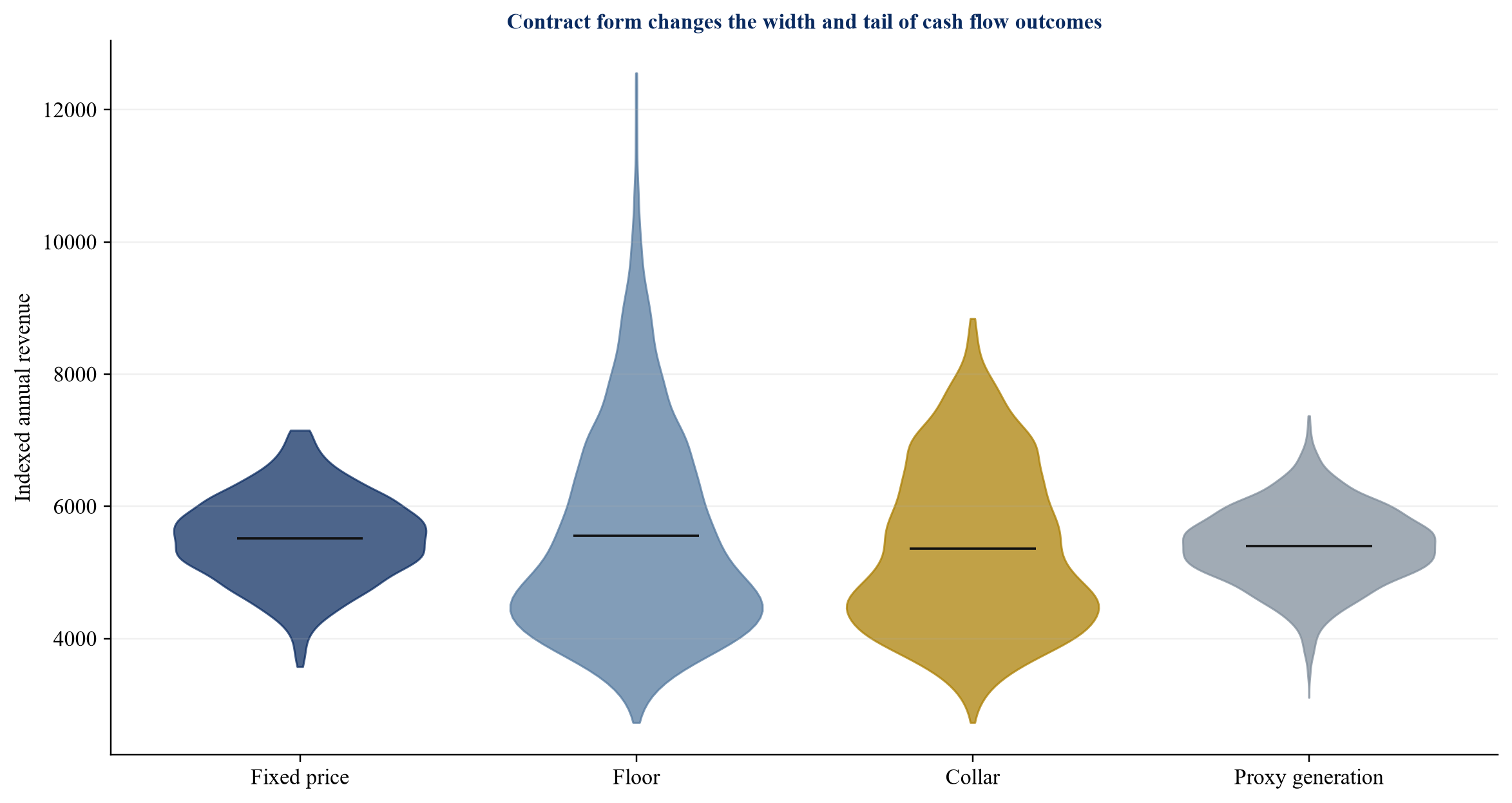
Author-modelled example for a 100 MW renewable project using hypothetical prices, output and contract terms. Values are indexed and are not forecasts or observed market outcomes.
13 Model debt service sensitivity
Debt-service sensitivity should link the PPA payoff to resource, availability, capture price, basis and operating cost. A single percentage change in average price is insufficient. Low prices can coincide with high renewable output, increasing settlement payments from the buyer. Weak output can coincide with high prices, reducing the project's physical revenue while creating a different hedge result.
The illustrative analysis uses hypothetical assumptions. It assumes a 100 MW project, annual expected output indexed to 100, a fixed strike of 55, a floor of 42 and a collar cap of 68. It applies resource, market and operating variation without representing any jurisdiction. The purpose is to show how the structures transmit risk.
Table 2. Illustrative debt-service sensitivity by contract structure
| Scenario | Fixed price DSCR | Floor DSCR | Collar DSCR | Proxy-generation DSCR | Main driver |
|---|---|---|---|---|---|
| Base resource and price | 1.45x | 1.39x | 1.41x | 1.43x | Expected output and reference price |
| Resource 15 percent below plan | 1.23x | 1.18x | 1.20x | 1.16x | Lower actual output; proxy shortfall adds exposure |
| Market price 30 percent below plan | 1.45x | 1.22x | 1.22x | 1.43x | Fixed price and proxy strike protect price; floor binds |
| Capture rate 12 percentage points lower | 1.41x | 1.28x | 1.30x | 1.37x | Node and shape mismatch reduce physical revenue |
| Availability five percentage points lower | 1.37x | 1.32x | 1.34x | 1.24x | Proxy settlement exceeds actual operating output |
| Counterparty payment delayed 90 days | 1.18x | 1.16x | 1.17x | 1.17x | Liquidity reserve and working-capital pressure |
| PPA termination after year seven | 1.11x | 1.09x | 1.10x | 1.08x | Merchant tail and refinancing exposure |
Author-modelled values use hypothetical assumptions. DSCR means debt service coverage ratio. The analysis is a method demonstration rather than transaction advice.
14 Evaluate counterparty credit
The contract is worth only what the counterparty can pay. EIB analysis identifies corporate creditworthiness as a major barrier to PPA finance and notes that lenders often require strong offtaker credit [11]. The EIB's approved pan-European guarantee programme is designed to support corporate PPA obligations and renewable investment [12].
Credit analysis should examine financial capacity, business cyclicality, energy-cost exposure, ownership, rating, guarantees and the contract's potential mark-to-market. A buyer with low current payment exposure can face a large obligation after a sustained market fall. A generator can face a large payment obligation when market prices rise above a fixed strike or collar cap.
Credit support can include parent guarantees, letters of credit, collateral thresholds, margining, reserve accounts, insurance or public guarantees. The amount should reflect potential future exposure, settlement timing and replacement cost. Collateral terms also create liquidity risk. A party can remain solvent yet fail to meet a rapid margin call.
15 Design collateral and liquidity terms
Collateral should respond to exposure without destabilising the project. Daily variation margin may suit a financial institution but can be difficult for a project-financed special-purpose vehicle. A threshold and independent-amount structure can limit unsecured exposure while preserving operating liquidity. A letter of credit can substitute bank credit for corporate credit, subject to renewal and issuing-bank quality.
The Bank for International Settlements states that margin frameworks should capture valuation risk, collateral quality, counterparty risk, volatility and liquidity [13]. PPA documents should define valuation agent, price source, dispute process, eligible collateral, haircuts, timing and consequences of failure. The direct agreement with lenders should coordinate cure and enforcement rights.
The financing model should include collateral posting under adverse prices. A fixed-price project may owe settlement amounts when prices rise even though physical energy revenue also rises. Timing differences, basis and curtailment can prevent a complete natural hedge. Liquidity facilities should be sized from stressed settlement and collateral profiles.
16 Address accounting before signature
Accounting classification can affect earnings volatility, balance-sheet presentation and disclosures. The International Accounting Standards Board issued amendments in December 2024 for nature-dependent electricity contracts, including PPAs. The amendments clarify own-use treatment, permit qualifying hedge accounting and add disclosure requirements. They apply for annual periods beginning on or after 1 January 2026, with earlier application permitted [14].
Physical and virtual contracts can receive different treatment. Contract design, net settlement, resale practices, volume mismatch and environmental attributes may influence classification. Proxy generation adds another quantity convention that accounting teams should evaluate. A commercially attractive structure can become unacceptable when its fair-value volatility exceeds the buyer's tolerance.
Accounting analysis should occur alongside commercial modelling. The term sheet should identify intended treatment, required documentation and data. The contract should not promise an accounting outcome because classification depends on applicable standards and facts over time.
17 Treat environmental attributes separately
Energy and environmental attributes can move together or separately. A PPA may transfer renewable energy certificates, guarantees of origin or other attributes based on actual or proxy generation. The quantity and delivery period should match the buyer's reporting framework.
Proxy settlement creates a potential mismatch when proxy quantity exceeds actual generation. The project cannot transfer more valid attributes than it creates unless replacement attributes are permitted. The contract should specify shortfall, substitution, geographic and technology eligibility, vintage, registry, retirement and audit.
The price allocated to attributes can affect termination and damages. A combined energy-and-attribute price may obscure the value of each component. Separate schedules can improve transparency while preserving a single commercial transaction.
18 Allocate operational performance
The project controls maintenance, availability and many operating decisions. A pay-as-produced PPA can reduce buyer payments automatically when the project underperforms because settlement quantity falls. The buyer may still lose expected energy and attributes. Contracts therefore include availability guarantees, liquidated damages or replacement obligations.
Proxy generation makes the operational allocation more explicit. Settlement continues on modelled output while the project receives market revenue on actual output. Underperformance creates a direct project loss. The agreed efficiency factor and exclusions determine how much operating risk remains with the project.
Mechanical availability and proxy-generation terms should be coordinated. ISDA provides optional attachments for both concepts [8]. The contract should avoid double penalties for the same outage. It should distinguish planned maintenance, forced outage, grid curtailment, force majeure and data failure.
19 Govern the proxy model
The proxy model becomes a financial calculation agent. Governance should cover weather sensors, calibration, missing data, equipment curves, degradation, losses, wake effects, clipping, temperature, curtailment and model updates. An independent settlement agent can reduce disputes, but the contract still needs transparent methods and audit rights.
The baseline model should be tested against historical or pre-commercial data where available. The parties should set tolerance bands and correction processes. A material model change should require defined approval rather than unilateral discretion. Data retention should cover the limitation period for claims.
Cybersecurity and data integrity are part of settlement risk. Weather and operational data should have controlled access, time synchronisation, backup and anomaly detection. The contract should define fallback data sources when sensors fail.
20 Integrate the PPA with project documents
The PPA does not operate alone. Engineering, procurement and construction terms determine completion and performance. Operations and maintenance terms govern availability. Grid connection and market-access agreements determine physical sales. Insurance covers defined events. Debt documents control cash, reserves and enforcement.
Key provisions should be back-to-back where appropriate. The construction long-stop date should align with PPA commercial operation. Availability commitments should align with the operations contract. Change-in-law and curtailment treatment should align with permits and grid rules. Termination payments should support debt repayment where the risk is allocated to the buyer.
The World Bank identifies the PPA as the primary revenue contract in many power projects and emphasises pricing, risk allocation, testing, third-party sales and termination as central to bankability [15]. Lenders require direct agreements, notice, cure and step-in rights. The contract suite should be reviewed as one risk system.
21 Set termination economics before financial close
Termination converts long-term exposure into an immediate claim. The contract should distinguish project default, buyer default, prolonged force majeure, change in law and convenience termination. Each case needs a payment formula, timing, security and transfer consequences.
Buyer-default compensation may include outstanding amounts, debt, break costs and an equity component. Project-default compensation may be lower and may account for replacement energy or hedge loss. A financial PPA can have positive or negative mark-to-market depending on market prices. The valuation method should be reproducible and should avoid circular assumptions.
The parties should model termination at several dates and price states. A formula that appears balanced at signature can create an unfinanceable shortfall after construction or a windfall late in the term. Lender cure and replacement rights can preserve the contract before termination becomes necessary.
22 Coordinate public support and PPA revenue
Projects may receive contracts for difference, tax credits, grants, capacity payments or regulated support alongside a PPA. The interaction can alter settlement, additionality, price and credit. The European electricity-market reform promotes PPAs and two-way contracts for difference as long-term instruments [16].
The PPA should state how public support affects price, attributes and change in law. Double compensation should be avoided. A support award after PPA signature may change the project's risk and value. A support withdrawal may trigger renegotiation only when the contract clearly allocates that risk.
Public authorities should consider whether PPA terms preserve efficient dispatch and competition. IRENA's 2026 auction guidance emphasises the trade-off between low procurement price, project realisation, macroeconomic risk and local value [10]. Contract design should reflect the full public exposure, including guarantees and foreign-currency obligations.
23 Compare structures through a decision scorecard
A decision scorecard should use financeability, buyer value, risk transparency, operational alignment, accounting, credit and execution complexity. Each criterion should have a defined measure. A structure should not receive a high score merely because its headline price is low.
The illustrative scorecard below uses a five-point scale and hypothetical weights. It assumes a project sponsor requires contracted downside support and a corporate buyer has moderate price-risk capacity. A different buyer, market or technology would produce different weights and results.
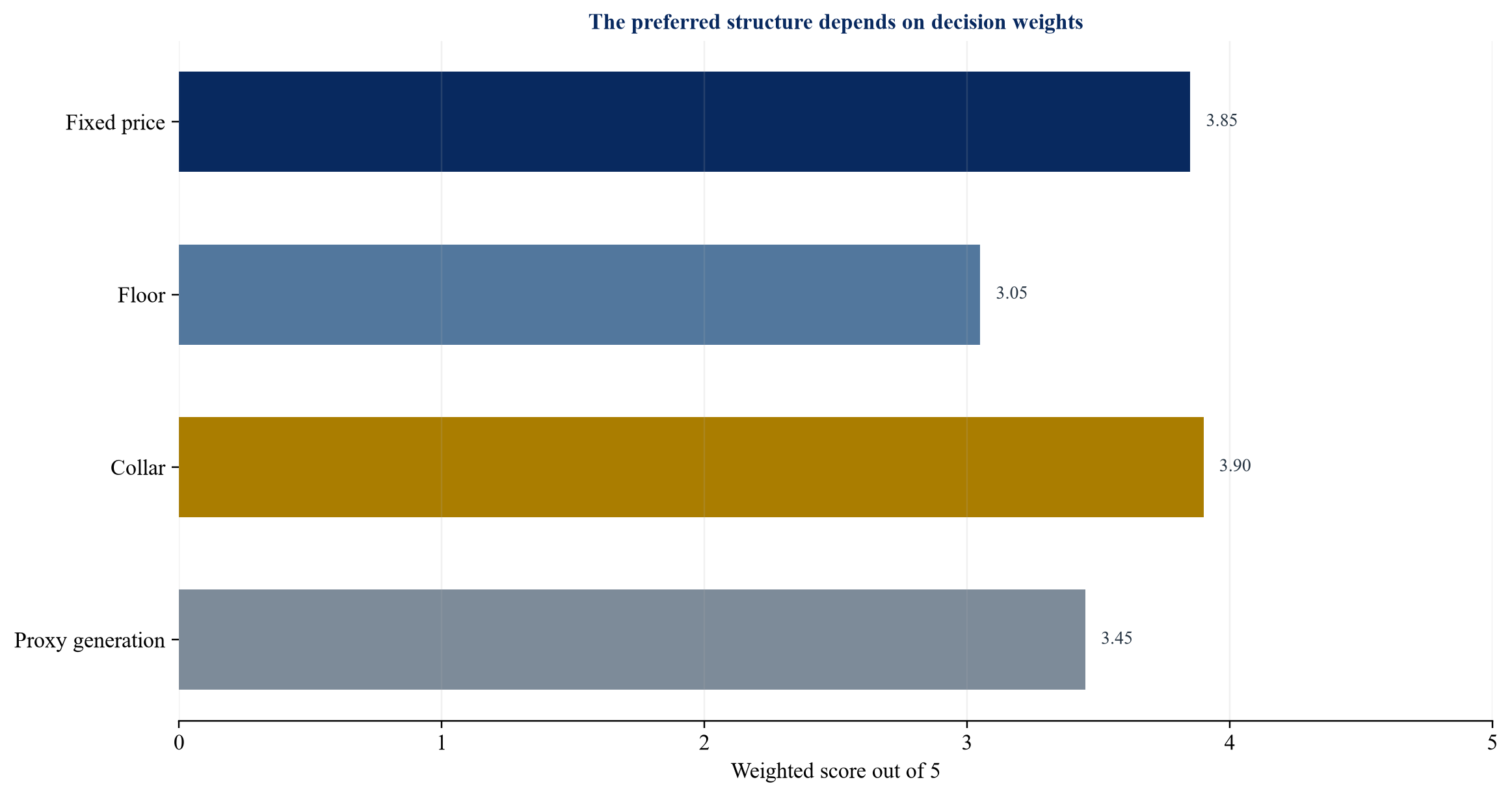
Author-modelled scores use hypothetical criteria and weights. They show a decision method rather than a recommendation for a specific project.
Table 3. PPA selection scorecard and evidence required
| Decision test | Evidence | Fixed price tends to fit when | Floor or collar tends to fit when | Proxy generation tends to fit when |
|---|---|---|---|---|
| Debt support | DSCR, tenor, downside revenue and counterparty case | High contracted-revenue requirement | Some merchant exposure is financeable | Weather transfer improves hedge value and operations are strong |
| Buyer cost fit | Hourly load, residual purchases, basis and budget tolerance | Buyer accepts long fixed exposure | Buyer wants tail protection with market participation | Buyer can manage modelled volume and residual basis |
| Risk transparency | Hourly model and risk-allocation matrix | Metered quantity and reference align | Floor and cap are simple and observable | Weather data and model governance are mature |
| Operational alignment | Availability, curtailment and maintenance rules | Actual output settlement is acceptable | Project retains operating incentives | Project should bear operational shortfall against weather potential |
| Credit efficiency | Potential future exposure and collateral profile | Two-way mark-to-market is manageable | Asymmetric or bounded exposure is preferred | Quantity model reduces covenant disputes |
| Execution capacity | Legal, trading, accounting and settlement resources | Parties need a familiar structure | Parties can value optionality | Parties can govern independent data and calculations |
The scorecard should be completed from project-specific evidence and approved assumptions.
24 Run a structured negotiation
The negotiation should begin with data and risk limits. The project provides resource, output, availability, grid and cost assumptions. The buyer provides load, procurement, credit and accounting constraints. The parties agree reference markets, scenarios and valuation methods before exchanging final price proposals.
A term sheet should record settlement quantity, price structure, reference price, tenor, attributes, negative-price treatment, curtailment, credit support, accounting intent, change in law, force majeure and termination. Open items should identify the risk owner and required evidence. A price should not be final while the quantity or reference basis remains open.
Lender review should occur before contract language is substantially fixed. Market sounding can identify debt-size, tenor and bankability constraints. The World Bank recommends using lender feedback during project preparation because risk allocation determines financeability [17].
25 Use an implementation roadmap
The first thirty days should establish the decision team, objectives, data room and modelling perimeter. Commercial, technical, legal, accounting, tax, sustainability, credit and financing workstreams should use the same assumptions. The team should create a risk register and hourly data specification.
Days thirty-one to seventy-five should build the physical and financial model. The analysis should compare actual output, baseload, shaped and proxy quantities. It should test fixed, floor and collar prices across resource, price, basis, curtailment, availability and credit scenarios. Accounting and regulatory analysis should identify constraints before term-sheet approval.
Days seventy-six to one hundred and twenty should run counterparty engagement and lender sounding. Bidders should price the same structures and data. The project should evaluate price together with collateral, tenor, termination and execution certainty. The preferred structure should proceed to credit approval and documentation.
Days one hundred and twenty-one to one hundred and eighty should complete contract drafting, direct agreements, model audit, conditions precedent and operational readiness. Settlement systems, data interfaces, invoices, collateral and dispute procedures should be tested before commercial operation.
26 Establish governance after signature
PPA management requires more than invoice processing. The parties should monitor production, proxy quantity, reference price, basis, negative prices, curtailment, credit exposure, collateral, attributes and covenant compliance. A monthly operating report can reconcile physical and financial positions.
A quarterly risk committee should review forecast changes, mark-to-market, counterparty credit, accounting and liquidity. Model changes, meter corrections and data gaps should follow approved controls. Material disputes should be escalated early because unresolved settlement differences can affect debt service.
The board should receive a concise view of contracted revenue, merchant exposure, collateral headroom and termination value. The report should distinguish realised cash, accrued settlement and modelled future exposure.
27 Apply the framework across markets
Market design changes the preferred structure. In a liquid hub market, a virtual PPA can use transparent prices while retaining basis risk. In a single-buyer market, a physical PPA with government or utility credit support may be the principal bankability instrument. In an emerging corporate PPA market, guarantee instruments and aggregation can expand the eligible buyer pool.
The European Commission's 2026 recommendation addresses barriers to PPA development, while ACER continues annual market assessment and maintains a list of voluntary templates [18][19]. ISDA's global financial PPA template provides a standard starting point for financial contracts [8]. Standardisation can reduce negotiation cost, but project-specific quantity, market and credit terms remain material.
Currency and convertibility require separate treatment in markets where project debt and PPA revenue use different currencies. Indexation can protect cost recovery while increasing buyer exposure. Sovereign support can improve financeability while creating public contingent liabilities. IRENA recommends explicit consideration of currency, contract duration and risk allocation [10].
28 Recognise limitations
The modelling in this paper is illustrative. It does not use a specific project's resource data, market curve, load profile, tax, accounting or financing terms. The relative results would change with technology, geography, settlement point, contract tenor, resource correlation, buyer credit and public support.
Legal characterisation differs by jurisdiction. A virtual PPA can be regulated as a derivative. Physical delivery can require licences, balancing arrangements and market access. Accounting and tax outcomes depend on facts and standards. The framework supports structuring and diligence, then requires transaction-specific advice.
Historical price and resource data cannot establish future outcomes. Climate change, transmission expansion, storage, demand growth, market reform and renewable penetration can alter correlations. Scenario analysis should therefore include structural change rather than rely only on historical variance.
29 Prepare the investment and credit decision memorandum
The final decision memorandum should connect commercial terms to cash flow and governance. Its opening page should state the chosen structure, tenor, settlement quantity, reference market, price mechanism, attribute treatment, counterparty, credit package and expected signing timetable. The recommendation should identify the risks retained by the project, the buyer and the lenders. It should also identify any condition that can change the recommendation, such as a lower credit rating, a different delivery point or a material change in the hourly generation profile.
The economic section should compare the shortlisted structures on the same assumptions. It should show annual and hourly settlement values, downside revenue, expected collateral, termination exposure and the interaction with project debt. Each table should distinguish contracted revenue from merchant revenue and cash settlement from non-cash mark-to-market movements. Sensitivities should cover resource, capture price, basis, curtailment, negative prices, availability, inflation, interest rates and counterparty default. A lender case should show debt-service coverage, liquidity and covenant headroom under the selected downside combinations.
The memorandum should document evidence quality. Data supplied by the project, buyer, network operator and market-data provider should be listed with an owner, date and validation status. Author-modelled assumptions should be described as illustrative and should remain separate from observed data. The model version, curve date, weather years and proxy-generation methodology should be recorded. Material limitations should appear beside the relevant decision rather than only in a final disclaimer.
The execution section should convert the recommendation into approvals and drafting instructions. It should list the open commercial points, responsible executive, approval body, required advice and target resolution date. Drafting instructions should cover quantity, price, reference data, availability, losses, curtailment, negative prices, credit support, collateral, tax, accounting, change in law, force majeure, termination, direct agreements and dispute resolution. The operations team should confirm that metering, forecasting, market access, invoicing and collateral systems can perform the proposed obligations.
Approval should remain conditional until the legal documents, financial model and operational design describe the same transaction. A change in settlement quantity or reference price can alter value and risk even when the headline price remains unchanged. The final memorandum should therefore include a reconciliation signed by the commercial, finance, legal, accounting and operations leads. This control gives the board and credit committee a traceable basis for authorisation and provides the transaction team with an agreed path to signing and financial close.
Conclusion
Fixed price, floor, collar and proxy generation solve different problems. A fixed price can create strong revenue visibility while transferring two-way mark-to-market exposure. A floor protects downside and preserves upside at a cost. A collar shares extreme outcomes and can balance buyer and generator objectives. Proxy generation separates weather quantity from operational performance and therefore changes the settlement and data architecture.
The financeable choice depends on the complete risk package. Settlement quantity, reference price, delivery profile, credit support, collateral, termination and accounting should be designed together. Lenders should size debt from protected cash flow and stress the residual risks. Buyers should measure hourly cost, basis, profile and liquidity rather than rely on the headline strike.
A disciplined process begins with objectives and data, compares structures through a common hourly model, assigns each risk to a capable party and documents the resulting economics. This approach makes the PPA a transparent financing instrument rather than a price promise whose hidden exposures appear after signature.
References
- European Investment Bank. Infrastructure Solutions: The power of purchase agreements. 2022. https://www.eib.org/en/essays/renewable-energy-power-purchase-agreements
- International Renewable Energy Agency. Renewable Power Generation Costs in 2024. 2025. https://www.irena.org/Digital-Report/Renewable-Power-Generation-Costs-in-2024
- Agency for the Cooperation of Energy Regulators. Progress of EU electricity wholesale market integration, Monitoring Report 2025. 2025. https://www.acer.europa.eu/sites/default/files/documents/Publications/ACER-2025-Electricity-market-integration.pdf
- European Commission. Commission Recommendation on removing barriers to the development of power purchase agreements and other energy purchase agreements. 2026. https://energy.ec.europa.eu/publications/commission-recommendation-removing-barriers-development-power-purchase-agreements-and-other-energy_en
- European Commission Directorate-General for Energy. Understanding the renewables power purchase agreements market. 2026. https://op.europa.eu/en/publication-detail/-/publication/4671f3e3-7753-11f1-bf5e-01aa75ed71a1/language-en
- United States Environmental Protection Agency. Customer Power Purchase Agreements. 2022. https://www.epa.gov/statelocalenergy/customer-power-purchase-agreements
- United States Department of Energy. Power Purchase Agreement, Better Buildings Financing Navigator. https://betterbuildingssolutioncenter.energy.gov/financing-navigator/option/power-purchase-agreement
- International Swaps and Derivatives Association. Global Financial Power Purchase Agreement Confirmation Template with Optional Attachments. 2026. https://www.isda.org/book/fppa-confirmation-template-with-optional-attachments/
- African Legal Support Facility and World Bank. Understanding Power Purchase Agreements. 2014. https://ppp.worldbank.org/sites/default/files/2024-08/Africa_Understanding_Power_Purchase_Agreements.pdf
- International Renewable Energy Agency. Renewable energy auctions: Design for risk allocation. 2026. https://www.irena.org/Publications/2026/Jan/Renewable-energy-auctions-Design-for-risk-allocation
- European Investment Bank. The power of purchase agreements. 2022. https://www.eib.org/en/stories/renewable-energy-power-purchase-agreements
- European Investment Bank. Pan-EU Power Purchase Agreement Guarantee Lending Envelope. 2025. https://www.eib.org/en/projects/all/20250202
- Basel Committee on Banking Supervision. Counterparty credit risk, margining. 2026. https://www.bis.org/committees/bcbs/basel-consolidated-guidelines/module/cri/40
- IFRS Foundation. Power Purchase Agreements, amendments to IFRS 9 and IFRS 7. 2024. https://www.ifrs.org/projects/completed-projects/2024/power-purchase-agreements/
- World Bank Public Private Partnership Resource Center. Power Purchase Agreements and Energy Purchase Agreements. https://ppp.worldbank.org/sector/energy/energy-power-agreements/power-purchase-agreements
- European Commission. Electricity market design. 2026. https://energy.ec.europa.eu/topics/markets-and-consumers/electricity-market-design_en
- World Bank. Preparing bankable infrastructure projects. 2017. https://blogs.worldbank.org/en/ppps/preparing-bankable-infrastructure-projects
- Agency for the Cooperation of Energy Regulators. Power Purchase Agreements. 2026. https://www.acer.europa.eu/electricity/market-monitoring/ppas
- Agency for the Cooperation of Energy Regulators. Expert Group on Power Purchase Agreements. https://www.acer.europa.eu/electricity/market-monitoring/expert-group-power-purchase-agreements-ppas
- European Investment Bank Advisory. Commercial Power Purchase Agreements. 2025. https://advisory.eib.org/publications/attachments/commercial-power-purchase-agreements.pdf
- International Renewable Energy Agency. Five Pillars That Determine Commercial Renewables Projects' Bankability. 2024. https://www.irena.org/News/expertinsights/2024/Apr/Five-Pillars-That-Determine-Commercial-Renewables-Projects-Bankability
- International Renewable Energy Agency. Bankable Power Purchase Agreements are an Important Element of Renewables Investments in Caribbean SIDS. 2022. https://www.irena.org/News/articles/2022/Dec/Bankable-PPAs-are-an-Important-Element-of-Renewables-Investments-in-Caribbean-SIDS
- European Commission Directorate-General for Economic and Financial Affairs. The Development of Renewable Energy in the Electricity Market. 2023. https://economy-finance.ec.europa.eu/system/files/2023-06/dp187_en_energy%20markets.pdf
- United States Environmental Protection Agency. Physical Power Purchase Agreement. 2022. https://www.epa.gov/green-power-markets/physical-ppa
- National Renewable Energy Laboratory. Wind Energy Finance in the United States. 2017. https://www.nrel.gov/docs/fy17osti/68227.pdf
- World Bank. Understanding Power Project Financing. 2015. https://ppp.worldbank.org/sites/default/files/2021-09/Understanding%20Power%20Project%20Financing.pdf
- World Bank Public Private Partnership Resource Center. Risk Allocation. https://ppp.worldbank.org/risk-allocation
- European Commission. Questions and Answers on the revised electricity market design. 2024. https://ec.europa.eu/commission/presscorner/api/files/document/print/en/qanda_24_2260/QANDA_24_2260_EN.pdf
- International Renewable Energy Agency. Capacity Building on Design of Bankable Power Purchase Agreements in AIS SIDS. 2022. https://www.irena.org/Events/2022/Aug/Capacity-Building-on-Design-of-Bankable-Power-Purchase-Agreements-in-AIS-SIDS
- International Accounting Standards Board. IASB Update March 2024, Power Purchase Agreements. 2024. https://www.ifrs.org/news-and-events/updates/iasb/2024/iasb-update-march-2024/
About the Author
Authored by Chennakeshav Adya Independent Researcher
Chennakeshav (CK) is a corporate finance and investment banking executive with 25+ years of global experience in deal origination, structuring and execution across M&A, growth capital and corporate strategy. He has led value-creation mandates for founders, corporates and funds — bridging the boardroom view to hands-on execution and close.
His career spans Morgan Stanley, HSBC, Lloyds Banking Group, EWEC, ADQ portfolio companies and Emirates Growth Fund, across TMT, real estate, fintech, deeptech, cleantech, infrastructure and energy. He has partnered with C-suite leaders, private equity and venture funds, sovereign wealth funds and family offices to finance complex fund raises and scale-up ventures, and has led M&A due diligence, post-merger integration and business-transformation initiatives to create value.
At Matchpoint Partners he is Managing Partner, leading the firm's corporate finance, M&A and capital-raising practice. He holds an MBA from London Business School, an engineering degree from VTU and a Master of Laws (LLM, in progress) from UCL London.
An active start-up mentor, CK mentors at Techstars, DIFC FinTech Hive, Startup Grind, Founder Institute and IN5, serves as Entrepreneur Mentor in Residence (EMiR) at London Business School, and judges the Entrepreneurship World Cup.
LinkedIn: https://www.linkedin.com/in/ckadya/ Matchpoint Partners: https://www.matchpoint-partners.com/team/ck-adya.html
This paper is part of a continuing series on the structure of private and alternative markets. The views expressed are the author's own. The paper is for information only, describes market structure in general terms, and does not constitute investment, legal, tax or regulatory advice or a recommendation in respect of any security, vehicle or counterparty.
