

1. Define the decision before bid launch
The decision is whether a defined public service and commercial structure are sufficiently prepared to justify launching a competitive PPP procurement. Bid launch commits credibility, adviser time, bidder expense and a procurement timetable. It can also create expectations among users, lenders, contractors and political stakeholders. A weak structure discovered after launch can reduce competition, force opaque amendments, delay essential service or expose the public authority to avoidable fiscal commitments.
The gate begins with the underlying public investment decision. The authority should establish the service need, beneficiaries, outputs, technical feasibility, economic rationale, environmental and social requirements, land and permitting path, and realistic delivery alternatives. Private finance cannot repair an undefined project. The World Bank PPP guidance places feasibility and economic viability ahead of the decision about whether a project is commercially viable as a PPP. It also identifies value for money, fiscal responsibility and management capacity as distinct appraisal questions. [1]
The gate should produce a decision among four outcomes: proceed to bid; proceed after specified conditions; restructure and retest; or stop the PPP route. A stop outcome does not necessarily reject the public service. It can redirect the project to conventional procurement, phased delivery, a regulated model, public operation or further project preparation.
The sponsoring authority should approve a dated gate mandate. It should name the project perimeter, decision authority, evidence cut-off, responsible workstreams, market-sounding rules, confidentiality controls and required outputs. Each material conclusion needs a source, owner, review date and open-item status.
Bankability is not a label supplied by an adviser or a positive response from one lender. It is an evidence-based conclusion that the proposed project company can raise the required debt and equity on terms compatible with the payment mechanism, risk allocation, procurement timetable and public-interest constraints. The decision remains conditional until bids and committed finance confirm it.
2. Keep six tests separate
The first test is strategic need. The authority should show how the project supports an approved policy, service or infrastructure plan and why the proposed capacity and timing are required. A political announcement, land availability or unsolicited proposal supplies insufficient evidence on its own.
The second test is technical and economic viability. The proposed solution should be deliverable and should create benefits that exceed resource costs under an appropriate appraisal. Technology, climate, demand, environmental and social factors should be considered over the asset life.
The third test is commercial bankability. Sponsors, contractors, operators, insurers and lenders must be able to price the obligations and earn risk-adjusted returns. The structure should support debt service through resilient cash flow and enforceable rights.
The fourth test is public affordability. Direct payments, capital contributions, land, tax treatment, guarantees, termination obligations and other contingent exposures should fit within approved fiscal capacity. The World Bank notes that long-term and contingent commitments can make PPP affordability difficult to assess. [2]
The fifth test is value for money. The authority should compare realistic delivery models and assess whether the proposed allocation of responsibilities and risks improves whole-life outcomes. The analysis should retain qualitative factors, distributional effects and uncertainty rather than reduce the decision to one model output.
The sixth test is executability. The authority needs a lawful procurement route, competent team, advisers, data, timetable, approvals and contract-management capability. A financially attractive model can still fail if the authority cannot procure or govern it.
These tests interact, but combining them into one score can conceal failure. A project with strong demand can remain unaffordable to users. A government guarantee can improve lender confidence while worsening fiscal exposure. The gate should show every test independently and state any condition that must be met before release.
| Test | Minimum evidence | Primary challenge | Release condition |
|---|---|---|---|
| Strategic need | Approved service objective, demand need and options considered | Sponsoring ministry and central planning function | Defined public outcome and justified scope |
| Technical and economic viability | Feasibility, lifecycle cost, economic appraisal and environmental and social work | Independent technical and economic review | Deliverable option with evidenced net public benefit |
| Commercial bankability | Base financial model, market sounding and preliminary financing terms | Transaction and lender review | Financeable structure under credible downside cases |
| Public affordability | Budget path, fiscal model, guarantees and contingent-liability analysis | Finance ministry or competent fiscal authority | Approved direct and contingent exposure |
| Value for money | Delivery-model comparison and risk-adjusted whole-life analysis | Independent appraisal and procurement authority | Preferred route supported by evidence and sensitivity |
| Executability | Legal route, governance, team, approvals, timetable and contract-management plan | Legal, procurement and implementation review | Deliverable procurement with accountable resources |
Original framework. The exact evidence and approval route should reflect the project, sector and jurisdiction.
3. Establish one controlled project perimeter
The authority should freeze the project perimeter at the gate date. The record should identify assets, service areas, users, land, interfaces, legacy arrangements, permits, technology, construction programme, operating term, handback obligations and excluded works. A financial model built on a different perimeter from the feasibility study cannot support a reliable decision.
Scope should be expressed through outputs and service requirements where appropriate. The private party needs room to manage obligations it accepts, while the authority needs measurable outcomes. Inputs that are mandatory for safety, interoperability, public policy or legal compliance should be identified expressly.
Interfaces deserve particular attention. A transport concession can depend on feeder roads, border systems or public enforcement. A water project can depend on bulk supply, grid connection, offtake and sludge disposal. A hospital can depend on clinical services retained by government. The project company cannot manage an interface when the counterparty, completion date or performance standard remains undefined.
The perimeter should reconcile technical quantities to land, permits, capital cost, operating cost and the revenue model. Capacity that appears in demand forecasts but is absent from the design should be corrected. Assets funded elsewhere should not be counted twice. Existing public assets transferred to the project should have a documented condition, legal basis and valuation purpose.
Version control is essential. Each approved change should state why it was made, which model inputs and risks are affected, and who authorised it. Tender documents, market-sounding material, fiscal approvals and board papers should reference the same version.
The gate record should also list missing evidence. An open geotechnical survey, unresolved land title or incomplete environmental approval should remain visible. The authority can decide that a matter is acceptable before launch only when the consequence, allocation, mitigation, timetable and approval are recorded.
4. Test demand and willingness to pay
Demand evidence should begin with the service problem rather than a revenue target. The analysis should identify user groups, current behaviour, alternatives, constraints, price sensitivity, service quality and forecast drivers. Historical volumes require reconciliation to source systems and changes in network, regulation or competition.
A forecast should distinguish population or economic demand from chargeable demand. People may need a service while lacking an affordable route to use it. A new road can divert traffic from existing routes, but users may choose free alternatives when tolls rise. A treatment plant can have a policy need while its contracted offtaker bears the payment obligation.
The demand model should state base year, units, ramp-up, seasonality, capacity, price, elasticity, competing supply, collection loss and forecast horizon. Independent review should test the relationship between demand and price. The model should retain gross demand, served demand, billed demand and collected revenue separately.
Demand risk should be allocated according to influence and control. World Bank guidance describes user-pays structures in which the private party generally bears demand risk, and availability structures in which the authority retains demand risk while private revenue depends on service availability. [3] Hybrid mechanisms can share risk through minimum-revenue support, volume bands, shadow tariffs or revenue sharing. Each instrument changes incentives and fiscal exposure.
The gate should test low demand, slow ramp-up, price resistance, competing capacity, service interruption and collection delay. It should also test upside and specify who benefits. A structure that socialises downside and gives all upside to the private party requires a clear public rationale.
Market sounding can challenge forecast assumptions, but participants have commercial interests and incomplete information. The authority should record the questions, data provided, respondents, caveats and range of responses. One optimistic bidder statement should not become the demand case.
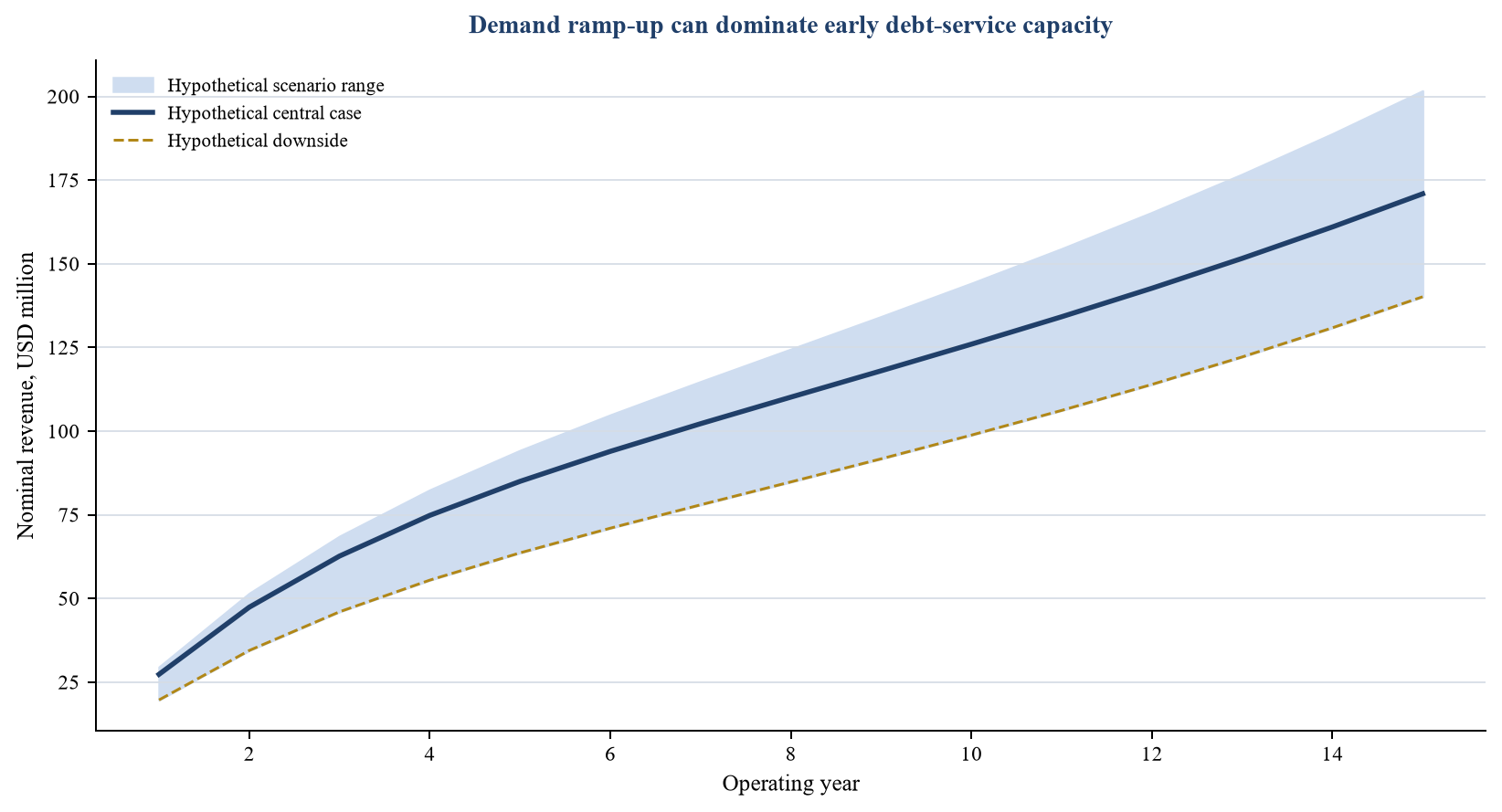
Original hypothetical illustration. Volumes, tariffs and revenue are scenario assumptions, not observed data or forecasts.
5. Select and test the payment mechanism
The payment mechanism converts service and risk allocation into cash. It should identify the payer, payment base, unit, timing, indexation, performance conditions, deductions, caps, relief events, disputes, tax treatment and payment route. It should be capable of implementation by the authority and verification by lenders.
User charges connect private revenue to demand, tariff and collection. The contract and sector framework should state who can set or approve tariffs, how changes are calculated, when extraordinary review is permitted, and what occurs when political action prevents an approved increase.
Availability payments connect revenue to an asset or service being available at defined quality. The output specification, measurement system, deduction regime and cure process must work together. If every failure produces a negligible deduction, risk transfer may be weak. If deductions can become disproportionate or unpredictable, lenders may reduce leverage or require support.
Usage-based government payments retain public payment responsibility while varying with demand. They can preserve volume incentives but create budget volatility. Milestone or capital contributions can reduce financing cost while reducing private capital at risk during delivery.
World Bank guidance states that PPP payment mechanisms can combine user charges, government payments, milestone subsidies, bonuses and deductions, and that the details should be defined in the contract. [4] The gate should trace every payment element to the risk it is intended to allocate and the behaviour it is intended to encourage.
Indexation deserves its own test. The model should identify the index, base date, lag, currency, formula, cap, floor and unavailable-index replacement. Construction and operating costs may respond differently to inflation. Debt can reprice on another basis. A broad consumer index may provide imperfect protection for energy, labour or imported equipment.
The gate should reconcile calculated payment to invoice, approval, budget and cash. Operational teams need systems and authority to measure service and process payment within the contractual timetable. A bankable formula with no executable public payment process remains incomplete.
6. Build the project cash-flow spine
The financial model should connect construction, operations, revenue, working capital, tax, financing, reserves and distributions in a transparent sequence. It should be controlled, versioned and capable of independent reproduction. Inputs should state source, date, unit, currency and status.
Construction cost should reconcile to design quantities, procurement assumptions, contingencies, inflation, land and interface responsibilities. The model should distinguish base cost, risk allowance, financing cost, taxes and public contributions. Schedule assumptions should link to permits, procurement, construction logic, testing and service commencement.
Operating cost should include labour, energy, maintenance, lifecycle replacement, insurance, concession fees, technology, environmental obligations, handback and contract management. Costs that occur infrequently can still drive debt capacity if they coincide with weak revenue.
Revenue should flow from the payment mechanism. The model should not use one annual growth line when the contract depends on volume bands, indexation, service deductions or tariff approvals. Cash collection should reflect billing and payment timing.
Financing assumptions should distinguish indicative terms from committed terms. Debt amount, draw schedule, tenor, amortisation, interest, fees, hedging, reserve accounts, covenants and refinancing need evidence. Equity contribution and return assumptions should reflect the proposed risk.
The central case should satisfy arithmetic and contractual logic. Downside cases should test combined risks rather than isolated sensitivities alone. Construction delay can increase interest during construction, postpone revenue, consume contingency and shorten operating cash flow at the same time.
The gate should report debt-service coverage, loan life coverage, equity cash flow, minimum cash, fiscal payments and contingent exposure. These ratios are decision aids. They do not establish lender commitment or investment return without verified assumptions and negotiated documents.
7. Translate risks into rights and obligations
The risk register should identify cause, event, consequence, phase, controlling party, proposed allocation, mitigation, contract treatment, financial-model effect and residual exposure. Generic lists provide a starting point. The project-specific record should reflect geography, sector, technology, counterparties and interfaces.
Risk should generally sit with the party able to control its likelihood or consequences at reasonable cost. Allocation also requires the rights and information needed to manage it. World Bank guidance connects responsibilities, rights, risks and payment mechanisms. [5]
Construction risk may sit with the project company, supported by a fixed-price or risk-priced construction contract, completion tests, delay damages and sponsor support. Government-retained land, utility relocation or permit obligations should have defined dates and consequences.
Operating risk may sit with the private party when output standards are measurable and the operator controls resources. Changes in law, discriminatory action, force majeure and political risk require jurisdiction-specific treatment. Environmental and social risk should reflect responsibility for existing conditions, design, construction, operation and stakeholder engagement.
Demand, tariff, currency, inflation and refinancing risks should be tested together. Allocating foreign-exchange risk to a project with local-currency revenue and foreign-currency debt can produce failure outside management control. Public support may be justified, but the fiscal cost and alternatives need approval.
Each relief or compensation event should specify notification, mitigation, evidence, calculation, dispute and time limits. Broad clauses can create uncertainty and pricing premiums. Overly narrow clauses can leave a project unable to continue after a material event.
The gate should identify residual risks that remain unallocated, uninsurable or uncapped. These matters can drive bid qualifications and lender conditions. They should be resolved or accepted by the competent authority before launch.
| Risk | Control question | Required contractual expression | Gate evidence |
|---|---|---|---|
| Site and land | Who can provide lawful access by the required date | Access obligation, condition, relief and compensation | Title, surveys, acquisition plan and approved timetable |
| Design and construction | Who controls design, contractors, cost and completion | Output requirements, completion tests, damages and relief | Feasibility, reference design, market evidence and risk-priced cost |
| Demand and revenue | Who can influence use, tariff and collection | Payment mechanism, review formula, bands and support | Demand study, willingness-to-pay evidence and sensitivity |
| Operations and lifecycle | Who controls performance and replacement | Service standards, deductions, monitoring and handback | Operating plan, lifecycle model and independent review |
| Law and government action | Which changes are ordinary business risk or public action | Change mechanism, compensation and termination | Legal review, jurisdiction analysis and fiscal approval |
| Currency and inflation | Which party controls denomination or hedging | Indexation, currency treatment and hedge obligations | Cost, revenue, debt and market alignment |
| Force majeure and climate | Which events can be mitigated or insured | Relief, insurance, restoration and termination | Hazard study, resilience design and insurance sounding |
| Termination | What value and debt protection apply in each cause | Formula, deductions, payment timing and security | Legal enforceability and fiscal sensitivity |
Original framework. This table does not recommend an allocation for any specific project.
8. Test government support as a priced instrument
Government support can include land, capital grants, subordinated funding, minimum-revenue arrangements, availability payments, tax treatment, guarantees, foreign-exchange protection, debt-service support, termination payments and political-risk undertakings. Each instrument should have a defined purpose.
The authority should identify the market failure or retained public risk being addressed. Support can improve bankability by reducing construction cost, protecting a risk outside private control or strengthening payment security. It can also weaken incentives, displace private risk capital or conceal an unaffordable project.
World Bank guidance groups support across direct finance, grants, subsidies, guarantees and other risk-mitigation arrangements. It emphasises that public involvement varies by sector and context. [6] The gate should avoid treating a comfort letter, contractual undertaking and sovereign guarantee as equivalent. Their legal effect and fiscal exposure can differ materially.
Every instrument should specify beneficiary, trigger, amount, cap, duration, conditions, ranking, budget route, approval, monitoring and disclosure. The model should quantify expected direct payments and scenario-based contingent payments. Legal review should test authority and enforceability.
Support should be compared with alternatives. An upfront grant may reduce financing cost but transfer less completion risk. A minimum-revenue guarantee can preserve private demand incentives within a band but expose government to prolonged shortfall. An availability structure may allocate demand to government directly and make performance risk more explicit.
The gate should test whether support remains proportionate under upside. Revenue sharing, refinancing gain sharing or support reduction can preserve public value when performance exceeds the case that justified support.
Approvals should identify the fiscal owner. A project ministry may support the service while a finance ministry bears the contingent liability. Both need a common record and continuing monitoring plan.
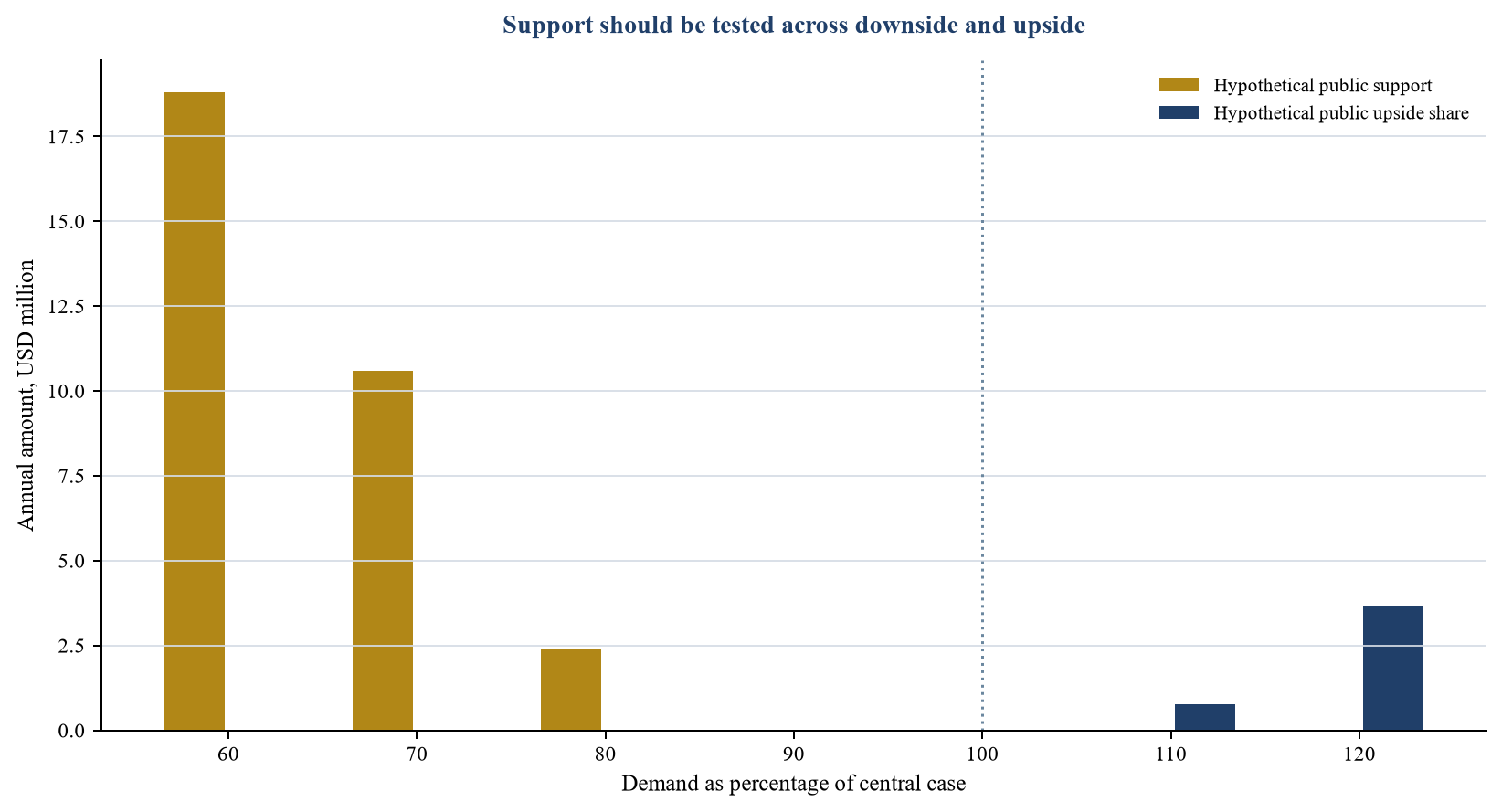
Original hypothetical illustration. Support payments and thresholds are assumptions and do not describe any government programme.
9. Measure direct and contingent fiscal exposure
Fiscal appraisal should cover cash, accrual and contingent effects over the project life. Direct commitments include capital contributions, availability payments, operating subsidies, land and public works. Contingent commitments can arise from guarantees, compensation events, termination, refinancing support, currency protection and public-counterparty failure.
The model should map each contractual trigger to a fiscal variable. It should state whether the exposure is capped, indexed, time-limited, insured, shared or recoverable. It should also identify implicit exposure where government may intervene to preserve an essential service even without an express guarantee.
PFRAM, developed by the IMF and World Bank, supports assessment of PPP fiscal costs and risks. Its outputs include private-partner cash flow, government financial statements, a fiscal-risk matrix and sensitivity analysis. [7] A project gate can use PFRAM or an authorised equivalent, with project-specific data and documented assumptions.
Affordability should be tested against the responsible budget, not only national aggregates. A payment may be modest relative to government revenue while exceeding a ministry's future operating envelope. The gate should identify appropriation, multi-year commitment authority, payment priority and any dependency on annual approval.
Scenario analysis should combine demand, inflation, exchange rate, delay, deductions and termination. It should state nominal and real values consistently. Probability-weighted expected cost can support analysis when probabilities have a defensible basis, but tail exposures and liquidity timing should remain visible.
The fiscal record should name the monitoring owner after award. Guarantees and support require periodic exposure measurement, budget planning and public reporting as applicable. A one-time approval before tender does not manage a twenty-five-year obligation.
10. Test payment security and public-counterparty credit
Lenders examine the legal and practical route from service performance to cash. For user-pays projects, this includes tariff authority, billing, collection, leakage, enforcement, account control and competing claims. For government-pays projects, it includes budget authority, appropriation, invoice certification, payment timing, dispute rules and the credit of the paying entity.
The gate should map every step. The model may assume payment on day thirty while the public process requires service certification, departmental approval, treasury release and bank settlement. Historical payment performance can inform the timing assumption when comparable evidence exists.
Payment security instruments can include escrow, reserve accounts, letters of credit, guarantees, direct agreements, assignment, intercept mechanisms or budget undertakings. Each requires legal, fiscal and operational review. The instrument should address a defined risk and remain executable throughout the term.
The authority should distinguish central government, municipality, state-owned enterprise, regulator and dedicated fund. Their obligations, revenue sources and legal capacity can differ. A general expectation of government support does not create an enforceable payment right.
Termination compensation requires particular attention because it can support debt while creating a large public liability. Formulas should distinguish authority default, private default, prolonged force majeure and voluntary termination. They should address asset condition, insurance, deductions, equity treatment, senior debt, hedging breakage, payment timing and transfer.
The gate should test delayed payment, disputed deductions, budget interruption and counterparty downgrade. Lender feedback should identify whether proposed security changes pricing, tenor, leverage or participation. The record should preserve the range and conditions rather than claim committed debt.
11. Conduct disciplined market sounding
Market sounding should test structure, capacity and procurement design without conferring advantage. The authority should prepare a controlled information pack, common questions, confidentiality terms and a response record. Applicable procurement law should guide contact and disclosure.
Participants can include sponsors, construction contractors, operators, lenders, institutional investors, insurers, technical suppliers and advisers. Different participants see different risks. A contractor may accept completion obligations that lenders still view as weak because the contractor's credit or cap is insufficient.
Questions should seek specific evidence: acceptable risk, pricing driver, financing tenor, currency, security, minimum due-diligence period, information gap, procurement concern and conditions for participation. A statement that a project is attractive is less useful than a description of the term that prevents an underwritten bid.
The authority should avoid negotiating the contract through sounding. It should also avoid adopting a respondent's preferred allocation without testing public value and fiscal consequences. The record should identify conflicts and commercial incentives.
Competitive depth matters. A structure that only one sponsor or lender can accept can weaken price discovery and resilience. The gate should estimate the credible field by role and identify concentration in technology, construction, financing or operation.
Sounding should be repeated after material changes. A positive response to an earlier scope does not validate a revised payment mechanism or risk allocation. The gate conclusion should state the version tested and unresolved qualifications.
12. Build a lender-readiness case
The lender case should begin with the proposed borrower, ownership, project agreements, cash-flow waterfall, security package and direct agreements. The project company needs the rights, resources and contracts to perform its obligations.
Technical due diligence should address design, construction plan, technology, interfaces, schedule, cost contingency, performance tests, operations, lifecycle and handback. Environmental and social review should address applicable law, standards, permits, land, consultation and remediation.
Legal diligence should test authority, procurement, concession rights, land, permits, enforceability, security, step-in, termination, dispute and sovereign or public-counterparty matters. Tax, accounting, insurance and hedging advice should reflect the structure and jurisdiction.
The model should generate covenant and reserve cases. Lenders may require minimum coverage, debt-service reserves, maintenance reserves, distribution locks, cash sweeps, sponsor support or completion undertakings. These terms affect equity returns and public affordability.
The gate should obtain evidence of available financing currency and tenor. Long-life local-currency assets can face refinancing or currency mismatch when markets offer shorter or foreign-currency debt. Public or development-finance participation should be identified with its eligibility and approval conditions.
An indicative term sheet can strengthen the gate, but it remains conditional. The authority should record conditions precedent, information requirements, underwriting assumptions, syndication exposure and expiry. Bid timetables should allow bidders to obtain credible finance without restricting competition unnecessarily.
13. Test sponsor, contractor and operator capacity
Bankability depends on the delivery chain as well as project cash flow. The gate should define minimum technical, financial and integrity qualifications for sponsors, contractors and operators. These criteria should be proportionate and compatible with competition.
Sponsor review can cover relevant delivery record, financial resources, governance, compliance, proposed equity, support commitments and capacity across other projects. A large balance sheet does not establish willingness to fund an overrun unless the obligation is documented.
Contractor review should consider scope alignment, price basis, exclusions, cap, delay and performance damages, security, parent support, interface obligations and credit. A pass-through contract can reduce project-company risk only to the extent that obligations, timing and remedies align.
Operator review should cover service delivery, staffing, systems, maintenance, lifecycle, emergency response and handback. Long-term cost assumptions should reconcile to enforceable arrangements or a prudent replacement case.
Supply-chain concentration should be visible. Proprietary technology, scarce equipment, single ports, foreign exchange, sanctions, export controls or specialist maintenance can affect construction and operation. The structure should include alternatives, inventory, warranties and transition rights where appropriate.
The gate should state how qualifications will be verified and maintained. Consortium changes after qualification can alter capacity and risk. Tender rules should address approval, replacement and continued compliance.
14. Integrate climate, environmental and social resilience
The project should identify physical climate hazards, transition factors, environmental impacts, social effects and adaptation requirements. These issues can alter design, cost, insurance, demand, permits, financing and service continuity.
Hazard assessment should consider the asset location and operating life. Flood, heat, drought, storm, wildfire, sea-level, water availability and grid conditions can affect sectors differently. The technical design should state the standard, data and residual risk.
Environmental and social assessment should connect mitigation commitments to project agreements, cost, timetable and monitoring. Land acquisition, resettlement, labour, community health, biodiversity and cumulative impacts can become critical-path obligations.
The payment mechanism should avoid incentives that conflict with resilience. A private party should have the rights and payment treatment needed to maintain agreed standards. Government-directed changes should use a controlled change process.
Insurance sounding should test availability, exclusions, deductibles, limits and future repricing. Uninsurable or increasingly expensive risks require an explicit allocation and reserve plan.
The gate should distinguish compliance from value creation. Meeting a minimum permit condition may leave substantial lifecycle exposure. A resilience investment may increase initial cost while reducing interruption, fiscal support or handback risk. The appraisal should compare whole-life effects with stated assumptions.
15. Design a procurement that can produce a financeable bid
The procurement should state evaluation criteria, bid requirements, data-room access, dialogue process, timetable, bid security, financing evidence, contract mark-up rules and conditions for award. Requirements should support comparable bids and preserve competition.
The authority should decide which terms remain fixed and which can be optimised. Excessive prescription can block innovation. Excessive flexibility can produce bids that cannot be compared and require post-award negotiation.
The bid model should use common assumptions where comparability requires them, such as inflation curves, tax assumptions, reference interest rates or demand data. Bidders should identify deviations and proprietary inputs. The authority should retain the ability to test bid robustness.
Financing requirements should reflect market conditions. A fully underwritten package can strengthen deliverability but increase bid cost and restrict participants. A looser commitment can preserve competition while increasing financial-close risk. The gate should choose and justify the balance.
Evaluation should cover price, service, technical quality, risk, deliverability and fiscal effect. A low central payment can be achieved by aggressive demand, residual value or refinancing assumptions. The authority needs adjustment and sensitivity rules that expose these differences.
The procurement timetable should allow site visits, diligence, consortium formation, lender approval, insurance review and bid governance. Delays should be managed through a controlled process. Repeated late changes can raise price or drive credible bidders away.
16. Create the gate scorecard without false precision
The gate scorecard should display the status of each test, the evidence confidence, material open items and the responsible authority. It can use red, amber and green for navigation, provided the underlying facts remain visible.
A red result indicates that the current structure should not launch. Examples include an undefined payment obligation, no lawful land path, unaffordable public exposure, a demand case with no evidence, or a risk that credible lenders cannot accept.
An amber result requires a named condition, owner, deadline and consequence. The approving authority should decide whether the condition must be completed before launch or can be completed before bid submission, award or financial close. That sequencing should reflect market confidence and public risk.
A green result means the required evidence has been reviewed for the stated gate. It does not guarantee bid response, financial close or project performance. The record should state the review scope and date.
Weighting can help prioritise work, but it should not permit a strong strategic score to offset an unaffordable fiscal commitment. Mandatory conditions should sit outside the weighted score.
The scorecard should include evidence quality. A technically plausible estimate based on preliminary design has a different status from a contracted price. A lender's general sector appetite differs from a project term sheet. The board should see these distinctions.
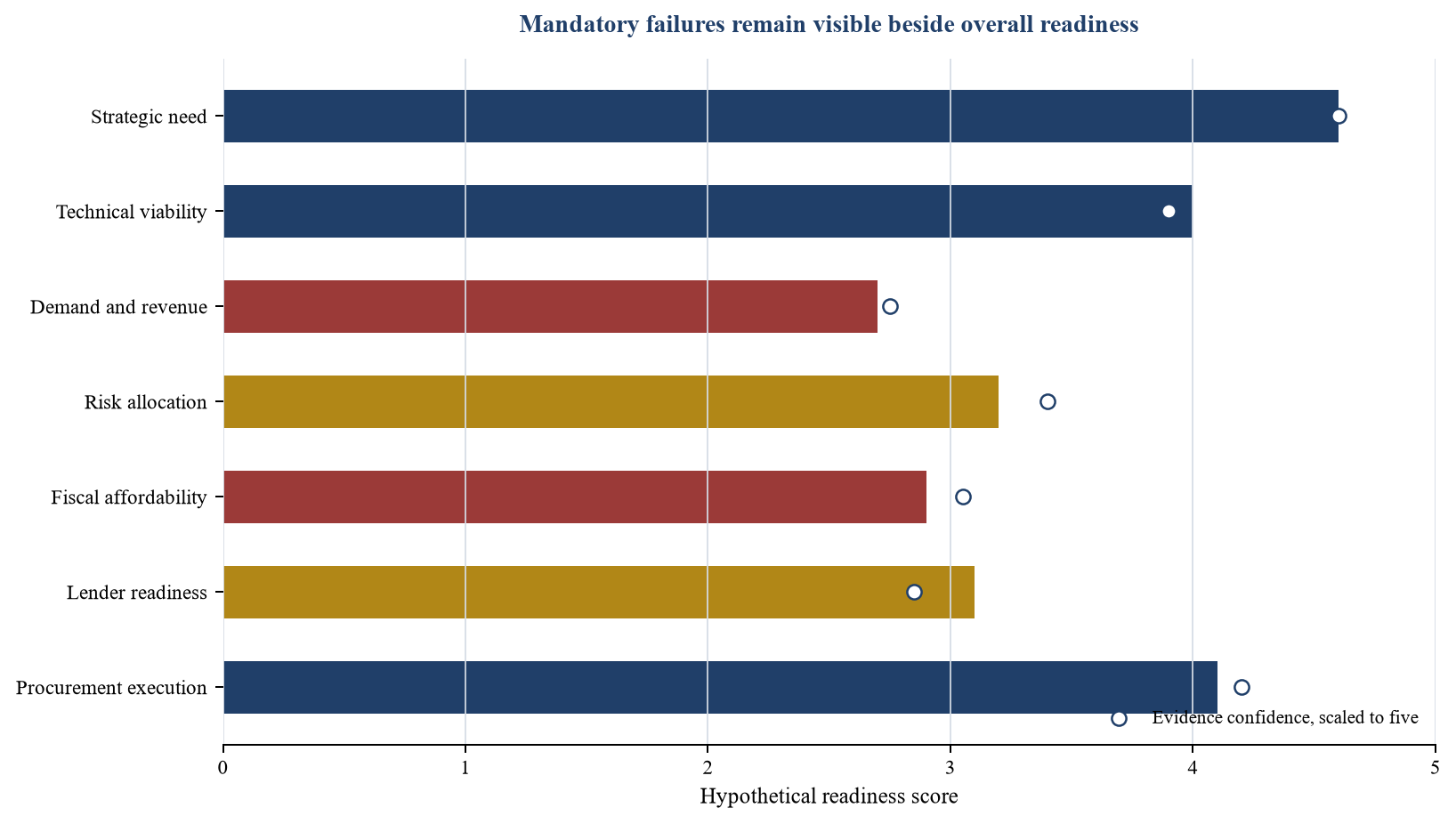
Original framework. Scores are hypothetical and do not assess any actual project.
17. Apply a hypothetical integrated case
Consider a wholly hypothetical infrastructure project with USD 420 million of construction cost, a three-year construction period and a twenty-five-year operating term. The project could use a user-pays, availability-payment or hybrid revenue structure. Every amount and assumption in this section is illustrative.
The central user-pays case assumes first full-year revenue of USD 68 million after ramp-up, long-run nominal growth of 2.5 per cent, operating and lifecycle cash cost of USD 24 million, and senior debt of USD 294 million. A downside combines a twenty per cent demand reduction, a twelve-month ramp-up delay, five per cent construction overrun and slower collections. The project requires additional equity and produces weaker debt coverage.
The availability case assumes an annual unitary payment calibrated to service and deductions. It reduces private demand exposure while creating a direct public commitment. A ten per cent service deduction, delayed public payment and inflation mismatch are tested together.
The hybrid case combines user revenue with a minimum-revenue band and public upside share. At low demand, support activates up to a stated cap. At high demand, government receives a share above a threshold. The structure preserves some private demand exposure while creating contingent fiscal risk.
The authority should compare the cases across service outcome, bankability, fiscal cost, user affordability, incentive, complexity and value for money. A case with the highest leverage is not automatically preferred. Higher debt can increase fragility and termination exposure.
The hypothetical gate identifies demand evidence and fiscal affordability as amber. It requires an independent willingness-to-pay study, a revised tariff path, finance-ministry approval of the support cap and lender confirmation of the revised payment-security package before bid launch.
| Measure | User-pays | Availability payment | Hybrid |
|---|---|---|---|
| Construction cost | USD 420 million | USD 420 million | USD 420 million |
| Proposed senior debt | USD 294 million | USD 315 million | USD 302 million |
| Principal revenue risk | Demand, tariff and collection | Public payment, availability and deductions | Shared demand, support trigger and public payment |
| Central public cash | Limited direct payment | Long-term unitary payment | Support only within stated band plus defined public obligations |
| Downside pressure | Lower revenue and coverage | Deduction and payment-delay exposure | Demand loss partly absorbed by capped support |
| Primary gate condition | Verify willingness to pay and tariff enforceability | Approve budget path and payment security | Approve support cap, upside sharing and monitoring |
Every amount, rate and conclusion is hypothetical. The table is a worked method, not a forecast or recommendation.
18. Stress combined failure paths
Single-variable sensitivities are useful for understanding model mechanics. They can understate risk when events are connected. A delay can increase construction cost, interest, foreign-exchange exposure and lost revenue simultaneously. Demand weakness can coincide with political reluctance to raise tariffs.
The gate should identify a small set of coherent scenarios. These can include delayed completion, lower demand, tariff freeze, public-payment delay, construction overrun, operating underperformance, inflation mismatch, currency depreciation, interest-rate increase and early termination. Each scenario should state causal logic and avoid double counting.
Liquidity timing matters. An annual model can show adequate coverage while a quarterly payment delay causes default. The project and fiscal models should use a time step capable of capturing construction draws, reserve use, debt service and public payments.
Mitigation should be modelled with its cost. Sponsor support, reserve accounts, insurance, hedging, standby facilities and public guarantees require fees, capital or fiscal capacity. The case should avoid assuming that every mitigation is simultaneously available.
The authority should examine recovery as well as failure. Cure periods, step-in, contractor replacement, tariff review, refinancing and public intervention have timelines and legal conditions. An asset may remain essential even when the project company fails.
The outcome should be a decision about resilience. The gate should state which scenario the structure can absorb, which requires intervention, and which makes the PPP route unacceptable.
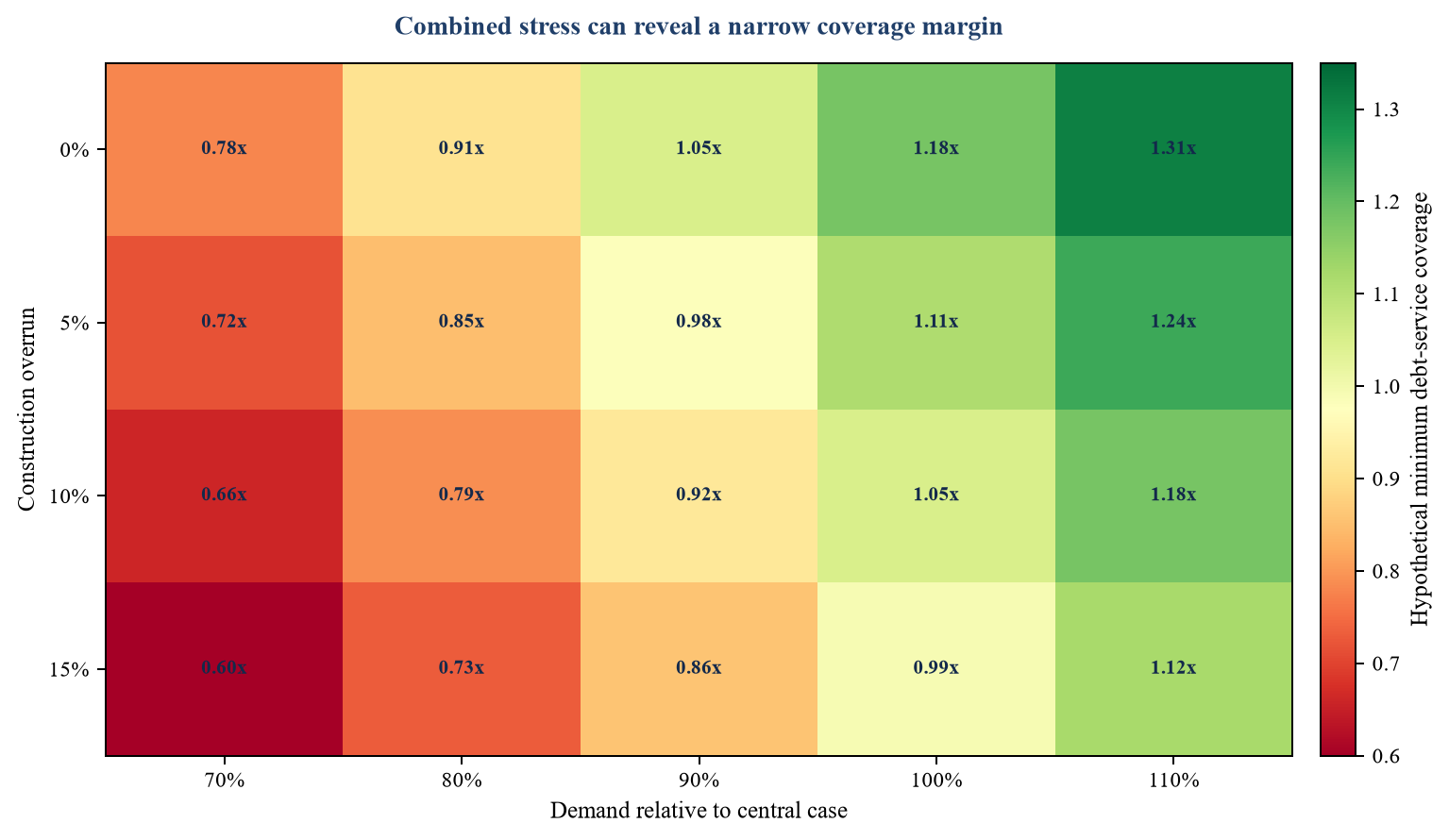
Original hypothetical illustration. Coverage ratios and stress assumptions do not represent lender terms or project forecasts.
19. Set conditions and decision rights
Every unresolved matter should have an owner, deadline, required evidence and consequence. The gate committee should distinguish conditions for bid launch, bid submission, preferred-bidder selection, contract signature and financial close.
Conditions for launch should include matters that affect market confidence, competition, legality or the ability to price. Examples can include project perimeter, land route, payment mechanism, principal risk allocation, fiscal authority and a credible procurement timetable.
Some detailed matters can remain for competitive dialogue or bid optimisation. Their treatment should be transparent and consistent. The authority should avoid deferring a structural affordability or bankability problem into negotiation with the preferred bidder.
Decision rights should reflect institutional mandates. The sponsoring authority can own service scope. A finance ministry can own fiscal approval. A procurement authority can own process. Regulators, environmental authorities and land agencies can own relevant approvals. The gate record should show concurrence and dissent.
Advisers prepare and challenge evidence within their mandates. They should not replace public decision authority. Conflicts, assumptions and reliance limitations should be recorded.
The release memorandum should state the approved structure, evidence date, scenarios, conditions, delegated changes and matters requiring return to the gate. A material change in scope, payment, support, risk or timetable should trigger reappraisal.
20. Govern the data room and bid evidence
The pre-bid data room should allow credible bidders and lenders to test the structure. It can include feasibility studies, surveys, demand evidence, legal framework, land records, environmental and social work, reference design, asset data, payment assumptions, fiscal approvals and draft project documents.
Documents should have owners, dates, versions and reliance status. The authority should distinguish information supplied for background from warranties or bidder-risk items. Contradictory studies should remain visible with an explanation rather than be silently removed.
Questions and answers can change risk allocation. Material clarifications should be issued consistently to eligible bidders and incorporated into controlled documents. The authority should maintain a decision log connecting each change to technical, financial, fiscal and legal effects.
Sensitive information requires access controls and lawful handling. Security, personal data, critical infrastructure, land and commercially confidential records may require tiered access or redaction. Controls should still provide enough evidence for pricing and finance.
The financial model supplied to bidders should state purpose, assumptions, protections and audit status. Bidders will build their own cases. A public model should support comparability and fiscal evaluation without becoming an implied guarantee of outcome.
Before launch, an independent data-room readiness review should test completeness against the risk register and bid requirements. Missing material should become a disclosed condition with a timetable and allocation.
21. Monitor the gate through procurement and financial close
The gate remains a living control after launch. Bidder feedback, site findings, market rates, law, demand and public budgets can change. The authority should refresh the decision at defined procurement milestones.
At qualification, it should test competitive depth and delivery capacity. Before final bid, it should confirm that clarifications and contract changes remain within fiscal approval. At preferred bidder, it should compare bid assumptions, financing evidence and qualifications against the gate case.
Before contract signature, the authority should repeat affordability and value-for-money appraisal using the actual bid. World Bank guidance notes that final cost, affordability and value for money are not known until procurement is complete. [1]
Before financial close, the authority should verify financing documents, conditions precedent, hedging, reserves, sponsor commitments, direct agreements and any change from award. It should also confirm that public support instruments have valid approvals and implementation arrangements.
The contract-management team should inherit the risk register, payment model, fiscal-support register, data definitions, key assumptions and decision history. It should have systems, budget and authority to monitor service, payments, guarantees, changes and handback.
Material deviations should return to the competent gate. A revised financing plan, additional support or altered payment mechanism can change risk transfer and public value. Contract signature should not make those questions invisible.
22. Use the gate to protect public and private value
A disciplined gate can reduce wasted bid cost, improve competition and expose structural problems while the authority can still change course. It creates a common record for public decision makers, sponsors, lenders, advisers and procurement teams without merging their responsibilities.
The gate protects public value by keeping strategic need, affordability, value for money and fiscal exposure visible. It protects private participation by supplying a coherent scope, evidence base, risk allocation and decision timetable. It supports credible refusal where a proposed structure cannot be financed or governed responsibly.
The strongest gate output is a reproducible decision. A reviewer should be able to trace the service need to the technical perimeter, payment mechanism, demand evidence, risk allocation, financing case, government support, fiscal model, procurement design and conditions.
The authority should preserve uncertainty. Preliminary cost, demand and financing terms should retain their status. Scenario results should not be presented as forecasts. Market appetite should not be described as committed capital until the relevant institution has completed its approvals.
The PPP route is suitable when it can deliver the required service through an affordable, competitive and governable allocation of long-term responsibility and risk. The PPP Bankability Gate gives the competent authorities a structured point at which to proceed, condition, restructure or stop before bid launch.
| Decision item | Required statement | Evidence attachment | Approval |
|---|---|---|---|
| Public investment case | Defined service need, selected scope and economic rationale | Options and economic appraisal | Sponsoring and planning authorities |
| Payment and revenue | Payer, formula, tariff, indexation, deductions and collection | Payment model and demand evidence | Sponsoring and fiscal authorities |
| Risk allocation | Principal risks, rights, mitigations and residual exposure | Risk matrix and draft commercial terms | Project board and legal authority |
| Government support | Instrument, purpose, cap, trigger and monitoring | Fiscal model and legal authority | Competent fiscal authority |
| Financing | Indicative debt and equity, downside capacity and conditions | Model, market sounding and indicative terms | Project board with independent challenge |
| Procurement | Competitive field, timetable, evaluation and bid requirements | Procurement strategy and approvals | Procurement authority |
| Conditions | Owner, evidence, deadline and consequence | Controlled exception register | Named gate committee |
| Release | Proceed, condition, restructure or stop | Signed gate memorandum | Competent decision authority |
Original framework. Approval roles and thresholds should follow applicable law and institutional mandates.
Sources
- World Bank Group. Appraising Potential PPP Projects. Accessed 15 September 2026. Read the primary source
- World Bank Group. Assessing Fiscal Implications of a PPP Project. Accessed 15 September 2026. Read the primary source
- World Bank Group. Structuring the PPP Contract: Demand Risk and Payment Models. Accessed 15 September 2026. Read the primary source
- World Bank Group. Payment Mechanism. Accessed 15 September 2026. Read the primary source
- World Bank Group. Translating Risk Allocation into Contract Structure. Accessed 15 September 2026. Read the primary source
- World Bank Group. Government Support in PPP Projects. Accessed 15 September 2026. Read the primary source
- International Monetary Fund and World Bank Group. PPP Fiscal Risk Assessment Model 2.0 User Manual. September 2019. Accessed 15 September 2026. Read the primary source
- World Bank Group and partner institutions. PPP Reference Guide, Version 3. Accessed 15 September 2026. Read the primary source
- OECD. Recommendation of the Council on the Governance of Infrastructure. 17 July 2020. Accessed 15 September 2026. Read the primary source
- OECD. Infrastructure Governance Indicators: Conceptual Framework, Design, Methodology and Preliminary Results. 6 June 2023. Accessed 15 September 2026. Read the primary source
