
Introduction
The worst day for a water system is rarely a simple shortage. A prolonged drought may coincide with high demand and reduced source quality. A trunk main may fail while a treatment plant is under maintenance. A power disruption can stop pumping across several assets. Flooding can contaminate intakes and block access. Cyber or telecommunications failure can impair control systems. The service problem is therefore a sequence of constrained sources, treatment, storage, conveyance and distribution.
Strategic reserves create time for the system to respond. They can hold raw or treated water, connect surplus and deficit regions, preserve minimum supply for critical users, or provide a deployable emergency source. Their value appears during infrequent and severe conditions. Normal volumetric tariffs may provide too little revenue for assets designed to wait, switch or respond. A public-private partnership can convert the reserve obligation into measurable performance and long-term payment, provided the public authority defines the service clearly and allocates risks to parties able to manage them.
The financing problem therefore begins with a public decision about acceptable service loss. The authority must decide which emergencies the system should absorb, how much minimum service it will protect and how long the reserve must bridge disruption. Engineering then identifies the assets required. Commercial design determines who can control each obligation, how performance will be verified and which payment supports investment. This sequence prevents a procurement model from being chosen before the reserve need is understood.
1 Define the public service obligation
The starting point is the service to be protected. The authority should specify the population and critical facilities covered, minimum potable and non-potable volumes, water-quality requirements, delivery points, response time, duration and recovery standard. A broad promise of water security provides insufficient precision for procurement, finance or accountability.
The obligation should distinguish ordinary reliability from emergency continuity. Ordinary reliability concerns expected operating conditions and scheduled maintenance. Emergency continuity concerns severe events that exceed normal redundancy. The distinction determines whether the reserve is paid through a utility tariff, an availability charge, a government service payment, an emergency budget or a combination.
The obligation must also establish priority rules. Hospitals, firefighting, sanitation, food production, cooling and household drinking water may require different qualities and delivery arrangements. Allocation during scarcity remains a public decision, even when private parties own or operate reserve assets.
2 Map the complete reserve system
A reserve system can combine surface reservoirs, aquifer storage and recovery, treated-water tanks, desalination, reuse, inter-regional pipelines, emergency boreholes, mobile treatment, tanker filling points and mutual-aid connections. Each component performs a different function. Storage buys duration. Transfer capacity moves water between zones. Treatment provides quality. Distribution reaches users. Monitoring and communications support command.
The portfolio should be assessed as a system rather than a list of projects. A large reservoir provides little emergency value if the outlet, treatment works or transfer main is unavailable. A desalination plant provides limited resilience without power, chemical supply and conveyance. Mobile units can support local disruption but may be insufficient for metropolitan demand. The investment case should identify the constrained link under each scenario.
3 Establish the baseline and counterfactual
The baseline should record present sources, treatment, storage, transfer routes, leakage, demand-management capability, backup power, emergency plans and restoration performance. Planned public investment and regulatory commitments belong in the counterfactual. Excluding committed improvements can overstate the incremental value of the PPP.
The authority should model the consequence of doing nothing beyond the baseline. Consequences include emergency procurement, tanker logistics, temporary treatment, business interruption, health protection, public communication and restoration. Some costs fall on the utility, while others fall on households, businesses and government. The project model should keep these categories visible.
Evidence quality matters. Historical droughts and outages support calibration, but future climate and demand can differ. Scenario ranges should therefore be documented as conditional assumptions. They should not be presented as forecasts.
4 Translate hazards into service loss
The reserve need arises through a chain from hazard to service consequence. Drought reduces source yield. Flood can degrade quality. Fire can damage catchments and increase sediment. Energy interruption can halt pumping and treatment. Contamination can remove an otherwise full reservoir. Pipeline failure can isolate stored water from demand. Supplier disruption can constrain chemicals, membranes or fuel.
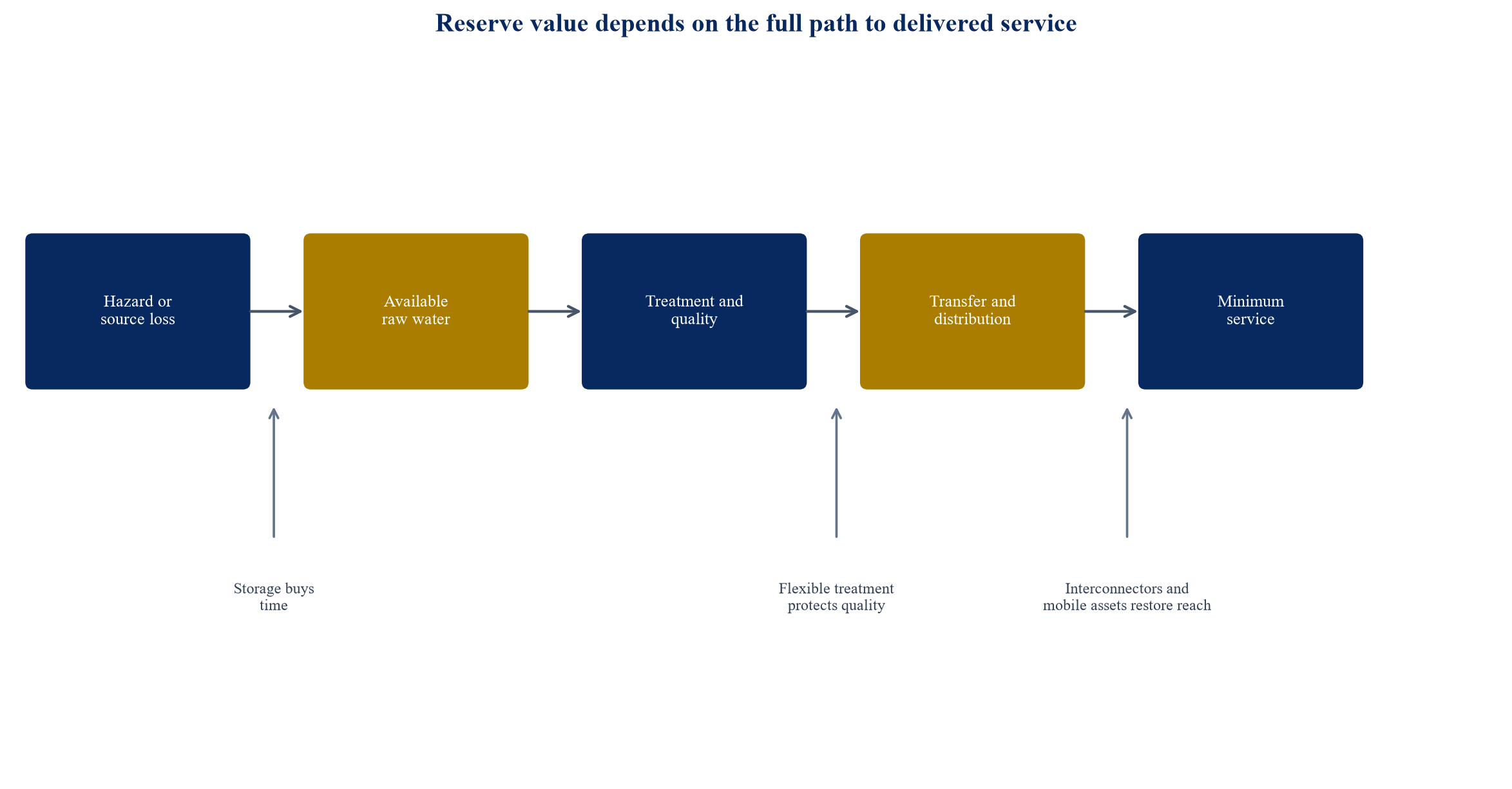
The diagram is an author-developed framework. It does not describe a particular water system or predict an emergency.
This chain prevents isolated capacity claims. The relevant measure is deliverable water at the required quality and location during the defined emergency. Reserve assets should be tested against shared dependencies such as electricity, access, communications and specialist labour.
5 Size the reserve through service days
Reserve size should start with minimum service demand during the emergency, adjusted for demand reduction, alternative sources and delivery losses. The system then needs sufficient duration to bridge the expected restoration or mobilisation period. A single headline number of days can hide important differences between raw-water storage, treated-water storage and distributed emergency inventory.
The calculation should use several service tiers. A life-safety tier can cover drinking, hygiene, healthcare and firefighting. A continuity tier can add essential industry and public services. A recovery tier can restore wider commercial activity. Each tier needs a defined volume, quality and delivery method.
Sensitivity analysis should test population, peak demand, leakage, source yield, treatment derating and restoration time. The authority should also test whether behavioural measures and temporary restrictions are operationally credible.
6 Value storage as an option
Strategic storage has option value because it preserves choices during uncertainty. Water held today can be released when another source fails, a drought worsens or restoration takes longer than expected. The financial model should value avoided emergency cost, avoided interruption and the ability to delay irreversible supply decisions while information improves.
Storage also has carrying costs. Evaporation, treatment, pumping, monitoring, land, environmental mitigation and water-quality management continue during normal periods. Aquifer storage may reduce evaporation but introduces hydrogeological, recovery and quality risks. Treated-water tanks provide rapid access but usually cover shorter durations.
The preferred option depends on the service requirement and local system. The PPP should specify available usable volume, refill capability, quality and release performance rather than rely on nominal geometric capacity.
7 Design interconnectors for deliverability
Pipelines and pumping stations convert regional diversity into usable resilience. Their value depends on hydraulic capacity, compatible water quality, pressure, receiving-network capacity, energy, operating rules and rights to the source. A line on a map does not prove deliverability.
Interconnectors should be tested in both directions where operationally relevant. The emergency may affect either region. Maintenance and inspection regimes must preserve low-use assets that can deteriorate unnoticed. Periodic exercising can verify valves, pumps, controls, communications and operator readiness.
Commercial arrangements should define nomination, scheduling, energy cost, water quality, metering, losses, maintenance windows and priority during concurrent scarcity. Bulk supply agreements can allocate ordinary transfers, while the reserve PPP governs emergency availability and response.
8 Include emergency treatment and distribution
Large storage and pipelines may take years to develop. Mobile treatment, modular desalination, emergency boreholes, tanker filling points and packaged distribution can provide earlier or local capability. These assets can also address contamination events that leave water physically available but unsuitable for use.
The contract should specify mobilisation locations, transport, connection standards, testing frequency, consumables, staffing and maximum response time. Equipment stored without exercises can create false confidence. Payment should depend on verified readiness and successful drills.
Emergency distribution requires coordination with local authorities, health agencies, logistics providers and critical facilities. Queue management, access, security, public information and vulnerable-user support sit outside plant performance yet determine service outcomes.
9 Choose the PPP boundary
The PPP boundary should follow controllable performance. A private partner can design, finance, build, operate and maintain a reservoir, pipeline, treatment plant or integrated reserve package. The authority should retain water allocation, emergency declaration, public-health policy, compulsory restrictions and sovereign coordination.
A whole-system concession may offer integrated incentives but can become complex where several utilities, regions or regulators are involved. Asset-specific PPPs are easier to finance but require strong interface agreements. A programme vehicle can procure several standardised reserve assets while maintaining public system control.
The boundary should avoid assigning hydrology, national demand or public allocation decisions to the private partner where it cannot control them. It should still hold the partner accountable for design robustness, asset availability, operating response and maintenance.
10 Select the commercial model
Potential models include design-build-operate contracts, build-operate-transfer concessions, availability-payment PPPs, bulk-water purchase agreements and regulated infrastructure-provider models. The choice depends on whether volume revenue is reliable and whether the asset serves normal operations as well as emergencies.
Availability payments are often suited to strategic reserves because the authority purchases readiness. Deductions can apply when usable capacity, water quality, response time or tested availability falls below contract. A bulk-water tariff can support assets with regular output, while a separate capacity charge covers emergency reserve obligations.
Demand-risk transfer should be limited where public policy controls consumption, restrictions and source dispatch. Artificial volume guarantees can encourage water use or burden the authority with unnecessary offtake. The commercial model should reward resilience and efficient operation.
11 Build the payment mechanism
The payment mechanism should link public expenditure to measurable service. Core elements can include fixed availability, verified usable volume, transfer capacity, response time, quality compliance, maintenance, drill performance and restoration. Energy and commodity pass-through should follow transparent indices and efficiency benchmarks where appropriate.
Payment deductions need proportionality. Small administrative failures should not threaten debt service, while prolonged loss of emergency capability should create material consequences. Cure periods should reflect health and safety. Repeated failure can trigger enhanced monitoring, lender intervention or public step-in.
The mechanism should prevent double payment where the same asset earns a regulated tariff and a government availability charge. The financial model must show which cost and risk each revenue stream covers.
12 Separate availability from emergency use
Availability is the asset's verified readiness before an event. Emergency use is its actual performance after activation. Both require measurement. Availability can be tested through inspections, telemetry, water-quality sampling and exercises. Emergency performance can be measured through mobilisation, delivered volume, quality, continuity and restoration.
An authority may pay the majority of the annual charge for availability, with smaller variable payments for activation and consumables. This structure supports debt service during years without emergencies. It also avoids depending on disaster frequency for revenue.
Activation rules should identify who declares the event, how instructions are issued and how conflicting requests are resolved. The private partner should receive protection from unauthorised dispatch while remaining accountable for responding to valid instructions.
13 Develop a bankable revenue bridge
Lenders require predictable cash flow from a creditworthy payer or ring-fenced regulated revenue. The authority should identify the legal appropriation, tariff allowance, guarantee, escrow or support mechanism that underpins availability payments. Multi-authority projects need a payment waterfall and clear several-party obligations.
The revenue bridge should also address inflation, power cost, chemical cost, tax, change in law and refinancing. Indexation should match controllable cost exposure without insulating the partner from efficiency obligations. Currency exposure requires explicit treatment where debt, equipment and revenue currencies differ.
Government support should be recorded transparently. Guarantees, minimum payments and termination compensation create contingent liabilities even when they do not appear as immediate expenditure.
14 Allocate construction and interface risk
The private partner can usually manage detailed design, construction method, procurement and completion. The authority should retain or share risks arising from land, existing assets, undisclosed conditions, permits controlled by government and changes to public network interfaces.
Reservoir and pipeline projects face long planning periods, environmental requirements, land acquisition and stakeholder impacts. Early surveys reduce uncertainty, but some ground, archaeological and ecological risks remain difficult to price. Excessive transfer can produce high contingencies, weak competition or disputes.
Interface risk deserves specific schedules. The contract should identify who provides power, source water, connecting works, operating data, access and receiving capacity. Completion tests should demonstrate integrated service rather than individual asset operation.
15 Allocate hydrology and source risk
The private partner can manage compliance with design hydrology and operating rules. It cannot create rainfall, river flow or groundwater recharge. Source-yield risk should therefore be separated from asset-performance risk.
The authority should provide a reference hydrological case, required stress cases and rules for updating them. Payment should remain available when the asset meets contracted readiness but source water is unavailable for reasons outside private control. The partner remains responsible where poor maintenance, leakage or operating error reduces usable reserve.
Groundwater and aquifer storage add abstraction rights, recharge quality, subsurface performance and long-term sustainability. Monitoring obligations should support adaptive management and protect against over-extraction.
16 Allocate climate and force-majeure risk
Climate change affects long-term averages, extremes and compound events. A long contract should distinguish reasonably foreseeable design conditions from exceptional events and gradual changes outside the priced baseline. The World Bank's climate-smart PPP guidance emphasises early assessment, contractual allocation, monitoring and mechanisms for change.
The contract can set design envelopes, periodic climate reviews and thresholds for mandatory adaptation. Where a change exceeds the original envelope, predefined cost-sharing or variation rules are preferable to an open dispute. Force majeure should provide relief for genuinely exceptional conditions while preserving emergency cooperation.
Insurance availability can change. Required coverage, deductibles, uninsurability and premium escalation need specific provisions. Public disaster-risk financing may sit alongside project insurance.
17 Preserve public step-in powers
Water is an essential service. The authority needs step-in rights for health, safety, national security, emergency coordination and serious contractor failure. Lenders also require cure and substitution rights before termination where the problem can be remedied.
Step-in should define trigger, scope, information access, asset control, cost allocation and return to ordinary operations. It should protect staff and public health while respecting lender security. Emergency step-in for a regional crisis differs from default step-in caused by private non-performance.
Data, operating manuals, spares and access credentials must remain available during step-in. A contract right without operational readiness provides limited protection.
18 Protect water quality
Reserve water must remain safe and suitable for its intended use. Storage time can affect disinfectant residuals, temperature, sediment and biological conditions. Inter-regional transfers can introduce chemical differences and network effects. Aquifer storage requires source protection and recovery monitoring.
The water-safety plan should cover catchment, treatment, storage, transfer and distribution. WHO guidance supports systematic risk management and climate integration. Quality obligations should specify sampling, laboratories, thresholds, notification, corrective action and public-health authority roles.
Quality failure should trigger rapid isolation and alternative supply. The payment regime can apply deductions where the private partner caused or failed to manage the breach. Source contamination outside its control requires coordinated response rather than automatic default.
19 Establish the reserve value equation
Strategic reserve value can be expressed as the discounted sum of avoided emergency procurement, avoided utility restoration cost, reduced service interruption, protected critical services, deferred capital and supported system growth, less capital expenditure, operating cost, financing cost, environmental cost and residual risk.
Table 1. Strategic reserve value components and financeability
| Value component | Primary measure | Evidence required | Main beneficiary | Potential funding route |
|---|---|---|---|---|
| Reserve availability | Usable volume and service days | Storage, quality and operating tests | Authority and utility | Availability payment or tariff |
| Transfer resilience | Deliverable flow under stress | Hydraulic, power and network studies | Connected regions | Bulk supply and capacity charge |
| Emergency response | Mobilisation time and delivered volume | Exercises, logistics and staffing | Critical users and public | Government service payment |
| Avoided interruption | Service-hours and users protected | Scenario and demand evidence | Households and economy | Public funding or resilience allowance |
| Avoided emergency procurement | Tankers, temporary plant and premium supply | Historic or benchmarked costs | Utility and authority | Retained budget or reserve |
| Growth capacity | Firm water available for development | Planning and demand evidence | Customers and government | Connection, tariff or development funding |
The table is an author-developed framework. Project values require location-specific engineering, economic, legal and regulatory evidence.
Economic value and borrower cash flow should remain separate. Wider social benefit can justify public support, while debt service requires an enforceable payment route.
20 Build a transparent scenario model
The model should test ordinary operations, single-asset loss, regional drought, contamination, power disruption, concurrent maintenance and compound events. It should identify minimum service achieved, duration, emergency cost, payment, deductions and liquidity under each case.
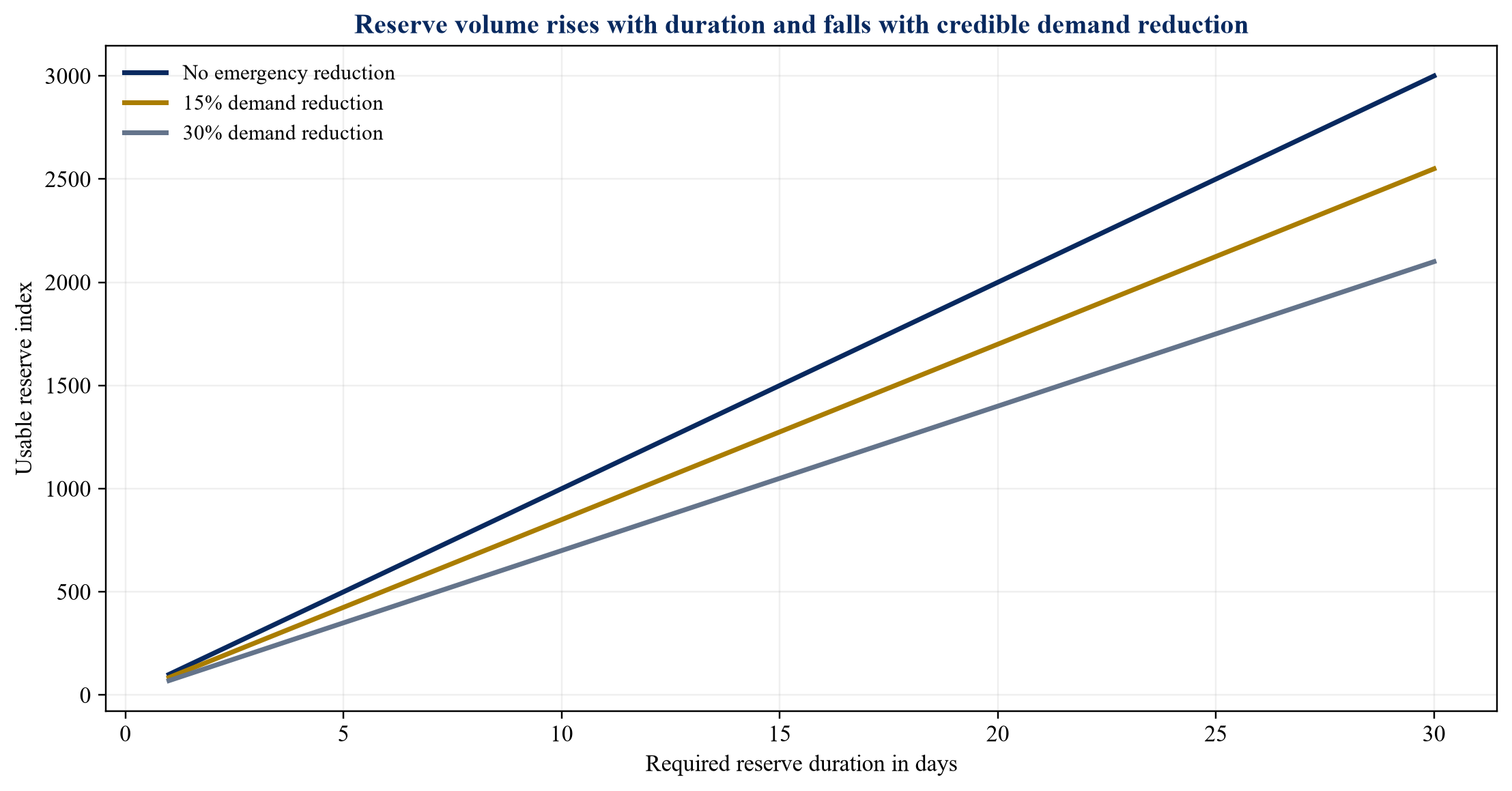
All values are hypothetical author-modelled assumptions for method demonstration. They are not forecasts or project data.
The scenario model should make assumptions visible and version-controlled. Independent review should test hydrology, demand, cost, financing and public-benefit inputs.
21 Test affordability and fiscal exposure
An availability-payment PPP converts upfront capital into a long-term public obligation. Affordability should be tested against tariff revenue, public budgets and competing water investment. The authority should model nominal payments, indexation, contingent liabilities, termination compensation and severe-event activation cost.
Value for money depends on lifecycle performance and risk transfer. Financing cost alone is incomplete. The analysis should compare conventional public delivery and PPP delivery on consistent scope, timing, risk and performance assumptions.
Fiscal reporting should include guarantees and support agreements. A reserve that is politically essential may create an implicit public obligation even without an explicit guarantee. Transparent recognition supports better project selection.
22 Structure debt around availability
Project debt can be supported by contracted availability payments after completion. Construction debt must cover long development and build periods, while reserve facilities address cost overrun, delayed commissioning and temporary payment interruption. Debt maturity should fit the asset life and contract term.
Coverage ratios should be tested after performance deductions, index mismatch and higher operating cost. Severe scenarios should include delayed public payment and partial asset unavailability. Lenders will review termination compensation, step-in, insurance, change in law and dispute resolution.
Where the project combines regular bulk supply and reserve service, cash flows should be separated or clearly prioritised. A transparent waterfall reduces ambiguity during drought or emergency dispatch.
23 Use blended finance selectively
Public grants, concessional loans, guarantees, viability-gap funding and climate finance can improve affordability where wider benefits cannot be captured in tariffs. These instruments should address a documented funding or risk gap. They should not conceal weak project preparation or an unmanageable operating model.
Blended finance can fund early studies, adaptation features, vulnerable-user service or first-loss protection. Commercial debt can then finance predictable availability cash flow. The allocation of benefit and subsidy should remain transparent.
Results-based tranches can link concessional support to commissioning, quality, leakage, resilience exercises or verified service days. The measurement framework needs independent assurance.
24 Protect environmental and social outcomes
Reservoirs and pipelines can affect land, ecosystems, communities and downstream users. The project should assess alternatives, cumulative effects, environmental flows, resettlement, cultural heritage and construction impacts. These matters influence schedule, cost, legitimacy and financing.
Strategic reserves can also provide environmental benefits where they reduce abstraction during sensitive periods or enable transfers from lower-impact sources. Such benefits require evidence and operating rules. Recreational or ecological uses should not compromise emergency availability without an explicit public decision.
The PPP should include monitoring, grievance mechanisms, remediation and disclosure consistent with applicable law and financing standards.
25 Plan energy and carbon performance
Water transfer, treatment, reuse and desalination can consume substantial energy. Emergency operation may coincide with grid stress. The design should assess power demand, backup supply, efficiency, renewable integration and fuel logistics.
Energy risk can be shared through indexed pass-through with efficiency benchmarks. The private partner should remain accountable for controllable consumption and maintenance. The authority should retain policy-driven dispatch decisions that change the source mix.
Carbon assessment should cover construction and operation. A lower-carbon option may carry different land, duration or resilience characteristics. The investment decision should evaluate these trade-offs directly.
26 Use digital systems without creating a single point of failure
Telemetry, sensors, digital twins and forecasting can improve reserve management. They can monitor usable volume, quality, leakage, source yield, energy and equipment condition. Digital systems should support early warning and more efficient dispatch.
Critical manual capability remains necessary. Cyber, communications or data failure can coincide with the emergency. Offline procedures, local controls, protected backups and exercises should form part of the service requirement.
Data rights and interoperability should be defined. The authority needs access for oversight, step-in and future competition. The contract should protect security-sensitive infrastructure information.
27 Procure through evidence gates
The procurement should move through service definition, options appraisal, reference design, environmental and land readiness, market testing, affordability, tender, financial close and completion. Each gate should have evidence requirements and decision ownership.
Early market engagement can test bankability, construction capacity, insurance and bidder appetite. It should not replace competitive procurement or create unequal access. Standardised commercial frameworks can reduce repeated transaction cost across a programme.
Bids should be evaluated on whole-life cost, deliverability, resilience, financing, quality, emergency readiness and environmental performance. A low price based on optimistic hydrology or incomplete interfaces can produce later claims.
28 Set completion and acceptance tests
Mechanical completion does not prove emergency service. Acceptance should test usable storage, water quality, sustained flow, pump and power redundancy, communications, control integration, emergency mobilisation and receiving-network performance.
Tests should cover degraded conditions, not only ideal commissioning. A pipeline may need to demonstrate reverse flow, alternative power or operation with one pump unavailable. Mobile assets should complete realistic deployment exercises.
Independent certification can support lenders and the authority. Remaining defects should be categorised by their effect on service and payment.
29 Operate and exercise the reserve
Low-use assets require active maintenance. Stagnant water, infrequently operated valves, standby generators, dormant treatment trains and stored mobile equipment can deteriorate. The operating plan should set turnover, flushing, sampling, test runs and drills.
Exercises should involve command agencies and critical users. They can test activation, communication, access, security, logistics and public information. Findings should lead to corrective actions and contract updates.
Availability certification should combine automated data with physical inspection and drills. Self-reporting alone provides limited assurance.
30 Manage change over the contract life
Demand, climate, technology, energy and regulation will change during a long PPP. The contract should include periodic review, data-driven adjustment, variation procedures and competitive benchmarking. Flexibility should protect public value without undermining debt predictability.
Changes inside the original design envelope can sit with the private partner. Changes in public policy, allocation priorities or standards may require compensation or scope adjustment. Benefits from cheaper technology can be shared through predetermined mechanisms.
The parties should maintain an updated system model. A new reservoir, desalination plant or major user can alter the reserve's role and value.
31 Establish performance indicators
Indicators should cover usable reserve, quality, transfer capacity, response time, equipment availability, exercise outcomes, leakage, energy, incidents and restoration. They should measure the service bought by the authority.
Targets need definitions, data sources, exclusions and audit rights. Too many indicators can dilute attention and create disputes. A concise set of critical measures can drive payment, supported by wider operational reporting.
Performance history should inform lifecycle maintenance and future procurement. Publication of non-sensitive outcomes can support public accountability.
32 Build the risk allocation matrix
The risk matrix should identify each risk, cause, consequence, owner, mitigation, financial treatment, insurance and contractual mechanism. It should be translated into the project agreement, payment mechanism, direct agreement, support agreements and operating protocols.
Table 2. Illustrative strategic-reserve PPP risk allocation
| Risk | Indicative allocation | Principal mitigation | Contract mechanism | Lender focus |
|---|---|---|---|---|
| Design and construction | Private partner | Surveys, reference requirements and fixed completion tests | Completion obligations and security | Cost and schedule contingency |
| Land and public permits | Public or shared | Early acquisition and approvals plan | Conditions precedent and relief | Delay and termination protection |
| Source yield and national allocation | Public authority | Hydrological cases and operating rules | Availability protection and dispatch protocol | Revenue independent of volume |
| Asset availability and quality | Private partner | Lifecycle maintenance and testing | Deductions, cure and default | Deduction caps and performance reserve |
| Extreme climate beyond design | Shared | Design envelope, review and insurance | Relief, adaptation and cost sharing | Cash flow and restoration rights |
| Change in law or standards | Public or shared | Monitoring and variation process | Compensation and schedule relief | Debt-service preservation |
| Emergency command and step-in | Public authority | Exercised protocols and data access | Step-in, handback and cost rules | Lender notice and cure |
The allocation is an author-developed starting point. Applicable law, market conditions and project facts determine final allocation.
The matrix should be reviewed before tender, preferred bidder and financial close. Risk allocation that cannot be expressed operationally remains incomplete.
33 Test the project under severe scenarios
Stress tests should combine drought duration, lower source yield, delayed construction, higher energy cost, payment deduction, interest rates and emergency activation. The objective is to identify breakpoints and required mitigants.
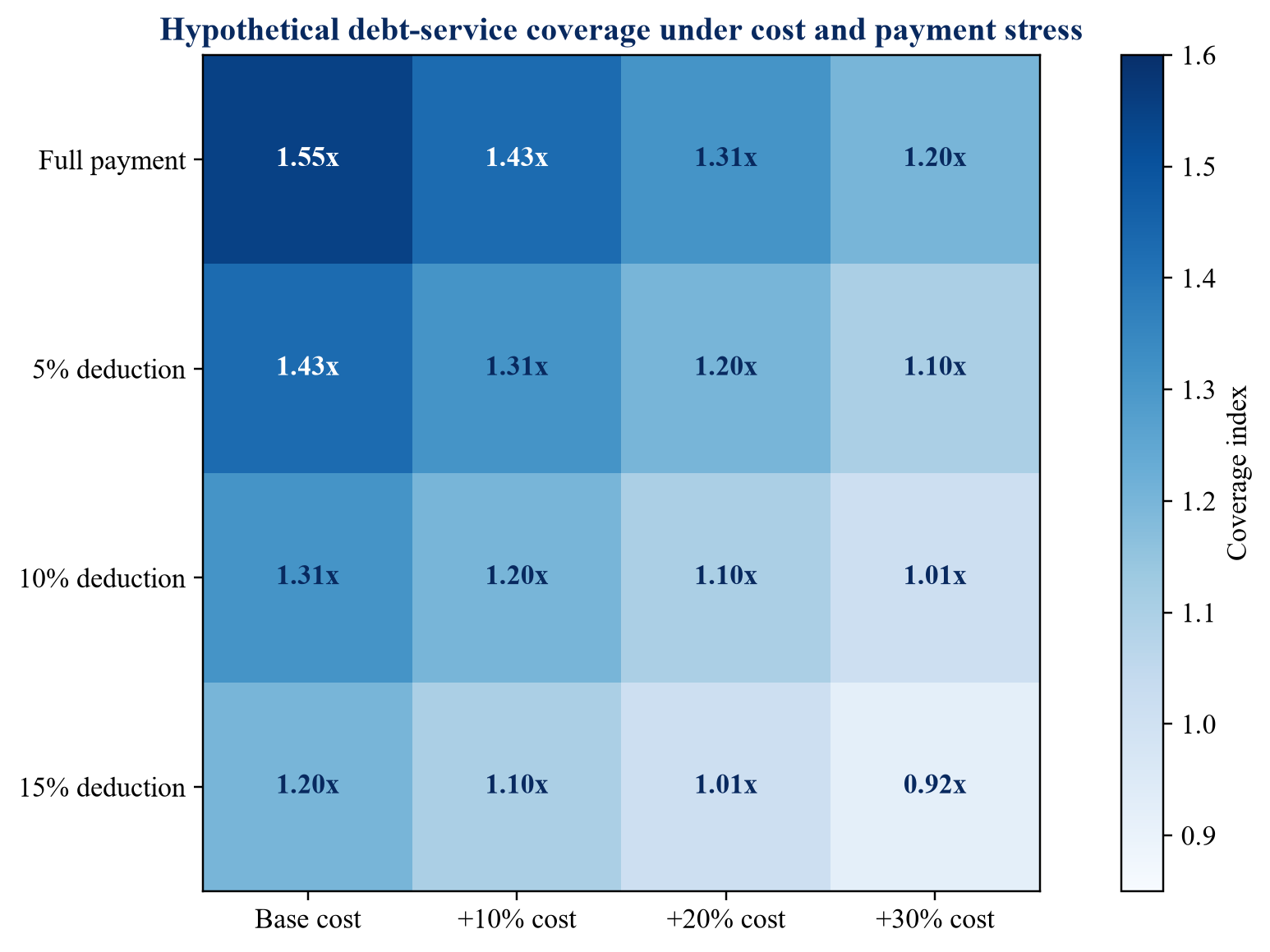
All values are hypothetical author-modelled indices for method demonstration. They are not financial projections or market terms.
The stress model should include minimum liquidity, reserve facilities, covenant headroom and public contingent liabilities. It should also test system service where several assets fail together.
34 Compare delivery options
The authority should compare public procurement, corporate utility delivery, regulated infrastructure provision and PPP delivery. The comparison should use the same service specification and risk-adjusted cost. Different scopes can create misleading conclusions.
Table 3. Delivery-model decision framework
| Decision factor | Public delivery | Utility balance sheet | Availability PPP | Bulk-water concession |
|---|---|---|---|---|
| Revenue basis | Budget | Tariff or corporate cash | Contracted availability | Volume and capacity payments |
| Best fit | Sovereign or highly integrated assets | Regulated network investment | Measurable reserve service | Regular production with offtake |
| Main advantage | Direct policy control | Existing operating integration | Lifecycle and performance discipline | Output and operating incentives |
| Main challenge | Delivery and maintenance discipline | Balance-sheet and regulatory capacity | Long-term fiscal commitment | Demand and dispatch allocation |
| Emergency control | Direct | Utility protocol | Public step-in and activation | Contracted dispatch and step-in |
The table is an author-developed framework. The preferred route depends on legal, regulatory, institutional and market conditions.
Institutional capacity matters. A complex PPP requires a capable public counterparty for contract management over decades.
35 Govern multi-authority projects
Strategic reserves often cross utility, municipal or national boundaries. Governance should identify the contracting authority, participating utilities, health regulator, environmental regulator, emergency command and fiscal authority. Decision rights should remain clear during ordinary operations and emergencies.
A joint committee can coordinate planning, but contractual rights and payment obligations need legal certainty. Cost allocation can reflect capacity reserved, expected benefit, population, usage or risk reduction. The selected method should withstand years in which one party uses more of the service.
Dispute resolution should preserve continued water service. Technical disputes can use expert determination, while broader disputes follow the agreed legal process.
36 Implement a 180-day development programme
The first 30 days should confirm the service boundary, governance, baseline and evidence register. Days 31 to 60 should develop hazard, demand, reserve and network scenarios. Days 61 to 90 should screen asset options and define the PPP boundary. Days 91 to 120 should build affordability, risk allocation and market-sounding materials.
Days 121 to 150 should test the payment mechanism, financing, environmental path and procurement plan. Days 151 to 180 should complete the outline business case, independent review and approval pack. Complex land, environment and hydrology work will continue beyond this period.
The programme should end with explicit decisions on need, preferred system, delivery model, fiscal envelope and further diligence. It should not create artificial certainty.
37 Learn from current water-security programmes
Current programmes show several design principles. Singapore diversifies supply through catchment, imported water, reclaimed water and desalination, with reservoirs and an integrated water loop. The UAE Water Security Strategy 2036 addresses normal and emergency conditions and supports strategic reserves. England's RAPID and Major Water Infrastructure Programme use staged regulatory gates for reservoirs, transfers, reuse and desalination.
These examples differ in law, climate, institutions and market structure. Their transferable lesson is the use of portfolios, long-term planning and clear governance. A project should not copy a foreign structure without adapting it to local authority, tariff, hydrology and delivery capability.
38 Set board and public reporting
The board should receive reserve availability, service-day coverage, critical dependencies, exercises, incidents, capital delivery, payment, fiscal exposure and residual risk. Lenders need payment, deductions, coverage, lifecycle condition and insurance. Regulators need quality, affordability, environment and service evidence.
Public reporting should explain what the reserve is designed to achieve, its cost and verified readiness. Security-sensitive locations, vulnerabilities and control details should remain protected. Transparent non-sensitive reporting can strengthen accountability for an asset that may be rarely activated.
Governance should include independent technical and financial assurance. Internal audit can test payment and data controls. Emergency exercises should report corrective actions and closure.
39 Integrate insurance and disaster-risk finance
Project insurance can cover construction, property damage, machinery breakdown, liability and defined interruption exposures. It cannot replace a national emergency funding plan. Drought, widespread contamination and correlated infrastructure failure may be difficult to insure or may exceed available limits. The authority should identify which losses sit with the project, the utility, government disaster funds and affected users.
The contract should specify required policies, deductibles, insured parties, proceeds, reinstatement and lender rights. It should also address insurance becoming unavailable or available only at materially higher cost. Premium pass-through should depend on market evidence and the partner's compliance with risk-management obligations.
Contingent credit, budget reserves and parametric disaster instruments can provide liquidity for public response. Their triggers and permitted uses should align with the emergency plan. Liquidity timing matters because response expenditure arises before final loss adjustment or fiscal reallocation.
40 Plan lifecycle maintenance and handback
Strategic reserve assets can operate for decades, while the PPP term may end before the physical asset life. Lifecycle plans should cover civil works, liners, gates, pumps, valves, electrical systems, controls, water-quality equipment, access and security. Funding should match the timing of major maintenance rather than depend on optimistic residual value.
Handback requirements should define condition, remaining life, tests, records, spares and defect correction. Surveys should begin several years before expiry so the authority and lenders can address deterioration without threatening service. A handback reserve or security can support compliance.
The authority should receive complete asset data throughout the term. Delayed access to maintenance history, models or control information can impair future competition and emergency operation. Data standards should support transfer to a replacement operator without exposing protected infrastructure information.
41 Apply the framework in acquisitions and refinancing
An investor acquiring or refinancing a water-reserve project should test the service obligation, payment source, deduction history, asset condition, hydrology, quality, interface agreements and public support. Reported availability may conceal repeated waivers, temporary fixes or incomplete exercising. Diligence should reconcile operating evidence with invoices and authority certification.
Change-of-control provisions can require public consent and capability tests. The authority should protect service continuity while allowing reasonable capital recycling. Lenders and investors should assess whether refinancing gains, distributions and lifecycle funding remain consistent with the contract.
Valuation should separate stable contracted cash flow from contingent upside. Emergency activation, claims recovery, refinancing and future scope changes should not be treated as certain. Downside cases should include sustained deductions, delayed variation payment, uninsurable events and higher maintenance.
42 Build a repeatable national programme
A national programme can standardise service definitions, risk allocation, payment structures, data and procurement while tailoring engineering to each region. Repeatability can reduce transaction cost, broaden the supplier base and create a pipeline suitable for specialised lenders and institutional investors. Ofwat's current work on common commercial arrangements illustrates the value of consistent frameworks for large water-resource schemes.
Programme governance should rank projects by service risk and system contribution. It should avoid procuring isolated assets that duplicate capacity or compete for the same scarce source. Portfolio sequencing can coordinate reservoirs, transfers, reuse, desalination and demand management.
Standardisation should preserve learning. Each procurement and exercise should update cost benchmarks, risk assumptions and contract provisions. A central assurance function can compare bids and performance, while local operators retain responsibility for system integration and emergency response.
43 Recognise limitations
This framework does not provide engineering design, hydrological forecast, water-quality approval, environmental consent, legal opinion, fiscal approval or investment recommendation. Each project requires qualified technical, public-health, environmental, legal, regulatory and financial review.
Source yield, demand, emergency duration, construction cost and climate conditions are uncertain. The figures and tables use hypothetical author-modelled assumptions. They should not be treated as observed performance, market terms or project forecasts. Availability payments, guarantees and termination rights depend on executed contracts and applicable law.
National-security and emergency information may require controlled handling. Disclosure should balance public accountability with infrastructure protection.
Conclusion
Strategic water reserves protect time, options and minimum service when ordinary systems are constrained. Their value depends on the complete path from source and storage through treatment, transfer and distribution. A nominal reservoir or pipeline capacity is insufficient without quality, power, access, operating rules and exercised response.
A PPP can finance this capability when the authority defines the emergency service, purchases verified readiness and retains allocation and step-in powers. The private partner can accept design, construction, availability, maintenance and response obligations that it can manage. Hydrology, sovereign allocation and public-health command require different treatment.
The commercial structure should support long-term payment while preserving adaptation. Availability charges, bulk-water revenues, blended finance and public support can be combined transparently. Risk allocation, fiscal exposure and lender protection should be tested across severe scenarios. The resulting project is a service-continuity contract supported by reservoirs, pipelines, treatment and emergency logistics.
References
- OECD, Financing a Water Secure Future, 2022. https://doi.org/10.1787/a2ecb261-en
- World Bank, Funding a Water-Secure Future: An Assessment of Global Public Spending, 2024. https://ppp.worldbank.org/library/funding-water-secure-future-assessment-global-public-spending
- World Bank, Technical Brief on Resilient Infrastructure Public-Private Partnerships: Policy, Contracting and Finance, 2019. https://documents1.worldbank.org/curated/en/925691571416771609/pdf/Technical-Brief-on-Resilient-Infrastructure-Public-Private-Partnerships-Policy-Contracting-and-Finance.pdf
- World Bank PPP Resource Center, PPP Risk Allocation Tool 2019 Edition: Water and Waste. https://ppp.worldbank.org/library/ppp-risk-allocation-tool-2019-edition-water-and-waste
- World Bank PPP Resource Center, Water and Sanitation Agreements. https://ppp.worldbank.org/sector/water-sanitation/water-agreements
- World Bank PPP Resource Center, Water and Sanitation Toolkits. https://ppp.worldbank.org/water-and-sanitation/water-sanitation-toolkits
- World Bank PPP Resource Center, Allocating Risks. https://ppp.worldbank.org/allocating-risks
- World Bank PPP Resource Center, Structuring the PPP Contract. https://ppp.worldbank.org/structuring-ppp-contract
- World Bank PPP Resource Center, Translating Risk Allocation into Contract Structure. https://ppp.worldbank.org/translating-risk-allocation-contract-structure
- World Bank PPP Resource Center, Renegotiation, Government Step-in Rights, Termination and Dispute Resolution. https://ppp.worldbank.org/renegotiation-government-step-rights-termination-and-dispute-resolution
- World Bank PPP Resource Center, Climate-Smart PPPs. https://ppp.worldbank.org/climate-smart/climate-smart-ppps
- World Bank PPP Resource Center, Preparing, Procuring and Implementing Climate-Smart PPPs. https://ppp.worldbank.org/climate-smart/climate-smart-clean-technology-ppps/preparing-procuring-and-implementing-climate-smart-ppps
- UNDRR, Principles for Resilient Infrastructure, 2022. https://www.undrr.org/publication/principles-resilient-infrastructure
- UNDRR and Coalition for Disaster Resilient Infrastructure, Global Methodology for Infrastructure Resilience Reviews: Guidance for the Water Sector, 2025. https://www.undrr.org/publication/global-methodology-infrastructure-resilience-reviews-guidance-water-sector
- World Health Organization, Water Safety Plan Manual: Step-by-Step Risk Management for Drinking-Water Suppliers, second edition, 2023. https://www.who.int/publications/i/item/9789240067691
- World Health Organization, Climate-Resilient Water Safety Plans, 2017. https://www.who.int/publications/i/item/9789241512794
- World Health Organization Europe, Guidance on Water Supply and Sanitation in Extreme Weather Events, 2011. https://www.who.int/europe/publications/i/item/9789289002585
- US Environmental Protection Agency, Emergency Drinking Water Supply Guidance. https://www.epa.gov/waterutilityresponse/emergency-drinking-water-supply-guidance
- US Environmental Protection Agency, Drought Response and Recovery Guide for Water Utilities. https://www.epa.gov/waterutilityresponse/drought-response-and-recovery-guide-fact-sheet-water-utilities
- US Environmental Protection Agency, Emergency Response for Drinking Water and Wastewater Utilities. https://www.epa.gov/waterutilityresponse
- OECD, Financing Water Supply, Sanitation and Flood Protection, 2020. https://doi.org/10.1787/6893cdac-en
- OECD, Global Drought Outlook: Adapting to Drought Risk for Long-Term Resilience, 2025. https://www.oecd.org/en/publications/global-drought-outlook_d492583a-en.html
- Ofwat, Achieving Long-Term Water Resources Resilience. https://www.ofwat.gov.uk/regulated-companies/rapid/achieving-effective-long-term-water-resources-resilience/
- Ofwat, Streamlining the Planning and Delivery of the Major Water Infrastructure Programme, 2026. https://www.ofwat.gov.uk/streamlining-the-planning-and-delivery-of-the-major-water-infrastructure-programme/
- Ofwat, RAPID Action on Major Water Infrastructure, 2025. https://www.ofwat.gov.uk/rapid-action-on-major-water-infrastructure-is-securing-supply-for-future-generations/
- Ofwat, Commercial Arrangements for Major Water Infrastructure. https://www.ofwat.gov.uk/regulated-companies/major-water-infrastructure-programme/major-projects-guidance/commercial-arrangements/
- Ofwat and RAPID, Approaches for Estimating and Benchmarking Costs for Large-Scale Water Infrastructure Projects, 2022. https://www.ofwat.gov.uk/publication/approaches-for-estimating-and-benchmarking-costs-for-large-scale-water-infrastructure-projects-a-report-for-ofwat-and-rapid-by-cepa/
- UAE Ministry of Energy and Infrastructure, Water Security is a National Priority for the UAE, 2025. https://moei.gov.ae/en/media-center/news/23/3/2025/water-security-is-a-national-priority-for-the-uae
- PUB Singapore, Singapore Water Story. https://www.pub.gov.sg/Public/WaterLoop/OurWaterStory
- Singapore Ministry of Sustainability and the Environment, Water, updated 2026. https://www.mse.gov.sg/policies/water/
About the Author
Authored by Chennakeshav Adya Independent Researcher
Chennakeshav (CK) is a corporate finance and investment banking executive with 25+ years of global experience in deal origination, structuring and execution across M&A, growth capital and corporate strategy. He has led value-creation mandates for founders, corporates and funds — bridging the boardroom view to hands-on execution and close.
His career spans Morgan Stanley, HSBC, Lloyds Banking Group, EWEC, ADQ portfolio companies and Emirates Growth Fund, across TMT, real estate, fintech, deeptech, cleantech, infrastructure and energy. He has partnered with C-suite leaders, private equity and venture funds, sovereign wealth funds and family offices to finance complex fund raises and scale-up ventures, and has led M&A due diligence, post-merger integration and business-transformation initiatives to create value.
At Matchpoint Partners he is Managing Partner, leading the firm's corporate finance, M&A and capital-raising practice. He holds an MBA from London Business School, an engineering degree from VTU and a Master of Laws (LLM, in progress) from UCL London.
An active start-up mentor, CK mentors at Techstars, DIFC FinTech Hive, Startup Grind, Founder Institute and IN5, serves as Entrepreneur Mentor in Residence (EMiR) at London Business School, and judges the Entrepreneurship World Cup.
LinkedIn: https://www.linkedin.com/in/ckadya/ Matchpoint Partners: https://www.matchpoint-partners.com/team/ck-adya.html
This paper is part of a continuing series on the structure of private and alternative markets. The views expressed are the author's own. The paper is for information only, describes market structure in general terms, and does not constitute investment, legal, tax or regulatory advice or a recommendation in respect of any security, vehicle or counterparty.
