

1. Establish authority and independence
The company and its advisers should record board powers, shareholder matters, lender consents, adviser mandates, prospective officeholder independence, conflicts and the approvals required before marketing or signing. The work starts with constitutional documents, delegations, financing agreements, engagement letters, conflict searches and current legal advice. The decision question is who may authorise preparation, disclose information, select a bidder, enter administration and complete the sale. The record should state the responsible entity, evidence date, owner, unresolved items and the next irreversible deadline [1][2][16].
The controlled output is an authority and independence schedule. It should connect the transaction evidence to the applicable legal process, available cash, creditor outcome and completion timetable. Each conclusion should be traceable to a current document, calculation or attributed professional judgement.
The principal risk is that unclear authority or conflicted advice can undermine a sale completed under severe time pressure. The team should measure the effect on going-concern value, distributable proceeds, execution probability and operating continuity. A material change should update the route and decision record when it becomes known.
2. Map the governing process
This stage requires the transaction team to identify the jurisdictions, legal entities, insolvency routes, court or creditor roles, statutory objectives and recognition requirements that may govern preparation and completion. Evidence should come from entity records, governing-law clauses, centre-of-main-interests evidence, local insolvency statutes and cross-border advice. The practical test is which process can transfer the business within runway while satisfying applicable duties and oversight. The analysis should use one decision date and retain the links among cash, entities, assets, contracts, claims and the proposed transfer [3][4][5][21].
Decision-makers should maintain a jurisdiction and process map. The schedule should show the governing documents, calculation logic, conditions, dependencies and the person authorised to resolve each exception. Legal, insolvency, tax, valuation and regulatory judgements remain with qualified advisers.
A material execution failure occurs when a commercially agreed sale may fail because the chosen procedure cannot deliver title, releases or recognition. Review the route against the base case and a combined downside. A transaction that cannot survive a credible delay, cash shortfall or missing approval should not be represented as executable.
3. Fix the decision clock
The readiness team should translate payroll, tax, rent, insurance, critical supplier, debt, filing, enforcement, licence and customer deadlines into one dated timetable, using a controlled thirteen-week cash forecast, payment calendar, default notices, court timetables and operating dependencies. Its central question is the last practical date for market testing, bidder selection, appointment, signing and completion. The answer matters when it is current enough to guide disclosure, bidder access, selection, appointment, signing or completion [6][7][8].
The required deliverable is an accelerated sale clock with irreversible dates. It should distinguish binding rights from expectations, committed funding from indications and verified facts from analytical scenarios. The decision-maker should see how every exception affects value and time.
The execution threat is that the business can lose going-concern value before the legal process is ready to complete. Owners should define a control, evidence threshold, escalation route and switch time. Scenario values require continuing reconciliation to cash, bids, documents, approvals and operating results.
4. Define the transaction perimeter
The company should map the shares, businesses, assets, contracts, employees, licences, data, intellectual property, cash, debt and liabilities proposed for transfer. The evidence base includes entity charts, asset registers, statutory books, contracts, licences, payroll records and financing documents. The decisive test asks what the buyer must acquire for the business to operate on day one. Conclusions should remain at entity and asset level because cash, claims, title, licences and contractual rights may sit in different parts of the group [3][18][33].
The decision-makers should receive a perimeter and dependency memorandum. It should state the calculation date, source, conditions and approvals. This makes the analysis reproducible when facts change or an independent reviewer examines the sale.
The material downside is that an incomplete perimeter can transfer assets without the people, permissions or systems that generate value. Connect the response to minimum cash, creditor recoveries, process integrity and transaction milestones. The selected route remains preferred only while these controls support it.
5. Set the statutory and commercial objective
The company and its advisers should state the applicable insolvency objective, creditor-interest test, rescue rationale and commercial outcomes sought by the sale. The work starts with legal advice, board records, creditor positions, liquidity evidence and operating forecasts. The decision question is what result the decision-maker is legally required and commercially trying to achieve. The record should state the responsible entity, evidence date, owner, unresolved items and the next irreversible deadline [3][9][21].
The controlled output is an objectives and decision-criteria statement. It should connect the transaction evidence to the applicable legal process, available cash, creditor outcome and completion timetable. Each conclusion should be traceable to a current document, calculation or attributed professional judgement.
The principal risk is that price can be overemphasised while continuity, recoveries, employment or execution duties remain unresolved. The team should measure the effect on going-concern value, distributable proceeds, execution probability and operating continuity. A material change should update the route and decision record when it becomes known.
Table 1. Decision objectives and evidence
| Objective | Primary evidence | Failure signal |
|---|---|---|
| preserve going-concern value | funded buyer and continuity perimeter | runway expires before transfer |
| improve creditor outcome | counterfactual recovery comparison | unreconciled claims or costs |
| maintain process integrity | market log and conflict controls | unequal access or hidden connection |
| complete lawfully | approval and closing certificate | unmet mandatory condition |
Values and scores are analytical scenarios; transaction evidence should replace model values.
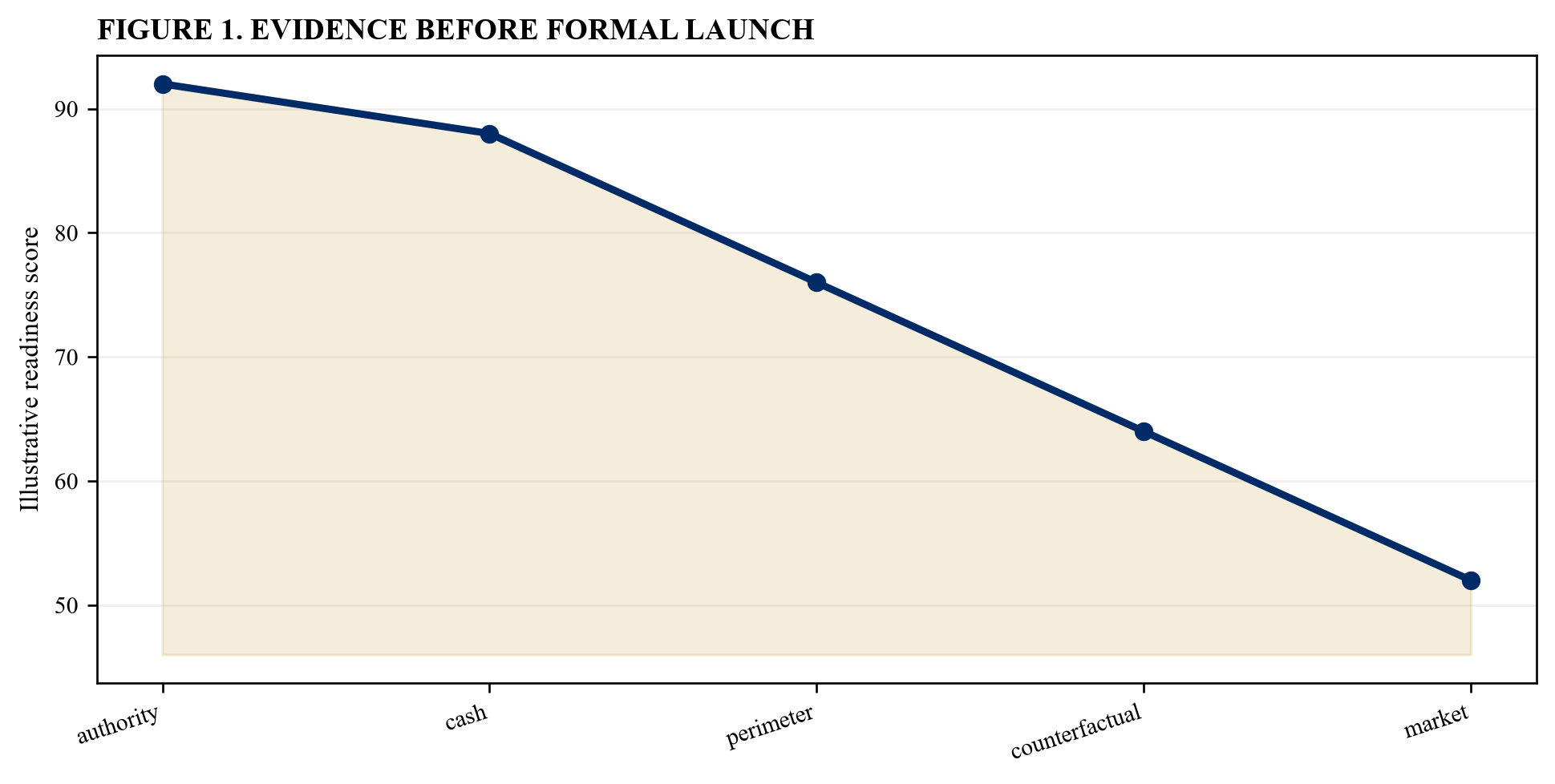
Illustrative analytical scenario; transaction evidence should replace model values.
6. Build the stakeholder and claims map
This stage requires the transaction team to identify secured creditors, preferential claims, floating-charge holders, unsecured creditors, landlords, employees, pension trustees, tax authorities and shareholders by entity. Evidence should come from claims ledgers, security records, payroll, tax accounts, leases, pensions data and creditor correspondence. The practical test is whose rights, consent, notice or economic outcome can affect the sale. The analysis should use one decision date and retain the links among cash, entities, assets, contracts, claims and the proposed transfer [3][10][34].
Decision-makers should maintain a stakeholder rights and claims matrix. The schedule should show the governing documents, calculation logic, conditions, dependencies and the person authorised to resolve each exception. Legal, insolvency, tax, valuation and regulatory judgements remain with qualified advisers.
A material execution failure occurs when an omitted claim or blocking right can change distributions, authority or completion mechanics. Review the route against the base case and a combined downside. A transaction that cannot survive a credible delay, cash shortfall or missing approval should not be represented as executable.
7. Reconcile opening cash and claims
The readiness team should certify cash by account and entity together with debt principal, interest, fees, guarantees, security, set-off and contingent claims, using bank confirmations, facility statements, agent notices, hedge records, ledgers and legal opinions. Its central question is how long the business can trade and how sale proceeds would flow through the capital structure. The answer matters when it is current enough to guide disclosure, bidder access, selection, appointment, signing or completion [6][10][35].
The required deliverable is an opening cash and claims certificate. It should distinguish binding rights from expectations, committed funding from indications and verified facts from analytical scenarios. The decision-maker should see how every exception affects value and time.
The execution threat is that unreconciled balances can distort runway, valuation, voting and expected creditor recoveries. Owners should define a control, evidence threshold, escalation route and switch time. Scenario values require continuing reconciliation to cash, bids, documents, approvals and operating results.
8. Create the information integrity register
The company should grade financial, commercial, legal, operational and asset information by source, date, owner, completeness and reproducibility. The evidence base includes audited accounts, management reports, source-system extracts, contracts, board papers and third-party confirmations. The decisive test asks which information can support bidder reliance and which gaps require qualification or remediation. Conclusions should remain at entity and asset level because cash, claims, title, licences and contractual rights may sit in different parts of the group [11][12][36].
The decision-makers should receive an evidence register and exception log. It should state the calculation date, source, conditions and approvals. This makes the analysis reproducible when facts change or an independent reviewer examines the sale.
The material downside is that buyers can price uncertainty aggressively or withdraw when core data cannot be reconciled. Connect the response to minimum cash, creditor recoveries, process integrity and transaction milestones. The selected route remains preferred only while these controls support it.
9. Appoint the readiness team
The company and its advisers should define responsibilities for the board, restructuring adviser, prospective officeholder or monitor, legal counsel, valuation specialist, tax adviser, data-room owner and communications lead. The work starts with engagement scopes, independence checks, workplans, decision rights and professional standards. The decision question is who owns each evidence item and who can form or challenge the required judgement. The record should state the responsible entity, evidence date, owner, unresolved items and the next irreversible deadline [1][13][37].
The controlled output is a responsibility and escalation matrix. It should connect the transaction evidence to the applicable legal process, available cash, creditor outcome and completion timetable. Each conclusion should be traceable to a current document, calculation or attributed professional judgement.
The principal risk is that duplicated work and unowned gaps can consume the remaining runway. The team should measure the effect on going-concern value, distributable proceeds, execution probability and operating continuity. A material change should update the route and decision record when it becomes known.
10. Control connected-person risk
This stage requires the transaction team to identify directors, shareholders, affiliates, management bidders, family relationships and prior dealings that may create a connected-person or conflict issue. Evidence should come from statutory definitions, beneficial-ownership records, bidder declarations, conflict checks and adviser interviews. The practical test is which proposed buyers or decision-makers require additional scrutiny, disclosure or approval. The analysis should use one decision date and retain the links among cash, entities, assets, contracts, claims and the proposed transfer [1][2][14].
Decision-makers should maintain a connected-person and conflicts register. The schedule should show the governing documents, calculation logic, conditions, dependencies and the person authorised to resolve each exception. Legal, insolvency, tax, valuation and regulatory judgements remain with qualified advisers.
A material execution failure occurs when an undisclosed relationship can damage creditor confidence and trigger regulatory or legal challenge. Review the route against the base case and a combined downside. A transaction that cannot survive a credible delay, cash shortfall or missing approval should not be represented as executable.
11. Define the market strategy
The readiness team should decide which buyer groups can be approached, how confidentiality will be protected, what time each receives and what evidence supports any constrained outreach, using buyer longlists, competitor analysis, confidentiality risks, liquidity runway and adviser market knowledge. Its central question is how the process will obtain credible competitive tension within the available time. The answer matters when it is current enough to guide disclosure, bidder access, selection, appointment, signing or completion [9][15][21].
The required deliverable is a documented marketing strategy with inclusion and exclusion reasons. It should distinguish binding rights from expectations, committed funding from indications and verified facts from analytical scenarios. The decision-maker should see how every exception affects value and time.
The execution threat is that a narrow process can suppress value unless its limits are objectively justified and recorded. Owners should define a control, evidence threshold, escalation route and switch time. Scenario values require continuing reconciliation to cash, bids, documents, approvals and operating results.
12. Establish valuation bases
The company should prepare going-concern, market, income, asset, liquidation and transaction-value analyses on consistent dates and assumptions. The evidence base includes current trading, forecasts, asset appraisals, market evidence, bids, cost estimates and valuation standards. The decisive test asks what value range applies under each feasible route and how rapidly that value may decay. Conclusions should remain at entity and asset level because cash, claims, title, licences and contractual rights may sit in different parts of the group [17][38][39].
The decision-makers should receive a common-date valuation memorandum. It should state the calculation date, source, conditions and approvals. This makes the analysis reproducible when facts change or an independent reviewer examines the sale.
The material downside is that mixed dates or unsupported forecasts can make a selected bid appear stronger than it is. Connect the response to minimum cash, creditor recoveries, process integrity and transaction milestones. The selected route remains preferred only while these controls support it.
13. Build the insolvency counterfactual
The company and its advisers should estimate timing, costs, asset realisations, claims, continuity losses and distributions if the accelerated sale does not complete. The work starts with liquidation appraisals, creditor hierarchy, contract termination risk, cash forecasts and insolvency advice. The decision question is whether the proposed sale improves expected outcomes against the relevant alternative. The record should state the responsible entity, evidence date, owner, unresolved items and the next irreversible deadline [3][10][40].
The controlled output is a counterfactual recovery model. It should connect the transaction evidence to the applicable legal process, available cash, creditor outcome and completion timetable. Each conclusion should be traceable to a current document, calculation or attributed professional judgement.
The principal risk is that an unrealistic fallback can overstate the value preserved by the selected transaction. The team should measure the effect on going-concern value, distributable proceeds, execution probability and operating continuity. A material change should update the route and decision record when it becomes known.
Table 2. Illustrative route comparison
| Measure | Accelerated sale | Trading administration | Liquidation |
|---|---|---|---|
| completion days | 12 | 45 | 90 |
| going-concern value index | 86 | 78 | 42 |
| new cash required | 8 | 21 | 12 |
| execution confidence | 72% | 66% | 88% |
Values and scores are analytical scenarios; transaction evidence should replace model values.
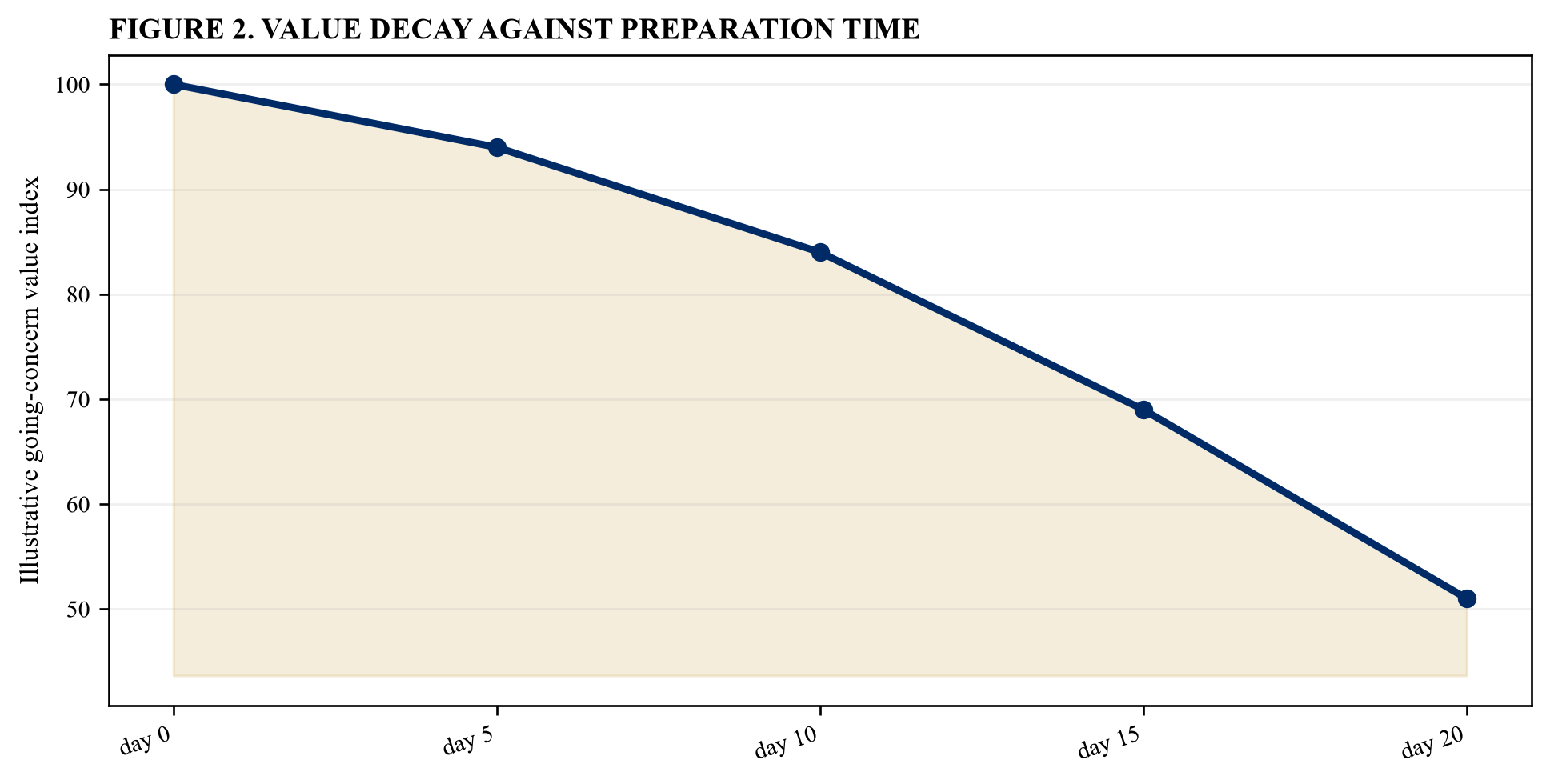
Illustrative analytical scenario; transaction evidence should replace model values.
14. Design the buyer universe
This stage requires the transaction team to screen strategic acquirers, financial sponsors, lenders, management, connected persons, competitors and specialist turnaround investors. Evidence should come from sector maps, prior transaction evidence, ownership data, sanctions checks and financing capacity. The practical test is which parties can understand, fund and close the perimeter within the decision clock. The analysis should use one decision date and retain the links among cash, entities, assets, contracts, claims and the proposed transfer [15][41][42].
Decision-makers should maintain a prioritised buyer universe with evidence of contactability. The schedule should show the governing documents, calculation logic, conditions, dependencies and the person authorised to resolve each exception. Legal, insolvency, tax, valuation and regulatory judgements remain with qualified advisers.
A material execution failure occurs when a long buyer list can create false comfort when few parties can complete. Review the route against the base case and a combined downside. A transaction that cannot survive a credible delay, cash shortfall or missing approval should not be represented as executable.
15. Prepare the sale narrative
The readiness team should explain the business model, distress cause, perimeter, value drivers, cash requirement, transaction timetable and principal diligence issues accurately, using verified operating data, management interviews, forecasts, customer evidence and legal review. Its central question is what a capable buyer needs to decide whether to invest resources immediately. The answer matters when it is current enough to guide disclosure, bidder access, selection, appointment, signing or completion [11][18][43].
The required deliverable is a concise information memorandum and management script. It should distinguish binding rights from expectations, committed funding from indications and verified facts from analytical scenarios. The decision-maker should see how every exception affects value and time.
The execution threat is that promotional or incomplete disclosure can waste time and create later misrepresentation disputes. Owners should define a control, evidence threshold, escalation route and switch time. Scenario values require continuing reconciliation to cash, bids, documents, approvals and operating results.
16. Construct the accelerated data room
The company should organise finance, tax, legal, commercial, employees, pensions, assets, intellectual property, data, operations, regulation and transaction materials with clear access controls. The evidence base includes the evidence register, source files, redaction protocol, index, permission matrix and question log. The decisive test asks whether bidders can complete focused diligence without uncontrolled disclosure. Conclusions should remain at entity and asset level because cash, claims, title, licences and contractual rights may sit in different parts of the group [11][12][44].
The decision-makers should receive a permissioned data room with a completeness certificate. It should state the calculation date, source, conditions and approvals. This makes the analysis reproducible when facts change or an independent reviewer examines the sale.
The material downside is that poor indexing or inconsistent access can delay bids and weaken process fairness. Connect the response to minimum cash, creditor recoveries, process integrity and transaction milestones. The selected route remains preferred only while these controls support it.
17. Set the diligence priorities
The company and its advisers should identify matters that affect title, operating continuity, value, assumed liabilities, regulatory approval, funding or closing and defer low-impact work explicitly. The work starts with buyer questions, red-flag reports, contracts, licences, financial reconciliations and specialist advice. The decision question is which issues can change price or prevent completion within the available time. The record should state the responsible entity, evidence date, owner, unresolved items and the next irreversible deadline [18][33][45].
The controlled output is a red-flag diligence plan and materiality threshold. It should connect the transaction evidence to the applicable legal process, available cash, creditor outcome and completion timetable. Each conclusion should be traceable to a current document, calculation or attributed professional judgement.
The principal risk is that teams can spend scarce hours on low-value review while a closing dependency remains hidden. The team should measure the effect on going-concern value, distributable proceeds, execution probability and operating continuity. A material change should update the route and decision record when it becomes known.
18. Govern bidder access
This stage requires the transaction team to use NDAs, clean teams, information barriers, staged permissions and equal-data rules suited to competitors and connected parties. Evidence should come from confidentiality agreements, competition advice, data classifications and access logs. The practical test is what each bidder may see, when and under which safeguards. The analysis should use one decision date and retain the links among cash, entities, assets, contracts, claims and the proposed transfer [41][44][46].
Decision-makers should maintain a bidder access protocol and audit trail. The schedule should show the governing documents, calculation logic, conditions, dependencies and the person authorised to resolve each exception. Legal, insolvency, tax, valuation and regulatory judgements remain with qualified advisers.
A material execution failure occurs when uncontrolled disclosure can harm the business or create an unfair informational advantage. Review the route against the base case and a combined downside. A transaction that cannot survive a credible delay, cash shortfall or missing approval should not be represented as executable.
19. Run management interaction
The readiness team should provide bidders with consistent access to management, site visits and operational evidence while protecting trading continuity, using approved presentation materials, question logs, attendance records and operating schedules. Its central question is whether bidder assumptions can be tested without disrupting the business or favouring one party. The answer matters when it is current enough to guide disclosure, bidder access, selection, appointment, signing or completion [11][15][43].
The required deliverable is a controlled management-presentation programme. It should distinguish binding rights from expectations, committed funding from indications and verified facts from analytical scenarios. The decision-maker should see how every exception affects value and time.
The execution threat is that inconsistent answers can contaminate bid comparability and credibility. Owners should define a control, evidence threshold, escalation route and switch time. Scenario values require continuing reconciliation to cash, bids, documents, approvals and operating results.
20. Issue the bid protocol
The company should state deadlines, required documents, perimeter, form of consideration, assumed liabilities, proof of funds, approvals, conditionality and mark-up requirements. The evidence base includes the decision clock, valuation work, legal process, data-room evidence and buyer feedback. The decisive test asks what constitutes a compliant and comparable offer. Conclusions should remain at entity and asset level because cash, claims, title, licences and contractual rights may sit in different parts of the group [9][21][47].
The decision-makers should receive a bid-process letter and compliance checklist. It should state the calculation date, source, conditions and approvals. This makes the analysis reproducible when facts change or an independent reviewer examines the sale.
The material downside is that ambiguous instructions can produce headline prices that cannot be compared or completed. Connect the response to minimum cash, creditor recoveries, process integrity and transaction milestones. The selected route remains preferred only while these controls support it.
21. Verify proof of funds
The company and its advisers should test cash, debt, equity, investment-committee approval, currency, transfer mechanics and conditions behind each funding source. The work starts with bank evidence, commitment letters, fund documents, lender terms, approvals and sanctions checks. The decision question is whether the bidder can fund price, costs, cure payments and day-one liquidity at completion. The record should state the responsible entity, evidence date, owner, unresolved items and the next irreversible deadline [42][48][49].
The controlled output is a funding certainty certificate. It should connect the transaction evidence to the applicable legal process, available cash, creditor outcome and completion timetable. Each conclusion should be traceable to a current document, calculation or attributed professional judgement.
The principal risk is that an attractive bid can collapse when capital remains indicative or subject to unmet conditions. The team should measure the effect on going-concern value, distributable proceeds, execution probability and operating continuity. A material change should update the route and decision record when it becomes known.
22. Compare offers on one basis
This stage requires the transaction team to bridge cash price, assumed liabilities, cure costs, working capital, tax, transaction costs, execution probability and completion timing. Evidence should come from bid forms, mark-ups, funds-flow drafts, diligence findings and valuation scenarios. The practical test is which offer produces the strongest risk-adjusted outcome under the applicable decision criteria. The analysis should use one decision date and retain the links among cash, entities, assets, contracts, claims and the proposed transfer [17][21][47].
Decision-makers should maintain a common-basis bid comparison. The schedule should show the governing documents, calculation logic, conditions, dependencies and the person authorised to resolve each exception. Legal, insolvency, tax, valuation and regulatory judgements remain with qualified advisers.
A material execution failure occurs when headline consideration can conceal liabilities, leakage or conditions that reduce distributable value. Review the route against the base case and a combined downside. A transaction that cannot survive a credible delay, cash shortfall or missing approval should not be represented as executable.
Table 3. Illustrative common-basis bid analysis
| Measure | Bid A | Bid B | Bid C |
|---|---|---|---|
| cash at completion | 72 | 65 | 54 |
| assumed liabilities | 14 | 24 | 31 |
| cure and leakage | 9 | 6 | 4 |
| risk-adjusted value | 68 | 74 | 69 |
Values and scores are analytical scenarios; transaction evidence should replace model values.
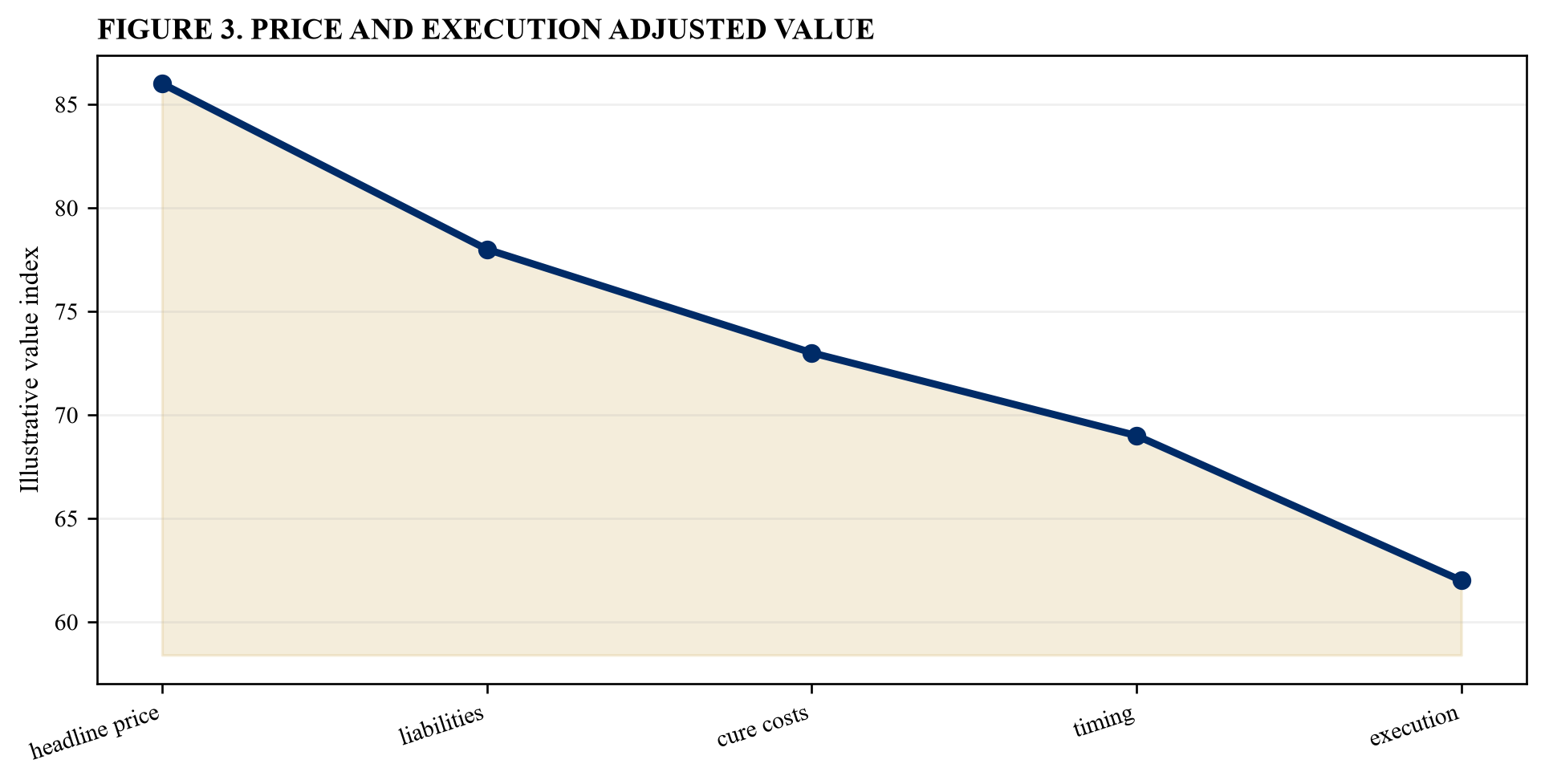
Illustrative analytical scenario; transaction evidence should replace model values.
23. Review contracts and cure costs
The readiness team should identify assignment, consent, termination, change-of-control, arrears, retention-of-title, set-off and cure requirements in material contracts, using executed agreements, correspondence, aged payables, legal advice and buyer perimeter assumptions. Its central question is which contracts transfer automatically, require consent or need cash to preserve continuity. The answer matters when it is current enough to guide disclosure, bidder access, selection, appointment, signing or completion [18][33][50].
The required deliverable is a contract transfer and cure schedule. It should distinguish binding rights from expectations, committed funding from indications and verified facts from analytical scenarios. The decision-maker should see how every exception affects value and time.
The execution threat is that the buyer may acquire assets without critical revenue or supply agreements. Owners should define a control, evidence threshold, escalation route and switch time. Scenario values require continuing reconciliation to cash, bids, documents, approvals and operating results.
24. Resolve employee and pension issues
The company should map transferring employees, consultation, arrears, benefits, incentive arrangements, pension liabilities and required notifications. The evidence base includes payroll, employment contracts, collective arrangements, pensions data and specialist advice. The decisive test asks what workforce obligations and communications apply to each transaction structure. Conclusions should remain at entity and asset level because cash, claims, title, licences and contractual rights may sit in different parts of the group [19][20][34].
The decision-makers should receive an employee and pensions implementation plan. It should state the calculation date, source, conditions and approvals. This makes the analysis reproducible when facts change or an independent reviewer examines the sale.
The material downside is that incorrect assumptions can create liability, delay or operational disruption at completion. Connect the response to minimum cash, creditor recoveries, process integrity and transaction milestones. The selected route remains preferred only while these controls support it.
25. Quantify tax and duty
The company and its advisers should analyse direct tax, VAT, transfer taxes, losses, group relief, payroll, withholding and transaction-specific clearances. The work starts with tax returns, group structure, asset values, transaction documents and qualified tax advice. The decision question is how the chosen perimeter changes cash proceeds, buyer cost and post-sale liabilities. The record should state the responsible entity, evidence date, owner, unresolved items and the next irreversible deadline [22][23][51].
The controlled output is a tax structure and cash-impact memorandum. It should connect the transaction evidence to the applicable legal process, available cash, creditor outcome and completion timetable. Each conclusion should be traceable to a current document, calculation or attributed professional judgement.
The principal risk is that unmodelled tax can materially reduce creditor recoveries or make a bid uneconomic. The team should measure the effect on going-concern value, distributable proceeds, execution probability and operating continuity. A material change should update the route and decision record when it becomes known.
26. Clear merger and investment controls
This stage requires the transaction team to screen competition, foreign-investment, sector ownership and public-interest review in every relevant jurisdiction. Evidence should come from turnover, market shares, ownership data, sector licences, buyer information and official guidance. The practical test is whether regulatory conditions can be satisfied within runway or require an alternative perimeter. The analysis should use one decision date and retain the links among cash, entities, assets, contracts, claims and the proposed transfer [24][25][52].
Decision-makers should maintain a regulatory approval critical path. The schedule should show the governing documents, calculation logic, conditions, dependencies and the person authorised to resolve each exception. Legal, insolvency, tax, valuation and regulatory judgements remain with qualified advisers.
A material execution failure occurs when a mandatory filing or standstill can make an otherwise funded bid incapable of timely completion. Review the route against the base case and a combined downside. A transaction that cannot survive a credible delay, cash shortfall or missing approval should not be represented as executable.
27. Protect licences and regulated permissions
The readiness team should identify licences, accreditations, permits, concessions, registrations, change-of-control notices and temporary operating arrangements, using regulatory registers, licence terms, correspondence, compliance records and buyer credentials. Its central question is what permissions the buyer needs to operate the business on day one. The answer matters when it is current enough to guide disclosure, bidder access, selection, appointment, signing or completion [26][27][53].
The required deliverable is a licence transfer and continuity schedule. It should distinguish binding rights from expectations, committed funding from indications and verified facts from analytical scenarios. The decision-maker should see how every exception affects value and time.
The execution threat is that the legal asset transfer can complete while regulated activity remains prohibited. Owners should define a control, evidence threshold, escalation route and switch time. Scenario values require continuing reconciliation to cash, bids, documents, approvals and operating results.
28. Secure intellectual property and data
The company should verify ownership, registrations, licences, source code, domains, databases, privacy roles, cyber incidents and transfer mechanisms. The evidence base includes IP registers, development contracts, licence agreements, privacy records, system maps and security reports. The decisive test asks which rights and data the buyer needs and whether they can lawfully and securely transfer. Conclusions should remain at entity and asset level because cash, claims, title, licences and contractual rights may sit in different parts of the group [28][29][44].
The decision-makers should receive an IP data and cyber transfer plan. It should state the calculation date, source, conditions and approvals. This makes the analysis reproducible when facts change or an independent reviewer examines the sale.
The material downside is that missing ownership or unlawful data transfer can impair the acquired business immediately. Connect the response to minimum cash, creditor recoveries, process integrity and transaction milestones. The selected route remains preferred only while these controls support it.
29. Stabilise customers and suppliers
The company and its advisers should identify critical counterparties, arrears, credit insurance, deposits, rebates, service levels, concentration and communication triggers. The work starts with customer and supplier contracts, aged balances, forecasts, correspondence and continuity plans. The decision question is which relationships require funding, consent or coordinated communication to preserve value. The record should state the responsible entity, evidence date, owner, unresolved items and the next irreversible deadline [7][30][54].
The controlled output is a counterparty continuity plan. It should connect the transaction evidence to the applicable legal process, available cash, creditor outcome and completion timetable. Each conclusion should be traceable to a current document, calculation or attributed professional judgement.
The principal risk is that rumour, non-payment or service failure can destroy value before completion. The team should measure the effect on going-concern value, distributable proceeds, execution probability and operating continuity. A material change should update the route and decision record when it becomes known.
30. Negotiate the sale agreement
This stage requires the transaction team to define title, assets, assumed liabilities, exclusions, consideration, conditions, limited warranties, indemnities, termination and risk transfer. Evidence should come from the perimeter schedule, diligence findings, bid comparison, legal advice and process requirements. The practical test is whether the document delivers the selected economic and legal outcome within the decision clock. The analysis should use one decision date and retain the links among cash, entities, assets, contracts, claims and the proposed transfer [18][31][47].
Decision-makers should maintain an execution-ready sale agreement and disclosure pack. The schedule should show the governing documents, calculation logic, conditions, dependencies and the person authorised to resolve each exception. Legal, insolvency, tax, valuation and regulatory judgements remain with qualified advisers.
A material execution failure occurs when open drafting can consume runway or allocate risks inconsistently with the chosen bid. Review the route against the base case and a combined downside. A transaction that cannot survive a credible delay, cash shortfall or missing approval should not be represented as executable.
31. Design consideration protection
The readiness team should assess deposits, escrow, guarantees, holdbacks, deferred consideration, earn-outs, security and set-off against certainty and enforceability, using bid terms, buyer credit evidence, funds-flow model, security documents and legal advice. Its central question is how much consideration is available at completion and how contingent amounts are protected. The answer matters when it is current enough to guide disclosure, bidder access, selection, appointment, signing or completion [17][31][48].
The required deliverable is a consideration and credit-support schedule. It should distinguish binding rights from expectations, committed funding from indications and verified facts from analytical scenarios. The decision-maker should see how every exception affects value and time.
The execution threat is that nominal value can exceed recoverable value when payment is deferred or unsecured. Owners should define a control, evidence threshold, escalation route and switch time. Scenario values require continuing reconciliation to cash, bids, documents, approvals and operating results.
32. Fund the preparation and completion period
The company should size trading, professional fees, retention, cure costs, deposits, insurance and contingency through closing. The evidence base includes the thirteen-week forecast, sale timetable, supplier plan, fee estimates and bidder funding terms. The decisive test asks how the business remains operational until proceeds and buyer funding are available. Conclusions should remain at entity and asset level because cash, claims, title, licences and contractual rights may sit in different parts of the group [6][7][55].
The decision-makers should receive a sale-period sources-and-uses schedule. It should state the calculation date, source, conditions and approvals. This makes the analysis reproducible when facts change or an independent reviewer examines the sale.
The material downside is that an underfunded process can fail after a preferred bidder is selected. Connect the response to minimum cash, creditor recoveries, process integrity and transaction milestones. The selected route remains preferred only while these controls support it.
33. Create the decision record
The company and its advisers should maintain dated evidence, alternatives, advice, bidder interactions, valuations, conflicts, dissent and reasons for each material choice. The work starts with meeting minutes, process logs, data-room records, bid analyses, reports and approvals. The decision question is whether an independent reviewer can reconstruct what was known and why the decision was reasonable. The record should state the responsible entity, evidence date, owner, unresolved items and the next irreversible deadline [1][9][16].
The controlled output is a contemporaneous decision log and document index. It should connect the transaction evidence to the applicable legal process, available cash, creditor outcome and completion timetable. Each conclusion should be traceable to a current document, calculation or attributed professional judgement.
The principal risk is that post-event explanations carry less weight when the contemporaneous record is incomplete. The team should measure the effect on going-concern value, distributable proceeds, execution probability and operating continuity. A material change should update the route and decision record when it becomes known.
34. Prepare the scrutiny pack
This stage requires the transaction team to assemble the evaluator, administrator, monitor, court, creditor or committee materials required by the governing process. Evidence should come from connected-person reports, market records, valuations, counterfactuals, bids, conflicts and decision minutes. The practical test is what evidence the relevant oversight body needs to approve, assess or explain the sale. The analysis should use one decision date and retain the links among cash, entities, assets, contracts, claims and the proposed transfer [1][2][14].
Decision-makers should maintain a process-specific scrutiny and disclosure pack. The schedule should show the governing documents, calculation logic, conditions, dependencies and the person authorised to resolve each exception. Legal, insolvency, tax, valuation and regulatory judgements remain with qualified advisers.
A material execution failure occurs when missing prescribed information can delay approval or weaken confidence in the outcome. Review the route against the base case and a combined downside. A transaction that cannot survive a credible delay, cash shortfall or missing approval should not be represented as executable.
35. Set switch and stop triggers
The readiness team should define cash, trading, bidder, funding, regulatory, documentation and legal thresholds that move the process to another route, using the decision clock, downside forecast, bid status, legal advice and operating indicators. Its central question is when continuing the preferred accelerated sale would destroy more value than switching. The answer matters when it is current enough to guide disclosure, bidder access, selection, appointment, signing or completion [6][7][21].
The required deliverable is a trigger matrix with owners and decision times. It should distinguish binding rights from expectations, committed funding from indications and verified facts from analytical scenarios. The decision-maker should see how every exception affects value and time.
The execution threat is that teams can persist with a failing transaction until no viable alternative remains. Owners should define a control, evidence threshold, escalation route and switch time. Scenario values require continuing reconciliation to cash, bids, documents, approvals and operating results.
Table 4. Switch and stop controls
| Risk | Leading indicator | Required action |
|---|---|---|
| liquidity failure | minimum cash breached | activate funded fallback |
| bidder failure | commitment condition remains open | advance reserve bidder |
| regulatory delay | filing exceeds runway | change perimeter or route |
| process challenge | conflict or access exception | independent review and cure |
Values and scores are analytical scenarios; transaction evidence should replace model values.
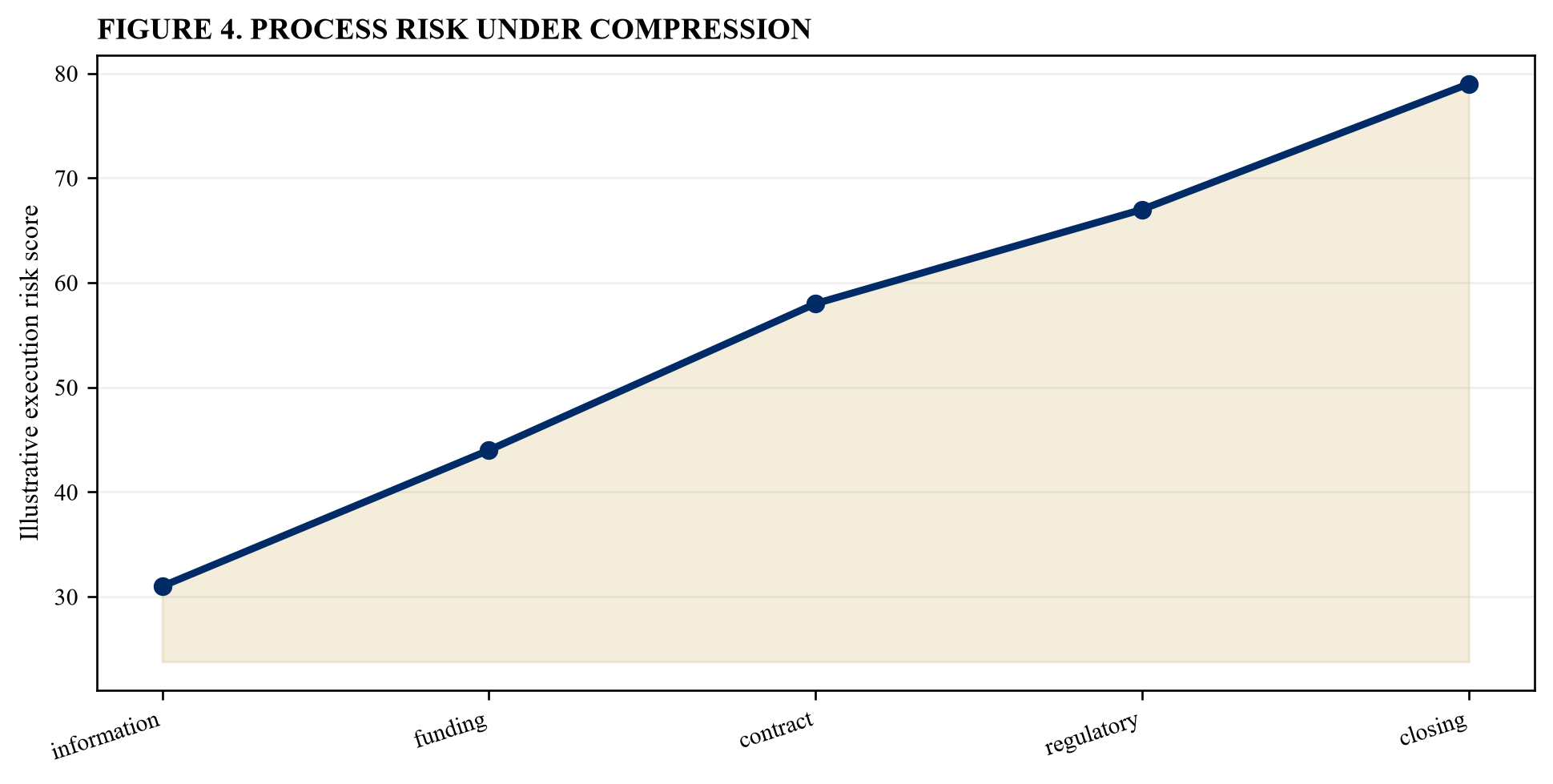
Illustrative analytical scenario; transaction evidence should replace model values.
36. Control signing and completion
The company should reconcile conditions, approvals, funds flow, title documents, releases, employee transfers, contracts, licences, notices and day-one access. The evidence base includes closing checklists, signed documents, bank details, confirmations and legal opinions. The decisive test asks whether every legal and operational dependency is satisfied or explicitly waived by an authorised party. Conclusions should remain at entity and asset level because cash, claims, title, licences and contractual rights may sit in different parts of the group [18][31][56].
The decision-makers should receive a completion certificate and funds-flow statement. It should state the calculation date, source, conditions and approvals. This makes the analysis reproducible when facts change or an independent reviewer examines the sale.
The material downside is that a last-minute failure can leave the business without liquidity or a lawful operating perimeter. Connect the response to minimum cash, creditor recoveries, process integrity and transaction milestones. The selected route remains preferred only while these controls support it.
37. Execute separation and evidence retention
The company and its advisers should transfer systems, premises, people, contracts, data and records while preserving books, claims evidence, statutory files and process materials. The work starts with transition plans, data maps, record-retention rules, service agreements and closing archives. The decision question is how the buyer operates immediately and how the seller or officeholder administers the remaining estate. The record should state the responsible entity, evidence date, owner, unresolved items and the next irreversible deadline [29][32][57].
The controlled output is a day-one plan, separation schedule and indexed archive. It should connect the transaction evidence to the applicable legal process, available cash, creditor outcome and completion timetable. Each conclusion should be traceable to a current document, calculation or attributed professional judgement.
The principal risk is that value can leak after closing through access failures, stranded costs or missing evidence. The team should measure the effect on going-concern value, distributable proceeds, execution probability and operating continuity. A material change should update the route and decision record when it becomes known.
Table 5. Accelerated implementation roadmap
| Horizon | Decision | Evidence |
|---|---|---|
| first 24 hours | secure authority and cash | mandates and bank reconciliation |
| days 2 to 5 | launch controlled market | perimeter data room and protocol |
| days 6 to 12 | select executable bid | valuation funding and mark-up |
| completion and day one | transfer and preserve evidence | certificate funds flow and archive |
Values and scores are analytical scenarios; transaction evidence should replace model values.
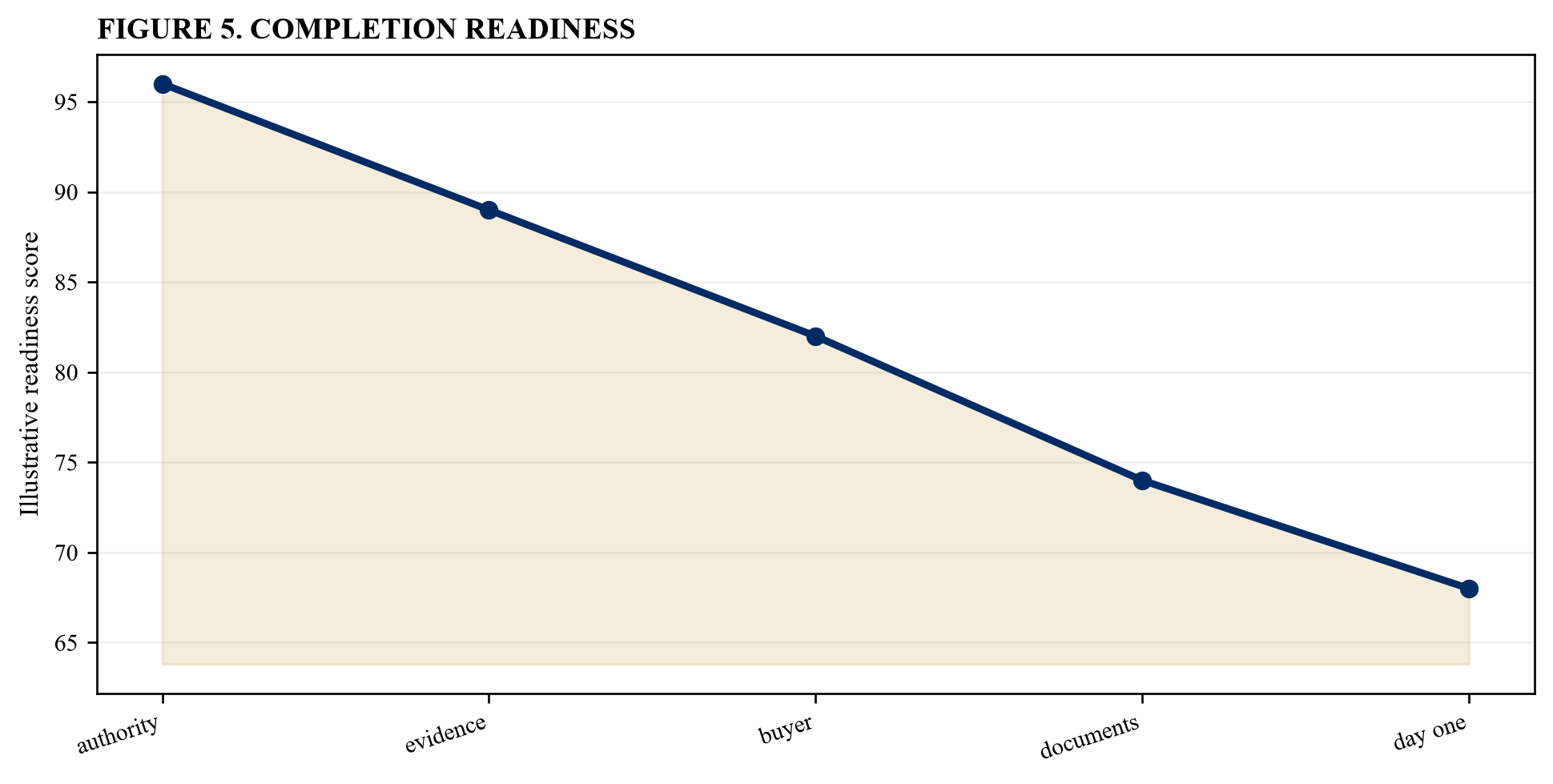
Illustrative analytical scenario; transaction evidence should replace model values.
References
- UK Government, Requirements for Independent Scrutiny of Disposals in Administration, https://www.gov.uk/government/publications/requirements-for-independent-scrutiny-of-the-disposal-of-assets-in-administration-including-pre-pack-sales/requirements-for-independent-scrutiny-of-the-disposal-of-assets-in-administration-including-pre-pack-sales
- The Administration Restrictions on Disposal etc to Connected Persons Regulations 2021, https://www.legislation.gov.uk/uksi/2021/427/contents
- Insolvency Act 1986, https://www.legislation.gov.uk/ukpga/1986/45/contents
- Insolvency Rules 2016, https://www.legislation.gov.uk/uksi/2016/1024/contents
- UNCITRAL, Model Law on Cross-Border Insolvency, https://uncitral.un.org/en/texts/insolvency/modellaw/cross-border_insolvency
- UK Government, Corporate Financial Distress Guidance Note, https://www.gov.uk/government/publications/the-sourcing-and-consultancy-playbooks/corporate-financial-distress-guidance-note-html
- UK Insolvency Service, Company Insolvency Statistics Releases, https://www.gov.uk/government/collections/company-insolvency-statistics-releases
- Companies Act 2006, Part 26A, https://www.legislation.gov.uk/ukpga/2006/46/part/26A
- UK Government, Pre-pack Sales in Administration Report, https://www.gov.uk/government/publications/pre-pack-sales-in-administration/pre-pack-sales-in-administration-report
- UK Government, Order of Payment of Creditors, https://www.gov.uk/government/publications/technical-guidance-for-official-receivers/35-order-of-payment-of-creditors
- Financial Reporting Council, UK Corporate Governance Code, https://www.frc.org.uk/library/standards-codes-policy/corporate-governance/uk-corporate-governance-code/
- Companies Act 2006, Accounting Records, https://www.legislation.gov.uk/ukpga/2006/46/section/386
- Insolvency Service, Annual Review of Insolvency Practitioner Regulation 2024, https://www.gov.uk/government/publications/insolvency-practitioner-regulation-process-review-2024/annual-review-of-insolvency-practitioner-regulation-2024
- Statement of Insolvency Practice 16, Pre-packaged Sales in Administrations, https://www.economy-ni.gov.uk/publications/sip-16-pre-packaged-sales-administrations
- Directive EU 2026/799 Harmonising Certain Aspects of Insolvency Law, https://eur-lex.europa.eu/eli/dir/2026/799/oj
- UK Supreme Court, BTI 2014 LLC v Sequana SA, https://www.supremecourt.uk/cases/uksc-2019-0046
- International Valuation Standards Council, International Valuation Standards, https://ivsc.org/standards/
- United States Bankruptcy Code Section 363, https://uscode.house.gov/view.xhtml?req=granuleid:USC-prelim-title11-section363
- UK Government, Employee Rights on Insolvency, https://www.gov.uk/your-rights-if-your-employer-is-insolvent
- Transfer of Undertakings Protection of Employment Regulations 2006, https://www.legislation.gov.uk/uksi/2006/246/contents
- Directive EU 2026/799 Articles on Pre-pack Proceedings, https://eur-lex.europa.eu/legal-content/EN/TXT/PDF/?uri=CELEX:32026L0799
- HM Revenue and Customs, Insolvency Manual, https://www.gov.uk/hmrc-internal-manuals/insolvency
- HM Revenue and Customs, VAT Transfer of a Business as a Going Concern, https://www.gov.uk/hmrc-internal-manuals/vat-transfer-of-a-business-as-a-going-concern
- Competition and Markets Authority, Mergers Guidance, https://www.gov.uk/topic/competition/mergers
- UK Government, National Security and Investment Act Guidance, https://www.gov.uk/government/collections/national-security-and-investment-act
- Financial Conduct Authority, Change in Control, https://www.fca.org.uk/firms/change-control
- UK Government, Find a Licence, https://www.gov.uk/licence-finder
- UK Intellectual Property Office, Manage Intellectual Property, https://www.gov.uk/browse/business/intellectual-property
- Information Commissioner's Office, Data Sharing, https://ico.org.uk/for-organisations/uk-gdpr-guidance-and-resources/data-sharing/
- ISO 22301 Business Continuity Management Systems, https://www.iso.org/standard/75106.html
- United States Bankruptcy Code Chapter 11, https://uscode.house.gov/view.xhtml?path=/prelim@title11/chapter11
- UK Government, Record Keeping for Companies, https://www.gov.uk/running-a-limited-company/company-and-accounting-records
- United States Courts, Chapter 11 Bankruptcy Basics, https://www.uscourts.gov/court-programs/bankruptcy/bankruptcy-basics/chapter-11-bankruptcy-basics
- The Pensions Regulator, Clearance Guidance, https://www.thepensionsregulator.gov.uk/en/document-library/regulatory-guidance/clearance-guidance
- Companies House, Register a Charge, https://www.gov.uk/guidance/register-a-charge-mortgage-for-a-limited-company
- IFRS Foundation, IAS 1 Presentation of Financial Statements, https://www.ifrs.org/issued-standards/list-of-standards/ias-1-presentation-of-financial-statements/
- Insolvency Practitioners Association, Ethics Code, https://insolvency-practitioners.org.uk/regulation-and-guidance/ethics-code
- IFRS Foundation, IFRS 13 Fair Value Measurement, https://www.ifrs.org/issued-standards/list-of-standards/ifrs-13-fair-value-measurement/
- IFRS Foundation, IAS 36 Impairment of Assets, https://www.ifrs.org/issued-standards/list-of-standards/ias-36-impairment-of-assets/
- World Bank, Principles for Effective Insolvency and Creditor Debtor Regimes, https://www.worldbank.org/en/topic/financialsector/brief/the-world-bank-principles-for-effective-insolvency-and-creditor-rights
- Competition and Markets Authority, Mergers Intelligence Function, https://www.gov.uk/guidance/tell-the-cma-about-a-merger
- UK Government, UK Sanctions, https://www.gov.uk/government/collections/uk-sanctions
- Financial Conduct Authority, Principles for Businesses, https://www.handbook.fca.org.uk/handbook/PRIN/2/
- UK General Data Protection Regulation, https://www.legislation.gov.uk/eur/2016/679/contents
- Financial Reporting Council, Going Concern Guidance, https://www.frc.org.uk/library/standards-codes-policy/accounting-and-reporting/going-concern-and-viability/
- Competition and Markets Authority, Clean Teams Guidance, https://www.gov.uk/government/publications/guidance-on-the-application-of-the-competition-act-1998-horizontal-guidance
- Federal Rules of Bankruptcy Procedure Rule 6004, https://www.law.cornell.edu/rules/frbp/rule_6004
- Financial Action Task Force, Beneficial Ownership of Legal Persons, https://www.fatf-gafi.org/en/publications/Fatfrecommendations/Guidance-Beneficial-Ownership-Legal-Persons.html
- UK Government, Money Laundering Regulations Guidance, https://www.gov.uk/guidance/money-laundering-regulations-your-responsibilities
- United States Bankruptcy Code Section 365, https://uscode.house.gov/view.xhtml?req=granuleid:USC-prelim-title11-section365
- OECD, Transfer Pricing Guidelines for Multinational Enterprises and Tax Administrations, https://www.oecd.org/tax/transfer-pricing/oecd-transfer-pricing-guidelines-for-multinational-enterprises-and-tax-administrations-20769717.htm
- European Commission, EU Merger Control Overview, https://competition-policy.ec.europa.eu/mergers/overview_en
- European Banking Authority, Authorisations, https://www.eba.europa.eu/activities/single-rulebook/regulatory-activities/authorisation
- ISO 31000 Risk Management, https://www.iso.org/iso-31000-risk-management.html
- United States Bankruptcy Code Section 364, https://uscode.house.gov/view.xhtml?req=granuleid:USC-prelim-title11-section364
- Federal Rules of Bankruptcy Procedure Rule 6006, https://www.law.cornell.edu/rules/frbp/rule_6006
- UK Government, Retaining Company Records, https://www.gov.uk/running-a-limited-company/company-and-accounting-records
- UNCITRAL, Legislative Guide on Insolvency Law, https://uncitral.un.org/en/texts/insolvency/legislativeguides/insolvency_law
- UNCITRAL, Model Law on Enterprise Group Insolvency, https://uncitral.un.org/en/MLEGI
- Directive EU 2019/1023 on Restructuring and Insolvency, https://eur-lex.europa.eu/legal-content/EN/TXT/?uri=CELEX:32019L1023
- OECD, G20 OECD Principles of Corporate Governance 2023, https://www.oecd.org/en/publications/g20-oecd-principles-of-corporate-governance-2023_ed750b30-en.html
- International Monetary Fund, Orderly and Effective Insolvency Procedures, https://www.imf.org/external/pubs/ft/orderly/
- International Organization of Securities Commissions, Principles for Financial Benchmarks, https://www.iosco.org/library/pubdocs/pdf/IOSCOPD415.pdf
- COSO, Internal Control Integrated Framework, https://www.coso.org/internal-control
- Institute of Internal Auditors, Three Lines Model, https://www.theiia.org/en/content/position-papers/2020/the-iias-three-lines-model-an-update-of-the-three-lines-of-defense/
- UK Government, Corporate Insolvency and Governance Act 2020 Evaluation Reports, https://www.gov.uk/government/publications/corporate-insolvency-and-governance-act-2020-evaluation-reports
- Matchpoint Partners, Thirteen Week Cash Flow as Transaction Infrastructure, https://www.matchpoint-partners.com/our-insights/thirteen-week-cash-flow-transaction-infrastructure.html
- Matchpoint Partners, Rescue Refinance or Sell, https://www.matchpoint-partners.com/our-insights/rescue-refinance-sell-decision-tree-value-time-pressure.html
