

1 The financing decision
The investment committee should decide whether accepted customer payments can support the proposed capital commitment throughout the service term. Specify the equipment and integration being funded, the service purchased and the payment conditions before selecting a financing vehicle. A sensor programme, a maintenance service and a plant-availability undertaking involve different responsibilities. Their cash forecasts should reflect the actual promise being sold.
This paper proposes a special purpose vehicle, or SPV, to fund a defined predictive-maintenance programme and receive its contracted payments. The vehicle could purchase monitoring equipment, contract for integration and procure continuing analytics and maintenance support. This is a structural proposal. Incorporation alone supplies no finding about bankruptcy remoteness, enforceable security, accounting consolidation, tax or lender acceptance. Those questions require separate diligence in the relevant jurisdiction.
The decision should begin with a payment map. Identify who pays for commissioning, who accepts recurring service, which deductions reduce invoices and when cash is due. Establish whether payments depend on sensor availability, maintenance action, plant output or verified savings. A model can support engineering decisions while earning no separate contractual revenue. The financing case needs a defined payment obligation and a credible collection route.
Recommend a smaller pilot where those obligations remain unresolved. Fund the uncertain development phase with capital able to bear development losses, subject to the sponsor's actual resources and approvals. Long-term debt should be considered after the parties can test the customer contract, delivery costs and continuity arrangements. This sequencing is an author recommendation, with no claim that a particular financing provider follows it.
2 Scope and source boundaries
The paper concerns financing equipment monitoring and associated services through a proposed combination of availability and verified savings payments. It addresses assets such as pumps, motors and other equipment in energy and water operations. Each application requires equipment-specific engineering review. No claim is made that a model tested on one asset, facility or operating regime performs reliably on another.
DOE describes US federal energy savings performance contracts as arrangements in which an energy service company designs improvements and arranges project financing. Its descriptions include a savings undertaking within that federal framework.[1] This provides a relevant contracting reference. It establishes neither a standard private predictive-maintenance SPV nor procurement authority outside its stated setting. The paper's proposed structure is independently developed.
DOE's operations and maintenance resource identifies the need to incorporate, document and verify the claimed savings.[2] Its verification options distinguish component isolation, facility-level approaches and calibrated simulation for energy and water projects.[3] The application proposed here uses those concepts to organise diligence. The appropriate method depends on the actual intervention, records and contract. An engineering assessor must determine whether the selected evidence supports the intended payment.
NIST's AI framework is voluntary guidance for evaluating AI risk.[4] Its operational-technology publication addresses security alongside reliability, safety and performance requirements.[5] NASA defines prognostics through prediction of lost component function and remaining useful life in a vehicle-health setting.[6] These sources inform specific evaluation questions. The paper reports no experiment, audited customer savings, observed default rate or measured market demand.
3 Define the purchased service
Create a service schedule that names the assets, permitted interfaces, reporting frequency and delivery obligations. Monitoring availability can mean that valid data arrive and the agreed analytical service is accessible. Plant uptime can mean that equipment performs a defined physical duty. An agreement should specify which measure earns the availability fee. Calling both measures availability creates a payment ambiguity that a financing model cannot resolve.
The proposed contract separates equipment installation, analytical service and physical intervention. Installation acceptance tests should confirm that the specified equipment and interfaces meet the agreed requirements. Analytical-service acceptance should use a documented evaluation and reporting protocol. Maintenance work should require an authorised work order and evidence of completion. These are proposed contractual boundaries; the parties may combine responsibilities when supported by engineering capability and clear liability allocation.
Define the recipient of each alert. An operator needs enough information to understand the affected asset, the condition detected, confidence limitations and required review. A contractual response obligation should identify who decides whether to inspect, stop or continue the equipment. The technology provider should not acquire an undefined right to change operations merely because it provides a forecast. Approval rights need to match the safety and operating context.
Record dependencies on the customer. Site access, communications, operating data and maintenance permissions can affect delivery. If the customer withholds an agreed dependency, the contract should specify the evidence needed for relief and the resulting payment treatment. A lender assessing cash continuity needs to see both the provider's obligations and those dependencies. A commercial summary without the exception schedule leaves the payment forecast incomplete.
4 Convert condition evidence into accepted cash
The proposed evidence chain starts with an identified asset and a time-stamped condition record. It proceeds through model output, human review, an authorised intervention where applicable, accepted service and invoicing. Collection completes the cash chain. Each stage requires its own record. An accepted invoice can remain unpaid; an engineering result can remain disputed; a completed repair can fall outside the contracted scope.
Assign a record owner at each transition. The operator controls its work-order approval, the provider retains analytical versions, and an agreed reviewer assesses performance under the contract. The SPV's contract administrator should reconcile these records to invoices. The paper recommends preserving the original evidence and any later corrections. A corrected reading should have an explanation and approval trail so the reviewer can reconstruct the payment calculation.
Measure the time between delivery and acceptance. Where a customer has a lengthy review period, receivables financing cannot be assumed to cover the interval before entitlement is established. The sponsor must fund continuing operations and verification during that period. The financial model should show the cash gap separately from the ultimate annual outcome. An annual surplus can coexist with a temporary inability to pay staff or suppliers.
Figure 1 presents a proposed readiness curve with contractual milestones. The vertical movement is qualitative evidence maturity, not a validated technology-readiness score or observed adoption rate. The curve is intended to prompt review of the least developed dependency. A technically mature sensor can remain commercially immature if the invoice process, operating permissions or continuity rights are unresolved.
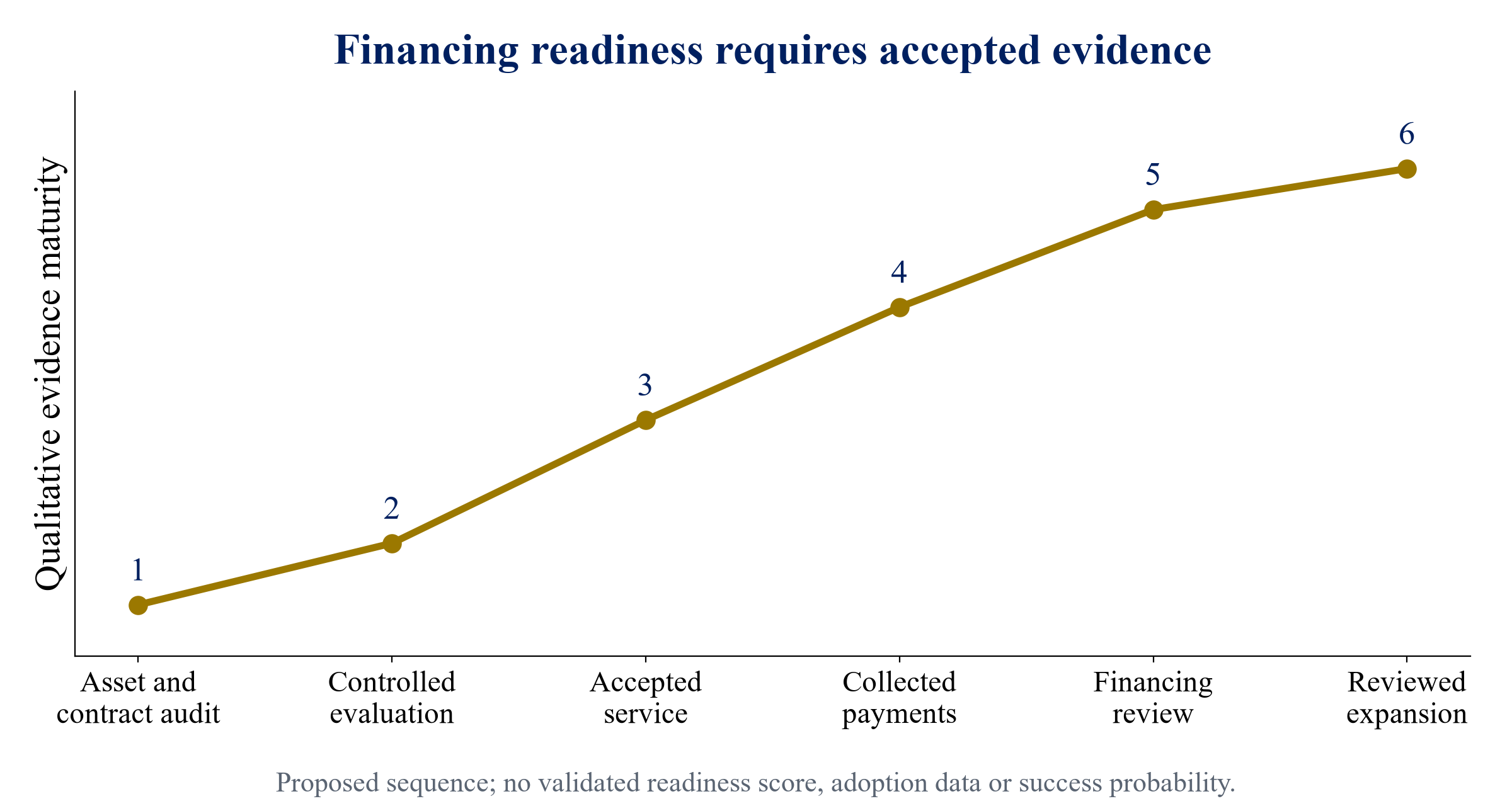
Author-designed qualitative curve and contractual milestones. No measured adoption, probability of success or validated technology-readiness score is asserted.
5 Identify the asset and responsibility perimeter
Attach an asset register that connects each monitored component to its location, equipment identifier, maintenance history and intended duty. Include replacement rules and the process for adding assets. A contract covering a pump train should say whether the motor, bearing, coupling and electrical supply are inside its scope. A broad description of a facility does not establish responsibility for every reason that production can stop.
Define the physical and operational boundary before commissioning. A plant may operate with redundant equipment, seasonal load changes or shared utilities. A component outage may have no immediate production consequence when a standby asset carries the duty. Conversely, a common supply interruption can disable several healthy components. The proposed contract records those relationships rather than valuing every alert as a separately avoided plant shutdown.
Set a mechanism for changes in operating duty. A customer may increase throughput, change the product mix or retire equipment during the service term. Those actions can affect the data distribution, maintenance requirements and scope of the service. The parties should agree when revalidation, repricing or a replacement asset schedule is necessary. The mechanism must preserve a record of conditions underlying the original offer.
Table 1 proposes a responsibilities matrix for negotiation. It allocates evidence and review questions rather than asserting a legal standard. Local counsel and technical advisers should test the resulting signed arrangement. Responsibility without practical control can generate a promise that neither the operator nor the provider can fulfil reliably, leaving the SPV exposed to a disputed deduction.
Table 1. Proposed responsibilities and payment evidence
| Function | Proposed responsible party | Evidence relevant to payment |
|---|---|---|
| Asset identity and operating duty | Customer operator | Agreed register and change log |
| Monitoring installation | Integration contractor | Commissioning acceptance record |
| Analytics and model versions | Technology provider | Versioned results and exception record |
| Physical maintenance decision | Authorised operator | Approved work order and completion record |
| Performance acceptance | Customer and agreed reviewer | Reproducible service or savings calculation |
| Invoice and collection | SPV administrator | Accepted invoice and bank receipt |
6 Evaluate the monitoring and model evidence
The financing review should request the evaluation dataset, asset coverage and failure definitions relevant to the offered service. Record periods with missing data, calibration issues and operating changes. Distinguish a retrospectively fitted model from performance observed after a defined model version enters operation. The proposed review requires information about how the model was tested; a financing presentation should not convert a demonstration into a contractual performance finding.
Choose evaluation measures that reflect the operational decision. An alert that arrives after maintenance is already required may have limited scheduling value. An early alert may be useful only when spare parts, access and personnel can support action. False alerts can consume inspection resources. Missed events can leave operators unaware of a deterioration. The contract should explain which consequences fall within its service promise and how performance will be assessed.
NASA's prognostics definition connects remaining useful life to the anticipated loss of component function.[6] Applying that idea to an industrial contract requires a specified operating duty and failure criterion. The paper proposes retaining the forecast interval and its stated assumptions alongside a central prediction. A numerical remaining-life estimate should be accompanied by sufficient engineering interpretation to support a responsible operating decision.
Record how updates are approved. Changes to features, thresholds, training data or model versions can alter alerts and acceptance results. Establish a version register, evaluation record and fallback procedure. The lender's diligence should ask whether those changes can alter revenue without customer approval. This paper proposes governance for such changes; it provides no certification of a model's safety, accuracy or suitability for autonomous control.
7 Price monitoring availability
An availability fee should identify the exact service being made available. For the proposed monitoring service, the parties could specify eligible data coverage, analytical-service access and response obligations. Set the denominator, scheduled exclusions and required evidence. If the customer purchases plant availability, the contract needs a broader analysis of equipment capability, operator action and causes of outage. The fee should reflect the signed scope.
Specify how deductions are calculated. A communications outage affecting one asset and a system-wide analytical outage may require different treatment. The contract can define deduction periods, aggregation rules and caps, subject to applicable law and negotiation. The financial model should reproduce those rules directly. A single percentage haircut can conceal a nonlinear deduction schedule that removes substantially more revenue during a concentrated interruption.
The proposed financing case uses an annual gross availability fee of USD 360,000. That figure is fictional, selected to demonstrate cash mechanics. It is neither a market quotation nor evidence of a customer's willingness to pay. Base-case deductions of USD 5,000 are also assumptions. Actual pricing needs the customer's budget, the service scope, comparable bids where available and assessment of the operational benefit.
Separate the payment calendar from the calculation period. An annual service calculation with monthly payments may require adjustments after review. Define true-ups, disputed amounts and treatment of overpayments. The SPV should forecast cash using the agreed timing and possible deductions. It should retain enough liquidity to meet delivery obligations during reconciliation, subject to an explicit reserve policy and actual funding.
8 Define eligible maintenance savings
Create a savings schedule stating the avoided expenditure that can earn an outcome payment. Possible categories for assessment include externally procured maintenance, emergency mobilisation and specified replacement costs. The contract should identify the corresponding baseline and supporting records. An avoided task may change timing rather than eliminate expenditure. A forecast repair cost should not automatically be treated as cash saved in the current year.
DOE's operations and maintenance resource supports documenting and verifying savings in its performance-contract setting.[2] This paper proposes a transaction-level ledger of the claimed saving, baseline obligation, actual expenditure and approved adjustment. Keep labour redeployment, avoided procurement and production benefit separate. An employee who spends time on another task creates a different financial effect from a cancelled supplier payment.
Account for interventions that move costs between parties. A maintenance contractor may perform additional inspections following alerts, while the customer postpones an overhaul. The savings calculation should deduct incremental delivery and verification costs where the negotiated definition requires them. Avoid combining the customer's gross operating benefit with the SPV's fee revenue. The payment share and the operating saving describe different economic interests.
The proposed case assumes USD 40,000 of accepted savings fees in its base year. The higher case assumes USD 70,000 and the downside case zero. These amounts are hypothetical customer payments, with no claim about the physical saving necessary to earn them. A real transaction would require the contractual sharing formula, accepted saving and payment evidence before inserting such revenue into a financing model.
9 Agree verification and disputes
Select the measurement and verification approach with the technical assessor before relying on an outcome fee. Component-level measurement can help where the intervention and relevant parameters are isolated. A facility-wide comparison requires careful treatment of other operating changes. DOE's options describe these approaches in energy and water projects.[3] Their use here requires adaptation to the specific maintenance promise and evidence available.
Agree access to underlying records. The reviewer needs the baseline, reporting-period data, intervention history and calculation method. Preserve the data version used for each invoice and document corrections. When a supplier's intellectual property restricts model disclosure, the parties should negotiate enough access to verify contractual performance without assuming unrestricted rights. An inability to reproduce the payment calculation is a material diligence issue.
Define the path for a disputed calculation, including reviewer authority, timetable and treatment of undisputed amounts. Technical questions about a meter or model differ from interpretation of a contractual exclusion. The proposed schedule records the nature of the issue and assigns the appropriate decision maker. It does not assert enforceability of a particular dispute clause or an automatic right to withhold payment.
The financing model should include delayed acceptance and delayed collection as separate sensitivities. An outcome that is ultimately accepted can still create a cash shortfall during review. A reserve draw is a financing response to that timing problem. It cannot establish that an unaccepted outcome was earned, nor supply evidence that a customer will pay at the end of a dispute.
10 Set data and continuity rights
The SPV should receive the rights needed to deliver, verify and continue the contracted service. Those rights may involve equipment access, operational records, software licences and provider support. List each right, its holder, term and termination conditions. Owning a monitoring device does not establish access to its platform, the customer's operational data or a replacement provider's analytical tools.
Agree portability requirements before financing. Retain an asset-data dictionary, units, timestamps, calibration history and permitted export format. Test whether a replacement provider can use the available records without recreating the entire integration. The proposal treats portability as an operational question supported by evidence. It supplies no conclusion about the ownership of data or software under any particular legal system.
A continuity plan should describe service migration, retained records, licences and technical support following provider failure. Test the plan with the customer and an appropriate specialist. Escrow can form part of a negotiated arrangement, but its practical value depends on accessible material and usable rights. The financing presentation should report the tested capabilities and unresolved dependencies rather than assign a generic recovery percentage.
11 Control operational technology risk
NIST SP 800-82 Revision 3 addresses operational technology security with attention to reliability, safety and performance.[5] Its publication page also identifies an initial public draft of Revision 4 as of September 2026. The paper uses the final Revision 3 as a reference and does not present the draft as a final standard. Contract requirements should identify the relevant approved versions and review later changes through an agreed process.
The proposed monitoring design should specify whether access is read-only, how remote connections are authorised and who may change equipment settings. A provider collecting condition data has different authority from a system controlling a plant. Assess the network boundary, credentials, update process and incident response with the customer's security and engineering teams. Changes to production operations require the customer's defined approval and safety procedures.
Include continuing security costs in the operating budget. Monitoring can require credential management, patch review, secure integration and incident investigation. A low subscription price can coexist with material customer-side work. The financing analysis should allocate those obligations and their costs. It should also assess whether a security restriction can interrupt the service and how that interruption affects payment under the signed agreement.
Specify evidence retention during an incident. Protect operating safety first and document authorised containment and recovery actions. The payment schedule should address service disruption and the treatment of compromised data. An insurance policy or indemnity may provide a negotiated remedy, subject to its terms and credit quality. Neither substitutes for a practical continuity plan and a verified record of the delivered service.
12 Allocate risk through the SPV contracts
Map the customer agreement, integration contract, technology licence, maintenance arrangement and financing documents together. Identify mismatched terms, termination triggers and limits of liability. A customer may require continued service for four years while a crucial software licence renews annually at an uncertain price. The proposed review requires a funding plan for those dependencies and a remedy where continued delivery cannot be contracted on acceptable terms.
Specify which assets and receivables the vehicle is intended to hold. Assess title, assignment restrictions, third-party consents and existing security with legal advisers. Any proposed direct agreement or lender step-in mechanism requires review under applicable law and the actual contracts. The paper makes no finding that an SPV designation isolates risks or makes operational contracts transferable after default.
Allocate completion risk to parties able to perform and fund the relevant obligation. Installation delay can defer customer payments while interest and support costs accumulate. Agree commissioning tests, milestone payments and treatment of defects. A guarantee should be assessed by its scope, conditions, remedy and provider resources. A promise from an underfunded supplier cannot be entered into a cash model as certain recovery.
Keep equity incentives visible. A sponsor earning integration margin, platform fees and equity distributions may face choices between timely maintenance expenditure and near-term cash release. The proposed governance requires related-party contracts to be disclosed and reviewed, with approval rights for material changes. Actual fiduciary duties, procurement requirements and conflict rules depend on the jurisdiction and the entities involved.
13 Compare operating and capital costs
Construct a cost benchmark using quotations and the full delivery scope when actual data are available. For this paper, Table 2 provides an entirely fictional annual cost build for fifty assets. The figures illustrate the categories that a review should reconcile. They cannot establish the relative price of any supplier, the efficiency of AI or the economics of a real water or energy facility.
The base illustration assigns USD 35,000 to analytics and licences, USD 20,000 to connectivity and security, USD 25,000 to field support, USD 10,000 to verification and USD 10,000 to administration. The annual total is USD 100,000, or USD 2,000 per asset for fifty assets. A separate annual lifecycle contribution of USD 25,000 funds assumed replacement needs. It is excluded from operating costs and deducted separately in the cash calculation.
Upfront monitoring and integration expenditure is assumed at USD 900,000, or USD 18,000 per asset. An additional USD 100,000 is placed in an initial debt-service reserve. The total initial funding requirement is USD 1 million. Financing fees, taxes and working-capital requirements beyond that reserve are omitted for analytical clarity. A transaction model must insert them where applicable and revise the funding requirement accordingly.
Figure 2 compares the fictional cost and receipt assumptions across operating cases. It does not plot an empirical cost-performance frontier. Actual performance comparisons need a consistent asset mix, service scope, observation period and verified outcome. The proposed benchmark is useful for identifying the assumption that changes a financing decision, including a licence escalation or additional field visit required to sustain service.
Table 2. Fictional base operating cost benchmark for fifty assets
| Cost category | Annual USD | Review requirement |
|---|---|---|
| Analytics and software licences | 35,000 | Signed scope and renewal terms |
| Connectivity and security | 20,000 | Continuing support responsibilities |
| Field maintenance support | 25,000 | Work-order and access assumptions |
| Independent verification | 10,000 | Review scope and timetable |
| SPV administration | 10,000 | Reporting and contract administration |
| Total operating costs | 100,000 | Reconcile to the cash model |
| Separate lifecycle contribution | 25,000 | Replacement plan and cash retention |
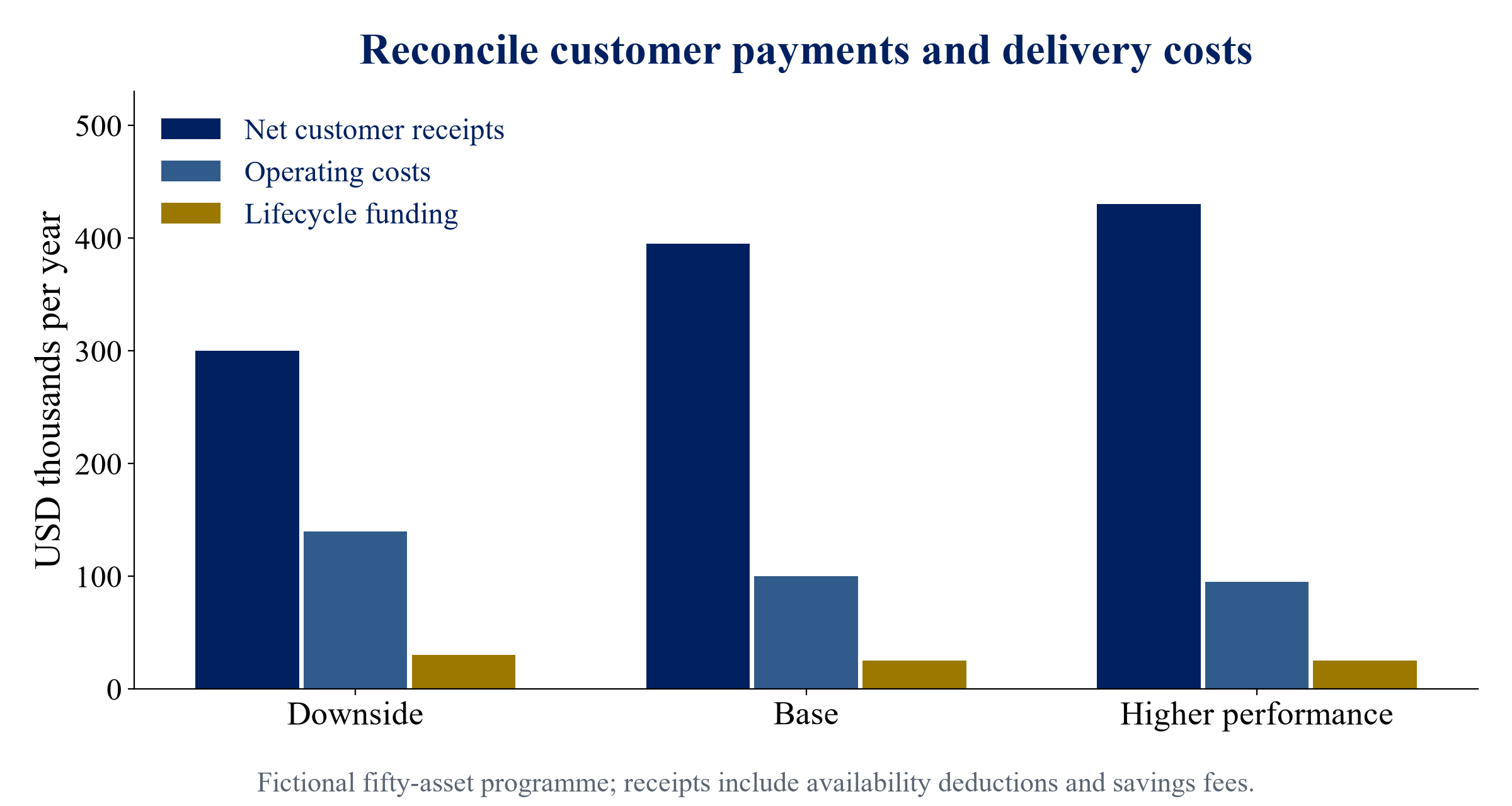
Author assumptions, USD thousands per year. Net receipts include deductions and savings fees. Operating costs and lifecycle contributions are deducted separately. No market price or measured performance is represented.
14 Build the financing model
The fictional programme receives USD 600,000 of debt and USD 400,000 of equity at inception. These sources fund USD 900,000 of monitoring and integration and the USD 100,000 reserve. Debt amortises through equal annual payments over four years at an assumed eight percent annual interest rate. Annual debt service is USD 181,152.48, calculated using a standard level-payment annuity. No arrangement fee or refinancing is assumed.
Calculate cash available for debt service by taking collected availability and savings receipts, deducting operating costs and deducting the annual lifecycle contribution. The contribution is assumed to leave operating cash for a restricted replacement account. This definition avoids treating money needed for asset renewal as freely distributable. Its relationship to a lender's covenant definition would require negotiation and document review.
In the base case, USD 360,000 of gross availability fees less USD 5,000 of deductions plus USD 40,000 of savings fees produces USD 395,000 of receipts. Deduct USD 100,000 of operating costs and USD 25,000 of lifecycle funding to obtain USD 270,000 of cash available for debt service. Dividing by annual debt service gives coverage of 1.49. These are hypothetical calculations, not a borrowing offer.
Separate funding, operating and distribution ledgers. The reserve is initial restricted funding; lifecycle contributions are recurring operating cash retention; debt payments reduce financing obligations. Payments between those ledgers require a stated rule. Treating a reserve balance as annual revenue would inflate coverage. Treating debt principal as operating expense would distort an unlevered valuation. The proposed workbook should expose each flow and reconcile opening and closing cash.
15 Test downside and performance variation
The downside case assumes USD 60,000 of availability deductions, zero savings fees, USD 140,000 of operating costs and USD 30,000 of lifecycle funding. Receipts fall to USD 300,000 and cash available for debt service to USD 130,000. Coverage is approximately 0.72. Annual operating cash falls short of scheduled debt service by USD 51,152.48. A financing decision needs a documented response to that shortfall.
The higher-performance case assumes no availability deductions, USD 70,000 of savings fees, USD 95,000 of operating costs and USD 25,000 of lifecycle funding. Receipts are USD 430,000 and cash available for debt service USD 310,000. Coverage is approximately 1.71. This case is a sensitivity, with no probability assigned. Its higher cash result does not offset a downside liquidity event unless the cash is actually available when needed.
Table 3 reports the same definitions in all cases. Test compound events as well as separate changes. A provider outage may increase field-support costs while reducing fees. A customer can dispute savings while withholding availability amounts under the agreed contract. Correlated cash effects need an explicit event model. Independent percentage sensitivities should not imply that unrelated shocks exhaust the range of plausible operational outcomes.
The board should identify which assumption it can influence. It may negotiate payment timing, obtain a different delivery quotation or reduce the financed perimeter. It cannot convert an uncertain technical result into collected money by choosing a favourable model input. Use the sensitivities to frame a decision about scope, capital structure and contractual evidence, then obtain actual diligence for the selected terms.
Table 3. Fictional annual cash and four-year valuation scenarios
| Item | Downside | Base | Higher performance |
|---|---|---|---|
| Gross availability fee USD | 360,000 | 360,000 | 360,000 |
| Availability deductions USD | 60,000 | 5,000 | 0 |
| Accepted savings fee USD | 0 | 40,000 | 70,000 |
| Operating cost USD | 140,000 | 100,000 | 95,000 |
| Lifecycle contribution USD | 30,000 | 25,000 | 25,000 |
| Cash available for debt service USD | 130,000 | 270,000 | 310,000 |
| Coverage at fixed annual debt service | 0.72 | 1.49 | 1.71 |
| Project NPV at ten percent USD | -519,616 | -75,835 | 50,960 |
16 Size debt against accepted receipts
Assess the availability-only case before including contingent savings fees. Under base deductions, operating costs and lifecycle funding, cash available without savings fees is USD 230,000. Coverage on the illustrative loan is 1.27. If a hypothetical lender required 1.40 coverage under that case, the proposed debt would exceed the case's permitted debt service. The 1.40 threshold is an author-selected test, with no claim that it represents market practice.
The annual cash needed for that test is USD 253,613.48. The gap to availability-only cash is USD 23,613.48. Accepted savings receipts at least equal to that gap would meet the test arithmetically under the other base assumptions. The actual decision requires assessing the reliability and timing of those receipts. A mathematically sufficient outcome fee can remain unsuitable for underwriting if its acceptance basis or collection record is unresolved.
Debt sizing should reflect the weakest relevant period and the governing covenant definition. Quarterly obligations, delayed fees and seasonal delivery costs can produce a different result from annual averaging. Use the signed payment schedule and monthly operating model to assess liquidity. A lender could require lower leverage, sponsor support, reserves or a different repayment schedule; actual terms must come from a verified financing proposal.
The proposed approach leaves unproven savings upside outside the initial debt case unless diligence supports its inclusion. That treatment can reduce the capital raised and increase the sponsor's equity requirement. Record whether the customer and sponsor can fund the resulting structure. An otherwise attractive operating idea can remain unfinanceable at the proposed scope when the parties cannot provide the required capital.
17 Design reserves and the cash waterfall
The proposed USD 100,000 initial reserve exceeds the fictional one-year downside debt-service shortfall, but it does not establish that four years of downside performance can be financed. Two identical shortfall years would require USD 102,304.97 before considering other needs or reserve earnings. That exceeds the initial balance. The reserve illustration assumes no replenishment, interest income or permission to use lifecycle money for debt service.
Set draw and replenishment rules in the actual financing documents. A proposed waterfall could prioritise essential service expenditure, verification, lifecycle funding and scheduled debt service before equity distributions. The parties should determine the exact order and permitted exceptions. Necessary operating costs cannot be deferred indefinitely without affecting service, deductions and the underlying customer contract. The model should show that feedback when a stressed waterfall restricts expenditure.
Separate the debt reserve from the lifecycle account. Replacement funding supports the ability to continue delivering service. A lender may negotiate conditions for transfers, but any use of lifecycle money should be assessed against future equipment obligations. The paper's valuation treats annual lifecycle contributions as spent or committed to replacement and assigns them no terminal recovery. That conservative modelling choice is an author assumption.
Distributions should follow an agreed evidence and coverage review. The proposed administrator would reconcile bank cash, unpaid obligations, reserve balances and accepted performance before seeking approval. The arrangement needs actual governance, bank-account controls and review authority. A spreadsheet calculation alone cannot restrict distributions or establish the priority of a payment after insolvency.
18 Examine collection timing
The base annual receipts include an outcome fee that may be accepted after the availability invoices. A cash model should schedule each receipt separately and show the period before acceptance. Annual debt service in the illustration is paid at year end. The paper also offers a simplified quarterly comparison solely to expose timing risk; it is not the repayment calendar used in the annuity calculation.
Dividing availability-only annual cash by four gives USD 57,500 per quarter under even costs and receipts. Dividing annual debt service by four gives USD 45,288.12. The arithmetic margin is USD 12,211.88. These equal-quarter assumptions ignore payment delays and seasonal costs. A delayed availability invoice can consume that margin even when the annual total eventually arrives.
Prepare a rolling cash forecast using actual invoice dates, approval intervals, supplier payments and restricted accounts. Distinguish an unbilled performance claim from an accepted receivable and an overdue invoice. Financing eligibility and security requirements must be assessed for each state. The proposed SPV should preserve invoice-level records that connect the service evidence to the amount requested and the money collected.
Add a stress in which the customer pays an accepted invoice late while the provider must pay a critical software renewal. Specify the available committed liquidity and the consequence of failure to renew. A promised future equity contribution requires evidence of commitment and resources. Uncommitted support should remain an unresolved funding dependency in the investment recommendation.
19 Value the project with explicit limits
The four-year project valuation discounts each annual cash-available amount at an assumed ten percent and subtracts the USD 1 million initial funding requirement. It adds the initial USD 100,000 debt-service reserve as a recovery at the end of year four, assuming it remains untouched. The operating equipment has zero terminal value in this illustration. Taxes, transaction fees and additional working capital are excluded. Those omissions limit application to an actual investment.
The annuity discount factor is approximately 3.169865. Using constant annual cash within each scenario yields project net present values of negative USD 519,616 in the downside case, negative USD 75,835 in the base case and positive USD 50,960 in the higher case. These are unlevered project calculations under the stated assumptions. They are neither an equity valuation nor estimates of sale proceeds or fair value.
The reserve-recovery assumption is favourable to the downside valuation. Section 17 shows that sustained downside cash would consume it and require additional support. Presenting the assumed recovery across all scenarios preserves a common calculation convention, but overstates downside value if a draw occurs. A transaction model should track each draw, replenish where required and use the resulting terminal balance. No downside solvency conclusion follows from the displayed NPV.
Figure 3 places the hypothetical valuations alongside the proposed commercialisation roadmap. The base case's negative NPV requires a decision about price, cost, funding scope or investment criteria. Debt-service coverage and positive project value answer different questions. This paper supplies no claim that meeting a coverage threshold proves that the investment creates value for the sponsor.
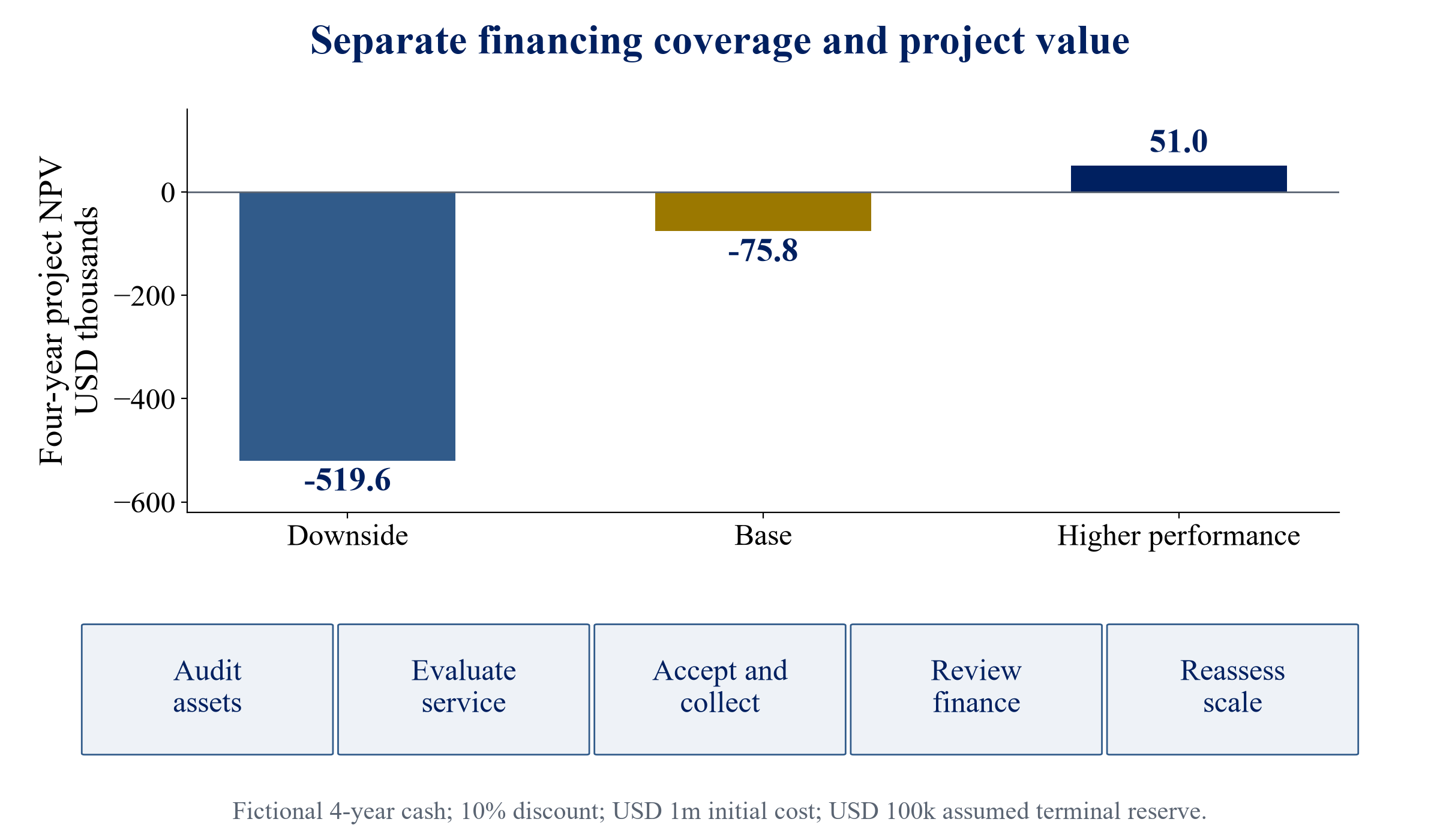
Four-year constant cash cases, ten percent discount, USD 1 million initial funding, assumed USD 100,000 terminal reserve recovery and zero equipment residual. No taxes or fees. Reserve draws would change the result. Roadmap stages are author proposals.
20 Review termination and replacement
Review each termination event against the debt balance and continuing service obligations. A customer may terminate for breach, convenience or specified events, depending on the negotiated agreement and law. The financing case must inspect the actual compensation formula, offsets, timing and conditions. A projected termination receipt cannot be treated as certain merely because an unsigned term sheet contains a compensation heading.
Consider technology-provider failure separately from customer termination. The SPV may need to replace a provider while preserving the customer's contract. Assess licences, equipment interfaces, usable data, support records and customer consent. A proposed direct agreement could address cure and replacement mechanisms, subject to legal review. Operational capability and authority to act must both be established before assigning recovery value to that mechanism.
Define the end-of-term handover. The customer needs an agreed equipment condition, data delivery and treatment of continuing licences. The vehicle needs clarity about removal costs, remaining obligations and release of security or reserves. A zero equipment residual in the financial illustration avoids reliance on an unsupported resale value. Actual residuals require evidence of condition, marketability, ownership and permitted disposal.
Evaluate cyber incidents, data loss and prolonged site inaccessibility against the exception schedule. The signed documents should define relevant remedies and payment consequences. Insurance recoveries depend on covered events, deductibles, exclusions and insurer response. The proposed review records those terms and stresses the timing of recovery. The paper makes no claim that insurance covers a particular loss or closes every continuity gap.
21 Assess portfolios and acquisition opportunities
A platform may seek to finance several maintenance programmes through one vehicle or acquire providers with recurring service contracts. Start by examining each asset perimeter and payment agreement. Combining contracts does not establish diversification when they depend on the same customer, model, cloud service or equipment supplier. Record those dependencies and their possible effects on deductions, operating costs and collections.
For an acquisition, reconcile recurring invoices to accepted service and cash. Examine termination rights, customer concentration, renewal terms, data access and required field support. A subscription revenue label does not reveal the physical obligations needed to keep that revenue. The proposed diligence should identify the cost of delivering existing contracts and the expenditure needed when equipment reaches its replacement date.
Review potential common-cause events before using portfolio averages. One software update can affect multiple installations. One customer review dispute can delay several payments. A central support team can become a capacity constraint during simultaneous outages. The paper proposes event-based portfolio stresses with explicit dependencies. It reports no measured correlation or industry default dataset from which to estimate a universal diversification benefit.
22 Transfer the framework across jurisdictions
The proposed payment map can be used as a diligence checklist in different geographies, subject to local assessment. Its questions about asset scope, evidence, deductions and cash timing remain contractual questions to investigate. Procurement power, assignment, security, insolvency, tax, data rules and accounting require jurisdiction-specific advice. No conclusion about a UAE, UK, Indian or US transaction is inferred from the reference frameworks.
The Eurostat and EIB guide addresses statistical treatment of energy performance contracts in national accounts.[7] It expressly excludes business accounting and bankability endorsement. Its discussion stresses economic substance and consideration of the arrangement as a whole. This paper cites those boundaries to caution against using a public-sector statistical classification as proof of financing feasibility or an off-balance-sheet treatment for a private vehicle.
For a public customer, investigate authority to enter the agreement, required procurement procedures and payment approvals. Identify who can commit the budget over the service term and whether additional consents are needed. The paper does not supply a conclusion on those powers. Actual legal and procurement review should identify conditions precedent before the sponsor commits expenditure that depends on future public payments.
For cross-border arrangements, assess currency mismatches, payment restrictions and delivery logistics. A fixed local-currency availability fee with foreign-currency licences or debt creates a modelling dependency. Insert the proposed hedge, cost and counterparty terms only after obtaining evidence. The illustrative USD case contains no foreign-exchange exposure, making it unsuitable for direct use where currency risks are material.
23 Commercialise through evidence milestones
The proposed roadmap begins with an asset and contract audit. Establish the operating perimeter, available records, current maintenance expenditure and proposed service responsibility. Commission a technical review of measurement gaps and model evaluation needs. Obtain a customer decision on the service to be purchased before presenting a financing structure. The audit's outcome can be a narrower pilot or a decision to stop.
Next, run a controlled evaluation with explicit operating permissions and acceptance criteria. Preserve model versions and site events. Review the intervention workflow, field costs, verification process and customer approvals. This paper assigns no universal duration or success threshold. The appropriate observation period depends on asset behaviour, events available for review and the engineering questions material to the contract.
The third stage tests acceptance and collection under a contracted operating period. Reconcile invoices to evidence and cash, including deductions and disputes. Use actual delivery costs and replacement needs to replace the fictional assumptions. Review continuity arrangements and proposed financing terms. The sponsor should commission a financing assessment once those dependencies can be inspected, with development expenditure and sunk costs reported transparently.
Expansion follows a renewed review of asset scope and dependencies. A programme that works for a monitored pump fleet may need different evidence, support and liability arrangements for a battery system or process-critical turbine. Approve the next perimeter on its own technical and commercial basis. The proposed roadmap makes each scale decision accountable to records and identified obligations rather than to an aggregate demonstration score.
24 Recommendations and further research
The proposed investment recommendation should state the service being funded, the customer payment obligation, the accepted evidence and the stressed cash capacity. It should identify who can authorise physical action and who bears the cost when a forecast does not lead to an accepted outcome. Include capital requirements, operating dependencies, reserve policy and the consequences of contract termination. These are decisions for the actual transaction parties and advisers.
The fictional case demonstrates why lenders and sponsors need separate tests. Base cash covers the assumed annual debt service at 1.49 times, while the stated project valuation remains negative. Availability-only coverage is lower, and repeated downside cash consumes the reserve. These results follow from selected inputs. Changing the price, costs, term, reserve treatment or discount rate changes the decision; an actual proposal requires evidence for each change.
Further research should test the framework on longitudinal operating records with independently verified service, maintenance costs and accepted payments. Relevant questions include how forecast lead time affects authorised intervention, how repeated data gaps affect deductions, and how provider replacement changes costs and uptime. A study should publish its asset scope, evaluation method, limitations and treatment of confidential customer data. The paper supplies no such field dataset.
For a prospective mandate, the immediate deliverable is an auditable contract-and-cash model supported by an asset register and technical evaluation plan. That work can identify missing evidence, proposed amendments and the capital structure requiring review. It cannot establish customer demand, financing approval or collected advisory revenue before the corresponding commitments and payments exist. The recommended next decision is whether the defined programme merits a funded, controlled diligence phase.
References
- US Department of Energy Federal Energy Management Program. About Federal Energy Savings Performance Contracts. https://www.energy.gov/cmei/femp/about-federal-energy-savings-performance-contracts Accessed 4 October 2026. US federal contracting context.
- US Department of Energy Federal Energy Management Program. How To Determine and Verify Operations and Maintenance Savings in Energy Savings Performance Contracts. 15 August 2024. https://www.energy.gov/cmei/femp/articles/how-determine-and-verify-operations-and-maintenance-savings-energy-savings Accessed 4 October 2026. Resource landing page, not a reviewed full guide.
- US Department of Energy Federal Energy Management Program. Measurement and Verification Options for Federal Energy- and Water-Saving Projects. https://www.energy.gov/cmei/femp/measurement-and-verification-options-federal-energy-and-water-saving-projects Accessed 4 October 2026.
- National Institute of Standards and Technology. AI Risk Management Framework. Voluntary framework overview and revision status. https://www.nist.gov/itl/ai-risk-management-framework Accessed 4 October 2026.
- National Institute of Standards and Technology. SP 800-82 Revision 3 Guide to Operational Technology Security. September 2023, publication-page planning note 21 September 2026. https://csrc.nist.gov/pubs/sp/800/82/r3/final Accessed 4 October 2026. Final Revision 3 distinguished from draft Revision 4.
- NASA Open Data Portal. Prognostics. Aerospace prognostics definition and resource description. https://data.nasa.gov/dataset/prognostics Accessed 4 October 2026. Descriptive resource; no site-specific model validation asserted.
- Eurostat and European Investment Bank. A Guide to the Statistical Treatment of Energy Performance Contracts. 2018, scope and limitations pages 12 to 14 in printed numbering. https://www.eib.org/attachments/pj/guide_to_statistical_treatment_of_epcs_en.pdf Accessed 4 October 2026. National accounts only; no business-accounting or bankability endorsement.
About the Author
Chennakeshav (CK) is a corporate finance and investment banking executive with 25+ years of global experience in deal origination, structuring and execution across M&A, growth capital and corporate strategy. He has led value-creation mandates for founders, corporates and funds — bridging the boardroom view to hands-on execution and close.
His career spans Morgan Stanley, HSBC, Lloyds Banking Group, EWEC, ADQ portfolio companies and Emirates Growth Fund, across TMT, real estate, fintech, deeptech, cleantech, infrastructure and energy. He has partnered with C-suite leaders, private equity and venture funds, sovereign wealth funds and family offices to finance complex fund raises and scale-up ventures, and has led M&A due diligence, post-merger integration and business-transformation initiatives to create value.
At Matchpoint Partners he is Managing Partner, leading the firm's corporate finance, M&A and capital-raising practice. He holds an MBA from London Business School, an engineering degree from VTU and a Master of Laws (LLM, in progress) from UCL London.
An active start-up mentor, CK mentors at Techstars, DIFC FinTech Hive, Startup Grind, Founder Institute and IN5, serves as Entrepreneur Mentor in Residence (EMiR) at London Business School, and judges the Entrepreneurship World Cup.
