

1 Set the decision around the next cash obligation
A sponsor choosing a development capital stack needs a dated answer to a practical question: how much additional money must be available, where must it sit, and by when must it reach the project if presale cash arrives late? Expected proceeds at completion cannot answer that question alone. The decision requires a bridge from current unrestricted cash to each payment date, with conditions attached to every future inflow. This paper develops that bridge and compares three hypothetical support routes: an upfront equity reserve, binding staged equity and a standby debt facility. It evaluates their ability to fund the same construction schedule under explicit assumptions.
The decision perimeter is a single development entity with one identified remaining programme. The model follows money permitted for that programme, excluding unrelated sponsor assets and other projects' escrow balances. Its principal output is the additional support required to maintain a stated cash floor at each tested month-end. A second output identifies the first period when the unassisted project breaches the floor or cannot pay all assumed uses. These dates determine the latest workable cure. An attractive commitment announced after the failure date remains outside the usable funding case until an earlier bridge is evidenced.
The framework is designed for a development board, sponsor investment committee and financing team reviewing a specific draw and support plan. Each needs to approve a documented cash path rather than a single undated funding total. The worked case assumes a six-month completion programme and explicitly excludes final senior principal repayment from construction uses. It therefore tests completion-period liquidity, not the complete investment return or exit solvency. A separate repayment and distribution model must follow. Keeping that boundary visible allows a team to distinguish a construction funding solution from an unresolved maturity obligation and to avoid presenting one approval as evidence of the other.
2 State the evidence base and research boundary
The primary-source review covers published escrow legislation and official operating materials for Dubai, Abu Dhabi, Saudi Arabia and Bahrain [1–6]. These sources describe account and permission boundaries, with different scope and authority. The IFRS Interpretations Committee's demand-deposit decision concerns a specified accounting fact pattern [7]. RICS development-property guidance addresses valuation methodology and uncertainty [8,9]. IFC financing-information requirements and World Bank project-finance materials supply a conceptual basis for investigating sponsors, funding terms, timetable and lender protections [10–12]. None supplies the numerical presale delays, interest rate or sponsor reserve assumed in the worked case.
The paper's prior-art positioning is methodological. Escrow controls, development cash-flow analysis, sponsor support and construction funding are established subjects in the cited materials. The proposed contribution is their integration into a reproducible dated support test and instrument comparison. This review establishes no claim of worldwide research novelty. It also provides no evidence that developers across the GCC experience a particular average collection delay or that a specified capital structure is generally optimal. Such conclusions require consented transaction observations, consistent definitions and an explicit sampling method. Here, the regional legal context motivates the questions; fictional arithmetic demonstrates the decision procedure.
The source hierarchy should remain visible in a live application. Applicable law and project documents determine permissions. Technical and commercial records support costs, progress and collections. The executed financing agreement determines debt availability. Management forecasts provide forward assumptions that require challenge. The analytical model reconciles these inputs; it cannot convert an unsupported input into a verified fact. Every material cell should carry its source date, owner, evidence status and update trigger. A board can then see which conclusions follow from current documents and which depend on an assumption still awaiting confirmation. This separation also makes a later comparison with realised cash outcomes possible without rewriting the original forecast after the event.
3 Fix the entity and completion perimeter
The proposed first step is a perimeter statement identifying the borrower, developer, account holder, project land, approved scope, escrow arrangement and intended completion milestone. The statement should distinguish the project entity from its parent and identify contracts held elsewhere in the group. A sponsor's consolidated accounts can provide information about resources, while the transfer of those resources to the borrower requires its own authority and funding route. An existing guarantee, related-party receivable or landholding should enter the cash model only through the enforceable obligation or realised liquidity actually relevant to the project.
Completion needs an operational definition. For this paper's fictional model, remaining uses cover six months of construction, professional costs, assumed senior financing charges and other specified completion costs. The last month represents the assumed construction completion point. The model includes no further construction cost after that date, an assumption that requires independent scrutiny in a real development. Handover costs, retention, defects, tax, utility connection, certification and outstanding claims should each be explicitly included or separately modelled. An excluded obligation can change both the peak support need and the money available for repayment. A broad label such as remaining capex is insufficient evidence that every completion obligation has been captured.
The perimeter statement should also identify the cash floor's purpose. In the worked case, AED 5 million is an invented operating policy, separate from already included project uses. It supplies a cushion against timing variation; it represents no statutory minimum or observed lender practice. A live team must avoid counting the same contingency once inside forecast costs and again as an unexplained reserve. The board should know whether the floor covers payment timing, unexpected expenditure or a contractual account balance. Its definition determines whether the reserve is available for ordinary payments and how any release or reduction would be authorised.
4 Bridge contracted presales to usable money
The proposed presale bridge starts with signed sales contracts and follows each expected instalment through billing, collection, account receipt and permitted release. Those stages have different evidential support. A contract states an obligation under its terms. A bank entry establishes that money arrived in a particular account. A release approval determines the amount available for an identified permitted use. The model should retain separate columns for these events and record cancellations, amendments, disputes and refunds where relevant. Treating every signed sale as current construction cash would remove the timing question that this paper is intended to answer.
The fictional scenario shifts usable presale releases by two months without changing their ultimate aggregate amount. That shift deliberately combines collection and release timing into one transparent stress variable. A live model should separate them. A buyer might pay on time while the project's release approval remains outstanding. Conversely, an approved release procedure cannot supply receipts that have not arrived. Where milestone-related collection and milestone-related release interact, the team should trace both dependencies to the construction programme and the relevant documents. The delayed amount should enter the permitted-cash line at its evidenced or expressly assumed date, with an unresolved dependency identified beside it.
The bridge also separates cash timing from sales economics. A later receipt under unchanged price terms differs from a discount, cancellation or permanent non-payment. This paper's lag scenarios assume no reduction in contracted value and no additional collection expense. Those limitations isolate the financing effect of delay. They should appear alongside the results so readers do not interpret the calculation as a comprehensive sales downturn forecast. If a live stress changes price, cancellation rates and timing together, each change needs a separate input and a reconciliation to the revised sales ledger. Otherwise the same adverse event could be counted twice or a price loss could be disguised as a temporary funding need.
5 Apply the jurisdiction-specific escrow boundary
Dubai's published Law No. 8 of 2007 establishes project-specific escrow arrangements for covered developments and addresses purchaser and financing deposits. Its mortgage-proceeds provision places relevant project financing into escrow; its completion provisions address retention and release [1]. Dubai Land Department's named mortgage deposit and settlement service lists financing documentation and developer undertakings. Its settlement route also requires evidence of funds for remaining completion and a completion-account amount linked to net collections [2]. These materials support explicit investigation of permitted use and remaining funding. They establish no general permission to withdraw every collected dirham or repay every facility on demand. The authoritative Arabic text and the actual account and financing documents require transaction review.
Abu Dhabi Real Estate Centre's published project-development overview describes off-plan buyer payments entering approved escrow and developer releases in tranches following independently verified construction milestones [3]. Saudi Arabia's active published off-plan law requires separate project escrow and addresses financing deposits, payment-order authorisation and completion-related withdrawal or retention conditions [4]. The model should attach each cash event to its applicable jurisdiction and approval route. A milestone recognised by a technical adviser still needs its required payment and account permissions. These official summaries and legislation do not provide a common GCC release lag or a uniform loan advance percentage.
Bahrain's published Law No. 27 of 2017 addresses development funding, project mortgage proceeds and dedicated escrow spending [5]. Its official undated operating guidance describes supporting payment documentation and controls around financing repayment and profit withdrawal [6]. Incorporation of every amendment into that guidance could not be verified; its numerical thresholds require current transaction confirmation. Across the four reviewed jurisdictions, the practical protocol is to obtain the applicable current rules, executed escrow arrangements and written approval evidence for each proposed use. The legal sources define questions that counsel and the account operator must answer. They cannot substitute for a project-specific confirmation that a particular amount is usable on a particular date.
6 Separate reported cash from permitted funding
The IFRS Interpretations Committee's April 2022 decision, updated in January 2026 for IFRS 18 presentation references, examines a demand deposit accessible on demand but subject to contractual use restrictions. In that defined fact pattern, restrictions alone do not change cash classification unless they change the deposit's nature. The decision also cites IAS 7 disclosure of significant cash balances unavailable for group use [7]. It does not classify every development escrow arrangement. The relevant analytical lesson is to assess accounting presentation and permitted project use separately, with the actual facts and accounting advice determining the former.
The proposed funding ledger therefore reconciles the accounting balance to construction availability. Begin with the bank-confirmed amount and identify its owner, currency and account. Record restrictions, minimum balances, pledges, transfer conditions and uses already allocated. Admit to the completion model only the amount permitted for the assumed payment at the assumed date. A balance excluded from one payment might become available later or for another authorised purpose. It should remain in a restricted-cash bridge rather than disappearing from the records. This treatment preserves the connection to financial statements while showing the board why the model's current usable cash can differ.
The same discipline applies to sponsor resources. Public financial statements, portfolio valuations and property holdings may inform an assessment of capacity, but the worked support cases require executable transfers to the project. The decision pack should distinguish cash already deposited, a binding contribution commitment, a proposed asset sale and an informal expression of support. Each has a different path to payment. The model should record the completion of that path rather than using a blanket percentage discount to sponsor net worth. If an asset sale is necessary, its settlement date and net available proceeds need their own evidence or explicitly stated assumptions. The construction schedule cannot draw directly on an appraisal of an unsold asset.
7 Build the bankability and support evidence register
The proposed register has one row for each material source or use, linking the cash model to supporting documents and required action. The row should identify amount, currency, entity, payment date, contractual condition, approving party and expiry or refresh date. A separate evidence field distinguishes a confirmed current amount from a future conditional amount and an unsupported proposal. The register can then drive the support decision: include, defer, exclude or obtain additional evidence. This is an author-developed governance tool. Its required documents depend on the specific jurisdiction, facility and project; the table represents review categories rather than a universal legal checklist.
The funding team should reconcile commercial, technical and legal dates instead of maintaining independent versions. A revised construction programme may change milestone collections, eligible senior draws and supplier payments simultaneously. The register should carry the accepted programme version and show whether each dependent schedule has been updated. An unchanged presale line beside a delayed milestone line needs an explicit explanation. A board paper should identify unresolved inconsistencies and retain the uncured downside case until the responsible parties confirm a new executable cash path. Resolving a spreadsheet mismatch alone does not establish that the buyer, lender or escrow operator has agreed to the revised date.
Support evidence should be assessed before approval of the assumed cure. For staged equity, the key questions concern the obligation, permitted transfer and demonstrated resources at each instalment date. For standby debt, they concern borrowing capacity, conditions, senior consent, security, drawing procedure and repayment terms. A hypothetical facility amount belongs in a scenario, clearly identified. A documented facility belongs in the live funding case only to the extent that the assumed draw is actually available. The proposed approach retains a dated missing-evidence list so a decision maker can distinguish a commercially promising route from cash that the project can request and receive before its next obligation.
Table 1. Author-developed bankability and sponsor-support checklist
| Review area | Evidence to reconcile | Treatment of unresolved funding |
|---|---|---|
| Project perimeter | Entity, title, approvals, scope and completion definition | Exclude outside-project balances |
| Remaining costs | Independent forecast, invoices, variations and due dates | Retain identified provisional uses |
| Presale releases | Contracts, receipts, escrow terms and written release route | Separate collection from permitted use |
| Senior draws | Executed terms, eligibility, caps, conditions and draw calendar | Exclude unconfirmed additional capacity |
| Sponsor equity | Binding amount, available resources, transfer authority and date | Separate proposals from executable cash |
| Standby debt | Consent, security, commitment, notice and interest terms | Model only authorised timely draws |
| Completion and exit | Certification, retention, maturity and repayment schedule | Keep repayment outside construction headroom |
Categories require transaction-specific confirmation. Future amounts remain conditional until their relevant evidence and permissions are satisfied.
8 Reconcile remaining costs to a payment calendar
The proposed cost ledger begins with an independently challenged remaining-cost forecast and allocates its components to their expected payment dates. Certified works, deposits, variations, professional fees and disputed claims should retain their own identifiers. A construction milestone percentage alone cannot specify every resulting cash payment. The model should distinguish work performed from payment certified and money due. That distinction matters where a supplier deposit precedes installation or retention falls due after the apparent end of construction. Each change in the ledger should show its basis and the programme version to which it belongs.
RICS guidance recognises the complexity, uncertainty and optionality of development valuation and directs users to the applicable wider valuation standards [8,9]. A cash-support assessment can use the same discipline of explicit assumptions while serving a different decision. The present model does not estimate market value. It asks whether identified completion-period payments can be funded. A project may have a positive estimated residual value while requiring support before disposal proceeds arrive. A live board should request separate value, completion-cash and repayment outputs, each using consistent scope and dates. None should be relabelled as another without the underlying reconciliation.
For the fictional case, six monthly uses are AED 20, 22, 24, 20, 14 and 10 million. Their total is AED 110 million and includes all assumed completion-period costs and senior financing charges. Extra standby interest is added only in the standby alternative. The further cost stress adds AED 5 million in each of months three and four. These are invented allocations chosen to expose timing interactions, with no claim about prevailing construction costs. A live version must also test intra-month dates, since a month-end receipt could arrive after an invoice due earlier in that month. The monthly ledger supplies a transparent first calculation; execution requires the finer calendar.
9 Define senior draws and support as conditional sources
The fictional senior facility supplies assumed permitted draws of AED 10, 12, 12, 10, 8 and 8 million across six months, totalling AED 60 million. The scenario assumes all relevant conditions for those draws are met at the stated dates. It supplies no extra advance capacity after a presale delay or cost increase. This is deliberately conservative about unapproved amendments without asserting that a real lender would refuse one. Any proposed facility increase should be modelled as a separate agreed or hypothetical case, with the necessary credit, security, escrow and intercreditor permissions identified.
World Bank project-finance materials describe lender protections, reporting, consent requirements and support arrangements [11]. IFC's financing-information requirements include sponsor financial information, proposed equity and debt terms, sales assumptions and a timetable [10]. These references support the investigation categories. They do not make the worked draw schedule a prevailing financing practice. The model should state whether debt is irrevocably committed, subject to outstanding conditions, reimbursing earlier spending or discretionary. If the amount depends on a current valuation or certified claim, that dependency should be calculated rather than treated as a fixed cash receipt without explanation.
Figure 1 presents the hypothetical funding sources and controls. The three support routes are alternatives. Sponsor equity contributions must not be added to the standby draws when comparing the cases. Likewise, a delayed presale receipt should not enter both current escrow cash and a future release line. The diagram is intended to expose these possible double counts. It shows sources feeding the project through permissions, with completion uses and the operating floor receiving the resulting available cash. An accepted capital stack requires evidence of both amount and timing. The model's totals remain incomplete unless each source has a usable route into the project at the date assumed.
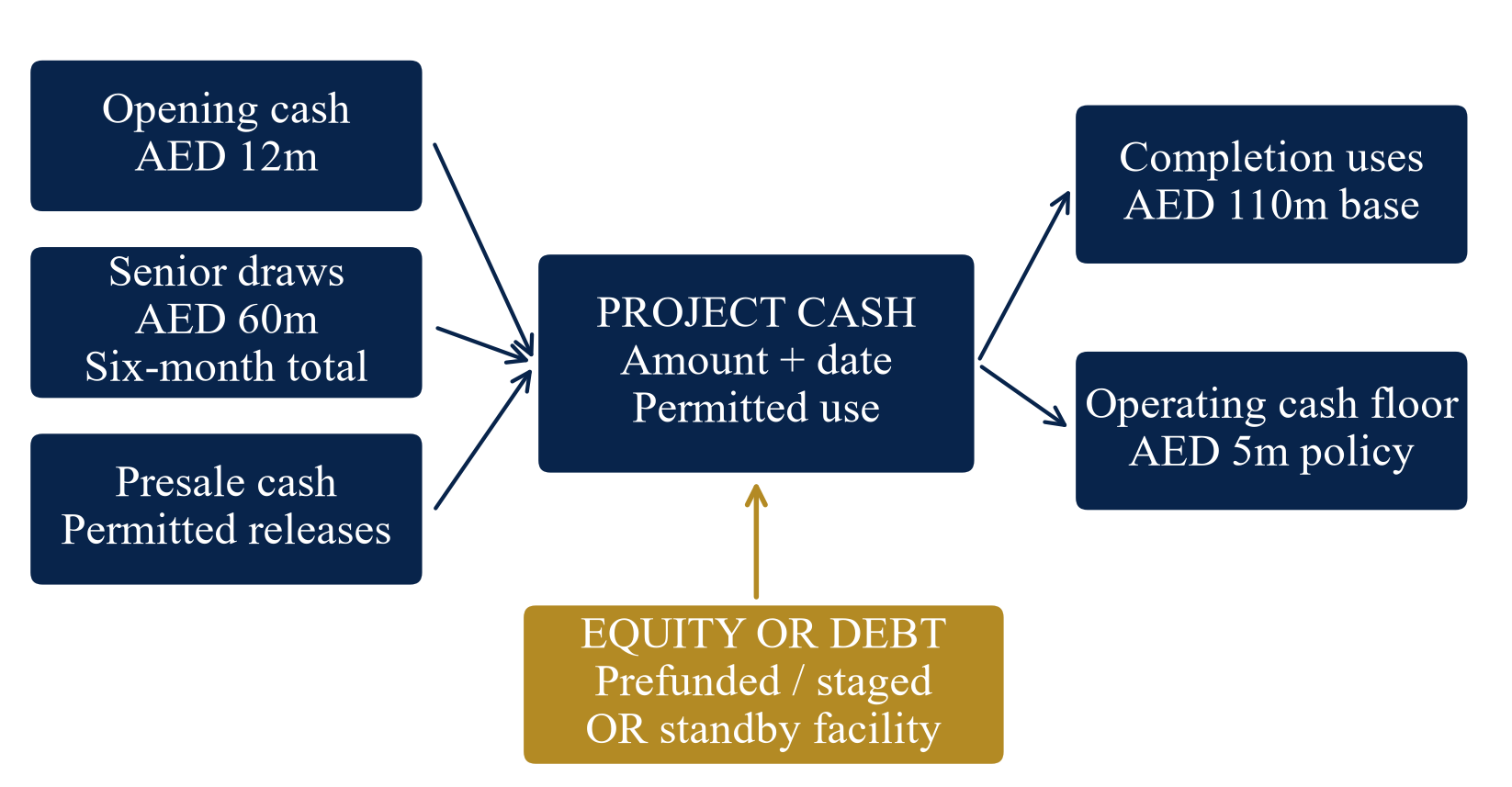
Author-developed capital-stack framework. Equity and standby debt are alternative cases. All amounts shown are fictional assumptions; consent and draw conditions require confirmation.
10 Calculate the six-month base path
Let opening unrestricted cash be C0 and let each month's uses, permitted presale release and permitted senior draw be U, R and D respectively. The unsupported cash position at month t equals C0 plus the cumulative sum of D and R less U through that month. This arithmetic describes the amount remaining under the assumed cash schedule before additional equity or standby borrowing. Where the calculated position becomes negative, it represents a counterfactual unfunded requirement. The model does not assume an actual overdraft or continued payments without funds. A live entity would require an executable intervention or a revised payment programme.
For the base case, C0 is AED 12 million and usable presale releases are AED 5, 8, 12, 12, 10 and 8 million. With the senior schedule and uses defined above, closing positions are AED 7, 5, 5, 7, 11 and 17 million. No additional support is required to meet the fictional AED 5 million floor at month end. Total base inflows are AED 115 million, comprising senior debt of 60 and presale releases of 55. Adding opening cash and deducting uses of 110 reconciles to the final 17. This final balance remains subject to obligations outside the construction-period calculation.
The base result depends on precisely timed and permitted inflows. It is therefore a conditional scenario rather than a claim that the development is adequately funded under every outcome. The appropriate approval records the draw conditions, presale release assumptions and costs that produce the result. The board should also see the downside path without support, so an apparently adequate aggregate funding plan does not conceal its exposure to timing. Recalculating the cumulative path after each material change supplies an early action point. A final positive balance, considered alone, cannot show whether a payment failure occurred earlier in the programme or whether the cash floor was maintained.
11 Shift the releases and identify the first failure
The two-month lag case moves every base presale release two months later. Within the six-month horizon, usable releases become AED 0, 0, 5, 8, 12 and 12 million, totalling AED 37 million. The remaining AED 18 million is assumed to arrive as 10 and 8 in months seven and eight. It is delayed rather than permanently lost. Those later amounts remain outside the six-month construction test. Including them in the first six months would erase the timing stress; writing them off permanently would create a different economic scenario.
With no additional support, counterfactual month-end positions are AED 2, minus 8, minus 15, minus 17, minus 11 and minus 1 million. The policy floor is first breached in month one. The first zero-cash payment deficit arises in month two. The largest unassisted deficit is AED 17 million in month four. A sponsor maintaining the assumed floor needs AED 22 million of cumulative additional support by that point. The extra five is the defined floor already included in the support requirement; it should not be added again. The final six-month deficit of one is materially smaller than the peak need and gives an incomplete picture if reported alone.
This stress isolates timing while leaving construction costs, loan permissions and total ultimate presale releases unchanged. It demonstrates how a project with sufficient expected aggregate receipts can require substantial interim liquidity. The model provides no probability that such a lag occurs. It also assumes the construction schedule can continue if the support is timely. Without support, continued payments and unchanged progress are counterfactual. A live team should show the consequences of an actual interruption separately, including revised cost and release dates. The initial unsupported path identifies the intervention required to preserve the assumed programme; it does not describe a project operating indefinitely with negative cash.
Table 2. Fictional monthly liquidity under a two-month presale-release lag, AED million
| Month | Uses | Senior draw | Delayed release | Unsupported position | Staged equity | Cash after equity |
|---|---|---|---|---|---|---|
| 1 | 20 | 10 | 0 | 2 | 3 | 5 |
| 2 | 22 | 12 | 0 | -8 | 10 | 5 |
| 3 | 24 | 12 | 5 | -15 | 7 | 5 |
| 4 | 20 | 10 | 8 | -17 | 2 | 5 |
| 5 | 14 | 8 | 12 | -11 | 0 | 11 |
| 6 | 10 | 8 | 12 | -1 | 0 | 21 |
Opening usable cash is 12. Negative unsupported positions describe funding requirements, not actual permitted overdrafts. Timely staged equity is an alternative to standby debt. The 5 cash floor is fictional policy.
12 Size a reserve against the full path
For an upfront reserve, the additional amount required equals the greater of zero and the largest difference between the selected cash floor and the unsupported position at any tested date. In the two-month lag case, the minimum position is minus AED 17 million and the floor is five; the calculated reserve is therefore 22. Depositing that amount before month one makes the month-end positions AED 24, 14, 7, 5, 11 and 21 million. The reserve is progressively consumed by the timing gap, with the minimum supported position in month four. It supplies an explicit amount for the support decision under the stated assumptions.
For staged equity, contributions can instead arrive just before the months requiring them. The fictional contributions of AED 3, 10, 7 and 2 million in months one through four total the same 22 and produce closing balances of 5, 5, 5, 5, 11 and 21. The arithmetic advantage is lower project cash held in the early months. The execution question is whether each contribution is binding and deliverable at the necessary date. A staged promise supported only by future discretionary approval should remain in a proposed case. A live team should test notice periods, funding sources and transfer permissions before relying on it in the approved payment calendar.
Figure 2 compares the base, unsupported delay and staged-equity paths. The floor is visibly separated from the zero-cash boundary so the policy breach and payment deficit remain distinct. This distinction matters for escalation: a board may choose to respond before the first unpaid obligation. The model supplies dates for that decision without asserting a universal cash policy. The size and governance of a live reserve depend on payment granularity, cost uncertainty, restrictions and the risk appetite formally approved for the project. A reserve released early should trigger a revised calculation rather than being treated as automatically surplus because the base case still appears positive.
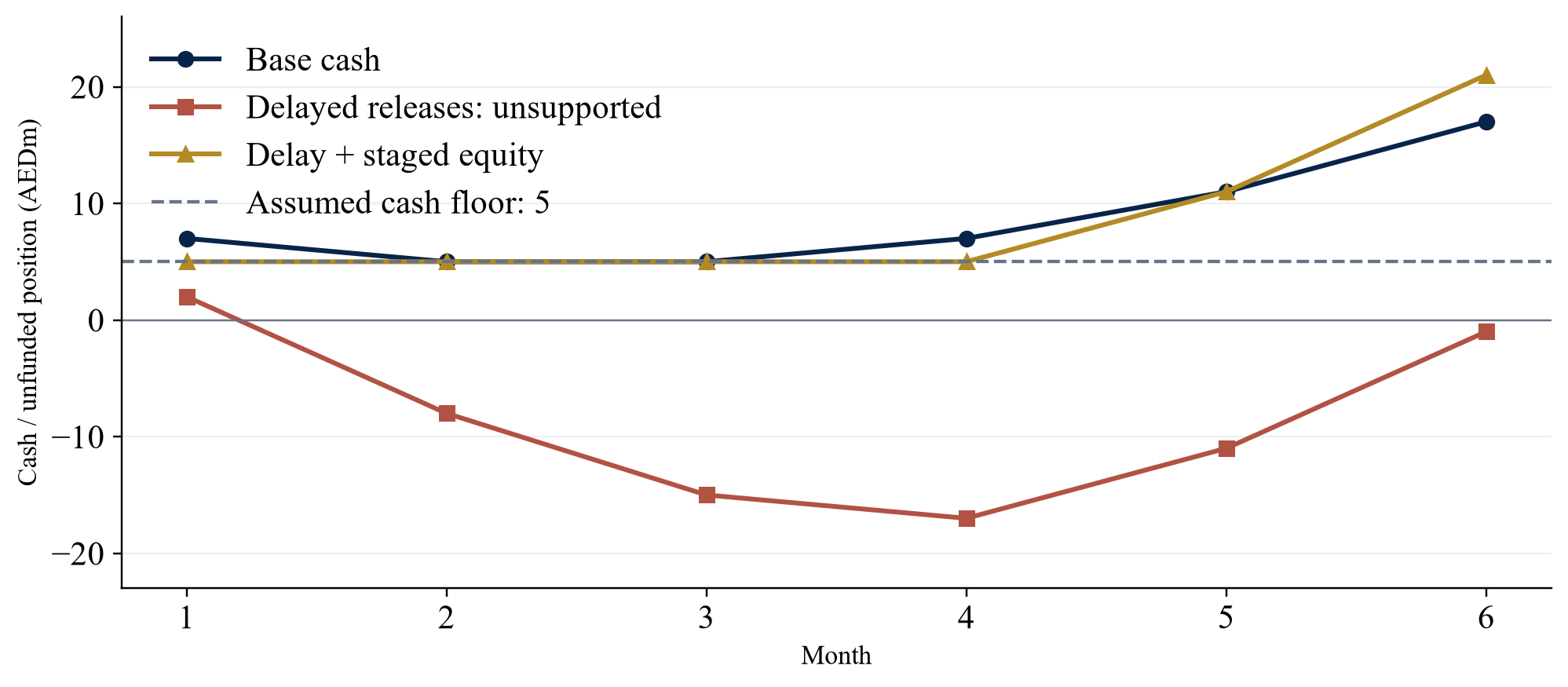
AED million. Negative values show counterfactual unfunded requirements. The operating floor is an author-assumed policy, not a regulatory threshold. Monthly totals do not verify intra-month liquidity.
13 Compare prefunded and binding staged equity
The prefunded reserve and staged-equity cases have the same hypothetical contribution total and the same six-month closing cash. Their differences concern when sponsor money is transferred, the conditions protecting availability and the exposure retained outside the project before contribution. Prefunding places the support into the identified project account before the stress period. The assumed staged case leaves part of the support with the sponsor until each contribution date. The model itself assigns no investment return to that retained sponsor cash and no probability of transfer failure. Those economics and risks need separate transaction evidence before a commercial preference is justified.
The proposed equity-support instrument should specify amounts, dates, notice, authorised use, remedy and any conditions affecting the obligation. Counsel should assess enforceability and the relevant corporate authority. The treasury team should confirm the actual funding source and permitted route. The technical programme should supply the latest acceptable payment date, allowing for transfer and approval steps. A guarantee or support letter requires analysis of its terms and practical cash-delivery mechanism; its nominal face value cannot be assumed equivalent to an immediately drawable deposit. The board pack should describe what happens if the sponsor misses one contribution rather than recording only the aggregate commitment.
Staged equity also creates a monitoring requirement. Before each draw, update the sponsor's available resources and competing obligations that are relevant to the committed instalment. The proposed review should focus on evidence needed for that transfer and remain proportionate to the transaction. If the contribution depends on a separate disposal or refinancing, identify its expected completion date and an alternative support route. The scenario should retain a version with that external event delayed. A commercially attractive reduction in early prefunding can carry a new timing dependency. The decision maker needs that dependency and the dated uncured path to assess whether the staged structure remains executable through the completion programme.
14 Model the standby revolver with interest
The standby alternative replaces the AED 22 million equity-support case with hypothetical consented borrowing. It assumes a facility that can be drawn in time, subject to all relevant senior, security and account permissions. Each month the facility supplies enough to restore closing cash to five. Later excess cash above five repays standby principal. For transparency, invented cash interest is one percent per month on opening standby principal, paid that month. A draw during a month incurs no interest for that same month under this simplified convention. The rate and convention represent no market quote or prevailing GCC term.
The calculated first-month draw is three. Month two begins with principal three, charges interest of 0.03 and draws 10.03. Month three charges 0.1303 and draws 7.1303. Month four charges 0.201603 and draws 2.201603, taking peak principal to 22.361903. Month five interest is 0.22361903 and excess-cash repayment is 5.77638097. Month six interest is 0.1658552203 and repayment is 9.8341447797. All amounts are AED million. Closing standby principal is 6.7513772503 and six-month cash interest totals 0.7513772503. These exact values permit reproduction; transaction reporting could round them while retaining the underlying calculation.
A standby commitment of exactly 22 is insufficient for the assumed floor in month four because interest raises peak borrowing above the equity requirement. A commitment of 25 has capacity under this particular scenario, provided it is genuinely drawable as assumed. Changing interest to include current-month draws for a full month increases peak principal to approximately 22.591493 and six-month interest to 0.985582. This sensitivity demonstrates the importance of contract conventions. Fees, day counts, compounding, borrowing-base conditions and repayment limits would require separate modelling. The resulting six-month principal remains a repayment obligation; the calculation does not establish an exit, refinancing approval or discharge of senior debt.
15 Test late partner capital and competing sponsor claims
A proposed joint-venture contribution of AED 22 million arriving only in month four has the right aggregate amount for the equity-support case and the wrong timing for earlier payments. The unassisted floor breach appears in month one and the first cash deficit in month two. The hypothetical late contribution cannot resolve those earlier dates retrospectively. The proposed decision is to identify an executable interim bridge or revise the payment and construction programme before relying on the partner's money. A bridge must itself pass amount, permission and timing tests; labelling it temporary does not establish availability.
Partner capital also needs a clear economic and governance description. A contribution may be subject to due diligence, investment committee approval, title or permit conditions and completion of documents. The proposed model distinguishes signed unconditional support, binding conditional support and an indicative commercial discussion. It assigns no success probability to the latter categories. A live negotiation should show the cash path before closing, the changes after closing and the rights governing permitted uses and distributions. The cash contribution should enter once, at the date supported by the transaction evidence. It should not also be counted as sponsor resources retained outside the borrower.
The sponsor assessment should examine relevant competing commitments across the period of promised support. A resource already committed to another project might require consent or refinancing before it becomes transferable. A proposed contribution funded by an asset sale needs an after-cost cash figure and a realistic settlement sequence supported by available documents. This paper supplies no observed sponsor concentration data and no claim about the typical reliability of a family or corporate owner. Its decision protocol is evidence-specific. The committee should request the resources and authority underlying each contribution and retain a downside version for unresolved dependencies. That approach makes the actual support route reviewable without substituting reputation or consolidated wealth for project cash.
16 Add cost stress without losing the timing mechanism
The additional-cost scenario increases completion uses by AED 5 million in month three and five in month four. Total uses become 120. The two-month release lag remains unchanged and senior draws remain 60. Unsupported positions become AED 2, minus 8, minus 20, minus 27, minus 21 and minus 11 million. Peak additional support for a floor of five rises to 32. Timely staged contributions of 3, 10, 12 and 7 in the first four months produce the same floor-preserving pattern of 5, 5, 5, 5, 11 and 21. The identical closing cash follows from the additional ten of support exactly matching the additional ten of costs.
This calculation isolates a specified cost addition at stated dates. It includes no automatic further delay, changed sales price or extra senior finance charge caused by the higher costs. A real cost overrun can have several consequences requiring distinct evidence and calculations. For example, an assumed later completion date would change future payment, release and interest dates. A revised valuation could affect a contractual draw limit if the actual facility contains that mechanism. The analyst should trace these connections explicitly rather than importing an unsupported regional rule. Each model change should identify its cause, affected contract or programme and resulting cash entries.
The support decision should compare the original and revised paths using the same date and perimeter. Showing only the higher total development cost would obscure when the extra support must arrive. Showing only an amended equity commitment could conceal whether its transfer is sufficiently early. The proposed board bridge explains the ten increase in uses, the unchanged release and senior assumptions and the ten increase in required timely support. If a lender or partner subsequently funds part of that addition, the revised source should replace the corresponding equity need at its permitted date. Maintaining this reconciliation reduces ambiguity about what the negotiated cure actually supplies and which downside remains unresolved.
17 Combine buyer delays with a senior-draw lag
The separate senior-delay stress moves every assumed senior draw one month later. Within the horizon, draws become AED 0, 10, 12, 12, 10 and 8 million, totalling 52. The remaining eight moves to month seven. Combined with the two-month buyer-release lag and base uses, unsupported positions become minus AED 8, minus 20, minus 27, minus 27, minus 19 and minus 9 million. The cash floor requires 32 of additional timely support. Both negative-cash exposure and the policy breach begin in month one. This case shows why support notice and transfer dates need to precede the first affected payment.
Adding the ten cost stress to that coupled timing case increases required support to 42. This follows from a minimum unsupported position of minus 37 in month four and the policy floor of five. The model assumes buyer and lender timing shifts together without assigning a statistical relationship or probability. It reports a deterministic scenario selected by the author. A live review should examine whether the actual release and senior draw procedures share milestones, documents or approval dependencies. Where the same technical report affects both, the team should model the joint condition directly and state the evidence for the assumed dates.
The modelling boundary remains important. The shifted buyer and senior amounts outside month six are not treated as permanently lost. Their later receipt could support subsequent repayment, subject to permissions and obligations then due. The six-month model cannot certify that repayment because it excludes a complete post-completion debt and distribution calendar. A proposed bridge that depends on those later receipts should add the relevant months and contractual interest, release controls and maturity requirements. The committee needs to know whether it is approving construction support only or an instrument whose repayment remains dependent on an untested later event. The present scenario deliberately leaves that second decision open.
18 Use sensitivities as support limits
Table 3 reports the additional upfront support needed for the chosen floor under zero, one, two and three months of buyer-release lag. Each column retains the same underlying monthly payment and senior-draw schedule. The added-cost column uses the five increases in months three and four. The results are support requirements under invented deterministic paths. They represent neither percentile liquidity reserves nor recommended buffers for every developer. The sensitivity range supplies an explicit set of questions for the board: which path is accepted, which support amount is committed, and which observable event triggers a new calculation or contribution request?
The support curve is shaped by the sequence of uses and inflows. A further month of delay does not necessarily create a constant additional requirement because the most cash-intensive months differ. In the fictional base-cost cases, required support rises from zero to 12, 22 and 30 as lag increases. Under the added-cost case it becomes 8, 20, 32 and 40. These values are calculated from the largest dated floor shortfall, with delayed receipts beyond the horizon excluded until their assumed arrival. The method can be extended to different programmes, but the numbers cannot be transferred without the corresponding project evidence and dates.
Sensitivity should connect to an executable response. If a selected support commitment covers only a one-month lag, the board should identify what evidence shows the actual release path moving towards a two-month lag and how additional resources would arrive before failure. The proposed monitoring pack tracks contractual collections, actual receipts, requested releases, permissions, technical milestones and draw notices. Each review updates the dated path and compares it with committed support. A widening uncovered amount needs a named action, deadline and approval route. A sensitivity table displayed without that response plan supplies information but leaves the payment decision unresolved.
Table 3. Fictional required upfront support by buyer-release lag, AED million
| Buyer-release lag | Base-cost support | Support with 10 extra costs | First base-cost floor breach | First base-cost payment deficit |
|---|---|---|---|---|
| 0 months | 0 | 8 | None in horizon | None in horizon |
| 1 month | 12 | 20 | Month 1 | Month 2 |
| 2 months | 22 | 32 | Month 1 | Month 2 |
| 3 months | 30 | 40 | Month 1 | Month 2 |
Each case maintains an assumed 5 cash floor. Cost stress adds 5 in months three and four. No standby interest is included; equity and debt support require separate pricing and permission tests. Breach and deficit dates refer to unsupported base-cost paths.
19 Test shorter-frequency liquidity and actionable deadlines
The worked calculations establish month-end positions only. They cannot verify that the project can pay every invoice on its exact due date or maintain the floor throughout each month. A live team should translate the accepted programme into a shorter-frequency cash schedule, such as a weekly rolling forecast supplemented by daily dates for large payments. The proposed forecast distinguishes bank-cleared cash from expected receipts and includes the lead time for draw notices and transfers. A buyer receipt assumed at month end cannot support an earlier supplier payment unless another usable source covers that interval.
The cure deadline should work backwards from the obligation. Identify the payment due date, account authorisation, clearing time, draw or contribution notice, documentary completion and decision approval required. These steps form a dated chain. If the chain already exceeds the remaining interval, the proposed source may be too late even when its amount is sufficient. The board should retain the earlier unsupported version and identify an alternative cash route or an agreed payment amendment. The framework assigns no universal number of days to these steps. Actual banking, contractual and regulatory processes determine the execution calendar.
The same calendar should distinguish a policy response from a contractual breach. The fictional five floor triggers an internal liquidity action; it creates no assumed statutory default or universal lender event. Actual covenants, draw conditions, payment defaults and remedies require their own terms and dates. A board report should name each trigger and show its numerical basis. An internal escalation can occur before any contractual failure. Conversely, a facility condition might fail before cash reaches zero. Presenting these triggers separately helps the committee request the relevant consent and funding action without describing an assumed model threshold as a legal conclusion. The current cash path then becomes a tool for timely documented decisions rather than an undated statement of financial strength.
20 Approve the cure, permissions and residual obligations
The proposed cure pack presents the unsupported scenario, the selected support instrument and the resulting cash path on a consistent basis. It identifies amount, timing, source, conditions, approval, transfer evidence and monitoring responsibility. For standby debt, it also records senior consent, aggregate borrowing limits, security and account permissions where applicable. A project cannot assume that a sponsor-funded bridge is automatically permissible simply because it supplies the missing cash. The executed documents and required approvals should support its entry into the accepted funding case.
Figure 3 shows the proposed decision sequence. A fully evidenced source is tested against the first payment and the cash floor. An unresolved source remains in the conditional case. A source arriving after the required date needs an earlier bridge or a revised agreed programme. Each accepted action leads to a recalculated path and a separate repayment test. The sequence is author-developed; actual financing documents determine the remedies and approval authorities. It should retain the record of the original shortfall so a later reviewer can understand why the support instrument was chosen and what evidence permitted reliance on it.
Residual obligations need explicit treatment after completion. In the fictional standby case, cash is five and standby principal is approximately 6.751 million at month six, alongside assumed senior principal of 60. Later buyer releases of 18 are expected under the author's shifted schedule. Their existence does not establish unrestricted repayment capacity after interest, retention, other obligations and permission tests. The project needs an extended maturity and distribution schedule before making that claim. The board should record which stage of the financing decision is complete and which remains open. This separation makes a completion-support mandate concrete while preserving the unresolved exit and repayment questions for subsequent evidence and negotiation.
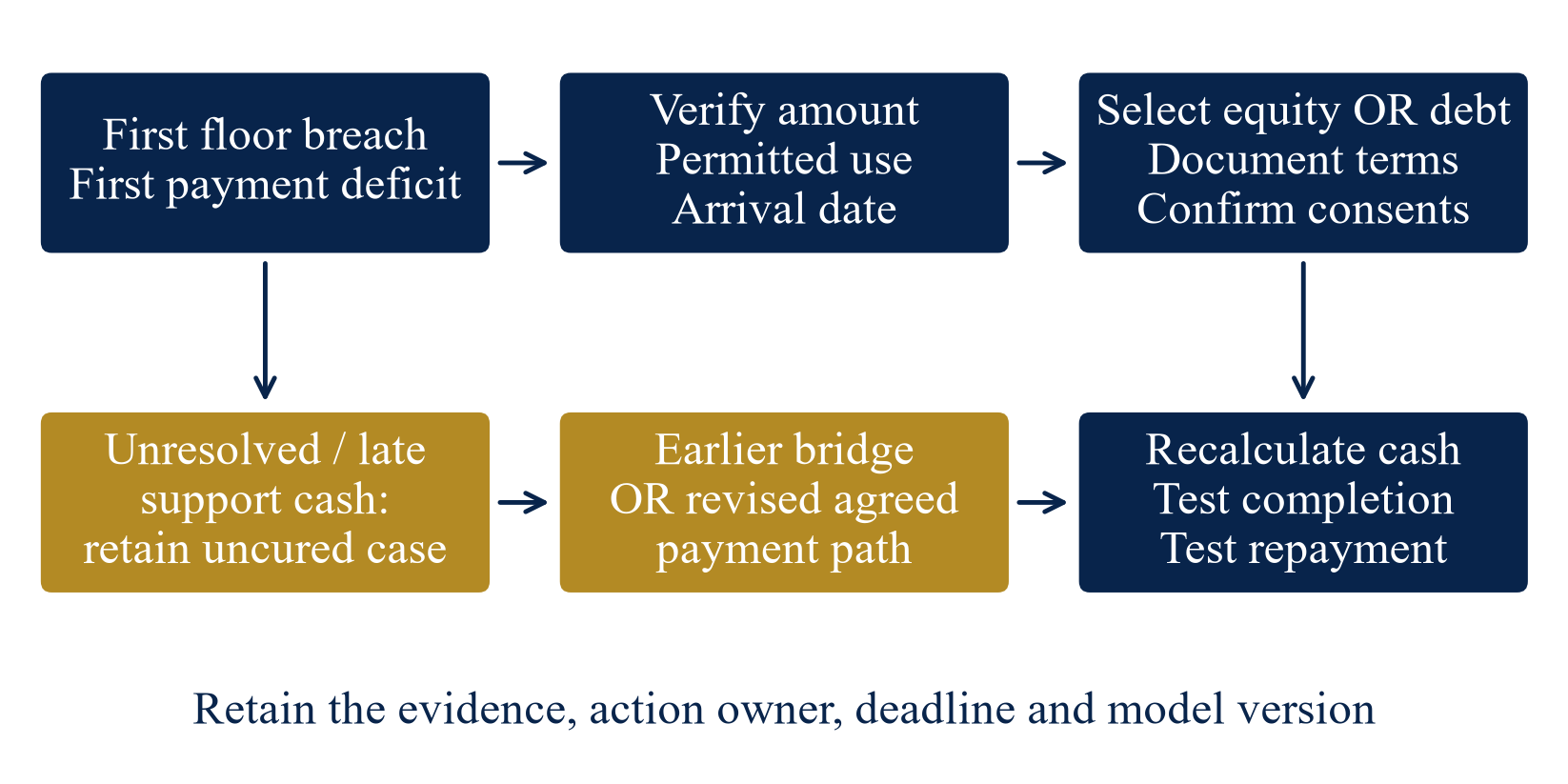
Author-developed protocol. Actual obligations, permissions and remedies depend on project documents. Completion cash and final debt repayment require separate tests.
21 Define an empirical validation and data-control agenda
An empirical extension would require consented project-level observations of sales contracts, actual collections, escrow releases, construction payments, draw requests, sponsor contributions and realised outcomes. The study should preserve original dated forecasts alongside subsequent events. Its unit of analysis could be a project-period funding decision with documented conditions and permissions. The dataset would need unsuccessful draw requests and abandoned support proposals as well as completed financing. A sample containing only successful transactions would omit important decision outcomes. This paper has no such dataset and therefore reports no fitted relationship between sponsor wealth, presale delays and loan approval.
The proposed research questions concern timing accuracy and decision performance. How often did expected collection and release dates diverge? Which dependencies caused the first uncovered payment? Did support arrive by its committed date? How did the selected reserve compare with the largest realised cash shortfall under a consistent definition? Each question requires a specified measurement rule and permission to use the records. Cross-jurisdiction comparisons should control for legal scope, project stage, programme, account arrangements and facility terms rather than treating the GCC as a single release regime. Any confidentiality restrictions should be resolved before publishing identifiable project or counterparty information.
Data tools and AI-assisted document extraction could support a proposed workflow by locating dates, amounts and conditions for human review. This is a prospective application, with no demonstrated extraction accuracy or commercial outcome claimed here. The control design should retain the source page, proposed field, reviewer decision and version history. Numeric reconciliations should remain independently reproducible. No generated release date, assumed consent or inferred sponsor resource should enter a verified funding cell without documentary support. The methodological objective is a reviewable evidence-to-cash chain. Its performance must be measured on authorised records before an empirical or operational benefit is asserted.
22 Conclude with the amount, date and instrument decision
The fictional model provides a precise conditional answer. With the specified senior draws, completion uses and opening cash, a two-month shift in usable presale releases needs 22 of additional timely support to maintain the assumed five floor. Extra costs of ten raise the requirement to 32. Combining the buyer shift with a one-month senior lag requires 32 at base costs and 42 with the added costs. These figures are AED million and are calculated from dated cumulative positions. They provide no estimate of typical sponsor support, market delay probabilities or a recommended reserve for an actual GCC project.
The instrument comparison is equally conditional. Prefunded and binding staged-equity cases can maintain the modelled floor with contributions totalling 22 under the base-cost two-month lag. The standby alternative requires a larger peak principal because of its fictional interest convention and leaves debt outstanding at the end of the period. A late partner contribution needs an earlier usable bridge. The decision therefore depends on amount, transfer date, permissions and residual repayment obligations. A live commercial preference also requires evidenced cost, enforceability and sponsor-resource information that the hypothetical model does not supply.
The proposed board instruction is to reconcile the project perimeter, remaining payment calendar, presale-to-release bridge, permitted senior draws and sponsor resources to one evidence date. Locate the first floor breach and payment deficit, select executable support before that date, and recalculate after each material change. Keep construction-period liquidity separate from final debt repayment and distributions. Published regulatory, accounting and professional materials support the investigation questions; actual project documents determine the permitted transaction. The framework's contribution is a transparent support-sizing method and a documented path from an identified timing problem to an actionable financing decision, with unresolved evidence and later obligations retained for further review.
References
- Dubai Legislation Portal. Law No. 8 of 2007 Concerning Escrow Accounts for Real Estate Development in the Emirate of Dubai, issued 6 May 2007; Arabic text authoritative; accessed 7 October 2026. https://dlp.dubai.gov.ae/Legislation%20Reference/2007/Law%20No.%20%288%29%20of%202007.html
- Dubai Land Department. Depositing a mortgage into an escrow account application, official financing and settlement service conditions; accessed 7 October 2026. https://dubailand.gov.ae/en/eservices/request-for-mortgage-payment-in-escrow-account/
- Abu Dhabi Real Estate Centre. Project Development, official project and escrow operating overview; detailed project permissions require confirmation; accessed 7 October 2026. https://adrec.gov.ae/en/sectors/regulatory-services/project-development
- Real Estate General Authority, Saudi Arabia. Law of Selling and Leasing Off-Plan Real Estate Projects, official English text marked Active; accessed 7 October 2026. https://rega.gov.sa/en/laws-and-decisions/regulations-and-by-laws/rules/law-of-selling-and-leasing-off-plan-real-estate-projects/
- Survey and Land Registration Bureau, Bahrain. Law No. 27 of 2017 Promulgating the Real Estate Regulatory Law; official English guidance version published May 2024; Arabic legislation and amendments authoritative; accessed 7 October 2026. https://www.slrb.gov.bh/en/law-no-27-of-2017-promulgating-the-real-estate-regulatory-law
- Real Estate Regulatory Authority, Bahrain. Operating Guidelines for Off-Plan Escrow Accounts, undated official downloadable guidance; incorporation of every current amendment could not be verified; accessed 7 October 2026. https://helpdesk.rera.gov.bh/hc/ar/article_attachments/360014880732
- IFRS Interpretations Committee. Demand Deposits with Restrictions on Use arising from a Contract with a Third Party, IAS 7 agenda decision; published April 2022, updated January 2026; accessed 7 October 2026. https://www.ifrs.org/content/dam/ifrs/supporting-implementation/agenda-decisions/2026/demand-deposits-with-restrictions-on-use-jan-26.pdf
- Royal Institution of Chartered Surveyors. Valuation of development property, professional-standard overview; accessed 7 October 2026. https://www.rics.org/profession-standards/rics-standards-and-guidance/sector-standards/valuation-standards/valuation-of-development-property
- Royal Institution of Chartered Surveyors. Valuation of development property, first edition, 2019, effective February 2020; read with applicable current global standards; accessed 7 October 2026. https://www.rics.org/content/dam/ricsglobal/documents/to-be-sorted/valuation-of-development-property---first-edition.pdf
- International Finance Corporation. How to Apply for Financing, proposed project, sponsor and financing information; accessed 7 October 2026. https://www.ifc.org/en/what-we-do/products-and-services/how-to-apply-for-financing
- World Bank Public-Private Partnership Resource Center. Key Issues in Developing Project-Financed Transactions, lender protections and support mechanisms; accessed 7 October 2026. https://ppp.worldbank.org/financing/issues-in-project-financed-transactions
- International Finance Corporation. Project Finance in Developing Countries, April 1999; historical conceptual reference on completion and support arrangements; accessed 7 October 2026. https://ppp.worldbank.org/sites/default/files/2022-05/ProjectFinance_DevelopingCountries_IFC.pdf
About the Author
Chennakeshav (CK) is a corporate finance and investment banking executive with 25+ years of global experience in deal origination, structuring and execution across M&A, growth capital and corporate strategy. He has led value-creation mandates for founders, corporates and funds — bridging the boardroom view to hands-on execution and close.
His career spans Morgan Stanley, HSBC, Lloyds Banking Group, EWEC, ADQ portfolio companies and Emirates Growth Fund, across TMT, real estate, fintech, deeptech, cleantech, infrastructure and energy. He has partnered with C-suite leaders, private equity and venture funds, sovereign wealth funds and family offices to finance complex fund raises and scale-up ventures, and has led M&A due diligence, post-merger integration and business-transformation initiatives to create value.
At Matchpoint Partners he is Managing Partner, leading the firm's corporate finance, M&A and capital-raising practice. He holds an MBA from London Business School, an engineering degree from VTU and a Master of Laws (LLM, in progress) from UCL London.
An active start-up mentor, CK mentors at Techstars, DIFC FinTech Hive, Startup Grind, Founder Institute and IN5, serves as Entrepreneur Mentor in Residence (EMiR) at London Business School, and judges the Entrepreneurship World Cup.
