

1 The decision behind the headline valuation
A fundraising presentation usually expresses a proposal as money raised at a valuation. That description is insufficient for a board deciding whether the company can execute its strategy after closing. A new share class can change the allocation of a sale price without changing the advertised post-money valuation. A lender can leave issued shares untouched while limiting acquisitions, new borrowing or distributions. A funding tranche can be conditional on a milestone, so the committed amount and the cash available today are different. The decision is therefore a package of cash, ownership, priority, control and timing.
The board should ask what action it expects to take with the proceeds. A company funding organic expansion may value budget discretion and additional debt capacity. A company buying a competitor may need a rapid acquisition consent and flexibility to issue shares as consideration. A founder planning a later sale may care intensely about liquidation priority and drag-along terms. Those preferences are specific to the issuer; none can be inferred from the term 'growth capital'. A common comparison begins with a dated business plan and a list of the decisions needed to deliver it.
This paper constructs such a comparison. It neither recommends a security to every issuer nor treats a quoted valuation as a complete price. It uses public legal, accounting and academic sources to define questions for a transaction. Where a term has no public, comparable Gulf dataset, the paper states a hypothetical mechanism and leaves the economic value unmeasured. Counsel, accountants and the issuer must test the final documents against the applicable entity and facts before signing.
2 Four ledgers for one funding decision
The first ledger records cash. It starts with gross subscription or loan proceeds, deducts actual fees and restricted amounts, and schedules dividends, interest, redemption, principal and exit payments. It distinguishes cash contractually owed from cash payable only if the board declares a distribution. The second ledger records ownership on a fully diluted basis, including options, warrants, conversions and a plausible next round. Both ledgers need dates; an option that may be exercised in two years is different from shares issued now.
The third ledger is a priority waterfall. It allocates a range of exit values among debt, preferred securities and ordinary shareholders under the actual documents. A participating preference, cumulative dividend, redemption right or senior debt claim can materially change that waterfall. The fourth ledger is a decision-right map. It names actions requiring shareholder, class, board or lender approval, identifies thresholds and exceptions, and states the response procedure. An investor's 20% economic stake does not by itself describe its authority over an acquisition or budget.
These ledgers must reconcile. A preference may convert into ordinary shares at exit, changing both ownership and priority. A warrant attached to debt changes the fully diluted cap table, even if the loan is described as non-dilutive. A veto attached to a financing can affect the company's ability to raise the next tranche. The rights-adjusted comparison is a structured record of these interactions, not one synthetic cost-of-capital percentage. A composite score can obscure the reason a transaction fails the issuer's strategy.
3 Identify the company and law before reading the rights
The issuer's legal form and jurisdiction determine which corporate actions, share classes, resolutions and filings are available. UAE Federal Decree-Law No. 32 of 2021 supplies a federal commercial-company framework [1]. ADGM Companies Regulations 2020 provide a distinct framework for ADGM companies, including provisions on allotment, pre-emption and class rights [2]. A company in another free zone or another GCC state requires its own law and constitutional-document review. The rights assumed in one financing model cannot be copied into another entity without that review.
The corporate group may add a second perimeter. The operating company could sit onshore while an investment holding company sits in a financial free zone. Capital could enter a parent and be lent to a subsidiary. Existing shareholders may own different entities or share classes. A term sheet that says 'company' without a legal-entity schedule leaves uncertainty about who issues the security, receives cash, grants security and is bound by consent restrictions. Before modelling dilution, the team should reconcile registers, options, shareholder agreements, debt instruments and intercompany claims.
Legal diligence should also ask whether the proposed financing needs existing lender consent, a shareholder waiver, regulatory approval or a change to the constitutional documents. ADGM pre-emption provisions illustrate why an issuance process may involve more than a board vote [2]. The exact application, exceptions and amendments require a current legal check. The model can flag a consent dependency; only qualified local advice and the executed documents can determine whether it is satisfied.
4 Ordinary equity: visible dilution and hidden conditions
A priced issue of ordinary equity is the cleanest arithmetic case: investment divided by agreed post-money value gives the new investor's percentage, before options and transaction adjustments. The arithmetic does not establish what valuation was actually achieved. It depends on the definition of fully diluted pre-money shares, treatment of an option-pool increase, outstanding convertibles and whether investment expenses reduce cash received. A board should insist on a share-number bridge from the existing register to the closing register.
Ordinary shares can still arrive with a shareholders' agreement, board nomination, information rights, pre-emption rights, tag and drag provisions, and consent rights. The security label therefore does not answer the control question. An investor might request approval over annual budgets, acquisitions, debt, dividends or a future equity round. The scope of each right matters: a veto over a sale of substantially all assets differs from a veto over any commercial contract above a low threshold. The rights map should quote the operative definitions, not a marketing summary.
The OECD's 2023 corporate-governance principles describe shareholder rights, equitable treatment and the use of pre-emptive rights or qualified majorities in different systems [3]. They provide a policy framework, not a term sheet for a private GCC issuer. Ordinary equity may be attractive when the company needs patient capital and can tolerate ownership dilution. That conclusion remains conditional on price, governance, a realistic use of funds and future capital needs. A low percentage sold today can become a larger cumulative dilution after option refreshes and later rounds.
5 Preferred equity: one share count, several economics
Preferred equity can carry priority on liquidation, dividends, conversion rights, redemption or protective votes. Each feature has to be read separately. A one-times non-participating liquidation preference, in a simplified example, allows the investor to take its preference amount or convert and take its ordinary-share fraction; it does not take both. A participating preference can produce a different distribution. A preference multiple, accrued dividend or seniority to another class also changes the result. The signed waterfall, including the definition of a liquidation event, controls.
The quoted post-money valuation can stay constant while preference terms move value between outcomes. At a high sale price, conversion may make the preferred investor economically similar to an ordinary investor. At a low sale price, the priority claim can transfer more of the remaining value to that investor. A board should therefore show exits below invested capital, between the investment and the conversion crossover, and above it. It should include debt claims and transaction expenses before distributing equity value in a real model.
Preferred rights can also affect operating decisions. A class vote might be required to issue senior securities, change the articles, sell the company or incur specified debt. These protections can be rational from an investor's perspective, but the issuer should check whether they overlap with its planned financing and acquisition steps. The US National Venture Capital Association publishes model documents that separate incorporation, stock purchase, investor rights and voting mechanics [4]. Their function here is a drafting taxonomy. They are US examples and do not determine what is valid or customary for a UAE or GCC issuer.
6 Structured debt: apparent ownership retention, contractual control
Structured debt can include amortisation, a bullet maturity, a revenue-linked payment, conversion, warrants, security, cash sweeps or covenant-based reporting. This paper uses a simple interest-bearing loan and a separate warrant sensitivity to isolate mechanisms. A loan without a share-linked instrument may preserve the ordinary cap table at closing. It still imposes dated payment obligations and restrictions that may be decisive during a growth phase. A company cannot call the route 'non-dilutive' if it grants a warrant, conversion feature or equity kicker.
Financial covenants and negative undertakings can allocate practical decision rights. A lender may require consent for additional indebtedness, distributions, asset sales, changes in business, acquisitions or a new share issue, depending on the agreement. A company can be solvent and still lack headroom under a bespoke EBITDA definition or cash threshold. A borrowing or consent basket may permit small actions yet block the acquisition that underpins the strategy. The comparison needs both the contractual definition and a forecast tied to the decision calendar.
Debt also introduces maturity risk. If repayment depends on an IPO, sale or larger funding round, the company should test a delayed or lower-valued outcome. A structured loan may be economically preferable in a strong case and expose the issuer to a cash shortfall in a weak case. This paper does not assign a default probability to the fictional issuer. It shows the dated cash claim and the decision gates that would need evidence before a real board could rank the route.
7 Accounting classification follows substance
Financial-statement labels are another reason not to equate a security's name with its economics. IAS 32 distinguishes financial liabilities from equity instruments by contractual obligations, including whether the issuer must deliver cash or another financial asset [5]. A convertible instrument can contain liability and equity components. A preferred share with a cash-redemption obligation may require analysis that differs from ordinary shares. The assessment depends on the exact terms and the applicable accounting framework; this paper does not classify a hypothetical contract for a real issuer.
An accounting analysis should be requested when the term sheet is still negotiable. A mandatory redemption clause, put option, variable-share settlement or payment triggered by an event outside issuer control can change the reported capital structure. That treatment may then interact with lender covenants, earnings measures and investor presentation. Accounting classification is neither a substitute for legal rights nor proof of cash availability. It is a separate ledger that can constrain a financing if stakeholders use reported leverage or equity thresholds.
IFRS 10 also requires a facts-and-circumstances assessment of control and distinguishes protective rights in that assessment [6]. The IFRS Interpretations Committee has explained that changed circumstances, such as rights becoming exercisable after a breach, can require reassessment [7]. A board should not assert that every veto gives accounting control or that a protective description permanently removes control questions. Accounting advisers must review the full rights package and actual conduct where consolidation is material.
8 A wholly fictional common financing case
Assume a fictional growth company is worth AED 200 million immediately before financing and needs AED 50 million of freely usable cash at closing. Its existing shareholders own all shares; founders hold 70% of that existing pool and other holders 30%. Ignore options, transaction fees, taxes, existing debt and subsequent rounds in the first illustration. The pre-money value and proceeds are invented teaching inputs; they are not a valuation of a company, an offer or a statement of Gulf market terms.
Under ordinary equity at the stated price, the investor receives AED 50 million divided by AED 250 million post-money, or 20% of shares. Founders hold 56% after financing and other existing holders 24%. The company receives the full AED 50 million in the simplified case. In a sale for AED 150 million of equity value, the investor receives AED 30 million, founders AED 84 million and other existing holders AED 36 million. In a sale for AED 400 million, the same percentages produce AED 80 million, AED 224 million and AED 96 million respectively.
The arithmetic shows percentage dilution only. It does not show the value created by deploying the investment, the effect of a lower price, an option-pool refresh, a bridge security or governance restrictions. Those require additional assumptions. Its purpose is to create one common base against which a preference and a loan can be compared. Every sensitivity should begin from the same opening cap table, cash need and timing.
9 A fictional preferred waterfall
Now assume the AED 50 million investment is preferred equity, convertible into the same 20% ordinary interest. For illustration only, give it a one-times non-participating liquidation preference, with no accrued dividend, no participation, no senior debt and no transaction expenses. At an AED 150 million exit, conversion would yield AED 30 million. The investor instead takes the AED 50 million preference. The remaining AED 100 million goes to existing ordinary holders in their 70:30 pre-financing ratio: founders receive AED 70 million and other holders AED 30 million.
At an AED 400 million exit, conversion yields AED 80 million, exceeding the AED 50 million preference. The investor converts and the ordinary distribution matches the prior example: founders AED 224 million and other holders AED 96 million. The conversion crossover is AED 250 million of distributable equity value, because 20% of that amount equals AED 50 million. Below the preference amount, a simplified investor claim can absorb all equity proceeds, subject to the actual document and higher-ranking claims. The line is an analytical breakpoint, not a market forecast.
The comparison exposes a transfer that a single valuation headline conceals. At the AED 150 million fictional exit, founders receive AED 14 million less under the preferred route than under ordinary equity, and other existing holders receive AED 6 million less. The investor receives AED 20 million more. The company received the same initial cash in both cases. The board may judge that downside protection is necessary to close a beneficial financing, but it should record the distributional cost explicitly.
Table 1. Fictional equity proceeds under one financing and two exit values
| Route and exit equity value | New investor | Founders | Other existing holders | Total |
|---|---|---|---|---|
| Ordinary equity; AED 150m | 30 | 84 | 36 | 150 |
| 1x non-participating preferred; AED 150m | 50 | 70 | 30 | 150 |
| Ordinary equity; AED 400m | 80 | 224 | 96 | 400 |
| 1x non-participating preferred after conversion; AED 400m | 80 | 224 | 96 | 400 |
AED millions. All inputs and terms are invented; equity value is after any higher-ranking claims, which are excluded in this simplified table. Rounded exact arithmetic; no tax, fees or option pool.
10 A fictional debt route and its limits
For a third illustration, assume an AED 50 million loan reaches the company in full, bears 10% simple annual interest and has principal due at the end of year three. Ignore fees, compounding, tax, security enforcement and covenant breach. The company owes AED 5 million interest each full year and AED 50 million principal at maturity. The existing ordinary cap table is unchanged at closing. If all interest is paid from operations and the company sells immediately after year three, debt principal is paid before ordinary equity receives the remaining sale proceeds, subject to actual ranking and costs.
At a fictional AED 150 million enterprise cash exit with no other claims, repayment of AED 50 million principal leaves AED 100 million for existing shareholders: founders AED 70 million and other holders AED 30 million. That result resembles the low-exit preferred example numerically, but its legal and operating path differs. The company also had to service AED 15 million of simple interest across three years from operating cash, or fund it by another route. The equity examples assumed no dividends. Comparing exit tables without those interim cash flows would be misleading.
Suppose the lender also asks for warrants representing 5% of fully diluted ordinary equity after exercise, with the exercise price and proceeds ignored solely for this sensitivity. Existing founders would fall from 70% to 66.5%, other existing holders from 30% to 28.5%, and the lender would hold 5%. This is share dilution even though the main instrument is debt. A real warrant model must include strike price, exercise proceeds, anti-dilution terms, timing and tax. No conclusion about whether such a package is available follows from this invented case.
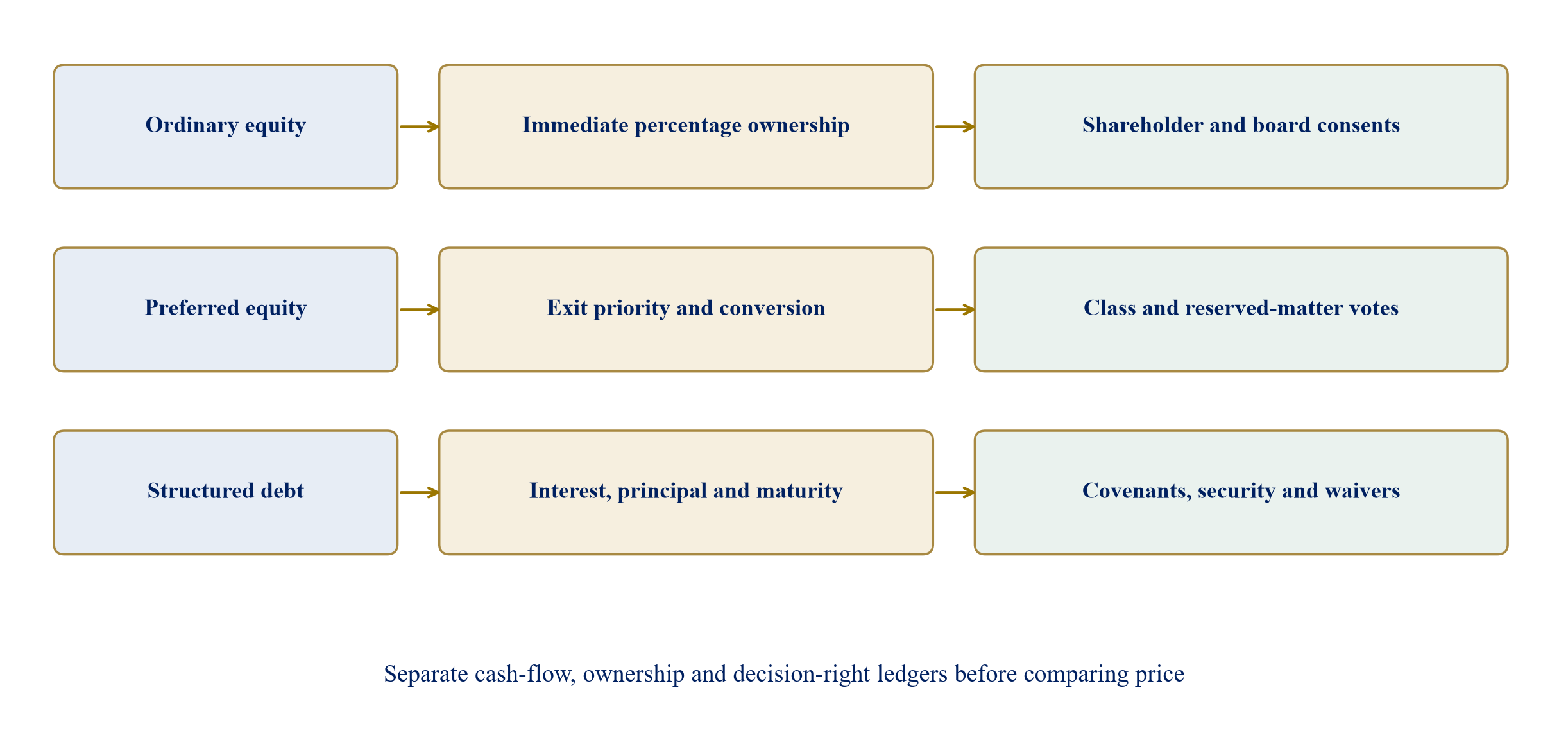
Author-developed conceptual map; boxes identify rights to investigate, not an observed term sheet or legal conclusion.
11 Put financing routes on one cash calendar
The fictional equity routes deliver AED 50 million at closing and do not contain a scheduled repayment. The fictional loan delivers the same cash, then requires AED 5 million each year and AED 50 million at year three. Those amounts are not a rate of return comparison because the company's value and cash generation may change after funding. The common calendar asks whether operations can finance interest, whether planned investments leave covenant headroom and whether a credible maturity take-out exists.
For preferred equity, the calendar should show when any dividend accrues or becomes payable, whether redemption can be demanded, and whether a future round triggers conversion or a price adjustment. If a preferred instrument creates a cash obligation, both liquidity and accounting analysis change. For ordinary equity, the calendar should show subsequent fundraising, option grants and possible down rounds. A term sheet with AED 50 million 'commitment' in three conditional tranches should show only the tranche available under presently satisfied conditions as day-one usable cash.
A finance team can create a monthly model with rows for starting cash, operating inflow and outflow, investment spend, interest, dividends, fees, principal, optional draws and closing liquidity. The control matrix should sit beside it. When management forecasts an acquisition in month nine, the model should flag whether the preferred investor or lender must approve it and by when. The size of a lost opportunity cannot be invented; the dependency and approval lead time can still be recorded.
12 Build a veto register from operative documents
The term 'veto' can describe a statutory class right, shareholder reserved matter, director consent, negative covenant or lender waiver condition. These are different legal mechanisms. A useful register has one line per action: the trigger, affected entity, approving person, decision threshold, notice content, response time, deemed consent if any, exceptions, duration and remedy for breach. It also records whether the right exists at signing, closing, a financial trigger or a later performance state.
Management should map the next twelve to twenty-four months of planned decisions against that register. Examples include an acquisition, new debt, share issuance, annual budget, key executive appointment, sale of a subsidiary, related-party contract and dividend. The register should distinguish protective approvals for exceptional actions from recurring controls that touch ordinary operations. That distinction is an analytical screen, not a legal classification. A low threshold can turn an apparently exceptional right into frequent operational supervision.
The National Venture Capital Association's document suite distinguishes investors' rights and voting agreements from the share purchase itself [4]. Academic research by Kaplan and Strömberg reports separate allocation of cash-flow, voting, board, liquidation and other control rights in the US venture contracts they studied [8]. Those findings show why a one-line cap table is insufficient. They do not establish the frequency or value of similar rights in UAE or GCC deals. A local mandate should examine the actual drafts and relevant company law.
Table 2. Decision-right comparison to populate from actual term sheets
| Planned action | Ordinary equity question | Preferred equity question | Structured debt question |
|---|---|---|---|
| Issue a follow-on share class | Is shareholder or board approval needed? | Is a class consent or anti-dilution adjustment triggered? | Is additional equity restricted by a covenant? |
| Acquire a competitor | Is there a reserved matter or director approval? | Does the class vote cover acquisitions or asset transfers? | Is an acquisition basket or lender consent needed? |
| Increase the operating budget | Who approves the budget and deviations? | Does a preferred veto apply to annual or revised budgets? | Does spending affect covenant capacity or permitted use? |
| Borrow for working capital | Are shareholder approvals or pre-emption issues relevant? | Is debt seniority or amount restricted by protective terms? | Is additional indebtedness permitted under baskets? |
| Sell the business | Which vote and drag-along process applies? | What preference, conversion and class consent apply? | What repayment, prepayment or security release applies? |
Illustrative prompts only. Each cell must be replaced by the operative clause, threshold, entity and consent process for a real decision.
13 A fictional acquisition decision tests the register
Assume the fictional company expects to buy a small distributor nine months after financing. The acquisition price is AED 20 million; the board plans to use AED 10 million cash and AED 10 million new borrowing. These amounts are invented to test a clause, not an acquisition opportunity. In the ordinary-equity draft, assume shareholder consent is needed only for a sale of substantially all company assets. The acquisition could proceed subject to ordinary board, lender and legal approvals. In a preferred-equity draft, assume investor class consent is needed for any acquisition above AED 15 million.
In a separate debt draft, assume the company may incur only AED 5 million of additional debt without lender consent. The same acquisition now requires lender consent for the planned borrowing. Neither term is evidence of market practice. The exercise asks counsel to verify definitions and management to identify alternative funding if consent is withheld or delayed. If the transaction has a binding deadline, the response period becomes an economic term. A right with a five-day response process differs operationally from one with no deadline, even if both use the word 'consent'.
A board can negotiate a carve-out for a documented pipeline acquisition, a higher basket, consent not to be unreasonably withheld where appropriate, or an alternative consideration structure. Those are negotiation options, not promised concessions. The company should not assume an approval will be granted because its forecast shows value creation. It should treat approval as a dependency until written consent or a contractual exception is confirmed.
14 Rights can change when performance deteriorates
Some contracts allocate more authority to a capital provider after a measurable event. A covenant breach may activate cash controls, board observer rights, additional reporting or remedies. Preferred terms may include a vote or board seat that changes after a failed dividend or redemption event. A financing model should therefore show rights in at least three states: normal performance, a defined breach or shortfall, and a recovery or exit. The trigger definitions and cure processes matter as much as the headline rights.
The IFRS Interpretations Committee has discussed reassessment of control when previously protective rights become exercisable after a breach [7]. The accounting conclusion is fact-specific and can change with circumstances. A legal consent right is also governed by its own documents and applicable law. The board should not generalise from an accounting agenda decision to a universal commercial remedy. It should instead identify what the counterparty can do on each trigger date and who within the company monitors that date.
A stress test can be concrete without pretending to know probabilities. Assume revenue falls 20% in the fictional case and the proposed lender covenant headroom disappears. The board records the resulting consent, cure, cash and maturity questions; it does not assign a confident probability of default without evidence. Similarly, a preferred redemption right can be shown as a potential cash demand under the date and conditions written in the draft. Rights that are remote in a base forecast can dominate negotiations if they activate in the downside state the issuer is most exposed to.
15 Measure dilution across time rather than at closing
The 20% new-investor stake in the common case is only the first financing step. A later share issue, option-pool increase, warrant exercise or convertible-security reset can dilute existing holders again. Pre-emption and anti-dilution rights can alter who absorbs that dilution. A board model should show a fully diluted share register immediately before closing, immediately after closing and at each planned subsequent capital event. It should not combine a current issued-share percentage with a future fully diluted percentage in one column.
The simplest future-round sensitivity uses a fixed number of new shares at a stated price and calculates ownership after issuance. More elaborate terms require careful treatment of price-based anti-dilution, pay-to-play conditions and conversion. These features can affect both founder ownership and the ability to attract a new investor. Their commercial value depends on later prices and behaviour, so a single expected figure would be a management estimate. Scenario ranges with explicit assumptions are more honest.
The board should also examine the location of dilution. A pre-money option-pool expansion borne by existing holders has a different distributional effect from a post-money pool shared with the new investor. A warrant issued to a lender may be described in debt documentation, yet it belongs in the equity ledger. The approved cap table should reconcile legal registers, option grants and signed side letters. A spreadsheet alone cannot establish who owns a security.
16 Exit priority can conflict with a strategic sale
A preference is most visible when a sale value lies below the advertised financing valuation. It can also influence negotiation over a transaction that gives different classes different proceeds. The board must read liquidation-event definitions, conversion mechanics, allocation of transaction expenses, debt repayment, escrow, earn-out and contingent consideration. An exit model that allocates only immediate cash can misstate proceeds if the investor and founders receive different rights to deferred payments or if preference is calculated before expenses.
The fictional AED 150 million sale illustrates a distribution, not whether that sale should be accepted. A founder might reject a low sale because the preferred claim leaves limited residual value, while an investor with downside protection may prefer liquidity. The reverse can occur under other terms. Drag-along provisions, class votes and director duties frame the actual decision. The issue is an incentive conflict to identify and manage in documentation; this paper does not assert that a particular investor will act in a particular way.
Before signing, the parties can model a range of transaction values and specify how each consideration type is treated. The board should include a sale at which the preference converts, one below invested capital, and one in the middle. Counsel should check whether the legal documents implement the commercial term sheet consistently. The company should preserve a versioned waterfall with assumptions and identify whose approval is needed to accept each class of offer.
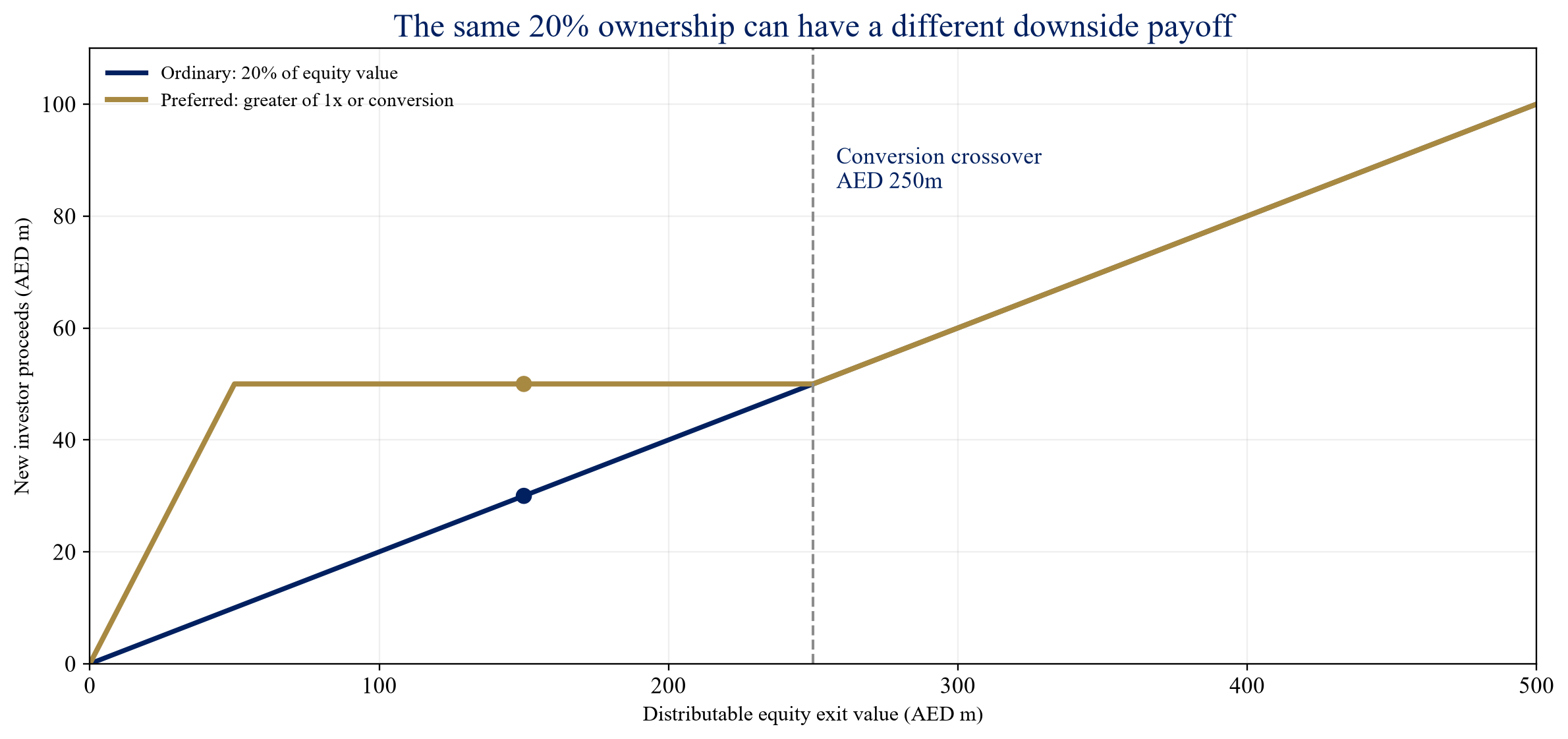
Author-developed AED 50m investment for 20% as-converted ownership; excludes debt, taxes, fees, options and accrued dividends. Illustrative arithmetic only.
17 Distinguish a protective veto from an operating plan blocker
A capital provider may need protection against actions that fundamentally change its investment. The issuer may need speed to execute ordinary commercial decisions. The term sheet can reconcile these interests by defining thresholds, exceptions and procedures with care. A veto over changing the share-class rights protects a specific bargain. A veto over every contract above an amount routinely encountered in the business could make the provider an operational gatekeeper. The economic consequence depends on the company's decision frequency and the time sensitivity of those decisions.
The board can perform a decision audit using its real historical approvals and forward plan. It should count how many past actions would have triggered each proposed consent, identify the largest expected decisions and record deadlines. That exercise produces an issuer-specific exposure measure without claiming a market price for control. If the company has no acquisition plan, an acquisition veto may be less immediate. If it has a signed pipeline, the same clause may be central to the financing decision.
The negotiation should test whether the veto applies to all subsidiaries, whether routine transactions are carved out, whether the threshold grows with company size, whether approval can be delegated and what happens if no response arrives. Counsel can draft objective wording; management can supply real operating examples. The paper does not recommend deleting all investor protections. It recommends understanding exactly which business action each clause can interrupt and recording that answer alongside cash and dilution.
18 Information and board rights have their own cost
Information rights can require monthly accounts, budgets, forecasts, board materials and prompt event notices. Those obligations may be proportionate to a material investment, but they have implementation and confidentiality consequences. The issuer needs a reporting owner, reliable source systems and a policy for competitively sensitive or privileged material. A board observer may receive information and influence discussion without a formal vote; the observer's actual rights and confidentiality duties need to be stated in the documents.
Board nomination, quorum and committee rights can affect execution even without a reserved-matter veto. If the nominated director is absent, can the board meet? Can a conflicted investor nominee vote on an acquisition involving an affiliate? Are decisions delayed until a particular representative attends? These questions require the actual articles and governance agreement. A term sheet that grants one board seat should be translated into a board decision process before it is assigned a benign or adverse label.
The OECD principles place responsibility for corporate strategy and operations with boards and management while recognising shareholder rights over fundamental matters [3]. That is a useful governance reference, not an answer to a private company's proposed board composition. A prudent issuer can design an information calendar and conflict protocol before signing. This avoids discovering at the first urgent transaction that a requested consent depends on an unavailable person or an incomplete reporting pack.
19 The document stack and execution path
A term sheet is an entry point to a larger document set. Ordinary or preferred equity may require subscription documents, amended constitutional documents, shareholders' agreements, board and shareholder resolutions, waivers and updated registers. Debt may require a facility agreement, security, guarantees, intercreditor terms, account arrangements, legal opinions and reporting certificates. A warrant adds its own exercise and share-allotment mechanics. Each document must agree with the model on price, shares, ranking, consent and dates.
The team should prepare a closing dependency map. Existing shareholder consent may precede amended articles. Existing lender consent may precede new security. A financing tranche might depend on audited accounts or a milestone certificate. A loan draw may be conditioned on perfection of security or a no-default representation. The amount shown on a signed term sheet is not cash usable at closing until those conditions are satisfied. The map should distinguish conditions the company controls from those requiring a counterparty or regulator.
For a UAE or GCC group, jurisdiction-specific counsel should confirm each issuer, guarantor, security provider and register. The federal and ADGM sources cited here establish distinct legal contexts [1, 2]; they do not provide a blanket permission to issue a preferred class or enforce a particular covenant across all entities. The finance model should be frozen to the executed documents after completion, with an owner for every ongoing reporting and consent obligation.
20 A board decision protocol
The board can receive one page per route and a common annex. Each page should show day-one usable cash, contractual payments, fully diluted ownership, exit waterfall at specified values, consent map for planned actions, maturity or redemption calendar, legal approvals and unresolved conditions. The annex should contain the exact drafts and the model version. An indicative proposal should be identified as such. If a route has no signed funding commitment, the comparison should flag execution uncertainty rather than treating it as equal to available cash.
A practical decision rule has two stages. First, exclude or condition routes that cannot fund the required amount on the required date or that require an unacceptable consent over a central business action. Second, compare the feasible routes under the same base and downside scenarios. The board can then make an explicit judgment about the balance of ownership, priority, cash obligations and control. The rule does not promise an optimum; it makes the trade-offs auditable and responsive to new terms.
The minutes should record the evidence, assumptions and rights the directors considered material. Management-estimated exit values, revenue plans and response times should be identified as estimates, with owners and revision dates. Legal and accounting conclusions should be attributed to the advisers who gave them. A later financing or acquisition can then revisit the exact right that constrained a decision, rather than relying on a remembered headline valuation.
Table 3. Board evidence and document checklist for rights-adjusted funding
| Workstream | Minimum evidence | Decision question |
|---|---|---|
| Day-one cash | Dated uses, fees, conditions and available tranches | How much can be used at closing? |
| Ownership | Register, options, warrants, conversion and pool treatment | Who owns what on a fully diluted basis after each round? |
| Exit priority | Executable waterfall over low, mid and high exits | Who receives each unit of sale proceeds? |
| Consent rights | Clause-level veto register and planned-action calendar | Which planned action needs external approval? |
| Contractual cash | Interest, dividends, redemption, principal and cure schedule | What cash is owed before value is realised? |
| Legal perimeter | Entity map, corporate approvals and existing restrictions | Can the issuer grant and perform the proposed rights? |
| Accounting | IAS 32 and control memorandum where relevant | How will the instrument and rights be reported? |
| Closing path | Conditions, owners, dates and fallback funding | When can the promised capital actually be drawn? |
Author-developed checklist; real transactions need signed documents, current law and qualified legal and accounting review.
21 Research design and evidence limits
A broader empirical study could estimate how governance terms affect funding and operating outcomes only with consented, comparable transactions. It would need complete term sheets, executed documents, opening cap tables, later rounds, actual draw dates, waivers and exit proceeds. It would also need deals that failed to close or were rejected because control rights were unacceptable. Studying successful investments alone would omit a meaningful part of the negotiation frontier. Company maturity, growth prospects, bargaining power, jurisdiction and investor type would require careful controls.
The older US venture-contract research of Kaplan and Strömberg documents separable rights [8], and later research by Ewens, Gorbenko and Korteweg estimates how contract terms affect value division in startup financing [9]. These studies are informative prior art. Their samples and identification strategies cannot be transplanted into GCC growth-company transactions without new data and methods. The UAE and ADGM legal sources describe formal rules, not how often private parties negotiate any particular clause. The present paper makes no empirical claim about a common Gulf veto, preferred return or dilution level.
A feasible future protocol would define the unit of observation as a dated offer to one issuer, preserve redacted terms and outcome dates, and obtain permission before using confidential records. It would distinguish proposed from executed terms, funded from unfunded offers, and formal rights from actual interventions. Statistical analysis would report uncertainty and selection. Until that evidence exists, the fictional examples here illustrate a decision method. They cannot support a claim that one instrument is cheaper, faster or better in the market.
22 A ninety-day financing workplan
During the first thirty days, management can reconcile the share register, option schedule, existing debt and company group. It should define the minimum cash date, use of funds and planned decisions over the next two years. Counsel can identify the legal perimeter and pre-existing approvals. The finance team can build the four ledgers using current evidence and isolate unresolved assumptions. This is a proposed project sequence, not an assertion that every transaction can be completed on the same timetable.
During the next thirty days, the company can solicit comparable written indications against one information pack. Each indication should be entered into the same cash, dilution, waterfall and veto model. Ambiguous terms should become written questions for the provider. The company can identify a preferred and fallback route, and test the proposed rights against an acquisition, follow-on financing and downside performance state. If a provider changes a term, the model should retain the earlier version and show the difference.
During the final thirty days, the team can negotiate definitive documents, obtain consents and legal opinions, test closing conditions and arrange the reporting process that will operate after funding. A complicated cross-border issuance or security package may require more time. The plan should be extended to fit the actual critical path. The board should approve the negotiated rights and updated economics together, because a consent clause changed on the last day can alter the business case even when the subscription amount is unchanged.
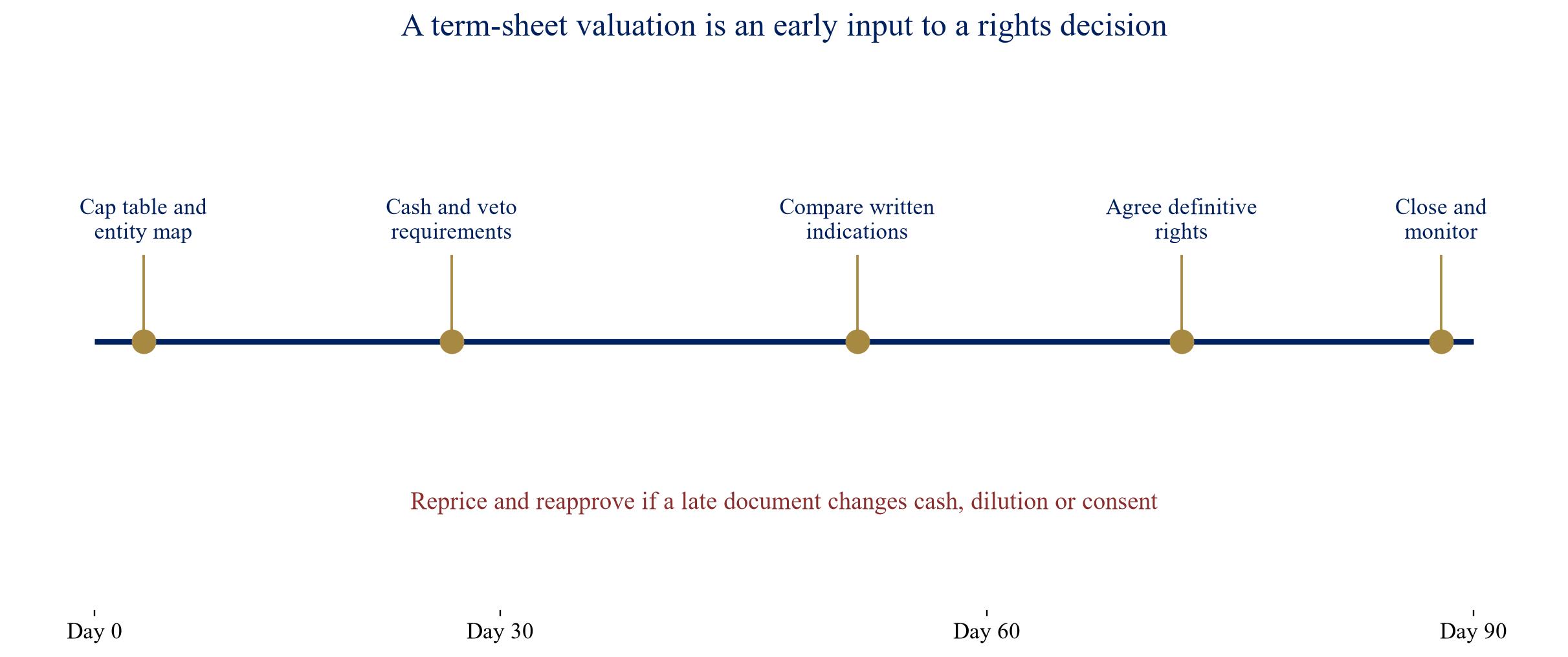
Author-developed planning sequence; days are illustrative and not a claim about actual completion times.
23 Conclusion: price the rights being transferred
Ordinary equity, preferred equity and structured debt can supply the same day-one cash while moving different claims and decisions outside the company. The fictional AED case shows immediate ordinary dilution, a preferred downside priority and a debt repayment path. The veto map adds an acquisition and follow-on funding test that a valuation headline cannot answer. The board should compare the complete package on one calendar, with the same operating plan and exit scenarios.
The supported conclusion is methodological. The cited law, accounting standards, governance principles and contracting research establish relevant mechanisms and jurisdictional limits [1–9]. They do not validate the fictional valuation, rates, thresholds, cash flows or a market preference among structures. The actual documents, corporate form, consent process and legal advice determine the rights in a transaction. A rights-adjusted board paper should make those facts visible before the issuer signs away flexibility it needs to deliver the growth plan.
The comparison should remain live after completion. New acquisitions, covenants, share issues and performance events can change the value of a consent right or the allocation of exit proceeds. Management can update the ledgers when that happens and preserve the prior decision record. The price of keeping control is therefore a specific, testable set of dilution, cash and approval consequences for an issuer; it is not one universal percentage.
Several comparisons deserve particular caution. A higher valuation offered with a strong downside preference might yield the same founder proceeds as a lower valuation without that preference in one sale scenario, and different proceeds in another. A debt proposal might preserve ownership at closing yet constrain acquisitions and require refinancing before the company's investment cycle pays off. A founder may rationally prefer one structure, while other existing holders prefer another because their share classes and liquidity needs differ. The board should disclose those distributional effects in its own decision process and avoid treating a single shareholder's preferred outcome as the company's universal objective.
The model should also be re-run when a financing provider changes the definition of a trigger. A reserved matter defined by gross transaction value can capture more actions than one defined by net cash outlay. A covenant measured quarterly can create a different response window from one measured monthly. A preference calculated on gross proceeds can differ from one calculated after transaction expenses. Each wording change belongs in a versioned assumptions log, with the economic and governance effect shown beside the proposed clause. This discipline makes the financing decision auditable without pretending that every legal nuance has an objective monetary price.
Finally, the absence of comparable public transaction data limits what the paper can conclude about market competitiveness. A board may receive several live offers and create a genuine issuer-specific comparison; this paper has no access to those offers. It cannot verify a typical Gulf preference multiple, a normal veto threshold, a standard debt coupon or the probability that an investor grants consent. Any mandate using this framework should replace every fictional input with dated evidence and obtain specialist advice for legal enforceability, accounting classification and tax consequences. Those checks are part of the transaction, not caveats to be left for after signing.
References
- United Arab Emirates. Federal Decree-Law No. 32 of 2021 on Commercial Companies, official legislation portal, accessed 6 October 2026. https://www.uaelegislation.gov.ae/en/legislations/1542
- Abu Dhabi Global Market. Companies Regulations 2020, official rulebook consolidated PDF dated 29 November 2024; current amendments and application require transaction-specific review. https://en.adgm.thomsonreuters.com/sites/default/files/net_file_store/ADGM1547_20963_VER20241129.pdf
- OECD. G20/OECD Principles of Corporate Governance 2023, Chapter II, shareholder rights and equitable treatment. https://www.oecd.org/en/publications/g20-oecd-principles-of-corporate-governance-2023_ed750b30-en/full-report/component-5.html
- National Venture Capital Association. Model Legal Documents, including updated 2025 investor-rights and voting documents; US drafting examples. https://nvca.org/model-legal-documents/
- IFRS Foundation. IAS 32 Financial Instruments: Presentation, official standard overview, accessed 6 October 2026. https://www.ifrs.org/issued-standards/list-of-standards/ias-32-financial-instruments-presentation/
- IFRS Foundation. IFRS 10 Consolidated Financial Statements, official standard overview, accessed 6 October 2026. https://www.ifrs.org/issued-standards/list-of-standards/ifrs-10-consolidated-financial-statements.html/
- IFRS Interpretations Committee. IFRIC Update, September 2013, effect of protective rights on an assessment of control under IFRS 10. https://media.ifrs.org/2013/IFRIC/September/IFRIC-Update-September-2013.html
- Kaplan, Steven N., and Per Strömberg. “Financial Contracting Theory Meets the Real World: An Empirical Analysis of Venture Capital Contracts,” NBER Working Paper 7660, 2000. https://www.nber.org/papers/w7660
- Ewens, Michael, Alexander S. Gorbenko, and Arthur Korteweg. “Venture Capital Contracts,” NBER Working Paper 26115, revised 2020. https://www.nber.org/papers/w26115
- OECD. G20/OECD Principles of Corporate Governance 2023, Chapter IV, disclosure and transparency of ownership and control arrangements. https://www.oecd.org/en/publications/g20-oecd-principles-of-corporate-governance-2023_ed750b30-en/full-report/component-7.html
- IFRS Interpretations Committee. IFRIC Update, May 2013, IAS 32 classification of financial instruments with issuer settlement choice. https://media.ifrs.org/2013/IFRIC/May/IFRIC-Update-May-2013.html
About the Author
Chennakeshav (CK) is a corporate finance and investment banking executive with 25+ years of global experience in deal origination, structuring and execution across M&A, growth capital and corporate strategy. He has led value-creation mandates for founders, corporates and funds — bridging the boardroom view to hands-on execution and close.
His career spans Morgan Stanley, HSBC, Lloyds Banking Group, EWEC, ADQ portfolio companies and Emirates Growth Fund, across TMT, real estate, fintech, deeptech, cleantech, infrastructure and energy. He has partnered with C-suite leaders, private equity and venture funds, sovereign wealth funds and family offices to finance complex fund raises and scale-up ventures, and has led M&A due diligence, post-merger integration and business-transformation initiatives to create value.
At Matchpoint Partners he is Managing Partner, leading the firm's corporate finance, M&A and capital-raising practice. He holds an MBA from London Business School, an engineering degree from VTU and a Master of Laws (LLM, in progress) from UCL London.
An active start-up mentor, CK mentors at Techstars, DIFC FinTech Hive, Startup Grind, Founder Institute and IN5, serves as Entrepreneur Mentor in Residence (EMiR) at London Business School, and judges the Entrepreneurship World Cup.
