

1 Price an executable service
The board-level question is whether an identified storage project can accept a specified stream of carbon dioxide for a specified period at a price that covers its complete obligations. This differs from asking whether a basin contains abundant pore space. A prospective emitter wants firm acceptance at a delivery point, a quality specification, metering, evidence of retention and a remedy when service is unavailable. The storage operator needs rights, wells, surface facilities, pressure headroom, containment and the ability to monitor and close the site. The capital provider needs a creditworthy payment stream and a funded route through the obligations that continue after injection ends.
An investment committee should therefore describe the asset as a chain of conditional rights and capabilities. Geological capacity is one input. Permits define an allowed operating envelope. An injection test and calibrated model support a rate within that envelope. A transport connection makes the service physically accessible. Contracts allocate volume, quality, interruptions, title, risk and payment. Monitoring and closure plans impose spending throughout and after the revenue period. A failure in any link can reduce or postpone the cash flow available to investors.
This paper makes a specific decision possible: compare two proposed storage opportunities on an equal contracted-service basis, and decide how much development capital to release at each evidence gate. It does not claim that every formation can be priced by one tariff. It gives the investment team a shared vocabulary for the subsurface engineer, regulator, commercial negotiator and lender. The same structure can be used in an acquisition, a joint venture, a transport-and-storage network financing or a bilateral service agreement, subject to the jurisdiction's law.
The key unit is an accepted, metered and contractually paid tonne at the agreed boundary. A tonne of geological resource that cannot be injected at the required rate during the contract year has no current service revenue. A tonne accepted without a credible monitoring and liability plan can create a future obligation larger than its fee. The economic model must follow the service and its complete life cycle.
2 Build the capacity ladder
Five quantities should be reported separately. First, theoretical or atlas-scale capacity is a regional estimate of potential subsurface storage. Second, site-appraised resource is an estimate built from local geological and fluid data. Third, permitted capacity reflects the authorised pressure, rate, total mass and conditions for specific wells or a storage complex. Fourth, contracted capacity is the annual or lifetime quantity promised to customers under enforceable terms. Fifth, verified retained mass is the amount actually injected and accounted for, subject to the applicable monitoring and reporting method. Each step has a distinct owner, uncertainty and evidence file.
NETL's storage-formation material says its atlas estimates are high-level resource assessments and should not replace site-specific characterization [1]. It identifies adequate reservoir injectivity and a seal as necessary conditions for a viable site. An atlas number can guide a basin-screening budget. It cannot set a debt covenant or a delivery guarantee. Similarly, a subsurface simulator can estimate injection performance under assumed permeability, pressure, boundary and well configuration. Its result needs sensitivity analysis and calibration against field evidence.
The permitted injection rate may be lower than the reservoir model's preferred rate. Operating pressure limits, pressure-front extent, neighbouring rights, well integrity or monitoring conditions can constrain it. Contracted volume may then be lower again because the customer has phased capture capacity or the network cannot deliver the design stream. Actual injection can depart from booked volume through outages, off-specification carbon dioxide, demand shortfalls or planned testing. A valuation that takes the highest number in this ladder and prices every tonne at the full service fee overstates what the current evidence supports.
Use a capacity ledger with date, unit, case, source, owner and confidence level. For a project spanning multiple reservoirs, do not sum gross regional estimates without checking hydraulic communication, pressure interference and shared infrastructure. For a portfolio of storage licences, do not treat each licence as a commissioned injection site. A meaningful portfolio table should show the percentage of proposed annual service that is appraised, permitted, connected, contracted and operating.
3 Test injectivity as a rate and a time path
Injectivity is the ability to place carbon dioxide into a formation at a given rate under the allowed pressure conditions. The rate can change as the reservoir fills, the pressure front expands, brine moves and wells age. A single initial well test is valuable evidence, yet it is not a twenty-year firm-capacity certificate. The investment case should model annual and peak-day injection at the proposed wells and delivery point, including maintenance, well intervention and planned expansion.
Start with permeability, thickness, porosity, fluid properties, pressure and temperature. Then evaluate near-well effects, completion design, perforations, impurities and potential reactions or plugging. Translate the reservoir model into a well count, compressor duty, injection pressure and energy requirement. An alternative scenario with a lower effective permeability, earlier pressure constraint or delayed well should show the lost firm tonnes and the cost of corrective works. This is a direct sensitivity for service revenue, not merely a scientific appendix.
The US EPA requires Class VI applicants to disclose proposed daily injection rates, anticipated total mass and pressure characteristics; permits then set operating conditions [2,3]. Those US requirements illustrate the difference between a developer's design and authorised operation. Other jurisdictions have their own approval process. The UK NSTA's permit guidance asks applicants to demonstrate the storage complex and operational plans, including monitoring and financial security [4]. A transaction team must verify the current local requirements before representing capacity as available.
Injection capacity should be measured at the customer's handover boundary. If the producer delivers variable composition or pressure, the storage operator may need conditioning or extra compression. If the transport network restricts flow, a high-capacity well alone cannot fulfill the service promise. A daily nomination model should test the integrated chain at a high-flow day, an outage day and a prolonged low-delivery period. The result is an operationally usable rate schedule rather than a headline maximum.
Table 1. Evidence ladder for a bankable carbon-storage service
| Stage | Evidence required | Permissible commercial treatment |
|---|---|---|
| Basin screen | Regional geology and published resource estimate | Fund limited appraisal; no firm service revenue |
| Site appraisal | Seismic, cores, fluids, wells and calibrated model | Risk development option and appraisal budget |
| Injection test | Site-specific injectivity, pressure and integrity data | Size candidate well and compression programme |
| Regulatory approval | Storage rights, permits, operating limits and financial security | Model authorised capacity within permit conditions |
| Network and contract | Commissioned connection, specification and creditworthy customer | Recognise enforceable contracted service case |
| Operation and closure | Metering, monitoring, updated models and funded closure | Verify earned revenue and residual obligation |
Author-developed framework; all site values require local source documents and qualified review.
4 Treat pressure as the scarce resource
In a saline formation, displaced fluid and injected carbon dioxide create a pressure response extending beyond the carbon dioxide plume. This pressure front can constrain injection before the nominal pore volume is filled. The location of neighbouring wells, faults, protected water resources and other storage projects matters. If two projects share a hydraulically connected region, their pressure budgets may interact even when their plume footprints do not overlap. The asset is therefore partly a right to use a pressure envelope under specified conditions.
The EPA's Class VI area-of-review approach uses computational modelling of the plume and pressure front, followed by re-evaluation as operating and monitoring data develop [2,6]. This creates a continuing obligation to update the subsurface case. An initial model should show the pressure path under base, high-rate and low-permeability cases, with explicit boundaries and uncertainty. A project that cannot demonstrate the pressure response at the proposed rate should carry an appraisal value, not a firm twenty-year throughput value.
Pressure management may require more wells, altered injection patterns, production or handling of formation water where lawful, or a lower annual acceptance commitment. Each response has a capital, operating, permitting and environmental consequence. Brine handling should never be entered as a frictionless modelling switch. Its chemistry, treatment, discharge or reinjection route and rights can become the project's critical path. The project model should tie a pressure constraint to a defined action, cost, lead time and new approval requirement.
Commercial allocation is also necessary. If a third party starts injecting into the same regional system, the operator may face less pressure headroom than the original model assumed. Licence boundaries, data-sharing rights and interference arrangements should be checked before acquisition. Contract terms should address how a regulator-mandated rate reduction affects service, remedies and force majeure, subject to local law. A prudent base case should not charge customers for theoretical space that the project cannot use without violating its pressure envelope.
5 Establish containment and legacy-well integrity
The subsurface containment case depends on a suitable storage reservoir, confining zone, faults, fractures, pressure limits and every relevant wellbore. A depleted hydrocarbon field may have extensive data and established structures; it may also contain a legacy well inventory with uncertain barriers. A saline formation may have fewer old wells in one area but less production history. The decision is site-specific. Neither reservoir label is sufficient proof of secure retention.
The diligence team should obtain a complete well register, including abandoned, suspended, monitoring, injection and neighbouring wells within the relevant area. Review construction records, cement logs, interventions, pressure history, corrosion and abandonment status. Map geological discontinuities and historical seismicity. Test plausible migration pathways and the ability to detect an excursion early enough to act. Independent subsurface review should document unresolved items and the cost of corrective action.
The EPA Class VI framework requires area-of-review corrective action, well construction, mechanical-integrity testing, monitoring, plugging, post-injection care and closure [2,3]. These are US regulatory obligations, with project-specific permit detail. NETL's best-practices material addresses site characterization, well management, simulation and risk assessment [7]. A cross-border investor can use the underlying engineering questions, then obtain local legal and regulatory advice for the relevant country.
A seller's statement that the caprock has held hydrocarbons for geological time can motivate appraisal. It does not establish the condition of a thirty-year-old well or the planned injection pressure. Acquisition consideration can be staged around receipt of records, independent verification and critical tests. Known remediation can be funded before close or priced through escrow and specific indemnities, subject to enforceability and obligor strength. The buyer's model should distinguish inherited obligations from the new storage operation's prospective liabilities.
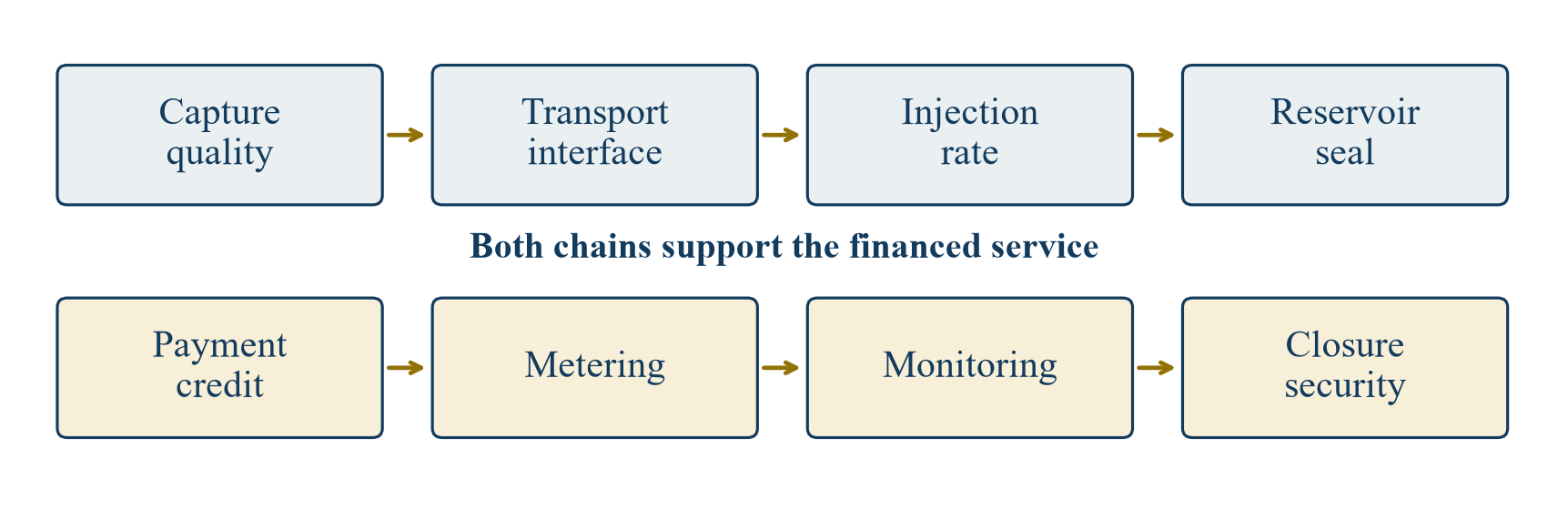
Author-developed system map; physical and contractual boundaries require project-specific definition.
6 Locate and price pore-space rights
The legal ability to inject carbon dioxide and use subsurface space is distinct from physical suitability. Rights can depend on ownership of the pore space, mineral or petroleum rights, surface access, public licensing, offshore concessions and pipeline easements. The operator also needs data rights to inspect seismic and well records and to share them with regulators, lenders and independent engineers. A technically attractive structure without a defensible right to develop and operate is not an executable storage asset.
Create a title and consent map covering the injection site, the modelled plume and pressure area, wells, surface facilities, transport corridor and monitoring locations. The area may extend across more than one tract or licence. Check competing subsurface uses, including hydrocarbon production, geothermal activity, water abstraction and another storage proposal. The applicable law may distinguish permission to explore, permission to appraise and authority to inject commercially. Each stage should be recorded separately, with expiry dates, transfer controls, work commitments and security requirements.
The UK NSTA guidance treats a storage permit as a detailed, site-specific submission and addresses monitoring, closure and financial security [4]. The US Class VI well permit focuses on protection of underground drinking-water sources and has its own technical requirements [2,3]. A US injection permit does not by itself establish every land or pore-space right, and a UK offshore licence does not by itself prove that a storage site can accept a proposed commercial stream. Project counsel must identify all instruments relevant to the jurisdiction and transaction structure.
An acquisition agreement should state the exact rights being transferred and their conditions. A purchaser may need consent before change of control, assignment of a licence or replacement of financial security. It should determine who retains historical decommissioning or environmental liabilities. A discounted purchase price is not enough when the buyer cannot lawfully operate, obtain data or secure a transport corridor. Title diligence belongs before a purchase price is attributed to future contracted storage tonnes.
7 Connect storage to the transport and capture chain
The injection well is one component of a network. Captured carbon dioxide must be conditioned, compressed and transported to an injection point at an agreed pressure and composition. The customer may expect one party to provide the entire transport-and-storage service, while the proposed investment owns only the store. The transaction team must draw contractual boundaries and find any missing capital, permit and credit link. A stranded well with strong geology is still a development option rather than a revenue service.
Network economics depend on source locations, pipeline or shipping distance, route rights, throughput, shared capacity and construction sequencing. A shipping terminal introduces liquefaction, temporary storage, ship scheduling and unloading constraints. A pipeline introduces rights of way, crossings and line-pack dynamics. Carbon dioxide impurities can affect corrosion, phase behaviour and acceptance. A storage agreement that uses a generic “pipeline-ready” specification should be converted into measurable composition, pressure, temperature and metering obligations.
The IEA's 2026 CCUS Projects Database tracks capture, transport, storage and utilisation projects globally [5]. Its project pipeline is a source of market context and potential comparators. It does not verify the precise commissioning date, contract or delivery specification of an unrelated local network. Review the most recent project-specific filings and executed agreements before building revenue from an announced capture plant. If the capture plant is delayed, determine whether a take-or-pay payment survives and whether the customer can actually pay it.
An integrated schedule should identify the long-lead items: subsurface tests, environmental review, storage permit, compressor and well procurement, network construction, capture commissioning and testing. The base-case first-injection date should be the latest of the necessary commissioned components. A storage project that finishes early may require standby financing until the emitter and transport chain are ready. This timing risk should appear explicitly in the sources-and-uses statement and debt draw conditions.
8 Define the service contract precisely
A storage service contract should specify the accepted stream, delivery point, firm annual and daily quantities, nominations, pressure, composition, measurement, testing and outage rights. It should allocate title and risk in the carbon dioxide and the consequences of rejected or off-specification delivery. The parties should agree which evidence constitutes storage performance and how corrections to a metered volume are handled. A vague promise to “store all captured emissions” can create an uncapped performance obligation inconsistent with the permitted system.
Revenue design can combine availability, capacity reservation and throughput charges. An availability payment may support fixed costs and debt service when capture volumes vary. A throughput charge can cover variable power, chemicals, monitoring and carbon dioxide stream handling. Minimum volume commitments should align with the customer's capture ramp and the site's physically supportable rate. Indexation should be tied to identifiable costs and jurisdiction-specific contract rules, not an unsupported assumption that all future costs can be passed through.
The contract must address pressure-related rate reductions, well workovers, regulator-directed shutdowns and third-party interference. Remedies should recognize that the operator cannot inject unsafely to avoid a payment. Define notification, mitigation, alternative storage and long-stop rights. Insurers and lenders will want to know whether an unavailability event creates an uncapped liability or a capped commercial remedy, and whether environmental and regulatory obligations sit outside that cap.
The buyer's credit matters as much as the tariff. A ten-year agreement with a thinly capitalized emitter may not support twenty years of debt. Parent support, letters of credit, reserve accounts and step-in rights can help, subject to actual enforceability. Conversely, the emitter should examine whether the storage special-purpose vehicle can fund monitoring and remediation after revenue stops. Both parties need a counterparty with the capacity to perform through closure.
9 Distinguish market context from project price
Market data can guide diligence, but public project lists rarely reveal comparable, all-in storage tariffs. A posted charge may include transport, compression, capture integration or public support. A project may report gross capacity while its contract sells a lower firm service. Prices can also vary with stream quality, annual volume, duration, location and liability allocation. A benchmark table should first normalize its boundaries and exclusions.
The IEA's database was last updated in March 2026 and covers large-scale projects from operation through planning [5]. A 2025 IEA commentary described a global pipeline in which announced capture capacity could reach about 430 million tonnes per year by 2030 and storage capacity about 670 million tonnes per year [8]. Those numbers are conditional project-pipeline indicators. They do not equal operational capacity or revenue. The IEA's chart separates operational, under-construction, advanced and concept-stage activity [9]. This categorization is useful for screening maturity, not for declaring all announced capacity bankable.
Public permit documents provide a different benchmark. They may disclose well number, rate, total mass, financial responsibility and monitoring plans. Those are regulatory submissions for specific sites. They do not necessarily disclose the whole network's capital cost or negotiated tariff. Engineering studies can illuminate cost categories and uncertainty, but their dollar values should not be copied into an acquisition model unless geography, date, scope and specification are genuinely comparable.
Use a two-layer benchmark. The first layer records public observations with source, date, geography, unit and project stage. The second layer records the project's own evidence: independent engineer estimate, signed equipment quotes, permit conditions, tax and funding terms, security instruments and customer contract. A valuation committee should see both layers side by side and avoid blending them into a spurious “market price of pore space.”
Table 2. Public benchmarks and limits of their use
| Public source | Observation | Appropriate investment use | Missing local proof |
|---|---|---|---|
| NETL storage formations [1] | Atlas resource is high-level and site-specific characterization is required | Screen regions and appraisal questions | Local reservoir, seal and injectivity tests |
| EPA Class VI [2,3] | Permits require technical plans and financial responsibility | Build US diligence and assurance checklist | Project permit and approved operating limits |
| UK NSTA permit guidance [4] | Storage permit includes development, monitoring and closure evidence | Build UK offshore submission plan | Accepted site-specific permit and security |
| IEA CCUS database [5] | Projects span operation and multiple planning stages | Map maturity and comparators | Connection, customer, tariff and delivery |
| IEA 2025 commentary [8] | 2030 pipeline estimates are conditional | Assess direction of sector activity | Commissioned and paid-for local service |
Sources [1-9]; these observations are not project-specific performance or price evidence.
10 Put monitoring into the financial model
Monitoring, verification and accounting are permanent operating functions during injection and can continue after it ends. The programme may include pressure and temperature measurement, well-integrity tests, fluid sampling, seismic or other geophysical surveys, surface surveillance, model updates and reporting. The correct suite depends on geology, regulatory approval and risk assessment. A line item labelled “monitoring” without equipment, frequency, staffing and replacement assumptions is not an investment-grade cost estimate.
NETL's monitoring best-practices manual discusses techniques, the information they provide and how plans can be assembled for geologic storage projects [7,10]. The EPA Class VI rules require testing, monitoring and periodic area-of-review re-evaluation [2,3]. The NSTA asks for a storage-complex monitoring and closure case [4]. These sources show that monitoring is connected to the site's evolving model and regulatory duties. They do not prescribe one global sensor package or fixed cost per tonne.
Monitoring data can also settle commercial claims. Metering establishes accepted mass; subsurface and well surveillance support the assertion that the service remains within the permitted envelope. The contract should define data access for customers, lenders, insurers and independent verifiers, while protecting legitimately confidential information. It should specify the procedure when measured data conflict with the original model, including a safe operating response and a funding source for extra monitoring.
Technology can make anomalies visible sooner, yet it must be tested and maintained. A digital dashboard is useful only when the underlying measurements are calibrated and reviewed by accountable specialists. Models should retain their versions, inputs and exceptions. A change in permeability estimate or pressure trajectory should flow into both the operating plan and the financial forecast. Reporting a stable headline capacity while quietly reducing the rate forecast conceals the asset's central economic risk.
11 Carry liability beyond the injection period
Storage revenue may end when the final tonne is accepted; monitoring, well plugging, corrective action and closure can continue. The present value of these duties is part of the acquisition price and the service tariff. The EPA's Class VI rules require financial responsibility for area-of-review corrective action, well plugging, post-injection site care, site closure and emergency and remedial response [2,3]. EPA guidance describes a default post-injection care period of fifty years, with an alternative period possible through a site-specific demonstration under the rule [11]. This is a US regulatory starting point, not a universal fixed duration for every project.
In the European Union, the CCS Directive provides for financial security and conditions for transfer of responsibility after closure [12]. UK regulation and NSTA guidance set their own application, post-closure and financial-security requirements [4,13]. These regimes differ in legal mechanism and timing. A transaction model should follow the obligations applicable to its exact site and licence. It should not assume that a future transfer of responsibility has already occurred or that an insurance policy covers every regulatory duty.
Closure cost should include plugging and abandonment, facility removal where required, surveillance, reporting, contingent corrective action and the final financial contribution or security required by the authority. Estimate those costs in money of the year incurred and discount them only after the physical scope is established. Then model funding: a reserve account, funded trust, bond, letter of credit, parent guarantee or other approved instrument. The security's annual fees and collateral needs can affect project cash flow before closure.
An acquisition buyer should review who holds the security, whether it is transferable, how its amount is adjusted and whether the seller or a prior operator remains liable for historical acts. A change in control may require consent or replacement security. A project with low visible capex can carry substantial inherited well and remediation obligations. These must be documented and priced through the transaction structure, not hidden in a broad contingency percentage.
12 Run a transparent illustrative tariff calculation
Consider a fictional saline-storage project accepting one million tonnes each year for twenty years. The author assumes USD 240 million of capital spent at time zero, USD 18 million of operating cost at each year-end, USD 40 million of terminal closure spending at the end of year twenty and a 10% annual discount rate. For clarity, the example assumes every annual tonne is accepted and paid for, no construction delay, constant real money, no tax, no financing costs, no replacement capital and no post-year-twenty operating expense. These simplifications make the calculation auditable, not predictive.
The twenty-year annuity factor is 8.5136, and the year-twenty discount factor is 0.14864. The present value of costs is USD 240 million plus USD 18 million times 8.5136 plus USD 40 million times 0.14864; this equals approximately USD 399.20 million. The present value of twenty annual one-million-tonne deliveries is 8.5136 million discounted tonnes. Dividing yields a levelized required payment of USD 46.89 per tonne. At 0.8 million tonnes annually, the same fixed costs yield USD 58.61 per tonne; at 0.6 million tonnes, USD 78.15 per tonne. These are author-assumed illustrations, not market charges.
A second fictional design assumes USD 210 million upfront, USD 22 million annual operating cost and USD 60 million terminal closure cost with the same one-million-tonne annual service and discount factors. Its resulting required payment is USD 47.71 per tonne. The lower initial capital is offset by higher annual and terminal obligations in this selected case. A real comparison must normalize the delivery point, technical performance, tax, currency, inflation, financing, contingency, construction schedule and liability arrangements. No technology ranking follows from these invented figures.
The calculation isolates a key negotiation point: when the service fee is fixed and the site can accept fewer tonnes, cash coverage shrinks unless the contract includes a reservation payment or other support. Model actual payment terms, not just physical throughput. An availability charge can change the tariff's unit expression and improve fixed-cost recovery, but it creates performance obligations. The contract and engineering model must be reconciled before a lender accepts the base case.
Table 3. Fictional twenty-year required-payment case
| Item | Design A | Design B | Design A at lower throughput |
|---|---|---|---|
| Initial capital | 240 | 210 | 240 |
| Annual operating cost | 18 | 22 | 18 |
| Terminal closure cost in year 20 | 40 | 60 | 40 |
| Annual paid injection, million tonnes | 1.0 | 1.0 | 0.8 |
| Annual discount rate | 10% | 10% | 10% |
| Required payment, USD per tonne | 46.89 | 47.71 | 58.61 |
Every financial and volume input is an author assumption. Figures are rounded; USD million unless stated.
13 Test the sensitivities that change value
The most useful downside cases are tied to a physical or contractual cause. Reduce injectivity after a pressure test. Delay the second well. Increase compressor power because the delivery pressure is lower than planned. Add corrective action for a legacy well. Extend the monitoring period. Reduce annual paid volume when the anchor capture facility is delayed. Each scenario should identify an evidence trigger, owner, mitigation cost and effect on covenants.
For the fictional Design A, a decline from one million to 0.8 million paid tonnes per year raises the levelized required payment from USD 46.89 to USD 58.61 per tonne when costs stay fixed. A decline to 0.6 million paid tonnes raises it to USD 78.15. This is arithmetic under the selected assumptions. In practice, some expenses may vary with throughput while others are fixed, and payment may depend on availability rather than actual injection. A project-specific model must reflect those features.
Sensitivity should extend beyond a single percentage table. Test a slow commissioning ramp, loss of one well, a pressure-front revision, a newly identified well requiring remediation, a lengthy post-injection programme and customer default. Separate remediable issues from hard viability failures. An additional injection well may restore rate at a known cost and permit lead time. A loss of legal access to the storage area may prevent the project from continuing at all. The investment committee should see the difference before agreeing to risk-adjusted discount rates.
Use a probabilistic model only when the probabilities are supported by relevant data and maintained transparently. A management-provided “90% chance of permit approval” is a management estimate until grounded in jurisdiction-specific evidence. A deterministic gate model may be clearer early in development: spend a limited sum, run a defined test, then decide whether to proceed, re-engineer or abandon. This avoids a false impression of precision from a spreadsheet with unsupported probability inputs.
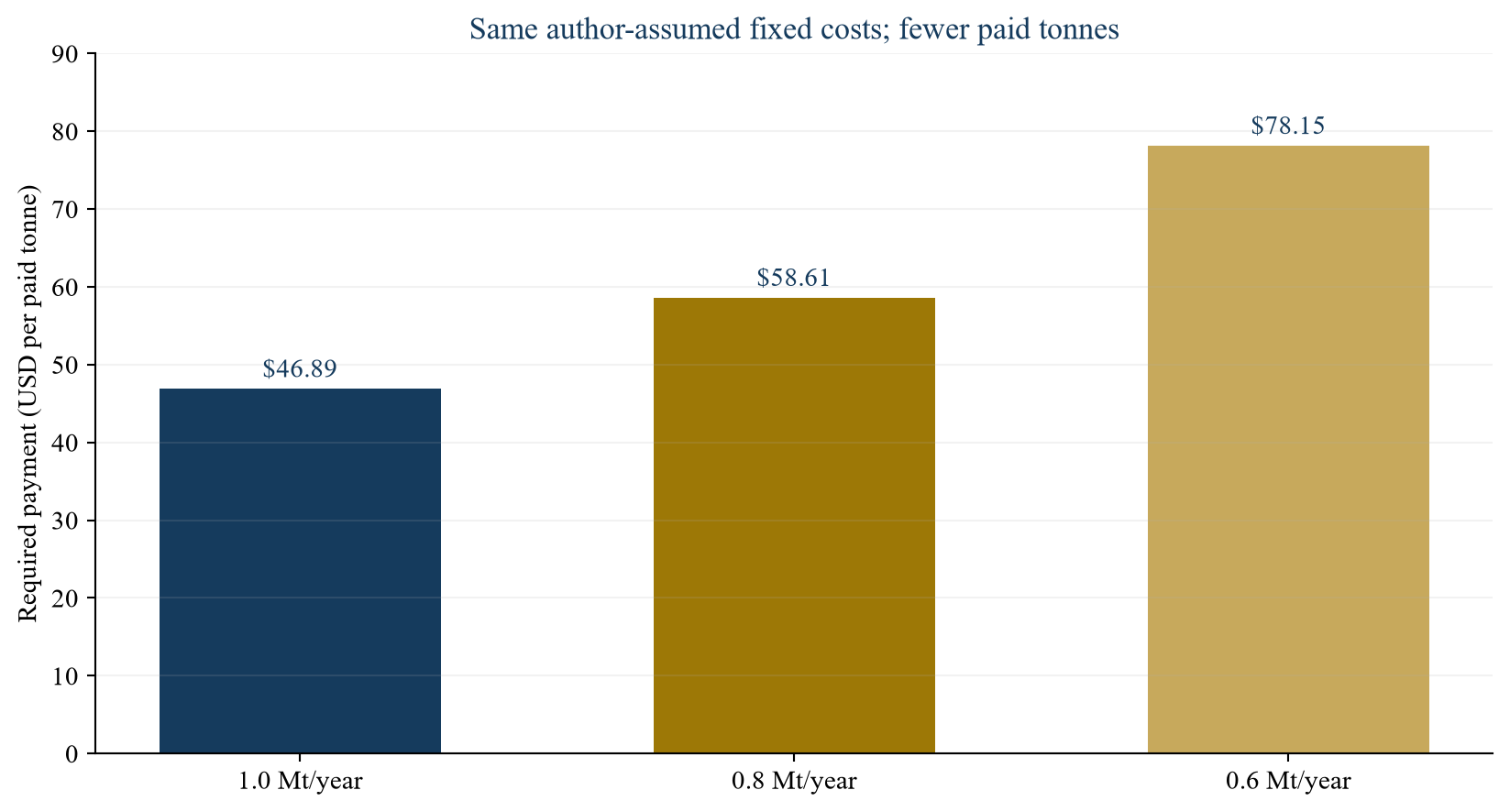
Author-assumed Design A; calculations use the stated twenty-year 10% model. Not a market benchmark.
14 Finance a whole-life obligation
Project finance can be considered when the service, rights, technical performance and payment stream are sufficiently defined. Lenders will examine the storage permit, independent reservoir assessment, well design, construction contracts, network connection, anchor customer, insurance, monitoring plan and closure security. The permitted annual rate is a ceiling; prudent debt sizing should use the lower firm service supported by the independent case and executed contracts. A geological resource estimate alone is not a repayment source.
Debt service should be stress-tested against downtime, delayed first injection and a pressure-related capacity cut. The model should distinguish customer payment for booked availability from payment for actual injected mass. If the contract allows wide volume discretion, lenders may size against a smaller minimum commitment. A special-purpose vehicle with limited assets also needs cash or a creditworthy sponsor to meet obligations after the contract term. Shareholders should not distribute all operating cash if monitoring and closure remain unfunded.
Financial assurance is not simply a footnote to valuation. An approved letter of credit can tie up collateral or reduce borrowing capacity; a funded trust consumes cash; insurance carries premium, deductible and exclusions. The choice depends on the regulator and project. The financing term sheet should specify security renewal, top-up triggers, replacement after downgrade and interaction with lender collateral. If a sponsor's guarantee supports a public obligation, its release conditions should be explicit.
For a storage portfolio, debt can be allocated to operational sites while early licences remain equity-funded options. Shared pipelines may create coordination efficiencies, yet only when rights, timing and contract interfaces are real. Portfolio diversification cannot cure a common pressure system, one anchor emitter or one regulatory bottleneck. Disclose asset-level exposure and the physical links among sites. A lender should not be asked to finance a catalogue of undeveloped pore-space opportunities at the same leverage as a commissioned, contracted storage service.
15 Structure an acquisition around evidence
Buying a storage developer, licence or mature site transfers more than resource potential. Diligence should start with rights, data provenance, wells, permits, customer commitments, network interfaces and liabilities. Build a red-flag register with the evidence document for each claim. A seller presentation can guide questions, but the buyer needs access to original geological interpretations, model files, regulator correspondence, well records, contracts and security instruments.
Consider staged consideration where commercial value depends on an unresolved injection test or permit. An initial payment can compensate the seller for verified rights and data; later payments can depend on objectively documented permit, firm rate, contracted capacity or commissioning milestones. Earn-outs must account for who controls development spending and how performance is measured. A buyer should avoid paying fully for a capacity figure that may require costly additional wells or pressure management.
Environmental and historical liabilities require their own workstream. Review prior hydrocarbon operations, contaminated sites, abandoned wells, unresolved regulatory notices and decommissioning obligations. A storage licence may have ongoing work commitments or financial-security requirements. The purchase price should include the cost of compliance and any required replacement collateral. Seller indemnities are useful only with a solvent obligor, suitable survival period and enforceable terms.
Post-close integration is also technical. Preserve the provenance of subsurface models, control changes to assumptions, integrate monitoring data and maintain the regulator relationship. If the acquisition combines a capture plant, pipeline and store, align contract boundaries and avoid duplicated or missing liability. A transaction that closes quickly but loses essential subsurface records can destroy the very evidence on which the valuation relied.
16 Address cross-border differences explicitly
Carbon storage is increasingly relevant to international capital, yet the legal route varies by location. The US Class VI framework is a federal well-permitting regime with state primacy in some jurisdictions [2,3]. The EU CCS Directive supplies a common framework implemented through member-state rules [12]. The UK has offshore licensing and storage-permit arrangements, including separate rules for termination and post-closure matters [4,13]. These are examples of different regimes, not interchangeable checklists.
For a GCC, Indian or other project, an investor must obtain the current local answer on pore-space rights, injection authorisation, environmental review, monitoring, liability transfer, financial assurance and emissions-accounting treatment. Do not transplant a US Class VI permit duration or an EU transfer condition into a jurisdiction with different law. The engineering disciplines remain useful across borders: characterize the reservoir, assess injectivity and containment, define the pressure front, monitor performance and fund end-of-life obligations.
Cross-border carbon dioxide shipment creates another layer. Identify who holds title at each border, which specifications apply, whether transport and storage activities have separate permits and how reporting avoids double counting. Treaty, marine, waste and emissions-trading questions may arise depending on route and use. This paper makes no legal conclusion about a proposed route. Counsel and the relevant authorities should confirm the operative rules before the business case includes imported carbon dioxide volumes.
Currency and sovereign risk also affect bankability. Capital equipment may be priced in one currency while storage fees are paid in another. A government-backed emitter or policy support can improve credit only when legal terms and payment history support it. A proposed carbon price should be a sensitivity until the investor identifies a binding instrument and an entitled party. The storage project's revenue model needs its own signed payment rights.
17 Use data and AI within an auditable workflow
Digital tools can help assemble well records, seismic interpretations, permit conditions and monitoring data. Machine learning may flag missing well information, unusual pressure behavior or inconsistency between a model and observations. These uses can reduce review time when the source files, methods and false-positive rates are documented. They do not establish injectivity, certify containment or replace an independent engineer. A model's output should retain its version, training data scope, input record and human reviewer.
A practical data room should maintain a spatial index of wells, faults, leases, sampling points, pressure sensors and predicted plume and pressure fronts. Every map layer needs a date, coordinate reference, owner and update process. A commercial team can then see which customer's tonnes depend on which well and pressure assumption. This is especially useful after a proposed change in injection rate or another operator's activity. Data quality becomes a financing control because a stale map can conceal a capacity conflict.
The monitoring system should compare observed pressure and plume indicators with a calibrated prediction and prescribed response thresholds. A visible exception log can connect a technical event to commercial notification, a regulator report, reserve release or a financial-model update. Automation can prepare the evidence pack; qualified operators and the authority retain their respective decision roles. Contractual data-access permissions should be secured before a lender or customer relies on the dashboard.
An acquisition team should also test whether the vendor's claimed data advantage is transferable. Proprietary interpretation may be valuable if it is accurate, supported and licensed for the buyer's use. A database of public permits with no validation may have limited defensible value. The transaction price should reflect rights to underlying source data, maintainability and the cost of independent verification.
18 Create an investment-gate sequence
Gate one defines the emitter's required annual and peak service, stream specification and delivery point. Gate two secures a plausible rights and regulatory path, then screens geology and existing wells. Gate three acquires local data and conducts an injection and pressure-management appraisal. Gate four develops the integrated network, monitoring and closure design with a priced engineering scope. Gate five secures permits, customer commitments, financial security and a financing package. Gate six commissions to the contractual boundary and begins a continuous monitoring and model-update programme.
Each gate has an expenditure ceiling and a stop condition. If the reservoir cannot deliver a rate within a safe pressure envelope, the sponsor should redesign or stop before committing full construction capital. If a missing pore-space right can be secured on specified terms, the site may remain a development option. If the anchor emitter cannot demonstrate a funded capture schedule, the storage project may need a different customer or an availability-payment structure. These are specific decisions, not a generic “high risk” label.
The board pack should carry a one-page evidence record for each gate: decision sought, documents received, outstanding tests, owner, budget, approval needed, alternative, downside consequence and date for reassessment. A lender can use the same record to set conditions precedent. A regulator's permission should be listed with its actual scope and limitations. A customer memorandum of understanding should not be shown as a binding service contract.
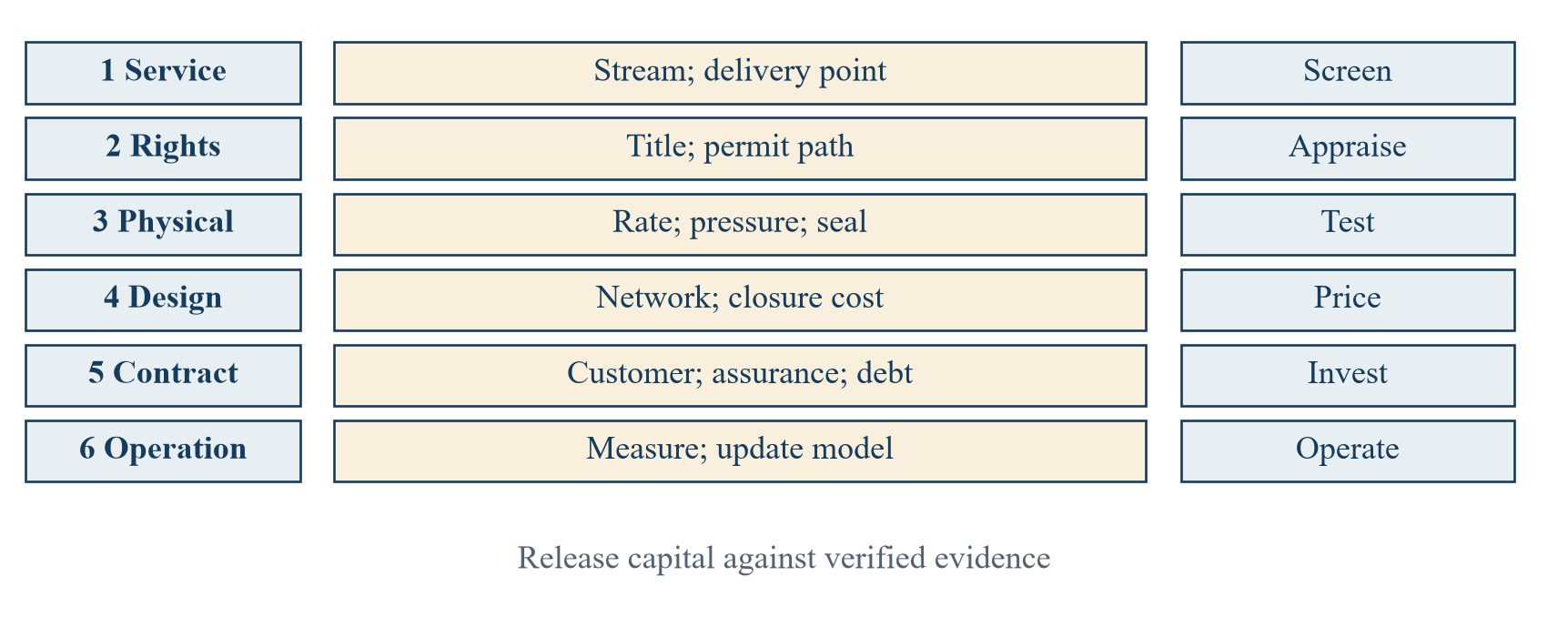
Author-developed governance roadmap; order may vary with site-specific law and engineering.
19 Allocate governance and decision rights
The operator controls daily injection within its permit and safety case. The subsurface team updates the pressure and containment model. The commercial team manages nominations and customer remedies. The finance team funds assurance, reserves and covenants. The board releases capital and decides on major changes in scope. These roles should be named in a decision-rights matrix so that a revenue target cannot override an engineering stop condition.
An independent technical adviser should review the assumptions that drive valuation: usable capacity, pressure limits, well count, contingency, monitoring and closure. The reviewer should report ranges and unresolved data, not simply endorse a single point estimate. If an observation deviates from forecast, the operator should update the model and present its impact on firm service. A lender can require notice and independent review before distributions resume after a material excursion.
The customer needs confidence that contracted capacity remains available and that accepted tonnes are measured properly. The regulator needs compliance with site-specific conditions. The sponsor needs a credible account of residual obligations. A reporting dashboard can serve all three when it retains a controlled source record and differentiated access. The board should receive a concise quarterly summary of injected mass, rate, pressure trend, well integrity, exceptions, security balance and closure-cost estimate.
Conflicts of interest deserve attention in a vertically integrated capture-and-storage project. A sponsor may prefer to record full capture performance while the store is capacity constrained. Reconcile metering at each custody point and define what counts as verified storage. External assurance may be required by applicable rules or contracts. The financial model should not recognise service revenue or environmental claims beyond the evidence and entitlement established by those instruments.
20 Limitations and research priorities
This paper is a decision framework. It does not calculate the storage resource, injectivity, containment, lifecycle emissions, tariff or return of any named site. The fictional financial case is based solely on author-chosen assumptions and omits construction timing, taxes, financing, inflation, replacement capital, throughput variability, insurance deductibles, policy support and possible additional post-closure expense. Its payments are not observed market prices. A live investment case requires qualified site-specific engineering, legal and commercial analysis.
The cited public sources have different purposes. NETL gives research and practice guidance; EPA describes US well-permitting obligations; NSTA addresses UK offshore permits; EU law sets a European framework; IEA counts a global project pipeline. None of them approves a particular transaction. Regulatory details and project statuses can change. Decision-makers should check the current primary documents and relevant authority at the decision date rather than treating this paper as an enduring permit checklist.
Better empirical research would publish comparable site outcomes: tested annual injectivity, pressure-front growth, well intervention frequency, monitoring spend, financial-security cost, closure expenditure and actual contracted payment boundaries. The sample should include delayed and rejected projects. Public project announcements alone create survivorship and stage bias. A matched dataset with scope, geography and service specification could improve capital underwriting while protecting confidential subsurface information.
The framework remains useful because it keeps each claim attached to its evidence. A regional resource can justify a test. A successful injection test can support an engineering design. A permit and signed contract can support a financed service. Measured operation and funded closure can support a mature infrastructure valuation. Each transition requires its own documents, and each unresolved obligation remains in the capital case.
21 Conclusion
Pore space acquires commercial value when a project can lawfully and safely accept a specified carbon dioxide stream at a reliable rate, demonstrate retention and fund its obligations through closure. The investment unit is the contracted storage service, with the pressure envelope and financial assurance built into its price. A large resource estimate creates an appraisal opportunity. A tested, permitted, connected and contracted rate can create bankable cash flow.
The fictional twenty-year model shows why injectivity and paid throughput are central. With author-assumed capital of USD 240 million, annual operating cost of USD 18 million, terminal closure cost of USD 40 million and a 10% discount rate, the required payment is USD 46.89 per tonne at one million paid tonnes annually. Under the same fixed-cost assumptions, 0.8 million paid tonnes require USD 58.61 per tonne. Those figures teach the sensitivity; they are not site forecasts or tariffs.
The execution route is staged: define the customer service, prove rights, test geology and rate, constrain pressure, engineer monitoring and closure, secure the network and contract, then finance and operate under continuing independent review. A storage opportunity should be priced at the evidence gate it has actually passed. That discipline protects capital, clarifies the customer promise and makes long-term liabilities visible before the transaction closes.
References
- US Department of Energy, National Energy Technology Laboratory. CO2 Storage Formations and Carbon Storage Atlas discussion. Accessed 6 October 2026. https://netl.doe.gov/node/5964
- US Environmental Protection Agency. Federal Requirements Under the Underground Injection Control Program for CO2 Geologic Sequestration Wells. Accessed 6 October 2026. https://www.epa.gov/uic/federal-requirements-under-underground-injection-control-uic-program-carbon-dioxide-co2
- US Environmental Protection Agency. Class VI Wells Used for Geologic Sequestration of Carbon Dioxide. Accessed 6 October 2026. https://www.epa.gov/uic/class-vi-wells-used-geologic-sequestration-carbon-dioxide
- North Sea Transition Authority. Guidance on Applications for a Carbon Storage Permit. Accessed 6 October 2026. https://www.nstauthority.co.uk/media/15zdvyzq/guidance-on-applications-for-a-carbon-storage-permit.pdf
- International Energy Agency. CCUS Projects Database, March 2026 edition. Accessed 6 October 2026. https://www.iea.org/data-and-statistics/data-product/ccus-projects-database
- US Environmental Protection Agency. Final Class VI Guidance Documents, including Area of Review Evaluation and Corrective Action Guidance. Accessed 6 October 2026. https://www.epa.gov/uic/final-class-vi-guidance-documents
- US Department of Energy, National Energy Technology Laboratory. Best Practices Manuals for Geologic Carbon Storage. Accessed 6 October 2026. https://www.netl.doe.gov/carbon-management/carbon-storage/strategic-program-support/best-practices-manuals
- International Energy Agency. CCUS Projects around the World Are Reaching New Milestones (2025). Accessed 6 October 2026. https://www.iea.org/commentaries/ccus-projects-around-the-world-are-reaching-new-milestones
- International Energy Agency. Announced and Operational CCUS Capacity in 2030 across Database Editions (2025). Accessed 6 October 2026. https://www.iea.org/data-and-statistics/charts/announced-and-operational-carbon-capture-utilisation-and-storage-capacity-in-2030-across-editions-of-iea-ccus-projects-database
- US Department of Energy, National Energy Technology Laboratory. Monitoring, Verification and Accounting for Geologic Storage Projects, DOE/NETL-2017/1847. Accessed 6 October 2026. https://netl.doe.gov/node/5827
- US Environmental Protection Agency. Class VI Well Plugging, Post-Injection Site Care and Site Closure Guidance (2016). Accessed 6 October 2026. https://www.epa.gov/sites/default/files/2016-12/documents/wp-pisc-sc_guidance_final_december_clean.pdf
- European Union. Directive 2009/31/EC on the Geological Storage of Carbon Dioxide. Accessed 6 October 2026. https://eur-lex.europa.eu/legal-content/EN/ALL/?uri=CELEX%3A32009L0031
- United Kingdom. The Storage of Carbon Dioxide (Termination of Licences) Regulations 2011. Accessed 6 October 2026. https://www.legislation.gov.uk/uksi/2011/1483/body
About the Author
Chennakeshav (CK) is a corporate finance and investment banking executive with 25+ years of global experience in deal origination, structuring and execution across M&A, growth capital and corporate strategy. He has led value-creation mandates for founders, corporates and funds — bridging the boardroom view to hands-on execution and close.
His career spans Morgan Stanley, HSBC, Lloyds Banking Group, EWEC, ADQ portfolio companies and Emirates Growth Fund, across TMT, real estate, fintech, deeptech, cleantech, infrastructure and energy. He has partnered with C-suite leaders, private equity and venture funds, sovereign wealth funds and family offices to finance complex fund raises and scale-up ventures, and has led M&A due diligence, post-merger integration and business-transformation initiatives to create value.
At Matchpoint Partners he is Managing Partner, leading the firm's corporate finance, M&A and capital-raising practice. He holds an MBA from London Business School, an engineering degree from VTU and a Master of Laws (LLM, in progress) from UCL London.
An active start-up mentor, CK mentors at Techstars, DIFC FinTech Hive, Startup Grind, Founder Institute and IN5, serves as Entrepreneur Mentor in Residence (EMiR) at London Business School, and judges the Entrepreneurship World Cup.
