
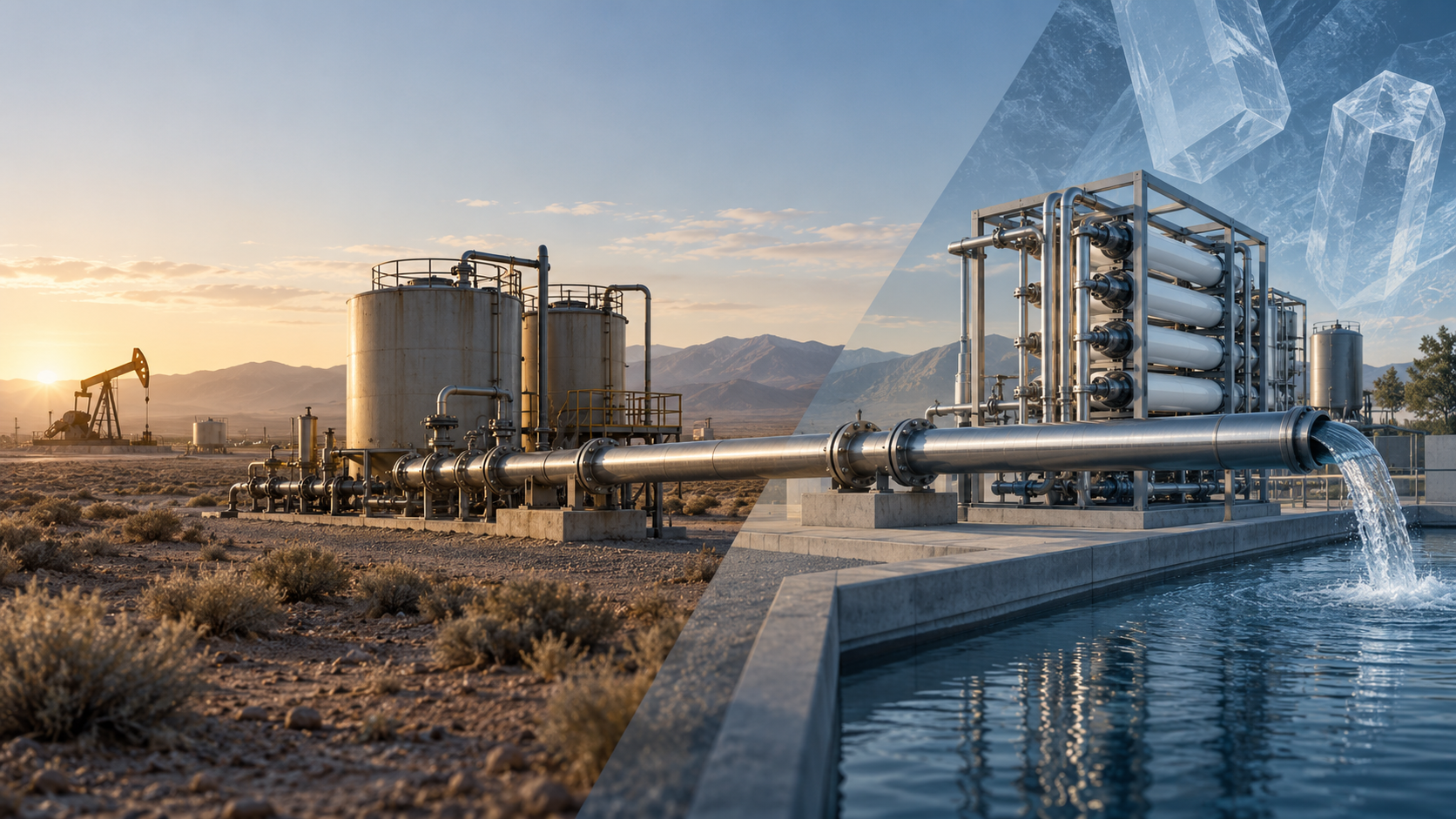
1 Treat water as a linked operating system
Produced water is a continuous operating reality for many oil and gas assets. A well can deliver water with hydrocarbons, and an operator must separate, handle, treat, inject, discharge or otherwise manage that water under the applicable permits and contracts. The same water can contain dissolved lithium and other elements. Recovery may create another revenue source; treatment can make some water suitable for a defined reuse. These opportunities share a feed stream. They do not share an automatic commercial entitlement, a single treatment process or one set of permits.
An investment proposal should therefore start with a map of the whole water system. Identify the producing wells and their expected operating life, separation and gathering points, existing water-handling contracts, disposal routes, sampling access, treatment sites, rights to dissolved minerals, product conversion, residuals and potential users of treated water. Each physical node has a counterparty, capacity, cost and quality condition. A plant cannot be financed from a laboratory concentration if the sponsor lacks the right to receive stable flow or sell the recovered product.
The US Geological Survey's National Produced Waters Geochemical Database compiles chemistry from waters associated with US oil and gas production and other deep formation waters [1]. The Oil and Gas Waters Project studies composition, volume, impact and potential commodity recovery [2]. These are valuable prospecting sources. They contain observations gathered for different purposes, places and periods. They do not replace a field sampling programme, a recoverable resource assessment or an engineering design for a particular asset.
Three distinct propositions deserve separate underwriting. Lithium extraction must produce a buyer-accepted salt or intermediate at an economic cost. Reuse must yield water that meets a specified customer's quality, reliability and legal requirements. Disposal avoidance must be measured against what the operator would actually pay without the project. A project may succeed on one leg and fail on another. A credible investment memorandum makes each leg independently auditable before combining them in one cash-flow model.
2 Establish rights before testing a plant
The first diligence question concerns control. The hydrocarbon operator may own or control the well stream while a midstream company owns gathering equipment or provides disposal under a long-term contract. A mineral owner, surface owner, water-service provider or public authority may claim a different interest in dissolved substances or treated water. The answer depends on the jurisdiction, title documents and the exact transaction. A feed supply agreement alone may not convey a right to market lithium; a mineral licence may not provide surface access or permission to change existing water operations.
Construct a rights ledger with five entries: feed possession at the transfer point, title to dissolved minerals, title to separated product, right to use or sell treated water, and responsibility for residual streams. For each entry record the governing document, term, exclusivity, termination rights, volume priority, liability allocation and dispute mechanism. Link the ledger to a process-flow diagram. A change in ownership should occur at a visible, measurable point; contracts should specify sampling, custody transfer and measurement disputes.
An oilfield operator needs operational priority during a well-control event, change in production or maintenance outage. A recovery investor needs sufficient predictable feed and data to amortise its plant. Those interests can be aligned with minimum delivery ranges, optionality around shut-ins, notice requirements and compensation for avoidable curtailment. A fixed take-or-pay obligation unsupported by field forecasts can shift excessive risk to the operator. An uncommitted feed promise leaves the plant exposed to an asset sale, production decline or water-routing change.
Rights diligence should include existing disposal, reinjection and water-treatment contracts. Exclusivity, minimum volumes or termination penalties may absorb the anticipated avoided-cost benefit. Changing a water route can also affect reservoir management, enhanced recovery, pressure support or other operational objectives. Local legal and technical advisers should test every proposed transfer and permit change. The commercial model should leave an unverified benefit out of bankable cash flow until a documented right and counterparty are identified.
3 Define the feed that can actually arrive
Regional maps can help identify brines worth investigating. The USGS database documents variability across fields and samples [1]. USGS research using produced-water geochemistry explores whether machine learning can help estimate lithium concentration or classify samples [3, 4]. Such models can direct sampling effort; their predictions are not independent measurements of the feed that a proposed plant will receive. A project's usable feed is the flow available at the agreed transfer point over time, after operational priorities and contract rights are applied.
Build a well-by-well and month-by-month water forecast. Document oil and gas production, historical water cut, planned drilling, completion practices, shut-ins, gathering constraints and any expected change in reinjection. A single annual average can conceal both a production ramp and a later decline. The lithium concentration can change with water source, well age, blending and process chemicals. USGS work on Niobrara wells examines geochemical and radium variations within a defined field sample; that observation supports sampling for variability rather than applying a formation-wide grade to one facility [2].
The measurement plan should specify flow meters, calibration, temperature and density corrections, sampling frequency, split samples, chain of custody, analytical detection limits and laboratory quality control. It should capture common ions, total dissolved solids, organics, suspended solids, barium, calcium, magnesium, strontium, radium and any constituents relevant to the chosen extraction and water-treatment process. The list depends on local geology and intended end use. A selected high-lithium sample does not represent the volume-weighted annual grade unless a documented blend model supports it.
Report feed uncertainty as separate ranges for volume, lithium concentration and interference chemistry. Do not multiply the highest observed flow by the highest observed concentration if they occurred in different wells or seasons. The first investable dataset is a reconciled series of delivered cubic metres and independently checked analytes across the proposed operational envelope. It should be accompanied by a statement of which wells and periods remain unsampled.
Table 1. Evidence ledger for a produced-water commercial proposition
| Proposed value | Physical or legal basis | Evidence before underwriting | Principal failure if assumed |
|---|---|---|---|
| Lithium output | Delivered flow, measured grade and recoverable conversion | Metered series, independent assays, pilot balance and buyer specification | A high assay does not become paid product |
| Treated-water value | Permitted use and identified customer | Treatment trial, quality limits, delivery contract and payment terms | Water is treated but cannot be sold or used |
| Avoided management cost | Counterfactual route and released obligation | Existing contracts, tariffs, capacity and measurable displacement | Same cubic metre receives two incompatible credits |
| Residual management | Concentrate, spent media and reject streams | Characterisation, permitted route and funded cost | Recovery creates a new liability outside the model |
| Feed tenure | Rights to stable volume and dissolved minerals | Title, transfer-point contract and operating priority | Plant loses feed or product rights before payback |
Author-developed framework; the entries describe tests, not conditions verified at any actual field.
4 Distinguish oilfield co-production from dedicated brine production
Lithium-rich geological brines can be evaluated as purpose-developed lithium resources. Oilfield produced water differs because the primary well and reservoir decisions are made for hydrocarbons. The water volume is co-produced, and its delivery can rise, fall or stop with an oil-and-gas development plan. This distinction changes cost allocation. A dedicated lithium project may bear drilling, pumping and brine-return costs directly; a co-produced-water project must establish which costs are already part of the hydrocarbon baseline and which new costs it creates.
A project should avoid claiming a free feed without examining transfer, pumping, storage and liability. The oilfield operator may currently pay to handle water. The lithium developer may need new gathering lines, equalisation tanks and pretreatment. The allocation must be written into the contract and model. Similarly, a geological resource estimate for a lithium-bearing formation cannot be converted directly into output from an existing oilfield network. The reachable wells, expected water volumes, tenure and chemistry may be a small and changing subset of the formation.
The USGS has reported lithium-bearing brines in the Smackover Formation and a wide sampled concentration range in its 2024 assessment [5]. That range is geological evidence. It is not a typical grade for oilfield co-produced water, a commercial cut-off or a forecast for another basin. USGS's later machine-learning study examined an estimated grade cut-off as a classification exercise [4]. An estimated cut-off in a research model should not be presented as a universal break-even concentration; costs, recovery, payability, flow and capital structure differ by project.
An acquisition or joint venture should identify which asset is being bought. It may be an exclusive right to study water, a concession to process specified volumes, equipment and permits, mineral interests, a product business, or an integrated oilfield water-service contract. The valuation method and liabilities differ. Clear definition of the asset prevents a buyer from paying for both a hypothetical resource and the same projected operating cash flow.
5 Test chemistry against the whole process
Direct lithium extraction describes a family of processes intended to separate lithium from brine, often through selective sorbents, membranes, solvents or electrochemical routes. Selection depends on feed composition and target product. Pretreatment may be needed to control oil, solids, scaling ions or organics. An extraction step can create a lithium-rich stream; conversion and purification are then needed for a marketable product. The separated water may still be saline or unsuitable for the proposed reuse. Lithium recovery and water reuse are separate engineering systems connected by one inlet stream.
The US Department of Energy's produced-water and critical-minerals programme describes treatment, mineral recovery and direct lithium extraction as potential pathways while identifying variability, data gaps and cost challenges [6]. DOE project selections also support proof-of-concept work on lithium-selective separation from produced water and other waste streams [7]. A technology award or laboratory demonstration establishes a reason to test; it does not certify a commercial plant at a different field. The sponsor needs proof on representative feed and on the actual product required by its buyer.
Record a closed mass balance. For each period, report lithium entering with feed, lithium in the product stream, lithium in treated water, lithium in spent material and lithium in waste. Track water, salts, reagents and contaminants in parallel. Show analytical closure error. A claim of 90% extraction recovery can coexist with poor final conversion yield, high reagent usage or an off-specification product. The process economics should use lithium that is payable after conversion and customer acceptance, not lithium temporarily transferred from one liquid to another.
Pilot campaigns should include high- and low-salinity blends, low and high target grade, adverse interference chemistry, start-stop cycles and realistic process-water recirculation. Measure media life, cleaning frequency, corrosion, fouling, heat and power use, reagent losses, residue volume and operator interventions. An independent laboratory should analyse split samples and product lots. The engineering package should separate measured performance, supplier guarantees and still-unverified scale-up assumptions.
6 Build a product route backward from the buyer
Recovered lithium can be delivered as a concentrate, chloride stream, carbonate or hydroxide depending on the process and downstream agreement. These products have different specifications and pricing arrangements. A finance model needs an identified buyer or toll processor, a product form, acceptance ranges, impurity limits, sampling and dispute protocol, delivery terms and payment security. Multiplying contained lithium by a headline lithium-carbonate price skips conversion, payability and commercial deductions.
The product route may involve a third-party converter. That counterparty's operating capacity, credit quality, permits and fee schedule become part of the risk analysis. A nominal offtake memorandum is useful for product development, but a lender will need an enforceable commercial arrangement and credible substitution if the buyer fails. Different customers may value purity, traceability, supply security and delivery form differently. Those benefits should enter the model only when an actual contract or independently supportable price basis establishes them.
The conversion from elemental lithium to lithium-carbonate equivalent is an accounting bridge, not proof that carbonate has been produced. The mass ratio is approximately 5.323 tonnes of lithium-carbonate equivalent per tonne of contained lithium in a pure chemical conversion. Real production requires recovery, conversion yield, specification and product payability. The illustrative case later in this paper applies those deductions explicitly. A contract that pays for a mixed lithium stream may require a different conversion and net realised price.
Before final investment, the plant should make enough product across representative feed conditions for a buyer to inspect. Batch samples should be accompanied by independent analytical certificates and traceable process records. Rejection rates, penalties, tolling charges and working-capital lags belong in the downside model. Product qualification can be the decisive gate even when a laboratory reports impressive lithium selectivity.
7 Define water reuse by end use and location
Water emerging from a lithium extraction circuit is not automatically suitable for industrial cooling, agriculture, municipal use or surface discharge. End users require different parameters for salinity, organics, metals, microbiology, scaling and reliability. Pretreatment, desalination, polishing and monitoring may be required. Water delivered to another oilfield process also has a different risk and regulatory profile from water released outside the oilfield. The quality specification should come from the intended use and the applicable authority, then determine treatment design and cost.
US EPA resources on industrial water reuse assemble examples and technical considerations for cooling, energy and other uses [8]. EPA's description of an Oklahoma industrial-reuse framework illustrates that allowable uses and quality criteria can be jurisdiction-specific [9]. EPA announced a review of federal oil-and-gas extraction effluent guidelines in 2025, including potential flexibility for beneficial reuse [10]. An announced review is not a permit for a particular project. The sponsor should check current federal, state or local requirements and obtain site-specific approvals before treating external reuse or discharge as executable.
Water demand must also be real. A nearby data centre or industrial user may need high reliability, a precise chemistry range and delivery infrastructure. A pipeline, storage buffer or backup supply can dominate the treatment economics. The customer's willingness to pay should be evidenced by a contract, not by the abstract value of freshwater in the region. If the oilfield itself can reuse treated water, calculate the displaced input and any effects on production, reservoir management and existing service contracts.
A reuse contract should specify quality sampling, acceptance, interruption rights, capacity, take-or-pay or minimum purchase, liability, change-in-law allocation and ownership of reject water. It should identify who bears the cost of an off-specification batch. The baseline alternative must be explicit. Only then can the model claim a water-reuse benefit without confusing gross treated volume with cash collected.
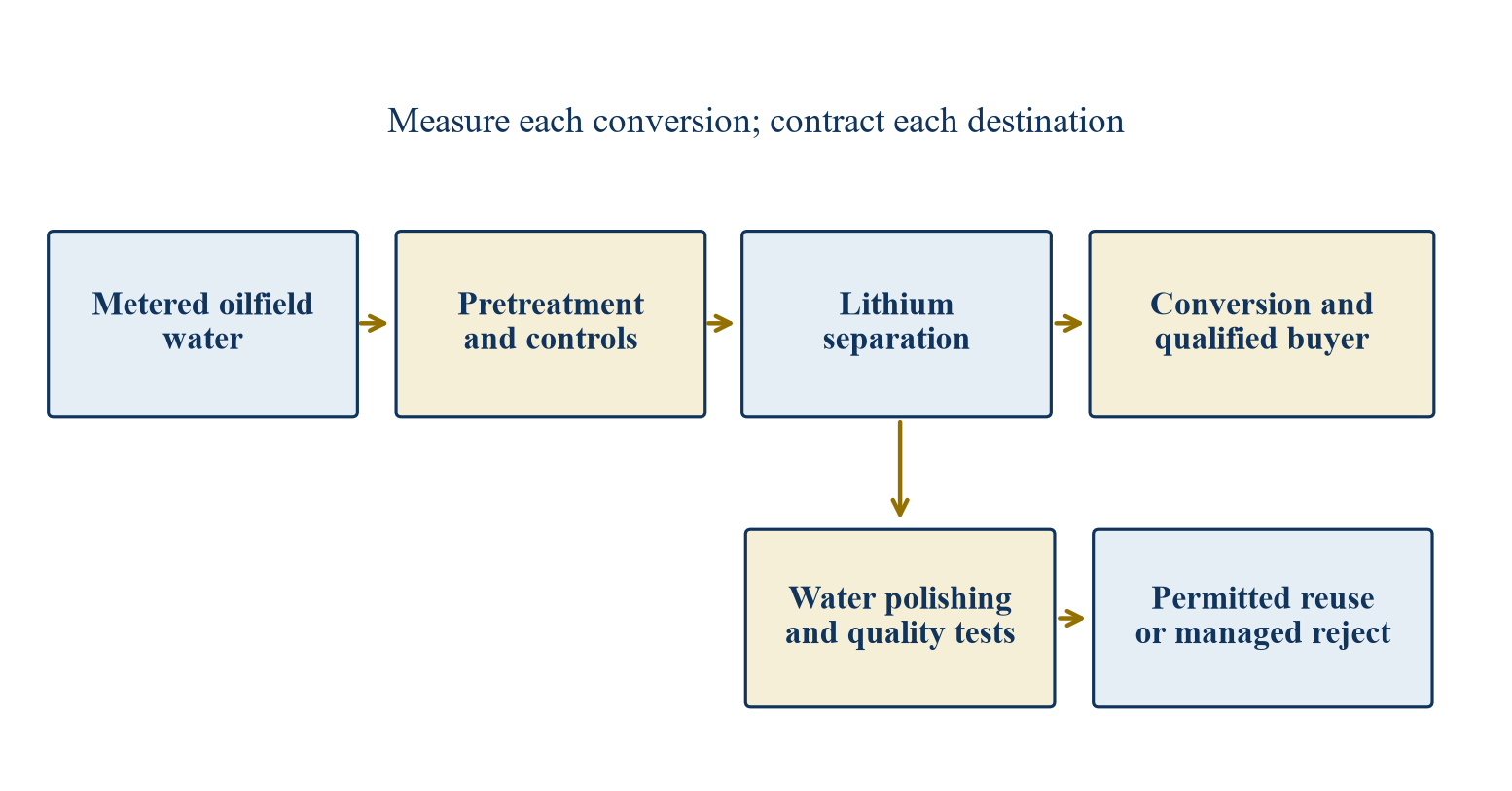
Separate product, reusable-water and residual streams require distinct tests, rights and counterparties.
8 Keep three value legs separate
The strongest commercial claim may be that lithium receipts, water sales and lower disposal expense together make a plant viable. The combined proposition needs a counterfactual ledger. For lithium, identify the net price of product accepted and paid. For water, identify the buyer or internal use that displaces a documented purchase. For avoided disposal, identify the route, volume and invoice that cease because the plant changes water handling. These values can coexist when each is incremental. They cannot be stacked mechanically on the same water volume without checking contracts and the physical balance.
Suppose a plant treats water that would otherwise be injected. If the operator still pays the same fixed disposal capacity charge, the project may have little immediate avoided cost despite lower injection volume. If a reuse customer pays for treated water, the net contribution is the sale price less polishing, storage and delivery. If that customer's water replaces freshwater previously bought by the same integrated group, counting both a sale and the full avoided purchase as two independent cash inflows would overstate group value. The model should identify whose cash account receives each benefit.
A useful reconciliation begins with the without-project case: actual operator water volumes, tariffs, transport charges, permitted options and existing minimum payments. The with-project case adds pretreatment, extraction, conversion, water treatment, product transport, residues and new monitoring. Compare only incremental cash flows over the same period and volume. Record any transferred payment between affiliated entities separately from value created for the consolidated group. Show changes to taxes, royalties or profit shares where applicable, using local advice rather than a generic assumption.
This ledger also makes negotiation fairer. The oilfield operator may contribute feed, land, utilities and avoided-disposal value; the extraction sponsor may contribute technology and capital; a water user may pay for quality and reliability. A joint venture can allocate upside around observable measures. A contract that relies on vague environmental value or a future water market will be harder to finance than one grounded in verifiable cash receipts and displaced costs.
9 Price the residual streams and environmental duties
Lithium separation and water polishing change the composition of the remaining streams. Pretreatment can generate oily solids or filters; DLE can create spent media, wash solutions or concentrate; desalination can create a reject brine; conversion can create chemical residues. A project that advertises near-total water recovery must show where salts, contaminants and processing chemicals go. Conservation of mass makes an unpriced residual a missing cost or an unrecognised liability.
Characterise every residual in the pilot. Quantify daily volume or mass, expected variability, classification under applicable law, storage capacity, transport, treatment and final destination. Identify the permitted entity responsible for each step. A water-reuse route that removes a disposal obligation from one volume can still increase the concentration and cost of managing a smaller reject stream. Include that cost in the same scenario that claims a reuse benefit. Closure and decommissioning should cover tanks, contaminated equipment, monitoring and any long-term storage obligation.
Public agency sources emphasise that composition affects both potential recovery and the safety of treatment and disposal plans [1, 2, 6]. EPA's produced-water management study examined legal and technical questions around alternatives to traditional disposal; its 2019 draft status should be retained when used as historical context [11]. Current rules and permits require separate verification. A water-quality pass at the plant outlet does not necessarily satisfy a downstream user, injection permit, surface-water discharge or residual-handling approval.
Environmental claims should have a defined baseline and measurement method. Reduced freshwater withdrawal, lower truck traffic or reduced disposal volume may be possible. Whether a particular project delivers those outcomes depends on energy use, chemical supply, residual handling and the actual alternative. Life-cycle or carbon claims need their own boundary and evidence. They should not be converted to revenue before an eligible, verified programme and purchaser exist.
10 Use data tools to choose tests, not to replace them
Large produced-water datasets and geochemical models can improve prospect selection. The USGS research published in 2024 and 2026 investigated machine-learning approaches to formation classification and lithium-concentration prediction from associated chemical data [3, 4]. Such work is useful when lithium measurements are sparse. It can identify where a sampling campaign may have higher information value and detect inconsistent laboratory records. A predictive model trained on particular formations and sample methods can perform differently in a new basin, operating period or mixed-gathering network.
An investor should request the model's training data, target definition, missing-data treatment, uncertainty interval and out-of-sample testing against the actual field. Data leakage can arise if samples from the same well or campaign appear on both sides of a test split. A map with attractive colours should be accompanied by the underlying sample density and analytical dates. If a model classifies above or below a screening cut-off, the cut-off itself remains an economic assumption that changes with price, cost and recovery.
The practical data architecture links well identifier, sample time, flow volume, measured chemistry, operational status and downstream plant performance. Record calibration and laboratory methods. Use a versioned mass-balance model so a revised grade or meter correction is visible in every forecast. A digital twin may support operating optimisation after sufficient measured data exist. It cannot establish mineral ownership, customer acceptance or a legal reuse path. These require documents, physical tests and permits.
The highest-value analytics task may be to identify the next uncertainty to resolve. A model can show whether variability in grade, delivered flow, resin life or water customer demand dominates the investment decision. Sampling and pilot budgets can then be directed to the uncertainty that can change a go/no-go decision. That discipline is more useful than an unqualified claim that artificial intelligence has found a resource.
11 Design the pilot to answer financing questions
A pilot is a controlled attempt to close the gaps between assay and cash. Its feed should represent the wells and blends that a commercial plant would treat. It should include enough continuous operating time to observe fouling, reagent consumption, media replacement, start-stop performance and waste accumulation. It must make product lots that an independent buyer can test. A bench test of one sample can screen chemistry; it should not be extrapolated directly to ten years of availability and payability.
Define acceptance criteria before running the pilot. Examples include metered feed volume and chemistry, lithium extraction and conversion yields, product purity, water quality, unit energy and reagent use, residual quantity, equipment uptime and analytical mass-balance closure. The thresholds should be tied to the financial model and intended contracts. If a proposed plant depends on a narrow lithium-grade range, the pilot should deliberately test the low-grade boundary. If water reuse is essential, a full treatment and customer-acceptance test is part of the pilot scope.
Independent replication matters. Use duplicate and split samples, third-party assays, blinded product testing where feasible, and documented instrument calibration. Record failed runs, cleaning intervals and modifications to the process. A supplier performance guarantee should specify exactly which measured feed chemistry and throughput it covers. A guarantee without a remedy, parent support or tested conditions may offer little protection to a lender. The sponsor should also obtain a costed engineering estimate that includes integration with the oilfield site.
The pilot gate can produce three legitimate outcomes: move toward a permitted commercial plant, redesign the process or stop. A successful technical recovery that fails buyer specification may justify a conversion redesign. A water-treatment success without economic lithium recovery may support a water-service contract. A negative result is valuable if it prevents expensive equipment procurement and leaves the underlying oilfield operation undisturbed.
12 Walk a fictional case from feed to payable output
The following case is entirely fictional and each input is an author assumption. It describes no field, company, permit or current market quote. Assume delivered water of 20,000 cubic metres per operating day for 330 days a year, containing 100 milligrams of elemental lithium per litre. Annual water feed is 6.6 million cubic metres. The lithium mass balance is 20,000 cubic metres per day times 1,000 litres per cubic metre times 100 milligrams per litre, divided by one billion milligrams per tonne, times 330 days: 660 tonnes of contained lithium annually.
Assume 80% DLE recovery and 85% subsequent conversion yield. Those two steps produce 448.8 tonnes of lithium represented in final output. Multiplying by the lithium-carbonate-equivalent mass ratio of 5.323 gives 2,388.96 tonnes of theoretical LCE output. Assume 90% commercial payability after specification and settlement; payable LCE is 2,150.07 tonnes. At an author-assumed net realised price of USD 15,000 per payable tonne, annual lithium receipts are USD 32.251 million. This price is a teaching input, not a reported market price or forecast.
Assume 60% of feed water is recovered to a specified reuse quality and that a customer pays a net incremental USD 0.80 for each cubic metre accepted. Reused water is 3.96 million cubic metres a year and illustrative annual water receipts are USD 3.168 million. The model credits no separate avoided-disposal benefit because the hypothetical disposal contract and counterfactual tariff are unspecified. That choice prevents an unverified second credit. Remaining water and process residuals still require a managed route and are represented in operating costs only for arithmetic illustration.
Assume pretreatment cost of USD 0.70 per cubic metre of all feed, USD 9 million annual extraction and conversion cost, polishing at USD 1.20 per reused cubic metre, feed and residue logistics at USD 1.00 per cubic metre of all feed, and USD 3 million annual fixed and compliance cost. The resulting annual operating cost is USD 27.972 million. Annual cash before tax, financing and sustaining capital is USD 7.447 million. The case deliberately simplifies the real engineering and legal questions so that the volume-to-cash bridge is visible.
Table 2. Fictional annual base-case bridge with author assumptions only
| Step | Author assumption or formula | Illustrative annual result |
|---|---|---|
| Delivered feed | 20,000 m3/day x 330 days | 6.600 million m3 |
| Contained lithium | 100 mg/L x delivered litres | 660.0 tonnes Li |
| Recovered and converted lithium | 80% extraction x 85% conversion | 448.8 tonnes Li |
| Payable LCE | x 5.323 LCE ratio x 90% payability | 2,150.07 tonnes LCE |
| Lithium receipts | USD 15,000 per payable tonne | USD 32.251 million |
| Reuse receipts | 60% reused x USD 0.80/m3 | USD 3.168 million |
| All operating costs | Pretreat, extract, polish, logistics and fixed | USD 27.972 million |
| Pre-tax annual operating cash | Receipts less operating costs | USD 7.447 million |
Rounded figures may differ slightly from formula precision; no entry is a measured field result or market quotation.
13 Test whether the cash repays the capital
Positive operating cash does not make the fictional project investable. Assume initial capital expenditure of USD 55 million, ten years of level annual operating cash and a USD 5 million closure and residual-management payment at the end of year ten. At an author-assumed 12% annual discount rate, the ten-year annuity factor is approximately 5.6502. Discounted operating cash is roughly USD 42.08 million. The discounted closure payment is approximately USD 1.61 million. The illustrative net present value is negative USD 14.53 million after initial capital. Taxes, royalties, debt service, working capital, ramp-up, outages, inflation and sustaining capital are omitted.
Holding every other author assumption fixed, the arithmetic break-even net realised lithium price is approximately USD 16,196 per payable tonne LCE. At the assumed USD 15,000 price, break-even lithium concentration is approximately 108 milligrams per litre. These are model thresholds, not industry cut-offs. A different water customer, conversion route, operating life, recovery rate or capital requirement changes them. A real project should not rely on reaching break-even from one optimistic parameter while ignoring correlated costs and risks.
Consider a lower-feed case. If delivered water falls, total lithium receipts and water volumes decline, while much fixed cost remains. A lower grade can coincide with more difficult chemistry, affecting both output and cost. The model should therefore include combined downside cases, not only one-variable sensitivities. A contract for minimum feed, a flexible modular plant or staged capacity may reduce exposure, but each has a cost and enforceability test. A public commodity-price series should be dated and sourced separately if used in an actual valuation.
The case demonstrates why avoided disposal should not be inserted casually. A documented USD 3 million annual net saving would change the illustrative NPV by about USD 16.95 million at the assumed discount factor, before any new cost or tax. That amount could reverse the sign of this simplified case. It is precisely why the underlying contract, displaced volume, baseline fee and residual route need independent verification. The model should show the improvement as a contingent line until evidence is complete.
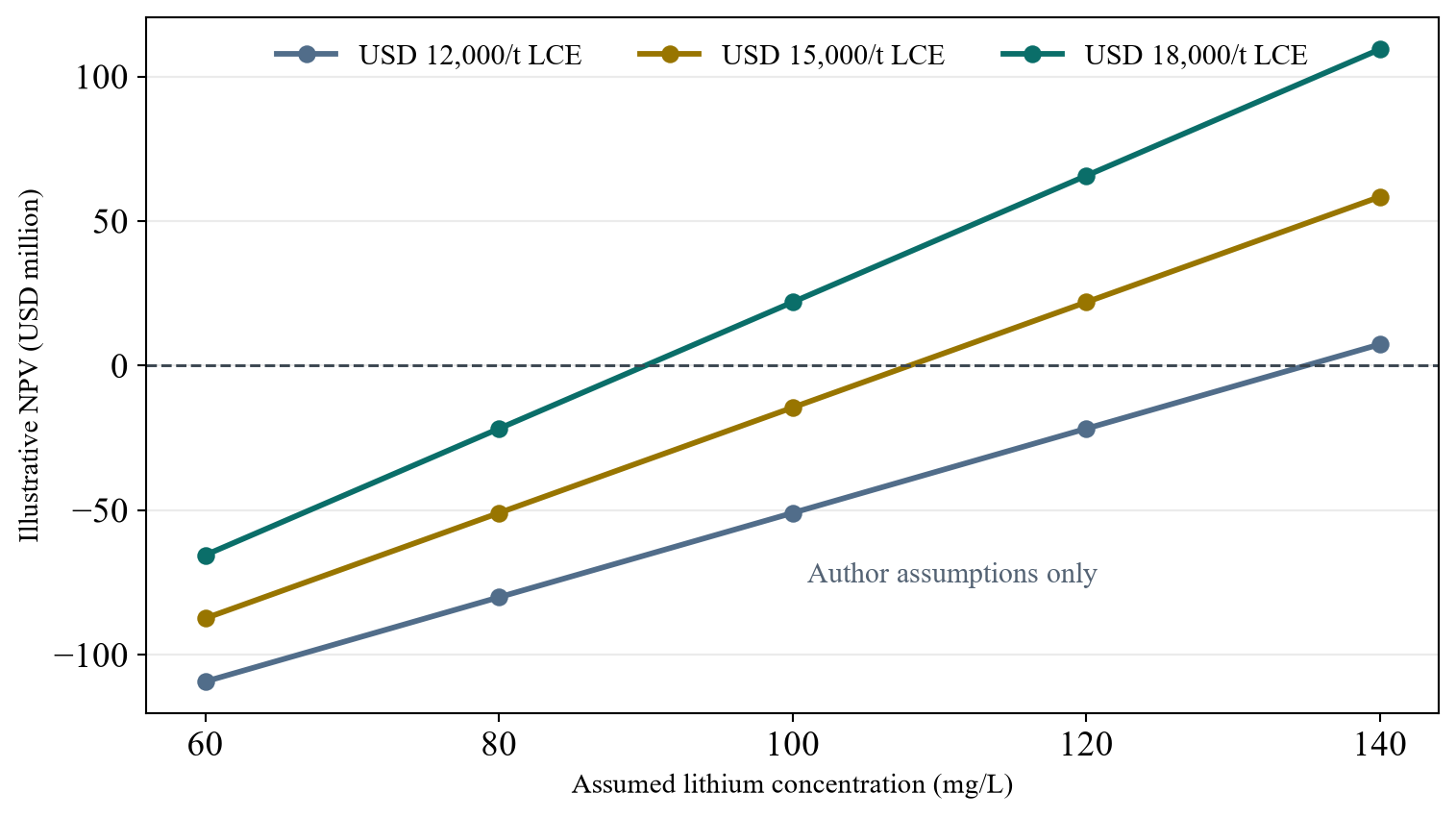
All inputs are author assumptions; each plotted result holds other case variables fixed and is not a site valuation or price forecast.
14 Design finance around staged evidence
Early investigation capital should buy an option to learn, with spending capped at each gate. The first budget covers legal rights, flow and chemistry review, operator integration and a qualified sampling plan. The next budget covers bench and pilot work. Development capital can then fund engineering, product qualification, water customer trials and permits. Construction debt belongs later, when feed, process, product and water route support a credible downside case. A public research programme or technology grant may lower early experimentation cost, but it should not be modelled as committed project finance unless awarded on usable terms.
An oilfield operator and technology sponsor can structure a service agreement, royalty, joint venture or equipment lease. A service contract may fit a project whose dominant value is compliant water management. A mineral joint venture may fit an operator that can contribute exclusive feed and product rights. A project-finance vehicle may be possible after long-term feed and offtake contracts, technical warranties, permits and an independent engineer's assessment. Each structure should allocate cost overruns, shutdown risk, product rejection, residual liabilities and asset-transfer rights.
The capital stack must reflect operating exposure. A plant with mineral-price risk, uncertain recovery and merchant water sales may not support the leverage of a contracted utility. Product offtake can reduce sale risk but may introduce buyer concentration. A minimum-feed commitment can support debt only if backed by a credible field plan and enforceable remedies. Reserve accounts may be needed for maintenance, residual treatment, closure and environmental security. The lender should see the entire physical system rather than a stand-alone DLE module.
Stage gates can also create a disciplined acquisition path. A buyer may take an exclusive study option, then pay for measured performance and finally acquire a plant interest after a permitted commercial trial. Milestone payments should use observable outcomes: delivered feed, qualified product, paid invoices and treated water accepted under a contract. A metric such as 'lithium identified' is too remote from cash to justify a large unconditional payment.
15 Benchmark evidence without importing another field's economics
Public evidence provides a useful range of questions, not a ready-made operating model. The USGS national database is a compilation of sample chemistry [1]. The USGS Smackover fact sheet reports an approximate 1 to 477 milligrams per litre lithium range across historical and newer Gulf Coast samples [5]. The 2026 USGS machine-learning paper tested an estimated 150 milligrams per litre screening cut-off for classification [4]. These figures have different purposes and sample populations. None is a universal commercial threshold or the grade of the fictional case.
The case assumes 100 milligrams per litre specifically to expose the effect of concentration on economics. Its USD 15,000 per tonne LCE price, 80% extraction recovery and USD 55 million capital expenditure are also author assumptions. A committee should never replace its own assays or quotations with these values. A meaningful transaction benchmark would require contemporaneous contracts or bids, comparable feed chemistry and throughput, similar product specifications, a comparable water route, and a consistent allocation of shared oilfield infrastructure.
Technology claims should also be benchmarked at the right scale. A laboratory extraction percentage is not comparable with sustained commercial product output. A pilot's unit cost may exclude utilities, outages, residue transport or conversion. A public water-reuse project may have different salinity and end-use standards. Benchmark every claim at the same physical boundary: inlet feed, accepted lithium product, customer-accepted water, residuals and paid cash. When the boundaries differ, present a range of possibilities rather than a falsely precise peer multiple.
Table 3. Public evidence and fictional case inputs have different uses
| Item | Public evidence or case input | Appropriate use | Inappropriate use |
|---|---|---|---|
| National water chemistry | USGS produced-waters database [1] | Prioritise basins and sampling | Treat a regional record as plant feed |
| Smackover lithium range | About 1 to 477 mg/L across stated USGS sample set [5] | Understand variation in one formation | Price another field or assume typical grade |
| USGS model exercise | Estimated 150 mg/L classification cut-off [4] | Evaluate a screening method | Claim a universal economic cut-off |
| Fictional plant feed | 100 mg/L and 20,000 m3/day | Demonstrate mass-balance arithmetic | Claim a real resource or market average |
| Fictional financial inputs | USD 15,000/t LCE; USD 55m capex | Show sensitivity and gate logic | Claim a current quote or transaction comparable |
The public entries retain the source's scope; the fictional entries are author assumptions, not measured market benchmarks.
16 Allocate operating and water-security risk
The plant needs a reliable place in an operating oilfield. Define a design envelope for maximum and minimum flow, pressure, temperature, oil carryover, solids and chemical treatment. The operator should retain safe control of the hydrocarbon facility. The lithium plant should have agreed bypass, buffer storage, isolation and emergency shutdown procedures. An optimisation that interrupts the operator's permitted water management can damage the primary asset and invalidate the assumed feed agreement.
Water-security claims need similar discipline. National Energy Technology Laboratory research describes treatment development for fit-for-purpose reuse and techno-economic justification [12]. The proposition is operational as well as chemical: a customer needs water at the required volume and quality when it is needed. Redundant treatment, storage, backup supply and monitoring may be necessary. Their cost belongs in the price of reliability. A model that sells every treated cubic metre with no interruption allowance should be tested against realistic maintenance and well-output variability.
Contracts should define quality-triggered diversion. Off-specification water may need reprocessing or disposal; a user should know when acceptance stops and who pays. The operator needs sampling rights and an incident protocol. A buyer of treated water may require independent continuous monitoring and indemnity. Insurance and financial assurance should match those allocations, although coverage availability and exclusions require project-specific review. A third-party water customer can diversify revenue while adding more performance and liability obligations.
The operating dashboard should combine flow, grade, extraction yield, conversion, product quality, water quality, rejection rate, residual volume, downtime and paid invoices. Separate a temporary low-grade blend from a plant failure or a buyer dispute. This granularity allows a sponsor to intervene before a quarterly financial result reveals the problem too late.
17 Make permits a stage-gate item
A plant may require approvals for construction, industrial treatment, residual transport, water reuse, discharge, product conversion, air emissions and chemical storage. Existing oilfield permissions may not cover a new mineral-recovery activity or a transfer of treated water to another use. The required set varies by country, state, basin and site. A project should prepare a permit matrix with issuing authority, applicant, scope, monitoring duty, public process, critical path and conditions precedent to financing.
EPA's 2025 announcement about possible revisions to oil-and-gas extraction wastewater regulations describes a policy review, not a grant of project approval [10]. Its industrial-reuse resources and state examples show why the end use and jurisdiction must be specified [8, 9]. A sponsor should also identify the applicable water rights and any limits on moving water or concentrated residuals across boundaries. Qualified local counsel and environmental specialists should confirm the current rules before a construction commitment is made.
Permit risk and technology risk interact. A treatment configuration may meet a customer's commercial specification but fail a discharge condition. A process change to improve lithium yield may alter residual composition or water quality. Engineering changes should be reviewed against the permit basis. Financing documents can require evidence of all material approvals and reserves for compliance obligations, with a clear process if a condition changes during operation.
Community and land-use effects also merit direct study. Pipelines, trucks, chemicals, noise and new disposal routes can affect neighbouring users. The project should document a baseline and communicate what it proposes to change. A claim of water conservation or critical-mineral supply should be supported by measured outcomes and a credible plan for adverse effects.
18 Structure transaction diligence around proof points
A buyer or lender can organise diligence into six workstreams. Legal diligence establishes feed, mineral and water rights. Subsurface and operations diligence tests the delivered-flow forecast. Geochemical diligence checks assays and variability. Process diligence tests extraction, conversion and residual handling. Commercial diligence secures product and water counterparties. Environmental diligence checks permits, monitoring, liability and closure. Each workstream should report unresolved issues alongside the cash-flow line it supports.
The data room needs original meter series, laboratory certificates, sample locations and dates, field operating records, water contracts, title documents, pilot protocols and raw results, product specifications, third-party testing, engineering estimates, permit correspondence and financial models. Document versioning matters. A sophisticated model cannot compensate for a missing source assay or a water contract that covers only a fraction of forecast output. Diligence should reconcile model inputs back to original records rather than rely on a management presentation.
Purchase price can be staged against verification. An initial option payment might secure access and exclusive study rights; further payments can follow a sustained pilot, qualified product and an approved reuse route. Any royalty should specify measurement point, product definition, deductions, audit rights and treatment of internal transfers. Environmental indemnities should be supported by an identified obligor and financial capacity. Parties should establish who owns intellectual property and operating data if the venture ends before construction.
The committee memo should show a bridge from measured facts to author or management estimates. Unverified inputs are useful for sensitivity analysis when clearly identified. They do not belong in a lender base case without a plan and deadline for validation. A disciplined transaction can proceed in stages while preserving the right to stop when core evidence fails.
19 Apply an implementation roadmap with hard stops
The first gate tests whether the opportunity exists on paper: lawful control of feed and product, plausible flow, identified sample access and no obvious conflict with essential oilfield operations. The second gate buys representative data and bench work. The third gate funds a continuous pilot, buyer product tests and water-user trials. The fourth gate develops engineering, permits, contracts and financing. The fifth gate operates under monitored covenants and funds closure. At each step, capital at risk should rise only when the evidence appropriate to that step has been independently reviewed.
Decision rights should be explicit. The operator can veto interference with hydrocarbon safety and water compliance. The technology sponsor can propose process changes within a measured feed envelope. The investor can stop capital calls if a defined pilot or contract condition fails. The water user can reject off-specification deliveries under agreed tests. Without these rights, parties may continue spending because sunk cost and public excitement obscure a failed product or permit gate.
For a multi-field platform, replication should follow the same protocol but retain site-specific chemistry and law. One successful field pilot does not establish recovery or reuse economics in another basin. A platform can still gain value from reusable measurement systems, vendor contracts, analytical quality control and modular engineering. The investment case should distinguish shared capabilities from field-level cash flow and avoid paying twice for the same expected expansion.
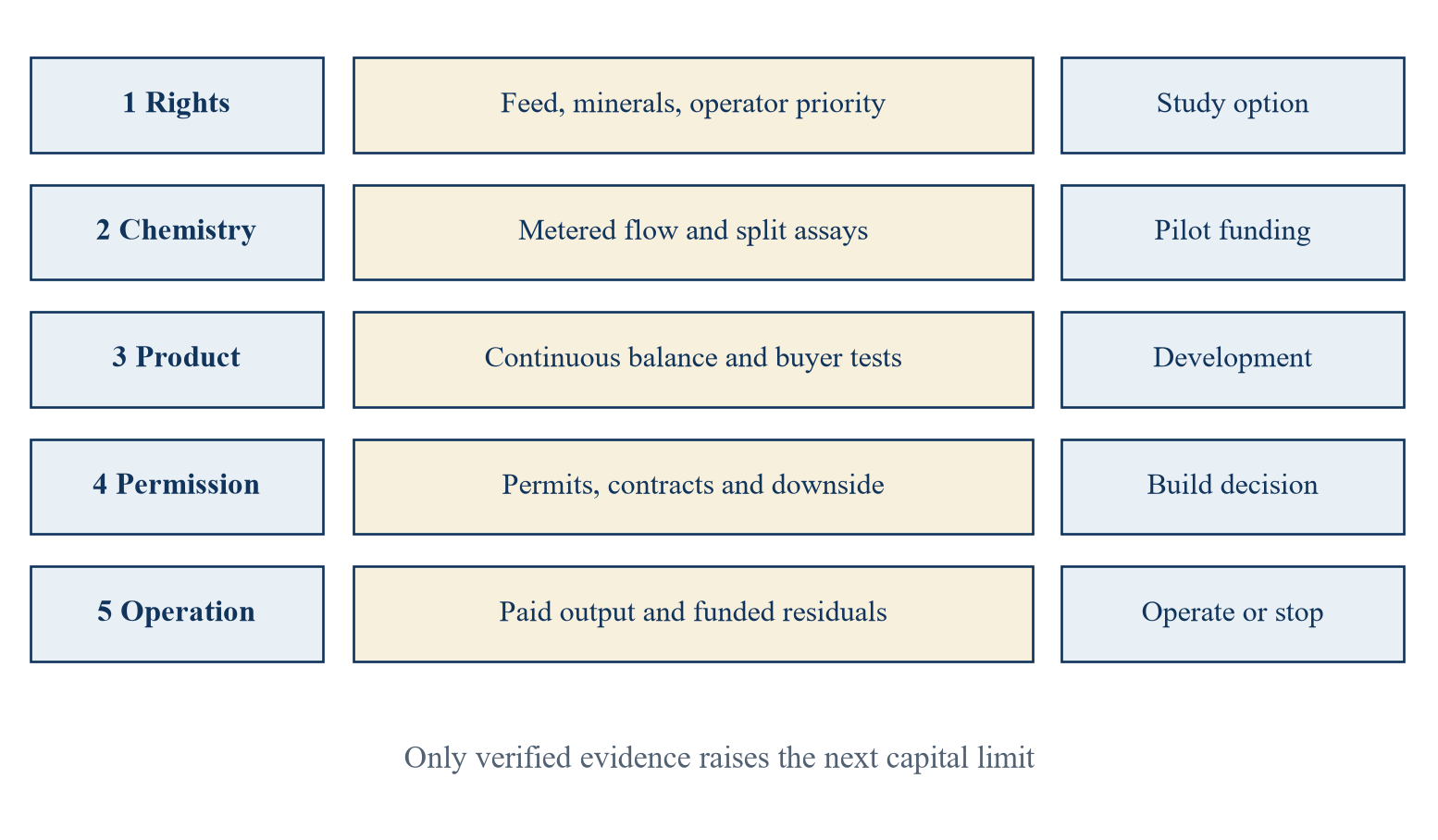
The route identifies the evidence and capital decision at each gate; timing and cost depend on the actual project.
20 Limitations and further research
This paper offers a commercial decision method. It does not estimate reserves, confirm mineral title, certify a treatment technology, assess the safety of any water reuse, interpret a specific permit, forecast lithium prices or value an actual asset. The worked case is fictional. Every numerical input was chosen for arithmetic illustration. The model omits taxes, royalties, debt, ramp-up, water-quality failures, field decline, sustaining capital and several other potentially material costs. Its negative illustrative net present value is a property of those assumptions only.
The public sources have defined limits. USGS datasets and studies support geochemical investigation and method development [1-5]. DOE and NETL describe research and technology pathways [6, 7, 12]. EPA materials explain selected reuse and policy contexts [8-11]. None provides a permit or field-specific bankability test. Local law, contract rights and current regulatory state require fresh professional verification before action. The published Smackover range should not be transferred to another field, and an algorithm's grade classification should not substitute for measured feed.
Further research could publish paired longitudinal datasets of flow and lithium chemistry at operating transfer points, independently audited DLE-to-product mass balances, full residual and water-treatment costs, buyer specification outcomes and the economics of modular deployment. Comparative work should standardise boundaries so a laboratory extraction result is not reported as equivalent to paid commercial output. Such research would improve both capital allocation and environmental accountability without assuming that every produced-water stream can support mineral recovery.
21 Conclusion
Produced water can support a lithium and reuse proposition only when the feed, rights, conversion, customer and residual system works as one. The first proof is access to representative, metered water. The second is repeatable lithium extraction and a buyer-accepted product. The third is permitted, fit-for-purpose water with a real customer or documented internal use. The fourth is cash after all operating, capital and environmental obligations. Each proof has a different owner and decision gate.
The fictional case carries an assumed 660 tonnes of annual contained lithium through extraction, conversion and payability to 2,150.07 tonnes of payable lithium-carbonate equivalent. Despite USD 7.447 million of illustrative annual operating cash, its ten-year pre-tax net present value is negative USD 14.53 million at the assumed capital and discount rate. That result does not reject real projects. It shows why grade, flow, water credit, technology cost and capital intensity must be reconciled before a financing claim is made.
The practical route is staged: secure rights, measure actual water, test representative chemistry, prove product and reuse quality, price every residual, obtain permits and commit plant capital against a downside case. Data tools can focus investigation; independent assays, buyer tests and contracts establish the value. A project that passes those gates can be assessed as a complete water-and-mineral business rather than a promising assay attached to an oilfield pipe.
References
- US Geological Survey. U.S. Geological Survey National Produced Waters Geochemical Database, version 3.0 (2024). Accessed 6 October 2026. https://www.usgs.gov/data/us-geological-survey-national-produced-waters-geochemical-database-ver-30-december-2023
- US Geological Survey. Oil and Gas Waters Project. Accessed 6 October 2026. https://www.usgs.gov/centers/geology-energy-and-minerals-science-center/science/oil-and-gas-waters-project
- Attanasi, E., Coburn, T. and Freeman, P. Machine Learning Approaches to Identify Lithium Concentration in Petroleum Produced Waters, Mineral Economics (2024). Accessed 6 October 2026. https://www.usgs.gov/publications/machine-learning-approaches-identify-lithium-concentration-petroleum-produced-waters
- Attanasi, E., McDevitt, B., Freeman, P. and Coburn, T. Evaluating Machine Learning Approaches to Identify and Predict Oil and Gas Produced Water Lithium Concentrations (2026). Accessed 6 October 2026. https://www.usgs.gov/publications/evaluating-machine-learning-approaches-identify-and-predict-oil-and-gas-produced-water
- US Geological Survey. Lithium Resource in the Smackover Formation Brines of Southern Arkansas, Fact Sheet 2024-3052 (2024). Accessed 6 October 2026. https://pubs.usgs.gov/publication/fs20243052/full
- US Department of Energy, Office of Fossil Energy and Carbon Management. Produced Water from Oil and Gas Development and Critical Minerals Fact Sheet (2024). Accessed 6 October 2026. https://www.energy.gov/sites/default/files/2024-06/Produced%20Water%20from%20Oil%20and%20Gas%20Development%20and%20Critical%20Minerals%20Fact%20Sheet_6.18.24.pdf
- US Department of Energy. Project Selections for FOA 3105: Critical Material Innovation, Efficiency, and Alternatives (2026). Accessed 6 October 2026. https://www.energy.gov/cmei/mining/project-selections-foa-3105-critical-material-innovation-efficiency-and-alternatives
- US Environmental Protection Agency. Water Reuse for Industrial Applications Resources. Accessed 6 October 2026. https://www.epa.gov/waterreuse/water-reuse-industrial-applications-resources
- US Environmental Protection Agency. Summary of Oklahoma's Water Reuse Guideline or Regulation for Industry. Accessed 6 October 2026. https://www.epa.gov/waterreuse/summary-oklahomas-water-reuse-guideline-or-regulation-industry
- US Environmental Protection Agency. EPA Will Revise Wastewater Regulations for Oil and Gas Extraction (2025). Accessed 6 October 2026. https://www.epa.gov/newsreleases/epa-will-revise-wastewater-regulations-oil-and-gas-extraction-help-unleash-american
- US Environmental Protection Agency. Study of Oil and Gas Extraction Wastewater Management Under the Clean Water Act, draft (2019). Accessed 6 October 2026. https://nepis.epa.gov/Exe/ZyPURL.cgi?Dockey=P100WSJJ.TXT
- US Department of Energy, National Energy Technology Laboratory. Produced Water Treatment Research and Development. Accessed 6 October 2026. https://www.netl.doe.gov/oil-gas/upstream/producedwater
About the Author
Chennakeshav (CK) is a corporate finance and investment banking executive with 25+ years of global experience in deal origination, structuring and execution across M&A, growth capital and corporate strategy. He has led value-creation mandates for founders, corporates and funds — bridging the boardroom view to hands-on execution and close.
His career spans Morgan Stanley, HSBC, Lloyds Banking Group, EWEC, ADQ portfolio companies and Emirates Growth Fund, across TMT, real estate, fintech, deeptech, cleantech, infrastructure and energy. He has partnered with C-suite leaders, private equity and venture funds, sovereign wealth funds and family offices to finance complex fund raises and scale-up ventures, and has led M&A due diligence, post-merger integration and business-transformation initiatives to create value.
At Matchpoint Partners he is Managing Partner, leading the firm's corporate finance, M&A and capital-raising practice. He holds an MBA from London Business School, an engineering degree from VTU and a Master of Laws (LLM, in progress) from UCL London.
An active start-up mentor, CK mentors at Techstars, DIFC FinTech Hive, Startup Grind, Founder Institute and IN5, serves as Entrepreneur Mentor in Residence (EMiR) at London Business School, and judges the Entrepreneurship World Cup.
