

1. The decision
The decision is whether a strategic mineral reserve can provide usable industrial protection without becoming a permanently funded warehouse. A reserve must hold the right material, in the right form, at the right location and quality, with a release mechanism that works when normal supply fails.
The financing decision follows the operating design. Debt cannot be sized from headline inventory value alone. It depends on title, price transparency, liquidity, storage, insurance, rotation, user commitments, government support, release rights and loss allocation.
2. Why stockpiles are returning
The International Energy Agency reported that critical-mineral supply risks became operationally visible during 2025 and highlighted concentrated refining across strategic minerals [1]. Export controls and production interruptions sharpened government and industry interest in inventories that can bridge short disruptions.
The rationale varies by jurisdiction. Defence, energy, advanced manufacturing, transport, semiconductors and telecommunications may each require different materials and service levels. A reserve designed for national defence cannot be assumed available for general commercial use.
3. Policy context
The European Union Critical Raw Materials Act requires Member States to report specified strategic stocks and directs the European Commission to develop safe-level benchmarks and coordinate release and accessibility, while preserving incentives for private operators to hold stocks [2]. The Regulation does not impose a general obligation on Member States to hold or release stocks [2].
The distinction matters. Reporting and coordination create policy architecture, while each reserve still needs its own authority, funding and operating rules.
4. Emerging public-private models
Australia's Critical Minerals Strategic Reserve uses financial and commercial tools to secure rights to selected Australian production and on-sell those rights to meet demand. Official programme information identifies AUD 1 billion within an expanded Critical Minerals Facility and AUD 150 million for selective physical stockpiling [3].
The United States Export-Import Bank announced Project Vault in February 2026 as an independently governed public-private partnership holding essential raw materials in United States facilities [4]. United States Treasury later stated that the initiative unlocks USD 12 billion for procurement, including nearly USD 2 billion of private equity [5].
5. Public inventory precedents
The United States National Defense Stockpile is governed by statute for national-defence purposes. The statutory framework covers acquisition, storage, security, maintenance, processing, rotation and recovery of strategic materials [6]. The law restricts release to authorised purposes and separates national-defence stockpiling from general economic or budgetary use [6].
This precedent shows that a stockpile is a continuing operating mandate. Purchase is only one stage of the lifecycle.
6. The reserve system
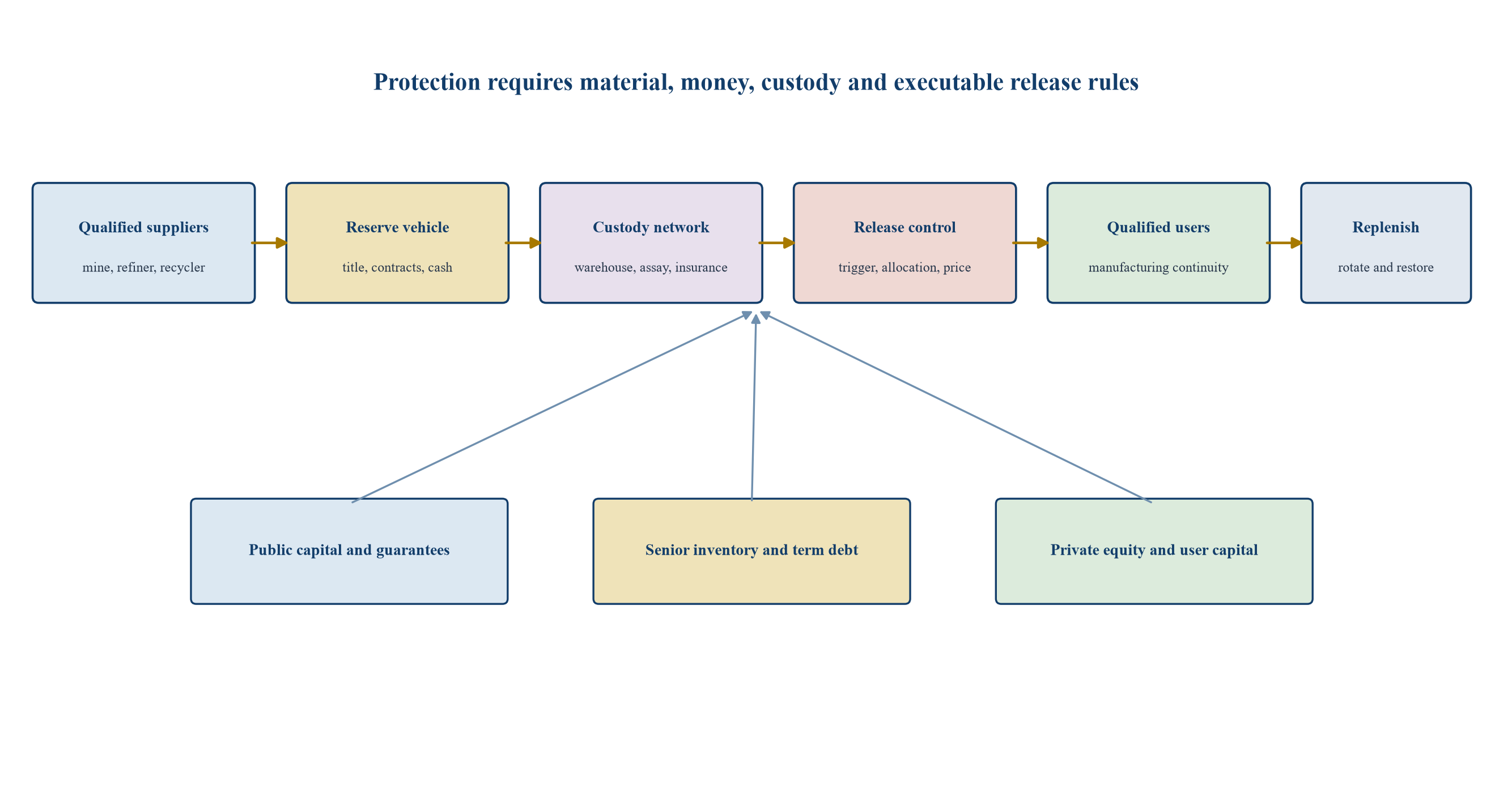
Generic framework; legal authority, financial instruments and release rights require transaction-specific confirmation.
7. Define the protected function
The reserve should begin with the industrial or public function that must continue during disruption. The target may be defence production, grid equipment, vehicles, data centres, medical devices or another critical activity. The required service level determines the material, form, quantity and release speed.
An inventory target expressed only in tonnes can conceal whether the stock can enter the user's process. The design should translate disruption duration into qualified production input.
8. Material selection
The IEA recommends assessing value-chain bottlenecks and prioritising materials with the highest country- or region-specific supply risk [1]. Selection should consider concentration, substitution, lead time, market depth, price transparency, storage, hazard, deterioration and industrial consequence.
A critical-minerals list is broader than a financeable reserve portfolio. Each proposed material needs a documented protection case and operating plan.
9. Material form
The IEA recommends stockpiling the form imported or otherwise usable in the relevant market [1]. Ore, concentrate, oxide, metal, alloy, chemical and finished component are not interchangeable. Conversion capacity may itself be the bottleneck.
The reserve should hold the form that can be released into qualified production within the required time, or contract the necessary conversion. Storage stability, assay, packaging and transport must match that form.
10. Quality specification
Eligibility requires a controlled specification covering chemistry, purity, particle size, moisture, contaminants, packaging, origin and certification where relevant. A warehouse receipt is insufficient if the material does not meet user qualification.
The reserve should maintain approved laboratories, sampling procedures, assay dispute rules and re-test intervals. Quality failure affects collateral value and emergency utility at the same time.
11. Demand qualification
Manufacturers should identify eligible materials, minimum lots, approved sources, process constraints and substitution limits. User agreements can establish call rights, membership fees, capacity payments, minimum purchases or replenishment obligations.
Demand evidence reduces the risk of accumulating material that policy makers consider strategic but manufacturers cannot consume. It also informs release allocation when multiple users compete for limited stocks.
12. Supplier qualification
Suppliers should be assessed for technical quality, capacity, ownership, jurisdiction, responsible sourcing, logistics, sanctions, financial strength and delivery history. Procurement from a concentrated source may provide immediate volume while leaving long-term dependency unchanged.
A staged sourcing policy can separate initial buffer acquisition from replenishment intended to support diversified production. The distinction should be explicit in programme reporting.
13. Portfolio register
Table 1. Mineral reserve design register
| Design field | Required decision | Evidence | Financing consequence |
|---|---|---|---|
| Protected function | output and disruption period | industrial continuity analysis | required reserve size |
| Material and form | exact specification and conversion stage | user qualification, trade flow | liquidity and advance rate |
| Quantity | days or tonnes by scenario | consumption and disruption model | funding requirement |
| Source | eligible jurisdictions and suppliers | contracts, diligence, traceability | policy and delivery risk |
| Custody | location, warehouse, assay, insurance | custody agreement and controls | collateral enforceability |
| Release | trigger, user allocation and price | rulebook and user agreement | cash-flow timing |
| Rotation | age, sale and replacement process | inventory policy and market access | impairment and obsolescence |
| Replenishment | responsibility and funding | procurement mandate and liquidity plan | continuing leverage |
14. Coverage target
Coverage can be expressed in days of net imports, days of qualified industrial consumption, tonnes by end use or scenario-specific output. The EU framework contemplates safe-level benchmarks expressed as days of average daily net imports while considering private stocks and supply risk [2].
A financing model should translate the policy benchmark into actual purchase lots, storage and cash. Coverage changes with consumption, production and substitution, so the target requires periodic refresh.
15. Public mandate
The sponsoring authority should define the reserve's purpose, eligible materials, governance, public support, release authority, confidentiality and reporting. An ambiguous mandate creates political and credit risk.
The legal instrument should identify whether the programme owns material, owns production rights, guarantees financing, provides first-loss capital or contracts a private operator. These positions create different balance-sheet and control outcomes.
16. Reserve vehicle
A special-purpose vehicle can acquire inventory or contractual rights, borrow, enter custody arrangements, sell to users and replenish stocks. Bankruptcy remoteness, public-control requirements and accounting treatment require jurisdiction-specific advice.
The vehicle should have limited permitted activities and clear decision rights. The public sponsor's policy powers should be reconciled with lender protections and user rights.
17. Ownership alternatives
The reserve may own physical material, hold title under repurchase arrangements, secure call options, prepay for future production or aggregate user-owned stocks. Physical ownership provides direct control while requiring more capital and operating capability.
Contractual rights can reduce storage and price exposure, subject to supplier performance and enforcement. A blended portfolio may be appropriate across materials.
18. Public capital
Public capital can fund strategic value that private investors cannot monetise, absorb early losses, extend tenor or support politically required inventory. It can take the form of equity, subordinated capital, grants, guarantees, availability payments or credit facilities.
The support instrument should state its limit, term, conditions, priority and termination. General policy support should not be modelled as a payment guarantee.
19. Private equity
Private investors require defined rights to cash flow, governance, information and exit. Returns may come from membership fees, storage and handling, purchase-sale margins, option premiums, interest on user receivables, or contracted public payments.
The equity case should separate commercial returns from unpriced policy benefit. Exit can be difficult where inventory and contracts are tailored to public purposes.
20. Senior debt
Senior debt can fund eligible inventory and supporting infrastructure. A borrowing base may apply advance rates to verified material value, less reserves for price, liquidity, concentration, location, quality, ageing and enforcement.
Longer-term debt requires predictable cash flows beyond inventory liquidation. User fees, public availability payments or contracted margins can support debt service while the reserve remains intact.
21. Revolving inventory facility
A revolving facility can finance purchase, rotation and replacement. Draws should be matched to eligible inventory and verified title. Repayment can occur through user sales or scheduled rotation.
The facility needs liquidity for margin movements, replacement and settlement timing. A release during crisis may increase receivables while preventing ordinary inventory rotation.
22. Warehouse-receipt finance
Warehouse finance relies on enforceable title or security, controlled custody, verified quantity and quality, insurance and lender access. The collateral manager should be independent and obligated to the secured parties.
The structure should address commingling, substitution, release instructions, fraud, warehouse insolvency and cross-border enforcement. Electronic records should reconcile to physical counts and assay.
23. Supplier prepayment
Prepayment can finance production in return for future deliveries. It may support new supply and reduce upfront warehouse volume. Credit exposure shifts from inventory to producer performance, construction, operating and delivery risk.
Security, step-in, delivery-shortfall remedies, price formula and termination value must be defined. Prepaid material should not be counted as available stock until delivery and acceptance.
24. Offtake and call rights
The reserve can secure long-term offtake with rights to nominate, defer or redirect volumes. A call option may preserve access without funding full inventory. Option value depends on strike price, delivery, capacity reservation and counterparty performance.
Rights should match the material form and disruption scenario. A contract for mine concentrate offers limited protection if the region lacks conversion capacity.
25. User membership
Manufacturers can contribute equity, fees or purchase commitments in exchange for access rights. Membership aligns demand and funding, while allocation must remain workable during shortage.
The agreement should define base entitlement, priority, transfer, minimum take, credit support and treatment of a member default. Public authorities may retain override rights for defined emergencies.
26. Sources and uses
Table 2. Illustrative reserve sources and uses
| Sources | Illustrative share | Uses | Illustrative share |
|---|---|---|---|
| Public subordinated capital | 20% | Initial mineral purchases | 72% |
| Senior inventory facility | 50% | Warehousing, assay and logistics | 6% |
| Private equity and user capital | 20% | Price and liquidity reserve | 12% |
| Supplier or user credit | 10% | Systems, insurance and start-up | 5% |
| Financing fees and contingency | 5% | ||
| Total | 100% | Total | 100% |
27. Interpreting the capital stack
The table is a hypothetical design case. The appropriate leverage depends on material liquidity, price volatility, enforceability, user cash flow and public support. A reserve holding thinly traded or highly specialised products may require more equity and larger valuation reserves.
Capital should include working liquidity. Funding the initial purchase without rotation, assay, insurance and replenishment produces an undercapitalised reserve.
28. Procurement price
Procurement can use spot purchases, formula pricing, auctions, long-term offtake, price floors or cost-linked contracts. Buying rapidly into a small market can raise prices and weaken value for money.
A phased procurement plan should consider market depth and supplier response. Governance should distinguish a security objective from short-term trading performance.
29. Valuation
Inventory valuation should use observable prices where available and conservative methods where markets are opaque. Adjustments may be required for form, grade, location, lot size, liquidity, processing and selling cost.
Accounting value, collateral value and strategic value are different measures. Debt should be sized to enforceable cash value under stress rather than replacement value during crisis.
30. Price risk
Prices can fall after procurement, reducing collateral value and creating public criticism. Prices can rise during disruption, increasing replacement cost and user affordability pressure.
The design may use hedging where liquid instruments exist. Many specialised minerals lack effective hedges, requiring equity, reserves, lower advance rates and staged purchase.
31. Volume risk
Demand can decline through technology change, substitution or manufacturing relocation. A reserve may hold material that remains chemically sound but commercially less relevant.
Periodic portfolio review should test protected use, user qualification and alternative markets. Rotation and disposal authority should exist before obsolescence becomes severe.
32. Carry cost
Carrying cost includes interest, storage, handling, assay, insurance, security, systems, shrinkage and governance. It should be measured per tonne and per protected day.
Public reporting should distinguish purchase value from recurring cost. A reserve that cannot fund carry becomes dependent on irregular appropriations or forced sales.
33. Revenue model
Potential revenue includes user membership, capacity payment, reservation fee, handling, option premium, financing margin and rotation gain or loss. Crisis sales should not be the only source of debt service because releases are uncertain.
The base case should rely on contracted and affordable payments. Merchant trading revenue should be treated cautiously.
34. Availability payments
A public authority can pay for maintained readiness, measured through eligible quantity, quality, location, release time and system availability. Deductions can apply for shortfalls.
Availability payment converts policy value into a contractual cash flow. The payment obligation, appropriation risk, termination and force majeure require careful analysis.
35. User reservation fees
Users may pay for priority access to a defined quantity. The fee can support carrying cost while the material remains in reserve. The contract should specify whether the fee is refundable, credited to purchase price or forfeited when unused.
The fee must be calibrated against the user's alternative of self-stocking. Shared inventory can offer diversification and professional custody.
36. Illustrative debt-service sensitivity
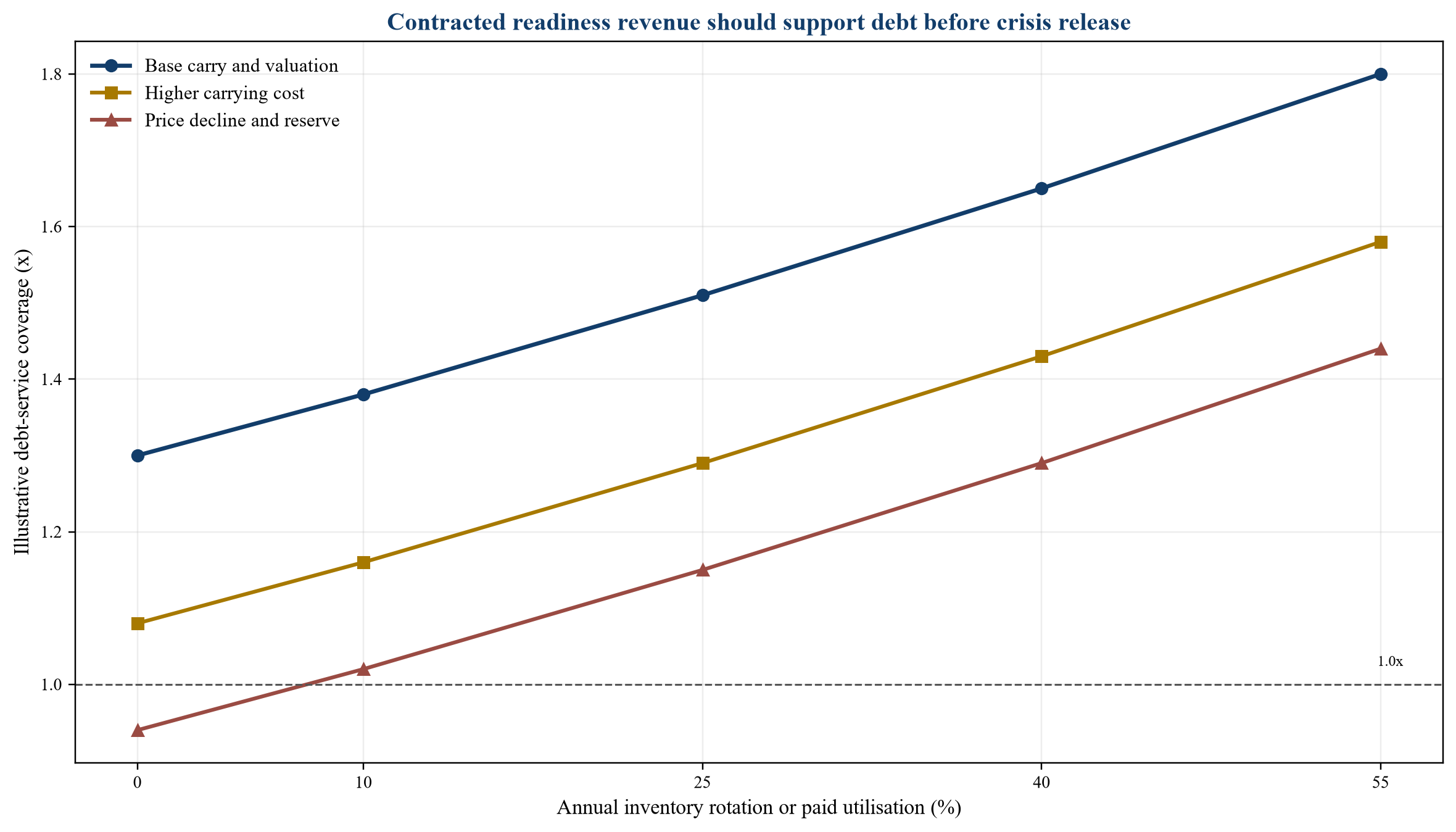
Hypothetical model; values are decision examples and do not represent an actual reserve, forecast or credit rating.
37. Sensitivity interpretation
The illustrative case assumes contracted revenue plus increasing handling or rotation income. Higher carrying cost reduces coverage even when inventory remains intact. A price decline introduces a collateral reserve and can pressure refinancing.
Actual analysis should model each material separately and consolidate liquidity. Coverage above one does not establish bankability if title, release or public payment remains uncertain.
38. Release objective
Release should address an identified disruption while preserving longer-term security. The IEA recommends clear and transparent release principles that respond to acute short-term disruption and maintain investment signals [1].
Rules should avoid arbitrary sales that undermine producers or reward users who failed to manage ordinary inventory. The purpose and trigger should be published to the extent consistent with security.
39. Trigger design
Triggers may include government declaration, verified supply interruption, import shortfall, price and availability indicators, or inability of qualified users to obtain material. Mechanical price triggers can release stock during demand growth without a physical shortage.
A decision committee should assess evidence, expected duration, alternatives and downstream consequence. Emergency authority and lender consultation should be reconciled in advance.
40. Allocation
Allocation can follow pre-agreed user rights, criticality, pro rata consumption, auction, public direction or a blended method. The rule should address new entrants and smaller manufacturers.
An allocation process needs verified need, credit support and anti-hoarding controls. Users should report consumption and unused volume during the release period.
41. Release price
Release pricing can use market price, acquisition cost, replacement cost, formula price or subsidised price. Each choice allocates gains and losses differently. Below-market release can support users while creating public loss and arbitrage risk.
Contracts should prevent resale where policy requires consumption. If the public sponsor directs a concessionary release, the financing documents should identify who absorbs the difference.
42. Lender release controls
The secured lender may control inventory movement under ordinary conditions. Emergency release authority can conflict with collateral protection. The intercreditor and government agreements should provide notice, valuation, payment waterfall and replacement.
A public override should carry defined compensation or credit support if it can remove secured inventory without proceeds sufficient to repay debt.
43. Replenishment
Release turns a reserve into a receivable and then a replenishment requirement. The programme needs procurement authority, liquidity and supplier capacity to restore coverage.
Replenishment timing should avoid amplifying scarcity. A phased plan can use existing offtake, options and allied supply. Coverage reporting should show the post-release gap.
44. Rotation
Rotation sells older inventory and buys replacement before deterioration or obsolescence. The United States statutory stockpile framework expressly contemplates rotation to prevent deterioration or technological obsolescence [6].
Rotation requires ordinary-market authority, qualified buyers and replacement funding. It should not be treated as a speculative trading programme.
45. Disposal
Material may become excess because the protected technology changes, the specification changes or the policy target falls. Disposal should follow an approved process that considers market impact, confidentiality, environmental duty and public value.
Debt documents should state whether disposal proceeds repay debt, fund replacement or distribute to capital providers.
46. Custody network
Warehouses should meet material-specific requirements for security, environment, segregation, packaging, handling and dangerous goods. Location should balance user access, geopolitical exposure, cost and concentration.
Multiple sites can improve resilience while increasing control complexity. Each site requires tested records and emergency dispatch.
47. Collateral management
The collateral manager verifies receipts, releases, counts, substitution and reporting for secured lenders. Independence, liability, insurance and systems should be assessed.
Reports should reconcile purchase contract, assay, warehouse record, general ledger and borrowing base. Surprise inspections and third-party counts can deter fraud.
48. Assay and inspection
Material quality can change through moisture, contamination, oxidation, packaging failure or misdescription. Sampling and testing should follow an agreed protocol and chain of custody.
Dispute procedures should identify the umpire laboratory and treatment of affected lots. A valuation haircut cannot solve unusable material.
49. Insurance
Coverage may include property damage, theft, transit, contamination, environmental liability, cyber incident and business interruption. Policy exclusions, deductibles, valuation basis and government action require review.
Insurance does not cover every price or obsolescence risk. The lender should be loss payee where appropriate and receive notice of cancellation.
50. Logistics
The reserve must move material from storage to the user's qualified facility during disruption. Transport permits, packaging, carriers, routes, borders and delivery slots should be pre-planned.
A warehouse near supply but far from users may provide poor emergency utility. Release exercises should test the physical chain.
51. Data and traceability
Inventory records should capture identity, lot, specification, origin, title, custody, assay, insurance, restriction, release and replenishment. Traceability must be proportionate to public policy and user qualification.
The digital record should reconcile to physical counts. Access controls should protect sensitive stock levels and user information.
52. Governance
The board should include appropriate public, financial, industrial and technical expertise while preserving clear accountability. Reserved matters can cover portfolio, borrowing, procurement, release, disposal, related parties and material contracts.
Conflict rules are important when users, suppliers or traders hold equity or governance rights. Independent decisions may be required for pricing and allocation.
53. Risk-allocation matrix
Table 3. Public-private reserve risk allocation
| Risk | Preferred owner | Control | Financing treatment |
|---|---|---|---|
| Policy mandate and emergency override | public sponsor | statute, contract, compensation rule | guarantee or termination protection |
| Supplier delivery | supplier and reserve | qualification, security, replacement | advance restriction and reserve |
| Material quality | supplier, warehouse and reserve | assay, segregation, warranty | ineligibility until accepted |
| Price and liquidity | equity and reserve | diversification, hedging, haircuts | lower advance rate and liquidity reserve |
| Custody and fraud | warehouse and collateral manager | control agreement, inspection, insurance | lender direct rights |
| Carrying cost | reserve and contracted payers | availability and reservation revenue | minimum coverage covenant |
| Release allocation | public sponsor and reserve | published rulebook, audit | compensation for directed loss |
| Obsolescence | reserve and users | rotation, portfolio review | amortisation and valuation reserve |
| Replenishment | reserve and public sponsor | committed liquidity and offtake | revolving capacity and equity call |
54. Public-sponsor risk
Policy can change after capital is committed. The programme may be terminated, redirected or required to release at a loss. Private finance requires contractual treatment of these events.
Protection can include compensation, debt takeout, minimum payment, termination value or government guarantee, subject to lawful authority. Political statements are not substitutes for enforceable obligations.
55. Market-distortion risk
Large procurement can raise prices, crowd out ordinary users or encourage marginal supply. Sudden disposal can depress prices and undermine new projects. The IEA advises tailoring governance to each material and maintaining investment signals [1].
Procurement and release should consider market depth, timing and transparency. Confidentiality may remain necessary for security and trading.
56. Moral hazard
Shared reserves can discourage manufacturers from holding prudent operating stocks. Eligibility should require users to maintain agreed ordinary inventories, diversify suppliers or demonstrate disruption exposure.
Fees and allocation rules can preserve incentives. Emergency access should complement normal risk management.
57. Concentration
A diversified reserve may still depend on one refiner, warehouse, transport route or user. Concentration limits should cover supplier, jurisdiction, form, site and end use.
The risk register should identify common-mode failures. Multiple nominal suppliers can share the same upstream source.
58. Counterparty credit
The reserve faces suppliers, warehouses, insurers, users, banks and public payers. Credit assessment should reflect exposure type and replacement difficulty.
User receivables may increase sharply during crisis. Credit support and payment mechanics should be established before release.
59. Sanctions and trade controls
Material origin, ownership, transport and payment can be affected by sanctions, export controls, tariffs and local restrictions. Compliance should operate at procurement, storage, transfer and release.
Contracts need termination, substitution and blocked-payment provisions. A legally stranded stock may retain physical value but fail its policy purpose.
60. Environmental and social responsibility
Strategic urgency does not remove environmental, labour and community risk. Procurement standards, traceability and audit should match applicable law and programme policy.
The reserve should avoid creating demand for material that cannot be responsibly sourced or legally sold to intended users. Exceptions require documented authority and consequence.
61. Accounting and tax
The vehicle must determine inventory accounting, impairment, foreign exchange, borrowing cost, public support, revenue recognition and consolidation. Tax treatment can affect ownership and rotation.
These matters require jurisdiction-specific professional advice. The financial model should be reconciled to the approved accounting policy.
62. Procurement governance
Procurement should define competition, permitted negotiation, conflicts, benchmarks, independent review and record retention. Specialist commodity traders can provide market access while creating agency and information risks.
Fees, spreads and related positions should be disclosed to the programme within agreed confidentiality. Execution quality should be measured against an approved benchmark.
63. Fraud controls
Commodity inventory is exposed to duplicate warehouse receipts, false assay, circular transactions, title defects and unauthorised releases. Controls should include independent custody, direct confirmation, unique lot records, inspections and payment verification.
The financing agent should receive information directly from the custodian and assay provider. Borrower-provided summaries are insufficient.
64. Cash waterfall
Operating receipts should first fund taxes, custody, insurance and essential operating cost, then senior interest and principal, required reserves, subordinated capital and equity distributions according to the agreed priority.
Emergency release proceeds may have a separate waterfall if public policy requires replenishment. The documents should avoid competing claims over the same cash.
65. Covenants
Core covenants can cover eligible inventory, advance rates, minimum liquidity, debt-service coverage, concentration, ageing, insurance, title, custody, public-support validity and reporting.
Cure mechanisms should distinguish administrative errors from material loss of inventory or authority. Repeated data failures may justify tighter controls.
66. Completion tests
Before full funding, the reserve should demonstrate vehicle authority, capital commitments, supplier contracts, qualified inventory, custody, assay, insurance, user agreements, release system, data reconciliation and emergency dispatch.
Completion should include a live or simulated release. Purchase and storage alone do not prove availability.
67. Stress testing
Stress cases should combine price decline, higher interest, lower fee revenue, delayed rotation, supplier failure, warehouse loss, user default and directed release. A severe case should test replenishment after a disruption.
Liquidity and policy support should be modelled with contractual limits. Management intent should not be treated as committed funding.
68. First-loss sizing
First-loss capital should cover plausible valuation decline, enforcement cost, operating interruption and replenishment gap. The calculation should reflect portfolio correlation during geopolitical stress.
A reserve across several minerals may not be diversified if the same policy event affects all prices and users. The equity layer should be tested at portfolio level.
69. Debt tenor
Debt tenor should match contracted revenue, rotation and public support. Short facilities can create refinancing risk while inventory remains strategically required. Long tenor creates exposure to obsolescence and policy change.
Amortisation can be linked to availability payments or scheduled rotation. A bullet maturity requires credible takeout.
70. Currency risk
Minerals may be priced in one currency, purchased in another and funded in a third. User fees or public payments may not move with the commodity currency.
Hedging can reduce mismatch where markets and tenor allow. Residual risk requires liquidity and covenant headroom.
71. Inflation and interest
Storage, insurance, labour and financing cost can rise while contracted fees remain fixed. Fee formulas should address measurable cost changes without creating uncontrolled public liability.
Interest-rate sensitivity should include delayed procurement and refinancing. Fixed-rate public debt can stabilise carry, subject to prepayment and duration.
72. Operating dashboard
The dashboard should show eligible tonnes, protected days, quality, age, location, market value, collateral value, user rights, carrying cost, revenue, liquidity, debt service, concentration and unresolved exceptions.
Public reporting can aggregate sensitive holdings. Lenders require detailed data under confidentiality.
73. Release dashboard
During disruption, decision-makers need available quantity, transport readiness, qualified users, allocation, price, credit, dispatch, consumption and replenishment. Reporting frequency may increase to daily.
The dashboard should distinguish authorised, dispatched, delivered and consumed material. Announced release is not delivered protection.
74. Audit
Audit should cover physical inventory, title, valuation, procurement, related parties, custody, release, allocation and public payments. Technical specialists may be needed for assay and market valuation.
Findings should be reported to the board, public sponsor and lenders according to materiality. Security restrictions should not prevent necessary assurance.
75. Scenario governance
Scenario assumptions should be approved and versioned. Consumption, disruption duration, price, lead time and substitution can change materially.
The board should review the target portfolio after major market or technology change and at a defined frequency. Changes should flow into funding and contracts.
76. International coordination
Multiple national reserves can duplicate the same material or compete during crisis. The EU framework contemplates coordination and cross-border accessibility [2], while the IEA recommends international collaboration where compatible with domestic policy [1].
Coordination can cover information, mutual access, common specifications, logistics and replenishment. Legal commitments should define priority during simultaneous disruption.
77. Financing new production
Reserve procurement or offtake can support project bankability by creating demand and price visibility. It should not replace technical, environmental, construction and operating diligence.
Long-term purchase commitments can be staged against project milestones and qualification. Public policy may justify support for diversified supply while private lenders still require completion protection.
78. Supporting recycling
Recovered materials can qualify for reserve procurement where specification, traceability and policy allow. Purchase commitments can support recycling investment and circular supply.
Availability depends on collection, feed composition, process yield and product qualification. Forecast recycled output should not be counted as stock before production and acceptance.
79. Option-based reserve
An option-based structure pays suppliers for the right to call production during disruption. It reduces physical carry but leaves operating and logistics risk at exercise.
The reserve should test capacity dedication, competing customers, input availability and delivery security. Option collateral or performance security may be required.
80. Virtual inventory
Virtual inventory aggregates verified stocks held by manufacturers, traders or suppliers under access agreements. It can improve visibility and reduce duplicate holdings.
The programme needs audit rights, minimum levels, encumbrance controls and release enforcement. Inventory reported by multiple programmes creates double counting.
81. Blended portfolio
A robust reserve can combine physical stock for immediate use, options for replenishment, long-term offtake for new production and virtual inventory for visibility. The mix should reflect material-specific risk.
Each instrument should have separate availability, credit and funding assumptions. A portfolio total should not treat all rights as equivalent tonnes.
82. Implementation roadmap
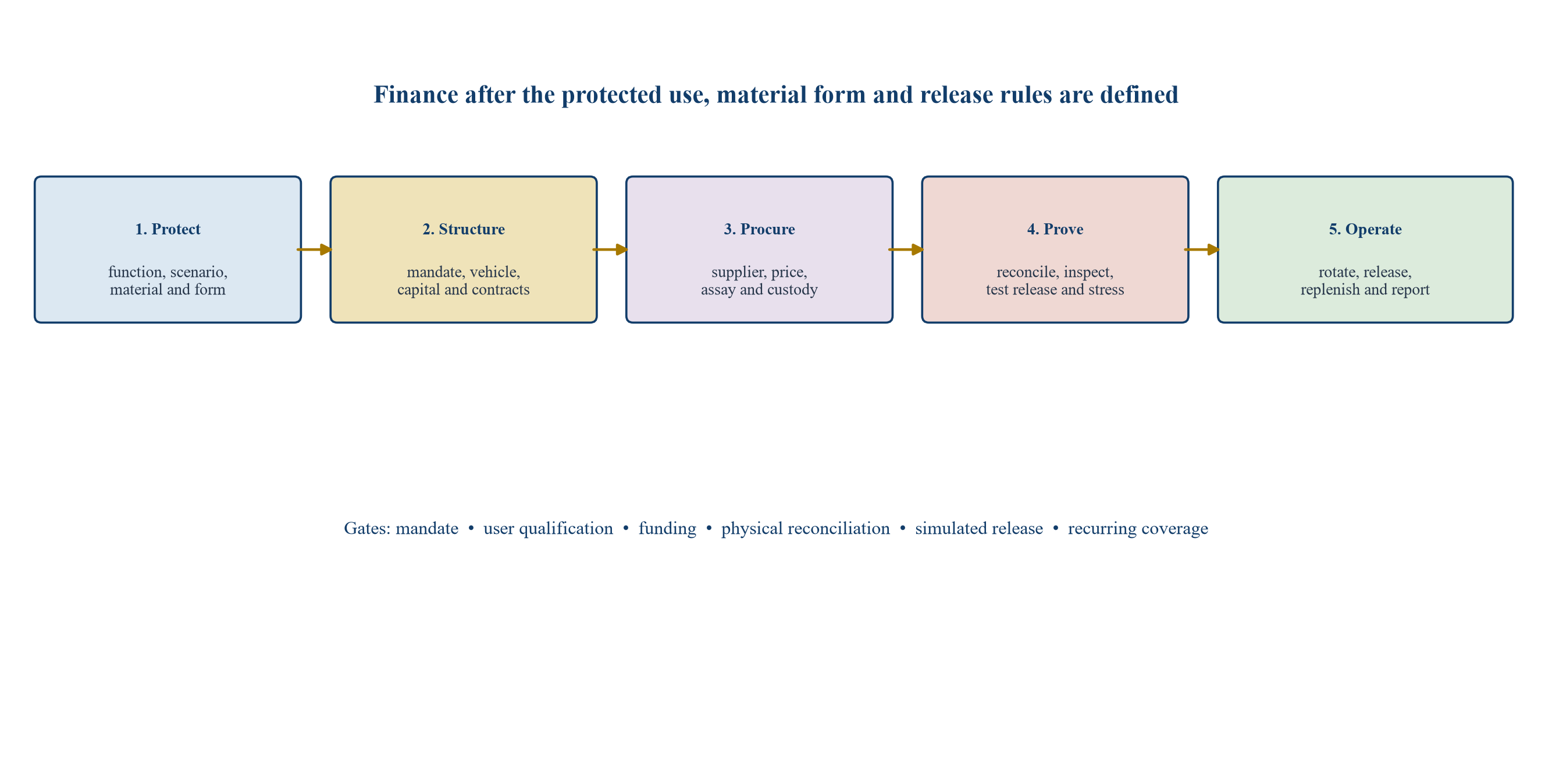
Generic sequence; timing and approvals require programme-specific confirmation.
83. Phase one: protect
Define the protected output, disruption scenarios, material bottlenecks, required forms, coverage targets and eligible users. Document exclusions and substitution.
The output is a board- and sponsor-approved protection case for each material. No financing should be marketed before this decision is stable.
84. Phase two: structure
Establish legal authority, vehicle, ownership, public support, user rights, supplier contracts, custody and financing. Allocate policy, price, performance and release risk.
The financial model should connect sources and uses, carry, revenue, rotation, release and replenishment under stress.
85. Phase three: procure
Run controlled procurement, complete diligence, assay accepted lots, perfect title and security, and place material in approved custody. Draw debt only against eligible inventory.
Track market impact and supplier concentration. Preserve documentation for public and lender audit.
86. Phase four: prove
Reconcile physical and digital records, test warehouse controls, exercise user access, simulate emergency release and confirm transport. Stress cash flow and collateral.
Close critical findings before scaling. The reserve should prove usable supply and financeability together.
87. Phase five: operate
Monitor coverage, quality, valuation, carry, fees and covenants. Rotate material, exercise options, update user qualification and test release regularly.
After any release, report delivered protection, financial effect and replenishment plan. Review portfolio composition as technology and risk change.
88. First 100 days
During the first month, appoint sponsor and board leads, select pilot materials, map users and define scenarios. During the second month, choose the vehicle and instruments, request supplier and custody proposals, and build the model. During the final period, negotiate core contracts, acquire a pilot lot and test an end-to-end release.
The pilot should be narrow enough to control and broad enough to reveal title, quality, logistics and user-integration failures.
89. Decision rule
Proceed when the reserve protects a defined industrial function, holds or controls qualified material in a usable form, has enforceable authority and contracts, funds the full lifecycle, preserves debt service under stress and can release and replenish through tested procedures.
Defer where public support is discretionary, user demand is unqualified, title or custody is weak, or revenue depends on crisis sales. These gaps can strand capital before a supply shock occurs.
90. Conclusion
Strategic mineral inventories can provide a practical buffer against concentrated supply and sudden disruption. The reserve creates value only when industry can use it on time. Material selection, form, quality, custody, release and replenishment determine that utility.
Public-private finance can expand capacity by combining policy capital, long-tenor debt, user commitments and commercial operating expertise. The structure must translate policy intent into enforceable cash flows and loss allocation. A reserve that funds readiness through ordinary contracted revenue, rotates ageing material and protects lenders during directed release has a stronger chance of delivering security without immobilising capital indefinitely.
91. Material-specific term sheets
Each mineral should have a schedule to the master programme documents. The schedule should specify eligible forms, grades, origin, packaging, storage, re-test interval, users, market reference, valuation haircut, advance rate, concentration limit, rotation deadline and release logistics. A single generic term sheet can hide material differences.
The master agreement can preserve consistent governance and financing, while schedules allow technical requirements to change without reopening the entire programme. Amendments should require technical, credit and public-policy approval where they affect security or collateral. The lender should receive notice before a material becomes eligible or its advance rate changes.
92. Procurement pacing
Procurement should consider the relationship between target stock, normal market volume and available qualified production. A rapid programme can move prices, exhaust deliverable lots or attract opportunistic supply that fails quality standards. Pacing should be approved against a market-impact assessment.
The reserve can divide procurement into a pilot lot, initial protection tranche and steady-state replenishment. Each tranche should have acceptance, funding and review gates. A pause mechanism is useful when price, policy or supplier conditions change materially. The programme should record the security cost of delay alongside the financial cost of accelerated buying.
93. Merchant and agent roles
Commodity merchants can source, finance, transport, blend, store and market material. Their network can reduce execution time, while their trading positions can create conflicts. The reserve should define whether the merchant acts as principal, agent, inventory owner, facility borrower or service provider.
Compensation should identify fixed fees, financing spreads, purchase-sale margin and performance incentives. The reserve needs audit access to relevant transaction evidence and a related-party policy. Competitive tension can be maintained through multiple agents, benchmarked orders or periodic retendering, subject to material-specific market depth.
94. User credit and settlement
Emergency conditions can weaken user liquidity just as material is released. The reserve should establish credit limits, guarantees, letters of credit, prepayment or public payment support before disruption. Settlement terms should reflect the need for rapid dispatch.
User default rules should address whether material is redirected, returned or funded by a sponsor. Accounts receivable created by release should have a distinct eligibility and reserve policy. The borrowing base should not continue valuing the same economic exposure as both inventory and receivable after title transfers.
95. Directed release compensation
Where government can direct a release, the contract should define the protected creditor and investor position. Compensation may equal outstanding secured debt, replacement cost, agreed book value, fair market value or another formula. The formula should account for timing, currency, unpaid carry and replenishment obligation.
The payment source and authority require legal verification. A compensation clause without appropriation or enforceable payment capacity may provide limited credit support. Lenders should test the sequence from direction to payment, including disputes and interim liquidity. Public sponsors should understand the contingent liability created by the override.
96. Transparency and confidentiality
Public programmes require accountability for mandate, funding, procurement integrity and results. Exact holdings, locations, supplier terms and user vulnerabilities may be commercially or nationally sensitive. Reporting should separate information that can be aggregated from information that requires restricted access.
The EU reporting framework recognises national-security and confidentiality limits while seeking aggregated stock information and release procedures [2]. A public-private reserve can use the same principle: disclose governance, aggregate coverage and audited performance, while protecting operational details. Confidentiality should not prevent lenders, auditors and authorised oversight bodies from obtaining the information needed for their roles.
97. Performance evaluation
The programme should evaluate security service, financial sustainability and market effect. Security measures can include qualified coverage, release time, delivered tonnes and protected production. Financial measures can include carrying cost, fee recovery, debt-service coverage, valuation change and replenishment liquidity. Market measures can include procurement concentration and evidence of unintended price distortion.
Evaluation should compare outcomes with the approved counterfactual and recognise that avoided disruption is difficult to observe. A reserve that is never released may still provide preparedness, while a reserve that cannot pass exercises has weak evidence of usefulness. Periodic independent review can recommend portfolio, funding or governance changes without waiting for a crisis.
References
- International Energy Agency. Designing an Effective Strategic Stockpiling System for Critical Minerals. 27 January 2026. https://www.iea.org/commentaries/designing-an-effective-strategic-stockpiling-system-for-critical-minerals
- European Parliament and Council of the European Union. Regulation (EU) 2024/1252 establishing a framework for ensuring a secure and sustainable supply of critical raw materials, Articles 22 and 23. 11 April 2024. https://eur-lex.europa.eu/eli/reg/2024/1252/oj
- Australian Government Department of Industry, Science and Resources. Critical Minerals Strategic Reserve. Accessed 2 October 2026. https://www.industry.gov.au/mining-oil-and-gas/minerals/critical-minerals/critical-minerals-strategic-reserve
- Export-Import Bank of the United States. EXIM Approves Project Vault Loan to Launch America's Strategic Critical Minerals Reserve and Support Manufacturing Jobs. 2 February 2026. https://www.exim.gov/news/project-vault
- United States Department of the Treasury. Remarks by Secretary of the Treasury Scott Bessent Before the EXIM Annual Conference. 2026. https://home.treasury.gov/news/press-releases/sb0481
- United States Code. Strategic and Critical Materials Stock Piling Act, 50 U.S.C. 98 et seq., preliminary edition current through 22 September 2026. https://uscode.house.gov/view.xhtml?edition=prelim&path=%2Fprelim%40title50%2Fchapter5
- Defense Logistics Agency. National Defense Stockpile Transaction Fund Agency Financial Report, Fiscal Year 2025. https://www.dla.mil/Portals/104/Documents/J8Finance/DLA%20FY25%20NDSTF%20AFR.pdf
- International Energy Agency. Global Critical Minerals Outlook 2026: Executive Summary. 2026. https://www.iea.org/reports/global-critical-minerals-outlook-2026/executive-summary
- United States Government Accountability Office. Critical Minerals: Reducing U.S. Import Reliance with Substitution and Recycling Technologies, GAO-26-108687. 2026. https://www.gao.gov/assets/890/887977.pdf
About the Author
Chennakeshav (CK) is a corporate finance and investment banking executive with 25+ years of global experience in deal origination, structuring and execution across M&A, growth capital and corporate strategy. He has led value-creation mandates for founders, corporates and funds — bridging the boardroom view to hands-on execution and close.
His career spans Morgan Stanley, HSBC, Lloyds Banking Group, EWEC, ADQ portfolio companies and Emirates Growth Fund, across TMT, real estate, fintech, deeptech, cleantech, infrastructure and energy. He has partnered with C-suite leaders, private equity and venture funds, sovereign wealth funds and family offices to finance complex fund raises and scale-up ventures, and has led M&A due diligence, post-merger integration and business-transformation initiatives to create value.
At Matchpoint Partners he is Managing Partner, leading the firm's corporate finance, M&A and capital-raising practice. He holds an MBA from London Business School, an engineering degree from VTU and a Master of Laws (LLM, in progress) from UCL London.
An active start-up mentor, CK mentors at Techstars, DIFC FinTech Hive, Startup Grind, Founder Institute and IN5, serves as Entrepreneur Mentor in Residence (EMiR) at London Business School, and judges the Entrepreneurship World Cup.
LinkedIn: https://www.linkedin.com/in/ckadya/
Profile: https://www.matchpoint-partners.com/team/ck-adya.html
