

Introduction
Computational chemistry supports decisions in pharmaceuticals, chemicals, batteries, catalysts, semiconductors, aerospace materials and energy systems. A typical project moves from a scientific question to a molecular or materials representation, chooses a model and basis, prepares inputs, executes calculations, analyses uncertainty, compares predictions with experimental observations and communicates a recommendation. Many different tools and specialists contribute to the result.
Quantum computing may improve selected electronic-structure calculations, especially for strongly correlated systems that are difficult for classical approaches. Current platforms also rely heavily on classical pre-processing, high-performance computing, simulators, error mitigation, workflow orchestration and domain expertise. Official InQuanto documentation, for example, describes a complete pipeline that begins with chemical specification and classical mean-field work before quantum program construction and execution [8,9]. Amazon Braket similarly describes hybrid jobs that combine classical resources with quantum processing units and measure complete job behaviour [10].
The transaction question concerns ownership of the user, data and decision pathway. A target may own a valuable user interface while depending on external chemistry engines. It may own proprietary algorithms while lacking customer integration. It may have impressive publications while deriving most revenue from bespoke research. A buyer needs an evidence architecture that assigns value to each component and avoids applying a platform multiple to scientific activity that remains specialist dependent.
This paper provides that architecture. It begins with the customer decision, maps the workflow and evidence chain, evaluates model credibility and benchmarking, tests data and software control, reconciles customer economics and builds a probability-weighted valuation. It then translates uncertainty into price, contingent consideration and a controlled integration plan.
1 Define the decision the platform informs
The acquisition thesis should begin with a specific decision. Examples include selecting a lead molecule, ranking a catalyst, choosing a battery electrolyte, predicting a reaction barrier, identifying a material defect or reducing the number of physical experiments. The buyer should record the decision owner, required accuracy, time window, cost of error and evidence currently used.
A calculation becomes commercially relevant when it changes an action. An energy estimate may influence which compounds enter synthesis. A predicted binding interaction may determine which candidates advance. A corrosion model may redirect experimental resources. The diligence team should identify the point at which a platform output enters the customer's governed process and the person who accepts responsibility for the decision.
The question of interest also defines model credibility. FDA's M15 framework links model evaluation to a stated question and the consequence of an incorrect decision [1]. A research exploration can tolerate more uncertainty than a regulatory submission or a manufacturing decision. The same algorithm may therefore support different valuations across use cases.
The board paper should state the counterfactual. The customer may continue with laboratory screening, license an established classical package, use open-source tools, hire a contract research organisation or build an internal workflow. Acquisition value should reflect the target's incremental contribution to time, quality, cost, risk or strategic control compared with these alternatives.
2 Map the end-to-end chemistry workflow
The workflow map should start before computation. It should cover scientific question definition, molecular or periodic structure, conformer generation, basis selection, active-space choice, classical driver calculations, Hamiltonian construction, embedding, state preparation, quantum or classical execution, mitigation, post-processing, experimental comparison and decision reporting. Each step should have an accountable owner, input, output, version and acceptance rule.
Workflow integration creates switching costs when the platform is embedded in data sources, laboratory systems, electronic notebooks, high-performance-computing schedulers, compound registries, model repositories and governance records. These links can be more durable than a single algorithm. They can also create remediation costs when interfaces are undocumented or dependent on founders.
The diligence map should identify manual hand-offs. A platform may appear automated while scientists repeatedly repair structures, select active spaces, tune ansatzes or interpret anomalous results. These interventions can create genuine value through expertise, yet they reduce product scalability. Time records, run histories and project files can reveal how much specialist effort is required for each accepted output.
The buyer should separate optional quantum steps from mandatory workflow components. Some projects may run entirely on classical resources. Others may use quantum execution for a narrow subproblem. Revenue attribution should follow the actual delivered workflow rather than the marketing category assigned to the product.
3 Build a scientific evidence ladder
The first evidence level is a documented calculation on a defined system. The second is reproducibility in a clean environment. The third compares results with credible classical methods. The fourth compares predictions with experimental or accepted reference data. The fifth reproduces performance across molecules, materials, compute environments and time. The sixth shows that a customer accepts the output for a governed decision.
Each level should preserve provenance. Required records include molecular structures, basis sets, pseudopotentials, active spaces, integral files, algorithm versions, compiler settings, device identifiers, calibration data, random seeds, measurement settings, classical optimisation, mitigation, post-processing and exclusions. Experimental records should identify assay, measurement conditions, uncertainty and linkage to the modelled system.
NIST's Computational Chemistry Comparison and Benchmark Database brings calculated results together with experimental data and comparisons [3]. BenchQC provides a toolkit for practical benchmarking of variational quantum eigensolver workflows [4]. These resources support a transaction principle: an acquirer should value a result according to the strength of the reference, completeness of the record and relevance to the customer decision.
A target should disclose failed calculations and negative results. Selective reporting can make a fragile method appear general. The evidence pack should include attempted systems, convergence failures, discarded runs and the reason for every exclusion. The buyer can then assess the true operating envelope and the cost of achieving a publishable or customer-accepted result.
4 Test model credibility for the intended use
Model credibility combines verification, validation and applicability. Verification asks whether the software solves the stated equations correctly. Validation asks whether model outputs agree with suitable observations for the intended context. Applicability asks whether the new molecule, material, regime or decision lies inside the supported domain.
The buyer should require a credibility plan for each material use case. It should define the question of interest, context of use, decision consequence, model-risk tolerance, evidence required, uncertainty analysis and approval authority. FDA's M15 guidance offers a useful structure for planning, evaluation, documentation and regulatory interaction around model-informed evidence [1,2]. The same discipline can improve commercial diligence even when the target does not support regulated submissions.
Validation needs an appropriate comparator. Experimental values can contain measurement error, conditions that differ from the model and ambiguous molecular states. Classical calculations can provide useful references while retaining method and basis limitations. Agreement with one comparator does not establish general accuracy. The diligence report should explain the reference hierarchy and quantify uncertainty.
Customer acceptance should be documented separately. A scientifically credible model may remain outside the customer's decision process because integration, governance or interpretability is insufficient. Conversely, a customer may use a tool for exploratory ranking without treating the output as definitive. Valuation should follow the actual context of use.
5 Compare quantum and classical contributions fairly
A chemistry benchmark should give each method an appropriate representation and resource budget. Classical comparators may include density functional theory, coupled-cluster methods, multireference approaches, tensor networks, quantum Monte Carlo and domain-specific approximations. A weak or poorly configured baseline can inflate an apparent quantum contribution.
The measurement perimeter should include data preparation, integral generation, embedding, circuit construction, compilation, queue time, shots, mitigation, classical optimisation, post-processing and failed runs. Cloud documentation for hybrid quantum jobs makes clear that both classical and quantum resources participate in execution [10]. The buyer should reconcile provider invoices and internal compute logs to the reported cost.
Near-term demonstrations often use small systems, reduced active spaces or simplified Hamiltonians. These studies can validate components without establishing an economic advantage for a production problem. The diligence report should state the chemical system, approximation, resource count and difference between the demonstration and the customer's intended system.
Recent work has reduced measurement error and developed more efficient first-quantised algorithms, while resource analyses for realistic corrosion workflows continue to show substantial system and fault-tolerance requirements [5,6,7]. The valuation should recognise achieved software and scientific capability and treat future quantum performance as a conditional option supported by dated evidence.
6 Evaluate workflow portability and dependency
Portability concerns more than hardware choice. The platform should reproduce its scientific workflow across supported classical engines, simulators, quantum devices, storage systems and orchestration environments. The buyer should distinguish source portability, build portability, execution portability, performance portability and result portability.
Dependency mapping should cover chemistry packages, numerical libraries, compilers, cloud services, quantum providers, experimental databases and specialist suppliers. For each dependency, diligence should record licence, version, cost, change rights, data processing, export restrictions, service levels, termination and replacement path.
An ablation test can isolate the target's contribution. The team can replace a proprietary component with an accepted alternative while holding the rest of the workflow constant. Changes in accuracy, runtime, specialist effort and customer acceptance provide stronger value evidence than architecture diagrams alone.
Portability can be economically important even when the quantum step is unchanged. A platform that preserves data lineage and decision records across providers may reduce migration cost and vendor concentration. A workflow tied to one inaccessible environment may require a value deduction or contingent consideration until transfer is proven.
7 Assess data control and scientific provenance
Chemistry platforms can process proprietary molecular structures, assay results, material recipes, simulation outputs and customer annotations. Rights may differ across raw inputs, derived descriptors, trained models, benchmark sets and aggregated learnings. The buyer should map ownership, licence, consent, confidentiality, export control and permitted reuse for each data class.
Provenance should connect every decision output to exact inputs, software, parameters and compute records. Hashes, immutable run manifests and linked experimental records can support reproducibility. The acquirer should test whether a sample customer conclusion can be reconstructed after removing founder access and using transferred credentials.
Customer data may be restricted to a project or field of use. A target may have broad technical access while lacking the right to train a shared model or reuse results in another engagement. Revenue and valuation should not assume rights beyond the governing contract.
Data quality also affects scientific performance. Incorrect protonation, inconsistent units, uncertain structures, batch effects and missing experimental conditions can dominate algorithmic differences. The platform's controls for validation, exception management and correction history should therefore form part of product diligence.
8 Review software, intellectual property and reproducibility
The software review should establish controlled repositories, clean builds, release histories, tests, documentation, deployment processes and recovery procedures. It should identify proprietary code, open-source components, third-party libraries, patents, trade secrets and employee or contractor assignments.
Scientific software often contains notebooks, exploratory scripts and environment-specific configuration. These can be valuable research records while remaining difficult to operate as a product. The buyer should reproduce material workflows from versioned packages in a clean environment and record every undocumented intervention.
Patent coverage should be mapped to implemented claims, jurisdictions, ownership and remaining term. Publication can limit future patent options while strengthening evidence of expertise. Trade-secret value depends on access controls and the ability to transfer knowledge without disclosing customer information.
Open-source dependencies require licence and security review. Permissive components may support broad use; copyleft or research-only terms may constrain distribution. The remediation plan should price replacement, relicensing, notice obligations and customer communication.
9 Connect outputs to laboratory and development decisions
The customer-evidence review should trace a model output into the next action. In drug discovery, this may be synthesis, assay selection, lead optimisation or candidate nomination. In materials, it may be formulation, prototype fabrication, cycling, corrosion testing or scale-up. The target should show who received the output, what decision changed and what happened next.
Time saved should be measured against the complete process. A faster calculation provides limited value when data preparation, scientific review or laboratory capacity remains the bottleneck. The buyer should compare cycle time, experiment count, success rate and resource use before and after adoption.
Experimental agreement should be interpreted carefully. A prediction can help rank candidates without accurately predicting every absolute value. The acceptance metric should reflect the customer decision, such as enrichment among selected candidates or reduction in failed experiments.
The platform should retain decision records even when the result is negative. A well-supported decision to stop a programme can preserve capital. Customer value may therefore appear as avoided work, faster learning or reduced uncertainty rather than product revenue alone.
10 Analyse customer cohorts and revenue quality
Revenue should be separated into recurring software, compute usage, scientific services, research collaborations, grants, milestones, cloud resale and other income. Each category has different gross margin, recurrence, concentration and delivery requirements.
Customer cohorts should show opening recurring revenue, expansion, contraction, churn, new recurring revenue and closing recurring revenue. Usage data should identify active scientists, completed workflows, accepted outputs and dependence on target personnel. Contract records should reconcile to invoices, cash and deferred revenue.
A paid pilot confirms budget and a defined test. It does not establish scalable product demand. A research collaboration can create valuable data and customer access while remaining dependent on joint scientific work. Product valuation becomes stronger when several customers repeat a governed workflow with predictable support and renewal economics.
The buyer should review concentration by customer, programme, therapeutic area or material class. A large contract can depend on one sponsor, one research champion or one milestone. Renewal calls should confirm decision use, remaining manual work, alternative tools, budget ownership and reasons for continuing.
11 Evaluate the team and operating model
Quantum chemistry platforms require computational chemists, quantum-algorithm researchers, software engineers, cloud specialists, product managers and customer scientists. Diligence should map critical roles to workflows, customers, code, data, approvals and intellectual property.
Founder dependence often appears in problem formulation, model selection, anomaly interpretation and customer communication. A buyer should observe independent teams running representative work. Knowledge-transfer plans should include documented playbooks, paired execution and acceptance tests.
The operating model should reveal the ratio of product engineering to project delivery. High scientific payroll can support innovation while increasing cash use. Utilisation, backlog, support demand and project gross margin help distinguish reusable platform work from bespoke research.
Retention terms should align with transfer of capability. Service-based vesting, documented handovers and customer transition milestones can protect value. Retention should not substitute for ownership, reproducibility or sustainable organisation design.
12 Review security, confidentiality and regulated evidence
The platform may handle sensitive compounds, genomic information, industrial formulations and unpublished inventions. Security diligence should cover identity, privileged access, encryption, logging, incident response, software supply chain, data residency and third-party processing.
Cloud and quantum providers can process tasks in external facilities. Official Amazon Braket documentation describes third-party processing and regional resource behaviour [11]. Customer contracts should permit the actual architecture and identify responsibilities for deletion, retention and breach response.
Regulated evidence needs controlled versions, audit trails, documented review and reproducible outputs. A platform may support research while lacking the controls required for submission or manufacturing decisions. Marketing, contracts and valuation should reflect the validated operating scope.
Post-quantum security claims should remain separate from quantum chemistry value. Cryptography, computational chemistry and quantum hardware share parts of the technology stack yet solve different customer problems. The acquisition model should avoid counting unrelated market opportunities without evidence.
13 Build the replacement-cost case
Replacement cost should estimate the resources required to recreate controlled software, chemistry methods, integrations, benchmark data, quality systems and customer workflows. Historical spend provides context but may include failed work or costs that a buyer would not repeat.
The model should separate research exploration from reproducible product assets. Repositories, validated methods, workflow components, data rights and integration connectors can support value. General scientific learning and unpublished intuition may depend on retained personnel.
Replacement time can be more important than direct cost when customer programmes or strategic options have fixed windows. The buyer should model recruitment, licensing, provider access, validation, customer acceptance and governance approval.
Obsolescence deductions should reflect new classical methods, public libraries, improved hardware and changing customer standards. A replacement-cost analysis should not capitalise every historic research dollar.
14 Model income from observable drivers
The income model should begin with contracted revenue, usage, renewal, gross margin and delivery capacity. It should distinguish recurring software from services and research funding. Forecast growth should link to customers, deployed workflows and sales capacity rather than a broad quantum-computing market estimate.
Gross margin should include cloud and quantum compute, scientific review, implementation, support, data licensing and provider commitments. A nominal software contract can have service-like economics when each result requires extensive expert intervention.
Cash needs should include research, product engineering, hardware access, security, validation, sales and working capital. The board should identify the next scientific and commercial evidence gates and the financing required to reach them.
Terminal value requires caution. Quantum chemistry methods, hardware and customer practices can change materially. Scenario analysis and explicit transition probabilities provide a clearer record than a single perpetual-growth assumption.
15 Construct the hypothetical valuation
The wholly hypothetical target has USD 29 million of annual revenue. Recurring workflow software and usage contribute USD 12 million, scientific services USD 9 million, research collaborations USD 5 million and cloud resale and other income USD 3 million. Unrestricted cash is USD 84 million and annual cash use is USD 36 million.
Four enterprise-value scenarios are used. A specialist-services business is valued at USD 145 million with a 20 per cent probability. A classical workflow platform with reusable software and integrations is valued at USD 390 million with a 42 per cent probability. A quantum-enabled decision platform with reproducible customer evidence is valued at USD 860 million with a 30 per cent probability. A category platform embedded across customer development programmes is valued at USD 1.65 billion with an 8 per cent probability.
The probability-weighted enterprise value is USD 591 million. The illustrative allocation assigns USD 125 million to scientific methods and software, USD 110 million to workflow and integrations, USD 90 million to customer relationships, USD 72 million to data and benchmark assets, USD 104 million to team and know-how and USD 90 million to conditional quantum and platform options.
These values are management assumptions for demonstration. They are not observed company, market or transaction data. A real valuation would require current financial records, customer evidence, technical diligence, market evidence and a stated valuation date.
16 Apply a workflow-control scorecard
The scorecard should assess decision relevance, model credibility, experimental grounding, reproducibility, workflow integration, data rights, software control, portability, customer adoption, revenue quality, team transfer and security. Each score should link to evidence and a named reviewer.
Workflow integration should receive a high weight because the paper's acquisition thesis concerns control of the user, data and decision pathway. Scientific accuracy should be assessed for defined contexts of use. Customer acceptance and gross profit should determine whether technical capability has become a commercial platform.
The scorecard should record deductions. Missing data rights, founder-only execution, unvalidated claims, weak experimental linkage, concentration and provider lock-in reduce achieved value. A remediation plan can move a deduction into contingent consideration when evidence can be produced after signing.
Scores should change as diligence progresses. A customer call, clean build, failed reproduction or contract restriction can materially alter value. The investment committee should receive the evidence change and valuation consequence together.
17 Separate achieved value from options
Achieved value includes controlled code, transferable contracts, accepted workflows, customer cash and staff who have agreed to transfer. Near-term option value may include workflows that require bounded validation or integration. Long-dated option value may depend on fault-tolerant hardware, new algorithms or access to data the target does not yet control.
Options should identify the technical event, commercial event, probability, timing, cash requirement and owner. A general statement that quantum chemistry will become important does not create a transaction value without a route from capability to customer economics.
The buyer should also consider strategic options created by workflow control. An integrated platform may distribute future methods, combine classical and quantum resources and accumulate governed evidence. These options require customer access, rights and architecture that can absorb new components.
Price should avoid paying twice for the same option. A high revenue multiple, explicit technology premium and optimistic probability-weighted scenario can duplicate value. The valuation bridge should show where every premium appears.
18 Structure consideration and integration
Upfront consideration can cover controlled software, transferable data, contracted recurring revenue, customer relationships and retained capability. Holdbacks and contingent consideration can depend on clean builds, workflow reproduction, data-rights confirmation, customer renewal, gross-margin conversion and independent validation.
Scientific milestones should define the system, model, reference data, acceptance metric, uncertainty, compute perimeter and reviewer. A milestone based on one favourable calculation invites dispute. A stronger test uses held-out systems, documented conditions and repeat execution.
The purchase agreement should address IP ownership, open-source obligations, customer data, provider access, benchmark records, security, employee assignments and disclosed model limitations. Required customer, provider and regulatory consents should be conditions where continuity depends on them.
The first one hundred days should preserve the evidence environment. Repositories, packages, environments, data manifests, benchmark records, contracts and run histories should transfer before consolidation. Independent teams should reproduce representative workflows and reconnect them to customer systems.
The integration ledger should track scientific, product and commercial value. It should show baseline, target, evidence source, owner, cost, timing, dependency and realised result. The board can then release contingent value, fund remediation or revise the product thesis using an auditable record.
Integration sequencing should protect customer experiments already in flight. The buyer should inventory active compounds, materials, jobs, reports and decision deadlines before changing infrastructure or access. For each programme, the transition plan should identify the frozen workflow version, accountable scientist, source data, expected output, customer acceptance point and recovery route. A controlled parallel run can compare the seller environment with the buyer environment before cutover.
The buyer should also preserve research traceability. Repository migrations, package upgrades and provider substitutions can alter numerical results even when the scientific method appears unchanged. The change-control process should require impact assessment, regression cases, uncertainty review and sign-off for any component that affects a material customer output. Reproducibility should be tested across representative systems rather than one demonstration molecule.
Commercial integration needs a separate workstream. Customer-facing teams should reconcile every scientific commitment with validated capability, staff availability and provider capacity. Statements about quantum performance, regulatory use or experimental accuracy should pass technical and legal review. Proposals should identify the workflow, decision and evidence standard the company can support. This discipline protects trust and reduces the chance that an acquisition accelerates sales beyond operational maturity.
Product integration should prioritise high-frequency workflow pain points. Data ingestion, structure validation, run orchestration, exception handling, experiment linkage and decision reporting can create value before a new quantum algorithm changes core chemistry performance. The buyer should measure adoption, turnaround, failure recovery, specialist effort and customer gross margin for each release. Investment can then follow observable workflow constraints.
Contingent consideration requires governance after closing. The measurement committee should include buyer and seller representatives, an independent scientific reviewer where appropriate, finance and customer leadership. It should approve test protocols before results are known, preserve all runs and resolve changes to data, hardware or customer context. Payment triggers should remain specific enough to audit and broad enough to reflect the intended economic outcome.
The first board review should compare acquisition assumptions with transferred evidence. It should show controlled assets received, workflows reproduced, customers retained, cash collected, remediation costs incurred and options advanced. Differences should flow through the valuation bridge. This closes the loop between deal approval, integration execution and realised value.
Operational metrics should remain tied to the acquisition thesis. Useful measures include the share of workflows reproduced without seller intervention, median time from validated input to accepted output, percentage of runs with complete provenance, experimental confirmation rate for defined use cases, customer renewal, recurring gross margin and value realised against the integration ledger. Each measure needs a source system, owner, review frequency and threshold for action.
The integration committee should retire metrics that reward activity without decision value. Numbers of circuits, jobs, publications or compounds processed can describe scale while providing limited evidence of customer outcomes. The governing dashboard should connect technical execution to accepted decisions, contracted economics and cash. This keeps scientific ambition, product investment and transaction accountability in the same record.
Conclusion
Quantum chemistry platform value resides in a controlled path from scientific question to customer decision. Algorithms, quantum execution and publications can strengthen that path. Durable value requires reproducibility, credible models, transferable rights, workflow integration, customer acceptance and gross profit.
An acquirer should define the decision, map every workflow component, compare quantum and classical contributions fairly, preserve data lineage and test scientific results against suitable references. Customer diligence should establish how outputs change experiments or development choices. Financial diligence should separate recurring workflow economics from services, collaborations, grants and resale.
The illustrative valuation recognises achieved workflow and customer assets while treating future quantum performance as conditional. A staged transaction can pay for controlled value at closing and release further consideration when independent technical and commercial evidence appears. This approach allows a buyer to invest in a developing field with clear accountability for the acquisition thesis.
Appendix A Workflow diligence protocol
The protocol should freeze a representative scientific question, input data, molecular structures, model choices, basis, active space, algorithm, compute environment, acceptance metric and reference evidence. The seller should provide complete records before receiving held-out cases. The buyer should reproduce the workflow in a clean environment and document every intervention.
The review should compare at least one established classical method, the customer's incumbent process and the target workflow where applicable. It should record complete time, compute cost, specialist effort, uncertainty, failed runs and experimental comparison. Differences should be attributed to specific components through ablation tests.
Appendix B Customer evidence schedule
For each customer, collect contracts, amendments, statements of work, acceptance criteria, invoices, cash, usage, support records, model outputs, experimental follow-up, decision records and renewal evidence. Separate research access, paid pilots, accepted deployments and repeated governed use.
Customer calls should confirm the question addressed, baseline process, decision changed, confidence, manual work, alternatives, switching cost, budget owner and renewal rationale. Differences from seller records should be resolved before value is assigned.
Appendix C Valuation data room
The data room should contain repositories, releases, environments, architecture, dependencies, licences, assignments, patents, data inventories, provenance, benchmark protocols, complete run records, experimental references, customer cohorts, contracts, invoices, cash, provider agreements, security reports, workforce maps, budgets and forecasts.
Every value component should link to a folder, owner and evidence date. The model should show revenue category, gross margin, support effort, research spend, cash, cash use, replacement cost, scenario values, probabilities, integration cost and contingent consideration.
Appendix D Integration value ledger
The ledger should list each value initiative, baseline, target, evidence, owner, cost, timing, dependency and realised result. Scientific initiatives may include clean-build reproduction, model validation and benchmark expansion. Product initiatives may include workflow automation, provider portability and laboratory integration. Commercial initiatives may include renewal, product conversion and margin improvement.
The board should review the ledger at defined intervals. Unachieved value should trigger a product, capital or integration decision. The record preserves the link among acquisition thesis, evidence, cash and execution.
Appendix E Decision figures and tables
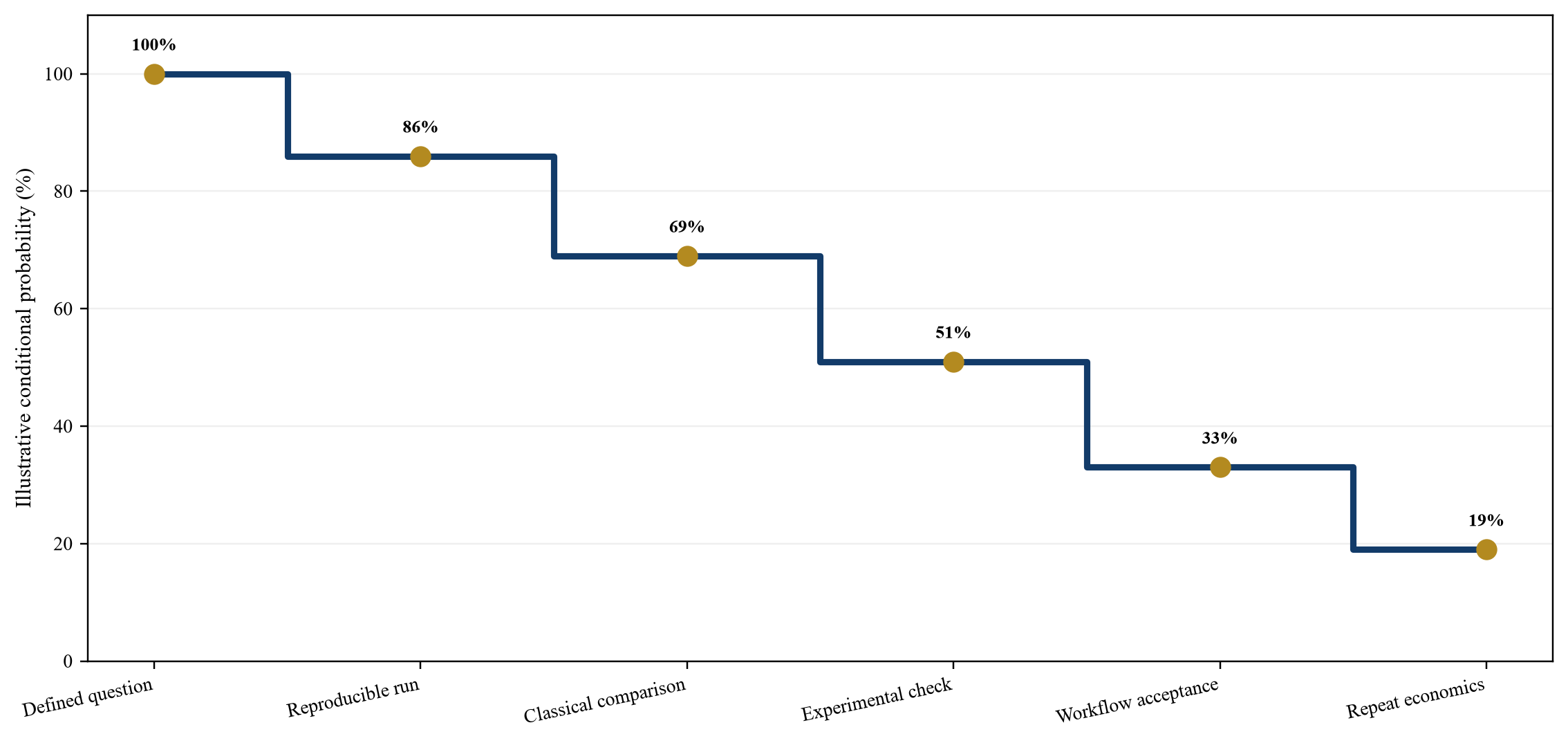
Proposed sequence; each stage requires a reproducible record and acceptance rule.
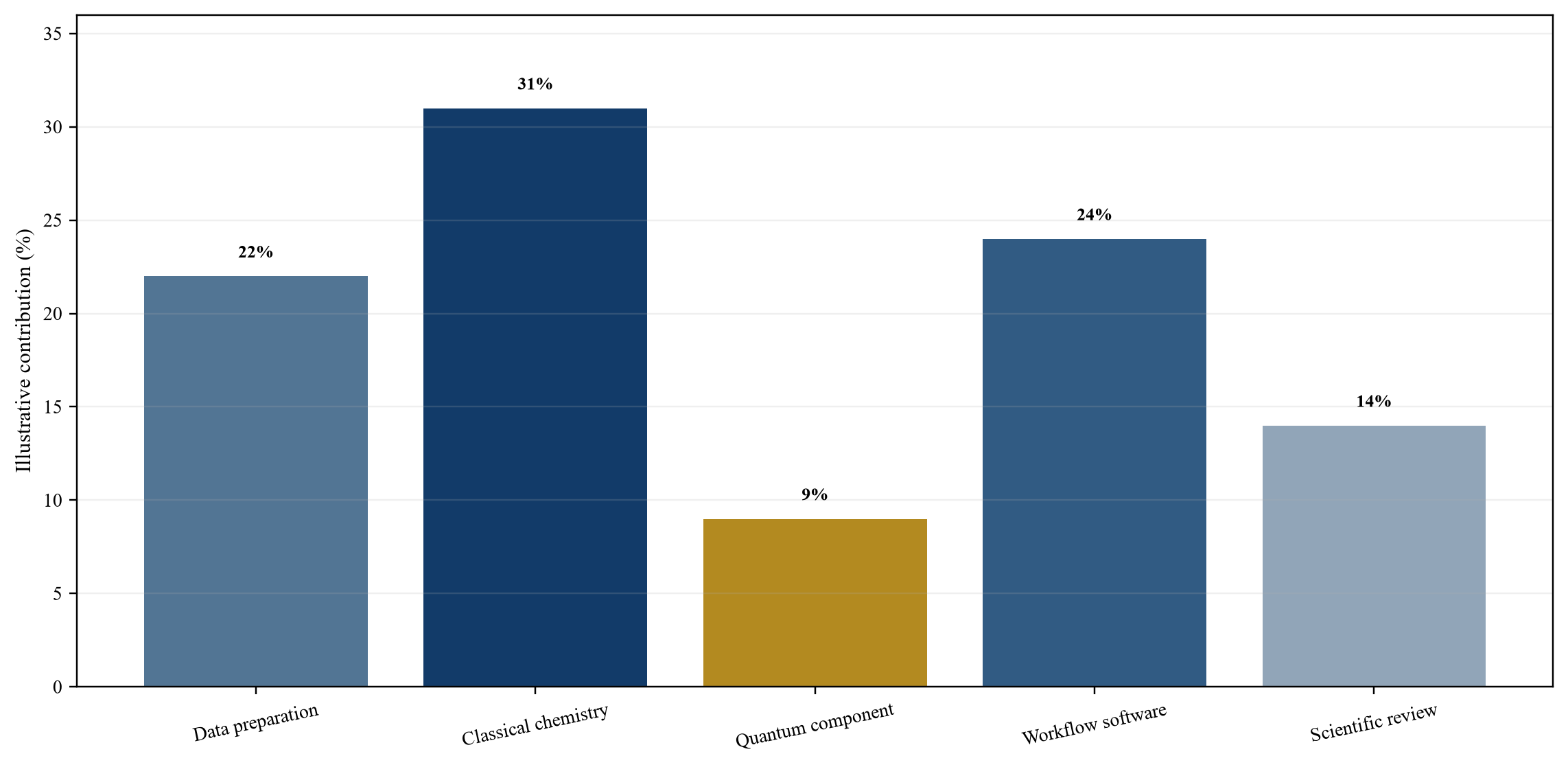
Wholly hypothetical management assumptions; accepted decision events by contribution.
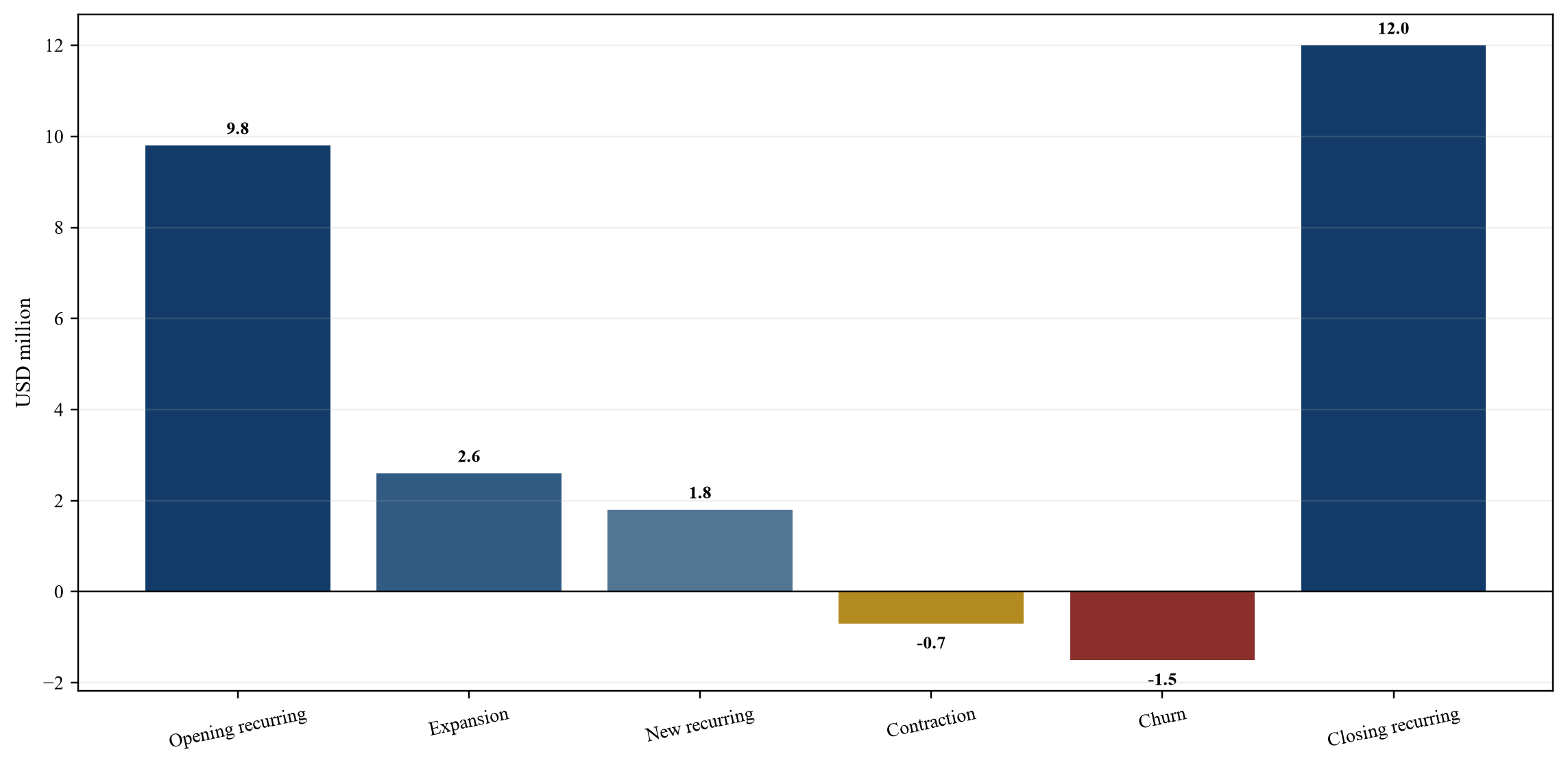
Wholly hypothetical management assumptions; USD million.
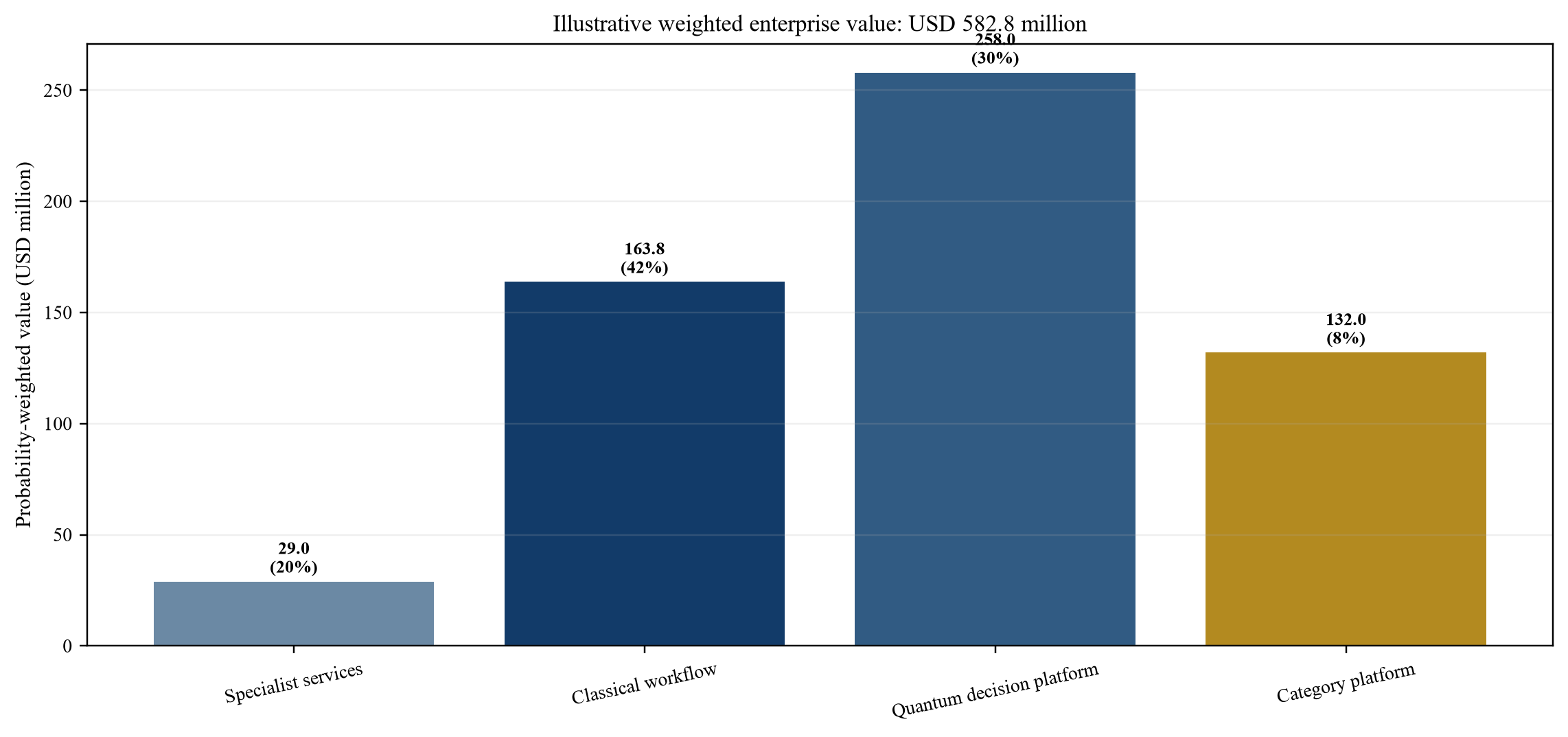
Wholly hypothetical management assumptions; USD million.
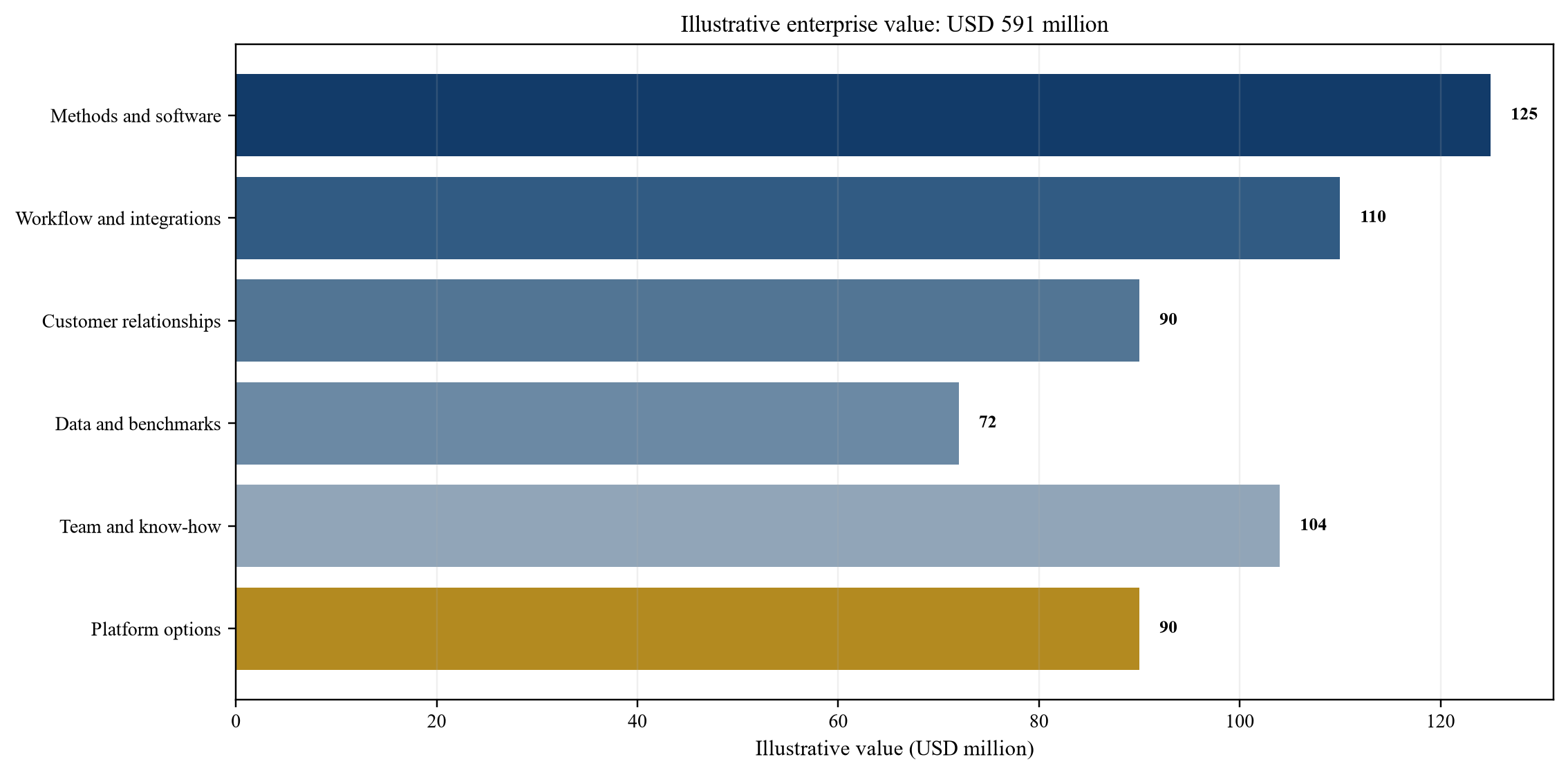
Wholly hypothetical management assumptions; USD million.
| Level | Core question | Required evidence | Valuation use |
|---|---|---|---|
| Calculation | Does the software produce a result? | Defined system and complete run | Technical capability |
| Reproducibility | Can an independent team recreate it? | Clean environment and run manifest | Transfer value |
| Comparative result | Does it improve on suitable methods? | Credible classical portfolio and full resources | Method premium |
| Experimental grounding | Does it agree with relevant observations? | Reference data, uncertainty and conditions | Scientific credibility |
| Decision acceptance | Does a customer use the output? | Governed decision record | Workflow value |
| Repeat economics | Does use produce renewal and gross profit? | Contracts, cash and cohort | Income value |
Proposed definitions; each level requires separate evidence.
| Stage | Principal evidence | Common dependency | Review output |
|---|---|---|---|
| Scientific question | Context of use and decision consequence | Customer scientist | Approved question |
| Molecular representation | Structure, basis and active space | Chemistry package | Input manifest |
| Computation | Code, parameters and resources | HPC or quantum provider | Reproducible run |
| Validation | Experimental or accepted reference | Laboratory data | Credibility report |
| Decision | Acceptance and accountable owner | Customer governance | Decision record |
| Learning | Outcome, correction and reuse rights | Data contract | Value and rights ledger |
Proposed transaction-diligence record.
| Dimension | Diligence question | Evidence | Failure mode |
|---|---|---|---|
| Verification | Does code solve the stated model correctly? | Tests and reference cases | Software error |
| Validation | Does output agree with suitable observations? | Experimental comparison | Unsupported accuracy |
| Applicability | Is the new system inside the supported domain? | Domain definition and similarity | Extrapolation risk |
| Uncertainty | Are important sources quantified? | Sensitivity and uncertainty analysis | False precision |
| Governance | Is use approved for the decision? | Review, version and audit trail | Uncontrolled reliance |
Proposed minimum review for material use cases.
| Value component | Illustrative amount | Evidence gate | Downside treatment |
|---|---|---|---|
| Scientific methods and software | USD 125 million | Clean build, rights and credible performance | Reproduction deduction |
| Workflow software and integrations | USD 110 million | Customer deployment and portability | Remediation reserve |
| Customer relationships | USD 90 million | Acceptance, renewal and cash | Retention adjustment |
| Data and benchmark assets | USD 72 million | Provenance, rights and contribution | Rights deduction |
| Team and know-how | USD 104 million | Critical-role retention and transfer | Service-based retention |
| Quantum and platform options | USD 90 million | Held-out validation and customer economics | Contingent consideration |
Wholly hypothetical management assumptions; not observed company or transaction data.
| Evidence | What it supports | Limitation | Valuation use |
|---|---|---|---|
| Research collaboration | Joint scientific work | May lack product acceptance | Relationship evidence |
| Paid pilot | Budget and defined question | Bespoke delivery may not scale | Probability-adjusted conversion |
| Accepted workflow | Use against agreed criteria | Renewal remains unproven | Product and contract value |
| Governed decision use | Output enters approved process | May remain programme specific | Strong workflow evidence |
| Repeat paid use | Continuing relevance and budget | Concentration may remain | Stronger income evidence |
Proposed classification for revenue diligence.
| Measure | Illustrative amount | Diligence question | Valuation consequence |
|---|---|---|---|
| Recurring workflow software and usage | USD 12 million | Renewal, margin and active use | Income support |
| Scientific services | USD 9 million | Specialist effort and product conversion | Services adjustment |
| Research collaborations | USD 5 million | Restrictions and recurrence | Separate from product multiple |
| Cloud resale and other income | USD 3 million | Net economics and dependency | Margin adjustment |
| Unrestricted cash | USD 84 million | Availability and commitments | Equity-value reconciliation |
| Annual cash use | USD 36 million | Next evidence gate and financing lead time | Runway and dilution adjustment |
Wholly hypothetical management assumptions; USD million.
| Decision area | Green evidence | Amber condition | Red condition |
|---|---|---|---|
| Scientific evidence | Reproducible and experimentally grounded | Bounded validation plan | Selective demonstrations only |
| Workflow control | Integrated, documented and portable | Costed manual or provider dependency | Founder-only or inaccessible process |
| Customers | Governed use, renewal and cash | Pilot with conversion evidence | Logos or pipeline treated as revenue |
| Rights | Code, data and licences transferable | Costed remediation | Critical assets unowned or restricted |
| Valuation | Achieved workflow value separated from options | Wide but explicit scenarios | Quantum label substitutes for evidence |
Proposed decision framework.
Sources
- U.S. Food and Drug Administration, M15 General Principles for Model-Informed Drug Development, 2026. Read the primary source
- International Council for Harmonisation, M15 General Principles for Model-Informed Drug Development, 2026. Read the primary source
- National Institute of Standards and Technology, Computational Chemistry Comparison and Benchmark Database. Read the primary source
- National Institute of Standards and Technology, BenchQC: A Benchmarking Toolkit for Quantum Computation, 2025. Read the primary source
- K. Korhonen and collaborators, Practical techniques for high-precision measurements on near-term quantum hardware and applications in molecular energy estimation, npj Quantum Information, 2025. Read the primary source
- T. N. Georges and collaborators, Quantum simulations of chemistry in first quantization with any basis set, npj Quantum Information, 2025. Read the primary source
- N. Nguyen and collaborators, Quantum computing for corrosion simulation: workflow and resource analysis, npj Quantum Information, 2026. Read the primary source
- Quantinuum, InQuanto platform overview. Read the primary source
- Quantinuum, InQuanto workflow documentation. Read the primary source
- Amazon Web Services, Amazon Braket Hybrid Jobs. Read the primary source
- Amazon Web Services, How Amazon Braket works. Read the primary source
- IBM Quantum Documentation, Qiskit Nature. Read the primary source
- Microsoft Azure Quantum, Chemistry and materials solutions. Read the primary source
- Google Quantum AI, Quantum simulation resources. Read the primary source
- U.S. Food and Drug Administration, Modeling and Simulation at FDA. Read the primary source
- U.S. Food and Drug Administration, Focus Area: Model-Informed Product Development. Read the primary source
- U.S. Food and Drug Administration, New Approach Methodologies. Read the primary source
- S. McArdle and collaborators, Quantum computational chemistry, Reviews of Modern Physics, 2020. Read the primary source
- Y. Cao and collaborators, Quantum Chemistry in the Age of Quantum Computing, Chemical Reviews, 2019. Read the primary source
- Google Quantum AI and collaborators, Hartree-Fock on a superconducting qubit quantum computer, Science, 2020. Read the primary source
- IBM Research and collaborators, Hardware-efficient variational quantum eigensolver for small molecules and quantum magnets, Nature, 2017. Read the primary source
- A. Peruzzo and collaborators, A variational eigenvalue solver on a photonic quantum processor, Nature Communications, 2014. Read the primary source
- P. J. J. O'Malley and collaborators, Scalable Quantum Simulation of Molecular Energies, Physical Review X, 2016. Read the primary source
- National Institute of Standards and Technology, Quantum Information Science. Read the primary source
- International Organization for Standardization, ISO/IEC 4879:2024 Quantum computing vocabulary. Read the primary source
- National Institute of Standards and Technology, Cybersecurity Framework 2.0. Read the primary source
- National Institute of Standards and Technology, Secure Software Development Framework SP 800-218. Read the primary source
- IFRS Foundation, IFRS 3 Business Combinations. Read the primary source
- IFRS Foundation, IFRS 13 Fair Value Measurement. Read the primary source
- IFRS Foundation, IAS 38 Intangible Assets. Read the primary source
- International Valuation Standards Council, International Valuation Standards. Read the primary source
- United States Securities and Exchange Commission, Schrodinger annual report, 2026. Read the primary source
