
1. The capital-allocation decision
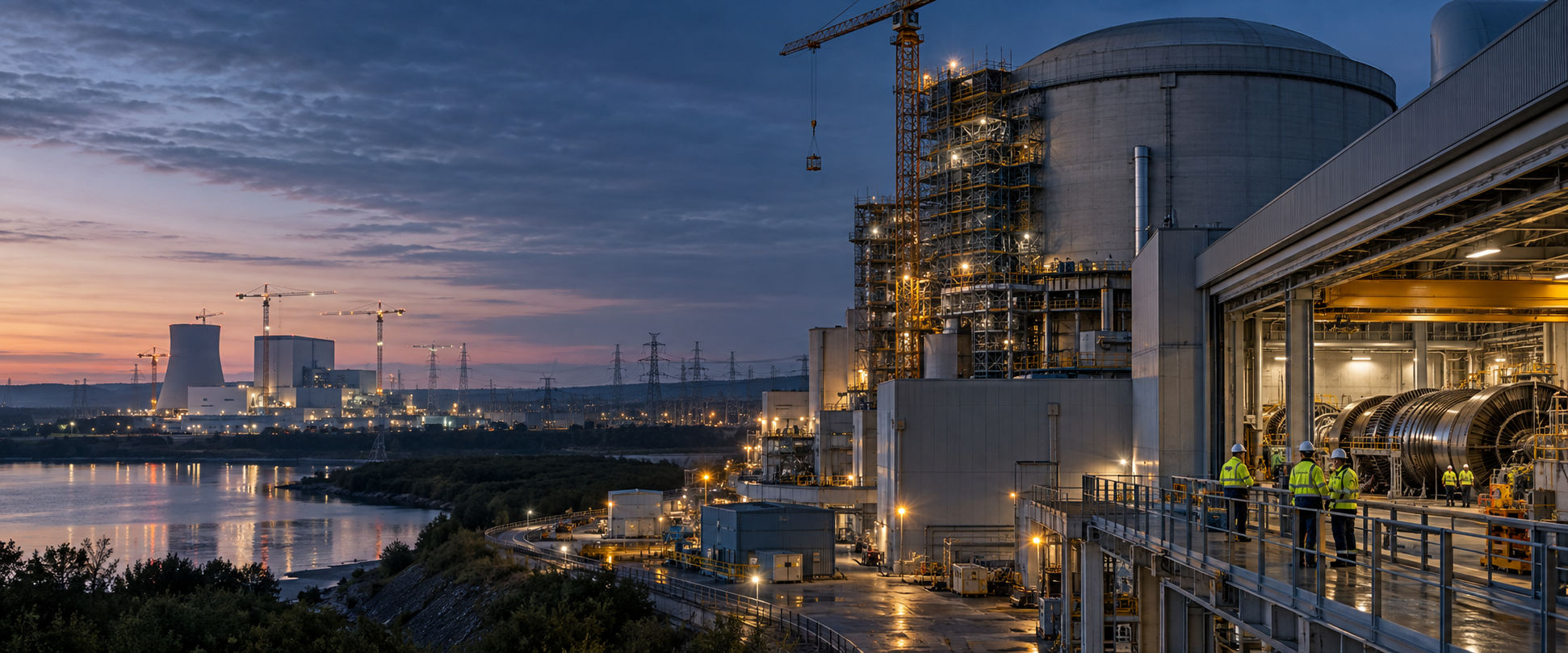
The decision is whether further capital committed to an existing reactor creates more risk-adjusted system value than the credible alternatives. Refurbishment may include fuel-channel replacement, steam-generator work, turbine and generator renewal, control-system modernisation, civil upgrades, electrical replacement, cooling-system work, seismic improvements and new safety equipment. The scope can range from an extended outage with selected component replacement to a multi-unit programme lasting a decade.
The counterfactual is rarely a single new reactor. It may combine new nuclear, renewables, storage, gas capacity, demand response, interconnection and network reinforcement. A fair comparison therefore measures delivered energy, dependable capacity, grid services, carbon exposure, completion timing and financing. It also recognises that a functioning nuclear site contains permits, cooling access, transmission rights, trained people and operating systems whose replacement cost is not visible in overnight construction cost.
2. Safety eligibility precedes economics
No financial advantage can substitute for an acceptable safety case. The International Atomic Energy Agency frames long-term operation around systematic ageing management, periodic safety review, plant configuration, operating experience and time-limited ageing analyses. The United States Nuclear Regulatory Commission similarly requires licence-renewal applicants to demonstrate that the effects of ageing will be managed during the extended operating period.
The investment process should begin with an exclusion gate. Components that cannot be replaced or credibly managed, unresolved degradation mechanisms, inadequate environmental qualification, weak safety culture or an infeasible licensing pathway can terminate the refurbishment option. Capital modelling begins only after the owner and regulator identify a plausible route to safe operation for the proposed life.
3. Long-term operation is an integrated programme
Long-term operation is not permission to continue with routine maintenance. It connects engineering assessment, safety improvement, component replacement, obsolescence management, outage planning, procurement, workforce readiness and financing. The scope must be designed around the future operating period rather than the next inspection cycle.
Plant life management provides the economic bridge. It turns asset condition and safety requirements into a sequenced investment plan, establishes which work is mandatory, distinguishes enhancement from replacement and tests whether expected post-work performance supports the capital. A programme that separates engineering from finance can understate scope, misprice outage risk and overvalue the operating years gained.
4. The strategic alternatives
Four alternatives should normally remain visible until the evidence narrows them. The first is refurbishment for a defined life extension. The second is continued operation with only required maintenance until the current authorised end date. The third is replacement by a new firm generating asset. The fourth is replacement by a portfolio of generation, storage, flexibility and network investments.
These alternatives have different delivery dates and risk concentrations. Refurbishment concentrates risk in condition discovery and outage execution. New nuclear concentrates risk in development, construction and financing. A portfolio may reduce single-project exposure but introduce land, connection, balancing and market risks. Continued operation with no major life extension can preserve optionality while consuming time needed to develop replacement capacity.
5. The decision stage gate
The programme should move through successive gates: strategic need, safety feasibility, scope definition, reference-class cost, outage readiness, financing, final investment decision, execution hold points and return to service. Each gate should have evidence requirements, decision rights and a termination rule. Regulatory approval and board approval are related but distinct.
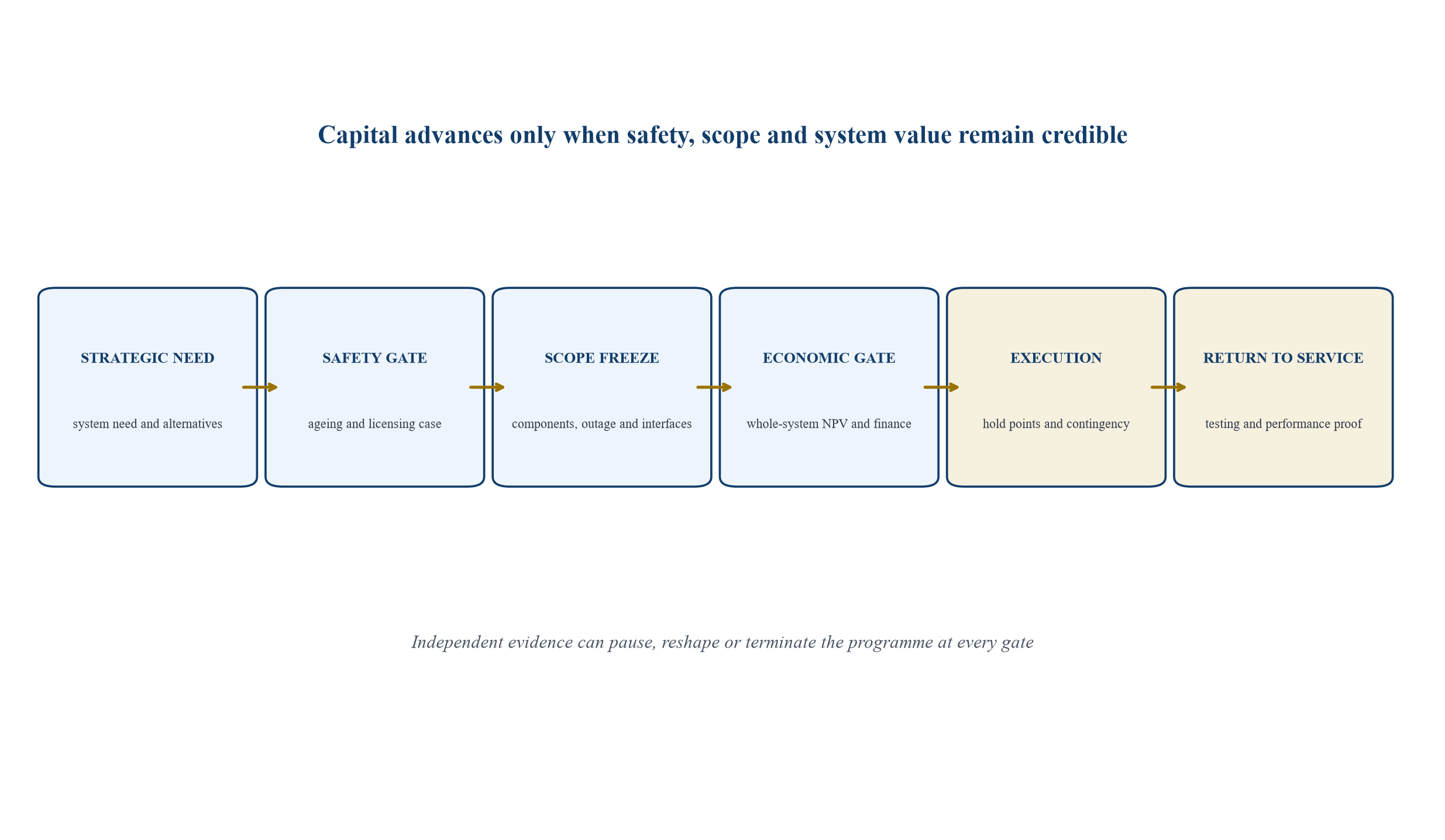
Generic framework. Regulatory requirements and hold points depend on the plant and jurisdiction.
6. Define the life gained
The denominator of refurbishment economics is the operating life that can reasonably be earned after the work. A headline extension of twenty or thirty years may contain regulatory review points, inspection obligations, component-specific limits and commercial uncertainty. The model should distinguish authorised life, technically supportable life and economically expected life.
Residual life should also be tested against future policy and market conditions. Cooling-water constraints, climate resilience, fuel-cycle policy, waste arrangements, market design and network requirements may change during the extended period. The base case should use a conservative operating horizon, with longer life treated as upside until supported by evidence.
7. Identify life-limiting components
Some major components can be replaced; others are effectively permanent. Reactor pressure vessels, containment structures and embedded systems require particular scrutiny because replacement may be impractical. Steam generators, pressure tubes, feeders, turbines, generators, transformers, pumps, cables and control systems can often be replaced or renewed, subject to plant design and access.
The owner needs a component-by-component map of condition, degradation mechanism, inspection confidence, remaining life, replacement method, lead time and consequence of failure. Correlated degradation matters. A portfolio of individually manageable components can become uneconomic when many require intervention during the same extension period.
8. Condition uncertainty has option value
Early inspection and engineering work can buy information before the full commitment. Material samples, non-destructive examination, mock-ups, destructive testing of retired components and supplier surveys reduce uncertainty about scope and execution. The value of this information is highest when it can change the decision.
The board should fund option-preserving studies separately from irreversible refurbishment expenditure. A limited development budget can establish the safety case, mature design and validate outage duration. The final investment decision should occur after the largest reducible uncertainties have been addressed and while the replacement alternative remains deliverable.
9. Scope architecture
Refurbishment scope should be divided into mandatory safety work, life-limiting component replacement, reliability improvement, power uprate, obsolescence removal, regulatory enhancements and discretionary performance work. This structure makes cost and value traceable. It also clarifies which items remain necessary if the commercial case weakens.
Interfaces between packages can dominate execution risk. A turbine upgrade may depend on condenser work, cooling capacity, electrical protection and grid studies. Digital instrumentation may require plant-wide cybersecurity and human-factors approval. Scope control should therefore operate at system level rather than as a list of independent projects.
10. Reference-class estimating
Plant-specific engineering should be tested against completed programmes and comparable components. Reference-class analysis can expose optimism in labour productivity, outage duration, contingency, commissioning and first-of-a-kind work. Comparability must be explicit because reactor design, regulation, labour market and fleet standardisation differ.
Ontario Power Generation's Darlington programme provides a completed multi-unit reference. EDF's Grand Carenage provides a large fleet programme covering inspections, safety improvements, major component work and performance restoration. United States licence renewal offers a different model in which ageing management and selected capital work support operation toward sixty or eighty years. None should be copied without adjustment.
11. A cost-performance benchmark
The benchmark should connect each spend category to the performance or risk outcome it purchases. A safety upgrade can be mandatory even without incremental output. Turbine work may increase output or efficiency. Digital control replacement may reduce obsolescence risk and improve diagnostics. Cooling upgrades may preserve operation under warmer conditions.
Table 1. Refurbishment cost and performance benchmark
| Scope category | Economic purpose | Principal evidence | Key downside test |
|---|---|---|---|
| Safety and regulatory modifications | Establish acceptable extended-operation basis | Safety case, periodic review, regulator findings | Additional requirements after scope freeze |
| Primary-system life extension | Replace or manage life-limiting components | Inspection data, degradation models, mock-ups | Condition discovery and access constraints |
| Turbine-generator renewal | Restore reliability and recover output | Heat-rate tests, outage history, OEM assessment | Uprate unavailable or reliability gain not sustained |
| Electrical and control modernisation | Remove obsolescence and strengthen monitoring | Spares review, cybersecurity case, human factors | Integration failure and commissioning delay |
| Cooling and climate resilience | Preserve output and safety margins | Site climate scenarios, water studies, thermal limits | Derating, water restriction or major civil scope |
| Site and grid interfaces | Retain connection and system services | Connection agreement, protection study, stability model | Reinforcement required despite retained site |
Illustrative categories; actual scope depends on design, condition and regulation.
12. Outage duration is a capital item
During the refurbishment outage, the plant loses energy and capacity revenue while the owner pays replacement-power costs and fixed operating expenses. Delay can therefore destroy value even when physical capital cost remains within budget. The schedule model should price each month of outage using seasonal market conditions and system scarcity.
Outage duration depends on pre-fabrication, access, sequencing, component discovery, labour productivity, lifting strategy, testing and regulatory hold points. Schedule contingency should be risk-based. A fixed percentage applied to the critical path can miss discrete events such as pressure-boundary repair or failed commissioning tests.
13. Replacement lead time sets the comparison clock
Replacement cannot be assumed available on the date the existing plant closes. New nuclear can require site approval, design licensing, financing, supply-chain mobilisation, construction and commissioning. Renewable portfolios require land, connections, storage and network works. Gas capacity requires fuel infrastructure and creates fuel-price and emissions exposure.
The correct model places each alternative on a common calendar. A refurbishment that returns firm capacity in four years may have substantial time-to-power value against a replacement portfolio that matures over ten years. Delay in initiating either option can create a capacity gap with its own cost.
14. Retained grid connection value
An operating nuclear site generally has a high-capacity transmission connection, protection systems, switchyard, access, water infrastructure and an established operational interface with the system operator. Replacement elsewhere may require new network investment and face a connection queue. Reuse can reduce development time and preserve stability services.
The connection should be valued through avoided reinforcement and time gained, subject to technical studies. It is not automatically transferable to a different technology or capacity. Changes in fault level, reactive power, inertia and operating profile can require additional equipment even at the same site.
15. Firm capacity and energy are separate products
Annual megawatt-hours do not capture dependable capacity during tight system periods. A replacement portfolio may produce similar energy while providing a different contribution to adequacy. Storage duration, weather correlation, forced-outage risk, fuel availability and interconnection must be modelled.
Refurbished nuclear also has forced-outage risk and common-mode exposure. The capacity value should reflect expected post-work reliability rather than historic peak performance. A balanced comparison measures energy, dependable capacity and ancillary services separately, then reconciles them into system cost.
16. System services
Large synchronous generators can provide inertia, voltage support, fault current and frequency response, depending on plant configuration and operating rules. These services may have explicit market prices or remain embedded in network planning. Replacement portfolios may need synchronous condensers, grid-forming inverters or other equipment.
The economic case should identify which services the existing unit actually provides, what remains after refurbishment and what replacement equipment would cost. Claims of system value require technical evidence from the system operator. Avoided cost should be recognised only where the alternative plan would otherwise incur it.
17. Post-refurbishment performance
The base case should specify capacity factor, forced-outage rate, planned outage duration, net output, thermal efficiency and operating cost after return to service. Improvements should be tied to scope. A power uprate requires engineering, licensing and grid approval. Reliability improvement requires evidence that the relevant failure drivers are addressed.
Performance warranties can align contractors with the investment case. Guarantees may cover component availability, heat rate, output or schedule. They should be backed by creditworthy counterparties and calibrated to actual economic loss. Some nuclear risks will remain with the owner because suppliers will not accept open-ended consequential exposure.
18. Operating-cost trajectory
An ageing plant can require higher inspection, maintenance and specialist labour. Refurbishment may reset selected costs while new ageing mechanisms continue. The model should forecast fixed and variable operating cost by workstream rather than extrapolating a recent average.
Fuel, security, insurance, regulatory fees, waste, outage maintenance and corporate support should be treated consistently across alternatives. Fleet effects also matter. A single remaining unit may lose shared services and purchasing scale as neighbouring units retire. A fleet programme may lower unit costs through standardisation and repeat work.
19. Decommissioning interaction
Refurbishment defers final shutdown and may change the decommissioning plan, fund profile and waste inventory. Deferral can preserve cash and allow the decommissioning fund to grow. It can also create additional future liabilities through continued operation and activated materials.
The model should include incremental decommissioning and waste costs attributable to life extension, together with changes in funding requirements. Existing liabilities are generally sunk for the go-forward decision, yet timing effects remain economically relevant. Double counting occurs when the full historic liability is charged only to refurbishment.
20. Spent fuel and waste capacity
Extended operation produces additional spent fuel and operational waste. Storage, transport, disposal and site infrastructure must be adequate for the proposed period. A constrained spent-fuel pool or interim store can become a capital prerequisite.
National waste policy affects both timing and confidence. The financial model should include owner obligations under the applicable regime and stress delayed availability of off-site disposal. A programme can remain economic while requiring material waste investment, provided the cost and schedule are visible before commitment.
21. Climate resilience
Long-term operation extends exposure to changing temperature, flood, drought, storm, wildfire and sea-level conditions. Cooling-water availability and discharge limits can affect output. Safety systems, external hazards and emergency arrangements may require adaptation.
Climate resilience should be embedded in scope and performance assumptions. The owner should use site-specific scenarios rather than historical averages alone. A replacement option at the same site faces many of the same hazards, while a geographically diverse portfolio may reduce concentration risk.
22. Supply-chain readiness
Long-lead forgings, nuclear-qualified materials, specialist welding, non-destructive examination, controls, cables and heavy-lift equipment can determine the critical path. Obsolete components may require redesign and qualification. Limited supplier capacity can create correlated risk across several programmes.
Early market engagement should test manufacturing slots, quality systems, export controls, workforce and financial capacity. Reservations may preserve schedule but create cancellation exposure. The contracting plan should distinguish commodities, repeatable fleet work and design-sensitive packages.
23. Workforce and knowledge
The existing workforce holds plant-specific knowledge that is difficult to recreate after closure. Refurbishment can retain and renew that capability while requiring a surge of construction labour. Replacement may create a longer development gap during which experienced personnel leave.
The business case should value recruitment, training, security clearance, competence maintenance and knowledge transfer. Productivity assumptions should reflect the constrained nuclear work environment. A crowded site, radiological controls and permit interfaces can make apparent industrial benchmarks unrealistic.
24. Contracting strategy
An owner may use engineering, procurement and construction packages, alliance contracts, target-cost arrangements, reimbursable work or a hybrid. The structure should match scope maturity and control. Fixed prices can be expensive or fragile where latent condition risk is high. Open-book reimbursement can weaken cost discipline without target and pain-share mechanisms.
Contract boundaries should minimise interface risk. The owner must retain an intelligent-client capability able to integrate design, safety, schedule, quality and commissioning. Contracting cannot transfer the regulatory duty or all consequences of delayed generation.
25. Regulatory hold points
Return to service should occur through predefined hold points supported by completion assurance and evidence. The Canadian Nuclear Safety Commission's refurbishment approach shows how unit-specific return-to-service protocols can define regulatory conditions before equipment is loaded, systems are commissioned and power increases.
The integrated master schedule should include regulatory review durations and evidence production. Commercial pressure should not bypass hold points. The financing plan needs liquidity for rework or extended testing because approval follows demonstrated completion rather than the owner's planned date.
26. Darlington as a completed programme
Ontario Power Generation's Darlington refurbishment replaced major reactor components and upgraded systems across four units. OPG states that the programme's approved budget was C$12.8 billion and that the work supports at least thirty additional years of operation. In February 2026, OPG reported construction completion four months ahead of the baseline schedule and forecast C$150 million below budget.
Darlington demonstrates the value of extensive planning, a sequenced multi-unit programme, learning across units and formal return-to-service controls. It does not eliminate plant-specific risk. Its governance, reactor design, provincial market structure and owner capability form part of the result.
27. Fleet learning and repeatability
Multi-unit programmes can reuse tooling, training, design, suppliers and lessons. Later units may benefit from demonstrated methods and known interfaces. They can also inherit common errors. Learning should be measured by task rather than assumed from unit sequence.
The investment model can recognise expected productivity improvement while maintaining contingency for unit-specific condition. A fleet owner should preserve configuration control so that standardisation remains real. Variations introduced during execution can erode repeatability.
28. Grand Carenage and fleet renewal
EDF's Grand Carenage programme combines periodic inspections, safety improvements, major component refurbishment, resilience work and performance measures across the French fleet. EDF's 2025 facts and figures describe approximately EUR 5 billion of annual investment and estimated phase-two expenses of EUR 36.3 billion, including stress-corrosion repairs.
The programme illustrates the scale of coordinated fleet renewal. It also shows how emerging degradation can alter scope. A fleet-level business case should retain reserves for common-mode findings and plan industrial capacity across units so that simultaneous outages do not undermine system adequacy.
29. United States licence renewal
The United States framework allows reactor licences to be renewed in twenty-year increments. The NRC's subsequent licence renewal process addresses operation from sixty to eighty years through updated ageing-management guidance, including attention to reactor parts, concrete, piping and electrical cables.
Licence duration does not determine commercial life. Owners still decide whether market revenues, operating costs and capital requirements support continued operation. The regulatory process provides a safety pathway, while the economic decision remains plant-specific.
30. Financing long-term operation
Lifetime extensions can be easier to finance than new reactors because they involve operating assets with established revenue, performance history and infrastructure. The International Energy Agency notes this distinction and records the use of green debt for lifetime extension and refinancing.
Financing still depends on outage risk and revenue during the shutdown. Lenders will test liquidity, contractor protection, cost contingency, covenant headroom, insurance and the post-work revenue model. A long-term offtake contract, regulated revenue or capacity mechanism may support leverage where merchant exposure is material.
31. Capital structure
Debt capacity should be sized to downside cash flow rather than the base-case value gain. Construction or refurbishment facilities may convert into operating debt after return-to-service tests. Equity or contingent liquidity should cover cost overruns and lost revenue that lenders will not fund.
The capital structure should preserve decision discipline. Excessive sunk capital can create pressure to continue after the economics deteriorate. Staged commitments, sponsor support and independent certification can keep later funding conditional on remaining completion value.
32. Revenue architecture
Revenue may come from regulated tariffs, bilateral contracts, capacity payments, clean-energy credits, ancillary services or merchant markets. Each source has a different duration, volume risk and credit profile. The refurbishment life can extend beyond contracted revenue.
The model should separate physical performance from price support. A strong engineering case can remain unfinanceable without a credible revenue floor. A generous revenue contract cannot rescue a plant whose safe and reliable operation is not established.
33. Cost of capital
Discount rates should reflect the risk of each alternative and phase. Applying one corporate hurdle rate to refurbishment and greenfield replacement can distort the result. Development-stage replacement risk differs from operating-stage nuclear risk. Regulated or contracted revenue can lower exposure.
The model should show both project cash flow and financing cash flow. A lower cost of capital can materially favour assets with large upfront expenditure and long lives. Transparency about discount rates is essential because small changes can reorder options.
34. A common time-to-power comparison
The outage and replacement timelines should be shown on one axis. Refurbishment development can overlap continued operation. The major outage creates a concentrated loss of output, followed by return to service. Replacement capacity may arrive in tranches, and network work may sit on its critical path.
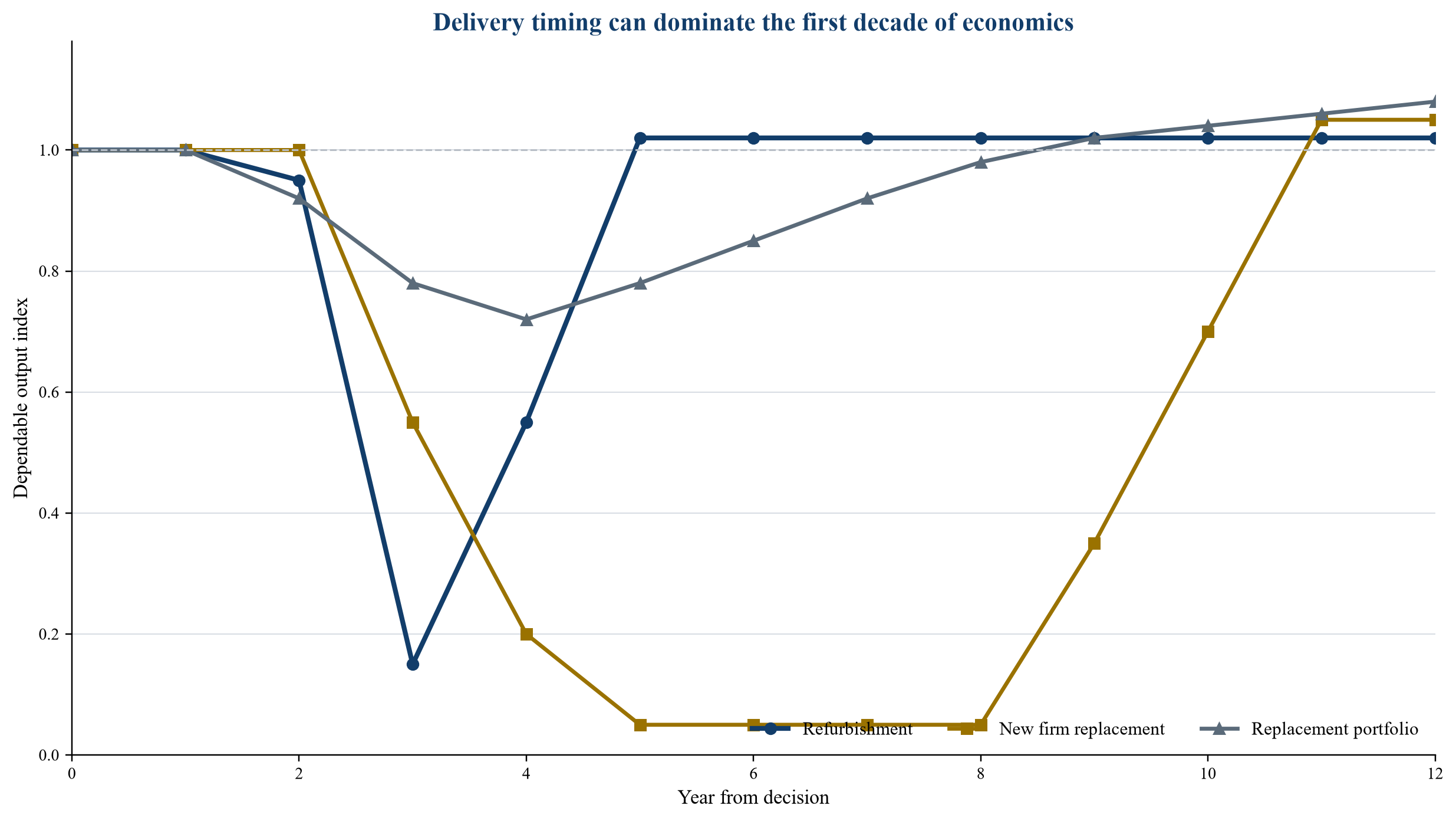
Years and output profiles are illustrative. They do not describe a named plant or project.
35. Build the economic boundary
The economic boundary should include refurbishment capital, development expenditure, outage replacement power, lost revenue, operating cost, fuel, waste, decommissioning timing, post-work performance and financing. The replacement side should include development, construction, connection, transmission, balancing, reserve, fuel, carbon and decommissioning of the old plant.
Taxes and transfer payments should be treated consistently with the decision-maker's perspective. A utility shareholder view differs from a government or system-cost view. Both may be necessary where public support is involved.
36. Avoid sunk-cost errors
Historic construction cost does not determine whether incremental refurbishment is economic. Existing infrastructure has opportunity value, but past expenditure is sunk. The decision should compare future cash flows from the decision date.
Development expenditure already incurred on replacement options may also be sunk. Boards should keep the counterfactual current rather than allowing organisational ownership to bias the comparison. Separate teams or independent review can challenge asymmetric assumptions.
37. Sources and uses
The sources-and-uses model should identify cash requirements before, during and after the outage. Pre-outage development, supplier deposits and site preparation can be material. During the outage, construction expenditure coincides with low generation revenue. Commissioning can require further liquidity before performance is proven.
Table 2. Hypothetical refurbishment sources and uses
| Uses | Illustrative units | Funding source | Control |
|---|---|---|---|
| Development, licensing and engineering | 8 | Sponsor equity | Stage-gate release |
| Long-lead equipment and advance works | 17 | Equity and committed facility | Supplier milestones and security |
| Major outage execution | 55 | Construction facility and equity | Independent progress certification |
| Replacement power and lost margin | 10 | Liquidity reserve | Monthly market-cost reconciliation |
| Contingency and condition discovery | 15 | Contingent sponsor support | Defined draw triggers and board approval |
| Commissioning and performance reserve | 5 | Restricted cash | Release after return-to-service tests |
| Total uses | 110 |
Monetary values are illustrative units and are not a forecast or valuation.
38. Lost-generation cost
Lost-generation cost should be modelled as the contribution margin or replacement cost attributable to the outage, not simply average wholesale price. Seasonal price, capacity obligations, hedges and fuel savings influence the result. The system perspective may value scarcity differently from the owner's accounting margin.
Schedule sensitivity should show the economic effect of each additional month. This creates a direct bridge from project controls to value. It also helps calibrate liquidated damages and incentive payments, subject to contractor capacity to bear them.
39. Replacement-power strategy
Owners can hedge outage exposure through forward purchases, bilateral contracts, capacity arrangements or portfolio generation. Hedging can reduce price volatility but creates volume and credit risk if the outage moves. The strategy should align with the schedule confidence curve.
The replacement-power cost belongs in the final investment decision because it is a consequence of refurbishment timing. It should not be hidden in the trading portfolio. A transparent transfer price allows the board to compare physical and commercial mitigation.
40. Residual value
At the end of the model horizon, a refurbished plant may retain further operating option value, site value or decommissioning obligations. A replacement asset may have a much longer remaining life. Terminal-value assumptions can dominate the comparison.
The model should therefore show results with and without terminal value. Any residual value should be supported by remaining authorised life, asset condition and revenue assumptions. A conservative case can assign no value beyond the defined operating period while retaining liabilities.
41. Carbon and fuel exposure
Refurbishment can avoid fossil generation during the period before other firm low-carbon capacity is available. The value depends on the actual replacement mix and carbon price. Fuel-price volatility and energy-security considerations may be material even where they do not appear in plant-level LCOE.
Carbon benefits should be estimated from marginal system emissions, not the average grid factor alone. New nuclear and renewable portfolios can also deliver low-carbon output, but their commissioning date determines the cumulative emissions difference.
42. Levelised cost and its limits
Levelised cost provides a useful common metric when assumptions are consistent. The IEA and OECD NEA's 2020 analysis found nuclear long-term operation highly competitive and noted that brownfield life extension can cost less than new low-carbon investment. Plant-level LCOE excludes transmission and many system effects.
Decision-makers should use LCOE alongside net present value, affordability, capacity value, time-to-power and downside liquidity. An option with a low average cost may still be unacceptable if it exposes the owner to an unfinanceable outage overrun.
43. Scenario valuation
The base case should be accompanied by downside cases for cost, schedule, output, operating expenditure, life and replacement timing. Correlated cases matter. A long outage can coincide with higher replacement-power prices and additional capital. Component discovery can also reduce the remaining life expected after the work.
Probabilistic modelling can complement deterministic cases where input distributions are evidence based. It should not conceal weak scope maturity. The board needs interpretable thresholds that show when refurbishment ceases to create value.
44. Hypothetical NPV comparison
The illustrative model below compares three options using common nominal cash-flow conventions. It is designed to show sensitivity, not to estimate a named asset. Refurbishment value falls as outage delay and capital cost rise. Replacement value is sensitive to development duration, construction cost and the cost of covering the capacity gap.
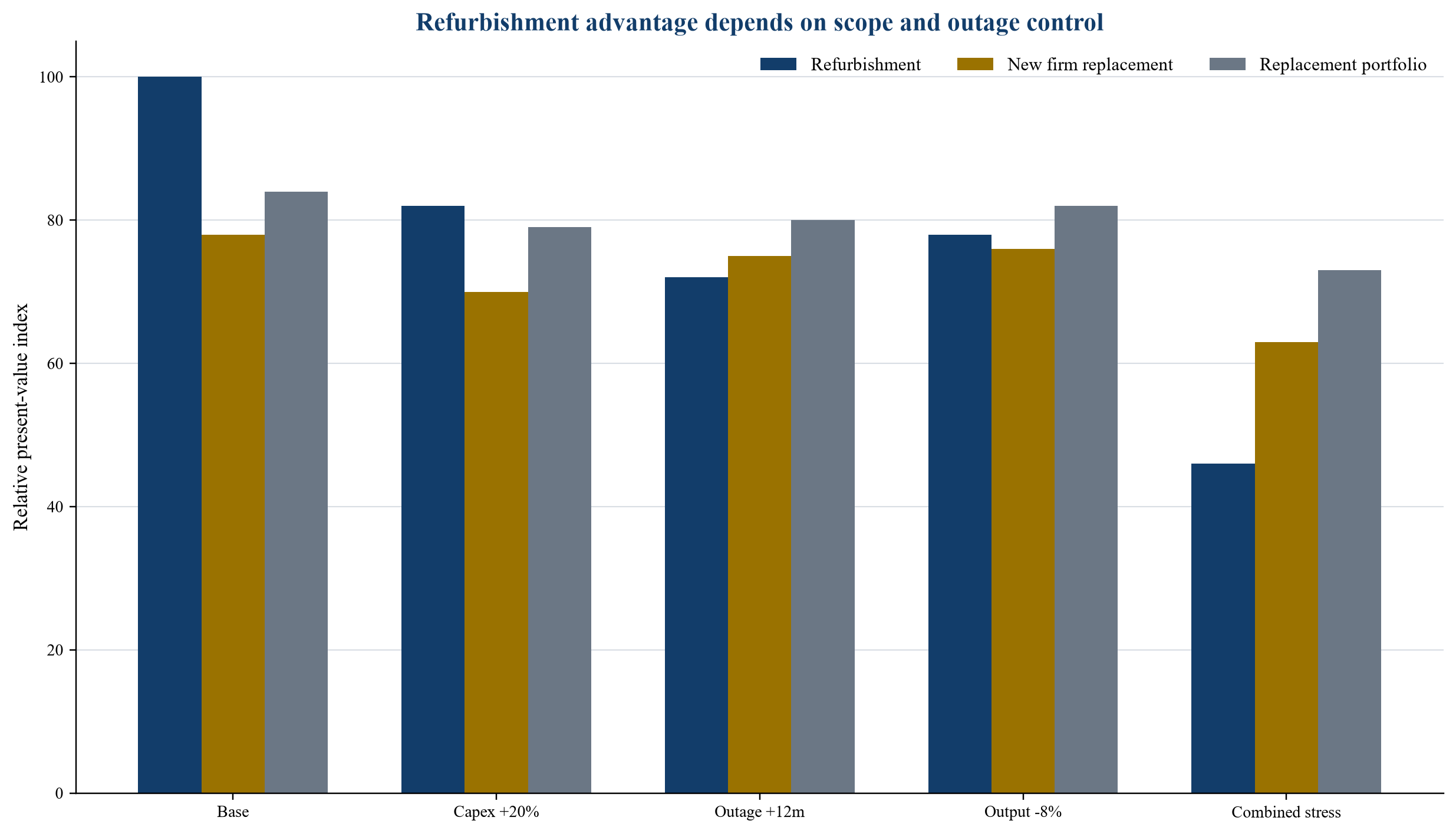
Index values are illustrative and are not a forecast or valuation.
45. Break-even thresholds
The investment committee should approve explicit break-even thresholds: maximum all-in capital, maximum outage duration, minimum post-work capacity factor, minimum life, minimum revenue floor and maximum annual operating cost. These thresholds should be translated into project indicators.
When forecasts cross a threshold, management should update the counterfactual and recommend continue, re-scope, defer or terminate. Thresholds should account for remaining completion cost and value at the decision date, avoiding automatic cancellation after sunk expenditure.
46. Real options
Refurbishment may preserve the option to operate while replacement technology matures. Continued operation can also preserve the site for future new nuclear, storage or other firm clean generation. Replacement development can be advanced in parallel to protect against failed life extension.
Option value depends on maintaining permissions, supply-chain access and decision time. A nominal alternative that cannot be delivered before closure provides limited protection. Boards should fund the least-cost actions needed to keep credible alternatives alive until the main decision is resolved.
47. Risk allocation
Risk should sit with the party best able to control or absorb it. The owner retains plant condition and regulatory duty. Contractors can bear productivity, quality and selected schedule risk within defined scope. Government or consumers may bear policy or market-design risk under public programmes. Lenders require protection against uncontrolled completion exposure.
Table 3. Refurbishment risk allocation and decision controls
| Risk | Primary control | Possible bearer | Decision evidence |
|---|---|---|---|
| Latent plant condition | Inspection, sampling, mock-ups and contingency | Owner with bounded contractor sharing | Condition register and quantified risk range |
| Design and integration | Configuration control and independent design review | Owner and responsible designers | Frozen interfaces and verified design maturity |
| Outage productivity | Detailed work packaging and rehearsals | Contractor within target-cost mechanism | Reference-class productivity and critical-path proof |
| Regulatory approval | Early engagement and completion assurance | Owner | Agreed hold points and evidence schedule |
| Lost generation | Hedging and schedule contingency | Owner or regulated customers under approved rules | Seasonal replacement-power model |
| Post-work reliability | Commissioning and performance warranty | Owner and qualified suppliers | Reliability growth plan and warranty security |
| Replacement delay | Parallel development and connection reservations | Replacement sponsor or system planner | Deliverable counterfactual schedule |
Generic allocation for investment-committee design.
48. Governance
The board should establish a programme committee with nuclear safety, engineering, finance and independent challenge. The nuclear operator retains safety authority. Commercial governance should never create pressure to suppress safety findings. Decision papers should show both the safety recommendation and economic consequence.
An independent technical adviser can certify progress, assess schedule, review contingency and test completion forecasts. Independence requires direct access to data and a clear duty to the appointing decision-maker. Reports should distinguish observed progress from management forecast.
49. Programme controls
Cost and schedule should share one work-breakdown structure. Each package should reconcile approved budget, commitment, accrual, actual cost, forecast, contingency, physical progress and critical-path effect. Change control should identify regulatory, condition, design and commercial causes.
Earned-value indicators can support oversight if work packages are measurable. They should be combined with engineering quantities and milestone evidence. Percentage-complete estimates without objective rules can create false confidence during a complex outage.
50. Commissioning and return to service
Commissioning is part of the capital programme rather than an administrative tail. System turnover, testing, regulatory evidence, fuel loading, low-power tests and staged power ascension can reveal defects. The schedule and liquidity plan should include rework.
Performance should be proven over a defined period before reserves, contractor holdbacks or sponsor support are released. A rapid return to full output can create operational risk if learning and defect correction are compressed.
51. Commercialisation roadmap
The roadmap begins with strategic system need and a credible alternative plan. It proceeds through condition assessment, regulatory engagement, scope maturation, supplier strategy, revenue support, financing and final investment decision. Execution starts only after long-lead items, design, permits and workforce reach defined maturity.
The final stage is benefits realisation. Post-work output, reliability, operating cost and system services should be compared with the approved case. Lessons should feed later units and future investment decisions.
52. The owner decision pack
The decision pack should contain the safety and licensing pathway, scope basis, asset-condition register, reference-class estimate, integrated schedule, contracting plan, workforce plan, revenue case, sources and uses, downside liquidity, replacement counterfactual, system-cost comparison, decommissioning impact and governance.
Every major assumption should identify an evidence owner and update date. The board should see a bridge from technical findings to cash flow. A single headline cost or LCOE cannot substitute for this chain.
53. The government decision pack
Government should assess adequacy, security, emissions, affordability, regional employment, supply-chain capability, fiscal exposure and market design. Public support should be conditional on transparent risk allocation and independent evidence.
If consumers or taxpayers carry outage, price or completion risk, the support mechanism should define caps, triggers, reporting and recovery. Public value should be measured against the same deliverable alternatives available to the system.
54. The lender decision pack
Lenders need a mature scope, credible schedule, experienced owner, contracted revenue, contingency, insurance, covenant headroom and completion support. Draw conditions should follow certified progress and preserve funding for safety-critical work.
The downside case should test debt service after delayed return to service and lower output. Refinancing assumptions should not be necessary for survival. Security and enforcement require careful treatment in a regulated nuclear asset.
55. Red flags
Red flags include a life extension justified only by average LCOE, an undefined replacement counterfactual, unresolved permanent-component condition, weak outage planning, low contingency, supplier reservations without interface maturity, unsupported uprate assumptions, revenue contracts shorter than debt, and a decommissioning plan excluded from the model.
Another warning is a decision date so late that closure becomes the only alternative to refurbishment. Option erosion can manufacture apparent value. Good governance keeps replacement development sufficiently advanced to preserve choice.
56. Decision rules
Refurbishment is strongest when the safety pathway is credible, life-limiting components are manageable, scope is mature, outage execution is rehearsed, post-work reliability is supportable, replacement capacity is slower or more expensive, and the retained site and grid connection have material value.
Replacement is stronger when non-replaceable constraints dominate, degradation is uncertain, regulatory requirements keep expanding, recurring outages reduce availability, operating costs rise structurally, or the system can deliver a superior portfolio within the required time. Deferral can be rational when information can be obtained without losing the alternative.
57. Conclusion
Reactor refurbishment is a decision about the next operating life of an integrated energy asset. Its value comes from safe extended operation, retained infrastructure, time-to-power and dependable low-carbon output. Its risk comes from condition discovery, outage execution, performance and the possibility that capital is committed before the evidence is mature.
A rigorous comparison places refurbishment and replacement on the same calendar and within the same system boundary. Safety eligibility gates the process. Technical scope drives cost and schedule. Financing reflects downside liquidity. The final decision rests on whether the refurbished plant delivers more credible risk-adjusted value than the alternatives while preserving public and regulatory confidence.
References
- International Atomic Energy Agency. Ageing Management and Development of a Programme for Long Term Operation of Nuclear Power Plants. Safety Standards Series No. SSG-48. Vienna: IAEA, 2018. https://www.iaea.org/publications/12241/ageing-management-and-development-of-a-programme-for-long-term-operation-of-nuclear-power-plants
- International Atomic Energy Agency. Plant Life Management Models for Long Term Operation of Nuclear Power Plants. Nuclear Energy Series No. NP-T-3.18. Vienna: IAEA, 2020. https://www.iaea.org/publications/13423/plant-life-management-models-for-long-term-operation-of-nuclear-power-plants
- International Atomic Energy Agency. International Generic Ageing Lessons Learned Database. https://igall.iaea.org/
- OECD Nuclear Energy Agency. The Economics of Long-Term Operation of Nuclear Power Plants. Paris: OECD Publishing, 2012. https://www.oecd-nea.org/jcms/pl_14548/the-economics-of-long-term-operation-of-nuclear-power-plants
- OECD Nuclear Energy Agency. Long-Term Operation of Nuclear Power Plants and Decarbonisation Strategies. Paris: OECD Publishing, 2021. https://www.oecd-nea.org/jcms/pl_60310/long-term-operation-of-nuclear-power-plants-and-decarbonisation-strategies
- OECD Nuclear Energy Agency. Status Report on Long-Term Operation of Nuclear Power Plants Beyond 60 Years. Paris: OECD Publishing, 2025. https://www.oecd-nea.org/jcms/pl_114405/status-report-on-long-term-operation-of-nuclear-power-plants-beyond-60-years
- International Energy Agency and OECD Nuclear Energy Agency. Projected Costs of Generating Electricity 2020. Paris: OECD Publishing, 2020. https://www.iea.org/reports/projected-costs-of-generating-electricity-2020
- International Energy Agency. The Path to a New Era for Nuclear Energy. Paris: IEA, 2025. https://www.iea.org/reports/the-path-to-a-new-era-for-nuclear-energy
- International Energy Agency. World Energy Investment 2025. Paris: IEA, 2025. https://www.iea.org/reports/world-energy-investment-2025
- United States Nuclear Regulatory Commission. Backgrounder on Reactor License Renewal. https://www.nrc.gov/regulations-legislation/fact-sheets-brochures/backgrounder-on-reactor-license-renewal
- United States Nuclear Regulatory Commission. Backgrounder on Subsequent License Renewal. https://www.nrc.gov/regulations-legislation/fact-sheets-brochures/backgrounder-on-subsequent-license-renewal
- United States Nuclear Regulatory Commission. Generic Aging Lessons Learned for Subsequent License Renewal Report. NUREG-2191. Washington, DC: NRC, 2017. https://www.nrc.gov/reading-rm/doc-collections/nuregs/staff/sr2191/
- Ontario Power Generation. Darlington Refurbishment Project. https://www.opg.com/projects-services/projects/nuclear/darlington-refurbishment/
- Ontario Power Generation. Showing the World What's Possible: Darlington Refurbishment Construction Completed Ahead of Schedule, Under Budget. 2 February 2026. https://www.opg.com/news-resources/newsroom/our-stories/story/darlington-refurb-construction-completed-ahead-of-schedule-under-budget/
- Canadian Nuclear Safety Commission. Regulatory Hold Points for Facility Refurbishments. https://www.cnsc-ccsn.gc.ca/eng/reactors/regulatory-hold-points/refurbishments/
- Electricite de France. 2025 Facts and Figures. Paris: EDF, 2026. https://www.edf.fr/sites/groupe/files/2026-04/2026-04-02-edf-facts-and-figures-2025.pdf
- Electricite de France. EDF Adjusts the Cost of Its Grand Carenage Programme. 29 October 2020. https://www.edf.fr/sites/groupe/files/contrib/groupe-edf/espaces-dedies/espace-medias/cp/2020/2020-10-29-pr-certified_edf-adjusts-the-cost-of-its-grand-carenage-programme.pdf
- Ontario Power Generation. Darlington Refurbishment Performance Update Q4 2025. https://www.opg.com/reporting/darlington-refurbishment-reports/news/darlington-refurbishment-performance-update-q4-2025/
- Canadian Nuclear Safety Commission. Licence Conditions Handbook and Return-to-Service Oversight for Darlington Nuclear Generating Station. https://www.cnsc-ccsn.gc.ca/eng/reactors/power-plants/nuclear-facilities/darlington-nuclear-generating-station/
- World Nuclear Association. Long-Term Operation of Nuclear Power Plants. https://world-nuclear.org/information-library/nuclear-fuel-cycle/nuclear-power-reactors/long-term-operation-of-nuclear-power-plants
About the Author
Chennakeshav (CK) is a corporate finance and investment banking executive with 25+ years of global experience in deal origination, structuring and execution across M&A, growth capital and corporate strategy. He has led value-creation mandates for founders, corporates and funds — bridging the boardroom view to hands-on execution and close.
His career spans Morgan Stanley, HSBC, Lloyds Banking Group, EWEC, ADQ portfolio companies and Emirates Growth Fund, across TMT, real estate, fintech, deeptech, cleantech, infrastructure and energy. He has partnered with C-suite leaders, private equity and venture funds, sovereign wealth funds and family offices to finance complex fund raises and scale-up ventures, and has led M&A due diligence, post-merger integration and business-transformation initiatives to create value.
At Matchpoint Partners he is Managing Partner, leading the firm's corporate finance, M&A and capital-raising practice. He holds an MBA from London Business School, an engineering degree from VTU and a Master of Laws (LLM, in progress) from UCL London.
An active start-up mentor, CK mentors at Techstars, DIFC FinTech Hive, Startup Grind, Founder Institute and IN5, serves as Entrepreneur Mentor in Residence (EMiR) at London Business School, and judges the Entrepreneurship World Cup.
LinkedIn: https://www.linkedin.com/in/ckadya/
Profile: https://www.matchpoint-partners.com/team/ck-adya.html
