Introduction
Few beliefs in investing are as widely held and as loosely examined as the idea that real estate protects against inflation. The intuition is appealing: property is a real asset, its rents and capital value are expressed in money, and when money loses value the things it buys, including buildings and land, should rise in price to compensate. For Gulf families, who hold a large share of their wealth in property and who watched inflation return across their major investment markets after a long dormancy, the question of whether that intuition holds is not academic. It determines whether a large part of the family balance sheet is doing the job the family assumes it is doing.
The honest answer is that real estate hedges inflation under some conditions and fails to under others, and that the difference between the two is not a matter of luck but of structure. A logistics warehouse on a short lease with rents that reset to the market every year, financed with a fixed-rate loan, is a powerful inflation hedge. A prime office let for twenty years on a fixed rent, held unlevered, is close to a bond and can lose real value rapidly when inflation rises. Both are real estate. The asset class label tells the investor almost nothing; the structure tells almost everything.
This paper sets out to replace the slogan with a framework. It identifies the channels through which property hedges inflation, shows how property type, lease structure and leverage determine the strength of each channel, and examines how the hedge behaves across different inflation regimes. It then turns to the specific position of Gulf family offices, whose dollar-pegged currency, exposure to oil-linked domestic demand and access to both regional and international property markets give the question a particular shape. The aim is a practitioner framework that a family can use to judge whether its existing property holdings hedge inflation and how to build exposure that does.
The Three Channels of the Hedge
Real estate hedges inflation through three distinct channels, and the strength of a given holding’s hedge is the sum of how strongly each channel operates. Separating them is the key analytical move of this paper, because it explains why two buildings can offer such different protection.
Rent indexation. The first and most direct channel is the adjustment of rent. Where leases reset to the market frequently, or are explicitly linked to an inflation index, the income the property produces rises with prices, and the investor’s real income is preserved. Where leases fix rent for long periods, this channel is weak or absent, and inflation erodes the real value of the income stream just as it would for a bond.
Replacement cost. The second channel operates through the cost of building. Inflation raises the cost of land, labour and materials, which raises the cost of creating new competing supply. Existing buildings, whose construction cost is sunk, become more valuable relative to the rising cost of replacements, and this supports their capital value. The channel is strongest where supply is constrained and construction costs are a large part of value, and weakest where land is abundant and new supply can arrive quickly.
Debt erosion. The third channel is financial rather than physical. A property financed with fixed-rate debt benefits when inflation erodes the real value of that debt: the investor repays the loan in money that is worth less than the money borrowed, transferring value from the lender to the equity holder. This channel is entirely a function of how the property is financed and operates regardless of the building itself, which is why leverage is so central to the inflation-hedging question.
These channels do not operate uniformly. A short-lease, supply-constrained, fixed-rate-financed property fires on all three; a long-lease, abundant-supply, unlevered property fires on none. The art of building an inflation hedge in real estate is therefore the art of selecting and structuring property so that as many channels as possible operate strongly.
The Evidence Across Time
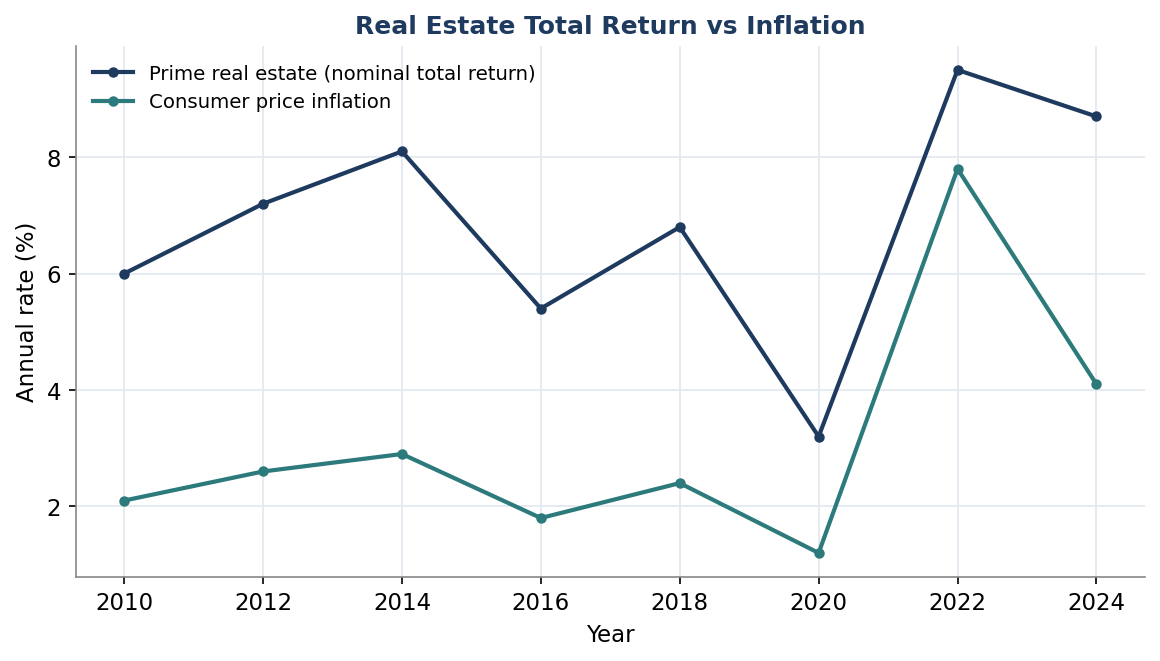
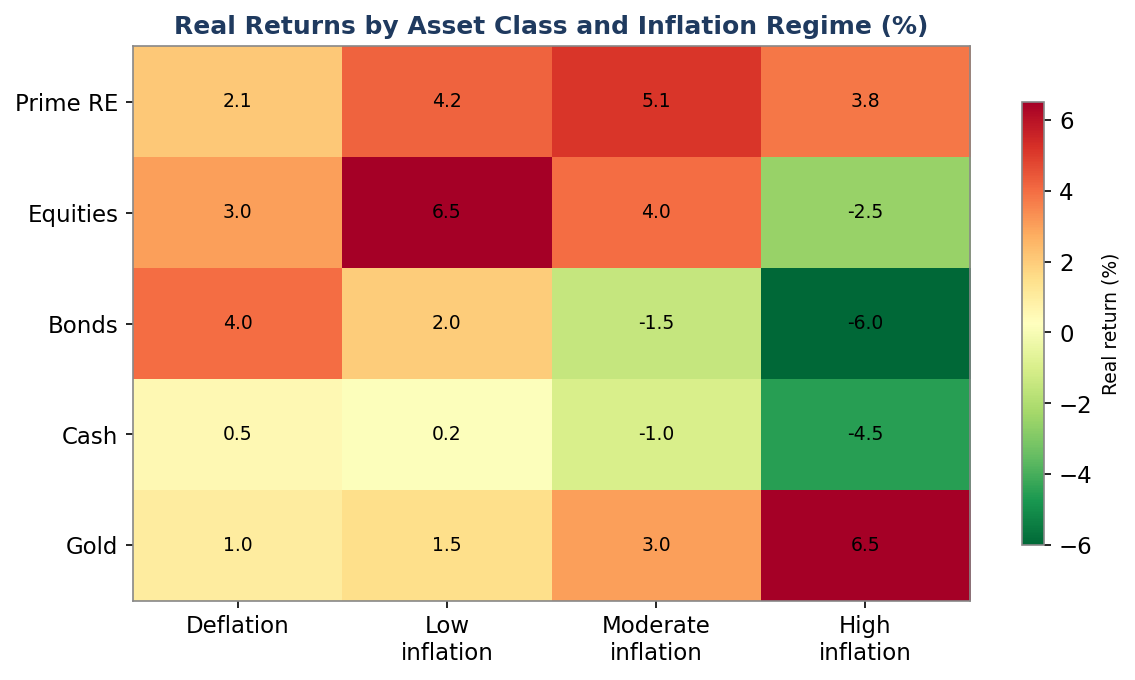
The behaviour of property relative to inflation over the past decade and a half illustrates both the strength and the limits of the hedge. Over long periods, prime real estate total returns have comfortably exceeded inflation, delivering a real return on top of preserving purchasing power. But the relationship is not smooth: in the low-inflation years property returns were driven by falling interest rates rather than by inflation, and in the inflationary shock of the early 2020s property initially lagged as rates rose before its income channel reasserted itself.
Figure 1. Real Estate Total Return Compared with Inflation
Prime real estate nominal total return against consumer price inflation across a full cycle.
The chart makes the central point visually. In most years property returns sit comfortably above inflation, preserving and enhancing real value. In the inflationary spike, property returns and inflation both rose, but the timing differed: the income channel took time to feed through as leases reset, so the hedge worked over the cycle rather than instantaneously. An investor who judged property by a single year during the shock would have concluded the hedge had failed; one who held across the adjustment saw it work. This is the empirical signature of a long-horizon hedge.
| Lease type | Rent adjustment | Inflation protection | Typical use |
|---|---|---|---|
| Short market lease | Resets to market frequently | Strong | Logistics, residential |
| Index-linked lease | Linked to CPI or RPI | Strong | Modern commercial |
| Stepped lease | Fixed percentage uplifts | Moderate | Retail, some office |
| Long fixed lease | No adjustment for years | Weak | Net lease, some office |
| Turnover lease | Linked to tenant sales | Moderate to strong | Retail, hospitality |
The Decisive Role of Lease Structure
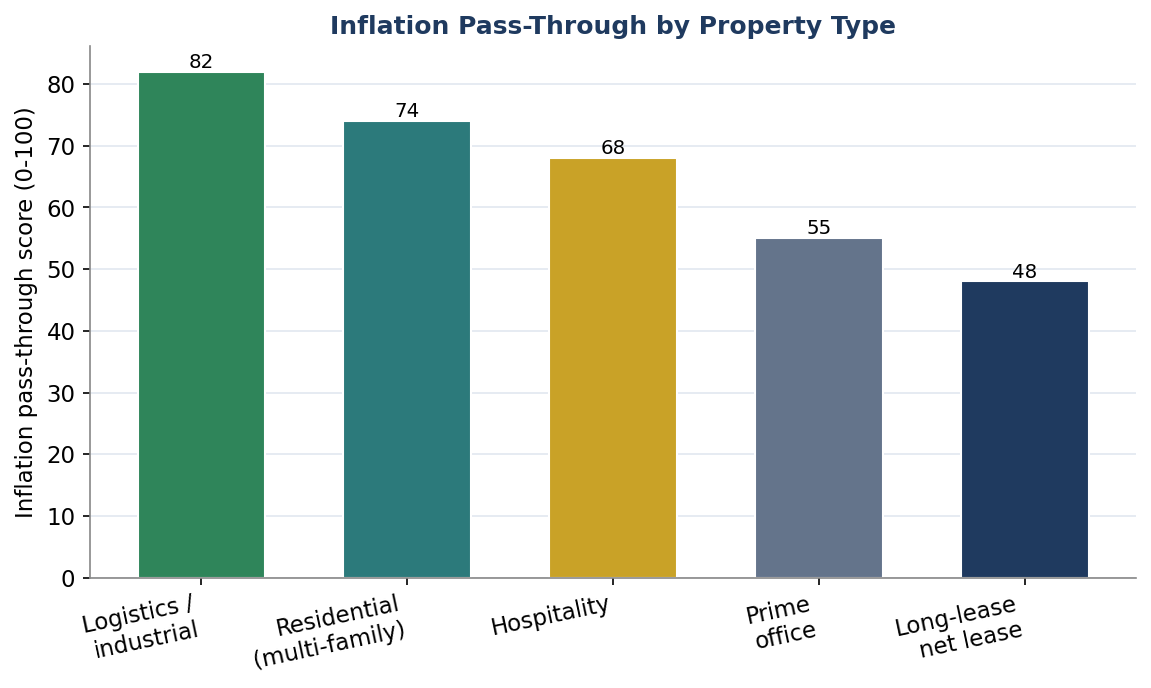
If property type sets the broad ranking, lease structure determines the outcome within it, and it is the single most important variable an investor can examine. The same building can be a strong or weak inflation hedge depending entirely on the lease attached to it. A warehouse let on a one-year lease at market rent hedges inflation; the identical warehouse let on a twenty-year lease at a fixed rent does not. The investor who understands this examines the lease before the building.
Table 1. Lease Structures and Inflation Protection
Inflation protection reflects how closely income tracks prices over a typical holding period.
Index-linked leases deserve particular note because they appear to offer the perfect hedge, with rent explicitly rising with a published inflation index. They are valuable, but two cautions apply. First, many index-linked leases contain caps that limit the uplift in exactly the high-inflation scenarios where protection matters most, converting a full hedge into a partial one. Second, an index-linked lease at an above-market starting rent can leave the investor exposed if the market rent falls below the indexed level, since the tenant may default or renegotiate. A family should read the indexation clause in full rather than assume that the label guarantees protection.
Nominal versus Real Returns in Practice
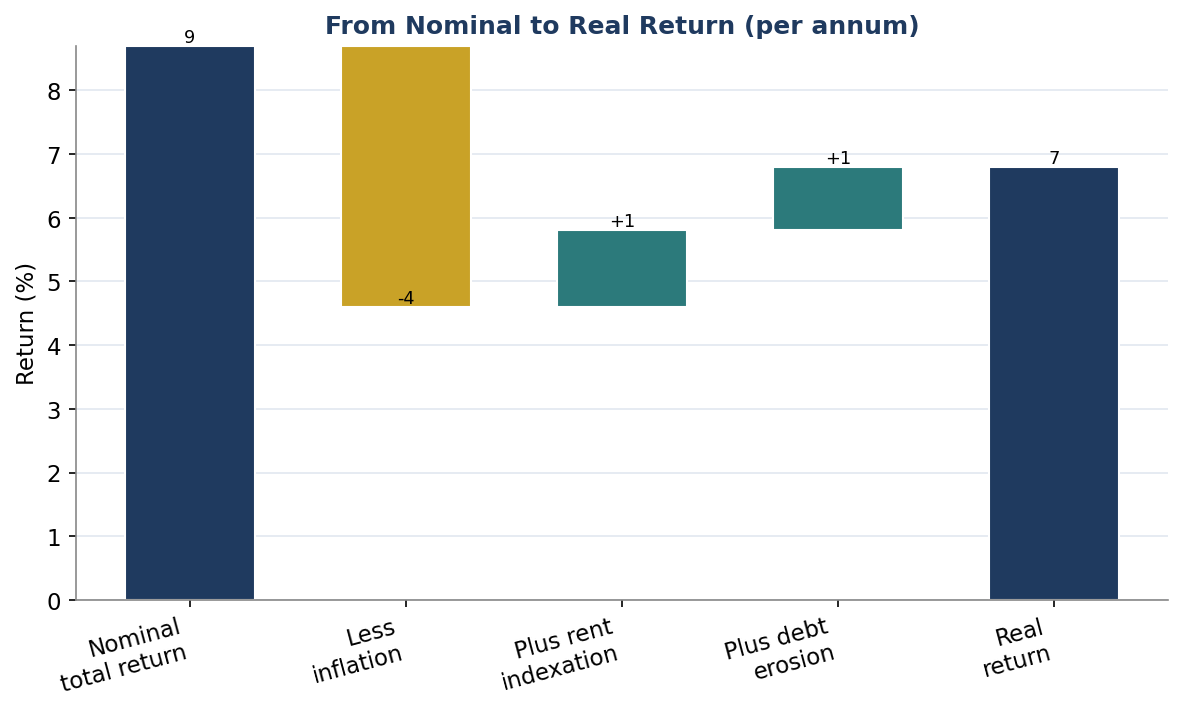
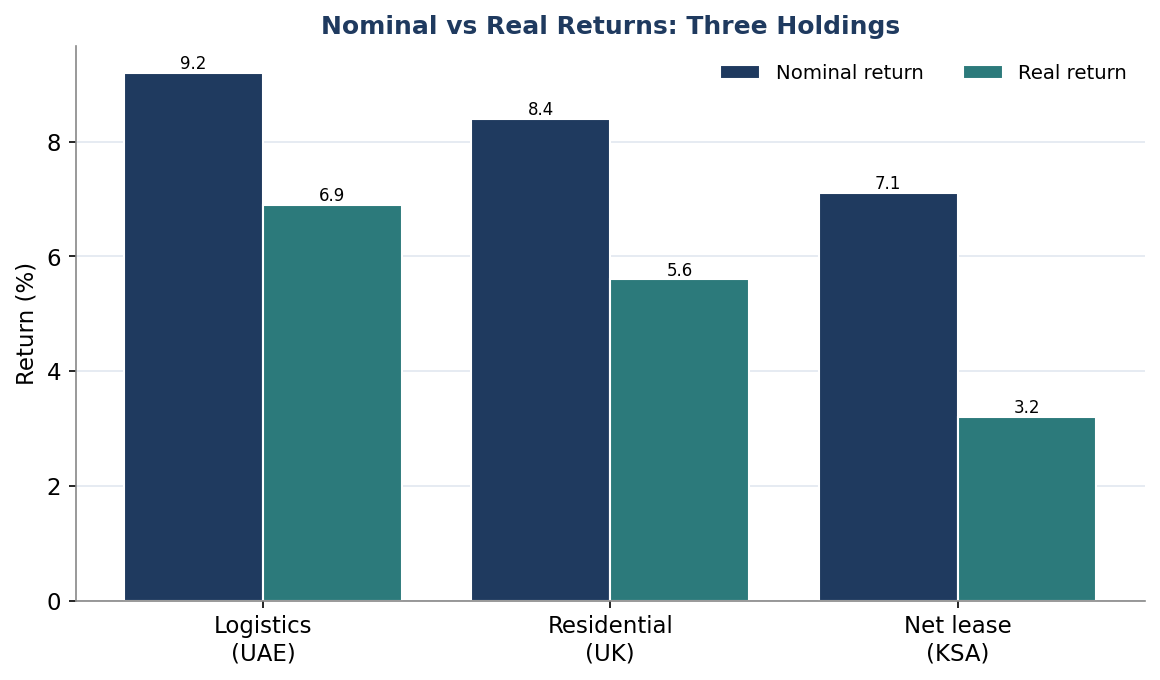
Bringing the channels together, it is instructive to trace a single representative holding from its nominal return to its real return, because this is the calculation that actually matters to a family preserving purchasing power. The bridge below decomposes a nominal total return into the inflation that erodes it and the indexation and debt-erosion effects that restore it.
Figure 4. From Nominal to Real Return for a Representative Holding
Decomposition of a leveraged, short-lease property’s return into its inflation-hedging components.
The bridge shows why structure matters so much. The raw nominal return, reduced by inflation, would leave a thin real return for a poorly structured property. But the rent indexation channel adds back a portion, and the erosion of fixed-rate debt adds back more, lifting the real return well above what the unlevered, long-lease equivalent would deliver. The same starting nominal return, attached to a long-lease unlevered property, would lose most of its value to inflation with nothing added back. This single comparison captures the entire argument of the paper.
Shariah-Compliant Real Estate Income
Many Gulf families require their investments to be Shariah-compliant, and real estate is one of the most natural asset classes for compliant structuring, which adds to its appeal as an inflation hedge. Property generates rental income, which is permissible, and can be financed through compliant structures such as Ijara, a lease-based arrangement, or diminishing Musharaka, a co-ownership that the occupier gradually buys out, rather than through interest-bearing debt.
The interaction with inflation hedging is favourable. Ijara leases can be structured with periodic rent reviews that track the market or an index, preserving the rent-indexation channel within a compliant framework. The replacement-cost channel operates regardless of financing and so is unaffected by compliance. The debt-erosion channel works through compliant fixed-profit-rate financing in much the same way as through conventional fixed-rate debt, since the family’s payment obligation is fixed in nominal terms and eroded by inflation. A family can therefore build a strong, compliant inflation hedge in real estate without sacrificing the channels that make property effective.
The practical caution is that compliant structures can carry additional documentation and administration, and that the rent-review and profit-rate mechanics must be drafted carefully to preserve the inflation linkage. A family should ensure that its compliant leases and financing are structured to allow the income and the financing to respond to inflation, rather than accepting a fixed compliant arrangement that, like a long fixed lease, would leave it exposed. Compliance and inflation protection are fully compatible, but only if the documentation is designed with both in mind.
The Illiquidity Trade-Off
The principal cost of using real estate as an inflation hedge is illiquidity, and a family must weigh this honestly. Direct property cannot be sold quickly without sacrificing price, transactions are slow and expensive, and a family that over-allocates to property can find itself asset-rich but cash-constrained at exactly the moment it needs liquidity. The illiquidity is not a flaw to be eliminated but a trade-off to be managed, since much of property’s return and stability derives precisely from the patience it demands.
The discipline is to match the illiquidity of the allocation to the family’s genuine time horizon and to maintain a liquidity reserve that removes any need to sell property under pressure. A family with a thirty-year horizon and a sensible cash buffer can hold illiquid property comfortably and capture its full inflation-hedging benefit; a family that has over-committed and lacks liquidity may be forced to crystallise losses or forgo the hedge when it matters most. The listed and debt routes discussed earlier have a role here, providing liquid real estate exposure that, while a weaker hedge, can be sold quickly and so allows the family to hold a larger illiquid core with confidence.
| Route | Inflation linkage | Liquidity | Control | Best for |
|---|---|---|---|---|
| Direct ownership | Strongest | Low | High | Large families, core holdings |
| Private RE fund | Strong | Low to moderate | Low | Diversified access, scale |
| Listed REIT | Moderate | High | None | Liquidity, smaller allocations |
| Real estate debt | Weak | Moderate | None | Income, capital preservation |
An Implementation Roadmap
Assess the family’s true inflation exposure, distinguishing dollar-linked, sterling and euro components and the spending the family must protect.
Audit the existing property portfolio against the three channels, identifying which holdings actually hedge and which behave like bonds.
Set a target real estate allocation sized against inflation-sensitive liabilities, with a deliberate split by geography, property type and currency.
Tilt acquisitions toward short-lease, supply-constrained property and away from long-lease, fixed-income-like property, reading every lease in full.
Finance the allocation with moderate, long-term, fixed-rate or fixed-profit-rate debt to capture the debt-erosion channel safely.
Maintain a liquidity reserve and a liquid real estate sleeve so the illiquid core need never be sold under pressure.
Review the portfolio across the inflation cycle, rebalancing toward the holdings and structures that are hedging as intended.
Valuation and the Cap-Rate Question
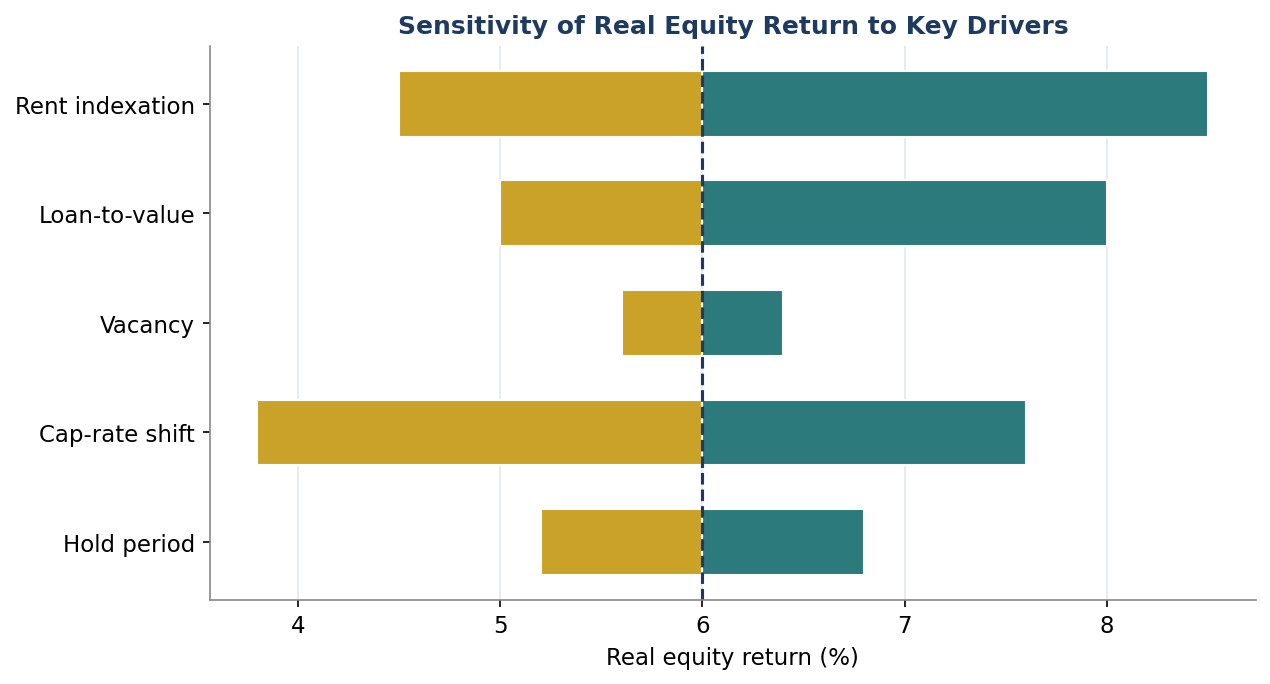
No discussion of real estate and inflation is complete without confronting the capitalisation rate, because it is the variable that most often makes property disappoint in the short run even when the underlying hedge is sound. A property’s value is its net income divided by its cap rate, so for a given income a rise in cap rates lowers value. Cap rates tend to track real interest rates, and because central banks often raise rates to fight inflation, the early phase of an inflationary episode can see cap rates rise and property values fall even as the income channel begins to work. This is the mechanism behind the lag visible in the historical evidence.
The resolution of this apparent paradox lies in horizon and income growth. Over a short period, the cap-rate effect can dominate and values can fall; over a longer period, the growth in income from rent indexation outpaces the cap-rate drag, and the hedge reasserts itself. A family that understands this will not be alarmed by a temporary mark-down in an inflationary shock, nor will it be tempted to sell into weakness, because it recognises that the income channel needs time to feed through leases. The investor who panics at the cap-rate-driven dip converts a temporary paper loss into a permanent realised one and forfeits the very hedge they were holding the property to capture.
The practical implication is to favour property whose income can grow fastest, since rapid income growth is what overcomes the cap-rate drag soonest. This reinforces the preference for short-lease, supply-constrained property: not only does it hedge inflation through indexation, it also recovers from a rate-driven value dip more quickly than long-lease property whose income is frozen. Cap-rate sensitivity is therefore not a separate consideration but another reason to prefer the structures the paper has favoured throughout.
Conclusion
The belief that real estate hedges inflation is true, but only with qualifications that determine everything. Property protects purchasing power through three channels, rent indexation, replacement cost and the erosion of nominal debt, and the strength of the hedge depends on property type, lease structure and financing rather than on the asset class as a whole. Short-lease, supply-constrained, fixed-rate-financed property hedges powerfully; long-lease, abundant-supply, unlevered property hedges poorly and can behave like a bond. A family that understands this can build a real estate allocation that genuinely defends its real wealth; one that relies on the slogan may hold property that fails it precisely when protection is needed.
For Gulf family offices the framework offers a clear path. Audit existing holdings against the channels, tilt toward the structures that hedge, diversify across geography and currency, finance conservatively with fixed-rate or compliant fixed-profit debt, and maintain the liquidity that allows the illiquid core to be held with patience. The reward is a portfolio whose real value is protected across the inflation regimes that a multi-generational horizon makes inevitable. That protection, deliberately constructed rather than assumed, is among the most valuable contributions real estate can make to a family’s lasting wealth.
| Holding | Structure | Nominal return | Real return | Hedge quality |
|---|---|---|---|---|
| Logistics (UAE) | Short lease, 50% fixed-rate debt | 9.2% | 6.9% | Strong |
| Residential (UK) | Annual resets, moderate gearing | 8.4% | 5.6% | Strong |
| Net lease (KSA) | 20-year fixed lease, unlevered | 7.1% | 3.2% | Weak |
Limitations
This paper uses modelled figures to illustrate relationships and mechanisms rather than to forecast returns for any specific property or market. Real estate outcomes depend on location, timing, management and conditions that no general framework can capture, and past relationships between property and inflation may not persist. Nothing here constitutes investment advice. Families should obtain advice tailored to their circumstances and conduct property-specific diligence before acting, and should treat the inflation-hedging framework as a lens for analysis rather than a guarantee of outcomes.