

1 Define the equity release decision
An owner considering property refinancing needs a precise decision: how much cash can leave the asset-owning business after a new facility settles the old debt, pays closing expenses and retains the balances required for continued operation. That question includes the dated obligations created by the new loan. A larger approved amount can coincide with a smaller usable distribution when settlement costs, reserves or repayment requirements change. The proposed framework therefore connects loan capacity to a closing allocation and follows the resulting obligations through operating payments and contractual maturity. The amount advanced, the cash released and the remaining property equity receive separate definitions.
The subject is income-producing GCC property, with specific UAE and Saudi administrative references identified individually. A completed building's physical occupancy can help explain rental prospects, but the amount collected and available for debt service requires its own evidence. The paper uses a collected-rent share to make that distinction calculable. It then asks which of two fictional sizing constraints binds as interest rates change. A second question tests the affordability of a loan already drawn when rental collection weakens and its rate resets. A third tests the amount that a separately assumed exit refinancing could repay at maturity. Each question uses a defined date and cash perimeter.
Every numerical case is hypothetical. No borrower financial statements, rent roll, executed facility, property inspection or lender quote has been supplied. The findings are consequences of transparent assumptions and provide a method for a transaction team to replace with reviewed evidence. The paper makes no claim that a GCC bank would lend at the illustrated rate or permit the calculated distribution. An investment committee should obtain the relevant valuation, cash-flow analysis, settlement terms and permissions before treating a proposed refinancing as executable capital. The practical output is a decision record identifying usable proceeds, conditions still open and specific payments requiring additional funding.
2 Establish the method and its evidence boundary
The research combines a bounded review of primary publications with deterministic financial modelling and an author-proposed execution workflow. RICS standards and practice information supply valuation context [1–3]. Selected Basel Framework editions identify property-dependent repayment and underwriting dimensions [4–6]. BIS historical analysis provides international commercial-property risk context [7]. UAE banking standards and location-specific mortgage and tenancy services support a separate discussion of underwriting and administrative evidence [8–12]. These materials do not supply the fictional loan parameters. Each citation is used within its stated scope, and an international supervisory classification is kept distinct from a transaction's actual lending terms.
The numerical method has three stages. First, annual net income supports a property-value proxy and a debt-service capacity calculation. Second, the lower capacity enters a closing allocation that deducts old debt, fees and a retained cash reserve. Third, an already drawn loan is followed through a specified reset and five-year maturity. A separate construction-pool grid examines redeployment of the closing release. The last two tests answer different funding questions and use different pools. Their gaps are reported separately. No probability distribution, empirical calibration or consolidated solvency claim is attached to the calculations, and the illustrations exclude tax and several actual operating cash adjustments.
Prior-art review identifies established research and professional guidance concerning rental valuation, property lending and refinancing. Existing discussions also address lease expiry, arrears, debt-service coverage and maturity gaps. This paper's particular organising device is the joint collected-rent and interest-rate threshold for a defined net release, followed by separately dated operating and balloon tests. No global novelty or absence of comparable research is established. Its utility can be assessed through reproducibility and the clarity of the evidence needed for one proposed transaction. An empirical extension would need consented executed-loan and property data, with comparable definitions and an appropriate research design.
3 Distinguish occupied space from collected rental cash
Physical occupancy measures the space occupied under a selected area or unit definition. Contracted rent identifies amounts due under lease terms. Collected rent records money received over a specified period. These quantities can diverge when units have different rents, tenants receive concessions, bills remain unpaid or payment dates fall outside the measurement window. A lender-facing analysis should bridge those differences. The bridge begins with the property and tenancy perimeter, then reconciles lease schedules, invoices, receipts and adjustments to the cash forecast. A property described as substantially occupied still needs evidence of the income available on its financing payment dates.
For the fictional model, q is the collected share of annual potential rent, expressed between zero and one. Annual potential rent is fixed at twenty monetary units. Equal unit economics and an even annual collection pattern are simplifying assumptions; q is not an observed physical occupancy statistic. At q equal to 0.85, modelled rental receipts are seventeen. Fixed annual operating costs of four leave thirteen. An actual rent roll would require unit-level prices, leased area, collection timing, concessions, arrears and responsibilities for property expenses. The simplified q permits a transparent threshold calculation while leaving those omitted dimensions visible as evidence requirements.
The proposed review also distinguishes recoverable arrears from cash already received. A tenant promise or a registered lease does not establish a payment in the borrower's account. Dubai's tenancy service describes contract registration and issuance of a certificate [10]; Saudi Ejar's commercial-contract service records parties, financial details and terms for approval [12]. These administrative records can support contract identification. Collection still requires the relevant receipts and reconciliation. Before sizing a loan, the analyst should establish the period, currency, receiving entity and treatment of disputed or refundable amounts. Forecast rent should retain its forecast status until the payment and any restrictions on its use are evidenced.
4 Translate lease quality into dated cash assumptions
Lease quality enters the model through terms that affect receipts, expenses and timing. RICS discounted-cash-flow guidance addresses lease events including breaks, expiry, renewal and void periods [2]. For a refinancing analysis, the team should map each material lease event to the period in which cash can change. A tenant concentration review should identify which contracts support the forecast, their remaining terms and the evidence of payment. The proposed method asks what happens if a specific tenant leaves, pays later or requires a concession. It does not assign an invented market-wide tenant-default probability to those events.
An annual rent total can conceal a funding mismatch within the year. A quarterly receipt arriving after a monthly loan payment creates a different cash path from even monthly collection. Likewise, tenant deposits may belong to an account that cannot fund ordinary debt service. Service-charge recoveries can have a corresponding expense or a timing lag. The cash bridge should identify such items explicitly and avoid treating gross collections as discretionary income. A model based on monthly dates can then locate the first payment requiring support. The annual simplification in this study holds those timing effects outside its calculation and should be replaced when the actual transaction requires them.
The proposed bankability file links each important lease assumption to a document and a reviewer. Contract expiry comes from the operative agreement; received rent comes from reconciled cash records; an anticipated renewal remains a forecast supported by separately described evidence. Legal review should address tenant rights, amendments and any relevant registration requirements for the location. Property management should reconcile occupied areas and expenses, while the finance team bridges them to the receiving entity's accounts. This division of evidence makes it possible to change one assumption without silently revising others. It also permits a committee to see which portion of the borrowing case depends on future collection rather than existing cash.
5 Keep collateral capacity and repayment capacity separate
Collateral value and operating repayment capacity answer different underwriting questions. The selected Basel standardised-approach edition discusses borrower repayment metrics and property occupancy within underwriting, alongside separate regulatory valuation and LTV provisions [4]. Its regulatory risk-weight bands establish no negotiated advance ceiling for this paper. The income-producing-property definition in the selected IRB chapter concerns dependence on property-generated cash flows [5]. These references support considering both repayment and collateral evidence, with their regulatory context retained. An actual facility requires the lender's applicable policy, definitions and executed terms rather than a number inferred from an international classification.
The hypothetical model imposes two invented limits: a maximum loan equal to sixty percent of its property-value proxy, and a minimum origination debt-service ratio of 1.35. Neither is described as a GCC norm or supervisory covenant. The model takes the smaller loan amount supported by those limits. This permits the binding constraint to change as an assumed interest rate increases. Raising property value can have no effect on loan capacity when debt service already binds. Improving rent collection can affect both limits in this deliberately simplified model because the same net-income proxy drives its value and repayment calculations. Actual valuation and credit definitions can use different adjustments.
The committee's proposed loan-capacity bridge should preserve the separate calculations even when a lender supplies one headline amount. It should identify the valuation basis and date, eligible security, reviewed cash available for service, rate structure, amortisation and other constraints. A policy cap, borrower concentration limit or required sponsor contribution could produce a smaller amount than either illustrated calculation. The mathematical minimum of two limits remains a model output until those additional conditions and approval requirements are assessed. Recording the reason a limit binds helps the borrower decide whether an improved lease, a different amortisation schedule or additional equity addresses the particular constraint under examination.
6 Use UAE underwriting requirements within their scope
The Central Bank of the UAE's Credit Risk Management Standards identify documented credit due diligence, affordability assessment, stressed benchmark rates and refinancing risk for facilities that are not fully amortising [8]. Article 5 also addresses collateral identification and legal-interest documentation. The official indexed text reviewed for this paper marks the standards effective from 30 November 2024 and in force. Direct retrieval of the linked full document was unavailable during review. The cited official Article 5 text supports this bounded process discussion; this study performs no compliance assessment of a bank, borrower or complete transaction file.
The proposed borrower response is a reviewable evidence package. It should reconcile operating cash, debt obligations and the selected adverse cases, with source documents for material terms. For a partially amortising facility, it should describe the amount remaining at maturity and the assumptions behind proposed repayment routes. A sponsor's assertion that refinancing should be available requires supporting evidence and an identified fallback; the model cannot grant a future loan. Actual lending terms, legal priority and collateral valuation should be reviewed by the relevant professionals. The study's sixty-percent advance and 1.35 ratio remain invented analytical inputs and carry no regulatory endorsement.
Dubai Land Department's mortgage service describes bank submission and registration procedures [9]. The DARI guide provides an Abu Dhabi route involving bank review, municipality approval and issuance of the mortgage contract [11]. Each applies to its own administrative setting. A proposed refinancing should therefore map settlement, release or replacement of security, registration and disbursement into the relevant sequence. The model places proceeds at closing for illustration. A real forecast should use the first date on which the borrower can deploy them under completed conditions. Neither a service application nor an expected registration timetable establishes an approved credit amount, funded balance or permission to distribute cash.
7 Specify the fictional sizing and closing model
The base case assumes annual potential rent of twenty, a collected-rent share of 85 percent and fixed operating costs of four. Net income is therefore thirteen monetary units. The model divides that amount by a fictional eight-percent capitalisation yield to obtain a property-value proxy of 162.5. The sixty-percent LTV ceiling supports 97.5. These are analytical quantities for an invented property. The yield is not a GCC market observation, and the proxy is not a professional valuation. The model deliberately omits taxes, capital expenditure, working-capital changes and other adjustments that would ordinarily need a bridge between net operating income and cash available for debt service.
Annual end-of-year loan payments use a twenty-year amortisation schedule. At rate r, the payment per unit borrowed is r divided by one minus the inverse of one plus r raised to the twentieth power. At seven percent, borrowing 97.5 gives an annual payment of approximately 9.20331. Dividing thirteen by 1.35 times the payment factor gives debt-service capacity of approximately 102.01643. The lower LTV amount therefore binds. The model assumes positive net income; for a non-positive net-income input, loan capacity is floored at zero. It includes no interest-only period, intra-year compounding, hedging expense or lender-specific cash definition.
Closing repays existing debt of 85, charges an invented fee of two percent of the new loan and retains an owned cash reserve of three for specified later support. The resulting unrestricted release is 97.5 minus 85 minus 1.95 minus three, or 7.55. The reserve remains owned cash but is excluded from that release. The property proxy less the new loan equals 65 of residual asset equity, which is a balance-sheet-style analytical residual rather than transferable cash. Figure 1 keeps these quantities visible. Actual settlement costs, accrued interest, reserve restrictions and distribution approvals require their own inputs before an amount becomes usable capital.
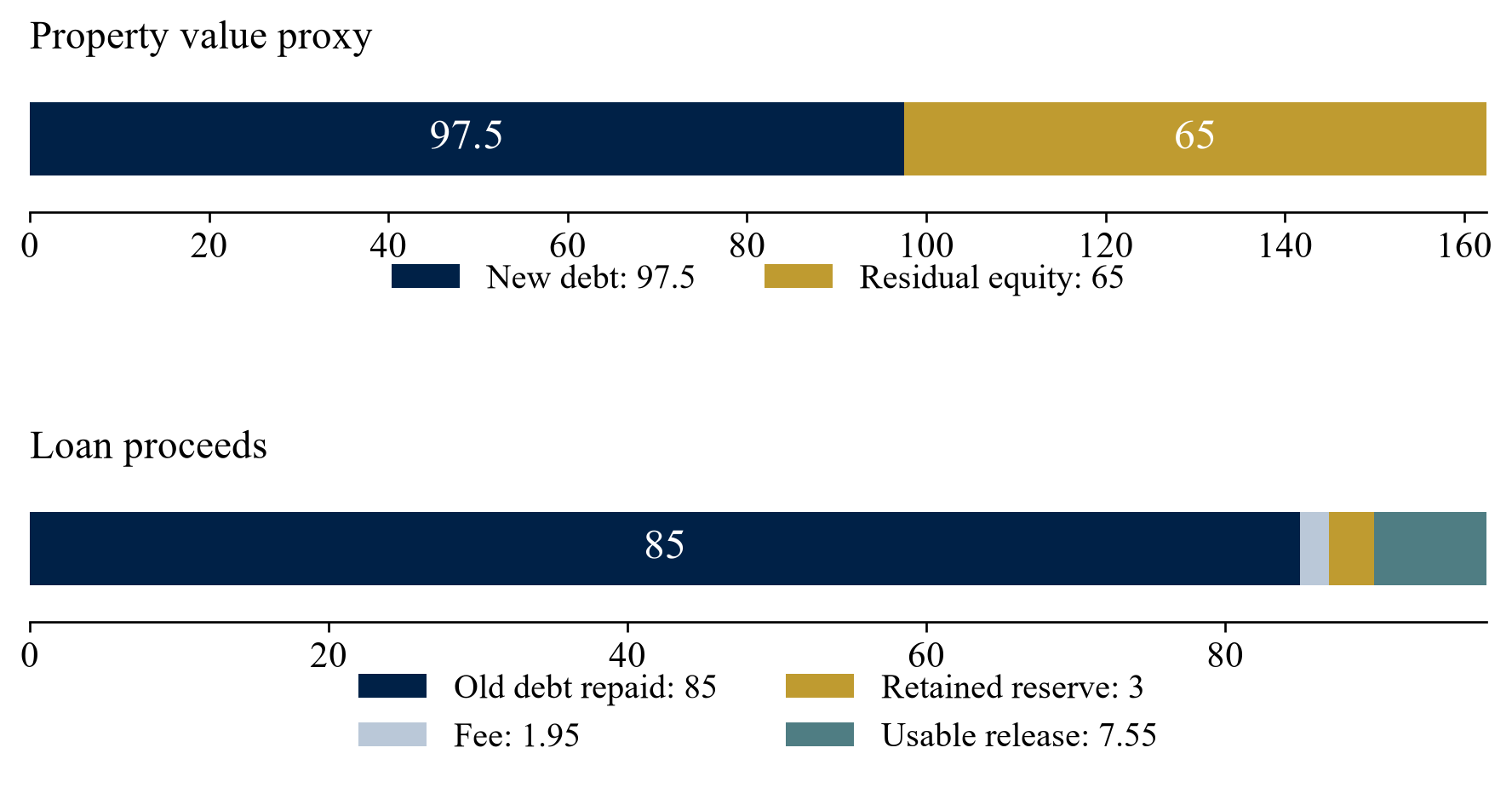
Author calculations in monetary units. Value proxy 162.5 comprises debt 97.5 and residual equity 65. Loan proceeds 97.5 comprise repayment 85 fee 1.95 retained cash reserve 3 and unrestricted release 7.55. No market value loan quote or distribution approval is represented.
8 Define the net release boundary before choosing a rate
Let the new loan amount be L, the fee share be f, old debt settlement be D and the retained cash reserve be R. The model's unrestricted cash is L multiplied by one minus f, less D and R. With f equal to 0.02, D equal to 85 and R equal to three, a zero release requires L equal to 88 divided by 0.98, approximately 89.795918. A strictly positive release requires capacity above that boundary and fulfilment of all other conditions. This equation describes an allocation. It provides no distribution permission or valuation gain, and a negative result means the selected closing structure requires additional funding.
Both sizing limits must support the boundary loan. At the assumed yield of eight percent and LTV of sixty percent, net income must reach approximately 11.972789. The debt-service limit requires income equal to 1.35 times the boundary loan times the applicable annuity factor. The larger of these two required income amounts determines the collected-rent threshold when costs and potential rent are fixed. Adding four of costs and dividing by twenty gives the threshold q. The derivation demonstrates why a refinance decision cannot rely on an occupancy target without also specifying the interest rate, repayment schedule, valuation assumptions and closing uses.
An actual transaction could introduce a discontinuity into this simple formula. A lender might change terms after reviewing concentration, an asset condition or a tenant event. Fees can contain fixed and variable components; a reserve can depend on debt service rather than stay fixed at three. The proposed method should then use the actual schedule and solve for a boundary under those terms. It should also state whether the target is any positive cash or a specified project contribution. Releasing 0.2 monetary units passes the mathematical zero boundary but might contribute little to an independently identified funding need. That need must be tested through its own dated payment model.
9 Calculate the joint collection and interest threshold
Table 1 holds potential rent, costs, yield, LTV, settlement, fee and reserve fixed while changing only the assumed interest rate. At six and seven percent, the collateral requirement determines a zero-release collection threshold of approximately 79.8639 percent. At eight percent, debt-service sizing becomes the tighter test, raising the threshold to approximately 81.7349 percent. At nine and ten percent, it becomes approximately 86.3986 and 91.1949 percent respectively. These are computed boundaries for the fictional inputs. They are neither recommended occupancy targets nor evidence of lending practices, and the percentage refers to collected potential rent rather than occupied space.
The base 85-percent collection case lies above the seven-percent boundary and below the nine-percent boundary. Re-sizing a proposed new loan at those rates therefore changes the closing allocation. That comparison differs from resetting the rate on a loan already drawn, because an outstanding principal balance does not shrink merely when origination capacity falls. The subsequent sections keep that distinction explicit. A committee looking at a loan proposal should ask whether the displayed principal is a fresh calculated capacity or an existing contractual amount. The answers determine which repayment and closing schedules belong in the decision record and how an unsupported payment is dated.
The threshold is also sensitive to the definition of income. A cash deduction for capital expenditure reduces the income available for service without necessarily reducing the valuation income by the same amount. A lender's reviewed rent assumption might exclude a particular tenant or apply its own treatment to concessions. In such a case, the two sizing calculations should use separate documented income bridges. The simplified threshold here uses identical net-income and debt-service proxies only because those adjustments are excluded by assumption. Its transparency supports replacing each simplification; it supplies no justification for excluding a material cash cost from an actual loan assessment.
Table 1. Fictional zero-release collection threshold by annual borrowing rate
| Annual rate | Debt-service income needed | Binding sizing test | Collected rent at zero release |
|---|---|---|---|
| 6 percent | 10.568903 | LTV | 79.863946 percent |
| 7 percent | 11.442734 | LTV | 79.863946 percent |
| 8 percent | 12.346982 | Debt service | 81.734910 percent |
| 9 percent | 13.279716 | Debt service | 86.398578 percent |
| 10 percent | 14.238983 | Debt service | 91.194915 percent |
Author calculations. Required loan 89.795918; fixed collateral-income requirement 11.972789. Threshold uses the larger collateral or debt-service income requirement plus operating costs of 4 divided by potential rent of 20. Rounded percentages are boundaries rather than safety margins.
10 Read the release surface without assigning probabilities
Figure 2 displays unrestricted cash across collected-rent shares of sixty to one hundred percent and assumed rates of six to ten percent. At eighty-percent collection, the release is 0.2 at six or seven percent and approximately minus 2.47 at eight percent. At ninety-percent collection, it is 14.9 at seven percent, approximately 4.77 at nine percent and approximately minus 1.48 at ten percent. Negative amounts denote additional closing funding required under the specified allocation. No cell is interpreted as a default probability, loss forecast or observed GCC market combination. The grid holds every other assumption fixed to isolate the two selected dimensions.
The flat portions of the grid reveal where LTV is binding. Increasing the rate within such a portion reduces debt-service headroom while leaving the selected principal unchanged until that second limit becomes tighter. Once debt service binds, a higher assumed rate reduces capacity and consequently the cash release. This result arises from the stipulated annual amortising payment formula. Changing the amortisation period, introducing an interest-only phase or applying a payment cap would change the surface and could leave a different residual principal. Those structures require their own calculation rather than an assertion that one version generally improves financing resilience.
A borrower can use the proposed grid to organise negotiations around reviewed assumptions. Each candidate facility should occupy its own row of actual terms and conditions, linked to the same collection and cash evidence. Comparing a shorter-maturity low-rate offer with a longer-maturity higher-rate offer requires both payment and maturity tests. The fictional grid does not perform that comparison because its schedule is fixed. A proposed committee record should show where a favourable closing release depends on an unconfirmed collection increase, future valuation or discretionary loan condition. A pending item should remain visible until the relevant evidence or approval is received and the calculation is updated.
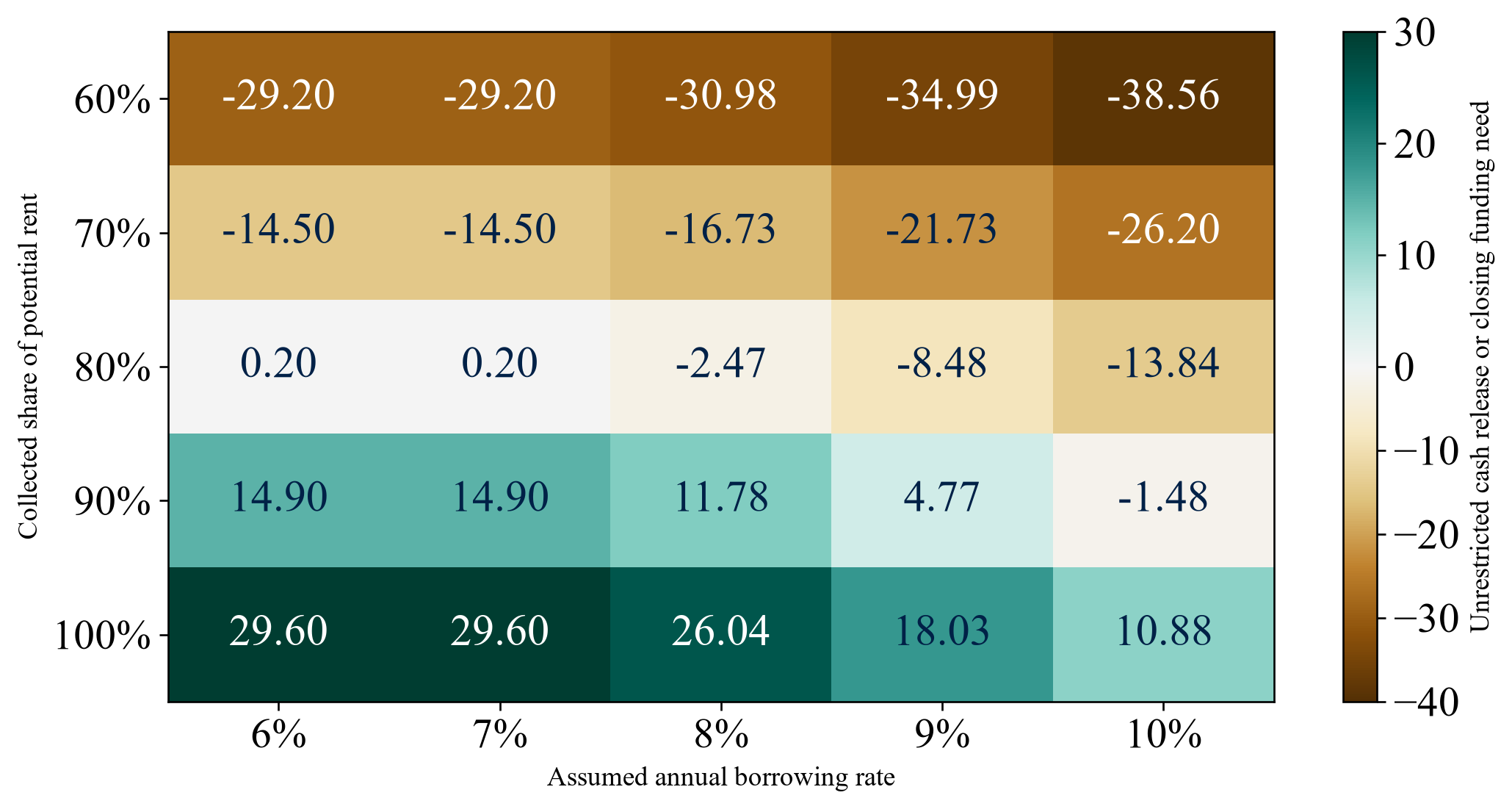
Monetary units; positive values are released cash and negative values are additional closing funding needs. Each cell applies the lower LTV or debt-service loan capacity. Settlement 85 fee 2 percent reserve 3 and yield 8 percent are held fixed. No probabilities or observed market ranges are assigned.
11 Separate fresh loan sizing from a contractual rate reset
A new-loan sizing surface asks what principal can be advanced under its selected terms. A rate reset asks what payments an already drawn principal requires under the contract. The second question needs the original amortisation schedule, balance at the reset date and rules determining subsequent payments. Replacing outstanding principal with a smaller calculated loan capacity would create an unsupported debt reduction. The proposed model retains the original drawn amount and calculates its balance after the first two instalments. It then re-amortises that balance over the remaining eighteen-year payment schedule at a separately assumed rate, while preserving a five-year contractual maturity.
The fictional initial loan is 97.5 at seven percent, with annual payments at year end and twenty-year amortisation. After two fully funded instalments, its principal is approximately 92.576898. At the beginning of year three, the rate becomes nine percent and the recalculated annual payment is approximately 10.573420. Rental collection simultaneously falls to sixty-five percent, leaving net annual cash of nine under the simplified operating assumptions. The shortfall is therefore approximately 1.573420 in each of years three to five. These coincident stresses are invented and carry no estimated likelihood or causal claim about rate changes and tenancy behaviour.
Figure 3 tracks the retained reserve of three against those shortfalls. Years-one and two surpluses are assumed distributed and absent from the later support pool; the original unrestricted release of 7.55 is also outside it. After year three, the reserve is approximately 1.426580. Year four first requires external support, and the total support beyond the reserve across the three stressed years is approximately 1.720259. The negative displayed balance identifies an unsupported payment path; continued contractual amortisation then requires separate funding. This cash convention is material to interpreting the later balloon calculation, which assumes that all scheduled instalments have actually been funded.
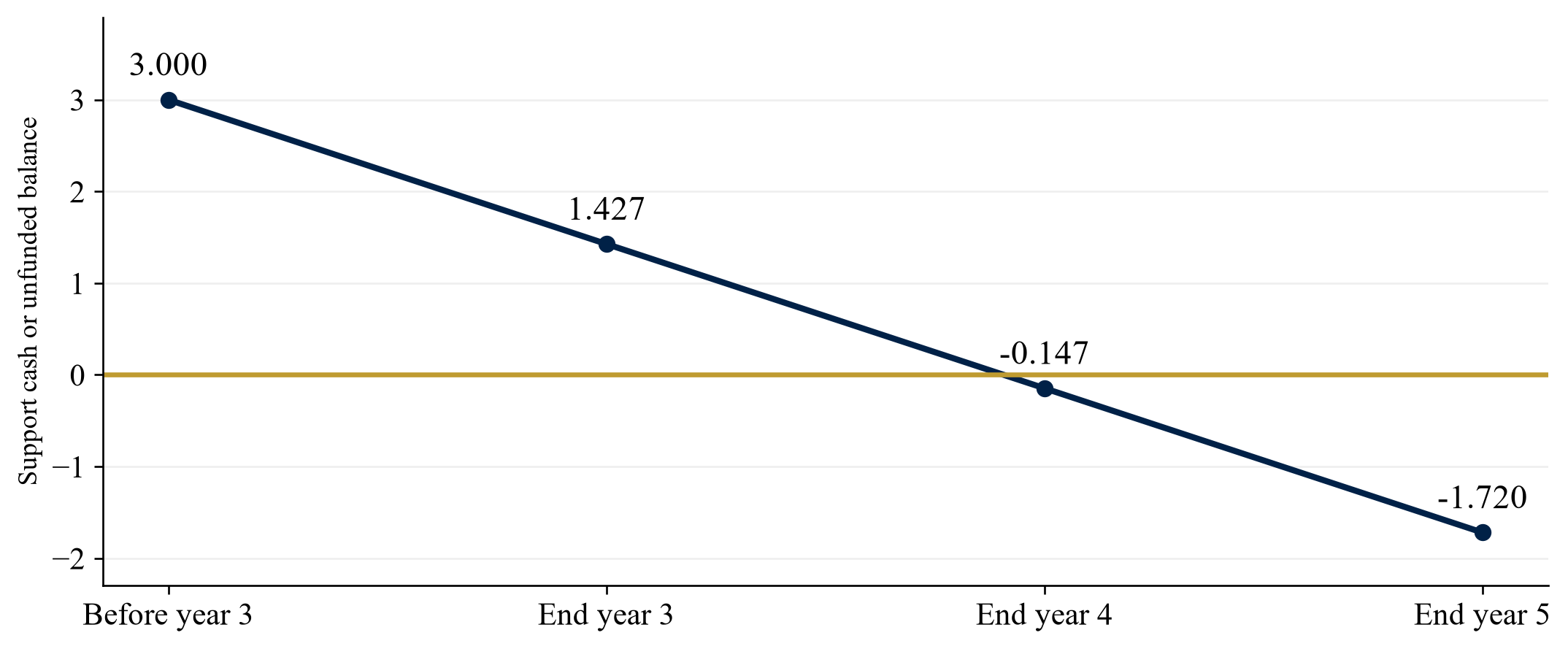
Retained support cash at the start of year 3 is 3. Annual cash shortfall is 1.573420. The plotted negative balance identifies funding required; it is not an arranged overdraft. Distributed early surpluses and the initial 7.55 release are excluded. Continued debt payments require separately funded gaps.
12 Test the rate reset against the contractual maturity
The fictional loan separates contractual maturity from the period used to calculate amortisation. Its initial principal is 97.5 monetary units, its maturity is five years and its initial instalment uses twenty annual year-end payments at seven percent. The annual payment is 9.203310. After the first two scheduled payments, the outstanding balance is 92.576898. At the start of year three, the assumed rate resets to nine percent and that balance is re-amortised over eighteen annual years. The resulting annual payment is 10.573420. Contractual maturity remains year five, so the remaining principal becomes due after the year-five scheduled payment. Every rate and term in this example is an author-selected assumption.
The property's collected-income factor falls to 65 percent in years three to five. Potential annual rent of twenty multiplied by that factor, less the fixed operating expense of four, produces the nine-unit cash-flow proxy. The model treats this amount as cash available for debt service because capital expenditure, tax and other adjustments are omitted. The reset payment exceeds it by 1.573420 annually, with coverage of approximately 0.851191. This calculation identifies a cash requirement under the defined schedule. Any contractual covenant test needs its own denominator, measurement period, permitted adjustments and consequences. CRE33 includes rate stress, coverage and tenant considerations within supervisory assessment; its categories supply no numerical covenant for this fictional transaction [6].
An actual repayment forecast should use the executed reset mechanism, including the reference rate, margin, review date and payment frequency. It should also identify any interest-rate protection and its contractual limitations. The Central Bank of the UAE's credit-risk standards address documented affordability, stressed rates and refinancing risk for facilities that do not fully amortise [8]. The proposed review therefore tests both scheduled payments and the maturity amount, with evidence attached to each funding source. A longer amortisation calculation leaves a substantial balance at the selected five-year maturity and requires a separately assessed exit.
13 Date each use of the retained operating reserve
The fictional operating-reserve schedule starts year three with three monetary units. The year-three shortfall of 1.573420 reduces the reserve to 1.426580. The year-four shortfall then exceeds the remaining reserve by 0.146839, creating the first external funding requirement in year four. A timely contribution of that amount permits the full scheduled payment and leaves the reserve at zero. Year five requires another external contribution of 1.573420. Across the three years, the operating shortfall is 4.720259 and the total support beyond the original reserve is 1.720259. Calculations retain full precision; displayed amounts are rounded to six decimal places.
The cash boundary matters to this result. The first two years each produce a fictional operating surplus of 3.796690, which is assumed to have been distributed before year three. The released closing cash of 7.55 also sits outside this operating pool. The example makes no claim that an actual loan permits either distribution. Retaining those earlier surpluses would produce a different reserve path and would require a corresponding change to the later operating and redevelopment cash schedules. The model assumes external operating contributions have no repayment obligation within this horizon and do not increase mortgage principal. This convention preserves the stated amortisation balances while making the sponsor cash needed for each payment visible.
The proposed transaction review should reconcile the reserve with account evidence, permitted withdrawals and the dates when replenishment becomes available. Annual totals alone cannot establish whether cash arrives before the debt-service instruction. For this illustration, each contribution arrives in time for the relevant year-end payment. Negative balances in an unsupported projection identify missing funding by that date. A committee should examine executable support, revised distributions or a changed financing structure before relying on the property to service the loan. Sponsor capacity and stressed coverage are relevant elements in the supervisory slotting framework, which supplies context for this review without prescribing the three-unit reserve [6].
14 Calculate the refinancing gap after funded year five service
The fictional maturity test occurs immediately after the year-five scheduled instalment has been paid in full. That payment leaves mortgage principal of 85.229041. The operating contributions in the preceding section are assumed to have funded the earlier cash deficits separately. At exit, the collected-income factor remains 65 percent and the annual income proxy remains nine. An invented ten-percent capitalisation yield produces value of ninety. The prospective refinancing quote uses ten-percent interest, twenty-year annual amortisation, a 60-percent loan-to-value ceiling and a 1.35 debt-service coverage requirement. These selected parameters describe one numerical test and establish no observed lender offer or market valuation.
The assumed loan-to-value rule permits fifty-four. The coverage calculation permits approximately 56.757091, so the lower loan-to-value amount binds. A two-percent fee on fifty-four uses 1.08 and leaves refinancing proceeds of 52.92. Subtracting those net proceeds from the funded year-five mortgage balance produces a maturity funding gap of 32.309041. This exit imposes no fresh reserve and includes no additional settlement charges, accrued interest or transaction costs beyond the stated fee. Actual settlement requirements would need to be added on their evidenced dates. The assumed refinancing amount is a sizing output; its availability remains a transaction-specific question requiring an executable commitment.
The maturity gap belongs to a different event from the year-four and year-five operating deficits. A refinancing receipt at maturity cannot fund an earlier payment unless a separately executable bridge changes the schedule. A combined assessment should trace each dated contribution and its repayment obligation through one consistent cash forecast. Simple addition of independent peak gaps supplies insufficient information about funding availability or reuse. Basel's income-producing real-estate classification recognises reliance on property-generated repayment and recovery cash flows [5]. The UAE credit-risk standards also address refinancing risk for non-fully amortising facilities [8]. These sources support examining the exit explicitly; the numerical gap and chosen take-out constraints remain fictional.
15 Support the valuation yield and income assumptions with evidence
The fictional capitalisation calculation divides the income proxy by a selected yield. It produces 162.5 when income is thirteen and yield is eight percent, and ninety when income is nine and yield is ten percent. This arithmetic isolates the effect of the chosen inputs. A transaction valuation needs an identified valuation date, basis, property interest and scope of work. The RICS Red Book supplies the relevant valuation framework, while RICS bank-lending practice information discusses distinctions between valuation bases and jurisdiction-dependent implementation [1,3]. An adviser should document which basis the lender requests and how it relates to the financing model's collateral input.
The proposed evidence file should retain comparable transactions and explain their relevance to location, property condition, lease terms and valuation date. Asking rents, contracted rents and collected cash need separate fields. The model's collected-income factor combines the rental amount credited to its cash forecast into one simplified input; physical occupancy alone cannot establish that amount. An actual forecast should model occupied space, collection performance and concessions separately. RICS discounted-cash-flow guidance addresses lease expiry, breaks, renewals, voids and rent-free periods [2]. Those features can be incorporated into a dated forecast, with the chosen method and its limitations explained in the valuation report.
The committee should examine both value sensitivity and the lending definition applied to that value. Regulatory loan-to-value treatment in CRE20 concerns bank capital classification and valuation safeguards [4]. It establishes no universal contractual advance ceiling. The paper's 60-percent ceiling therefore stays explicitly hypothetical. BIS discussion of commercial-property risk connects rental revenue, vacancy, rates and valuation uncertainty in historical international context [7]. It supplies no current GCC yield estimate for this case. A defensible approval record should identify the evidence supporting the adopted yield and any unresolved valuation condition, then show how a revised income or value changes capacity, fees and the cash available for release.
16 Keep redevelopment funding within its own cash boundary
The fictional development pool contains the released closing proceeds of 7.55 and another 2.45 of unrestricted cash, giving ten monetary units. The property's retained operating reserve of three remains outside this pool. Base remaining construction expenditure is eight. Table 2 applies selected cost increases of zero, ten, twenty and thirty percent to that entire eight-unit amount. Additional delays of zero, two, four and six months each add standing expenditure of 0.5 per month. The grid credits only the stated ten units and enters no additional receipts. Required support is the greater of zero and eight multiplied by one plus the cost increase, plus 0.5 multiplied by delay months, less ten.
At thirty-percent cost stress with six additional months, modelled expenditure reaches 13.4 and the construction pool needs 3.4 of additional support. At twenty-percent cost stress with two additional months, expenditure is 10.6 and support is 0.6. At zero cost stress with four additional months, uses exactly equal the available ten and the grid reports zero support. That boundary leaves no residual cash buffer. The selected stresses describe arithmetic cases without probabilities or observed inflation estimates. They also assume that all eight units are exposed to the chosen increase. A package-level budget could produce a different exposure when some costs are fixed or already paid.
This grid measures aggregate additional cash within its stated boundary and zero cash floor. A detailed construction schedule is required to identify the first unsupported bill and the timing of a staged contribution. It should show permitted transfers into the project, expenditure dates and any collections actually available before those dates. Interest on additional support, further operating expenditure and a lender-imposed project buffer would require explicit inputs. The operating-reserve requirement and the property's maturity refinancing gap remain in their own schedules. A group forecast can join these schedules using dated, legally available transfers and executable support. Reusing the same cash across simultaneous requirements would overstate the group's funding capacity.
Table 2. Fictional additional support required by the development cash pool
| Additional delay months | Cost 0% | Cost 10% | Cost 20% | Cost 30% |
|---|---|---|---|---|
| 0 | 0 | 0 | 0 | 0.4 |
| 2 | 0 | 0 | 0.6 | 1.4 |
| 4 | 0 | 0.8 | 1.6 | 2.4 |
| 6 | 1.0 | 1.8 | 2.6 | 3.4 |
Author calculations in monetary units. Support equals the positive part of 8 times one plus the cost increase plus 0.5 times additional delay months less 10. Retained property reserve 3 is excluded. No additional project receipts or support financing costs are credited. The grid uses a zero cash floor and selected stresses without probabilities.
17 Review lease quality and transaction records
The property's income forecast should be tied to an identifiable tenancy schedule and reconciled collections. For each lease, the proposed review records the relevant parties, space, payment dates, concessions and expiry provisions. Bank receipts should be matched to the period and tenant they settle, with arrears and recoveries shown separately. A deposit requires its own treatment according to the actual agreement and account restrictions. The fictional collected-income factor supplies none of this evidence. Tenant concentration and lease-expiry dispersion can then be tested using the actual schedule. CRE33 explicitly includes tenant quality, expiry, vacancy and sponsor capacity among its supervisory considerations [6].
Registration records provide a further documentary check within the relevant jurisdiction. Dubai Land Department describes tenancy-document review and issuance of an electronic Ejari registration certificate [10]. Ejar's commercial-contract process includes property, party, duration, financial details and terms, followed by approval by the parties [12]. These records should be cross-referenced to the executed lease and amendments. Rent collection still requires payment evidence, and any question about a clause's legal effect needs qualified local review. The review should identify the property, contract period and parties on each record, then reconcile any amendment with the rent schedule used for the financing calculation.
Transaction data used for rent or valuation comparisons also need a defined perimeter. The proposed record identifies the source, observation date, location and property characteristics, together with whether the figure concerns an asking quotation, executed contract or completed collection. Duplicate records and amendments should be linked so that one tenancy is represented consistently. Market evidence may support a valuation assumption when its relevance is explained; the reviewed property's ability to pay the mortgage remains dependent on its own forecast. The committee should receive a concise reconciliation of contractual rent, expected receipt and cash available after expenses. This makes concessions and collection assumptions traceable to the coverage and release calculations.
18 Apply a transaction specific bankability checklist
Table 3 proposes eight evidence reviews for a property-backed refinancing that releases funds into development. Each row links a document or calculation to a specific cash-model treatment. Completion requires transaction evidence and appropriate professional review. The checklist supplies no lender approval, universal reserve requirement or legal conclusion. Its purpose is to identify which inputs are supported and which closing or payment event still depends on unresolved information. A committee can then attach a decision date and responsible reviewer to each outstanding item. The evidence should relate to the correct borrower, property and receiving project, with the relevant version retained for subsequent review.
The mortgage process requires a jurisdiction-specific execution schedule. Dubai Land Department describes bank submission, authority review and registration of mortgage types and priorities [9]. The ADREC/DARI guide describes a separate Abu Dhabi process involving property and current-mortgage details, bank maker and checker review, municipality approval, payment and certification [11]. The proposed schedule should use the applicable route and confirm its actual conditions. Registration documentation addresses the administrative and security record. The funding forecast also needs the lender's executed facility, settlement instruction and permitted distribution terms. A completed administrative step alone supplies no evidence of the amount available to the development pool.
The checklist should be updated when the valuation, lease, rate or proposed allocation changes. A revised fee or reserve affects net released cash even when the headline facility stays unchanged. A repayment change affects the operating schedule and the maturity balance. The proposed review therefore preserves the closing calculation, debt schedule and project transfer record together, with an explanation of each amendment. Collateral priority is a matter addressed in the UAE credit-risk standards and needs attention in the actual financing review [8]. The model should enter only the cash amount and availability supported by the completed terms, then rerun its selected operating and development cases.
Table 3. Proposed bankability evidence review for property refinancing and redevelopment
| Review area | Evidence required | Cash model treatment |
|---|---|---|
| Collected property income | Executed leases rent ledger and matched bank receipts | Reconcile contractual rent to dated usable collections |
| Expenses and operating reserve | Expense records capital plans and account withdrawal terms | Derive cash available for debt service and reserve uses |
| Collateral value | Dated valuation with basis assumptions and comparables | Use the lender accepted value and test selected sensitivities |
| Existing debt and security | Settlement statement security record and release conditions | Date debt discharge and include evidenced settlement costs |
| Closing cash allocation | Facility fee terms reserve requirements and distribution permissions | Reconcile gross borrowing to unrestricted released cash |
| Reset and scheduled payments | Executed rate mechanism amortisation and payment calendar | Calculate instalments and dated operating support |
| Maturity funding | Balloon calculation and executable exit or sponsor commitments | Identify net take out proceeds and residual funding by maturity |
| Development application | Permitted transfer project budget and expenditure schedule | Exclude restricted balances and date construction support |
Author-proposed transaction checklist. Eight review areas require transaction evidence and qualified review. No numerical lending threshold or approval entitlement is established.
19 Govern the model and any proposed AI assistance
The proposed control record assigns a source, date and reviewer to each consequential model input. It distinguishes executed financing terms, documented property information and the author's selected stress parameters. The model should preserve units and cash boundaries as well as values. A fee percentage needs its calculation base, a rent entry needs its period, and a reserve needs its permitted use. Changing one of these definitions can alter the released proceeds without changing the displayed headline loan. The review record should therefore retain definitions beside the numbers and describe each departure from the simplified fictional example before the committee considers an actual proposal.
Independent numerical review should reproduce the binding capacity constraint, the closing reconciliation and the amortisation recurrence. The recurrence adds the period's interest to opening principal and subtracts the scheduled payment. Reviewers should also test that operating contributions and reserve withdrawals leave the debt balance consistent with the chosen funding convention. The year-five balloon needs the correct event order, including the final scheduled instalment. Construction-grid cells should be recalculated from the stated formula and reconciled to their cash boundary. A dated combined forecast should track any transfer between pools explicitly. These are author-proposed review steps, with no claim that the paper establishes an externally certified control framework.
AI assistance is a possible element of this proposed workflow and has not been tested in the paper. A transaction team could authorise a bounded extraction exercise for lease dates or a comparison of document versions, subject to its confidentiality and access rules. An accountable reviewer should inspect the relevant source passage before adopting an extracted term and retain that passage with the approved input. Any proposed automation needs a documented scope, handling of exceptions and human decision point. This paper makes no measured accuracy claim, lender-acceptance claim or assurance about a particular system. The committee's financing decision should rely on the reviewed source record and independently checked calculations.
20 Set committee conditions before releasing capital
The proposed committee decision should identify the amount to be released, the receiving entity and the conditions that make the money available. An acceptable facility amount alone leaves fees, reserves, settlement timing and distribution restrictions unresolved. The fictional closing releases 7.55 only after repaying eighty-five, paying the selected fee and retaining three. An actual approval should attach the completed allocation and evidence of permitted use. It should also identify any limit on the first development transfer and who has authority to make it. A proposal with outstanding conditions can be recorded as conditional, with those conditions carried into the forecast's availability dates.
The decision should address support for the selected operating and maturity cases. In the fictional reset schedule, sponsor contributions are needed in years four and five; the separate exit needs a much larger amount at maturity. An actual sponsor commitment should specify amount, beneficiary, permitted use, expiry and the conditions for payment. Its execution and enforceability require the relevant professional assessment. The maturity strategy should identify when take-out proposals need to be obtained and what action is authorised if they supply insufficient net proceeds. A forecast should retain the possibility of resizing or deferring the development where no acceptable executable source covers the chosen stress.
After closing, the proposed monitoring record compares actual collections, debt service and transfers with the approved forecast. Lease amendments, rate changes and revised construction costs should trigger an updated calculation on the same boundaries. The committee can choose its own monitoring intervals and action thresholds, with the reasons recorded. Those limits are transaction-specific governance choices. The public sources cited here discuss valuation, credit assessment and registration within their respective scopes [1,6,8,9,11]. They provide context for the evidence review without prescribing this paper's selected loan ceiling, reserve or release amount. A completed transaction record should distinguish the approved decision, satisfied conditions and any remaining obligation requiring funding.
21 Design an empirical study with explicit limitations
A feasible study could assemble a consented sample of completed property refinancings and their actual closing statements. The proposed fields include property location and type, collected rent, operating expenditure, valuation date and basis, facility amount, fees and retained reserves. Debt-service frequency, reset terms, amortisation period and contractual maturity would need separate observations. The dataset should distinguish a requested loan from an approved commitment and an actual funded draw. Released proceeds should be traced to their permitted use where access allows. Confidential borrower and tenant information would require appropriate permission, data handling and publication controls before the proposed study could proceed.
The initial analysis could reproduce each transaction's net release and compare it with a consistently defined operating forecast. Where definitions differ across lenders or properties, the study should retain the original definition and construct an explicitly documented comparison measure. Sensitivity tests could then isolate selected changes in collected rent, valuation yield and rates. A retrospective stress result would remain an analytical calculation, with its assumptions and observation date stated. An investigation of realised outcomes would require dated payment records and follow-up observations. The sources in this paper supply valuation and supervisory context [1,2,4,6]; they establish no empirical dataset or finding about GCC refinancing outcomes.
Sample selection would constrain any conclusion. Access limited to completed transactions could omit rejected applications, abandoned refinancing proposals and distressed cases. A narrow property or location sample would also require a clearly stated population. The proposed research should disclose missing fields, inconsistent valuation dates and changes in market conditions during observation. BIS's 2024 commercial-property discussion is historical international context and cannot establish current regional effects for this sample [7]. This paper has conducted no such study and assigns no probabilities to its fictional stresses. It provides a reproducible numerical illustration of closing release, later payment needs and maturity capacity, supported by defined cash boundaries and transparent assumptions.
22 Decide using released cash and the full repayment schedule
The fictional baseline produces unrestricted closing cash of 7.55 after the old mortgage, fee and retained reserve are accounted for. That amount is available for the separately defined development pool, alongside another 2.45 of unrestricted cash. The property continues to carry mortgage payments and a contractual maturity obligation. A decision to redeploy the proceeds therefore needs a closing allocation and the later repayment forecast together. The selected rate and income stress produces a first operating support requirement in year four and a total external contribution of 1.720259 through year five. Each amount belongs to a specified date and funding boundary.
The separate maturity test leaves a balloon of 85.229041 after funded year-five service. The invented exit constraints permit fifty-four of refinancing, yielding 52.92 after the selected fee and leaving 32.309041 to fund. The development grid independently reaches 3.4 of additional support under its largest chosen cost and delay case. A group decision can bring these schedules together only through a consistent dated forecast that identifies permitted transfers and executable support. Retained property reserves stay assigned to their stated use. Earlier distributions, fresh borrowing and repayments should be entered when evidenced, with their consequences carried through every affected pool and debt balance.
For an actual transaction, the proposed approval conditions are a supported income forecast, an appropriate valuation, completed financing and distribution terms, and identified funding for the selected payment and exit cases. Lease records and registration evidence support the documentary review within their jurisdictions [9–12]. Executed terms and qualified advice remain necessary for the transaction's contractual and legal questions. The fictional thresholds establish no universal lending policy or approval entitlement. The committee should record the release it can substantiate, the obligations created by the financing and the actions authorised if selected stresses exceed available cash. This provides a defined basis for deciding how much development expenditure the transaction can support over time.
References
- Royal Institution of Chartered Surveyors. RICS Valuation Global Standards incorporating IVS. December 2024, effective 31 January 2025; accessed 8 October 2026. https://www.rics.org/content/dam/ricsglobal/documents/standards/Red-Book-Global-Standards-incorporating-IVS.pdf
- Royal Institution of Chartered Surveyors. Discounted cash flow valuations. Global practice information, November 2023; lease-event discussion sections 4.27–4.35; accessed 8 October 2026. https://www.rics.org/content/dam/ricsglobal/documents/standards/Discounted-cash-flow-valuations-1.pdf
- Royal Institution of Chartered Surveyors. Bank lending valuations: Basel 3.1 prudently conservative valuation criteria adjustments. Global practice information, October 2025; jurisdiction-specific implementation requires verification; accessed 8 October 2026. https://www.rics.org/content/dam/ricsglobal/documents/standards/Bank-lending-valuations-1st-edition.pdf
- Basel Committee on Banking Supervision. CRE20 Standardised approach: individual exposures. Selected edition published 8 December 2022, effective 1 January 2023; paragraphs 20.73–20.75 provide regulatory underwriting and valuation context, not contractual advance limits; accessed 8 October 2026. https://www.bis.org/committees/bcbs/basel-framework/standard/cre/20/inforce/2023-01-01/published/2022-12-08
- Basel Committee on Banking Supervision. CRE30 IRB approach: overview and asset class definitions. Selected edition published 27 March 2020, effective 1 January 2023; paragraph 30.14 income-producing-property definition; accessed 8 October 2026. https://www.bis.org/committees/bcbs/basel-framework/standard/cre/30/inforce/2023-01-01/published/2020-03-27
- Basel Committee on Banking Supervision. CRE33 IRB approach: supervisory slotting approach for specialised lending. Selected edition published 8 December 2022, effective 15 December 2019; paragraph 33.14 supervisory criteria; accessed 8 October 2026. https://www.bis.org/committees/bcbs/basel-framework/standard/cre/33/inforce/2019-12-15/published/2022-12-08
- Bank for International Settlements. Annual Economic Report 2024, Chapter I: Laying a robust macro-financial foundation for the future. Historical international context, including commercial-property risk discussion in Box C; accessed 8 October 2026. https://www.bis.org/publications/aer-2024/laying-robust-macro-financial-foundation-future
- Central Bank of the UAE. Credit Risk Management Standards, Article 5: Credit Underwriting. C 3/2024 STA, effective 30 November 2024; official indexed Article 5 text marked In-Force reviewed 8 October 2026. Direct full-document retrieval was unavailable; use is limited to the official indexed underwriting provisions. https://rulebook.centralbank.ae/en/rulebook/article-5-credit-underwriting-0
- Dubai Land Department. Mortgage registration application. Current official Dubai administrative service; accessed 8 October 2026. https://dubailand.gov.ae/en/eservices/request-for-mortgage-registration/
- Dubai Land Department. Register Renew Tenancy Contract. Official Ejari registration service, not evidence of collected rent; accessed 8 October 2026. https://dubailand.gov.ae/en/eservices/register-renew-ejari-contract/
- Abu Dhabi Real Estate Centre DARI. Register a Property Mortgage Contract. Current official administrative guide; accessed 8 October 2026. https://help.dari.ae/en/support/solutions/articles/73000593553-register-a-property-mortgage-contract
- Ejar. Registering and documenting the commercial contract. Saudi official service; page last modified 19 September 2026, accessed 8 October 2026. Review limited to registration inputs and approval sequence; no eligibility or enforceability conclusion. https://www.ejar.sa/en/service/188277
About the Author
Chennakeshav (CK) is a corporate finance and investment banking executive with 25+ years of global experience in deal origination, structuring and execution across M&A, growth capital and corporate strategy. He has led value-creation mandates for founders, corporates and funds — bridging the boardroom view to hands-on execution and close.
His career spans Morgan Stanley, HSBC, Lloyds Banking Group, EWEC, ADQ portfolio companies and Emirates Growth Fund, across TMT, real estate, fintech, deeptech, cleantech, infrastructure and energy. He has partnered with C-suite leaders, private equity and venture funds, sovereign wealth funds and family offices to finance complex fund raises and scale-up ventures, and has led M&A due diligence, post-merger integration and business-transformation initiatives to create value.
At Matchpoint Partners he is Managing Partner, leading the firm's corporate finance, M&A and capital-raising practice. He holds an MBA from London Business School, an engineering degree from VTU and a Master of Laws (LLM, in progress) from UCL London.
An active start-up mentor, CK mentors at Techstars, DIFC FinTech Hive, Startup Grind, Founder Institute and IN5, serves as Entrepreneur Mentor in Residence (EMiR) at London Business School, and judges the Entrepreneurship World Cup.
