

1. Define the refinancing decision
The project board must decide whether a proposed refinancing improves resilience and value after construction. The decision should address new debt terms, distributions, public gain, tariff consequences and residual project risk.
A refinancing should not be approved solely because it produces immediate cash. The structure must remain compatible with service obligations, lifecycle expenditure, handback and termination.
2. Explain the post-construction rerating
During construction, lenders face completion, cost, delay and performance risk. After successful commissioning, those risks reduce and operating data replaces assumptions.
Debt pricing can fall, tenor can extend and covenants can loosen. Capital markets and institutional investors may also accept operating infrastructure that was outside their construction appetite [1][4].
3. Identify sources of gain
Gain can arise from lower margin, lower hedge cost, longer tenor, higher leverage, smaller reserves, released guarantees, improved rating or a change in currency.
Each source transfers risk differently. A lower margin may be pure pricing improvement; higher leverage can increase public and lender exposure.
4. Identify contributors to gain
Sponsors create value by completing the asset, operating it well and resolving risk. The public side contributes through the long-term offtake, tariff, land, permits, guarantees and stable legal framework.
Market rates and lender competition contribute independently. The sharing policy should recognise these sources without requiring an impossible attribution of every basis point.
5. Establish the policy before award
The procurement documents should define qualifying refinancing, consent, information, calculation, sharing and payment. Bidders can then price the rule consistently.
Retrofitting a rule after award can create legal and commercial conflict. Existing contracts may still permit voluntary negotiation where both parties receive value.
Table 1. Refinancing source, evidence and gain-treatment map
| Refinancing source | Evidence required | Potential benefit | Principal risk | Gain-treatment question |
|---|---|---|---|---|
| Lower debt margin | Term sheets, market test and old versus new margin | Lower interest cost and higher equity cash flow | Short-lived pricing or fees offset benefit | Share the NPV of net financing savings |
| Longer tenor | Amortisation, final maturity and coverage model | Lower annual debt service and improved liquidity | Debt remains outstanding later in concession | Test lifecycle, handback and termination exposure |
| Higher gearing | Sources and uses, distribution and downside model | Equity release and higher equity return | Lower resilience and greater termination exposure | Share gain and impose leverage constraints |
| Smaller reserves | Account requirements and liquidity analysis | Cash release and reduced carry cost | Weaker protection against outage or delay | Treat release as gain only after resilience test |
| Hedge restructuring | Old and new hedge confirmations and break cost | Lower fixed rate or better risk match | Break cost, basis or unhedged exposure | Calculate net, approved economic benefit |
| Currency change | Debt currency, tariff currency and hedge | Access to deeper or cheaper market | FX mismatch and public indexation exposure | Approve only the matched foreign exposure |
| Guarantee release | Original support, release terms and pricing effect | Frees sponsor or public capacity | Removes completion or performance backstop | Attribute benefit to risk actually released |
The allocation is illustrative and must be adapted to the executed contract, financing, law and procurement framework.
6. Define qualifying refinancing
A qualifying refinancing can include replacement, amendment or restructuring of senior debt, subordinated debt, hedges, reserves or capital structure that creates shareholder benefit.
The definition should capture economic substance. A transaction routed through an affiliate or shareholder instrument should not escape merely because senior debt remains nominally unchanged.
7. Define excluded transactions
Routine working capital, mandatory technical amendments, lender transfer without economic change and emergency cure financing may be excluded.
The exclusions should be narrow and evidenced. A series of small amendments should be aggregated where their combined effect is material.
8. Establish the original base case
The original base case is the approved financial model at contract effectiveness or financial close. It contains debt, tariff, costs, reserves, tax and shareholder cash flow.
World Bank guidance places the original base case at the centre of refinancing calculation and public audit rights [2]. The model should be preserved in an executable, controlled form.
9. Establish the reference date
The calculation needs a reference date for comparing original and revised shareholder cash flows. It should align with refinancing completion and distribution timing.
Cash flows before the date remain historical. Future cash flows are recalculated under consistent operational assumptions unless the contract permits defined adjustments.
10. Freeze non-financing assumptions
The comparison should hold output, availability, costs, tariff and tax assumptions constant except where a documented contractual event changed them.
This isolates financing gain. Updating the entire project forecast can transfer operating upside or hide underperformance inside the refinancing calculation.
11. Reconcile historic performance
Actual distributions, debt payments, reserves and capital expenditure before refinancing should replace the base-case amounts where the methodology requires.
The reconciliation should not revalue past performance. It establishes the starting balance and prevents cash already received from being counted again.
12. Define shareholder cash flow
Shareholder cash flow includes dividends, shareholder-loan principal and interest, fees and other value transferred to sponsors or affiliates.
The definition should capture accelerated and indirect distributions. Arm's-length project costs should remain operating costs rather than sponsor cash flow.
13. Choose the gain metric
Common methods compare the net present value of shareholder cash flow before and after refinancing or compare expected equity return.
NPV provides an amount that can be shared; IRR expresses return but can be sensitive to timing and multiple cash-flow signs. The contract should state the governing method.
14. Choose the discount rate
The discount rate converts future gain to present value. Options include the original base-case equity IRR, a contract rate or another agreed rate.
Using the new cheaper financing rate can overstate present value. The chosen rate should reflect the contractual allocation and remain consistent across refinancings.
15. Define transaction costs
Eligible costs can include lender, hedge, legal, technical, rating, tax and public-adviser costs required to execute the refinancing.
Costs should be arm's-length, reasonable and supported. Sponsor overhead and value paid to an affiliate require specific scrutiny.
16. Treat hedge break cost
Refinancing can terminate an interest-rate or currency hedge at a gain or loss. The calculation should include both outcomes symmetrically.
Only approved hedges that matched project exposure should qualify. Speculative or excess positions should remain private risk.
17. Treat debt prepayment cost
Existing facilities can require break fees, make-whole amounts or consent fees. These reduce net gain and may influence timing.
The project should demonstrate mitigation and compare alternatives. A refinancing that produces a large gross saving can create little net value after prepayment cost.
18. Treat fees and original issue discount
New debt may carry upfront fees, original issue discount, commitment fees or capital-market issuance cost. Headline margin alone is therefore insufficient.
The model should calculate all-in cost and timing. Deferred fees should be included in the revised cash flow.
19. Treat reserves
Reducing debt-service, maintenance or liquidity reserves can release cash. The released amount is an economic benefit but can weaken project resilience.
The approval should test downside liquidity and restore any reserve needed for service continuity. Only the sustainable release enters gain.
20. Build the refinancing contract map
The refinancing links the PWPA, direct agreement, senior facilities, security, hedges, shareholder instruments, government support and project contracts. Consent and economic consequences run through all of them.
The contract map should show approvals, cash flow, security changes, tariff effects and termination implications before documents are signed.
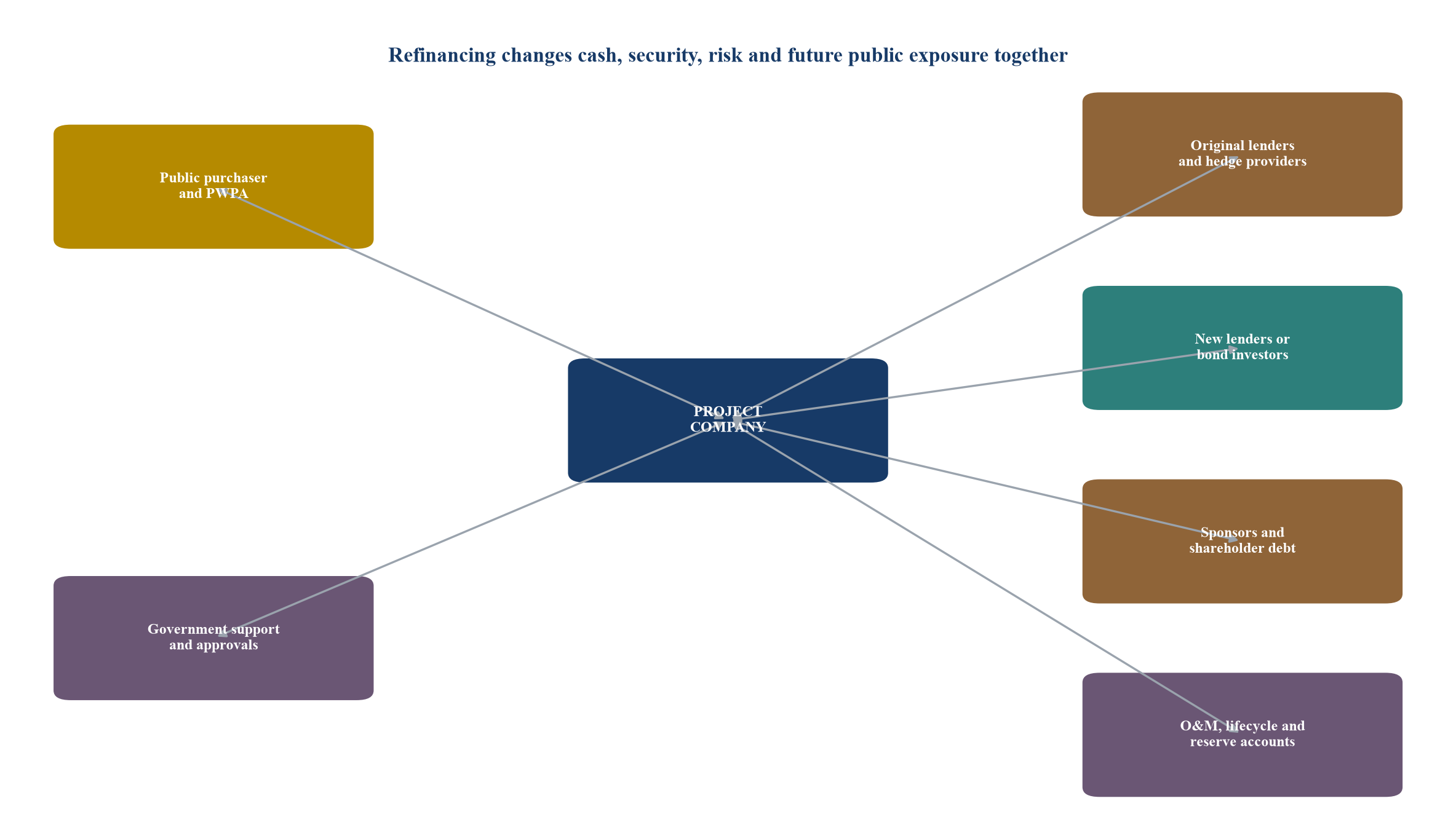
The diagram is a generic framework; transaction-specific rights require review of executed documents and applicable law.
21. Test lower margin
The simplest refinancing replaces debt with lower-margin debt of similar amount, tenor and risk. Net interest savings increase distributable cash.
The model should separate benchmark movement from margin reduction and account for hedge effects. Sharing can apply to the total net gain or to defined sources.
22. Test tenor extension
Longer tenor lowers annual debt service and can release distributions earlier. It also leaves debt outstanding closer to handback.
The asset's remaining life, major maintenance and termination payment should support the new maturity. A refinancing gain should not depend on transferring late-term risk to the public side.
23. Test higher leverage
Re-leveraging raises new debt above the refinanced balance and releases cash to shareholders. It can materially increase equity IRR.
The approval should cap leverage, preserve downside coverage and examine the use of proceeds. A distribution-funded borrowing creates different public value from debt funding productive capital expenditure.
24. Test reserve release
Operating history may support lower reserves. The released cash produces immediate gain and reduces carry cost.
The project should demonstrate outage, payment-delay and maintenance resilience. Reserve reduction should not rely solely on a short period of favourable performance.
25. Test guarantee release
Completion guarantees, cost-overrun support or letters of credit may be released after tests are passed. Refinancing can monetise the reduced sponsor exposure.
The calculation should distinguish contractual release already earned from an additional financing gain. Public protections should not be removed without equivalent security.
26. Test bond refinancing
An operating asset may access project bonds, sukuk or institutional debt with longer tenor. Capital-market execution introduces rating, disclosure, make-whole and investor-consent features.
The structure should remain compatible with direct agreements, step-in and amendments. Public approval should address future bondholder coordination.
27. Test Islamic refinancing
Islamic structures may use ijara, wakala, murabaha or sukuk features and require asset or cash-flow arrangements distinct from conventional loans.
The economic comparison should capture all rentals, profit payments, fees, reserves and tax. Legal form should not change the gain-sharing principle.
28. Test local-currency refinancing
Local debt can reduce currency mismatch and public FX exposure. It may have shorter tenor or higher nominal rate.
The model should compare risk-adjusted all-in cost and tariff indexation. A higher nominal local rate can still create public value by removing foreign exposure.
29. Test foreign-currency refinancing
Foreign markets may offer lower rate or longer tenor. The apparent saving can disappear after hedge or tariff FX exposure.
Approval should limit foreign borrowing to matched cash flow and examine contingent public cost. Unhedged sponsor speculation should remain private risk.
30. Test acquisition refinancing
A sponsor sale can coincide with debt refinancing. Purchase price, financing gain and change of control are separate transactions.
The gain calculation should capture qualifying financing changes without sharing the commercial value of a genuine equity sale unless the contract provides otherwise.
31. Treat operational improvement
Higher availability or lower cost can improve debt capacity. Sponsors should generally retain reward for performance within the contracted sharing rule.
The base-case comparison should avoid treating operating outperformance as a financing gain. Higher leverage made possible by public contract support still requires risk review.
32. Treat market-rate movement
Falling benchmarks can lower cost where the project was not fully hedged. Market movement is outside sponsor control and may justify public sharing.
The contract can share all qualifying gain rather than attribute each driver. Any exclusions should be explicit and administrable.
33. Treat country and sector rerating
Improved sovereign, offtaker or sector credit can lower lender pricing. Public policy and market development contribute to the gain.
This reinforces the case for sharing while preserving sponsor reward for delivering a proven asset. The public share can return value to tariffs or services.
34. Treat sponsor credit improvement
Stronger sponsors or additional support can reduce financing cost. If the sponsor provides new risk capital or guarantee, the benefit is not costless.
The calculation should include the value and cost of new support. Public sharing should apply to net refinancing gain after approved consideration.
35. Treat public guarantee changes
A new or expanded public guarantee may improve terms. The resulting saving is supported by additional public contingent exposure.
The transaction should price that support, disclose fiscal risk and allocate gain accordingly. A guarantee should not create private gain without public compensation.
Table 2. Illustrative refinancing risk-allocation matrix
| Refinancing element | Sponsor responsibility | Public purchaser right | Shared control | Decision test |
|---|---|---|---|---|
| Lower pricing | Competitive process and execution | Contractual share of qualifying gain | Audit of all-in economics | Net NPV gain after costs |
| Higher leverage | Equity release and retained risk | Consent and protection of public exposure | Leverage and coverage limits | Downside DSCR and termination amount |
| Longer tenor | Debt compliance and lifecycle alignment | Handback and late-term protection | Maturity and reserve conditions | Debt retired before defined date |
| Reserve release | Demonstrate sustainable liquidity | Protect service and maintenance | Minimum reserve or liquidity facility | Stress-case funding sufficiency |
| Currency change | Match or hedge private exposure | Control tariff and guarantee exposure | Approved currency schedule | Risk-adjusted public and project cost |
| Public guarantee | Pay agreed fee and comply with conditions | Fiscal approval and gain attribution | Cap, reporting and expiry | Public value exceeds contingent exposure |
| Performance improvement | Retain delivery incentive | Verify that gain is not misclassified | Base-case reconciliation | Separate operating and financing effects |
The entries describe a possible allocation and are not legal conclusions.
36. Calculate the pre-refinancing case
The pre-refinancing case should project remaining shareholder cash flow under the approved financing, using the original base case and defined actual updates.
It should include existing debt service, reserves, hedges, tax and permitted distributions. The model version and inputs require a controlled audit trail.
37. Calculate the post-refinancing case
The revised case replaces only the approved financing terms and direct consequences. It includes new fees, break costs, reserves, tax and distribution timing.
Operational assumptions remain consistent unless a contractual event requires change. Differences should be documented line by line.
38. Calculate net present value
The gain is the NPV of revised shareholder cash flow minus the NPV of the pre-refinancing cash flow, adjusted for eligible costs and defined exclusions.
The calculation should show annual or monthly amounts and the discount factor. A black-box output is insufficient for public approval.
39. Avoid double counting
Lower interest, reserve release and increased debt can all affect the same distribution. Adding separate headline gains can count value twice.
One integrated cash-flow comparison avoids duplication. Supporting schedules explain the sources without summing them again.
40. Build the gain waterfall
The waterfall starts with gross financing benefit, deducts transaction and break costs, adjusts for risk and exclusions, and applies the contractual sharing percentage.
The public share can be paid only from value actually created and should reconcile to the project and shareholder cash flows.
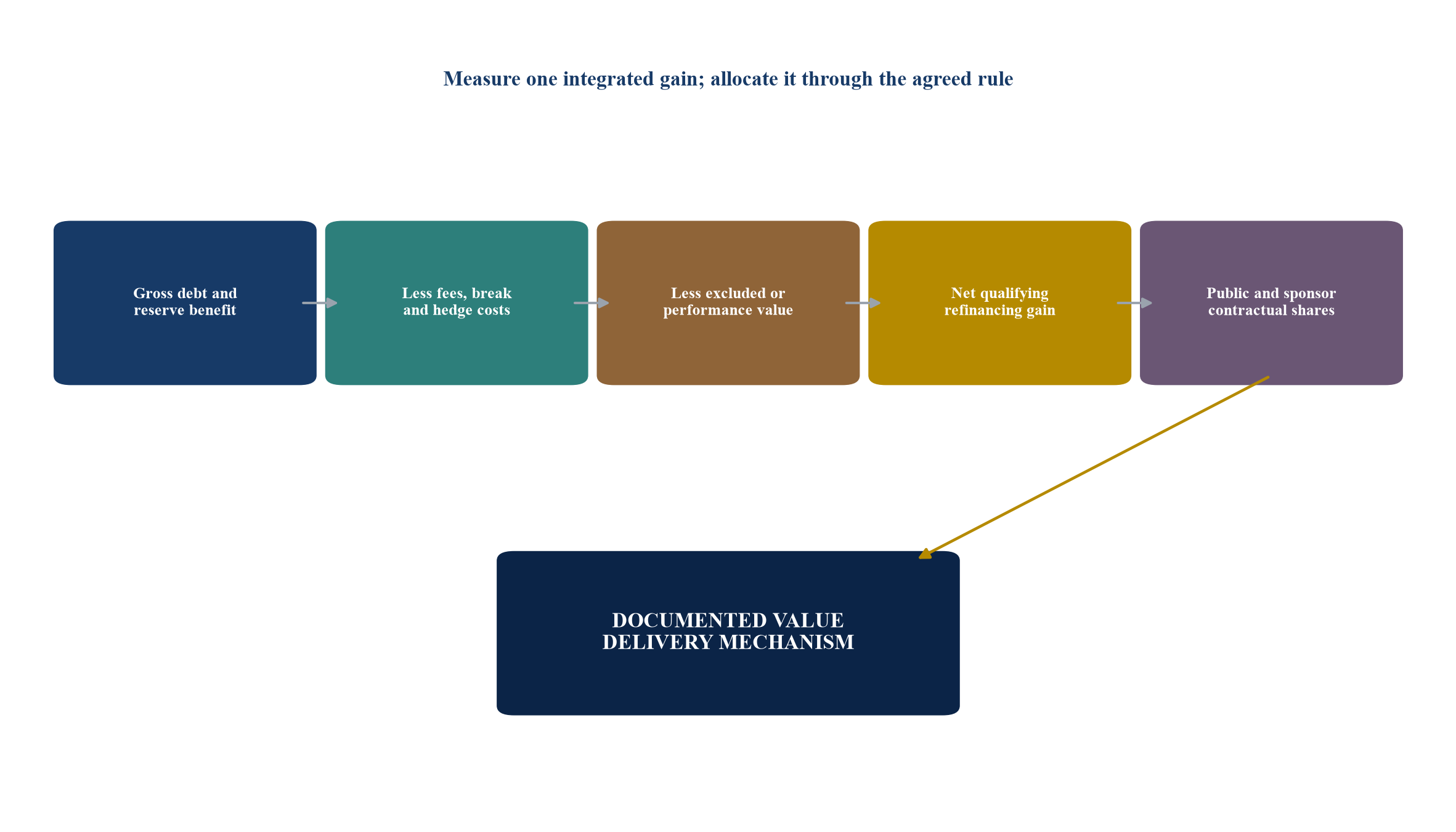
The sequence is hypothetical and must follow the contract and approved calculation method.
41. Choose the sharing percentage
Equal sharing is a common reference, while some frameworks use staged or source-specific percentages [1][2][3]. The correct percentage is a policy and procurement choice.
The rule should reward sponsor initiative while returning public-supported value. Complexity should be justified by material benefit.
42. Use staged sharing
A staged rule can increase the public percentage as gain grows. It preserves sponsor incentive for modest transactions and captures extraordinary value.
Thresholds should use NPV gain and avoid cliff effects. Worked examples should show the marginal percentage at each band.
43. Use source-specific sharing
The contract can assign different shares to margin reduction, higher leverage, reserve release or public-guarantee benefit.
This can improve attribution but increases disputes and modelling. It works best where sources are objectively separable.
44. Choose lump-sum payment
A lump sum delivers immediate, visible public value and avoids future credit exposure. It requires cash at refinancing completion.
The amount should not exceed value actually distributed or funded where the contract imposes that limit. Payment and sponsor distribution can occur simultaneously.
45. Choose tariff reduction
Reducing future availability or capacity payment returns value to users over the remaining term. It preserves project cash only if calibrated to the public share.
The reduction should be fixed in a revised schedule and reflected in termination compensation and lender models.
46. Choose additional service
Gain can fund additional capacity, lifecycle work, resilience or other service. The value must be independently priced and contractually enforceable.
An undefined promise of service can obscure the public share. Scope, performance and delivery dates should be clear.
47. Use a blended mechanism
A combination of lump sum, tariff reduction and service can match immediate distributions and future savings. World Bank guidance recognises multiple payment routes [2][3].
The combined NPV should equal the approved public share. Each element requires its own accounting and contract treatment.
48. Protect debt-service resilience
The refinancing should satisfy base, downside and lock-up coverage. Higher leverage should not consume all operating headroom.
Stress cases should include outage, payment delay, input cost, interest, FX and lifecycle expenditure. Reserve and distribution controls should remain credible.
49. Protect lifecycle expenditure
Operating utility assets need membranes, turbines, major overhauls, intake works and control upgrades. A refinancing can divert cash needed for these obligations.
The model should fund the approved lifecycle plan before shareholder release. Deferral should reduce distributable gain.
50. Protect handback
Debt maturity, reserve release and distributions should remain compatible with asset condition at expiry. A heavily levered late-term project can underinvest in handback.
The contract should preserve inspection, reserve and remediation rights. Refinancing consent can require a maximum final maturity.
51. Protect termination economics
Higher debt can increase termination payment where compensation follows outstanding senior debt. The public side should quantify exposure by termination cause.
Any increase should be approved, capped or excluded from compensation as agreed. The direct agreement and termination schedule require alignment.
52. Protect tariff indexation
Changing debt currency, rate or tenor can alter the economic basis of tariff components. The tariff should not continue protecting an exposure that was refinanced away.
The approval should rebase affected weights neutrally. Savings already counted in gain should not be counted again through tariff reduction.
53. Address tax
Refinancing fees, distributions, debt, shareholder loans and gain payments can create tax and withholding effects. The model should use transaction-specific advice.
Tax generated by sponsor structure should not automatically reduce public gain. The contractual method should state eligible tax treatment.
54. Address accounting and statistics
Gain payment, tariff reduction, debt change and public consent can affect accounting or statistical classification. Review should occur before approval.
The economic substance and risk transfer matter. Documentation should support the intended treatment without overriding service and value-for-money decisions.
55. Establish consent and audit
The project company should provide term sheets, models, finance documents, costs, distributions, sensitivities and risk analysis. The public authority should have audit and adviser rights [2].
Consent should be subject to a timetable and objective conditions. Silence should not imply approval unless expressly agreed.
56. Run the eligibility gate
The first gate determines whether the transaction is qualifying, excluded or partly qualifying. It maps every financing and capital-structure change.
The gate file records the contractual basis, approvals, transaction perimeter and unresolved classification issues.
57. Run the economics gate
The second gate reconciles original and revised models, actual history, costs, discount rate and gain. Independent replication should produce the same result.
The analysis separates operating performance, financing benefit and new public support. Sensitivities identify value at risk.
58. Run the resilience gate
The third gate tests coverage, liquidity, lifecycle, currency, interest, termination and handback. Technical and lender advisers should use the same operating case.
Conditions can include leverage caps, reserves, hedge, maturity, lock-up and maintenance funding.
59. Run the public-value and completion gate
The fourth gate confirms public share, payment method, tariff, approvals, fiscal exposure, tax and accounting. The fifth gate coordinates financing close, gain payment, document amendments and disclosures.
The final package should leave no gap between money distributed and public value delivered.
60. Adopt the decision record and 90-day plan
The decision record should state the refinancing purpose, approved terms, qualifying perimeter, gain method, discount rate, costs, sharing rule, public delivery, risk changes and conditions. It should compare the selected structure with credible alternatives.
The 90-day plan below can support a competitive refinancing after stable operations. The timetable should be adapted to procurement law, lender process, rating, sukuk or bond requirements and project complexity.
During the first two weeks, the project company should deliver the original base case, executed finance documents, historic cash flows, current model, performance record and preliminary term sheets. The public team should establish governance, confidentiality, adviser scope and the approval path. The parties should agree the transaction perimeter before detailed modelling begins.
The financial workstream should reconstruct the pre-refinancing case from the controlled original model and actual opening balances. It should create the revised case using the same operating assumptions. Every difference should be classified as financing, operational, contractual or tax. The gain schedule should reconcile to sources and uses, debt service, reserves and shareholder distributions.
The market workstream should test competition. Bank, bond, sukuk and institutional options can differ in price, tenor, covenants and flexibility. A credible process supports value and demonstrates that the chosen terms are commercially reasonable. The process should account for execution certainty and break costs rather than select the lowest headline margin.
The technical workstream should review operating history, asset condition, lifecycle programme and handback. It should confirm that reserve reductions and higher leverage do not depend on deferred maintenance. Major expenditure and outage should be reflected in the downside model before cash is released.
The legal workstream should review the PWPA, direct agreement, financing, security, hedge, government support, change of control and termination. It should draft consent conditions, amendments, payment mechanics, audit rights and future refinancing treatment. The amendment should preserve public and lender remedies.
The public-finance workstream should quantify tariff savings, lump-sum receipt, guarantee exposure, termination liability and portfolio concentration. It should identify budget, accounting, tax and disclosure approvals. Public value should be measured as a complete package rather than the gain cheque alone.
Before approval, an independent reviewer should reproduce the calculation from the source models and documents. The reviewer should test discount rate, costs, exclusions, actual cash flows, distributions and sharing bands. Unresolved differences should be recorded, and any provisional amount should have a true-up method.
Completion should coordinate new debt drawdown, old debt repayment, hedge close-out, security release, public gain payment, sponsor distribution and contract amendments. A closing statement should show each cash movement and condition. No sponsor distribution should precede satisfaction of the agreed public-value mechanism.
After completion, the project should update the tariff model, termination schedule, financial covenants, reserve policy and contract register. Annual monitoring should confirm compliance with lifecycle, handback and distribution conditions. Future refinancing proposals should start from the revised approved base case without counting the same gain twice.
The strongest arrangement creates a repeatable standard. Governments gain a transparent share of value created by public support and market rerating. Sponsors retain a meaningful incentive to complete, operate and refinance well. Lenders receive a stable framework for consent and execution.
The original base case should be preserved from financial close in a format that remains operable. Source inputs, macros, debt schedules, tax logic and distribution rules should be documented. A model that cannot be run years later weakens the contractual sharing mechanism and increases dependence on the project company's interpretation. A controlled archive should include the executed financing documents, financial-close report and model-audit findings.
Historic cash-flow reconciliation deserves equal discipline. The refinancing calculation should start with actual senior debt, shareholder instruments, reserve balances and distributions at the reference date. The project company should explain every variance from the base case. Variance can arise from availability, cost, tax, insurance, working capital, change in law or prior refinancing. Classification matters because only defined financing effects enter the qualifying gain.
The market-testing strategy should fit the transaction. A full competitive process can provide strong price evidence; a bilateral amendment can offer speed and lower execution risk. The approval paper should explain why the chosen route is reasonable and record alternatives. Comparable term sheets should use the same amount, tenor, amortisation and security so that margin comparisons do not conceal structural differences.
All-in financing cost should include benchmark, margin, upfront fees, commitment charges, agency fees, rating cost, listing cost, hedge premium, liquidity facilities and tax. The model should also recognise the value of covenant flexibility, prepayment rights and delayed amortisation. These terms can be economically significant even when they do not appear in the headline interest rate.
Where refinancing increases debt, the sources-and-uses statement should show exactly how the additional proceeds are applied. Uses can include old debt repayment, transaction cost, reserve funding, capital expenditure, public gain and shareholder distribution. A residual line or undefined project-purpose amount is insufficient. Completion instructions and bank evidence should confirm that actual cash followed the approved statement.
The downside case should focus on the period after the refinancing distribution, when the project has less equity cushion. It should test prolonged outage, purchaser payment delay, lower availability, higher input cost, interest-rate movement, FX movement and a major lifecycle event. Distribution lock-up and cure rights should activate before debt service failure. The public side should understand whether those protections also preserve service.
Lifecycle analysis should connect engineering condition with finance. The technical adviser should review component life, major overhaul dates, membrane replacement, corrosion, intake and outfall condition, spares and control-system obsolescence. The refinancing model should fund these items before calculating sustainable excess cash. Lower reserves are credible only where another committed source covers the same risk.
Handback deserves a forward-looking condition profile. Debt maturity, final distributions and maintenance spending should be compared with the required residual life at concession end. The public counterparty can require a handback reserve, inspection schedule or distribution restriction during the later years. These controls protect the asset without preventing a well-designed early refinancing.
Termination modelling should calculate compensation under authority default, project-company default, force majeure and voluntary termination before and after the transaction. Higher approved senior debt can increase public exposure even where annual tariff is unchanged. The consent can cap recognised debt, exclude cash-out borrowing from compensation or require an additional sponsor haircut, subject to the negotiated contract.
The public share should have a clear payment waterfall. On completion, new money repays old debt and transaction costs, funds required reserves, delivers the public amount and then supports sponsor distribution in the agreed order. The payment instruction should be signed by the facility agent, project company and relevant public authority. Escrow can address a final calculation true-up without delaying the entire refinancing.
Tariff reduction requires careful implementation. The amendment should state the revised capacity or availability payment by period, indexation and rounding. It should also update termination and change-in-law calculations that use the tariff. The lender model should confirm that the revised payment supports the approved debt and reserves after all performance deductions.
A lump-sum public receipt may be more visible, while a tariff reduction may align benefit with future users. The decision should consider credit, budget, intergenerational allocation and administration. Additional services can create strategic value when they are defined and priced. The project should avoid substituting a poorly specified promise for a measurable cash benefit.
Tax analysis should trace each payment through the project company and sponsors. Refinancing can create deductible fees, hedge gains or losses, withholding, value-added tax and limitations on interest deductions. The model should distinguish project tax from sponsor tax. Public gain should be measured on the contractual basis and adjusted only for tax items expressly recognised by that basis.
The amendment process should respect procurement integrity. A refinancing should not change the project's substantive scope or risk allocation beyond what the contract permits without the required competition or approval. Material changes to tariff, term, guarantee or service can have consequences beyond gain sharing. Counsel should document the authority for every amendment.
Disclosure should balance accountability and legitimate confidentiality. The public record can state the purpose, approved debt amount, gain methodology, public share and delivery route without publishing protected lender pricing or personal information. Internal files should retain the complete calculation and evidence for audit, parliamentary, regulatory or future contract-management review.
After completion, a refinancing register should record debt, maturity, hedge, reserves, public gain, tariff adjustment, consent conditions and future review dates. The project company's periodic reporting should confirm compliance with leverage, distribution and maintenance conditions. The public authority should assign ownership to a named contract-management function rather than leave the transaction file with advisers.
Future refinancings require a new baseline. The approved post-refinancing model becomes the comparison point only to the extent the contract provides, while historical gain already shared remains excluded. The method should prevent a later transaction from recreating or reversing prior value. Successive transactions should be auditable as one continuous financing history.
The policy can support a wider utility programme. Standard definitions, model schedules, consent templates and adviser protocols reduce transaction cost and improve consistency. Portfolio reporting can show gains, tariff reductions, debt maturity and contingent exposure across projects. A standard should still permit project-specific adaptation for technology, currency, concession structure and market conditions.
The commercial objective is durable alignment. Sponsors need enough retained upside to search for better financing and execute a complex transaction. The public side needs a defensible return on the contractual and sovereign support that helped create the asset's low-risk cash flow. Lenders need a process that preserves security and service. A transparent rule reconciles these interests before value is distributed.
Table 3. Hypothetical refinancing and debt-service sensitivity
| Scenario | Old debt NPV cost | New debt NPV cost | Fees and break cost | Net qualifying gain | Minimum post-refinancing DSCR | Public-value implication |
|---|---|---|---|---|---|---|
| Like-for-like margin reduction | 610 | 555 | 12 | 43 | 1.34x | Clear saving with limited structural change |
| Margin reduction plus tenor extension | 610 | 530 | 18 | 62 | 1.30x | Larger gain; later maturity requires review |
| Re-leveraging with distribution | 610 | 520 | 22 | 68 | 1.16x | High immediate gain; resilience constraint binds |
| Local-currency refinancing | 610 | 570 | 15 | 25 | 1.28x | Lower gain but reduced public FX exposure |
| Bond or sukuk with make-whole | 610 | 545 | 34 | 31 | 1.31x | Tenor benefit offset by execution cost |
All values are hypothetical management assumptions in USD millions unless stated otherwise. They demonstrate method only and are not observations, forecasts or valuation conclusions.
Table 4. Illustrative 90-day utility-refinancing workplan
| Period | Workstream | Core actions | Decision output | Accountable owner |
|---|---|---|---|---|
| Days 1-15 | Intake and governance | Freeze models; map contracts, approvals, advisers and transaction perimeter | Confirmed qualifying-refinancing scope | Project board and contracting authority |
| Days 16-30 | Base-case reconciliation | Reconcile actual debt, cash, reserves, performance and shareholder flows | Controlled pre-refinancing case | CFO and financial adviser |
| Days 31-45 | Market and structure | Test bank, bond, sukuk, currency, tenor, hedge and leverage options | Preferred financing structure | Sponsors and debt adviser |
| Days 46-60 | Gain and risk | Calculate NPV gain; test DSCR, lifecycle, handback and termination | Gain range and consent conditions | Independent advisers |
| Days 61-75 | Public value and documentation | Select sharing and payment; complete tax, accounting and amendments | Approval and signing package | Public finance and counsel |
| Days 76-90 | Completion | Close new debt, repay old debt, deliver public share and update registers | Verified refinancing completion statement | Transaction lead |
Timing is indicative and should be adapted to approvals, market execution and transaction structure.
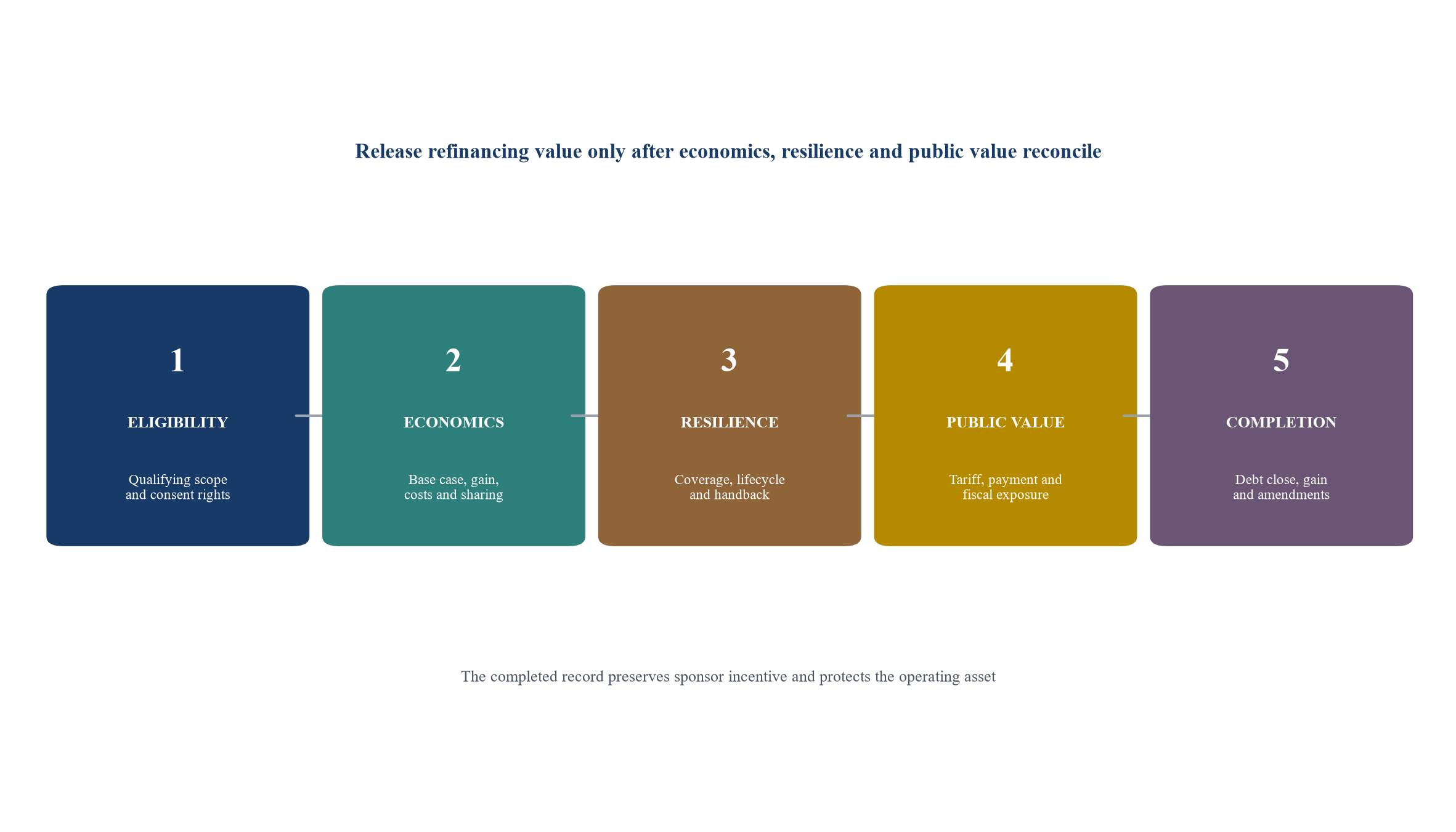
Each gate requires documented evidence before the transaction advances.
The framework turns refinancing from a private capital event into a controlled value-creation decision. It identifies the gain, protects project resilience, rewards sponsors for delivery and returns an agreed share of public-supported value through a transparent mechanism.
Execution quality matters. The original base case, current financing, market terms, asset condition and public exposure should reconcile before consent. A refinancing that leaves the utility stronger and distributes value according to an agreed rule can support future private investment and public confidence.
References
- World Bank Group, "Considerations for Government," PPP Resource Center, https://ppp.worldbank.org/considerations-government
- World Bank Group, "Guidance on PPP Contractual Provisions, 2019 Edition," refinancing provisions, https://ppp.worldbank.org/sites/default/files/2021-03/Guidance%20on%20PPP%20Contractual%20Provisions_2019%20edition.pdf
- World Bank Group, "Guidance on PPP Contractual Provisions, 2017," Sections 5.2.5 and 5.2.6, https://ppp.worldbank.org/sites/default/files/2024-07/Guidance_%20PPP_Contractual_Provisions_EN_2017.pdf
- European PPP Expertise Centre, "EPEC Guide to Public-Private Partnerships," European Investment Bank, https://www.eib.org/attachments/publications/epec_guide_to_ppp_en
- UK Government, HM Treasury, "PFI/PPP Finance Guidance," https://www.gov.uk/government/publications/pfippp-finance-guidance
- UK Government, "Refinancing of Early PFI Transactions: Code of Conduct," https://assets.publishing.service.gov.uk/government/uploads/system/uploads/attachment_data/file/225366/05_PPP_Refinancing_Code_of_Conduct.pdf
- UK Government, National Infrastructure and Service Transformation Authority, "PFI Foundations," 2026, https://www.gov.uk/government/publications/pfi-foundations-for-contract-managers/nista-contract-management-guidance-pfi-foundations
- World Bank Group, "Finance Structures for PPP," PPP Resource Center, https://ppp.worldbank.org/finance-structures-ppp
- World Bank Group, "Government Support," PPP Resource Center, https://ppp.worldbank.org/government-support
About the Author
Chennakeshav (CK) is a corporate finance and investment banking executive with 25+ years of global experience in deal origination, structuring and execution across M&A, growth capital and corporate strategy. He has led value-creation mandates for founders, corporates and funds — bridging the boardroom view to hands-on execution and close.
His career spans Morgan Stanley, HSBC, Lloyds Banking Group, EWEC, ADQ portfolio companies and Emirates Growth Fund, across TMT, real estate, fintech, deeptech, cleantech, infrastructure and energy. He has partnered with C-suite leaders, private equity and venture funds, sovereign wealth funds and family offices to finance complex fund raises and scale-up ventures, and has led M&A due diligence, post-merger integration and business-transformation initiatives to create value.
At Matchpoint Partners he is Managing Partner, leading the firm's corporate finance, M&A and capital-raising practice. He holds an MBA from London Business School, an engineering degree from VTU and a Master of Laws (LLM, in progress) from UCL London.
An active start-up mentor, CK mentors at Techstars, DIFC FinTech Hive, Startup Grind, Founder Institute and IN5, serves as Entrepreneur Mentor in Residence (EMiR) at London Business School, and judges the Entrepreneurship World Cup.
