

Introduction
Renewable development pipelines have become strategic acquisition targets for utilities, infrastructure funds, oil and gas companies, independent power producers, equipment groups and diversified investors. A developer can provide access to scarce sites, queue positions, local teams, supplier relationships, public authorities and future projects. Acquiring the company can be faster than building the same capability internally. It can also transfer a large portfolio of uncertain opportunities whose headline capacity bears little relationship to eventual operating output.
The global build requirement gives pipelines strategic relevance. The International Energy Agency forecasts approximately 4,600 GW of renewable capacity additions between 2025 and 2030. Its 2026 grid analysis also identifies more than 2,500 GW of renewable, storage and large-load projects stalled in grid queues worldwide. IRENA estimates that the transition pathway requires substantial investment in renewable generation, grids and flexibility through 2030. These figures describe the scale of development demand. They do not establish that each announced project or queued megawatt will reach operation.
Project attrition is material and measurable. Lawrence Berkeley National Laboratory reported that only 13 percent of capacity entering surveyed United States interconnection queues from 2000 through 2019 had reached commercial operation by the end of 2024; 77 percent had withdrawn and 10 percent remained active. The result should not be applied mechanically to another market or stage. It demonstrates why pipeline capacity requires project-level evidence and probability weighting.
The acquisition decision therefore concerns rights, probabilities and organisational capability. The buyer needs to know which projects are legally controlled, which milestones have been achieved, how much capital remains, which assumptions determine value, whether the team can repeat past conversion and how integration will affect that capability. This paper provides a structured answer.
1. Define what the buyer is acquiring
A renewable developer can contain operating assets, projects under construction, ready-to-build projects, early-stage development rights, service contracts, land options, grid applications, licences, data, intellectual property and employees. The legal perimeter may also include dormant entities, legacy liabilities, minority partners and obligations to vendors or landowners. The valuation perimeter should match the legal perimeter precisely.
The first transaction schedule should list every entity and project. For each project it should identify ownership, jurisdiction, technology, capacity, site control, grid status, permit status, offtake route, procurement status, expected commercial-operation date, committed expenditure, remaining development cost, construction cost, partner interests and material liabilities. The schedule should identify whether a right is owned, optioned, licensed, bid for, applied for or merely being explored.
The buyer should distinguish project ownership from economic participation. A target may own a small carried interest, earn a development fee, hold an option to acquire the project company or share economics with a local partner. Headline capacity should be adjusted for the target's net economic interest and the contractual conditions attached to it.
Shared resources belong in the perimeter analysis. A development platform can rely on a parent guarantee, central treasury, engineering team, procurement framework, brand, software or data licence that will not transfer. Each dependency requires a replacement plan, transitional service or valuation adjustment.
2. Separate controlled pipeline from commercial prospecting
Pipeline lists often combine projects with different evidential status. A controlled project may have enforceable site rights, an incorporated project company, a valid grid position and an active development plan. A prospect may be a market hypothesis, a landowner discussion, an auction intention or an early origination lead. Both can be commercially useful. They should not receive the same valuation treatment.
The acquisition data room should use a rights hierarchy. Tier one contains legally controlled projects with verified rights and a current route to development. Tier two contains conditional rights that require renewal, counterparty action, auction success or regulatory approval. Tier three contains qualified prospects supported by documented origination work. Tier four contains market opportunities without project-specific control. Only the first three tiers belong in a probability-weighted project model, and the fourth belongs in the platform growth case.
Control should be tested for duration and transferability. A land option that expires before the planning decision may have limited value. A grid application that cannot transfer on change of control may create closing risk. A permit may attach to land, a project company, a named applicant or a technical design. A joint-development agreement may grant a partner consent over a sale.
The buyer should require a pipeline representation tied to the final schedule. It should avoid broad assurances that all projects are viable because viability depends on changing facts and commercial assumptions. Specific representations can address ownership, disclosed contracts, validity, notices, disputes and known breaches.
3. Establish one stage taxonomy
Developers use terms such as early stage, advanced development, shovel ready, notice to proceed and ready to build. The same label can describe different milestone sets across countries and technologies. The buyer should replace target terminology with one transaction taxonomy linked to objective evidence.
A practical taxonomy can contain origination, site secured, grid application, grid offer, permit application, principal permits secured, offtake or route to market secured, financing-ready, construction-ready, under construction and operating. Each stage should have entry criteria, exit criteria and evidence. A project should occupy the lowest stage for which every mandatory criterion is met.
The taxonomy should recognise jurisdictional differences. Some markets award land and offtake together through competitive procurement. Others require the developer to secure private land, grid, planning and revenue independently. Offshore wind, geothermal, hydro and transmission-linked projects follow different sequences from utility-scale solar. The common taxonomy should preserve these differences through stage-specific checklists.
Stage definitions should also record reversibility. A permit can be challenged or lapse. A grid offer can change after restudy. An auction award can be terminated for missed milestones. A land option can expire. The probability model should reflect the durability of each achieved milestone rather than treating it as permanent.
4. Build project probabilities from evidence
Probability weighting converts an uncertain pipeline into an expected-value estimate. The process should begin with project-specific drivers rather than a single percentage assigned to a stage. Stage can provide a baseline. The analyst should then adjust for the quality and durability of site rights, grid position, permits, resource, offtake, economics, community acceptance, technical design, funding and team performance.
The model should separate conditional probabilities. A project may have a probability of securing final permits, a probability of retaining or obtaining grid access after permits, a probability of winning an auction, a probability of financing after an award and a probability of completing construction. Multiplying these conditional probabilities produces an overall conversion probability. The approach exposes the principal source of attrition and supports milestone-linked consideration.
Historical evidence should calibrate judgement. The target should provide a complete list of projects initiated, acquired, sold, withdrawn, rejected, expired and commissioned. Conversion rates should be measured by technology, jurisdiction, stage and vintage. Survivorship bias arises when the analysis includes only current and successful projects. Acquisitions and disposals should be reconciled so that the buyer does not credit the target for projects developed by others.
External queue or permitting data can provide a reasonableness check. It cannot substitute for project diligence. Berkeley Lab's queue results, Ofgem's queue reforms and FERC readiness requirements show that queue entry alone is weak evidence of completion. A signed interconnection agreement, site control and financial commitments provide stronger evidence, subject to project economics and remaining conditions.
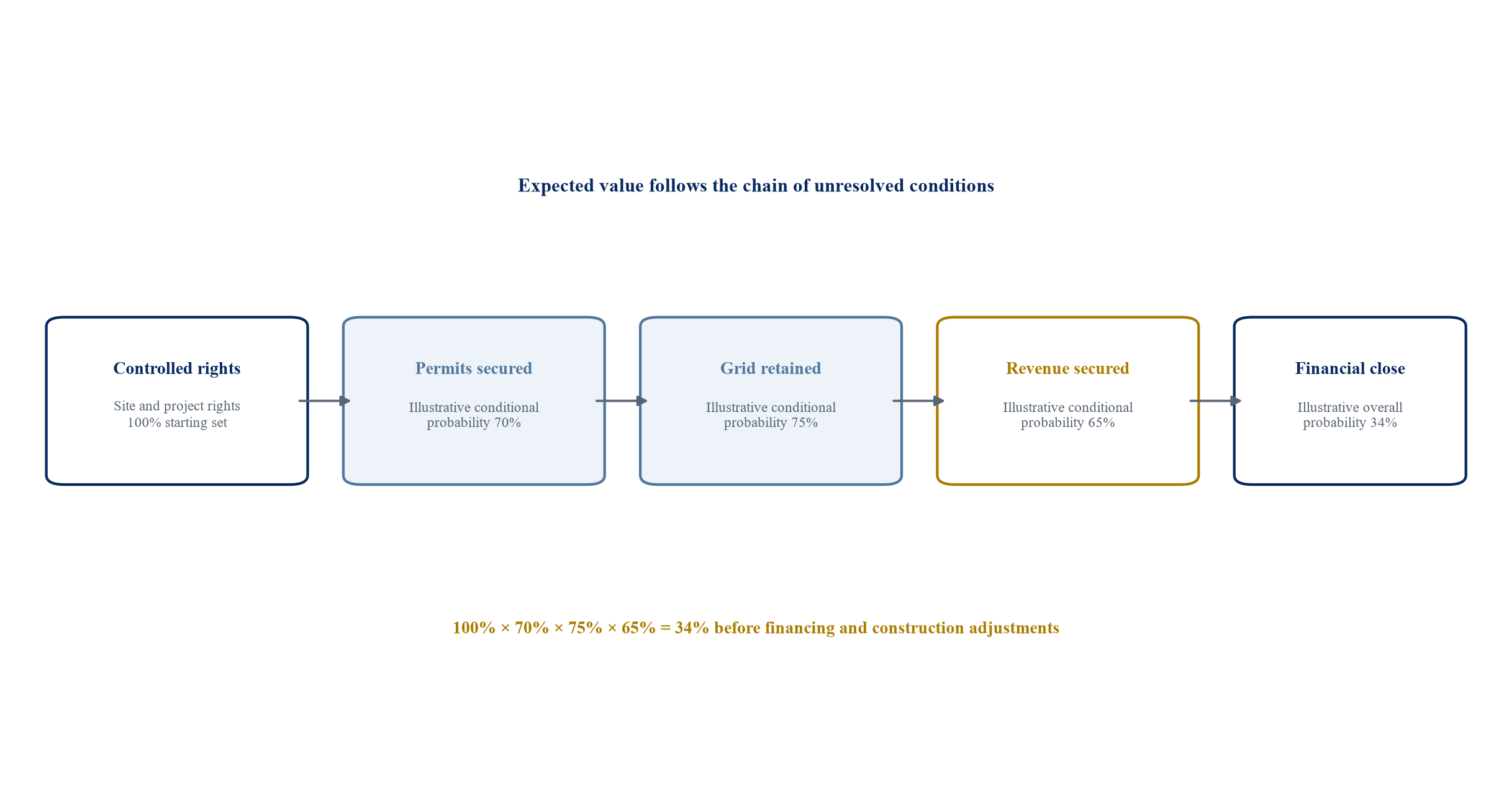
The probabilities are illustrative. Transaction teams should estimate each conditional probability from project evidence, target history and relevant market data.
5. Treat grid position as a contingent right
Grid access can determine whether a renewable project has a route to market. The value of a queue position depends on the connection point, capacity, timing, upgrade scope, security requirements, curtailment regime, study status and probability that the offer will survive reform or restudy. The legal ability to transfer the position is equally important.
FERC Order No. 2023 introduced cluster studies, commercial-readiness deposits, site-control requirements and withdrawal penalties for covered United States transmission providers. These measures aim to reduce speculative entries and improve processing. Ofgem's transition to a ready-and-needed framework similarly re-examines existing offers against readiness and system needs. A buyer should identify which reform regime applies and whether the project's existing status will be preserved.
Grid diligence should reconcile correspondence, studies, executed agreements, deposits, securities, milestone notices, cost allocations and change-of-control provisions. The model should include network upgrade cost, security timing, potential restudy, connection delay and curtailment. A connection date without a credible network-delivery plan should receive a schedule contingency.
The buyer should avoid treating queue position as an independent asset when it is inseparable from land, design or project-company obligations. It should also avoid double counting grid value in both project cash flow and a separate per-megawatt premium.
6. Test land and resource control
Land value depends on legal control, term, exclusivity, access, easements, change-of-control rights, rent escalation, restoration obligations and compatibility with the project design. Transmission routes, construction access and laydown areas can be as important as the generation site. The World Bank's solar development guidance identifies site control, grid connection and permits as basic development requirements.
The buyer should inspect executed documents and title evidence. A landowner memorandum or exclusivity letter may provide insufficient control for a long development period. Options should extend through anticipated permitting and financing, with renewal rights aligned to delay scenarios. Assignment provisions should permit the acquisition and later financing. Competing mineral, agricultural, environmental or community rights should be assessed.
Resource data should be tested independently. Solar irradiation, wind measurements, hydrology, geothermal resource and yield models influence project economics and design. The model should distinguish measured data, satellite or mesoscale estimates, third-party studies and target assumptions. Loss factors, degradation, wake effects, availability and climate variability should be documented.
Land and resource risks interact. A design change required by environmental review may move equipment into a weaker resource area or require new rights. Grid routing may require additional easements. The valuation should preserve these dependencies.
7. Convert permitting status into a decision path
Permitting is a sequence of legal and technical decisions rather than a binary status. Environmental approval, planning consent, construction permission, generation licence, aviation clearance, water rights, heritage approval and grid authorisation can involve different agencies and appeal rights. The World Bank notes that the sequence depends on the legal framework and entry regime. The European Commission's permitting guidance seeks clearer procedures, digitalisation and accelerated areas, while national implementation remains decisive.
The diligence file should identify each required permit, responsible authority, application status, decision date, consultation, conditions, expiry, appeal period, challenge and dependency. The buyer should review the evidence supporting management's expected date and probability. A permit marked submitted should not be treated as advanced if the application is incomplete or the authority has requested material redesign.
Permit conditions should flow into cost and schedule. Habitat mitigation, community benefits, local content, noise limits, water management, decommissioning security and construction windows can affect capital expenditure and output. An approved project can remain economically unattractive after conditions are imposed.
The acquisition agreement can use permit milestones for contingent consideration. The definition should require final effectiveness, transferability and an agreed project design rather than the issue of any decision.
8. Diligence the route to revenue
Revenue can come from a regulated tariff, contract for difference, power purchase agreement, capacity payment, renewable certificate, merchant sales or a combination. A project without a secured route may retain option value, while its valuation depends on forecast market conditions and future procurement success.
The buyer should verify auction eligibility, bid security, delivery milestones, indexation, negative-price provisions, volume obligations, curtailment, credit support, termination and change of control. For bilateral offtake, counterparty credit and contract enforceability matter. For merchant projects, the model should use transparent price curves and capture-rate assumptions with downside cases.
The IEA reports that procurement mechanisms differ across regions and technologies. Contracts for difference, utility auctions and merchant development create different risk profiles. Pipeline probability should therefore reflect the actual procurement route rather than a generic assumption that a buyer will secure a PPA later.
Hybrid projects require integrated analysis. Solar and storage values can depend on shared interconnection, dispatch rights and charging rules. Valuing each component independently can miss operational interaction. The transaction model should assign revenue, cost and grid rights consistently across the combined design.
9. Verify capital cost and delivery readiness
Development value depends on the future construction case. A project can hold permits and grid rights while remaining uneconomic because equipment, civil works, financing or connection costs have changed. The buyer should refresh capital expenditure rather than rely on an old bid or target budget.
The cost review should cover equipment, balance of plant, grid works, development fees, land, owner costs, contingency, tax, inflation, currency, interest during construction and working capital. It should distinguish firm quotes, framework prices, indicative proposals and management estimates. Delivery schedule should include manufacturing slots, logistics, seasonal constraints and commissioning.
Supply agreements can create value through secured capacity or pricing. They can also contain deposits, take-or-pay obligations, parent guarantees and technology concentration. Change of control may require supplier consent. The buyer should value the contract and the project together.
Financing assumptions should reflect debt availability, tenor, coverage, interest, hedging, reserve accounts and lender diligence. A project described as financing-ready should have a coherent legal, technical, commercial and model package. It does not need committed debt unless the stage definition requires it.
10. Distinguish project value from platform value
Project value arises from identifiable rights and expected project cash flows. Platform value arises from the organisation's ability to originate, advance, finance, build and monetise projects repeatedly. Paying separately for both avoids attributing future growth entirely to current pipeline capacity.
Platform diligence should examine the target's development process, local relationships, land origination, grid expertise, permitting record, commercial capability, engineering judgement, financing access, data quality, governance and retention. Historical conversion should be measured by stage and time. Fees or gains from project sales should be reconciled to the underlying projects.
The buyer should identify which capability will remain after closing. Key people may leave, incentives may change and decision-making may slow. A founder-led origination network may not transfer through employment contracts alone. Local partners may have personal relationships with the seller. Brand and balance-sheet support may change.
Platform value should be based on achievable future origination under a funded plan. A terminal assumption that the team replaces every failed project indefinitely can create circular value. The model should specify development budget, capacity, market scope and execution constraints.
Table 1. Renewable developer acquisition evidence matrix
| Value component | Evidence required | Principal failure mode | Valuation treatment |
|---|---|---|---|
| Site rights | Executed agreements, title, term, assignment and access | Expiry, challenge or non-transferability | Probability and cost adjustment |
| Grid position | Studies, offer, agreement, security and milestones | Restudy, upgrade cost, queue reform or delay | Scenario-weighted connection value |
| Permits | Permit register, applications, decisions and conditions | Refusal, appeal, redesign or expiry | Conditional probability by permit |
| Resource | Independent measurement and yield study | Bias, short history or design mismatch | Production and downside adjustment |
| Offtake | Award, PPA, tariff or merchant route | Bid failure, counterparty or price risk | Contracted and merchant cases |
| Supply chain | Quotes, reservations and delivery plan | Inflation, delay, interface or warranty gap | Refreshed capital cost and contingency |
| Development team | Roles, retention, track record and capacity | Attrition, key-person dependence or weak controls | Platform value and retention cost |
| Origination engine | Historical funnel, conversion and market access | Unfunded growth or relationship loss | Funded future pipeline case |
| Project partners | Joint-development and shareholder agreements | Consent, dilution or competing rights | Net economic interest and control discount |
| Data and systems | Model controls, document integrity and ownership | Incomplete records or non-transferable tools | Remediation cost and execution adjustment |
The evidence categories are illustrative and require jurisdiction-specific legal and technical review.
11. Use more than one valuation method
The valuation should combine project cash flow, probability-weighted milestone value, market evidence and platform economics. No single method captures all stages. Operating and construction assets can support discounted cash flow with risk reflected in cash flows, discount rates and scenarios. Early-stage projects often require milestone or per-megawatt benchmarks adjusted for rights, stage and conversion probability.
A probability-weighted net present value model estimates the value at a defined future milestone or operation, deducts remaining development and construction obligations, and applies conditional probabilities. The analyst should avoid applying a high discount rate and a low completion probability to the same risk without understanding the duplication.
Market multiples can test the result. Disclosed transactions may use enterprise value per megawatt, value per ready-to-build megawatt, development premium or platform metrics. Comparability depends on technology, stage, geography, revenue, ownership, date and included organisation. Headline consideration may include operating assets, earn-outs, debt or future commitments.
Cost can provide a floor only where expenditure created transferable rights and remains economically useful. Historical development spend can exceed value after a failed permit or grid change. It can also understate value where the target secured scarce rights at low cost.
12. Prevent double counting
Double counting commonly arises when the buyer values project cash flow, adds a pipeline multiple and then capitalises developer earnings generated by the same projects. It can also arise when synergies appear in both standalone value and acquisition benefits.
The valuation bridge should identify each source once. Existing projects contribute probability-weighted project value. The platform contributes value from future origination or services beyond those projects. Corporate costs reduce value unless already included at project level. Net cash, debt, development liabilities and minority interests then bridge to equity value.
The model should reconcile capacity. Gross capacity, net attributable capacity, capacity under control, capacity at each stage and probability-weighted capacity should be shown separately. Projects with shared grid positions or mutually exclusive designs require an exclusivity adjustment.
Public subsidies and tax benefits should enter the relevant project cash flow. They should not create a second transaction premium. A buyer synergy from cheaper capital should be shown separately because it depends on the buyer, not the target's standalone capability.
13. Design consideration around uncertainty
The buyer can pay cash at closing, deferred consideration, milestone payments, earn-outs, retained equity or vendor notes. The structure should allocate specific uncertainties rather than postpone price disagreement without resolving it.
Closing consideration can cover the operating platform and verified project rights. Contingent consideration can attach to permits, grid agreements, auction awards, financial close, notice to proceed or commercial operation. Each milestone needs an objective definition, evidence, deadline, project substitution rule, cost threshold and treatment of buyer decisions.
The seller should not bear risks that the buyer controls after closing without protection. If the buyer can stop funding a project, an earn-out linked to commercial operation may become illusory. The agreement can require agreed development budgets, reasonable efforts, consultation, information and acceleration of payment when the buyer sells or redirects the project.
The buyer should cap exposure and avoid incentives that favour capacity over value. A payment per megawatt can encourage oversized applications or projects with weak economics. A milestone payment adjusted for net interest, capital cost and return threshold can align value more closely.
Table 3. Hypothetical renewable developer acquisition structure
| Consideration element | Illustrative value units | Evidence required | Buyer protection | Seller protection |
|---|---|---|---|---|
| Operating platform at closing | 130 | Transferring team, systems, contracts and working capability | Retention, warranties and transition plan | Paid at closing subject to agreed adjustments |
| Verified project rights at closing | 185 | Controlled land, grid and permit rights in the final register | Title, validity, transfer and disclosed liabilities | Objective perimeter and completion statement |
| Permit milestones | 35 | Final principal permits for named projects | Cost, design and appeal conditions | Agreed budget and buyer cooperation covenant |
| Grid milestones | 30 | Transferable agreement with acceptable cost and date | Upgrade-cost and timing thresholds | Substitution for equivalent project where agreed |
| Revenue milestones | 25 | Executed award or offtake satisfying credit criteria | Return threshold and termination review | Clear evidence standard and prompt determination |
| Financial-close milestones | 20 | Binding financing and notice to proceed | Funding, covenant and capital-cost criteria | Acceleration if qualifying project is sold |
| Total potential consideration | 425 | Closing evidence plus defined future milestones | Aggregate cap and no payment for failed conditions | Information, governance and dispute mechanism |
The consideration allocation is illustrative. It does not describe an actual offer, market benchmark or recommended structure.
14. Link warranties to the project register
Renewable developer warranties should attach to a dated, disclosed project register. The register provides the factual baseline for ownership, rights, permits, grid, land, partners, expenditure, notices and disputes. It should be updated through closing under an agreed protocol.
Specific warranties can address title to shares and project rights, validity of material contracts, compliance with milestones, absence of undisclosed termination notices, accuracy of submitted applications, development expenditure, litigation, environmental matters, beneficial ownership and anti-bribery controls. Tax, employment, data and intellectual-property warranties remain relevant to the platform.
Indemnities may address identified legacy risks that cannot be priced reliably. Escrow, retention, warranty insurance or set-off against deferred consideration can support recovery. Coverage should reflect jurisdiction and transaction facts.
The buyer should avoid using warranties as a substitute for diligence. A permit warranty does not preserve a permit after policy changes. A grid warranty does not eliminate restudy. The valuation and consideration structure should still address future uncertainty.
15. Diligence the organisation and key people
Development capability resides partly in individuals. The buyer should map project responsibilities, decision rights, local relationships and technical knowledge. It should identify key-person concentration and whether records allow another employee to continue the work.
Retention arrangements should cover critical staff without distorting project judgement. Bonuses based only on capacity additions can reward weak pipeline. Measures can include milestone quality, risk-adjusted value, documentation, cost discipline, safety and successful handover. Deferred incentives should comply with local law and tax requirements.
The operating model should define the role of central and local teams after closing. A large buyer can add capital, procurement and risk functions while slowing origination or local approvals. Integration should preserve market responsiveness within clear authority.
Culture and governance matter. The team should be able to explain why projects were rejected, not only why successful projects advanced. A credible kill process protects development capital. Weak documentation, uncontrolled models or informal payments require remediation and may affect price.
16. Assess integrity and stakeholder risk
Renewable development involves landowners, public officials, local partners, agents, consultants and communities. The buyer should conduct beneficial-ownership, sanctions, politically exposed person, anti-bribery and adverse-finding checks proportionate to risk. It should review how the target secured land, permits, grid positions and public support.
Community acceptance can affect schedule and design. Consultation records, complaints, benefit arrangements, litigation and environmental commitments should be reviewed. A project with formal permission can still face execution risk if stakeholder commitments are unclear or unfunded.
Joint-development partners require diligence because they can hold consent rights, local licences or economic interests. The buyer should understand governance, funding obligations, default remedies, transfers and disputes. A local partner's relationship value should not be assumed to survive a change of control.
Integrity findings should connect to transaction action. The buyer may exclude a project, require remediation, change a partner, adjust price, seek an indemnity or stop the transaction. The decision should preserve evidence and follow legal advice.
17. Plan regulatory and competition approvals
The acquisition may require merger control, foreign-investment, energy-sector, licence, land, concession, subsidy or change-of-control approvals. The filing analysis should begin before signing because remedies or timing can affect value and long-stop dates.
Competition assessment can consider overlap in generation, development, grid services, supply contracts or local land and queue positions. A large pipeline can matter where it represents credible future competition. The buyer should align public statements, transaction rationale and internal valuation evidence.
Foreign-investment review may focus on critical infrastructure, energy security, data, technology and state-linked investors. The perimeter schedule should identify sensitive assets and ownership. Information-sharing protocols may be necessary during diligence.
The acquisition agreement should allocate filing responsibility, cooperation, remedy thresholds and termination. A broad obligation to accept any remedy can change the economic bargain. The buyer should model the effect of project divestments or governance restrictions.
18. Set the pre-close operating covenant
Development businesses change daily. They submit bids, extend land, pay grid security, amend designs, hire staff, enter partnerships and abandon projects. A generic ordinary-course covenant may either constrain necessary activity or permit material pipeline changes.
The agreement should define approved development plans and budgets for the signing-to-closing period. Material new commitments, project abandonment, permit amendments, grid changes, partner agreements and settlement of disputes may require buyer consent. Consent should be timely and should not transfer operational control before closing.
The target should maintain the project register and provide notices. It should preserve rights, meet milestones and avoid accelerating low-quality projects merely to increase consideration. Leakage controls should cover development fees, related-party contracts and distributions.
Interim covenants should respect competition law. The parties should use clean teams for sensitive information and avoid premature integration. The buyer should retain the ability to assess value without directing the target's competitive conduct.
19. Build the integration plan before signing
Integration should preserve project momentum and improve governance. The first plan should identify day-one authority, bank access, model ownership, document systems, supplier contacts, public-authority contacts, partner governance and critical deadlines. Each project should have a named accountable executive.
The buyer should decide which target processes remain and which move to group standards. Finance, compliance, cyber security and risk controls may need rapid alignment. Origination and permitting may require local autonomy. A blanket system migration during active submissions can create unnecessary execution risk.
The transaction thesis should become a value-creation register. Expected benefits can include cheaper financing, procurement scale, stronger bid capability, access to new markets, better portfolio optimisation and faster project monetisation. Each benefit requires a baseline, owner, investment, timing and evidence.
The buyer should protect the project kill process. Integration pressure can encourage management to retain every acquired project to defend the deal model. Post-close reviews should update probabilities and discontinue projects that no longer meet return or risk criteria.
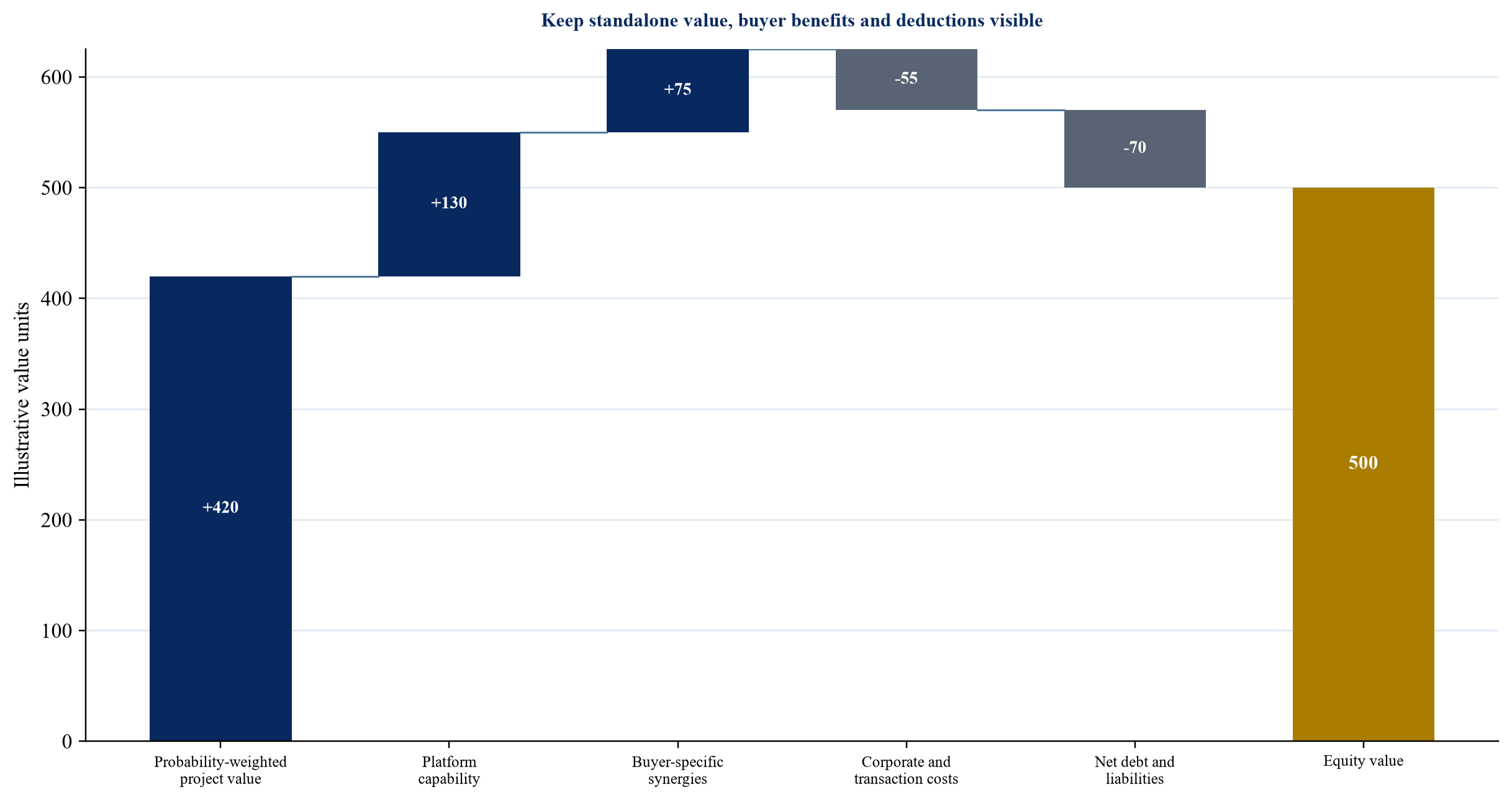
The bridge separates existing project rights, repeatable platform capability, buyer-specific benefits and transaction deductions.
20. Govern the pipeline after closing
The acquired pipeline should enter a common investment process. Each project should have a current stage, conditional probabilities, budget, next decision, key risks and responsible executive. Portfolio reporting should show gross, controlled, net attributable and probability-weighted capacity separately.
Capital allocation should follow risk-adjusted value. Management should compare the next unit of development spend across projects rather than fund every legacy plan. A small expenditure that preserves a scarce permit may rank ahead of a larger project with weak grid prospects. Sunk cost should not determine continuation.
The board should review changes in probability and value. A probability increase should require new evidence, and a decrease should record the trigger. Model version control should preserve the acquisition case and subsequent updates. This allows the buyer to separate market changes, diligence error and execution performance.
Project transfers, sales and partnerships should use approved valuation and conflicts processes. A developer can create value by selling projects before construction. The governance framework should permit monetisation when risk-adjusted proceeds exceed the value of continued ownership.
21. Design downside cases
The acquisition model should test more than a uniform delay. Relevant cases include permit refusal, grid-cost escalation, queue reclassification, auction failure, power-price decline, equipment inflation, higher financing cost, partner default, key-person departure, project overlap and slower replacement origination.
Correlations matter. A policy change can affect several projects in one country. Grid reform can reduce a technology cluster. Interest rates can affect every project. The platform may therefore have less diversification than the project count suggests.
The downside model should show liquidity. Development expenditure, deposits, securities, earn-out payments, staff costs and corporate overhead continue before projects generate cash. The buyer needs a funded plan for base and downside cases. A purchase price that consumes the available capital can weaken the pipeline it was meant to acquire.
Management actions should be explicit. The buyer can pause projects, sell minority interests, bring in partners, reduce overhead, renegotiate milestones or redirect development. Each action has timing, cost and contractual constraints.
22. Apply a transaction decision framework
The investment committee should answer a defined sequence. Which legal entities, rights and liabilities transfer? Which projects are controlled? Which milestones are complete and durable? What conditional probabilities convert each project to financial close and operation? What capital and time remain? What platform capability produces future projects? Which people, partners and dependencies will remain? Which buyer benefits require additional investment? Which consideration elements depend on future evidence? Which regulatory approvals and stakeholder risks affect closing? How much liquidity does the pipeline require? Which facts would cause the buyer to reduce price, restructure or stop?
The committee should receive a project-by-project valuation appendix and a consolidated bridge. Open diligence items should identify owner, consequence and required evidence. The acquisition agreement should implement the approved allocation of risk through perimeter, covenants, conditions, warranties, indemnities and contingent consideration.
The decision should use ranges. Early-stage pipeline valuation contains irreducible uncertainty. A narrow point estimate can obscure the effect of a few assumptions. Sensitivity should show probabilities, delay, capital cost, offtake, price, discount rate and attrition.
23. Hypothetical renewable developer acquisition
Consider a hypothetical infrastructure investor acquiring a renewable developer operating in three markets. The example is illustrative. It does not describe an actual company, project, transaction, offer, valuation or forecast.
The target reports 7.4 GW of gross pipeline. Diligence identifies 5.6 GW under documented control, 1.0 GW of conditional partner rights and 0.8 GW of commercial prospects. The target's net attributable controlled capacity is 4.2 GW after partner interests and mutually exclusive designs. The portfolio contains solar, onshore wind and battery projects at different stages.
The buyer assigns project probabilities from 8 percent for controlled early-stage rights to 78 percent for projects with principal permits, grid and contracted revenue. It values each project at the relevant milestone, deducts remaining development obligations and applies conditional probability. The probability-weighted project value is 420 illustrative value units.
The buyer assigns 130 units to the operating platform based on a funded five-year origination case, staff capacity and historical conversion. Buyer-specific procurement and financing benefits equal 75 units and remain outside standalone value. Corporate and transaction costs reduce value by 55 units. Net debt and disclosed development liabilities reduce value by 70 units. The resulting illustrative equity value is 425 units.
The parties agree that 315 units are payable at closing. Up to 110 units are payable when specified permit, grid and revenue milestones are achieved within agreed periods, subject to cost and return thresholds. The buyer commits a ring-fenced development budget and retains the right to stop projects that fail the investment criteria. Seller protection applies if the buyer sells a qualifying project or withholds the agreed budget without a documented project failure.
Table 2. Hypothetical pipeline segmentation and probability-weighted value
| Project group | Net attributable capacity MW | Development evidence | Illustrative conversion probability | Illustrative probability-weighted value |
|---|---|---|---|---|
| Solar with land, permits, grid and revenue award | 850 | Principal rights secured; financing work active | 78% | 150 |
| Onshore wind with land, grid offer and permit application | 900 | Key permit decision outstanding | 48% | 95 |
| Solar with site control and grid study | 1,150 | Grid cost and planning remain uncertain | 32% | 82 |
| Battery projects with grid position and merchant route | 600 | Revenue and dispatch assumptions unresolved | 28% | 48 |
| Early-stage controlled rights | 700 | Site control; material approvals outstanding | 8% | 25 |
| Platform development fees and contracted services | n/a | Executed mandates and service capacity | n/a | 20 |
| Total | 4,200 | Project-level evidence required | n/a | 420 |
Capacity, probabilities and values are illustrative. They do not describe a market benchmark or investment recommendation.
24. Stress the hypothetical case
The downside case removes one wind project after permit refusal, delays two solar projects by eighteen months, increases connection costs for the battery portfolio and reduces merchant capture prices. It also assumes that two senior originators leave after closing. The buyer updates project probabilities and platform replacement cost.
Probability-weighted project value falls from 420 to 300 illustrative units. Platform value falls from 130 to 95 because replacement origination slows and retention costs rise. Buyer-specific benefits fall from 75 to 50 because fewer projects reach procurement and financing. The contingent consideration falls because the affected milestones are not achieved. Liquidity remains sufficient because the buyer reserved development capital separately from purchase consideration.
The case shows why consideration structure and funding plan belong together. A high closing payment could have transferred most downside to the buyer and reduced available development capital. A pure earn-out could have transferred too much control risk to the seller. The balanced structure ties payment to objective evidence while preserving buyer discretion under defined criteria.
The post-close board should review the acquisition model quarterly for two years. It should explain changes by project evidence, market movement and execution. The review should not force projects to remain alive to protect accounting or transaction narratives.
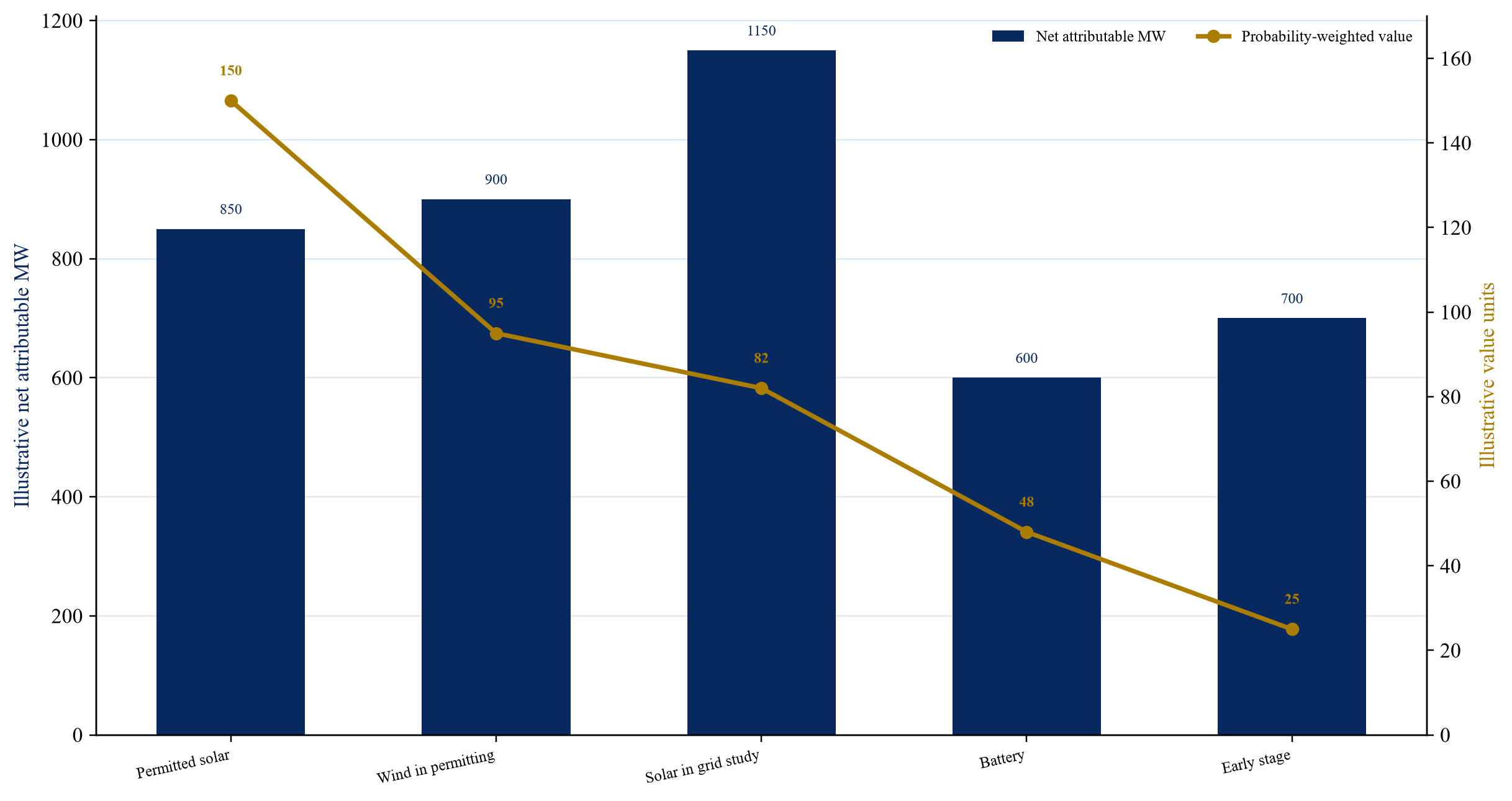
Capacity and value are illustrative. Probability weighting can produce a value mix that differs materially from the headline capacity mix.
25. Use a closing and post-close checklist
Before signing, the buyer should freeze the project register, valuation model, rights schedule and milestone definitions. Legal documents should match the investment approval. The financing plan should reserve development liquidity. Regulatory strategy, clean-team protocol and pre-close covenant should be agreed.
Before closing, the parties should confirm required consents, change-of-control approvals, key rights, deposits, securities, employees, partner notices and data migration. The buyer should refresh any project milestone that has changed since signing. Consideration adjustments should follow the agreement rather than informal negotiation.
During the first 100 days, the buyer should establish project governance, authority, model control, risk reporting and capital allocation. It should meet public authorities, grid operators, partners, landowners and key suppliers through an organised handover. It should confirm retention and succession for critical staff.
At the first annual review, the board should compare actual milestone conversion, cost and schedule with the acquisition case. It should update the probability framework using the expanded history. The review should inform future acquisitions and improve discipline across the portfolio.
26. Recognise the limits of the framework
Probability-weighted valuation depends on judgement and incomplete information. Historical conversion can be unstable when policy, grid rules, technology or market design changes. A target's record may contain too few comparable projects for statistical inference. External queue data can combine projects and regimes that differ from the target.
The framework does not establish fair value under a specific accounting standard, legal ownership, regulatory approval or tax treatment. Qualified advisers should address those matters. The hypothetical case illustrates structure and should not be used as a transaction benchmark.
The framework also cannot capture every strategic option. A buyer may value market entry, talent or customer access beyond the model. Those benefits should be stated, costed and governed. They should not be used as an unexamined premium.
The most reliable outcome comes from disciplined evidence, explicit uncertainty and clear transaction rights. The objective is a decision that remains understandable after project facts change.
Conclusion
Renewable developer M&A can accelerate access to sites, grid, permits, teams and future capacity. The acquisition price should reflect the quality of those rights and the probability that the organisation can convert them into financeable projects. Headline gigawatts provide context. Project evidence determines value.
The buyer should establish one perimeter, one stage taxonomy and one project register. It should model conditional probabilities, test grid and permitting durability, refresh capital cost, verify the route to revenue and separate existing project value from platform capability. Market multiples and historical spend can test the result when their limitations are clear.
Consideration should release value as uncertainty resolves. Warranties should attach to disclosed facts. Interim covenants should preserve the pipeline. Integration should protect local execution and introduce disciplined capital allocation. Downside cases should include correlated attrition and liquidity.
The acquisition succeeds when the buyer can explain what it owns, why each project may convert, how much capital remains, which team capability will endure and which milestone justifies each unit of price.
Frequently Asked Questions
1. Why is headline pipeline capacity an unreliable valuation measure?
Headline capacity can include prospects, overlapping designs, minority interests, expiring rights and projects with weak grid or permitting prospects. The buyer should use controlled, net attributable and probability-weighted capacity as separate measures.
2. How should the buyer assign a completion probability?
The buyer should combine an objective stage baseline with project evidence for land, grid, permits, resource, revenue, economics, financing and team capability. Target history and external market data can calibrate the judgement.
3. Is a grid connection offer sufficient evidence of project value?
A grid offer is important evidence. Its value depends on transferability, study status, upgrade cost, security, timing, curtailment, reform exposure and the project's remaining economics.
4. When should platform value be added?
Platform value can be added when the target has transferable people, processes and market access capable of originating or converting future projects beyond the valued existing pipeline. The forecast should have a funded plan and should avoid double counting.
5. Which milestones are suitable for contingent consideration?
Permits, grid agreements, revenue awards, financial close, notice to proceed and commercial operation can be suitable when each definition is objective, transferable, time-bound and linked to agreed cost and return criteria.
6. How can the seller be protected when the buyer controls development after closing?
The agreement can specify development budgets, governance, information, reasonable efforts, substitution rules and acceleration on sale. Payment should not depend on a result the buyer can prevent without a documented project reason.
7. How should buyer synergies be treated?
Buyer-specific financing, procurement or market-access benefits should be shown separately from standalone target value. The buyer can then decide how much of the benefit, if any, to share through price.
8. What should the board monitor after acquisition?
The board should monitor project stage, conditional probability, budget, capital at risk, next decision, key rights, stakeholder issues, liquidity and variance against the acquisition case. It should retain a disciplined process for stopping weak projects.
References
- International Energy Agency. World Energy Investment 2025. https://www.iea.org/reports/world-energy-investment-2025
- International Energy Agency. Renewables 2025. https://www.iea.org/reports/renewables-2025
- International Energy Agency. Electricity 2026: Grids. https://www.iea.org/reports/electricity-2026/grids
- International Energy Agency. Modernising Grids in the Age of Electricity, 2026. https://www.iea.org/reports/modernising-grids-in-the-age-of-electricity
- International Renewable Energy Agency. World Energy Transitions Outlook 2024. https://www.irena.org/publications/2024/Nov/World-Energy-Transitions-Outlook-2024
- Lawrence Berkeley National Laboratory. Queued Up: 2025 Edition, 2025. https://emp.lbl.gov/publications/queued-2025-edition-characteristics
- Lawrence Berkeley National Laboratory. Grid Connection Barriers to New-Build Power Plants in the United States, 2025. https://emp.lbl.gov/news/grid-connection-barriers-new-build-power-plants-united-states
- Federal Energy Regulatory Commission. Improvements to Generator Interconnection Procedures and Agreements, Order No. 2023, 2023. https://www.ferc.gov/news-events/news/fact-sheet-improvements-generator-interconnection-procedures-and-agreements
- Federal Energy Regulatory Commission. Explainer on the Interconnection Final Rule. https://www.ferc.gov/explainer-interconnection-final-rule
- Federal Energy Regulatory Commission. Explainer on Order No. 2023-A, 2024. https://www.ferc.gov/explainer-interconnection-final-rule-2023-A
- Ofgem. TMO4+ Connections Reform Proposals: Summary Decision, 2025. https://www.ofgem.gov.uk/sites/default/files/2025-04/Summary-Decision-Document-TMO4-package.pdf
- Ofgem. Connections Reform: Guidance on Offer Ambition for Clean Power 2030, 2025. https://www.ofgem.gov.uk/guidance/connections-reform-guidance-offer-ambition-clean-power-2030
- European Commission. Recommendation and Guidance on Speeding Up Permit-Granting for Renewable Energy and Related Infrastructure Projects, 2024. https://energy.ec.europa.eu/publications/recommendation-and-guidance-speeding-permit-granting-renewable-energy-and-related-infrastructure_en
- European Commission. Enabling Framework for Renewables. https://energy.ec.europa.eu/topics/renewable-energy/enabling-framework-renewables_en
- World Bank Group. Permitting and Licensing Regimes for Renewable Energy Projects. https://documents1.worldbank.org/curated/en/721161467997278739/pdf/Permitting0and0able0energy0projects.pdf
- International Finance Corporation. Utility-Scale Solar Photovoltaic Power Plants: A Project Developer's Guide. https://ppp.worldbank.org/sites/default/files/2022-03/IFC_Solar_Report_Web__08_05.pdf
- Australian Government Clean Energy Regulator. Large-Scale Renewable Energy Data. https://cer.gov.au/markets/reports-and-data/large-scale-renewable-energy-data
- Australian Government Department of Climate Change, Energy, the Environment and Water. National Renewable Energy Development Pathway. https://www.dcceew.gov.au/initiatives/national-renewable-energy-development-pathway
- IFRS Foundation. IAS 38 Intangible Assets. https://www.ifrs.org/issued-standards/list-of-standards/ias-38-intangible-assets/
- United Kingdom Competition and Markets Authority. Merger Assessment Guidelines. https://www.gov.uk/government/publications/merger-assessment-guidelines
- Grant Thornton UK and Clean Energy Pipeline. 2026 Renewable Energy Cost of Capital Survey. https://www.grantthornton.co.uk/insights/2026-renewable-energy-cost-of-capital-survey/
- McKinsey & Company. Ready, Set, Grow: Winning the M&A Race for Renewables Developers, 2022. https://www.mckinsey.com/industries/electric-power-and-natural-gas/our-insights/ready-set-grow-winning-the-m-and-a-race-for-renewables-developers
About the Author
Chennakeshav (CK) is a corporate finance and investment banking executive with 25+ years of global experience in deal origination, structuring and execution across M&A, growth capital and corporate strategy. He has led value-creation mandates for founders, corporates and funds — bridging the boardroom view to hands-on execution and close.
His career spans Morgan Stanley, HSBC, Lloyds Banking Group, EWEC, ADQ portfolio companies and Emirates Growth Fund, across TMT, real estate, fintech, deeptech, cleantech, infrastructure and energy. He has partnered with C-suite leaders, private equity and venture funds, sovereign wealth funds and family offices to finance complex fund raises and scale-up ventures, and has led M&A due diligence, post-merger integration and business-transformation initiatives to create value.
At Matchpoint Partners he is Managing Partner, leading the firm's corporate finance, M&A and capital-raising practice. He holds an MBA from London Business School, an engineering degree from VTU and a Master of Laws (LLM, in progress) from UCL London.
An active start-up mentor, CK mentors at Techstars, DIFC FinTech Hive, Startup Grind, Founder Institute and IN5, serves as Entrepreneur Mentor in Residence (EMiR) at London Business School, and judges the Entrepreneurship World Cup.
