

1. Define the repricing decision
The procurer must decide whether to preserve, amend, refinance, buy out or terminate the legacy contract. The decision should follow system need, plant economics, legal rights and financing consequences.
Repricing should address the service required for the remaining term. A system may need capacity, ramping or reserves from a plant whose mandatory energy is no longer economic.
2. Explain take-or-pay
Take-or-pay obliges the purchaser to take a minimum quantity or pay despite not accepting it. In power contracts, the protection can appear as minimum energy, deemed dispatch, capacity payment or fuel-liability pass-through.
The mechanism transfers demand and dispatch risk away from the project. It can support debt, but it can also make uneconomic generation appear to have zero short-run cost to the purchaser.
3. Identify the original financing logic
The original PPA may have funded construction through stable contracted cash flow, political-risk allocation and fuel pass-through. Lenders sized debt against payment rather than merchant dispatch.
Any amendment should identify which original risks remain. The project company should not be required to absorb a system transition it did not price unless consideration and financing consent are provided.
4. Identify the new system problem
Demand can vary more sharply, renewable generation can have near-zero marginal cost and storage can shift output. A must-run plant may force renewable curtailment or create oversupply.
Negative wholesale prices are an observable signal in market systems. IEA and IRENA link their increasing occurrence to insufficient supply and demand flexibility [1][2].
5. Separate price from quantity
Legacy negotiations often focus on the tariff while leaving the take quantity unchanged. The economic burden depends on both price and mandatory volume.
The repricing model should separate capacity, energy, fuel and other components. It should show payment at each dispatch level and avoid moving cost into an opaque fee.
Table 1. Legacy PPA obligation and repricing evidence map
| Obligation | Evidence required | Economic question | Repricing route | Debt-service consequence |
|---|---|---|---|---|
| Fixed capacity | Remaining debt, fixed O&M, insurance, tax and return | What cost remains unavoidable for an available plant? | Availability payment or buyout | Preserves fixed-cost recovery subject to performance |
| Minimum energy | Contract quantity, dispatch history and system need | Is mandatory generation still efficient? | Reduce, profile or replace with dispatchable energy | Changes variable margin and working capital |
| Fuel take-or-pay | Fuel contract, inventory, transport and pass-through | Which fuel liability is unavoidable and who controls it? | Renegotiate, compensate or amortise | Prevents stranded fuel liability from causing default |
| Flexibility limits | Start time, ramp rate, minimum load and cycling cost | What responsive service can the plant provide? | Start, ramp, reserve or flexible-capacity payment | Creates replacement revenue tied to performance |
| Termination | Debt, break costs, hedge, tax and asset value | Is amendment cheaper than exit? | Buyout, refinancing or phased retirement | Determines lender consent and settlement amount |
The allocation is illustrative and requires review of executed contracts, fuel arrangements and financing documents.
6. Establish the legal baseline
The executed PPA, fuel agreement, government support, direct agreement and financing documents define rights. Public policy alone does not amend them.
The baseline should identify consent, change-in-law, dispatch, deemed energy, force majeure, termination and dispute clauses. Negotiation should begin from enforceable obligations.
7. Establish the technical baseline
The plant's capacity, heat rate, minimum load, start time, ramp rate, outage, cycling limits and emissions should be independently assessed.
Nameplate capacity is insufficient. A plant may provide valuable flexibility only after controls, maintenance or equipment upgrades.
8. Establish the financial baseline
The model should identify outstanding debt, interest, hedge, reserve, tax, fixed O&M, variable O&M, fuel and equity cash flow. Historical tariff invoices should reconcile to contract formulas.
The baseline should distinguish sunk cost from future avoidable cost. Repricing is a forward decision, while legal settlement may include protected historic economics.
9. Establish the system baseline
The system study should model demand, renewable output, storage, transmission, reserve, fuel and outage. It should show dispatch with and without the legacy constraint.
Benefits should include avoided fuel, curtailment, starts, emissions and capacity needs. Assumptions should be common across alternatives.
10. Map the fuel chain
Fuel obligations can include quantity, price, transport, storage, quality and take-or-pay. A lower plant dispatch may leave an unavoidable supplier liability.
The PPA amendment and fuel amendment should close together. Otherwise the project loses energy revenue while retaining fuel payment.
11. Classify fixed costs
Fixed costs include debt, fixed O&M, insurance, land, tax, licences and minimum staffing. Some can fall with reduced operation; others remain until retirement.
Each cost should be evidenced, benchmarked and assigned a recovery route. Fixed payment should not protect avoidable inefficiency.
12. Classify variable costs
Variable costs include fuel, water, chemicals, variable O&M, emissions and start cost. They should follow actual dispatch or defined events.
Pass-through should use efficient benchmarks and audit rights. A repriced contract should not socialise poor heat rate or excessive start fuel.
13. Classify transition costs
Transition costs can include fuel settlement, debt breakage, hedge close-out, workforce, remediation, upgrade and tax. They are distinct from ongoing service cost.
The plan should fund them once and avoid embedding indefinite recovery in an energy tariff. Evidence and allocation should be explicit.
14. Define remaining service
The system may need firm capacity, reserve, ramping, inertia, voltage support, black start or emergency energy. The amended PPA should buy only services the plant can verify.
Each service needs availability, testing, dispatch and payment. A general flexibility label is insufficient for financing.
15. Define capacity availability
Capacity payment should depend on declared and tested availability under defined conditions. It can recover remaining fixed cost while allowing least-cost energy dispatch.
Outage, ambient derating and fuel availability should be treated consistently. The purchaser should not pay full capacity for unavailable plant.
16. Define energy dispatch
Energy should be dispatched according to the amended merit or protocol, subject to security constraints. Payment should reflect efficient variable cost and agreed margin.
Minimum-run obligations should be limited to technical need. The dispatch instruction should be recorded and settled at interval or event level.
17. Define start service
Frequent starts can create fuel, maintenance and life-consumption cost. The contract can pay verified start cost and enforce start reliability.
Hot, warm and cold starts may differ. Failed starts should trigger deductions and may affect available capacity.
18. Define ramp service
Ramping value depends on megawatts per minute, range, notice and sustainment. The plant should be paid for capability actually available and instructed.
Ramp performance should be metered. Degradation or maintenance consequences should be captured in the service price.
19. Define reserve service
Reserve requires capacity held ready rather than generated. The product should state response time, duration, activation and recovery.
Capacity reserved for one service should not be sold simultaneously without compatible rules. Revenue stacking needs a priority protocol.
20. Build the contract map
The amendment connects the purchaser, project company, fuel supplier, system operator, government support provider, lenders and hedge counterparties. Each consent and cash flow should be mapped.
The map should show dispatch, availability, payment, fuel and termination. A change in one document should not leave contradictory obligations elsewhere.
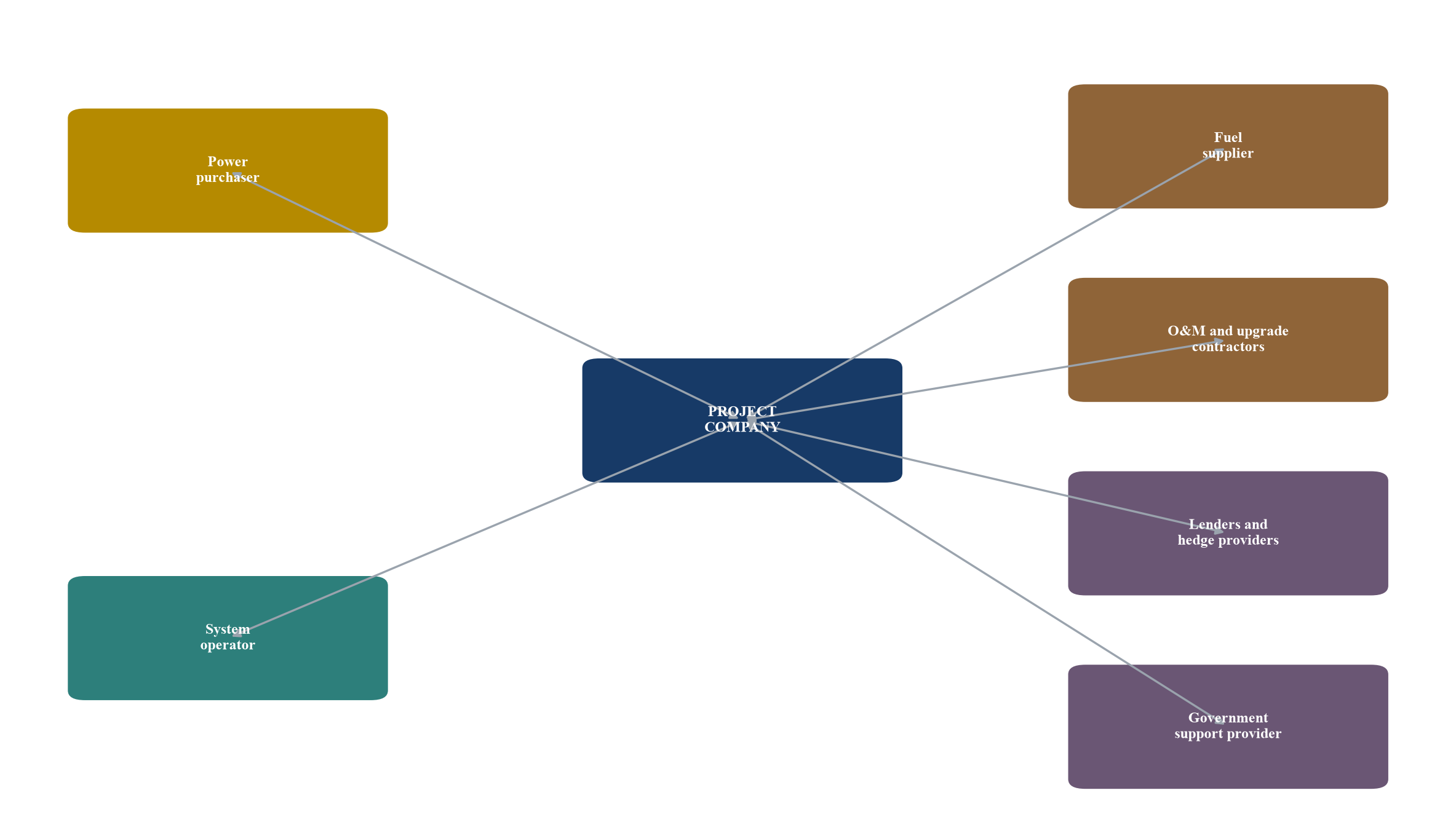
The diagram is a generic transaction framework; project-specific rights require document review.
21. Choose the amendment route
The parties can reprofile quantity, separate capacity and energy, convert to a flexibility contract, shorten term, refinance or buy out. Each route should be valued against the legal baseline.
A partial amendment may preserve optionality. A comprehensive restatement can reduce ambiguity but requires wider consents.
22. Separate capacity and energy
Two-part pricing places fixed recovery in capacity payment and variable cost in energy payment. This permits dispatch based on system value without removing financeability.
Capacity should be conditional on availability. Energy should follow actual output and efficient cost. The split should not duplicate margin.
23. Reprofile minimum take
Minimum take can decline over time, vary by season or apply only in specific hours. The profile should follow expected system need and fuel obligation.
Any retained quantity should remain transparent in dispatch modelling. Banking or carry-forward can create future concentration and requires limits.
24. Replace energy with options
The purchaser can buy an option over capacity rather than mandatory energy. Exercise price can reflect variable cost and start cost.
Option volume, notice, duration and availability need definition. The premium can support fixed cost while preserving dispatch choice.
25. Use contracts for difference
A contract for difference can preserve agreed economics while exposing physical dispatch to the market. Settlement follows a reference price against a strike.
Basis, liquidity, negative prices and volume should be addressed. A weak reference price can create new risk rather than reform the old one.
26. Use a vesting transition
A vesting contract can cover declining volume during market transition. Physical generation can bid into dispatch while financial settlement protects a defined position.
The glide path should promote liquidity and avoid sudden stranded cost. Transparency and regulatory governance are essential.
27. Amend fuel obligations
Fuel contracts can be reprofiled, resold, assigned, bought out or converted to capacity access. The solution depends on supplier rights and market alternatives.
The project should mitigate where commercially reasonable. Purchaser compensation should cover only qualifying unavoidable liability.
28. Fund flexibility upgrades
Controls, burners, heat-recovery equipment, cooling, battery integration or maintenance can improve ramp and minimum load. The business case should value system savings.
Upgrade capex needs completion tests, warranty, funding and recovery. Payment should follow delivered capability.
29. Address environmental cost
Carbon price, emissions limits, water use and local pollutants can change dispatch value. The amended contract should allocate existing and future obligations.
Pass-through can weaken efficiency. Benchmarks, caps and upgrade incentives can preserve accountability.
30. Build the risk-allocation matrix
The matrix should map demand, fuel, availability, market, dispatch, upgrade, credit and termination risks. It should identify evidence, payment and remedy.
Every row should link to contract clauses and model inputs. Unallocated risk should be escalated before approval.
Table 2. Illustrative legacy PPA repricing risk-allocation matrix
| Risk | Project company | Purchaser or system | Shared mechanism |
|---|---|---|---|
| Demand and dispatch | Maintain available capacity and follow instructions | Pay amended capacity and instructed energy | Seasonal profile, option or market settlement |
| Plant efficiency | Meet heat-rate and operating benchmarks | Pass through efficient fuel price where agreed | Tests, index and audit rights |
| Fuel take-or-pay | Mitigate and manage supplier performance | Compensate qualifying liability caused by lower dispatch | Fuel amendment, cap and evidence |
| Flexibility upgrade | Deliver tested capability | Fund or remunerate approved system value | Milestones, performance payment and clawback |
| Negative prices | Follow agreed market protocol | Define dispatch and settlement exposure | Price floor, option or CfD mechanism |
| Early retirement | Preserve asset and comply with process | Pay agreed settlement for protected rights | Independent valuation, lender consent and handover |
The matrix is a negotiation tool, not a substitute for legal review.
31. Build the counterfactual
The counterfactual compares the legacy contract with the amended route under the same system assumptions. It should include dispatch, fuel, curtailment, reserve, emissions and capacity.
The comparison should avoid assuming perfect market operation. Constraints, outages and start limits remain relevant.
32. Value remaining debt
Outstanding debt is contractual, but not every future project cash flow equals debt value. The model should identify principal, interest, hedge, reserve and prepayment.
Lender consent may require coverage and rating preservation. Refinancing can reduce the amendment cost if the new revenue remains bankable.
33. Value fixed cost
Efficient fixed O&M, insurance, land and tax should be forecast for the remaining service. Avoidable cost should fall when scope reduces.
Benchmarking and open-book evidence can support negotiation. A fixed payment should include defined productivity expectations.
34. Value fuel liability
Fuel settlement should use actual contract quantity, price, mitigation, resale and credit. It should not assume the entire nominal take-or-pay is an unavoidable loss.
Future market prices and supplier negotiation create uncertainty. Scenarios and caps should be disclosed.
35. Value flexibility
Flexibility value can include avoided renewable curtailment, lower reserve procurement, reduced peaker starts, lower fuel and deferred investment.
Payment should reflect measurable capability and system need. The project should not receive the entire gross system benefit without considering upgrade and operating cost.
36. Value negative-price avoidance
Reducing mandatory generation can avoid producing during negative-price periods or surplus conditions. The benefit depends on price, volume and the applicable market.
Systems without transparent wholesale prices need an alternative metric such as avoided variable cost or curtailment reduction. Assumptions should be labelled.
37. Build the payment bridge
The bridge starts with legacy capacity and minimum-energy payment, removes avoided fuel and variable cost, adds transition settlement and pays for retained flexibility.
The result should be compared with buyout and termination. Every component needs a legal and model source.
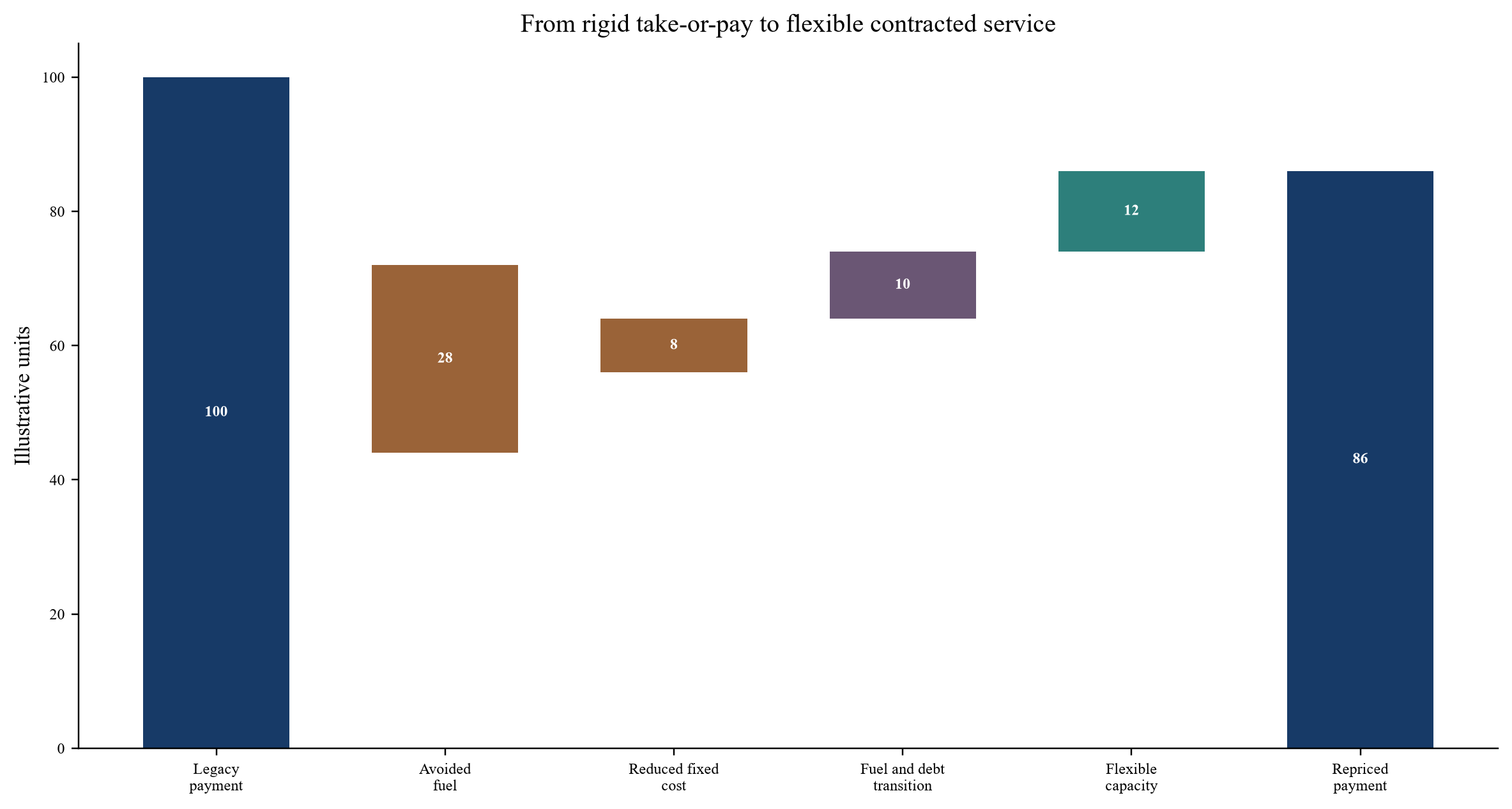
Values are hypothetical management assumptions and do not describe a market project.
38. Model debt-service coverage
Coverage should be tested under amended capacity, lower dispatch, fuel settlement and upgrade capex. Revenue quality and payment timing matter.
The model should show minimum coverage, reserve use, distribution lock-up and cure. It should distinguish transition payment from recurring service cash flow.
39. Model dispatch downside
Lower-than-expected dispatch reduces energy margin and may increase cycling. Capacity payment should preserve fixed recovery if the plant remains available.
The case should test minimum generation, starts and fuel obligations. Lenders will focus on correlated effects.
40. Model market downside
Price volatility, negative prices and basis can affect a market-linked amendment. The model should use appropriate historical and forward evidence.
Reference-price failure, illiquidity and regulatory change require fallbacks. A financial structure should not assume perfect hedge availability.
41. Model availability downside
An ageing plant may suffer greater outage when cycling increases. Capacity deductions can then reduce revenue.
Maintenance plans and upgrade scope should support the new duty. The model should fund major maintenance and spares.
42. Model fuel downside
Fuel price, quantity and supplier credit can change. A reduced take profile may alter unit price or transport economics.
Pass-through should use efficient benchmarks and protect against supplier failure. Inventory and working capital should be included.
43. Model transition delay
Regulatory approval, lender consent, fuel amendment and upgrade can delay effectiveness. The legacy contract remains operative until closing unless agreed otherwise.
The model should include interim payments and long-stop consequences. Parties should avoid relying on an amendment that is not yet unconditional.
44. Compare amendment alternatives
The committee should compare no change, quantity reduction, two-part repricing, option conversion, refinancing and buyout. Each should use the same system forecast.
Results should show public cost, project value, debt resilience, emissions and optionality. A single tariff comparison is insufficient.
45. Test sensitivities
Sensitivities should vary demand, renewable output, negative-price hours, fuel price, availability and discount rate. Combined cases should reflect plausible interaction.
The purpose is to find decision thresholds. Model precision should not exceed source evidence.
Table 3. Illustrative repricing debt-service sensitivities
| Scenario | Dispatch | Capacity payment | Fuel settlement | Minimum DSCR | Illustrative consequence |
|---|---|---|---|---|---|
| Base amendment | 55% | 100% | Planned | 1.35x | Scheduled distributions continue |
| Lower demand | 40% | 100% | Higher | 1.22x | Energy margin falls but fixed recovery remains |
| Availability stress | 45% | 88% | Planned | 1.08x | Distribution lock-up and reserve draw |
| Upgrade delay | Legacy profile during delay | 100% | Deferred | 1.02x | Interim liquidity pressure |
| Combined stress | 35% | 85% | Higher and delayed | 0.88x | Debt cure or restructuring required |
All values are hypothetical management assumptions used to demonstrate the framework.
46. Protect purchaser credit
An amendment may reduce total payment while changing timing or adding settlement. Payment security should match the revised exposure.
Letters of credit, escrow, guarantees and budget undertakings should be reviewed. Existing support may require formal amendment.
47. Protect lender rights
Lenders need consent, notice, cure, security and step-in under the revised contract. Changes should not impair enforceability or priority.
The direct agreement should address market settlement, fuel and upgrade. A refinancing should close with the amendment.
48. Govern shareholder economics
The project company may accept lower upside in exchange for protected capacity and reduced fuel risk. The negotiation should identify value transferred.
Shareholder return is relevant to consent but should not be presented as a guaranteed public obligation unless protected by contract.
49. Address tax and accounting
Settlement, tariff reclassification, impairment, lease treatment and debt modification can have tax and accounting consequences. These may affect value and covenants.
Specialist advice should be obtained before signing. The model should reflect cash tax and transaction cost.
50. Address competition and procurement
Amending a public contract can raise procurement, state-aid or competition questions. The authority should document legal basis, value for money and approval.
Where competition is feasible, alternative capacity or buyout options should be tested. Transparency supports legitimacy.
51. Define change in law
Market reform, emissions rules and grid codes may change the value of the amended service. The contract should allocate general and discriminatory change.
Relief should avoid restoring obsolete take-or-pay economics automatically. The new risk bargain should remain clear.
52. Define force majeure
Force majeure should address availability, fuel, dispatch, payment and term. It should not convert ordinary market change into relief.
Prolonged events need long-stop and settlement. The amended service may continue partially.
53. Define termination
Termination compensation should follow cause and the revised economic bargain. It can include debt, break costs and agreed equity treatment.
The amount should avoid double recovery of transition payments. Handback, decommissioning and environmental obligations should be funded.
54. Govern performance data
Dispatch, availability, starts, ramps, fuel, emissions and payments should use consistent time and data standards. Raw data should be accessible for audit.
Monthly reporting should reconcile contractual and market settlement. Disputes should separate technical and legal questions.
55. Use independent verification
An independent engineer can validate plant capability, upgrade, availability and lifecycle. A financial adviser can reconcile payment and value.
Independence, scope and reliance should be agreed. Verification should focus on material judgement and model inputs.
56. Refinance after amendment
The new capacity and flexibility cash flows may support refinancing. Lower total payment can still be financeable if revenue quality and risk improve.
Refinancing should preserve reserves and upgrade funding. Savings allocation should be agreed.
57. Apply five decision gates
The first gate confirms legal and financial baseline. The second confirms system need and plant capability. The third confirms the repricing bridge. The fourth confirms debt and credit. The fifth confirms approvals, closing and remedy.
Failure should produce redesign, buyout analysis or no change. Reform should not create an unfunded stranded asset.

Each gate requires project-specific evidence and an accountable decision.
58. Build the decision record
The record should preserve contracts, debt, fuel, system studies, technical tests, models, negotiations, approvals and deviations. It should identify observed and assumed data.
The record supports public accountability, lender review and future market reform. Protected information can remain controlled.
59. Use a ninety-day repricing plan
The first month should establish legal, technical, financial and system baselines. The second should model alternatives and negotiate commercial principles. The third should finalise documents, consents and closing.
Fuel or regulatory work may take longer. The plan should sequence conditions and prevent an incomplete amendment.
Table 4. Ninety-day legacy PPA repricing plan
| Period | Core work | Decision output | Principal control |
|---|---|---|---|
| Days 1-30 | PPA, debt, fuel, plant and system diligence | Agreed baseline and problem statement | Clause-to-model map and independent evidence |
| Days 31-60 | Alternatives, payment bridge, dispatch and sensitivities | Preferred commercial structure | Common system case and value-for-money review |
| Days 61-75 | PPA, fuel, finance, support and upgrade terms | Executable transaction package | Legal, technical and credit approvals |
| Days 76-90 | Final consents, conditions precedent and closing | Effective amendment or approved alternative | Evidence register, long-stop and implementation plan |
Timing is illustrative and should be adapted to legal, regulatory and financing requirements.
60. Conclusion
Take-or-pay contracts solved a genuine financing problem. They transferred demand and dispatch risk so that privately financed plants could recover capital and service debt. A changing system can make the same obligation inefficient when renewable energy, storage and volatile demand require flexible dispatch.
The Dispatch Repricing and Debt Preservation Framework separates protected fixed recovery from variable energy and values the service still needed. It aligns the PPA, fuel, financing and system operation. It tests repricing against buyout and termination rather than assuming that amendment is always superior.
The committee should require an enforceable baseline, independent plant and system evidence, a transparent payment bridge, lender consent, fuel resolution and a closing plan. The objective is a dispatchable, financeable service at lower system cost, supported by a fair settlement of existing rights.
The first committee question should be whether the contract is actually causing inefficient dispatch. Low plant utilisation alone does not prove inefficiency. The system may still need capacity, reserve or security support. The study should compare dispatch with and without the minimum-take obligation using realistic technical constraints. It should identify renewable curtailment, fuel, starts, emissions and capacity adequacy. Repricing should target the contractual distortion supported by evidence.
The second question should be which costs disappear when minimum energy falls. Fuel and variable O&M may fall quickly. Fixed staffing, insurance, debt and maintenance can remain. Fuel take-or-pay may convert an expected saving into a supplier liability. The payment bridge should recognise only costs actually avoided and liabilities genuinely unavoidable. This prevents the purchaser from paying twice and the project from absorbing obligations it cannot mitigate.
The third question should be what replacement service the system values. An older thermal plant can remain useful for evening peaks, reserves, voltage, black start or drought-related hydropower support. The amended contract should describe and test that service. Capacity payment without measurable availability can become another rigid subsidy. Flexibility payment without duty limits can accelerate equipment wear and weaken reliability.
The fourth question should be how the transition affects debt. Lenders underwrote the original payment structure, security and termination. A lower total tariff can remain bankable if fixed recovery, credit and remedies remain strong. A market-linked settlement can introduce basis and liquidity risk. The credit model should show coverage, reserve, hedge and covenant under the new service. Amendment should close together with lender consent and any refinancing.
The fifth question should be whether buyout produces better public value. A negotiated amendment can involve years of capacity payment and transition charges. A buyout can concentrate cost but release the system from future obligation. The comparison should use a common discount rate, include debt breakage, fuel, remediation, replacement capacity and residual asset value, and test uncertainty. The legally cheapest route may differ from the economically cheapest route.
The sixth question should be whether governance prevents the repriced contract from becoming rigid again. Dispatch protocols, service definitions and change mechanisms should accommodate storage, demand response and future market reform. Regular system review can reduce contracted volume when conditions change, subject to agreed economics. Data transparency should permit the purchaser, project and lenders to verify availability, instructions, starts, fuel and settlement.
The final approval paper should include a clause-to-model schedule. Each legacy obligation, amended obligation, transition payment, fuel treatment, security provision and termination rule should link to a financial-model input. It should identify owner, evidence and closing condition. This schedule exposes gaps before signature and gives the operating team a usable record after closing.
The legal baseline should be assembled at invoice level. The team should reproduce capacity, energy, fuel, start, indexation, tax and deemed-dispatch payments from the executed documents. Side letters, settlement agreements, waivers and historic practices may change the apparent wording. A model based only on the headline tariff can miss material protections or deductions. Reconciliation to paid invoices also reveals data gaps and disputes that can affect the amendment value.
The technical baseline should use the duty expected under the amended regime. A plant designed for baseload may experience greater thermal fatigue, maintenance and efficiency loss when cycling. Minimum stable generation, start reliability and ramp capability should be tested at current condition. Upgrade vendors should provide performance guarantees tied to the new service. The financial model should include incremental maintenance and life consumption rather than assuming flexibility is costless.
The system baseline should identify the hours and conditions in which the plant remains valuable. Annual capacity adequacy does not describe ramp need, seasonal fuel security or local network support. Chronological modelling should capture renewable output, demand, storage state, transmission and outages. Where data do not support full chronology, representative periods should be selected transparently. The service specification should follow the need demonstrated by the study.
The public-value analysis should separate consumer cost from utility cash flow. Lower mandatory energy can reduce fuel and curtailment, while an upfront settlement can increase near-term funding need. Capacity payment may remain substantial even when generation falls. The analysis should show nominal and present value, tariff impact, fiscal exposure, emissions and reliability. A route that improves system cost may require a financing plan for the purchaser.
The project-value analysis should separate enterprise value from protected settlement. Shareholders may have expected returns under the original contract, yet the enforceable rights determine the negotiation boundary. Remaining equity cash flow should be modelled under the contract, amendment and termination alternatives. Discount rate, performance assumptions and dispute risk should be disclosed. Independent valuation can support governance, but it cannot replace legal interpretation or commercial negotiation.
Fuel renegotiation deserves its own workstream. A supply contract may include annual quantity, daily nomination, transport reservation, quality tolerance, storage and credit support. Reduced plant dispatch can affect each item differently. The team should identify resale, swap, assignment, blending and alternative-user options. Any purchaser compensation should be reduced by feasible mitigation and limited to liability caused by the amendment rather than supplier underperformance.
Hedge treatment also requires precision. Interest-rate, currency, fuel or power hedges may depend on the original payment and dispatch profile. Amendment can create over-hedging, termination cost or accounting volatility. Hedge counterparties may have consent or close-out rights. The transaction model should include mark-to-market, collateral, break cost and replacement. A refinancing can restructure exposure, but it should close simultaneously with the revised revenue contract.
Capacity payment design should avoid rewarding declared capacity that the plant cannot deliver. Availability tests should specify ambient conditions, fuel, maintenance allowance and notice. Seasonal derating should be reflected. Deductions should increase when unavailable capacity affects system security, while avoiding disproportionate penalties for immaterial shortfalls. Persistent underperformance should trigger cure, re-rating and potential payment reduction rather than recurring disputes.
Energy pricing should preserve efficient dispatch. The variable price can use fuel index, benchmark heat rate, variable O&M and emissions. The project can retain a controlled incentive to beat the benchmark. The index should match the actual fuel and location as closely as practical. Caps, floors and reopeners can address extreme change. The purchaser should avoid dispatching an inefficient plant merely because a broad pass-through removes every operating consequence.
Start pricing should distinguish fuel and maintenance from profit. A verified start consumes fuel and component life even if the plant is later instructed to stop. Different start temperatures can have different cost. The contract should state when a start is successful, who bears a cancelled instruction and how failed starts affect payment. A start limit or maintenance adjustment may be required to preserve equipment life.
Reserve pricing should avoid simultaneous recovery through capacity and reserve. Capacity payment can make the plant available, while reserve payment can compensate the opportunity or operating duty of holding a defined response. The contract should state whether reserve is included in base availability or procured separately. Activation energy, testing and failure should have distinct settlement. The financial model should count each service once.
Negative-price treatment should follow the market design. The contract can permit economic shutdown below an agreed price, require purchaser instruction, or settle through a financial mechanism. The reference price, location, interval and data source should be clear. A price floor can protect financing but transfer market risk. A sharing mechanism can preserve some incentive. Markets without negative settlement need an equivalent oversupply signal.
Renewable-curtailment benefit should be measured carefully. Lower thermal must-run output can release room for solar or wind, but transmission and stability constraints may remain. The model should identify incremental renewable delivery attributable to the amendment. It should not value every curtailed megawatt as recoverable. Storage, network reinforcement and demand response should be compared where they can deliver the same benefit at lower cost.
Emissions value should use applicable regulation or an explicitly labelled management assumption. Avoided fuel can reduce carbon and local pollutants, while additional starts may offset some benefit. If carbon certificates or compliance value are monetised, ownership and eligibility should be confirmed. A shadow carbon price can inform policy analysis, but it should not be presented as contracted cash flow unless an enforceable mechanism exists.
Workforce and community consequences may be material, particularly where reduced running affects staffing, suppliers or local revenue. The transaction plan should identify workforce obligations, retraining, redeployment and transition cost. These considerations do not determine the economic dispatch result, but they affect implementation and public approval. A phased profile can create time for adjustment when the system can support it.
Environmental remediation and decommissioning should be funded if the amendment shortens plant life. The baseline should identify existing obligations, security, contaminated land, fuel infrastructure, water systems and waste. Buyout or early retirement should allocate responsibility and timing. The purchaser should not acquire an asset without understanding closure liability. The project should not receive payment for obligations already funded through tariff or reserve.
Regulatory approval should address prudency and tariff recovery. The regulator may need to determine whether settlement and revised capacity payments can be passed to consumers. The submission should provide alternatives, sensitivity and value-for-money evidence. Confidential commercial information can be protected while the decision rationale remains auditable. Approval conditions should be reflected in the documents and model before effectiveness.
Governance during operation should include a joint dispatch and performance committee with clear limits. It can review availability, instructions, starts, fuel, market settlement, upgrade and disputes. It should not rewrite contractual rights informally. Material changes should follow the amendment process and lender consent where required. Meeting records and data should support periodic system review and future procurement.
The closing plan should distinguish conditions precedent from post-closing actions. PPA, fuel, finance, government support, hedge and upgrade documents should become effective in a coordinated sequence. Required regulatory and corporate approvals should be listed. A funds-flow schedule should cover settlement, debt prepayment, reserve release and transaction costs. Long-stop provisions should state what happens if a critical consent does not arrive.
Implementation should include a shadow-settlement period. Before the amendment becomes financially binding, the parties can calculate revised dispatch, availability and payment alongside the legacy invoice. The exercise tests data, systems and interpretation. Differences can be resolved without disrupting debt service. The period should not create an indefinite option for either party; it should have defined entry, success and expiry criteria.
Post-closing review should test whether promised benefits occur. The report should compare actual dispatch, fuel, starts, renewable curtailment, system cost, capacity availability and payments with the approval case. Deviations should be explained. Contractual adjustments should follow only where the agreed mechanism permits. This evidence improves future PPA design and prevents reform from being judged solely by the negotiated tariff reduction.
The credit committee should require a downside case in which dispatch falls below the central forecast at the same time as availability deductions rise. Lower running can reduce energy margin, while cycling can increase maintenance and outage. The capacity component should cover efficient fixed obligations, but only when the plant performs. Reserve sizing, distribution lock-up and equity cure should reflect that interaction. This case often determines whether the amendment truly preserves financeability.
The purchaser should also model the opposite case in which demand or system stress requires sustained operation. A contract designed mainly for low dispatch must still provide fuel, maintenance and variable-cost recovery when the plant runs for extended periods. Energy price, heat-rate benchmark and fuel nomination should remain workable. The project should not face a loss from complying with a valid high-dispatch instruction, and the purchaser should not pay an untested scarcity premium.
Information exchange should begin before negotiation positions harden. The purchaser needs debt, fuel, cost and technical evidence. The project needs system forecasts, alternative procurement and expected dispatch. Confidentiality arrangements can protect sensitive information. Each party should identify disputed assumptions and provide a bounded range. A joint data book improves model consistency while preserving independent advice and decision authority.
Negotiation governance should separate evidence from concession. Technical and financial teams can agree facts such as debt balance, heat rate, minimum load and fuel quantity without agreeing who bears the cost. Commercial principals can then negotiate allocation using a shared baseline. This sequence reduces arguments caused by competing models. Exceptions should be recorded with owner, rationale and approval level.
The final decision should state the threshold for reversal. If lender consent fails, fuel liability exceeds the approved cap, upgrade tests fail or regulatory recovery is denied, the parties should know whether they return to the legacy contract, pursue buyout or terminate the process. A defined fallback prevents sunk negotiation cost from forcing approval of an amendment that no longer meets the public-value or credit case.
References
- International Energy Agency. Electricity 2025: Prices. https://www.iea.org/reports/electricity-2025/prices
- International Renewable Energy Agency. Flexibility for a Secure and Affordable Power Sector Transformation. 2026. https://www.irena.org/-/media/Files/IRENA/Agency/Publication/2026/Jan/IRENA_TEC_Flexibility_power_sector_2026.pdf
- World Bank PPP Resource Center. Structuring the PPP Contract. https://ppp.worldbank.org/structuring-ppp-contract
- World Bank Group. Understanding Power Project Financing. https://ppp.worldbank.org/sites/default/files/2021-09/Understanding%20Power%20Project%20Financing.pdf
- World Bank Group. Centralized Purchasing Arrangements: International Practices and Lessons Learned on Variations to the Single Buyer Model. https://documents1.worldbank.org/curated/en/605451468154171193/pdf/Centralized-purchasing-arrangements-international-practices-and-lessons-learned-on-variations-to-the-single-buyer-model.pdf
- World Bank Group. Wholesale Electricity Market Design and Decarbonisation in Developing Asia. https://documents1.worldbank.org/curated/en/099913410132211313/pdf/IDU0c1f79d1705d1d049860bfa4049a43015a831.pdf
- World Bank Group. Competitive Contracting for Privately Generated Power. https://documents1.worldbank.org/curated/en/529301468764055474/pdf/16906-Replacement-file-047BACON.pdf
- International Renewable Energy Agency. Flexible Power Purchase Agreement. https://www.irena.org/Innovation-landscape-for-smart-electrification/Power-to-heat-and-cooling/16-Flexible-power-purchase-agreement
- World Bank PPP Resource Center. Risk Matrix for Power Generation PPP. https://ppp.worldbank.org/energy-and-power/risk-matrix-power-generation
- World Bank PPP Resource Center. Understanding Power Purchase Agreements. https://ppp.worldbank.org/library/understanding-power-purchase-agreements
- International Energy Agency. Electricity 2026: Prices. https://www.iea.org/reports/electricity-2026/prices
- International Energy Agency. The Value of Demand Flexibility. https://www.iea.org/reports/the-value-of-demand-flexibility
- International Renewable Energy Agency. Flexibility Assessments. https://www.irena.org/Energy-Transition/Planning/Flexibility-assessments
- International Renewable Energy Agency. Delivering on the UAE Consensus. https://www.irena.org/Digital-Report/Tracking-progress-toward-tripling-renewable-energy-capacity-and-doubling-energy-efficiency-by-2030-2
- Equator Principles Association. Equator Principles. https://equator-principles.com/
- Loan Market Association. Green Loan Principles. https://www.lma.eu.com/sustainable-lending/resources
- International Project Finance Association. Project Finance Resources. https://www.ipfa.org/
- International Finance Corporation. Environmental and Social Performance Standards. https://www.ifc.org/en/insights-reports/2012/ifc-performance-standards
- International Energy Agency. Electricity Grids and Secure Energy Transitions. https://www.iea.org/reports/electricity-grids-and-secure-energy-transitions
- International Valuation Standards Council. International Valuation Standards. https://www.ivsc.org/standards/
- IFRS Foundation. IFRS 13 Fair Value Measurement. https://www.ifrs.org/issued-standards/list-of-standards/ifrs-13-fair-value-measurement/
- World Bank Group. Private Participation in Infrastructure Database. https://ppi.worldbank.org/
About the Author
Chennakeshav (CK) is a corporate finance and investment banking executive with 25+ years of global experience in deal origination, structuring and execution across M&A, growth capital and corporate strategy. He has led value-creation mandates for founders, corporates and funds — bridging the boardroom view to hands-on execution and close.
His career spans Morgan Stanley, HSBC, Lloyds Banking Group, EWEC, ADQ portfolio companies and Emirates Growth Fund, across TMT, real estate, fintech, deeptech, cleantech, infrastructure and energy. He has partnered with C-suite leaders, private equity and venture funds, sovereign wealth funds and family offices to finance complex fund raises and scale-up ventures, and has led M&A due diligence, post-merger integration and business-transformation initiatives to create value.
At Matchpoint Partners he is Managing Partner, leading the firm's corporate finance, M&A and capital-raising practice. He holds an MBA from London Business School, an engineering degree from VTU and a Master of Laws (LLM, in progress) from UCL London.
An active start-up mentor, CK mentors at Techstars, DIFC FinTech Hive, Startup Grind, Founder Institute and IN5, serves as Entrepreneur Mentor in Residence (EMiR) at London Business School, and judges the Entrepreneurship World Cup.
