

1 The decision to amend an offshore wind contract
A request to reprice an offshore wind contract requires a documented comparison between executable alternatives. The buyer needs to understand what it would pay for timely delivery, which risks the proposed amendment transfers, and whether a different procurement can deliver the same service on better terms. The developer needs a financeable construction budget and an executable supply chain. Lenders need contractual cash flows that can support the proposed debt under credible downside conditions. A negotiation should expose these separate requirements in one reconciled decision record.
This paper proposes a method for making that comparison. It follows the project from its original bid through changes in capital cost, financing and delivery assumptions, then evaluates a price reset against delay and reprocurement. The method combines a source-based account of selected UK, New York and European developments with a hypothetical financial model. The model represents no actual project, quoted financing offer or proposed government settlement. Its purpose is to show how alternative assumptions change a decision and what evidence a real transaction would require.
The research cut-off is 10 October 2026. Official auction records establish the terms and results reported for particular rounds. Issuer announcements establish the decisions those companies announced on the relevant dates. Neither type of evidence supplies the full project cost ledger or proves the value of an undisclosed amendment. Accordingly, the commercial framework treats the original contract, executed supplier commitments, lender terms and independent engineering evidence as inputs to be obtained for each actual mandate.
An amendment can change the initial price, the indexing formula, the contract term, delivery milestones, security or risk allocation. Each change has a different cash-flow effect. A longer revenue period, for example, has value only to the extent that the asset can produce and retain the required rights during those added years. A revised deadline has value to the developer and may impose replacement procurement costs on the buyer. The assessment should identify those transfers explicitly.
The proposed decision rule has four parts. Establish legal authority for the specific change. Reconstruct the efficient remaining cost and realistic delivery programme. Test project returns and debt capacity separately. Compare buyer expenditure and service delivery over a common calendar horizon. A board or public authority can then approve, reject or condition a proposal using the same underlying evidence. A favourable model result remains conditional on the assumptions and the execution evidence supporting it.
2 Map the contract before estimating relief
An offshore development can contain several distinct contracts: seabed rights, revenue support, electricity sale, grid connection, turbine supply, installation, operations, insurance and financing. A difficulty in one contract may propagate into others through deadlines, cross-defaults or price reopeners. The proposed review starts with a map that records each counterparty, its required action, the relevant date and the consequence of failure. The map should show which amendment can address a problem and which approvals remain outside that amendment.
For analytical purposes, divide the project into five linked cash-flow questions. What expenditure remains unavoidable? What output can actually be delivered and sold? What price is collected for that output? Which party pays when the expected timetable changes? What cash must be reserved before investors can receive distributions? This structure keeps the review close to the documents and the engineering programme. It also makes it easier to identify a requested concession that lacks a corresponding deliverable.
Table 1. Contract system and evidence required for a reset
| Contract layer | Decision evidence | Exposure to test |
|---|---|---|
| Revenue agreement | Executed terms and settlement formula | Price, volume and eligible delivery periods |
| Turbine and installation | Binding scope, slot and price validity | Replacement quotes and interface delay |
| Grid and seabed rights | Milestones, extensions and consent conditions | Loss of access or an unserved interval |
| Financing and security | Term sheets, hedges and guarantee terms | Debt capacity and contingent cash calls |
| Operations and end of life | Service scope, reserves and rights expiry | Lifecycle cost and added-term deliverability |
Notes: Proposed analytical system map. It describes documents to obtain; it makes no finding that a particular project has these rights or obligations.
The revenue agreement deserves a separate cash-flow diagram. A contract for difference can settle a difference against a reference price, while an energy certificate arrangement may operate alongside electricity and capacity revenues. Contracted headline prices therefore need to be reconciled to total cash receipts, deductions and volume treatment. A fixed percentage increase in a headline number can have a different economic effect under each arrangement.
The same discipline applies to claimed savings. A supplier concession may require a larger deposit. A later turbine delivery may reduce the quoted price while increasing vessel costs. A project sale can introduce a capable owner while triggering consent, tax or security issues. Each proposed mitigation should enter the model as a complete change in cash flows and obligations. Record the interdependent approvals and the date beyond which the proposed terms expire.
3 What the UK auction record establishes
The Department for Energy Security and Net Zero published the offshore-wind results of Allocation Round 7 on 14 January 2026 and updated the results publication on 10 February. The results record 8,437.50 MW, comprising 8,245 MW of fixed-bottom offshore wind and 192.50 MW of floating offshore wind. Fixed-bottom clearing prices were GBP 65.45/MWh for England and Wales and GBP 64.23/MWh for Scotland in 2012 prices. The corresponding published 2024-price figures were GBP 91.20 and GBP 89.49. Floating offshore wind cleared at GBP 155.37/MWh in 2012 prices, shown as GBP 216.49 in 2024 prices. These auction results retain their stated price bases. An individual project's financing requires its own quoted terms. [1]
The Allocation Round 6 results provide the preceding auction reference. Comparisons between rounds require their published technology categories, price years, delivery years and contract terms. The resulting comparison can identify changes in the offer made through a particular auction. It cannot isolate how much of a price difference arose from inflation, interest rates, competition, site characteristics or project design. [4]
Table 2. Published UK strike prices with distinct auction categories
| Auction category | GBP per MWh in 2012 prices | Comparison boundary |
|---|---|---|
| Allocation Round 6 new fixed-bottom offshore wind | 58.87 | Separate from permitted-reduction capacity |
| Allocation Round 6 permitted-reduction offshore wind | 54.23 | Separate award category |
| Allocation Round 6 floating offshore wind | 139.93 | Different technology from fixed-bottom wind |
| Allocation Round 7 fixed-bottom England and Wales | 65.45 | Regional clearing price |
| Allocation Round 7 fixed-bottom Scotland | 64.23 | Separate regional clearing price |
| Allocation Round 7 floating offshore wind | 155.37 | Floating technology category |
Notes: Published auction results [1, 4]. All displayed prices share the stated 2012 price basis. Contract duration, project scope and delivery conditions still require separate comparison; these entries establish no causal decomposition of price changes.
For a reset negotiation, the useful market benchmark is a carefully matched group of bids or contracts. Select comparable foundation type, water depth, distance, output profile, connection scope, delivery window and allocation of construction risk. Record differences that cannot be normalized with evidence. A regional clearing price can help test the plausibility of a claim, but the developer's remaining capital commitment and contractual position require separate examination.
The published conversions also illustrate why a price-year label belongs beside every tariff. A display in 2024 prices does not mean that the same amount is payable in every later operating year. The actual payment depends on the executed contract and its adjustment provisions. A review should reproduce the governing conversion and settlement rules in a separate schedule, avoiding a casual multiplication of already-adjusted figures.
The appropriate board question is whether the proposed terms could procure the required service today on a comparable risk basis. Historical auctions form part of that evidence. Current binding bids, supplier availability and construction capability provide further evidence. Keep the periods of observation separate so that the analysis remains reproducible when the next auction or project announcement changes the market record.
4 Indexation has a defined base and a defined clock
The UK government's July 2025 final response on Allocation Round 7 reforms announced the intention to offer 20-year contracts for the covered wind and solar technologies. The response also addressed planning eligibility and treatment of previously surrendered capacity. A project-specific eligibility conclusion requires the final rules and the facts of the relevant application. A change in a future auction's design does not itself amend an existing revenue agreement. [2]
The July 2025 Allocation Round 7 standard terms contain express adjustment provisions. Condition 20 distinguishes adjustments permitted by the contract, and its annual CPI mechanism uses the specified January observation for an adjustment effective from 1 April. The defined Base Year CPI refers to an October observation in the preceding calendar year. A published auction price-year conversion and this contractual mechanism are separate calculations. The applicable version of the executed agreement controls the project. [3]
A review of a different contract should extract the index name, published series, base observation, review date, payment-effective date, lag, revision policy, cap and floor. Identify the indexed proportion and any component left fixed. Record who must supply a notice and whether a missed notice changes the adjustment. These details determine the amount and timing of cash received.
Operating-cost indexation may also leave a construction-cost problem unresolved. A turbine deposit payable before commissioning can move independently of a consumer-price series. Imported equipment can create a currency exposure that the index does not address. A financing margin can change without any corresponding movement in an operating-cost index. The proposed approach therefore assigns an exposure to a contractual remedy only after its economic connection has been established.
Table 3. Questions for an indexation schedule
| Input | Required record | Model treatment |
|---|---|---|
| Indexed proportion | Executed adjustment clause | Apply only to the specified price component |
| Base observation | Index release and contract definition | Store level and observation date |
| Lag and effective date | Notice and settlement provisions | Shift cash receipts to the correct period |
| Currency | Supplier and revenue denominations | Model conversion or hedge separately |
| Cap and floor | Binding limits and exceptions | Apply limits before calculating debt coverage |
Notes: Proposed review schedule. The hypothetical financial model later in this paper uses its own explicitly defined annual convention; it does not replicate UK CfD settlement.
Where a new indexation clause is proposed, the buyer can compare several designs using the same forecast dataset. One design may compensate a construction exposure at financial close. Another may adjust a proportion of future tariff receipts. Both should be valued at the same decision date, including their response to declining prices. The amendment should state who benefits from a later reversal in the affected cost.
5 Project announcements reveal execution decisions
On 7 May 2025, Ørsted announced that it would discontinue Hornsea 4 in its then-current form and would not deliver the project under its Allocation Round 6 CfD. The announcement cited developments affecting the project's economics and said the company retained rights that could support future development. This establishes the announced decision at that date. It does not establish a subsequent restart, a new award or the price at which the company would proceed. [5]
Vattenfall's 20 July 2023 announcement suspended development of Norfolk Boreas in the context of changed market conditions and higher costs. Its account is an issuer statement about that development decision. It provides a historical example of a project becoming difficult to execute on earlier assumptions. It supplies no universal percentage uplift suitable for a different offshore development. [6]
These cases suggest useful questions for transaction diligence. What changed after the bid? When did management become aware of the change? Which costs were already fixed? Which supplier terms expired? What mitigation was attempted, with what counteroffer? What assets, permits or expenditure remain useful after discontinuation? A project can retain valuable development rights while the awarded revenue package becomes commercially unattractive.
The proposed analysis separates historical expenditure from remaining expenditure. A board reviewing continuation should understand the cash it must commit from today. A buyer reviewing a request for relief should also understand how the developer's original bid was formed and which risks it accepted. These two schedules serve different decisions and should reconcile to the same cost ledger.
An accounting impairment is a further distinct measure. It reflects a reporting assessment under the applicable accounting framework and its assumptions. The cash required to resume construction, the recoverable value of rights and a negotiated termination payment need their own evidence. Use an issuer's disclosed impairment or suspension to identify questions for diligence. Build the remaining-cost model from the underlying project records.
For an investor acquiring a stalled development, the commercial analysis should price the acquired rights and the obligations that survive transfer. Reconfirm counterparties, technical scope, milestone extensions, bonds and consent requirements. A low entry price can coexist with a large future construction commitment. The transaction case should state the total funding required to reach an independently supportable operating outcome.
6 New York separates relief petitions from new competition
New York's Public Service Commission denied requested contract adjustments in its 12 October 2023 order concerning renewable-energy projects. The order is a decision within that state's regulatory and contractual framework. It does not establish that repricing is unavailable in another jurisdiction or under another executed agreement. The analysis of a new proposal should examine the actual decision, its reasons and the route subsequently used to procure capacity. [7]
NYSERDA's fourth offshore-wind solicitation provides a distinct procurement record. Its official account records contract execution on 31 May 2024 and the subsequent announcement in June. The executed Empire Wind 1 purchase and sale agreement is a more useful source for payment mechanics than an isolated press headline: it specifies the arrangement for offshore renewable energy certificates and the associated settlement provisions. [8, 11]
NYSERDA's page for its fifth solicitation records inflation-indexing provisions and states that the solicitation concluded without an award on 13 February 2026. NYSERDA attributes that outcome to federal actions and uncertainty. The outcome therefore must be described as a closed solicitation with no award. It supplies no executed price benchmark for a successful new project. [9]
These records offer three different forms of evidence: a decision on requested relief, an executed new agreement and a solicitation that concluded without an award. They should remain separate rows in a market-comparison register. Combining them into a generic assertion that all offshore contracts were renegotiated would obscure the legal process and the delivery outcome.
For a buyer considering reprocurement, the proposed commercial analysis asks whether the new process can attract financeable offers and preserve the required project rights. The comparison should incorporate the procurement timetable, site access, supplier slots and connection dates. It should also identify which construction or development work can transfer to a new owner. These inputs determine the cost of moving from an incumbent development to an alternative supplier.
A comparison of certificate strike prices with total electricity prices requires the payment formula. Show the treatment of electricity and capacity revenues, the settlement reference, indexation and eligible output. Include the obligations and deductions associated with each contract. The resulting cash-flow schedule can support an investment comparison; headline prices alone provide a limited screen.
7 European auction design and the limits of relief
The European Commission's May 2024 recommendation on renewable-energy auction design addresses delivery and risk allocation, including indexation. Its recommendations provide a policy reference for how future auctions can respond to changing costs. They do not create a project-specific right to reopen an executed award. The December 2025 Commission guidance on two-way contracts for difference supplies further design considerations, subject to the applicable legal framework. [10, 12]
The proposed use of these sources is to review the risk allocation offered before bidding and to consider improvements for later procurements. A procurement authority can ask which exposures a bidder can reasonably price, which exposures it can hedge, and which exposures are controlled by public decisions. Where relief is contemplated for an existing project, the authority still needs a legal assessment of the governing contract and regime.
For a commercial review, prepare a chronology of award rules, bid commitments, subsequent changes and the requested amendment. Record whether the relevant risk was identified in the tender and how competing bidders were expected to treat it. This helps a decision maker distinguish an amendment contemplated in the original bargain from a proposed new allocation of risk. The chronology should include the version of each governing document that applied at the time.
The buyer should also examine how the amendment affects competition. Would the revised terms have attracted a different field of bidders? Would the price or delivery ranking have changed? Could the same solution be procured through a new competition within a credible timetable? These are proposed evaluation questions. Their legal significance depends on the applicable law and the facts of the award.
Where a policy objective requires supply-chain resilience, local investment or other non-price commitments, give each obligation an explicit scope and verification method. A promised factory, employment programme or port investment should have identifiable milestones, cost allocation and consequences for non-delivery. The project model can then show the commercial effect of the obligation. The authority should separately document the public-policy reason for requiring it.
8 Reconstruct efficient remaining cost
The 2024b Annual Technology Baseline offshore-wind methodology distinguishes capital expenditure, operations and maintenance, and capacity factor. It uses site characteristics and engineering models, including ORBIT, WOMBAT and FLORIS, to estimate different components. It also explains the role of deployment and enabling infrastructure in its cost scenarios. This is a methodological reference with its own data vintage and assumptions. It provides no current binding supplier quotation or audited cost for the project under review. [14]
The proposed reset process builds a remaining-cost schedule from the project's evidence. Start with the agreed construction scope. Reconcile quantities, unit prices, contingency, deposits and payment dates to executed contracts and valid quotations. Classify each line as committed, quoted, estimated or disputed. An estimated line should identify its preparer, the date of estimate and the evidence required before it becomes a financing input.
For each requested cost increase, identify the original allowance, the current efficient requirement, the exposure already hedged or fixed, and any recoveries. Potential recoveries can include supplier remedies, insurance proceeds, liquidated damages or credits, subject to their actual terms and collectability. The request for relief should use the net exposure supported by those records. Contingent recoveries belong in a separate scenario until their conditions are satisfied.
Table 4. Proposed cost bridge for commercial diligence
| Category | Evidence needed | Review question |
|---|---|---|
| Turbine and foundation | Scope-matched executable quotations | What changed in specification and unit cost? |
| Installation and vessels | Booked windows and cancellation terms | Which delays change the required vessel days? |
| Grid and connection | Current responsibility and milestone matrix | Which upgrades are included in the project budget? |
| Financing during construction | Draw schedule and binding loan terms | Which amounts arise from rate, margin or delay? |
| Contingency and recovery | Risk register and collectible claims | Is the same exposure counted more than once? |
Notes: Proposed diligence structure. An actual financing model needs dated evidence and a reconciled sources-and-uses statement.
Separate overnight capital cost from financing during construction. The hypothetical model in this paper deliberately places capital expenditure at one investment date so that its repricing mechanics remain visible. A real development needs a monthly construction draw schedule, interest during construction, fees, reserves and contingencies. Those inputs can materially change the funding requirement and the point at which an amendment must become effective.
The efficient-cost assessment should consider executable alternatives. A redesign may reduce a component cost while changing energy yield or delaying consent. A larger turbine may alter foundation loading and installation requirements. A supplier replacement may release one constraint and create another. Evaluate each alternative using consistent output, schedule and risk assumptions, supported by engineering and procurement records.
9 Rates and currencies require separate schedules
The proposed financing review separates the reference interest rate, credit margin, hedge premium, tenor, amortisation and debt fraction. Each item affects cash flows differently. A higher required project return changes the value assigned to future operating cash. A higher loan rate changes debt service. A lower debt fraction changes the equity funding requirement. These effects should appear separately before they are combined into a financing recommendation.
For an actual project, reconcile the original financing assumptions to executable lender terms. Identify the date on which a hedge was required, the amount hedged, the exposure left open and any costs of cancellation or extension. A market-rate movement applied to the whole capital budget can materially misdescribe an exposure when only part of the debt was floating or undrawn. Evidence of a hedge should include its maturity and the treatment of changes in the construction programme.
Currency analysis should follow the procurement payments and the collected revenue. A project can receive revenue in one currency, buy equipment in another and borrow in a third. Record contractual payment dates, conversion conventions, hedge settlement and any counterparty limits. Indexing a tariff to a domestic consumer-price series does not by itself specify the treatment of those foreign-currency payments.
The cost bridge should use one reporting currency and one stated valuation date. Show original-currency amounts beside their translated values for material exposures. Distinguish a change in the vendor's price from a change in the exchange rate used to report it. Where the vendor quote already includes a currency adjustment, applying a second general exchange-rate uplift can count the same movement twice.
A lender review should use its defined cash available for debt service and covenant period. The simplified annual model later in this paper uses revenue less operating cost as its stated proxy, with important exclusions. A financing transaction would need the exact treatment of tax, working capital, reserve accounts, maintenance capital, penalties and other deductions. A modelled ratio above a chosen threshold supplies one conditional calculation; lender approval depends on the full financing package.
10 Legal authority precedes the settlement proposal
The UK Cabinet Office's contract-modification guidance, updated on 20 July 2026, describes the permitted routes under the Procurement Act 2023 and their conditions. It distinguishes non-substantial changes, below-threshold changes and specified grounds for modification. Its account of unforeseeable circumstances includes a value limit with an exception for utilities contracts. It also describes transparency requirements. Applicability to a particular offshore contract must be assessed under its actual legal regime; this paper makes no finding that an existing CfD is governed by those provisions. [13]
The proposed commercial review asks counsel to provide a written assessment before terms are offered. The assessment should identify the relevant parties, contract version, governing law, applicable award regime, available amendment powers, approvals, publication requirements and potential challenge. It should address the whole proposed package, including term changes, milestone relief, security and any change of owner. A price adjustment considered in isolation can miss the legal effect of the other concessions.
Any settlement proposal should identify its conditions precedent. These can include approval by the relevant public body, lender consent, supplier commitments, permit changes and delivery of new security, where required by the particular transaction. The parties should specify which conditions must be satisfied before relief becomes effective and what happens if they are not satisfied by the agreed date. The commercial model should use the same conditional sequence.
Maintain a decision record that reconciles the reasons for the amendment to the evidence. Record the alternatives considered, the cost review, the forecast service-delivery consequences and the treatment of competition. The record should also state the uncertainties that remain and which party bears them. It should avoid language that implies the requested relief has been approved while approvals are still pending.
This framework is financial and commercial analysis. A particular project needs advice on procurement, contract, regulatory, tax, accounting and financing matters from suitably qualified advisers. The purpose of the framework is to organize evidence and quantify choices so that those advisers and the decision maker can evaluate a concrete proposal.
11 A cash-flow boundary for the reset
All quantities, prices, costs, rates and contractual terms in this model are fictional author assumptions. They illustrate a contract decision and contain no observed project, country tariff, market forecast or entitlement estimate. The currency is USD. Input prices use a 2026 base; annual cash flows and discount rates are nominal. The energy contract pays the full specified price for delivered electricity. There is no additional wholesale receipt, difference-contract settlement or merchant tail.
The fictional asset has 1,000 MW of nameplate capacity. Original net capacity factor is 44%, giving 3,854,400 MWh annually using 8,760 hours. The stressed factor is 41.5%, giving 3,635,400 MWh. These are accepted net-energy assumptions incorporating availability and losses in one input. Separate loss deductions would duplicate them. Generation remains constant throughout each asset's 25 operating years; degradation and probabilistic wind variation are omitted.
Immediate cases pay all investment at calendar time zero and receive operating cash at the ends of years 1 through 25. Reprocurement pays its complete, explicitly specified investment at year 3 and operates in years 4 through 28. This compressed construction convention omits construction sequencing, financing during construction and the probability of completion. The delayed capex input is already the nominal payment at year 3; it receives no further escalation. No expenditure precedes that investment date except the separately identified buyer administration payment.
For investment year d, annual energy Q, starting price T and indexation factor f(t), revenue is Q × T × f(t). Operating expenditure is O(t), and unlevered free cash flow is revenue minus O(t). Project NPV equals negative investment discounted from year d plus the 25 discounted operating cash flows. The project discount rate is a sponsor-required unlevered nominal hurdle. This model contains no levered equity NPV or equity-IRR estimate.
Taxes, subsidies, depreciation shields, working-capital balances, reserve accounts, refinancing, decommissioning, residual proceeds and terminal value are excluded. Operating cost includes the illustrative recurring maintenance allowance; extraordinary replacement capex is absent. These omissions limit the price floor's use in a real investment approval.
Table 5. Shared fictional assumptions
| Input | Value | Unit or timing |
|---|---|---|
| Nameplate capacity | 1,000.000 | MW |
| Operating life / debt tenor / buyer horizon | 25 / 20 / 28 | years |
| Original plant capex | 2,800.000 | USD million at time zero |
| Original operating cost | 75.000 | USD million, calendar year 1 basis |
| Plant-capex debt share | 60.000 | % |
| Tariff indexed share | 60.000 | % |
| Tariff index / opex inflation | 2 / 2 | % nominal annually |
| Indexation lag | 1 | year; years 1-2 fixed |
| Debt-service coverage floor | 1.300 | times |
| Buyer discount rate | 4.500 | % nominal |
| Replacement base price | 120.000 | USD/MWh, 2026 base |
| Replacement price inflation | 2.000 | % annually |
| Reset one-off cost | 15.000 | USD million at investment |
| Reprocurement public administration | 40.000 | USD million in calendar year 1 |
All inputs are fictional author assumptions. USD base-price year is 2026; resulting cash flows are nominal.
12 Four contracts on one calendar
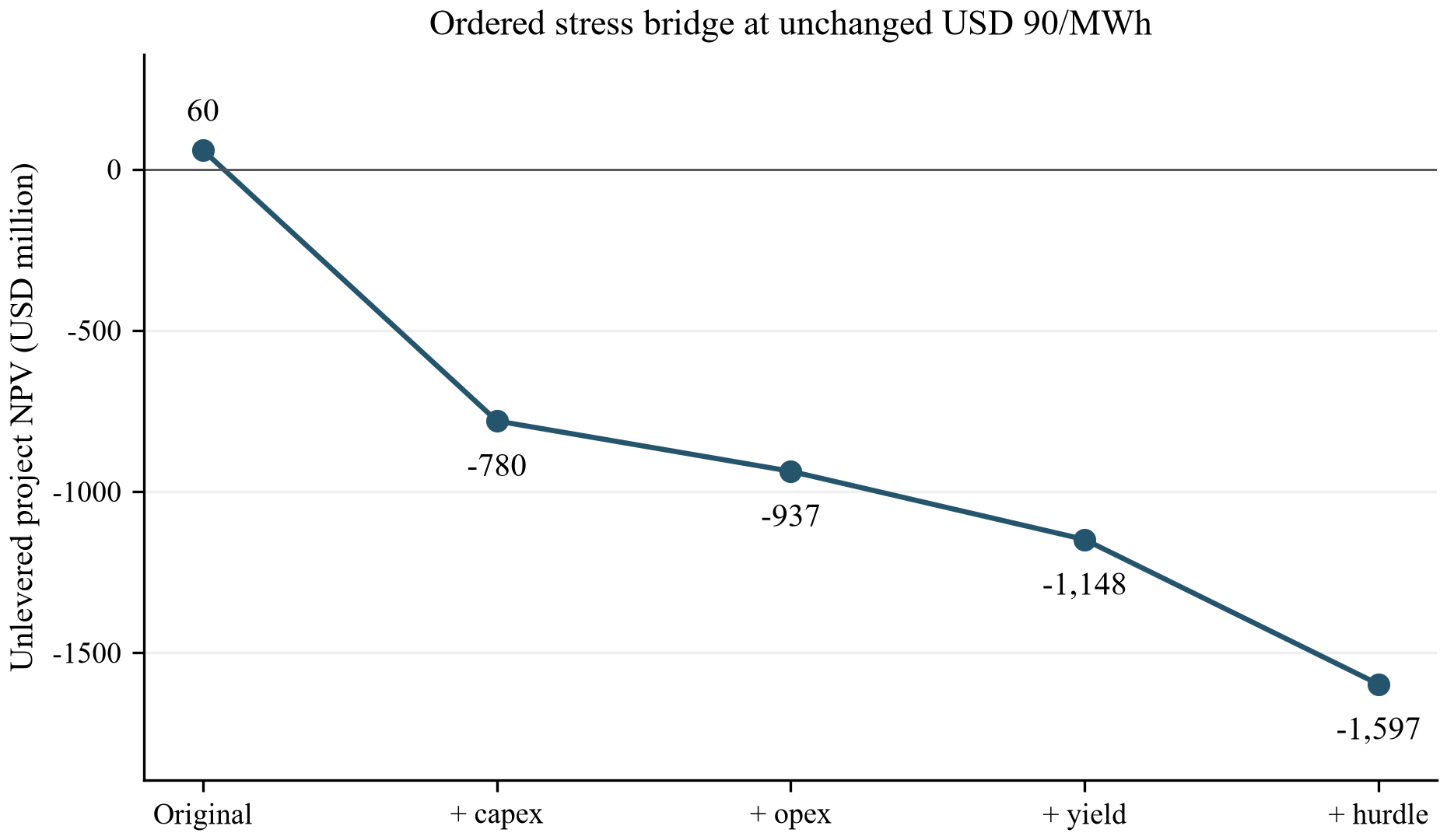
The original award combines USD 2.800 billion of investment, USD 75 million of calendar-year-1 operating cost and a USD 90/MWh starting tariff. Its project hurdle is 9%, and its loan rate is 6%. These rates serve different calculations. Original economics produce positive project NPV of USD 59.603 million at the defined hurdle.
The stressed unchanged award raises plant investment by 30% to USD 3.640 billion, operating cost by 18% to USD 88.500 million, and lowers net yield to 41.5%. Its project hurdle rises to 11.5%, with an 8.5% loan rate. The starting tariff remains USD 90/MWh. The calculated project NPV becomes negative USD 1,597.145 million. This is an illustrative repricing gap under specified assumptions, with no attribution to an actual developer's losses.
The reset retains the stressed plant, yield and recurring costs, adds a USD 15 million one-off investment cost, and assumes a USD 145/MWh negotiated starting price. The calculated project NPV is USD 144.122 million. This starting price is a hypothetical negotiated quotation; the model separately computes its mechanical hurdle floor. There is no assumed production improvement or additional subsidy attached to the reset.
Reprocurement assumes a three-year delay, USD 3.850 billion of plant investment at year 3, the stressed yield and operating-cost basis, and a USD 135/MWh starting quote. Operating-cost inflation continues during the delay. The new buyer also pays USD 40 million of administration cost in year 1. The quoted alternative produces negative project NPV of USD 187.791 million, despite adequate debt coverage. Its apparent buyer saving therefore requires a financeable replacement bid before it can support a decision.
The ordered stress bridge changes capex, operating cost, yield and then the project hurdle. Each point recalculates project NPV after the preceding changes. Changing the order changes individual bridge contributions because discounted revenue and cost interact. Loan interest does not enter this bridge's unlevered cash-flow calculation.
Table 6. Case boundaries and financing inputs
| Case | Invest year | Investment, USD m | Opex base, USD m | Net capacity factor, % | Project hurdle, % | Loan rate, % |
|---|---|---|---|---|---|---|
| Original award | 0 | 2,800.000 | 75.000 | 44.000 | 9.000 | 6.000 |
| Stressed unchanged award | 0 | 3,640.000 | 88.500 | 41.500 | 11.500 | 8.500 |
| Negotiated reset illustration | 0 | 3,655.000 | 88.500 | 41.500 | 11.500 | 8.500 |
| Reprocurement after delay | 3 | 3,850.000 | 88.500 | 41.500 | 11.500 | 8.500 |
Investment includes the reset one-off. Opex base is calendar year 1 money and escalates through any delay. No equity return estimate is made.
View figure at full size; scroll horizontally on smaller screens.
Fictional author-assumption results at USD 90/MWh. Each point adds the indicated change after all previous changes: plant capex, operating cost, net yield and then the unlevered project hurdle. Contributions depend on this order. Loan interest is excluded from unlevered cash flow. All project operating lives are finite at 25 years.
13 Price floors and debt coverage
The project hurdle tariff divides the present value of investment plus operating costs by discounted energy multiplied by its tariff-indexation factor. Numerator units are USD; denominator units are MWh; the result is a starting USD/MWh price. Solving this linear equation gives zero project NPV at the chosen unlevered hurdle.
The original project floor is USD 88.561/MWh. It rises to USD 140.017/MWh for the stressed unchanged plant and USD 140.487/MWh after the reset one-off cost. The reset quote therefore exceeds its defined project floor by USD 4.513/MWh. A commercial negotiation would still need to test whether the cost, yield and required-return inputs are evidenced and whether other omitted obligations consume that margin.
Debt equals 60% of plant capex and excludes the reset one-off cost. It is drawn at the investment date, amortises through 20 equal end-of-operating-year payments, and has no balloon. For principal D and loan rate r, annual debt service equals D × r divided by one minus (1+r) raised to negative 20. Annual interest equals opening debt multiplied by r; remaining payment amortises principal. The loan rate is used directly in this calculation.
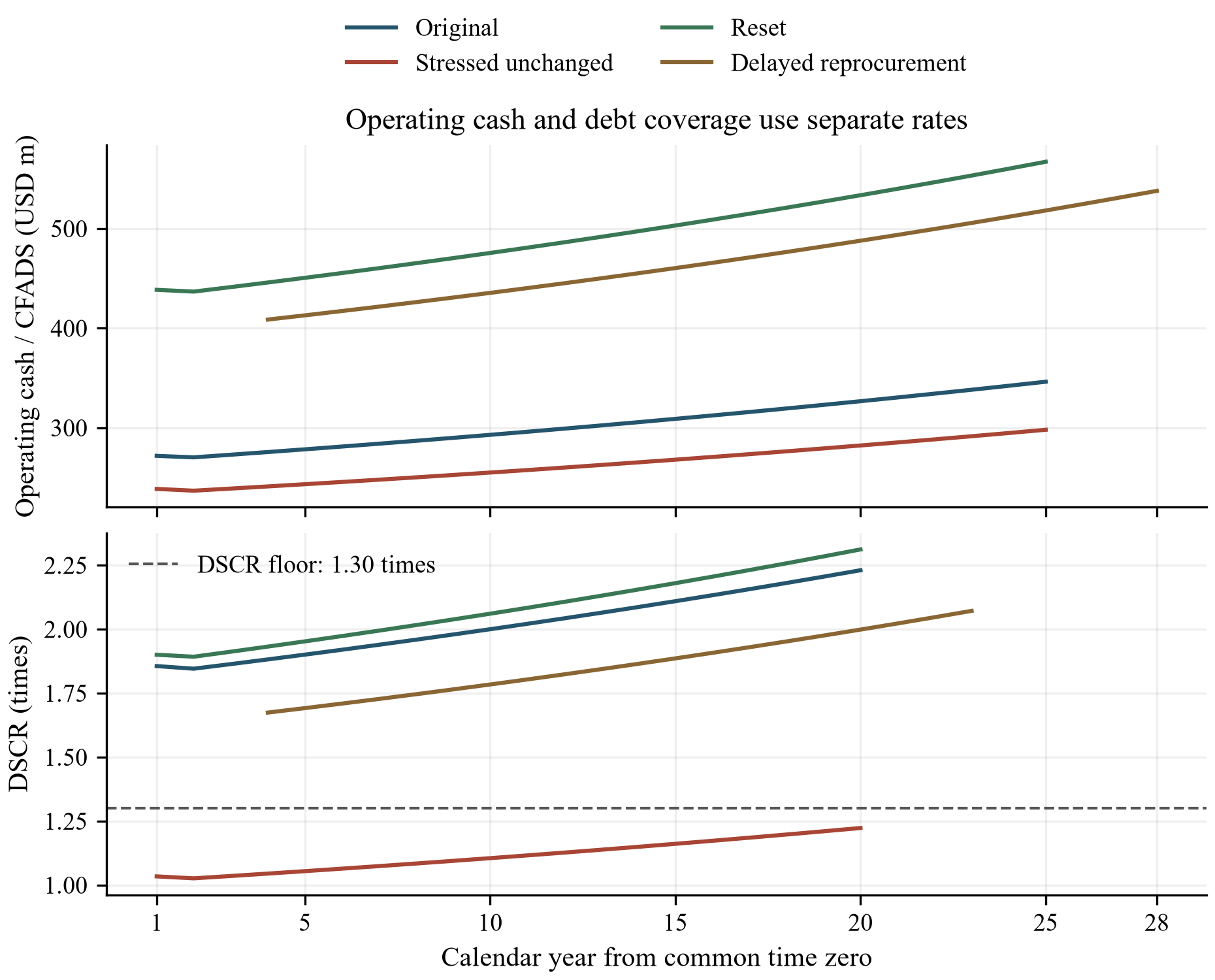
Cash available for debt service equals revenue minus operating cost under the model's simplified cash boundary. Debt-service coverage ratio divides that annual cash by actual scheduled debt service. The reported minimum covers all 20 debt years. No project discount rate appears in this ratio. Loan proceeds, principal and interest also remain outside unlevered project cash flow; subtracting interest there would count financing twice when applying an unlevered hurdle.
Original level debt service is USD 146.470 million annually. The stressed and reset cases require USD 230.785 million. Minimum original coverage is 1.846 times. Stressed unchanged coverage is 1.027 times, below the fictional 1.300-times floor. Reset coverage is 1.893 times. The reset's separate DSCR tariff floor is USD 107.358/MWh, substantially below its project floor. Debt affordability alone consequently leaves a large project-return gap in this example. A debt-free diagnostic reports coverage and its tariff floor as not applicable; a zero-interest diagnostic amortises principal evenly. Neither changes unlevered project NPV.
Table 7. Tariff and affordability outcomes
| Case | Base tariff, USD/MWh | Project floor, USD/MWh | DSCR floor, USD/MWh | Minimum DSCR, times | Project NPV, USD m |
|---|---|---|---|---|---|
| Original award | 90.000 | 88.561 | 69.248 | 1.846 | 59.603 |
| Stressed unchanged award | 90.000 | 140.017 | 107.358 | 1.027 | -1,597.145 |
| Negotiated reset illustration | 145.000 | 140.487 | 107.358 | 1.893 | 144.122 |
| Reprocurement after delay | 135.000 | 142.859 | 110.446 | 1.675 | -187.791 |
Fictional calculated results. Project floor gives zero unlevered NPV at the case hurdle. DSCR floor gives 1.30 times minimum debt-year coverage. NPV uses the complete 25-year operating life and common calendar time zero.
View figure at full size; scroll horizontally on smaller screens.
Fictional author-assumption cash available for debt service and annual DSCR. Loan repayments use each loan's own rate and a 20-operating-year annuity. The project hurdle is excluded from DSCR. Delayed generation begins in calendar year 4; its debt service ends in year 23. The USD 135/MWh reprocurement quote shown here has negative project NPV.
14 Indexation is a dated cash-flow rule
Sixty percent of the starting tariff is indexed at 2% annually. The remaining 40% stays fixed. The default one-year lag freezes the entire tariff in calendar years 1 and 2. Thereafter the indexed component uses exponent t minus 2. In symbols, f(t) equals 0.40 plus 0.60 × 1.02 raised to max(t−2, 0). Operating cost separately rises at 2% from its calendar-year-1 basis.
The contract index clock uses the common 2026 base throughout the exercise. It continues during the assumed reprocurement delay. The new USD 135/MWh quote therefore pays USD 138.272/MWh in its first operating year, calendar year 4. Its operating cost has also risen to USD 93.917 million by then. A contract rebasing indexation at commissioning would require a different model input and a fresh comparison.
Indexation changes both the initial tariff requirement and later buyer payments. Keeping all other reset assumptions unchanged, its required starting price is USD 151.901/MWh without indexation, USD 140.487/MWh under the default rule, USD 138.906/MWh with 60% indexation and no extra lag, and USD 131.412/MWh with full indexation and no extra lag. These are contract-design sensitivities. Any comparison of indexed and fixed awards must retain the complete dated payment stream.
Table 8. Indexation changes the required starting price
| Reset indexation design | Indexed share, % | Lag, years | Project floor, USD/MWh |
|---|---|---|---|
| No indexation | 0.000 | 1 | 151.901 |
| 60%, one-year lag | 60.000 | 1 | 140.487 |
| 60%, no lag | 60.000 | 0 | 138.906 |
| 100%, no lag | 100.000 | 0 | 131.412 |
Fictional sensitivity; all reset investment, yield, operating costs and hurdle inputs remain unchanged. Lag is the extra frozen year after calendar year 1; escalation applies from the common 2026 base.
15 A decision-valued reset sensitivity
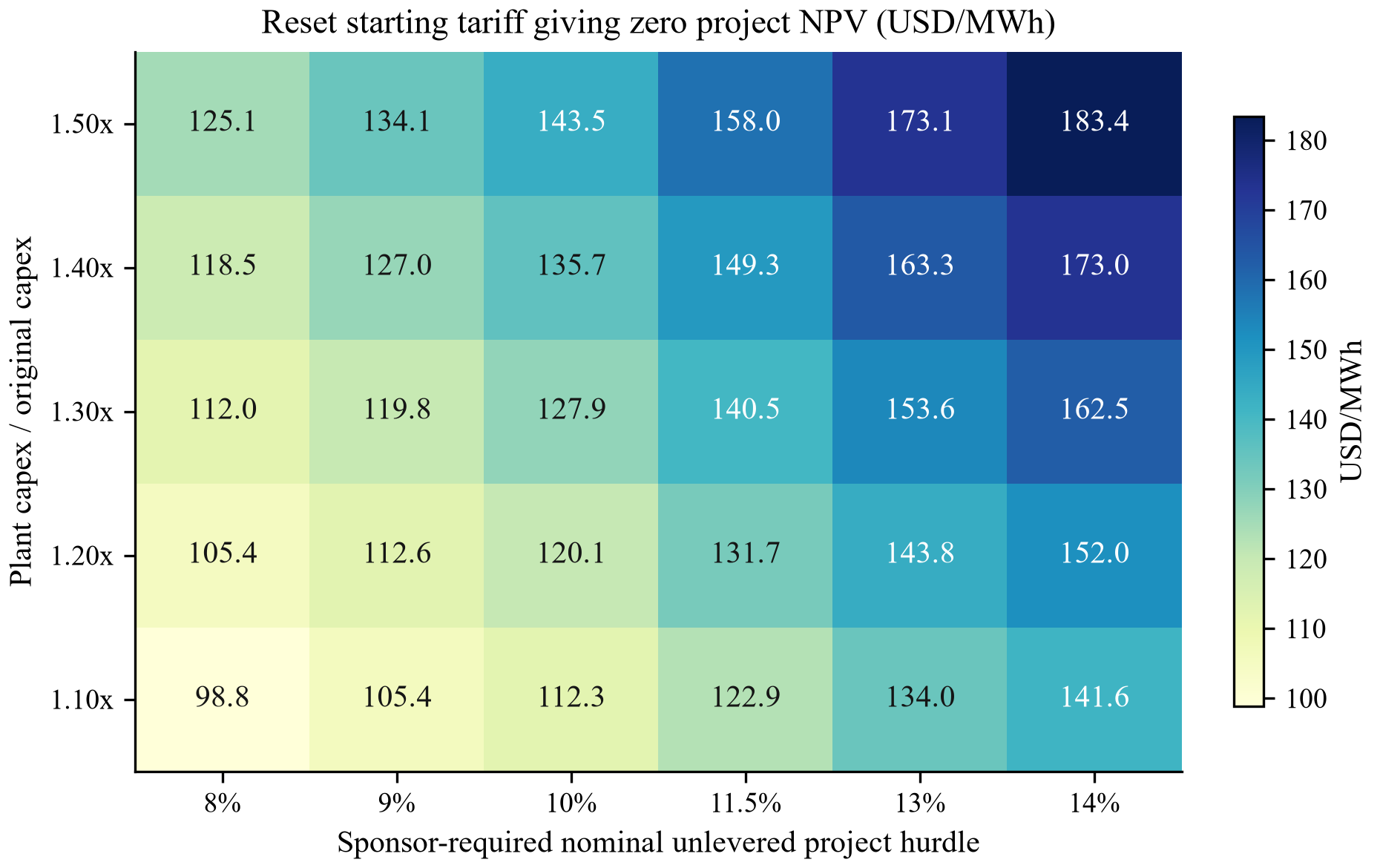
The threshold map varies plant capex from 1.10 to 1.50 times original investment and the nominal unlevered hurdle from 8% to 14%. Stressed operating costs, net yield, indexation and the USD 15 million reset cost remain fixed. Each cell solves a price floor directly; no weighted score or optimisation selects a preferred contract.
At 1.30-times plant capex, the floor is USD 119.783/MWh with a 9% hurdle, USD 140.487/MWh with an 11.5% hurdle, and USD 153.565/MWh with a 13% hurdle. The hypothetical USD 145 reset clears the central cell and fails the higher-hurdle cell. At an 11.5% hurdle, increasing capex to 1.40 times original investment raises the floor to USD 149.255/MWh, also above the quotation. Cost verification and the documented return requirement therefore change the illustrated approval outcome.
The map leaves the loan rate unchanged. A revised loan coupon would alter debt service and the DSCR floor. Its effect on an investor's actual equity valuation requires a separately specified levered model. The project-hurdle sensitivity represents a required-return input and contains no claim about the appropriate return for an actual offshore asset.
View figure at full size; scroll horizontally on smaller screens.
Fictional author-assumption starting tariffs give zero unlevered project NPV at each capex and hurdle combination. Stressed net yield, operating costs, dated indexation and USD 15 million reset cost remain fixed. Cells are direct arithmetic roots, without an optimiser, probabilistic forecast or actual required-return benchmark.
16 Buyer expenditure and the delay alternative
Buyer comparisons use one valuation origin, a 4.5% nominal discount rate and calendar years 1 through 28. Required energy is fixed at 3,854,400 MWh every year. Each pathway purchases replacement electricity for the gap between that requirement and asset generation. Immediate assets cease generation after year 25, requiring full replacement purchases in years 26 through 28. The delayed asset requires full replacement in years 1 through 3 and operates through year 28. All 25 operating years are included in every project valuation, and no asset payment falls beyond the buyer comparison horizon.
Replacement electricity starts at a fictional USD 120/MWh, escalating 2% annually from the same base. The stressed yield requires 219,000 MWh of supplementary purchases in each operating year. Buyer NPV sums contract payments, replacement purchases and the explicit administration cost. It excludes a resale receipt, grid costs, tax recoveries and broader system benefits.
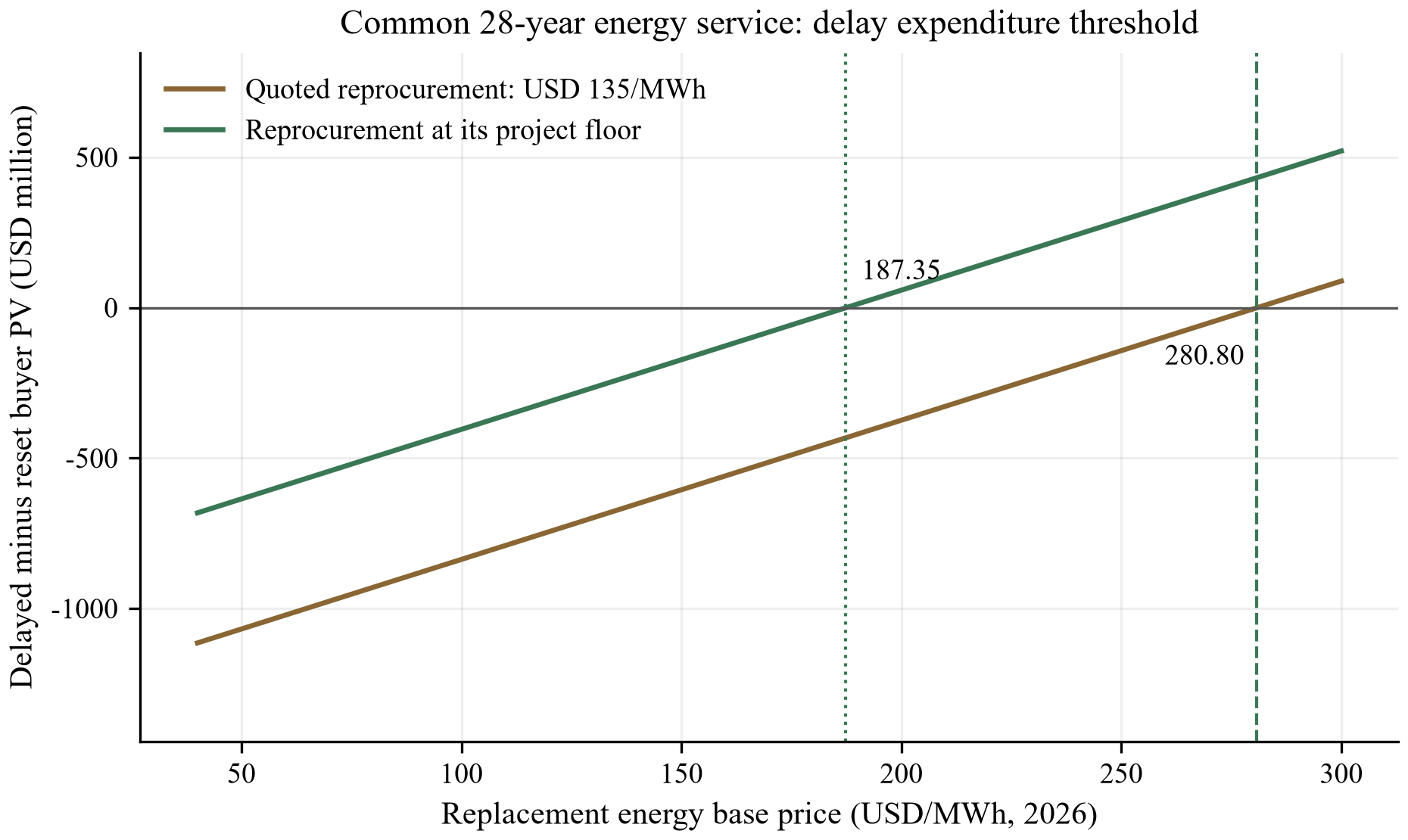
At the assumed replacement price, buyer spend is USD 9,950.027 million for the reset and USD 9,206.001 million for quoted delayed reprocurement. The quoted bid fails its own project hurdle. Repricing that delayed asset to its calculated USD 142.859/MWh project floor raises buyer spend to USD 9,638.394 million, leaving a USD 311.633 million saving relative to the USD 145 reset under these inputs. That floor case has zero project NPV and minimum DSCR of 1.794 times; it supplies no contingency margin.
Replacement-price sensitivity makes the tradeoff decision-valued. At the quoted USD 135 reprocurement price, delayed and reset buyer spend cross at USD 280.802/MWh of replacement base price. Using the hurdle-compatible replacement bid reduces that crossing to USD 187.351/MWh. Above the latter threshold, reset expenditure is lower; below it, hurdle-compatible delayed expenditure is lower, with every other assumption held fixed. Availability of replacement supply at those quantities and prices is unverified.
These gross purchasing cash flows are a fiscal exposure only to the extent that a public budget funds them. Allocation to consumer bills requires an explicit pass-through rule, collection timing and discount convention. The model supplies no consumer-incidence or welfare estimate. A procurement authority would need those additional inputs before translating the expenditure difference into a budget or household claim.
Table 9. Common-horizon buyer expenditure
| Case | Contract PV, USD m | Replacement PV, USD m | Administration PV, USD m | Total PV, USD m |
|---|---|---|---|---|
| Original award | 5,768.090 | 707.634 | 0.000 | 6,475.725 |
| Stressed unchanged award | 5,440.358 | 1,185.005 | 0.000 | 6,625.363 |
| Negotiated reset illustration | 8,765.021 | 1,185.005 | 0.000 | 9,950.027 |
| Reprocurement after delay | 7,427.482 | 1,740.242 | 38.278 | 9,206.001 |
| Reprocurement at project floor | 7,859.874 | 1,740.242 | 38.278 | 9,638.394 |
Fictional buyer spend in calendar years 1-28, discounted at 4.5% nominal to common time zero. Every case serves 3,854,400 MWh annually using asset energy plus replacement purchases. The last row reprices delayed reprocurement at its calculated project floor, with all other inputs unchanged. This is expenditure, with no consumer-incidence or welfare estimate.
View figure at full size; scroll horizontally on smaller screens.
Fictional author-assumption buyer expenditure differences for equal annual energy service over calendar years 1 through 28 at common time zero. Positive values mean delayed reprocurement costs more than the reset. The USD 135/MWh quote fails its project hurdle; the second line uses its USD 142.859/MWh project floor. Base replacement-price crossings are USD 280.802/MWh and USD 187.351/MWh respectively. No fiscal-incidence, household-bill or welfare estimate is made.
17 Conditions for using the result
The exercise supports a bounded negotiation: verify remaining investment, establish the net-energy basis, document dated indexation, obtain actual loan terms, and compare executable alternative procurement offers on a common energy-service calendar. The unchanged award fails both defined tests. The hypothetical reset passes them. The initially cheaper replacement quotation fails the project-return test, and its repriced version remains exposed to replacement-energy cost during delay.
A real approval would also require completion security, cost-overrun allocation, curtailment and negative-price treatment, insurance, supplier warranties, extraordinary maintenance, decommissioning and legal authority for contract amendment. Those items have no quantified value here. The calculated floors therefore remain analytical reference points for diligence and negotiation. The executable companion stores full-precision annual cash flows, checks energy and debt conservation, and reproduces each threshold; independent arithmetic review remains a separate control.
18 Design the relief around verified expenditure
The proposed negotiation begins with a line-by-line cost bridge and a dated construction programme. Divide the requested relief into amounts needed to restore delivery, amounts that compensate an accepted commercial risk, and amounts that remain unsupported. The classification is a negotiation tool, subject to the contract and the legal assessment. It should make clear which costs are recoverable under existing provisions and which require a new bargain.
A price increase can be conditional on verified procurement commitments. Where a developer needs a deposit to secure a turbine slot, the buyer can evaluate the amount, the slot's validity and the consequence of cancellation. If the deposit is recoverable, that recovery should have a contractual treatment. If the supplier later improves its offer, the amendment can specify whether and how the benefit returns to the buyer. The analysis should value these terms alongside the initial concession.
Sponsor contribution requires a precise definition. Additional equity can fund a construction gap, absorb a contingency or reduce leverage. Each use has a distinct effect. A developer's agreement to a lower target return should be translated into a modelled concession and tested against its investment approval. A nominal statement that the sponsor will share the burden supplies little financing evidence without an amount, date and binding commitment.
The authority can also evaluate staged relief. An initial adjustment might become effective at financial close, with further payments linked to documented completion or available generation. This structure can reduce payment before delivery, subject to the project's liquidity needs. The model should test the ability to fund construction under the actual payment timing. A condition that leaves the project unable to pay the supplier does not provide an executable recovery plan.
Table 10. Proposed amendment terms and corresponding controls
| Proposed term | Evidence before effectiveness | Ongoing control |
|---|---|---|
| Initial price reset | Approved remaining-cost bridge | Defined calculation and audit trail |
| Revised indexation | Agreed index, base and effective dates | Symmetric adjustments within agreed limits |
| Milestone extension | Critical-path programme and rights validity | Dated progress reporting and remedies |
| Added sponsor equity | Binding commitment and funding source | Verified contribution before distributions |
| Supplier cost sharing | Executed concession and recovery rights | Credit returned under agreed mechanism |
Notes: Proposed commercial design. Availability and enforceability depend on the project's governing documents and approvals.
19 Refinance only after the operating case reconciles
A revised tariff should be tested using the technical and financial case that lenders will review. Reconcile forecast net generation to the independent resource assessment, losses, availability, curtailment and export constraints. Reconcile operating costs to service contracts, insurance, lease payments, staffing, maintenance and required reserves. The required debt-service coverage ratio then applies to a defined cash-flow measure and covenant period.
The simplified numerical example uses annual periods and a fixed debt fraction to isolate the relation between price and debt service. In an actual transaction, debt sizing should respond to downside cash flows, tenor, sculpting, reserve requirements and the lender's conditions. The constant debt fraction is a sensitivity assumption. Actual debt availability requires lender terms. The underwriting process may produce a different gearing or repayment profile.
Credit support can have value through loss allocation, timing or counterparty strength. Evaluate the guarantor, guarantee scope, currency, expiry and enforcement conditions. A construction completion guarantee differs from a revenue payment guarantee. Both differ from an undertaking to inject equity if a budget overruns. The model and the documentation should use the same defined obligation so that a forecast benefit has an enforceable counterpart.
Debt restructuring should also reconcile existing lenders' rights. Identify consent thresholds, mandatory prepayment, hedge termination, security sharing and transfer conditions. A change of developer may improve execution capability while requiring approvals across several agreements. The transaction timetable needs to incorporate those approvals and the validity periods of new financing offers.
The proposed closing sequence requires an executed revenue amendment, current construction contracts, the technical report, committed equity, permitted rights and the final financing model. Conditions that remain open should be recorded with an owner and a deadline. A financing commitment that depends on a future unapproved price increase remains conditional; the decision record should say so.
20 Use AI and data analysis within an auditable review
This paper proposes using document extraction and structured data analysis to reduce manual reconciliation in the reset process. A controlled dataset can record every material clause, price, milestone and source document. Automated extraction can prepare candidate entries for review. A reviewer should confirm each material entry against the executed document, including schedules, amendments and definitions that alter its meaning. No extraction-accuracy or time-saving percentage is claimed here.
The most useful initial dataset contains the original bid assumptions, executed procurement terms, dated supplier changes, financing offers, index observations and forecast operating cash flows. Every record should retain its currency, unit, price year, source page, document version and review status. The model should reject an input with an unresolved unit or date before calculating a tariff. That control makes a GBP2012 auction value harder to confuse with a nominal USD 2026 model input.
An analytical assistant can generate questions about inconsistent clauses, expired offers or duplicated cost categories. Its output should remain a review queue. It should have no authority to change the approved financial model, accept a supplier term or issue a contractual notice. The responsible transaction team should review suggested changes and record the reason for accepting them.
Confidentiality requires an explicit workflow. Decide which documents can enter the chosen system, who can access them, where processing occurs and how outputs are retained. The contract parties may restrict disclosure of supplier pricing or financing terms. Counsel and information-security staff should review the proposed handling before those records are uploaded to a third-party service.
The final decision package should be reproducible without dependence on an opaque generated narrative. Store the reviewed input dataset, the calculation version and the approval record. A separate reviewer should be able to rebuild the results and trace a requested concession to its underlying evidence. The commercial value of the approach should be measured on an actual mandate using documented review effort and outcomes; it remains unquantified in this paper.
21 Apply the method to other jurisdictions carefully
The UK, New York and European records in this paper describe different institutions and contract structures. A developer considering another geography should begin with the local revenue agreement, applicable law, award rules and grid arrangements. A UK CfD mechanism should enter that review as an example of defined risk allocation. Its entitlement, index observations and settlement convention should not be copied into a different contract without legal and commercial support.
For a GCC or other emerging offshore opportunity, the proposed screen includes the local resource assessment, seabed and coastal constraints, grid capacity, port capability, supplier access and purchaser credit. These are diligence questions for the particular opportunity. This paper does not establish that a specific GCC offshore project is under procurement, has an economic resource or offers an investable return. Public ambitions and potential sites require project-level evidence before they enter a financial recommendation.
Cross-border developers should also test currency convertibility, tax, customs, local-content obligations and the allocation of political or regulatory risk. The contractual route for relief can depend on whether the counterparty is a public authority, utility, special-purpose company or corporate electricity purchaser. The actual obligations and available remedies need local advice and current documents.
For a corporate buyer, electricity service may require hourly shaping, balancing and replacement supply beyond the annual output represented in the illustrative model. A data-centre or industrial purchaser should define the required delivery profile and the consequences of interruptions. The tariff comparison should then include the cost of meeting that profile. Annual megawatt-hours alone cannot establish the availability of firm electricity in a required hour.
This adaptation process produces a country-specific decision pack using the same analytical disciplines: consistent units, dated evidence, executable alternatives and explicit risk allocation. It avoids presenting a single international tariff or financing assumption as applicable across markets.
22 Build an implementation programme from the critical path
The proposed implementation programme has four phases with evidence-based completion points. First, reconcile the contracts, original bid and current cost ledger. Second, complete the independent technical, legal and financing assessments. Third, negotiate the amendment alongside the required supplier and lender commitments. Fourth, close the transaction and monitor delivery against the revised obligations. An actual timetable should be derived from the project, including notice periods and the expiry of offers.
Table 11. Proposed implementation roadmap
| Phase | Main work product | Completion evidence |
|---|---|---|
| Reconciliation | Contract map and remaining-cost bridge | Reviewed documents and resolved material differences |
| Independent assessment | Technical case, legal route and financing analysis | Named reviewers and recorded assumptions |
| Negotiation | Complete conditional commercial package | Counterparty approvals and executable commitments |
| Closing and monitoring | Final model and revised delivery register | Satisfied conditions and dated performance evidence |
Notes: Proposed process sequence. It specifies no promised duration or guaranteed procurement outcome.
The programme should identify the next irreversible expenditure and the last date on which the related approval can be obtained. A model can show an attractive reset while the required vessel window has already expired. The transaction team should ask suppliers to reconfirm availability at defined points and incorporate any changed term into the current case. Each material revision should identify what changed since the preceding approval.
Settle information rights before disbursing relief. The buyer may need access to cost evidence, construction progress, recoveries and output data to administer the amendment. Access should be proportionate to the agreed control and respect confidentiality obligations. The parties should also specify how a dispute over an adjustment will be resolved while the project continues to perform.
The board paper should state the decision required, the maximum permitted concession, the conditions, the delegated authority and the matters requiring renewed approval. It should include a credible termination or reprocurement case even if continuation is preferred. That case needs its own cost, timing and service assumptions, supported by evidence.
23 Findings and limits of the proposed framework
The analysis supports a disciplined approach to contract reset. A proposal should reconcile efficient remaining cost to a financeable delivery programme, quantify the revenue required under explicit assumptions, and assess the buyer's executable alternatives. Legal authority, economic value and financing approval remain separate determinations. A decision should record how each determination was reached and the evidence on which it depends.
The hypothetical model supplies reproducible arithmetic for selected mechanisms. It excludes tax, detailed construction drawdown, depreciation, subsidies, terminal value, decommissioning expenditure, hourly energy shaping and a complete set of lender reserves. It uses deterministic assumptions and simplified annual cash flows. Accordingly, its tariff thresholds are conditional illustrations. A real transaction should extend the model to the actual jurisdiction, contractual definitions and project timetable before using it to price an amendment.
The buyer-expenditure comparison measures defined cash payments over a common horizon. It does not estimate total social welfare, carbon benefits, employment effects, grid-system costs or consumer-bill incidence. Those questions require additional models and evidence. The project valuation also uses a specified unlevered hurdle; it should not be read as an investor equity return or a lender's commitment.
The source record remains time-specific. Future auction rules, supplier offers, financing conditions and project announcements can change the available alternatives. A live mandate should refresh material inputs at approval and financial close. Where a fact cannot be substantiated, the decision pack should identify the open item and show the consequence of plausible alternatives without treating either as an observed outcome.
The practical contribution is a review method that links each concession to a defined exposure, documents the required approvals and evaluates delivery on consistent terms. Its usefulness in an actual negotiation depends on the quality of the underlying evidence, the alternatives available and the parties' ability to execute the resulting agreement.
References
- UK Department for Energy Security and Net Zero. Contracts for Difference Allocation Round 7 results (accessible webpage). 14 January 2026. https://www.gov.uk/government/publications/contracts-for-difference-cfd-allocation-round-7-results/contracts-for-difference-allocation-round-7-results-accessible-webpage Accessed 10 October 2026.
- UK Department for Energy Security and Net Zero. Further reforms to the CfD scheme for AR7: government response to policy proposals. 15 July 2025. https://www.gov.uk/government/consultations/further-reforms-to-the-contracts-for-difference-scheme-for-allocation-round-7/outcome/further-reforms-to-the-cfd-scheme-for-ar7-government-response-to-policy-proposals-published-july-2025-accessible-webpage Accessed 10 October 2026.
- UK Department for Energy Security and Net Zero; official CfD contract terms. FiT Contract for Difference Standard Terms and Conditions, Version 7. 24 July 2025. https://assets.publishing.service.gov.uk/media/688b9b55fdde2b8f73469577/AR7_-_Standard_Terms_and_Conditions_July_2025_84916781.18_.pdf Accessed 10 October 2026.
- UK Department for Energy Security and Net Zero. Contracts for Difference Allocation Round 6: results (accessible webpage). 3 September 2024. https://www.gov.uk/government/publications/contracts-for-difference-cfd-allocation-round-6-results/contracts-for-difference-cfd-allocation-round-6-results-accessible-webpage Accessed 10 October 2026.
- Ørsted A/S. Ørsted to discontinue the Hornsea 4 offshore wind project in its current form. 7 May 2025. https://orsted.com/en/company-announcement-list/2025/05/orsted-to-discontinue-the-hornsea-4-offshore-wind--143901911 Accessed 10 October 2026.
- Vattenfall AB. First six months 2023: A positive development for the customer business and challenges in offshore wind power. 20 July 2023. https://group.vattenfall.com/press-and-media/newsroom/2023/first-six-months-2023-a-positive-development-for-the-customer-business-and-challenges-in-offshore-wind-power/ Accessed 10 October 2026.
- New York State Public Service Commission. Order Denying Petitions Seeking to Amend Contracts with Renewable Energy Projects, Cases 15-E-0302 and 18-E-0071. 12 October 2023. https://documents.dps.ny.gov/public/Common/ViewDoc.aspx?DocRefId=%7BE0C7248B-0000-C91F-9B56-50CC9643132E%7D Accessed 10 October 2026.
- New York State Energy Research and Development Authority. 2023 Offshore Wind Solicitation, ORECRFP23-1 (fourth solicitation). 4 June 2024. https://www.nyserda.ny.gov/All-Programs/Offshore-Wind/Focus-Areas/Offshore-Wind-Solicitations/2023-Solicitation Accessed 10 October 2026.
- New York State Energy Research and Development Authority. 2024 Offshore Wind Solicitation, ORECRFP24-1 (fifth solicitation, closed). 13 February 2026. https://www.nyserda.ny.gov/All-Programs/Offshore-Wind/Focus-Areas/Offshore-Wind-Solicitations/2024-Solicitation Accessed 10 October 2026.
- European Commission. Commission Recommendation (EU) 2024/1344 of 13 May 2024 on auction design for renewable energy. 13 May 2024. https://eur-lex.europa.eu/eli/reco/2024/1344/oj/eng Accessed 10 October 2026.
- NYSERDA and Empire Offshore Wind LLC. Executed Offshore Wind Renewable Energy Certificate Purchase and Sale Agreement No. 231326. 31 May 2024. https://www.nyserda.ny.gov/-/media/Project/Nyserda/Files/Programs/Offshore-Wind/ORECRFP231-Empire-PSA-Public-Version-Final-Executed5035128221.pdf Accessed 10 October 2026.
- European Commission. Commission guidance on the design of two-way contracts for difference, C/2025/8479; OJ C/2025/6701. 19 December 2025. https://eur-lex.europa.eu/eli/C/2025/6701/oj/eng Accessed 10 October 2026.
- UK Cabinet Office. Guidance Contract Modifications. 20 July 2026. https://www.gov.uk/government/publications/procurement-act-2023-guidance-documents-manage-phase/guidance-contract-modifications-html Accessed 10 October 2026.
- National Laboratory of the Rockies formerly National Renewable Energy Laboratory. Annual Technology Baseline 2024b Offshore Wind. 2024 edition. https://atb.nlr.gov/electricity/2024b/offshore_wind Accessed 10 October 2026.
About the Author
Chennakeshav (CK) is a corporate finance and investment banking executive with 25+ years of global experience in deal origination, structuring and execution across M&A, growth capital and corporate strategy. He has led value-creation mandates for founders, corporates and funds — bridging the boardroom view to hands-on execution and close.
His career spans Morgan Stanley, HSBC, Lloyds Banking Group, EWEC, ADQ portfolio companies and Emirates Growth Fund, across TMT, real estate, fintech, deeptech, cleantech, infrastructure and energy. He has partnered with C-suite leaders, private equity and venture funds, sovereign wealth funds and family offices to finance complex fund raises and scale-up ventures, and has led M&A due diligence, post-merger integration and business-transformation initiatives to create value.
At Matchpoint Partners he is Managing Partner, leading the firm's corporate finance, M&A and capital-raising practice. He holds an MBA from London Business School, an engineering degree from VTU and a Master of Laws (LLM, in progress) from UCL London.
An active start-up mentor, CK mentors at Techstars, DIFC FinTech Hive, Startup Grind, Founder Institute and IN5, serves as Entrepreneur Mentor in Residence (EMiR) at London Business School, and judges the Entrepreneurship World Cup.
https://www.linkedin.com/in/ckadya/ https://www.matchpoint-partners.com/team/ck-adya.html
