

1. Define the expiry decision
A PWPA expiry is a coordinated contract, asset and market decision. The parties must choose whether the plant should transfer, continue, repower, be reprocured or retire, and support that choice with verified evidence.
The working file should identify the governing contract clause, asset evidence, responsible party and decision date. Legal, technical, commercial and financial conclusions should remain traceable to the source on which they rely.
A practical review asks what transfers, in what condition, with which continuing rights, at what cost and under which post-expiry revenue path. The answer should produce a testable end-state recommendation rather than a single unsupported terminal value.
2. Separate contract expiry from asset death
The end of contracted capacity and output payments rarely coincides exactly with the end of technical life. Residual value depends on the plant's condition, rights and post-contract revenue prospects.
The assessment should distinguish verified condition from management assumptions and future scenarios. The purchaser, owner, lenders and advisers should use one reconciled asset register, expiry timetable and evidence log.
The parties should translate the issue into dated actions, acceptance criteria and quantified valuation adjustments. Mandatory handback work, optional value creation and contingent liabilities should remain visible as separate lines.
3. Distinguish handback value from market value
Handback compliance measures whether the asset meets contractual transfer standards. Market value measures cash flows and options available after expiry. Both require separate evidence and can produce different conclusions.
The decision should be completed while the parties still have time to inspect, fund, procure and implement the required work. Any assumption affecting value should have an owner, validation method and expiry date.
The objective is a reliable transition that preserves service and allocates value and responsibility transparently. A plant retains residual value only where technical capability and the legal route to monetise that capability can both be demonstrated.
4. Establish the end-state options
The base options are transfer, negotiated extension, competitive reprocurement, life extension, partial repowering, full repowering and retirement. A disciplined process keeps viable options open until evidence supports selection.
The working file should identify the governing contract clause, asset evidence, responsible party and decision date. Legal, technical, commercial and financial conclusions should remain traceable to the source on which they rely.
A practical review asks what transfers, in what condition, with which continuing rights, at what cost and under which post-expiry revenue path. The answer should produce a testable end-state recommendation rather than a single unsupported terminal value.
5. Build the contract and asset map
The map should connect the PWPA, land, grid, fuel, water, permits, O&M, financing, insurance and government rights to physical systems, ownership and expiry dates.
The assessment should distinguish verified condition from management assumptions and future scenarios. The purchaser, owner, lenders and advisers should use one reconciled asset register, expiry timetable and evidence log.
The parties should translate the issue into dated actions, acceptance criteria and quantified valuation adjustments. Mandatory handback work, optional value creation and contingent liabilities should remain visible as separate lines.
Table 1. End-state option, evidence and principal risk
| End state | Required evidence | Principal value source | Principal risk | Completion test |
|---|---|---|---|---|
| Transfer | Enforceable transfer, accepted condition and permits | Service continuity and usable remaining life | Defects or rights fail to transfer | Signed acceptance and operational control |
| Life extension | Condition, overhaul scope and future revenue | Continued use of installed asset | Reliability and capex overrun | Funded plan and performance warranty |
| Repowering | Site, grid, permits and integration design | Better efficiency, flexibility and life | Construction and interface risk | Bankable contract and financing |
| Reprocurement | Lawful process, demand and bidder appetite | Competitive price discovery | Timetable exceeds expiry | Award and transition complete |
| Retirement | Replacement capacity and closure plan | Avoided losses and liabilities | Unfunded remediation | Funded decommissioning and site outcome |
The alternatives are generic and require transaction-specific legal, technical and market review.
6. Confirm title and ownership
Plant ownership may sit with the project company while land, interconnection equipment, intake works or shared facilities sit elsewhere. The transfer perimeter must identify title, encumbrances and excluded assets.
The decision should be completed while the parties still have time to inspect, fund, procure and implement the required work. Any assumption affecting value should have an owner, validation method and expiry date.
The objective is a reliable transition that preserves service and allocates value and responsibility transparently. A plant retains residual value only where technical capability and the legal route to monetise that capability can both be demonstrated.
7. Read the transfer terms literally
Transfer provisions should identify the recipient, date, consideration, condition, documentation, taxes, liabilities and completion mechanics. Commercial assumptions cannot substitute for the executed language.
The working file should identify the governing contract clause, asset evidence, responsible party and decision date. Legal, technical, commercial and financial conclusions should remain traceable to the source on which they rely.
A practical review asks what transfers, in what condition, with which continuing rights, at what cost and under which post-expiry revenue path. The answer should produce a testable end-state recommendation rather than a single unsupported terminal value.
8. Convert handback standards into tests
General duties such as good operating condition need measurable acceptance criteria. The protocol should specify reliability, efficiency, output, safety, integrity, records and remaining-life tests.
The assessment should distinguish verified condition from management assumptions and future scenarios. The purchaser, owner, lenders and advisers should use one reconciled asset register, expiry timetable and evidence log.
The parties should translate the issue into dated actions, acceptance criteria and quantified valuation adjustments. Mandatory handback work, optional value creation and contingent liabilities should remain visible as separate lines.
9. Define required remaining useful life
The contract may require individual systems to retain a stated life after transfer. The engineering assessment should distinguish design life, consumed life, condition-adjusted life and economically useful life.
The decision should be completed while the parties still have time to inspect, fund, procure and implement the required work. Any assumption affecting value should have an owner, validation method and expiry date.
The objective is a reliable transition that preserves service and allocates value and responsibility transparently. A plant retains residual value only where technical capability and the legal route to monetise that capability can both be demonstrated.
10. Commission the condition audit early
A first independent audit several years before expiry creates time to cure defects and fund lifecycle work. A late audit converts manageable maintenance into negotiation and service-continuity risk.
The working file should identify the governing contract clause, asset evidence, responsible party and decision date. Legal, technical, commercial and financial conclusions should remain traceable to the source on which they rely.
A practical review asks what transfers, in what condition, with which continuing rights, at what cost and under which post-expiry revenue path. The answer should produce a testable end-state recommendation rather than a single unsupported terminal value.
11. Freeze the baseline asset register
The register should identify every material unit, serial number, ownership, age, overhaul history, warranty, spares position and expected handback status. Changes require controlled updates.
The assessment should distinguish verified condition from management assumptions and future scenarios. The purchaser, owner, lenders and advisers should use one reconciled asset register, expiry timetable and evidence log.
The parties should translate the issue into dated actions, acceptance criteria and quantified valuation adjustments. Mandatory handback work, optional value creation and contingent liabilities should remain visible as separate lines.
12. Identify critical equipment
Turbines, generators, boilers, heat-recovery systems, membranes, pumps, intake and outfall works, transformers, switchgear and control systems should be ranked by service consequence and replacement lead time.
The decision should be completed while the parties still have time to inspect, fund, procure and implement the required work. Any assumption affecting value should have an owner, validation method and expiry date.
The objective is a reliable transition that preserves service and allocates value and responsibility transparently. A plant retains residual value only where technical capability and the legal route to monetise that capability can both be demonstrated.
13. Reconcile maintenance history
Work orders, outage records, inspection reports and vendor recommendations reveal whether the apparent condition is supported by executed maintenance. Missing records reduce confidence and may increase required reserves.
The working file should identify the governing contract clause, asset evidence, responsible party and decision date. Legal, technical, commercial and financial conclusions should remain traceable to the source on which they rely.
A practical review asks what transfers, in what condition, with which continuing rights, at what cost and under which post-expiry revenue path. The answer should produce a testable end-state recommendation rather than a single unsupported terminal value.
14. Quantify deferred maintenance
Deferred work should be separated into safety-critical, handback-required, reliability, efficiency and discretionary categories. The valuation deducts only supported obligations and scenario-specific capital expenditure.
The assessment should distinguish verified condition from management assumptions and future scenarios. The purchaser, owner, lenders and advisers should use one reconciled asset register, expiry timetable and evidence log.
The parties should translate the issue into dated actions, acceptance criteria and quantified valuation adjustments. Mandatory handback work, optional value creation and contingent liabilities should remain visible as separate lines.
15. Analyse performance history
Availability, output, heat rate, auxiliary load, specific fuel consumption, water recovery, quality and unplanned outage data should be normalised for dispatch, ambient conditions and contract tests.
The decision should be completed while the parties still have time to inspect, fund, procure and implement the required work. Any assumption affecting value should have an owner, validation method and expiry date.
The objective is a reliable transition that preserves service and allocates value and responsibility transparently. A plant retains residual value only where technical capability and the legal route to monetise that capability can both be demonstrated.
16. Test reliability and availability
A plant can pass a spot performance test while carrying high failure risk. Reliability analysis should use forced-outage frequency, mean time between failures and component condition.
The working file should identify the governing contract clause, asset evidence, responsible party and decision date. Legal, technical, commercial and financial conclusions should remain traceable to the source on which they rely.
A practical review asks what transfers, in what condition, with which continuing rights, at what cost and under which post-expiry revenue path. The answer should produce a testable end-state recommendation rather than a single unsupported terminal value.
17. Test efficiency and variable cost
Post-expiry competitiveness depends on fuel efficiency, energy consumption, chemicals, labour and maintenance. Historic contract pass-throughs may disappear under merchant or reprocured arrangements.
The assessment should distinguish verified condition from management assumptions and future scenarios. The purchaser, owner, lenders and advisers should use one reconciled asset register, expiry timetable and evidence log.
The parties should translate the issue into dated actions, acceptance criteria and quantified valuation adjustments. Mandatory handback work, optional value creation and contingent liabilities should remain visible as separate lines.
18. Test water output and quality
For IWPs and IWPPs, residual value depends on sustained production, salinity management, membrane condition, water quality, intake reliability and discharge compliance.
The decision should be completed while the parties still have time to inspect, fund, procure and implement the required work. Any assumption affecting value should have an owner, validation method and expiry date.
The objective is a reliable transition that preserves service and allocates value and responsibility transparently. A plant retains residual value only where technical capability and the legal route to monetise that capability can both be demonstrated.
19. Verify environmental compliance
Air emissions, marine impacts, brine, wastewater, noise, waste and hazardous materials can create upgrade or remediation obligations. The diligence should include permits, monitoring and unresolved notices.
The working file should identify the governing contract clause, asset evidence, responsible party and decision date. Legal, technical, commercial and financial conclusions should remain traceable to the source on which they rely.
A practical review asks what transfers, in what condition, with which continuing rights, at what cost and under which post-expiry revenue path. The answer should produce a testable end-state recommendation rather than a single unsupported terminal value.
20. Map permit continuity
Operating, environmental, generation, water, grid, land and fuel rights may expire, require consent or remain personal to the project company. Continuity conditions should be documented before valuation.
The assessment should distinguish verified condition from management assumptions and future scenarios. The purchaser, owner, lenders and advisers should use one reconciled asset register, expiry timetable and evidence log.
The parties should translate the issue into dated actions, acceptance criteria and quantified valuation adjustments. Mandatory handback work, optional value creation and contingent liabilities should remain visible as separate lines.
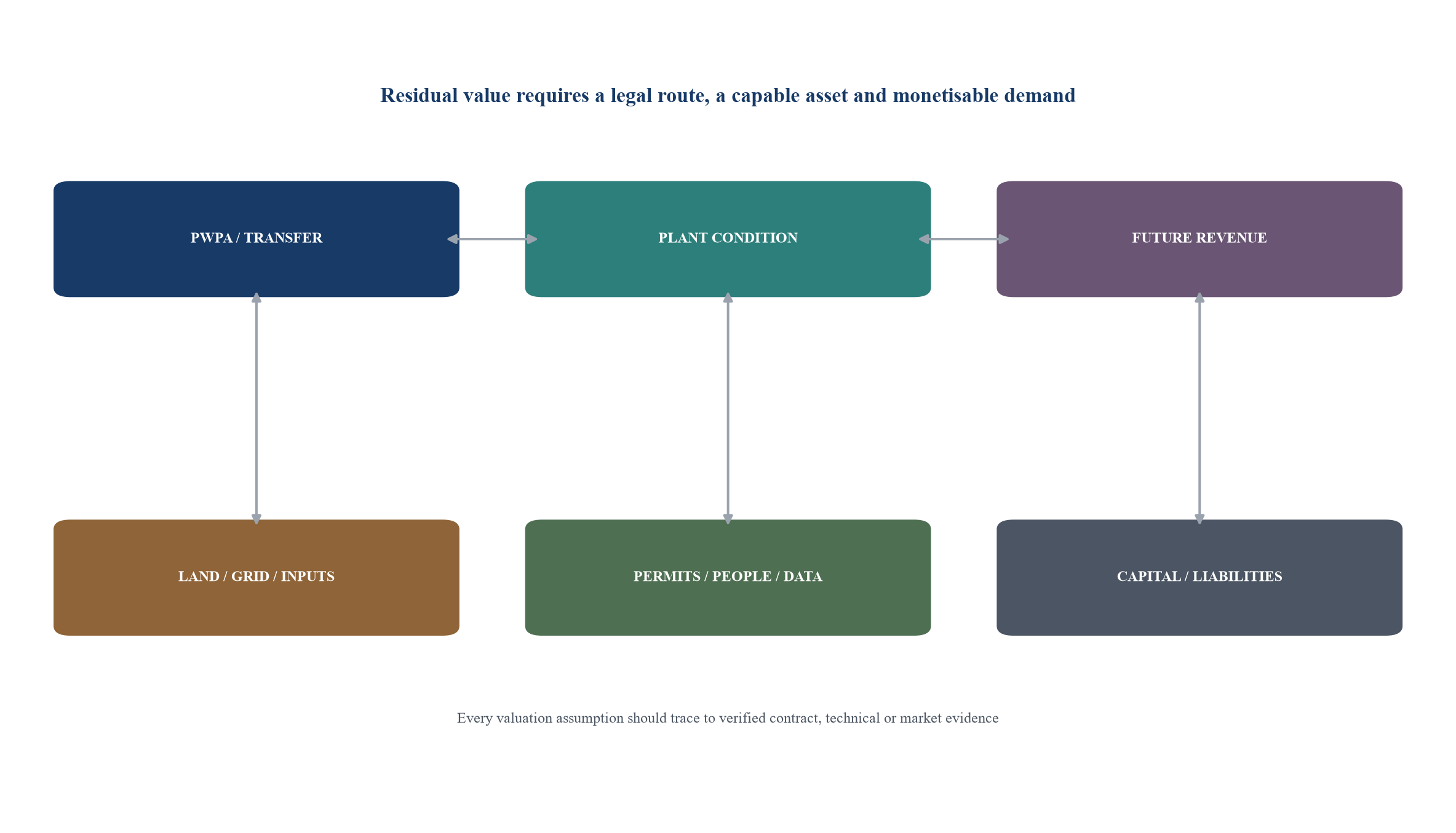
The diagram shows the evidence chain required to support residual value.
21. Preserve land, grid and input rights
A technically viable plant has limited value without enforceable site access, transmission, water intake, fuel and shared-infrastructure rights. Each right needs duration, transferability and capacity evidence.
The decision should be completed while the parties still have time to inspect, fund, procure and implement the required work. Any assumption affecting value should have an owner, validation method and expiry date.
The objective is a reliable transition that preserves service and allocates value and responsibility transparently. A plant retains residual value only where technical capability and the legal route to monetise that capability can both be demonstrated.
22. Reconcile the O&M position
The O&M agreement may expire with the PWPA or contain change-of-control and termination provisions. The transition plan should retain capability, manuals, licences and critical supplier support.
The working file should identify the governing contract clause, asset evidence, responsible party and decision date. Legal, technical, commercial and financial conclusions should remain traceable to the source on which they rely.
A practical review asks what transfers, in what condition, with which continuing rights, at what cost and under which post-expiry revenue path. The answer should produce a testable end-state recommendation rather than a single unsupported terminal value.
23. Protect workforce and operating knowledge
Experienced staff hold plant-specific knowledge that is difficult to recreate. Retention, transfer, consultation, training and pension or benefit obligations should be assessed under applicable law.
The assessment should distinguish verified condition from management assumptions and future scenarios. The purchaser, owner, lenders and advisers should use one reconciled asset register, expiry timetable and evidence log.
The parties should translate the issue into dated actions, acceptance criteria and quantified valuation adjustments. Mandatory handback work, optional value creation and contingent liabilities should remain visible as separate lines.
24. Secure data, software and spares
Control-system licences, source code, passwords, models, maintenance data, vendor tools and strategic spares should transfer with verified rights. Unsupported systems can impair operations immediately after handover.
The decision should be completed while the parties still have time to inspect, fund, procure and implement the required work. Any assumption affecting value should have an owner, validation method and expiry date.
The objective is a reliable transition that preserves service and allocates value and responsibility transparently. A plant retains residual value only where technical capability and the legal route to monetise that capability can both be demonstrated.
25. Map warranties and claims
Remaining warranties, latent-defect claims, insurance recoveries and contractor disputes should be assigned deliberately. A transfer should preserve value without duplicating recovery.
The working file should identify the governing contract clause, asset evidence, responsible party and decision date. Legal, technical, commercial and financial conclusions should remain traceable to the source on which they rely.
A practical review asks what transfers, in what condition, with which continuing rights, at what cost and under which post-expiry revenue path. The answer should produce a testable end-state recommendation rather than a single unsupported terminal value.
26. Quantify decommissioning obligations
Closure can require dismantling, contamination remediation, waste disposal, land restoration and marine works. The responsible party, security and timing should be reflected in every end-state case.
The assessment should distinguish verified condition from management assumptions and future scenarios. The purchaser, owner, lenders and advisers should use one reconciled asset register, expiry timetable and evidence log.
The parties should translate the issue into dated actions, acceptance criteria and quantified valuation adjustments. Mandatory handback work, optional value creation and contingent liabilities should remain visible as separate lines.
27. Test handback security
A bond, reserve, retention or distribution lock-up can protect the purchaser against an underfunded handback. The amount should follow evidence of required work rather than a mechanical percentage.
The decision should be completed while the parties still have time to inspect, fund, procure and implement the required work. Any assumption affecting value should have an owner, validation method and expiry date.
The objective is a reliable transition that preserves service and allocates value and responsibility transparently. A plant retains residual value only where technical capability and the legal route to monetise that capability can both be demonstrated.
28. Control the lifecycle reserve
The lifecycle account should reconcile forecast work, actual condition, available cash and remaining obligations. Releases should follow independent certification and preserve the ability to complete mandatory work.
The working file should identify the governing contract clause, asset evidence, responsible party and decision date. Legal, technical, commercial and financial conclusions should remain traceable to the source on which they rely.
A practical review asks what transfers, in what condition, with which continuing rights, at what cost and under which post-expiry revenue path. The answer should produce a testable end-state recommendation rather than a single unsupported terminal value.
29. Design the final distribution lock-up
Distributions near expiry can weaken maintenance incentives. A calibrated lock-up links cash release to audit findings, funded work, transfer documents and verified completion.
The assessment should distinguish verified condition from management assumptions and future scenarios. The purchaser, owner, lenders and advisers should use one reconciled asset register, expiry timetable and evidence log.
The parties should translate the issue into dated actions, acceptance criteria and quantified valuation adjustments. Mandatory handback work, optional value creation and contingent liabilities should remain visible as separate lines.
30. Align final debt maturity
Debt should mature early enough to resolve defects, discharge security and complete transfer. A short tail can leave lenders dependent on an untested terminal-value assumption.
The decision should be completed while the parties still have time to inspect, fund, procure and implement the required work. Any assumption affecting value should have an owner, validation method and expiry date.
The objective is a reliable transition that preserves service and allocates value and responsibility transparently. A plant retains residual value only where technical capability and the legal route to monetise that capability can both be demonstrated.
Table 2. Expiry risk-allocation matrix
| Risk | Project-company responsibility | Purchaser protection | Shared control | Evidence |
|---|---|---|---|---|
| Asset deterioration | Maintain and complete required work | Audit, security and acceptance tests | Agreed condition protocol | Records, inspections and test results |
| Rights discontinuity | Maintain permits and transfer documents | Withhold acceptance until effective | Consent and transition plan | Valid licences, land and grid rights |
| Deferred capex | Fund contractual lifecycle work | Reserve and distribution lock-up | Independent certification | Costed work plan and completion evidence |
| Service interruption | Operate safely through transition | Continuity and emergency rights | Joint handover command | Staffing, spares and operating plan |
| Residual-value shortfall | Bear risk allocated by financing | Avoid unsupported transfer payment | Agreed valuation process | Scenario model and assessor report |
| Environmental liability | Comply and remediate as contracted | Retain claims and security | Site baseline and allocation schedule | Permits, monitoring and closure estimate |
Allocation should follow the executed PWPA, applicable law and the selected end state.
31. Test refinancing tail risk
Refinancing close to expiry may rely on extension, merchant value or transfer proceeds. Lenders should test contractual rights and downside cash flows before crediting any residual value.
The working file should identify the governing contract clause, asset evidence, responsible party and decision date. Legal, technical, commercial and financial conclusions should remain traceable to the source on which they rely.
A practical review asks what transfers, in what condition, with which continuing rights, at what cost and under which post-expiry revenue path. The answer should produce a testable end-state recommendation rather than a single unsupported terminal value.
32. Define the valuation perimeter
The perimeter should include transferable physical assets, rights, working capital, spares, claims and liabilities. Non-transferable contracts and stranded costs require explicit treatment.
The assessment should distinguish verified condition from management assumptions and future scenarios. The purchaser, owner, lenders and advisers should use one reconciled asset register, expiry timetable and evidence log.
The parties should translate the issue into dated actions, acceptance criteria and quantified valuation adjustments. Mandatory handback work, optional value creation and contingent liabilities should remain visible as separate lines.
33. Value contracted cash flow
Remaining PWPA cash flow is valued using the executed tariff, availability, performance, deductions, costs and debt service. Terminal value should not mask weak near-term performance.
The decision should be completed while the parties still have time to inspect, fund, procure and implement the required work. Any assumption affecting value should have an owner, validation method and expiry date.
The objective is a reliable transition that preserves service and allocates value and responsibility transparently. A plant retains residual value only where technical capability and the legal route to monetise that capability can both be demonstrated.
34. Value post-contract cash flow
Post-expiry income depends on extension terms, market dispatch, capacity payments, ancillary services, water procurement, fuel and environmental costs. Each scenario needs an identified legal and commercial route.
The working file should identify the governing contract clause, asset evidence, responsible party and decision date. Legal, technical, commercial and financial conclusions should remain traceable to the source on which they rely.
A practical review asks what transfers, in what condition, with which continuing rights, at what cost and under which post-expiry revenue path. The answer should produce a testable end-state recommendation rather than a single unsupported terminal value.
35. Use replacement cost carefully
Replacement cost can benchmark scarcity and avoided development time. It does not by itself prove value because an older plant may have lower efficiency, shorter life and different rights.
The assessment should distinguish verified condition from management assumptions and future scenarios. The purchaser, owner, lenders and advisers should use one reconciled asset register, expiry timetable and evidence log.
The parties should translate the issue into dated actions, acceptance criteria and quantified valuation adjustments. Mandatory handback work, optional value creation and contingent liabilities should remain visible as separate lines.
36. Use depreciated replacement cost
Depreciated replacement cost adjusts a modern equivalent asset for physical deterioration, functional obsolescence and economic obsolescence. It is most useful where income evidence is limited.
The decision should be completed while the parties still have time to inspect, fund, procure and implement the required work. Any assumption affecting value should have an owner, validation method and expiry date.
The objective is a reliable transition that preserves service and allocates value and responsibility transparently. A plant retains residual value only where technical capability and the legal route to monetise that capability can both be demonstrated.
37. Apply the income approach
The income approach discounts scenario-specific free cash flow after required capital expenditure, tax, working capital and decommissioning. Probabilities should be supported and shown separately.
The working file should identify the governing contract clause, asset evidence, responsible party and decision date. Legal, technical, commercial and financial conclusions should remain traceable to the source on which they rely.
A practical review asks what transfers, in what condition, with which continuing rights, at what cost and under which post-expiry revenue path. The answer should produce a testable end-state recommendation rather than a single unsupported terminal value.
38. Recognise option value
An operating site with grid, permits and experienced staff can create options for repowering, storage, desalination or hybrid use. Option value requires executable rights, time and capital.
The assessment should distinguish verified condition from management assumptions and future scenarios. The purchaser, owner, lenders and advisers should use one reconciled asset register, expiry timetable and evidence log.
The parties should translate the issue into dated actions, acceptance criteria and quantified valuation adjustments. Mandatory handback work, optional value creation and contingent liabilities should remain visible as separate lines.
39. Build the life-extension case
Life extension preserves existing configuration through targeted overhaul. The case should show the work scope, outage, warranties, remaining life, performance and contractual route.
The decision should be completed while the parties still have time to inspect, fund, procure and implement the required work. Any assumption affecting value should have an owner, validation method and expiry date.
The objective is a reliable transition that preserves service and allocates value and responsibility transparently. A plant retains residual value only where technical capability and the legal route to monetise that capability can both be demonstrated.
40. Build the repowering case
Repowering replaces or upgrades major systems to improve efficiency, flexibility, emissions or water performance. The model should separate retained infrastructure from new capital and integration risk.
The working file should identify the governing contract clause, asset evidence, responsible party and decision date. Legal, technical, commercial and financial conclusions should remain traceable to the source on which they rely.
A practical review asks what transfers, in what condition, with which continuing rights, at what cost and under which post-expiry revenue path. The answer should produce a testable end-state recommendation rather than a single unsupported terminal value.
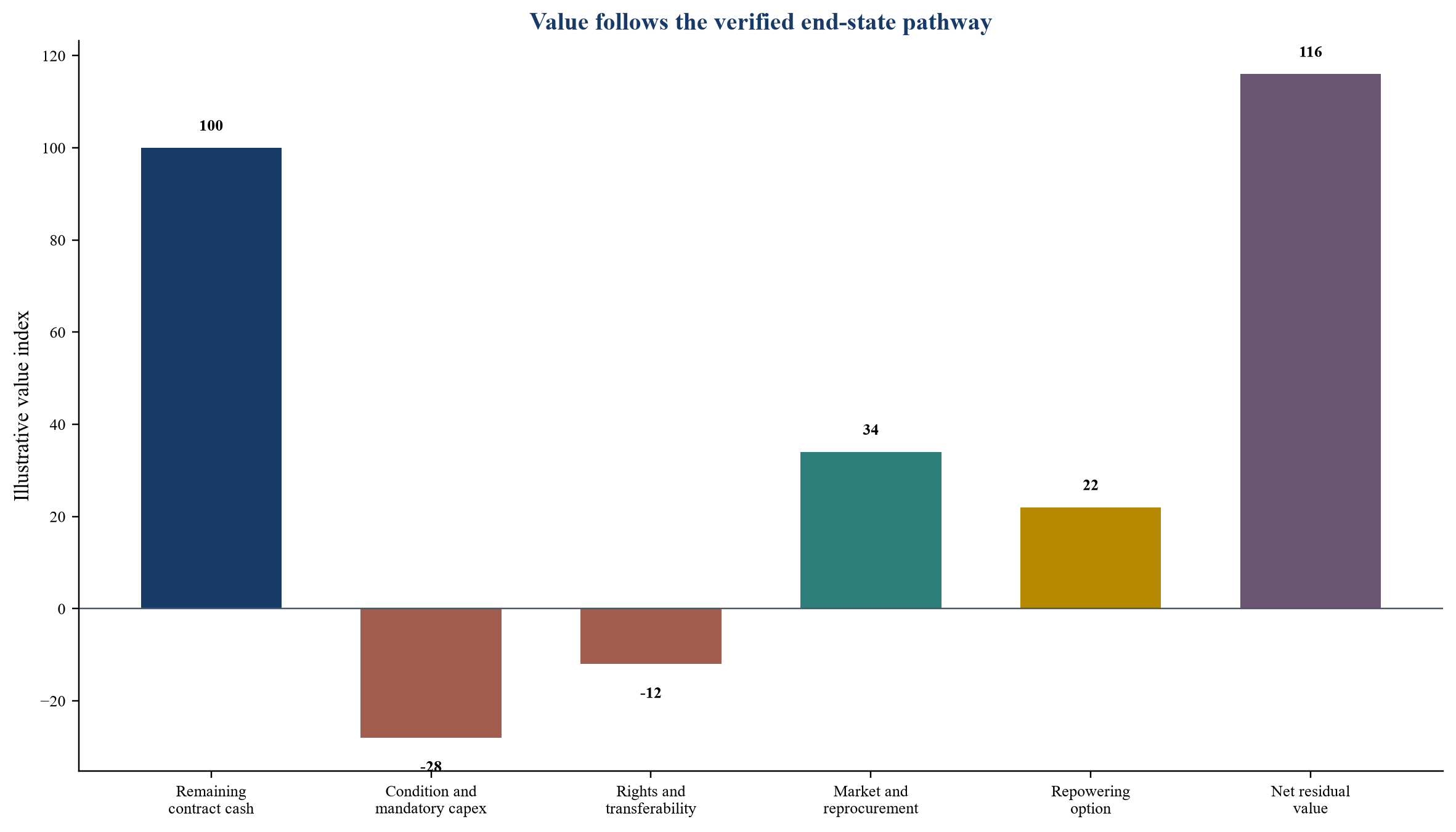
The bridge is conceptual; amounts require asset-specific evidence.
41. Build the transfer case
The transfer case should specify condition, price, liabilities, security release, records, people, permits and operational control. Completion tests should support uninterrupted service.
The assessment should distinguish verified condition from management assumptions and future scenarios. The purchaser, owner, lenders and advisers should use one reconciled asset register, expiry timetable and evidence log.
The parties should translate the issue into dated actions, acceptance criteria and quantified valuation adjustments. Mandatory handback work, optional value creation and contingent liabilities should remain visible as separate lines.
42. Build the reprocurement case
A new competitive contract can preserve the site while resetting price and risk allocation. The timetable must allow tendering, approvals, financing and transition before expiry.
The decision should be completed while the parties still have time to inspect, fund, procure and implement the required work. Any assumption affecting value should have an owner, validation method and expiry date.
The objective is a reliable transition that preserves service and allocates value and responsibility transparently. A plant retains residual value only where technical capability and the legal route to monetise that capability can both be demonstrated.
43. Build the retirement case
Retirement may be rational where efficiency, emissions, demand or remediation overwhelms value. The case needs a funded closure plan and replacement capacity strategy.
The working file should identify the governing contract clause, asset evidence, responsible party and decision date. Legal, technical, commercial and financial conclusions should remain traceable to the source on which they rely.
A practical review asks what transfers, in what condition, with which continuing rights, at what cost and under which post-expiry revenue path. The answer should produce a testable end-state recommendation rather than a single unsupported terminal value.
44. Price transition and carbon risk
Fuel and emissions exposure can change sharply after contract expiry. Scenarios should include carbon policy, fuel availability, efficiency standards and customer decarbonisation objectives.
The assessment should distinguish verified condition from management assumptions and future scenarios. The purchaser, owner, lenders and advisers should use one reconciled asset register, expiry timetable and evidence log.
The parties should translate the issue into dated actions, acceptance criteria and quantified valuation adjustments. Mandatory handback work, optional value creation and contingent liabilities should remain visible as separate lines.
45. Price fuel and input risk
Gas, electricity, chemicals and feedwater terms can determine post-expiry margin. The model should distinguish contracted pass-through from risks borne by the future operator.
The decision should be completed while the parties still have time to inspect, fund, procure and implement the required work. Any assumption affecting value should have an owner, validation method and expiry date.
The objective is a reliable transition that preserves service and allocates value and responsibility transparently. A plant retains residual value only where technical capability and the legal route to monetise that capability can both be demonstrated.
46. Test power and water market demand
Demand, reserve margin, system flexibility, water security and procurement plans determine whether capacity remains useful. Forecasts should be sourced and stress-tested.
The working file should identify the governing contract clause, asset evidence, responsible party and decision date. Legal, technical, commercial and financial conclusions should remain traceable to the source on which they rely.
A practical review asks what transfers, in what condition, with which continuing rights, at what cost and under which post-expiry revenue path. The answer should produce a testable end-state recommendation rather than a single unsupported terminal value.
47. Test technology obsolescence
New generation, storage, desalination and demand-side technologies can lower the value of an older configuration. Obsolescence analysis should compare service capability and total system cost.
The assessment should distinguish verified condition from management assumptions and future scenarios. The purchaser, owner, lenders and advisers should use one reconciled asset register, expiry timetable and evidence log.
The parties should translate the issue into dated actions, acceptance criteria and quantified valuation adjustments. Mandatory handback work, optional value creation and contingent liabilities should remain visible as separate lines.
48. Test cyber and control-system obsolescence
Unsupported control hardware or software can create reliability and security risk. Upgrade cost, outage, vendor access and data migration belong in the capital plan.
The decision should be completed while the parties still have time to inspect, fund, procure and implement the required work. Any assumption affecting value should have an owner, validation method and expiry date.
The objective is a reliable transition that preserves service and allocates value and responsibility transparently. A plant retains residual value only where technical capability and the legal route to monetise that capability can both be demonstrated.
49. Build the capital plan
The capital plan should connect each audit finding to timing, cost, outage, contingency, responsible party and value effect. Mandatory and option-dependent expenditure should remain distinct.
The working file should identify the governing contract clause, asset evidence, responsible party and decision date. Legal, technical, commercial and financial conclusions should remain traceable to the source on which they rely.
A practical review asks what transfers, in what condition, with which continuing rights, at what cost and under which post-expiry revenue path. The answer should produce a testable end-state recommendation rather than a single unsupported terminal value.
50. Build sources and uses
The transition financing plan should identify reserves, operating cash, sponsor capital, purchaser funding, new debt, grants and asset-sale proceeds against all required uses.
The assessment should distinguish verified condition from management assumptions and future scenarios. The purchaser, owner, lenders and advisers should use one reconciled asset register, expiry timetable and evidence log.
The parties should translate the issue into dated actions, acceptance criteria and quantified valuation adjustments. Mandatory handback work, optional value creation and contingent liabilities should remain visible as separate lines.
Table 3. Hypothetical residual-value and debt-service sensitivity
| Scenario | Transition capex, USD m | Post-expiry life | Revenue basis | Minimum DSCR | Hypothetical residual value, USD m |
|---|---|---|---|---|---|
| Transfer at contractual standard | 35 | 12 years | Regulated continuation | 1.30x | 210 |
| Targeted life extension | 90 | 15 years | Five-year extension plus market | 1.18x | 245 |
| Efficiency repowering | 260 | 25 years | New contracted capacity | 1.12x | 330 |
| Delayed reprocurement | 70 | 12 years | Two-year gap then contract | 0.88x | 145 |
| Retirement and remediation | 55 | None | Salvage only | Not applicable | Negative 25 |
Values are hypothetical management assumptions used only to demonstrate the framework. They are not observations, forecasts or valuation conclusions.
51. Test debt-service sensitivity
Lenders should test lower availability, higher overhaul cost, delayed extension, weaker tariff, higher interest and reduced terminal value. The model should show minimum DSCR and refinancing dependence.
The decision should be completed while the parties still have time to inspect, fund, procure and implement the required work. Any assumption affecting value should have an owner, validation method and expiry date.
The objective is a reliable transition that preserves service and allocates value and responsibility transparently. A plant retains residual value only where technical capability and the legal route to monetise that capability can both be demonstrated.
52. Address tax and accounting
Transfer taxes, capital allowances, asset retirement obligations, impairment, deferred tax and lease or concession classification can change proceeds and reported value. Specialist review should follow the actual structure.
The working file should identify the governing contract clause, asset evidence, responsible party and decision date. Legal, technical, commercial and financial conclusions should remain traceable to the source on which they rely.
A practical review asks what transfers, in what condition, with which continuing rights, at what cost and under which post-expiry revenue path. The answer should produce a testable end-state recommendation rather than a single unsupported terminal value.
53. Reconcile expiry and termination payments
Natural expiry, default termination and voluntary termination can produce different payments and liabilities. The transaction model should not use one formula for all outcomes.
The assessment should distinguish verified condition from management assumptions and future scenarios. The purchaser, owner, lenders and advisers should use one reconciled asset register, expiry timetable and evidence log.
The parties should translate the issue into dated actions, acceptance criteria and quantified valuation adjustments. Mandatory handback work, optional value creation and contingent liabilities should remain visible as separate lines.
54. Protect procurement and competition
Extension or direct award may require legal authority and value-for-money evidence. Competition analysis should test whether transition choices foreclose credible alternatives.
The decision should be completed while the parties still have time to inspect, fund, procure and implement the required work. Any assumption affecting value should have an owner, validation method and expiry date.
The objective is a reliable transition that preserves service and allocates value and responsibility transparently. A plant retains residual value only where technical capability and the legal route to monetise that capability can both be demonstrated.
55. Appoint the independent assessor
The assessor should have a clear scope, access, standards, sampling method, reporting timetable and dispute role. Independence and conflicts should be documented.
The working file should identify the governing contract clause, asset evidence, responsible party and decision date. Legal, technical, commercial and financial conclusions should remain traceable to the source on which they rely.
A practical review asks what transfers, in what condition, with which continuing rights, at what cost and under which post-expiry revenue path. The answer should produce a testable end-state recommendation rather than a single unsupported terminal value.
56. Create a dispute pathway
Technical disagreements should progress through joint review, independent expert and formal dispute mechanisms while maintenance and service obligations continue.
The assessment should distinguish verified condition from management assumptions and future scenarios. The purchaser, owner, lenders and advisers should use one reconciled asset register, expiry timetable and evidence log.
The parties should translate the issue into dated actions, acceptance criteria and quantified valuation adjustments. Mandatory handback work, optional value creation and contingent liabilities should remain visible as separate lines.
57. Run the contract gate
This gate confirms transfer rights, payment, condition, liabilities, permits and security. Missing provisions require an agreed legal route before value is credited.
The decision should be completed while the parties still have time to inspect, fund, procure and implement the required work. Any assumption affecting value should have an owner, validation method and expiry date.
The objective is a reliable transition that preserves service and allocates value and responsibility transparently. A plant retains residual value only where technical capability and the legal route to monetise that capability can both be demonstrated.
58. Run the technical gate
This gate confirms condition, performance, remaining life, mandatory work, outage and decommissioning. Findings should link directly to cost and acceptance tests.
The working file should identify the governing contract clause, asset evidence, responsible party and decision date. Legal, technical, commercial and financial conclusions should remain traceable to the source on which they rely.
A practical review asks what transfers, in what condition, with which continuing rights, at what cost and under which post-expiry revenue path. The answer should produce a testable end-state recommendation rather than a single unsupported terminal value.
59. Run the commercial gate
This gate tests demand, tariff, operating cost, capital, financing and option value for each end state. The comparison uses consistent assumptions and explicit probabilities.
The assessment should distinguish verified condition from management assumptions and future scenarios. The purchaser, owner, lenders and advisers should use one reconciled asset register, expiry timetable and evidence log.
The parties should translate the issue into dated actions, acceptance criteria and quantified valuation adjustments. Mandatory handback work, optional value creation and contingent liabilities should remain visible as separate lines.
60. Adopt the decision record and 90-day plan
The final record names the preferred end state, conditions, funding, owners, milestones and fallback. The first 90 days should close the highest-value evidence gaps and preserve alternatives.
The decision should be completed while the parties still have time to inspect, fund, procure and implement the required work. Any assumption affecting value should have an owner, validation method and expiry date.
The objective is a reliable transition that preserves service and allocates value and responsibility transparently. A plant retains residual value only where technical capability and the legal route to monetise that capability can both be demonstrated.
Table 4. Illustrative 90-day expiry-readiness plan
| Period | Workstream | Core actions | Decision output | Accountable owner |
|---|---|---|---|---|
| Days 1-15 | Contract perimeter | Reconcile expiry, transfer, payment, security and dispute provisions | Confirmed legal perimeter | Transaction counsel |
| Days 16-30 | Asset baseline | Freeze register; review records; plan tests and inspections | Condition-audit scope | Independent engineer |
| Days 31-45 | Rights and continuity | Verify land, grid, fuel, water, permits, people, data and spares | Transferability register | Project and purchaser teams |
| Days 46-60 | End-state cases | Model transfer, extension, repowering, reprocurement and retirement | Comparable valuation cases | Financial adviser |
| Days 61-75 | Funding and procurement | Size capex, reserves and financing; test competition route | Executable financing plan | Sponsors, lenders and purchaser |
| Days 76-90 | Decision record | Select preferred path, conditions, owners, milestones and fallback | Approved transition programme | Authorised project board |
Timing is indicative and should be adapted to the remaining contract term and asset complexity.
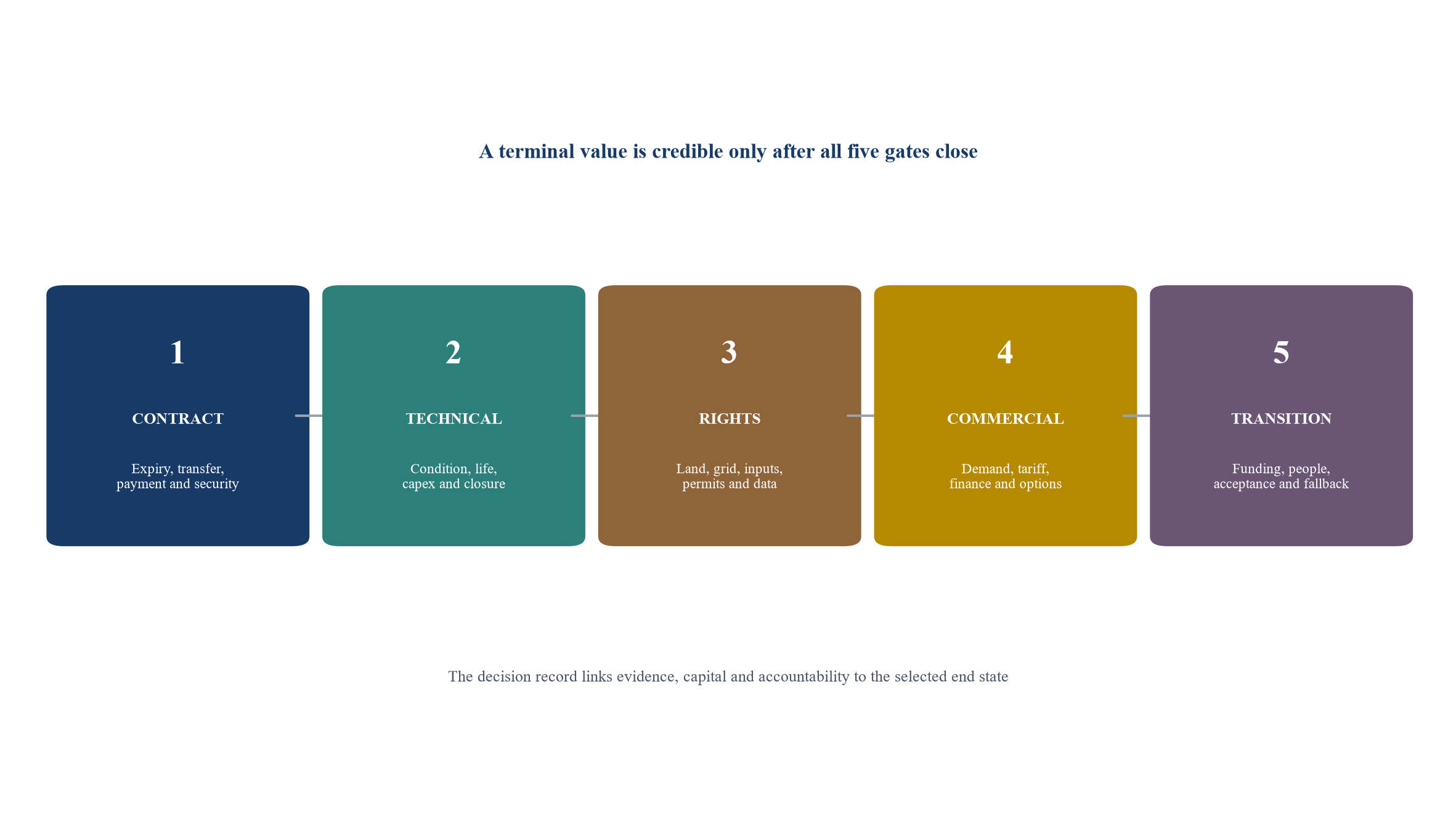
Each gate requires documented evidence before the preferred end state is approved.
The framework places expiry planning on the same footing as financial close and operations. It converts a distant contractual event into a controlled programme for evidence, funding, value and service continuity.
Execution should begin while the current operator retains incentives and while procurement, financing and capital works can still be completed. A verified residual-value case gives the parties a defensible basis for extension, transfer, repowering, reprocurement or retirement.
References
- World Bank Group, "Contract Expiry and Asset Handover," https://ppp.worldbank.org/contract-expiry-and-asset-handover
- World Bank Group, "Managing PPP Contracts," https://ppp.worldbank.org/managing-ppp-contracts
- World Bank Group, "Termination Provisions," https://ppp.worldbank.org/termination-provisions
- World Bank Group, "Guidance on PPP Contractual Provisions, 2019 Edition," https://ppp.worldbank.org/sites/default/files/2021-03/Guidance%20on%20PPP%20Contractual%20Provisions_2019%20edition.pdf
- Global Infrastructure Hub, "Operations to Handback," https://managingppp.gihub.org/report/construction-and-operations-routine-contract-management/managing-transitions/operations-to-handback/
- World Bank Group, "PPP Contract Types and Terminology," https://ppp.worldbank.org/ppp-contract-types-and-terminology
About the Author
Chennakeshav (CK) is a corporate finance and investment banking executive with 25+ years of global experience in deal origination, structuring and execution across M&A, growth capital and corporate strategy. He has led value-creation mandates for founders, corporates and funds — bridging the boardroom view to hands-on execution and close.
His career spans Morgan Stanley, HSBC, Lloyds Banking Group, EWEC, ADQ portfolio companies and Emirates Growth Fund, across TMT, real estate, fintech, deeptech, cleantech, infrastructure and energy. He has partnered with C-suite leaders, private equity and venture funds, sovereign wealth funds and family offices to finance complex fund raises and scale-up ventures, and has led M&A due diligence, post-merger integration and business-transformation initiatives to create value.
At Matchpoint Partners he is Managing Partner, leading the firm's corporate finance, M&A and capital-raising practice. He holds an MBA from London Business School, an engineering degree from VTU and a Master of Laws (LLM, in progress) from UCL London.
An active start-up mentor, CK mentors at Techstars, DIFC FinTech Hive, Startup Grind, Founder Institute and IN5, serves as Entrepreneur Mentor in Residence (EMiR) at London Business School, and judges the Entrepreneurship World Cup.
