

1. Define the capital-allocation decision
The board decision is which capital route should fund a defined development scope while preserving the project's ability to complete, operate and refinance. The comparison should use the same construction budget, schedule, resource base, operating plan, commodity assumptions and financing date. Changing operating assumptions between alternatives can make one route appear cheaper without changing its contractual economics.
The funding perimeter should identify the legal borrower or issuer, the mineral property, the funded assets, existing security, current shareholders, reserve and resource evidence, construction contingency and the cash needed through commercial production. A route that funds only construction while leaving commissioning, working capital or qualification costs unfunded does not solve the complete financing requirement.
Royalty, streaming and equity instruments allocate different claims. Equity participates in the residual value of the corporate or project entity. A royalty generally claims a percentage of defined revenue or value under a contract or property interest. A stream generally gives the financier the right to purchase a specified portion of production at an agreed ongoing price after an upfront deposit [5][6][7].
The approval request should state maximum value transfer, minimum funded liquidity, acceptable control rights, permitted security, tax and accounting conditions, future financing capacity and the circumstances requiring renewed board approval. The selected route should remain viable under downside cases, not merely produce the highest base-case net present value.
2. Use a seven-gate Capital Route Selection System
The system has seven gates: technical evidence; complete funding need; instrument economics; downside resilience; governance and control; legal, tax and accounting treatment; and execution readiness. Each gate has an evidence owner, independent challenge, approval authority and stop condition. A route advances only when the decision can be reconstructed from verified inputs.
The first gate proves mine plan, metallurgy, recoveries, product, schedule, infrastructure and closure obligations. The second reconciles uses and sources through ramp-up. The third models every payment, delivery, dilution and option. The fourth tests correlated operational and market stresses. The fifth maps consent, information and change-of-control rights. The sixth confirms enforceability and financial reporting. The final gate reconciles executed documents with the approved model.
This sequence prevents a familiar error: comparing a permanent royalty or stream with a temporary debt-like funding need solely by looking at the upfront cheque. The initial proceeds may be similar, while long-term value transfer differs materially when prices rise, reserves expand or production is accelerated.
The system should maintain one assumptions register and one controlled valuation model. Term-sheet revisions, resource updates, tax opinions and technical changes should flow into the same decision record. A financing route cannot be approved on an outdated mine plan while another is evaluated on a revised case.
3. Map claims across the project and corporate structure
The transaction map should show the licence holder, operating company, processing assets, sales entities, holding companies, existing lenders, shareholders and the proposed financier. It should identify where cash is generated, where title to minerals transfers, which entity grants the claim and which approvals are required.
The map should distinguish a contractual royalty, an interest registered against mineral tenure where permitted, a corporate payment obligation and a stream purchase agreement. Their insolvency, priority, enforcement and change-of-control consequences can differ by jurisdiction. Legal characterisation should come from qualified counsel and the executed documents.
Existing project debt may restrict new royalties, streams, liens, prepayments, disposals or long-term offtake. A new instrument can reduce borrowing capacity even without conventional principal repayment. Lenders will examine leakage from project cash flow, security ranking, termination payments, step-in rights and whether the instrument survives enforcement.
Corporate equity can finance a project indirectly and absorb diversified business risk. Project-level equity can isolate exposure but requires shareholder and governance arrangements. The map should show who bears cost overruns, who can approve scope changes and where additional capital must be contributed.
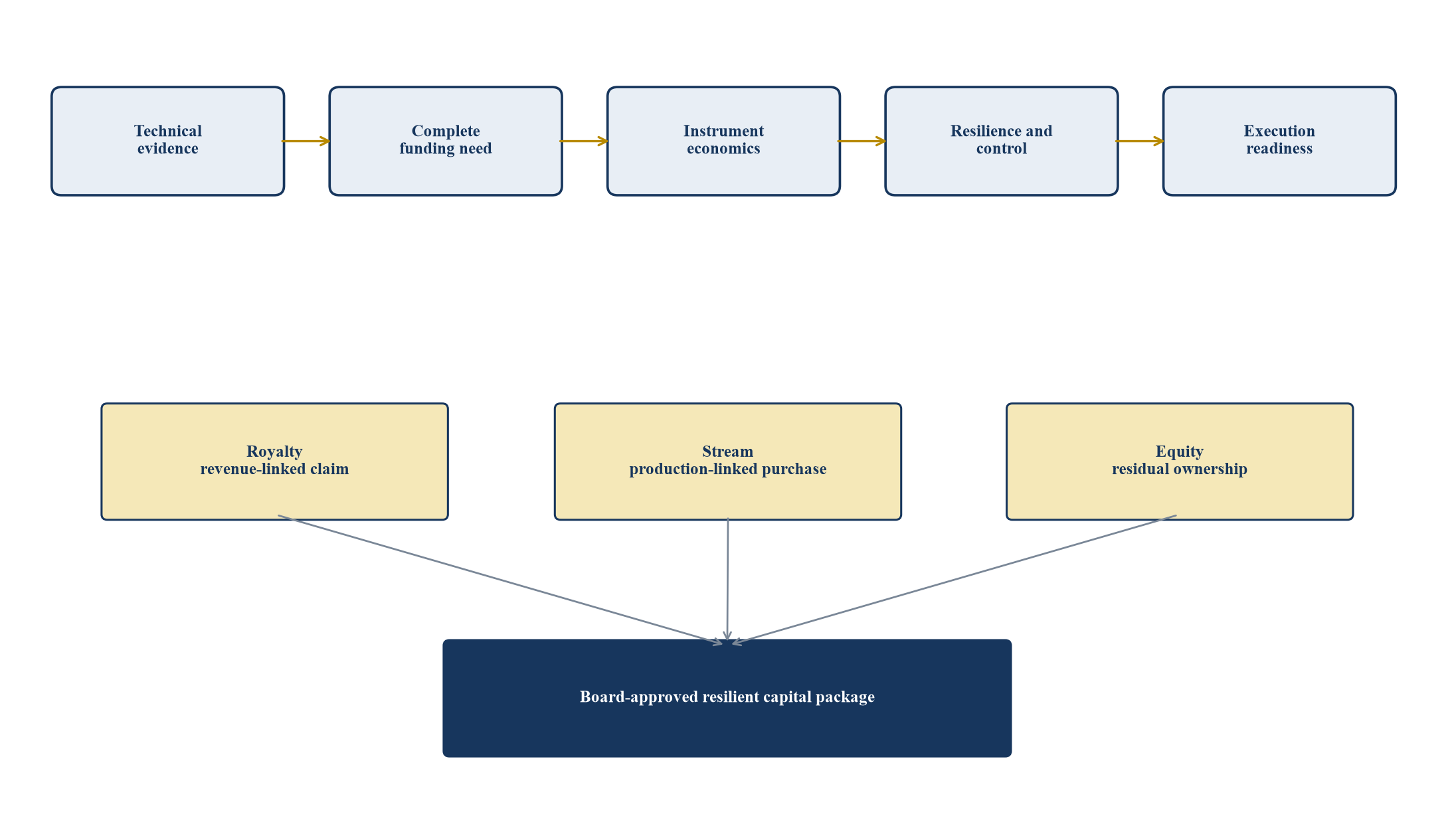
The preferred route emerges from common evidence, scenario economics, resilience and strategic-control tests.
4. Establish the complete funding requirement
The sources-and-uses schedule should include engineering, equipment, mining fleet, processing plant, power, water, transport, owner costs, permitting, environmental and social commitments, taxes, financing fees, contingency, working capital, commissioning and reserve accounts. The schedule should identify committed, probable and uncommitted sources.
Timing matters. Equity can usually be drawn when issued or contributed. Streaming deposits can be paid in tranches against construction milestones. Royalty financing may be funded upfront, in stages or through the acquisition of an existing interest. Each schedule should match the critical path and provide a response if conditions are delayed.
The model should include cost escalation and foreign-exchange exposure. Capital that appears sufficient at signing can leave a gap if procurement currencies strengthen or schedule slippage extends owner costs and interest. The route should provide funded contingency or a credible committed backstop.
Management should separate the immediate cheque from total available liquidity. A larger equity raise can provide headroom, while a narrowly sized stream may minimise initial dilution yet leave the sponsor exposed to cost overruns. The comparison should show completion probability under common funding assumptions.
5. Define royalty economics precisely
A royalty should specify the revenue or value base, rate, deductions, covered products, measurement point, payment timing, audit rights, reporting, minimums, step-downs, buybacks and duration. Labels such as net smelter return, gross revenue, net profits interest or gross overriding royalty do not substitute for the formula in the contract.
Permitted deductions can materially affect receipts. They may include treatment, refining, transport, insurance, penalties, marketing, taxes or other agreed costs. A gross claim with few deductions transfers more downside cost risk to the operator than a net claim with broad deductions. Both parties need an auditable calculation tied to actual sales and product specifications.
The model should apply the royalty to each product and period rather than to a headline revenue line. It should address provisional pricing, payability, quotational periods, related-party sales, hedging, stockpiles, toll treatment, substitutions and non-cash consideration. OECD mineral-pricing guidance illustrates why product characteristics and transaction terms matter when determining mineral value [12].
The agreement should define expansion, satellite deposits, processing of third-party ore and changes to property boundaries. These provisions determine whether future discoveries and infrastructure investments expand the claim. Their economic value should be modelled separately from the currently supported mine plan.
6. Define streaming economics precisely
A metal stream generally combines an upfront deposit with the right to purchase a specified percentage of production at an ongoing delivery payment. Royal Gold describes a stream as a purchase agreement granting rights to buy production at a price determined by the agreement [5]. The operator receives development capital and retains operating control, while the streamer receives commodity exposure.
The agreement should define covered metal, delivery percentage, fixed or indexed ongoing payment, delivery point, payable units, refining, settlement, security, reporting and duration. It should address shortfalls, substitutions, temporary shutdowns, commingling, tolling, inventory, force majeure and the treatment of hedged or pre-sold production.
The stream may cover a by-product rather than the mine's principal commodity. That can fund construction while preserving direct exposure to the core product. It can also transfer substantial value if by-product production, recoveries or prices exceed the original case. The operator should model co-product allocation and changes in the mine plan.
Deposit accounting and repayment provisions require specialist review. IFRS staff materials note that streaming arrangements may involve uncertainty over whether they represent revenue, financing or a combination, requiring analysis under multiple standards [8][9]. The board should approve economics only after accounting, tax and legal treatment are documented.
7. Define equity economics and dilution
Equity contributes capital in exchange for residual ownership. Its economic cost is the value of the ownership issued, including participation in existing assets, future discoveries, expansion, tax attributes and corporate optionality. The cash proceeds alone do not measure dilution.
The comparison should use fully diluted ownership after shares, warrants, options, convertibles and anti-dilution rights. It should show dilution to voting control, project economics and per-share value. A deeply discounted raise can transfer more value than indicated by the percentage of new shares if warrants or preferential rights are included.
Equity has no scheduled repayment and can absorb technical or market stress. That flexibility can protect completion and future debt capacity. It can also introduce board seats, reserved matters, information rights, transfer restrictions, exit rights and future funding obligations that affect strategic control.
The investor perimeter matters. Corporate equity can dilute exposure to all assets. Project equity can concentrate the investor on one mine and require governance over budgets, offtake, hedging, expansion and distributions. The model should reflect the exact ownership and waterfall proposed.
| Dimension | Royalty | Stream | Equity |
|---|---|---|---|
| Upfront funding | Contracted purchase or creation price | Deposit paid against future metal deliveries | Subscription or capital contribution |
| Continuing claim | Percentage of defined revenue or value | Percentage of production at agreed ongoing price | Residual ownership and distributions |
| Scheduled principal | Generally none | Generally none, subject to contract mechanics | None |
| Exposure to price upside | Through royalty base | Through metal margin and delivery volume | Through enterprise value |
| Exposure to operating cost | Depends on deductions | Usually indirect, subject to delivery terms | Full residual exposure |
| Control rights | Contractual protections and reporting | Contractual protections, security and delivery controls | Voting, board and shareholder rights |
Actual treatment depends on contract terms, jurisdiction, accounting and tax advice.
8. Convert every route into common valuation units
The comparison should convert all claims into cash flows to existing shareholders on a common valuation date. It should model proceeds received, issue costs, tax effects, production-linked payments, retained commodity exposure, future dilution, distributions and exit value. Each route should use the same mine plan and scenario set.
The royalty cost is the present value of forecast payments plus option value over future production not included in the base plan. The stream cost is the value of delivered metal less ongoing payments and relevant tax effects. The equity cost is the value of the ownership and rights issued, including the investor's share of future residual value.
Discount rates should reflect the risk and seniority of each cash flow. Applying one corporate discount rate to all claims can obscure differences in timing, priority and optionality. The board should see results at several rates and should not treat one model output as a market price.
Transaction costs and execution probability also matter. A theoretically cheaper route can destroy value if closing conditions, diligence or investor concentration create delay. Expected funding value should reflect probability, timing and the cost of a failed process, while clearly identifying those assumptions as management estimates.
9. Value price participation and commodity convexity
Royalty and stream costs often increase with commodity price. Equity dilution also transfers upside because new shareholders participate in enterprise value. The shapes differ. A fixed-percentage royalty generally rises linearly with its base, while a stream can have strong margin expansion when the spot price rises above the ongoing payment.
The model should separate benchmark price, product differential, payable content, treatment charges, hedging and exchange rates. It should calculate price participation for each mineral and period. A blended long-term price can conceal the cost of a claim during a temporary high-price period that coincides with accelerated production.
Scenario design should include sustained downside, central, upside and volatility cases. The purpose is to show transfer of economics, not to forecast a single price. IEA reporting records continued price volatility and uneven investment across critical-mineral markets, reinforcing the need for route decisions that can survive several market states [1][2].
The board should also see breakeven price levels and the incremental value surrendered for each price increase. A route can be resilient in downside cases and expensive in upside cases. That is an explicit insurance trade rather than a modelling error.
10. Value production, recovery and mine-life participation
Production-linked claims can extend beyond the initial reserve case. Exploration success, improved recovery, debottlenecking, higher throughput and satellite deposits may increase the royalty or streaming burden. Equity investors also participate in that upside, though their claim can be diluted by later financing.
The model should distinguish proven and probable reserves, other resources and conceptual exploration potential under the applicable reporting code. Base financing decisions should rely on supported mine plans. Optionality analysis can show the effect of additional tonnes without presenting them as established production.
Recovery risk affects routes differently. A royalty on gross revenue may remain payable when costs rise, while a stream depends on actual delivered metal. Equity absorbs both revenue and cost changes. The comparison should use mass-balance logic and reconcile mined tonnes, grade, recovery, payable metal and sales.
Extensions and expansions require capital. The claim may expand while the financier has no obligation to contribute additional funding. This asymmetry should be valued. Negotiated step-downs, area-of-interest limits, expansion thresholds or buyback rights can preserve incentives for later investment.
11. Test construction and ramp-up resilience
Construction stress combines cost overrun, delay, lower initial throughput, recovery shortfall and working-capital pressure. Equity can absorb stress if sufficient cash is raised and shareholders remain willing to contribute. Royalty or stream funding can reduce scheduled debt service while leaving the operator responsible for completion.
The financing package should state who funds overruns and under what conditions. A streamer may disburse by milestones and suspend later tranches if conditions are not met. Equity investors may cap commitments or require revised terms. The project needs committed liquidity through practical completion and stable operations.
Ramp-up modelling should use monthly or quarterly production, inventory and cash settlement. Royalty payments can begin as soon as revenue is generated, even when the project has not reached stable margins. Stream deliveries can reduce saleable metal and cash receipts during the same period. Their timing should be integrated with debt reserves and operating cash needs.
The board should compare minimum cash balance, funding gap and recovery actions across routes. Completion protection can justify a higher long-term economic cost when alternative structures leave a material probability of stranded construction expenditure.
12. Protect balance-sheet capacity explicitly
The absence of scheduled principal does not make royalty or streaming capital economically free. It can reduce reported or adjusted operating cash flow, affect leverage metrics and limit cash available for future debt service. Lenders and rating analysts may treat recurring production-linked obligations as structural claims.
The model should show gross and net debt, fixed charges, restricted cash, project distributions and cash leakage under each route. It should test current and future covenants, permitted indebtedness, restricted payments, asset-sale clauses, negative pledges and additional-financing baskets.
Accounting classification can influence reported liabilities, revenue and cash-flow presentation. IFRS materials identify diversity and interaction among standards for complex streaming arrangements [8][9]. The financing decision should use both contractual cash economics and the accounting treatment supported by the auditor or accounting adviser.
Future refinancing capacity should be measured after the new claim. A project that preserves nominal debt headroom but commits a large share of long-life production may have less practical borrowing capacity. The board should see debt capacity under executed economics, not a pre-transaction model.
13. Compare control and governance rights
Royalty and stream providers often seek information, inspection, audit, consent, security, cure, transfer and change-of-control protections. Equity investors may seek board representation, vetoes, pre-emption, anti-dilution, exit rights and approval over budgets or financing. These rights should be mapped to decisions across the mine life.
The rights matrix should cover mine-plan changes, closure, care and maintenance, processing routes, hedging, related-party sales, new debt, liens, asset disposals, expansions, acquisitions and corporate transactions. A right can have economic value even when it does not provide day-to-day operating control.
Consent thresholds and response times matter. A broadly drafted consent can delay urgent operating decisions. A deemed-consent mechanism, materiality threshold and emergency exception can preserve operator agility while protecting the financier's claim.
Change-of-control provisions can affect M&A value. A buyout payment, acceleration, consent right or survival of the claim changes the price a future acquirer is willing to pay. These effects should be considered before signing, rather than discovered during a sale process.
| Decision area | Royalty focus | Streaming focus | Equity focus |
|---|---|---|---|
| Mine-plan change | Protect calculation base and covered property | Protect deliverable metal and schedule | Protect enterprise value and budget |
| New financing | Priority, leakage and security | Intercreditor, delivery and security | Pre-emption, dilution and reserved matters |
| Asset sale | Claim survival or buyout | Assignment, termination or continuing delivery | Shareholder approval and exit rights |
| Expansion | Area, rate and future production | Additional metal and capacity | Funding obligation and ownership |
| Information | Sales, deductions and reserves | Production, inventory and deliveries | Financial, operational and board reporting |
| Default response | Audit, cure and enforcement | Cure, security, replacement and damages | Governance, dilution protection and remedies |
The matrix should be completed from the actual term sheets and legal advice.
14. Control security and intercreditor consequences
A royalty or stream may be unsecured, secured against project assets, supported by parent guarantees or protected through registered interests where law permits. The security package can include shares, accounts, receivables, inventory, insurance, material contracts and licences. Its creation and enforcement require jurisdiction-specific advice.
Senior lenders will examine ranking, standstill, cure, enforcement, proceeds, replacement, termination and step-in. A streamer's right to receive metal can conflict with a lender's right to sell inventory or operate the mine after enforcement. The intercreditor agreement must make the physical and cash-flow consequences executable.
Equity is structurally subordinated, yet preferential shares or shareholder loans can alter the waterfall. Project-level investors may seek security over shares or rights under shareholder agreements. The model should reflect distributions and recovery in distress rather than assuming all equity is identical.
The board should require a single priority diagram and funds-flow schedule. Term sheets that are individually acceptable can become inconsistent when combined. A closing condition should require legal confirmation that the entire capital stack can operate together.
15. Evaluate tax and fiscal consequences
Tax treatment can influence proceeds, deductions, withholding, transfer pricing, indirect taxes, capital gains and the timing of taxable income. Royalty and stream payments may be treated differently across jurisdictions. Equity contributions and distributions have separate consequences. Specialist advice is required for the actual entities and contracts.
The model should identify the transaction currency, payer, recipient, permanent establishment risk, withholding obligation, deductibility, tax basis and treaty position. It should also test changes in law and disputes over the character of payments. Tax benefits should not be counted before eligibility and enforceability are supported.
Related-party sales and mineral pricing can affect the royalty base and government revenue. OECD and IGF guidance emphasises product characteristics, contractual terms and comparable market evidence in determining mineral prices [12]. Private financing arrangements should not weaken compliance with public royalty and tax obligations.
Government consents may be required when claims attach to mineral tenure, production or export proceeds. The execution plan should identify approvals, registration, stamp duties and disclosure. Timing and conditions should be reflected in the critical path.
16. Integrate responsible-sourcing and sustainability obligations
Financing should be consistent with responsible-sourcing systems, environmental and social commitments and community agreements. OECD mineral guidance calls for management systems, risk identification, mitigation, independent assessment and reporting across relevant supply chains [10][11]. The capital contract should allocate evidence and remediation obligations without creating contradictory standards.
Royalty and stream providers may request reporting on permits, tailings, water, emissions, labour, security, community impacts and traceability. Equity investors may impose governance or sustainability policies. These requirements need defined standards, materiality, cure periods and access to evidence.
Environmental and social performance can affect construction, production, licence to operate and financing value. IFC Performance Standards and World Bank mining guidelines provide recognised frameworks for identifying and managing relevant risks [14][15]. Their application depends on project facts and lender requirements.
The contract should avoid automatic termination for immaterial or remediable issues that would worsen project distress. A proportionate escalation process can require notice, action plan, independent review, cure and, for material unresolved matters, suspension or other remedies.
17. Build a hypothetical route comparison
The hypothetical project requires USD 300 million to complete construction, commission the plant and fund working capital. The supported central case assumes ten years of production, annual saleable metal revenue of USD 420 million after ramp-up and operating cash cost before financing claims of USD 250 million. These figures are illustrative management assumptions.
Route A issues common equity for USD 300 million and gives the new investor 28 percent of the fully diluted project company. Route B grants a 2.25 percent gross-revenue royalty for USD 300 million. Route C grants a stream over 20 percent of payable by-product metal with an ongoing payment equal to 25 percent of the reference price.
The central model assumes a 12 percent nominal discount rate for project-equity cash flows and separately values contractual route cash flows at rates reflecting their timing and risk. It includes taxes and transaction costs only as simplified management assumptions. The case is not a valuation of any actual project or security.
The board compares proceeds, minimum liquidity, downside coverage, present value transferred, upside participation, governance rights and future debt capacity. Each route is tested under the same production and price scenarios. The selected route may combine elements when a single instrument fails the resilience or value-transfer tests.
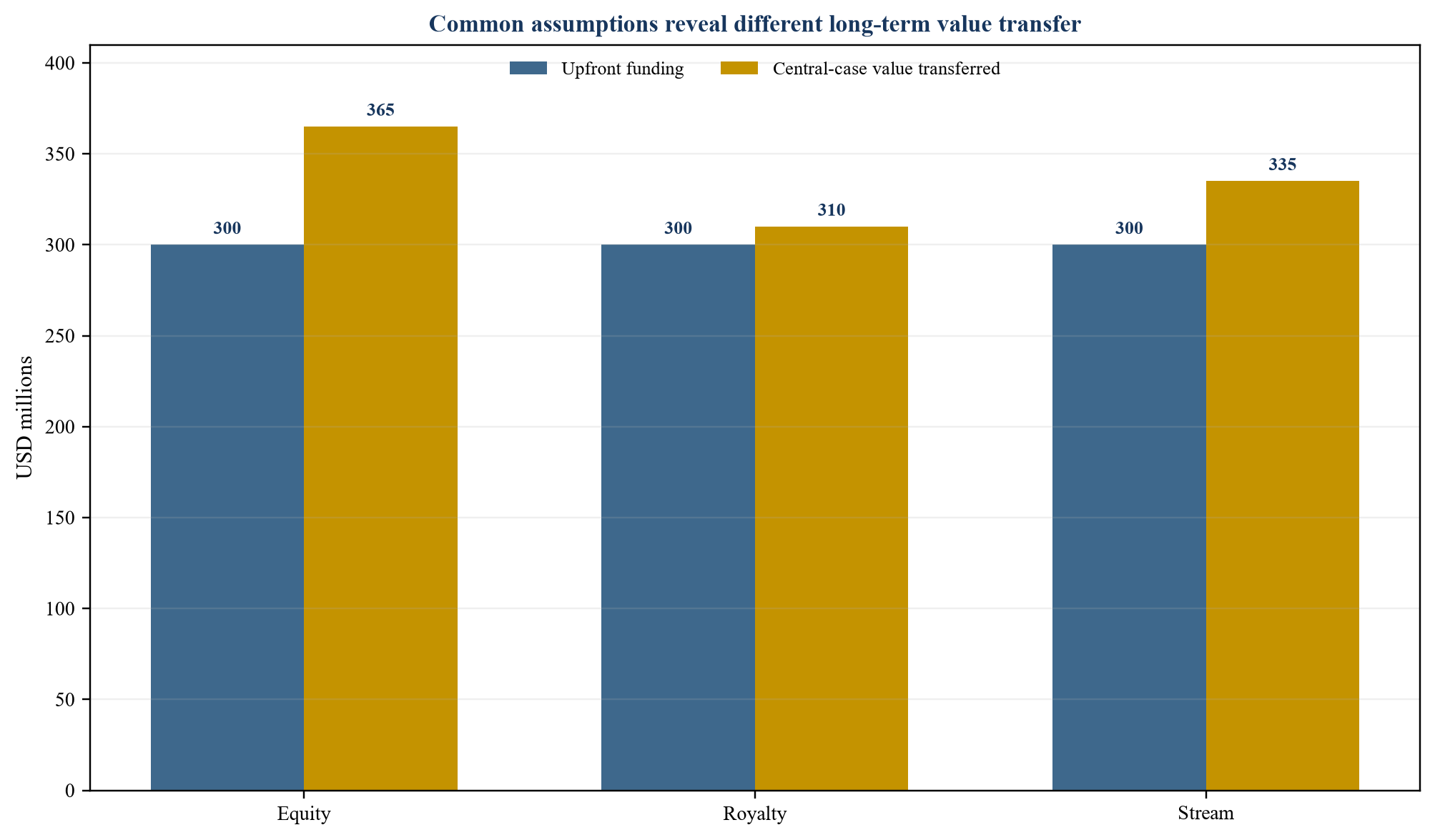
Values are illustrative management assumptions in USD millions and are not market quotations or financing offers.
18. Stress the three routes under common scenarios
The downside case assumes a twelve-month delay, 15 percent lower steady-state production and a 20 percent lower realised price for three years. The upside case assumes 10 percent higher production, a 25 percent higher price and a two-year mine-life extension. A separate overrun case requires USD 75 million of additional capital.
Equity provides the strongest initial liquidity in the example and has no production-linked cash payment. Existing owners surrender a fixed ownership share, including upside. The royalty preserves ownership but continues through downside and upside revenue. The stream reduces cash realised from delivered by-product metal and has pronounced price participation above the ongoing payment.
The model calculates value transferred, minimum cash, additional funding need and retained upside. It also identifies whether contractual relief, buyback, dilution protection or further financing is available. These are management estimates designed to expose decision sensitivity.
Correlated stresses matter. Lower price can coincide with weaker capital markets and operational underperformance. A route that appears manageable under isolated sensitivities can produce a funding gap under a combined case. Approval should focus on the combined case and the practical response.
| Route | Central value transferred | Downside minimum liquidity | Upside value transferred | Overrun response |
|---|---|---|---|---|
| Equity | USD 365m | USD 58m | USD 505m | Rights issue or investor follow-on |
| Royalty | USD 310m | USD 31m | USD 445m | Separate equity or subordinated capital |
| Stream | USD 335m | USD 24m | USD 520m | Additional deposit, equity or scope control |
All values are illustrative management assumptions; value transferred is modelled present value in USD millions.
19. Interpret the hypothetical results carefully
The central result does not identify a universally cheapest instrument. The royalty transfers less modelled central value than the other routes in the hypothetical case, while leaving lower downside liquidity than equity. The stream transfers more upside value because the margin on delivered metal expands with price and volume.
Equity appears expensive in the upside case because the investor owns 28 percent of residual value. That same ownership absorbs downside and supports the balance sheet. The economic cost is therefore linked to risk-sharing, governance and capital-market pricing, not simply dilution percentage.
The royalty's continuing claim remains payable when revenue is generated, even if margins are weak. Its lower central cost can be offset by reduced operating flexibility and future debt capacity. A negotiated step-down after a return threshold could alter that result.
The stream produces the lowest downside liquidity in the illustration because reduced metal receipts coincide with operational stress. A smaller delivered percentage, higher ongoing payment, delayed commencement or capped return could improve resilience while reducing upfront proceeds.
20. Design buybacks, step-downs and caps
Buyback rights can preserve future flexibility by allowing the operator to repurchase all or part of a royalty or stream. The price, timing, notice, funding source, tax treatment and conditions should be specified. A nominal buyback option can have little practical value if it becomes exercisable only after commodity upside is evident and the price is unaffordable.
Step-downs can reduce the claim after the financier receives a specified return, after delivery of a volume threshold or after a date. They align long-life economics with a finite funding need. The model should test whether the threshold is likely to be reached and how disputes over calculations are resolved.
Caps can limit cumulative payments or delivered value. Floors can protect the financier in downside cases. Combining them creates a corridor that resembles risk-sharing. The accounting and tax treatment may differ from a simple instrument and requires specialist review.
The board should compare the value of these protections with any reduction in upfront proceeds. A cheaper-looking headline rate can conceal a broad area-of-interest claim, while a higher rate with a realistic buyback may preserve more long-term value.
21. Use hybrid structures deliberately
A hybrid can combine equity with a smaller royalty or stream, or combine project debt with specialist capital. The purpose should be explicit: cover construction contingency, reduce scheduled debt, bridge to qualification, preserve control or allocate commodity exposure.
The model should avoid double counting. If equity funds the contingency, a separate reserve should not be presented as available unless actually committed. If a stream reduces saleable metal, debt-service cash flow must use net receipts. Intercreditor and governance rights must be integrated.
Staged financing can use equity for early technical risk, then project debt or a stream after permits and engineering are advanced. This can improve pricing while exposing the project to future market access. The board should test the cost of delay and the fallback if the second stage fails.
A hybrid should be simpler than the problem it solves. Multiple instruments can create conflicting consents, reporting obligations and remedies. The closing checklist should confirm a single operating model and priority framework.
22. Preserve future financing and M&A optionality
Future lenders and acquirers will evaluate the remaining commodity exposure, cash leakage, security, consent rights and duration of every claim. A permanent royalty or stream can be acceptable when clearly documented and priced into value. Ambiguous claims and broad change-of-control payments can delay or reduce transaction value.
The model should include a refinancing case and a sale case. It should estimate cash available for debt service after contractual claims and identify consents or buyouts required. The legal review should confirm assignment, survival and enforcement following a share or asset sale.
Equity governance can also affect exit. Drag, tag, pre-emption, lock-up, registration and valuation provisions influence timing and buyer access. Project-level investors may have different exit objectives from the sponsor.
Optionality should be treated as an asset. Retaining unencumbered production, expansion rights and governance flexibility can support later financing or strategic combination. The board should quantify value where possible and describe non-quantifiable constraints clearly.
23. Control information, audit and reserve reporting
Royalty and stream contracts depend on accurate production, sales, deductions, reserves and mine-plan information. The agreement should specify frequency, format, accounting basis, audit access, record retention, confidentiality and dispute resolution. Information rights should be proportionate and operationally feasible.
Technical reporting should use the applicable mineral disclosure framework, such as SEC Subpart 1300, NI 43-101 or a CRIRSCO-aligned code [16][17][18]. The financing model should reconcile to the competent or qualified person's supported mine plan and identify later changes.
Equity investors typically receive financial and operational reporting through shareholder rights and governance. Project-level reporting should include budget, schedule, production, recoveries, costs, incidents, permits and funding. Sensitive information requires controlled access and market-disclosure compliance.
Audit findings need a cure process. Disputed calculations should not automatically halt operations or all payments. The contract should allow payment of undisputed amounts and define expert determination, arbitration or court remedies as appropriate.
24. Prevent leakage through related-party and non-arm's-length transactions
The operator may sell product to affiliates, use related-party transport or processing, hedge through a group entity or allocate shared costs. These arrangements can affect royalty or stream calculations. The agreement should use arm's-length standards, comparable evidence and audit rights.
A deemed-sale mechanism can protect the financier when product is transferred below market value. It should define the reference price, quality adjustments, delivery point and permitted deductions. The model should test the mechanism under actual products and markets.
Equity investors face a broader leakage risk through management fees, intercompany debt, procurement, asset transfers and distributions. Shareholder agreements can require arm's-length dealing, approval thresholds and reporting. These controls should not prevent ordinary operations.
Public tax and royalty obligations remain separate. EITI promotes disclosure of contracts and payments in the extractive sector, subject to implementing-country frameworks [13]. Private claims should be documented so that government and stakeholder obligations can be reconciled.
25. Plan for distress, suspension and closure
The agreement should address temporary suspension, care and maintenance, force majeure, insolvency, abandonment, closure and sale after enforcement. The economic claim may continue while the mine is inactive, or certain obligations may be deferred. The consequences should be modelled.
Royalty holders may rely on property or contractual rights and have limited ability to fund a rescue. Streamers may have security, cure or step-in protections. Equity holders control residual decisions subject to governance and insolvency law. Each route creates different coordination needs in distress.
Closure obligations should remain funded. Financing claims should not divert restricted closure funds or prevent compliance with environmental and community commitments. The capital structure should recognise reclamation security and long-tail liabilities.
The contingency plan should identify liquidity, scope reduction, asset sale, refinancing, standstill and restructuring options. It should specify who can act, what consents are required and how claims are treated. A downside model without an executable response is incomplete.
26. Run a controlled competitive process
A competitive process can reveal price, structure and execution differences across specialist investors and equity providers. The information package should use one technical and financial case, a common data room and a consistent term sheet. Bidders should identify assumptions and conditions explicitly.
Evaluation should use a weighted scorecard covering net proceeds, value transfer, downside liquidity, completion certainty, control rights, security, tax, accounting, future financing, M&A flexibility, reputation and timetable. Weightings should be approved before final bids to reduce outcome-driven scoring.
Confidentiality and market disclosure need control. Reserve, resource, production and valuation information should be supported and released consistently. Management should avoid giving one bidder unsupported upside while presenting a conservative case to another.
Final negotiations should focus on the full contract, not only rate or ownership. Definitions, deductions, covered property, buybacks, reporting, default, assignment and change of control often determine more value than the headline percentage.
27. Execute through an evidence-led roadmap
The roadmap begins with technical model validation and a complete funding plan. It then moves through market sounding, term sheets, legal, tax and accounting analysis, detailed diligence, scenario valuation, board approval, documentation, conditions precedent and funds flow.
Workstreams should have named owners and decision dates. Technical updates, investor questions and financing terms should feed one controlled model. The process should include independent challenge of mineral assumptions, contract interpretation, model calculations and downside responses.
The critical path should identify government approvals, lender consents, security releases, shareholder approvals, stock-exchange requirements and disclosure. Long-stop dates and fallback routes should be agreed before exclusivity is granted.
Closing should reconcile executed economics with the approved case. Any change to proceeds, rate, delivery share, ownership, security, buyback, consent or conditions should be quantified and approved. The closing model becomes the surveillance baseline.
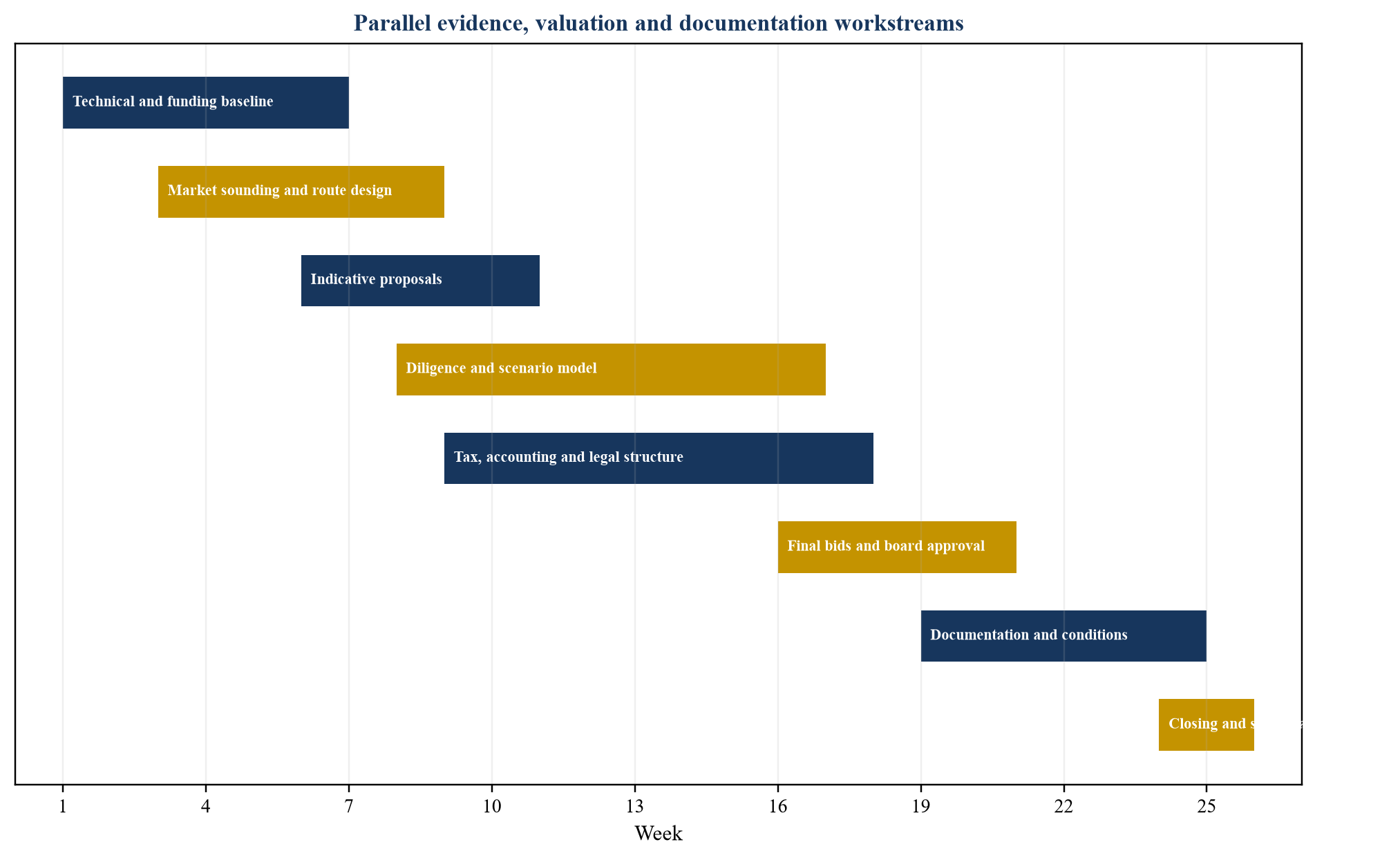
Timing is illustrative and should be adapted to project evidence, approvals, bidders and documentation.
28. Establish post-close surveillance
The operator should report production, sales, prices, deductions, deliveries, reserves, resources, capital, incidents and covenant matters at agreed intervals. The surveillance model should calculate actual royalty or stream economics and compare them with the approved case.
Equity governance should monitor budget, cash runway, milestones, additional funding and value creation. Reserved matters and board materials should focus on decisions and exceptions. Reporting volume should support action rather than create parallel uncontrolled datasets.
Triggers can include cost overrun, schedule delay, recovery shortfall, price decline, reserve revision, liquidity threshold, permit breach, dispute or change of control. Each trigger should have an owner, notification requirement and response plan.
Periodic strategic review should test whether buyback, refinancing, restructuring or expansion is value-accretive. The decision should use current evidence and executed contract rights. A financing instrument should not remain untouched merely because it was appropriate at closing.
29. Use a board approval matrix
The approval matrix should state the minimum evidence required for technical readiness, complete funding, route economics, downside resilience, governance, tax, accounting, legal enforceability and execution. Each row should identify an independent challenge and a stop condition.
The board should approve a bounded negotiating mandate. Limits may include minimum proceeds, maximum royalty rate or stream percentage, maximum dilution, required buyback, acceptable security, restricted consents, minimum liquidity and long-stop date. Deviations should return for approval.
The matrix should record assumptions that are management estimates. Scenario results, execution probabilities and optional resource cases should not be presented as observed facts. Technical and market evidence should be dated and sourced.
Approval should include the fallback plan. If the preferred bidder withdraws or conditions fail, the project needs a funded response such as scope deferral, bridge equity, alternate bidder or revised schedule. The fallback should be practical within the remaining cash runway.
| Workstream | Minimum evidence | Independent challenge | Stop condition |
|---|---|---|---|
| Technical | Supported mine plan, metallurgy, schedule and contingency | Qualified technical reviewer | Production case cannot support the proposed claim |
| Economics | Common model of proceeds, value transfer and scenarios | Model audit and valuation review | Material calculation or assumption remains unresolved |
| Resilience | Liquidity, overrun and combined downside cases | Finance and risk committee | No committed response to the downside funding gap |
| Governance | Rights, consents, reporting and change of control | Board and legal counsel | Strategic control is transferred outside approved limits |
| Tax and accounting | Written treatment for entities and contracts | Tax and accounting advisers | Material treatment remains uncertain or unacceptable |
| Closing | Documents, approvals, security, funds flow and conditions | Verification and board review | Executed terms differ materially from approval |
The register should be tailored to the project, jurisdiction, listed-company obligations and proposed counterparties.
30. Make the final route decision
The final paper should begin with the route and authority requested. It should state the project perimeter, funding need, proceeds, economics, scenario results, governance, security, tax and accounting treatment, conditions, timetable and fallback. It should show where judgement remains.
The recommendation should explain why the route is resilient and how it supports completion. It should quantify value transferred under central and upside cases, minimum liquidity under downside, and the effect on future debt and M&A flexibility. The board should see the cost of protection alongside the cost of capital.
A royalty can be suitable when the project can sustain revenue-linked payments and values ownership preservation. A stream can be suitable when a defined metal can support funding and the operator accepts long-term commodity participation. Equity can be suitable when risk absorption and balance-sheet strength justify dilution and governance sharing.
The strongest solution may combine routes or stage them over time. The combination should preserve clarity, sufficient liquidity and executable priority. Complexity should be accepted only when it creates measurable value or resilience.
The evidence appendix should contain the technical report, model, term sheets, route scorecard, scenario outputs, legal, tax and accounting advice, approvals, disclosure analysis and closing checklist. This enables later review of whether the decision delivered the intended result.
Mining capital should be selected through complete economics and controlled execution. The practical outcome is a funded project that can complete, withstand stress, preserve lawful and responsible operations, and retain enough strategic flexibility for refinancing, expansion or sale.
Sources
- International Energy Agency, Global Critical Minerals Outlook 2026, Market Overview, 2026. Read the primary source
- International Energy Agency, World Energy Investment 2025, 2025. Read the primary source
- International Energy Agency, Scaling Up Transition Finance, 16 October 2025. Read the primary source
- U.S. Geological Survey, Mineral Commodity Summaries 2026, version 1.3, May 2026. Read the primary source
- Royal Gold, Inc., Annual Report for the year ended 31 December 2025. Read the primary source
- Triple Flag Precious Metals Corp., Annual Report for the year ended 31 December 2025. Read the primary source
- Metalla Royalty and Streaming Ltd., Annual Information Form for the year ended 31 December 2025. Read the primary source
- IFRS Foundation, Extractive Activities: Matters outside the scope of IFRS 6, September 2021. Read the primary source
- IFRS Foundation, Extractive Activities Education Session, February 2021. Read the primary source
- OECD, Due Diligence Guidance for Responsible Supply Chains of Minerals from Conflict-Affected and High-Risk Areas, third edition. Read the primary source
- OECD, Enhancing Resilience Through Traceability, 2026. Read the primary source
- OECD and Intergovernmental Forum on Mining, Minerals, Metals and Sustainable Development, Determining the Price of Minerals, 6 November 2023. Read the primary source
- Extractive Industries Transparency Initiative, Contract Transparency. Read the primary source
- International Finance Corporation, Performance Standards on Environmental and Social Sustainability, 2012. Read the primary source
- World Bank Group, Environmental, Health, and Safety Guidelines for Mining, 2007. Read the primary source
- U.S. Securities and Exchange Commission, Regulation S-K Subpart 1300, Disclosure by Registrants Engaged in Mining Operations. Read the primary source
- Ontario Securities Commission, National Instrument 43-101 Standards of Disclosure for Mineral Projects. Read the primary source
- Committee for Mineral Reserves International Reporting Standards, International Reporting Template, November 2019. Read the primary source
