

Introduction
Sustainable aviation fuel has moved from demonstration into regulated demand. The European Union's ReFuelEU Aviation regime applies harmonised uptake and supply rules. The United Kingdom's mandate began at 2% of jet-fuel demand in 2025 and is scheduled to rise to 10% in 2030 and 22% in 2040.[1][2] ICAO maintains the sustainability, life-cycle emissions and certification framework used for CORSIA-eligible fuels.[3] These measures create a market direction, while individual projects still need contracts that convert that direction into financeable cash flow.
The supply base remains small relative to aviation demand. IATA estimated 2025 output at 1.9 million tonnes, equal to approximately 0.6% of total jet-fuel consumption, and projected slower growth in 2026.[4] It also reported a material price premium over conventional fuel. High policy demand and a high premium can coexist with cancelled projects, delayed final investment decisions and weak debt capacity because lenders finance the contractual allocation of risk.
The financing decision is therefore specific. A project must show that acceptable feedstock will arrive in the required quantity and quality, that the plant will convert it at a credible yield, that product will meet aviation-fuel specifications, and that creditworthy buyers will pay a price sufficient to cover operating cost and debt service. Environmental attributes, certificates and policy support must belong to the correct party and remain available through the contract term.
This paper provides a practical framework for that decision. It treats feedstock, conversion, certification, offtake, price support and debt as one connected system. It separates observed market evidence from hypothetical modelling. Its central proposition is that each contract must support the next obligation in the cash-flow chain.
1. Define the financing decision
The first decision is whether a proposed project can support limited-recourse debt on its contracted cash flows. The question requires a named technology pathway, production site, feedstock plan, product specification, delivery point, buyer group, support mechanism, capital budget and operating date.
The financing case should state the source of repayment. Revenue may come from physical SAF sales, co-products, environmental attributes, mandate certificates, policy payments, tolling fees or a combination. Each source has different volume, price, counterparty and eligibility risk.
Sponsors should translate the commercial story into conditions for financial close. These usually include site control, permits, construction contracts, technology rights, feedstock coverage, offtake coverage, certification plans, equity commitments, contingency and lender technical review.
2. Choose the contract chain
A SAF project links suppliers, transport providers, processors, storage operators, blenders, airports, airlines, traders, certificate registries and public counterparties. Cash flow depends on the chain operating as designed.
Map every material contract by legal counterparty, term, volume, price, credit support, condition, termination right, change-of-control rule and assignment restriction. Identify where title and risk pass. Reconcile physical product movement with invoice and attribute ownership.
A project can hold separate feedstock and offtake contracts, a tolling structure, an integrated supply agreement or a merchant model. The appropriate structure follows operating control and risk appetite. The lender needs enforceable rights across the chain, including direct agreements where interruption by a critical counterparty would impair repayment.
3. Specify the eligible product
The offtake contract must define the product with sufficient precision for delivery and payment. ASTM D7566 covers aviation turbine fuel containing synthesised hydrocarbons and provides the route by which compliant fuel can be redesignated as conventional D1655 turbine fuel.[5] The contract should incorporate the applicable edition, pathway, blend limit, test regime, documentation and consequences of off-specification output.
Regulatory eligibility requires another layer. CORSIA eligibility depends on sustainability criteria, approved certification schemes and life-cycle emissions methodology.[3] National and regional regimes may define eligible pathways, minimum savings, feedstock classifications and certificate rules differently.
The product definition should identify physical fuel, blend component, associated certificates, emissions-reduction claims and other attributes. It should also address future changes in standards without transferring unlimited redesign cost to one party.
4. Map physical and contractual flows
Physical material and contractual value can move through different routes. Feedstock may arrive by road, rail, ship or pipeline. Product may be stored, blended and delivered through an airport fuel system. Certificates or emissions reductions may be allocated separately.
Create one map showing title, custody, specification testing, loss responsibility, environmental attributes, payment and security. A book-and-claim arrangement can allocate emissions benefits away from the physical uplift location. IATA's accounting methodology establishes principles for purchase-based accounting and avoiding double counting.[6]
The map should identify each verification point. Lenders need evidence that a delivered batch can be traced to eligible inputs and that its attributes have not been sold twice. Any registry or chain-of-custody dependency belongs in operational diligence.
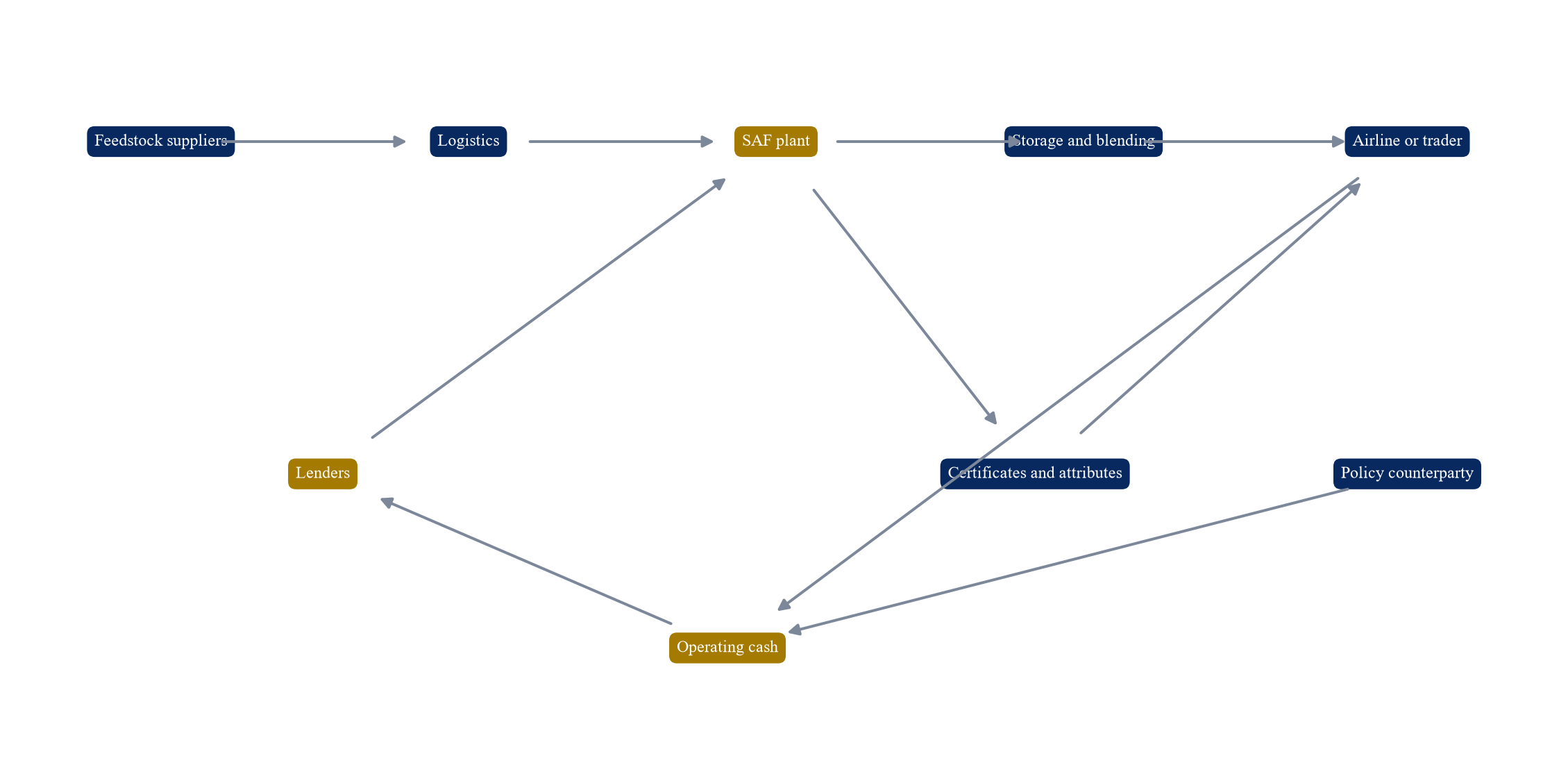
Proposed system map; actual title, custody, attributes and payment rights depend on project contracts and regulation.
5. Build the feedstock register
The feedstock register should list supplier, origin, category, annual quantity, quality specification, sustainability status, transport route, price formula, contract term, competing uses and replacement options. Aggregate tonnage without these fields is weak evidence.
The US SAF implementation framework states that feedstock investment must advance with production investment and identifies logistics, storage, preprocessing and sustainable supply as material constraints.[7] Project diligence should therefore extend beyond the plant boundary.
Separate contracted, optioned, forecast and addressable feedstock. Confirm whether the supplier owns or controls the material. Review seasonality, moisture, contamination, collection losses and storage degradation. A lender should see a monthly supply plan reconciled to production requirements and inventory capacity.
6. Match feedstock to technology
Different conversion pathways require different inputs and pretreatment. Waste oils and fats, alcohol intermediates, municipal waste, biomass, biogas and captured carbon create different yield, cost and sustainability profiles. A project should not treat feedstocks as interchangeable without tested operating evidence.
Define acceptable ranges for water, impurities, energy content and other pathway-specific properties. Link deviations to yield, catalyst life, maintenance and product quality. Include sampling, inspection, rejection and dispute procedures in supply contracts.
Feedstock flexibility can reduce concentration risk, but each alternative may require permits, certification, equipment changes or new operating data. The model should distinguish proven flexibility from future optionality.
7. Verify sustainability and traceability
Eligibility can be lost even when physical material arrives and converts successfully. ICAO requires CORSIA-eligible fuel to meet sustainability criteria and use an approved certification scheme.[3] Regional mandates can impose their own feedstock and emissions rules.
The supplier contract should require chain-of-custody documents, origin records, emissions data, audit access and timely correction of errors. It should allocate the cost of lost eligibility caused by inaccurate or incomplete supplier information.
Traceability systems also need operational controls. Review data capture, unit conversion, batch reconciliation, access rights, retention and independent verification. A certificate is one output of a continuing evidence process.
8. Test feedstock additionality and competition
Feedstock may already serve renewable diesel, chemicals, animal feed, power generation or other markets. A project can meet its own demand by diverting material and still face price or policy risk.
Map current uses, local collection capacity, import dependence and announced competing plants. Review the elasticity of supply at the volume required. A contract at a market index plus a margin transfers index risk rather than removing it.
Policy can alter relative economics. Changes in pathway incentives or mandate credit can shift feedstock between products and countries. The downside case should test simultaneous price increases and lower available volume.
9. Contract feedstock volume
Volume terms should define minimum, maximum and scheduled deliveries, annual and monthly tolerances, ramp-up, maintenance periods and make-up rights. A flat annual commitment can fail a project whose storage and production require regular delivery.
Take-or-pay obligations can support supplier investment but create cash cost during plant outages. Deliver-or-pay provisions can protect the plant but depend on supplier credit and enforceability. Balanced contracts often combine tolerances, notice periods, cover purchases and capped damages.
The lender should compare contracted quantities with the plant's downside feed requirement. Coverage should be measured after expected processing losses and quality rejection, not against nameplate input.
10. Contract feedstock price
Feedstock price can be fixed, indexed, cost-based or linked to product value. Each formula allocates market risk differently. A fixed price can become uneconomic for either party. A commodity index may not represent the delivered eligible material. Product-value linkage can align interests while preserving margin volatility.
Define index source, publication timing, currency, location, quality adjustment, transport, floor, cap and fallback. Specify treatment when the index is discontinued or becomes illiquid.
The financial model should use the exact contractual formula. It should avoid a simplified escalation assumption when the contract exposes the project to basis, currency or logistics risk.
11. Secure transport and storage
Feedstock supply depends on collection, preprocessing, terminal capacity and transport. Product sales depend on storage, blending and airport access. These assets can become binding constraints even when supply and offtake contracts are signed.
Map capacity, reservation, nomination, loss allowance, quality control, demurrage, force majeure and priority rights. Identify shared infrastructure and competing users. A non-firm logistics arrangement can weaken a firm offtake commitment.
Include inventory financing and working capital. Feedstock may be paid before conversion, while product revenue arrives after delivery and certification. The model should incorporate transit time, storage days, title transfer and tax.
12. Validate conversion yield
Production volume follows feedstock quality, process yield, uptime and product mix. Engineering design should provide mass and energy balances under expected and adverse inputs. Demonstration data should be reconciled to the proposed commercial scale.
The yield definition must match the financial model. Clarify whether it measures total liquids, SAF blend component or saleable finished product. Co-products should have separate specifications, volumes and prices.
Lenders usually require independent technical review of technology readiness, scale-up, warranties, performance tests and lifecycle capital. A sponsor forecast cannot substitute for tested evidence.
13. Align construction and operations
The engineering, procurement and construction package should define scope, completion, schedule, price, delay damages, performance guarantees and security. Technology licences, catalysts, proprietary equipment and long-lead items require separate review.
Completion tests should measure sustained throughput, yield, product quality, energy consumption and emissions performance. A single short test can overstate dependable production. Define cure, retest and liquidated-damages arrangements.
Operations and maintenance capability matters before completion. Staffing, spare parts, laboratory capacity, feedstock handling and maintenance systems should be ready for ramp-up. The debt schedule should accommodate commissioning volatility.
14. Define the offtake perimeter
An offtake agreement can cover physical fuel, a blending component, certificates, emissions reductions, logistics and ancillary products. The perimeter should state exactly what the buyer must take and pay for.
Identify delivery point, title transfer, custody, loss, testing, tax, transport and storage. Reconcile the offtake perimeter to the producer's contracts with terminals and blenders. A contractual obligation at a distant delivery point may leave the project with material transport exposure.
Check whether the buyer is an airline, fuel supplier, trader, airport or corporate purchaser of environmental benefits. Each counterparty has different operating capacity, regulatory obligations and credit.
15. Separate binding and non-binding demand
IATA counted 124 SAF offtake agreements between January 2022 and March 2025, with 86 binding commitments and 38 non-binding arrangements.[8] The distinction matters to financing.
Review conditions precedent, board approvals, technical qualification, project milestones, financing conditions, volume options and termination rights. A document titled an offtake agreement may still allow the buyer to walk away before the project incurs debt.
The financing case should show committed volume under enforceable contracts, conditional volume, options and marketing assumptions separately. Only committed economics should support base debt unless the lender explicitly credits another category.
16. Match offtake tenor to debt
The offtake term should cover a meaningful portion of debt maturity and principal repayment. A five-year contract provides limited protection to a fifteen-year loan unless renewal or merchant assumptions are well supported.
Measure average contract life by volume and margin, not contract count. Include scheduled volume decline, buyer termination windows and price reopeners. A long agreement with annual optional quantities can provide little cash-flow certainty.
Debt amortisation can follow contracted revenue. A shorter tail can reduce refinance dependence. The lender should understand the residual merchant exposure and remaining asset life when contracts expire.
17. Design the price formula
The price formula can reference conventional jet fuel, feedstock, production cost, mandate certificates, carbon value or an agreed strike price. A fixed premium over jet fuel leaves feedstock and operating-cost basis risk. A cost-plus formula may weaken efficiency incentives. A floor-and-sharing structure can protect debt service while allowing market participation.
Define every component, data source, currency, timing, floor, cap, review and fallback. Prevent ambiguity over whether transport, blending, certification and taxes sit inside the price.
Model revenue from the executed formula. Where price review is permitted, specify objective triggers and a dispute path that preserves interim payment.
18. Allocate environmental attributes
Environmental value can include mandate certificates, CORSIA claims, emissions reductions, book-and-claim units and voluntary corporate claims. The contract should allocate ownership at each stage.
IATA's methodology emphasises transparent accounting and avoidance of double counting.[6] The project should maintain a registry and reconciliation process that links each claim to eligible production and purchase evidence.
If a buyer receives all attributes, the producer should not model separate sales. If support payments depend on attributes, the contract chain must allow the producer to satisfy that obligation. Attribute leakage can directly reduce cash available for debt service.
19. Test buyer credit
Offtake value depends on payment capacity. Review audited accounts, liquidity, debt, ratings, ownership, government support and sector exposure. An airline's strategic commitment does not create the same credit protection as a guarantee or letter of credit.
Use parent guarantees, bank guarantees, letters of credit, cash collateral, prepayments or replacement rights where appropriate. Define credit-rating triggers and collateral top-up mechanics.
Concentration matters. One buyer can simplify contracting and create replacement risk. A portfolio can diversify credit and add operational complexity. Size debt to credible payment support.
20. Allocate volume shortfall
The contract should distinguish producer shortfall, buyer under-take, force majeure, feedstock failure, logistics interruption and regulatory ineligibility. Each event requires a different remedy.
Producer shortfall can trigger cover cost, damages or make-up delivery. Buyer under-take can trigger take-or-pay payment or inventory consequences. Force majeure should be specific and should not excuse economic hardship alone.
Damages must be enforceable and aligned with expected loss. A project cannot assume full revenue when liability is capped below debt service or when prolonged failure permits termination.
Table 1. SAF contract bankability test
| Area | Primary evidence | Financeable condition | Weak condition | Financing response |
|---|---|---|---|---|
| Feedstock volume | executed supply schedules | downside input covered by dependable suppliers | forecast tonnage or broad options | reduce capacity case or require new contracts |
| Feedstock quality | specifications and test history | input ranges match proven technology | untested flexibility or weak rejection rights | technical reserve and completion condition |
| Sustainability | certificates and chain of custody | auditable eligible material | incomplete origin or emissions evidence | exclude associated revenue and require cure |
| Product quality | ASTM pathway and testing plan | saleable product and clear remedies | qualification or blending route unresolved | condition precedent and contingency |
| Offtake volume | binding contracts | minimum take covers debt case | optional or milestone-dependent demand | lower debt and require credit support |
| Price | executed formula | floor or support covers downside cost | broad reopeners and unhedged basis | cash sweep, reserve or lower leverage |
| Attributes | contract and registry rules | ownership and claims reconcile | double-counting or conflicting allocation | clarify perimeter before close |
| Counterparty credit | accounts and security | payment support survives stress | weak buyer and limited damages | guarantee, collateral or diversification |
Proposed diligence framework; conclusions require project-specific contracts, technical review and legal advice.
21. Link policy support to contracts
Mandates can support demand without creating a fixed project price. ReFuelEU Aviation specifies uptake requirements, while the UK mandate establishes increasing supply targets.[1][2] A producer still needs a buyer, an eligible product and an agreed commercial formula.
The United Kingdom has progressed a revenue-certainty mechanism for eligible projects. The Sustainable Aviation Fuel Act 2026 provides for private-law contracts under which a designated counterparty guarantees a strike price for eligible SAF over a defined period.[9] January 2026 indicative terms addressed reference price, strike price, volume, payment and allocation.[10]
Model policy support using enacted rules and executed awards. Treat a proposed allocation as contingent until the required contract and conditions are satisfied.
22. Reconcile mandate and project revenue
A mandate certificate, buyer premium and revenue-support payment can interact. The project should identify who receives each item and whether one reduces another. Double recovery may be prohibited or reflected in the reference price.
Create a revenue waterfall from gross product sale through transport, certificate transfer, support payment, rebate and tax. Tie each line to a contract or regulation. Explain timing, audit and true-up.
Policy value can arrive after verification, creating working-capital exposure. Include delayed receipts, disputed eligibility and retrospective adjustment in liquidity sizing.
23. Set the revenue floor
A revenue floor can support debt when it covers variable cost, fixed operating cost, maintenance and scheduled debt service at conservative production. Its formula should remain objective and enforceable.
A guaranteed strike price, contract-for-difference structure or buyer floor can serve this purpose. The counterparty's obligation, volume limit, duration, eligibility and termination rights determine credit value.
The model should show cash flow with the floor, without the floor and after expiry. A project whose debt service depends on support beyond the contract term requires refinancing or merchant assumptions that need separate justification.
24. Test reference-price basis
A support mechanism commonly pays the difference between a strike price and a reference price. Basis risk appears when the reference does not match the project's realised sale price, geography, pathway or contract costs.
Review reference construction, publication frequency, liquidity, exclusions, negative prices and dispute rights. A thin market can produce a volatile or administratively determined reference.
Sensitivity should combine low realised price with a higher reference where the contract permits that outcome. The lender should know whether the project can hedge the basis or must hold a reserve.
25. Construct sources and uses
Uses should include development cost, land, engineering, process equipment, balance of plant, utilities, storage, blending, logistics connections, construction, owner's cost, financing fees, interest during construction, working capital, reserves and contingency.
Sources may include sponsor equity, strategic equity, grants, subordinated capital, senior debt, tax-related value and prepayments. Each source should have binding terms, timing and conditions.
The funding schedule must remain balanced monthly. A nominally balanced closing model can still face a construction-period shortfall when grants reimburse later or equity arrives after expenditure.
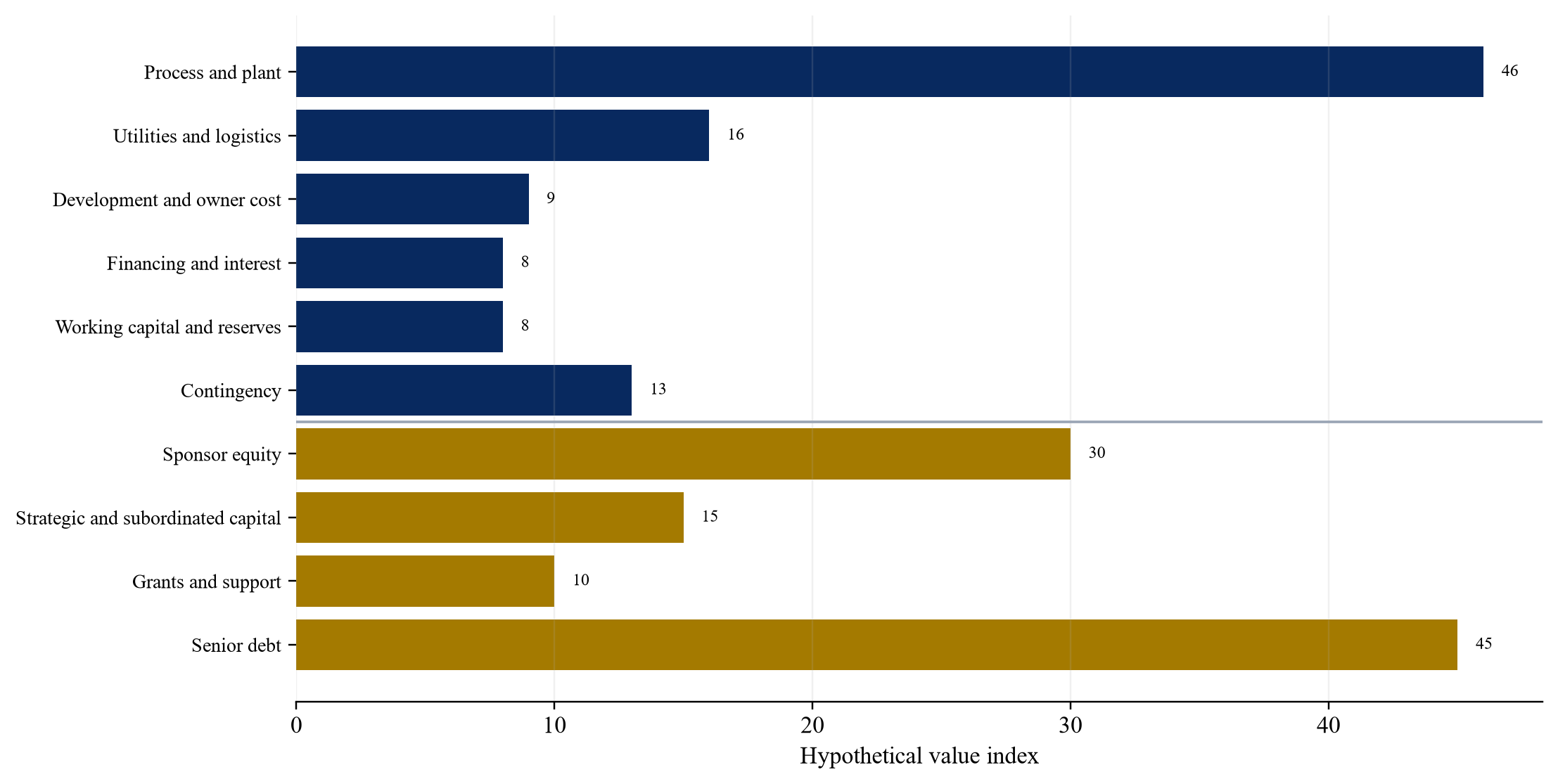
Hypothetical index values for framework demonstration; no identified project, borrower or financing.
26. Size contingency
First-commercial and scale-up projects require contingency that reflects design maturity, contracting strategy, technology, site, supply chain and schedule. A generic percentage can understate correlated risks.
Build a quantified risk register. Assign probability, cost, timing and mitigation to major items. Separate identified scope from true contingency and management reserve. Track drawdown against approved changes.
Contingency should remain funded through completion. Releasing it early to distributions can weaken the project before performance tests and final claims are resolved.
27. Define completion
Financial completion should require physical completion, permits, sustained performance, saleable product, eligibility evidence, operating systems and adequate working capital. Mechanical completion alone does not prove repayment capacity.
Performance tests should measure input rate, output, yield, quality, energy consumption, emissions and availability over a representative period. Specify the treatment of co-products and off-specification batches.
If tests fail, the financing documents should establish cure, retest, sponsor support, contractor damages, debt prepayment and default thresholds. Lenders should avoid an ambiguous transition into term debt.
28. Match debt to ramp-up
SAF plants can require feedstock commissioning, catalyst conditioning, product qualification and customer acceptance. Production may be volatile during ramp-up.
Use a grace period and sculpted amortisation based on conservative ramp-up. Include interest during construction and an operating liquidity reserve. Avoid scheduling principal repayment immediately after first production when cash receipts and certification remain delayed.
A long-stop date protects lenders from indefinite construction exposure. It should align with construction contingency, permit deadlines, offtake conditions and support-contract milestones.
29. Calculate cash available for debt service
Cash available for debt service should begin with collected revenue and deduct feedstock, logistics, utilities, operating cost, maintenance, taxes, working capital and required reserves. Certificate or support revenue enters only when eligibility and payment timing are credible.
Reconcile model cash to contractual invoice cycles. A buyer may pay after delivery, quality acceptance and documentation. A support counterparty may settle later through a true-up.
Exclude accounting revenue without cash. Capitalised costs and non-cash grants should not increase debt-service capacity.
30. Set the debt-service ratio
The debt-service coverage ratio divides cash available for debt service by scheduled principal and interest. Define the period, cash items, reserve movements, hedging and treatment of extraordinary receipts.
Use minimum, average and lock-up thresholds consistent with project risk. Coverage should be tested under the base case, lender case and defined downside cases. A high base ratio provides little comfort if feedstock and offtake assumptions are optimistic.
The ratio should work with distribution restrictions, cash sweeps and reserve requirements. Cure rights must be limited and transparent.
31. Stress feedstock price and availability
The first sensitivity should combine higher feedstock price with lower available volume. These factors can move together when competing demand increases.
Model cover purchases, transport from a wider radius, lower plant load and lost eligibility. Include minimum payments owed under other contracts. If flexible feedstock is proposed, reflect its yield and pretreatment cost.
Identify the point at which cash coverage falls below lock-up and default thresholds. This informs leverage, reserves and contract floors.
32. Stress production and yield
Reduce uptime, throughput and conversion yield while increasing energy and maintenance cost. Apply the scenario through a sustained operating period rather than one isolated month.
Distinguish recoverable ramp-up from structural underperformance. The first may require liquidity. The second may require debt resizing or sponsor support.
Link the stress to performance guarantees and insurance. Contract damages may arrive later and can be capped, so cash timing matters.
33. Stress offtake and price
Test buyer default, volume under-take, delayed payment, lower market price and loss of attribute value. Apply contractual damages and credit support according to their terms.
Replacement sales may carry a lower price, new delivery cost or different certification requirement. Avoid assuming immediate replacement at the original margin.
The downside should also test a price-support delay or basis mismatch. Combined stresses reveal whether separate protections rely on the same market condition.
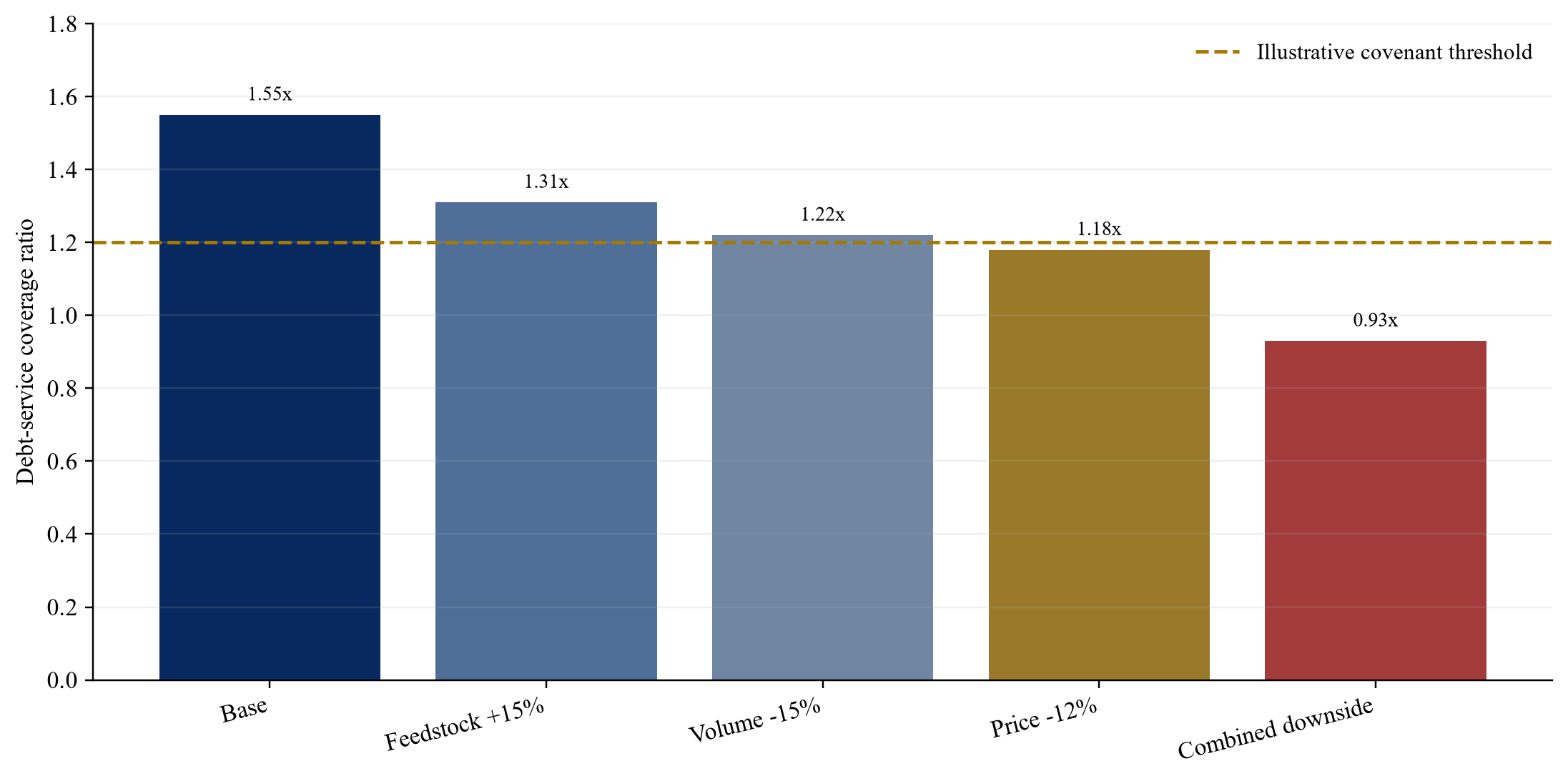
Hypothetical coverage ratios for framework demonstration; no identified project, borrower, tariff or debt facility.
34. Build the reserve package
Common reserves cover debt service, major maintenance, feedstock inventory, working capital and decommissioning. Size each reserve to a defined exposure and replenishment rule.
The debt-service reserve protects timing rather than long-term unviability. A maintenance reserve should follow lifecycle plans for catalysts, rotating equipment and major inspections. Inventory reserve should reflect seasonal supply and storage capacity.
Document permitted investments, release tests and lender control. A reserve that can be distributed before the relevant risk passes provides limited protection.
35. Hedge currency and interest
Capital expenditure, feedstock, product revenue and debt may use different currencies. Identify each exposure by timing and contractual index. A project should not rely on a natural hedge unless amounts and dates genuinely align.
Interest-rate hedging should match the expected debt profile and construction schedule. Over-hedging after delay or debt reduction can create termination cost.
The model should include hedge premium, collateral and close-out. Hedging changes risk distribution and does not repair weak operating margins.
36. Protect against change in law
SAF eligibility, mandates, certificate rules and tax treatment can change. Contracts should define the relevant change, materiality, notice, mitigation and economic adjustment.
Allocate project-specific compliance separately from broad market change. A buyer should not bear the cost of producer non-compliance, while a producer cannot absorb unlimited regulatory redesign without price or termination relief.
Financing documents should address loss of support, suspension, judicial challenge and delayed payment. Debt sizing should remain credible under the agreed allocation.
37. Address force majeure
Force majeure should cover events beyond reasonable control and require mitigation. It should distinguish feedstock shortage, plant failure, transport interruption, buyer facility outage and regulatory restriction.
Review relief duration, payment obligations, termination, insurance and replacement rights. Broad supply-chain wording can transfer ordinary procurement risk away from the responsible party.
If several project contracts define force majeure differently, the project can remain liable under one contract while excused under another. Align the chain where practical.
38. Coordinate insurance
The programme may include construction all-risk, delay in start-up, property damage, machinery breakdown, business interruption, liability, marine cargo and environmental cover. Confirm limits, deductibles, exclusions, waiting periods and named insureds.
Business-interruption values should follow the financial model and contract margins. Delay cover should reflect the critical path and debt interest. Technology and product-performance exclusions require attention.
Lenders usually require loss-payee rights and control over material proceeds. Insurance complements contract allocation and cannot cover every operating or market risk.
39. Secure direct agreements
Direct agreements give lenders notice and cure rights before termination of critical project contracts. They may also support assignment to a substitute owner after enforcement.
Prioritise site, construction, technology, feedstock, offtake, operations, storage, logistics and support contracts. Confirm counterparty consent to security and step-in.
The cure period should reflect the event and preserve operations. A nominal direct agreement with no practical access to technology, site or permits provides limited recovery value.
40. Control distributions
Distributions should occur only after debt service, reserve funding, covenant compliance and completion conditions. Cash sweeps can accelerate repayment when prices or production exceed the lender case.
Define permitted leakage, affiliate payments and management fees. Related-party feedstock or offtake requires arm's-length terms and audit rights.
The project should retain cash for near-term maintenance and working capital before distribution. This is especially important when policy or certificate receipts are delayed.
41. Build the security package
Security can cover shares, bank accounts, receivables, project contracts, equipment, land rights, insurance and intellectual-property licences, subject to local law and consent.
Review title and existing liens. Technology may be licensed and non-transferable. Feedstock or product held in third-party storage may be subject to retention or warehouse rights.
Enforcement value depends on continuity. A specialised plant without contracts, permits or technology access can have low recovery value despite substantial construction cost.
42. Allocate project risks
Each material risk should sit with the party able to control or absorb it. Contract allocation must then be tested against credit, caps, exclusions and enforcement.
The producer controls construction coordination and operations. Suppliers control contracted feedstock delivery and evidence. Buyers control take and payment. Public counterparties control support payments under their contracts. Some market and policy risks remain with the project.
The lender should compare contractual remedies with cash exposure. An indemnity from a weak entity or damages capped at a small amount cannot support the full model assumption.
Table 2. SAF project risk-allocation matrix
| Risk | Primary owner | Contract instrument | Lender control | Model treatment |
|---|---|---|---|---|
| Feedstock availability | supplier and project | minimum delivery, cover and damages | supplier tests and replacement plan | downside volume and price |
| Feedstock eligibility | supplier and project | evidence warranty, audit and indemnity | certification condition | exclude unsupported value |
| Construction | contractor and sponsor | fixed scope, schedule and performance terms | technical review and completion test | contingency and delayed revenue |
| Technology performance | licensor, contractor and project | warranty, licence and damages | step-in and support rights | lower yield and uptime |
| Product quality | project | specification and testing | independent certification | rejection and reprocessing cost |
| Offtake volume | buyer | minimum take and take-or-pay | credit support and replacement right | committed volume only |
| Price and policy | project, buyer and public counterparty | floor, index and support contract | reserve and distribution lock-up | reference and basis stress |
| Logistics | contracted providers and project | capacity, custody and service levels | direct agreement | interruption and working capital |
| Counterparty default | project | guarantee, collateral and diversification | replacement and cash control | recovery haircut |
| Change in law | allocated by contract | adjustment and termination terms | debt prepayment rules | support-loss scenario |
Proposed allocation principles; actual treatment depends on contracts, law, technology and counterparty credit.
43. Prepare the financing model
The model should integrate monthly construction, commissioning and operations before moving to quarterly or annual presentation. It should link feedstock quantity and price to conversion yield, product volume, contract price, certificates, support and cash receipts.
Use separate assumptions for each contract. Record source, date, owner and verification status outside the reader-facing publication. Maintain scenario switches for construction delay, cost overrun, production, feedstock, offtake, support and refinancing.
Reconcile model outputs to sources and uses, debt schedules, reserve balances and financial statements. Avoid hard-coded balancing items.
44. Establish monitoring covenants
Operational reporting should cover feedstock received, quality, eligible volume, production, yield, uptime, sales, price, attributes, receivables, support claims, costs, reserves and debt-service coverage.
Set thresholds for material variance, contract breach, certification lapse, buyer credit deterioration and budget overrun. Require timely notice and a remedial plan.
Independent engineer and auditor roles should be proportionate. Their reports should use definitions consistent with the financing documents.
45. Plan replacement and refinancing
Feedstock suppliers, buyers and support arrangements can change during debt life. Maintain a replacement plan before a material contract expires. Define eligibility and credit standards for substitutes.
Refinancing value should not support initial debt service unless the future market and asset performance justify it. A project should be able to amortise under its lender case.
Optional expansion can create value after the first train performs. Finance it separately until feedstock, offtake, permits and capital are secured.
46. Apply the investment-committee test
The committee should receive the complete contract map, feedstock register, technical report, certification plan, construction package, offtake summary, policy-support evidence, sources and uses, operating model, debt sensitivities, reserve package and legal risk allocation.
Ask whether the same downside event affects several inputs. A feedstock shock can reduce volume, raise price and impair eligibility. A policy change can lower support, alter buyer demand and redirect supply.
Approve leverage only when contracted downside cash supports debt after lifecycle capital and required reserves. Conditions should be specific, measurable and assigned.
Table 3. Illustrative SAF financing scorecard
| Category | Core question | Evidence threshold | Downside response |
|---|---|---|---|
| Feedstock | Is eligible input available at a financeable delivered cost? | supplier contracts, origin evidence and logistics plan | reduce load, raise cost and require alternatives |
| Technology | Can the plant deliver saleable SAF at modelled yield? | independent review and performance guarantees | lower output and add contingency |
| Offtake | Are volume, tenor and price enforceable? | binding contracts and credit support | exclude options and apply replacement discount |
| Policy | Does support attach to the project and product? | enacted rules, award and executable contract | model delayed or absent support |
| Construction | Are cost and schedule adequately protected? | complete scope, security and funded contingency | add equity and delay debt conversion |
| Debt capacity | Does downside cash cover debt service? | integrated lender model and reserves | lower leverage and sculpt amortisation |
| Risk allocation | Are remedies creditworthy and enforceable? | legal review, caps and direct agreements | reserve, holdback or closing condition |
| Execution | Can parties deliver contracts, permits and operations? | named owners, milestones and reporting | staged close and stop rules |
Proposed investment-committee framework; ratings require verified project evidence.
47. Limitations
This framework is general. It does not replace legal, tax, accounting, technical, environmental, regulatory, insurance, commodity, valuation or financing advice. SAF standards, eligible pathways, mandate rules, support mechanisms, prices and technology can change.
Company and industry disclosures use their own definitions and reporting periods. They do not establish comparable project economics. Transaction and financing diligence should verify each material input, contract, attribute and cash flow.
All financial exhibits use hypothetical values for explanation. They are not forecasts, investment returns, credit opinions or evidence concerning an identified project.
48. Conclusion
SAF project finance begins with a linked commercial system. Eligible feedstock must reach a proven process. Saleable product and attributes must reach a creditworthy buyer. The resulting cash must cover operating cost, lifecycle capital, reserves and debt service under a credible downside.
Mandates and revenue support can strengthen that system when their benefits are allocated through enforceable contracts. They cannot compensate for missing feedstock, weak technology performance, optional offtake or unsupported claims.
Sponsors can improve financeability by defining the product, contracting the physical and attribute flows, testing correlated downside and aligning debt with dependable cash. Lenders can improve decisions by tracing every modelled value to evidence and a responsible counterparty.
Appendix A. Investment-committee questions
1. Which feedstocks are contracted, eligible and available in the required monthly profile?
2. Which suppliers control the material, and what competing uses affect price or volume?
3. Does the technology have evidence at the proposed scale and with the proposed inputs?
4. Which specification and certification requirements govern each sale?
5. Which physical product, certificates and emissions claims belong to each party?
6. Which offtake volumes are binding, optional or conditional?
7. Does contract tenor cover the debt-amortisation period?
8. How does the exact price formula behave under feedstock and jet-fuel volatility?
9. Which buyer or public counterparty supports the revenue floor?
10. Are support awards and private-law contracts executed?
11. What basis risk remains between realised price and any reference price?
12. Which logistics and storage assets are firm and transferable?
13. How are construction delay, cost overrun and performance failure funded?
14. Which reserves cover ramp-up, maintenance, working capital and debt service?
15. How do combined feedstock, production and offtake stresses affect coverage?
16. Which counterparties provide guarantees, collateral or direct agreements?
17. Can lenders preserve permits, technology and contracts after enforcement?
18. Which changes in law trigger adjustment, termination or prepayment?
19. What operational data and certificates will be reported?
20. Does contracted downside cash support the proposed debt without assumed refinancing?
References
- European Parliament and Council, Regulation (EU) 2023/2405 on ensuring a level playing field for sustainable air transport, 18 October 2023. https://eur-lex.europa.eu/legal-content/EN/TXT/?uri=CELEX%3A32023R2405
- UK Department for Transport, Sustainable Aviation Fuel Mandate collection, updated 13 July 2026. https://www.gov.uk/government/collections/sustainable-aviation-fuel-saf-mandate
- International Civil Aviation Organization, CORSIA Eligible Fuels, updated June 2026. https://www.icao.int/CORSIA/corsia-eligible-fuels
- International Air Transport Association, SAF Production Growth Rate is Slowing Down, 9 December 2025. https://www.iata.org/en/pressroom/2025-releases/2025-12-09-04/
- ASTM International, ASTM D7566-26, Standard Specification for Aviation Turbine Fuel Containing Synthesized Hydrocarbons, 30 July 2026. https://store.astm.org/d7566-26.html
- International Air Transport Association, SAF Accounting and Reporting Methodology, 31 January 2025. https://www.iata.org/en/pressroom/2025-releases/2025-01-31-01/
- US Department of Energy, Sustainable Aviation Fuel Grand Challenge Roadmap Implementation Framework, November 2024. https://www.energy.gov/sites/default/files/2024-11/SAF-Implementation-Framework-Nov-2024.pdf
- International Air Transport Association, Global Outlook for Air Transport, June 2025. https://www.iata.org/en/iata-repository/publications/economic-reports/global-outlook-for-air-transport-june-2025/
- Sustainable Aviation Fuel Act 2026, Explanatory Notes, Revenue Certainty Mechanism. https://www.legislation.gov.uk/ukpga/2026/9/notes/division/3/index.htm
- UK Department for Transport, SAF revenue certainty mechanism: indicative heads of terms and contract allocation, 12 January 2026. https://www.gov.uk/government/consultations/saf-revenue-certainty-mechanism-indicative-heads-of-terms-and-contract-allocation
- UK Department for Transport, SAF revenue certainty mechanism: contract allocation strategy, 13 July 2026. https://www.gov.uk/government/collections/sustainable-aviation-fuel-saf-mandate
- European Commission, EU allocates EUR 100 million of ETS allowances to help airlines buy sustainable aviation fuels, 17 September 2025. https://climate.ec.europa.eu/news-other-reads/news/eu-allocates-eu100m-worth-ets-allowances-help-airlines-buy-sustainable-aviation-fuels-2025-09-17_en
- Standard Chartered, Financing of a greenfield sustainable aviation fuel production facility in the Netherlands, 13 February 2026. https://www.sc.com/uk/?p=5788
- International Civil Aviation Organization, SAF Offtake Agreements dashboard, accessed 2 October 2026. https://www.icao.int/SAF/saf-offtake-agreements
- International Civil Aviation Organization, Finvest Hub resources, accessed 2 October 2026. https://www.icao.int/finvest/resources
About the Author
Authored by Chennakeshav Adya Independent Researcher
Chennakeshav (CK) is a corporate finance and investment banking executive with 25+ years of global experience in deal origination, structuring and execution across M&A, growth capital and corporate strategy. He has led value-creation mandates for founders, corporates and funds — bridging the boardroom view to hands-on execution and close.
His career spans Morgan Stanley, HSBC, Lloyds Banking Group, EWEC, ADQ portfolio companies and Emirates Growth Fund, across TMT, real estate, fintech, deeptech, cleantech, infrastructure and energy. He has partnered with C-suite leaders, private equity and venture funds, sovereign wealth funds and family offices to finance complex fund raises and scale-up ventures, and has led M&A due diligence, post-merger integration and business-transformation initiatives to create value.
At Matchpoint Partners he is Managing Partner, leading the firm's corporate finance, M&A and capital-raising practice. He holds an MBA from London Business School, an engineering degree from VTU and a Master of Laws (LLM, in progress) from UCL London.
An active start-up mentor, CK mentors at Techstars, DIFC FinTech Hive, Startup Grind, Founder Institute and IN5, serves as Entrepreneur Mentor in Residence (EMiR) at London Business School, and judges the Entrepreneurship World Cup.
Matchpoint profile: https://www.matchpoint-partners.com/team/ck-adya.html LinkedIn: https://www.linkedin.com/in/ckadya/
