

1. Define the transaction and decision perimeter
The first task is to identify the decision that the analysis supports, whether formation, financing, acquisition, capital increase, impairment review or exit. A sovereign compute venture can contain land, power, buildings, equipment, licences, customer contracts, models, data rights and public commitments held by different entities. The unit of account therefore determines which cash flows and rights belong in the decision. The analysis should trace the beneficiary of each right and the party that bears the associated cost or risk. [1][12][21]
The evidence file should begin with entity charts, shareholder and contribution agreements, asset registers, service contracts, licences, financing documents, government commitments and intended decision users. Each item should record its legal owner, effective date, expiry or refresh point, decision authority and relationship to cash flow, localisation or exit. Public announcements and national strategy establish context. Transaction conclusions require executed rights and observed performance.
The principal failure is that a strategic platform name is treated as the economic perimeter even when assets and obligations sit elsewhere. The practical response is to state the valuation date, legal entities, contributed rights, excluded assets, decision perspective and permitted use before selecting a method. Central assumptions should reflect current enforceable arrangements. Downside cases should combine related technology, power, customer, shareholder, policy, liquidity and transfer risks. Material management assumptions should be identified in the model and refreshed when evidence changes.
2. Read public commitments as context
Saudi announcements show a rapid expansion of AI infrastructure and partnerships. The disclosed scale is relevant to supplier capacity, power planning, talent and competitive positioning. It does not prove that a specific venture has received capital, equipment, customers or regulatory approval. The analysis should trace the beneficiary of each right and the party that bears the associated cost or risk. [1][2][3][4][5][6]
The evidence file should begin with official releases, executed definitive agreements, board approvals, capital calls, purchase orders, permits, energisation records, acceptance evidence and customer contracts. Each item should record its legal owner, effective date, expiry or refresh point, decision authority and relationship to cash flow, localisation or exit. Public announcements and national strategy establish context. Transaction conclusions require executed rights and observed performance.
The principal failure is that announced investment, gigawatts or accelerator counts are recorded as funded capacity or contracted demand. The practical response is to maintain an evidence ladder from announcement through agreement, funding, construction, energisation, customer acceptance and collected revenue. Central assumptions should reflect current enforceable arrangements. Downside cases should combine related technology, power, customer, shareholder, policy, liquidity and transfer risks. Material management assumptions should be identified in the model and refreshed when evidence changes.
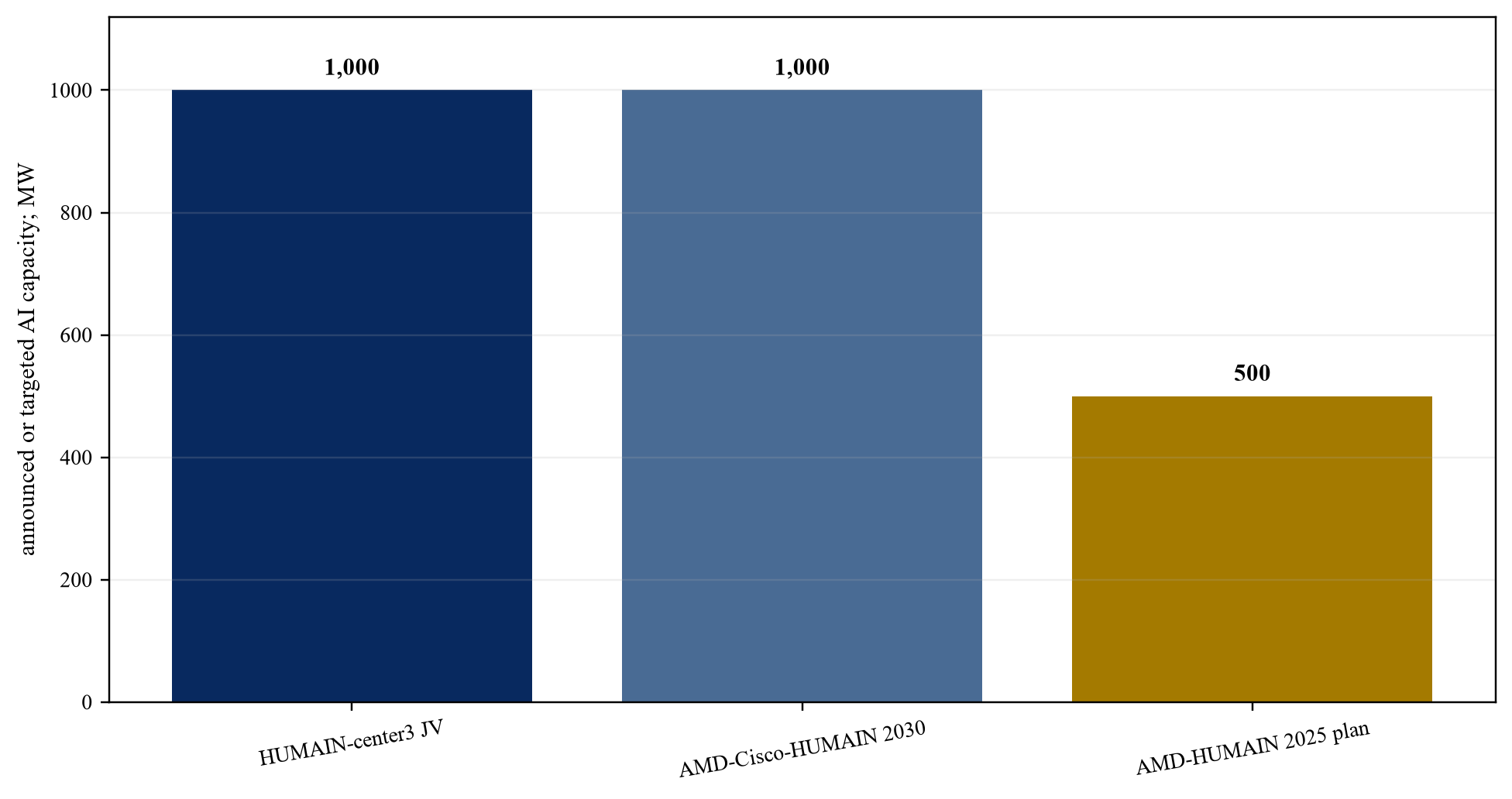
Official and company announcements; capacity is prospective unless stated otherwise.
| Stage | Required evidence | Permitted use |
|---|---|---|
| announcement | official release | strategic context |
| definitive agreement | executed obligations | conditional plan |
| funded commitment | cash or binding capital support | funded sources |
| ordered capacity | supplier order and approvals | delivery schedule |
| energised capacity | tested power and cooling | technical availability |
| accepted service | customer test and contract | billable capacity |
| collected revenue | invoice and bank receipt | repayment evidence |
Proposed classification; transaction documents and observed delivery determine treatment.
3. Map every contribution and dependency
Each shareholder may contribute cash, land, grid access, facilities, equipment allocation, software, customers, operating teams, market access or government relationships. The venture needs a schedule that establishes legal ownership, valuation, delivery date, operating dependency, transferability and remedy for every contribution. The analysis should trace the beneficiary of each right and the party that bears the associated cost or risk. [12][13][21]
The evidence file should begin with contribution schedules, title records, permits, equipment orders, licence terms, staff arrangements, customer novations, valuations and tax advice. Each item should record its legal owner, effective date, expiry or refresh point, decision authority and relationship to cash flow, localisation or exit. Public announcements and national strategy establish context. Transaction conclusions require executed rights and observed performance.
The principal failure is that headline equity percentages obscure unequal delivery risk and continuing dependence on one partner. The practical response is to value contributions independently and link vesting, voting, economics and remedies to verified delivery. Central assumptions should reflect current enforceable arrangements. Downside cases should combine related technology, power, customer, shareholder, policy, liquidity and transfer risks. Material management assumptions should be identified in the model and refreshed when evidence changes.
4. Write the value exchange before the governance chart
The commercial bargain should explain what each party provides and receives. A sovereign shareholder may seek local capability and strategic control, while a technology partner may seek capacity sales, software adoption and long-term supply. A telecom or infrastructure partner may contribute sites, fibre and operating capability. The analysis should trace the beneficiary of each right and the party that bears the associated cost or risk. [2][3][5][7]
The evidence file should begin with term sheets, investment committee papers, business plans, pricing schedules, procurement commitments, localisation obligations and benefit owners. Each item should record its legal owner, effective date, expiry or refresh point, decision authority and relationship to cash flow, localisation or exit. Public announcements and national strategy establish context. Transaction conclusions require executed rights and observed performance.
The principal failure is that ownership percentages are negotiated before the economic exchange and performance obligations are explicit. The practical response is to document the value exchange, price each material contribution and assign an accountable owner and remedy to every promised outcome. Central assumptions should reflect current enforceable arrangements. Downside cases should combine related technology, power, customer, shareholder, policy, liquidity and transfer risks. Material management assumptions should be identified in the model and refreshed when evidence changes.
5. Distinguish joint control from influence
Voting percentages alone do not determine joint control. IFRS 11 focuses on whether relevant decisions require unanimous consent, while IAS 28 addresses significant influence and equity accounting. The shareholder agreement and actual operating rights should support the intended accounting and control result. The analysis should trace the beneficiary of each right and the party that bears the associated cost or risk. [21][22]
The evidence file should begin with articles, shareholder agreement, board composition, reserved matters, committee mandates, delegation instruments and accounting opinions. Each item should record its legal owner, effective date, expiry or refresh point, decision authority and relationship to cash flow, localisation or exit. Public announcements and national strategy establish context. Transaction conclusions require executed rights and observed performance.
The principal failure is that the legal label joint venture is accepted without testing who directs relevant activities or bears obligations. The practical response is to map each relevant activity to its decision rule and reconcile legal governance with accounting treatment. Central assumptions should reflect current enforceable arrangements. Downside cases should combine related technology, power, customer, shareholder, policy, liquidity and transfer risks. Material management assumptions should be identified in the model and refreshed when evidence changes.
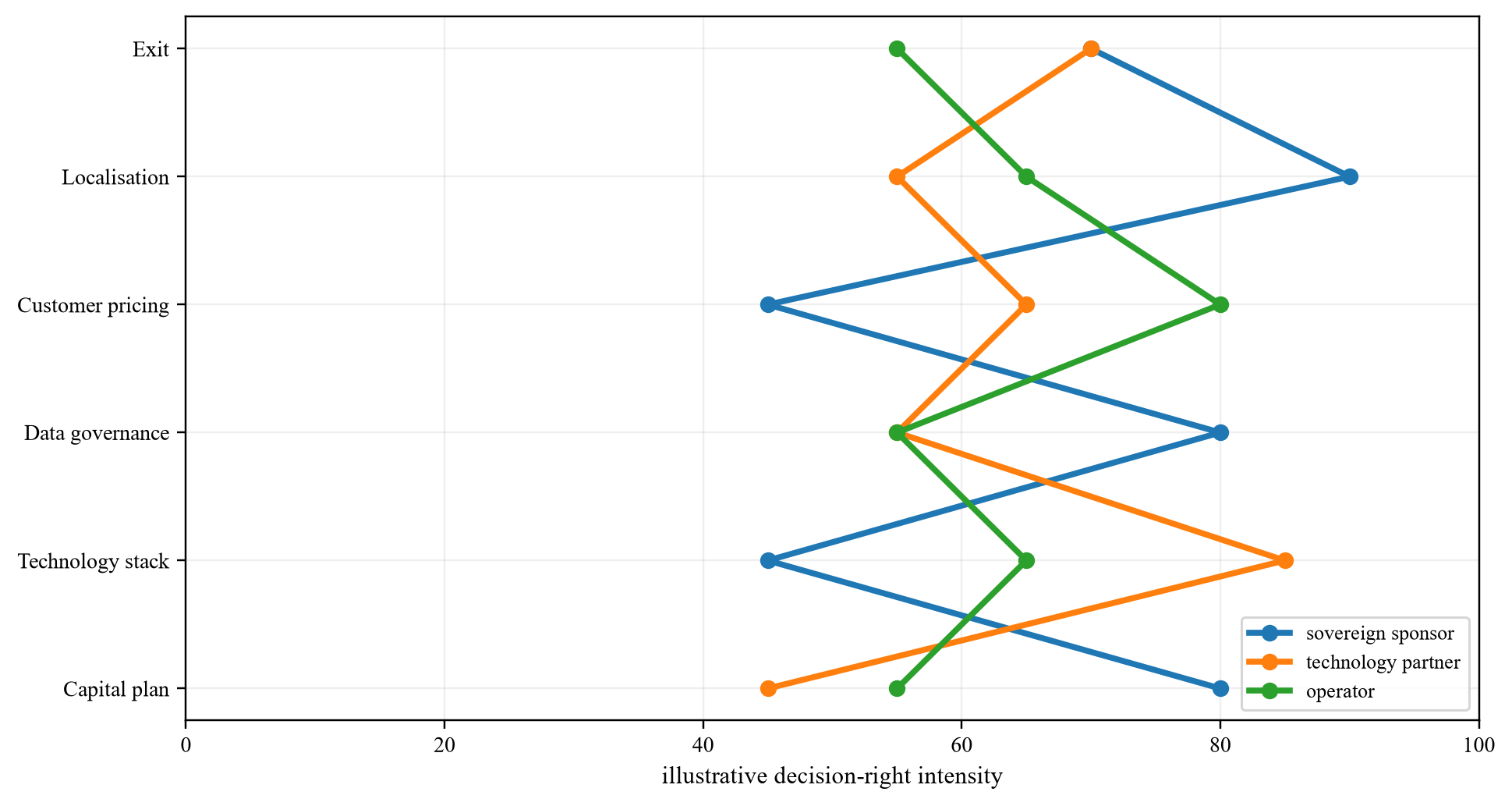
Proposed allocation; final rights depend on definitive agreements.
6. Design reserved matters around value at risk
Reserved matters should protect capital, technology access, data obligations and national outcomes without turning routine operations into repeated shareholder negotiations. Thresholds should distinguish annual plans, major contracts, debt, asset sales, related-party arrangements, technology changes and localisation deviations. The analysis should trace the beneficiary of each right and the party that bears the associated cost or risk. [10][13][16]
The evidence file should begin with reserved-matter schedule, financial thresholds, business plan, risk appetite, lender covenants, regulatory duties and committee mandates. Each item should record its legal owner, effective date, expiry or refresh point, decision authority and relationship to cash flow, localisation or exit. Public announcements and national strategy establish context. Transaction conclusions require executed rights and observed performance.
The principal failure is that an exhaustive veto list slows delivery while leaving important technology and data decisions outside formal approval. The practical response is to use materiality thresholds, emergency authority, time limits and escalation paths tied to specific risks. Central assumptions should reflect current enforceable arrangements. Downside cases should combine related technology, power, customer, shareholder, policy, liquidity and transfer risks. Material management assumptions should be identified in the model and refreshed when evidence changes.
| Decision | Suggested control | Escalation principle |
|---|---|---|
| annual plan and capital | qualified board approval | shareholder approval above threshold |
| technology architecture | technical committee and board | veto only for dependency or compliance risk |
| data and cybersecurity | accountable control owner | immediate escalation for material breach |
| related-party contracts | disinterested approval | independent benchmark required |
| localisation changes | scorecard variance review | cure plan before relief |
| asset sale or exit | shareholder reserved matter | lender and regulator consent |
Proposed framework; thresholds should match the final business and financing documents.
7. Resolve deadlock before capital is committed
Compute ventures face time-sensitive decisions on chips, power, customers and refresh cycles. A deadlock mechanism that relies only on senior negotiation can destroy value while equipment allocations or construction slots expire. The analysis should trace the beneficiary of each right and the party that bears the associated cost or risk. [12][13][21]
The evidence file should begin with meeting rules, escalation timetable, independent-expert remit, interim operating authority, buy-sell rights and lender restrictions. Each item should record its legal owner, effective date, expiry or refresh point, decision authority and relationship to cash flow, localisation or exit. Public announcements and national strategy establish context. Transaction conclusions require executed rights and observed performance.
The principal failure is that deadlock is treated as a remote legal event instead of an operating and liquidity risk. The practical response is to separate technical, valuation and strategic deadlocks and provide a time-bounded remedy for each. Central assumptions should reflect current enforceable arrangements. Downside cases should combine related technology, power, customer, shareholder, policy, liquidity and transfer risks. Material management assumptions should be identified in the model and refreshed when evidence changes.
8. Secure technology continuity
The venture may depend on accelerators, interconnect, orchestration software, cloud services and technical support controlled by a partner or supplier. Access should be defined by product, version, quantity, territory, term, service level, price, compliance condition and transition right. The analysis should trace the beneficiary of each right and the party that bears the associated cost or risk. [3][4][5][6]
The evidence file should begin with supply agreements, licences, road maps, export approvals, support terms, source or escrow rights, interoperability tests and replacement plans. Each item should record its legal owner, effective date, expiry or refresh point, decision authority and relationship to cash flow, localisation or exit. Public announcements and national strategy establish context. Transaction conclusions require executed rights and observed performance.
The principal failure is that a partnership announcement is treated as permanent access to future technology generations. The practical response is to contract current rights, price renewal and substitution, and preserve operating continuity through partner change or distress. Central assumptions should reflect current enforceable arrangements. Downside cases should combine related technology, power, customer, shareholder, policy, liquidity and transfer risks. Material management assumptions should be identified in the model and refreshed when evidence changes.
9. Allocate intellectual property and model rights
Background technology, venture-funded development, customer-specific improvements, Arabic models, training artefacts and operational data may have different owners. The venture needs rights to operate, improve, audit, transfer and continue critical systems without unintentionally transferring a partner’s wider platform. The analysis should trace the beneficiary of each right and the party that bears the associated cost or risk. [1][7][8]
The evidence file should begin with IP schedules, licence grants, development statements of work, invention rules, model cards, data provenance and employee or contractor assignments. Each item should record its legal owner, effective date, expiry or refresh point, decision authority and relationship to cash flow, localisation or exit. Public announcements and national strategy establish context. Transaction conclusions require executed rights and observed performance.
The principal failure is that all joint development is assumed to belong to the venture while contracts allocate ownership elsewhere. The practical response is to define background, foreground and derivative rights and grant survival and transition rights that match operating dependence. Central assumptions should reflect current enforceable arrangements. Downside cases should combine related technology, power, customer, shareholder, policy, liquidity and transfer risks. Material management assumptions should be identified in the model and refreshed when evidence changes.
10. Govern data location, access and transfer
Saudi personal-data rules allow cross-border transfer subject to legal conditions, safeguards and risk assessment. Domestic hosting alone does not resolve who controls data, encryption keys, support access, logs, model outputs or lawful transfer. The analysis should trace the beneficiary of each right and the party that bears the associated cost or risk. [9][10]
The evidence file should begin with data maps, controller and processor roles, transfer assessments, safeguards, key-management design, access logs, customer terms and deletion rules. Each item should record its legal owner, effective date, expiry or refresh point, decision authority and relationship to cash flow, localisation or exit. Public announcements and national strategy establish context. Transaction conclusions require executed rights and observed performance.
The principal failure is that data sovereignty is described by server location while operational and legal access remains unclear. The practical response is to set data classes, authorised purposes, locations, access roles, transfer routes, audit rights and exit migration procedures. Central assumptions should reflect current enforceable arrangements. Downside cases should combine related technology, power, customer, shareholder, policy, liquidity and transfer risks. Material management assumptions should be identified in the model and refreshed when evidence changes.
| Right | Operating requirement | Exit requirement |
|---|---|---|
| hardware supply | quantity, timing and support | transferable warranty and compliant buyer |
| orchestration software | production licence and updates | transition term or replacement path |
| background IP | necessary operating licence | survival after shareholder exit |
| venture-funded IP | documented ownership | buyer use and transfer rights |
| customer data | authorised processing and security | migration and deletion process |
| telemetry and logs | audit and service evidence | continuity and records access |
Proposed diligence; definitive licences and law govern.
11. Build cybersecurity into shareholder duties
Saudi cloud cybersecurity controls apply to cloud service providers and tenants and address governance, defence, resilience and third-party risk. The venture should allocate control ownership across facility, network, platform, customer and shareholder layers. The analysis should trace the beneficiary of each right and the party that bears the associated cost or risk. [11][19][20]
The evidence file should begin with control matrix, NCA applicability analysis, architecture, independent testing, incident plans, supplier assurance, logs and board reporting. Each item should record its legal owner, effective date, expiry or refresh point, decision authority and relationship to cash flow, localisation or exit. Public announcements and national strategy establish context. Transaction conclusions require executed rights and observed performance.
The principal failure is that security obligations are placed on the operator while technology and shareholder dependencies remain outside the control perimeter. The practical response is to assign each control to an accountable entity and make serious control failure a funding, service and governance event. Central assumptions should reflect current enforceable arrangements. Downside cases should combine related technology, power, customer, shareholder, policy, liquidity and transfer risks. Material management assumptions should be identified in the model and refreshed when evidence changes.
12. Convert localisation into a measurable score
Localisation can include technical employment, leadership, supplier spend, equipment assembly, developer access, research, intellectual property, Arabic-language capability and operational authority. A single spending percentage can conceal imported equipment and thin domestic capability. The analysis should trace the beneficiary of each right and the party that bears the associated cost or risk. [7][8]
The evidence file should begin with baseline workforce and supplier data, job architecture, payroll, procurement ledger, manufacturing records, training completion, IP registers and developer usage. Each item should record its legal owner, effective date, expiry or refresh point, decision authority and relationship to cash flow, localisation or exit. Public announcements and national strategy establish context. Transaction conclusions require executed rights and observed performance.
The principal failure is that construction spend is used as proof of durable local capability without measuring additionality or retention. The practical response is to use a weighted score with baselines, annual targets, evidence owners, audit rights and consequences for under-delivery. Central assumptions should reflect current enforceable arrangements. Downside cases should combine related technology, power, customer, shareholder, policy, liquidity and transfer risks. Material management assumptions should be identified in the model and refreshed when evidence changes.
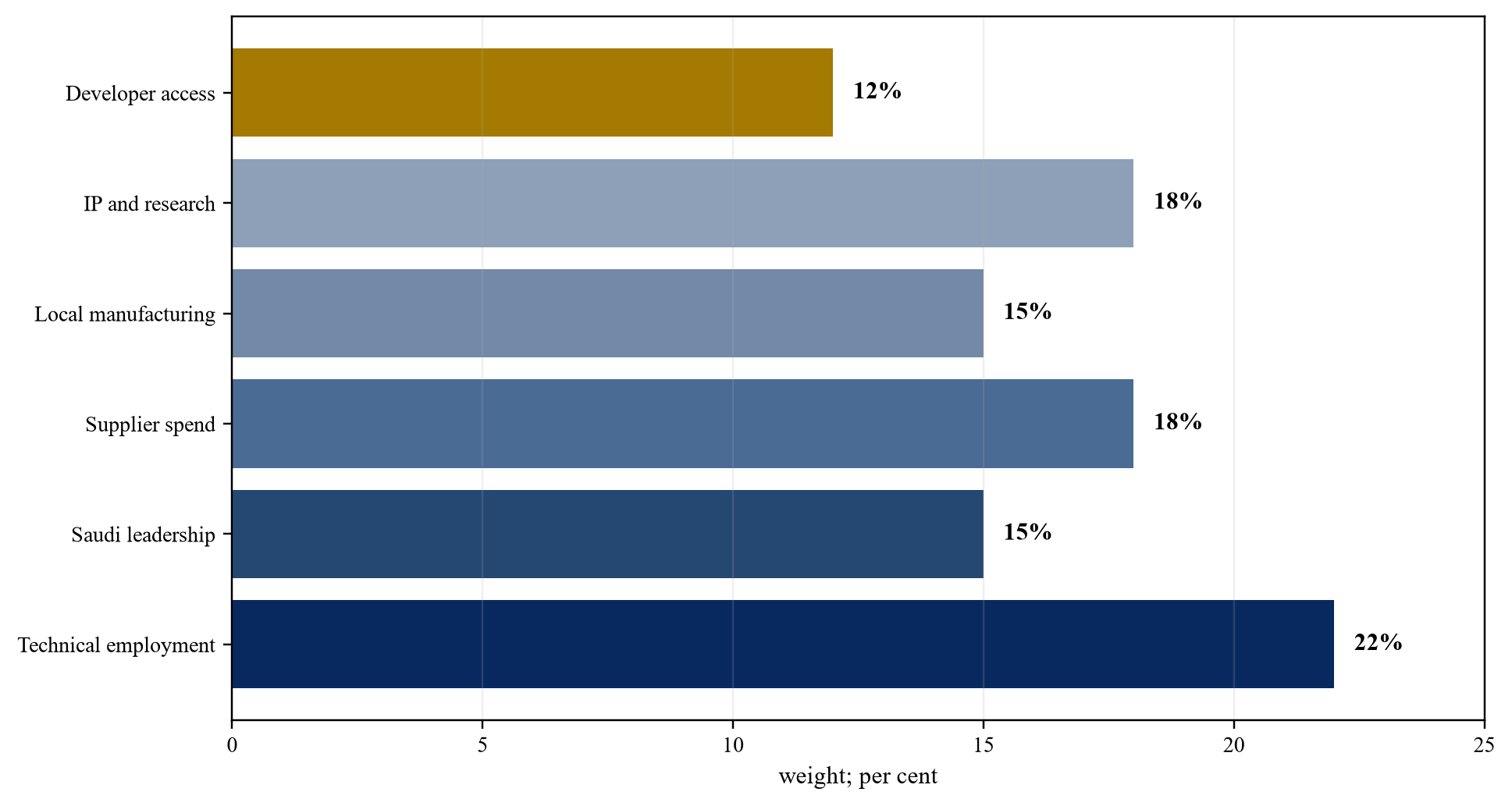
Proposed analytical framework; weights should reflect transaction objectives.
| Measure | Evidence | Example consequence |
|---|---|---|
| Saudi technical employment | payroll and role records | annual score adjustment |
| Saudi leadership authority | delegation and decisions | governance cure |
| qualified supplier spend | procurement ledger | sourcing plan update |
| local equipment manufacture | certified output and yield | milestone recognition |
| IP and research | assignments, patents and projects | earn-out or incentive |
| developer and start-up access | verified users and consumption | programme funding release |
Proposed analytical framework; baselines and weights require transaction approval.
13. Measure workforce and knowledge transfer
Training activity creates value when people gain assessed capability and assume defined operating responsibility. Course enrolment or attendance does not establish competence, retention or decision authority. The analysis should trace the beneficiary of each right and the party that bears the associated cost or risk. [7][8]
The evidence file should begin with role map, competency framework, assessment results, supervised operating records, promotion, retention and succession evidence. Each item should record its legal owner, effective date, expiry or refresh point, decision authority and relationship to cash flow, localisation or exit. Public announcements and national strategy establish context. Transaction conclusions require executed rights and observed performance.
The principal failure is that large participant counts substitute for evidence that Saudi teams can design, operate and improve the platform. The practical response is to link training to certified skills, role progression, independent operation and retention over time. Central assumptions should reflect current enforceable arrangements. Downside cases should combine related technology, power, customer, shareholder, policy, liquidity and transfer risks. Material management assumptions should be identified in the model and refreshed when evidence changes.
14. Develop local suppliers without weakening bankability
PIF identifies local manufacturing opportunities in server racks, cooling and data-centre power equipment. Local procurement can improve resilience and industrial capability when products meet performance, warranty, certification and delivery requirements. The analysis should trace the beneficiary of each right and the party that bears the associated cost or risk. [7][18]
The evidence file should begin with supplier qualification, technical tests, capacity audits, warranties, price benchmarks, delivery records and contingency supply. Each item should record its legal owner, effective date, expiry or refresh point, decision authority and relationship to cash flow, localisation or exit. Public announcements and national strategy establish context. Transaction conclusions require executed rights and observed performance.
The principal failure is that local content targets require unqualified substitution that increases failure, schedule or lifecycle cost. The practical response is to phase qualification, use dual sourcing and measure total delivered cost, reliability and learning rather than invoice location alone. Central assumptions should reflect current enforceable arrangements. Downside cases should combine related technology, power, customer, shareholder, policy, liquidity and transfer risks. Material management assumptions should be identified in the model and refreshed when evidence changes.
15. Connect power and compute commitments
AI capacity depends on deliverable electricity, grid connection, cooling, backup, fibre and equipment arriving in compatible phases. Nameplate power or a policy allocation should not support revenue until the venture can provide customer-usable service. The analysis should trace the beneficiary of each right and the party that bears the associated cost or risk. [2][3][18]
The evidence file should begin with connection agreements, system studies, generation and storage contracts, energisation milestones, load tests, cooling design and customer acceptance. Each item should record its legal owner, effective date, expiry or refresh point, decision authority and relationship to cash flow, localisation or exit. Public announcements and national strategy establish context. Transaction conclusions require executed rights and observed performance.
The principal failure is that MW targets are counted before power quality, redundancy, thermal limits and equipment delivery align. The practical response is to gate each phase by tested concurrent infrastructure and disclose the difference between gross power, IT load and billable compute. Central assumptions should reflect current enforceable arrangements. Downside cases should combine related technology, power, customer, shareholder, policy, liquidity and transfer risks. Material management assumptions should be identified in the model and refreshed when evidence changes.
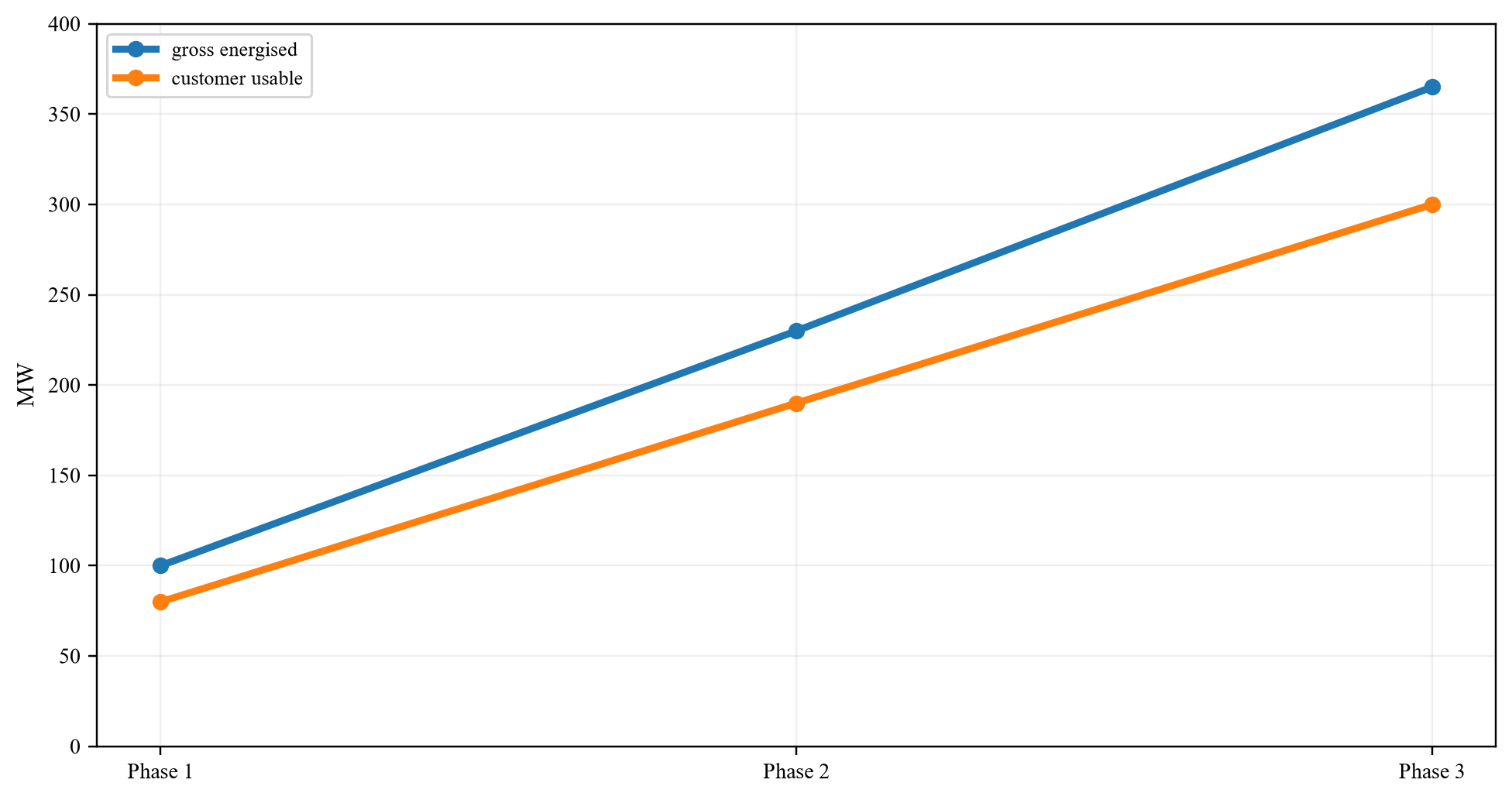
Wholly hypothetical; customer-usable MW.
16. Contract sovereign and commercial demand
Government and sovereign demand can support finance when procurement authority, budget, minimum payment, service acceptance and remedies are enforceable. Commercial and export demand need equivalent discipline around credit, term and workload portability. The analysis should trace the beneficiary of each right and the party that bears the associated cost or risk. [1][4][8]
The evidence file should begin with frameworks, service orders, take-or-pay obligations, capacity reservations, prepayments, credit support, acceptance and collection history. Each item should record its legal owner, effective date, expiry or refresh point, decision authority and relationship to cash flow, localisation or exit. Public announcements and national strategy establish context. Transaction conclusions require executed rights and observed performance.
The principal failure is that national demand projections or strategic relationships are modelled as guaranteed utilisation. The practical response is to classify every demand source by legal commitment, price, term, credit, acceptance, termination and portability. Central assumptions should reflect current enforceable arrangements. Downside cases should combine related technology, power, customer, shareholder, policy, liquidity and transfer risks. Material management assumptions should be identified in the model and refreshed when evidence changes.
17. Control related-party pricing and leakage
Shareholders may sell equipment, cloud services, maintenance, fibre, power, licences and management services to the venture. These arrangements can shift value from the venture even when headline equity interests appear aligned. The analysis should trace the beneficiary of each right and the party that bears the associated cost or risk. [13][16][22]
The evidence file should begin with service agreements, competitive tenders, cost allocation, transfer-pricing studies, benchmarks, invoices and conflict approvals. Each item should record its legal owner, effective date, expiry or refresh point, decision authority and relationship to cash flow, localisation or exit. Public announcements and national strategy establish context. Transaction conclusions require executed rights and observed performance.
The principal failure is that the venture model accepts shareholder charges without testing market terms, performance or duplication. The practical response is to require transparent scopes, arm’s-length evidence, performance credits, audit rights and disinterested approval. Central assumptions should reflect current enforceable arrangements. Downside cases should combine related technology, power, customer, shareholder, policy, liquidity and transfer risks. Material management assumptions should be identified in the model and refreshed when evidence changes.
18. Build a financeable revenue and cost model
Lenders depend on contracted cash within the security perimeter. The model should separate powered-shell revenue, equipment or GPU service revenue, software and support, pass-through power, related-party charges, refresh capital and public programme funding. The analysis should trace the beneficiary of each right and the party that bears the associated cost or risk. [15][21][27]
The evidence file should begin with customer contracts, tariff and service schedules, operating budget, equipment plan, tax model, account waterfall and reserve policy. Each item should record its legal owner, effective date, expiry or refresh point, decision authority and relationship to cash flow, localisation or exit. Public announcements and national strategy establish context. Transaction conclusions require executed rights and observed performance.
The principal failure is that strategic benefits and uncontracted growth support debt sized against narrow cash flows. The practical response is to cap debt at the lower of stressed contracted cash-flow capacity, eligible asset value and executable recovery. Central assumptions should reflect current enforceable arrangements. Downside cases should combine related technology, power, customer, shareholder, policy, liquidity and transfer risks. Material management assumptions should be identified in the model and refreshed when evidence changes.
| Exposure | Primary capital | Repayment or return basis |
|---|---|---|
| contracted powered shell | senior project debt | contracted service cash |
| accelerator cohorts | lease or vendor finance | equipment service cash and residual |
| uncontracted expansion | shareholder equity | future contracted value |
| sovereign redundancy | public or sponsor capital | measured resilience outcome |
| localisation programme | incentive or equity | verified capability milestones |
| platform and models | equity | licence and application cash |
Proposed allocation; negotiated financing documents determine eligibility.
19. Allocate capital across technology cohorts
Accelerators, networking and storage have shorter useful lives than buildings and utility assets. Funding should match equipment cohorts, refresh rights, residual routes and potential export or transfer limits. The analysis should trace the beneficiary of each right and the party that bears the associated cost or risk. [3][4][24][26]
The evidence file should begin with serialised equipment register, purchase and lease terms, benchmark data, warranty, maintenance, refresh plan, authorisations and buyer eligibility. Each item should record its legal owner, effective date, expiry or refresh point, decision authority and relationship to cash flow, localisation or exit. Public announcements and national strategy establish context. Transaction conclusions require executed rights and observed performance.
The principal failure is that long-term project debt assumes that initial compute equipment retains value through the facility tenor. The practical response is to use leases, vendor finance, reserves and amortisation matched to cohort cash and residual evidence. Central assumptions should reflect current enforceable arrangements. Downside cases should combine related technology, power, customer, shareholder, policy, liquidity and transfer risks. Material management assumptions should be identified in the model and refreshed when evidence changes.
20. Use milestone-based capital calls
Shareholder equity should be committed sufficiently early to make construction credible, while later calls can follow defined land, power, equipment, customer, cybersecurity and localisation milestones. Remedies must address delay without creating an uncontrolled change of ownership. The analysis should trace the beneficiary of each right and the party that bears the associated cost or risk. [15][18][21]
The evidence file should begin with approved budget, funding schedule, conditions precedent, completion tests, cure rights, dilution rules, sponsor support and lender consents. Each item should record its legal owner, effective date, expiry or refresh point, decision authority and relationship to cash flow, localisation or exit. Public announcements and national strategy establish context. Transaction conclusions require executed rights and observed performance.
The principal failure is that capital is called on calendar dates even when the venture has lost the evidence needed to deploy it productively. The practical response is to tie calls and debt draws to verified progress, remaining-cost sufficiency and continuing compliance. Central assumptions should reflect current enforceable arrangements. Downside cases should combine related technology, power, customer, shareholder, policy, liquidity and transfer risks. Material management assumptions should be identified in the model and refreshed when evidence changes.
21. Create an information and assurance system
Board and financing decisions require direct access to contracts, asset registers, telemetry, customer acceptance, cash, security controls and localisation evidence. Management presentation decks are insufficient when source systems disagree. The analysis should trace the beneficiary of each right and the party that bears the associated cost or risk. [16][19][20]
The evidence file should begin with data dictionary, source-system access, monthly close, telemetry reconciliation, audit plan, exception register and signed certifications. Each item should record its legal owner, effective date, expiry or refresh point, decision authority and relationship to cash flow, localisation or exit. Public announcements and national strategy establish context. Transaction conclusions require executed rights and observed performance.
The principal failure is that information rights are broad in principle but do not specify source data, frequency, quality or correction responsibility. The practical response is to define an evidence pack for every board cycle and permit independent verification of high-risk milestones. Central assumptions should reflect current enforceable arrangements. Downside cases should combine related technology, power, customer, shareholder, policy, liquidity and transfer risks. Material management assumptions should be identified in the model and refreshed when evidence changes.
22. Separate public value from venture cash flow
Local capability, resilience, Arabic-language services and wider ecosystem outcomes may justify public support. These outcomes should be measured against cost and counterfactuals rather than added automatically to enterprise value. The analysis should trace the beneficiary of each right and the party that bears the associated cost or risk. [8][16]
The evidence file should begin with public objectives, beneficiary baselines, fiscal commitments, service outcomes, independent evaluation and alternative delivery options. Each item should record its legal owner, effective date, expiry or refresh point, decision authority and relationship to cash flow, localisation or exit. Public announcements and national strategy establish context. Transaction conclusions require executed rights and observed performance.
The principal failure is that public-policy value is capitalised as commercial value even when it is not transferable or paid to the venture. The practical response is to record public outcomes separately and convert them into venture cash only through an enforceable contract or funding instrument. Central assumptions should reflect current enforceable arrangements. Downside cases should combine related technology, power, customer, shareholder, policy, liquidity and transfer risks. Material management assumptions should be identified in the model and refreshed when evidence changes.
23. Apply the hypothetical three-phase case
The case tests how a 300 MW venture can finance assets, control partner dependencies and earn value while meeting localisation targets. It is a decision model rather than a forecast of an announced project. The analysis should trace the beneficiary of each right and the party that bears the associated cost or risk. [18][21][23]
The evidence file should begin with the stated hypothetical capacity, cost, funding, contracts, localisation, technology, refresh and exit assumptions. Each item should record its legal owner, effective date, expiry or refresh point, decision authority and relationship to cash flow, localisation or exit. Public announcements and national strategy establish context. Transaction conclusions require executed rights and observed performance.
The principal failure is that one headline valuation combines transferable cash, owner benefits and public outcomes. The practical response is to show the commercial enterprise value, shareholder-specific benefits, localisation results and exit proceeds separately. Central assumptions should reflect current enforceable arrangements. Downside cases should combine related technology, power, customer, shareholder, policy, liquidity and transfer risks. Material management assumptions should be identified in the model and refreshed when evidence changes.
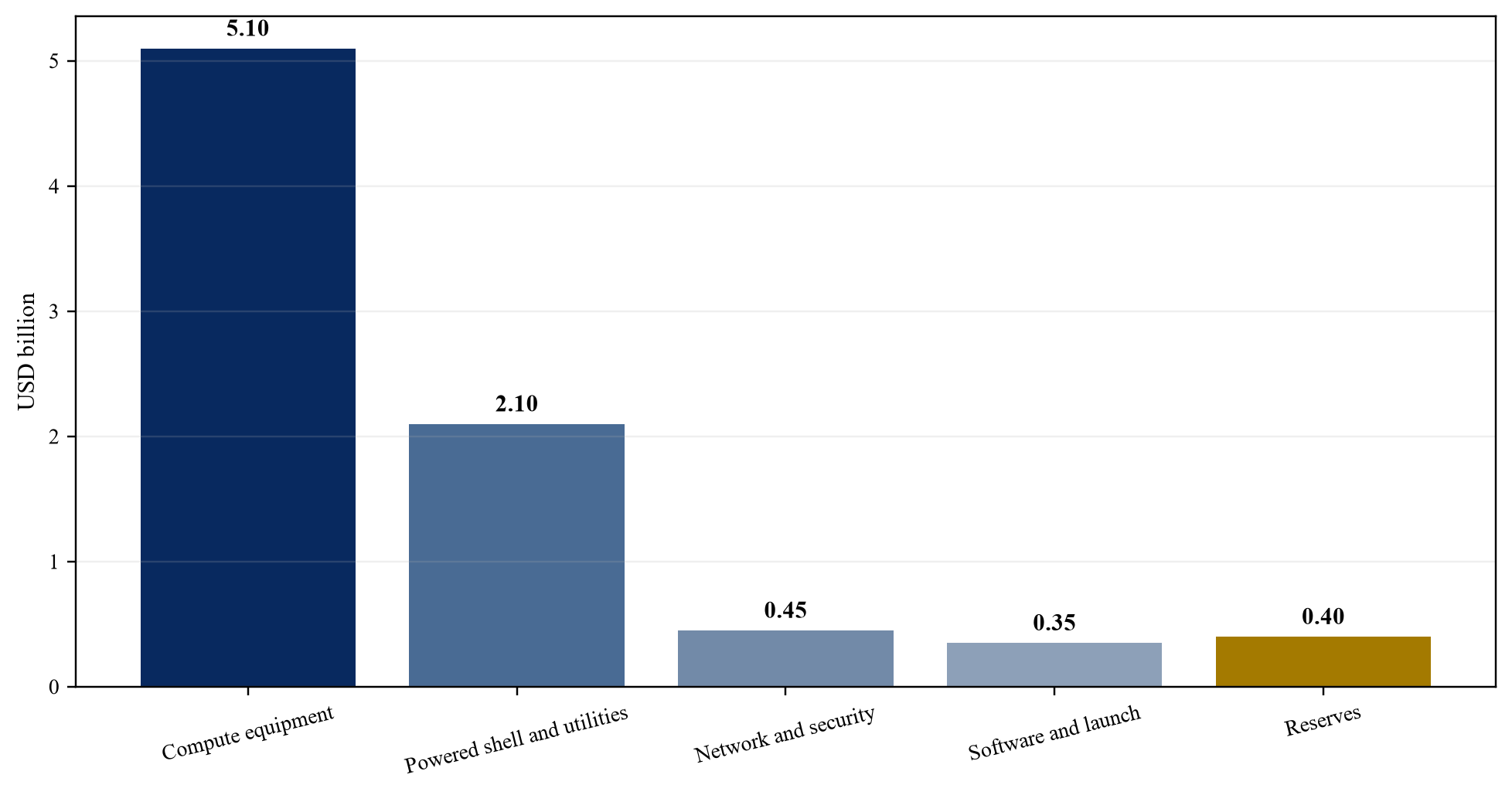
Wholly hypothetical; USD billion.
| Metric | Central assumption | Downside or gate |
|---|---|---|
| customer-usable capacity | 300 MW | 235 MW |
| capacity contracted at close | 210 MW | minimum 175 MW |
| total initial uses | USD 8.4bn | USD 9.3bn cap |
| senior secured project debt | USD 1.9bn | cash-flow cap applies |
| equipment lease and vendor finance | USD 2.1bn | cohort eligibility |
| shareholder equity | USD 3.4bn | plus committed cures |
| customer capacity prepayments | USD 1.0bn | net of refund exposure |
| year-five localisation score | 70% | 55% cure threshold |
| central market-participant EV | USD 9.2bn | USD 6.7bn downside |
Wholly hypothetical; figures do not describe an announced transaction.
24. Stress funding and operating performance
The venture should be tested for equipment delay, higher power cost, slower contracting, weaker utilisation, partner service failure, localisation shortfall and restricted technology access. Combined events matter because schedule, revenue and funding failures often reinforce each other. The analysis should trace the beneficiary of each right and the party that bears the associated cost or risk. [3][4][18][27]
The evidence file should begin with downside scenarios, remaining-cost analysis, contract remedies, liquidity reserves, alternative suppliers and sponsor cures. Each item should record its legal owner, effective date, expiry or refresh point, decision authority and relationship to cash flow, localisation or exit. Public announcements and national strategy establish context. Transaction conclusions require executed rights and observed performance.
The principal failure is that single-variable sensitivities leave sufficient liquidity even though a combined event would exhaust cash. The practical response is to run coordinated scenarios and define pre-agreed capital, scope and operating responses. Central assumptions should reflect current enforceable arrangements. Downside cases should combine related technology, power, customer, shareholder, policy, liquidity and transfer risks. Material management assumptions should be identified in the model and refreshed when evidence changes.
25. Design exit routes before formation
Potential exits include a strategic sale, partner buyout, public listing, infrastructure asset recycling, partial equipment monetisation or wind-down. Each route depends on transferable contracts, licences, data rights, technology continuity and regulatory approval. The analysis should trace the beneficiary of each right and the party that bears the associated cost or risk. [12][13][14]
The evidence file should begin with transfer restrictions, pre-emption, tag and drag rights, call and put terms, listing requirements, lender consents, permits and transition plans. Each item should record its legal owner, effective date, expiry or refresh point, decision authority and relationship to cash flow, localisation or exit. Public announcements and national strategy establish context. Transaction conclusions require executed rights and observed performance.
The principal failure is that exit is described as a valuation event without testing whether a buyer can lawfully and operationally continue the business. The practical response is to prepare each route as an executable rights and approvals pathway and refresh it as the venture develops. Central assumptions should reflect current enforceable arrangements. Downside cases should combine related technology, power, customer, shareholder, policy, liquidity and transfer risks. Material management assumptions should be identified in the model and refreshed when evidence changes.
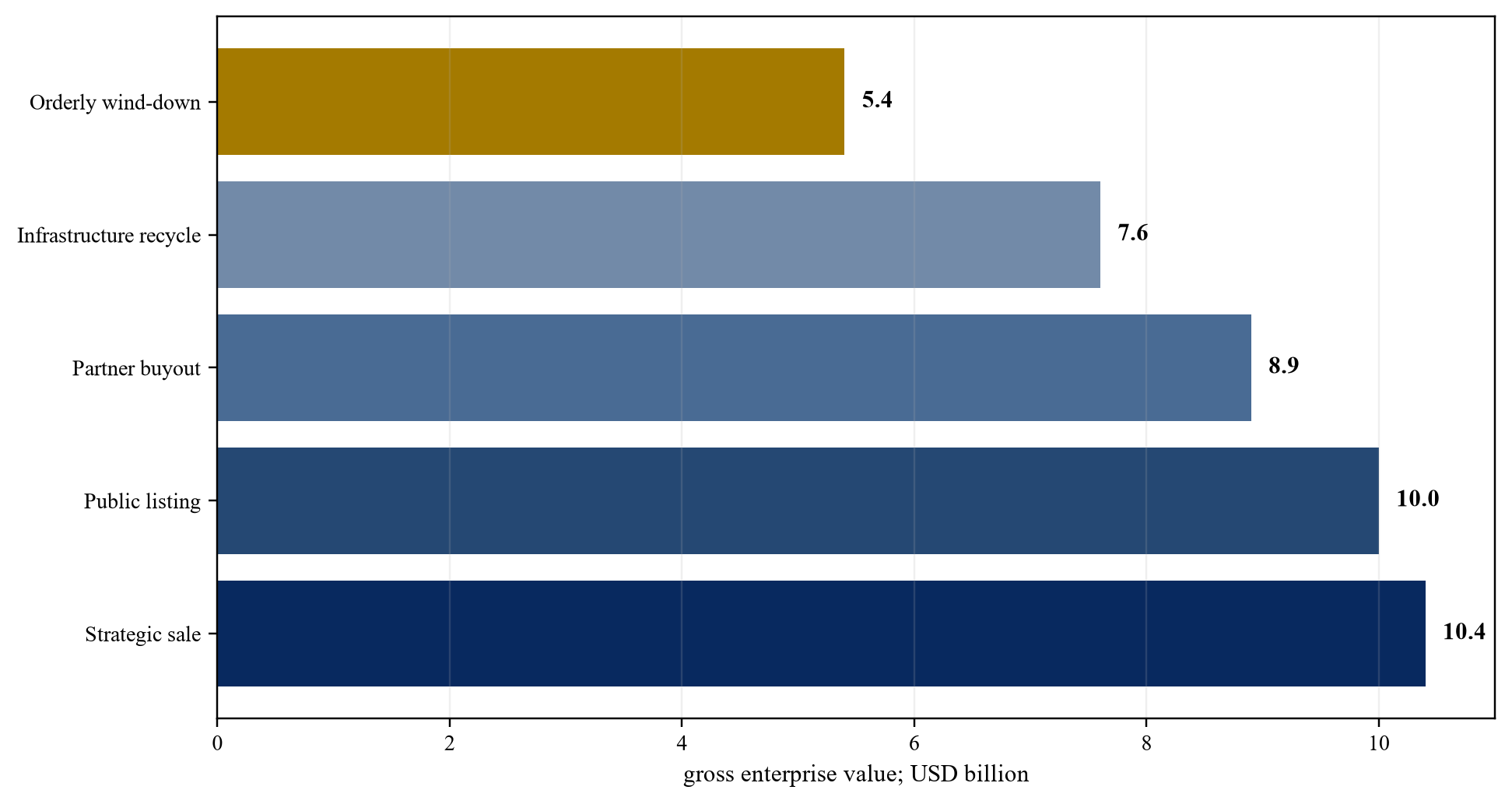
Wholly hypothetical; USD billion before transaction cost and shareholder allocation.
26. Set buyout and valuation mechanics
A buy-sell clause needs a defined valuation standard, cash-flow perimeter, treatment of shareholder contracts, debt, working capital, contingent obligations, public support, synergies and misconduct. Formula prices can become arbitrary when technology and contract mix change quickly. The analysis should trace the beneficiary of each right and the party that bears the associated cost or risk. [23][24]
The evidence file should begin with valuation clause, expert appointment, information rights, normalisation rules, minority and control treatment, payment terms and security. Each item should record its legal owner, effective date, expiry or refresh point, decision authority and relationship to cash flow, localisation or exit. Public announcements and national strategy establish context. Transaction conclusions require executed rights and observed performance.
The principal failure is that the agreement states fair value without defining perspective, assumptions, process or treatment of related-party dependencies. The practical response is to specify market-participant value, permitted owner benefits, adjustments, timetable, expert authority and payment protection. Central assumptions should reflect current enforceable arrangements. Downside cases should combine related technology, power, customer, shareholder, policy, liquidity and transfer risks. Material management assumptions should be identified in the model and refreshed when evidence changes.
27. Preserve continuity through change and distress
Change of control, sanctions, export restrictions, insolvency, cybersecurity failure or prolonged deadlock can interrupt critical services. Step-in and transition rights should permit continuity without transferring prohibited technology or data. The analysis should trace the beneficiary of each right and the party that bears the associated cost or risk. [9][10][11][27]
The evidence file should begin with change-control clauses, lender security, direct agreements, transition licences, escrow, data migration, replacement operator plan and regulatory advice. Each item should record its legal owner, effective date, expiry or refresh point, decision authority and relationship to cash flow, localisation or exit. Public announcements and national strategy establish context. Transaction conclusions require executed rights and observed performance.
The principal failure is that termination rights protect a shareholder while leaving customers and the venture unable to operate. The practical response is to use staged cure, step-in, transition assistance and controlled transfer that respect legal and technology constraints. Central assumptions should reflect current enforceable arrangements. Downside cases should combine related technology, power, customer, shareholder, policy, liquidity and transfer risks. Material management assumptions should be identified in the model and refreshed when evidence changes.
28. Reach the capital and governance decision
Approval should rest on aligned contributions, workable control, measurable localisation, enforceable demand, financeable cash, technology continuity and executable exit. The decision record should identify which risks remain with shareholders, lenders, customers and public authorities. The analysis should trace the beneficiary of each right and the party that bears the associated cost or risk. [2][12][21][23]
The evidence file should begin with reconciled rights matrix, business plan, funding case, localisation scorecard, compliance file, downside model, exit routes and accountable approvals. Each item should record its legal owner, effective date, expiry or refresh point, decision authority and relationship to cash flow, localisation or exit. Public announcements and national strategy establish context. Transaction conclusions require executed rights and observed performance.
The principal failure is that strategic importance substitutes for a transaction-specific decision on rights, cash, risk and alternatives. The practical response is to approve the venture and capital only when the evidence supports both delivery and a credible route through partner change or exit. Central assumptions should reflect current enforceable arrangements. Downside cases should combine related technology, power, customer, shareholder, policy, liquidity and transfer risks. Material management assumptions should be identified in the model and refreshed when evidence changes.
| Decision | Minimum evidence | Possible action |
|---|---|---|
| venture formation | contributions, control and licences | sign, resize or defer |
| construction funding | power, equipment, customers and budget | fund or stop |
| localisation recognition | audited score and additionality | recognise or require cure |
| debt capacity | stressed contracted cash and recovery | lend, condition or decline |
| partner change | continuity, compliance and valuation | consent, step in or buy out |
| exit | transferable rights, approvals and proceeds | sell, list, recycle or retain |
Proposed governance; each approval retains its legal authority.
Sources
- Saudi Press Agency, *HRH the Crown Prince Launches HUMAIN as Global AI Powerhouse*. Read the primary source
- Saudi Press Agency, *stc and HUMAIN Announce JV Partnership to Develop Data Centers Supporting up to 1 GW of AI Workloads in Saudi Arabia*. Read the primary source
- AMD, *AMD and HUMAIN Form Strategic USD 10B Collaboration to Advance Global AI*. Read the primary source
- AMD, *AMD, Cisco and HUMAIN Expand Saudi Arabia's AI Infrastructure as AMD Instinct Systems Go Live*. Read the primary source
- AWS and HUMAIN, *AI Zone to Accelerate AI Adoption in Saudi Arabia and Globally*. Read the primary source
- NVIDIA, *HUMAIN and NVIDIA Announce Strategic Partnership*. Read the primary source
- Public Investment Fund, *HUMAIN*. Read the primary source
- Saudi Vision 2030, *Annual Report 2025*. Read the primary source
- Saudi Data and Artificial Intelligence Authority, *Personal Data Protection Law*. Read the primary source
- Saudi Data and Artificial Intelligence Authority, *Regulation on Personal Data Transfer outside the Kingdom*. Read the primary source
- National Cybersecurity Authority, *Cloud Cybersecurity Controls*. Read the primary source
- Ministry of Investment of Saudi Arabia, *Updated Investment Law*. Read the primary source
- Ministry of Commerce, *Companies Law*. Read the primary source
- Capital Market Authority, *Listing Rules*. Read the primary source
- National Center for Privatization and PPP, *Private Sector Participation Law*. Read the primary source
- OECD, *Guidelines on Corporate Governance of State-Owned Enterprises 2024*. Read the primary source
- OECD, *A Blueprint for Building National Compute Capacity for Artificial Intelligence*. Read the primary source
- International Energy Agency, *Energy and AI*. Read the primary source
- National Institute of Standards and Technology, *AI Risk Management Framework*. Read the primary source
- National Institute of Standards and Technology, *Cybersecurity Framework 2.0*. Read the primary source
- IFRS Foundation, *IFRS 11 Joint Arrangements*. Read the primary source
- IFRS Foundation, *IAS 28 Investments in Associates and Joint Ventures*. Read the primary source
- IFRS Foundation, *IFRS 13 Fair Value Measurement*. Read the primary source
- IFRS Foundation, *IAS 36 Impairment of Assets*. Read the primary source
- IFRS Foundation, *IAS 16 Property, Plant and Equipment*. Read the primary source
- IFRS Foundation, *IFRS 16 Leases*. Read the primary source
- IFRS Foundation, *IFRS 9 Financial Instruments*. Read the primary source
- Communications, Space and Technology Commission, *Cloud Computing Services Regulations*. Read the primary source
