

1. Define the sports-asset value claim
The investment committee should define the specific claim it is being asked to capitalise. The claim may concern a sports club, competition, media-rights package, event portfolio, venue, fan-engagement platform or a combination. The perimeter should list the legal entities, competitions, teams, facilities, intellectual property, rights contracts, sponsorship inventory, ticketing channels, hospitality products, merchandise arrangements, digital platforms, data, people and liabilities included.
Audience scale should be decomposed before value is assigned. Registered accounts, identity-verified fans, marketing-consented fans, paying viewers, ticket buyers, season-ticket holders, stadium attendees, hospitality customers, merchandise buyers and social followers describe different relationships. The buyer should identify duplicates, inactive records, bots, purchased reach, geography, age, consent, source, last activity and demonstrated conversion.
The value claim should connect each asset to an observable commercial decision and cash consequence. Media rights need contract, territory, platform, term, exclusivity, sublicensing, production obligation, minimum guarantee, variable consideration and distribution evidence. Fan data needs lawful collection, permitted use, portability, security and demonstrated incremental decisions. Dynamic pricing needs a controlled comparison, realised transactions, attendance and retention evidence. The board should price the verified chain rather than the promotional narrative.
2. Reconstruct the fan-to-cash and rights waterfall
The diligence file should reconcile two connected waterfalls. The fan-to-cash waterfall begins with addressable audience, permission, offer exposure, transaction, attendance or viewing, fulfilment, invoice or settlement, bank receipt and repeat behaviour. The rights waterfall begins with competition or event rights, territorial and platform scope, production and distribution obligations, gross contract consideration, deductions, league or federation allocation, club distribution, collection and renewal.
Saudi football rights demonstrate why contract scope matters. The Saudi Pro League, First Division League and Saudi Arabian Football Federation awarded exclusive MENA broadcast rights for six seasons from 2025/26 through 2030/31. The reported aggregate contract value was SAR 2.32 billion after legal and regulatory requirements were completed [9-10]. A club buyer should not treat that headline amount as its own revenue. It should verify allocation rules, timing, conditions, production obligations, central deductions, performance variables, tax, collection and change-of-control effects.
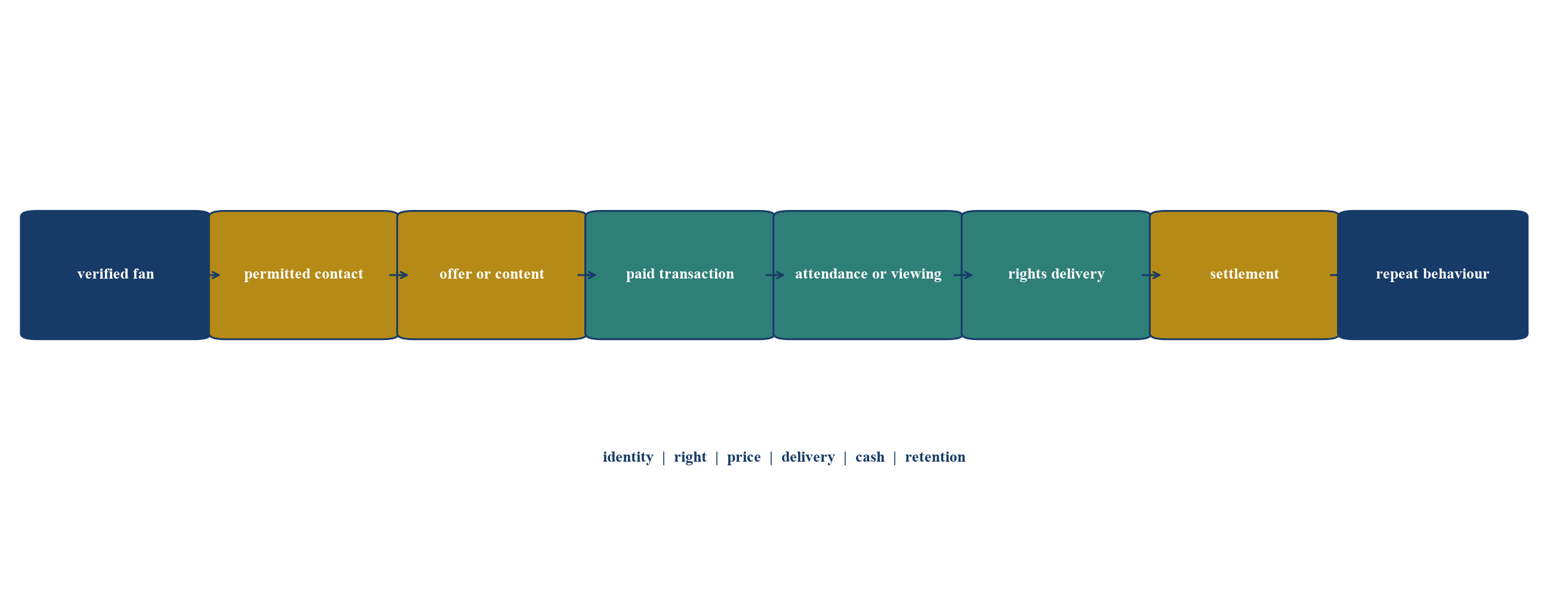
Proposed transaction framework; actual rights, distributions and recognition depend on contract and applicable requirements.
| Layer | Required evidence | Valuation question | Model treatment |
|---|---|---|---|
| rights perimeter | competition, territory, platform, language, term and exclusivity | what can be distributed, where and for how long? | include only contracted scope |
| consideration | fixed guarantee, variable share, value in kind and currency | which consideration is enforceable and collectible? | separate fixed and variable cases |
| delivery obligations | production, feeds, commentary, archive, promotion and service levels | what cost and performance precede payment? | deduct recurring and step-up cost |
| central deductions | production, league, federation, agency and shared costs | what reduces distributable proceeds? | reconcile to statements |
| club allocation | equal, performance, audience or other formula | what is the club-specific entitlement? | model contractual formula |
| collection and renewal | invoicing, settlement, disputes, credit and renewal | when does cash arrive and how persistent is it? | apply timing and downside |
Proposed diligence schedule; contract documents determine the actual economics.
3. Establish a credible commercial counterfactual
An observed improvement after model deployment is not automatically caused by the model. Demand, inflation, constrained ticket inventory, marketing, fixture quality, distribution, seasonality or a change in fan mix may explain the result. The buyer needs a counterfactual: a defensible estimate of what would have happened to comparable transactions without the pricing intervention.
Randomised tests are powerful when they are commercially and legally appropriate. Channels, ticket categories, fan groups or time windows can be assigned before the intervention, with guardrails for fairness, club and competition brand and protected ticket or hospitality inventory. The design should define the primary outcome, sample, duration, stopping rule and exclusions in advance. Analysts should report confidence intervals and economic effect, rather than select the best outcome after viewing results.
Historical programmes often lack randomisation. The diligence team can use matched controls, difference-in-differences, interrupted time series or synthetic controls when assumptions are defensible. Pre-treatment trends, spillovers and concurrent initiatives should be examined. A competing event's price change can contaminate both treatment and control. A system that learns across groups can also transfer information and weaken separation.
Evidence quality should be graded. A reconciled randomised experiment with stable implementation deserves more confidence than a before-and-after dashboard. A management estimate without raw data can inform questions but should not carry valuation credit. Where causal evidence is weak, the buyer can run a confirmatory test before signing, use a closing condition, reserve value for an earn-out or treat the capability as an option.
4. Preserve experiment and pricing integrity
Commercial experiments fail when operational teams change the treatment, sales staff override recommendations, ticket or hospitality inventory differs between groups, or marketing supports one group more heavily. Diligence should compare assigned treatment with actual exposure. The primary analysis can follow assignment, while an additional analysis examines actual use with appropriate caution. Override reasons, system outages and incomplete data should be visible.
The unit of assignment should match the contamination risk. Fan-level assignment may be unsuitable when prices are publicly observable or households share accounts. Product-level assignment can change order behaviour. Channel-level assignment can be confounded by local demand. Geography-level assignment may provide clearer separation but fewer statistical observations. The design should explain the trade-off.
Duration needs to cover the economic cycle. A short test may capture immediate revenue while missing repeat transaction, return, complaint and competitor response. Long tests face more external events. The team should define leading and lagging outcomes, then continue cohort observation after the price exposure ends. Results should be segmented only when the sample supports it.
The buyer should retain the analysis code, raw extracts, model version, approvals and test registry. Reproducibility matters because the acquisition may change staff, systems and incentives. If results depend on an analyst's undocumented spreadsheet, the claimed capability is fragile. A controlled experimentation process can be an asset in its own right, independent of the outcome of one model.
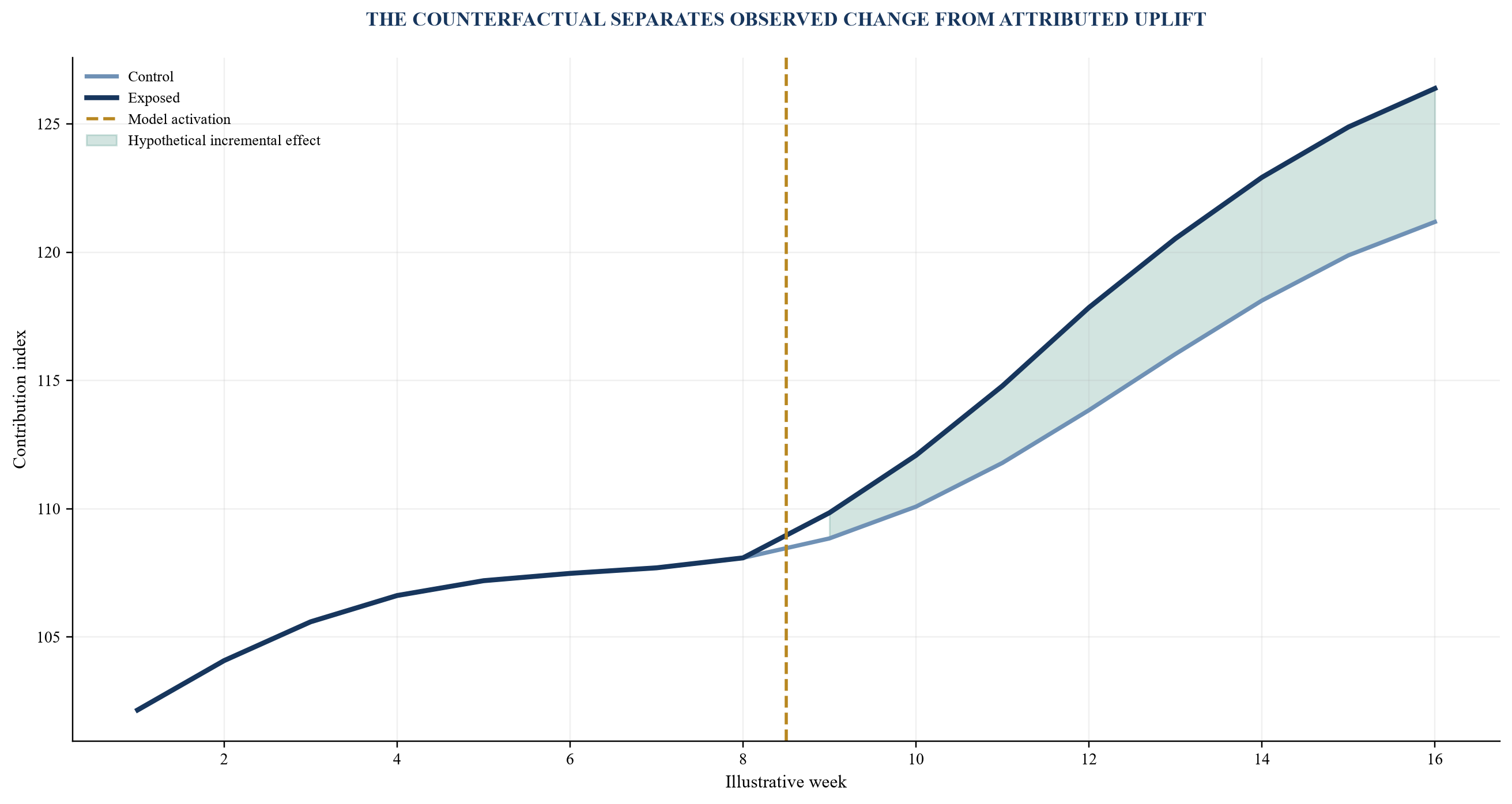
Values are hypothetical analytical assumptions and do not represent a company result.
5. Follow fan cohorts across seasons and commercial products
Fan economics should be measured by cohort, source and season. Build cohorts from first verified interaction, first paid transaction, membership start, season-ticket acquisition, digital subscription or event attendance. Track the same people through renewal, match attendance, viewing, hospitality, merchandise, sponsor engagement, service contacts, consent withdrawal and inactivity.
The buyer should distinguish growth in identifiers from growth in economically active relationships. A major player signing, tournament, title run, promotional campaign or free-content window can create a large acquisition cohort with weak repeat behaviour. A smaller local membership cohort can produce higher lifetime value through attendance, renewal and sponsor relevance.
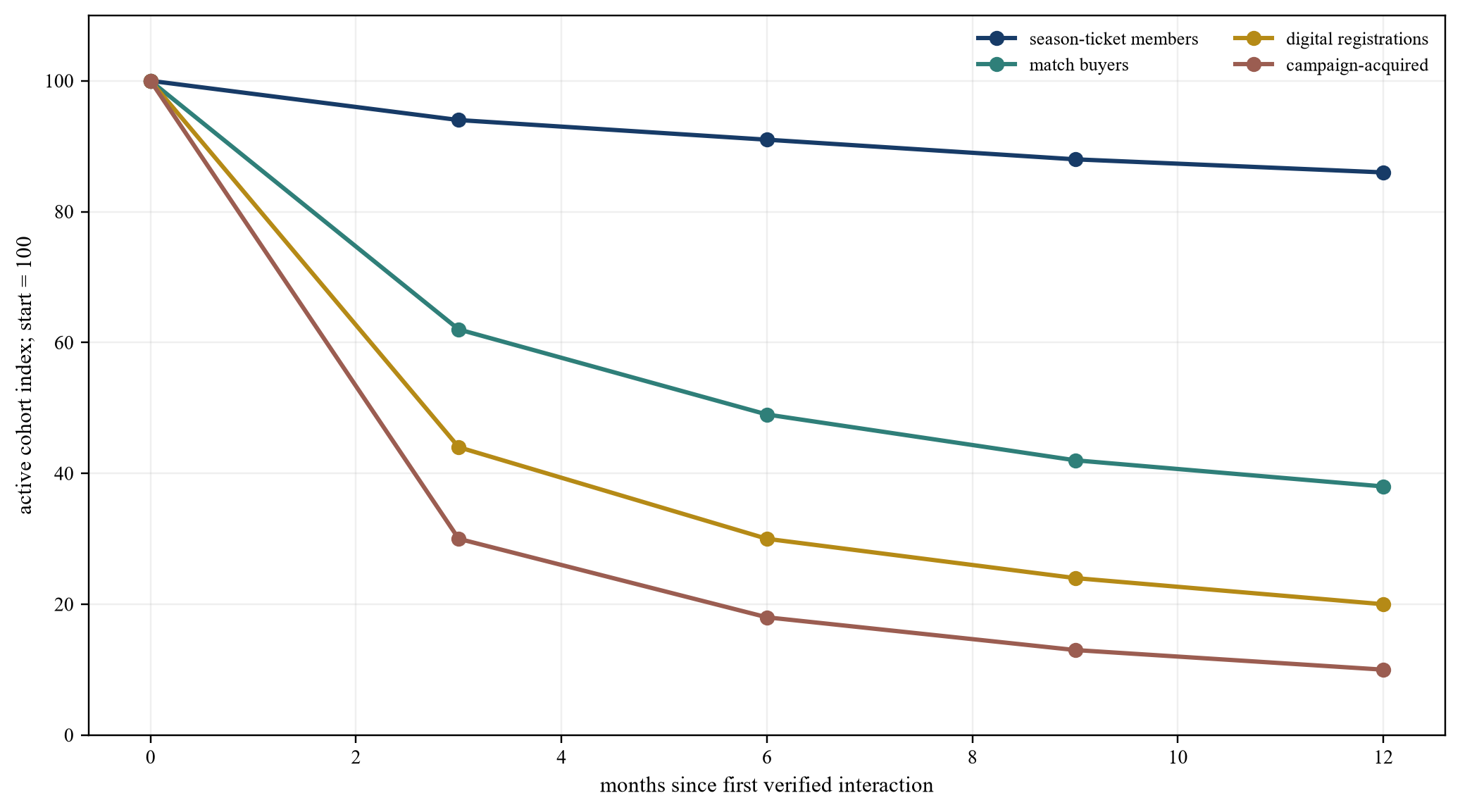
Wholly hypothetical data; no club performance is represented.
6. Separate demand elasticity from model confidence
Price elasticity estimates how demand changes when price changes, holding other factors sufficiently stable. The model's confidence score may describe predictive certainty, but it is not an economic elasticity and should not be presented as one. Diligence should inspect the sports asset variable, functional form, training period, segmentation, outlier treatment and uncertainty.
Elasticity varies by fixture, ticket category, fan segment, channel, season, competing event and size of price change. Historical data may contain few independent price changes because prices were set centrally or copied from comparable events. A model trained on small promotional moves may extrapolate poorly to a large permanent increase. Endogeneity is also important: management often applies concessions when demand is already weak, which can make naive analysis suggest that lower prices cause lower demand.
Controlled experiments and valid instruments can improve identification. The team should test whether estimates are stable across periods and whether signs and magnitudes are economically plausible. Cross-price effects matter when fans substitute between seat categories, fixtures, hospitality products and viewing options. A model that maximises one product's revenue can reduce total contribution or leave excess inventory elsewhere.
The acquisition model should use ranges. High-confidence, repeated elasticities can support a narrower scenario. Sparse data, rapid market change or major product innovation requires a wider range and less valuation credit. Model documentation should state where human judgement or hard constraints replace the estimated optimum.
7. Isolate media, star-player and promotional effects
Media-rights distribution, player signings, competition performance, fixture quality, schedule, broadcaster promotion, creator activity and paid media can change fan demand at the same time as pricing. The valuation model should identify these events and avoid assigning their full effect to a pricing engine or fan-data platform.
The Saudi Pro League introduced a direct-to-consumer international distribution model in September 2026 across selected markets, combining pay-per-view, sponsored access, creator participation and revenue sharing. The initiative was designed to complement the league's broadcaster network and generate first-party audience insight [8]. This creates a new learning channel. It does not prove the future conversion, retention, unit economics or club allocation that a buyer should capitalise.
Use event-level controls where possible. Compare similar opponents, competition stages, days, times, venue zones, sales windows and capacity states. Record star-player availability, sporting performance, weather, travel, broadcaster exposure, promotions and sponsor activation. A model should show the residual contribution after these factors and retain a downside case with no incremental pricing or data value.
8. Rebuild the ticket, hospitality and commercial-product mix
Average realised price rises when fans buy more premium seats, hospitality packages or subscriptions, even if no individual price changes. Contribution margin can move when category mix changes, commercial terms improve or lower-value inventory is unavailable. The price waterfall should therefore include a constant-mix view and a product-level view. New and discontinued products should be treated under an explicit comparability rule.
Dynamic pricing may interact with inventory mix. The optimiser can recommend higher prices for scarce seats, accelerate discounts on unsold capacity or steer demand toward substitutes. Those actions affect availability, attendance and future sales. A complete contribution bridge includes discount cost, displaced sales, fulfilment and working-capital effects.
The team should test whether model adoption coincided with inventory redesign, revised sponsorship terms, new media distribution or a shift to online channels. Each can create genuine value, but the source and replicability differ. Contract economics can change after the transaction if control provisions, audience thresholds or change-of-control clauses apply.
Valuation should avoid a double count. A pricing uplift and a separate premium-mix synergy may describe the same transactions. The model should allocate one effect at a time, preserve a reconciliation to total contribution and show interaction terms where material.
9. Test venue, calendar and capacity constraints
Prices often rise when stock, delivery capacity, seats, rooms or appointment slots are constrained. The algorithm may be correctly harvesting scarcity, yet the resulting margin may not persist when capacity returns or a competing event adds capacity. Diligence should map price outcomes against availability, lead time, service level and utilisation.
The buyer should distinguish a deliberate capacity strategy from operational failure. Low availability can damage fan trust and shift demand to competing properties. Higher realised price on the small quantity sold can conceal lost contribution. The analysis should estimate unconstrained demand where possible and include cancellation, substitution and wait-list behaviour.
Temporary market disruption needs separate treatment. Schedule changes, weather, regulation, a competing event cancellation or a product launch can create a favourable window. The valuation case should identify the normalised capacity state and test the model during both tight and balanced conditions. A capability that adjusts effectively across regimes is more valuable than one calibrated to a single shortage.
The integration plan should retain capacity signals and operational constraints in the pricing system. Removing a data feed, changing fulfilment priorities or centralising ticket and hospitality inventory can alter recommendations. Model performance after closing should be monitored alongside availability and service, rather than through price alone.
10. Measure competing event and platform response
Competitors can match, undercut, ignore or differentiate from a price change. Their response may take days in digital ticketing and months in contracted or regulated markets. A seller's historical uplift may therefore represent the period before rivals adapted. Diligence should build a dated panel of public prices, promotions, availability and relevant event attributes, while respecting competition-law constraints.
The team should examine response speed, magnitude and asymmetry. Competitors may follow increases quickly and reductions slowly, or respond only in selected categories. A common third-party pricing provider can create additional information-sharing and coordination risks. OECD and enforcement sources describe how algorithmic pricing can affect competitive dynamics and how common intermediaries may raise concerns.[1][2][7][8]
Scenario analysis should include no response, partial response, matching and aggressive undercutting. Demand and margin should be recalculated in each case. The buyer should also test new events, platform rule changes, broadcaster strategy and sponsor reaction. These effects can alter the addressable profit pool even when the sports asset's model operates as designed.
Competitive intelligence governance matters. The company should document lawful data sources, access, retention and use. Non-public competitor information should not enter a pricing workflow without qualified legal review. Independent commercial judgement and human accountability should remain visible in the decision process.
11. Examine personalisation, fairness and fan disclosure
Personalisation can change prices, offers, seat access, content, service and sponsor exposure. The sports asset should define which variables may influence each decision, how the fan is informed, which decisions require human approval, how complaints and accessibility needs are handled, and how the organisation prevents prohibited or unjustified discrimination.
Saudi Arabia's Personal Data Protection Law and implementing guidance govern collection and processing within their scope. The SDAIA controller and processor guidance addresses lawful processing, transparency, purpose, minimisation, rights, security, accountability and processor relationships [14-15]. Fan-data valuation should exclude uses that lack an evidenced lawful basis or contractual right.
Pricing governance should protect long-term relationships. The club should set floors, ceilings, protected allocations, membership commitments, accessibility rules, family or community policies, resale controls and exception authority. Dynamic pricing can optimise within this mandate. It should not silently rewrite a strategic fan covenant.
12. Verify fan-data, media-rights and model continuity
Build a rights ledger for every material audience and commercial asset. Fan data should identify controller, collection source, purpose, lawful basis, consent or other permission, permitted channels, geography, retention, sharing, processors, security, transfer conditions and deletion or objection status. Media rights should identify grantor, licensee, competition, territory, platform, content, exclusivity, sublicensing, production, archive, clips, data, reporting, consideration, expiry and change of control.
Model and system continuity should cover ticketing, CRM, identity, data warehouse, marketing automation, pricing, payment, access control, streaming, content management, sponsor measurement and analytics. Verify ownership or licence, interfaces, administrator access, source data, model versions, hosting, cyber controls, vendor support and exit.
| Asset | Core evidence | Critical test | Value treatment |
|---|---|---|---|
| fan identity | source, verification, duplicates and activity | is the person real, current and reachable? | exclude invalid and inactive records |
| permission | notice, lawful basis, consent and preference | may the proposed use continue after closing? | value only permitted use |
| ticketing data | transaction, seat, price, attendance and refund | does the record reconcile to access and cash? | cohort and realised-price evidence |
| media rights | executed grant, territory, platform, term and obligations | what content and revenue can the buyer control? | contract-specific cash flow |
| sponsor inventory | entitlement, delivery, measurement and make-good | can delivery and renewal be evidenced? | net recurring contribution |
| pricing model | data, rules, version, validation and override | is uplift incremental, fair and reproducible? | probability-weighted benefit |
| platforms | licence, hosting, interfaces, security and exit | can operations continue after control changes? | cost, TSA and continuity adjustment |
Proposed diligence structure; legal and contractual conclusions remain transaction specific.
13. Review governance and accountable pricing authority
The board should know who owns pricing policy, who owns the model, who can approve deployment and who can stop it. A clear responsibility matrix should cover data, modelling, commercial decisions, legal review, fan outcomes, cyber security and financial reporting. A vendor score does not transfer accountability away from management.
Model documentation should state objective, scope, data, features, constraints, training, validation, limitations and monitoring. Version control should connect each pricing recommendation to a model release. Overrides should record user, reason and result. High override rates can indicate poor adoption, weak recommendations or sales pressure. Very low override rates can indicate excessive automation or incentives that discourage judgement.
Monitoring should include commercial, statistical and conduct measures. Contribution uplift, conversion, churn and ticket, attendance and hospitality outcomes sit beside drift, missing data, latency, constraint breaches, complaints and fairness indicators. Thresholds should trigger investigation, rollback or retraining. Back-testing should compare predicted and realised outcomes.
The NIST AI Risk Management Framework provides a voluntary structure for governing, mapping, measuring and managing AI risk.[16] It can inform the diligence checklist without replacing company-specific controls or applicable law. The buyer should determine whether existing governance is proportionate to pricing impact and whether integration creates a more material use case.
14. Translate rights and ticketing into accounting revenue
Commercial analysis and financial reporting need a controlled bridge. IFRS 15 establishes principles for recognising revenue from contracts with fans, including transaction price, variable consideration, contract liabilities and returns.[9] Qualified accountants should determine the sports asset's treatment. The diligence team should test whether pricing-system outputs, order systems, invoices, returns and ledger entries remain aligned.
Loyalty points, vouchers, rebates, refunds, bundles, marketplace arrangements and subscriptions can change timing and measurement. An algorithm may optimise booked orders while returns or service credits emerge later. Management estimates for refund liabilities or variable consideration should be compared with subsequent outcomes and fan cohorts.
Cut-off is important when prices and orders change rapidly. The team should inspect transactions around period end, manual journals, cancellation windows and settlement. Seller adjustments that annualise a recent uplift require evidence that the system was active, fans were exposed and returns or churn have matured. A pilot cannot be annualised across unsupported revenue.
The quality-of-earnings report should reconcile model-attributed contribution to statutory and management accounts, then identify normalisation, one-offs and uncertainty. Pricing technology can support an adjustment only where the underlying revenue and associated costs are recognised consistently and the commercial effect is expected to persist.
15. Build a recurring contribution bridge
The persistence bridge starts with the seller's reported annualised uplift and removes effects that lack durable evidence. Typical adjustments include temporary scarcity, favourable mix, sponsor support, reduced media spend, deferred returns, immature fan churn, one-off campaigns, incomplete rollout, competitor response, data-right constraints and required governance cost.
The remaining contribution is allocated to evidence bands. Proven recurring contribution has reconciled transactions, credible causal support, mature cohorts and operational continuity. Probable contribution has positive evidence with identified limitations. Optional contribution requires further investment, wider deployment or untested data. The labels should connect to explicit cash-flow scenarios rather than arbitrary percentages.
Duration matters as much as initial amount. A gain can decay as fans learn, competing properties react or the model saturates easy opportunities. The model can apply a retention curve to contribution and a reinvestment requirement for data, staff, experimentation and compliance. Working-capital and tax effects should be included.
The bridge should reconcile to enterprise value without double counting cost synergies, pricing uplift or cross-sell. It should also state what management must do to preserve each layer. This turns a technology narrative into an executable value-creation plan.
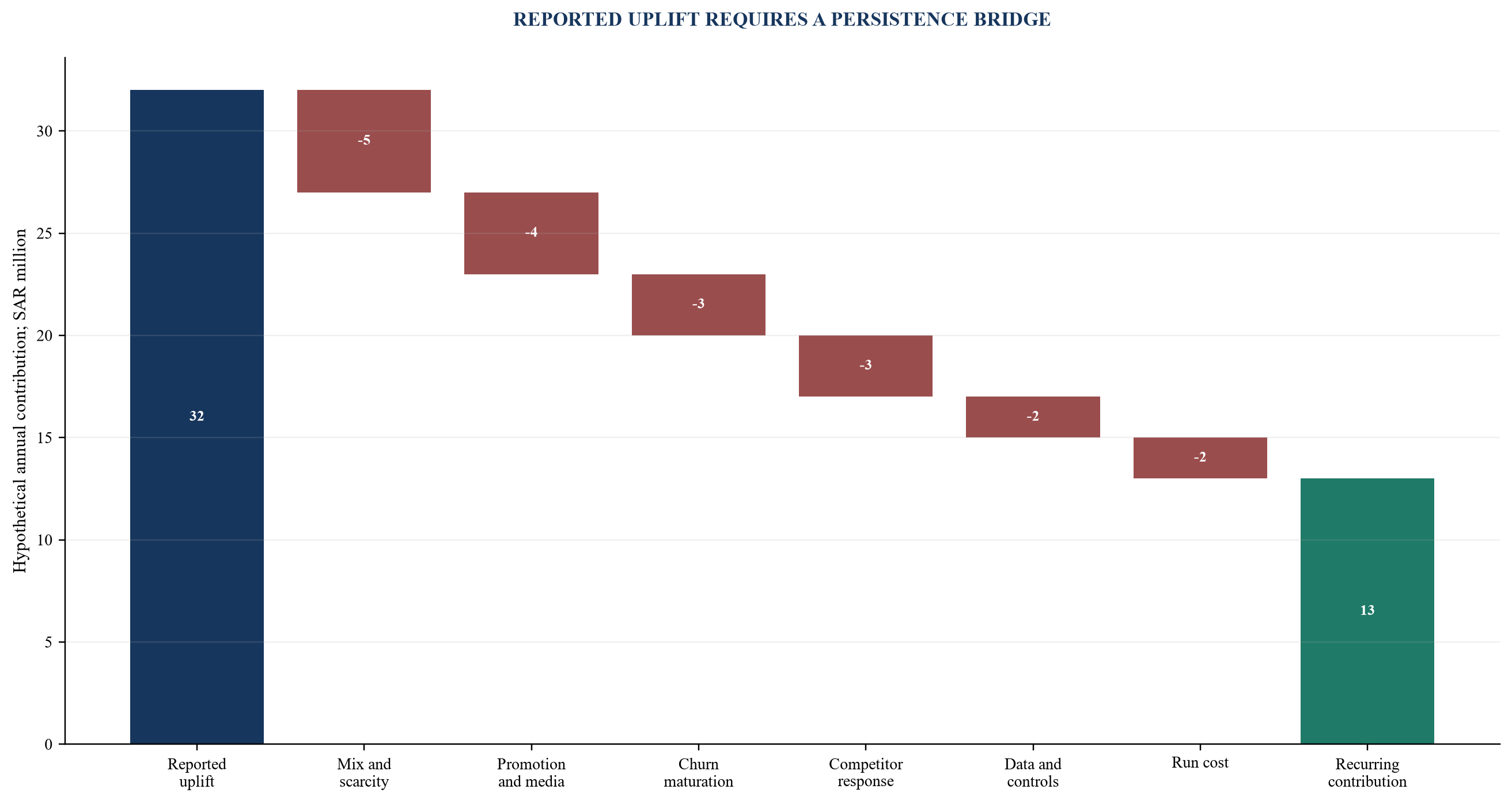
Values are hypothetical analytical assumptions used to demonstrate valuation discipline.
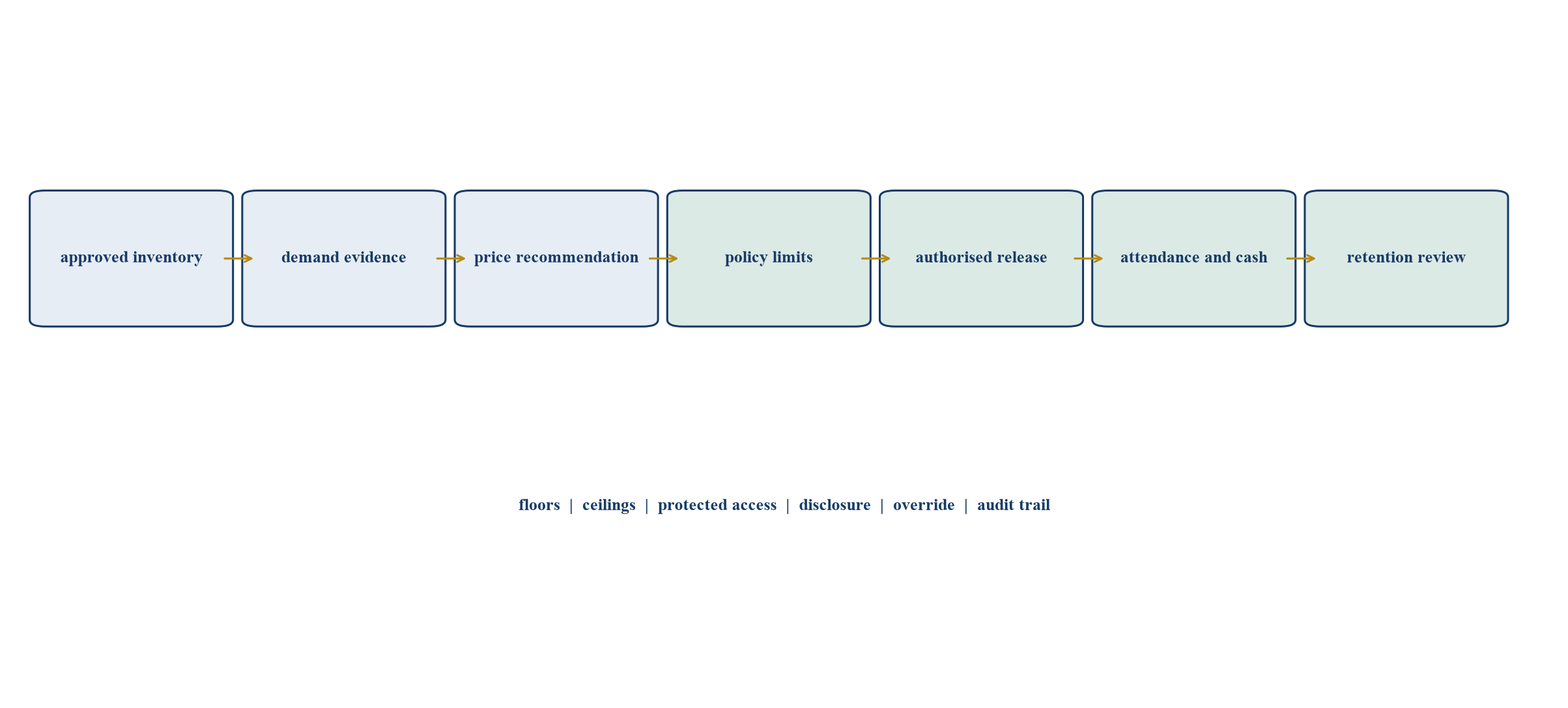
Proposed control architecture; actual pricing policy, data and limits are club specific.
16. Score commercial persistence through observable evidence
A persistence score can organise judgement without pretending to produce certainty. The score should cover causal evidence, transaction reconciliation, fan maturity, competitor response, data rights, technical continuity, governance, accounting quality and operating cost. Each dimension receives a definition, evidence grade and named reviewer.
Weights should reflect the business. A subscription platform may weight retention and fairness heavily. A club may emphasise attendance, ticket mix and fan response. A rights platform may emphasise distribution reach, conversion and renewal. The investment committee should approve weights before reviewing the final score to reduce outcome-driven adjustment.
The score is a decision aid rather than a valuation multiple. Two sports assets with the same score can have different scale, growth and risk. A weak dimension can also be fatal even when the weighted total looks acceptable, such as absent data rights or a serious competition concern. The framework should therefore include mandatory gates.
Evidence can improve between signing and closing or during an exclusivity period. Confirmatory tests, contract amendments, staff retention and data remediation can move a dimension. The scorecard should preserve dated versions and show which actions change the valuation case or transaction terms.
| Dimension | Illustrative weight | Strong evidence | Weak evidence |
|---|---|---|---|
| causal uplift | 20% | controlled, reproducible test | before-and-after claim |
| fan response | 15% | mature retention and complaint cohorts | first-order revenue only |
| competitor response | 15% | multi-regime market evidence | short launch window |
| data and continuity | 15% | transferable rights and reproducible deployment | vendor or key-person dependency |
| commercial reconciliation | 15% | transaction-to-cash waterfall | dashboard aggregate |
| governance and conduct | 10% | constraints, review and monitoring | undocumented automation |
| accounting and cost | 10% | ledger bridge and full run cost | unadjusted gross-margin claim |
Weights and thresholds are hypothetical analytical assumptions; actual decisions require transaction-specific judgement.
17. Integrate fan and rights evidence into quality of earnings
Quality of earnings should treat pricing as a source of variance requiring transaction evidence. The team begins with reported EBITDA or another agreed measure, then traces price, paid demand, mix, campaign, returns, cost and working capital. Seller adjustments for algorithmic uplift should be supported by realised transactions, mature adverse outcomes and the expected run cost.
Annualisation requires a stable launch date and representative period. A recent increase during a seasonal peak should not be multiplied mechanically. The analyst should compare prior-year periods, control groups and post-period results. Fan refunds, supplier rebates and marketplace settlements may arrive after the reporting period and change the bridge.
Costs include software, cloud, data, licences, experimentation, analysts, engineering, commercial operations, legal review, monitoring and fan remediation. Capitalised development should be reconciled with expense and cash. A model can improve contribution margin while consuming additional central resources that the club or product P&L does not carry.
The output should state the portion included in current earnings, the portion proposed as an adjustment, the evidence standard and the downside. Where evidence is incomplete, the buyer can retain upside in its value-creation case without paying for it at closing.
18. Convert commercial persistence into valuation scenarios
Valuation should separate contracted rights cash flow, evidenced recurring commercial contribution and optional growth. Contracted rights value begins with the buyer's enforceable entitlement after delivery obligations, deductions, allocation, tax and collection. Fan-data value should be derived from measured incremental decisions rather than a price per record. Dynamic-pricing value should use realised contribution after attendance, displacement, service, refund, channel, tax and retention effects.
The illustrative case begins with SAR 58 million of adjusted EBITDA and an indicative enterprise value of SAR 690 million. The buyer models SAR 9 million of verified recurring contribution from improved ticket yield, fan renewal, hospitality conversion and sponsor measurement after recurring technology and operating costs. A central case values part of this contribution after implementation risk. A downside removes the fan-data benefit, reduces rights distributions and includes migration and attrition cost.
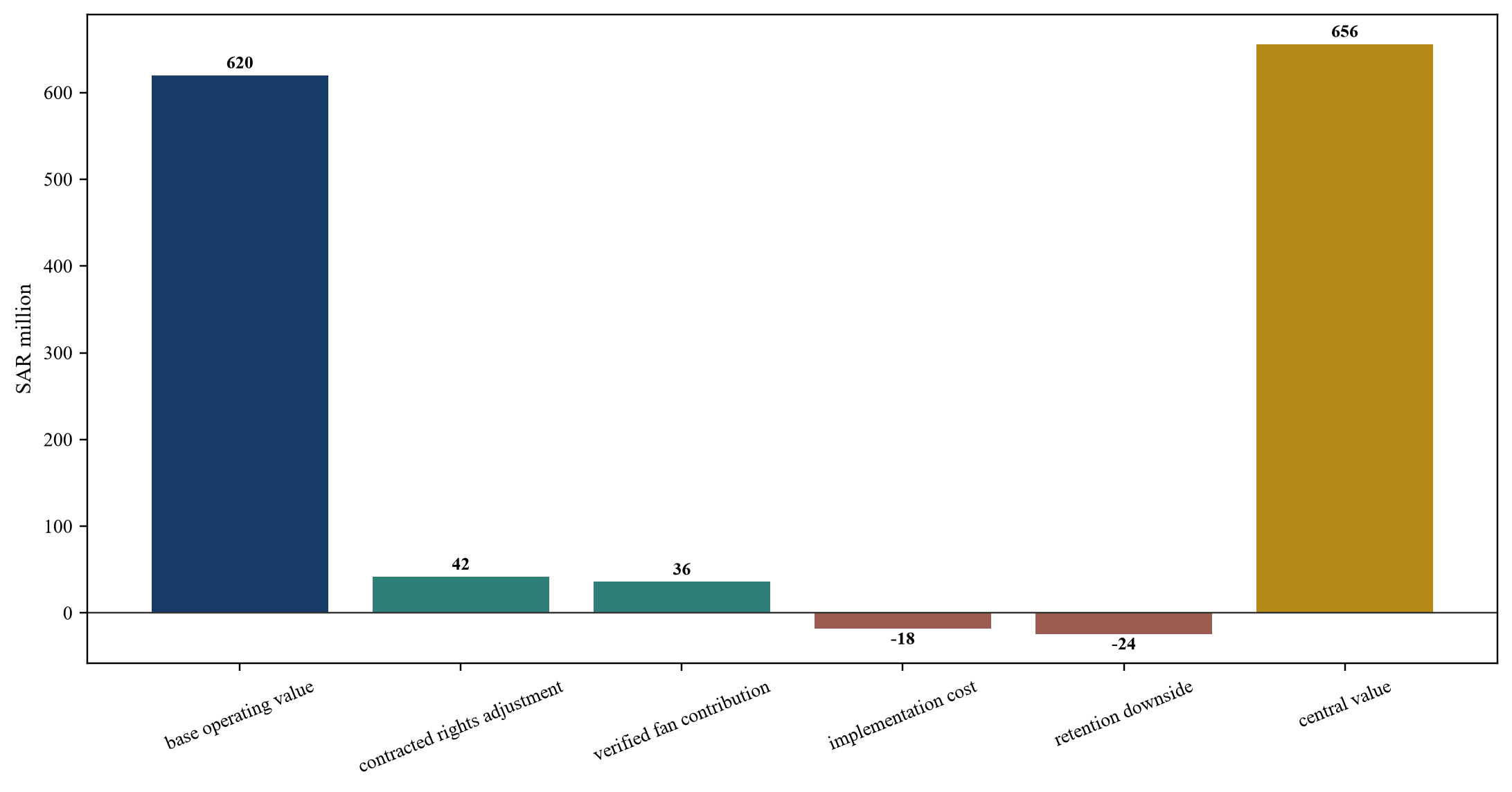
Wholly hypothetical scenario; amounts do not represent an identified club, offer or valuation opinion.
19. Use transaction structure to allocate uncertainty
Where evidence is incomplete, price mechanics can allocate risk. A lower upfront value with contingent consideration can link payment to realised contribution, fan retention or coverage. The measure should be defined from controlled records and should avoid incentives to maximise a narrow metric at the expense of fans or long-term value.
Earn-out design needs careful treatment of operating control. The buyer may change pricing policy, systems, marketing or inventory policy after closing. The agreement should address permitted actions, information, accounting, disputes and extraordinary events with qualified legal, tax and accounting advice. A simple revenue sports asset can reward concessioning or acquisition spend; a contribution and fan-quality measure may align better but requires robust data.
Representations and warranties can address data rights, model ownership, compliance, material incidents, fan disclosures and financial records. Covenants can preserve data, staff, models and experiments between signing and closing. Specific indemnities, escrow or insurance may be considered where identified risks are insurable and legally appropriate.
The buyer should avoid converting uncertain operating upside into a complex instrument that cannot be measured. If systems are weak, the better response may be a lower fixed price and a post-close value plan. Transaction structure complements diligence; it does not replace evidence.
20. Plan integration without destroying fan trust or evidence
The first integration decision is whether to preserve, migrate or replace the pricing stack. Rapid consolidation can remove the logs, control groups and model versions needed to verify value. The buyer should retain raw data, code, documentation and key staff before changing systems. Access controls and legal rights should be confirmed at close.
Commercial policy should remain accountable. Pricing objectives, floors, ceilings, campaigns, exceptions and fan protections need approval in the combined business. The buyer should decide which recommendations remain advisory and which can be automated. Market-facing decisions should retain independent judgement where competition risk exists.
Integration can change the model's environment. Ticket identifiers, fan accounts, channels, costs, inventory and comparable-event sets may shift. Pre-close performance may not transfer without recalibration. A parallel run can compare legacy and combined recommendations, with holdout groups and defined rollback.
The value-creation plan should include data remediation, feature migration, experimentation, talent, infrastructure, legal review and reporting. Each action has cost, owner and milestone. The investment committee should receive a post-close bridge from the acquisition case to realised contribution.
| Uncertainty | Possible mechanism | Measurement principle | Principal caution |
|---|---|---|---|
| immature uplift | contingent consideration | realised contribution after agreed costs | operating-control disputes |
| data or licence transfer | closing condition or covenant | documented rights and functioning access | third-party consent timing |
| model continuity | retention and transition services | reproducible deployment and service levels | key-person dependency |
| conduct exposure | representation, remediation or indemnity | defined incidents and verified loss | enforceability and exclusions |
| integration performance | staged investment plan | controlled post-close test and board gates | avoid double counting synergy |
Terms are illustrative and require qualified legal, tax, accounting and regulatory advice.
21. Address Saudi sports, competition and data-protection requirements
The transaction map should include the Saudi Sports Law, Ministry of Sport and federation or league rules, club licensing, competition, foreign investment, national-security review where applicable, PDPL, consumer protection, e-commerce, advertising, intellectual property, broadcasting, content, employment, tax and venue obligations. The Sports Law entered into force in June 2026 and applies across sports entities, competitions, events, facilities and relevant professionals; it supports commercial and sports investment transactions within its framework [3].
Saudi competition analysis should address the acquisition perimeter, common ownership or influence, central rights, exclusivity, platform access, sponsorship categories, ticketing, data combination and any vertical relationships. Merger-control assessment and filings depend on current law, thresholds and transaction facts. The buyer should obtain qualified advice and avoid using this paper as a legal conclusion.
The Ministry of Sport's privatisation process uses readiness review, investor qualification, technical and financial offers and selection procedures. Official announcements in 2025 and 2026 show completed transfers and continuing offerings [1-2]. Transaction diligence should test how the specific sale documents, club company, rights, liabilities, governance, facility access and league arrangements implement that process.
22. Create a board dashboard with leading and lagging indicators
The board should see a compact dashboard that connects model operation to cash and fan outcomes. Leading indicators include model coverage, data quality, override, constraint breaches, experiment status, competitor movement and complaints. Lagging indicators include realised contribution, repeat transaction, churn, attendance, hospitality utilisation and refunds and regulatory matters.
Every measure needs a definition, source, owner and reconciliation. The dashboard should show exposed and control outcomes, not only aggregate performance. Changes in inventory, promotion and capacity should be annotated. Confidence intervals and data gaps should be visible when material.
Thresholds should prompt action. A deterioration in retention, a fairness exception or a competitor-data concern can trigger investigation and a temporary control. A persistent gap between predicted and realised contribution can trigger recalibration. Commercial management should retain discretion within approved limits and document exceptions.
The acquisition case can become the baseline for post-close monitoring. The board should compare actual uplift, persistence, cost and integration milestones with the assumptions used in price. This creates accountability and supports future capital allocation.
| Workstream | Day-one evidence | Diligence test | Closing or post-close control |
|---|---|---|---|
| league and competition rights | governing documents and distributions | entitlement, term, deductions and change control | consent and reporting covenant |
| media contracts | executed grants and settlement statements | territory, platform, obligations, credit and renewal | condition, warranty or price mechanism |
| fan identity and permission | source and preference records | validity, consent, duplicates, activity and transfer | remediation and restricted use |
| ticketing and access | transaction, seat, gate and refund data | realised price, attendance, fraud and cash | reconciliation and service level |
| sponsorship | inventory, delivery and make-goods | measured exposure, category conflict and renewal | delivery ledger and claims process |
| dynamic pricing | policy, model, experiment and overrides | incremental contribution, fairness and persistence | bounded authority and monitoring |
Proposed transaction schedule; scope should be adapted to the asset and sale process.
23. Execute a one-hundred-day evidence programme
The first twenty days should preserve data, people, contracts, code and decision logs. The buyer confirms legal access, freezes definitions and recreates the historical waterfall. It also records the current model version, coverage, overrides, constraints and open incidents.
Days twenty-one to forty rebuild experiments, fan cohorts, mix, promotional and competitor panels. The team tests reconciliation and causal claims. Weak evidence becomes a remediation plan rather than an unsupported adjustment. A limited holdout may continue where commercially and legally appropriate.
Days forty-one to seventy establish the persistence bridge, governance, accounting treatment and risk controls. The combined management team approves pricing policy, responsibility, monitoring and escalation. Technology migration is tested in parallel. Fan and competitor responses continue to mature.
Days seventy-one to one hundred complete the valuation-to-realisation bridge and decide where to scale, redesign or stop. Capital is released to proven initiatives with measured return. The board receives a baseline dashboard and an updated downside. The process becomes a continuing commercial-control system.
| Period | Primary work | Required output | Decision gate |
|---|---|---|---|
| days 1-20 | preserve data, rights, code, staff and definitions | reproducible perimeter and price waterfall | evidence available and transferable |
| days 21-40 | rebuild tests, cohorts, mix and market response | causal and fan evidence pack | claimed uplift supported or resized |
| days 41-70 | govern, account, monitor and plan integration | persistence bridge and control framework | risk and run cost accepted |
| days 71-100 | parallel run and value realisation | board dashboard and updated valuation bridge | scale, redesign or stop |
Timing is illustrative and should be adapted to transaction structure, data quality and regulatory context.
24. Apply red-team tests before investment committee approval
The red team should ask what else could explain the claimed uplift. It should test data leakage, survivor bias, seasonality, stock-outs, ticket and hospitality mix, media, sponsor support, inflation, competing-event disruption, accounting cut-off and selective reporting. Reproducing management's result from raw data is a minimum starting point.
It should then test durability. What happens when fans observe price differences, competing properties respond, capacity normalises or data use is restricted? How much contribution remains after full operating cost? Which employees, vendors and contracts are essential? Which assumptions are facts, management estimates or hypothetical analytical assumptions?
The team should examine failure modes. A model can recommend economically rational prices that violate policy, create unfair outcomes, use unreliable data or optimise the wrong objective. Controls should be tested through exception cases and rollback. Incidents and near misses should be reviewed without assuming the absence of a recorded incident proves effective control.
The investment committee paper should preserve unresolved questions and quantify the affected value where possible. Approval conditions should name the evidence, owner and deadline. A disciplined stop or contingent structure can protect return when the technology story runs ahead of proof.
25. Use a decision checklist that connects rights, evidence, price and execution
The final decision memo should identify the legal entities, commercial products, markets, channels, model versions and data within scope. It should state the claimed uplift and reconcile it from transaction to cash. Coverage, overrides, outages and exclusions should be visible. The causal method and limitations should be explained in language the board can challenge.
Fan, competitive and conduct evidence should sit beside the financial case. Cohort retention, complaints, fairness tests, competitor response, data rights and model continuity determine whether the gain can survive. Accounting should reconcile revenue, returns, variable consideration, capitalised development and run cost. The valuation should show persistence and downside sensitivities.
Transaction terms should reflect unresolved uncertainty. Integration should preserve evidence and independent commercial judgement. The first one hundred days should contain named actions, costs, milestones and stop rules. The board dashboard should measure realised value against the acquisition case.
The central discipline is simple: an algorithmic recommendation has no acquisition value by itself. Value arises when the recommendation produces incremental cash, fans remain, competing properties do not erase the gain, the data and system continue lawfully, and management can govern the process. The paper's framework gives decision-makers a traceable path from a pricing claim to a transaction decision.
| Finding | Value consequence | Transaction response | Post-close owner |
|---|---|---|---|
| media-right entitlement is contracted and reconciled | recurring cash evidence | include under downside-tested terms | CFO and rights director |
| audience reach exceeds valid fan identities | lower addressable value | exclude unsupported records | data protection and commercial leads |
| ticket uplift lacks a controlled comparison | uncertain contribution | defer or price through contingent mechanism | revenue management lead |
| sponsor delivery cannot be evidenced | renewal and make-good risk | reserve, warranty or adjustment | commercial director |
| platform licence or consent cannot transfer | continuity and lawful-use risk | condition, replacement or TSA | technology and legal leads |
| cohort retention remains strong after price change | improved persistence evidence | recognise only observed contribution | board and finance |
Proposed decision framework; it is not a recommendation concerning an identified transaction.
Sources
- Saudi Ministry of Sport, “Ministry of Sport Announces Privatization of First Three Clubs and Opens the Door for Further Club Privatizations,” 24 July 2025, Read the primary source
- Saudi Ministry of Sport and National Center for Privatization & PPP, “Offering of Five Additional Clubs for Privatization,” 8 June 2026, Read the primary source
- Saudi Ministry of Sport, “Sports Law’s Entry into Force,” 11 June 2026, Read the primary source
- Saudi Ministry of Sport, “Sports Clubs Investment and Privatization Project,” current investment overview, Read the primary source
- Saudi Ministry of Sport, “Sports Facilities Investment Project,” 19 May 2025, Read the primary source
- Public Investment Fund, “PIF Establishes SRJ Sports Investments,” 6 August 2023, Read the primary source
- Public Investment Fund, Annual Report 2023, sports investments and club ownership, Read the primary source
- Saudi Pro League, “SPL opens new route to international fans with innovative distribution model,” 16 September 2026, Read the primary source
- Saudi Pro League, First Division League and Saudi Arabian Football Federation, “Broadcast rights award to Thmanyah,” 14 June 2025, Read the primary source
- Saudi Pro League, “Development and growth of domestic football competitions increases broadcast-rights value,” 26 February 2026, Read the primary source
- Saudi Pro League, “Broadcasters,” current distribution list, Read the primary source
- Saudi Pro League and Saudi Arabian Football Federation, “Production agreement with IMG,” 24 July 2024, Read the primary source
- Saudi Vision 2030, Annual Report 2025, sports participation, investment and privatisation, Read the primary source
- Saudi Data and AI Authority, “Guide to the Saudi Personal Data Protection Law for Controllers and Processors,” Read the primary source
- Saudi Data and AI Authority, Personal Data Protection Law knowledge centre and implementing guidance, Read the primary source
- Saudi General Authority for Competition, “Competition Law and Implementing Regulations,” current legislation and guidance, Read the primary source
- FIFA, Annual Report 2024, material accounting policies for television, marketing, licensing, hospitality and ticket revenue, Read the primary source
- FIFA, “Professional Football Landscape,” club and competition benchmarking resources, Read the primary source
- IFRS Foundation, “IFRS 3 Business Combinations,” issued standard, 2026, Read the primary source
- IFRS Foundation, “IFRS 15 Revenue from Contracts with Customers,” issued standard, 2026, Read the primary source
- IFRS Foundation, “IAS 36 Impairment of Assets,” issued standard, 2026, Read the primary source
- OECD, “Recommendation on Consumer Product Safety and personalised commercial practices,” current consumer-policy resources, Read the primary source
