

1. A retired battery enters a second contract
A battery removed from an electric vehicle has already performed under one product design, control system, temperature regime and warranty. Stationary reuse places it into a second commercial relationship. The new owner asks the same electrochemical asset to operate under a different duty cycle, site design, revenue contract and liability allocation.
The transfer creates information asymmetry. The seller may know vehicle identity and service history. The repurposer may observe present capacity and impedance. The integrator controls racks, thermal management, inverters and software. The operator creates future degradation through dispatch. The lender relies on all of them while holding security over an asset whose remaining life cannot be read from nameplate capacity.
Bankability therefore depends on a second contract that joins evidence, responsibility and remedy. The contract must identify each battery, establish what happened during first life, determine its current condition, specify the permitted stationary duty, allocate future performance and safety risk, and preserve data through replacement and end of life.
2. The investable asset is a verified population
A stationary system assembled from retired packs should be treated as a population of individually identified components. Packs of the same model can have different mileage, fast-charging exposure, temperature history, storage periods, accidents, repairs and software versions. Those differences can produce materially different degradation paths.
Portfolio averaging helps only after the distribution is understood. A system may meet average usable-energy requirements while containing weak modules that drive imbalance, thermal stress, downtime or early replacement. Acceptance should therefore test dispersion as well as mean performance.
The investable unit is the verified population that passed a controlled intake and grading process. The data room should link each installed unit to its source vehicle, inspection result, test record, grade, rack position, commissioning result and subsequent operating history. This component-level identity supports warranty claims, root-cause analysis, preventive replacement and residual-value decisions.
3. Market growth does not remove the second-life challenge
The International Energy Agency reported that electric-vehicle battery deployment reached 1.2 TWh in 2025, almost 30 percent above 2024. It also reported a structural delay of roughly 15 years between growth in battery deployment and the point at which comparable volumes reach end of life. Second-hand vehicle markets can extend first life further and change where batteries eventually become available.
The same IEA assessment identifies the principal difficulties for reuse: safety and warranty requirements, uncertainty about remaining lifetime, falling new-battery prices, dismantling and repurposing costs, and the transfer of safety, regulatory and end-of-life responsibility to the repurposer. These factors make feedstock volume a necessary but incomplete investment thesis.
The transaction question is narrower. A project must secure enough qualified packs at a known delivered cost, convert them into a certified system, support a defined warranty and remain competitive against new stationary batteries at financial close. Market growth should not substitute for project-specific proof.
4. Traceability begins before physical transfer
The chain of custody should start when the vehicle or pack is designated for removal. The transfer file should record the vehicle identification number, battery serial number, model, chemistry, manufacturing date, nominal capacity, service actions, software version, ownership status and legal authority to transfer.
Event history matters. Collision, immersion, fire exposure, over-temperature, isolation faults, deep discharge, long storage at extreme state of charge and unauthorized repair can affect safety and remaining life. A simple statement that the pack came from an operational vehicle does not establish these facts.
The custody record should identify each handler, location, time, transport classification, packaging, storage condition and seal status. Photographs and electronic signatures can support continuity. The record should preserve the distinction between a used product and waste because that classification can affect transport, handling and regulatory obligations.
5. The battery passport changes the evidence architecture
Regulation (EU) 2023/1542 requires a battery passport from 18 February 2027 for each electric-vehicle battery, each light-means-of-transport battery and each industrial battery above 2 kWh placed on the market or put into service. The passport includes model and individual-battery information, with access controls for different users.
For legitimate users, the required individual data include performance and durability values, state of health, status as original, repurposed, reused, remanufactured or waste, charging and discharging cycles, negative events such as accidents, operating temperature and state of charge. A repurposed battery requires a new passport linked to the original passport or passports.
This framework can lower diligence cost when records are complete, authentic and interoperable. It does not remove the need for physical testing. Passport data describe identity and history; commissioning evidence must still prove current performance in the new configuration.
6. Secure data access must survive the transaction
The EU Batteries Regulation requires read-only access to state-of-health and expected-lifetime parameters in the battery-management system for specified legitimate purposes, including assessing residual value, enabling energy-market participation and facilitating repurposing. It also recognises intellectual-property rights and assigns liability consequences when new battery-management software is uploaded.
A project should translate these principles into practical access rights. The repurposer needs the interface specification, relevant diagnostic parameters, time series, units, sampling frequency, error flags and software version. The owner and lender need durable access after supplier default or change of control.
Cybersecurity controls should separate diagnostic access from control authority. Credentials, encryption, audit logs and role-based permissions should remain documented. The project should avoid dependence on a remote service that can be withdrawn without notice or that prevents transfer to a replacement operator.
7. State of health is a family of measurements
State of health compares present battery condition with an initial state, but the result depends on the chosen indicator and test. Capacity state of health measures retained charge or energy. Power capability reflects resistance and voltage behaviour under load. Efficiency, self-discharge, thermal response and cell imbalance provide different evidence.
The EU regulation's Annex VII lists parameters such as remaining capacity, overall efficiency, resistance, power capability, self-discharge and temperature evolution where relevant. Research on second-life batteries shows why several indicators matter. Packs can share similar measured capacity while differing in internal resistance, cell dispersion or sensitivity to temperature.
The acceptance certificate should name the test protocol, equipment, calibration, environmental condition, rest period, charge window and calculation method. A percentage without that context is not a reproducible warranty baseline.
8. Remaining useful life requires a duty-specific model
Remaining useful life estimates how long a battery can satisfy a defined operating requirement. It changes with state-of-charge range, depth of discharge, charge and discharge rate, temperature, rest periods and calendar time. A value calculated for gentle residential cycling cannot be transferred directly to fast-response or high-throughput use.
Experimental research has shown that first-life history, chemistry and heterogeneous degradation complicate prognosis. A useful model should combine intake tests, available first-life data, second-life duty assumptions and ongoing field observations. Model error should be reported and updated rather than hidden in a single life estimate.
The financing case should use a conservative performance distribution. It should model early failures, ordinary degradation, replacements, augmentation and operational restrictions. The warranty should reference the same duty and measurement method used in the financial model.
9. Sorting and grading create the manufactured product
UL 1974 addresses the process used to evaluate batteries for repurposing. The process includes quality controls, visual inspection, collection and analysis of battery-management data, examination, sorting, grading, rejection and disposal of damaged components. Facility certification assesses whether these processes are controlled and repeatable.
The process has economic consequences. Broader acceptance can improve feedstock yield but increase dispersion and future replacement. Narrower grades can improve predictability but raise acquisition and testing cost. A lender should review the yield curve, not only the final accepted population.
Grade definitions should state minimum usable capacity, maximum resistance, cell or module dispersion, self-discharge, insulation resistance, thermal behaviour and excluded events. The project should preserve the raw test record so a future claim can be traced to the acceptance decision.
10. Application certification remains separate
Facility certification confirms the repurposing process. It does not by itself certify the finished stationary system. UL Solutions states that repurposed batteries intended for stationary storage still require the relevant battery and system certifications, including UL 1973 for stationary batteries and UL 9540 for energy storage systems in the referenced North American pathway.
IEC TR 62933-2-201:2024 reviews testing for battery energy storage systems using repurposed and reused batteries. IEC 61427-2 provides chemistry-neutral methods for endurance and electrical-performance testing in on-grid renewable-energy storage applications. The applicable route depends on jurisdiction, use and authority having jurisdiction.
The project should produce a certification matrix covering cells or modules, repurposing facility, battery assembly, energy-storage system, power conversion, fire testing, installation and grid connection. Gaps should be assigned to an owner, budget and timetable before construction notice to proceed.
11. Safety evidence should follow the actual configuration
A stationary installation changes enclosure, spacing, cooling, controls and emergency response. Safety evidence should therefore follow the installed configuration rather than assume that automotive certification transfers unchanged.
The hazard assessment should examine thermal runaway, propagation, flammable and toxic gases, stranded energy, electrical isolation, shock, arc flash, mechanical damage, water ingress and emergency access. NFPA 855 provides an installation framework for stationary energy storage in relevant jurisdictions. Site-specific building, fire and electrical rules may add requirements.
The contract should state which configuration changes require retesting or approval. Substituting another pack model, changing rack density, updating battery-management software or altering ventilation can invalidate assumptions used by the original assessment.
12. Warranty design begins with the promised service
A warranty should protect the service that supports revenue. For an energy-shifting project, usable MWh and efficiency may matter most. For capacity or backup, deliverable MW for a defined duration and availability can dominate. For reserve service, response accuracy and state-of-charge recovery may be critical.
The warranty metric should be measured at an agreed boundary. Pack-level capacity does not equal delivered AC energy after inverter, transformer, auxiliary-load and availability effects. The contract should state whether the guarantee applies to cell, module, DC rack, DC system or AC point of interconnection.
The operating envelope should specify annual throughput, equivalent full cycles, state-of-charge range, depth of discharge, power, temperature, rest and maintenance. The project should price any revenue contract that requires operation outside that envelope.
Table 1. Evidence required to admit a retired battery into a financeable stationary system
| Evidence domain | Minimum record | Acceptance question | Contract consequence |
|---|---|---|---|
| Identity and title | Vehicle and battery identifiers, ownership and transfer authority | Can the project prove lawful title to the specific unit? | Seller representation, indemnity and exclusion of disputed units |
| First-life history | Service, charging, temperature, accident and fault records where available | Does the history reveal an excluded event or missing period? | Price adjustment, enhanced testing or rejection |
| Physical condition | Visual inspection, isolation and enclosure condition | Is there damage, contamination or unauthorised repair? | Immediate rejection and controlled disposition |
| Electrical condition | Capacity, resistance, power, efficiency and self-discharge tests | Does the unit meet the selected grade under a reproducible protocol? | Grade assignment and warranty baseline |
| Population consistency | Cell or module dispersion and outlier analysis | Will weak components dominate rack performance? | Matching rule, balancing plan and spare requirement |
| Software and data | BMS access, version, diagnostic parameters and reset rights | Can the integrator monitor and control the unit through second life? | Licence, escrow, interface warranty and access covenant |
| Safety and certification | Repurposing-process and application-specific evidence | Does the configuration meet the required approval pathway? | Conditions precedent and change-control limits |
| End-of-life route | Take-back, recycling and transport plan | Who owns cost and responsibility after second life? | Reserve, take-back obligation and security |
The table is a diligence framework. Local law, standards and project design determine the final acceptance protocol.
13. The warranty stack has several accountable layers
One supplier rarely controls the complete outcome. The feedstock seller controls origin and disclosed history. The repurposer controls inspection, grading and assembly. The integrator controls rack, thermal and control design. The inverter supplier controls power conversion. The engineering contractor controls installation. The operator controls dispatch and maintenance.
The contract stack should avoid a gap where each party attributes failure to another layer. A single system integrator can provide an umbrella warranty backed by recourse to its suppliers. Alternatively, a wrap agreement can coordinate direct warranties and define a lead claims administrator.
The owner should retain direct rights where the umbrella provider lacks balance-sheet strength. Direct agreements, collateral warranties, assignment rights and step-in provisions can preserve claims after contractor default.
14. Feedstock representations should be specific
The acquisition contract should represent lawful title, authentic identifiers, disclosed chemistry and model, absence of undisclosed liens, known accident history, storage conditions and compliance with transport requirements. It should define what information is based on the seller's records and what remains unknown.
A broad statement that batteries are suitable for reuse is difficult to prove and can overlap the repurposer's responsibility. A clearer structure places history and title with the seller, present-condition testing with the repurposer, and application suitability with the integrator.
Remedies can include rejection, replacement, price adjustment and indemnity for title or deliberate misstatement. Claim periods should reflect the time needed to discover latent history defects through operation.
15. The repurposer should warrant its process and output
The repurposer should warrant compliance with the approved intake, test, grading, matching, assembly and quality-control procedures. It should identify the version of each procedure and preserve evidence for the warranty term.
Output warranties can cover initial usable energy, power, efficiency, insulation, communication and absence of specified defects. They should also state permitted dispersion within a rack and the minimum share of tested capacity that must remain available at commissioning.
The repurposer's warranty should respond when a unit was incorrectly graded even if the stationary duty remained within limits. The remedy should include diagnosis, removal, replacement, logistics, recommissioning and safe disposition rather than a replacement component alone.
16. The integrator should warrant system performance
The integrator combines heterogeneous battery components with racks, controls, thermal management, protection and power conversion. Its system warranty should bridge component promises to the AC service expected by the owner.
The guarantee can cover power, usable energy, round-trip efficiency, availability, response time and auxiliary consumption under defined conditions. Test procedures should state meter class, ambient range, stabilization period, state of charge and treatment of unavailable components.
The integrator should also warrant compatibility among hardware and software versions. A future component substitution should pass an approved change process and preserve certifications, safety evidence and warranty coverage.
17. Degradation warranties need a measurable curve
A degradation warranty can specify minimum usable energy at annual test points, a retained-energy curve or a throughput-adjusted formula. The method should distinguish calendar ageing from cycling where the operating envelope makes that useful.
Annual cliff tests can create disputes when measurement uncertainty is similar to the alleged shortfall. A banded approach can use periodic calibrated tests, continuous operating indicators and a defined confirmation test before a claim. The parties should agree how temperature and recent cycling are normalized.
The curve should reflect the actual accepted population. A warranty copied from new cells can misstate second-life risk. The project should test early-life heterogeneity, the probability of outliers and the operational effect of replacing modules with different histories.
18. Availability warranties must identify excluded time
Availability measures whether the system can deliver its contracted service when required. The formula should define scheduled maintenance, grid outages, owner instructions, force majeure, testing, supplier-caused outage and partial derating.
Second-life systems may need more component replacements than homogeneous new systems. A modular design can preserve high system availability while individual racks are isolated. The warranty should measure partial capability rather than treat every defect as a complete outage.
Liquidated damages should reflect lost value and remain compatible with the project contracts. An uncapped obligation can weaken the warranty provider; a low cap can leave the owner exposed. Credit quality and security matter as much as the stated percentage.
19. Remedy design determines economic value
A warranty has limited value when the remedy arrives after the revenue contract has already imposed penalties. Response time should cover remote diagnosis, site attendance, replacement decision, logistics, installation and recommissioning.
The owner should hold a planned inventory of qualified spares or retain access to a replacement pool. Replacement units should satisfy compatibility, test and traceability requirements. The contract should address whether replacement resets the warranty for that component.
Cash compensation can be appropriate when replacement is uneconomic or unavailable. The measure should reflect lost usable capacity, installation cost and reasonably foreseeable revenue loss within agreed limits. Termination rights may apply after repeated systemic failure.
20. Warranty security should match the risk period
The repurposer may be a young or thinly capitalised business. A long warranty from a weak obligor may provide little recovery. The lender should assess audited financials, insurance, parent support, bonding capacity and dependence on a small number of feedstock suppliers.
Security options include parent guarantees, performance bonds, letters of credit, escrow, retention, funded reserves and insurance. Each has cost and expiry risk. A bond that ends before degradation risk becomes observable creates a gap.
The project can combine limited supplier security with its own replacement reserve. The financing model should treat unsecured long-dated remedies conservatively and recognise any cap, exclusion or credit deterioration trigger.
21. Insurance needs a complete risk narrative
Insurers need evidence on chemistry, pack provenance, grading, certification, enclosure, thermal management, fire protection, monitoring, maintenance and emergency response. They may also ask how second-life components differ from the tested configuration.
Property damage, business interruption, product liability, professional indemnity, marine cargo and environmental cover can respond to different losses. The project should map exclusions for used equipment, gradual deterioration, cyber events, defective design and recall.
Insurance should complement contracts. It should not be assumed to replace a performance warranty or pay for ordinary degradation. Broker and underwriter review should begin while the design can still change.
22. Transport and storage remain part of the asset history
Retired packs may spend months between vehicle removal and stationary commissioning. State of charge, temperature, humidity, physical protection and monitoring during that interval can affect condition and safety.
The logistics protocol should classify each unit, record packaging, terminal protection, dangerous-goods documentation, carrier qualification, storage limits and incident reporting. A shipment should be quarantined after impact, water exposure or unexplained alarm.
The acceptance test should identify whether risk transfers before or after transport. The party controlling storage should bear responsibility for compliance and provide data needed to preserve warranty.
23. Software is part of the warranty asset
Battery-management and energy-management software estimate state, enforce limits, balance components and report faults. Software errors can create performance shortfall even when cells remain healthy.
The project should hold licences for the full financing term, access to updates, cybersecurity support, interface documentation and the right to appoint a replacement operator. Source-code escrow may be appropriate for critical proprietary functions, subject to practical release and maintenance arrangements.
Algorithm changes should use version control and validation. The owner should be able to reconstruct which model produced a state-of-health estimate used for a dispatch decision, warranty test or lender report.
24. Data quality should be subject to contract
Telemetry can be incomplete, misaligned or inconsistent across suppliers. The data contract should define required tags, units, sampling intervals, clock synchronization, retention, validation flags and access methods.
Missing-data rules should distinguish settlement estimation from technical diagnosis. A warranty provider should not avoid a claim solely because its own system failed to record the relevant data. The owner should preserve an independent copy of critical signals.
Periodic reconciliation should compare component inventory, firmware, test records and installed position. A battery passport or digital twin has value when it remains linked to the physical component throughout replacements.
25. Design the stationary duty around residual capability
Second-life packs can suit moderate-power, controlled-temperature applications where energy duration matters more than high acceleration power. The system designer should select applications after reviewing the accepted population and its degradation behaviour.
Dispatch boundaries can limit state-of-charge extremes, high temperature and sustained high current. These controls may extend life but reduce market revenue. The financial model should use the same boundaries and should not assume access to services that violate them.
Adaptive controls can narrow operating limits as state of health changes. This can preserve safety and remaining life while reducing deliverable capacity. The revenue contract should recognise the planned evolution or the project should fund augmentation.
26. Build the replacement strategy before commissioning
Component replacement is an expected lifecycle activity. The project should determine how many spare modules or packs are required, where they are stored, how their condition is preserved, and how replacements are tested and matched.
Future feedstock may differ from the original population. A closed supplier pipeline can reduce compatibility risk but increase concentration. An open architecture can admit several models but requires more testing, adapters and certification evidence.
The replacement plan should set minimum system capacity, trigger levels, procurement lead times and funding. It should also address the point at which continued replacement is less economic than repowering or recycling.
27. Fund end-of-life obligations
The second life postpones recycling; it does not remove it. The owner should identify who must collect, transport and recycle batteries after stationary service, which permits and contracts apply, and how costs change with chemistry and location.
A take-back agreement can transfer operational responsibility, but the owner should assess counterparty survival and legal obligations. A funded reserve can cover disposal if the supplier fails. Residual commodity value should be modelled conservatively because chemistry and market prices can change.
Records of ownership, condition and prior handling should travel to the recycler. End-of-life evidence closes the chain of custody and can support regulatory reporting.
28. Use a hypothetical project to test financeability
Consider a hypothetical 5 MW / 20 MWh AC stationary system assembled from retired electric-vehicle packs. The project has an eight-year operating contract. It earns fixed availability and scheduled energy-shifting revenue. The system begins with tested usable energy above its contracted requirement and maintains capacity through planned module replacement.
The scenario assumes total installed cost of USD 5.0 million. Sources comprise 55 percent senior debt and 45 percent equity. Debt amortises over eight years at a hypothetical 7 percent fixed rate. The annual debt service is approximately USD 0.46 million. These assumptions illustrate structure and do not estimate a current market price, tariff or financing offer.
The base case assumes annual revenue of USD 1.45 million, operating and insurance cost of USD 0.35 million, and a USD 0.10 million replacement-reserve contribution. Cash flow available for debt service is USD 1.00 million, producing a base debt-service coverage ratio of about 2.17x.
29. Stress replacement and data failure together
The principal downside is rarely one variable. Missing first-life data can increase testing cost and widen the failure distribution. Early failures can increase downtime, spare consumption and warranty disputes at the same time.
The downside case assumes revenue falls to USD 1.15 million because availability declines. Operating and insurance cost rises to USD 0.40 million and the replacement-reserve contribution rises to USD 0.15 million. Cash flow available for debt service falls to USD 0.60 million, giving coverage of about 1.30x on the same debt service.
A severe case assumes a systemic grading or software defect, a prolonged capacity derating and weak warranty recovery. Lenders should test cure time, liquidity and technical remediation rather than rely on a single percentage revenue haircut.
Table 2. Hypothetical financing sensitivity for a second-life 5 MW / 20 MWh system
| Scenario | Annual revenue | Operating and insurance cost | Replacement reserve | Cash flow available for debt service | Annual debt service | Coverage ratio |
|---|---|---|---|---|---|---|
| Base case | USD 1.45m | USD 0.35m | USD 0.10m | USD 1.00m | USD 0.46m | 2.17x |
| Downside | USD 1.15m | USD 0.40m | USD 0.15m | USD 0.60m | USD 0.46m | 1.30x |
| Severe case | USD 0.90m | USD 0.48m | USD 0.20m | USD 0.22m | USD 0.46m | 0.48x |
All monetary values and operating assumptions are illustrative. They are not forecasts, quotations or evidence of market pricing.
30. Debt should attach to verified usable output
Debt sizing should begin with independently verified AC usable energy, power and availability. Nominal automotive capacity should not enter the borrowing base without conversion to the stationary operating envelope and point-of-interconnection output.
The lender should apply haircuts for measurement uncertainty, population dispersion, unproven replacement supply and warranty-provider credit. It should exclude revenue that depends on operation outside the warranted duty.
Financial covenants can link distributions to coverage, available energy, funded reserves and absence of unresolved systemic defects. A technical default should have a clear cure and testing process so temporary component failures do not automatically accelerate debt.
31. Create a warranty reserve with objective release tests
The project can fund an upfront or periodic reserve for replacements, testing, logistics and recommissioning. The required amount should reflect failure distribution, supplier response time, spare cost and revenue exposure.
Reserve release should require evidence. The project may reduce the reserve after several years of operating data show stable degradation, supplier obligations remain enforceable and replacement availability is proven. A favourable average state of health is insufficient if tail failures remain high.
The reserve should be separate from ordinary maintenance working capital. Accounts, permitted uses, replenishment and lender control should be documented.
32. Align the offtake contract with the warranty
The revenue contract and system warranty should use compatible definitions of power, energy, availability, temperature and test conditions. A project can otherwise face offtake deductions for a shortfall that does not trigger supplier remedy.
The owner should flow dispatch limits into the offtake agreement. If the buyer controls dispatch, excess throughput, extreme state of charge or high temperature should create compensation or relief. Emergency instructions should be recorded and allocated.
Termination compensation should recognise outstanding debt when the project performs within its warranted envelope but the offtaker terminates for convenience or policy change. Supplier warranties should remain assignable to the offtaker or replacement owner after enforcement.
33. Allocate systemic and isolated defects differently
An isolated module failure can be managed through routine replacement. Repeated failures with the same root cause may indicate a systemic defect in grading, design, software or manufacturing.
The warranty should define an epidemic or systemic threshold based on affected units, common cause and time period. Once triggered, the supplier should investigate the full population and implement a fleet remedy rather than replace only failed units.
The owner needs audit rights and access to anonymised failure data across comparable installations where lawful. A confidentiality clause should not prevent disclosure to lenders, insurers, regulators or technical advisers.
34. Use independent verification at defined gates
An independent engineer can review feedstock contracts, grading procedures, sample tests, system design, certification, commissioning, degradation model and warranty consistency. The engineer should observe representative tests and verify calibration records.
Commissioning should include power, usable energy, efficiency, response, communications, protection and safety tests. The acceptance certificate should record the installed component inventory and software versions.
Operational verification can repeat annual capacity tests, review telemetry and inspect replacement history. Independent evidence can resolve disputes and support reserve release, refinancing and sale.
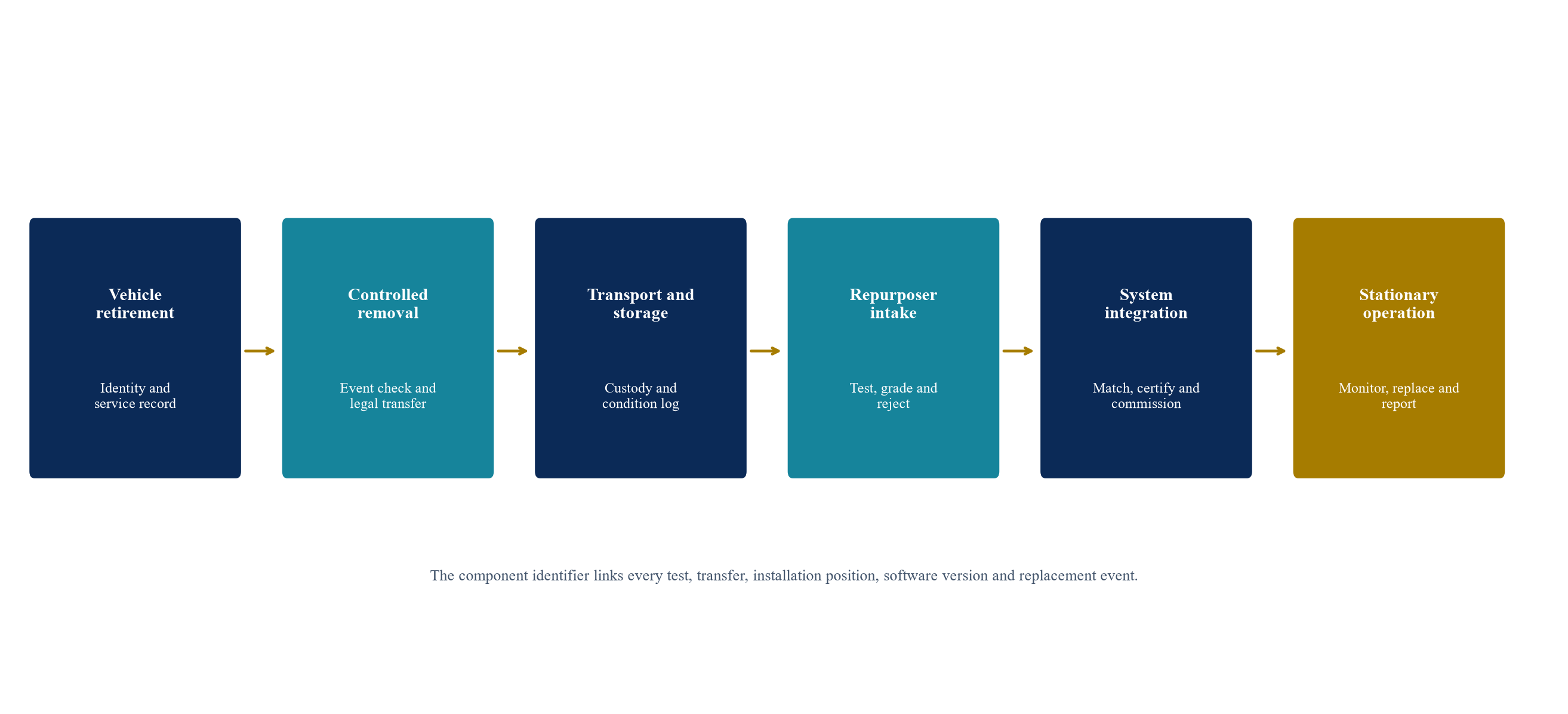
Each transfer preserves identity, condition evidence and responsibility. Missing evidence changes the acceptance route rather than being treated as a blank.
35. Build a contract matrix before procurement
The project should map every material promise to a provider, evidence source, measurement, remedy, security and survival period. This exposes gaps early.
Table 3. Warranty and risk-allocation matrix
| Promise | Primary provider | Measurement or evidence | Remedy | Credit support |
|---|---|---|---|---|
| Lawful title and disclosed history | Feedstock seller | Identifiers, records and transfer documents | Rejection, replacement and indemnity | Retention, parent support or escrow |
| Correct grading | Repurposer | Approved tests, calibration and raw results | Diagnosis, replacement and logistics | Bond, guarantee or funded reserve |
| Initial AC performance | System integrator | Commissioning test at agreed boundary | Rectification, capacity addition or damages | Performance security and retention |
| Degradation curve | Repurposer or integrator | Periodic normalized capacity tests | Replacement, augmentation or cash remedy | Warranty reserve and parent guarantee |
| System availability | Integrator and operator | Metered capability and outage classification | Liquidated damages and cure | Liability cap, bond and insurance |
| Software access and function | Software provider and integrator | Licence, version record and validation test | Correction, step-in and escrow release | Escrow and continuity undertaking |
| Safe installation | Engineering contractor and integrator | Certification, tests and authority approval | Rectification and indemnity | Construction security and insurance |
| End-of-life performance | Producer, owner or take-back provider | Collection and recycling records | Take-back or reimbursed cost | Reserve, guarantee or trust account |
The final matrix should reconcile acquisition, repurposing, integration, construction, operation, insurance, offtake and financing documents.
36. Price data gaps rather than ignoring them
A project may receive packs with incomplete history. It should have a defined route for that condition. Enhanced electrical and thermal testing, longer observation, lower grade, reduced price and conservative duty can mitigate some uncertainty.
Some gaps cannot be cured economically. Unknown title, evidence of accident, inconsistent identifiers, unexplained software modification or failed isolation should lead to rejection. The acceptance policy should be approved before feedstock procurement so commercial pressure does not weaken it.
The financial model should include the cost of rejected packs and testing yield. A low acquisition price can become expensive when logistics and testing are incurred on unusable units.
37. Prepare the lender data room around evidence chains
The data room should contain feedstock master agreements, title evidence, custody procedures, transport records, grading protocols, calibration certificates, test data, population statistics, certification, hazard analysis, design, software licences, warranties, security, insurance, offtake and operating procedures.
Each model input should link to a document. Accepted capacity should link to test results. Replacement cost should link to contracts and logistics. Warranty recovery should link to remedy, security and provider credit. Revenue should link to the same operating envelope as the warranty.
The project should preserve version history. A change in pack model, test method, firmware or dispatch profile can alter conclusions across several documents.
38. Apply nine approval gates
Investment approval should confirm lawful feedstock, continuous traceability, reproducible grading, certified application design, secure data and software access, aligned warranties, funded remedies, financeable downside and transferable rights.
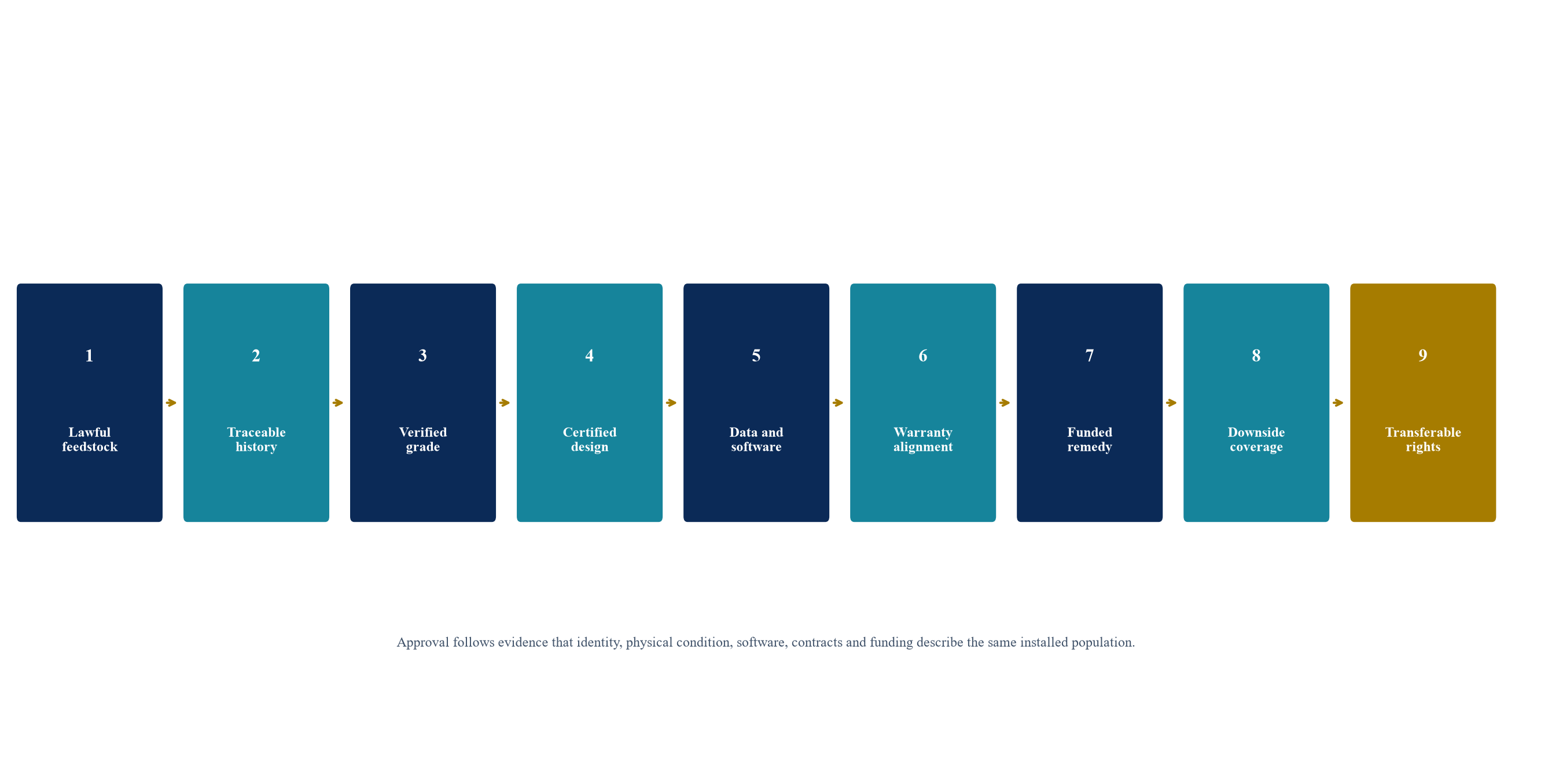
Conditional approval should identify missing evidence, responsible party, deadline and consequence. A failed safety or title gate stops the unit or project.
39. Preserve transferability through refinancing and sale
A buyer or enforcement purchaser should receive title to batteries, test records, passports, software rights, certifications, warranties, spares, take-back arrangements and operating data. Change-of-control and assignment restrictions should be identified before financing.
The asset register should reconcile physical inventory with security filings and insurance schedules. Replacement components should become part of the secured asset and inherit the required records.
Operating history can increase value when it demonstrates stable degradation, reliable availability and effective replacement. The owner should preserve raw data and independent reports rather than provide only summary dashboards.
40. Recognise limits and research needs
Second-life battery performance depends on chemistry, design, first-life use, testing, stationary duty and local conditions. Public research cannot establish the life or safety of a specific project population. The hypothetical model in this paper illustrates contract and financing mechanics rather than a project valuation.
Standards and regulation continue to develop. A project should confirm the current rules in each jurisdiction and with the relevant authority, insurer and lender. Certification pathways may differ from the examples cited here.
Further research should compare standardized field performance across larger populations, validate state-of-health estimates against independent tests, quantify warranty claim patterns and publish consistent second-life safety and availability data.
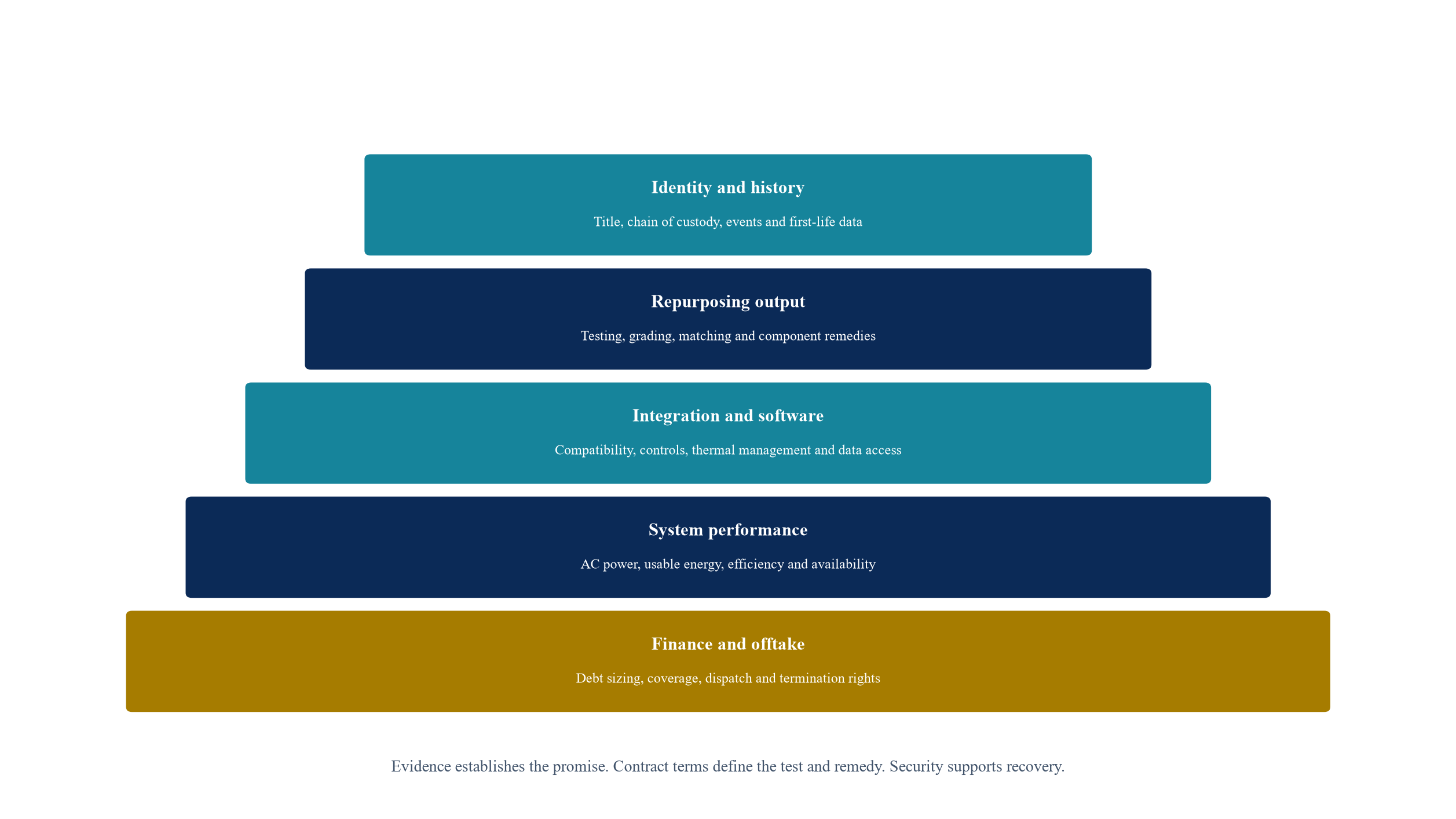
Each layer supports the next. A project remains exposed when a performance promise lacks evidence, remedy or credit support.
41. Conclusion
A retired electric-vehicle battery becomes financeable stationary storage through evidence and contract design. Identity, custody, first-life data and repeatable testing establish what the project owns. Application-specific integration and certification establish how it can operate. Aligned warranties, remedies and security establish who bears shortfall.
State of health is an important input. Bankability also requires dispersion analysis, remaining-life modelling, software access, duty-cycle controls, replacement planning and end-of-life funding. Every key model assumption should trace to evidence and every material promise should trace to a responsible and creditworthy party.
The second contract should be designed before feedstock is purchased. That sequence allows the developer to reject unsuitable units, price uncertainty, preserve certification and build a financing case around verified usable output.
References
- European Parliament and Council, Regulation (EU) 2023/1542 Concerning Batteries and Waste Batteries, consolidated text dated 31 July 2025. https://eur-lex.europa.eu/legal-content/EN/TXT/?uri=CELEX:02023R1542-20250731
- International Energy Agency, Electric Vehicle Batteries, Global EV Outlook 2026, 2026. https://www.iea.org/reports/global-ev-outlook-2026/electric-vehicle-batteries
- International Energy Agency, Battery Circularity, 2026. https://www.iea.org/reports/battery-circularity
- International Energy Agency, Recycling of Critical Minerals, 2024. https://www.iea.org/reports/recycling-of-critical-minerals
- UL Solutions, UL Certification Helps Promote Repurposing of Electric Vehicle Batteries, 10 October 2022. https://www.ul.com/news/ul-certification-helps-promote-repurposing-electric-vehicle-ev-batteries
- UL Solutions, UL Issues World's First Certification for Repurposed EV Batteries to 4R Energy, 19 August 2019. https://www.ul.com/news/ul-issues-worlds-first-certification-repurposed-ev-batteries-4r-energy
- International Electrotechnical Commission, IEC TR 62933-2-201:2024, Review of Testing for Battery Energy Storage Systems for the Purpose of Implementing Repurpose and Reuse Batteries, 2024. https://webstore.iec.ch/en/publication/88974
- International Electrotechnical Commission, IEC 61427-2:2015+AMD1:2024, Secondary Cells and Batteries for Renewable Energy Storage, Part 2 On-grid Applications, 2024. https://webstore.iec.ch/en/publication/93655
- United Nations Economic Commission for Europe, UN Global Technical Regulation No. 22, In-vehicle Battery Durability for Electrified Vehicles, 2022. https://unece.org/transport/documents/2022/04/standards/un-gtr-no22-vehicle-battery-durability-electrified-vehicles
- National Fire Protection Association, NFPA 855 Standard for the Installation of Stationary Energy Storage Systems, 2023 edition. https://link.nfpa.org/all-publications/33
- Neubauer, J., Smith, K., Wood, E. and Pesaran, A., Identifying and Overcoming Critical Barriers to Widespread Second Use of PEV Batteries, National Renewable Energy Laboratory, 2015. https://www.nrel.gov/docs/fy15osti/63332.pdf
- Neubauer, J. and Pesaran, A., Techno-economic Analysis of PEV Battery Second Use, National Renewable Energy Laboratory, 2015. https://www.nrel.gov/docs/fy15osti/64641.pdf
- Neubauer, J. et al., Battery Second Use Analysis and Demonstration, National Renewable Energy Laboratory, 2019. https://www.nrel.gov/docs/fy19osti/72557.pdf
- Moy, K. et al., Second-life Lithium-ion Battery Aging Dataset Based on Grid Storage Cycling, Data in Brief, 2024. https://doi.org/10.1016/j.dib.2024.111046
- State of Health Indicators for Second Life Battery Through Non-destructive Test Approaches from Repurposer Perspective, Journal of Energy Storage, 2024. https://doi.org/10.1016/j.est.2024.111656
- State of Health Estimation Methods for Second Life Lithium-ion Battery, Applied Energy, 2024. https://doi.org/10.1016/j.apenergy.2024.123542
- State of Health Estimation of Second-life Lithium-ion Batteries Under Real Profile Operation, Applied Energy, 2022. https://doi.org/10.1016/j.apenergy.2022.119992
- Horesha, N. et al., Driving to the Future of Energy Storage: Techno-economic Analysis of a Novel Method to Recondition Second Life Electric Vehicle Batteries, Applied Energy, 2021. https://www.osti.gov/servlets/purl/2409204
- International Energy Agency, Batteries and Secure Energy Transitions, 2024. https://www.iea.org/reports/batteries-and-secure-energy-transitions
- ACEEE, Repurposing EV Batteries for Second-Life Stationary Storage: Market Landscape and Key Challenges, 2025. https://www.aceee.org/sites/default/files/pdfs/repurposing_ev_batteries_for_second-life_stationary_storage_-_market_landscape_and_key_challenges.pdf
About the Author
Chennakeshav (CK) is a corporate finance and investment banking executive with 25+ years of global experience in deal origination, structuring and execution across M&A, growth capital and corporate strategy. He has led value-creation mandates for founders, corporates and funds — bridging the boardroom view to hands-on execution and close.
His career spans Morgan Stanley, HSBC, Lloyds Banking Group, EWEC, ADQ portfolio companies and Emirates Growth Fund, across TMT, real estate, fintech, deeptech, cleantech, infrastructure and energy. He has partnered with C-suite leaders, private equity and venture funds, sovereign wealth funds and family offices to finance complex fund raises and scale-up ventures, and has led M&A due diligence, post-merger integration and business-transformation initiatives to create value.
At Matchpoint Partners he is Managing Partner, leading the firm's corporate finance, M&A and capital-raising practice. He holds an MBA from London Business School, an engineering degree from VTU and a Master of Laws (LLM, in progress) from UCL London.
An active start-up mentor, CK mentors at Techstars, DIFC FinTech Hive, Startup Grind, Founder Institute and IN5, serves as Entrepreneur Mentor in Residence (EMiR) at London Business School, and judges the Entrepreneurship World Cup.
LinkedIn: https://www.linkedin.com/in/ckadya/
Profile: https://www.matchpoint-partners.com/team/ck-adya.html
