
Introduction
Long-term data-centre contracts can look bond-like. A hyperscale lease may specify critical information-technology capacity, a commencement date, a base term, rent escalation, power charges, operating standards and remedies. A portfolio can contain multiple campuses and tenants. Public filings also show established programmes of secured data-centre revenue notes and variable funding facilities.
Contracted revenue is not the same as financeable cash flow. The operator may need to buy power, maintain cooling and electrical systems, fund lifecycle capital expenditure, meet service levels and complete customer-specific work before receiving payment. A contract can be long-dated while its counterparty, pricing formula, termination rights or acceptance conditions create material uncertainty. Some campuses are owned; others are held through ground leases or operating rights. Recovery differs accordingly.
The financing question is therefore precise: which recurring cash flows can be isolated, standardised, stressed and governed so that debt can be repaid through the operating performance of a defined campus pool? The answer requires a contract-to-cash map, an asset-perimeter map and a legal structure that survives sponsor distress. It also requires an operational system capable of producing accurate data and maintaining the facilities throughout the financing term.
The central conclusion is that a portfolio becomes securitisable when its contracts, costs, assets and controls can be converted into a repeatable payment system. Power arrangements contribute to that system only where volume, price, pass-through, curtailment, credit and replacement are aligned with the customer obligations they support.
1 Define the securitised proposition
A data-centre securitisation is generally supported by income generated from operating facilities and, where the issuer owns the property, potential proceeds from asset sales. Rating analysis focuses on recurring lease income, property value, tenant concentration, utilisation, expenses, capital expenditure, downtime, renewals and transaction structure. Filed transactions commonly include asset entities, tenant leases, reserves, accounts, fixtures and equity interests within the collateral package.
The proposition should be stated without relying on a headline backlog. It identifies the obligors, campuses, eligible customer contracts, power and service arrangements, property interests, secured accounts, manager, servicer and permitted debt. It also states whether the pool contains stabilised facilities only or allows additions after defined completion tests.
Management should distinguish gross contracted revenue from collections available for debt service. The former can include electricity reimbursement, customer fit-out, future phases, renewal options and amounts subject to acceptance. The latter begins after operating expenses, power procurement, taxes, insurance, maintenance, required capital expenditure and senior payments.
2 Map the contractual stack
The campus cash flow can depend on five linked layers. The property layer covers land, buildings, access and easements. The grid layer covers utility service, interconnection, capacity, metering and operating restrictions. The energy layer covers electricity purchases, hedges, renewable contracts and backup supply. The customer layer covers leases, colocation, capacity and service obligations. The financing layer covers security, accounts, reserves and payment priority.
Each layer can have a different counterparty and term. A fifteen-year customer lease can rely on a utility arrangement that permits tariff changes. A ground lease can expire before the rated final maturity. A renewable power purchase agreement can settle financially while the campus still purchases physical power from the grid. The asset map should show these distinctions.
The transaction should recognise only rights held by an obligor or validly assigned to the financing perimeter. Sponsor affiliates may provide procurement, operations, guarantees or shared infrastructure. Those dependencies need enforceable agreements, replacement rights and limits on amendment.
3 Distinguish revenue types
Data-centre contracts can charge a fixed facility amount, a capacity fee, metered electricity, all-in power, interconnection, cross-connects, managed services, fit-out reimbursement or combinations. Public filings describe both all-in and metered-power structures. Under an all-in structure, utility-cost changes can compress margin unless indexation or adjustment clauses pass them through. Under metered arrangements, actual electricity cost can be reimbursed while volume and timing differences remain.
The financing model should separate base recurring revenue, power reimbursement, variable services, construction reimbursement and non-recurring income. Base revenue can receive stronger recognition when commencement, availability, escalation and termination are clear. Power reimbursement should be paired with the corresponding cost and working-capital timing. Fit-out reimbursement should not be treated as permanent operating margin.
Renewal options remain outside the binding case unless the methodology explicitly recognises them through conservative assumptions. Customer-announced contract value should be reconciled to annual billings, commencement, ramp, indexation and accepted capacity.
4 Define eligible assets
Eligibility criteria turn a collection of facilities into a governed pool. A stabilised campus can be eligible when it has enforceable site control, operating permits, accepted customer capacity, current power rights, completed material works, compliant insurance, tested systems and a complete data record. The contract should be valid, assignable where required and free of disqualifying default.
The criteria should set minimum remaining term, customer credit requirements, concentration limits, currency and jurisdiction rules, property standards, utilisation tests and environmental conditions. They should specify treatment of ground leases, customer options, affiliate contracts, unresolved disputes and material construction.
Assets that fail eligibility can remain outside the pool or enter a transition category with lower advance rates and extra reserves. Clear ineligibility protects investors and prevents the sponsor from treating future development value as present collateral.
Table 1. Contracted campus securitisation eligibility gates
| Gate | Required evidence | Failure signal | Financing response |
|---|---|---|---|
| Property | Title or lease, access, easements and security rights | Term mismatch, unregistered interest or consent gap | Exclude, cure or shorten debt term |
| Power | Executed utility and supply arrangements, metering and cost rules | Capacity is conditional, interruptible or subject to unpriced works | Haircut cash flow and require reserve |
| Customer | Executed contract, accepted capacity, payment history and support | Revenue depends on unsigned expansion or unresolved acceptance | Exclude future phase from debt sizing |
| Operations | Tested systems, service-level history, maintenance plan and operator continuity | Repeated outage or sponsor-only operating dependency | Remediate and add replacement rights |
| Cash flow | Reconciled billing, collections, costs and lifecycle capital expenditure | Contract value cannot reconcile to banked cash | Defer inclusion and correct data |
| Legal isolation | Obligor ownership, perfected security, controlled accounts and separateness | Critical rights remain in an affiliate | Transfer, assign or obtain direct agreement |
| Data | Complete lease, power, property and performance fields | Missing commencement, expiry, cost or concentration data | Zero recognition until corrected |
This author-developed matrix is a transaction-screening tool. It does not replace legal, technical, accounting, tax, regulatory or credit advice.
5 Build the contract-to-cash map
Every material contract should be translated into a monthly cash-flow rule. The customer agreement determines capacity, rate, escalation, commencement, credits and termination. The utility and procurement contracts determine demand charges, energy charges, network fees, taxes, losses and adjustment timing. Operating agreements determine fees and reimbursable costs.
The map should identify who invoices, who collects, which account receives cash and when amounts can be transferred. It should reconcile invoices to meter data, customer acceptance and bank receipts. Power expenses should be matched to reimbursed amounts and tested for timing lags.
The model should also identify cash that cannot be pledged. Customer deposits can be refundable. Tax and utility amounts can be held for third parties. Restricted environmental or construction funds can sit outside available cash. The waterfall begins only after ownership and purpose are established.
6 Standardise the data tape
The data tape is the operating representation of the collateral. Public rating models and agreed-upon-procedures filings indicate the importance of lease-level fields such as contract value, start and end dates, rent changes, property, currency and power cost. A portfolio securitisation needs the same discipline across every campus.
The tape should include legal entity, property interest, utility point, contracted and accepted critical load, customer, guarantor, credit support, lease term, rate, escalation, power treatment, service levels, termination rights, renewal, utilisation, operating cost, maintenance, capital expenditure and collections. Source documents and calculation rules should be linked.
An independent review can test selected fields against executed documents. Responsibility remains with management. Exceptions should be resolved before inclusion or disclosed and reflected in sizing. A clean data tape is also an asset for acquisitions, refinancing and surveillance.
7 Align customer and power terms
The customer promise and power obligation should be tested together. A fixed all-in customer price funded by floating utility tariffs creates margin risk. A pass-through clause can reduce that risk while creating billing and dispute exposure. A take-or-pay customer obligation can support revenue, yet availability failures can trigger credits or termination.
Term alignment matters. A customer lease that runs beyond an energy hedge or power supply arrangement exposes later cash flow to repricing. A PPA can exceed the customer term and leave stranded volume. Renewable claims and physical delivery should be distinguished because a financial PPA does not itself provide local capacity or reliability.
The transaction model should show matched volume, unmatched volume, fixed and indexed prices, floors, caps, collateral, curtailment, congestion, basis and termination. The weakest material mismatch should influence the advance rate and reserve structure.
8 Establish free net cash flow
Free net cash flow begins with eligible recurring collections. It deducts property and operating expenses, electricity and network costs, taxes, insurance, management, maintenance and a sustainable capital-expenditure allowance. It also reflects customer credits, bad debt and downtime.
Rating criteria often apply stresses to utilisation, renewal, expenses, capital expenditure, downtime and property value. The sponsor should build its own base and downside cases before engaging lenders. The calculation should be reproducible from the data tape and accounting records.
Growth expenditure should remain separate from maintenance required to preserve existing cash flow. Customer-funded fit-out should be matched to the related reimbursement and completion risk. Capitalised cost should not disappear from the cash model merely because accounting presentation spreads it over time.
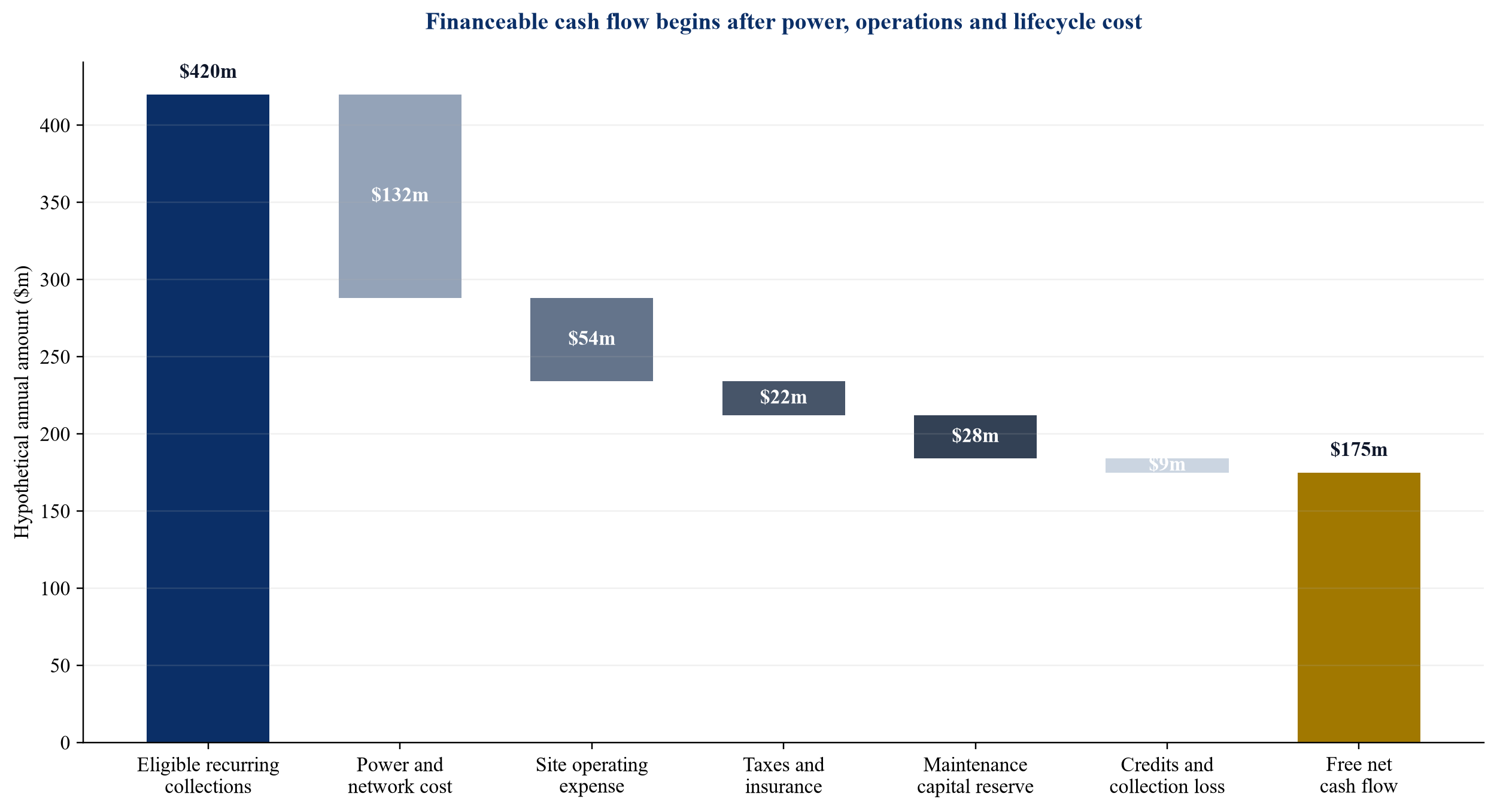
Values are hypothetical author-developed assumptions in US dollars millions. They do not describe a particular issuer, campus or financing.
9 Measure tenant credit and concentration
Hyperscale customers can provide strong contractual support while creating large single-name exposure. The analysis should identify the contracting entity, guarantor, rating, financial capacity, termination rights, cross-defaults, security and operational importance of the campus. Brand recognition alone is insufficient.
Concentration should be measured by revenue, free net cash flow, critical load, campus and lease expiry. A single tenant can occupy several facilities, so geographic diversification may not reduce obligor concentration. Customers can also be correlated through the same technology cycle or cloud market.
The downside case should combine a major tenant default with re-leasing downtime, incentives, fit-out and lower renewal rent. Deposits and guarantees should be recognised only to the extent enforceable and available within the financed entities.
10 Test utilisation and re-leasing
Utilisation can mean leased capacity, accepted capacity, energised load or actual consumption. The data tape should use consistent definitions. A tenant can reserve capacity without immediately drawing full energy. The facility still carries fixed costs and opportunity cost.
Re-leasing depends on market, location, power density, cooling, interconnection, security and configuration. Customer-specific facilities can require modification. Lease expiry analysis should therefore include downtime, tenant improvements, commissions and rent reset.
The strongest pool combines contractual protection with adaptable buildings and power systems. The recovery case should not assume immediate replacement by another hyperscaler at the same price.
11 Evaluate campus and geographic concentration
A portfolio can remain concentrated in one utility territory, transmission zone, climate, regulatory regime or natural-hazard area. Several buildings sharing one substation, fibre route or cooling source can fail together. Diversification should therefore be measured through common-cause dependencies.
The analysis should map utility, grid node, generation supply, flood, heat, water, seismic, wildfire, fibre and operator dependencies. It should identify which assets share spares, control systems or construction contractors. Geographic spread adds value when it reduces correlated loss and preserves alternative capacity.
Concentration limits can be written into the eligibility criteria and replenishment rules. The issuer should report them throughout the financing, not only at closing.
12 Separate operating and construction risk
Operating revenue notes should be supported by accepted, billable facilities. A construction campus has cost-to-complete, schedule, procurement, commissioning and customer-acceptance risk. Combining the two without a clear gate transfers development volatility into the securitised pool.
Construction can be financed through sponsor equity, construction debt, customer advances or a separate facility. An asset can enter the operating pool after utility energisation, integrated testing, completion certification, customer acceptance, insurance and data verification. Any debt released on entry should respect portfolio concentration and coverage tests.
A delayed project should not draw support automatically from operating campuses. Cross-support can increase completion confidence while reducing transparency and trapping cash. The board should approve the allocation deliberately.
13 Use a master-trust architecture carefully
A master trust can issue multiple series against a common collateral pool. Public data-centre revenue-note programmes show repeated issuance and variable funding notes alongside term debt. This architecture can reduce repeat transaction cost and support acquisitions or refinancing.
The programme documents must define parity, voting, additional issuance, collateral additions, releases, reserves, amortisation and inter-series priority. New debt should pass coverage, leverage, concentration and no-default tests. Asset substitutions should preserve or improve collateral quality.
The flexibility has a governance price. Weak additional-issuance tests can dilute existing investors. Broad release rights can move stronger assets out of the pool. Surveillance should show the effect of every addition, removal and new series.
14 Establish legal isolation and security
The securitisation usually relies on special-purpose obligors, separateness covenants, controlled accounts, security over assets and cash flows, and restrictions on other debt. The exact structure depends on jurisdiction, property ownership, tax and insolvency law.
The legal review should confirm ownership, transfer, assignment, perfection, enforceability and the treatment of customer and power contracts in insolvency. Consent may be required to assign a lease, utility agreement, ground lease or operating licence. Direct agreements can provide notice, cure and step-in rights.
Where an issuer does not own the land or facility, recovery can rely more heavily on recurring contracts and assigned rights. Debt sizing should reflect the resulting difference in liquidation value and control.
15 Size debt from stressed cash flow
Debt capacity should be derived from stressed free net cash flow, coverage, leverage, amortisation and recovery. The model should test customer default, downtime, lower renewal rent, utility-price mismatch, operating cost inflation, capital expenditure, interest rates and refinancing.
An anticipated repayment date is not the same as legal maturity. Public filings show structures with a near-term anticipated repayment date and a much later rated final payment date. Failure to repay by the anticipated date can trigger higher interest and excess-cash amortisation. This structure leaves refinancing risk with the sponsor while creating a contractual path after a failed refinance.
The board should compare proceeds with expected refinancing exposure. Maximum leverage can reduce current equity while increasing the risk that future capital markets control the outcome.
16 Design the payment waterfall
The waterfall should preserve the assets before distributing residual cash. Taxes, essential utilities, insurance and necessary operating expenses generally sit ahead of debt service. Trustee, servicer and administration costs follow according to the documents. Interest, principal, reserves and subordinated distributions then apply in defined order.
The waterfall should address timing differences. A missed customer payment can coincide with a utility bill that must be paid to keep the campus operating. Liquidity advances or reserves can bridge timing, subject to reimbursement and limits. They should not conceal permanent cash-flow deterioration.
Triggers can redirect cash from distributions to reserves or principal. The calculation agent should publish sufficient detail for management and investors to reproduce the result.
Table 2. Hypothetical operating cash waterfall and protections
| Waterfall level | Illustrative payment | Main control | Downside purpose |
|---|---|---|---|
| 1 | Taxes, essential power and critical operating cost | Approved budget and controlled account | Preserve legal and operating continuity |
| 2 | Insurance, trustee, servicer and administration | Policy and fee limits | Maintain collateral and transaction functions |
| 3 | Senior interest and required hedge payments | Interest reserve and hedging limits | Protect timely senior payment |
| 4 | Scheduled principal and required amortisation | Coverage and leverage tests | Reduce refinancing exposure |
| 5 | Replenish liquidity, maintenance and capital reserves | Target balances and permitted withdrawals | Fund outages, lifecycle work and timing gaps |
| 6 | Subordinated debt | Deferrable payment conditions | Absorb volatility before equity |
| 7 | Sponsor distribution | No default and distribution tests | Retain cash when collateral weakens |
The ordering is illustrative. Actual priority depends on transaction documents, law, tax, utility terms and rating or lender requirements.
17 Calibrate reserves
Reserve design should follow specific risks. A debt-service reserve addresses temporary payment gaps. A maintenance reserve addresses predictable lifecycle work. A power reserve can address collateral calls, price lag or extraordinary tariff adjustment. A property reserve can address taxes and insurance.
Sizing should use the exposure period, not a generic number of months. A transformer replacement reserve depends on procurement time and redundancy. A tenant rollover reserve depends on expiry concentration, downtime and fit-out. A utility collateral reserve depends on contractual posting requirements.
Reserves should have objective funding, withdrawal and replenishment rules. Excess reserves reduce equity efficiency, while insufficient reserves can force emergency sponsor support or asset deterioration.
18 Manage interest-rate, currency and basis risk
The collateral can be fixed, indexed or floating while debt can have a different profile. Interest-rate hedges may align debt service with collections. Currency risk arises when campuses or contracts span jurisdictions. Power-price basis risk arises when a hedge index differs from the local utility cost.
The issuer should model hedge counterparty credit, collateral, termination, replacement and mismatch. The hedge term should align with the debt or have a credible replacement plan. A long-dated hedge can itself require liquidity if market value moves.
Hedges reduce selected risks; they do not repair weak customer contracts or unavailable power. Governance should restrict speculative positions and require transparent reporting.
19 Treat power as an operating dependency
Electricity is both a cost and an essential service. The financing review should examine contracted capacity, physical delivery, network reliability, curtailment, backup, tariff, metering, demand charges, losses, taxes, collateral and dispute mechanisms. Renewable attributes should be tracked separately.
Public energy analysis continues to show rapid data-centre demand growth and regional grid constraints. A campus can have a signed energy contract while still facing interconnection, network or resource-adequacy risk. The issuer should preserve current utility evidence and comply with operating requirements.
Power procurement should be integrated with customer contracting. If a customer increases density or changes ramp, the operator may incur demand and infrastructure cost before the revenue adjustment becomes effective.
20 Stress power-price pass-through
Pass-through clauses differ in scope and timing. Some cover actual electricity, while network charges, demand penalties, taxes or extraordinary adjustments remain with the operator. Caps, notice periods and audit rights can delay recovery. A customer dispute can suspend payment.
The model should separate fully matched, lagged, capped and unhedged cost. It should include working-capital requirements and bad debt on reimbursed amounts. An indexed all-in rate should be tested against the actual cost index and load shape.
The stress case should combine a power-price increase with reduced utilisation and customer credit pressure. This reveals whether apparent reimbursement remains collectible when conditions deteriorate.
21 Govern additions and substitutions
A revolving or expandable programme needs clear rules for adding campuses, leases and contracts. Each addition should pass eligibility, data, legal, technical and concentration tests. Its inclusion should not cause a default or reduce required coverage.
Substitution should be limited to genuine asset management. The sponsor should not exchange a strong asset for a weaker development. Removal proceeds should repay debt, fund eligible replacement collateral or remain trapped according to the documents.
The trustee or verification agent should receive enough evidence to confirm compliance. Material judgement should remain subject to documented governance and investor protections.
22 Set performance triggers
Triggers translate deterioration into action. They can measure debt-service coverage, leverage, tenant concentration, delinquency, utilisation, outage, lease expiry, reserve balance, property value and manager performance. Breach can trap cash, stop additions, require amortisation or trigger replacement.
Metrics should use precise definitions and reliable data. A coverage ratio can be misleading if free net cash flow excludes required capital expenditure. Utilisation should distinguish contracted, accepted and consumed capacity. Property value should use an appropriate basis and date.
Cure rights should preserve viable operations without allowing indefinite delay. Repeated breaches can indicate a structural problem even when individually cured.
23 Preserve manager and servicer continuity
The manager operates facilities, negotiates leases, procures power, prepares budgets and maintains systems. The servicer administers collections, reporting and waterfall calculations. A sponsor-affiliated manager can provide expertise while creating dependency.
The transaction should define duties, standards, fees, replacement events, data access, transition assistance and intellectual-property rights. Back-up arrangements should be proportionate to complexity. Critical operating records and credentials should be available to a replacement.
Step-in is practical only when licences, staff, suppliers, software and control systems can transfer. The operating review should test this path before closing.
24 Fund lifecycle capital expenditure
Data-centre value depends on continuing investment in electrical, cooling, fire, security, controls and building systems. High-density computing can accelerate design change. Deferred maintenance can protect short-term distributions while weakening reliability and re-leasing value.
The lifecycle plan should link asset condition, useful life, replacement cost, procurement lead time and redundancy. It should distinguish routine maintenance, major replacement and customer-driven upgrades. Required work should be included in free net cash flow or funded through a reserve.
The surveillance package should compare actual work with plan. Persistent deferral should affect distributions and borrowing capacity.
25 Address technology and obsolescence
The facility is long-lived while computing technology evolves quickly. Power density, cooling, network, rack format and energy efficiency can change. A campus designed around one customer or cooling method can face conversion cost at renewal.
The underwriting should assess adaptability: electrical distribution, floor loading, cooling, water, fibre, modularity and expansion. It should also identify customer-owned equipment and removal obligations. Server obsolescence should not be confused with building obsolescence, but the two can interact through density and thermal design.
The recovery case should include reconfiguration time and capital. A highly specialised asset can have strong current cash flow and weak alternative use.
26 Control outage and service-level exposure
Customer contracts can impose credits, termination or damages for availability failures. The model should map each service level to operational evidence and financial consequence. Shared infrastructure can create multiple simultaneous claims.
Outage history should distinguish utility events, equipment failure, human error, software, maintenance and force majeure. Insurance can cover selected physical and business-interruption losses, subject to deductibles, exclusions and waiting periods.
The stress case should combine lost revenue, credits, repair cost, customer termination and reputational effects. Resilience expenditure can then be evaluated against avoided cash-flow loss.
27 Integrate cyber and operational technology risk
Campus operations rely on control systems, building management, access, monitoring and network services. Cyber incidents can interrupt operations or compromise data and safety. The financing perimeter should identify systems essential to collateral performance.
Controls should cover asset inventory, identity, segmentation, remote access, suppliers, logging, response, recovery and testing. Relevant frameworks can guide governance, while the implementation must reflect facility design and contractual duties.
Cyber insurance and customer requirements should be reconciled. A breach can create costs and contract remedies beyond insured loss. Material incidents should enter surveillance reporting.
28 Align insurance with collateral
Insurance should cover property, machinery breakdown, business interruption, liability, environmental exposure, cyber and construction where relevant. Policy terms should match replacement time, revenue dependency and lender interests. Named insureds, loss payees and notice rights require confirmation.
The business-interruption period should reflect long-lead electrical equipment and utility restoration. Sublimits, exclusions and deductibles can leave material retained risk. Several campuses in one hazard zone can exhaust aggregate coverage.
Claims proceeds should follow restoration and prepayment rules. Restoration is appropriate only when funding, timing, permits and continuing contracts support it.
29 Address accounting and tax presentation
Customer arrangements can contain lease, service and variable consideration components. Power contracts can have lease, derivative or executory-contract implications depending on their terms and applicable standards. Securitisation can involve consolidation, financial-liability, derecognition and restricted-cash questions.
Accounting does not determine legal isolation or credit risk. It does affect reported revenue, earnings, debt, cash flow and covenants. The transaction model should bridge accounting measures to contractual collections and free net cash flow.
Tax analysis should address asset transfers, interest, withholding, property, sales, value-added tax and special-purpose entities. Cross-border pools add currency, treaty and insolvency complexity.
30 Compare financing routes
Corporate debt relies on the issuer's overall credit and flexibility. Project finance isolates a project and sizes debt against its contracted cash flow, often with construction and completion protections. A securitisation can pool operating assets and use a repeat-issuance platform. Real-estate debt may focus more heavily on property value and leases.
The right route depends on development stage, asset ownership, operating history, contract standardisation, scale, sponsor credit, desired tenor and transaction cost. A mixed portfolio can use different instruments by stage: development equity and construction debt, followed by operating project debt or securitisation.
The comparison should include covenants, trapped cash, hedging, ratings, disclosure, servicing and future asset flexibility. Coupon alone is an incomplete measure.
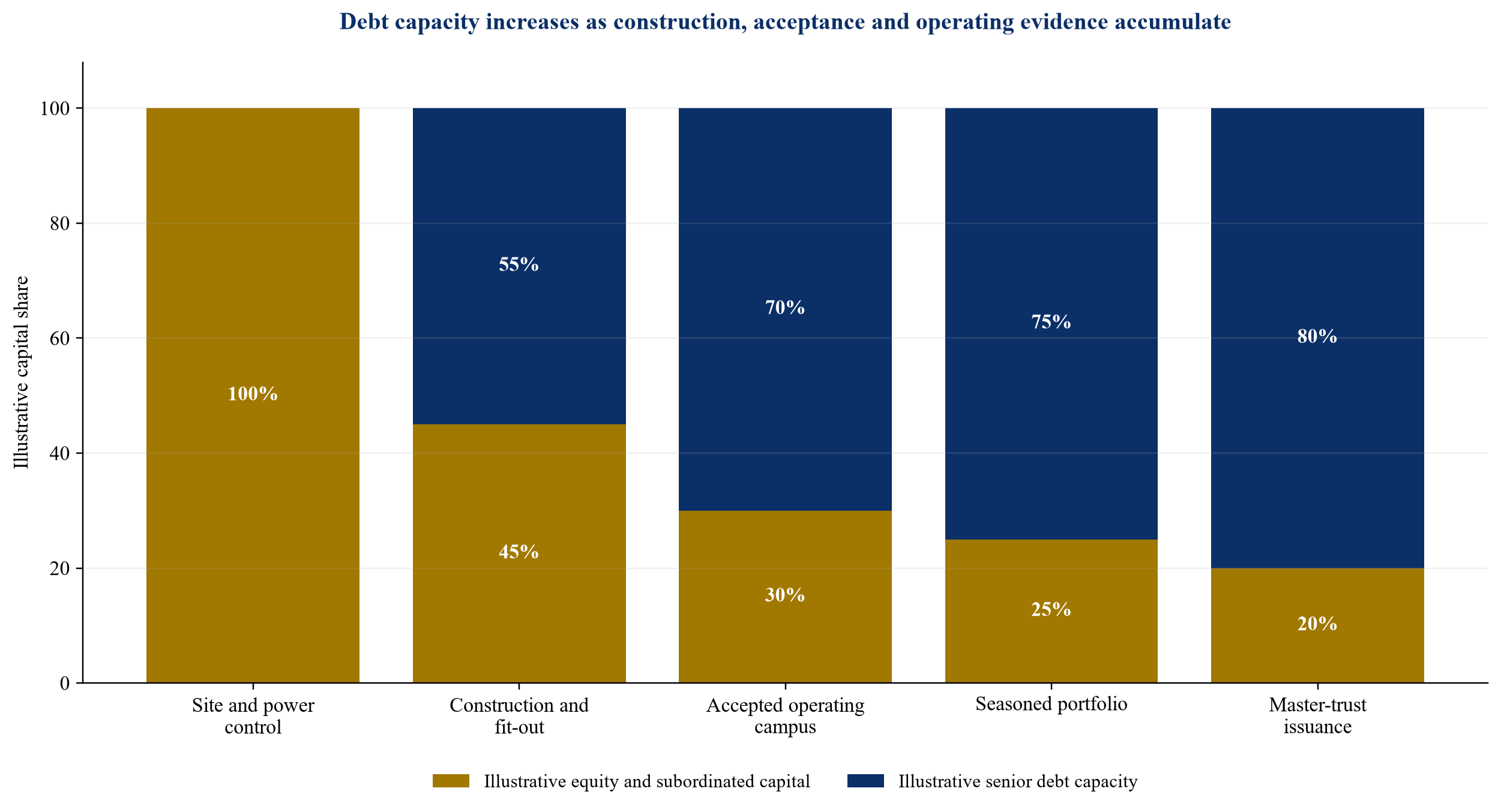
Amounts and thresholds are hypothetical author-developed assumptions. They are not market terms or recommendations for a particular financing.
31 Quantify transaction economics
The benefits can include longer tenor, fixed-rate debt, diversified investor access, repeat issuance and separation from sponsor credit. Costs include legal, rating, accounting, data review, hedging, trustee, servicing, surveillance, reserves and restricted flexibility.
The model should compare all-in present value across financing routes. It should include expected refinance cost at the anticipated repayment date, hedge termination, trapped cash and required capital. Repeat issuance can spread platform cost over time, but only if the asset pipeline and governance support it.
The transaction should create value under a realistic issuance programme. A one-off pool with complex exceptions can lose the standardisation benefit.
32 Use securitisation in portfolio M and A
A buyer can acquire operating campuses with bridge finance and refinance eligible assets into an existing platform after diligence and integration. The securitisation eligibility criteria then become an acquisition screen. Assets that cannot enter the pool require separate capital or a lower price.
The acquisition model should test change-of-control, assignment, customer consent, utility rights, property transfer, tax and integration. It should also preserve separateness between existing note collateral and newly acquired assets until addition conditions are met.
Sale proceeds and debt release should follow a documented asset-release price. Portfolio restructuring should not move value away from secured creditors without compensation and approvals.
33 Incorporate sustainability and reporting
Energy, water, carbon and renewable attributes can affect contracts, regulation, customer selection and capital access. Reporting should distinguish physical electricity, contractual renewable procurement and environmental certificates. It should use consistent boundaries and methods.
Sustainability-linked debt features should use measurable, auditable indicators and proportionate pricing consequences. They should not substitute for core credit protection. Data-centre reporting requirements differ by jurisdiction and can evolve.
The operating system should collect energy, water, power usage effectiveness, outages and customer allocation. These records support compliance, procurement and asset management as well as financing.
34 Apply a portfolio stress framework
The stress framework should combine correlated events. A power-price shock can coincide with customer stress and constrained grid capacity. A major outage can trigger credits, repairs, insurance delay and re-leasing risk. Higher interest rates can arrive at the anticipated repayment date when a large tenant approaches expiry.
Each scenario should show cash collections, operating cost, capital expenditure, reserve draw, debt service, coverage, trapped cash, principal repayment and ending liquidity. Property recovery should be tested separately from operating cash flow.
The scenario below illustrates how the same nominal contract portfolio can support different debt outcomes after customer, power and refinancing stresses.
Table 3. Hypothetical portfolio sizing and downside scenarios
| Metric | Base case | Moderate stress | Severe combined stress |
|---|---|---|---|
| Eligible annual collections | $420m | $372m | $296m |
| Free net cash flow | $175m | $132m | $82m |
| Senior debt | $1,650m | $1,450m | $1,050m |
| Cash interest and scheduled principal | $112m | $112m | $112m |
| Debt-service coverage | 1.56x | 1.18x | 0.73x |
| Liquidity and maintenance reserves | $95m | $122m | $165m |
| Largest tenant share of free net cash flow | 31% | 35% | 43% |
| Re-leasing downtime for defaulted capacity | 9 months | 18 months | 36 months |
| Refinancing rate at anticipated repayment date | 6.0% | 7.5% | 10.0% |
| Distribution status | Permitted | Trapped | Suspended and amortising |
All values are hypothetical author-developed assumptions in US dollars millions unless stated. They do not represent an offering, rating analysis, forecast or valuation.
35 Build the decision model
Management should evaluate the financing through four values. Operating value reflects contracted cash flow after sustainable cost. Financing value reflects proceeds and cost under the proposed structure. Flexibility value reflects the ability to add, sell, develop and refinance assets. Downside value reflects asset recovery and liquidity after stress.
The highest proceeds can reduce flexibility or increase refinance risk. A lower advance rate can preserve distributions under stress and allow easier asset additions. The decision model should therefore compare risk-adjusted equity value, not initial cash alone.
The board should record the selected leverage, reserve, tenor and trigger design together with rejected alternatives. Future issuances can then be assessed against the original risk appetite.
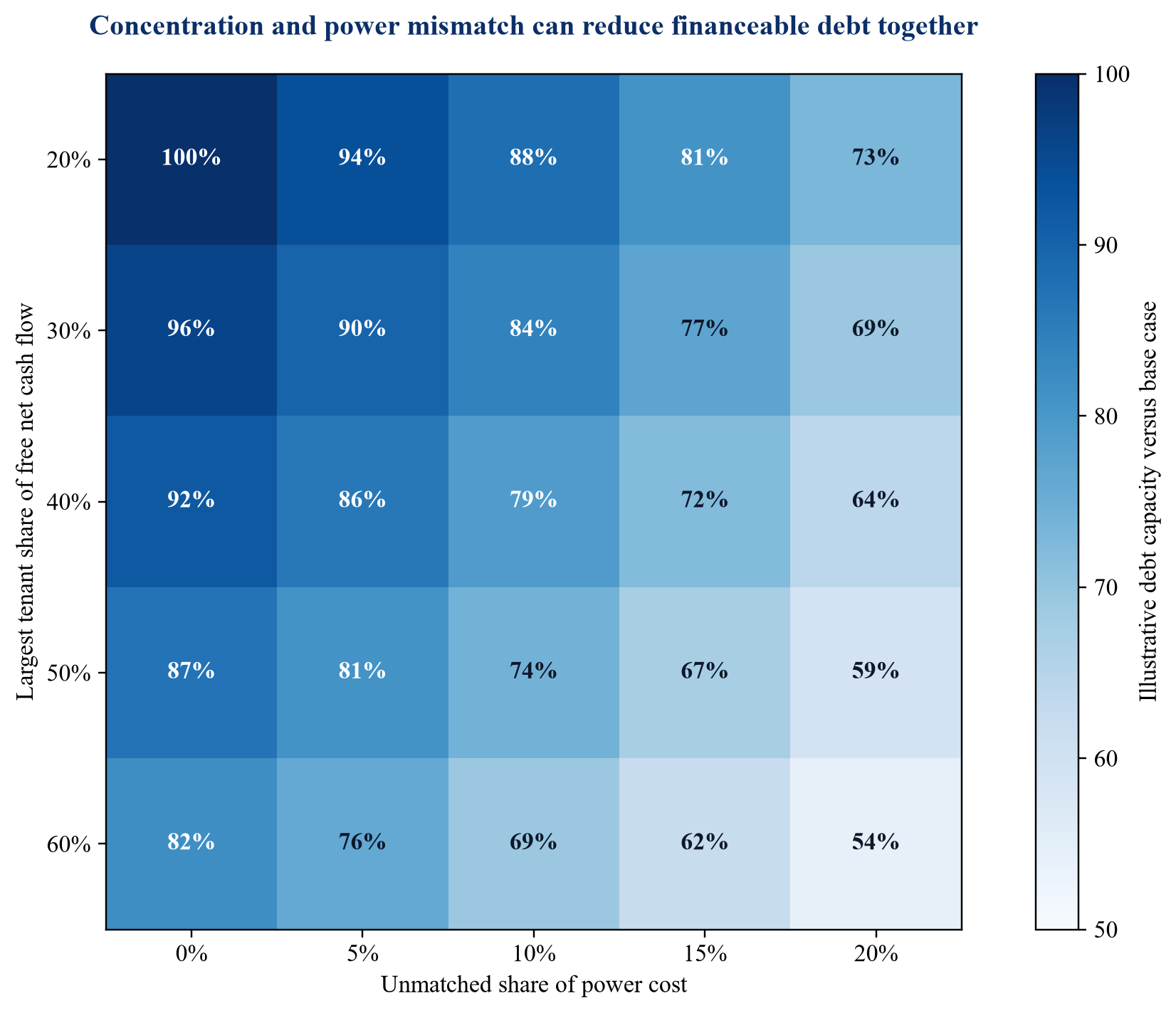
Values are hypothetical author-developed assumptions. Debt capacity is shown as a percentage of the base-case amount and does not represent a rating or lending model.
36 Establish surveillance
Surveillance should report collections, delinquencies, customer credit, utilisation, lease expiry, power cost and recovery, outages, capital expenditure, reserves, coverage, leverage, property value and trigger status. It should reconcile to the transaction accounts and data tape.
Material events include contract amendment, tenant downgrade, utility change, outage, casualty, cyber incident, environmental claim, litigation, insurance change and manager replacement. Reporting deadlines and responsibility should be defined.
The surveillance package also supports management. Trends in power recovery, credits and maintenance can identify value leakage before a covenant breach.
37 Recognise common failure modes
Common failures include using total contracted revenue as debt capacity, ignoring electricity and lifecycle cost, mixing construction with stabilised cash flow, treating financial renewable contracts as physical supply, overlooking tenant concentration and assuming refinancing at the anticipated date.
Other failures are legal: critical contracts remain outside the obligor group, assignment consent is absent, a ground lease ends too early or shared infrastructure cannot be controlled after sponsor distress. Data weaknesses can conceal each problem.
The transaction should stop when the contract-to-cash bridge cannot be reconciled, essential power or property rights cannot be secured, operating continuity is not credible or severe stress leaves no workable liquidity and recovery path.
38 Apply a board execution sequence
The board begins with a portfolio inventory and financing objective. It maps assets, contracts, power, property and dependencies. It defines eligibility, builds the data tape and reconciles collections to free net cash flow. Legal, technical, insurance, tax and accounting work then test the perimeter.
Management compares financing routes, develops the stress model and negotiates leverage, reserves, covenants, servicing and release rights. It completes independent data procedures and establishes surveillance. Only eligible operating assets enter the closing pool.
After closing, additions and new series follow the same gates. The programme becomes repeatable because evidence and definitions remain consistent across campuses and financing rounds.
39 Limitations
This paper presents a general analytical framework. It does not determine the legal isolation, accounting treatment, tax position, value, rating, financeability, credit quality or expected return of a particular issuer, contract, campus or security. Outcomes depend on transaction documents, jurisdiction, counterparties, asset condition, grid, power markets, customer contracts, operations and capital markets.
The figures and tables use hypothetical author-developed assumptions. They do not represent observed portfolio data, an offering document, valuation opinion, credit rating, financing commitment or investment recommendation. Public sources describe their own criteria, filings and transactions. Transaction-specific legal, technical, regulatory, accounting, tax, insurance, rating and financial advice is required.
Conclusion
Power, capacity and customer contracts can support portfolio financing when they operate as one verifiable payment system. The system begins with enforceable property and power rights, accepted customer capacity and reliable operations. It converts gross collections into free net cash flow after the costs required to keep the campuses functioning.
The Contracted Campus Securitisation Framework establishes eligibility, a standard data tape, legal isolation, stressed sizing, reserves, triggers, servicing and surveillance. It separates operating assets from construction risk and distinguishes customer revenue from power reimbursement and future options.
The strongest programme combines durable contracts with adaptable assets, controlled operating dependencies, conservative concentration limits and transparent downside liquidity. These qualities allow a financing platform to support growth while preserving the campuses and cash flows on which investors depend.
References
- S&P Global Ratings, Data Center Securitizations: Global Methodology and Assumptions, 2024. https://www.spglobal.com/ratings/en/research/digital-infrastructure
- S&P Global Ratings, Credit Rating Model: Data Center, updated 2025. https://spratings.spglobal.com/ratings/en/regulatory/article/-/view/sourceId/13110537
- S&P Global Ratings, ABS Frontiers: Equipping Data Centers Through Securitization, 2026. https://www.spglobal.com/ratings/en/regulatory/article/abs-frontiers-equipping-data-centers-through-securitization-s101645975
- S&P Global Ratings, CyrusOne Data Centers Issuer I LLC Series 2024-2 and 2024-3, 2024. https://www.spglobal.com/ratings/en/regulatory/article/-/view/type/HTML/id/3173264
- S&P Global Ratings, QTS Issuer ABS II LLC Series 2025-1 Presale. https://www.spglobal.com/ratings/en/regulatory/article/-/view/sourceId/101642672
- S&P Global Ratings, Global Framework for Payment Structure and Cash Flow Analysis of Structured Finance Securities. https://www.spglobal.com/ratings/en/regulatory/article/-/view/sourceId/8759141
- Fitch Ratings, Digital Infrastructure Securitization Rating Criteria, 2022. https://assets.fitchratings.com/downloadFile?reportType=report&sfReport=false&slug=structured-finance%2Fdigital-infrastructure-securitization-rating-criteria-06-09-2022
- US Securities and Exchange Commission, STACK Infrastructure Issuer Series 2026-1 Form 8-K, 2026. https://www.sec.gov/Archives/edgar/data/2069692/000206969226000012/osnl-20260303.htm
- US Securities and Exchange Commission, STACK Infrastructure Series 2026-1 Supplement, 2026. https://www.sec.gov/Archives/edgar/data/2069692/000206969226000012/exhibit42-stack2026x1xinde.htm
- US Securities and Exchange Commission, Centersquare Issuer Series 2025-6 Supplement, 2025. https://www.sec.gov/Archives/edgar/data/2105398/000110465926074624/tm264837d8_ex4-16.htm
- US Securities and Exchange Commission, Aligned Data Centers Series 2026-1 Agreed-Upon Procedures Report, 2026. https://www.sec.gov/Archives/edgar/data/1872842/000119312526274262/d48705dex991.htm
- US Securities and Exchange Commission, CenterSquare 2026 registration statement and secured notes disclosure, 2026. https://www.sec.gov/Archives/edgar/data/2105398/000110465926080556/tm264837-13_s1a.htm
- US Securities and Exchange Commission, CenterSquare asset-backed secured notes and variable funding note disclosure, 2026. https://www.sec.gov/Archives/edgar/data/2105398/000210539826000004/R19.htm
- US Securities and Exchange Commission, DI Issuer secured data-center revenue note form and restoration provisions. https://www.sec.gov/Archives/edgar/data/1615346/000156459021051065/lmrk-ex41_8.htm
- US Securities and Exchange Commission, Applied Digital annual report for year ended 31 May 2026. https://www.sec.gov/Archives/edgar/data/1144879/000114487926000048/apld-20260531.htm
- US Securities and Exchange Commission, Riot Platforms Form 10-Q for quarter ended 30 June 2026. https://www.sec.gov/Archives/edgar/data/1167419/000110465926093448/riot-20260630x10q.htm
- US Securities and Exchange Commission, Riot Platforms second-quarter 2026 results and data-centre lease disclosure. https://www.sec.gov/Archives/edgar/data/1167419/000110465926093406/riot-20260810xex99d1.htm
- US Securities and Exchange Commission, Hut 8 Beacon Point lease announcement, 2026. https://www.sec.gov/Archives/edgar/data/1964789/000110465926084862/tm2620835d1_ex99-1.htm
- US Securities and Exchange Commission, TeraWulf Anthropic lease announcement, 2026. https://www.sec.gov/Archives/edgar/data/1083301/000110465926080583/tm2619468d1_ex99-1.htm
- International Energy Agency, Energy and AI, 2025. https://www.iea.org/reports/energy-and-ai
- International Energy Agency, Data centre electricity use surged in 2025, 2026. https://www.iea.org/news/data-centre-electricity-use-surged-in-2025-even-with-tightening-bottlenecks-driving-a-scramble-for-solutions
- International Energy Agency, Electricity 2026: Demand. https://www.iea.org/reports/electricity-2026/demand
- International Energy Agency, Electricity Mid-Year Update 2026. https://www.iea.org/reports/electricity-mid-year-update-2026/executive-summary
- International Energy Agency, Total data centre electricity demand covered by renewable PPAs, 2026. https://www.iea.org/data-and-statistics/charts/total-data-centre-electricity-demand-covered-by-renewables-ppas
- US Energy Information Administration, Fossil generation could rise with faster-than-expected growth in data center power demand, 2026. https://www.eia.gov/todayinenergy/detail.php?id=67344
- US Energy Information Administration, Data center server energy use grows across the commercial building stock, 2026. https://www.eia.gov/todayinenergy/detail.php?id=67704
- US Energy Information Administration, Annual Energy Outlook 2026. https://www.eia.gov/outlooks/aeo/pdf/AEO_Narrative.pdf
- Federal Energy Regulatory Commission, Interconnection of Large Loads to the Interstate Transmission System, Docket RM26-4-000. https://www.ferc.gov/rm26-4
- North American Electric Reliability Corporation, Characteristics and Risks of Emerging Large Loads, 2025. https://www.nerc.com/globalassets/who-we-are/standing-committees/rstc/whitepaper-characteristics-and-risks-of-emerging-large-loads.pdf
- European Commission, Energy efficiency in data centres. https://energy.ec.europa.eu/topics/energy-efficiency/energy-efficient-products/energy-efficiency-data-centres_en
- European Commission, Commission Delegated Regulation EU 2024/1364 on data-centre reporting. https://eur-lex.europa.eu/eli/reg_del/2024/1364/oj
- IFRS Foundation, IFRS 9 Financial Instruments. https://www.ifrs.org/issued-standards/list-of-standards/ifrs-9-financial-instruments/
- IFRS Foundation, IFRS 15 Revenue from Contracts with Customers. https://www.ifrs.org/issued-standards/list-of-standards/ifrs-15-revenue-from-contracts-with-customers/
- IFRS Foundation, IFRS 16 Leases. https://www.ifrs.org/issued-standards/list-of-standards/ifrs-16-leases/
- IFRS Foundation, IFRS 10 Consolidated Financial Statements. https://www.ifrs.org/issued-standards/list-of-standards/ifrs-10-consolidated-financial-statements/
- World Bank Group, Project Finance: Key Concepts. https://ppp.worldbank.org/financing/project-finance-concepts
- World Bank Group, Risk Allocation in Public-Private Partnerships. https://ppp.worldbank.org/allocating-risks
- International Finance Corporation, Performance Standards on Environmental and Social Sustainability. https://www.ifc.org/en/insights-reports/2012/ifc-performance-standards
- National Institute of Standards and Technology, Cybersecurity Framework 2.0, 2024. https://doi.org/10.6028/NIST.CSWP.29
- National Institute of Standards and Technology, Guide to Operational Technology Security, SP 800-82 Revision 3, 2023. https://doi.org/10.6028/NIST.SP.800-82r3
- International Organization for Standardization, ISO 50001 Energy management systems. https://www.iso.org/iso-50001-energy-management.html
- International Organization for Standardization, ISO 55001 Asset management systems. https://www.iso.org/standard/83054.html
- Uptime Institute, Tier Standard: Topology. https://uptimeinstitute.com/tiers
- ASHRAE, Data Center Resources. https://www.ashrae.org/technical-resources/bookstore/datacom-series
- International Valuation Standards Council, International Valuation Standards. https://www.ivsc.org/standards/
About the Author
Chennakeshav (CK) is a corporate finance and investment banking executive with 25+ years of global experience in deal origination, structuring and execution across M&A, growth capital and corporate strategy. He has led value-creation mandates for founders, corporates and funds — bridging the boardroom view to hands-on execution and close.
His career spans Morgan Stanley, HSBC, Lloyds Banking Group, EWEC, ADQ portfolio companies and Emirates Growth Fund, across TMT, real estate, fintech, deeptech, cleantech, infrastructure and energy. He has partnered with C-suite leaders, private equity and venture funds, sovereign wealth funds and family offices to finance complex fund raises and scale-up ventures, and has led M&A due diligence, post-merger integration and business-transformation initiatives to create value.
At Matchpoint Partners he is Managing Partner, leading the firm's corporate finance, M&A and capital-raising practice. He holds an MBA from London Business School, an engineering degree from VTU and a Master of Laws (LLM, in progress) from UCL London.
An active start-up mentor, CK mentors at Techstars, DIFC FinTech Hive, Startup Grind, Founder Institute and IN5, serves as Entrepreneur Mentor in Residence (EMiR) at London Business School, and judges the Entrepreneurship World Cup.
