
Introduction
Industrial projects increasingly share the same external constraints. A low-carbon steel plant can require firm electricity, hydrogen, treated water and a carbon dioxide route. A cement plant may need power reinforcement, carbon transport and common storage. Chemical, refining, fertiliser, data-centre and advanced-manufacturing users can create additional demand for the same networks.
Public programmes already recognise the coordination problem. The United States Department of Energy describes regional clean hydrogen hubs as networks of producers, consumers and connective infrastructure. The European Commission treats carbon dioxide transport as an essential enabler of industrial carbon management. The World Bank finds that the economics of industrial water reuse improve when wastewater is close to users, including industrial parks.[1][2][3]
The investment question concerns the backbone that several projects can use. Sponsors must decide its initial scale, tariff structure, ownership, completion sequence and expansion rights before every future customer is known. This paper provides a framework for that decision.
1. Define the industrial service area
Map the geographic boundary before defining assets. Record existing factories, committed developments, ports, substations, water plants, storage sites, pipelines, rights of way and environmental constraints. Distances affect pressure loss, pumping power, connection cost and operating reliability.
The service area should reflect practical network reach. Hydrogen and carbon dioxide pipelines face different material, pressure and safety requirements. Water quality can change by use. Electricity connections depend on grid topology rather than straight-line distance. A shared digital platform can span the whole hub while physical networks follow separate corridors.
Classify each site as operating, committed, probable or conceptual. Only operating and contractually committed demand should support the base debt case. Probable users can justify expansion options. Conceptual demand belongs in strategic planning and should carry no financeable revenue value.
2. Start with the industrial production decision
Shared infrastructure serves production. Record the product, capacity, operating profile, quality requirement and consequence of service interruption for each participant. A hydrogen shortfall can reduce furnace output. Poor water quality can damage equipment or product. A power outage can stop every network at once.
Define the minimum service that keeps each anchor plant safe and economically operable. Separate continuous baseload from batch demand, maintenance, startup and seasonal variation. The hub design should reflect coincident peaks and the ability of customers to shift, store or substitute inputs.
This production map establishes willingness to pay. A service that prevents a high-cost outage can support stronger availability obligations than a discretionary input. The commercial model should connect every tariff to the production outcome it enables.
3. Identify anchor customers
Anchor customers create the minimum contracted capacity that supports initial construction. Their credit, operating life, consumption profile and switching options determine the hub's revenue quality. A large volume from a weak or short-lived customer can provide less finance support than a smaller long-term commitment from a durable operator.
Assess each anchor's final investment decision, permits, land, feedstock, product offtake and funding. A hub cannot rely on demand from a plant whose own development remains conditional on the hub. Mutual conditions precedent require one coordinated closing plan.
Use several anchors when possible. Diversification reduces exposure to one outage, insolvency or strategy change. Concentrated demand may still be viable when the service agreement provides minimum payments, termination compensation and replacement-customer rights.
4. Distinguish common and dedicated assets
Common assets include trunk pipelines, shared pumping, storage, treatment, substations, control rooms and common corridors. Dedicated assets include each customer's lateral connection, meter, pressure reduction, on-site equipment and internal distribution.
Allocate cost at the boundary where control and benefit change. A shared vehicle can own the backbone while each user funds its connection. The hub may finance dedicated connections when standardisation, speed or security requires one operator. The service agreement should then recover the dedicated capital from that customer.
Keep the asset register precise. Ownership affects insurance, maintenance, step-in, security and decommissioning. Lenders need a complete description of assets within their collateral and a workable right to operate them following default.
5. Build one integrated system map
Place power, hydrogen, carbon dioxide and water on one map. Show physical flows, control points, storage, meters, quality boundaries and external dependencies. Include heat, oxygen or other by-products where they influence economics.
Integration creates value and common-mode risk. Renewable power can feed electrolysers. Oxygen can support industrial processes or water treatment. Recycled water can reduce freshwater demand. Carbon dioxide transport can serve hydrogen, cement and waste facilities. A common substation or control system can also become a single point of failure.
The map should identify isolation points and fallback routes. Every interface needs an owner, operating limit and recovery procedure. System integration must remain understandable to customers, regulators, insurers and lenders.
6. Sequence projects around critical dependencies
Create an integrated schedule covering customer plants, networks, storage, grid works, permits and commissioning. Mark the dates when each service must be available for testing and commercial operation. A network completed too early can incur carrying cost. A late network can strand completed customer assets.
Identify the critical path through rights of way, long-lead equipment, interconnection, environmental approval and storage appraisal. The European Commission's carbon-management work emphasises coordinated infrastructure planning because capture projects depend on transport and storage availability.[2]
Use contractual longstop dates and staged remedies. Delay payments should reflect controllable harm. Shared causes and authority delays need separate treatment. Termination should preserve a route to complete the wider hub.
7. Design the power backbone
Estimate firm and flexible demand by customer and network. Separate industrial process load, electrolysis, pumping, compression, treatment, cooling and storage. Model hourly coincidence rather than adding nameplate capacities.
The power design can combine grid connections, dedicated generation, private networks, storage and demand response where law permits. Each source has different availability, price, emissions attributes and curtailment risk. The hub should define which loads are firm, interruptible or price-responsive.
Allocate connection rights and queue risk. A shared substation may reduce duplicated assets, while customer-specific energisation can still depend on individual permits and plant readiness. The operating code should govern outages, maintenance, power quality and emergency load shedding.
8. Design the hydrogen network
Define hydrogen composition, pressure, temperature, delivery profile and certification. Production technology and end use can impose different purity and carbon-intensity requirements. Blending incompatible streams can destroy value or breach customer specifications.
Storage can separate production from demand and improve resilience. Pipeline line-pack, tanks and geological storage operate at different scales and response times. The United Kingdom's 2025 market update proposed a regulated-asset-base approach for transport and a revenue cap-and-floor mechanism for storage, reflecting the distinct economics of these assets.[4]
The initial network should connect committed supply and demand. Design safeguards and corridors for expansion. Overbuilding before demand is contracted can create an unrecoverable tariff burden.
9. Design the carbon dioxide network
Map capture sources, composition, pressure, conditioning, shipping or pipeline routes, intermediate storage and permanent storage. Impurities affect corrosion, phase behaviour, transport safety and storage acceptance.
The European Union has set a legally binding target of 50 million tonnes of annual carbon dioxide injection capacity by 2030. JRC modelling indicates transport needs could rise to 280 million tonnes a year by 2040 and 450 million tonnes by 2050.[2][5] These figures describe a policy pathway, rather than committed demand for a specific hub.
Design access, nomination and specification rules before customers invest in capture. A capture plant has limited value without dependable transport and storage capacity. Network availability and storage acceptance should therefore form one service chain.
10. Design the industrial water system
Separate freshwater, treated municipal wastewater, industrial effluent, cooling water, boiler-feed water and discharge. Each stream requires a defined quality and quantity. Reuse opportunities depend on source proximity, contaminant profile and treatment cost.
The World Bank reports that the business case for water reuse is strongest when wastewater is available close to the point of use, including industrial parks. It recommends integrated planning, clear pricing and bankable delivery models.[3]
Use cascading where quality allows. One customer's discharge may become another process input after treatment. The contract must protect health, equipment, product quality and environmental compliance. Shared treatment requires enforceable inlet specifications because one customer's contamination can affect the entire system.
11. Decide which services belong in one vehicle
One holding structure can coordinate land, corridors, customers and capital. Separate operating companies can preserve technical accountability and regulatory clarity. The best structure depends on concession rules, licences, ownership restrictions and lender security.
A common development company can acquire permits and customer commitments, then transfer each network into a dedicated subsidiary at financial close. Shared services agreements can allocate staff, control rooms and overhead. Cross-defaults should remain limited to failures that genuinely threaten the integrated service.
Ring-fenced cash, assets and contracts can protect each service while a hub-level agreement coordinates interfaces and expansion. This structure can prevent a water dispute from automatically accelerating hydrogen debt.
12. Establish open access rules
Shared infrastructure can become a regional monopoly. Access rules should state eligibility, available capacity, connection process, queue management, technical standards, confidentiality and dispute resolution.
The UK carbon dioxide framework treats transport and storage networks as natural regional monopolies and uses economic regulation to protect users from anti-competitive pricing. It also requires fair, open and non-discriminatory consideration of third-party access requests.[6]
Publish enough information for prospective users to assess feasibility without exposing sensitive customer data. Reserve capacity for contracted users, then allocate remaining capacity through transparent procedures. Expansion requests should identify who funds reinforcement and who receives future tariff benefits.
13. Separate service tariffs
Charge each service through a transparent tariff. A bundled hub fee can obscure cross-subsidy and make regulatory review, customer comparison and lender analysis difficult. Separate charges allow each network's cost and performance to be tested.
A tariff may include connection, reserved capacity, throughput, quality, imbalance, metering and exceptional-service components. Fixed capacity charges support common fixed costs. Volumetric charges align payment with use. Quality and imbalance charges allocate customer-specific operating costs.
The tariff formula should state indexation, pass-through items, periodic review and change in law. Investors need revenue predictability. Customers need protection against costs they cannot control. The contract can meet both needs through defined reopeners and evidence requirements.
14. Contract minimum capacity
Minimum capacity payments underpin initial investment. Each anchor commits to pay for a reserved quantity during the contracted availability period, subject to network performance. The customer can use less while preserving the payment obligation.
Set the commitment against a realistic ramp profile. New industrial plants rarely reach full output on the first day. A stepped schedule can match commissioning and protect the hub from open-ended delay. Delay security or termination compensation should cover capital committed for that customer.
Allow capacity transfers where technically feasible. A customer that reduces demand can assign capacity to an approved replacement. The network maintains revenue and the region can attract new investment without rebuilding the backbone.
15. Allocate volume and utilisation risk
Volume above minimum commitments remains exposed to operations, commodity markets and customer strategy. Debt sizing should separate contracted capacity revenue from forecast throughput. Merchant utilisation can support equity value and future refinancing after evidence accumulates.
Use scenario analysis for anchor outage, delayed ramp, customer exit and new-user connection. Network operating cost may not fall proportionately with volume. Low utilisation can therefore reduce cash flow faster than expected.
Expansion capital should follow executed commitments or a regulated recovery mechanism. Forecast demand can inform corridor and modular design. It should create no unconditional construction obligation.
16. Allocate supply risk
Hydrogen production, carbon storage, water feed and power availability can fail independently. The network operator should control the assets it operates and avoid guaranteeing an upstream commodity beyond its remit.
Define whether the service is transportation, availability or delivered commodity. A transport-only contract passes supply risk to producers and consumers. A bundled supply contract places procurement and balancing risk on the hub or an intermediary.
Require diversified sources, storage or backup where interruption costs justify them. Identify force-majeure boundaries and restoration priorities. A customer should understand how scarce capacity will be allocated during a system event.
17. Protect quality at every interface
Hydrogen purity, carbon dioxide composition, water chemistry and power quality determine equipment performance. Set entry and exit specifications, sampling, telemetry, rejection rights and remediation.
Assign the cost of off-specification material to the party that caused it. Include testing protocols and independent verification for disputed measurements. Repeated violations should support suspension while preserving safe operations for other users.
Quality control also affects financing. Lenders need confidence that one customer's output cannot damage shared assets or create uninsured liability. Technical standards should therefore appear in enforceable network codes and connection agreements.
18. Create a nomination and balancing code
Customers should nominate expected hourly or daily use within agreed deadlines. The operator aggregates demand, confirms capacity and manages changes. Different services can use different nomination intervals.
Imbalance rules should recover the incremental cost of deviation without creating punitive volatility. Hydrogen and power can require active balancing. Carbon dioxide and water may depend more on storage, line-pack and treatment capacity. The code should define tolerances and emergency actions.
Historical performance can improve nominations and reduce reserves. Data rights should permit operational forecasting while protecting customer confidentiality. Material model changes need governance and audit trails.
19. Coordinate maintenance
Create a multi-year maintenance calendar for common and customer assets. One network outage can affect several production plants. Planned work should align with factory turnarounds where possible.
Set notice periods, outage allowances and coordination duties. Customers should provide their schedules, and the operator should publish common constraints. The contract should distinguish routine maintenance, major overhaul and emergency repair.
Redundancy should reflect economic consequence. Full duplication may be uneconomic. Bypass connections, mobile treatment, stored inventory and alternate delivery can provide targeted resilience at lower cost.
20. Design performance remedies
Define availability, capacity, pressure, quality, response and restoration measures. Payment reductions should correspond to service shortfall. Liability caps should reflect controllability, insurance and foreseeable production loss.
Repeated underperformance can trigger corrective plans, independent review, step-in or termination. A single technical defect should preserve a route to repair when recovery remains practical. Cure rights must remain time-bound and transparent.
Lenders need a direct agreement that preserves notice and cure opportunities. Customers need service protection during enforcement. A replacement operator framework can help maintain essential infrastructure following default.
21. Allocate interface risk
Each connection joins equipment designed, built and operated by different parties. Develop an interface register covering design data, tolerances, responsibilities, tests and acceptance evidence.
The hub integrator should control the master schedule and configuration. Contractors retain responsibility for their defined packages. Shared assumptions, such as pressure, voltage, flow or water quality, should appear in all affected contracts.
Interface change requires coordinated approval. A change that reduces one asset's cost can increase another asset's capital or operating burden. The change process should identify the total-system effect before instruction.
22. Build modular initial capacity
Modularity can reduce early capital at risk. Install the minimum common assets required for anchors while protecting corridors, foundations, control architecture and connection points for later modules.
Some assets have strong scale economies. A larger pipeline corridor or substation site can be cheaper to secure initially than to recreate later. Other equipment, including pumps, compressors and treatment trains, can be added as demand grows.
Compare modularity with duplication, efficiency and outage risk. The decision should use whole-life cost and expansion probability. Every option should show the capital that remains stranded if later users do not arrive.
23. Preserve expansion rights
Secure land, wayleaves, permits and technical standards for planned expansion. The initial contracts should define how new users connect and how reinforcement cost is allocated.
Existing customers can receive tariff credits when their early commitments supported capacity later used by others. The credit formula should avoid giving permanent control over an open-access network. Regulators may require benefits to be shared across users.
Expansion should protect existing service quality and debt covenants. Additional construction can create outage, completion and financing risk. Separate approval tests can preserve the operating asset while enabling growth.
24. Estimate capital by service and phase
Prepare sources and uses for each network and the common layer. Include development, land, rights of way, engineering, equipment, construction, owner's cost, financing fees, interest during construction, contingency, reserves and taxes.
Separate committed capital from optional expansion. The base financing should fund the contracted service. Expansion facilities can remain undrawn until conditions are satisfied. Cost allocation should follow causation and benefit instead of arbitrary equal shares.
Benchmarking requires consistent scope. A cost per kilometre or unit of capacity can mislead when pressure, geology, redundancy, treatment or connection scope differs. The estimate should reconcile quantities, unit rates and interface assumptions.
25. Choose the capital structure
Common infrastructure can use sponsor equity, senior debt, subordinated capital, grants, customer contributions and public support. The mix should reflect construction risk, revenue certainty, regulation and strategic value.
Debt capacity depends on contracted cash flow, customer credit, completion protection, operating resilience and legal security. Early-stage or merchant capacity generally requires more equity. Grants can reduce required tariff while carrying milestone and compliance obligations.
Customer connection contributions can align commitment. Refund or credit mechanisms may apply when later users share the same asset. Record the economic ownership clearly so accounting, tax, security and termination treatment remain consistent.
26. Match financing to asset life
Pipelines, substations, treatment plants and storage can operate for decades. Customer contracts may be shorter. The financing plan should address the gap through renewals, regulated recovery, refinancing or conservative amortisation.
Use construction facilities until completion tests pass. Convert to term debt after service commencement and customer acceptance. Maintain reserves for debt service, maintenance and decommissioning where required.
A maturity should rely on cash flow contracted or recoverable during its tenor. Refinancing can be a planned option after utilisation grows. The base case should provide another route to principal repayment.
27. Consider regulated and concession models
A regulated asset model can recover efficient cost from users over time and may support investment ahead of full utilisation. It requires an empowered regulator, licence, allowed-return methodology and customer protection.
A concession can grant rights to build and operate infrastructure under performance and tariff obligations. Availability payments can support services with public value and uncertain early demand. User-pay structures transfer more utilisation risk.
The model should reflect institutional capacity and law. The United Kingdom uses economic regulation and government support for carbon transport and storage, while its hydrogen proposals distinguish transport and storage mechanisms.[4][6] These examples provide design references for transaction-specific analysis.
28. Use public support for defined market failures
Public support can fund first-of-a-kind cost, early excess capacity, common corridors, studies or affordability gaps. Define the market failure and the minimum support required. Broad subsidy without a clear counterfactual can weaken discipline.
The US hydrogen-hub programme provides up to $8 billion across regional hubs. The European Hydrogen Bank's 2025 auction used a fixed premium for verified hydrogen production, with a €1.3 billion budget.[7][8] These mechanisms support different risks.
Tie support to milestones, availability or verified output. Preserve clawback and reporting rules. The private capital case should remain transparent after grants.
29. Size debt against dependable cash flow
Construct a cash-flow waterfall from contracted capacity charges, throughput, connection fees and ancillary revenue. Deduct operating cost, pass-through items, maintenance, taxes and reserve funding before debt service.
Use conservative availability, ramp and collection assumptions. Exclude uncontracted users from the base case. Apply customer-specific default scenarios and service-specific downtime. Debt service coverage should remain adequate after credible stress.
Merchant upside can increase equity returns. It should enter debt sizing only after an operating record or other support establishes dependability. Cash sweeps can accelerate repayment when utilisation exceeds the base case.
30. Test correlated downside cases
Hub risks can occur together. A delayed anchor can reduce throughput while increasing interest during construction. A power constraint can affect hydrogen, water and carbon systems. Commodity weakness can reduce several customers' production at once.
Model combined delay, cost overrun, low utilisation, customer default and tariff pressure. Apply realistic correlations rather than isolated single-variable tests. Examine liquidity through the recovery period.
The downside case should identify management actions. Capital deferral, module cancellation, customer replacement, tariff adjustment, insurance, reserve use and sponsor support each have limits. Record the time needed to execute them.
31. Measure concentration risk
Calculate revenue share by customer, sector, service and parent group. Common ownership can make apparently diverse demand correlated. Product markets can connect customers across sectors.
Set concentration limits for new debt and expansion. A hub can accept initial concentration when termination compensation and sponsor support cover exposure. The plan should show how later connections improve diversification.
Monitor customer credit and operating performance throughout the contract. Early warning may permit capacity transfer or replacement before distress becomes a payment default.
32. Protect against stranded capacity
Stranded capacity arises when demand fails, technology changes, policy shifts or a competing network appears. Quantify the unrecovered capital under each route. Separate reusable assets from specialised equipment.
Preserve optionality through common corridors, standard interfaces and modular equipment. A carbon pipeline may have limited alternative use. Power and water assets can serve wider industrial development. Hydrogen assets depend on materials, pressure and future demand.
Termination payments, public support and regulated recovery can allocate early stranded-asset risk. Their enforceability and affordability require careful review. A strategic rationale requires a funded recovery mechanism.
33. Value resilience explicitly
Shared networks can reduce duplicated equipment while increasing dependence on the backbone. Compare the avoided dedicated cost with the expected cost of common failure. Include production loss, safety, environmental consequence and recovery time.
Value storage, redundancy and alternate delivery by the disruption they mitigate. A modest buffer may protect short interruptions. Long outages can require duplicate routes, backup fuel or customer shutdown plans.
Resilience spending should follow consequence and probability. Document the basis because excessive redundancy can make the tariff uncompetitive while insufficient resilience can undermine every customer investment.
34. Establish environmental and safety responsibility
Map permits, emissions, discharge, hazardous materials, process safety, emergency response and community obligations. Assign one accountable operator for each regulated activity.
Shared corridors require coordinated emergency planning. Hydrogen leakage, carbon dioxide release, water contamination and electrical faults present different hazards. Isolation, detection, evacuation and communication systems should reflect the combined site.
Financial security may be required for remediation or decommissioning. Insurance exclusions and deductibles should be understood before debt close. Contract indemnities need credit support when the potential consequence exceeds ordinary operating cash flow.
35. Build a common data architecture
Create a metering plan for every custody-transfer, quality and performance point. Define timestamp, calibration, validation, retention and access. Settlement should use one agreed source of record.
The platform can support nominations, balancing, maintenance, emissions accounting and expansion planning. Customer data should remain segregated. Aggregated information can help the operator optimise shared assets without disclosing competitive production details.
Cybersecurity forms part of operational resilience. Control networks should use defined access, change management, backups and incident response. A commercial analytics layer should create no uncontrolled path into safety systems.
36. Define emissions and attribute accounting
Hydrogen, electricity, captured carbon and recycled water can carry environmental attributes. State the methodology, boundary, certification and ownership. Avoid double counting across producer, network and customer claims.
Metering and chain of custody should support applicable regulation and customer reporting. Changes in methodology can affect product eligibility and willingness to pay. The contract should allocate compliance and change-in-law risk.
Environmental attributes can create revenue or market access. Treat them as financeable only when rules, verification and contracts are sufficiently durable. Scenario analysis should show the project without optional attribute value.
37. Procure the integration capability
The hub needs an owner-side integrator with authority across packages. Engineering, procurement and construction contractors can deliver individual assets. The owner must control interfaces, configuration and system acceptance.
Choose packaging after mapping risks. A single wrap can simplify responsibility while increasing price and limiting specialist competition. Multiple packages can improve technical fit while leaving integration and schedule risk with the owner.
Use common design bases and document control. Tenderers should price defined boundaries. Bid comparison should normalise exclusions, contingencies, escalation and performance guarantees.
38. Coordinate commissioning
Commission dedicated assets, common networks and integrated operations in stages. Temporary supply or test media may be needed before anchors are ready. Plan their cost and permits.
Define mechanical completion, energisation, first flow, performance testing, reliability run and commercial acceptance. One customer's delay should allow testing of unrelated systems where safe isolation exists.
Integrated tests should cover normal dispatch, quality excursions, communication loss, emergency shutdown and restart. Acceptance evidence should support customer service commencement and debt conversion.
39. Govern the hub transparently
Create a board and operating committee with clear reserved matters. Customers can advise on maintenance, expansion and code changes while the operator retains day-to-day control.
Related-party contracts need independent review. Tariff adjustments and capacity allocations should follow recorded procedures. Lenders require information and consent rights proportionate to their risk.
Disputes should escalate from operations to technical expert, commercial committee and formal resolution. Essential services should continue where safe while disputes are resolved.
40. Prepare for customer entry and exit
Standard connection and service agreements can reduce transaction time for later users. Technical schedules should remain customer-specific. Entry testing must protect existing operations.
Exit provisions should address outstanding payments, dedicated assets, decommissioning, data and capacity release. A departing anchor may owe termination compensation linked to unrecovered capital, subject to mitigation and replacement revenue.
The operator should maintain a replacement-user pipeline. Industrial-development agencies and landowners can help align site allocation with available network capacity.
41. Value the hub by component and platform
Value each operating network from its contracted and expected cash flows, capital needs and risk. Then assess the platform value created by land, corridors, permits, customer access, controls and expansion rights.
Avoid double counting. A platform premium must arise from cash flow or measurable option value beyond the standalone assets. Uncontracted pipeline should receive probability and timing adjustments.
Use discounted cash flow, regulated-asset analysis and transaction benchmarks where appropriate. International Valuation Standards require the valuer to identify the asset, basis, assumptions and uncertainty. The same discipline applies to hub valuation.[9]
42. Assess merger and acquisition implications
A buyer will examine asset ownership, concessions, tariffs, customer concentration, expansion obligations, interface liabilities and environmental exposure. Separate service companies can enable partial sales while shared contracts create continuing dependencies.
Change-of-control provisions should preserve customer and regulatory confidence without making the asset untradeable. Financing documents need permitted transfer and release mechanics. Government support may require consent or benefit sharing.
Prepare a data room that reconciles technical capacity, contracts, model, permits and operating records. Inconsistent definitions of capacity or availability can create direct valuation adjustments.
43. Protect refinancing flexibility
Initial financing can carry construction and ramp risk. Refinancing after acceptance and utilisation growth may reduce cost and release equity. Preserve this option in contracts and security.
Early repayment fees, grant restrictions, customer consent and concession terms can limit refinancing. Model them before close. Expansion debt should rank and share security under clear intercreditor rules.
Refinancing proceeds should follow an agreed waterfall. Lenders may require debt reduction before distributions. Public funders may seek a share of upside where support absorbed early risk.
44. Create an evidence-led expansion plan
Expansion should follow measured utilisation, executed commitments, operating performance and available corridors. Define threshold capacity, credit and return tests. Update costs before approval.
Use a rolling connection forecast with named development stages. Management estimates should remain separate from contracted demand. Publish enough capacity information to support market development while protecting commercial confidentiality.
Each module should have a standalone investment paper and an integrated-system impact review. This preserves discipline as the hub grows.
45. Apply stage gates to development capital
Release early capital for mapping, customer studies, routes and permits. Increase exposure after anchor term sheets, technical definition and rights of way. Commit major construction only after bankable contracts and funding.
Each gate should specify evidence, decision rights and maximum capital at risk. Development spending can be valuable even when construction does not proceed, but management should state the information it is buying.
Keep independent review proportionate. Technical, market, legal, environmental, tax, insurance and model diligence should converge before final investment.
46. Use a coordinated financial close
Align conditions precedent across the hub vehicle, customers, contractors, lenders, grant providers and authorities. Create one closing checklist with evidence owner and longstop date.
Mutual dependencies need simultaneous or sequenced effectiveness. A customer should become unconditionally liable when the network can proceed. The network can proceed when minimum payments become enforceable. Escrow, conditional notices and limited early works can bridge timing.
Confirm land, permits, connection rights, construction contracts, insurance, security and funding. Record every waiver and residual condition in the post-close action plan.
47. Monitor operating performance
Report service availability, contracted capacity, throughput, quality, imbalance, outages, safety, collections, operating cost and covenant headroom. Compare each measure with contract and budget.
Separate network performance from customer production. Low throughput can reflect weak demand while availability remains strong. Both matter for cash flow and future investment.
Use root-cause analysis for repeated failures. Capital expenditure should target verified constraints. Update the expansion plan and downside cases with operating evidence.
48. Define the board decision
The board should approve a service platform with specific customers, assets, contracts, funding and gates. The decision paper should state initial capacity, expansion rights, tariff, minimum payments, completion plan and downside liquidity.
Approval should identify unresolved dependencies and the capital exposed before each is cleared. A strategic hub can create regional value, while the project vehicle still needs funded obligations and enforceable revenue.
The final decision should authorise the base phase, conditions for subsequent modules and management's reporting duties. This keeps strategic ambition connected to transaction discipline.
Conclusion
A shared industrial backbone becomes financeable when its services, users and interfaces are contractually defined. Hydrogen, carbon dioxide, water and power networks can reinforce one another through common corridors, storage, controls and diversified demand. They can also transmit delay and operating failure across the hub.
The initial phase should rely on creditworthy anchor commitments, modular assets and transparent access rules. Separate tariffs and ring-fenced service companies support accountability. A hub-level agreement coordinates schedule, data, expansion and common operations.
Capital should follow evidence. Early development establishes routes, customers and permits. Final investment requires bankable service contracts, coordinated completion and downside liquidity. Expansion then follows executed demand and verified operating performance.
Decision exhibits
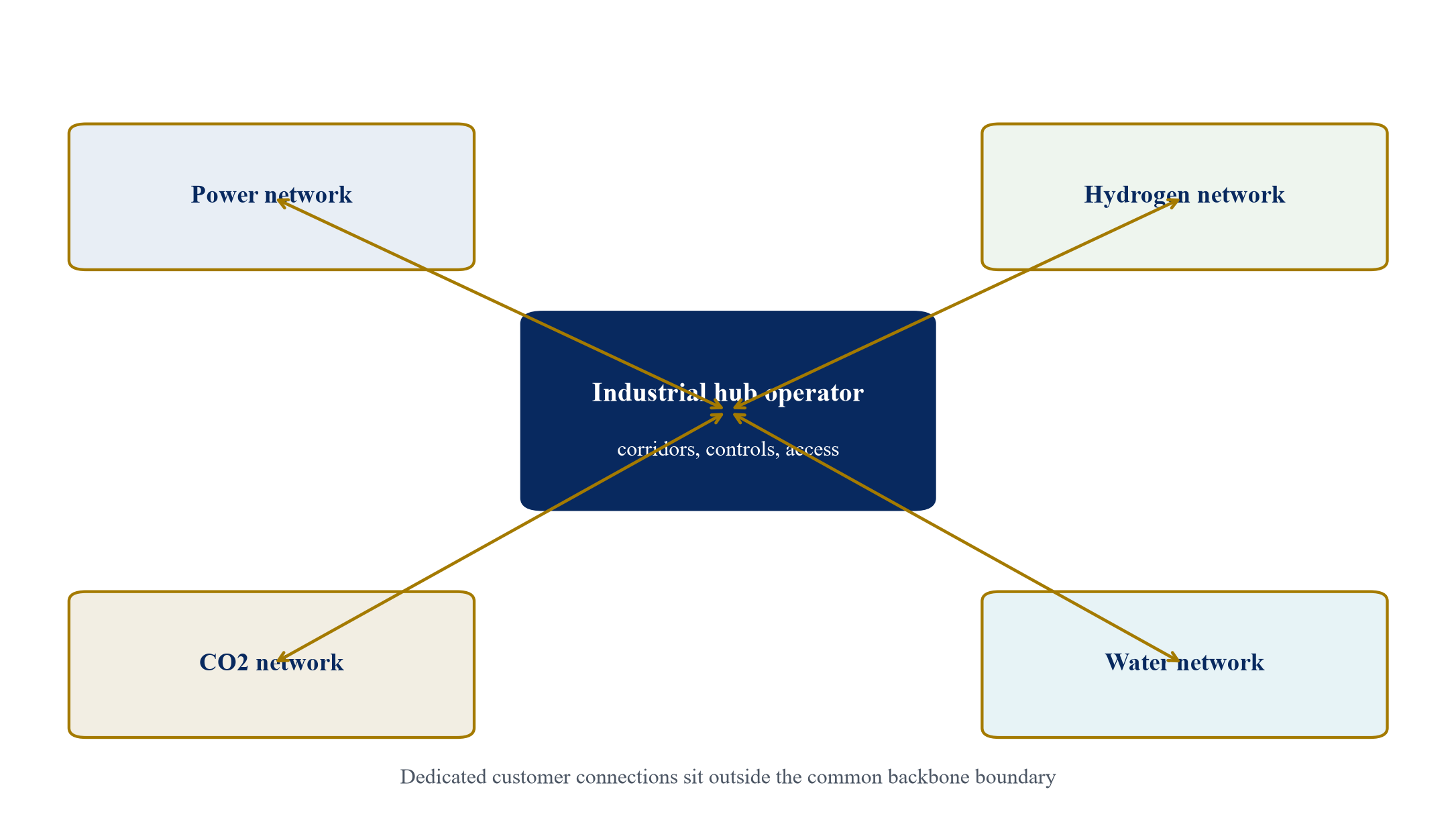
Proposed decision architecture based on the sources and analysis in this paper.
Table 1. Shared-service contract benchmark
| Service | Capacity commitment | Core performance measure | Principal allocation issue |
|---|---|---|---|
| Power | reserved connection and firm or flexible load | voltage, availability and curtailment | grid connection and common-mode outage |
| Hydrogen | reserved flow and pressure | quantity, purity and delivery pressure | production shortfall and storage |
| Carbon dioxide | reserved transport and storage capacity | accepted quantity, composition and availability | capture delay and storage acceptance |
| Industrial water | reserved treatment and delivery capacity | flow, quality and discharge compliance | inlet contamination and scarcity |
| Common platform | connection and service charge | control, data and corridor availability | interface failure and expansion rights |
Proposed qualitative benchmark; applicable law, licences and project contracts control.
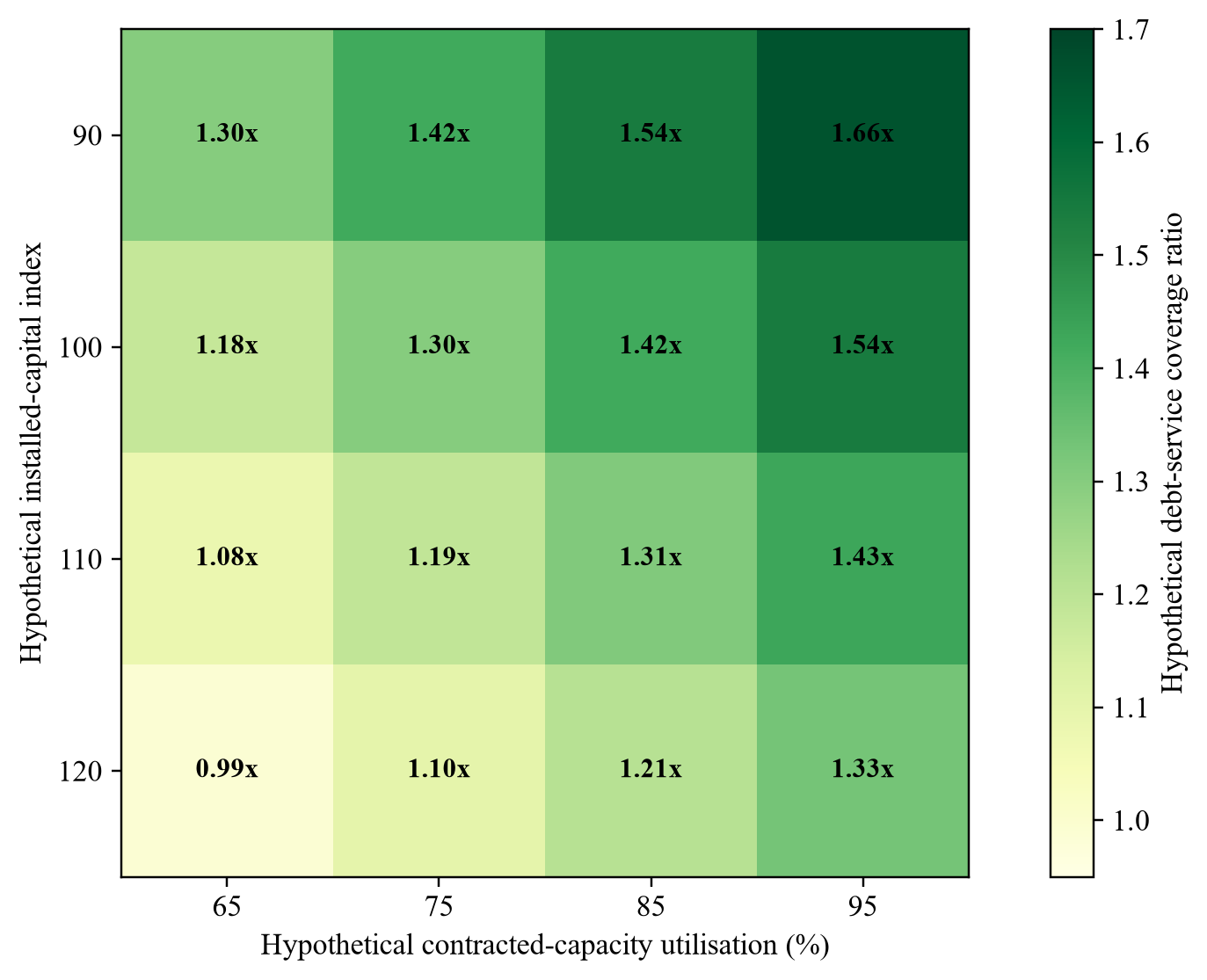
Wholly hypothetical; the values describe no identified company, hub or transaction.
Table 2. Hypothetical sources and uses framework
| Uses | Share of total uses | Sources | Share of total sources |
|---|---|---|---|
| Common corridors and civil works | 24% | Sponsor equity | 30% |
| Power and control infrastructure | 21% | Senior debt | 42% |
| Hydrogen, carbon and water networks | 31% | Public or programme support | 18% |
| Development, integration and commissioning | 11% | Customer connection contributions | 10% |
| Contingency, financing and reserves | 13% | Total sources | 100% |
| Total uses | 100% |
Illustrative percentages only; transaction-specific commitments and costs are required.
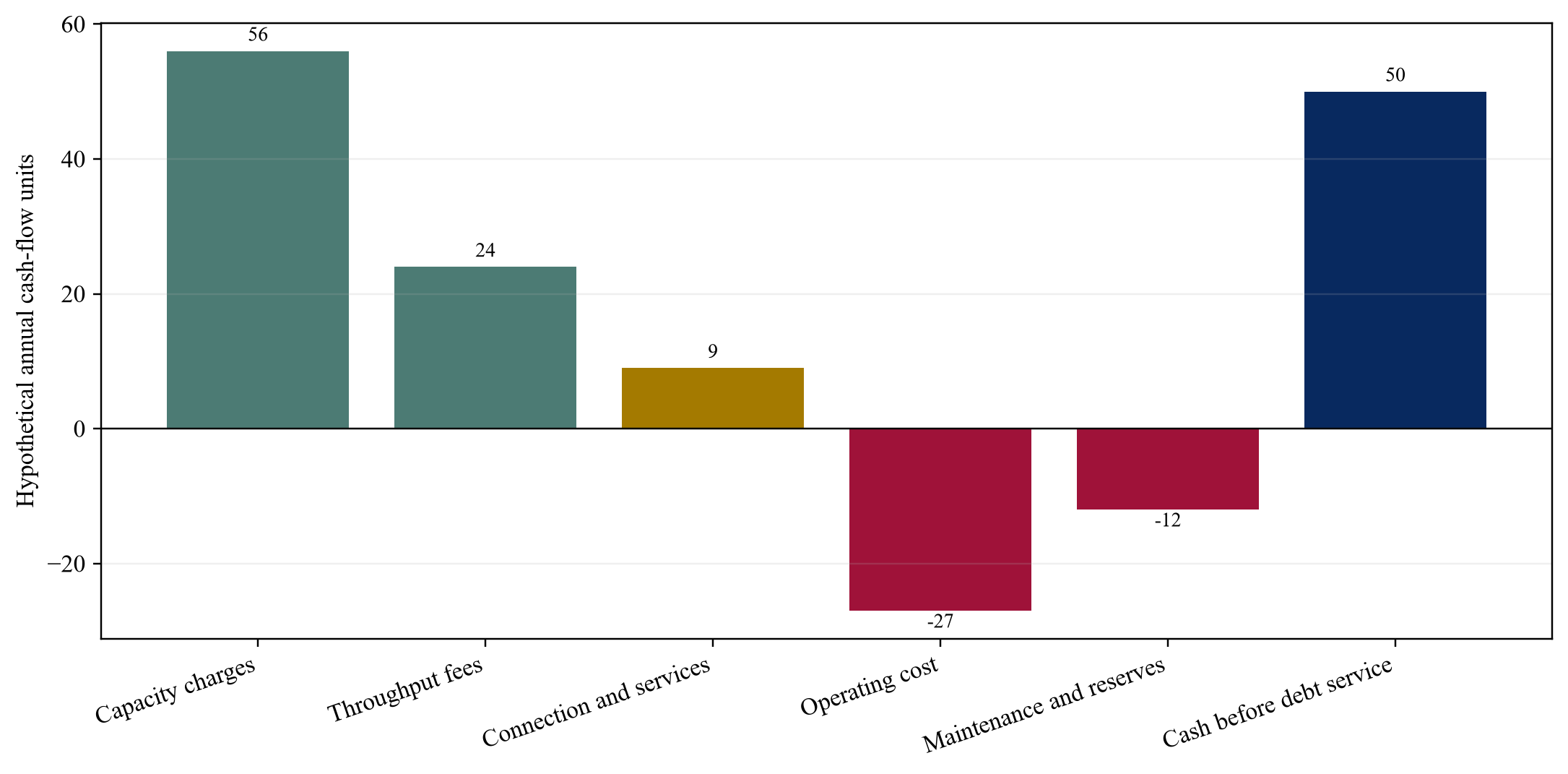
Wholly hypothetical; values describe no identified company, hub or transaction.
Table 3. Risk allocation and investment gates
| Gate | Minimum evidence | Primary risk owner | Maximum cumulative capital at risk |
|---|---|---|---|
| System definition | site map, service boundaries and anchor demand | hub sponsor | 0.2% |
| Contract concept | tariffs, access, minimum capacity and interfaces | sponsor and anchors | 1.5% |
| Bankable definition | permits, routes, engineering, contracts and financing model | allocated by contract | 5% |
| Final investment | committed funding, completion security and reserves | sponsors and lenders | 100% |
| Integrated acceptance | tested capacity, quality, controls and customer connections | contractors and operator | retained capital |
| Expansion | executed commitments, operating history and updated economics | hub board | next module budget |
Proposed governance framework; percentages are hypothetical caps on cumulative capital at risk.
Appendix A Questions for the investment committee
1. Which committed industrial users and production decisions support the initial hub?
2. Which assets are common, dedicated or external to the project vehicle?
3. Which service specifications and availability obligations apply at each interface?
4. How are power, hydrogen, carbon dioxide and water completion dates coordinated?
5. Which minimum capacity payments and credit support underpin fixed cost and debt?
6. Which access, tariff and expansion rules apply to later customers?
7. Which risks can affect several services or customers at the same time?
8. Which storage, redundancy and alternate-delivery arrangements protect production?
9. Which capital is exposed before permits, routes and anchor commitments become unconditional?
10. How are grants, customer contributions, equity and debt allocated across services?
11. Which stranded-capacity and termination mechanisms protect the initial investment?
12. What evidence triggers final investment, integrated acceptance and each expansion module?
References
- International Energy Agency, Global Hydrogen Review 2025, 12 September 2025. https://www.iea.org/reports/global-hydrogen-review-2025
- European Commission, Industrial carbon management, updated 2026. https://energy.ec.europa.eu/topics/carbon-management-and-fossil-fuels/industrial-carbon-management_en
- World Bank Group, Scaling Water Reuse: A Tipping Point for Municipal and Industrial Use, 2025. https://www.worldbank.org/en/topic/water/publication/scaling-water-reuse
- UK Department for Energy Security and Net Zero, Hydrogen update to the market, July 2025. https://assets.publishing.service.gov.uk/media/6880b2139fab8e2e86160efe/hydrogen-update-to-the-market-2025.pdf
- European Commission Joint Research Centre, CO2 transport infrastructure: key to achieving climate neutrality by 2050, 6 February 2024. https://joint-research-centre.ec.europa.eu/jrc-news-and-updates/co2-transport-infrastructure-key-achieving-climate-neutrality-2050-2024-02-06_en
- UK Department for Energy Security and Net Zero, Carbon Capture, Usage and Storage: a vision to establish a competitive market, 2023. https://www.gov.uk/government/publications/carbon-capture-usage-and-storage-a-vision-to-establish-a-competitive-market/carbon-capture-usage-and-storage-a-vision-to-establish-a-competitive-market
- United States Department of Energy, Regional Clean Hydrogen Hubs, accessed 2 October 2026. https://www.energy.gov/cmei/regional-clean-hydrogen-hubs-0
- European Commission, IF25 Hydrogen Auction, updated 19 June 2026. https://climate.ec.europa.eu/areas-action/eu-funding-climate-action/innovation-fund/calls-proposals/if25-hydrogen-auction_en
- International Valuation Standards Council, International Valuation Standards, effective 31 January 2025. https://www.ivsc.org/standards/
- European Climate, Infrastructure and Environment Executive Agency, CO2 networks, accessed 2 October 2026. https://cinea.ec.europa.eu/co2-networks_en
- World Bank Group, An International Framework for Eco-Industrial Parks Version 2.0, 2021. https://documents1.worldbank.org/curated/en/350851612561873572/pdf/An-International-Framework-for-Eco-Industrial-Parks-Version-2.0.pdf
- UK Department for Energy Security and Net Zero, Carbon capture, usage and storage business models, updated 22 July 2026. https://www.gov.uk/government/publications/carbon-capture-usage-and-storage-ccus-business-models
- UK Department for Energy Security and Net Zero, Hydrogen Infrastructure Strategic Planning policy statement, 2025. https://www.gov.uk/government/publications/hydrogen-infrastructure-strategic-planning-policy-statement/hydrogen-infrastructure-strategic-planning-policy-statement-accessible-webpage
- International Energy Agency, Accelerating deployment of CCUS in Clean Energy Transitions, 2020. https://www.iea.org/reports/ccus-in-clean-energy-transitions/accelerating-deployment
About the Author
Authored by Chennakeshav Adya Independent Researcher
Chennakeshav (CK) is a corporate finance and investment banking executive with 25+ years of global experience in deal origination, structuring and execution across M&A, growth capital and corporate strategy. He has led value-creation mandates for founders, corporates and funds — bridging the boardroom view to hands-on execution and close.
His career spans Morgan Stanley, HSBC, Lloyds Banking Group, EWEC, ADQ portfolio companies and Emirates Growth Fund, across TMT, real estate, fintech, deeptech, cleantech, infrastructure and energy. He has partnered with C-suite leaders, private equity and venture funds, sovereign wealth funds and family offices to finance complex fund raises and scale-up ventures, and has led M&A due diligence, post-merger integration and business-transformation initiatives to create value.
At Matchpoint Partners he is Managing Partner, leading the firm's corporate finance, M&A and capital-raising practice. He holds an MBA from London Business School, an engineering degree from VTU and a Master of Laws (LLM, in progress) from UCL London.
An active start-up mentor, CK mentors at Techstars, DIFC FinTech Hive, Startup Grind, Founder Institute and IN5, serves as Entrepreneur Mentor in Residence (EMiR) at London Business School, and judges the Entrepreneurship World Cup.
Matchpoint profile: https://www.matchpoint-partners.com/team/ck-adya.html LinkedIn: https://www.linkedin.com/in/ckadya/
